Tag: Joe Burrow

  • Joe Burrow’s Digging a Top-10 Ranking

    Joe Burrow’s Digging a Top-10 Ranking

    It’s been awhile since we last updated the World’s No. 1 Quarterback Ratings.

    The biggest development in the last seven weeks is the rapid and recent ascent of Bengals quarterback Joe Burrow, who just made his way into the top 10.

    A reminder that The World’s No. 1 Quarterback Ranking is based on a model devised by Bill James to evaluate The World’s No. 1 Starting Pitcher. Bill’s model was based on cumulative evaluation of individual starts over an extended time period using the metric Game Score.

    The World’s No. 1 Quarterback Ranking uses our player value stat Total Points to make a cumulative evaluation of game performance over a three-year period. The key to our calculation is Points Above Average (PAA), which is the statistical underpinning of Total Points that is centered at zero so that positive numbers are above average and negative numbers are below average.

    Success over time is key to maintaining a good ranking. Prolonged inactivity results in a ranking drop. The most recent performances carry the most weight.

    Burrow spent the first year and five weeks of his pro career usually ranked in the 20s. He stood at 34th after a rough Week 2 game against the Bears, but then turned the corner with five straight games of above-average performance. Still, a rather blah Weeks 11, 12, and 13 left him sitting at No. 21.

    Then came Week 14 against the 49ers in which Burrow was 25-of-34 for 348 yards and two touchdowns. That game moved him six spots in the rankings to No. 15. Two weeks later, his 525-yard, four-touchdown game against the Ravens both moved the Bengals into the AFC North lead and bumped him to the No. 10 spot in the rankings.

    He now sits one spot behind Vikings QB Kirk Cousins (who was the subject of our last article … he’s since dropped from his midseason No. 2 ranking).

    The current top-10 is:

    1. Aaron Rodgers
    2. Patrick Mahomes
    3. Justin Herbert
    4. Tom Brady
    5. Josh Allen
    6. Kyler Murray
    7. Matthew Stafford
    8. Derek Carr
    9. Kirk Cousins
    10. Joe Burrow

    There’s still reason to be wary of Burrow, of course. He’s the NFL leader in both sacks and interceptions thrown. But he also leads the league in catchable pass percentage (89.5%) and on-target percentage (83%). Burrow ranked in the top seven in both of those stats last season, perhaps providing some foreshadowing for what’s happened in the latter part of this season.

    The other jump of note belongs to Kyler Murray, who is now a career-best No. 6 even as his team is sputtering with three straight losses. Murray recorded 7.7 PAA last week against the Colts, his second-highest PAA of the season. As such, he moved past Matthew Stafford, Derek Carr, and Cousins, each of whom had negative PAA last week, in our rankings.

    For the season, Murray has jumped nine spots, as he entered 2021 at No. 15, a deserved ascent given that he started the season with eight straight PAA-positive games before getting hurt.

    Murray has nearly tripled his Points Earned from 2020 on passes thrown at least 15 yards downfield. His surface numbers don’t look that much better, but it’s worth noting that Cardinals receivers have dropped a league-leading eight passes of 15-plus yards this season.

    Kyler Murray – On Passes At Least 15 Yards Downfield

    Season Comp-Att Catchable Passes TD-Int
    2020 39-93 58 8-4
    2021 44-82* 60 9-4

    * 53.7% (2nd-highest in NFL)

    The only quarterback with more points earned than Murray on throws of this depth is … Burrow, who has made major improvements to his intermediate and deep passing games since last season.

    Joe Burrow – On Passes At Least 15 Yards Downfield

    Season Comp-Att Catchable Passes TD-Int
    2020 26-76 51 1-2
    2021 45-87 68 14-7

    Having Ja’Marr Chase makes a huge difference. Burrow is 16-of-34 with 6 touchdowns when throwing a pass of that depth to Chase (and Chase dropped five of the 18 incompletions). He’s also 14-of-28 when throwing those to Tee Higgins, compared to 14-of-35 last season.

    The full list of QB rankings is below.

    Rank Player PAA Per 60 Last Week Rank Start Of Season
    1 Aaron Rodgers 6.1 1 1
    2 Patrick Mahomes 6.0 2 2
    3 Justin Herbert 5.3 3 10
    4 Tom Brady 5.2 4 3
    5 Josh Allen 4.6 5 6
    6 Kyler Murray 2.8 9 15
    7 Matthew Stafford 2.7 6 14
    8 Derek Carr 2.6 7 7
    9 Kirk Cousins 2.4 8 9
    10 Joe Burrow 2.0 15 22
    11 Lamar Jackson 1.2 10 12
    12 Teddy Bridgewater 1.1 11 18
    13 Matt Ryan 0.9 13 11
    14 Deshaun Watson 0.8 12 4
    15 Russell Wilson 0.5 14 5
    16 Ryan Tannehill 0.3 17 8
    17 Dak Prescott -0.2 20 17
    18 Jalen Hurts -0.2 19 70
    19 Jimmy Garoppolo -0.4 16 25
    20 Carson Wentz -0.6 22 81
    21 Jameis Winston -0.8 21 55
    22 Tua Tagovailoa -0.9 23 50
    23 Mac Jones -1.0 18 N/A
    24 Jacoby Brissett -1.1 24 21
    25 Josh Johnson -1.2 27 49
    26 Trevor Siemian -1.6 25 N/A
    27 Ryan Fitzpatrick -1.8 26 16
    28 Gardner Minshew -2.1 28 32
    29 Taysom Hill -2.1 30 20
    30 Colt McCoy -2.2 31 51
    31 Chad Henne -2.3 32 29
    32 John Wolford -2.4 33 24
    33 Tyrod Taylor -2.4 34 56
    34 Kyle Allen -2.4 42 34
    35 Baker Mayfield -2.4 29 13
    36 Marcus Mariota -2.5 35 27
    37 Geno Smith -2.5 36 N/A
    38 Mason Rudolph -2.5 37 26
    39 Tyler Huntley -2.5 38 57
    40 Case Keenum -2.5 39 60
    41 C.J. Beathard -2.5 40 30
    42 Blaine Gabbert -2.6 41 36
    43 Brett Hundley -2.6 43 35
    44 Josh McCown -2.7 45 38
    45 Blake Bortles -2.7 46 44
    46 Sean Mannion -2.7 47 45
    47 Chase Daniel -2.7 49 39
    48 AJ McCarron -2.7 50 47
    49 Matt Barkley -2.7 51 48
    50 Nate Sudfeld -2.7 52 52
    51 Nick Mullens -2.8 53 72
    52 Josh Rosen -2.8 54 58
    53 Brian Hoyer -2.8 55 59
    54 Zach Wilson -2.8 70 N/A
    55 David Blough -2.8 56 61
    56 Jordan Love -2.9 57 N/A
    57 Mike White -2.9 58 N/A
    58 Joe Flacco -2.9 59 63
    59 Brett Rypien -2.9 60 65
    60 Will Grier -2.9 61 69
    61 Jarrett Stidham -2.9 62 66
    62 Drew Lock -3.0 78 23
    63 Andy Dalton -3.0 63 46
    64 Jared Goff -3.0 64 31
    65 Ben DiNucci -3.0 65 68
    66 Alex Smith -3.1 66 74
    67 Brandon Allen -3.1 67 75
    68 Trey Lance -3.1 68 N/A
    69 Ryan Finley -3.2 69 77
    70 Nick Foles -3.2 74 76
    71 Garrett Gilbert -3.2 72 54
    72 Cooper Rush -3.2 73 N/A
    73 Daniel Jones -3.4 75 71
    74 Chris Streveler -3.4 76 62
    75 Dwayne Haskins -3.4 77 78
    76 Tim Boyle -3.5 71 N/A
    77 Jake Luton -3.5 80 79
    78 Jake Fromm -3.7 48 N/A
    79 Mitchell Trubisky -3.7 81 80
    80 Phillip Walker -3.7 83 67
    81 Trevor Lawrence -3.8 85 N/A
    82 Cam Newton -3.8 79 19
    83 Justin Fields -3.9 84 N/A
    84 Sam Darnold -4.0 82 82
    85 Davis Mills -4.8 88 N/A
    86 Mike Glennon -5.2 86 73
    87 Taylor Heinicke -5.8 87 28
    88 Ben Roethlisberger -6.0 89 53
  • Evaluating Draft Prospects Using Predicted Completion Percentage

    Evaluating Draft Prospects Using Predicted Completion Percentage

    By Nate Weller

    NextGen’s Completion Percentage Above Expected (CPOE) became one of the staple metrics for evaluating quarterback (and receiver and defensive back) performance this past NFL season. Due to its reliance on tracking data though, it was not able to evaluate NCAA players the same way. SIS’s two newest metrics—Predicted Completion Percentage (pComp) and Predicted Completion Percentage Plus/Minus (pComp+/-)—can add the same context to a player’s performance as CPOE, and can also be expanded into the NCAA ranks.

    Evaluating Quarterbacks

    A player’s pComp is calculated with SIS’s charting data. It uses route type, the defensive coverage, distance of throw, and whether or not the defensive line was able to generate pressure to determine how likely each pass was to be completed. pComp+/- is how much better or worse a player’s actual completion percentage was than what was predicted. Breaking down completion percentage in this way adds a lot of context to a player’s performance.

    2019 pComp+/- Leaders – Quarterbacks (Minimum 250 attempts)

    PlayerpCompActualpComp+/-
    Joe Burrow61.8%77.6%15.8
    Jalen Hurts60.2%71.7%11.5
    Tyler Huntley64.2%74.3%10.1
    Justin Fields59.9%70.0%10.1
    Kedon Slovis65.6%74.0%8.4

    Not surprisingly, presumptive number one overall pick Joe Burrow tops the leaderboard by a fairly wide margin. Burrow also led the NCAA in SIS’s Total Value Metric, Total Points (his 251 was 71 more than the next closest player), and trailed only Tua in EPA per Attempt (EPA/A).

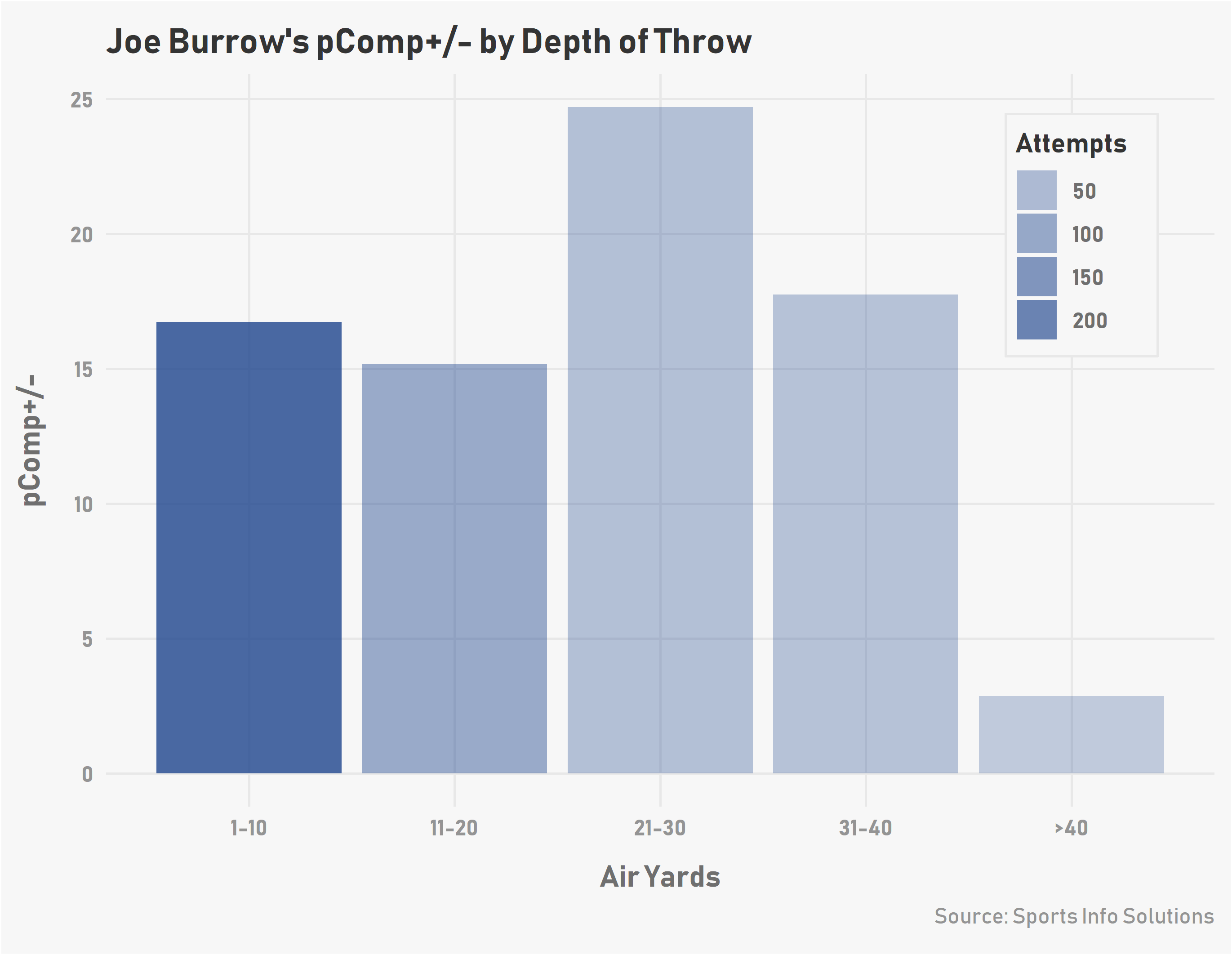
    Burrow’s pComp+/- becomes more impressive when breaking it down by throw depth. Using buckets of five air yards, Burrow is actually at his best in the intermediate and deeper portions of the field. He posted a pComp+/- of 24.7 on throws between 21 and 30 air yards and 17.8 on throws between 31 and 40 air yards (he completed 14-of-29 but was expected to complete only 9 of those passes).

    Another way to use pComp that has been popularized within the analytics “dark web” is to assess how many air yards a quarterback has completed above what would have been expected, or Air Yards Plus/Minus (AY+/-). As an example, a pass that travels 20 yards in the air with a pComp of 50% has an “expected air yards” of 10. A completion would net the quarterback +10, and an incompletion would be worth -10.

    2019 AY+/- Leaders – Quarterbacks (Minimum 250 attempts)

    PlayerADoTAY+/-
    Joe Burrow9.11.6
    Tanner Morgan11.41.3
    Jalen Hurts10.61.2
    Layne Hatcher11.01.1
    Tyler Huntley8.51.1

    Joe Burrow leads comfortably by this metric as well. On a per attempt basis, he completed 1.6 air yards above what would have been expected based on the difficulty of each throw. Jalen Hurts, who trailed only Burrow in pComp+/-, also cracks the top five here with an AY+/- of 1.2.


    Evaluating Receivers

    Predicted Completion Percentage can also be flipped on its head in a few different ways to evaluate receivers and defensive backs. For receivers, pComp+-/ is just the quarterbacks pComp+/- when targeting the receiver.

    2019 pComp+/- Leaders – Wide Receivers (Minimum 100 targets)

    PlayerpCompActualpComp +/-
    Justin Jefferson62.4%82.6%20.2
    Ja’Marr Chase53.8%68.0%14.2
    Easop Winston64.6%78.7%14.1
    Terrell Jana57.8%71.8%14.1
    Hasise Dubois57.6%71.4%13.8

    Pacing all receivers in pComp+/- are LSU’s Ja’Marr Chase and Justin Jefferson. It’s hard to parse their performances from Burrow’s entirely, but there is still no denying that Chase and Jefferson are among the best in the country. Chase led the nation in both receiving yards and touchdowns and won the Biletnikoff Award as the county’s best receiver. Jefferson projects to be a late day one or early day two pick in the coming NFL draft.


    Evaluating Corners

    Flipping the metric again, we can look at which corners were the best at preventing completions as the primary defender. The metric is calculated the exact same way as it is for quarterbacks and receivers, meaning that a plus/minus below zero is good.

    2019 pComp+/- Leaders – Corners (Minimum 40 targets)

    PlayerpCompActualpComp+/-
    Caleb Farley48.1%27.9%-20.2
    Trevon Diggs49.5%30.6%-18.9
    Charles Oliver53.8%36.4%-17.4
    Jeffrey Okudah56.3%39.6%-16.7
    Parnell Motley51.5%36.2%-15.3

    Virginia Tech’s Caleb Farley was the best in the country by this metric. His actual completion percentage when targeted of 27.9% was 20.2 percentage points lower than what would’ve been expected. Trevon Diggs and potential top ten pick Jeffrey Okudah rank as the best among prospects who have entered the draft.

  • Stat-Based NFL Player Comparisons for the 2020 QB Class

    By: John Shirley

    Within the 2020 SIS Rookie Handbook, we provided a look at how well some player-level quarterback metrics correlate between the NCAA and the NFL. The following table and excerpt from the Handbook summarizes the results:

    Correlation of QB Rate Metrics

    MetricNFL Year-to-Year (n=71)Final NCAA Season to NFL Career (n=20)
    Scramble%0.760.50
    ADoT0.410.40
    Catchable%0.480.33
    ADoC0.330.29
    Comp%0.490.22
    Sack%0.340.04
    EPA/DB0.330.04
    TD/INT0.320.03
    Y/A0.310.00

    “The metrics that correlate the highest year-to-year are the ones that measure what quarterbacks have the most control over: accuracy (Catchable%), aggressiveness (ADoT), and the decision to scramble (Scramble%). These are also the same things that have a high correlation from college to the NFL. Performance value metrics have much lower year-to-year correlations and NCAA to NFL correlations, most likely due to the fact that these measure overall offensive performance instead of direct quarterback performance.

    “SIS’s Total Points value metric shows relative stability at the NFL level (correlation = .45), but as we only have NCAA Total Points data for 2018 and 2019, we do not have a large enough sample to model a relationship. This is also a drawback for all of the quarterback metrics, as any relationship based on a sample size of 20 should be taken as a first glimpse and not gospel.”

    Using this information, we can see that the top five metrics (Scramble%, ADoT, Catchable%, ADoC, and Completion%) show some relationship between a player’s performance in college and his performance in the NFL. By using these metrics and historical college data from previous draft classes, we can compare this season’s quarterback prospects to the college performance of current NFL players. We’ll use a similarity score on the scale of 0 to 100, with a higher number representing a more similar player.

    Results

    SIS Rookie Handbook Position RankPlayerMost Similar PlayerSimilarity Score
    1Joe BurrowBaker Mayfield73
    2Tua TagovailoaDwayne Haskins86
    3Justin HerbertDeshaun Watson92
    4Jordan LoveSam Darnold81
    5Jacob EasonDrew Lock89
    6Jake FrommCooper Rush88
    7Tyler HuntleyJake Browning69
    8Jalen HurtsKyler Murray74
    9Anthony GordonGardner Minshew II84
    10Steven MontezDaniel Jones87


    SeasonPlayerScramble%ADoTCatchable%ADoCComp%
    2017Baker Mayfield5.7%10.788.3%8.170.5%
    2019Joe Burrow7.4%9.191.2%7.776.3%

    Joe Burrow’s closest statistical comparison is fellow Heisman winner Baker Mayfield. Although, this is one of the weaker comparisons among the group. This is mainly due to how incredible Burrow’s season was. There are not many other quarterbacks that can compare to his high-level accuracy, while also pushing the ball down the field with an ADoT of 9.1.

    SeasonPlayerScramble%ADoTCatchable%ADoCComp%
    2018Dwayne Haskins5.0%7.985.3%6.370.0%
    2019Tua Tagovailoa4.0%8.387.8%6.171.4%

    If this result surprises you because of the difference in stature between the two quarterbacks, maybe their similar stat lines convince you otherwise. It’s worth noting that if we include height as a variable in our model, Deshaun Watson becomes Tua’s strongest comparison.

    SeasonPlayerScramble%ADoTCatchable%ADoCComp%
    2016Deshaun Watson4.0%8.585.1%5.667.0%
    2019Justin Herbert4.0%8.483.4%5.866.7%

    Justin Herbert and Deshaun Watson have the highest similarity score among the group, and when you look at their near-identical key statistics, it’s easy to see why. That said, if the 4 inch difference height between the two is too much for you to see past (pun intended), our height-inclusive model pegs Daniel Jones as most similar to Herbert, albeit with a similarity score of just 77.

    How It Works

    The first part of creating the similarity scores is to normalize the five input metrics, which essentially means that we are adjusting them so that they are all on the same scale of 0 to 1.

    We can then input the normalized metrics into the distance formula, which compares all players to each other and measures how far apart each player is based on the inputs. So, players with similar metrics will have short distances, while players with wildly different performances will be far apart.

    The final part of the process is to create a similarity score out of the distances. This will be done by using the formula: 1 / (1+Distance). The final output will be a similarity score on the scale of 0 to 100, with a higher number representing a more similar player.

    This doesn’t mean each player will have a similar NFL career path as their comparison. But, it can be a fun and useful way of analyzing prospects. For more in-depth stats and full scouting reports on the entire 2020 draft class purchase the 2020 SIS Rookie Handbook.