Tag: NFL

  • Will the Packers free agent spending be more impactful than a draft and develop strategy?

    Will the Packers free agent spending be more impactful than a draft and develop strategy?

    By John Shirley

    During the Ted Thompson era in Green Bay, the Packers were notoriously inactive in free agency. That trend has changed under second year General Manager Brian Gutekunst. Will that help maximize Green Bay’s contending window?

    This off-season alone, Gutekunst has already handed out contracts worth a total of $182 million per Spotrac. For comparison, Thompson handed out only $77.5 million worth of contracts over his last 7 years as GM combined. Gutekunst’s signings so far have been focused on defense, as he’s signed safety Adrian Amos and edge rushers Preston Smith and Za’Darius Smith, while also signing offensive lineman Billy Turner.

    The three defensive signings should immediately fill positions of need, and importance, for the Packers. That is always a good thing for a team with an aging quarterback. But is spending on large free agent contracts now better than their previous draft and develop strategy?

    With four draft picks in the top 75 selections and a draft loaded with pass rushers, it might seem like the Packers overspent on the two Smith’s in free agency. However, when analyzing how edge rushers at different points in their careers perform based on SIS’s Total Points metric, Green Bay probably made the right move to maximize its contending window.

    How Edge Rushers and Safeties of Different Tenures Perform in the NFL:

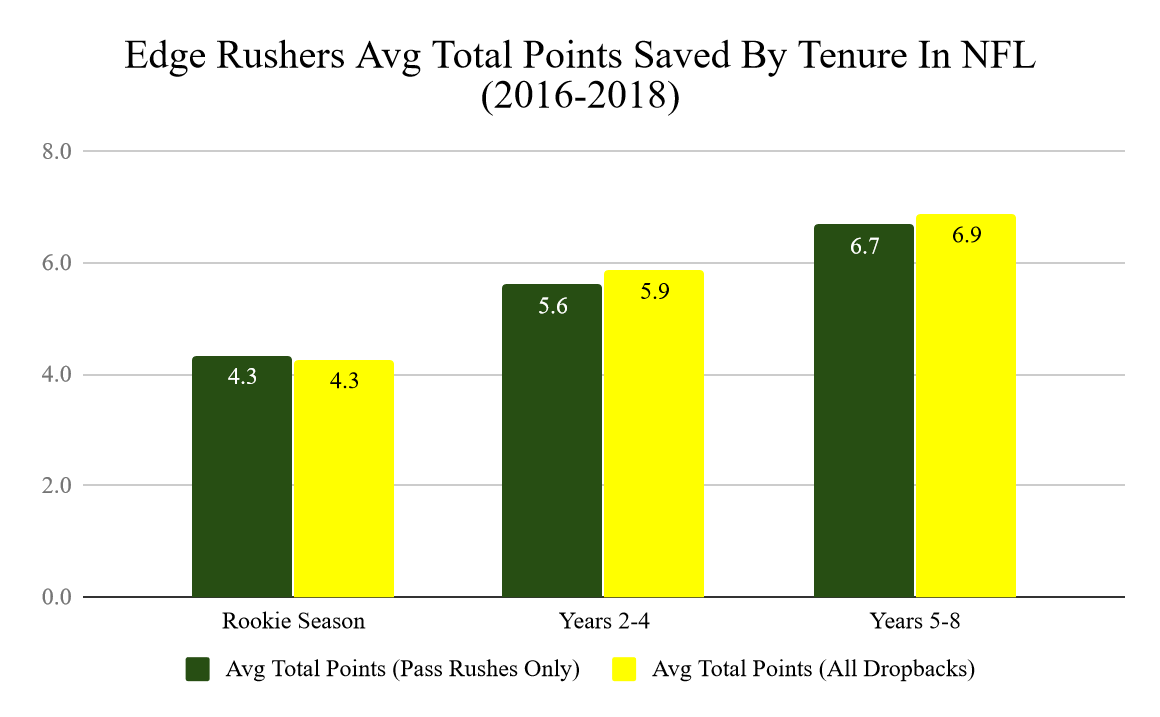
    We analyzed how edge rushers performed over the past three seasons based on how many years they have been in the NFL. Only edge rushers (DE or LB who rushes at least 70 percent of his snaps) who had at least 100 pass play snaps in a given season from 2016-2018 were included. Their performance was broken up by two major milestones in a player’s development and contract situation.

    The first grouping only includes a player’s rookie season since rookies generally have a learning curve to adjust to from college. The second group is second through fourth year players. The third group is fifth year through eighth year players. This group is made up of players who are mainly playing on their second contract.

    In looking at the average Total Points Saved that edge rushers create, there is an unsurprising positive jump after a player’s rookie season. There is also a positive jump as they enter into their second contract.

    This doesn’t mean that free agency is a better way to build a team, especially once finances are included into the equation. It also doesn’t mean that players linearly improve as they age—there are survivor biases to consider when comparing rookies to eighth-year players. It just means that teams can generally expect more immediate results from older players that have proven they can perform in the NFL. And if the Packers are looking to maximize Aaron Rodgers’ prime seasons, that’s a big factor.

    The same analysis was applied to safeties, with only safeties who played at least 100 pass play snaps in a given season from 2016-2018 included. The results show the same trend of a positive jump after a player’s rookie season and a second jump after a player’s fourth season in average Total Points Saved.

    Both of these tables bode well for the Packers’ need for immediate impact players on defense. They show that safeties, such as Amos, and edge rushers, such as the two Smith’s, who make it too their second contract perform better on average than younger players and rookies.

    How Adrian Amos, Preston Smith, and Za’Darius Smith will Help the Packers:

    How their positions perform by tenure is not the only positive for the Packers when analyzing the signings of Amos and the two Smith’s.   

    Last season the Packers ranked 26th in EPA allowed per designed pass play (pass plays plus scrambles and minus screens).  This was primarily due to their inability to create pressure on opposing quarterbacks and their below-average safety play. That is a major problem for a team that played the 4th-most man coverage and blitzed the 7th most in 2018. Teams with those tendencies need to have good pass rushers and reliable safeties on the back end to clean up plays.

    • Packers players ranked 27th in Coverage Success Rate (41%) when lined up at safety. (Coverage Success Rate is the percent of targets that result in a negative EPA for the Offense )
    • The Packers defense ranked 24th in Pressure Percentage on non-blitz plays (25%)
    • Only one Packer defender with at least 100 pass rushes had a pressure percentage of at least 10%, and that was interior defensive lineman Mike Daniels.

    Adrian Amos:

    • Ranked 2nd in Coverage Total Points Saved (27) among safeties in 2018
    • Ranked 3rd in Coverage Success Rate (67%) on targets from the safety position among defenders targeted at least 15 times.
    • Ranked 1st in Man Coverage Success Rate (85%) on targets from the safety position among defenders targeted in man coverage at least 7 times.

    Preston Smith and Za’Darius Smith:

    • Both have had a Pressure Percentage of at least 10% each of the last two years.
    • Za’Darius Smith (11%) and Preston Smith (10%) would have ranked 1st and 2nd, respectively, in Pressure Percentage among Packers edge rushers last season.
    • Preston Smith ranked 3rd in Pass Rush Total Points Saved among LB in 2017 with 23. He had 15 Pass Rush Total Points Saved in 2018, which was more than double the most by a Packers edge rusher.

    The Packers’ need to maximize the window they currently have with Aaron Rodgers at quarterback. Going into free agency they targeted defensive players that could help them right away, while also still having some upside. They came away with Adrian Amos, Preston Smith, and Za’Darius Smith on that side of the ball.

    Even though they come with large contracts, the statistics and Total Points by tenure analysis show that these signings have a good chance of working out. So although the draft and develop strategy is generally thought of as more efficient, signing free agents can be a good way to supplement a roster with immediate impact players.

    For the Packers, it also doesn’t hurt that they still have plenty of draft capital to continue a draft and develop strategy for the future.

  • Two Trades Overshadow an Eventful Start to Free Agency

    The league season is still a few hours from officially starting, and yet the last week has been among the most chaotic in recent memory. While record-breaking contracts have been given out left and right, the two biggest moves actually came via trade, as Antonio Brown was sent to the Raiders and Odell Beckham Jr. was sent to the Browns.

    Odell to the Browns

    Browns get: Odell Beckham Jr.
    Giants get: S Jabrill Peppers, 17th pick, 95th pick

    Baker Mayfield excelled last season under then-interim OC Freddie Kitchens. From weeks 9 through 17, Mayfield posted an Independent Quarterback Rating (IQR) of 112.1, the fourth-best rating during that stretch, and a Yards per Attempt (Y/A) of 8.6, trailing only Patrick Mahomes by a tenth of a yard. With Kitchens now the head coach and with Baker having his first full offseason of preparation, that high level of play was already expected to continue into 2019. But now with Beckham in the fold, the Browns’ offense has the potential to be among the league’s most dangerous.

    In 2018, Beckham was only targeted on throws more than 15 yards downfield 36 times, a criminally low rate for such a dangerous player. For reference, Julio Jones saw 65 such targets. To make matters worse, Eli Manning ranked 22nd in On-Target% (57.9) and 25th in IQR (81.2) on those throws.

    Beckham should expect to be targeted downfield much more often with the Browns. During Kitchens’ tenure as OC, only Aaron Rodgers pushed the ball downfield more consistently than Mayfield. On those throws, Mayfield posted an On-Target% of 62.5 and an IQR 109.7, which ranked as the fifth- and seventh-best marks in the league during that span. Beckham should immediately become Mayfield’s go-to guy downfield, and Jarvis Landry can work the short and intermediate parts of the field where he is more comfortable. (In 2016 and 2017, 33 percent of Landry’s targets came on slants, drags, or screens, compared to only 21 percent in 2018.)

    On the other end of the deal, this trade leaves the Giants in a precarious position, even before considering the dead salary cap ramifications. They’re only a handful of years away from owing Barkley a huge pay day, and have managed to trade away most of their young talent, all while not making any real effort to find a replacement for Eli. Maybe their quarterback of the future falls to them at the sixth pick this year, or maybe they use their new first round pick in a package to move up and draft their guy, but it’s hard to see a path to quick rebuild for the Giants.

    The Browns also find themselves in an unfamiliar spot: betting favorites in the AFC North. It feels crazy to say about a team that is only two years removed from a winless season, but with a strong cast of skill position players on offense and a couple of young playmakers on defense, the Browns appear to be a legitimate threat in the AFC this year. It is possible that OBJ is the final piece in what has been a remarkably quick turnaround.

    Brown to the Raiders

    Raiders get: Antonio Brown
    Steelers get: 66th pick, 141st pick

    This time last year, the Steelers were legitimate Super Bowl contenders. They had a future HOF quarterback; Antonio Brown and Le’Veon Bell who were both arguably the best at their respective positions; and young budding talent in players like JuJu Smith-Schuster. Fast forward to now, the Steelers are fresh off of their first playoff miss since 2013, and have managed to turn their two best players into a 3rd round pick, a 5th round pick, and $21 million of dead cap.

    The Raiders, on the other hand, appeared to be entering a full on rebuild last year when they shipped their best player off to Chicago, but are seemingly trying to expedite that rebuilding process with this trade. Given the incredibly low price tag and their plethora of draft capital, it is hard to blame them.

    Brown provides immediate help for an offense that mostly struggled in its first season under Jon Gruden. Derek Carr was efficient, completing 68.9% of his passes, but struggled to find big plays. His Y/A of 7.3 ranked as only 20th-best among QBs with at least 200 attempts. Despite his age, Brown should provide an immediate impact downfield. On throws of at least 15 yards, Brown turned 52 targets into 614 yards and 9 touchdowns. Raiders receivers as a whole had 1,029 yards and 7 touchdowns on such throws. The Raiders are hoping Brown can turn into the consistent downfield threat they thought they were getting with Amari Cooper.

    Brown can also provide additional value in the shallow routes that are the staple of Gruden’s offense. While the Raiders were mostly efficient on these routes last year (they completed 81% of slants), Brown provides the big play threat and YAC ability that the Raiders lacked. Brown’s 8.8 YAC per reception on slant routes last year ranked 2nd in the NFL behind Tyreek Hill. Raiders receivers as a whole averaged only 6.4 YAC per reception, and only 5.3 if you remove Cooper from that equation.

    A lot of the Raiders’ success this season will depend on what their three first round picks turn into, but Brown provides a clear boost to an offense lacking in playmakers. He should immediately become Carr’s favorite target and be the focal point of an offense hoping to turn things around this season.

  • The QB Sneak is the most underutilized play in football

    The QB Sneak is the most underutilized play in football

    It doesn’t get any simpler than the QB sneak. The offensive line drives straight ahead, the quarterback hides himself behind the center and attempts to fall forward a few feet. It’s far from elegant, but it’s effective. And yet, NFL teams seem unwilling to utilize it.

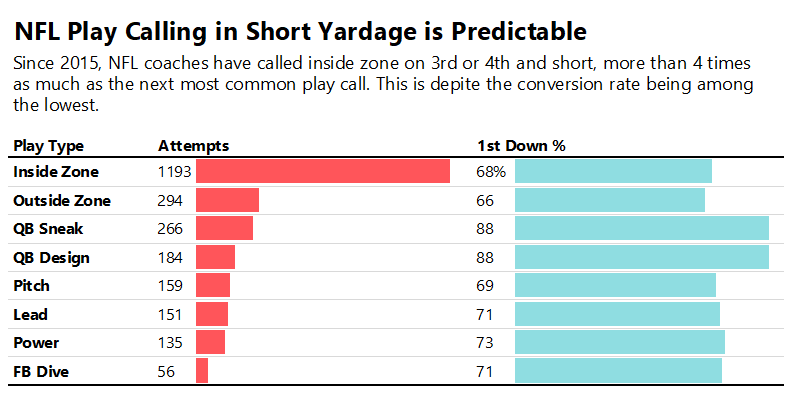
    On third or fourth down with a yard or less to go since 2015, teams have called an inside zone (a run up the middle with no pulling lineman or lead blockers) 1,193 times. It’s outside counterpart is a distant second with only 294 attempts. QB sneak ranks third with 266.


    Despite being the most commonly run, the inside zone ranks as the second worst play call in terms of first down conversion rate at 68 percent, narrowly edging out the outside zone at 66 percent. By comparison, the QB sneak has a conversion rate of about 88 percent, 20 percentage points better than the inside zone, and 15 percentage points better than the closest play call to a running back.

    In theory, based on these numbers, if a team in third- and-1 ran two consecutive quarterback sneaks, they would have approximately a 98 percent chance of converting a first down. This is obviously an imperfect approach, and doesn’t factor in defensive adjustments, but it does help illustrate how baffling it is that teams continue to take the ball out of their QBs hands in these situations.

    What’s more, the QB sneak is not an acquired skill, and doesn’t require a particularly athletic quarterback. Since 2015, Blake Bortles, Nick Foles, Drew Brees, and Josh Allen have all boasted perfect conversion rates (Brees has the most successes, 23-of-23). Carson Wentz, Kirk Cousins and Matt Ryan have each failed only once, and no quarterback had a conversion rate lower than the inside zone’s 68 percent.

    Increased volume would undoubtedly lead to a decreased success rate, and the list of quarterbacks with a 100 percent conversion rate would likely disappear, but it’s hard to imagine it dropping by 20 percent as a whole.


    In the defense of teams, the QB sneak has seen a steady increase since 2016, while the inside zone has rightfully seen a sharp decrease. Even still, the inside zone remained the most common play call in short yardage in 2018, outpacing the QB sneak by almost 100 attempts.

    The increase in volume showed almost no effect on the performance of the QB sneak. Its success rate in 2018 of 87 percent was only 1 percentage point lower than its 4-year mark. Likewise, the inside zone did not become more effective with it’s decrease in volume, its 68 percent success rate matched its 4-year total. If there is a point where increased volume decreases the effectiveness of the QB sneak, teams certainly haven’t found it yet.

    In terms of personnel, teams have also shown a strong tendency towards heavy personnel when it comes to short yardage. To see the effects this has had, we looked at first down conversion rates against the number of players the offense has “in the box”. Men in the box on the offensive side is just a count of how many men are on or near the line of scrimmage, excluding the quarterback.


    In similar fashion to the play types, the most effective personnel grouping is also the most infrequently used. The 6-man box, (most commonly a 4-wide set), had a first down conversion rate of 82 percent but was only used 89 times. The 9-man box, most frequently used by coaches at 692, had a conversion rate of only 71 percent.

    Intuitively, having more blockers sounds like a good idea, but in practice it just allows the defense to stack the box and bring in heavier personnel, making the job of the lineman that much more difficult. Using spread-type personnel forces the defense to defend the whole field, and also likely forces them to bring in their smaller dime or nickel personnel, and creates better matchups on the interior.

    At least until defenses adjust, teams need to start using their quarterback as a weapon more often in crucial short yardage situations, and stop insisting on heavy personnel. Offense as a whole has become more efficient than ever, and it’s time that expands into short-yardage downs as well.

  • The Rams’ Rushing Success is More Than Just Todd Gurley or C.J. Anderson

    The Rams’ Rushing Success is More Than Just Todd Gurley or C.J. Anderson

    The resurgence of C.J. Anderson in Los Angeles has seemingly breathed life back into the debate about the relevance of running backs in the modern NFL. On Saturday night, Anderson went for 123 yards on 23 carries, adding two touchdowns. On the opposite side of the ball, superstar running back Ezekiel Elliott turned his 20 carries into only 47 yards.

    It was the latest chapter in a season in which James Conner gained close to 1,500 scrimmage yards in only 13 games, and a 33-year-old Adrian Peterson get back over the 1,000 yard mark for the first time since 2015. Meanwhile, teams like the Jaguars, whose run game carried them to a conference championship only a year ago, failed to have a single 100-yard rusher.

    Based on pretty much any metric, passing provides more value than running, but what that really means for play calling is still hotly debated. And if it’s so inefficient, why were the Rams, Chiefs, and Patriots able to win this weekend by dominating on the ground?

    Stop Trying to Establish the Run

    Conventional wisdom has always stated that establishing the run is crucial to an offense’s success. Even if you aren’t running the ball particularly well, you should stick with it because you will wear down the down the defense and have more success as the game wears on.

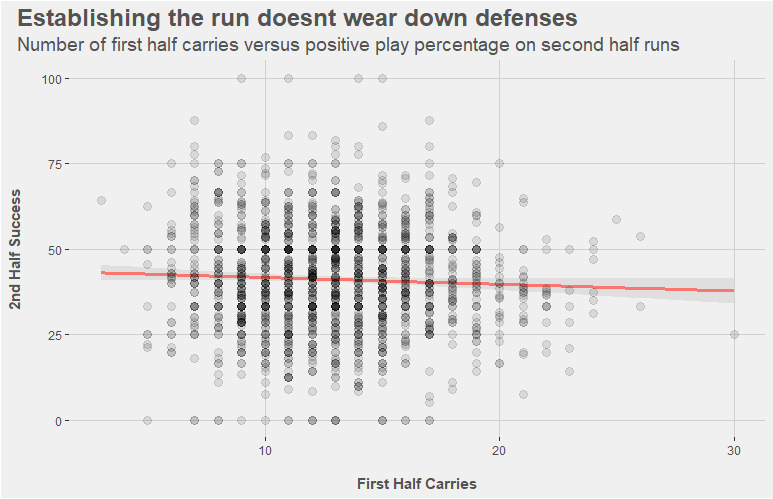
    To look at this, we compared a team’s first half carries versus their positive play percentage (Positive%) on second half carries. (Positive% is an Expected Points-based metric that represents the percentage of plays a player earned a positive Expected Points Added value.) Establishing the run in the first half shows almost no correlation to second half success. In fact, it actually shows a small negative correlation, indicating at some level that rushing performance actually decreases the more carries are forced onto a running back early in the game.


    This potentially indicates a few things: that running the ball a lot early does not cause the defense to fatigue more than a normal offensive split, at least not enough to affect performance in a meaningful way, and that predictable play calling can lead to decreased offensive performance.

    Despite this, coaches continue to stick by this strategy. As recently as Wild Card weekend the Seahawks ran the ball 24 times for 3.0 yards per carry, waiting until the final quarter to open up the pass game. This is despite Russell Wilson averaging 8.6 yards per attempt and posting a QB Rating of 115.3.

    This also illustrates another important point: passing success generally acts independent of rushing success. Since 2016, the correlation between a teams Positive% on the ground and their Positive% through the air is close to zero, and this correlation even holds true when looking at play action. On average, success rate on play action passes tended to stay around 50 percent, with some noise on either side, regardless of a team’s success on the ground.

    Creating Mismatches at the Line of Scrimmage

    Teams that are successful on the ground in the modern NFL are not doing so by staying patient, or “establishing the run” early. They are doing so by putting their running backs and linemen in advantageous situations.


    C.J. Anderson is the perfect case study. During his 2017 campaign with Denver, Anderson ran into a stacked box on 33 percent of attempts, and had a Positive% of 36 percent. In weeks 16 and 17 with the Rams this season, Anderson ran into a stacked box on only 19 percent of his carries, and flipped that into a Positive% of 62 percent. Among running backs with at least 25 carries in that time period, that ranked second behind fellow Rams running back Malcolm Brown (69 percent). Put into context, no running back with more than 100 attempts in 2018 had a success rate above 50 percent.

    Even without considering that he was unemployed for most of the season, Anderson has been impressive, and McVay’s creative play calling deserves a lot of credit. While the Rams predominantly stick to one personnel grouping, they use a wide variety of formations and move players around a lot to generate mismatches, including some of the most creative use of motion in the league.

    Nobody Uses Motion More Effectively Than the Rams

    In 2018, teams averaged 1.6 yards before contact (YBC) and 4.1 yards per attempt (Y/A) on runs that didn’t use motion. When using motion in any capacity those numbers jumped to 1.9 and 4.5, and jumped further to 2.2 and 4.9 on plays using jet motion (YBC and Y/A exclude jet sweeps and QB scrambles).

    No team made use of this more than the Rams, who led the league in jet motion usage by a long shot. In total, the Rams used jet motion on 17 percent of offensive snaps in 2018. The next closest teams were the Chargers and Titans who used jet motion on 14 and 8 percent of offensive snaps respectively.

    The Rams averaged an astonishing 2.7 YBC on plays utilizing jet motion, significantly better than their overall average on runs plays of 2.0, and almost a full yard better than the average run play in the NFL (1.8).

    There’s more to this than simply using jet motion more, and having a talented running back certainly adds value, but the point is that scheme plays an important role too. Nobody will argue that Anderson is a better running back than Ezekiel Elliott, but Elliott wasn’t good enough on Saturday to overcome facing a stacked box on 40 percent of his carries.

    Running the ball still has an important role in modern offenses, but for teams to be successful they need to start moving away from the more traditional ground-and-pound methods. The Rams are creating a blueprint; now it’s time for other teams to start using it.

  • Preview: NFC Divisional Round – Eagles vs. Saints

    Let’s take a brief look at some statistical notes ahead of the NFC Divisional Round playoff game between the Eagles and Saints.

    Saints Passing vs. Eagles Pass Defense

    • Drew Brees on passes of at least 20 yards downfield: 52 percent completion percentage (1st among QBs with at least 30 such throws), 66 percent on-target rate (1st), 18 percent touchdown rate (1st).
    • On throws of 20-plus yards downfield, Eagles’ opponents recorded a positive play (based on Expected Points Added) 41 percent of the time. That was tied for sixth-worst among NFL defenses.
    • One key for Brees and the Saints: avoiding sacks. Brees’ 3.5 percent sack rate in the regular season was tied with Tom Brady for third-lowest in the NFL, behind Andrew Luck (2.7%) and Ben Roethlisberger (3.4%).
    • Saints left tackle Terron Armstead was the only lineman to play at least 100 pass-blocking snaps and not have a blown block credited to him. However, he has missed time due to a pectoral injury and sat out in Week 17.
    • Philadelphia’s Michael Bennett (58) and Fletcher Cox (56) ranked tied for fourth and sixth, respectively, in quarterback pressures this season.

    Saints Rushing vs. Eagles Run Defense

    • Both members of the Saints’ backfield can be found among the top ten running backs (min. 100 carries) in positive play percentage: Alvin Kamara at 47 percent and Mark Ingram at 46 percent.
    • The Eagles’ run defense tightened things up late in the season. In Weeks 15 through 17, Philadelphia allowed only 3.4 rush yards per attempt (3rd in NFL) and 1.7 yards after contact per attempt (1st).
      • Similarly, the Eagles surrendered only 65 rushing yards on 18 attempts (3.6 YPA) in Chicago last weekend.

    Eagles Passing vs. Saints Pass Defense

    • Among quarterbacks who attempted 60+ passes in Weeks 15 through 17, Nick Foles ranked first in completion percentage (77 percent), on-target rate (86 percent), and yards per attempt (8.5).
    • Among receivers with at least 15 targets in that same time, Alshon Jeffery ranked first in yards per target (16.7) and Nelson Agholor ranked first in Receiver Rating (148.3).
    • The Saints allowed 8.2 yards per pass attempt in the regular season, which ranked fifth-worst in the NFL.
    • New Orleans can bring pressure, having ranked third in pressure percentage (35.4%) – led by Cameron Jordan’s 58 QB pressures.
    • That said, it doesn’t always rattle Foles. Among QBs with 50+ attempts under pressure, he ranked first in on-target rate (82.4 percent) and sixth in yards per attempt (7.5) when pressured this season.

    Eagles Rushing vs. Saints Run Defense

    • The Saints’ run defense was excellent in the regular season: second in yards per attempt (3.6), second in yards after contact per attempt (1.9), fourth in broken tackle percentage (6.7%), and tied for fourth in positive play percentage (40%).
    • The Eagles have not had great success running the football, especially with the injuries to Jay Ajayi and Corey Clement.
      • Over the last six weeks of the regular season (since they last played New Orleans), Philadelphia ranked last in the NFL with an average of 3.6 yards per attempt and tied for 25th with a 38 percent positive play rate on rushes. Of course, they still managed five wins in those six weeks.
  • Preview: NFC Divisional Round – Cowboys vs. Rams

    By NATE WELLER

    Let’s take a brief look at some statistical notes and storylines ahead of the NFC Divisional Round playoff game between the Cowboys and Rams.

    Prescott Needs to Use His Legs to Negate the Rams Pass Rush

    Aaron Donald led the league with 20.5 combined sacks this year, 4.5 more sacks than runner up J.J. Watt. He also leads the league in pressure rate, pressuring the quarterback on just shy of 17 percent of pass rush snaps. Dak Prescott though has excelled when he has been able to escape the pocket. His Independent Quarterback Rating (IQR) on throws from outside the pocket is 113.2, versus 99.5 on throws from inside the pocket. Looked at another way, using SIS’s total points metric, he earned 2 points from outside the pocket, and -13.2 from inside the pocket.

    If the Rams’ defensive ends can contain Prescott and keep him in the pocket, their pass rush will be very disruptive. If the Cowboys’ offense is going to be successful, Prescott will need to extend some plays with his feet and continue making plays from outside of the pocket.

    The Cowboys Need to Run Smart

    On runs against a defense with less than 8 men in the box, Ezekiel Elliot leads the NFL with 5.1 yards per attempt (Y/A). This number drops drastically to 3.3 when facing a stacked box. Unfortunately for the Cowboys, the Rams stacked the box on defense more than any team in the NFL this year, doing so on 17.5 percent of defensive snaps.

    On third or fourth down with less than a yard to go, this number jumps all the way to 46 percent (3rd in the league). Elliot is a crucial part of the Cowboys offense, and the Rams will likely make it a priority to stop him.  If the Cowboys are going to find offensive success, they will need to use audibles to prevent sending Elliot into a stacked box consistently, and Prescott will likely need to make some plays with his arm on short yardage downs to take advantage of an aggressive Rams defense.

    Goff Needs to Find a Way to Beat the Cowboys Zone

    The Cowboys play in zone coverage 52 percent of the time, the 8th most in the NFL, and in man coverage 35 percent of snaps. (Screen, prevent, and combo coverages make up the remaining percentage). Against man coverage this season Jared Goff posted an IQR of 114.4 (4th), compared to an IQR of only 96.7 (18th) on passes versus zone coverage. The 17.7 split is the 6th largest among quarterbacks with at least 100 attempts. Additionally, Goff has thrown 9 of his 12 interceptions against zone coverage.

    Player

    IQR vs Man

    IQR vs Zone

    Split  

    Cam Newton

    118.9

    78.6

    -40.3

    Ryan Fitzpatrick

    118.6

    89.6

    -29

    Drew Brees

    131.5

    111.7

    -19.8

    Ben Roethlisberger

    103.8

    84.8

    -19

    Matthew Stafford

    101.1

    83.1

    -18

    Jared Goff

    114.4

    96.7

    -17.7

    Sam Darnold

    82

    72.4

    -9.6

    Kirk Cousins

    107.2

    98.8

    -8.4

    Jameis Winston

    101.9

    93.6

    -8.3

    Deshaun Watson

    110.6

    102.6

    -8


    The Rams Offense Needs to Get Back on Track

    Since the bye, Goff’s IQR of 79.7 ranks 30th among quarterbacks. This number is mostly due to a particularly bad three game stretch coming out of the bye where he posted IQR’s of 78.1, 23.5, and 75.1 in consecutive games.

    Through week 15, the Rams had used 11 personnel (1 RB, 1 TE) on 96 percent of offensive snaps, almost 20 percentage points higher than the next closest team. In weeks 16 and 17, the Rams only ran 56 percent of plays out of 11, and used 12 personnel (1 RB, 2 TE) on 40 percent of offensive snaps. In limited action in these two games, Goff threw out of 12 personnel 11 times (he had 1 such attempt in the 14 games prior), completing 8 of them for 88 yards with two touchdowns and no interceptions, an IQR of 147.

    The Rams also found success running the ball out of 12 personnel in the team’s final two games. C.J Anderson and John Kelley ran the ball a total of 37 times for 161 yards and a touchdown. Put into context, the Rams ran the ball out of 12 personnel a total of 16 times the first 14 games of the season. With Gurley back in the lineup, it’s possible the Rams will continue to lean on 12 personnel sets.

  • Couple of questionable calls played a role in shaping AFC Playoff picture

    Couple of questionable calls played a role in shaping AFC Playoff picture


    BY NATE WELLER

    It’s the time of year where teams and fans alike look back at what could have been. No team will be wondering more than the Steelers, who after a 7-2-1 start to the season, were officially eliminated from the playoffs when the Colts and Texans game ended decisively in regulation.

    All of this is not without controversy though. The struggles of referees in the NFL this year have been well documented and thoroughly scrutinized, and the Steelers arguably have the biggest issue of any team. Two of the games with the biggest implications for their own playoff chances swung on miscues by the officiating crew.

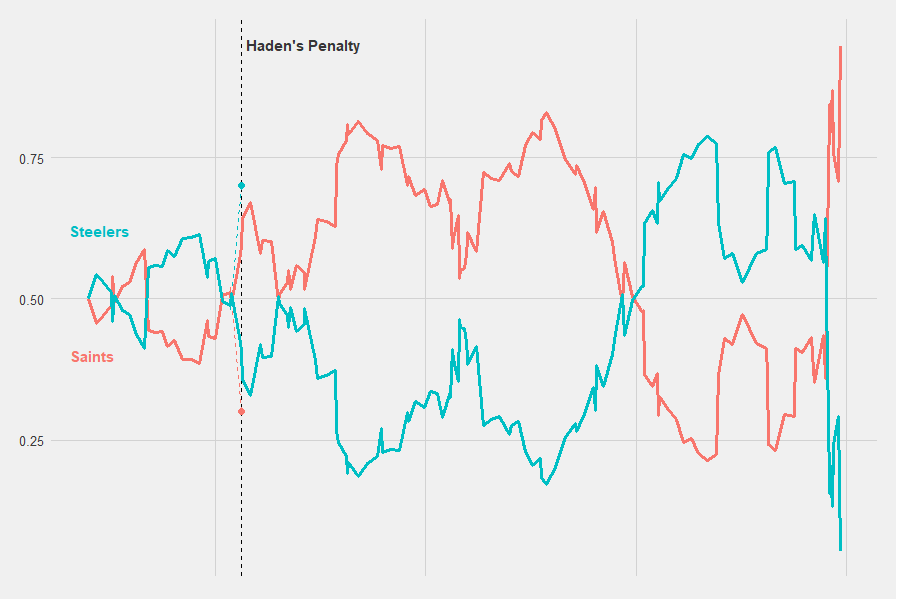
    With about three minutes left in the first quarter of the Steelers’ Week 16 game against the Saints, the Saints, down 3, elected to go for a fourth-and- short from the Steelers’ 34-yard line. Brees was flushed from the pocket, and threw up what was effectively a punt towards Alvin Kamara in the endzone. The ball fell incomplete, but Joe Haden was called for pass interference. Replay appeared to show that no foul had occurred. The Saints were given a first-and-goal from the 1, and subsequently scored their first touchdown.

    A fourth-down stop would have resulted in -3.28 EPA for the Saints, and set the Steelers up in good field position. Instead the play resulted in 3.73 EPA for the Saints, a total swing of 7.01 expected points. Put into context, Derrick Henry’s 99-yard touchdown run versus the Jaguars added 5.73 expected points. The sequence of events for the Steelers and Saints was among the largest swings in expected points this season.

    From a win probability standpoint, the Saints chance of winning prior to the fourth-down attempt was 49 percent. Following Ingram’s score, their win probability jumped to 68 percent. With a fourth-down stop, the Steelers’ win probability would have jumped to almost 70 percent.

    The penalty was a major turning point in a game that the Steelers would lose by a field goal. The foul occurred early, and the Steelers still had plenty more opportunities to win, but most people will still look back at the penalty and ensuing touchdown as a major factor in the loss.

    The defeat left them needing help from the division rival Browns in week 17. The Steelers’ scenario was simple, a win and a Ravens loss and they were in .

    With a little under two minutes remaining in the second quarter of that matchup, the Ravens were set up on the Browns 1 with an opportunity to extend their lead to three scores. On third down, Ravens quarterback Lamar Jackson attempted to clear the pile on a quarterback sneak, and extended the ball towards the goal line. The ball was punched loose, and cleanly recovered by Jabril Peppers of the Browns, who took off towards the end zone. The play however was immediately whistled dead as it was ruled the ball had crossed the plane.

    The play would be reviewed and correctly overturned, but due to the premature whistle, Cleveland was given the ball at its own 7 , cancelling out what would have undoubtedly been a defensive touchdown.

    The play as it stood was still worth -4.6 expected points for the Ravens. A 99- yard fumble-return touchdown though would have been an expected points swing of more than 12 points, effectively worth close to two touchdowns.

    Looking at the win probability, the Browns chances were down to about 5 percent with the Ravens likely to go into the half up three scores. The play as it stood increased their chances by almost 10 percentage points, up to 14 percent. A touchdown would have increased their odds to nearly 46 percent going into the half, which would have been the biggest swing in win probability on a single play this season. The Browns would go on to make things interesting in the fourth quarter, but were not able to do enough to erase the two-score second half deficit, losing the game 26-24.

    The Steelers are a team that is full of Super Bowl-level talent. Given that they won 7 of their first 10, they should’ve been battling for home field, not hoping for a wild card spot. But it still does not feel like much of a leap to think that both of the plays mentioned above played a large role in their failure to make the playoffs. Calls going the wrong way have always been a part of the game, but the Steelers and their fan base will likely feel slighted going into this offseason a little more than everyone else.