After a hectic start to the NFL offseason, things have slowed considerably as GMs do their final draft prep and learn how to use Zoom. At some point, though, the market will pick back up, and the biggest non-QB domino left to fall is Jadeveon Clowney.
It’s a weird time to be an NFL free agent, and Clowney is undoubtedly feeling the effects, probably more than any other player. Given his checkered injury history and team’s inability to perform a physical with their own doctors, Clowney has been unable to generate as much of a market as one might expect for a talented 27-year old pass rusher. Beyond that, teams are no doubt hesitant to throw top edge rusher money at a guy coming off of a three-sack campaign, even if that’s not really a fair reflection of Clowney’s performance.
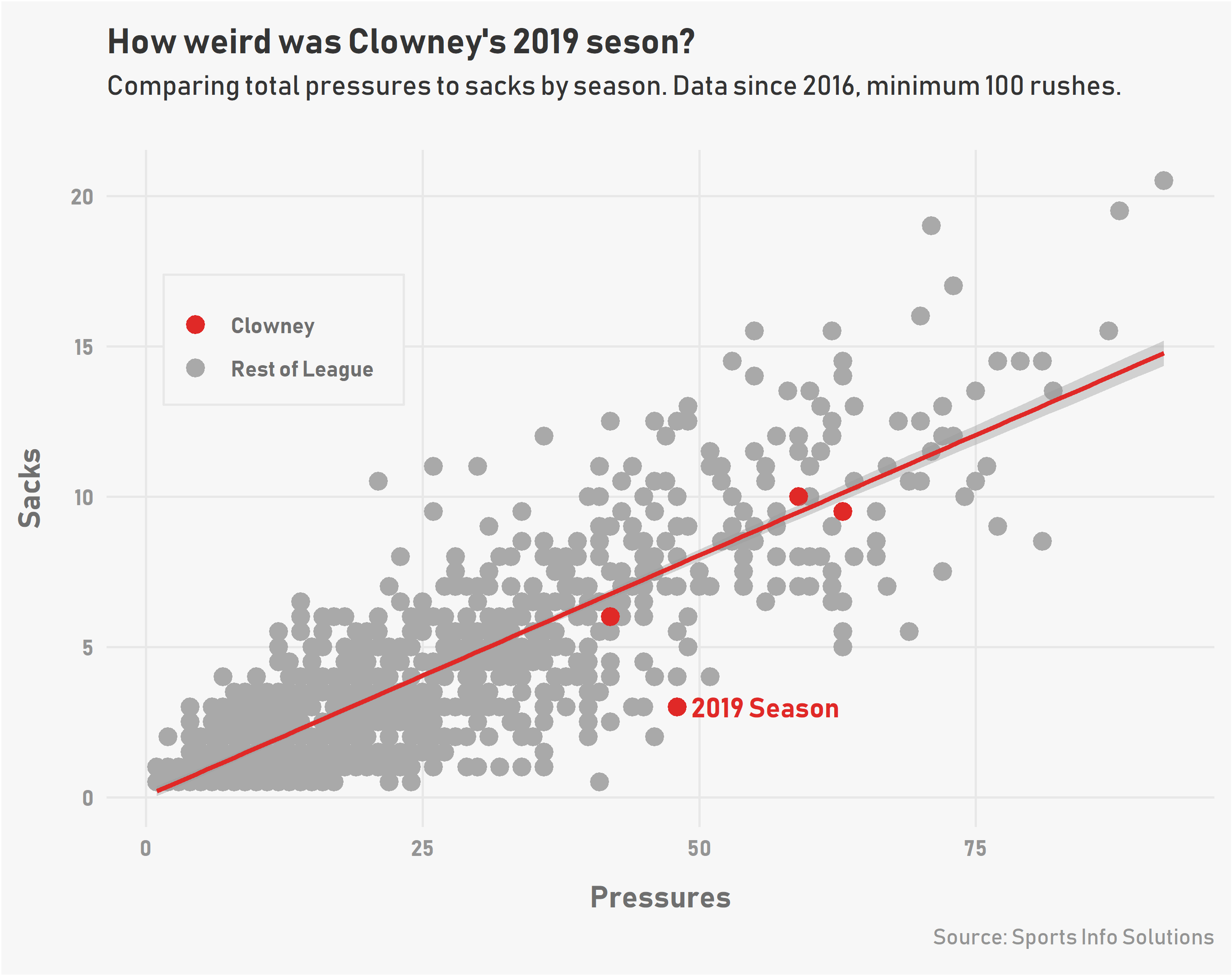
Clowney generated 48 pressures in 2019, which still ranked him tied for 29th in the league despite missing time. The problem was that Clowney only turned those pressures into sacks a little less than six percent of the time, which ranked him 50th of 51 players with at least 40 pressures. Turning pressures into sacks is an inherently noisy metric, and there’s plenty of reason to believe Clowney will bounce back. Between 2016 and 2018 Clowney ranked 13th in the NFL in pressures with 163, and he turned 16 percent of those into sacks.
Arguably the best part of Clowney’s game, though, is his ability against the run. Clowney was solid as a run defender 2019. His 13 Run Defense Points Saved in 2019 (a stat explained here) ranked him 12th among defensive ends. But even after a (relatively) down year against the run, Clowney still leads all defensive ends by this metric since 2016, edging out Calais Campbell.
It’s impossible to say precisely how much of Clowney’s limited market can be attributed to his medical history and how much is a reaction to his stats in 2019. Regardless, Clowney is likely to have a strong market once things return to relative normalcy. And whatever team does pay Clowney will likely be getting production that is much closer to his performance between 2016 and 2018 than what we saw last season
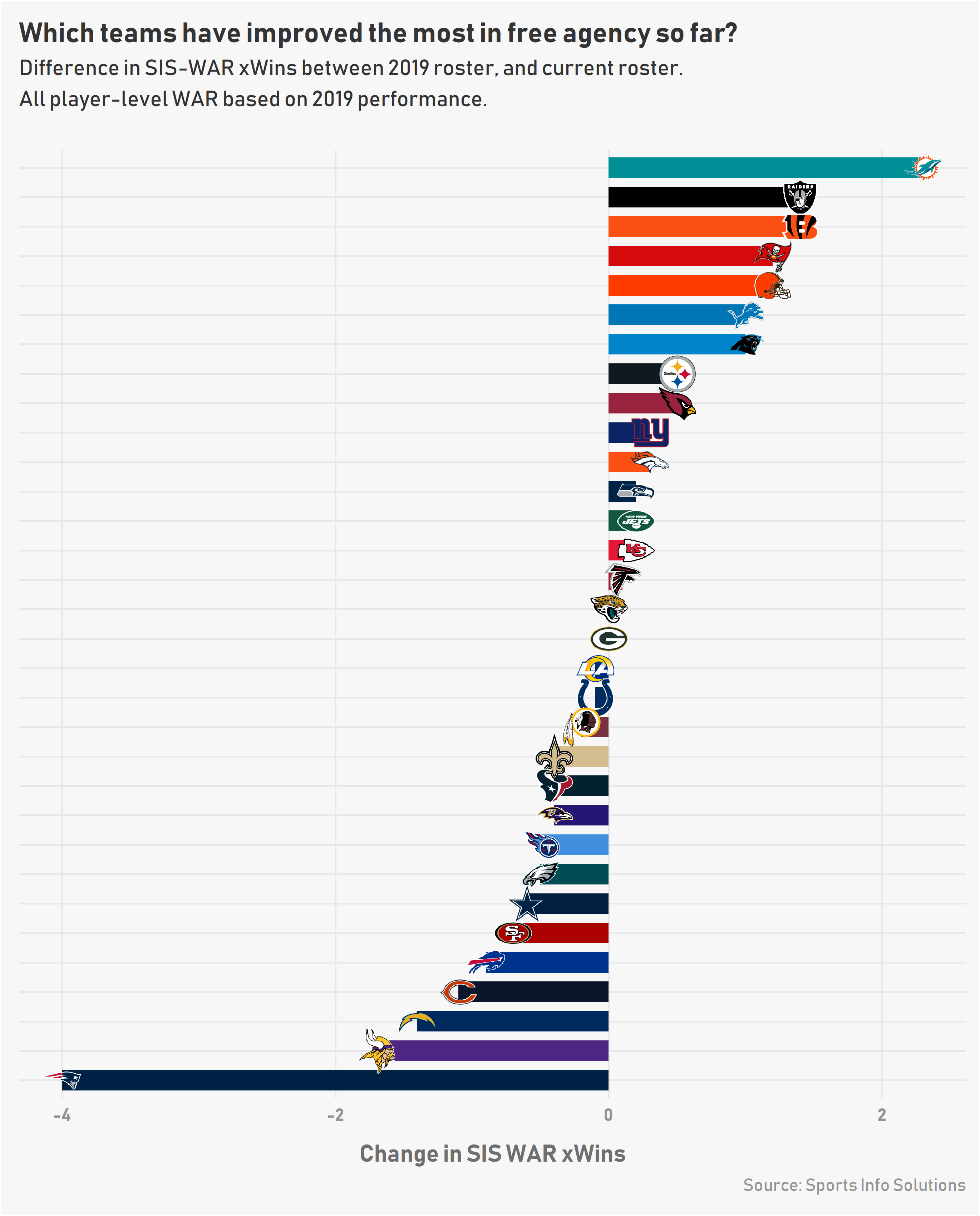
While the rest of the sports world has come to a screeching halt, the NFL offseason has been as chaotic as ever. SIS-WAR xWins can be a helpful tool to make some sense of what exactly has gone down at a high-level.
SIS’s Wins Above Replacement (WAR) uses a similar framework as Total Points (explained in more detail here). It compares a player’s Total Points per snap to that of a replacement-level player and scales it to win total. WAR xWins is the just sum of an entire team’s WAR plus two, the number of games a team of replacement level players would be expected to win.
A few small caveats before everyone gets mad about where their team ranks:
This is not a pure projection of the 2020 season. This does not make any assumptions about playing time or a player’s role on his new team. This is just a high-level overview of what’s gone down in free agency so far.
This is only using a player’s 2019 WAR, which means it’s going to feel very strongly about players coming off career years, and not like guys who either were hurt or struggled in 2019.
This only includes players who have signed with or been traded to new teams. A player who is a free agent but has not yet signed will still be included with the team he played for in 2019.
With all of that said, here is where things stand a little more than one week into the new league year.
Biggest Winner: Miami Dolphins
2019 xWins: 0.7 | Current xWins: 3.0
A roster with the talent-level of the 2019 Dolphins would barely be expected to win one game on average, making them the only team to finish 2019 below replacement-level (though the Bengals did come very close). That was always the plan, though, and so far this offseason, they have added more than two wins’ worth of talent to their roster.
Leading the way are a couple strong signings within their front seven. Shaq Lawson is coming off a career year in Buffalo, where he posted a WAR of 0.6 with a career-high in both sacks (6.5) and pressures (40). It’s hard to say whether Lawson can match that performance moving forward—he only accumulated 0.6 WAR in his three previous seasons combined—but he has a chance to be a very valuable signing for the Dolphins. The Dolphins also added Kyle Van Noy, who is coming off of a season where he tallied 0.5 WAR thanks to 6.5 sacks and 54 pressures.
The biggest splash for the Dolphins was the addition of Byron Jones. Jones has been among the most consistent corners in the league since 2016, posting a WAR of 0.3 last season and 0.4 in each of the three seasons prior. Jones will play across from Xavien Howard and form one of the best cornerback tandems in the NFL.
Honorable Mention: Oakland Raiders
2019 xWins: 7.5 | Current xWins: 8.9
The Raiders haven’t made any headline-generating moves but have quietly had a solid offseason. The signings of Nick Kwiatowski, Carl Nassib, and Maliek Collins were worth 0.3 WAR each. The Raiders also parted ways with Tahir Whitehead, who managed a WAR of minus-0.7 in 2019, the worst among linebackers, and the fourth-worst among all players.
Biggest Loser: New England Patriots
2019 xWins: 11.4 | Current xWins: 7.4
The obvious place to start is the departure of Tom Brady. Even in a down year where Brady clearly saw the effects of both his age and the Patriots’ lack of receiving talent, Brady was still worth a little more than two wins. Making the problem worse, the Patriots don’t have a clear heir apparent. Jarrett Stidham, a 4th-round pick last year, appears to be the next in line if the Patriots don’t make a run at one of the remaining free-agent quarterbacks.
The departure of Brady still only accounts for about half of the value lost by the Patriots this offseason, though. The Patriots also lost Jamie Collins (0.9 WAR), Kyle Van Noy (0.5 WAR), and Duron Harmon (0.2 WAR). Collins and Van Noy led the Patriots in sacks last season and combined for 84 pressures on one of the league’s best defenses.
The Patriots have made a handful of small signings to try and recoup some value, but none of the players they have signed have been worth more than 0.1 WAR. Most of the offseason is still ahead for the Patriots, and betting against Bill Belichick has been a terrible idea historically. Still, as of now, the end of the Patriots dynasty is appearing more and more likely.
Not-So-Honorable Mention: Minnesota Vikings
2019 xWins: 11.0 | Current xWins: 9.3
The most notable departure for the Vikings this offseason is top receiver Stefon Diggs. Diggs was worth half a win in 2019, and while the Vikings got a solid haul of draft picks in return, they didn’t receive any proven help. The Vikings also lost Trae Waynes (0.6 WAR), Andrew Sendejo (0.4 WAR), and Laquon Treadwell (0.3 WAR). Minnesota did make a solid depth signing in Tajae Sharpe (0.2 WAR), but they still have a lot of work left to do this offseason to break even.
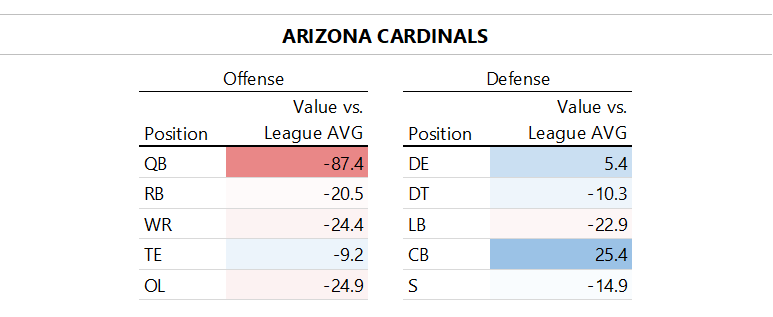
With the free agency finally slowing down, all eyes are turning towards the draft. With that in mind we looked at how teams at the top of the draft have used free agency to bolster their records, and how it may affect their decision come draft day. Team need charts are based on SIS’s unique Total Points metric compared against the league average at each position.
Biggest acquisitions:
The Cardinals have been relatively busy already this offseason, but have yet to make a splash signing. Terrell Suggs and Jordan Hicks were arguably the two biggest signings for the team, both signed in an attempt to bolster a linebacker unit that struggled in 2018.
Hicks was solid against the run in 2018, but struggled in the pass game. On 28 targets Hicks allowed 22 catches for 271 yards and a touchdown. A QBR against of a little bit over 100. Using Total Points, Hicks ranked as the 98th best linebacker in pass coverage among players with at least 10 targets.
The soon-to-be-37 years old Suggs, while listed as a linebacker, will slot in on the edge, and despite his age he should still be able to add value to a pass rushing unit that actually fared pretty well in 2018.
Additional signings:
In terms of weapons for whoever the QB is in 2019, the Cardinals signed TE Charles Clay, TE Ricky Seals-Jones, and WR Kevin White, a rather uninspiring trio for a team lacking weapons and moving into a Kliff Kingsbury offense in 2019. The Cardinals also added a couple of offensive linemen in Max Garcia and Marcus Gilbert and defensive lineman Darius Philon.
What to expect in the draft:
The speculation of Murray to the Cardinals seemingly won’t go away, and while Rosen’s rookie season was nothing short of a disaster, it seems crazy to think they would move on from him only one year removed from moving into the top 10 to select him.
Compounding the intrigue, Cardinals defensive ends were one of only two position groups that put up numbers above the league average in 2018. Outside of Murray, the only player’s who have been mocked at the top of the draft are pass rushers, namely Nick Bosa and Josh Allen. Either of those players would provide an immediate impact and be an upgrade over current Cardinals pass rushers, but it still makes the pick all the more interesting.
Biggest acquisitions:
It has been a relatively quiet offseason so far for the 49ers outside of sending second round pick to Kansas City for Dee Ford, adding a star player in a position of need.
Ford was a force in 2018, generating 13 sacks and 72 pressures, good for 9th and 2nd best respectively. Additionally, his 6 forced fumbles also tied with J.J. Watt for the lead league. Overall, Ford was far and away the top rated pass rusher by Total Points 2018 with 37.7 Points Earned, outpacing the like of Frank Clark, Aaron Donald, and J.J. Watt.
The 49ers also gave a massive 4 year deal to former Bucs linebacker Kwon Alexander, worth $54 million, including $25.5 million guaranteed. Alexander is a young high upside linebacker, but is coming off of a torn ACL. The 49ers are betting he can return to his 2017 form when he had 96 combined tackles, including 6.5 for a loss.
Additional signings:
The 49ers did also add another playmaker to their offense in Tevin Coleman. The 49ers were able to get solid production from a committee of running backs last season, namely Matt Breida, Alfred Morris and Raheem Mostert. Coleman will join a crowded but talented backfield, including a newly healthy Jerrick McKinnon.
What to expect in the draft:
The 49ers will have their fingers crossed hoping that the Cardinals take Murray with the 1st overall pick, allowing them to take whoever is on the top of their big board. 49ers GM John Lynch has made it clear he plans to take the “best player available”.
That “best player” is very possibly another pass rusher to go alongside Dee Ford. Nick Bosa or Josh Allen lining up opposite of Ford would quickly turn an impotent pass rush from last year into one of the more dangerous tandems in the league.
Defensive tackle was also a position of weakness for the 49ers last year, and the recent acquisition of Ford may allow the 49ers to select Quinnen Williams, a player many view as the best in the draft (including our rookie handbook). The Outland Trophy winner was dominant against the run, leading the nation in tackles for non-positive yards, and his hurry rate when pass rushing was also far and away the best among college defensive tackles.
Biggest acquisitions:
The Jets have been among the biggest spenders in free agency this season, most notably inking Le’Veon Bell to a four-year deal. Bell’s year off certainly adds some question marks, but it seems more likely than not that Bell will again find himself among the best at the position. Our Bryce Rossler took a deeper dive on what Bell does well earlier this offseason.
The Jets also added LB C.J. Mosley. The former Raven was productive over the course of his rookie contract, particularly against the run. In 2018 Mosley had 101 combined tackles, including 4.5 for a loss. Mosley did struggle in pass coverage in 2018 though, allowing a QBR against of 100 on 39 targets. By SIS’s Points Saved metric Mosley ranked as the 40th best linebacker in pass coverage this past season.
Additional signings:
Some other notable transactions for the Jets include WR Jamison Crowder, who they are hoping can turn into a reliable target for Sam Darnold, and also WR Josh Bellamy.
What to expect in the draft:
After selecting their franchise QB in last years draft, the Jets will likely be taking the “best player available” approach with the No. 3 pick. This would likely be one of Nick Bosa, Josh Allen, or Quinnen Williams, all of whom would provide tremendous value at positions of need.
It is also likely that the Jets will be fielding offers from QB-needy teams, especially if Murray slides past the Cardinals. This could allow the Jets to recoup some of the assets they parted ways with last year to get Darnold, and depending on the suitor could still leave them in position to get either Greedy Williams or Deandre Baker. Gaining assets while also grabbing the best player at arguably their biggest position of need may be the best case scenario for the Jets.
Biggest acquisitions:
After trading away Khalil Mack and Amari Cooper during the season, it appeared the Raiders were entering a lengthy rebuilding period. By trading for Antonio Brown they made it abundantly clear that was not the case. Brown immediately slots in as the best playmaker on the team, and the number one option for Derek Carr. I have already done a more detailed analysis on this trade here.
The Raiders also gave a record setting contract to offensive tackle Trent Brown, fresh off a Super Bowl win and the best season of his career. By Total Points, Brown was the 4th highest rated offensive lineman, and was especially strong pass blocking, earning 4.4 of his 5.7 Points in the pass game.
Additional signings:
The Raiders also added more talent to their wide receiving core by adding the speedy Tyrell Williams, who should find himself as their No. 2 option. LaMarcus Joyner was also brought in to help bolster the secondary, and more recently the Raiders added LB Vontaze Burfict.
What to expect in the draft:
Even after a busy start to the offseason, the Raiders have needs just about everywhere. They also conveniently have three picks in the first round this year. While their have been fun rumors about Kyler Murray throwing to Antonio Brown, it would be surprising to see them do anything other than replace the Khalil Mack-sized hole in their pass rushing unit. Depending on what happens in the first three picks this may mean one of Montez Sweat or Clelin Ferrell, but a run on quarterbacks at the top of the draft could certainly shake things up.
Biggest acquisitions:
Because of cap concerns, the Bucs have been forced into an uneventful offseason. The honor of being their biggest signee likely belongs to LB Deone Bucannon.
Bucannon played well in his time under Arians in Arizona, and now get’s a chance to be re-united with the coach who made him a first round pick in 2018. A converted safety, Bucannon will likely play a similar hybrid type role that he flourished in during his time in Arizona. In 2017 (his last season with Arians), he had 82 combined tackles, allowed a QBR against of only 76 on 44 targets, limited quarterbacks to 5.6 yards per attempt, and scored two defensive touchdowns.
Additional signings:
Outside of Bucannon, the Bucs have mostly looked to add depth. Other signings for the Bucs include S Kentrell Brice, G Earl Watford, and LB Shaqil Barrett.
What to expect in the draft:
By Total Points, the Bucs weaknesses aren’t quite as glaring as the rest of the top 5, but this is at least in some respects due to some Fitz-Magic early in the season. It is also worth noting that the future of their star defensive tackle, Gerald McCoy, is up in the air as the Bucs currently don’t have the cap to sign their upcoming draft picks.
Whether or not the Bucs are able to retain the services of McCoy will likely play a huge role in who they take with the number 5 pick. It is not impossible that Quinnen Williams is still their for the taking, and he would provide a solid, and more importantly, cost controlled, consolation for the loss of McCoy.
Two potential positions of need for the Bucs are at cornerback and on the offensive line. If the top of the draft goes as expected they will have the luxury of taking whoever is on the top of their board at either of the those positions, if they decide to go that route.
On the offensive line this would likely mean a debate between Alabama product Jonah Williams, or the incredibly athletic Jawaan Taylor. At corner, DeAndre Baker and Greedy Williams sit atop our big board. All four could provide an immediate impact for the Bucs in 2019.
The Bucs pick could also be a prime target for teams looking to make a move for a sliding QB. Projecting what Dave Gettelman will do at No. 6 is tricky, but the Giants taking a QB seems like the most likely outcome. A team like Washington or Cincinnati my need to jump to No. 5 if they want to grab their franchise QB in this draft.
The league season is still a few hours from officially starting, and yet the last week has been among the most chaotic in recent memory. While record-breaking contracts have been given out left and right, the two biggest moves actually came via trade, as Antonio Brown was sent to the Raiders and Odell Beckham Jr. was sent to the Browns.
Odell to the Browns
Browns get: Odell Beckham Jr. Giants get: S Jabrill Peppers, 17th pick, 95th pick
Baker Mayfield excelled last season under then-interim OC Freddie Kitchens. From weeks 9 through 17, Mayfield posted an Independent Quarterback Rating (IQR) of 112.1, the fourth-best rating during that stretch, and a Yards per Attempt (Y/A) of 8.6, trailing only Patrick Mahomes by a tenth of a yard. With Kitchens now the head coach and with Baker having his first full offseason of preparation, that high level of play was already expected to continue into 2019. But now with Beckham in the fold, the Browns’ offense has the potential to be among the league’s most dangerous.
In 2018, Beckham was only targeted on throws more than 15 yards downfield 36 times, a criminally low rate for such a dangerous player. For reference, Julio Jones saw 65 such targets. To make matters worse, Eli Manning ranked 22nd in On-Target% (57.9) and 25th in IQR (81.2) on those throws.
Beckham should expect to be targeted downfield much more often with the Browns. During Kitchens’ tenure as OC, only Aaron Rodgers pushed the ball downfield more consistently than Mayfield. On those throws, Mayfield posted an On-Target% of 62.5 and an IQR 109.7, which ranked as the fifth- and seventh-best marks in the league during that span. Beckham should immediately become Mayfield’s go-to guy downfield, and Jarvis Landry can work the short and intermediate parts of the field where he is more comfortable. (In 2016 and 2017, 33 percent of Landry’s targets came on slants, drags, or screens, compared to only 21 percent in 2018.)
On the other end of the deal, this trade leaves the Giants in a precarious position, even before considering the dead salary cap ramifications. They’re only a handful of years away from owing Barkley a huge pay day, and have managed to trade away most of their young talent, all while not making any real effort to find a replacement for Eli. Maybe their quarterback of the future falls to them at the sixth pick this year, or maybe they use their new first round pick in a package to move up and draft their guy, but it’s hard to see a path to quick rebuild for the Giants.
The Browns also find themselves in an unfamiliar spot: betting favorites in the AFC North. It feels crazy to say about a team that is only two years removed from a winless season, but with a strong cast of skill position players on offense and a couple of young playmakers on defense, the Browns appear to be a legitimate threat in the AFC this year. It is possible that OBJ is the final piece in what has been a remarkably quick turnaround.
Brown to the Raiders
Raiders get: Antonio Brown Steelers get: 66th pick, 141st pick
This time last year, the Steelers were legitimate Super Bowl contenders. They had a future HOF quarterback; Antonio Brown and Le’Veon Bell who were both arguably the best at their respective positions; and young budding talent in players like JuJu Smith-Schuster. Fast forward to now, the Steelers are fresh off of their first playoff miss since 2013, and have managed to turn their two best players into a 3rd round pick, a 5th round pick, and $21 million of dead cap.
The Raiders, on the other hand, appeared to be entering a full on rebuild last year when they shipped their best player off to Chicago, but are seemingly trying to expedite that rebuilding process with this trade. Given the incredibly low price tag and their plethora of draft capital, it is hard to blame them.
Brown provides immediate help for an offense that mostly struggled in its first season under Jon Gruden. Derek Carr was efficient, completing 68.9% of his passes, but struggled to find big plays. His Y/A of 7.3 ranked as only 20th-best among QBs with at least 200 attempts. Despite his age, Brown should provide an immediate impact downfield. On throws of at least 15 yards, Brown turned 52 targets into 614 yards and 9 touchdowns. Raiders receivers as a whole had 1,029 yards and 7 touchdowns on such throws. The Raiders are hoping Brown can turn into the consistent downfield threat they thought they were getting with Amari Cooper.
Brown can also provide additional value in the shallow routes that are the staple of Gruden’s offense. While the Raiders were mostly efficient on these routes last year (they completed 81% of slants), Brown provides the big play threat and YAC ability that the Raiders lacked. Brown’s 8.8 YAC per reception on slant routes last year ranked 2nd in the NFL behind Tyreek Hill. Raiders receivers as a whole averaged only 6.4 YAC per reception, and only 5.3 if you remove Cooper from that equation.
A lot of the Raiders’ success this season will depend on what their three first round picks turn into, but Brown provides a clear boost to an offense lacking in playmakers. He should immediately become Carr’s favorite target and be the focal point of an offense hoping to turn things around this season.