Tag: Kyler Murray

  • Patrick Mahomes Is Still The King Of Clutch (Despite the Bills Loss)

    Patrick Mahomes Is Still The King Of Clutch (Despite the Bills Loss)

    Photo: Rich Graessle/PPI/Icon Sportswire

    The Chiefs once again lost to the Bills in the regular season, something that they’ve grown accustomed to despite having no issue dismissing Buffalo from the playoffs in recent years. Even as they were sitting a score or two behind for much of the game, the specter of Mahomes Magic loomed, but it didn’t quite manifest in this contest.

    In a world where Bo Nix seems to post a big fourth quarter (after a questionable first three) every week, I thought it’d be helpful to talk about quarterback clutch performance and put Patrick Mahomes into some perspective with others in the league.

    First off, how might we operationalize clutch? I thought of it two ways, in both cases using our player value metric Total Points to draw the comparison. 

    The simple one is performance late in games, comparing fourth quarter production to first-three-quarters production. 

    The more complex one is comparing high-leverage situations to low-leverage ones, building in an understanding that a fourth quarter touchdown when you’re down by 28 points isn’t very clutch. For this we borrow methodology from the baseball world, where we can label a situation’s “leverage index” by comparing how much a team’s win probability can swing in a given situation compared to the average. 

    Leverage can get really high in some situations (like 10x a typical play), but values above 2 are pretty rare in football, so samples get small. So for this purpose I am considering high leverage to be 1.5x and low leverage to be 0.5x an average situation.

    To put that in slightly more concrete terms, here are three 1st-and-10 situations around midfield that have different leverage indices by our calculations.

    Average leverage: 1st quarter, 4 minutes left, 7 point lead

    High leverage (1.5x average): 4th quarter, 4 minutes left, tie game

    Low leverage (0.5x average): 2nd quarter, 4 minutes left, 13 point lead

    I took each quarterback’s relative success in fourth quarters and high-leverage situations (compared to the rest of their plays) and simply averaged them together to come up with a “clutch composite”, if you will. And if we look at current quarterbacks with at least 1,500 evaluated plays in their career so far (roughly two-plus full seasons), it’s not surprising who we find at the top.

    Most clutch current quarterbacks, minimum 1,500 career dropbacks / carries

    Plays TP/play difference*
    Patrick Mahomes 5,890 0.10
    Tyrod Taylor 1,844 0.09
    Kyler Murray 3,633 0.08
    Carson Wentz 4,053 0.07
    Jalen Hurts 3,326 0.06

    * The average of the gap between fourth-quarter and other-quarter performance and high-leverage and all-other-leverage performance

    Would you look at that: Mahomes sits above the rest of his peers in terms of how well he rises to the situation. And he’s done so across a much greater sample size. Josh Allen has had similar overall production, but it’s been more balanced between the low-leverage and high-leverage spots.

    And lest we think that early-career Mahomes is coloring the picture, his most clutch seasons by this measure are the three most recent.

    An aside on other players

    In looking at this research, I figured I’d poke around to see other interesting trends. 

    Bo Nix has had a lot of “no no no yes” games this year, but his performance from a Total Points perspective hasn’t been appreciably better in big-time situations. The Broncos have averaged fourth-quarter scoring that’s almost a touchdown better than the first three quarters, but Nix hasn’t shown that kind of productivity jump on his own.

    Justin Fields has been one the least clutch quarterbacks this year. He’s basically become less clutch every year he’s been in the league. In general, it’s fair to assume that a player’s clutch performance has an outsized impact on the vibes surrounding his season, and that feels particularly relevant when a player gets benched. 

    Drake Maye and Sam Darnold are obvious counterexamples to that last point, as players who have had really strong seasons so far. Maye has been excellent in low-to-medium leverage and quite poor in high leverage. Darnold has been elite in the first three quarters but the worst quarterback in the league in the fourth quarter.

    Of the players who have been the most clutch by this composite measure this year, Michael Penix Jr. is the only one who has been worse in high-leverage spots (and therefore very good in fourth quarters). He’s run up the score or turned it on in garbage time but has not risen to the big moments.

  • We’ve Seen This Before From Kliff Kingsbury

    We’ve Seen This Before From Kliff Kingsbury

    Photo: Andy Lewis, Kevin Abele/Icon Sportswire

    With the constant influx of athletic quarterbacks into the NFL, offensive coaches have slowly incorporated more QB designed runs into their schemes. We’ve seen these concepts plenty in college football with the likes of Urban Meyer, Chip Kelly, and Rich Rodriguez starting the revolution of the spread option offense. 

    It is fitting that Kliff Kingsbury, who spent time in college before coaching the Cardinals and Commanders, has created an offensive scheme that utilizes plenty of Air Raid and Spread Option principles. It’s also fitting that Kingsbury has been tasked with developing two Heisman winning quarterbacks who possess the athleticism to be a successful rusher in the NFL, but who have had to manage in-season injuries that limit how much they can use that athleticism.

    In this article, we are going to look at how Kingsbury has utilized the running ability of Jayden Daniels and Kyler Murray before and after lingering in-season injuries. 

    Daniels and the Commanders offense were off to a roaring start before Daniels suffered a rib injury in Week 7 against the Panthers that forced him to leave the game. The Commanders were 5-2 and ended that game having scored 30 points or more in four of five games. Since Week 8, the Commanders are 3-3 and have scored 30 points just once, in their Week 13 game against the Titans.

    The table below shows team rushing stats for the Commanders before and after Daniels suffered his rib injury: 

    Pre-Rib Injury Post-Rib Injury
    Rush Attempts / Game 32 32
    Rush Yards / Game 165 147
    EPA/Rush 0.16 0.06
    Total Points / Rush 0.19 0.05

    The Commanders rushing offense has been less effective since Daniels was injured. Although the EPA per Rush has decreased by a tenth of a point since the injury, the Commanders have still been successful running the football compared to the rest of the league. From Week 8 on, the Commanders are tied for third with the Giants in EPA per Rush. 

    However, there is more to this story. The table below shows rushing stats for Jayden Daniels on designed QB runs. For the purpose of this article, we are not going to include QB sneaks and kneels. 

    Pre-Rib Injury Post-Rib Injury
    Designed Runs / Game 4.2 2.8
    Rush Yards / Game 18 14
    EPA/Rush 0.16 0.02
    Total Points / Rush 0.22 0.03

    The Commanders have run Daniels less frequently since the injury. His effectiveness has also dropped off. Now, when we look at his rushing stats in the Red Zone only, a clearer picture starts to emerge:

    Pre-Rib Injury Post-Rib Injury
    Designed Runs 13 5
    Touchdowns 4 1
    EPA/Rush 0.15 -0.07
    Total Points / Rush 0.29 -0.27

    This paints a clear picture of where the Daniels injury has impacted the Commanders rushing offense the most: in the red zone. His ability to run the Read Option in the red zone puts a lot of pressure on the defense. Kingsbury is running his quarterback less in general, but especially in key situations in tight quarters, and he’s done worse with those attempts (albeit in a small sample). 

    Defenses can pick up on this trend, as well. To make a baseball analogy, using the quarterback in the option run game is like having a great changeup to complement your fastball. It is pretty much impossible to sit on a great fastball and changeup, similar to defending the option in football. If you can eliminate one of the options pre-snap or pre-pitch, you have a much greater chance of success. This is where Kingsbury has run into problems during his tenure as a playcaller not only in Washington, but Arizona as well. 

    Kingsbury has caught a lot of flak for his offenses struggling in the second half of the season since his days in Arizona with Kyler Murray. There does appear to be some truth to that logic, although he has had unfortunate injury luck at quarterback dating back to the 2020 season.

    The 2020 Cardinals started the season 5-3 before a Kyler Murray shoulder injury in Week 9 that lingered for the rest of the season. The 2021 Cardinals started 7-1 before Murray suffered a sprained ankle that caused him to miss 3 games and limped to the end of the season with a 11-6 record and a playoff berth. The two tables below highlight the similarities between the 2020 Cardinals and 2024 Commanders offenses pre- and post-injury for their franchise quarterback. 

    2020 Cardinals Pre-QB Injury Post-QB Injury
    Rush Attempts / Game 32 28
    Rush Yards / Game 163 117
    Rush Touchdowns / Game 1.75 1.13
    EPA/Rush 0.16 -0.04
    Total Points / Rush 0.07 -0.05

    2024 Commanders Pre-QB Injury Post-QB Injury
    Rush Attempts / Game 32 32
    Rush Yards / Game 165 147
    Rush Touchdowns / Game 2.0 1.3
    EPA/Rush 0.16 0.06
    Total Points / Rush 0.19 0.05

    The numbers are astonishingly similar, especially pre-injury for both seasons. As you can see, Kingsbury has tweaked his offense to his personnel in Washington to form one of the most potent rushing attacks in the NFL this season. 

    Kingsbury’s rushing offense has not cratered like it has in the 2020 and 2021 seasons after Murray was injured. Part of that should be attributed to personnel differences, but another part of it should be attributed to schematic changes.

    Kingsbury has adapted from a zone-run heavy run scheme in Arizona to a more balanced approach to gap and zone run schemes in 2024 with Washington. He is calling gap scheme running plays 47% of the time this year, compared to 28% and 38% in 2021 and 2022, respectively. In terms of running the ball, not much else has changed. He still runs an up-tempo, shotgun heavy offense that uses motions at a lower rate than most of the league, where his offenses have always ranked in the bottom 5 in motion percentage.  

    Some of this is unfortunate injury luck, some of this is also just the reality of consistently running your quarterback in the NFL. In 2020 Kyler Murray had 73 designed runs and in 2024 Jayden Daniels is currently at 47 with four games left to play. 

    Murray’s 68 runs are tied for 6th most for a quarterback in a season since 2020, while Daniels comes in tied for 16th. Ahead of these players on that list include the likes of Lamar Jackson, Jalen Hurts, Josh Allen, and Cam Newton. Besides Lamar, the three other quarterbacks have a much better body composition to sustain hits throughout the season compared to Murray and Daniels. Even then, there were discussions held within each franchise to lessen the workload for their franchise quarterback to make sure they were fully healthy going into the playoffs. 

    This is the conundrum that Kingsbury seems to keep getting stuck in, year in and year out. His offenses seem to peak too early in the regular season before waning off come crunch time. It could be the case of getting figured out by defensive coordinators or it could also be because of lingering injuries to his quarterbacks that affect how he calls plays. More than likely, both are true, but either way, Kingsbury needs to find an answer to this problem, especially if he is interviewing for head coaching positions in the off-season. 

    Luckily for the Commanders, the bye week came much later and that might just be a blessing in disguise. In future seasons, Kingsbury will need to find the perfect balance between keeping his quarterback fresh for the playoffs and finding success during the regular season or his offenses will continue to limp into the playoffs, literally and figuratively, alongside their quarterback.

  • Reviewing The 2019 NFL Draft Class

    Reviewing The 2019 NFL Draft Class

    While many crave all the NFL Draft Team Grades that publications put out the day after the draft, including us on both accounts, there are many others who can’t stand it. Of course, we all have our own NFL Draft prospect rankings heading into that weekend, but those players have yet to play a single snap in the NFL. So, how can we really grade a team’s draft class if those players haven’t yet stepped onto the field?

    It usually takes at least three years to see how well a draft class turned out. While said publications, including us, don’t want to wait three years before putting out their grades on a draft class, we decided to now do both.

    Three years ago, prior to the 2019 NFL Draft, Sports Info Solutions created its first ever draft guide: The SIS Football Rookie Handbook. This book marked a first for SIS, as it was the first football publication since the company added the sport on the data collection front in 2015. After the 2019 NFL Draft, we, just as many others, posted our NFL Draft Team Grades, which can be seen here.

    I’ve developed a system to evaluate the draft classes using Total Points relative to position as the foundation. Now that three seasons have gone by, let’s use that to truly see how each team did with getting value from their selections in the 2019 NFL Draft.

    How much value did teams get?

    Before we get into the process, let’s take a look at how we ranked teams after the 2019 NFL Draft and then who got the most and least value. See the Appendix below to see how all 32 teams ranked in our 2019 rankings and in TP Score.

    Here are the teams we ranked at the top immediately following the draft back in 2019. To see our scouting grading scale, check out our new NFL Draft site.

    Top 5 Teams in 2019 Post-Draft Rankings
    Team Book Rank Grade
    Titans 1 6.63
    Bills 2 6.50
    Cardinals 3 6.46
    Ravens 4 6.44
    Bengals 5 6.44

    TP Score will be defined below, but here are the top 5 teams based on how much value they received from their draft class.

    Top 5 Teams in TP Score
    Team TP Rank TP Score
    Titans 1 84.64
    Broncos 2 82.81
    Raiders 3 77.23
    Buccaneers 4 67.50
    Jaguars 5 62.18

    The No. 1 team in 2019 (the time of our initial evaluation) and in this ranking both worked out to be the Tennessee Titans. Five of their six draft picks have been above average, all playing in at least 38 games over the past three seasons. The only pick who didn’t hit was D’Andre Walker, who appeared in only one game.

    The top 3 teams, the Titans, Broncos, and Raiders, are at the top for a reason. They drafted good players throughout their entire draft class. They were the only teams to draft above-average players on 75% or more of their draft class.

    Conversely, here are the bottom 5 teams from our 2019 rankings.

    Bottom 5 Teams in 2019 Post-Draft Rankings
    Team Book Rank Grade
    Saints 28 6.12
    Browns 29 6.10
    Seahawks 30 6.03
    Lions 31 6.00
    Chiefs 32 5.90

    Based on TP Score, here are the worst teams in terms of getting value from their 2019 draft picks.

    Bottom 5 Teams in TP Score
    Team TP Rank TP Score
    Chargers 28 16.00
    Panthers 29 14.53
    Bengals 30 12.48
    Eagles 31 12.24
    Seahawks 32 10.12

    Determining Total Points Score

    Now that you’ve seen the rankings, let’s explain the process. When looking back to see how good or bad a specific draft class was, there are two main points to detect:

    1. How productive were the draft picks on the field?
    2. How much talent did the team draft relative to the amount of picks they made? 

    As in: Did they hit on one player or did they hit on multiple players?

    To determine the value of the draft classes, I used Total Points, our flagship player value stat, from across the last three seasons. However, for those of you who are familiar with Total Points, it gives a lot of extra weight to quarterbacks. With that said, Kyler Murray, the No. 1 pick, alone would have had the 5th best draft class with his 286 Total Points if we just used raw Total Points.

    While there is a reason we weigh quarterbacks so much more compared to other positions (they are pretty important), using that raw number in this sense isn’t going to make for a perfect match. Yes, the Cardinals got a lot of value in Murray, but when looking at their draft class as a whole, I think many would agree they didn’t have the best draft class. A fate they would have had if just using raw Total Points.

    Now, answering the second question takes into account how well a team drafted throughout the entirety of the draft class. I found the average Total Points per player from the 2019 class at each position, including UDFAs who have taken at least one offensive or defensive snap, since they were also available to be selected.

    The positional averages are shown in the table below.

    Pos TP per Player
    QB 38.1
    RB 8.8
    WR 15.7
    TE 11.2
    OL 25.3
    ED 29.1
    DT 19.8
    LB 23.5
    CB 23.2
    S 30.2


    The TP Score, as referenced earlier, is what’s used to rank the teams. It is calculated as follows:

    1. Add up the Total Points from the entire team’s draft class

    2. Divide that number by the number of selections the team had

    3. Multiply that number by the percentage of draft picks that were above the average Total Points for their given position

    4.Add that to the original Total Points per draft pick

    In these 4 steps, we are essentially answering how productive the draft class was and how many picks were “hits”.

    Let’s run through an example using the Chicago Bears.

    Here is their Draft class:

    Pos Player Total Points
    RB David Montgomery 45
    WR Riley Ridley 4
    CB Duke Shelley 21
    RB Kerrith Whyte Jr. 2
    CB Stephen Denmark 0
    1. Add up the Total Points from the entire team’s draft class
    72
    2. Divide that number by the number of selections the team had
    72 Total Points divided by 5 selections equals 14.40
    3. Multiply that number by the percentage of draft picks that were above the average Total Points for their given position
    David Montgomery was the only player whose Total Points were above average
    14.40 times 20% (1 out of 5) equals 2.88
    4. Add that to the original Total Points per draft pick
    14.40 plus 2.88 equals 17.28, which is their TP Score


    So, to summarize, we took the team’s Total Points gained from these players, dispersed it throughout the entire class and then gave a bump based on how many above-average players they drafted.

    Now that we know how the teams ranked and how the TP Score is calculated, let’s dive into some of the details.

    Other Key Takeaways

    – The Raiders “hit” on 7 of their 9 picks. It is interesting to note that all three of their 1st-Round picks, Clelin Ferrell, Josh Jacobs, and Johnathan Abram, had their 5th-Year Options declined. However, they still played well enough to be above-average players. Plus, that doesn’t include gems they found later in the draft in Maxx Crosby and Hunter Renfrow.

    – Every team drafted at least one player who has played above the positional average compared to the rest of the draft class. However, Dallas (Trysten Hill), New England (N’Keal Harry), Philadelphia (Andre Dillard), Seattle (L.J. Collier), and Washington (Dwayne Haskins) were the only teams whose first draft selection wasn’t an above-average player.

    – The Cardinals draft class accumulated the most Total Points with 446, though as mentioned before, Kyler Murray accounted for 286 of them. They hit on 3 of 11 draft picks on their way to a No. 7 ranking. It’s worth noting that their Supplemental Draft selection of Jalen Thompson and his 73 Total Points isn’t included, as he isn’t part of their original draft class.

    – The fewest Total Points came from the Eagles. They garnered only 51 Total Points across their five draft picks, with 43 coming from Miles Sanders.

    – Hitting on quarterbacks is pivotal to winning in the NFL, as seen by Kyler Murray in 2019. Conversely, missing on quarterbacks can set teams back. Carolina and Cincinnati both took quarterbacks who severely hurt their Total Points number and pushed them down the rankings, even in minimal games played.

    Will Grier accounted for -26 Total Points out of Carolina’s 89 total. Funny enough, Brian Burns had 91 himself. Ryan Finley was even worse for Cincinnati with -39. In nine games in which Grier and Finley played and threw at least one pass, they combined for a 1-8 record.

    It’s possible the teams had a better chance of winning if neither played. If both had never played and accumulated 0 Total Points, Carolina would have improved four spots in the rankings and Cincinnati would have improved three spots.

    How do our Initial Grades Compare?

    56% (18/32) of our initial ranks were in the correct half. Meaning a team we ranked between 1 and 16 or 17 and 32 was ultimately in that tier. And before I get too much further, I want to make sure it’s understood that 2019 was our first year of the Handbook which meant there were plenty of growing pains. Major changes took place beginning in 2020 after studying our initial process.

    The biggest differences in our initial grades and these final rankings were the Bengals (25 spots), Eagles (23 spots), and the Ravens (23 spots). We rated these teams near the top immediately following the draft, but they finished near the bottom based on these rankings.

    For Cincinnati, we’ve already talked about Ryan Finley (who was our No. 4 QB), but they also drafted two running backs. Rodney Anderson (SIS No. 4 RB) has battled injuries his entire career and Trayveon Williams (SIS No. 5 RB) has been buried on the depth chart and has seen minimal playing time.

    The Eagles took four of five players who were featured in the Handbook, with Miles Sanders and Andre Dillard both grading out as a 6.7. As mentioned earlier, Dillard was one of the top picks who has failed to be an above-average player. For Baltimore, all eight selections were in the Handbook, and we graded six of them at 6.4 or higher. They clearly have underperformed based on our initial grading.

    What were some of our biggest misses elsewhere? Not including Mecole Hardman or Sean Murphy-Bunting proved to be a big miss. As mentioned before, immediate action was taken to improve upon our process to make sure we weren’t missing good players and early draft picks.

    Additionally, we ranked Wisconsin OG Beau Benzschawel as our No. 4 guard and New Mexico State LB Terrill Hanks as our No. 5 linebacker. Neither have played a snap in the NFL.

    Nik Needham is first and foremost when we talk about our NFL Draft wins. He’s been a big talking point around the company for the past three years. We ranked him as our No. 4 corner going into the draft, and he currently ranks third in Total Points among 2019 CBs (we were higher on him than any other mainstream draft analyst). His 85 Total Points tops all UDFAs from the 2019 class and ranks 12th overall.

    The table below shows the top Total Points earners across the past three seasons and how we graded and ranked them in the Handbook.

    Rank Position Player Total Points SIS Grade SIS Pos Rank
    1 QB Kyler Murray 286 6.8 2
    2 ED Nick Bosa 120 7.0 1
    3 LB Devin White 99 7.0 1
    4 CB Jamel Dean 97 6.7 6
    T-5 ED Maxx Crosby 96 6.5 11
    T-5 CB Byron Murphy 96 6.9 3
    T-5 WR Deebo Samuel 96 6.7 4

    While we were a little low on Dean and Crosby, all eight of these guys were tabbed as starters in some form by our scouts.

    Conclusion

    Nobody really knows how a draft class is going to turn out immediately after the draft, as stated before, yet it still makes sense to grade and rank the teams based on player grades for an initial reaction. Post-draft grades are great in a sense, but they should be taken with a grain of salt. Once three years go by and we’ve seen what these players have done in the NFL, we can get a better sense of how good the team drafted.

    These rankings are all about finding which teams drafted the best draft class as a whole, not just who got the best player. While there are some players who didn’t play for the team that drafted them for the entirety of the past three seasons, that wasn’t taken into account since those decisions came after the initial drafting of these players, which is what this is based off of. It’s not a perfect science, but it does a good job at pulling player value and seeing how well teams drafted as a whole class.

    Three years later, the comparison between our initial rankings and these rankings aren’t terrible for Year 1 (in both our grading and our scouting process). Though, we hope this article next year takes a large positive swing given the process changes we made heading into the 2020 cycle.

    As with everything we do here, we hope this improves year over year and can look back and say we kept getting better every day.

    Appendix

    2019 SIS Post-Draft Rankings based on the SIS Football Rookie Handbook

    Team Book Rank Grade
    Titans 1 6.63
    Bills 2 6.50
    Cardinals 3 6.46
    Ravens 4 6.44
    Bengals 5 6.44
    Raiders 6 6.40
    Broncos 7 6.38
    Eagles 8 6.34
    Jaguars 9 6.33
    Cowboys 10 6.30
    Patriots 11 6.30
    Rams 12 6.30
    Falcons 13 6.29
    Giants 14 6.28
    Panthers 15 6.24
    Packers 16 6.24
    Dolphins 17 6.22
    Steelers 18 6.21
      Commanders 19 6.21
    49ers 20 6.20
    Buccaneers 21 6.20
    Jets 22 6.20
    Texans 23 6.17
    Vikings 24 6.14
    Bears 25 6.14
    Chargers 26 6.13
    Colts 27 6.12
    Saints 28 6.12
    Browns 29 6.10
    Seahawks 30 6.03
    Lions 31 6.00
    Chiefs 32 5.90

    TP Rank based on TP Score and how much value each team got from their draft picks over the last three seasons

    Team TP Rank TP Score
    Titans 1 84.64
    Broncos 2 82.81
    Raiders 3 77.23
    Buccaneers 4 67.50
    Jaguars 5 62.18
    49ers 6 60.19
    Cardinals 7 51.60
    Packers 8 48.38
    Saints 9 48.16
    Chiefs 10 44.50
    Commanders 11 43.68
    Dolphins 12 41.00
    Giants 13 40.80
    Texans 14 37.96
    Bills 15 36.00
    Rams 16 34.72
    Jets 17 32.89
    Browns 18 30.00
    Colts 19 29.25
    Lions 20 27.77
    Falcons 21 25.16
    Vikings 22 22.00
    Cowboys 23 21.72
    Steelers 24 18.81
    Patriots 25 18.60
    Bears 26 17.28
    Ravens 27 16.25
    Chargers 28 16.00
    Panthers 29 14.53
    Bengals 30 12.48
    Eagles 31 12.24
    Seahawks 32 10.12


  • World’s No. 1 QB Rankings: Justin Herbert’s now No. 2!

    World’s No. 1 QB Rankings: Justin Herbert’s now No. 2!

    The World’s No. 1 QB at the end of the 2021 regular season is Aaron Rodgers.

    Yawn.

    Justin Herbert ranks No. 2.

    Alright, now we’re talking!

    Herbert excelled in 2021 both qualitatively and quantitatively. He finished as the overall leader in Total Points and was the highest-value player on a per-play basis as well.

    A reminder that The World’s No. 1 Quarterback Ranking is based on a model devised by Bill James to evaluate The World’s No. 1 Starting Pitcher. Bill’s model was based on cumulative evaluation of individual starts over an extended time period using the metric Game Score.

    The World’s No. 1 Quarterback Ranking uses our player value stat Total Points to make a cumulative evaluation of game performance over a three-year period. The key to our calculation is Points Above Average (PAA), which is the statistical underpinning of Total Points that is centered at zero so that positive numbers are above average and negative numbers are below average.

    Success over time is key to maintaining a good ranking. Prolonged inactivity results in a ranking drop. The most recent performances carry the most weight.

    Herbert led in Total Points for a few reasons. For one, he had Aaron Rodgers beat by about 150 dropbacks. More dropbacks meant more chances to do good things and Herbert was rewarded for that.

    For another, Herbert was playing behind an offensive line that rated near league average, while someone like Tom Brady was playing behind a line that ranked near the top of the league. Factor that into each quarterback’s performance and Herbert comes out ahead.

    Putting Herbert against Mahomes, Herbert has the edge in catchable pass percentage and touchdown percentage. And Mahomes had several more turnover-worthy plays than Herbert did (fumble, interception, dropped interception).

    Herbert started the year ranked No. 10 and never dropped lower than that. After his huge game against the Eagles in Week 9, he vaulted from No. 8 to No. 3 and was No. 3 or No. 4 for nine straight weeks. A big game in a loss to the Raiders in the Chargers’ season finale moved him up one spot to his highest ranking yet. He ended the year with back-to-back games of more than 10 Points Above Average.

    Our rankings include postseason performance, so it’s possible Herbert could get dislodged from his current spot, but for now, he stands tall where he is. He was the only quarterback in the top eight to not make the playoffs.

    Here’s the Top 10.

    1. Aaron Rodgers
    2. Justin Herbert
    3. Tom Brady
    4. Patrick Mahomes
    5. Josh Allen
    6. Matthew Stafford
    7. Joe Burrow
    8. Kyler Murray
    9. Kirk Cousins
    10. Derek Carr

    The other 3 big movers in the Top 10

    A new team did Matthew Stafford the good that was expected. He started the season No. 14 and is now No. 6 entering the playoffs.

    Stafford pushed as high as No. 3 after starting the season with an eight-game tear in which he averaged 7.2 Points Above Average per game. He’s laid some pretty bad statistical eggs since then against the Titans, Packers, and Vikings, but he has done enough to offset that the last two weeks to put him in the No. 6 spot.

    Joe Burrow’s ascent was a sharp one. He ranked No. 21 through the end of Week 13, but he’s moved up 14 spots since then.

    Burrow’s Week 16 game against the Ravens produced 20.7 PAA, the highest total for any quarterback this season. In Week 17, he totaled 16.3 PAA, the season’s fourth-highest total. Burrow didn’t play in Week 18, so he actually dropped a spot from No. 6 to 7. But he’ll have the potential to continue that surge in the playoffs.

    One other note on Burrow: He finished the season as the NFL’s best deep passer. His 11 touchdowns on passes thrown at least 20 yards downfield led the NFL. That’s a good way to rack up points.

    Kyler Murray started the season ranked No. 15 and soared up the rankings with eight straight games of at least 3 PAA. He’s bounced around between No. 7 and No. 9 the last 11 weeks, including the four that he was injured and missed. He’s averaged 1.4 PAA in six games since returning, hindering his chance of continuing to move up the ranks.

    Here’s the full set of rankings entering the playoffs:

    Rank Player PAA Per 60 Plays Last Rank Start Of Season Rank
    1 Aaron Rodgers 6.4 1 1
    2 Justin Herbert 6.2 3 10
    3 Tom Brady 5.9 4 3
    4 Patrick Mahomes 5.9 2 2
    5 Josh Allen 4.5 5 6
    6 Matthew Stafford 3.5 7 14
    7 Joe Burrow 2.9 6 22
    8 Kyler Murray 2.8 8 15
    9 Kirk Cousins 2.3 10 9
    10 Derek Carr 2.2 9 7
    11 Russell Wilson 1.5 13 5
    12 Ryan Tannehill 1.4 15 8
    13 Dak Prescott 1.0 17 17
    14 Lamar Jackson 1.0 11 12
    15 Teddy Bridgewater 0.8 12 18
    16 Jalen Hurts 0.3 16 70
    17 Matt Ryan -0.1 14 11
    18 Mac Jones -0.3 18 N/A
    19 Carson Wentz -0.5 19 81
    20 Jimmy Garoppolo -0.7 20 25
    21 Taysom Hill -0.8 22 20
    22 Jameis Winston -1.0 21 55
    23 Jacoby Brissett -1.1 23 21
    24 Josh Johnson -1.3 24 49
    25 Tua Tagovailoa -1.5 25 50
    26 Ryan Fitzpatrick -1.9 27 16
    27 Trevor Siemian -1.9 26 N/A
    28 Gardner Minshew -2.0 29 32
    29 Colt McCoy -2.2 30 51
    30 Jared Goff -2.2 56 31
    31 Chad Henne -2.3 31 29
    32 Tyrod Taylor -2.3 32 56
    33 Kyle Allen -2.4 33 34
    34 John Wolford -2.4 34 24
    35 Case Keenum -2.5 38 60
    36 Marcus Mariota -2.5 35 27
    37 Geno Smith -2.5 36 N/A
    38 Mason Rudolph -2.5 37 26
    39 C.J. Beathard -2.6 39 30
    40 Blaine Gabbert -2.6 40 36
    41 Brett Hundley -2.6 41 35
    42 Chase Daniel -2.7 43 39
    43 Matt Barkley -2.7 44 48
    44 Nick Mullens -2.7 45 72
    45 Nate Sudfeld -2.7 46 52
    46 Josh Rosen -2.7 47 58
    47 Brian Hoyer -2.8 48 59
    48 David Blough -2.8 49 61
    49 Drew Lock -2.9 58 23
    50 Mike White -2.9 51 N/A
    51 Joe Flacco -2.9 52 63
    52 Will Grier -2.9 53 69
    53 Brett Rypien -2.9 54 65
    54 Jarrett Stidham -2.9 55 66
    55 Zach Wilson -2.9 42 N/A
    56 Alex Smith -3.0 57 74
    57 Tyler Huntley -3.0 28 57
    58 Jordan Love -3.0 50 N/A
    59 Sean Mannion -3.1 60 45
    60 Garrett Gilbert -3.1 61 54
    61 Cooper Rush -3.2 62 N/A
    62 Nick Foles -3.2 63 76
    63 Ian Book -3.2 64 N/A
    64 Daniel Jones -3.2 65 71
    65 Baker Mayfield -3.3 66 13
    66 Chris Streveler -3.3 67 62
    67 Dwayne Haskins -3.3 68 78
    68 Trevor Lawrence -3.4 78 N/A
    69 Jake Luton -3.5 69 79
    70 Trey Lance -3.5 70 N/A
    71 Mitchell Trubisky -3.6 72 80
    72 Phillip Walker -3.7 73 67
    73 Tim Boyle -3.7 74 N/A
    74 Justin Fields -3.8 76 N/A
    75 Cam Newton -3.8 77 19
    76 Brandon Allen -3.8 59 75
    77 Jake Fromm -4.0 71 N/A
    78 Andy Dalton -4.1 75 46
    79 Davis Mills -4.7 80 N/A
    80 Sam Darnold -5.3 79 82
    81 Taylor Heinicke -5.5 81 28
    82 Ben Roethlisberger -6.4 82 53
    83 Mike Glennon -6.7 83 73


  • Joe Burrow’s Digging a Top-10 Ranking

    Joe Burrow’s Digging a Top-10 Ranking

    It’s been awhile since we last updated the World’s No. 1 Quarterback Ratings.

    The biggest development in the last seven weeks is the rapid and recent ascent of Bengals quarterback Joe Burrow, who just made his way into the top 10.

    A reminder that The World’s No. 1 Quarterback Ranking is based on a model devised by Bill James to evaluate The World’s No. 1 Starting Pitcher. Bill’s model was based on cumulative evaluation of individual starts over an extended time period using the metric Game Score.

    The World’s No. 1 Quarterback Ranking uses our player value stat Total Points to make a cumulative evaluation of game performance over a three-year period. The key to our calculation is Points Above Average (PAA), which is the statistical underpinning of Total Points that is centered at zero so that positive numbers are above average and negative numbers are below average.

    Success over time is key to maintaining a good ranking. Prolonged inactivity results in a ranking drop. The most recent performances carry the most weight.

    Burrow spent the first year and five weeks of his pro career usually ranked in the 20s. He stood at 34th after a rough Week 2 game against the Bears, but then turned the corner with five straight games of above-average performance. Still, a rather blah Weeks 11, 12, and 13 left him sitting at No. 21.

    Then came Week 14 against the 49ers in which Burrow was 25-of-34 for 348 yards and two touchdowns. That game moved him six spots in the rankings to No. 15. Two weeks later, his 525-yard, four-touchdown game against the Ravens both moved the Bengals into the AFC North lead and bumped him to the No. 10 spot in the rankings.

    He now sits one spot behind Vikings QB Kirk Cousins (who was the subject of our last article … he’s since dropped from his midseason No. 2 ranking).

    The current top-10 is:

    1. Aaron Rodgers
    2. Patrick Mahomes
    3. Justin Herbert
    4. Tom Brady
    5. Josh Allen
    6. Kyler Murray
    7. Matthew Stafford
    8. Derek Carr
    9. Kirk Cousins
    10. Joe Burrow

    There’s still reason to be wary of Burrow, of course. He’s the NFL leader in both sacks and interceptions thrown. But he also leads the league in catchable pass percentage (89.5%) and on-target percentage (83%). Burrow ranked in the top seven in both of those stats last season, perhaps providing some foreshadowing for what’s happened in the latter part of this season.

    The other jump of note belongs to Kyler Murray, who is now a career-best No. 6 even as his team is sputtering with three straight losses. Murray recorded 7.7 PAA last week against the Colts, his second-highest PAA of the season. As such, he moved past Matthew Stafford, Derek Carr, and Cousins, each of whom had negative PAA last week, in our rankings.

    For the season, Murray has jumped nine spots, as he entered 2021 at No. 15, a deserved ascent given that he started the season with eight straight PAA-positive games before getting hurt.

    Murray has nearly tripled his Points Earned from 2020 on passes thrown at least 15 yards downfield. His surface numbers don’t look that much better, but it’s worth noting that Cardinals receivers have dropped a league-leading eight passes of 15-plus yards this season.

    Kyler Murray – On Passes At Least 15 Yards Downfield

    Season Comp-Att Catchable Passes TD-Int
    2020 39-93 58 8-4
    2021 44-82* 60 9-4

    * 53.7% (2nd-highest in NFL)

    The only quarterback with more points earned than Murray on throws of this depth is … Burrow, who has made major improvements to his intermediate and deep passing games since last season.

    Joe Burrow – On Passes At Least 15 Yards Downfield

    Season Comp-Att Catchable Passes TD-Int
    2020 26-76 51 1-2
    2021 45-87 68 14-7

    Having Ja’Marr Chase makes a huge difference. Burrow is 16-of-34 with 6 touchdowns when throwing a pass of that depth to Chase (and Chase dropped five of the 18 incompletions). He’s also 14-of-28 when throwing those to Tee Higgins, compared to 14-of-35 last season.

    The full list of QB rankings is below.

    Rank Player PAA Per 60 Last Week Rank Start Of Season
    1 Aaron Rodgers 6.1 1 1
    2 Patrick Mahomes 6.0 2 2
    3 Justin Herbert 5.3 3 10
    4 Tom Brady 5.2 4 3
    5 Josh Allen 4.6 5 6
    6 Kyler Murray 2.8 9 15
    7 Matthew Stafford 2.7 6 14
    8 Derek Carr 2.6 7 7
    9 Kirk Cousins 2.4 8 9
    10 Joe Burrow 2.0 15 22
    11 Lamar Jackson 1.2 10 12
    12 Teddy Bridgewater 1.1 11 18
    13 Matt Ryan 0.9 13 11
    14 Deshaun Watson 0.8 12 4
    15 Russell Wilson 0.5 14 5
    16 Ryan Tannehill 0.3 17 8
    17 Dak Prescott -0.2 20 17
    18 Jalen Hurts -0.2 19 70
    19 Jimmy Garoppolo -0.4 16 25
    20 Carson Wentz -0.6 22 81
    21 Jameis Winston -0.8 21 55
    22 Tua Tagovailoa -0.9 23 50
    23 Mac Jones -1.0 18 N/A
    24 Jacoby Brissett -1.1 24 21
    25 Josh Johnson -1.2 27 49
    26 Trevor Siemian -1.6 25 N/A
    27 Ryan Fitzpatrick -1.8 26 16
    28 Gardner Minshew -2.1 28 32
    29 Taysom Hill -2.1 30 20
    30 Colt McCoy -2.2 31 51
    31 Chad Henne -2.3 32 29
    32 John Wolford -2.4 33 24
    33 Tyrod Taylor -2.4 34 56
    34 Kyle Allen -2.4 42 34
    35 Baker Mayfield -2.4 29 13
    36 Marcus Mariota -2.5 35 27
    37 Geno Smith -2.5 36 N/A
    38 Mason Rudolph -2.5 37 26
    39 Tyler Huntley -2.5 38 57
    40 Case Keenum -2.5 39 60
    41 C.J. Beathard -2.5 40 30
    42 Blaine Gabbert -2.6 41 36
    43 Brett Hundley -2.6 43 35
    44 Josh McCown -2.7 45 38
    45 Blake Bortles -2.7 46 44
    46 Sean Mannion -2.7 47 45
    47 Chase Daniel -2.7 49 39
    48 AJ McCarron -2.7 50 47
    49 Matt Barkley -2.7 51 48
    50 Nate Sudfeld -2.7 52 52
    51 Nick Mullens -2.8 53 72
    52 Josh Rosen -2.8 54 58
    53 Brian Hoyer -2.8 55 59
    54 Zach Wilson -2.8 70 N/A
    55 David Blough -2.8 56 61
    56 Jordan Love -2.9 57 N/A
    57 Mike White -2.9 58 N/A
    58 Joe Flacco -2.9 59 63
    59 Brett Rypien -2.9 60 65
    60 Will Grier -2.9 61 69
    61 Jarrett Stidham -2.9 62 66
    62 Drew Lock -3.0 78 23
    63 Andy Dalton -3.0 63 46
    64 Jared Goff -3.0 64 31
    65 Ben DiNucci -3.0 65 68
    66 Alex Smith -3.1 66 74
    67 Brandon Allen -3.1 67 75
    68 Trey Lance -3.1 68 N/A
    69 Ryan Finley -3.2 69 77
    70 Nick Foles -3.2 74 76
    71 Garrett Gilbert -3.2 72 54
    72 Cooper Rush -3.2 73 N/A
    73 Daniel Jones -3.4 75 71
    74 Chris Streveler -3.4 76 62
    75 Dwayne Haskins -3.4 77 78
    76 Tim Boyle -3.5 71 N/A
    77 Jake Luton -3.5 80 79
    78 Jake Fromm -3.7 48 N/A
    79 Mitchell Trubisky -3.7 81 80
    80 Phillip Walker -3.7 83 67
    81 Trevor Lawrence -3.8 85 N/A
    82 Cam Newton -3.8 79 19
    83 Justin Fields -3.9 84 N/A
    84 Sam Darnold -4.0 82 82
    85 Davis Mills -4.8 88 N/A
    86 Mike Glennon -5.2 86 73
    87 Taylor Heinicke -5.8 87 28
    88 Ben Roethlisberger -6.0 89 53
  • Who were the best QBs on long passes in 2020?

    By KYLE RODEMANN

    Completing a deep pass can be a vital turning point in a game. In Week 17 of the 2020 NFL season, the Titans needed to secure a victory against the Texans. They were tied with less than a minute left and it looked like the game would go into overtime. Then Ryan Tannehill completed a deep pass to A.J. Brown that allowed the team to kick a field goal and win the game.

    That wasn’t the only such meaningful deep throw of 2020. There were plenty of them.

    Who were the best NFL QBs at completing the long pass this season? This article will take a look at different stats ranging from usage to overall effectiveness.

    For our purposes, we’re referring to balls thrown at least 20 yards downfield, unless otherwise stated. Minimum of 25 deep pass attempts.

    Most Deep Balls Attempted

    A quarterback who is known as a risk taker will always keep a defense honest. That defense has to plan around the deep shots, leaving safeties back and loading the box at a lower rate.

    Which quarterbacks have thrown deep the most so far in the 2020 season? The answer is in the table below:

    QuarterbackNumber of Throws
    Tom Brady83
    Matt Ryan75
    Aaron Rodgers72
    Patrick Mahomes66
    Josh Allen65
    Ben Roethlisberger65
    Drew Lock64
    Matthew Stafford62

    Buccaneers quarterback Tom Brady ends the year as the league-leader in deep passes attempted. With a head coach in Bruce Arians who loves to take deep shots, and a supporting cast of Mike Evans, Chris Godwin, and Antonio Brown, this does not come as a surprise.

    Falcons quarterback Matt Ryan ended the 2020 season with an NFL-high 626 pass attempts and he likes to throw long, so it’s not shocking that he’s second on this list. Perhaps a surprise in the top eight is Drew Lock of the Broncos, a second-year signal caller, though he was known for his arm in college. While he threw the ball deep often, his on-target percentage of 50% was below league-average (52%) and ranked tied for 19th among our 32 qualifiers.

    Highest On-Target Percentage

    It is one thing to attempt deep passes; it is a whole other thing to be accurate on them. On-Target Percentage looks at the percentage of passes that hit the receiver in stride.

    Below is a table of the season leaders in On-Target Percentage on deep balls for 2020.

    QuarterbackOn-Target %
    Cam Newton70%
    Aaron Rodgers64%
    Kirk Cousins63%
    Baker Mayfield63%
    Derek Carr63%
    Kyler Murray61%
    Daniel Jones61%
    League average: 52%

    Patriots quarterback Cam Newton tops this list partly because of where we set our qualifier (25 attempts). He had 28 deep attempts in 2020 and had an on-target percentage of 70% on them. Among the more prolific deep throwers, it was tight at the top of the leaderboard. Packers QB Aaron Rodgers displayed MVP-like accuracy, while Baker Mayfield of the Browns and Kyler Murray of the Cardinals showed us that their future in this area looks bright.

    For those wondering, Mitchell Trubisky (32%), Joe Flacco (39%) and Carson Wentz (39%) were the bottom three quarterbacks on the list. And for those looking for how each player’s completion percentage compares, check out this tweet from Dan Pizzuta of Sharp Football Analysis.

    Highest Touchdown Percentage

    Touchdown percentage not only can tell you how successful a QB is at throwing deep, but also how successful their receivers are at finishing the explosive plays by scoring.

    These QBs threw a touchdown at the highest rate when throwing the ball 20 or more yards downfield:

    QuarterbackTD% (TDs Thrown)
    Patrick Mahomes18% (12)
    Aaron Rodgers17% (12)
    Derek Carr16% (9)
    Deshaun Watson16% (9)
    Dak Prescott15% (4)
    Russell Wilson15% (9)
    Justin Herbert15% (9)
    League average: 10%

    Having Tyreek Hill and Travis Kelce to throw to has helped Chiefs quarterback Patrick Mahomes top the NFL in TD percentage on long passes. Rodgers makes another appearance on a deep ball leaderboard, and he and Mahomes share the distinction of their receivers being in the top 10 in the league in dropped deep passes, so there were even more touchdowns left on the table.

    A surprising name on this list is Dak Prescott, who missed most of the season due to injury but was incredibly prolific in the early going, leveraging his excellent receiver group and terrible defense.

    Overall

    Points Earned is one way to determine which quarterbacks have made the largest positive impact while throwing the deep ball. Here is a quick explanation of Points Earned, as shared by Alex Vigderman:

    The core assumption of passing Points Earned is that each throw has a certain expected outcome based on information like the route, the depth, and the coverage. From that point, the passer and receiver split responsibility for how well they perform above that expectation. Throwing off-target passes and deserved interceptions (caught or not) will bury a signal-caller, while he will be rewarded for leading receivers to more yards after catch and making something out of a broken pocket.

    A more in-depth explanation can be found here. This stat shows which quarterback has helped his team win the most when throwing the deep ball.

    Of the lists we’ve shown, this is the one that best reflects overall value on long passes. Check out the league leaders below:

    RankPlayerAttemptsPoints Earned
    1Aaron Rodgers7246.5
    2Tom Brady8328.9
    3Derek Carr5628.4
    4Deshaun Watson5826.2
    5Matthew Stafford6220.6
    6Kyler Murray5820
    7Daniel Jones3919.9
    8Russell Wilson6018.9
    9Patrick Mahomes6618.8
    10Justin Herbert6113.5

    If the MVP race was determined by the deep ball, Rodgers would probably win it. He has been lights-out this season when throwing deep, making every leaderboard in this article.

    Who do you think will make this list next year? Any under-the-radar names come to mind? Check back next season to find out!


  • Lots of Stat-Based Reasons To Feel Good About Kyler Murray

    Lots of Stat-Based Reasons To Feel Good About Kyler Murray

    Before reading this article, it may help you to take a quick look at our Total Points primer, as well as our article that explained Predicted Completion Percentage +/- (pComp+/-), which is cited multiple times.

    By BRYCE ROSSLER

    The only athlete to ever be taken top ten in both the MLB and NFL Drafts, Kyler Murray completed an improbable saga when he shunned the bright lights of Double-A baseball to be a starting quarterback in the NFL. While we’ll never know what he may have been in the Big Leagues, Murray’s doing just fine in football. He added Offensive Rookie of the Year to his hardware collection and was one of the few bright spots for a 5-win Cardinals team in 2019. 

    But, Arizona isn’t rebuilding so much as they are rebranding. Team leadership made a conscious decision to blaze a trail when they hired Kliff Kingsbury, and again when they (wisely) shed 2018 first-rounder Josh Rosen to take Murray with the first overall pick. 

    The NFL’s first official Air Raid team experienced some growing pains in their first year, but that was to be expected when the two most important figures in the organization were copy-and-pasted from the wide open plains of the Big 12.

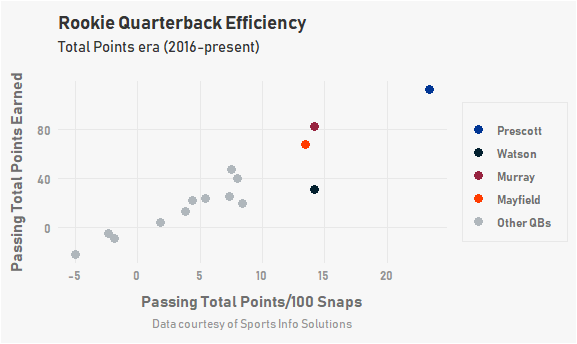
    The good news is that Murray had one of the better rookie seasons in recent memory. In fact, it was probably the best since Dak Prescott’s 2016 Rookie of the Year campaign.

    Kyler Murray graphic

    Although Murray is hoping to avoid the second year slump that fellow Sooner alum Baker Mayfield experienced, he flashed high-level quarterbacking at times as a rookie and gave Cardinals faithful a lot to be optimistic about.

    Murray was one of the better quick-game quarterbacks last year thanks to his quick footwork, fast release, ability to access different arm slots, and exceptional arm talent.

    While his ranks of eleventh and twelfth in success rate (57%) and EPA/Attempt (0.15) were respectable, his differential in Predicted Completion Percentage from his actual completion percentage (pComp+/-) of 6.1% on true quick-game drops (i.e. no RPOs, no screens) was elite, ranking fifth in the NFL among qualifying passers (minimum 50 attempts). He was effective in safeguarding the ball in these concepts, ranking eleventh in turnover-worthy throw rate (1.8%). 

    The same traits that made him successful in the quick game helped him pilot the screen-happiest team in the NFL (8% of all plays in 2019) to the fourth-best success rate (52%) on screens.

    The Cardinals would presumably like to do more than dink and dunk down the field in 2020, though. Murray ranked seventh in on-target rate on deep passes (58%) among 21 quarterbacks with at least 50 attempts thrown at least 20 yards down the field. 

    However, in order for them to maximize Murray’s deep ball prowess, the protection will need to hold up better than it did in 2019. Starting tackles D.J. Humphries (4.3%) and Justin Murray (5.2%) ranked 55th and 66th in blown block rate in pass protection out of 76 offensive tackles with at least 200 pass sets in 2019. And J.R. Sweezy (3.0%, 54 of 68) wasn’t much better among guards.

    For as good as Murray was as a rookie, the Cardinals didn’t have a lot of touchdowns to show for it. In fact, they were dismal in the red zone last year. 

    Regardless of whether you examined their efficiency with the traditional measuring stick (48% TD rate, 28th in NFL), through an Expected Points lens (-3.6 EPA/100 Plays, 18th in NFL), or by an eye test which revealed that they ran goal line fades at a disturbingly high rate (18%, 4th in NFL), it’s clear that the red zone was a no-fly zone for the Cardinals in 2019. 

    Air Raid offenses are often maligned for being ineffective inside the opponent’s 20-yard line, and while that was certainly the case this past year, there is reason for optimism moving forward. 

    Murray suffered the sixth-largest dip in average Passing Points Earned/100 Snaps from the rest of the field to the red zone, a dip of -18.6/100 Snaps. That alone should suggest that some positive regression is coming, as there is research that suggests that quarterback red zone performance is unstable

    The Cardinals’ diminutive signal caller is not without his flaws, however. One opportunity for growth is his touch on layered throws placed over a second level defender and under a safety. He ranked 22nd of 31 qualifying players (minimum 50 attempts) in pComp+/- on over-under balls (-3.9%) and 24th among that same group in on-target rate (66%). 

    He would also benefit greatly from developing the ability to navigate the pocket upwards and outwards rather than defaulting the wrong way. His average sack depth (-6.4 yards) was about average (-6.6), but he took a loss of 10 yards or worse on 29% of his sacks, good for the third-worst rate among qualifying quarterbacks (min. 20 sacks) and far worse than the average of 17%. 

    Pressure also turned into sacks at an abnormally high rate for him. 30% of all his pressures resulted in a sack, the fifth-worst rate among quarterbacks with at least 100 dropbacks and 1.5 times the league average of 20%.

    As a rookie, Murray continued to grow as a dropback passer in a league with plenty of detractors who doubted his ability to succeed in structure. His physical gifts and point-and-shoot passing acumen were evident at Oklahoma. Now, he is honing his anticipation and showing the requisite mental processing to excel in quick-game at the NFL, two promising signs for his development. If this trend continues, Murray and the Cardinals will have the league on notice in no time.

  • Who were the best quarterbacks throwing long passes in 2019?

    By: Kyle Rodemann

    The deep ball is one of the most exciting plays in the NFL. Momentum can change at the drop of a hat the instant the football leaves the quarterback’s hand. Some quarterbacks are known as deep ball throwers, and this was noted during Sunday’s NFC Wild Card game  when Cris Collinsworth stated that Russell Wilson is the best deep passer in the NFL during the game’s broadcast. Was he right? This article will answer that question.

    For our purposes, we’re referring to passes thrown at least 20 yards downfield, unless otherwise stated.

    The Precision Passers

    Which quarterbacks are most accurate with their deep throws? The table below shows the players with the highest Catchable Percentage on passes that travel at least 20 yards down the field (minimum 30 attempts). This stat looks at the passes that should be caught by the receiver based on where the pass is placed. Keep track of the players on this list, and compare this list to the “gunslinger” table that follows.

    QuarterbackCatchable %
    Jimmy Garoppolo72%
    Matt Ryan67%
    Gardner Minshew60%
    Drew Brees60%
    Daniel Jones60%
    Kirk Cousins59%
    Carson Wentz/Baker Mayfield58%

     This list shows how dominant Jimmy Garoppolo has been when throwing the deep ball, throwing an accurate pass 72% of the time. Compare that to Jameis Winston’s 54%, and you can see why Winston was prone to interceptions.

    In terms of who is completing deep passes most often, Garoppolo leads the league with a 59% completion percentage (19-of-32). He’s followed by Gardner Minshew (22-of-45, 49%), Patrick Mahomes (29-of-62, 47%), Drew Brees (14-of-30, 47%) and Dak Prescott (33-of-74, 45%). 

    The Gunslingers

    A “gunslinger” is a quarterback that takes chances downfield by taking deep shots to their receivers. These quarterbacks are notorious for throwing the deep ball. The 2019 season had plenty of these quarterbacks, with the top gunslinger being known as a risk-taker. Here are the 2019 deep ball attempt leaders:

    QuarterbackNumber of Throws
    Jameis Winston101
    Aaron Rodgers88
    Dak Prescott74
    Philip Rivers73
    Russell Wilson71
    Carson Wentz69
    Deshaun Watson67

    Jameis Winston was a very aggressive quarterback in 2019. He threw 13 more deep balls than the second quarterback on the list, Aaron Rodgers. This comes as no surprise since Winston is known to chuck the ball deep to his top receivers, Chris Godwin and Mike Evans. Carson Wentz makes a surprise appearance on this list with 69 deep throws. This is a surprise considering most of his starting receivers were injured for a large part of the season. 

    The Touchdown Machines

    Touchdown percentage looks at the percentage of deep throws that result in a touchdown. The following list can help determine where negative regression is possible, as a high touchdown percentage is often unsustainable. Here is the table (minimum 30 attempts):

    QuarterbackTD%
    Jimmy Garoppolo22%
    Patrick Mahomes19%
    Daniel Jones17%
    Kirk Cousins14%
    Drew Brees13%
    Lamar Jackson13%
    Dak Prescott12%
    Tom Brady12%

    Garoppolo again leads this list of deep ball passers. He not only is throwing an accurate ball, but is finding success scoring touchdowns on such plays. Maybe this means Kyle Shanahan will draw up more shots for his quarterback in the postseason? Daniel Jones also makes it on his second list, showing that the rookie has a knack for throwing deep. Keep an eye on him in 2020.

    The Most Impactful

    Points Earned is one way to determine which quarterbacks have made the largest positive impact while throwing the deep ball. Here is a quick explanation of Points Earned, as written by Alex Vigderman:

    The core assumption of passing Points Earned is that each throw has a certain expected outcome based on information like the route, the depth, and the coverage. From that point, the passer and receiver split responsibility for how well they perform above that expectation. Throwing off-target passes and deserved interceptions (caught or not) will bury a signal-caller, while he will be rewarded for leading receivers to more yards after catch and making something out of a broken pocket.

    A more in-depth explanation can be found here. This stat shows which quarterback has helped their team win the most while throwing the deep ball. Check out the league leaders below:

    QuarterbackPoints Earned
    Russell Wilson31.4
    Kirk Cousins28.0
    Dak Prescott23.3
    Gardner Minshew22.3
    Jimmy Garoppolo22.1
    Kyler Murray19.6
    Patrick Mahomes18.6

    Wilson rates best. His 31.4 points is three higher than Kirk Cousins’ 28.0 at number two. This stat shows how impactful Wilson has been on his deep throws.

    Getting specific, Wilson was 30-of-71 (42%) with six touchdowns, two interceptions and 40 catchable throws (56% of throws were catchable). Wilson averaged just over 30 air yards per completion, which ranked second to Ryan Tannehill’s 31 among quarterbacks who completed at least 10 such passes.

    Kyler Murray is a surprise name on this list. The exciting rookie has room to grow in Kliff Kingsbury’s offense.

    Conclusion

    Collinsworth was right in this regard: Wilson is definitely the most impactful deep passer. But there are plenty of other quarterbacks right there with him, including a few who we’ll see this weekend in the Divisional Round. We’ll see which one comes out on top.

  • Top props for 49ers-Cardinals

    By Steve Schwartz

    Week 9 begins in Arizona where the unbeaten San Francisco 49ers look to keep their record clean against an improving Arizona Cardinals squad. Be sure to check the status of star running back David Johnson (ankle) before doing anything. He’s missed all but three snaps in the past two games and I don’t expect him to be in this one either, but a late change could have an effect on some prop bets.

    Props are evaluated using SISBets.com – our overall record is 15-9, including 4-0 and 3-1 the last two weeks (the only wrong pick was a longshot on whether Case Keenum would score a touchdown). Odds from ParxCasino.com

    1) Jimmy Garoppolo, 18.5 completions, over -139.

    Garoppolo hasn’t cracked the 18-completion mark in either of the last two games, but I’m blaming extenuating circumstances more than the quarterback. A monsoon in Washington led to little passing and an easy shutout win and last Sunday an early 21-point burst made passing an afterthought. In his first five games, he averaged 20.4 completions. The SISbets data makes a fair value at -330 on this prop bet and we are only paying -139.

    2) Kenyan Drake, score a touchdown +260.

    The newest Cardinals back will get some immediate work because he’s the most talented of what remains after injuries to Johnson (ankle) and Chase Edmonds (hamstring). It’s Drake or last week’s signings Zach Zenner and Alfred Morris. Our numbers say Drake should be +150, but here we are getting much more than that at +260.

    3) Kyler Murray, 0.5 interceptions, under +134.

    Murray has gone four consecutive games without throwing an interception after throwing four in the first four games. He learns quickly. He’ll likely be under a heavy rush for the 49ers front line in this one, but that just means he won’t be throwing late over the middle which frequently is a very bad thing for under bettors. Instead he’ll use his legs after the first read and run. Run Kyler run! We make fair market value at -122 and we are getting +134.

    4) Jimmy Garoppolo, 1.5 touchdown passes, under +133.

    “Jimmy G” has just nine touchdown passes in seven games and even throwing out the monsoon game in Week 7, he’s still averaging just 1.5 touchdown passes per game. Meanwhile, the undefeated 49ers have rushed for 13 scores on the ground this season. We make a fair number at -110, but we are getting +133 here. Take it.

    Sports Info Solutions has been an innovator in the collection and analysis of sports data for almost two decades. SIS specializes in baseball and football data, using professional scouting practices to collect the most detailed and accurate information in both sports. Their data can be found in the majority of team front offices, and on websites such as Fangraphs and Football Outsiders.

    Quarterback Touchdown Passes

    ——————————————

    Jimmy Garoppolo, 1.5, over -167/under +133

    Kyler Murray, 1.5, over +168/under -215

    Quarterback Interceptions

    ———————————–

    Jimmy Garoppolo, 0.5, over -112/under -112

    Kyler Murray, 0.5, over -167/under +134


    Quarterback Completions

    ———————————-

    Jimmy Garoppolo, 18.5 completions, over -139/under +112

    Kyler Murray, 20.5 completions, over -106/under -118


    Touchdown Scorers

    ————————–

    San Francisco –

    Tevin Coleman -125
    George Kittle +120
    Emmanuel Sanders +175
    Jeff Wilson +210
    Raheem Mostert +210
    Matt Breida +210
    Deebo Samuel +260
    Marquise Goodwin +300

    Dante Pettis                    +450

    Jimmy Garoppolo          +700


    Arizona –

    David Johnson +150
    Larry Fitzgerald +250
    Kenyan Drake +260
    Christian Kirk +275
    Kyler Murray +375
    Zach Zenner +375
    Damiere Byrd +450
    Alfred Morris +550


    Total Receptions

    ———————-

    San Francisco –

    George Kittle, 5.5, over -165/under +132

    Emmanuel Sanders, 4.5, over +143/under -180

    Marquise Goodwin, 2.5, over +183/under -235

    Deebo Samuel, 2.5, over -155/under +124


    Arizona –

    Larry Fitzgerald, 3.5, over -125/under +101

    Christian Kirk, 4.5, over +114/under -141


  • NFL Rookies to Watch on Thursday Night

    NFL Rookies to Watch on Thursday Night

    By John Shirley

    Football season officially kicked off last Thursday with the Hall of Fame Game, but tomorrow night is the first night with multiple games to watch and analyze.

    And nothing is more fun to analyze in the Preseason than all the new rookies. Some of these rookies are expected to take the league by storm right out of the gate, some will be trying to quiet critics that have already deemed them a bust, some will be trying to make a solid impact on their new team, and others will just be trying to prove they belong in the NFL.

    Here are 8 rookies to watch for tomorrow that range in draft status and expectations, along with stats and an excerpt from their scouting reports in the Sports Info Solutions (SIS) Football Rookie Handbook (click the link to purchase):

    Trying to live up to expectations:

    Arizona Cardinals QB Kyler Murray – The Cardinals offense will be interesting to watch all season, and this will be the first look at their new franchise QB. In his lone season as a starter at Oklahoma, Murray could not have been better. Among QBs in the Handbook, he ranked first in Yards / Attempts (11.6), On-Tgt% (79%), Independent QB Rating (143.2), Expected Points Added (EPA)/ Dropback (.47), and Rushing EPA (61.4). He also compares well to last season’s No. 1 overall pick, Baker Mayfield.

    Detroit Lions TE T.J. Hockenson –  During the lead up to the Draft there was debate about whether Hockenson or fellow Iowa TE Noah Fant was the top player at the position. The Lions ended up making Hockenson the highest drafted TE since Vernon Davis (6th pick in 2006). If last season is any indication, Hockenson should have no trouble living up to those lofty expectations. He led all Handbook tight ends in Receiving EPA (47.4) and ranked 5th in both Target Share% (17%) and Yards per Route Run (2.3 yards). And he did all of this while sharing the field with another first round talent at TE.

    Trying to quiet the critics:

    New York Giants QB Daniel Jones – This will be the first in-game look at the Giants top pick and heir apparent to Eli Manning. The Giants have taken criticism for what some saw as reaching for Jones with the sixth pick, but he can quiet the critics with a strong preseason. That said, he will need to show an understanding of the offense and improve upon his 75% On-Target Throw Percentage (On-Tgt%) as a junior, which ranked ranked 8th out of 13 qualified Rookie Handbook QBs (Murray was best at 79%).

    Denver Broncos QB Drew Lock – Lock is another QB that was drafted as an heir apparent, though he has faced less criticism as a second round pick. Similar to Jones, Lock will need to improve his accuracy moving forward as he had an even worse On-Tgt% of 73% his senior season. One of the bright spots for Lock in college was his deep passing ability. He thrived on these throws and had an IQR of 135.4 on deep throws last season (IQR is scaled the same as QB Rating, but doesn’t penalize a QB for dropped passes or reward him for dropped potential interceptions)

    Trying to make an impact:

    Buffalo Bills RB Devin Singletary – Singletary will be trying to stand out in a crowded Bills backfield that includes veterans LeSean McCoy, Frank Gore, and T.J. Yeldon. To do that he will need to show the same ability to break tackles and excel on off-tackle runs that he showed in college. Last season he broke tackles at a rate of 41 per 100 touches, which led all Handbook running backs. Over the last three seasons he averaged 7.2 yards per carry on off-tackle runs.

    Green Bay Packers LB Rashan Gary – The Packers spent big on free agent pass rushing help this off-season and then also drafted Gary with the 12th overall pick. During training camp, Gary has impressed with the physical traits that made him such a high pick, as he tries to become a big part of the Packers edge rotation. When he does get on the field he should make an impact in the passing game (13% Pressure Percentage last season) and in the running game (opponents averaged only -0.38 EPA per rush attempt when running towards him). Another interesting aspect to watch in the preseason is how Gary performs when asked to stand up as an OLB. Last season at Michigan, he had his hand on the ground 99% of the time and rarely dropped into coverage. 

    Trying to make a name for himself:

    New England Patriots QB Jarrett Stidham – Unlike Jones and Lock who were higher picks, Stidham will need to audition for the role of heir apparent. Stidham is also coming from a college offense that is very different than what he will be running in the NFL. These points mean that the preseason will be vitally important for him to showcase his ability. Although his completion percentage declined by six percentage points from his junior to senior seasons, his Catchable Throw% actually increased from 80% to 81% and he had a higher On-Tgt% (77%) than Jones or Lock. He also showed an ability to read zone coverage in college by posting an IQR of 124.1 versus zone last season.

    Miami Dolphins CB Nik Needham – Needham was a favorite among all the SIS Video Scouts who studied his tape. He is an under-the-radar undrafted prospect from UTEP, but has already spent some time practicing with the Dolphins first team defense in camp. During the next four games he will attempt to showcase the coverage skills that led our scouts to rank him the fourth best CB in the Draft. Over the last three seasons Needham allowed a Completion% of only 44% on 126 targets and an EPA / Target of only -0.14.

    For more football content, check out the new episode of the Off the Charts podcast. Click here for the link