Author: Alex Vigderman

  • SIS Announces Partnership with BetVictor to Supply CEBL Data and Odds

    SIS Announces Partnership with BetVictor to Supply CEBL Data and Odds

    TORONTO, ON– May 23, 2023 – Sports Info Solutions (SIS) has announced a partnership with BetVictor to supply Canadian Elite Basketball League (CEBL) data and odds.

    Building upon the partnership established between SIS and the CEBL in 2022, SIS has developed new tools and capabilities for the CEBL, inclusive of data collection and data visualisations living on CEBL.ca along with the distribution of real-time CEBL data and odds, with special emphasis on delivering an innovative experience surrounding the Target Score finish.

    Dan Hannigan-Daley, CEO of Sports Info Solutions, said, “As the CEBL enters its 5th season, it has been great to collaborate with the league and unlock new and improved experiences for their operations team, consumers and, of course, sports bettors. We’re ecstatic to partner with a global betting leader like BetVictor and take the fan experience to the next level ”

    BetVictor and the CEBL announced their partnership last week, naming BetVictor as the official sports betting partner of the League.  

    Matt Scarrott, Director of Emerging Markets at BetVictor said, “We are proud and delighted to be the official sports betting partner of the CEBL. This new and exciting partnership with SIS, and the rich and real-time sport data, insights and odds supplied by them, will help us establish ourselves in Ontario and take the product onto the next level for CEBL fans.”


    SIS enhances collaboration between CEBL and BetVictor, enabling fans to utilize their extensive data for Money Line, Point Spreads, and Over/Under bets in the upcoming CEBL season.

    ###


    About SIS

    Pioneers in the sports data space since 2002, their mission is to enrich and optimize the decision-making process for sports teams, sports leagues, sportsbooks, and sports fans. Learn more at www.sportsinfosolutions.com.

    About CEBL

    A league created by Canadians for Canadians, the CEBL is Canada’s pre-eminent professional basketball league. The league has the highest percentage of Canadian players of any professional league

     in the country, with 75 percent of its rosters being Canadian. Players bring experience from the NBA, NBA G League, top international leagues, the Canadian National team program, and top NCAA programs as well as U SPORTS. The only First Division Professional League Partner of Canada Basketball, the CEBL season runs from May through August.

    About BetVictor 

    BetVictor is an online gambling company and B2B solutions provider licensed in the UK, Germany, Ireland, Gibraltar, Malta, the Isle of Man and Ontario. Founded in 1946, the privately owned gambling operator employs more than 650 people worldwide with its global headquarters based in Gibraltar.

    Offering sportsbook, casino and bingo, BetVictor is committed to protecting customers from gambling related harm and is dedicated to improving the gambling experience by leveraging in-house developed technology and innovative products.


    CONTACTS:

    SIS

    Kelsea Benoit

    kbenoit@ww2.sportsinfosolutions.com

  • Reviewing 6 Studies and How They Apply To The 2023 NFL Draft

    Reviewing 6 Studies and How They Apply To The 2023 NFL Draft

    For a full treatment of the draft results and team grades, check out this magnum opus from Nathan Cooper, the head of our scouting operation.

    We wrote a bunch of articles in the run-up to the NFL Draft that evaluated players, teams, and the league as a whole. How does what happened in this year’s draft reflect on what we learned through those pieces? 

    Combine Measurements and Total Points – Do they Correlate?

    Our article on combine measurements looked to see how well they correlated to a player’s 2-year Total Points production value. We broke down all positions and their relative Total Points categories to see what combine measurements correlated well to success early on in a player’s career.

    Anthony Richardson (Colts) set a broad jump (10’9”) and vertical jump (40.5”) record for quarterbacks at the combine. The broad jump has the highest correlation of Total Points production for quarterbacks, so his gaudy combine numbers may translate well if he is the presumed starter off the bat in Indianapolis. New head coach Shane Steichen …what are you gonna do? (more on Richardson in a little bit)

    The Chiefs traded up in the second round to get SMU receiver Rashee Rice. Rice was tied with West Virginia’s Bryce Ford-Wheaton with the highest vertical jump (41”), which also shows a good correlation for receiver success. Patrick Mahomes worked out with Rice during the offseason, so he was able to see first hand the leaping abilities that his newly acquired weapon has.

    What Does a College Receiver’s Route Tree Say About Their Pro Prospects?

    In this article, we looked at what it means for a player to have a route tree that projects well to the NFL. There were three iterations of that analysis, and it gave us some players to watch out for.

    – How many unique routes did a receiver run in college?
    – What percentage of their routes were among the NFL’s ten most common?
    – How did their rank order of route types run compare to the NFL average?

    Each of these is a bit more refined towards the NFL route tree than the other, but each resulted in similar suggestions of players who might outperform or underperform expectations. 

    On the high end, players like Jalin Hyatt (Giants) and Cedric Tillman (Browns), who came out of Tennessee and went back-to-back in the third round, had route trees that aligned well with the NFL. TCU’s Quentin Johnston (Chargers) also appeared on multiple lists on the positive end.  Zay Flowers (Ravens) and Josh Downs (Colts) are the most at risk of underperforming, receiving red flags in all three variations of this analysis.

    The 2023 QB Conversation: How Teammate and Schematic Context Impacts It

    We’ll keep this one short. There were some interesting dives into different contextual elements that affect how we should evaluate the profiles of the top four quarterback prospects in this draft, but the biggest takeaway was just that Bryce Young (Panthers) and C.J. Stroud (Texans) had massive production, and they stood head-and-shoulders above the other QB prospects (and in line with previous top picks).

    This is mostly just to say that we might have been overthinking things a bit when there were conversations about the Texans passing on Stroud (and they ended up having their cake and eating it too by taking Will Anderson Jr. as well).

    Revisiting Our Draft Pick Value Curve

    We took another look at our Total-Points-based draft pick value curve through a couple of lenses in this article, but we can also just run the model for the trades that happened during the draft.

    This year’s first-round trades were pretty tame, in part because teams didn’t move that much. The biggest move by far was the Texans jumping up to No. 3 to take Anderson, which cost them a hefty price. Even if we assume that next year’s draft picks—of which the Texans dealt their first and third rounders—are worth a quarter of a pick in the current year, the size of their overpay was as big as any trade the last couple drafts.

    But if they assign little value to next year’s picks, the Texans weren’t very consistent in that approach. In a flurry of trades to start Day 3, they dealt the third pick of the fourth round to the Eagles for next year’s third rounder. From the perspective of our model, the Eagles actually underpaid to get to that slot, in a rare instance of a team not paying a premium to trade up. 

    Which NFL teams Would Be Most Justified In Drafting For Need?

    Speaking of the Eagles, we devised a measure of the quality of each team’s starters to find the teams for whom drafting for need would be most appropriate, and Philadelphia came out on top.

    Of course, they pretty much did what they typically do by taking quality trenches players with their first three picks, but they did use later picks to address some of the holes that remain on an otherwise fearsome roster.

    Another team we highlighted, the Chargers, took a best-player-available approach as well. They did not address their biggest holes in the secondary and interior offensive line. 

    The Titans and Raiders both had entire position groups that needed help—Tennessee’s offensive line and Las Vegas’ secondary—so they only could have done so much. The Titans took Peter Skoronski with their first pick, but the Raiders didn’t address the back end of their defense until the fourth round.

    Anthony Richardson’s Accuracy: A Closer Look

    Regardless of how Colts fans feel about Anthony Richardson as a prospect, there must be some degree of optimism around his marriage to new head coach Shane Steichen. 

    Jalen Hurts and Richardson are different players, but Steichen was able to develop and maximize the former’s talents, especially in the run game. Hurts went from being on the hot seat to securing a $255 million extension, including substantial improvement as a passer. Even if you don’t believe in Richardson right now, the past results should be encouraging for a prospect like him who is considered to have a low floor.

  • Which NFL teams Would Be Most Justified In Drafting For Need?

    Which NFL teams Would Be Most Justified In Drafting For Need?

    We’re going rogue in the SIS Football Research department, and we’re going to do something that our fearless leader Matt Manocherian would almost certainly not approve of: we’re going to analyze the NFL Draft from the perspective of team needs.

    While we acknowledge that every team is always an injury away from having a brand new need, there must be some teams for whom need-based drafting would make more sense than others. Here’s our attempt at sorting that out:

    Separating “Wants” from “Needs”

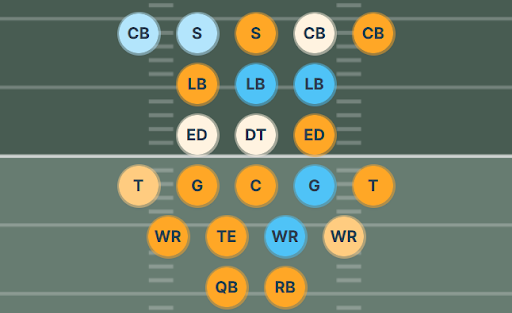
    To evaluate each team’s roster, we used the Sonar Depth Chart that we publish on the SIS draft site and the 33rd Team site. For this visualization, each starter on the depth chart is evaluated relative to the rest of the league using their Total Points per game in their most recent season’s worth of games.

    Using Sonar, we thought of teams as having “wants”—starters that are below the 50th percentile—and “needs”—positions that are below the 25th percentile. We then determined the extent of a team’s wants and needs by how far off each position was from no longer being a want. 

    To identify teams with the most specific needs, for each team we compared the total extent of their needs to the total extent of their wants, simply by subtracting them. 

    For example, a team that’s middle-of-the-road across the board with the exception of three players who are in the 20th percentile would have the highest possible rating, because all of their sub-par positions are positions of need. A team that’s full of 33rd percentile players would probably be rated as worse overall, but they wouldn’t have any specific needs. 

    So, here is every team in the league ordered by this metric, with links to the team pages on the SIS draft site. A handful of teams are spelled out in more detail, but you can evaluate all of the rosters yourself by following each link.

    And for reference, here is the color scale used to illustrate the quality of each starter:

    Color scale for the Sonar depth chart visual. Blue is low and orange is high.

    1. Eagles

    Sonar depth chart visualization for the Eagles. They have low-quality starters at two linebacker positions, right guard, and third wide receiver, a couple of below-average positions, and mostly good players otherwise.

    Just look at this depth chart and you know we’ve nailed the goal of identifying teams with specific needs. For a team coming off an excellent season they aren’t as well-positioned to take “luxury picks” as you might think, especially after losing multiple defensive starters to free agency. They have multiple first rounders, so they could have an opportunity to go for both a position of need and a best-player-available selection.

    2. Seahawks

    3. Chargers

    Chargers Sonar depth chart visual. Their worst position is slot cornerback, they have below average players at S, DT, RT, and WR3, as well.

    The Chargers might need to look at a cornerback early on after struggling to solidify the opposite side of Asante Samuel Jr. with a struggling and injured J.C. Jackson. Adding a defensive tackle would fill one of their biggest needs too. Filling these major needs can make this one of the most complete rosters in the NFL.

    4. Raiders

    Raiders Sonar depth chart visualization. They have very bad starters at all but three defensive positions, as well as below average players at both guard positions and quarterback.

    The Raiders have many more holes than the teams ahead of them on this list, but they are almost all strong needs. Their struggles primarily fall on the defensive side of the ball, with a back seven that Sonar makes look like the cast of the next Avatar movie. They finished the season 2nd to last in Pass Defense Total Points and allowed the highest EPA/play on passes. In addition to the backend, their linebacking corps can use improvement after losing Denzel Perryman to the Texans. Sitting at pick No. 7, they are in a good spot to address one of these defensive holes.

    5. Titans

    Titans Sonar depth chart visualization. They have poor players all along the offensive line, at two of three wide receiver slots, at LB and at CB, with several players just above or below average.

    The Titans have major needs on the offensive side of the ball. After presumably losing Taylor Lewan to free agency, the Titans need to address their offensive line that already was in the bottom third in production a season ago in terms of Total Points. On top of that, another receiver would be welcomed after finishing in the bottom tier of Receiving Total Points. If the Titans end up taking a QB in the first round, it might be an unenviable position to be in for the young signal-caller.

    6. Bengals

    7. Vikings

    8. Saints

    9. Ravens

    10. Jaguars

    Jaguars Sonar depth chart visualization. They have poor starters at slot cornerback and right tackle, several average players on the offense and defense, and a handful of strong starters across both sides of the ball.

    It might not look it based on the Sonar visual, but the Jaguars actually rated as the team with the smallest total value of their wants. There are opportunities for improvement on the offensive line and in the back seven defensively, but they’ve established solid starters on both sides of the ball. They won’t have as good of an opportunity to improve through the draft as they have in recent seasons because they were actually pretty good in 2022, but that’s a problem they’d accept.

    11. Texans

    12. Dolphins

    13. Cardinals

    Cardinals Sonar depth chart visualization. They have poor starters at several positions on each side of the ball, with strong starters at S and WR (both of whom have requested trades).

    And here we have the neediest team, but one with enough wants to go with them that they don’t top this list. The Cardinals could use the most help in their front seven after a couple of key departures, and their depth at receiver could look a lot better if Marquise Brown and Rondale Moore take steps forward in 2023 (or a lot worse if DeAndre Hopkins departs). Kyler Murray has his faults, but he’s not going to be replaced with the No. 3 pick in this year’s draft, so they have a great opportunity to start filling in these gaps.

    14. Packers

    15. 49ers

    16. Jets

    17. Broncos

    18. Browns

    19. Chiefs

    20. Commanders

    21. Bills

    Bills Sonar depth chart visualization. They have poor starters at LB and WR3, two strong starters on each side of the ball, and a bunch of players in the middle.

    The Bills roster is balanced and strong. Wide receiver and linebacker are their biggest needs, but they could also stand to bolster the offensive tackle position as well. Sitting at pick No. 27, they certainly won’t have a first choice of who they want, so it would be wise to take the best player available.

    22. Patriots

    23. Steelers

    24. Lions

    25. Giants

    26. Buccaneers

    27. Colts

    28. Falcons

    29. Cowboys

    30. Bears

    31. Rams

    Rams Sonar depth chart visualization. They have below-average players at nearly all defensive positions and just three solidly above average players.

    How things have changed in the span of two years! The Rams look like a bare cupboard after several post-Super-Bowl departures, and one of the better positions listed on their Sonar is headed up by tight end Tyler Higbee, whose usage and hands performance in 2022 suggest he’ll be more valuable as a blocker than receiver going forward. They have the most wants in the league, but, because there are so many of them, their targets shouldn’t be as defined as the teams above them.

    32. Panthers

    Panthers Sonar depth chart visualization. They have average-to-better players at all but one defensive position, but below-average players at most offensive positions (with no poor starters, however).
    The Panthers are a great example of what we’re trying to do here. They have zero needs by this measure, but have several wants (primarily on the offensive side of the ball). Establishing a franchise QB with the first pick in the draft will help, but there is definitely some work to be done across the skill positions with DJ Moore out of the picture. The Miles Sanders signing isn’t viewed too positively through the Total Points lens, but there’s no doubt they’re in a better spot at running back than they were without him.

  • SIS Hires Sujoy Ganguly as Chief Data Scientist Amid its Advancement in the NBA Team Analytics Space

    SIS Hires Sujoy Ganguly as Chief Data Scientist Amid its Advancement in the NBA Team Analytics Space

    SIS, a leader in advanced sports data and analytics, has announced Sujoy Ganguly as its new Chief Data Scientist. With his impressive computer vision background at Stats Perform and Unity Technologies, coupled with a Ph.D. in Applied Mathematics and Theoretical Physics from the University of Cambridge, Ganguly brings a wealth of experience to the senior leadership team at SIS.

    Jake Loos, Senior Vice President of Basketball and Innovation at SIS, said, “We’re beyond thrilled to add Sujoy to the team. His immense experience as a leader in the machine learning and computer vision industries will be invaluable as we look to escalate our data creation and modeling capabilities. We are eager to continue innovating and Sujoy is a crucial piece to realizing those ambitions.”

    As Chief Data Scientist, Ganguly will first be spearheading the development of cutting-edge technical components to enhance SIS’ team-facing analytics provision in the NBA.

    Ganguly’s hire is the latest in a series of many exciting advancements that SIS is making in the advanced team analytics product space. In Q1 of 2023, SIS rolled out basketball versions of a new batch of team-facing products, making its rich and groundbreaking data more insightful to clients than ever before. 

    Ganguly and his team will continue to drive innovation on these tools as the company launches baseball and football versions for team, media, and betting clients throughout the rest of 2023.

    A screenshot of SIS’ new NBA data exploration platform, bringing endless insights and queries of the data seen on its basketball Twitter page to clients’ fingertips.

    ###

    About SIS
    Pioneers in the sports data space since 2002, their mission is to enrich and optimize the decision-making process for sports teams, sportsbooks, and sports fans. Learn more at www.sportsinfosolutions.com.

    CONTACT
    Kelsea Benoit
    kbenoit@ww2.sportsinfosolutions.com

  • Revisiting Our Draft Pick Value Curve

    Revisiting Our Draft Pick Value Curve

    Last year we dipped our toes into the conversation about draft pick value. Stephen Polacheck took two-year Total Points as the measure of performance and computed a curve that represents what you can expect from a selection throughout the draft.

    This year we’ll take that work and extend it to two particular lines of inquiry: the potential value over a full contract, and the value teams are ascribing to future picks.

    Production over a full rookie deal

    Our previous iteration looked only at the Total Points accumulated in a player’s first two years. This is in line with how our scouting process works, as our grades project a player through his second NFL season. But there are enough players who jump up or fall off in the final years of their rookie deals that we wanted to look at a longer time horizon as well.

    Here are the draft curves that we generate after each year in the first four. 

    The biggest thing I notice when looking at these plots is that, in general, the differences between the curves are pretty consistent year-over-year. That basically means that we’re not seeing some kind of dramatic change in production of players in their third season, or something like that.

    We can see a production advantage for early first round picks that persists throughout the player’s first contract. A player taken at the top of the first round essentially doubles the productivity of a player taken at the end of the first round at each step. That suggests top picks are overvalued by the rookie wage scale, which gives top draft picks roughly three times the contract value of a player selected at the end of the first.

    You should notice the little hitch in the curve at around the end of the second round. That’s in part because these curves are actually made by blending a steeper first round curve with a more gradual full-draft curve, which results in a curve that doesn’t have a single smooth trajectory. But it’s also a kind of quirky peak of productivity over the past several years that is hard to fully smooth out. Just picks 62 to 64 from 2016 to 2021 have produced Carlton Davis, Kevin Byard, James Bradberry, Creed Humphrey, JuJu Smith-Schuster, and DK Metcalf.

    Applying the value curve to previous trades

    At this point we’re pretty familiar with the notion that the relatively flat curve of draft pick value past the top of the first round suggests that trading back is generally a pretty valuable proposition. 

    For example, all of the seven pick-for-pick trades in the first round of the 2022 draft yielded more total expected production for the team moving down than the team moving up. How much value that is depends on which of the above curves you use, but the general trend is the same.

    What I’ve found more interesting of late is the trading of future picks. Just in the first round of the 2021 draft, three pick-for-pick trades involved a future first round pick changing hands:

    • The 49ers moving up 9 slots to take Trey Lance
    • The Dolphins moving up 6 slots to take Jaylen Waddle
    • The Bears moving up 9 slots to take Justin Fields

    It’s tough to build a model that prescriptively assigns value to a future draft pick, because teams should place different value on future assets based on their franchise trajectory. But trades that have already been made can tell us something about how much temporal discounting teams are building in.

    Let’s run these three trades through our model, comparing the projected four-year Total Points for the picks going each direction. We can assume that the difference between these values should be roughly the value teams are ascribing to the future picks included in those deals. 

    Projected Four-Year Total Points of Picks Traded in 2021

    2021 pick value  given up 2021 pick value received Suggested Value

    Rest of Trade

    49ers -> Lance 88 119 31*
    Dolphins -> Waddle 107 119 12
    Bears -> Fields 83 101 19*

    * Multiple future picks were traded

    For a little bit of context, that “rest of trade” value can be compared to the value of a single pick in the current draft. The 31 projected Total Points that make up the remainder in the Lance deal—and therefore roughly what we think the future picks are worth—is comparable to the 87th pick in the current draft. The future picks in the Waddle deal compare to the 153rd pick in the current draft, and for Fields it’s the 121st pick.

    So, if those trades were to be fair—which we actually shouldn’t expect them to be, because the team trading up is almost always going to pay a bit of a premium—the future picks would be valued at somewhere between a third rounder and a fifth rounder in total. Compared to a conventional-wisdom heuristic that a pick next year is worth one round less than a pick this year, we’re seeing some pretty heavy devaluing of future first round picks. 

    We can also think of this through the lens of the implied discounting rate for a pick year-over-year. The Waddle example suggests that a future first round pick—which we can assume is the 16th pick in the next draft, for simplicity—is getting discounted by about 85% within one year (from 79 projected Total Points to 12). The Fields deal has a similar implied discounting rate.

    Virtually all people employed by NFL teams are living in a world where you can’t guarantee your employment for very long, so it’s not unreasonable for teams to heavily devalue future draft picks. After all, even a draft pick this year might not bear fruit for two more seasons. But if teams are so willing to make trades to move up a few spots in the first round, it seems odd that they would value creating a first round pick from nothing, even if it’s deferred a year, would be more valuable than it seems to be.

    Future Directions

    With each year that we accumulate data, we also gather more firepower to build frameworks to evaluate the long-term value of players (and draft picks). Integrating draft pick value with long-term player projections will allow player-for-pick trades to be analyzed more usefully, and of course bringing in salary information (for player trades and for incoming rookies) informs teams’ decisions greatly.

    Look for us to reference these draft pick values in evaluating trades during the upcoming draft season. Of course, keep in mind that these models are still a work in progress when it comes to measuring some of the “softer” factors that contribute to trade decisions. We still have some work to do to measure how much we should expect a team to overpay for the right to move up, and how much scarcity of available players at the position being acquired moves the needle.

  • The Top Ranked NFL Draft Prospect At Every Position

    The Top Ranked NFL Draft Prospect At Every Position

    Each year, the SIS scouting staff puts their money where their mouth is and grades hundreds of the top players in the NFL Draft player pool. The SIS NFL Draft site combines those reports with advanced metrics to provide as complete a picture of each prospect as you can find.

    To celebrate the launch of the 2023 version of the site, let’s run through the staff’s top prospects at each position.

    (Of course, if you want, you can just look at the full big board, which still has more players coming in!)

    Quarterback: Bryce Young

    School: Alabama

    Grade: 6.9 (Solid starter)

    The SIS staff has Young and C.J. Stroud graded the same, but while Young’s body composition is the weakest trait between them, he only had three traits graded as sufficient or worse compared to Stroud’s five. Young’s poise, decision making, and pocket awareness and creativity are his biggest strengths.

    From Jordan Edwards’ report:

    “Young has a smooth and lightning-quick release while also showing the comfort and effectiveness to throw from different arm angles. He is consistently accurate especially in the short and intermediate areas of the field. While his deep ball accuracy is still good overall, he can miss his targets under pressure or when he can’t set his base. He has the arm strength to make most throws downfield and can put enough velocity on throws into tight windows.”

    On the statistical side, our measures of his arm strength and his ability to get the ball out show some flaws, but all other measures of production and accuracy compare very favorably to the rest of the class. His Total Points and Independent Quarterback Rating put him at the top of the group.

    For more stats on the rest of the quarterback class, check out the positional leaderboards.

    Running Back: Bijan Robinson

    School: Texas

    Grade: 7.0 (High-end 3-down starter)

    Robinson is the consensus top back in the draft, with an unimpeachable statistical record. He easily led draft-eligible running backs in Total Points per game, and did so while running into a heavy box twice as often as he did in previous years.

    Chad Tedder highlighted his vision in his scouting report:

    “Off the handoff, he does a good job at scanning the line and seeing where openings are going to be. He watches the movements of second-level defenders and can often set them up flowing one way before using his lateral agility to cut back behind them. If the space is not opening, he has the patience and trust of his line to allow for enough space to open for him to accelerate through.”

    He’s an asset in the passing game as a receiver, but his worst trait grade came as a pass blocker, where his vision and anticipation in the run game doesn’t quite translate as well.

    For more stats on the rest of the running back class, check out the positional leaderboards.

    Wide Receiver: Jaxon Smith-Njigba

    School: Ohio State

    Grade: 6.8 (Solid 3-down starter)

    C.J. Stroud didn’t rank as our top quarterback, but one of his receivers does top that positional group. Smith-Njigba didn’t play much in 2022, but his 2021 season would have put him at the top of the position in terms of Total Points on a total and per-play basis.

    He’s not an explosive athlete with big top speed, but he’s smooth and fluid with a good understanding of how to run routes running mostly from the slot.

    From Ryan Rubinstein:

    “In the passing game, Smith-Njigba excels in the slot. He consistently shows burst off the line and can beat press coverage with a studder step or by swiping the defender’s hands away. He mainly finds separation with quickness and route running, stemming to open holes in zone coverage or by manipulating defenders at the top of his route. Occasionally, he tends to get thrown off by contact at his stem but shows the ability to use his off hand to get separation and to recover back into his route.”

    For more stats on the rest of the wide receiver class, check out the positional leaderboards.

    Tight End: Michael Mayer

    School: Notre Dame

    Grade: 6.8 (Solid starter with Y & H ability)

    Mayer isn’t head and shoulders above other tight end prospects from a scouting grade perspective, but from a statistical perspective he dominated in his last year at Notre Dame. He ranked as the top tight end in 15 out of 22 tight end leaderboards.

    The scouting report from Jeremy Percy and Seamus Rooney highlights his hands and his solid blocking fundamentals.

    “Mayer has very good hands overall. He has great manual dexterity and is extremely smooth when using his hands independently from his body. He is also adept at extending fully and catching the ball away from his body, regardless of where the pass is.”

    “He showcases very good blocking fundamentals, plays under control, and makes getting in the way of his man his top priority while rarely lunging or whiffing.”

    Offensive Line: Peter Skoronski (OT)

    School: Northwestern

    Grade: 6.8 (Solid starter with positional flexibility)

    Skoronski ties with center John Michael Schmitz as the top graded offensive linemen, but the former takes the top spot in the rankings. 

    He excels in generating power from awkward positions. To hear Jeff Dean say it:

    “Power rushers have their work cut out for them, as he has a very good anchor and uses leverage to take away the opponent’s leg drive on these rushes. Even when dropped to one knee, he generates power to keep the rusher at bay and reestablishes himself in proper position.”

    On the statistical side, the team context around him makes him look a bit worse than he should, but even the stats that separate him from his context—like blown block rate—don’t show him as an elite producer.

    For more stats on the rest of the offensive line class, check out the positional leaderboards.

    Interior Defensive Line: Jalen Carter

    School: Georgia

    Grade: 7.0 (High-end 3-down starter)

    Carter’s generally viewed as a better prospect than his former teammates who were first round picks a year ago, but one who also has some red flags in terms of his off-field behavior.

    Ben Hrkach’s scouting report alludes to Defensive Player of the Year upside, but with some inconsistency as well. His elite disruption in the running game is communicated most strongly:

    “In terms of stopping the run, Carter has a collection of traits that are rarely found outside of a video game. With ideal size and bulk, Carter blends excellent base and upper-body strength with malleable power that allows him to work from awkward angles and reestablish the [line of scrimmage] while moving laterally.”

    Inconsistency often leads to less inspiring on-field metrics, and Carter is a victim of that to some extent. He shows elite run defense production—tackling ballcarriers much further upfield than typical—but the pass rush numbers are less stellar, even considering that he’s lining up inside.

    For more stats on the rest of the interior defensive line class, check out the positional leaderboards.

    Edge Rusher: Will Anderson Jr.

    School: Alabama

    Grade: 7.2 (High-end 3-down starter)

    The highest-graded player on the SIS board, Anderson burst onto the scene in 2021 with 4 more sacks and 13 more pressures than Aidan Hutchinson in his best season. His production slipped to merely quite-good in 2022, but the traits are still there to be a top performer.

    His best trait is his strength, which gives him some margin for error in terms of pass rush technique. Jeff Dean noted that he still has room for improvement in his repertoire of rush moves.

    “Due to his physical gifts, his pass rushing moves are still a work in progress. Outside of his impressive bull rush, the cupboard is a little lacking. He will flash promising swipe, spin, and push-pull moves, but they are not second nature at this point. Developing more effective counter moves will also be key to his growth, as he can seem a little lost when his initial attack fails. He appears content to stalemate the opponent or take more of a containing role if thwarted.”

    Dean also notes that Anderson has a high floor because of his skill setting the edge in the running game (although he could use improvement as a tackler).

    For more stats on the rest of the edge rusher class, check out the positional leaderboards.

    Off-ball Linebacker: Trenton Simpson (WLB)

    School: Clemson

    Grade: 6.6 (Lower-end starter)

    Simpson is one of four off-ball linebackers to be given the top grade at the position, with athleticism and versatility that make him particularly appealing.

    He might struggle to make an impact in the running game initially despite his size, but his flexibility as a coverage defender (particularly in zone) and a pass rusher on third down could have evaluators squinting and seeing visions of Micah Parsons.

    Jordan Edwards put his coverage ability this way:

    “He can close and gain ground quickly as a zone coverage defender to limit yards after the catch. He is a sure tackler and makes his presence felt on contact, using his length and physicality to bring ballcarriers down. His speed and ability to close quickly also allow him to play in the slot where he can cover and also blitz from depth.”

    Simpson’s limitations in the run game come through in his statistical performance as well. He had the worst Adjusted Tackle Depth Plus among off-ball linebackers on the SIS draft board, meaning he was tackling ballcarriers a good bit further downfield than typical.

    For more stats on the rest of the linebacker class, check out the positional leaderboards.

    Cornerback: Devon Witherspoon

    School: Illinois

    Grade: 6.8 (Solid 3-down starter)

    Witherspoon isn’t the same kind of press-man prospect that Sauce Gardner was coming out last year, but his experience playing primarily man coverage at the college level gives him intriguing upside.

    Here’s how Ben McClure described his ability playing up on the line in man coverage:

    “He has very good mirror/match technique in press coverage and rarely finds himself out of phase when pressing. He has the ability to run with receivers on crossing routes in press, and also be physical with the opponent off the line and stay tight to vertical routes.”

    Statistically, Witherspoon’s flexibility and dominance stand out. He allowed an insane 3.9 Passer Rating in 2022, and was among the best cornerbacks in the class in yards allowed per coverage snap in both man and zone coverage. And despite playing from the slot just a quarter of the time, he tied for the lead in Total Points per game from the slot.

    For more stats on the rest of the cornerback class, check out the positional leaderboards.

    Safety: Brian Branch

    School: Alabama

    Grade: 6.8 (Solid 3-down starter)

    Branch is a particular kind of safety prospect, as he played from the slot more than two-thirds of the time at Alabama. He shows natural ability as a coverage player, with his best trait grade being his football intelligence and instincts.

    From Ryan Rubinstein:

    “He displays good footwork at the top of routes and has very good reactive athleticism when flipping his hips, He shows the ability to consistently stick with his man in either press or off-man technique and shows very good mirror/match ability. He puts himself in positions to consistently contest catches and often is able to make plays on the ball to swat it away or try and go up for an interception.”

    In the run and pass game he plays with physicality. That shows particularly strongly in his run tackling numbers, which show he makes a lot of plays upfield and doesn’t miss many tackles.

    For more stats on the rest of the safety class, check out the positional leaderboards.

  • Sports Info Solutions Announces Launch into Soccer via Partnership with ReSpo.Vision

    Sports Info Solutions Announces Launch into Soccer via Partnership with ReSpo.Vision

    TORONTO, ON – SIS, a leading sports data and analytics provider, and ReSpo.Vision, a cutting-edge computer vision sports analytics company, announce a partnership where ReSpo.Vision will provide SIS with advanced soccer analytics data based on broadcast tracking technology. Concurrently, the two companies will collaborate on new products to enhance and automate data collection, tracking and the development of groundbreaking metrics for the beautiful game.

    Under the agreement, SIS will be able to integrate, analyze, and distribute ReSpo-generated soccer data to pro sports teams, media entities, betting operators, agencies, and any other prospective or current SIS clients with interest in the new data products.

    Dan Hannigan-Daley, CEO of SIS said, “Following several months of diligence as we considered our entry into soccer, it became clear that ReSpo.Vision’s technology and team would be the ideal partners for us. We’re passionate about the sport and the opportunity to make an impact, especially as professional soccer grows within North America on both the men’s and women’s side”.

    CEO and Co-Founder of ReSpo, Pawel Osterreicher, said “We were impressed by SIS’s deep sports knowledge and are excited to leverage their very scientific approach of distilling the game into a set of measurable metrics. Coupled with our state-of-the-art 3D player & ball tracking technology we are looking at opening a new frontier in sports analytics here”.

    ###

    About SIS

    Pioneers in the sports data space since 2002, their mission is to enrich and optimize the decision-making process for sports teams, sports leagues, sportsbooks, and sports fans. Learn more at www.sportsinfosolutions.com.

    About ReSpo.Vision
    Deep Tech company using AI and Computer Vision to capture detailed 3D player and ball position data, using any single camera video as input. The captured data is then used to generate insights & immersive 3D visuals. Learn more at www.respo.vision

    CONTACT:

    SIS
    Kelsea Benoit
    kbenoit@ww2.sportsinfosolutions.com

    ReSpo.Vison
    Pawel Osterreicher
    pawel@respo.vision

  • 2023 NFL Free Agent Analysis & Projections

    2023 NFL Free Agent Analysis & Projections

    The NFL offseason has its shining moments, and free agency seems to have been timed just right to not collide with the crescendo of the World Baseball Classic and the start of the NCAA Tournament.

    Alex Vigderman and James Weaver teamed up to identify a handful of players whose contracts we found interesting, taking into account what we expect from their production over the next few years. We’re not talking as much about the big ticket contracts, because often they’re not that interesting. Pay a bunch of money for the best player, and pay more than you should because of the winner’s curse.

    In order to do this, we need to have a sense for what we think a player will do over the course of the contract. We quickly built a projection system to do just that, so let’s cover that first.

    Projection Methodology

    To try to value a player’s projected contributions, we took a relatively streamlined approach. 

    Each projection started with a Marcel-like* weighted average—in this case, a three-year average with 2022 counting five times, 2021 counting three times, and 2020 counting once. Each player has a weighted average for his Total Points per snap and his snap count.

    Marcel is a baseball projection system designed by Tom Tango that you can learn more about here.

    Then we tacked on an aging factor, again for both Total Points per snap and snap count. That comes from the average change in performance or play time from year to year for players of a given position group (quarterbacks, running backs, pass catchers, offensive linemen, defensive front, and defensive backfield). There’s also a little bit of smoothing done to iron out smaller samples of positions and ages.

    We’re talking about free agents—and therefore players who are already past their first contract—so this aging factor projects decline in both expected play time and performance every successive year.

    From there, we can just multiply the projected performance per play by the projected playing time, and we have a rough look at each player’s slow march towards their eventual demise.

    And now, onto some contracts that we think represent good value based on those criteria.

    For quick reference, we’re including how each contract’s Average Annual Value (AAV) ranks at the position, and where his projected production ranks over the course of the full contract. Obviously many of these players won’t play out their contract in its entirety, but it’s a good shorthand way of judging each deal.

    Derek Carr, QB

    Team: New Orleans Saints

    Age: 31

    Contract: 4-year, $150M

    AAV Rank: 10th

    4-year Production Rank: 7th

    Derek Carr has found a new home in New Orleans after Raiders Head Coach Josh McDaniels sent a clear signal that he was ready to move on from Carr by benching him. The 4-year, $150M contract that Carr signed ranks 10th in AAV among QBs. His projected 3-year Marcel Total Points Value is 214, which ranks him 7th in projected quarterback production over that timespan. In his last season with the Raiders, Carr ranked 23rd in SIS’ Independent Quarterback Rating (IQR) at 90.2 and T-20th in adjusted net yards per attempt with 6.0. Reuniting with his former coach Dennis Allen, Carr will have a chance to provide stability at QB for the Saints and lead them back into the postseason after a 2-year hiatus.

    Jimmy Garoppolo, QB

    Team: Las Vegas Raiders

    Age: 31

    Contract: 3-year, $72.75M
    AAV Rank: 16th

    3-year Production Rank: 23rd

    Replacing Carr in Vegas is McDaniels’ old friend Jimmy Garoppolo, who comes over from an up-and-down tenure in San Francisco. Garoppolo’s 3-year Marcel Total Points Value is 79, which ranks him 23rd among quarterbacks, but his contract AAV ranks 16th. He has multiple partial seasons included in that production estimate, so he’s a bit undervalued by this method, but we also understand that there is added injury risk here.

    The question that has always hovered over Garoppolo is whether or not he is a win-with quarterback. Last year, Garoppolo ranked 8th in IQR and T-3rd in ANY/A among QBs with 100 or more attempts and has consistently been in the top 20 in IQR over the last 4 years. Joining a familiar system with McDaniels and pairing him up with a top 3 running back and top 3 receiver sets him up well for success. 

    Orlando Brown Jr., T

    Team: Cincinnati Bengals

    Age: 26

    Contract: 4-years, $64M

    AAV Rank: 17th

    4-year Production Rank: 12th

    The Bengals needed to upgrade their offensive line after finishing 27th in Blocking Total Points in 2022. They have now done that by bringing in arguably the best offensive line free agent in this class in Orlando Brown Jr. The Bengals made Brown the 17th-highest paid tackle in the league and according to the Marcel Total Points Value, this is a steal. Brown projects to have the 10th highest Total Points value over the next 3 years. After ranking 11th among tackles in Total Points in 2021, he fell back to 32nd in 2022. However, even with the drop, he had more Total Points than any Bengals tackle. This is an upgrade for the Bengals, and if they can get the 2021 version of Brown, it is a steal.

    Jessie Bates, Safety

    Team: Atlanta Falcons

    Age: 26

    Contract: 4-year, $64M

    AAV Rank: 4th

    4-year Production Rank: 20th

    The Falcons bolstered their already-interesting back end by signing Jessie Bates to a top-five contract among safeties. These Total Points projections suggest that might be a bit rich, as he’s projected to produce more like a middle of the pack safety over the course of the contract.

    Bates is coming off back-to-back extremes, ranking 6th among safeties in Total Points in 2022 after ranking 66th in 2021. That down season a year ago featured an insane 15 yards per target allowed, whereas he yielded 6 yards per target in the surrounding seasons. If we see that as a fluke, his production numbers are underselling him. He is now paired with Richie Grant on the back end, a 2021 second-rounder who was the team leader in Total Points in 2022 primarily thanks to his play against the run.

    Allen Lazard, WR

    Team: New York Jets

    Age: 27

    Contract: 4-year, $44M

    AAV Rank: 28th

    4-year Production Rank: 38th

    Allen Lazard will follow Aaron Rodgers to the Jets (presumably) after agreeing to a 4-year deal that will make him the 28th-highest paid receiver. His Marcel Total Points Value has him as the 37th-best receiver over the next 3 years. A bit of an overpay, but if it was necessary to bring in Rodgers, then it was worth it. Lazard was Rodgers’ favorite target last year, as he accumulated 100 targets (36 more than Christian Watson) and 1,249 intended air yards (311 more than Watson). Lazard was also one of the best big play threats for Rodgers, as he ranked 9th overall in the NFL in boom percentage (EPA greater than 1).. Bringing a familiar face will make the transition smoother for Rodgers in New York, especially bringing in his main guy from the Packers.

    James Bradberry, CB

    Team: Philadelphia Eagles

    Age: 29

    Contract: 3-year, $38M

    AAV Rank: 14th

    3-year Production Rank: 12th

    James Bradberry returns to the NFC Champion Philadelphia Eagles on a deal that makes him the 14th highest paid corner in the league. This comes at a potential value for the Eagles, as Bradberry projects to have the 12th highest Marcel Total Points Value with 107. Last season, Bradberry ranked T-3rd in EPA/Tgt allowed and was 1st in Y/A allowed among corners. If he can continue to produce those types of numbers, the Eagles will be well on their way to allowing the lowest EPA/Play on pass defense again.

    JuJu Smith-Schuster, WR

    Team: New England Patriots

    Age: 26

    Contract: 3-year, $25.5M

    AAV Rank: 33rd

    3-year Production Rank: 51st

    JuJu Smith-Schuster left Kansas City and signed a deal with New England that makes him the 33rd-highest paid receiver. This is a bit high, as Marcel Total Points projects him to be the 51st-best receiver when it comes to production. However, JuJu comes from a Kansas City team where he was 2nd in targets on the Chiefs and was 3rd in the NFL in positive play percentage. With Jakobi Meyers out of the fold, JuJu will have an opportunity to prove that he is a No. 1 option in an offense looking to create a spark in 2023.

    Samson Ebukam, DE

    Team: Indianapolis Colts

    Age: 27

    Contract: 3-year, $24M

    AAV Rank: 29th

    3-year Production Rank: 22nd

    The defensive line pipeline between the 49ers and Colts continues to flow, with Ebukam following a couple seasons after DeForest Buckner went to Indy. We shouldn’t compare those two players in terms of production, but Ebukam is a nice midrange pickup to complement 2021 first rounder Kwity Paye. He’s a solid contributor as a pass rusher and run defender, and he’s projected to be the 22nd-most-productive DE over the life of the contract, getting paid first-round-rookie-contract kind of money.

    Patrick Peterson, CB

    Team: Pittsburgh Steelers

    Age: 32

    Contract: 2-year, $14M

    AAV Rank: 32nd

    2-year Production Rank: 18th

    Patrick Peterson will look to make some noise at the back end of his career in Pittsburgh after signing a 2-year deal that will make him the 32nd highest paid cornerback in the league. This is undershooting him a bit even acknowledging his age, as he ranks inside the Top 20 in projected Total Points over the next two years. Even in the twilight of his career, Peterson is still a productive player as he ranked 3rd among corners in Pass Defense Total Points last season with only being targeted 59 times. After letting Cam Sutton walk for $11M a year, the Steelers added a veteran presence to the secondary for $4M less who can mentor a young corner if they decide to bring one in via the draft.

  • The 2023 QB Conversation: How Teammate and Schematic Context Impacts It

    The 2023 QB Conversation: How Teammate and Schematic Context Impacts It

    Every year, another group of interesting quarterbacks. Every year, another conundrum about how to project them effectively, given how complex the position is and how different the context around them will be in the NFL.

    C.J. Stroud is a great example of the context part of this. He’s thrown to the likes of Chris Olave, Garrett Wilson, Marvin Harrison Jr. and Jaxon Smith-Njigba over the last two years. It’s not surprising that Stroud has put up big numbers.

    So with this group of four top prospects—Stroud of Ohio State, Bryce Young of Alabama, Anthony Richardson of Florida, and Will Levis of Kentucky—I want to try to identify some of the bits of context that might be relevant to their evaluation. 

    Establishing a Starting Point

    It’s probably good to just start with a standard measure of total production to align on how to compare these players. Ignoring any kinds of situational factors, we can take EPA as a good measure of overall production, and then we’ll get to trying to split out the individual contributions in a second.

    QB Passing EPA Ranks, 2022 

    (out of 98 QBs with 250 attempts)

    Pass EPA Rank
    C.J. Stroud

    4

    Bryce Young

    6

    Anthony Richardson

    52

    Will Levis

    55

    That makes for some pretty obvious tiers as passers. 

    Richardson has the extra dimension with elite running ability, and obviously that’s not included here. This is just to show that Stroud and Young stand on their own from a passing production standpoint (which is, naturally, the most relevant kind of production for a QB).

    It’s difficult to advocate for Will Levis from a production perspective. His candidacy for a top pick relies on things a data analyst is ill-equipped to evaluate. So keep that in mind as we compare him to the rest of the crew.

    Now, let’s get onto trying to evaluate the offenses these players generated this production from.

    Teammates

    Let’s start with the interlocking parts of the players around each of these players. The Total Points system endeavors to disentangle the performance of each player, so let’s use that.

    Here are the team ranks in Total Points per play by the pass catchers and pass blockers around each of these prospects in 2022.

    Team Total Points per Play FBS Ranks

    Receiving Pass Blocking
    Ohio State (Stroud)

    2nd

    54th

    Alabama (Young)

    11th

    76th

    Florida (Richardson)

    26th

    18th

    Kentucky (Levis)

    16th

    16th

    Richardson’s receiving corps was definitely the most limited among this group. Their on-target catch rate was below average, which wasn’t true of the other three schools. It’s the same with contested-catch situations: Florida receivers came down with just 25% of such throws, compared to an FBS average of 32%.

    None of these players had poor offensive lines that might tilt our evaluations, but Levis and Richardson did benefit from pretty stout pass blocking overall. That’s something to keep in mind when looking at their pressure rates, which are both higher than average. That suggests they’re inviting pressure to an extent that could prove troublesome at the next level. 

    Easy Completions

    Another big talking point is how often quarterbacks are given really easy throws that can inflate their numbers. The screen game is one example of this, but so is throwing to a lot of open windows. In theory we want players who don’t rely too much on these plays.

    While only Levis was given specifically more screens than average, all of these prospects had their fair share of easy throws in 2022. Only Stroud ended up with fewer total easy throws than the FBS average.

    Top Prospects’ Easy Pass Rates, 2022

    Screen% Wide Open % (Non-Screen) Total
    C.J. Stroud

    10%

    14% 24%
    Bryce Young

    11%

    19%

    30%

    Anthony Richardson

    9%

    21%

    30%

    Will Levis

    16%

    13% 29%
    FBS Average

    13%

    14%

    27%

    On these easy throws, Richardson’s accuracy numbers are the worst of the group.  That could be seen as a large problem with his mechanics, or as low-hanging fruit to achieve quick improvement.

    If we’re trying to choose the “winner” of this comparison, we might give Stroud the advantage for having fewer “gimmes”. 

    Simplifying Reads

    Scheme can help by creating open throwing lanes, but it can also streamline the decisions the quarterback has to make. We know the hallmarks: play action, RPOs, and designed rollouts. Deceive the defense, split the field up, sharpen your focus to a limited number of players on both sides of the ball.

    Team Offense Play Type Percentages and Ranks, 2022

    Play Action % RPO % Designed Rollout %
    Ohio State (Stroud) 19% (39) 14% (95) 11% (17)
    Alabama (Young) 18% (57) 32% (14) 3% (112)
    Florida (Richardson) 31% (1) 29% (22) 12% (16)
    Kentucky (Levis) 17% (65) 10% (113) 7% (58)

    Richardson stands out here, but in a way that is probably somewhat consistent with how he’d be used at the NFL level. (Well, maybe not quite so many RPOs, since both he and Young used them at a rate higher than any NFL team.) It makes sense to get him on the move on designed rollouts to leverage his athleticism outside the pocket, but he was productive as a passer in those situations, too.

    Stroud has benefited from the simpler reads that come from designed rollouts, ranking in the top 10 in Independent Quarterback Rating each of the last two years on those plays. He’s not the same athlete as Richardson, so the threat to the defense isn’t the same, but it’s something that the team that drafts him probably would like to integrate.

    If we take out all these scheme elements and just try to isolate “straight up” pass plays, we’re sort of squinting to see what the player can do without some of the bumpers (to use a bowling reference). And when we do that, we get a result that looks a lot like the initial findings we had up top: Young and Stroud >>>.

    QB Ranks without Play Action, RPO, or Rollouts, 2022 

    (out of 101 QBs with 150 attempts)

    Total Points / Play IQR
    C.J. Stroud 2 7
    Bryce Young 1 2
    Anthony Richardson 38 87
    Will Levis 66 59

    Looking as far back as 2018, Young and Stroud each have two seasons in the top ten in the Total Points per play split (over 400 player seasons qualify). They’re joined exclusively by first round picks at the top: Kyler Murray, Justin Fields, and Mac Jones have the three best seasons. 

    Young coming at the top here is particularly compelling because of how RPO-dependent the Alabama offense is. Even if we remove those elements—which we know to be utilized less at the next level—he shows outstanding performance worthy of a top selection. 

    It’s an interesting contrast with Stroud, whose production is hard to claim is superior, but who arguably did so with fewer schematic supports to lean on.

  • STUDY: What Does a College Receiver’s Route Tree Say About Their Pro Prospects?

    STUDY: What Does a College Receiver’s Route Tree Say About Their Pro Prospects?

    I’m sure since the world turned upside down you’re frequently thinking about what life was like in 2019. Let’s take that skill and apply it to the 2019 NFL Draft discourse.

    At that time, there were a lot of questions about DK Metcalf. He was a physical marvel who didn’t have enough of a track record—and specifically a track record of running a full NFL route tree—to be a top prospect.

    We can frame Metcalf’s limited route diversity at the time in a few ways. A relatively simple version is to just count how many routes he ran at least 5 times over his last two years at Ole Miss. SIS charted just nine, which is fewer than almost every receiver to enter the NFL over the last four seasons (among those with at least 150 routes run in their final two FBS seasons).

    Metcalf obviously turned that narrative on its head when he showed his physical tools to be more than sufficient to overcome whatever limitation he had in experience. Most players aren’t in that position. 

    So what can we learn about the value of a strong route tree in projecting into the NFL?

    Below are a few angles at what it means to have a route tree that might be desirable to NFL evaluators, and how useful they might be in identifying quality prospects.

    For this, the sample is limited to wide receivers drafted in 2019 or later who ran at least 150 routes over the two seasons prior to being drafted. In terms of their NFL performance, we’ll look at results over their first two seasons as professionals.

    When you see references to a player producing a WR1 or WR2 season, we want to show how often they played well enough to be a team’s top receiver or second-best receiver in a given year. So, a population of players having a WR2 % of 36% means that 36% of players achieved a top-64 season at least once in their first two years.

    Running a variety of routes

    As done above with Metcalf, we can look at players who simply ran a wide variety of routes in college. As we know always and in all situations, more is better!

    Are teams selecting for this?

    Not really. Receivers drafted in the first three rounds have averaged 15.8 routes run at least 5 times. Those who are Day 3 picks or go undrafted have averaged 15.1. And that’s with more than half of the players in the late/undrafted group being in the bottom third in this metric, which really drags down the average.

    Does it project success in the NFL?

    A little bit, and not in the way you might expect. 

    Among receivers selected in the first three rounds, only 2 of the 14 who were in the top third in route variety had at least one top-32 year at the position (by Total Points). 

    Of the 44 qualifying players in the middle or bottom third in route variety, 14 of them had a top-32 season (more than twice as often by proportion).

    Early NFL Production of Top-Three-Round Selections

    WR1 % WR2 %
    Top-third route variety (n=14) 14% 36%
    Lower route variety (n=44) 32% 55%


    Early NFL Production of Late Selections and Undrafted Players

    WR1 % WR2 %
    Top-third route variety (n=16) 0% 13%
    Lower route variety (n=82) 4% 10%


    This suggests that variety of routes might actually be a red herring in terms of finding top talent (bolded for emphasis)

    We don’t see enough top-32 seasons among late picks to say much about that group, but if we expand the search to top-64 campaigns, route variety might have a small benefit in terms of productivity. 

    Looking at this year’s prospects…

    To whatever extent we might be worried about players with “too much” route diversity, the names to look at would be BC’s Zay Flowers and UNC’s Josh Downs.

    At the low end, TCU’s Quentin Johnson and Tennessee’s Jalin Hyatt are not nearly at Metcalf level, but they’re solidly in the bottom third.

    Running “NFL routes”

    Logically, we can think of the routes a receiver prospect runs through the lens of the most common routes NFL receivers run. To put a point on it, more than half of NFL routes come from just the five most common routes, and more than three-quarters come from the top 10.

    Most common routes for NFL receivers

    • Curl
    • Dig
    • Go
    • Out
    • Slant
    • Post
    • Fade
    • Deep Cross
    • Corner
    • Screen

    So, we could think of a player’s NFL-readiness in terms of how often they run routes that NFL receivers run. 

    Are teams selecting for this?

    They’re selecting for it, but not within the draft. The rates of receivers running the top 10 NFL routes are virtually identical between early and late picks. But 80% of the routes run by NFL-caliber college players are NFL-caliber routes, which is roughly the same rate the NFL players run them. So there’s definitely alignment in that sense.

    Does it project success in the NFL?

    Yes, but specifically when it comes to the players at the bottom of the spectrum. The players in the bottom third in terms of running NFL routes perform worse than others drafted in a similar range.

    Early NFL Production of Top-Three-Round Selections

    WR1 % WR2 %
    Bottom-third NFL route volume (n=17) 12% 47%
    Higher NFL route volume (n=41) 34% 51%


    Early NFL Production of Late Selections and Undrafted Players

    WR1 % WR2 %
    Bottom-third NFL route volume (n=35) 3% 6%
    Higher NFL route volume (n=63) 3% 13%

    Depending on when the player is selected (and what you’d want from a pick in that range), the players who run relatively few routes from the NFL tree are substantially less likely to produce a quality season in their first two. So it seems like variety might not be the key, so much as running the routes that matter to NFL productivity.

    Looking at this year’s prospects…

    Two Tennessee receivers (Hyatt and Cedric Tillman) sit towards the top of this list, showing that while they might not be running a variety of routes, but the ones they’re running project to NFL usage. Quentin Johnson also shows up here, suggesting reduced route diversity comes along with running a lot of NFL routes.

    And would you look at that: The players towards the bottom of NFL route frequency are the variety kings, Flowers and Downs.

    Mirroring the NFL route tree

    We can take this notion of reproducing the NFL route tree a step further and identify players whose rank order of their routes closely resembles the NFL route tree. 

    For example, if deciding between two receivers who each ran the same total percentage of NFL routes, all-else-equal we’d prefer the one who ran more curls and outs over the one who was running a lot of deep crosses and corners.

    (There’s a bit of a confounding element of the player’s speed here—a promising deep threat might be more likely to run the top end of the route tree. We’ll get to that.)

    To get at this question, we can take the average deviation between the player’s rank order of their routes and the NFL average rank order, focusing on the fifteen most common routes. That group makes up 90% of NFL routes, and going too deep into the route tree could cause deviations that unfairly skew the results.

    Are teams selecting for this?

    There’s a little evidence that teams might care about this beyond the first few rounds, but it’s pretty flimsy. Players in the top third or bottom third in this deviation metric are more common among those added after the first two days of the draft. But early selections aren’t running route trees any more (or less) similar to NFL route trees, which is consistent with the previous analysis.

    Does it project success in the NFL?

    There is a bit of signal here as well. We can see that there is a difference when it comes to players with what we might call a “deviant” route tree—the upper one-third in average deviation from the NFL route tree.

    Early NFL Production of Top-Three-Round Selections

    WR1 % WR2 %
    Top-third route tree deviation (n=17) 6% 29%
    Lower route tree deviation (n=41) 37% 59%


    Early NFL Production of Late Selections and Undrafted Players

    WR1 % WR2 %
    Top-third route tree deviation (n=35) 6% 14%
    Lower route tree deviation (n=63) 2% 8%

    Like with the overall NFL-caliber-route analysis, players who don’t conform to the NFL standard who are drafted early are much less likely to produce a top season early on. 

    Interestingly we see the opposite relationship among players not drafted early, where the players who deviate from the NFL prototype have done a bit better. Technicians like Amon-Ra St. Brown and Hunter Renfrow are examples of the type of skill set that can buck this trend.

    Looking at this year’s prospects…

    We get some new names when it comes to adhering to the hierarchy of the NFL route tree: LSU’s Kayshon Boutte and Ole Miss’s Jonathan Mingo.

    However, we get even more concerning evidence for the prospects of Zay Flowers and Josh Downs, who are towards the deviant end of the spectrum.

    So what did we learn?

    Offensive schemes differ enough that there isn’t a one-size-fits-all approach to route tree analysis that’s ever going to give us a great projection into NFL productivity. However, we can see some broad strokes of what teams look for and how useful those traits are.

    More is not necessarily better when it comes to route variety. Players drafted in the first three rounds who have been asked to do a lot more in college are actually less likely to show top performance early on in their NFL careers.

    If we instead focus on the routes that NFL receivers run most often, and specifically with a frequency that aligns with what NFL receivers run, we start to see an effect. 

    This is a disqualifier more than a feather in a player’s cap, though, because the biggest effect is for players who are at the low end of the spectrum (i.e. have the least alignment with NFL-level route trees). 

    Players who come off the board in the first two days without showing they can run an NFL-like route tree are much less likely to produce like a top-level player early on.