Author: Alex Vigderman

  • Sports Info Solutions Announces Partnership with Gemini Sports Analytics

    Sports Info Solutions Announces Partnership with Gemini Sports Analytics

    Gemini Sports Analytics and SIS (Sports Info Solutions) announce a partnership to pre-integrate SIS data into the Gemini app. Along with the data integration, the two companies will leverage their complementary offerings and develop solutions for their current and future clients.

    Gemini Sports Analytics is the first sports-specific AI and Automated Machine learning tool. Gemini’s mission is to make it faster and easier for sports organizations across the world to use predictive analytics in their decision-making processes around recruitment, player development, personnel, health and performance and other management choices.

    Mat Young, Head of Business Development at Gemini, said, “SIS has a rich history and they have been a pioneer in sports data since 2002. We are delighted to launch this partnership and looking forward to helping our customers save time and enhance their workflows with data pipelines, foundational models, and an easy-to-use application tool that democratizes data science”.

    SIS is a leading sports data and analytics provider for teams across the NFL, NBA, and MLB. By working with Gemini, SIS can continue to enrich the insights and analytics they provide to sports teams by gaining access to Gemini’s predictive analytics models, helping teams win games and maximize player performance.

    Matt Manocherian, Senior Vice President of Football and Data Analytics at SIS, said, “The Gemini Sports Analytics platform is a perfect complement to SIS data because it allows sports data scientists to exponentially increase their efficiency in extracting insights from such rich data.”

    ###

    To book a demo of Gemini’s first-of-its-kind tool, please click here.

    To join Gemini Sports Analytics’ newsletter, click here.

    To stay updated on announcements, resources, information, and events, please follow Gemini Sports Analytics on Twitter @gemini_sports and SIS at @SportsInfo_SIS

    About SIS

    Pioneers in the sports data space since 2002, their mission is to enrich and optimize the decision-making process for sports teams, sports leagues, sportsbooks, and sports fans. Learn more at www.sportsinfosolutions.com.

  • Study: What’s a Small Sample of Defensive Stats Worth These Days?

    Study: What’s a Small Sample of Defensive Stats Worth These Days?

    They say you should catch readers early with a hot take, so here it is…

    The Angels haven’t had much success building a winner around Mike Trout and Shohei Ohtani. 

    No? Eh, back to the drawing board.

    There is one thing that they seem to be doing well of late:

    Giving opportunities to players at positions they had played in the majors a little, but not a lot, who can bring quality defense to the table.

    In each of the last two seasons, an Angels infielder has become a primary contributor at a defensive position that he hadn’t spent much time at previously.

    In 2021, in the first full season after the team’s acquisition of Anthony Rendon, David Fletcher became a full-time second baseman. He had played the better part of a season’s worth of innings at the position across three years in the majors, and saved a pretty solid 13 runs in that time.

    Given a full year of playing time at second, Fletcher was outstanding. He finished as one of the top three candidates for both the AL Gold Glove and the Fielding Bible Award, ranking second at the position in DRS. He didn’t maintain the same elite level of per-inning performance that he had shown in the previous three seasons, but we know not to expect such things.

    David Fletcher Stats as 2B

    Season(s) G Inn DRS
    2018-20 100 729 13
    2021 142 1212 11

    That season, Fletcher’s strong showing was more than counterbalanced by the performance of shortstop Jose Iglesias. The veteran far and away cost his team the most runs of any shortstop, with -22.

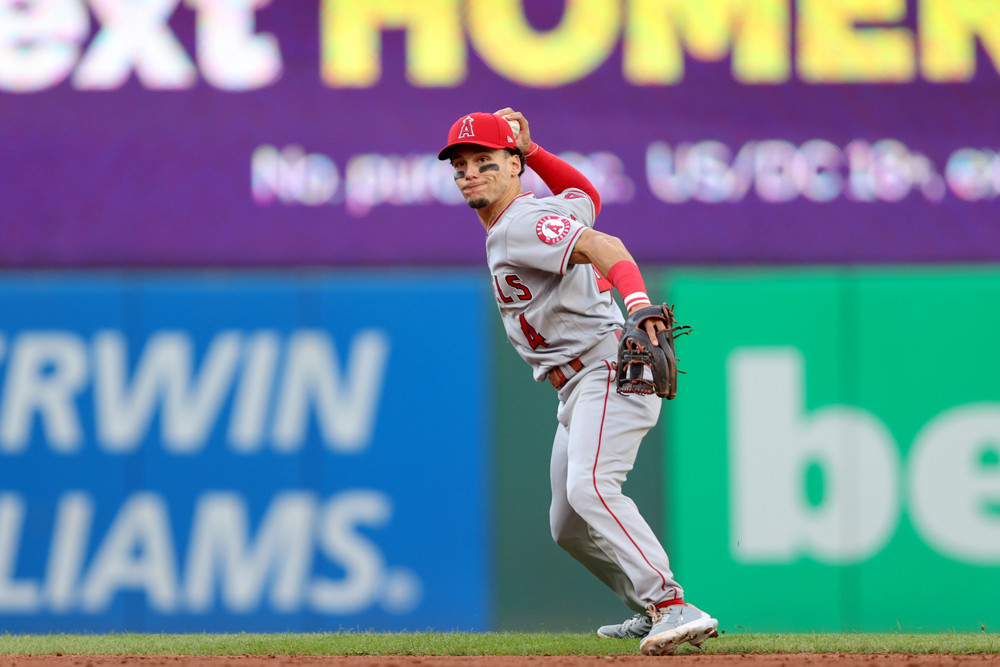
    So, in 2022, the team brought in journeyman Andrew Velazquez. 

    He had spent the last three seasons bouncing around four different franchises, with fewer than 200 career Major League plate appearances. A slugger he is not, but he had major league playing time at six positions (including shortstop and center field), so being light on MLB experience specifically at short wasn’t necessarily a deal-breaker.

    When given a full season of opportunity, Velazquez delivered on the defensive upside his limited playing time had suggested. He placed fourth in the majors in DRS among shortstops, and because of his positional value cracked the top 10 in the AL in Baseball-Reference’s Defensive WAR.

    Andrew Velazquez Stats as SS

    Season(s) G Inn DRS
    2018-21 60 360 4
    2022 124 906 11

    Naturally, not all players with small samples of strong (or weak) defensive numbers go on to deliver on their initial impressions when given more opportunity. But the Angels have had some measure of success with it of late. They’re likely going with yet another new face at shortstop this year in Luis Rengifo, whose results are likely to be somewhere in the middle between Iglesias and Velazquez.

    With our database, we can take this out of the realm of specific examples and look at the last decade all at once.

    Both Fletcher and Velazquez are examples of players I’ll call “innings jumpers,” which I’ll define as those who, for a given position:

    • played at least 600 innings more than their previous high 
    • played more innings than they had total in their career 

    We can look at those jumpers to see how well their small-sample numbers translated when they were given a lot more playing time. To do that, I also make sure that the player had at least 300 career innings prior, so there’s enough of a track record to compare to. That gives us 60 such players over the last decade. 

    To give a comparison, I also am including the same stats for a group of players who didn’t have a jump in innings but who also had at least 900 innings at a position in a season (think 300 career minimum + 600 inning jump).

    Here’s how those players looked coming in, and how their performance in the next season correlated with their previous results.

    Innings Jumpers Comparison Group
    Career Inn 545 4,830
    Season Inn 1,184 1,147
    DRS/Inn Correlation 0.43 0.50

    When comparing the players’ career DRS with their results in the next season, the innings jumpers are barely less projectable than the players with a much more pronounced track record.

    We can look at this another way, focusing on the players who had established being above average (+3 DRS per 1,000 innings) or below average (-3 DRS per 1,000 innings), and how they performed in the follow-up season. In this case, we can look at the average DRS per 1,000 innings of the players in that follow-up year compared to what they had shown previously. 

    Players With a Career -3 DRS per 1,000 Innings or Worse

    Innings Jumpers Comparison Group
    Career Inn 557 3,761
    Season Inn 1,202 1,147
    Career DRS / 1000 Inn -12 -6
    Season DRS / 1000 Inn -2 -4

    Players With a Career 3 DRS per 1,000 Innings or Better

    Innings Jumpers Comparison Group
    Career Inn 531 4,981
    Season Inn 1,176 1,149
    Career DRS / 1000 Inn 10 9
    Season DRS / 1000 Inn 3 5

    This exercise illustrates the power of regression to the mean.

    The innings jumpers showed strong (positive and negative) results in small samples, and in general maintained that direction of performance when given more opportunity, but were much closer to average.

    The comparison players didn’t have as extreme performance prior, but they “held onto” their track record more in the following season. 

    These results are encouraging for the value of small-sample defensive metrics, at least directionally.

    The key takeaway: Players who show themselves to be solidly above or below average in limited playing time are as likely to maintain that as those with much longer track records. 

    There are some limitations, however. We shouldn’t expect the scale of a player’s small-sample performance to maintain itself (as seen in the last table). We’re looking at players who did actually play a full season, but many players who are given opportunities don’t play well enough to get there. (I don’t think that’s a huge concern, because we’re also showing an effect for poor defenders). And this is still a pretty small group of players to evaluate, based on the constraints we’re putting on it. 

    All that said, it’s a compelling jumping off point for the defensive metric enthusiasts among us. And it gives us a bit of a framework within which to talk about players like Brendan Donovan and Bryson Stott, who are being given the keys to a position that they dabbled with in their MLB debuts.


  • 2022 SIS MAC All-Conference Team

    2022 SIS MAC All-Conference Team

    It’s finally time to release our SIS All-Conference teams. We used our all-encompassing player value stat, Total Points, along with other metrics and our scouting work as leading references in putting together our team of selections for 2022, plus a few honorable mentions.

    You can learn more about Total Points and the statistics referenced here.

    These picks are meant to honor this season’s best-of-the-best in the Mid-American Conference.

    Offense

    Position Name School
    QB Kurtis Rourke Ohio
    RB Carson Steele Ball State
    WR Dante Cephas Kent State
    WR Sam Wiglusz Ohio
    TE Brady Hunt Ball State
    FLEX Devontez Walker Kent State
    OT Davis Heinzen Central Michigan
    OT Marcellus Marshall Kent State
    OG Deiyantei Powell-Woods Central Michigan
    OG Vinny Sciury Toledo
    OC Jack Hasz Buffalo

    When talking about the 2022 MAC season, we must start with Ohio’s “Maple Missile” Kurtis Rourke. Rourke led all MAC QBs in Total Points with 97, taking a massive step forward from his 3FR season, while missing the final 3 games of the season. One reason for the progress was the addition of former Ohio State walk-on Sam Wiglusz. Wiglusz, playing primarily in the slot, was Rourke’s No. 1 target, contributing 893 yards and 11 TDs.

    Kent State’s high-paced attack was led by receivers Dante Cephas and Devontez Walker during the 2022 season. Cephas was 2nd in the MAC in Total Points as a receiver with 24, while Walker led the conference with 921 yards receiving and 11 TDs on 103 targets.  

    Carson Steele was arguably the best player in the MAC in 2022, compiling 1,531 yards and 14 TDs. What put the nation on notice was Steele’s ability to break through tackles and first contact, finishing the year with 1,113 yards after contact and 65 broken tackles. Steele was a dominant player for the Cardinals in 2022, earning a Power-5 transfer to UCLA.

    Defense

    Position Name School
    DT Braden Fiske Western Michigan
    DT Devonte O’Malley Northern Illinois
    EDGE Andre Carter Western Michigan
    EDGE Jose Ramirez Eastern Michigan
    LB Zaire Barnes Western Michigan
    LB Dyontae Johnson Toledo
    CB Quinyon Mitchell Toledo
    CB Nic Jones Ball State
    S Trey Jones Central Michigan
    S Marcus Fuqua Buffalo
    FLEX Joshua Scott Eastern Michigan

    Coming off an 8-sack year in 2021, Eastern Michigan’s Jose Ramirez became a house-hold name in 2022, finishing the year tied-3rd in the nation with 11 sacks, each one unassisted. Ramirez became the nightmare for QBs, earning a deserved 1st-Team honor.

    Let’s stick with the pass rush as Western Michigan possessed two dynamic pass rushers themselves in Braden Fiske and Andre Carter. Fiske and Carter managed 6 and 6.5 sacks, respectively, in 2022, while both maintained a pressure rate greater than 9%.

    Specialists

    Position Name School
    K Alex McNulty Buffalo
    P Luke Elzinga Central Michigan
    Returner Keegan Wilburn Ohio

    Keegan Wilburn finished 2nd in the nation in kickoff return yards, and also returned one for a touchdown. Wilburn was one of the most explosive returners in the nation, and we expect to see another big year out of him next year. Luke Elzinga was a productive punter for CMU with 22 punts inside the 20 and 20 forced fair catches. Alex McNulty was a weapon for Buffalo from anywhere on the field. He made 85% of his kicks in 2022, which led the MAC.

    Honorable Mentions

    Name School
    Marquez Cooper Kent State
    Cole Tucker Northern Illinois
    Jamal Turner Toledo
    Karl Brooks Bowling Green
    Thomas Incoom Central Michigan
    Zachary Ford Toledo

    Karl Brooks and Thomas Incoom finished right behind EMU’s Ramirez in sacks, with 10 and 11 sacks respectively. Both also possessed pressure rates greater than 10% (13.8% and 10.9%, respectively). On the offensive side, Jamal Turner for Toledo finished the year with 8 TDs, making him the go-to scoring option for the MAC Champion Rockets.

    Total Points, stats, and ranks as of 2/7/2023

  • How the Super Bowl QBs Handle the Pocket Differently

    How the Super Bowl QBs Handle the Pocket Differently

    This matchup of Patrick Mahomes and Jalen Hurts could serve to highlight the value of special talent at quarterback, if you were inclined to make grand proclamations based on one game.

    Mahomes brings unbelievable throwing ability from all kinds of platforms, while Hurts brings physicality and athleticism. Both can extend plays with their legs (health permitting), but they make very different decisions when they do that.

    Setting a Baseline

    First off: these guys were the top two MVP candidates this year, so let’s give them credit for what they were able to do overall.

    Patrick Mahomes and Jalen Hurts Ranks in 2022

    Mahomes Hurts
    Independent QB Rating 1st 2nd
    Passing Total Points 1st 5th
    Total Points 1st 4th

    (Suffice it to say, my position is that Mahomes deserves the MVP this year).

    Mahomes is the better passer, but he should also get credit even when compared to Hurts for his rushing contributions. He was 5th in the NFL in Total Points from scrambles, barely edging out Hurts in both volume and efficiency.

    This isn’t a discussion about who the better player is overall, because I’d argue there isn’t a discussion to be had. But these guys present an interesting case study in contrasting skills and styles that each got them to the mountaintop. And when we’re looking at players’ splits, it’s important to keep in mind what baseline we’re working from.


    What Happens When Plays Get Long

    At SIS we track how long it takes for a pass play to develop into whatever it’s going to develop into (i.e. a pass, scramble, or sack). That allows us to empirically confirm the statement I made earlier about both Mahomes and Hurts being able to extend plays.

    They’re each among the top 10 highest in Snap-to-Throw +/-, which takes each passer’s times and compares them to the average for similar dropbacks. A high number means they take more time to get the ball out than you’d expect on average. (Hurts’ distribution is a little skewed because there are so many RPOs in the Eagles offense. He has a lot of quick throws that are counterbalanced by very long plays.)

    Getting the ball out quickly is a desirable thing in general, because it means you’re more likely to be staying within the play design and less likely to end up on your back. And the good news for both of these guys is that they’re 1-2 in the NFL in Total Points per play when either the pass, sack, or scramble occurs before the average time of a throw for that drop type.

    When the play extends beyond what we’d expect—typically three seconds or more—these two have different results. Hurts was seven points per 60 plays worse than Mahomes when he held onto the ball. (And while the expectation I’m using is based on when the throw should come out, I am including all dropbacks in the evaluation of what happens on those plays.)

    Total Points per 60 Plays by Dropback Time, 2022

    Faster than Expected Slower than Expected
    Mahomes 17 (2nd) 17 (2nd)
    Hurts 18 (1st) 10 (12th)

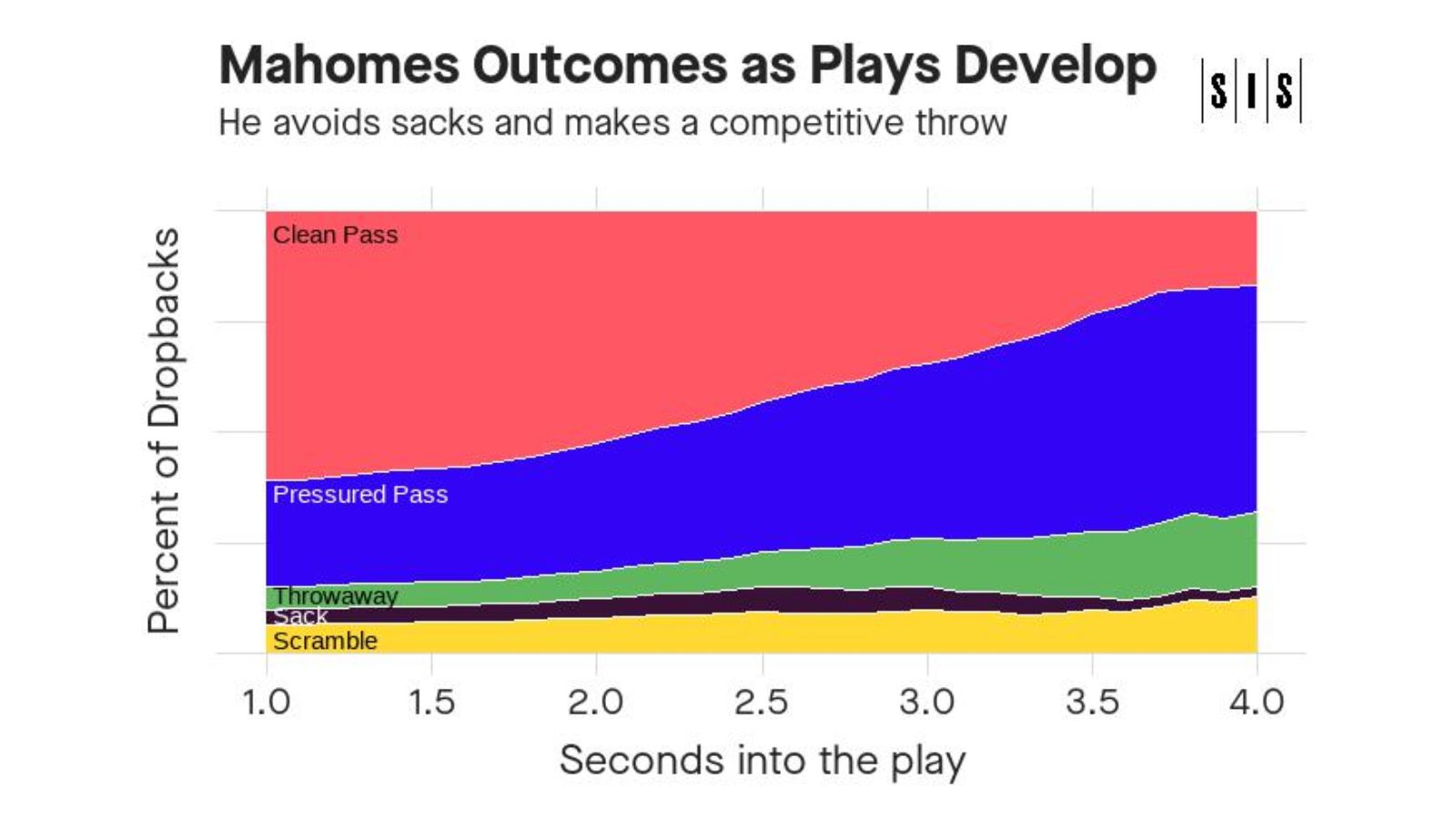
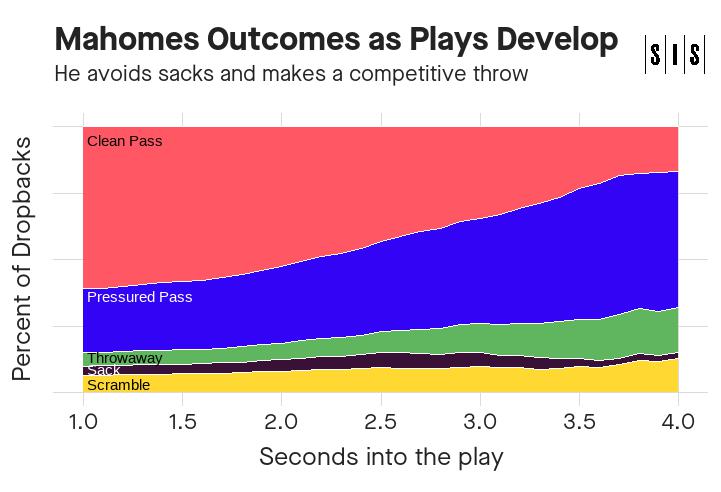
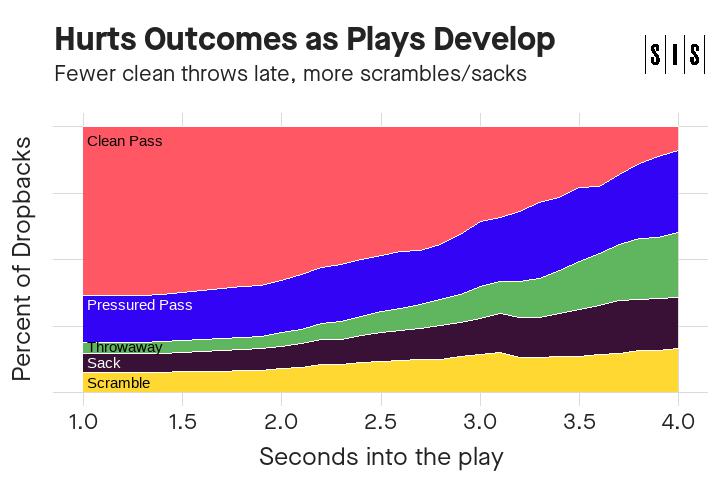
    We can look at this a little differently by breaking out the kinds of plays that result from a play taking longer than a couple seconds. Here is a breakdown of how often each of several different results come out of a Mahomes or Hurts dropback, assessed every tenth of a second. Think of it as, “After X seconds into a play, how likely is Y outcome?”

    Stacked area chart showing Patrick Mahomes' rates of five different outcomes (Clean Pass, Pressured Pass, Throwaway, Sack, Scramble) as the play progresses from 1 to 4 seconds. At all time points he is likely to make a competitive throw, and he is rarely sacked.

    So what can we learn from this?

    First off, Mahomes is getting off a competitive throw (i.e. not thrown away) just under three-quarters of the time even on plays that extend beyond four seconds. That’s pretty impressive, especially considering he ranked second in the NFL in Independent Quarterback Rating (IQR) under pressure.

    But it’s also important that he’s avoiding sacks. Remember, this plot is saying how often a given result occurs after that point in the play. So when the Sack band thins out after three seconds, that means he’s taking most of his sacks relatively early (likely because of blown blocks) and is avoiding them late in the play.

    Let’s take a look at Jalen Hurts for comparison.

    Stacked area chart showing Jalen Hurts' rates of five different outcomes (Clean Pass, Pressured Pass, Throwaway, Sack, Scramble) as the play progresses from 1 to 4 seconds. After 3.5 seconds he's roughly equally likely to produce any of the five outcomes.

    The right side of this plot looks a lot different than that of Mahomes. As discussed above, both Hurts and Mahomes are pretty consistent scramblers, although Hurts seems to duck and run a little earlier. But when the play extends towards four seconds, Hurts is taking a sack or throwing the ball away half the time, which is way more often than Mahomes. And once the play gets to four seconds or more, all five of these outcomes are similarly likely.

    The “good news” is that Hurts isn’t making throws under pressure nearly as often, which we know to be a bad proposition in general. And this year, Hurts was in the middle of the pack in terms of IQR under pressure, so he’d like to avoid those plays if possible. The trouble is that those sacks can be killers.


    How Does Mahomes’ Injury Affect This?

    Two weeks of rest should do wonders for Mahomes’ injured ankle, but if we assume he’s still a bit hampered, it stands to reason that we might expect a different look from him and the Chiefs if he’s not expected to be as effective in escaping the pass rush.

    Oddly, Mahomes has had fewer short drops, RPOs, and screens (57%) than he did in the regular season (64%), so they’re not trying to get the ball out quicker. He has been sacked just as often as well.

    He is throwing a bit less from off-platform (32%) compared to the regular season (39%), possibly a result of trying to avoid putting pressure on the ankle. Not that it matters—he has completed 20 of 23 passes for 213 yards and 3 touchdowns without his feet planted in the last two weeks. So we probably needn’t worry.

  • Who’s Up, Who’s Down Heading Into Conference Championships?

    Who’s Up, Who’s Down Heading Into Conference Championships?

    Ever since the Giants won a couple of Super Bowls earlier this century, there has been a team every few years that “gets hot at the right time” and rolls to a ring.

    While there isn’t much that can be done analytically to assess when a team will start or stop being hot, as passive observers it can be useful to know which teams are closer to their apex and which are closer to their nadir, especially when we often cite full-season stats.

    We kind of already have a sense for where teams are in that sense, though. The Chiefs are hanging on by a Patrick Mahomes ankle, the Bengals are banged up but riding high off a road win, the Eagles have gotten healthy but haven’t had to stand up to a test in quite a while, and the 49ers are doing as well as you could with a third-string quarterback.

    So, I thought I’d take a look at it from a player perspective. Which players are at their best right now? And who is at their worst?

    We can use Total Points, which captures most things a player does on the field, to evaluate how players have done in January and how that compares to the rest of the year. Because playing time can vary between months, I’ll use monthly Points Above Average, which is the underpinning of Total Points that sets average performance at zero. A player who barely plays is likely to stick close to average, while a player with a lot of playing time has the opportunity to make a bigger impact (for better or worse).

    Here are some of the players for each of the remaining four teams who have had either their best or worst month in January. They need to have played for at least 4 months to qualify.

    Eagles

    Trending upward

    A comfortable win against the Giants in the Divisional Round meant that Kenneth Gainwell got some run, totaling 112 yards on 12 carries. He achieved seven first downs on those runs. Prior to this game, Gainwell had eight first downs on 25 carries since Week 10. He was a much tougher tackle than usual, with 4 broken or missed tackles on those 12 runs. He eluded 9 tackles per 100 carries during the season.

    Kicker Jake Elliott got some good reps in thanks to a productive offense last week (5-for-5 on extra points and a made FG), and he showed himself to be far and away the most productive NFC East kicker in the playoffs this year. He is also 3-for-3 on field goals of 50+ yards in January.

    Trending down

    The players of concern for the Eagles are to some extent obvious. Both quarterback Jalen Hurts and right tackle Lane Johnson have been ailing, so a combination of missed time and less-outstanding performance puts them in this spot. Hurts didn’t need to push it once they got up big against New York, and he really hasn’t put on a show through the air since the Titans game in Week 13. Johnson looked banged up but played a full complement of snaps in the Divisional Round, and the Eagles called runs to his gap more than in any other game this year.

    49ers

    Trending upward

    The Niners are in the best spot as a team by this method of evaluation, with 10 players having their best month and 6 having their worst.

    He didn’t have a strong showing in the win against Dallas, but Christian McCaffrey was dealing prior to that bump in the road. He averaged 6.5 yards per carry in his three prior January games, with nearly a third of his rushes going for a first down.

    Safety Tashaun Gipson nabbed three of his five interceptions (and had his hands on what might have been another) in the last two weeks of the regular season. He’s generally playing deep safety, so if you’re hearing his name it’s most likely very good or very bad. In the last month it’s been more the former.

    Trending downward

    Other players in the San Francisco secondary have not been as fortunate with their recent playmaking. Breakout safety Talanoa Hufanga—for whom I have a particular affinity because he was all over the leaderboards of the SIS Football Rookie Handbook when he came out of USC—has been all over the field making plays, but less so of late. 

    Talanoa Hufanga Stats, 2022

    September-December

    (15 games)

    January (4 games)
    Interceptions 4 0
    Tackles for Loss 5 0
    Pressures 10 (2 sacks) 2 (0 sacks)

    Cornerback Charvarius Ward has handled being the team’s top corner well, yielding a team high in targets with pretty good results on those targets. In the last month he has allowed more successful plays, particularly against the Seahawks in the Wild Card round when he was targeted eight times for a total of 98 yards and a touchdown. A matchup with DK Metcalf was a problem in that game, and a matchup with another Ole Miss product in A.J. Brown awaits.

    Chiefs

    Trending upward

    The Kansas City skill position group has had different contributors every few weeks (behind Travis Kelce), and at this point in the year Isiah Pacheco and Kadarius Toney are top dogs.

    Pacheco has taken the lion’s share of the carries this year, with an explosive run against the Jaguars providing a highlight in the most recent contest. This month he’s produced more first downs and been stuffed less than a third of the rate he was prior, which is a level of consistent productivity that is all this offense needs.

    Over the last three games Toney is second on the team in basically every measure of total productivity you can think of. He’s been very efficient, with a league-leading Yards per Route Run and an EPA per target that ranks in the top 10.

    Trending downward

    I’m sure it doesn’t shock you that Patrick Mahomes shows up here, based on his injury. But even before that, he had posted three of his five below-average games by Points Above Average this season since Week 14. If we assume he’ll be throwing from a stable platform more often than usual this game, it’s worth noting that in January he ranks outside the top 10 in Independent Quarterback Rating with his feet planted. He was second by that measure in the first 16 weeks of the season.

    One player who might be doing more scrambling than Mahomes is linebacker Nick Bolton, who has been targeted in coverage more than any non-cornerback in January. He has allowed a 100% Deserved Catch Rate in that span, which measures the catch rate a player allows on catchable throws and treats dropped passes as though they were completions. 

    Bengals

    Trending upward

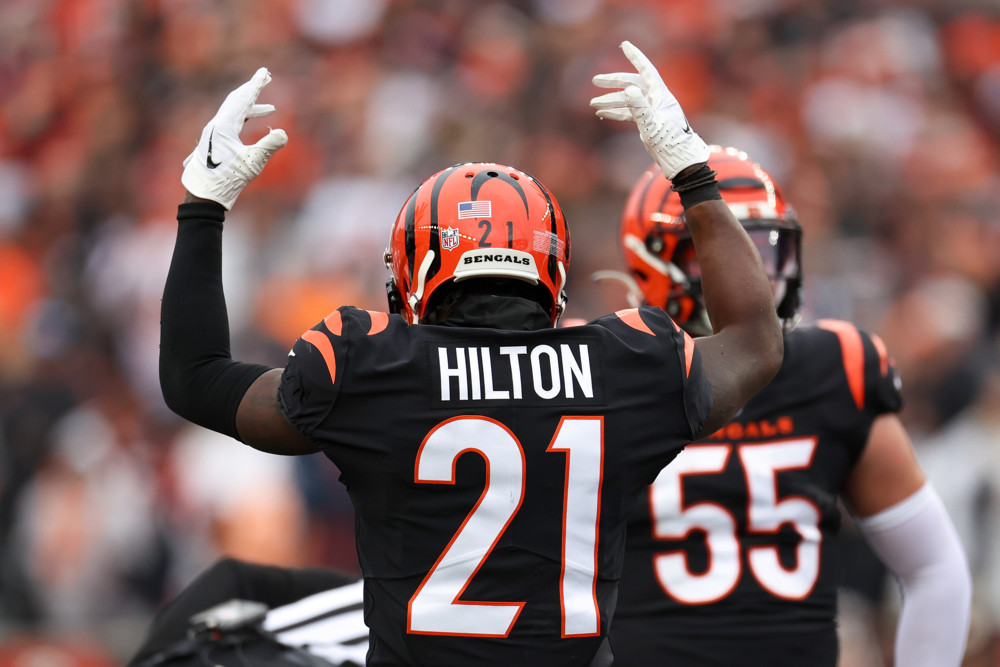
    Cincinnati’s secondary has done better than expected in the absence of the injured Chidobe Awuzie, with most recent contributions to that effort coming from cornerbacks Cam Taylor-Britt and Mike Hilton. Each is among the 10 best defenders in terms of EPA per Target in January (minimum 10 targets), with Hilton manning the slot and Taylor-Britt on the outside. A large part of their value has come from allowing completions on just 1-of-8 targets between them on third and fourth down.

    Trending downward

    Another injury-related entry on this list comes in the form of Tee Higgins, who suffered a hip injury in Week 18 and has had below-average games since. He was always the 1b to Ja’Marr Chase’s 1a, but in the last two games Chase has him nearly doubled in targets and more than doubled in yards.

    Linebacker Logan Wilson has felt success slip through his fingers of late. He’s allowing ballcarriers to elude his tackle attempts more than twice as often in January as he had through December, and multiple passes that he could have intercepted have fallen for incompletions.

  • Sports Info Solutions and Combat Registry Announce Partnership with Invicta Fighting Championships

    Sports Info Solutions and Combat Registry Announce Partnership with Invicta Fighting Championships

    TORONTO – (November 11, 2022) SIS, a leading sports data and analytics provider, and Combat Registry, a combat sports data provider, today announced a multi-year partnership with Invicta Fighting Championships, a subsidiary of Anthem Sports & Entertainment, Inc., and the world’s premier all-women’s mixed martial arts organization, to serve as the exclusive Official Data Providers for the fight organization.

    As part of the agreement, Combat Registry and SIS will collect and distribute both live data and historical data, as well as betting-enabling data and analytics, for every Invicta FC event. More importantly, SIS will also be granted the exclusive right to license and distribute relevant data to sports betting operators.

    Poised to be a force in this competitive landscape, SIS, Combat Registry, and Invicta FC will combine their rich experience and records of success to strategically utilize the growing popularity and availability of sports betting throughout the United States, and the exponential boom in interest and demand that is currently taking place in women’s sports. 

    Dan Hannigan-Daley, CEO of Sports Info Solutions, said, “We’re thrilled to support Invicta FC as the preeminent Women’s MMA property. What Shannon and her team are building there is really exciting and combined with SIS and Combat Registry’s support on the Sports Betting and Data side, we’re sure to bring Invicta FC more to the masses.”

    Shannon Knapp, Founder and President of Invicta FC, said “Invicta FC has already broken new ground as the premier all-female MMA organization, and now we aim to do so once again through this landmark partnership with SIS and Combat Registry. They each possess an incredible depth of knowledge and a sustained track record of success, and we are excited to join forces with them as we expand Invicta’s reach even further.”

    Chris Palmquist, President of Combat Registry, stated, “As a long time fan of Invicta FC, we are excited to partner with them alongside SIS to create data products to further strengthen their fan engagement and drive increased awareness of their already world class level promotion.” 

    As part of the collaboration, SIS will support Invicta FC’s integrity and social responsibility efforts, including efforts regarding bet types, anti-piracy, and problem gambling, alongside partner operators and those offering wagering on Invicta FC.


    ### 


    About SIS

    Pioneers in the sports data space since 2002, their mission is to enrich and optimize the decision-making process for sports teams, sportsbooks, and sports fans. Learn more at www.sportsinfosolutions.com.

    About Combat Registry

    Founded in 2008, Combat Registry has been an internationally prominent company in the collection and distribution of historical combat sports data, and is today the industry-leading provider of media rankings services for the biggest combat sports promotions in the world. For more information, visit www.combatreg.com

    About Invicta FC

    Invicta Fighting Championships (invictafc.com) is a world championship, all-pro mixed martial arts (MMA) fight organization dedicated to providing female athletes with a major platform to hone their skills on a consistent basis. Founded in 2012 by longtime MMA executive Shannon Knapp, Invicta is committed to pioneering the future growth of women’s MMA by promoting the best possible match-ups between female competitors and identifying and developing future superstars of the sport. Follow Invicta on Twitter (@InvictaFights), Facebook (InvictaFights), and Instagram (@InvictaFC) for all the latest information.

    About Anthem Sports & Entertainment, Inc.

    Anthem Sports & Entertainment, Inc. is a global multi-platform media company with offices and studios in Los Angeles, Denver, Nashville, New York, Kansas City, Cleveland and Toronto.  Anthem’s portfolio includes:  AXS TV, a leading music entertainment and lifestyle television channel and digital media company; global film distribution company Gravitas Ventures; Fight Network, the world’s premier combat sports channel; IMPACT wrestling, one of the world’s leading wrestling organizations specializing in original programming and live events; Invicta Fighting Championships, the world’s premier all-women mixed martial arts promotion; Game+, the leader in Esports and gaming content; GameTV, the home of games shows and competition-based reality series; and HDNet Movies, which features theatrically released films and documentaries.  Anthem also has a significant ownership interest in Pursuit Channel, one of the top outdoor channels in the U.S.


    CONTACTS:

    SIS, Kelsea Benoit, kbenoit@ww2.sportsinfosolutions.com

    Combat Registry, Chris Palmquist, chris@combatreg.com

    Anthem/Invicta Fighting Championships, Cindy Ronzoni, cronzoni@anthemse.com

  • Sports Info Solutions Named Official Data Provider for Premier Rugby Sevens

    Sports Info Solutions Named Official Data Provider for Premier Rugby Sevens

    (NEW YORK, Oct. 27, 2022) – Sports Info Solutions (SIS), a leading sports data and analytics provider, today announced a partnership with Premier Rugby Sevens (PR7s). As the league’s first official data provider, SIS will collect, distribute, and develop raw analytical and betting data starting with the 2023 PR7s season. 

    Aimed to grow the sport of rugby through sports betting and increased fan engagement, SIS was also granted non-exclusive distribution rights of the data for media entities. The parties will collaborate on further commercial opportunities to position the league for North American expansion and continued growth for both the men’s and women’s competitions. 

    “Rugby sevens and sports betting have been a long-discussed perfect match,” said Owen Scannell, CEO of Premier Rugby Sevens. “Sevens’ action-packed competitiveness and high volume daily of outcomes make for a fantastic product for bettors and sportsbooks alike. We are thrilled that our partnership with SIS will enable Premier Rugby Sevens to drive one of the most exciting and engaging sports betting products and bring new fans into rugby.”

    “Owen and the team at Premier Rugby Sevens are forward thinkers, who have seen exceptional growth to date,” said Dan Hannigan-Daley, CEO of Sports Info Solutions. “We’re excited to support PR7s with data and betting products which will enable the league to take that next step as they look forward to the Rugby World Cup hitting the USA in 2031, bringing with it continued acceleration of the sport here in North America.” 

    In collaboration with third-party operators and those offering wagering on PR7s’ events, SIS will support Premier Rugby Sevens’ integrity and social responsibility efforts, including bet types, anti-piracy, and problem gambling.

    Coming off a successful 2022 season at MLS stadiums across the United States, PR7s is breaking down gender barriers for sports in the U.S. and has achieved several firsts in its brief existence. The league is the first professional sports entity to launch with equal pay for male and female athletes and is the only platform for women to play professional rugby in North America.

    About SIS

    Pioneers in the sports data space since 2002, their mission is to enrich and optimize the decision-making process for sports teams, sportsbooks, and sports fans. Learn more at www.sportsinfosolutions.com.

    About Premier Rugby Sevens

    Premier Rugby Sevens (PR7s) is a groundbreaking professional sports league in North America that debuted in 2021. With a focus on accessibility and entertaining content for fans, the league showcases the electrifying sport of rugby sevens through a touring format in cities across the United States. PR7s is the first sports organization of its kind, with men’s and women’s teams competing under one umbrella with equal pay. To learn more about Premier Rugby Sevens, go to PRSevens.com and follow the league on Twitter, Instagram, Facebook, and LinkedIn.


    # # #

    CONTACTS:

    SIS
    Kelsea Benoit
    kbenoit@ww2.sportsinfosolutions.com

    Premier Rugby Sevens
    Eric Nemeth
    eric.nemeth@prsevens.com


  • Sports Info Solutions Announces Partnership With Canadian Elite Basketball League

    Sports Info Solutions Announces Partnership With Canadian Elite Basketball League

    TORONTO, ON– May 31, 2022 – The Canadian Elite Basketball League (CEBL), Canada’s preeminent professional basketball league and SIS, a leading sports data and analytics provider, today announced a partnership naming SIS as an Official Data Provider of the CEBL.

    As part of the partnership, SIS will collect, analyze and distribute real-time CEBL data. SIS will support all aspects of the CEBL’s data requirements, inclusive of ensuring an innovating experience surrounding the Elam Ending, which the CEBL is bringing back to continue creating exciting finishes to CEBL games.

    Dan Hannigan-Daley, CEO of Sports Info Solutions, said, “At SIS, we’re big believers in the continued evolution of sports and as such are excited to support the Canadian Elite Basketball League and the Elam Ending at large, grow as a key component of basketball.”

    SIS will also amplify the CEBL within the recently regulated sports betting industry in both Canada and the US.

    “The betting opportunities and interest surrounding this innovative way of determining basketball wins and losses is very compelling to us as a driver of advanced fan engagement” Hannigan-Daley said.

     “We are very excited to find a partner in SIS that truly supports our efforts to grow the game domestically and internationally and more importantly create a betting solution to further enhance the great benefits of the Elam Ending,” said Mike Morreale, Commissioner of the CEBL. “I can’t wait to see how SIS helps propel us forward through their innovation to new fans across the globe.”

    The partnership was orchestrated by ThePostGame, the U.S.-based sports consultancy and content studio, which is working with the CEBL on betting and media rights strategies.

    SIS will support the CEBL’s integrity and social responsibility efforts, including efforts regarding bet types, anti-piracy, and problem gambling, alongside partner operators and those offering wagering on the CEBL.

    ###

    About SIS

    Pioneers in the sports data space since 2002, their mission is to enrich and optimize the decision-making process for sports teams, sports leagues, sportsbooks, and sports fans. Learn more at www.sportsinfosolutions.com.

    About CEBL

    A league created by Canadians for Canadians, the CEBL is Canada’s pre-eminent professional basketball league. The league has the highest percentage of Canadian players of any professional league in the country, with 75 percent of its rosters being Canadian. Players bring experience from the NBA, NBA G League, top international leagues, the Canadian National team program, and top NCAA programs as well as U SPORTS. The only First Division Professional League Partner of Canada Basketball, the CEBL season runs from May through August.

    CONTACT:

    SIS

    Kelsea Benoit

    kbenoit@ww2.sportsinfosolutions.com

  • Evaluating Our Evaluations: How our Scouting Grades Have Fared So Far

    Evaluating Our Evaluations: How our Scouting Grades Have Fared So Far

    At SIS, we use a role-based grading scale for draft prospects. That means that we’re not as concerned about what round you should select a player; instead, we focus on the mix between the overall quality of the player and the kind of role he could take for an NFL franchise.

    Our grades are meant to be taken as a projection for the player by their second NFL season. There is a bit more detail than this, but as a rough guide, you can think of our grading scale this way:

    Grade Range Rough Description % of grades from 2019-21
    7.0-9.0 Blue Chip / All Pro 2%
    6.7-6.9 Strong Starter 17%
    6.5-6.6 Situational Starter 17%
    6.2-6.4 Role Player 36%
    6.1 or below Backup 28%


    These grade ranges, if calibrated appropriately, should bear themselves out in terms of both playing time and performance on the field. This might seem like an obvious thing to say, but it’s important when you’re in the business of analysis to check your assumptions and make sure they’re valid!

    The intent is, naturally, to project players accurately. But there are always players who find themselves in particularly good or bad situations in terms of playing time, so sticking too close to the starter/backup distinction is a bit rigid.

    Let’s take a few different angles and see how these grading ranges relate to NFL outcomes.

    For all of the below, I’ll be using results from the last three draft classes. I’ll also be lumping in the players with grades of 7.0 or higher with the group below, because that group is too small to analyze on its own (and small enough that it won’t bias the result).

    In the case of the 2021 class, they haven’t had a chance to play their second season, which means they haven’t had as much opportunity to make an impact. As a result, it’s fair to assume that we’re slightly underestimating the value of our grades by including these players. The 2021 quarterback class is a particularly apt example, given the mix of subpar opportunity and performance from all but Mac Jones.

    Relating Pre-Draft Grade to NFL Playing Time
    Here we’re taking the grade ranges from above and looking at how often players in each group get on the field. This is on a per-season basis to put the 2021 draftees on an even playing field, and uses position-specific quartiles that account for differences in typical snap counts by position.


    Per-Season Snap Count Percentiles, 2019-21 Draftees’ First Two Seasons

    Grade Range > 25% > 50% > 75%
    Strong Starter (6.7+) 82% 73% 50%
    Situational Starter (6.5-6.6) 68% 41% 22%
    Role Player (6.2-6.4) 47% 28% 9%
    Backup (6.1 or lower) 37% 19% 6%


    You can see that there are nice monotonic relationships. The top graded players are multiple times more likely to achieve snap counts in the 75th percentile than anyone with less rosy grades. Those graded as situational starters are more likely to be below the median than above it. And players with role player or backup grades are more likely to be in the bottom quartile than the upper three quartiles.

    It’s very likely that part of the reason that the players with “strong starter” grades are so much more likely to get substantial playing time is that teams are more likely to give top draft picks more opportunities. After all, two-thirds of those players have been drafted in the first two rounds—and nearly all of the players with a 6.9 grade or higher.

    Relating Pre-Draft Grade to NFL Performance
    To the previous point, it’s insufficient to judge a pick on playing time. So let’s take a similar angle, but instead use the player’s Wins Above Replacement (WAR) per play.

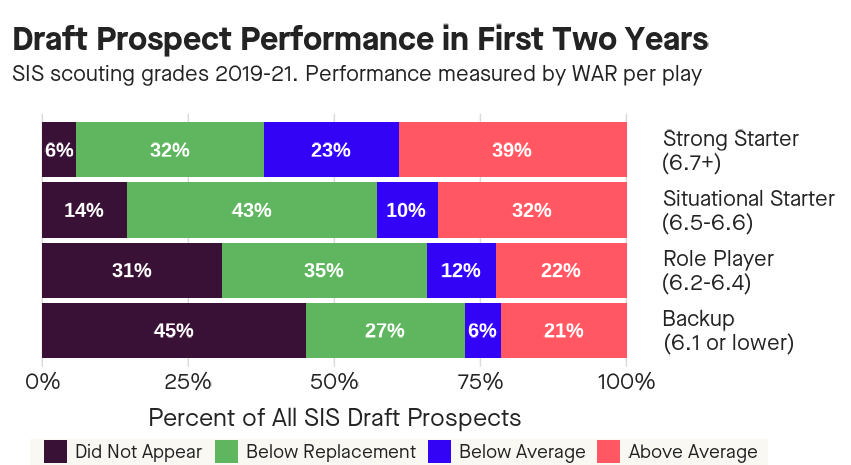
    Analogous to the above, we’ll look at the odds of a player not making it onto the field, playing but being a sub-replacement contributor (i.e. recording a below-zero WAR), and being a solid contributor (i.e. recording an above-average WAR).

    Breakdown of performance of NFL draft prospects over the last three classes. In general, players with starting grades from SIS bomb out much less and have above-average results much more.

    Once again, we come to the encouraging conclusion that higher grades yield better NFL outcomes. But the picture is muddier this time around.

    In contrast to the rather dramatic and consistent trend for playing time, the relationship between pre-draft grade and performance is less stark. In particular, we find that there is a larger gap in per-play performance between the starter and backup grades than between the different backup-level grades. Higher grades correspond most strongly with getting onto the field and with being above average, but there are plenty of examples of sub-par performance regardless of the scouting grade.

    Takeaways and Next Steps

    We’re still in the early days of our scouting operation, but so far we are doing a good job in projecting a player’s likelihood of making an NFL impact. Keep an eye on a player’s grade within that range of 6.2 to 6.9, because the outcomes for that middle-to-upper-middle class of players can vary quite a bit. We can see an effect not only in playing time but also in performance.

    As discussed on the Off the Charts Podcast, we are really excited to look at this with more seasons of data and more targeted analysis of the value of specific positional factors. Players often land in spots that don’t allow them to achieve their projection (think Jordan Love in Green Bay as an extreme example), so we want to be able to make additional adjustments beyond taking the sample of draftees as a whole.

  • How Receiver Productivity in College Relates to NFL Outcomes

    How Receiver Productivity in College Relates to NFL Outcomes

    The 2019-2021 NFL drafts have, among other things, put a spotlight on the wide receiver position heading into this draft.

    Ahead of those drafts, that added attention has at least in part been a consequence of top prospects coming out of big-time programs like Alabama (DeVonta Smith, Jerry Jeudy, Henry Ruggs, Jaylen Waddle) and LSU (Justin Jefferson, Ja’Marr Chase). But the production generated from the position has also been outstanding.

    This isn’t a true evaluation of talent, but one way of looking at the excellence of the current crop of young receivers is this: 12 of the 23 wide receivers in the first four tiers of FantasyPros’ rankings for 2022 were drafted in the first three rounds of the 2019-21 NFL drafts.

    According to SIS scouts, this year’s group doesn’t have the same elite top-end that the previous two years did, but the starter-quality depth is there. Eight players have been given starting grades, which means you’ll likely see 10 or more go off the board before the end of the second round (as was the case the last two years).

    Which members of the receiver class have production we’d want to bet on?

    The SIS NFL Draft site has dozens of advanced statistics to evaluate receiver prospects, and a lot of them are specific to certain skills like hands, route running, and yards after catch. But if we want to identify which players we expect to succeed generally, it’s still best to rely on overall measures of production. We’ll start with that, and then take overall production within a particularly relevant split (against press coverage).

    Setting the Scene with Production as a Whole

    It shouldn’t shock anyone that production at the college level corresponds to production at the NFL level, but having some numbers behind that claim is useful.

    Let’s take a look at recent prospects’ college production across their last few college seasons. We’ll use Expected Points Added (EPA) on targets per season at the college level, because that allows us to use multiple college seasons even for 2019 draftees. Ideally we would use our catch-all value metric Total Points—most notably because it does a better job of isolating what a receiver is accountable for—but that only exists going back to 2018.

    Below is a breakdown of how EPA at the college level has projected to EPA at the NFL level. The players being considered are those whom SIS evaluated, which includes basically any player likely to be drafted.

    Per-Season College and NFL EPA, 2019-21 Receiver Classes

    College EPA per Season NFL EPA per Season
    0 – 10 2.1
    10 – 20 0.9
    20 – 30 5.0
    30 or more 14.6

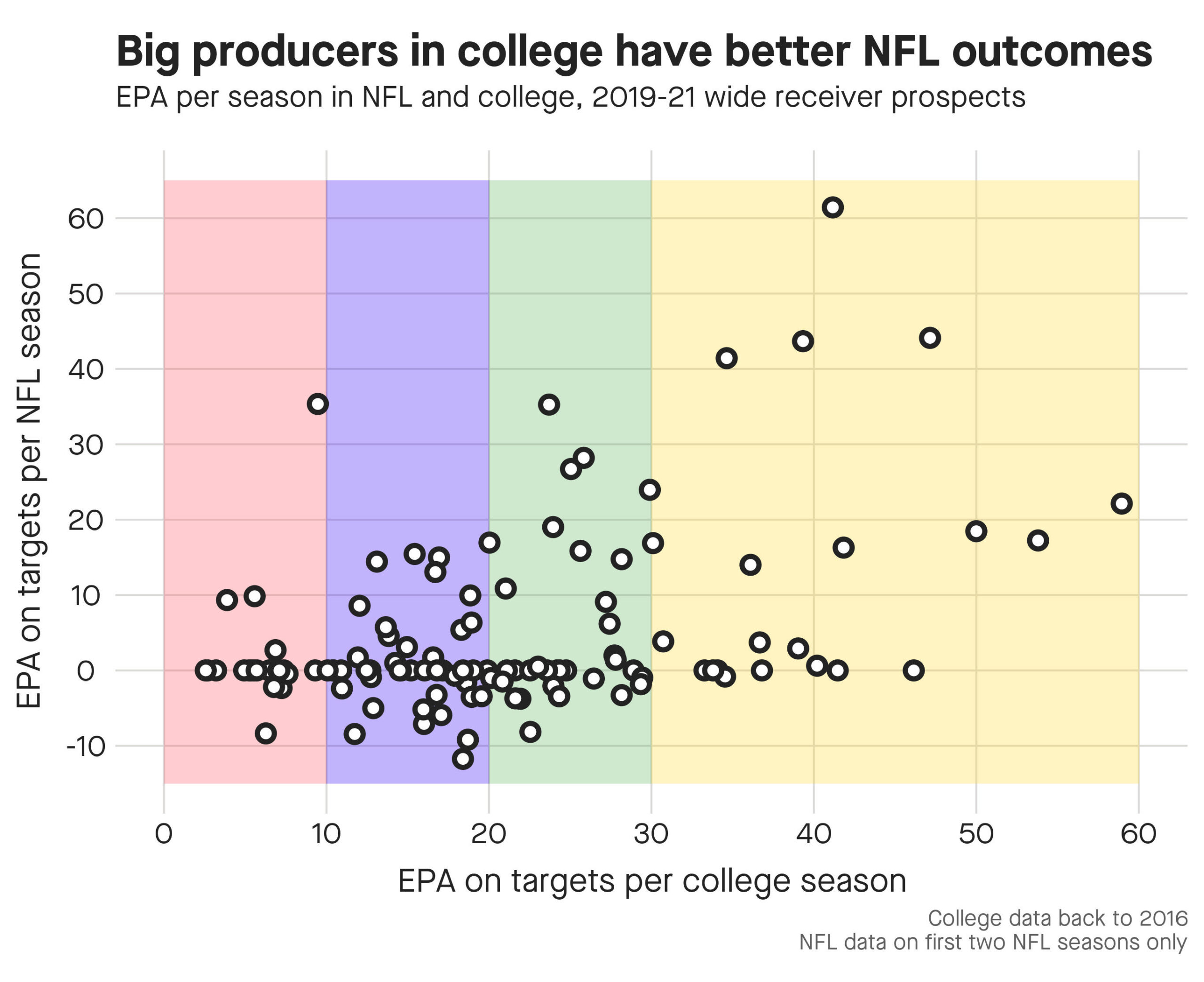
    And if you want a look at the individual results, here they are as well.

    Receiver EPA per season in college vs. NFL. Solid NFL producers almost exclusively produced 20+ EPA per season in college.

    Getting above the 20 EPA per season mark in college suggests improved results at the NFL level—but getting above 30 is the real indicator.


    Because players like Justin Jefferson skew the average, we might also consider just asking how many productive NFL players come out of each group. 

    Say we set that bar at an average of at least 20 EPA per season in the NFL—somewhere in the 800-yard, 6-TD range if you want to think of it that way. All but one of the 2019-21 draftees who have produced 20 EPA per season at the NFL level produced at least 20 EPA per season at the college level. DK Metcalf stands out as an exception, but he stood out as an exception during the draft process because of his crazy measurables.

    These results should also be taken in tandem with scouting evaluations. Metcalf, for example, was still graded as a starter-quality prospect despite his lackluster production.

    Several players have had outstanding production but less-outstanding traits on film, and in those cases the scouting report tells a valuable story. Eight players fell into that 30+ EPA group but were not graded as solid starters by SIS scouts. Only Diontae Johnson has worked out of that group.

    Of the eight starter-quality prospects on the SIS draft board this year, two did not meet that EPA threshold: Justyn Ross of Clemson and George Pickens of Georgia. While this measure is taking into account their whole careers, recent injuries play a part in both cases. Pickens missed the majority of this season recovering from ACL surgery, while Ross was somewhat hampered play-to-play by a foot injury that eventually ended his season.

    Beating Press Coverage

    Yes, being productive in college is good. But as mentioned before, not all production is created equal. Like with quarterbacks and “NFL throws”, we want to be able to find the spots where a player is asked to do something more NFL-like than average.

    Press coverage is one of those “NFL” things. Particularly in college, teams typically use it more if they have the personnel to get away with it. As a consequence, that also means that press coverage is a good bit less common than it is at the NFL level, which means it’s a situation that we want to focus on to better evaluate a prospect heading into the NFL.

    If you can beat press coverage as a college receiver it likely means two things: you’re able to get off the line without being diverted from your route, and the defenders you’re facing are higher-quality on average than we’d assume just based on the overall team quality.

    SIS has measured press coverage usage for the last three college seasons. We identify the alignment pre-snap but also the immediate action of the defender, so we can focus on plays where the defender stayed in press after the snap.

    Take a look at the leaderboard below. Looking at only college prospects, we’ll take the players with at least 50 routes run when lined up outside against true press coverage over the last three college seasons. For this we’ll use Yards per Route Run as the measure of success. Press coverage is supposed to blanket the receiver and deter them from getting the ball, so we need a measure that captures non-targeted routes.

    Yards per Route Run Against Press on the Outside, 2019-21 CFB

    Player Draft Year Y/RR
    DeVonta Smith 2021 4.6
    Ja’Marr Chase 2021 4.2
    Cornell Powell 2021 4.0
    Kyle Pitts 2021 3.9
    Drake London 2022 3.9
    Damonte Coxie 2021 3.8
    Frank Darby 2021 3.5
    Tee Higgins 2020 3.5
    Dax Milne 2021 3.3
    Quintez Cephus 2020 3.1


    Remembering that this leaderboard is subject to all the limitations of using college stats as a projection, this is a pretty encouraging record of success for players coming into the NFL, with Smith, Chase, Pitts, and Higgins primed to be top producers at their position.

    For what it’s worth, the bottom 10 players in this stat have combined for under 1,000 career receiving yards (including first-round pick Jalen Reagor and 2021 preseason fantasy sleeper Terrace Marshall Jr.).

    Let’s take this out of the anecdotal and into a more holistic measure. Here the group of prospects is split in half twice: once by their yards per route run against true press, and once by their yards per route run against everything else. And we’ll look at their overall Total Points per season in the NFL.

    NFL Total Points per Season by CFB Performance vs. Press, 2019-21 prospects

    Bad vs. No Press Good vs. No Press
    Bad vs. Press 1.0 3.0
    Good vs. Press 5.3 7.7


    Being good against press is more relevant to NFL success than being good otherwise. You can tell because the differences between the rows in the table above are both larger than the differences between the columns.

    Keep in mind that defensive backs aren’t pressing most of the time; we’re seeing college performance on a minority of snaps be a meaningful predictor of NFL performance overall.

    If we turn our eyes to the top end of this year’s crop of prospects, that suggests good things for USC’s Drake London (SIS’s No. 6 WR) and some cause for concern for Alabama’s Jameson Williams (No. 2). Arkansas’ Treylon Burks barely faced press in college, which we might want to trust more than the insane production he generated against it.

    Yards per Route Run Against Press, Top 2022 WR Prospects

    Player School SIS Grade Routes Y/RR
    Treylon Burks Arkansas 6.9 22 9.7
    Jameson Williams Alabama 6.9 119 0.9
    Garrett Wilson Ohio State 6.8 147 1.9
    George Pickens Georgia 6.8 163 2.3
    Jahan Dotson Penn State 6.8 233 1.3
    Drake London USC 6.8 73 3.9
    Chris Olave Ohio State 6.7 152 2.4
    Justyn Ross Clemson 6.7 99 1.6

    Of the names just beyond this list, David Bell (No. 14) did very well against press, while Christian Watson (No. 10) was much better when he wasn’t bumped at the line. (It’s worth noting that we don’t have all of Watson’s stats because he went to an FCS school.)

    If you want to dig deeper and find players with backup grades who might have some upside, Calvin Austin III (No. 19) and Jack Sorenson (No. 47) are among the top performers against press. Sorenson is a fun test case for the interplay of scouting and statistics, because his lowest-graded skill in his scouting report is his release off the line. If he makes it to the NFL, it’s likely because he outperforms that grade.