Author: Andrew Kyne

  • Preview: Alabama vs. Clemson, College Football National Championship

    Let’s take a brief look at some statistical notes ahead of tonight’s College Football National Championship between No. 1 Alabama and No. 2 Clemson.

    Alabama Passing vs. Clemson Pass Defense

    • Tua Tagovailoa ranks second (142.3) in our Independent Quarterback Rating* metric for the 2018 season, behind only Oklahoma’s Kyler Murray (145.3).
    • That said, Tagovailoa has performed much better when not under pressure: 149.3 IQR with no pressure; 113.1 IQR with pressure (which still ranked sixth in the country, minimum 50 attempts)…
    • …and Clemson’s pass rush, even without Dexter Lawrence, can bring pressure. The Tigers have registered 256 QB pressures this year, third behind only Ohio State (263) and Alabama (260).
    • Tua’s primary targets include Jerry Jeudy and Henry Ruggs III. Among receivers with at least 60 targets on the season, Jeudy ranks third in yards per target (12.4) and Ruggs ranks 12th (11.1).
    • Clemson’s defense recorded only 27 passes-defensed for the season — by far the fewest of any of the playoff teams (Notre Dame 51; Alabama 48; Oklahoma 40).

    Alabama Rushing vs. Clemson Run Defense

    • Clemson’s run defense is dominant, allowing only 2.2 yards per attempt (best in the country).
    • The Tigers are especially good up the middle at 1.95 yards per attempt. Every other FBS team allowed at least 3 YPA. We’ll see if Lawrence’s absence on the interior affects this against Alabama.
    • Alabama has depth in the backfield. It gave 100+ carries to three rushers this season: Damien Harris (139), Josh Jacobs (109), and Najee Harris (108).
    • Among NCAA rushers with at least 100 carries, Jacobs ranks third in broken tackle percentage (38.5%) and first in first down percentage (41.3%).

    Clemson Passing vs. Alabama Pass Defense

    • Trevor Lawrence has picked apart man coverages — his 137.8 IQR in such situations ranks third behind Tagovailoa (139.0) and Murray (138.7).
    • Why is this notable? Alabama plays a lot of man defense — specifically Cover 1 and Man Cover 2.
    • As noted above, Alabama’s pass rush brings the pressure like Clemson’s. But Lawrence has shown so far that he can handle it: his 122.7 IQR under pressure ranks second among quarterbacks with at least 70 attempts in such situations.
    • Keep an eye on Hunter Renfrow, who’s succeeded in previous matchups against the Crimson Tide. The dependable Renfrow is tied for 30th nationally with a 90.4 percent on-target catch rate.

    Clemson Rushing vs. Alabama Run Defense

    • Clemson running back Travis Etienne was one of only three running backs with more than 20 rushing touchdowns on the season, joining Memphis’ Darrell Henderson and Florida Atlantic’s Devin Singletary.
    • Etienne has been one of the nation’s most effective rushers on a per-attempt basis, ranking as one of five running backs with an average of over eight yards per attempt while carrying the ball at least 100 times.
    • Alabama’s run defense has not been as effective on the outside as it has been on the inside. The team ranks 11th among FBS teams in limiting yards per attempt on inside runs, but only 84th on off-tackle and outside runs.
    • That could be something to watch, as Etienne has collected 927 yards on 101 off-tackle and outside carries. That 9.2 YPA ranks second among NCAA running backs with at least 50 such runs.

    Independent Quarterback Rating is Sports Info Solutions’ proprietary quarterback metric. It builds on the traditional Passer Rating formula by accounting for results that are outside of the quarterback’s control – dropped passes, dropped interceptions, throwaways, etc. – to form a better benchmark of QB value.

  • Stat of the Week: A Statistical View of the College Football Playoff Field

    The College Football Playoff field is set: the semifinal games on December 29 will feature No. 1 Alabama against No. 4 Oklahoma, and No. 2 Clemson against No. 3 Notre Dame.

    All four teams have had interesting storylines at quarterback, while also dominating in other facets of the game. Using Sports Info Solutions’ advanced metrics and charting data, let’s take a brief look at each team’s success this season.

    No. 1 Alabama

    Tua Tagovailoa burst onto the scene in last year’s National Championship when he replaced Jalen Hurts and led the Crimson Tide over Georgia. Retaining the starting job this year, Tua has not disappointed. He ranks second in the nation in our Independent Quarterback Rating* (IQR) metric, behind the quarterback Alabama will face in the semifinal: Oklahoma’s Kyler Murray.

    Yet it was Hurts who played the hero in last weekend’s SEC championship victory after replacing an injured Tagovailoa. It’s worth noting that Hurts has done well himself this season, completing 50 of 67 passes and posting a 139.6 IQR—right behind Tagovailoa when considering quarterbacks who have attempted 50 or more passes in 2018.

    Best IQR Among QB with 50+ Attempts
    Player School IQR
    Kyler Murray Oklahoma 147.9
    Tua Tagovailoa Alabama 143.1
    Jalen Hurts Alabama 139.6
    Jake Fromm Georgia 134.2
    Dwayne Haskins Ohio State 131.2

    Alabama has been arguably the best team at throwing the ball deep. On 56 throws of 20-plus yards, they have completed 35 of them and scored 16 touchdowns. On a per-attempt basis, those marks are the best in college football.

    The talented Jerry Jeudy has been the preferred target at wide receiver. Among receivers with at least 75 targets, he ranks third with 12.3 yards per target and fifth with a 134.9 Receiver Rating (which is traditional passer rating on targets).

    No. 2 Clemson

    Trevor Lawrence has excelled since taking over for Kelly Bryant at quarterback. The true freshman has picked apart man coverages; his 137.8 IQR in such situations ranks fourth behind Tagovailoa, Fromm, and Murray.

    Beyond Lawrence, Clemson dominates the running game on both sides of the ball. The defense has allowed 2.1 yards per rush attempt (YPA), the best mark in the nation. With draft prospects Christian Wilkins and Dexter Lawrence on the interior of the defensive line, the Tigers are a force up the middle. Clemson has surrendered only 1.9 yards per attempt on inside runs. Every other FBS team has allowed at least 3 YPA on such plays.

    Offensively, Travis Etienne picks up the bulk of the carries and has been one of the best rushers on a per-attempt basis, averaging 8.3 YPA. Along with Memphis’ Darrell Henderson and Florida Atlantic’s Devin Singletary, Etienne is one of three players with more than 20 rushing touchdowns on the season.

    No. 3 Notre Dame

    Like Alabama and Clemson, a change at quarterback was a major storyline for the Fighting Irish. Through Week 3, Brandon Wimbush registered just a 54.0 IQR, which ranked 117th out of the 122 quarterbacks with at least 50 pass attempts to that point.

    Since taking over the starting job, Ian Book’s 107.2 IQR ranks among the top 30 nationally. Notre Dame gained accuracy in the passing game with the transition, with Book’s 70 percent completion rate signifying a considerable improvement over Wimbush’s 53 percent rate.

    Pass defense has been similarly important. The Irish pass rush leads the country in quarterback hurries, just ahead of college football’s other contenders. Defensive end Julian Okwara ranks among the top ten nationally with 39 hurries, while tackle Jerry Tillery and end Khalid Kareem have contributed 30 and 26, respectively.

    Most QB Hurries
    School Hurries
    Notre Dame 187
    Alabama 186
    Clemson 175
    Ohio State 172

    No. 4 Oklahoma

    Leading the nation with a 147.9 IQR, Kyler Murray has been outstanding as the successor to Baker Mayfield. Murray has been particularly dynamic outside of the pocket; among signal callers with at least 25 attempts in those situations, his 146.3 IQR, 16 percent touchdown rate, and 10.4 yards per attempt all lead the country. He can also push the ball downfield with accuracy, ranking third in on-target percentage on throws of 20 or more yards.

    Murray’s primary targets are Marquise Brown and CeeDee Lamb, who rank first and second, respectively, in yards per target (among receivers with at least 75 targets on the season).

    Despite losing running back Rodney Anderson to a season-ending injury, Oklahoma’s ground game has remained solid with Trey Sermon and Kennedy Brooks. As a team, the Sooners are among the best at breaking tackles (ranking second with a total of 143) and rushing to the outside (ranking second with an average of 8.1 YPA).

    Independent Quarterback Rating is Sports Info Solutions’ proprietary quarterback metric. It builds on the traditional Passer Rating formula by accounting for results that are outside of the quarterback’s control – dropped passes, dropped interceptions, throwaways, etc. – to form a better benchmark of QB value.

  • Visualizing the Range of MLB’s Best and Worst Outfielders in 2018

    Visualizing the Range of MLB’s Best and Worst Outfielders in 2018

    By ANDREW KYNE

    The primary component of Baseball Info Solutions’ Defensive Runs Saved metric is the Range & Positioning system, which rates each fielder’s success at converting batted balls into outs.

    Fielding Bible Award winners Alex Gordon (LF), Lorenzo Cain (CF), and Mookie Betts (RF) were among the best at their respective positions in 2018 according to Range & Positioning Runs Saved.

    Using BIS’s batted ball location data, let’s visually compare the outfield range of Gordon, Cain, and Betts with other defenders at their positions who did not fare quite as well.

    A few notes on the following graphics…

    • Each point on the plot represents a catch made by the outfielder.
    • The points are sized relative to the “Plays Saved” value for each out. If our system determines a play should be made 60% of the time and the outfielder makes the catch, he gets credit for 0.4 Plays Saved (1-0 minus .6). The better the play, the bigger the scatter point on the plot.
    • Outs with a Plays Saved credit of 0 were removed (meaning 100% expectation of making the catch — “a can of corn” for the outfielder).

    Left Field

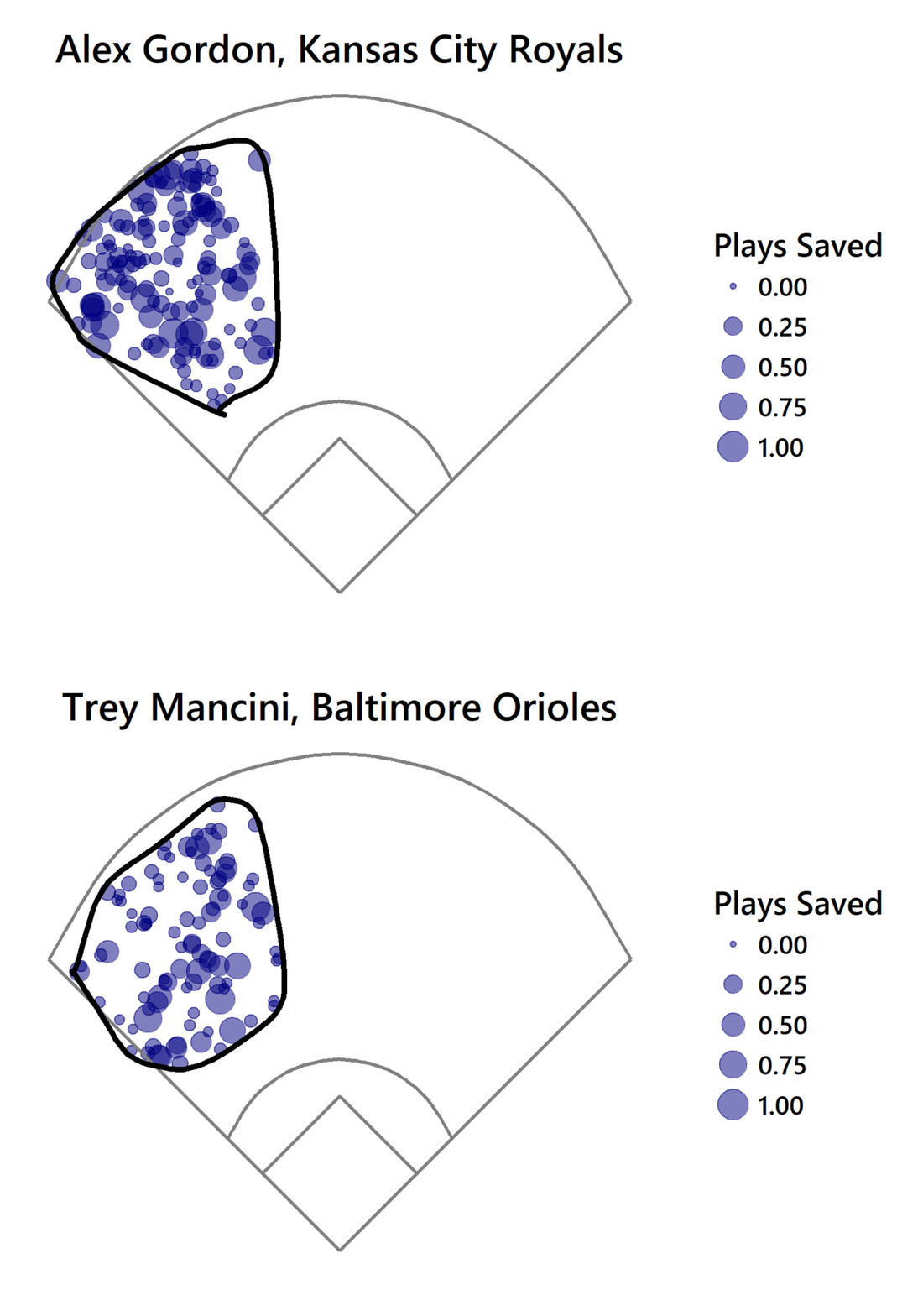
    Excellent: Alex Gordon (+10)
    Poor: Trey Mancini (-14)

    LeftField

    Having split time between left field, first base, and DH, Mancini did not have as much volume here, yet he still cost the Orioles 14 runs with his range and positioning in left. The numbers back up what the image shows: Mancini was particularly poor on medium and deep balls (16 plays below average).

    On the other hand, Gordon was excellent en route to his fourth career Fielding Bible Award. The only outfielder with more “Good Fielding Plays” than Gordon this year was Cincinnati’s Billy Hamilton.


    Center Field

    Excellent: Lorenzo Cain (+13)
    Poor: Adam Jones (-19)

    CenterField

    As the image illustrates, Cain was excellent on deep balls — the best among any outfielder, in fact, at +13 plays.

    Jones rated negatively on both shallow and deep balls, while also not exhibiting as much lateral ability as Cain, especially to right-center (possibly a product of defensive positioning).


    Right Field

    Excellent: Mookie Betts (+12)
    Poor: Nicholas Castellanos (-17)

    RightField

    Betts’ dominance reveals itself in the right-center gap. The American League MVP and World Series Champion also did well on deep balls, while still making a bunch of high-quality plays in front of him.

    The image nicely shows Betts’ ability to cover all of right field. He registered +6 on shallow balls, +4 on medium, and +4 on deep. Betts and Adam Duvall were the only outfielders to save at least four plays in all three areas at one position.

    Castellanos appears to have made a decent number of plays going towards the line, but struggled in other areas. He rated particularly poorly on deep balls (17 plays below average).

  • Stat of the Week: Tommy John Surgery in Major League Baseball

    Stat of the Week: Tommy John Surgery in Major League Baseball

    This month, two of baseball’s promising young pitchers—Shohei Ohtani of the Angels and Michael Kopech of the White Sox—learned that they will likely need Tommy John surgery due to torn ulnar collateral ligaments in their throwing arms. While Ohtani remains in the Angels’ lineup as a hitter, Kopech’s debut season is over after fewer than 15 innings.

    In the 2018 Bill James Handbook, Sports Info Solutions added Tommy John surgery information for every pitcher who appeared in MLB in 2017, including surgery dates. This information will be updated for every 2018 pitcher in the upcoming 2019 Bill James Handbook as well. Did you know that several pitchers have undergone multiple Tommy John surgeries? For example, Oakland A’s reliever Shawn Kelley has had two surgeries—the first in 2003 and the second in 2010.

    More than 25 percent of the league’s pitchers in 2018 have undergone Tommy John surgery at some point in time. That’s a surprisingly high figure, demonstrating how common the procedure is, as well as how pitchers have been successfully able to pitch in the majors after the surgery.

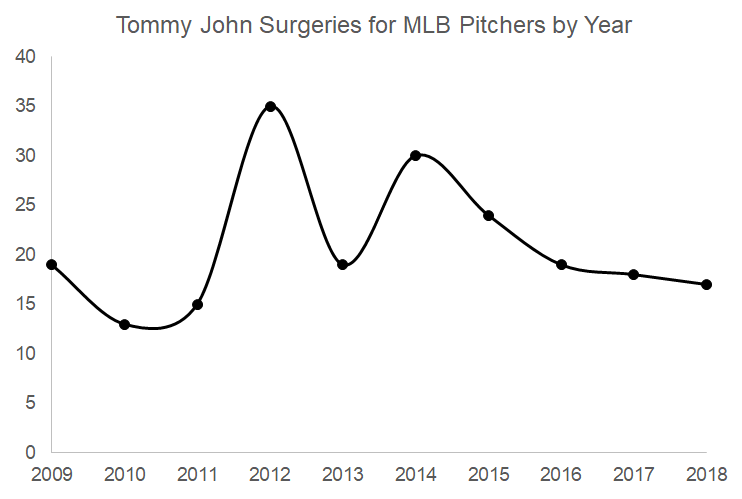
    Over the past three years, just under 20 additional MLB pitchers per year have had the surgery. There are also typically about one to three Tommy John procedures for MLB position players each season, such as the Dodgers’ Corey Seager and the Mets’ Travis d’Arnaud in 2018.

    TJS

    Among the pitchers who have returned to the Major League level after the surgery, the average return time is about 19 months, while the median is 16 months. Long recovery times skew these results; the most common returns are 12 and 13 months.

    However, not every pitcher returns from the operation—for example, former relievers Joel Hanrahan and Joel Zumaya. More than 20 percent of MLB pitchers who had Tommy John in 2016 or earlier did not return to the majors after the surgery.

    We also looked at how velocity changes after Tommy John surgery compared to before, considering fastballs thrown one year prior to the surgery date and one year following the return date for pitchers who returned to the same role (starter or reliever).

    Of the 156 pitchers in our sample, 96 had a lower average fastball velocity in the year after their return. The median increase among velocity gainers was about 0.6 miles per hour, while the median decrease among decliners was about minus-1 mile per hour. The declines may not be entirely attributable to the surgery, of course; pitchers tend to lose velocity steadily with age.

    That said, players who are younger at the time of surgery are more likely to gain velocity when they return. Of the 94 players who were 28 years old or younger, 43 saw their velocity increase (46 percent). Of the 62 players who were older than 28, 17 saw their velocity increase (27 percent).

    Baseball researcher Jon Roegele’s publicly-shared Tommy John Surgery List is an invaluable resource that aids Sports Info Solutions in the collection of Tommy John data.

  • Numbers show improvement in Eric Hosmer’s range

    Numbers show improvement in Eric Hosmer’s range

    by ANDREW KYNE
    Evaluation of San Diego Padres first baseman Eric Hosmer’s defense has long differed between the eye test and metrics such as our Defensive Runs Saved (DRS). Scouts and coaches have considered the Padres’ new first baseman to be among the league’s best at the position, while the numbers have typically rated him as a negative from a run-saving perspective.

    MLB.com’s Jeffrey Flanagan discussed the varying perceptions last August, with Hosmer’s former manager, Ned Yost, praising the first baseman’s “footwork around the bag, the ability to make great picks, handling pickoff throws” and other defensive detail. Our numbers at Sports Info Solutions generally agree, especially for picks – Hosmer leads all first basemen in runs saved via scoops over the last three seasons.

    However, in a June 2016 profile for The Kansas City Star, Yost admitted that “(Hosmer) doesn’t have exceptional range.”

    His range is, in fact, what defensive metrics have been skeptical of. According to our data, he cost the Royals a total of 11 runs in 2016 and seven runs in 2017 due to his range and positioning.

    Given his history, it’s noteworthy to find Hosmer’s name currently atop the total DRS leaderboard at first base for 2018:

    Name

    Range & Positioning

    Total Runs Saved

    Eric Hosmer

    4

    6

    Brandon Belt

    4

    5

    Matt Olson

    3

    5

    Joey Votto

    5

    4

    Paul Goldschmidt

    5

    4

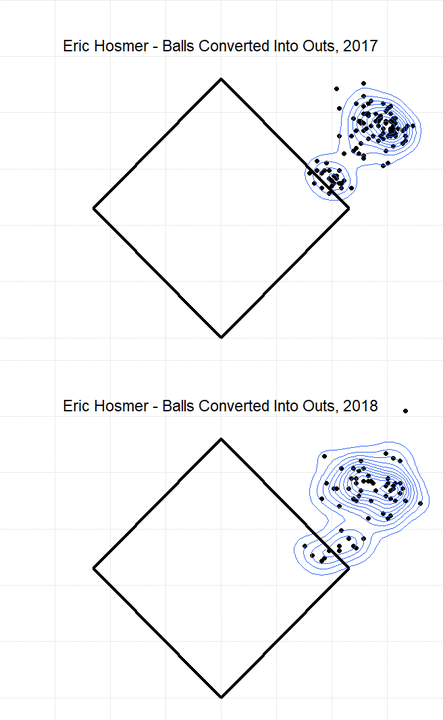
    Four of Hosmer’s runs saved have been credited to range and positioning, representing a significant improvement from his time as a Royal. He still rates slightly below average on plays to his glove side, but has been plus on balls hit straight at him and to his left.

    The following animation illustrates the wider range of balls that Hosmer has converted into outs so far in 2018 compared to 2017:

    EricHosmerRange

    It is worth noting that Hosmer’s average starting position (in terms of depth and angle) has not been significantly different this season, as seen through Statcast and Baseball Savant’s Player Positioning application.

    Of course, the sample size has been small and defensive metrics like DRS need time to stabilize, but Hosmer has our attention.

  • Visualizing the Range of MLB’s Best and Worst Outfielders

    Visualizing the Range of MLB’s Best and Worst Outfielders

    Baseball Info Solutions’ Defensive Runs Saved (DRS) metric measures a player’s total defensive contribution at a given position, compared to league average. The primary component, as outlined in The Fielding Bible, is the company’s Range & Positioning system, which rates each fielder’s success at converting batted balls into outs.

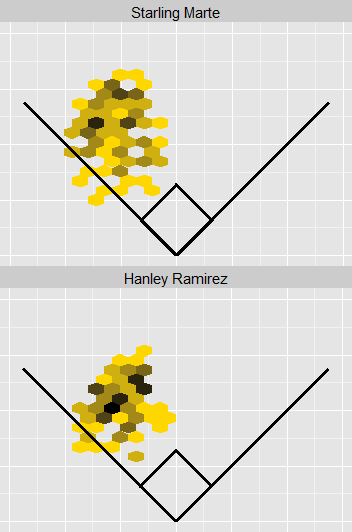
    Using BIS’s batted ball locations, we are able to compare the range covered by some of the best and worst outfielders in baseball. In doing so, we can visualize a piece of the DRS puzzle by seeing how well these players convert batted balls into outs (in this particular case, flyballs). Let’s take a look.


    Left Field

    LeftFieldAnimation

    Poor: Hanley Ramirez (-16)
    Excellent: Starling Marte (+8)

    While the Red Sox managed to sign both Pablo Sandoval and Hanley Ramirez in the offseason, it has not worked out as they would have hoped. Neither player has performed up to offensive expectations; both have killed the Sox on the defensive end. Ramirez, in particular, has endured an uncomfortable experience in left field; his -16 DRS is the second worst for any player at a single position. Even though the Green Monster in Fenway Park limits the amount of ground he has to cover, it is clear that Ramirez is limited in his range and unable to reach many balls in the corner.

    The Pirates’ groundball-heavy pitching staff limits some of the action in the outfield for Starling Marte, Andrew McCutchen, and Gregory Polanco, but they show off a great deal of range when flyball opportunities arise. Marte has settled in nicely to PNC Park’s spacious left field, combining his instincts, speed, and throwing arm to become one of the league’s most solid defenders. Since 2013, his 33 Runs Saved in left field ranks second to only Kansas City’s Alex Gordon (47). With Gordon currently on the shelf, Marte is among the favorites for his first Fielding Bible Award.


    Center Field

    CenterFieldAnimation

    Poor: Angel Pagan (-13)
    Excellent: Kevin Kiermaier (+24)

    The San Francisco Giants have turned into one of baseball’s best defensive teams, as their 36 Runs Saved ranks second in the National League behind the Arizona Diamondbacks (39). In fact, they have played average or better defense at every position… except for center field. After a few solid seasons in the Mets’ outfield, Pagan has not registered an above-average DRS since 2010. He has cost the Giants a total of 32 runs since joining the team in 2012. BIS’s Scott Spratt recently identified San Francisco’s center field as one of the biggest defensive holes on contending teams.

    Meanwhile, the Rays’ Kevin Kiermaier has become the gold standard for defense this season, leading Major League Baseball with 24 Runs Saved. A year after saving 14 runs in 108 games, Kiermaier is proving his worth through defense this season. His heatmap above shows almost no holes, with a high volume of plays made all over center field. Kiermaier’s ability to close the right-center gap aids the Rays’ defensive deficiency in right field, where Steven Souza and Brandon Guyer, among others, have cost the team four runs.


    Right Field

    RightFieldAnimation

    Poor: Carlos Beltran (-10)
    Excellent: Curtis Granderson (+11)

    Carlos Beltran missed time earlier this month due to an oblique injury, so he has not had as many opportunities as other right fielders. Yet the 38-year-old Beltran owns the worst DRS total at the position, exhibiting a clear and considerable decline in his defense. Slowed by injuries and aging effects, the eight-time All-Star simply does not have the range he once did when roaming center field for the Royals, Astros, and Mets.

    While the Yankees employ baseball’s worst defensive right fielder, the team across town employs the best. The Mets’ Curtis Granderson has bounced back both offensively and defensively in 2015. After a below-average defensive showing in his first season with the team, Granderson’s 11 Runs Saved barely edges out Jason Heyward (10) and Bryce Harper (10) for the time being. With steady center fielder Juan Lagares to his right, Granderson doesn’t have to worry much about the right-center gap, but he has the rest of right field under control.

  • The Best Team Defense Improvements of 2015

    On the heels of Kansas City’s improbable postseason run in 2014 and now successful start to 2015, baseball has been further exposed to the importance of team defense. With an electrifying outfield headlined by 2014 Fielding Bible Award winners Lorenzo Cain and Alex Gordon, the Royals have owned the American League’s best defense since the beginning of 2014 by BIS’s Defensive Runs Saved—and they’re winning ballgames because of it.

    After saving 34 runs in 2014—third-best in the AL—Kansas City has managed to be even better defensively in 2015. Their 37 Defensive Runs Saved (DRS) through 54 games puts them on a ridiculous pace of 111 across a full season, which would top the DRS record of 97 set by the 2005 Philadelphia Phillies (DRS has been tracked back to 2003).

    The Royals’ gain represents one of baseball’s best defensive improvements this season:

    2014 DRS 2015 Pace Gain
    Detroit Tigers -61 39 +100
    Toronto Blue Jays -22 64 +86
    Tampa Bay Rays -19 59 +78
    Kansas City Royals 34 111 +77
    Miami Marlins -24 31 +55

    * includes BIS’s Shift Runs Saved

    However, the very best improvement belongs to one of KC’s division rivals, the Detroit Tigers. There have been a few key factors in Detroit’s defensive turnaround; first and foremost, Nick Castellanos has resembled a competent third baseman. A year removed from being the league’s worst defender by costing the Tigers a whopping 30 runs, Castellanos has actually been a tick above average in 2015. After losing the entire 2014 season to injury, the return of slick-fielding Jose Iglesias at shortstop will surely help in the long run—and it doesn’t hurt that he’s contributing at the plate as well. Furthermore, the additions of Yoenis Cespedes and Anthony Gose have shored up the team’s outfield defense.

    The Blue Jays’ two major offseason splashes are paying dividends in 2015, both at the plate and in the field. Josh Donaldson has been a consistent run-saver at the hot corner in his career, while Russell Martin brought his excellent defensive reputation to his home country. In addition, Kevin Pillar has already made a number of highlight-reel grabs in 2015, saving the Jays a total of 13 runs between left and center field.

    The Rays’ improved defense has helped keep them competitive in the AL East, as they currently sit in second place, 1.5 games back of the New York Yankees. One of their biggest defensive improvements has actually come on the mound; their pitchers cost the club 13 runs on defense last season but have saved them three in 2015. While they’ve been average at shortstop, shipping Yunel Escobar (and his -23 DRS in 2014) to Washington this past winter has improved their defense at the position. Meanwhile, Kevin Kiermaier’s 11 Runs Saved ties him for second-most among outfielders this season. Tampa Bay has also saved eight runs by shifting alone, third-best in the American League behind Houston’s 13 and Baltimore’s 10.

    The aforementioned Royals are looking even better in the field and their outfielders are showing off once again. However, improvements in the infield may be the primary reason for their 2015 defensive success. Last year, Kansas City’s infielders were all below average in converting batted balls into outs; this year, it’s a completely different story:

    Kansas City Royals Defensive Runs Saved
    Season 1B 2B 3B SS Shifts Total
    2014 -1 -2 -6 -4 0 -13
    2015 1 2 9 2 3 17

    The biggest swing has come at third base, where Mike Moustakas is finally reaching the potential he showed in 2012 when he saved 14 runs. In all, the Royals have been average or better at eight of the nine positions. The lone exception is on the pitcher’s mound, where their staff has cost them one run defensively.

    Although the first two months of the Marlins’ season proved to be a disappointment, they did have one thing going for them: better defense. Second base was a major liability for Miami in 2014; that was corrected, however, with the addition of Dee Gordon. Despite being a below-average defender in his time with Los Angeles, Gordon has been the best defensive second baseman by DRS in 2015. With the help of respected infield instructor Perry Hill, both Gordon and shortstop Adeiny Hechavarria have been more focused on positioning this season and are seeing positive results in the process.

    While those five teams have seen the largest defensive gains in 2015, these five have experienced the most drastic declines:

    2014 DRS 2015 Pace Loss
    Washington Nationals 12 -26 -38
    New York Yankees 12 -37 -49
    Boston Red Sox 54 -34 -88
    Philadelphia Phillies -32 -128 -96
    San Diego Padres 52 -50 -102

    Two of the most significant drops belong to teams who added offense at the expense of defense over the winter. The Padres’ outfield defense, as expected, has been awful, already costing the team a total of 19 runs. A recent Stat of the Week article wondered if the Friars’ outfielders were hitting enough to offset their terrible defense.

    Meanwhile, Boston added the powerful bats of Hanley Ramirez and Pablo Sandoval while forfeiting defense at their respective positions. The Ramirez experiment in left field has been a costly one, with his -12 DRS proving to be the worst in the big leagues to this point. Sandoval, meanwhile, has contributed to the team’s -8 total DRS at third base.

    The Phillies continue to play poor baseball; on pace for -128 Runs Saved, they could challenge the record-low of -120 set by the 2005 Yankees.

    Defense is clearly an important piece of the puzzle, and it could dictate a few important divisional races over the final four months. In the AL Central, the Royals have used it to their advantage in the past, but the Tigers are now turning the corner defensively. In the tight AL East, the Blue Jays and Rays are seeing great defensive improvements, while the Red Sox are trending in the wrong direction. Each team is looking for wins at the margins, and making plays on the defensive side of the ball can be a key difference maker.