Author: James Weaver

  • Off The Charts Division Preview: AFC South

    Off The Charts Division Preview: AFC South

    Photo: Ken Murray/Icon Sportswire

    The AFC South is going through a renaissance, as 3 out of the 4 teams have replaced their head coach and starting quarterback since the end of 2022. Every team believes it has their quarterback of the future and have made personnel upgrades at key positions in free agency and the draft.

    The Texans caught everyone by surprise in 2023 in the first year of the Ryans/Stroud duo, winning both the division and a playoff game. Now as the division champs, they are no longer the young team looking to make a leap, but are now the hunted.

    With a young team being chased by 3 formidable opponents, this division has all the makings of a wild and wacky race in 2024. To help bring some clarity, Bryce Rossler welcomed John Shipley of Jaguar Report SI to the Off the Charts Football Podcast to break down each team and how it will fare in 2024.

    Here’s one thing the two discussed about each team and how that will impact them this season.

    The Texans receiving core is really good and maximized by their scheme

    Last season, the Texans had the 4th-most Receiving Total Points. Now, C.J. Stroud moves into year 2 with another top tier receiver in Stefon Diggs. With all of this talent, there is a legitimate argument the Texans can have the most prolific passing attack in the league this year.

    Nico Collins returns as WR1 after posting a top 10 Receiving Total Points season last year. Collins is a big play waiting to happen, as he ranked behind only Brandon Aiyuk in Boom Percentage last year (plays with 1 EPA or greater) among players with at least 100 targets.

    Two other Texans receivers, Tank Dell and Noah Brown, finished high in Boom Percentage too. The big play of these Texans receivers comes from both their talent and the scheme. 

    “I think their scheme impacts a lot of things. For example, the motions and play actions they did against the Jaguars last year led to two 50+ yard catches from Tank Dell where there wasn’t a DB within 10-15 yards of him because it was a complete coverage bust.”

    – John Shipley

    All eyes will be on the Texans offense in 2024 to see if it can replicate the success o 2023 and potentially make a deeper run into the playoffs.

    Ryan Nielsen is an upgrade at defensive coordinator for the Jaguars

    Ryan Nielsen takes over for Mike Caldwell to lead the Jaguars defense in 2024. Nielsen comes over from the Falcons where he improved a defense that ranked T-29th in EPA per Play in 2022 to T-7th in 2023. The pass rush doubled its sack total from one year to the next.

    The Jaguars have talent in the pass rush department that is looking to take the next step as well. Josh Hines-Allen is a legitimate Defensive Player of the Year candidate (T-8th in odds at Draft Kings) and had the 4th-highest pressure rate among players with at least 300 pass rush snaps in 2023. They also added former 49ers defensive linemen Arik Armstead who is coming off a 5-sack season in only 12 games from the interior.

    A big question will be whether or not Travon Walker can take the next step as a former number 1 overall pick. 

    John believes that he has the opportunity to be more versatile in Nielsen’s scheme. 

    ”He is this freak athlete who you can try to get mismatches against guys across the offensive line. Now that there is a guy there who has shown he is willing to move guys around, I think that will be good for their front overall.” 

    – John Shipley

    With the talent up front and the pedigree from a defensive coordinator to improve defenses quickly, the Jaguars defensive arrow is pointing up heading into 2024.

    Colts’ athletes on offense will look to push the ball downfield

    “They have some absolute freaks between Jonathan Taylor, A.D. Mitchell, and Anthony Richardson. These guys are absolute mutants.” 

    – John Shipley

    In adding Anthony Richardson back into the fold as the signal caller, this offense will look to take advantage of Richardson’s athleticism and big arm to push the ball downfield, per Bryce. 

    “I think he wants to push the ball. We saw some of that when Richardson was active. With Richardson healthy, I think they will be more vertically oriented.” 

    – Bryce Rossler

    Both of them need to see it from Richardson before anointing him as an MVP contender, but they both buy into him as a guy who can get there.

    Will Levis is in for a rough time

    Both Bryce and John are very low on Titans quarterback Will Levis going into this season. They see too much inconsistent play and questionable decision making, which leads them to think the Titans are in for a bad year.

    “He was 24th in On-Target Rate Above Expectation among 34 quarterbacks with 200+ attempts. He was 32nd out of 41 quarterbacks in sack to pressure ratio. 33rd out of 35 in positive play rate and bust percentage. The lowlights are hilarious. I think it’s gonna be a trainwreck.” 

    -Bryce Rossler

    “The best way I can describe Will Levis is that he plays like a Vince Vaughn movie character playing quarterback. There was one start against the Jags last year where he took a sack because he turned to hand the ball off the wrong way. I would be surprised if it ended up working out for him.” 

    -John Shipley

    Yikes, not good. One thing going for Levis is that he can throw the ball downfield. He ranked 1st in average depth of target and was middle of the pack in boom percentage. He has the cannon arm, but he needs to limit all of the mistakes and ill-advised plays if the Titans offense is going to succeed. The addition of Calvin Ridley will provide some additional upside in a receiving group that was surprisingly above average by Total Points in 2023.

    Conclusion

    The SIS Betting Model sees the Texans as the division favorite with a projected 8.5 wins, but the Jaguars are close behind at 8.3. A clear dropoff ensues with the Colts at 5.8 and Titans at 4.3. A Texans repeat will be difficult with the Jaguars breathing down their necks, and if Richardson can play at that MVP level, this division can get crazy. In regards to the Titans, it might be time to pump the brakes on what this team can achieve offensively even with the weapons they added.

    Check out the full breakdown of each team on the Off the Charts Football Podcast!

  • Off The Charts Division Preview: AFC East Has 3 Super Bowl Contenders

    Off The Charts Division Preview: AFC East Has 3 Super Bowl Contenders

    Photo: Peter Joneleit/Icon Sportswire

    There is an argument to be made that three out of the four teams in the AFC East can win the Super Bowl. There is also a case that the fourth team might have drafted the best quarterback in the draft. With so many teams fighting for ultimate glory, this division is shaping up to be one of the most competitive in the NFL. 

    To break it all down, Mark Schofield from SB Nation joins our own Bryce Rossler to look at each team in this division in the latest episode of Off The Charts.


    Let’s dive into one thing Bryce and Mark talked about for each team and how it will shape the landscape of the AFC East this season. 

    How vulnerable are the Bills to giving up the AFC East crown?

    In the offseason, the Bills lost Stefon Diggs, Tre’Davious White, Mitch Morse, Leonard Floyd, Jordan Poyer, Gabe Davis, and potentially Micah Hyde. A serious reshaping of the roster will take effect in 2024, putting all the more pressure on Josh Allen to be an MVP caliber quarterback.

    The Bills have decided to put all their eggs into the Allen MVP basket, as they have given him fewer weapons to make hay on the offensive side of the ball. The last two years of production show that he is capable of achieving this level, as he is only behind Patrick Mahomes in Total Points in that time. 

    “They still have who I would say is the second-best quarterback in football in Josh Allen. And, despite all the things I said about Josh Allen coming out, he’s a guy that can and has carried this team. But this is kind of a soft rebuilding year for them.”

    – Bryce Rossler

    A soft rebuild? With all the talent in the AFC East, it is certainly reasonable to think this team is vulnerable to not win the division. 

    The Jets don’t need vintage Aaron Rodgers to make noise this year.

    The 2024 Jets are primed to take a major step forward assuming that they can get a lot more than 4 plays out of Aaron Rodgers this year. 

    They bolstered the offensive line by signing veteran tackles Morgan Moses and Tyron Smith, and then used the 11th pick in the draft on another tackle in Penn State’s Olu Fashanu.

    After Rodgers went down, less-than-middling quarterback play ultimately led to their demise. Their young talents in Breece Hall and Garrett Wilson were severely limited by this, and they could never make the impact that they are capable of.

    On the other side of the ball, the Jets boast one of the best stop-units in the NFL. In 2023, they ranked second in EPA per play against the pass and sixth against the run. That’s all the more impressive with them being on the field more often than not due to the inept offense. Quinnen Williams and Sauce Gardner will once again be the anchors, with both coming off Pro Bowl seasons and Gardner his second straight first team All-Pro season.

    All of the talent here suggests that Rodgers doesn’t need to be otherwordly. 

    “They need just say an average Rodgers, like, subpar year. He probably gets them to be a playoff team, and that was the hope going into last year. If you just got sort of run-of-the-mill season type numbers from Aaron Rodgers, you’re probably a playoff team.”

    – Mark Schofield

    Anything can be better than an offense that ranked last in passing EPA and positive play percentage that the Jets’ quarterbacks gave them last season, so a jump to at worst 16th would be a major improvement and can get this team to a place it hasn’t been to since the days of Mark Sanchez.

    How good does the Miami Dolphins defense need to be?

    The departure of Vic Fangio at defensive coordinator, late-season injuries to Bradley Chubb and Jaelan Phillips, and free agency losses in Christian Wilkins and Andrew Van Ginkel leave a lot of questions about this Dolphins defense. This defense ranked 12th in EPA per play last season before all that upheaval.

    However, there is still plenty of talent here. Phillips and Chubb will return at some point during the season and the Dolphins used their first round pick on Penn State edge rusher Chop Robinson to add to the rotation. Jalen Ramsey ranked first in EPA per target allowed among cornerbacks in a partial season. Jevon Holland also finished in the Top 10 in EPA per target among safeties with 15 targets.

    The Dolphins also added Jordyn Brooks and Jordan Poyer via free agency, two players who had significant impacts to their prior teams. Brooks topped linebackers in Pass Rush Total Points per play while Poyer was Top 10 among safeties in Run Defense Total Points.

    Anthony Weaver comes in from the Ravens to take the reins of a defense that has seen a lot of moving parts. Luckily, this offense is still good enough to lead this team, so a top five defense isn’t really required.

    “I think this doesn’t need to be a top five defense. This doesn’t need to be a defense that you’re calling on and hoping will pitch a shutout here and there. It needs to be the kind of defense that can steal an extra possession or two for your offense, particularly. On those days where that offense is struggling a little bit, give them a short field, give them an extra possession via a turnover, things like that.”

    – Mark Schofield

    Can Drake Maye be the answer for the Patriots to push the ball down the field? 

    As soon as the 2023 NFL Draft was complete, rumblings began about the 2024 talent at quarterback. At the time, Drake Maye and Caleb Williams were considered the top tier, and mock drafts varied between the two on who would be the top pick.

    Fast forward a year after the rise of Jayden Daniels and the meteoric rise of Williams, Maye dropped out of the top tier and ended up as the third overall pick of the draft. 

    Yes, Maye also took a bit of a step back in 2023, with fewer passing yards and a lower Independent Quarterback Rating (IQR) for the Tar Heels, but there are plenty of signs that the Patriots might have found the guy to build around in the future.

    “You see some of the throws, some of the reads, the willingness to attack the middle of the field with velocity between defenders with anticipation type throws. You see the competitive toughness, which is the thing that I value highly in quarterbacks.” 

    – Mark Schofield

    In his two full seasons Maye had the 3rd and 15th most pass attempts between the numbers in the FBS, respectively, and he was in the Top 15 in IQR (our Independent QB Rating stat)  in both seasons.

    Going forward, Maye and the Patriots will look to add verticality in the offense under new offensive coordinator Alex Van Pelt. Van Pelt comes from a Browns offense that ranked 7th in average depth of target in 2023. The Patriots’ offense ranked 28th.

    The goal this year is to evaluate Maye and see if he can be the quarterback of the future, so giving him every possible opportunity to excel in this offense is crucial. 

    So what do Mark and Bryce think on how the division will pan out? You can check out the full podcast here for more of a breakdown as well as their predictions. 

  • Analyzing NFL Win Totals with the SIS Prediction Model

    Analyzing NFL Win Totals with the SIS Prediction Model

    We’ve reached prediction season for the NFL. A big part of dissecting the upcoming season is analyzing the schedule and predicting which teams will overperform or underperform their expectations.

    Expectations these days come from the sportsbooks, especially through win totals. These markets have been posted and bettors have begun forming their stance on each individual team. The lines will move all offseason long, as more information and opinions will move the lines in one direction or another.

    At SIS, we have created a pre-game prediction model to predict the spreads, totals, team totals, and moneylines of each game using a multitude of data points that we collect. We also constructed the model to be able to run for the entire season, allowing us to run simulations on the season and create win total prices of our own. The model went 18-13-1 in over-under predictions on team’s preseason win totals last season.

    We have run our first simulation of the year and the Football R&D team selected their favorite wagering opportunities in the win total markets based on the model’s output. The three of us (Alex Vigderman, Bryce Rossler, and James Weaver) each selected four hypothetical wagers we would make in a snake draft style on the Off the Charts Football Podcast.

    These are our model’s win total projections.

    Team DraftKings Win Total Model Projected Win Totals Difference
    Raiders 6.5 10.4 Over 3.9
    Saints 7.5 10.7 3.2
    Bears 8.5 10.7 2.2
    Lions 10.5 12.3 1.8
    Buccaneers 8.5 10.3 1.8
    Browns 8.5 9.8 1.3
    Packers 9.5 10.7 1.2
    Seahawks 7.5 8.7 1.2
    Jets 9.5 10.6 1.1
    Patriots 4.5 5.5 1
    Ravens 11.5 12.1 0.6
    Bills 10.5 11.1 0.6
    Giants 6.5 7.1 0.6
    Cowboys 10.5 11.1 0.6
    Rams 8.5 9 0.5
    Cardinals 6.5 6.9 0.4
    Bengals 10.5 10.9 0.4
    Texans 9.5 9.4 Under -0.1
    Panthers 5.5 5.2 -0.3
    Dolphins 9.5 9 -0.5
    Chiefs 11.5 10.9 -0.6
    Broncos 5.5 4.7 -0.8
    Steelers 8.5 7.4 -1.1
    Jaguars 8.5 7.4 -1.1
    Falcons 9.5 8.1 -1.4
    Chargers 8.5 6.9 -1.6
    49ers 11.5 9.8 -1.7
    Colts 8.5 6.1 -2.4
    Vikings 6.5 4 -2.5
    Titans 6.5 4 -2.5
    Commanders 6.5 3.2 -3.3
    Eagles 10.5 6.8 -3.7

    Model Overview (How did we get these numbers?)

    Our model utilizes 18 features that are a combination of game, team, and player level metrics. 

    Game level metrics include whether or not the game is in the postseason, weather predictions like wind speed and precipitation probability, and a home team indicator.

    Some of the team level metrics include weighted points for and points against averages, both offensive and defensive weighted penalty yards, and some possession metrics in the form of snaps per game or drive. Each of these metrics is computed for the team’s past 7 games, with the most recent weighted more heavily. 

    We use a weighted 16-game average with our Total Points for the player metrics. We calculate the average Total Points for each skill (Passer, Rusher, Pass Rush, etc.) for every player per snap, and then aggregate the projected values for each game to the team level using each player’s projected snap counts for the game.

    Then, we utilize Monte Carlo simulation to illustrate variance in player performance by simulating 1,000 games for each player. After each simulation, all of the metrics are incorporated into a Lasso regression model to predict the team’s point total. The distributions of the predictions are aggregated to an average and spread so that point estimates and alternate point estimates can be drawn from the distribution.

    Now that there are lines for each game, we can simulate 1,000 regular seasons based on the moneyline output and take the average win total for each team.

    Analyzing the Overs

    The Off The Charts podcast crew of Bryce Rossler, Alex Vigderman and I went through the over-under possibilities here and drafted the ones they felt best about (Listen to the episode here).

    They went with the Raiders, Saints, Browns, Packers, Patriots and Cardinals on the ‘over’ side (listen to the episode to find out who took whom and their reasoning).

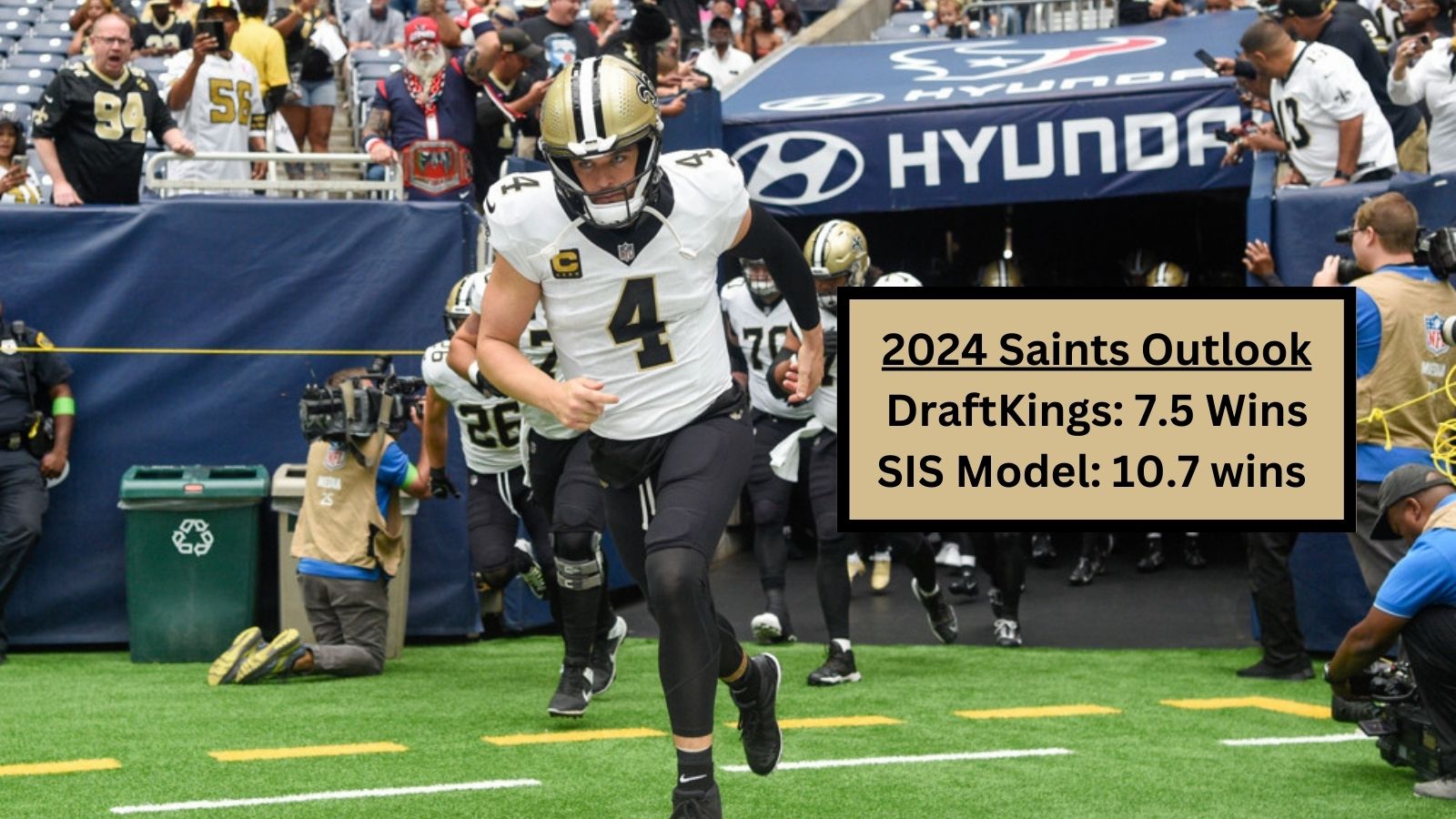
    The model picked the Raiders and Saints to go over their Vegas win total by the widest margin. The Raiders are projected to have 10.4 wins and the Saints 10.7, good for 3.9 and 3.2 wins of value, respectively. 

    Both teams finished last season strong in regards to the various model inputs. The Saints are No. 1 in our Points For weighted average and No. 5 in Points Against weighted average, which goes back to the last 7 games played of last season. Additionally, Derek Carr ranks 2nd in the Passer Points per play weighted average coming into this season (5th if you include projected snap count).

    The Raiders added Gardner Minshew, who is 8th in Passer Points per play weighted average and will battle Aidan O’Connell for the starting QB spot. They also come into the season 9th and 6th in the Points For and Points Against weighted averages, respectively.

    The Browns and Packers come in at 1.3 and 1.2 wins above their current win totals of 8.5 and 9.5. The Browns will welcome back Deshaun Watson after catching lightning in a bottle with Joe Flacco at the end of last season. The Packers also finished strong, pushing the 49ers to the brink in the divisional round and are ranked second in recency-weighted Points For. 

    Our crew drafted both the Patriots and Cardinals even though the model total only slightly exceeded the DraftKings number. The reason: quarterback optimism.

    Unders

    After a total collapse at the end of last season, the Eagles come in with the most value towards the under, as they are projected to win only 6.8 games compared to a win total of 10.5. They rank 26th and 30th in recent points for and points against. 

    Bryce took both the Eagles and the Vikings, who are projected for 4 wins in our model when DraftKings has the over-under set at 6.5. Bryce doesn’t have faith in J.J. McCarthy and believes it will take him more than a season to get to a good place.

    “This is a player who doesn’t have a lot of reps at game speed,” Bryce said. “I know he started several years at Michigan but he’s not passing a lot in that offense. I think Year 1 in the NFL is going to be very rough. I know they feel like as an organization that they’ve found their quarterback. But I don’t see it in Year 1.”

    The Vikings defense also ranked in the bottom eight in points against, with a bottom-five rank in defensive Total Points over the full season.

    Two of the other unders taken in our “draft” were the Chargers, who have a 6.9 expected win value compared to their 8.5 wins total, and the 49ers, who have a 9.8 expected win value compared to a win total of 11.5. 

    The Chargers are in the midst of a small rebuild and culture change with a new coach, and our drafter, Alex, wants to see it to believe it with another new coaching staff and a reworked skill position group. 

    The 49ers, fresh off the Super Bowl loss, were in a few dogfights down the stretch in the playoffs, and the defense wasn’t as good as its reputation last year, hence the reasons for the differential. 

    “I look at their schedule … they get the AFC East, and they lump in the Chiefs,” James said on our podcast (that’s me!) “Improved NFC, Super Bowl hangover being real. I just think 11.5, that’s pretty high.”

    A Battle in Charlotte

    Two of our draftees, Alex and Bryce, will go head-to-head this season when it comes to the Carolina Panthers. 

    Bryce has taken the under 5.5 because he doesn’t see a scenario in which Bryce Young can be a good quarterback for this team.

    Alex, on the other hand, thinks the hate has gone too far, and has a little more optimism with a new head coach in Dave Canales (who improved the quarterback play of Baker Mayfield and Geno Smith over the last few years).

    “This is my pick in the genre of ‘Rookie quarterback might take them somewhere,’” Alex said. “I think you could also have ‘Rookie quarterback is anomalously bad’ and people get kind of insane about it. A year ago people were feeling reasonably good about the rest of the team, offensive line and defense. I do think there’s an overreaction and they can get a little bit of a bounceback.”

    The model sides with Bryce by the slimmest of margins, projecting 5.2 wins to the win total of 5.5. 

    Check out the full Off the Charts Football Podcast here for more analysis!

    Follow us on Twitter at @football_SIS and check out the DataHub and DataHub Pro for access to all our stats.

  • Under Pressure? Projecting Sack Numbers using Advanced Pass Rushing Metrics

    Under Pressure? Projecting Sack Numbers using Advanced Pass Rushing Metrics

    In today’s pass-happy league, the No. 1 concern for defenses has been affecting the play of the quarterback. Allowing time from a clean pocket to make a throw spells doom for defenses.

    We have seen the massive contracts given to high-end pass rushers who make game-changing plays. Nick Bosa, Chris Jones, Josh Allen, Brian Burns, and T.J. Watt all find themselves in the Top 25 in average annual contract value where that list is primarily made up of quarterbacks and a few receivers. 

    To that point, we set out to project the next crop of sack artists using some of our metrics. The big pain with projecting pass rush performance, though, is that context plays a huge role. An interior player who primarily plays on early downs has a much harder time than a situational pass rusher coming off the edge. 

    We created Expected Pressure Percentage and Pressure Percentage Plus-Minus a few years ago for this reason. The former uses game situation, player alignment, and quarterback drop type to estimate how likely a player is to generate pressure on each play, and the latter is how much the defender performed above or below that expectation.

    In order to better predict year-over-year sack production, we looked into four stats to see how predictive each of these are towards the following year’s sack output.

    – the previous year sack percentage 

    – pressure percentage 

    – expected pressure percentage 

    – pressure percentage plus-minus of pass rushers 

     Once we dove into what has predictive value, we looked at some interesting candidates for positive or negative sack regression in 2024.

    Methodology

    Sack percentage, pressure percentage, expected pressure percentage, and pressure percentage plus-minus were aggregated for every player in their previous season going back to 2019. 

    These four metrics were then used as features in linear regression models to predict the sack percentage of the player’s next season. Players were only considered if they had 100 pass rushes in each season.

    The significance of each variable and adjusted R2 values of each model were analyzed to see which metrics have the best year-over-year predictive value. The adjusted R2 value is a 0-to-1 measure of how well the features explain the variability of the dependent variable, in this case current year sack percentage, and is adjusted based on how many features there are in the model.

    Results

    Model Adjusted R2 Statistically Significant?
    Sack% 0.13 Yes
    Pressure% 0.27 Yes
    Expected Pressure% 0.29 Yes
    Pressure% +/- 0.03 Yes
    Expected Pressure% + Pressure% +/- 0.32 Yes/Yes

    For starters, all of these are statistically significant, meaning that an increase or decrease in one of these features meaningfully impacts the following year’s sack percentage. 

    Also, we used sack percentage instead of actual sacks because we need to factor how many pass rushes a player had in a given season. Playing time can be affected by a variety of factors, so we are keeping it simple by focusing on per-play performance.

    Sack percentage comes in with the second lowest adjusted R2 value when predicting next season’s sack percentage. Considering that sacks are more output than process when it comes to good pass rush, this makes sense. Sacks come at such a low sample that having one more or fewer can drastically impact this percentage, especially year-over-year.

    Expected pressure percentage shows a slightly higher adjusted R2 value than pressure percentage and are the two with the best explanation of variability in next season’s sack percentage. This is the process driven argument, as getting more pressure on a quarterback shows better predictive value than your sack percentage from the previous year.

    Pressure percentage plus-minus comes in at the bottom. This metric strips out the opportunities to get a sack and looks solely at the skill portion. Volume is a big part in getting sacks and situational factors are very impactful, so the low explanation in variability here (low adjusted R2) makes sense.

    The best model combines expected pressure percentage with pressure percentage plus-minus, coming in with an adjusted R2 of 0.32. Factoring in the skill component with the expected measure makes the model better explain variability, and it does so better than just using pressure percentage because it weighs the situational factors more strongly.

    With the latter model leading the way, let’s use that to predict some sack percentages for 2024.

    2024 Outlook

    Decline in Wattage

    T.J. Watt once again led the league in sacks for the 3rd time in 2023 with 19. However, his unimpressive expected pressure rate of 10.3% would suggest he is in for a drop in sack percentage by 1.8 percentage points in 2024. This would be a massive drop off by Watt’s standards, putting him roughly at 10 sacks this upcoming season based  if he had roughly 500 pass rushes. Leading the league in sacks three times is very impressive, but sustaining that production over time is a very tall task.

    Trading Trey?

    Trey Hendrickson walked back his trade request with the Bengals by expressing his desire to win a Super Bowl for Cincinnati. Hendrickson, who had a career high 17.5 sacks with the Bengals last season, is a candidate due for a drop in sack percentage by 2.2 percentage points. His expected pressure rate put him in the middle of the pack last season at 10.1%. Looking at a sell high opportunity, the return on Hendrickson might be enough to warrant a trade.

    The Youthful Cameron Jordan

    Cam Jordan may be past his prime at age 34, but he can still affect the quarterback at a high rate. His 10.3% expected pressure percentage last year came only with a 0.5% sack percentage. According to the model, this should result in a bump to 11.5% in his 14th season in the league. Can Jordan turn back the clock? Maybe not, but he should have higher production than his 2.5 sacks a season ago.

    A More Hungry Lion

    Aidan Hutchinson is projected to take another step forward and increase his sack percentage to 2.2% this year, good for another half-sack. Hutchinson took a leap last season, ranking 8th in pressure percentage among those with 30 pressures and 12th in sacks. Another step forward would be huge for a Lions team coming oh so close to getting to the Super Bowl last season.

    Sack Title Contenders

    Looking at the predicted sack percentages for next year and using the pass rushes a player had last year, Maxx Crosby (13) and Aidan Hutchinson (13) are our top contenders to take home the sack crown, with Danielle Hunter, T.J. Watt, Micah Parsons, Nick Bosa, and Khalil Mack just behind. Josh Uche, who had only 214 pass rushes last season, is projected to have a higher sack percentage this year at 2.2%. Playing with Matthew Judon on the other side, Uche has a chance to accumulate a high sack total given more opportunities.

    Conclusion

    Using advanced pressure metrics gives us more of a sense of predicted output going forward. Sacks are the output, but their predictive power is minimal. Looking at the process of getting a sack leads us to seeing who may be a diamond in the rough poised for a breakout season or someone who might be overvalued. After all, this is arguably the second-most important position in football, so getting these players right is critical to success.

  • A Mathematical Realignment of FBS College Football Conferences

    A Mathematical Realignment of FBS College Football Conferences

    We are now over halfway through the 2023 College Football season and coming closer to a 2024 that will look nothing like its predecessor. A new playoff format and new conference alignment will take center stage and drive the new era of college football forward.

    We decided to take a stab at realigning FBS college conferences based on a multitude of features that can be grouped by academics, location, on-field football performance, and finances. If we blew up the whole existing scheme and went for schools that were most aligned on these key factors, how would that shake out? 

    For the mathy people out there, these factors were weighted using Multiple Factor Analysis and then used to create new conferences utilizing K-Means Clustering. Some additional details about the methodology are included below.

    Without further ado, let’s jump right into the fun!

    Features

    As stated previously, the features can fall into 4 categories: academics, location, on-field football performance, and finances. 

    Academics

    • R1 University Status – A university that has high research activity with the required benchmarks outlined here. As it stands, only 3 schools in the current Power 5 do not have R1 status.

    Location

    • The latitude and longitude of each college football stadium for the respective school.

    On-Field Performance

    • Winning Percentage – The winning percentage of each team from 2018-2022.
    • Average Recruiting Ranking – The average 247 star-ranking for each player on the team from 2018-2022.

    Finances

    • Total Athletic Department Revenue – All sources of operating revenue for the schools’ athletics departments for the 2022-2023 fiscal year.
    • Total Athletic Department Expenses – All operating expenses for the schools’ athletic departments for the  2022-2023 fiscal year.
    • College Football Head Coach Salaries – The total pay by the school and athletically related compensation from non-university sources in 2023.

    *The data collected comes from USA Today. Private schools are exempt from reporting revenue, expenses, and coaches’ pay as well as some that are under state exemption. To fill in the missing data, the average dollar amount from the respective school’s current conference was used. The proxy values for Army and Navy come from the AAC, and Notre Dame’s are averages of the top 20 schools in each category.

    Methodology – Tailored Version

    Here’s the skinny on what we did.

    We started by structuring the various inputs into groups and then trying to identify where those inputs could be consolidated, so our model becomes as streamlined as possible. 

    From there, we took those component measures for each school and grouped them by similarity. We can use statistical methods to identify how many groups (“clusters”) there should be, which said that about 6 conferences makes the most sense. 

    Yes, that means we’re coming out with a lot fewer conferences than currently exist in FBS. But we’re having fun here (and boy are those new conferences going to have some fun).

    Methodology – Detailed Version

    Multiple Factor Analysis

    Multiple factor analysis is used to structure the provided data into groups and then reduce dimensionality using a combination of principal component analysis and multiple correspondence analysis. More on the specifics of multiple factor analysis can be found here.

    In regards to this analysis, each of the quantitative variables are scaled to a z-score and then weighted properly in each component. In this case, 5 components (dimensions) were selected to be used for clustering with 97.48% of variance explained. The following is a table of the contributions of each group of variables to each dimension:


    Dimension 1 Dimension 2 Dimension 3 Dimension 4 Dimension 5
    Academic 25% 3% <1% 46% 25%
    Performance 33% 1% 2% 47% 53%
    Financial 42% <1% <1% 1% 21%
    Location <1% 95% 97% 5% 1%

     K-Means Clustering

    K-Means clustering is an unsupervised machine learning technique used to create clusters of data with similar traits. Basically, the optimal number of clusters is selected by the analyst with help from some optimization techniques, and then the model optimizes how to assign each data point to its ideal cluster center. Once the clusters have been made and each data point has been assigned to a cluster, it is up to us on how to interpret those clusters distinctly. Read here for more on K-means clustering.

    In this case, each cluster includes the teams that will be in each new proposed conference. Based on the results, the optimal number of conferences will be 6. Additionally, the worst option other than 1 is 10, which will be the number of conferences after the PAC-12 disbands next season. This number was determined using the best silhouette distance (see here) for the given number of clusters. The plot visualizing this can be seen below.

    Results

    Step aside Power 5, I present to you the Sweet 6 FBS Football Conferences!

    Southern USA

    Baylor FIU Florida Atlantic Georgia State Georgia Tech
    Houston Louisiana Memphis Mississippi State New Mexico
    North Texas Rice South Florida Southern Mississippi Texas Tech
    Tulane UAB UCF UTEP UTSA

    In the newly formed Southern USA conference (named in part because we see a lot of current C-USA schools), we see a mix of teams that come from both the original power and non-power 5 conferences. All of these schools are R1 universities. The range of recruiting rankings goes from 2.4 to 3.23 and only 4 schools have athletic revenue and expenses over $100 million (Baylor, Georgia Tech, Texas Tech, and Mississippi State). 

    PAC-17 (RIP 2-Pac)

    Arizona Arizona State California Colorado Colorado State Hawaii
    Nevada Oregon Oregon State Stanford UCLA UNLV
    USC Utah Utah State Washington Washington State

    The new look PAC-12 adds Colorado State, Hawaii, UNLV, Nevada, and Utah State in this scenario. The geographical impact of this conference is prevalent with all of these schools located in Colorado or west. USC, Oregon, Washington, and UCLA are still in this conference based on the factors considered and were unable to make the jump to the elite conference that we will discuss later. However, the first 3 lead the new conference in recruiting rankings with an average of 3.51, with UCLA in 7th at 3.10. 

    The American 30

    Air Force Akron App. State Arkansas State Army Ball State Boise State Bowling Green
    BYU Central Michigan Charlotte Coastal Carolina East Carolina Eastern Michigan Fresno State Georgia Southern
    Jacksonville State James Madison Liberty Louisiana Tech Louisiana-Monroe Marshall Miami OH Middle Tennessee State
    New Mexico State Northern Illinois Sam Houston State San Diego State San Jose State SMU South Alabama TCU
    Texas State Toledo Troy Tulsa Wake Forest Western Kentucky Western Michigan Wyoming

     This conference is really the best of the rest across the country. This is the only conference that includes teams that are not R1, as all of these institutions do not have that distinction. Wake Forest, BYU, and TCU are the current Power 5 schools that find themselves in this conference. This conference spans the entire United States, highlighted by a would-be conference game between Army and San Diego State, schools that are 2,796 miles apart. Hopefully the MAC teams in this conference wouldn’t push for the Wednesday night games or these two schools would be doomed!

    The Northleast

    Buffalo Kent State Navy Ohio
    Old Dominion Temple UCONN UMASS

    These 8 teams are the bottom-tier when it comes to winning percentage and recruiting rankings. 7 out of 10 fall in the bottom 30 in recruiting and 5 out of 8 fall in the bottom 30 in winning percentage. One of the main reasons why they are separated from The American 30 is that they are all R1 institutions. It is a shame that basketball performance is not taken into account for the Huskies, as the reigning national champion and perennial powerhouse basketball program would certainly lift this team to a better conference.

    TCGP (The Champion Gets Promoted)

    Kansas Rutgers Vanderbilt Nebraska
    Arkansas Northwestern Illinois Indiana
    Duke Louisville Maryland Virginia Tech
    Syracuse South Carolina Boston College Purdue
    North Carolina Missouri West Virginia Virginia
    Ole Miss Michigan State Iowa State Kansas State
    NC State Pittsburgh Wisconsin Kentucky
    Oklahoma State Minnesota Iowa Cincinnati

     The best of the rest in the Power 5 find themselves here one step below the elites. The current Big 10, Big 12, ACC, and SEC are all represented here as the mid-tier teams of their respective conferences. They are all R1 universities and have revenues over $100 million except for Cincinnati, who was just in the College Football Playoff 2 years ago and has the highest winning percentage of these teams. Kansas and Syracuse are the only two teams that don’t reach the 3-star recruiting ranking threshold in this conference. If relegation was alive in college football, this would be the conference where teams can make the jump to elite status or fall back down to.

    The Premier 16 

    Alabama Auburn Clemson Florida
    Florida State Georgia LSU Miami FL
    Michigan Notre Dame Ohio State Oklahoma
    Penn State Tennessee Texas Texas A&M

    We have finally reached the elite tier conference. This conference boasts the best of the best including all of the national champions of this millennium. These teams recruit the best players, generate the most revenue, win the most, and are all R1 institutions. The SEC, Big 10, ACC, and Big 12 are all represented here as well as independent Notre Dame. All 16 of these teams reside in the top 18 when it comes to recruiting as well, meaning it might be difficult to keep any of these teams out of the Premier competition for long.

    At the end of the day, this was a thought-exercise used to create new conferences based on a multitude of factors rather than location. At the end of the day, the west coast is still really far away, but dropping the FBS to 6 conferences really made similarities amongst teams that we wouldn’t usually compare stand out. Now let your minds wander on what relegation can look like year to year…

  • The Sniff Test: What Metrics From 2022 Provide A Signal For 2023?

    The Sniff Test: What Metrics From 2022 Provide A Signal For 2023?

    On the latest episode of the Off the Charts Football Podcast, Matt Manocherian and James Weaver dove into the SIS Data Hub ($) and uncovered some of the most surprising stats from the previous season.

    The question they asked themselves was: Does this stat pass the sniff test?

    They wanted to figure out if if these stats provide a signal going into the future or if they are just a noisy occurrence.

    Here’s a look at the stats they went through. See if they pass your version of the sniff test.

    Jared Goff was 3rd in Passing Wins Above Replacement (WAR) with 3

    Pass the Sniff Test? – Yes

    Given Goff’s track record of taking an offense to the Super Bowl and how the Lions finished in 2023, James bought into this stat and believed it had staying power.

    “I kind of believe it,” said Matt, who noted Goff was worth only 1.2 WAR in 2021. “It does pass the sniff test for me. But in order for that to repeat this year, a lot of the ancillary items like having a low sack number and having interception luck will have to happen again this year.”

    Sam Darnold was 2nd in the league in IQR from Week 12 onward with 108.1

    Pass the Sniff Test? – Split

    Matt was taken aback when he heard this and does not think this passes the sniff test. He believes that the simplification of the Panthers offense made Darnold’s efficiency look good.

    James responded with some other metrics that support that Darnold might have found something at the end of last season.

    Darnold ranked:

    – 3rd in On-Target Percentage

    – 7th in Average Throw Depth

    – 2nd in Yards per Attempt

    – 4th in Boom Percentage.

    “The sample size was small and he was playing for an interim coach at the end of the season, but he very well might have played the best football of his career,” James said.

    Jawaan Taylor lead all Offensive Tackles in Total Points with 42.8

    Pass the Sniff Test? – No

    “I couldn’t believe he was the leader among all tackles. I thought it would be someone like Tristian Wirfs,” Matt said. “Every year, he has shown out as somebody who is better than we thought he was and if Total Points is right, then him fitting in with Mahomes can be something really good.”

    Matt also discussed the state of the Chiefs offensive line, as they brought Taylor and Donovan Smith in to protect Mahomes on the bookends after the departure of Orlando Brown Jr.

    He doesn’t think Taylor passed the sniff test to be the leader among all tackles but believes that he can be a cornerstone for the Chiefs moving forward.

    The Texans were 4th in Pressure Rate at 37.8%

    Pass the Sniff Test? – Undetermined

    This was another stunner for Matt and it was left for James to counter.

    He pointed out that Christian Kirksey ranked 11th overall in pressure rate, and players like Ogbonnia Okoronkwo and Jerry Hughes contributed positively to that number. The Texans ranked 13th in sack percentage and 26th in Pass Rush Points Saved.

    “So they were generating pressure, but couldn’t bring down the quarterback when they got to him,” James said.

    Matt brought up that the roster has a lot of good young players, including Will Anderson who can absolutely make an impact this season.

    In terms of deciding if this sticks, James thought that it will be hard to find a signal in this stat due to the turnover in Houston, as the team looks very different compared to a year ago.

    Josh Uche led all players in Pressure Rate at 20% among players with 100 Pass Rushes

    Pass the Sniff Test? – Yes

    “Interestingly, even with the limit set at 100, he had 256 rushes. I definitely would not have expected that,” Matt said.

    James thought that this might be due to having a Defensive Player of the Year candidate in Matt Judon on one end and that Uche might be a beneficiary of that. However, he does believe that Uche is a solid player.

    Matt thinks this has a big signal and has a big upwards arrow heading into 2023.

    The Pittsburgh Steelers were 7th in Blocking Total Points

    Pass the Sniff Test? – Yes

    Overall, the Steelers were 4th in Blown Block Percentage and 9th in Wins Above Replacement,

    “Not a lot of people thought that this was a Top 10 offensive line last year.” James said.

    The Steelers were a super-heavy zone running team and had a positive EPA when doing so. The system credits the o-line for all the yards before contact that the RB’s accrue in this scheme.

    Matt noted that they protected better than expected, but he wasn’t blown out of the water by that No. 7 ranking.

    On an individual basis, James Daniels (14th in Total Points), Mason Cole (40th in Total Points), and Kevin Dotson (18th in Total Points) were a solid trio on the interior of the line that helped the Steelers achieve that ranking.

    The Philadelphia Eagles allowed 0.07 EPA/A against the Run and -0.16 EPA/A against the Pass

    Pass the Sniff Test? – Maybe

    Both James and Matt were blown away that there was such a great discrepancy between the two. James pointed out that after the Commanders game, the Eagles brought in Ndamukong Suh to fill in on the D-line and that they don’t pay linebackers.

    Matt said “They really want you to rush against them so that you can’t pass efficiently against them. The only way you can keep up with their offense is to be really effective passing against them, so they will defend that more than the run. You can’t beat us at our game, you can’t out run us.”

    The Baltimore Ravens were 30th in Receiving Total Points

    Pass the Sniff Test? – Undetermined

    There was no receiver over 1.5 Yards Per Route Run on Baltimore, with Demarcus Robinson coming the closest at 1.4, 25th in Yards Per Target, the 6th-highest Drop Percentage, and 18th in On-Target Catch Percentage.

    “The receivers did the quarterbacks no favors in helping them out,” James said

    Matt pointed out that this won’t tell us anything going forward, as Zay Flowers and Odell Beckham Jr. should erase what happened the year before.

    Saquon Barkley led the NFL in using the Designed Gap

    Pass the Sniff Test? – Yes

    Matt brought up how Barkley would never hit his gap in college or in the early years of his career, so it was interesting to see him doing so regularly in the NFL.

    “It is good to see that from a player who is that powerful and that strong that can hit the gap as quick as he can,” James said.

    Matt provided more context behind Saquon’s changes. Barkley was hit at the line 41% of the time, which he gauged to be a little high

    “He is still not high on the Yards Before Contact per Attempt leaders. He’s still responsible for a whole lot of what he’s earning out there. But he got his Stuff Percentage down to 17% which is good to see.”

    Matt believes that a part of the Giants success can come down to Saquon hitting the gap in his contract year for this upcoming season.

    To listen to the episode and hear more of Matt and James’ thoughts, check out the podcast link below.

  • Scouts vs Stats: The NFL’s Top Linebackers & Safeties

    Scouts vs Stats: The NFL’s Top Linebackers & Safeties

    Over the spring/summer, the SIS R&D staff is convening on the Off the Charts Podcast to talk about their top players at a position. To do this, we pit two methodologies against each other: 

    • The “Scouts,” which comes down to the film-based opinions of Matt Manocherian and Bryce Rossler, each of whom has a lot of experience breaking down film and scouting players (Matt having done it for NFL teams).
    • The “Stats,” which involves James Weaver and Alex Vigderman devising a ranking based on a suite of metrics, and having that ranking speak for itself.

    Officially, Sports Info Solutions does not condone the dichotomy between scouting and statistical analysis. Each of them provides data in their own way and should inform our evaluation of a player. 

    When we originally produced the Football Rookie Handbook before transitioning that content to our NFL Draft site, we put the scouting reports and stats side-by-side with the idea that the reader would bounce back and forth between them and leverage both to come to a conclusion about a prospect.

    This week, we decided to do a 2-for-1 special and break down the Top 5 Off-Ball Linebackers and Top 5 Safeties in the NFL. So, without further ado, let’s get into the fun!

    Off-Ball Linebackers

    Scouts’ Opinion Statistical Analysis
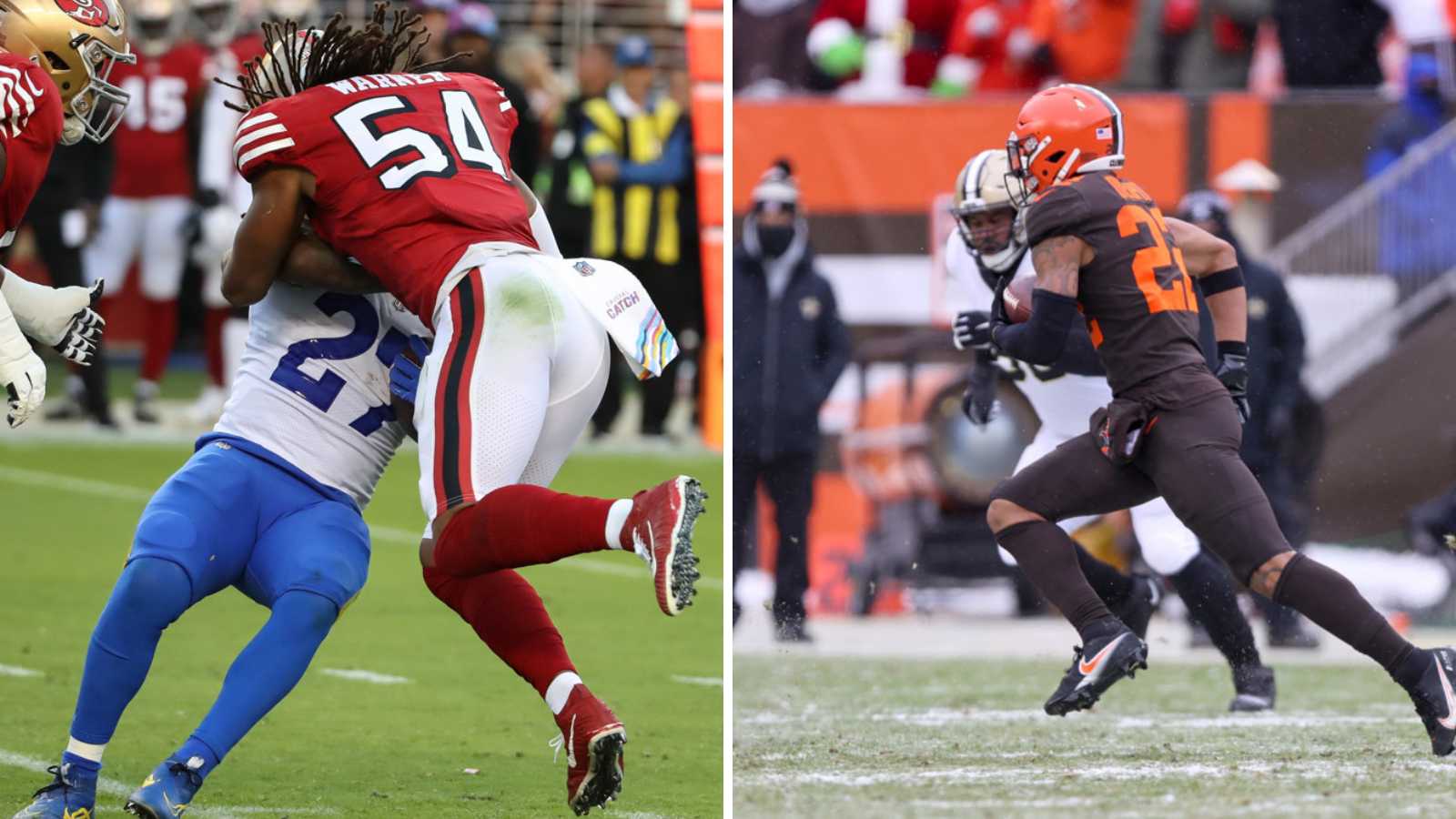
    1. Fred Warner 1. Roquan Smith
    2. Roquan Smith 2. Fred Warner
    3. Matt Milano 3. Shaquille Leonard
    4. Dre Greenlaw 4. Bobby Wagner
    5. Demario Davis 5. Matt Milano

    The Stats List Methodology

    The stats-based ranking includes a three-year recency-weighted average of a player’s results across several different metrics, with the following weights applied to each:

    • 20% Run Defense Total Points
    • 15% Pass Rush Total Points
    • 10% Pass Coverage Total Points
    • 10% Broken+Missed Tackle Allowed %
    • 10% Adjusted Tackle Depth
    • 10% Pressure % Plus Minus
    • 5% Hand On-Ball %
    • 5% Deserved Catch %
    • 5% Targets Per Cover Snap
    • 5% Positive % Allowed Zone Scheme
    • 5% Positive % Allowed Man Scheme

    From an off-ball linebackers perspective, the stats team felt that weighting run defense and pass rush more than pass coverage was appropriate when considering Total Points. To indirectly increase the weighting, we included five supplemental metrics with 5% weights that analyzed different aspects of a linebacker’s coverage skills. A player like Matt Milano benefits from including these pass coverage metrics, as he ranked in the Top 10 in Hand On-Ball %, Deserved Catch %, and Positive Play % Allowed Zone Scheme while also ranking 3rd in Pass Coverage Total Points.

    Rounding out the rest of the metrics, Adjusted Tackle Depth compares actual tackle depth to the expected tackle depth based on personnel, intended run gap, and the defender’s pre-snap alignment. Hand On-Ball % is the percentage of plays where a defender got their “hand on the ball.” This includes breaking up or intercepting a pass as well as forcing or recovering a fumble. Deserved Catch % is the percentage of targets as the primary defender that the receiver either caught or dropped the ball when the pass was catchable.

    What the Stats Showed

    Roquan Smith, the leader in the clubhouse on the stats side, finished in the Top 3 in all of the Total Points categories. He also accumulated these numbers without getting his hand on the ball much, ranking 97th. 

    Fred Warner came in 6th and 7th respectively in Run Defense and Pass Rush Total Points. What propelled him to 2nd was his supplemental metrics. He finished 3rd in Deserved Catch % (1st in Top 5), 7th in Pressure % +/- (2nd in Top 5), and 12th in Targets Per Cover Snap (2nd in Top 5). 

    Shaq Leonard finished 1st in both Run Defense and Pass Rush Total Points at this position, even with only playing in 3 games all of last year. Unlike Smith, he had his fingerprints all over the football when he played, ranking 2nd in Hand On-Ball %. His pass coverage metrics aren’t anything to write home about, ranking 17th in Pass Coverage Total Points and not any higher than 73rd in the supplemental pass coverage metrics.

    What the Scouts Thought

    The scouts had Fred Warner as their number 1 and Roquan Smith as their number 2. This was a clear cut decision for both Bryce and Matt, who said that he tried to make this a conversation with Bryce, but ultimately couldn’t argue for Smith ahead of Warner. 

    In regards to Warner’s pass coverage skills, Bryce is still in awe of the play in the NFC Divisional Game where Warner ran stride for stride with CeeDee Lamb,

    “He was 40 yards downfield stride-for-stride with one of the best receivers in the NFL. Nobody else can do that,” Bryce said. “There are corners who can’t even do that.” 

    On Smith, Matt said

    “At the center of your defense, this is someone who will make your entire defense faster.” Bryce added on, “He will hit you and will materialize out of nowhere on a perimeter run and make a tackle. His range is crazy.”

    One player that the scouts had on their list that the stats team didn’t was Demario Davis. Matt highlighted his versatility, strength, and tackling ability all as positives. He stated that he isn’t great in pass coverage, but Bryce thought that he has some athletic juice and showed some quality skills. They both credit his pass rushing ability as well as his availability.

    Safeties

    Scouts’ Opinion Statistical Analysis
    1. Derwin James 1. Grant Delpit
    2. Talanoa Hufanga 2. Budda Baker
    3. Minkah Fitzpatrick 3. Justin Simmons
    4. Budda Baker 4. Minkah Fitzpatrick
    5. Antoine Winfield Jr. 5. Talanoa Hufanga

    The Stats List Methodology

    The stats-based ranking includes a three-year recency-weighted average of a player’s results across several different metrics, with the following weights applied to each:

    • 25% Pass Coverage Total Points
    • 15% Run Defense Total Points
    • 10% Broken+Missed Tackle Allowed %
    • 10% Adjusted Tackle Depth
    • 10% Hand On-Ball %
    • 10% Deserved Catch %
    • 10% Pass Rush Total Points
    • 5% YAC Per Completion
    • 5% Targets Per Cover Snap

    The categories here are very similar to off-ball linebackers, with the only differences being the removal of the man Positive %, Zone Positive %, and Pressure % over expectation, while adding in YAC Per Completion. The weights are changed with pass coverage taking over as the most important Total Points category. Run defense is still prominent, and pass rush drops to a 10% weight.

    What the Stats Showed

    Grant Delpit took the top spot for the stats team. He ranked 2nd in both Run Defense and Pass Rush Total Points as well as 1st in the Top 5 in Adjusted Tackle Depth. He was 17th in Pass Coverage Total Points 

    Budda Baker came in 2nd, even though he finished 1st in both Run Defense and Pass Rush Total Points. He finished 31st in Pass Coverage Total Points, but was the best in the Top 5 in Targets Per Cover Snap. He only faced 16 targets in 2022 with 526 cover snaps, meaning his impact is known when you try to throw at him.

    Talanoa Hufanga cracked the Top 5 with only having meaningful playing time in one season. He ranked 12th in Pass Coverage Total Points, but was 20th and 23rd in Run Defense and Pass Rush, respectively. He ranked the best in the Top 5 in Deserved Catch % as well as YAC Per Completion.

    What the Scouts Thought

    Coming in No. 1 on the scouts list was Derwin James.

    “This is a player who athletically is 1 of 1,” Matt said. “He’s faster than anyone else on this list, he hits like a linebacker, he can guard any tight end.” Bryce continued the praise, “He’s a problem-solving player. You can put him on Kelce. He’s a matchup eraser. He’s a prototype.”

    In 3rd, the scouts had Minkah Fitzpatrick. Bryce discussed how good of an athlete he is and how you can ask him to do whatever you need him to do. Matt added that he is as versatile as they come, and that he can play slot, corner, strong, or free safety. 

    Cracking into the 5th spot was Antoine Winfield Jr. Matt said:

    “He plays the game with a sixth sense about him. Just like the Honey Badger.” He continued, “You have to be careful throwing the ball when Antoine Winfield is in the vicinity.”

    Want to hear more discussion and debate? Check out this episode of the podcast:

  • Scouts vs Stats: Debating The Top 10 NFL Tight Ends

    Scouts vs Stats: Debating The Top 10 NFL Tight Ends

    Over the spring/summer, the SIS R&D staff is convening on the Off the Charts Podcast to talk about their Top 10 players at a position. To do this, we pit two methodologies against each other: 

    • The “Scouts,” which comes down to the film-based opinions of Matt Manocherian and Bryce Rossler, each of whom has a lot of experience breaking down film and scouting players (Matt having done it for NFL teams).
    • The “Stats,” which involves James Weaver and Alex Vigderman devising a ranking based on a suite of metrics, and having that ranking speak for itself.

    *This week, Matt called for some backup, so we brought in Jeff Dean from our Football Ops department

    Officially, Sports Info Solutions does not condone the dichotomy between scouting and statistical analysis. Each of them provides data in their own way and should inform our evaluation of a player. 

    When we originally produced the Football Rookie Handbook before transitioning that content to our NFL Draft site, we put the scouting reports and stats side-by-side with the idea that the reader would bounce back and forth between them and leverage both to come to a conclusion about a prospect.

    So, without further ado, let’s celebrate Tight End University week and break down the ‘Best Tight Ends in the NFL’ lists.

    Scouts’ Opinion Statistical Analysis
    1. Travis Kelce 1. Travis Kelce
    2. George Kittle 2. George Kittle
    3. Mark Andrews 3. Mark Andrews
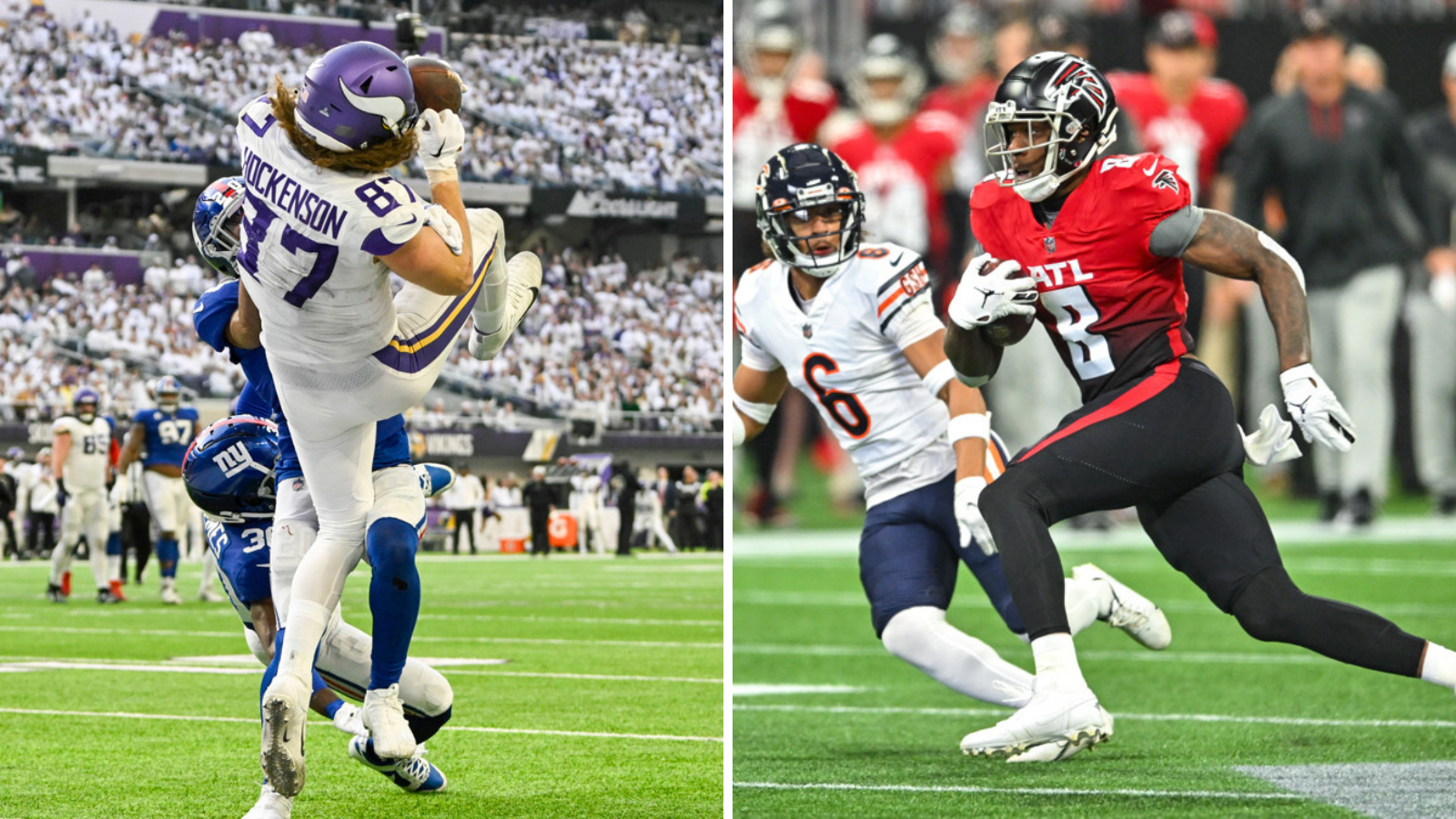
    4. T.J. Hockenson 4. Kyle Pitts
    5. Dallas Goedert 5. Dallas Goedert
    6. Darren Waller 6. Dalton Schultz
    7. Kyle Pitts 7. Darren Waller
    8. Evan Engram 8. Cole Kmet
    9. David Njoku 9. Hunter Henry
    10. Dalton Schultz 10. Pat Friermuth

    The Stats List Methodology

    The stats-based ranking includes a three-year recency-weighted average of a player’s results across several different metrics, with the following weights applied to each:

    • 35% Pass Game Total Points (Receiving and Pass Blocking)
    • 15% Run Blocking Total Points
    • 15% Targets Above Expectation
    • 15% On-Target Catch %
    • 10% YAC/Rec
    • 5% ADoT
    • 5% Broken Tackles + Missed Tackles/Rec

    For tight ends, we decided to combine Receiving and Pass Block Total Points into an all-encompassing passing game metric. This was created so that a player who rarely pass blocks is not punished if he does well in the receiving game. 

    Run Blocking Total Points are also factored in to highlight the secondary responsibility of a good tight end. This metric is what shot Cole Kmet up the stats’ leaderboard, playing in an offense that is run heavy.

    The rest of the metrics all measure how good a tight end is in the receiving game. Of note, Kyle Pitts was 1st in the ADoT metric and Travis Kelce was 6th in the Broken Tackles and Missed Tackles Per Rec.

    What the Stats Showed

    The Top 4 players in the pass game Total Points metric were all in the Top 4 of the stats’ list.

    Mark Andrews finished ahead of George Kittle in the metric, but Kittle finished ahead of Andrews in Run Blocking Total Points, Broken and Missed Tackles Per Reception, Yards After Catch Per Reception, and On-Target Catch Percentage. Kyle Pitts was 4th in the pass game metric despite playing in only 10 games (and in a very low-volume pass offense) last season, emphasizing how productive he was in his rookie season. Travis Kelce, who was first in this metric, nearly doubled the value of second place Kittle, with 42 Total Points per season compared to 24. His production in Receiving Total Points over the last 3 years would make him a Top 5 receiver overall. 

    The Top 4 in the stats’ list also all came in the Top 10 in Targets Above Expectation. This metric measures how many targets the player themselves generates based on contextual factors like alignment, coverage, and route type. Other than No. 10-ranked Pat Friermuth (14th), no other player in the Top 10 on the stats’ list came in the Top 15. Generating one’s own targets was a separator for the Top 4 on the list.

    Yards After Catch Per Reception numbers for Kelce (2nd in Top 10) and Kittle (3rd in Top 10) separated themselves from Andrews (Last in Top 10). Dallas Goedert, who placed fifth overall, came out the best in this metric among the top ten players, ranking 14th among tight ends with 6.7 YAC/R. Goedert was also solid in all other metrics, coming in 7th overall in pass game Total Points, 8th in Run Blocking Total Points, and 25th (3rd in the Top 10) in Broken and Missed Tackles Per Reception.

    What the Scouts Thought

    This one lacks a little suspense. Both lists had Travis Kelce as the best tight end in the league.  From a scouts’ perspective, Bryce Rossler states, “He is one of the best tight ends of all-time. Probably only Gronk above him. His route-running is amazing, his yards after the catch ability is amazing, and he’s a pretty good athlete.” 

    Both groups also had the same players at No. 2 and No. 3. The scouts found T.J. Hockenson to be 4th on their list while the stats guys did not have them in their Top 10.

    As to why, Jeff said, “His ability to produce no matter who his quarterback is, no matter what kind of offense he’s in, is something you don’t find in a lot of tight ends.” He goes on to say, “Not to mention his huge wingspan, being able to post up linebackers over the middle, and challenge cornerbacks on out routes is something that is really hard to find in the position.”

    One of the differences on the scouts’ list was that they included Jaguars tight end Evan Engram at number 8. “He might not have the gaudy numbers you look for, but when you watch him play, he’s a guy the defense has to account for. He’s a legitimate receiving threat,” Jeff said. “I would not be surprised if he has a bigger year than he did last year in this upcoming season.” 

    Want to hear more discussion and debate? Check out this episode of the podcast:

  • Scouts vs Stats: Top 10 NFL Cornerbacks

    Scouts vs Stats: Top 10 NFL Cornerbacks

    Over the spring/summer, the SIS R&D staff is convening on the Off the Charts Podcast to talk about their top ten players at a position. To do this, we pit two methodologies against each other: 

    • The “Scouts,” which comes down to the film-based opinions of Matt Manocherian and Bryce Rossler, each of whom has a lot of experience breaking down film and scouting players (Matt having done it for NFL teams).
    • The “Stats,” which involves James Weaver and Alex Vigderman devising a ranking based on a suite of metrics, and having that ranking speak for itself.

    Officially, Sports Info Solutions does not condone the dichotomy between scouting and statistical analysis. Each of them provides data in their own way and should inform our evaluation of a player. 

    When we originally produced the Football Rookie Handbook before transitioning that content to our NFL Draft site, we put the scouting reports and stats side-by-side with the idea that the reader would bounce back and forth between them and leverage both to come to a conclusion about a prospect.

    So, without further ado, let’s get to these ‘Best Cornerbacks in the NFL’ lists and then do a deep dive on why each group ranked as it did.

    Scouts’ Opinion Statistical Analysis
    1. Pat Surtain II 1. Sauce Gardner
    2. Jalen Ramsey 2. Tyson Campbell
    3. Jaire Alexander 3. Jalen Ramsey
    4. Sauce Gardner 4. Pat Surtain II
    5. Darius Slay 5. Tariq Woolen
    6. Tre’Davious White 6. Jaire Alexander
    7. Marshon Lattimore 7. J.C. Jackson
    8. Xavien Howard 8. Michael Jackson Sr.
    9. Denzel Ward 9. L’Jarius Sneed
    10. A.J. Terrell 10. Michael Davis

    The Stats List Methodology

    The stats-based ranking includes a three-year recency-weighted average of a player’s results across several different metrics, with the following weights applied to each:

    • 30% Pass Coverage Total Points
    • 5% Pass Rush Total Points
    • 10% Run Defense Total Points
    • 10% Positive % Allowed vs. Man Coverage
    • 10% Hand-On-Ball %
    • 10% Deserved Catch Allowed %
    • 5% Press Coverage %
    • 5% Slot Corner %
    • 5% Broken+Missed Tackle Allowed %
    • 5% Penalties
    • 5% YAC Per Completion Allowed

    Once again, the stats team leans heavily into Total Points. This catch-all metric incorporates many of the elements that we would care about when evaluating a player’s performance. In this case, Pass Coverage Total Points takes the higher weight due to the nature of what cornerbacks are asked to do.

    Run defense and pass rush are also included in order to favor those with specific skill sets that add to a team’s value. Obviously these two are not the usual attributes first thought of when evaluating cornerback play, but a sneaky corner blitzer like L’Jarius Sneed or an ultra-aggressive run defender in Jalen Ramsey add value to a team with these skills.

    The stats team also wanted to give credit to corners who line up in press coverage more often as well as those who line up on the outside rather than in the slot (a smaller slot corner % value). A player who lines up in press usually has the skill and trust from the coaching staff to go 1-on-1 with their counterpart on the offensive side of the ball with minimal help. With the better receivers usually lining up on the outside, we credited those corners who line up on the outside more often than in the slot.

    The other 10% weights—positive % allowed vs. man coverage, hand on-ball %, and deserved catch %—all break down an individual player’s performance when the spotlight is on them. Positive % vs. man is the percentage of positive plays (EPA > 0) a corner allows when they are in man coverage. Hand on-ball % is the percentage of time a player has an interception, a pass deflected, a pass tipped, a forced fumble, or a fumble recovery. Deserved catch % is the percentage of time a corner allows a catch or a drop on a catchable throw, so a lower number is better here.

    The rest of the weights include broken and missed tackles allowed, yards after catch per completion allowed, and penalties. Gauging whether or not a player is disciplined and a sure tackler are standard staples on defense.

    What the Stats Showed

    4 out of the top 5 players on the stats list came in the Top 5 in Pass Coverage Total Points. Tariq Woolen was the only one who didn’t, but he was the best in the Top 10 in press coverage % and was 1st among all corners in deserved catch %. Both he and Sauce Gardner benefit from having massive rookie seasons, as they have less baggage clinging to them in what they have allowed.

    Tyson Campbell ranked No.2 on the stats list while he didn’t make the Scouts Top 10 list. His stats across the board ranked highly among Top 10 players such as 4th overall in Pass Coverage Total Points and 7th overall in Run Defense Total Points. He also ranked the best among Top 10 players in slot corner %, meaning his production came on the outside.

    J.C. Jackson was No. 7 on the stats list solely because of his 2020 and 2021 seasons with the Patriots. He has the same rank in Pass Coverage Total Points, has the 2nd-best press coverage rank among those in the Top 10, and is 3rd overall in hand-on-ball %. However, allowing 16 yards per target in 2022 is less than ideal. He will have to get back to his previous standards this year after being benched and suffering an injury last season.

    What the Scouts Thought

    Pat Surtain II was their best corner in the league. Surtain’s NFL pedigree came from his father, Pat Surtain Sr., and the younger Surtain has surpassed his father by being more physical and having the ability to punish a receiver throughout the game. Those coupled with his size, strength, and speed make him No. 1 on their list.

    A big difference between the stats and scouts list was the ranking of Darius Slay. The scouts had him No. 5, but the stats list had him No. 63! “When he is on, he is dangerous,” Matt said of Slay. Matt adds, “I think he earns every bit of the money he earns in Philadelphia.” The stats had him a lot lower, as he ranked 73rd in Pass Coverage Total Points. 

    Further along, Bryce discussed why Tre’Davious White ranked No. 6: “Maybe feisty is the word, but he is definitely one of the more physical guys even with his size.” 

    Matt also liked the play of Xavien Howard as the 8th best cornerback on the scouts list. He still believes that he is a top corner despite fighting through an injury.

    “This is somebody who, going into last year, would have been at the very top of this list for me,” Matt said. “I think that he is an interesting case study for the volatility of corners,”

    Want to hear more discussion and debate? Check out this episode of the podcast:

  • Study: Where does “NFL-Ready” talent come from in the NFL Draft?

    Study: Where does “NFL-Ready” talent come from in the NFL Draft?

    Everyone has heard the term “NFL-Ready” prospect. These are players who are deemed to have the skills, talent, and football IQ to make an immediate impact when their time comes to take the field. This opportunity usually comes sooner rather than later for these types of players, but some situations arise where they still have to wait their turn (looking at you, Patrick).

    In trying to quantify this immediate production, we looked at a player’s draft position to see if there were any significant differences in their Total Points production in their first handful of games. Are these immediate impact players all taken early, or are there more to be found in later rounds? We try to answer this question here with our company’s favorite stat, Total Points.

    Methodology

    Going back to the 2016 NFL Draft, we looked at players who have played in at least 4 games and played at least 40 snaps in their first 4 games. We then took the average Total Points value of those first 4 games for each relevant category (e.g. Receiving Total Points for WR). After accumulating the player averages, we then took the overall average at each position based on if that player was selected in the first round or not and if a player was taken in the early rounds (1, 2, or 3) or the late rounds (4, 5, 6, 7, or undrafted).

    Once the averages were taken, we used a Standard T-Test, Welch T-Test, or a Wilcoxon Signed Rank Test to compare the averages and test whether or not first round or early round players have a higher average compared to their counterparts. The test used was decided based on whether or not the data subsets were normal based on a Shapiro-Wilk test. If the data subset was normal, we used a version of a T-Test. If not, we used the Wilcoxon Signed Rank Test. The type of T-Test was determined by whether or not the two data subsets shared the same variance (Standard or Welch).

    In each case, we are testing the null hypothesis that the Total Points means between each group are equal to each other. If the test yields a p-value less than 0.01, our alpha level, then we reject that the null hypothesis is true. In the tables below, you will find whether or not the test was found to be significant (p-value less than 0.01) and the average Total Points per game value of each group that was compared.

    This is not a test of the complete performance of a player’s career, but rather the chance of having an immediate impact once they get their opportunity. 

    Enough stat talk, let’s dive into some of the results!

    Quarterbacks

    Total Points Category Draft Groups Significant? First/

    Early Round

    Mean

    Other/

    Late Round Mean

    Passer Points First Round/

    Not First Round

    No 2.50 1.16
    Passer Points Early Round/

    Late Round

    No 2.11 1.20

    Analyzing Passer Total Points among quarterbacks, we see that we cannot reject the null hypothesis that the means of a quarterback’s first 4 games are the same regardless of how we split players up. Even though the means look different, we cannot statistically infer that the compared populations have different average production.

    Consider this when a quarterback makes his first start. Regardless of the round selected, quarterbacks have produced right away from all rounds within the draft. The Top 3 quarterback Passer Total Points averages come from Patrick Mahomes (1st Round, 10.2), Dak Prescott (4th Round, 9.5), and Cody Kessler (3rd Round, 7.9). Immediate production from the signal caller can be found at any point throughout the draft.

    Wide Receivers/Tight Ends

    Position Total Points Category Draft Groups Significant? First/

    Early Round Mean

    Other/

    Late Round Mean

    WR Receiver Points First Round/

    Not First Round

    Yes 0.92 0.16
    WR Receiver Points Early Round/

    Late Round

    Yes 0.51 0.08
    TE Run Block Points First Round/

    Not First Round

    No 0.34 0.25
    TE Run Block Points Early Round/

    Late Round

    No 0.26 0.25
    TE Receiver Points First Round/

    Not First Round

    Yes 0.53 0.09
    TE Receiver Points Early Round/

    Late Round

    Yes 0.30 0.03


    For both wide receivers and tight ends, Receiving Total Points shows a significant difference in both tests favoring the first/early rounds. 

    Among receivers, Terry McLaurin (1st Round, 4.30), Will Fuller V (1st Round, 2.69), Justin Jefferson (1st Round, 2.40), Marquise Brown (1st Round, 2.16), and Ja’Marr Chase (1st Round, 2.06) all come in the Top 5 for Receiving Total Points. No shortage of top end talent and pedigree for sure.

    The Top 3 tight ends in Greg Dulcich (3rd Round, 1.38), Gerald Everett (2nd Round, 1.31), and Kyle Pitts (1st Round, 1.28) all came in the early rounds as well. Run Blocking Total Points from a tight end perspective are not statistically different from one another depending on when they were selected. 

    Defense

    When comparing the first to the other rounds, every defensive position and relevant Total Points Category is statistically significantly better. This suggests that defensive talent that is taken in the first round has a higher impact when it takes the field in its first 4 games than a player that is taken later. When comparing the early and late rounds, there were several other positions with Total Points categories that were significant, but the more consistent effect was found in the first and other round comparisons.

    Furthermore, below is a table of the players with the highest impact of each position at the most relevant Total Points Category. All of these players come from either the first or second round.

    Position Player Total Points Category Total Points Value Round Drafted
    DT Derrick Brown Run Defense 1.44 1st
    DE Nick Bosa Pass Rush 3.07 1st
    LB Devin Bush Run Defense 1.67 1st
    DB Asante Samuel Jr. Pass Coverage 6.11 2nd

    Other Positions

    The two positions not covered above, running backs and offensive linemen, yielded different results. There was no Total Points category that showed a significant difference for running backs when considering Rushing and Receiving Total Points. On the other hand, both Pass Block and Run Block Total Points showed significant differences in both group types for offensive linemen.

    Conclusion

    The TLDR summary of this study would be: The idea that early draft picks outperform late picks in the receiving game from the jump is interesting, particularly because that hasn’t been the case for passing or rushing.

    All in all, only quarterbacks, running backs, and run blocking tight ends did not show significantly different averages between players selected in the first/early rounds when compared to the other/late rounds. Again, these results suggest performance differences for players playing in their first 4 games. These results do not conclude anything about long-term performance. To put it in fantasy terms, think picking up a receiver on the waiver wire for one week vs. picking a receiver in a rookie draft for a dynasty league.

    Getting early production can come from a lot of different places in the draft. Finding that production is very position dependent, but can also vary among different situations. Consider these findings when building expectations for the new players on your favorite team in what they might be able to accomplish early on in their careers.