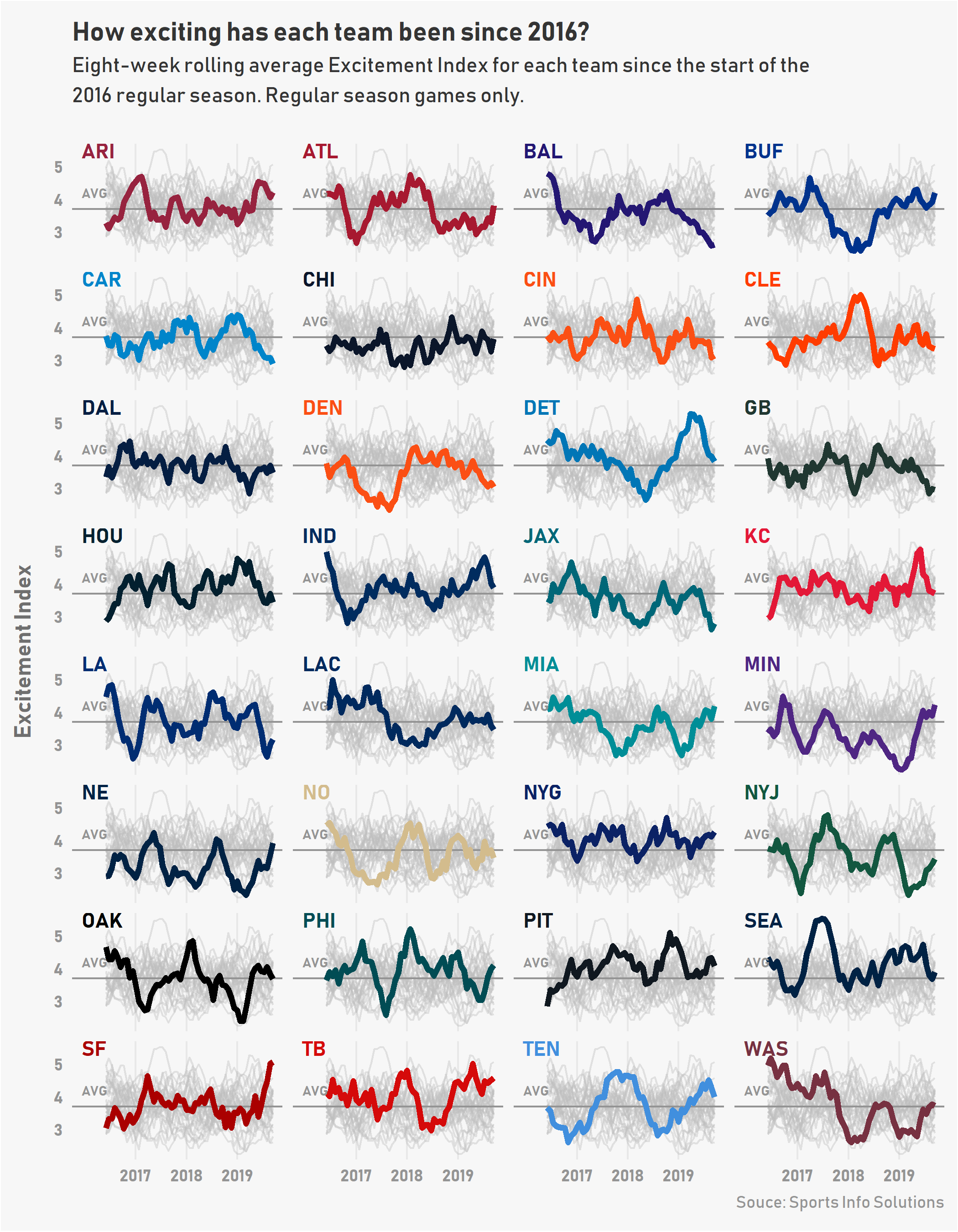
The basic idea is to calculate the total change in win probability throughout the course of the game, and use that as a proxy for excitement, meaning games that are tightly contested or feature large comebacks and swings in win probability will be the most “exciting.”
For a slightly different look at things, EI can also be aggregated at the team level or turned into rolling averages. In this case, we will use the SIS win probability model to calculate eight-week rolling average EI. This way, we will see which teams have put together the most exciting stretches of football in recent memory, and not just the most exciting game.
The 2017 Seattle Seahawks
This could just as easily read “Seattle in General.” Since the beginning of the 2016 season Seattle’s games have had an average EI of 4.2, putting them comfortably in the top spot. Seattle has also participated in the two most exciting games within the SIS database by our index. All of this has earned them a reputation for “literally never playing in a normal game.”
But even by their own lofty standards, 2017 was wild.
Their run from Week 3 to Week 11 was the most exciting eight-game stretch within SIS’s database with an average EI of 5.5. Beyond that, four other eight-game iterations from that same season rounded out the top five.
The Seahawks Week 8 win over the Texans was the most exciting game of the stretch, and also is the most exciting game since 2016 with an EI of 8.3. The Seahawks were down to about a 20% chance to win in the fourth quarter before taking the lead with 21 seconds left on an 18-yard Russell Wilson touchdown pass to Jimmy Graham. The game featured more than 400 passing yards from both Deshaun Watson and Russell Wilson and more than 200 yards receiving from DeAndre Hopkins.
The 2019 Detroit Lions (Yes, Really)
A record of 3-4-1 isn’t exactly what comes to mind when you think of exciting football, but the 2019 Lions were truly one of the most exciting average football teams we have seen. Their average EI of 5.2 from Weeks 1-9 trails only the aforementioned 2017 Seahawks for the most exciting stretch of football we’ve seen over the last four seasons.
The “excitement” in this case though is mostly driven by two gut-wrenching losses in back-to-back games against the Chiefs and Packers. In each game the Lions eclipsed a 90% chance to win, and in both cases were north of 75% in the fourth quarter before losing late.
Honorable Mention: The 2017/2018 Philadelphia Eagles
After a thoroughly unexciting stretch of football at the end of 2016 that spilled into 2017, the Eagles put together one of the most exciting stretches of football in the back half of their 2017 season. Even excluding the Nick Foles’ playoff run and Super Bowl victory, the Eagles had an average EI of 5.1 from Week 14 of 2017 to Week 4 of 2018.
NextGen’s Completion Percentage Above Expected (CPOE) became one of the staple metrics for evaluating quarterback (and receiver and defensive back) performance this past NFL season. Due to its reliance on tracking data though, it was not able to evaluate NCAA players the same way. SIS’s two newest metrics—Predicted Completion Percentage (pComp) and Predicted Completion Percentage Plus/Minus (pComp+/-)—can add the same context to a player’s performance as CPOE, and can also be expanded into the NCAA ranks.
Evaluating Quarterbacks
A player’s pComp is calculated with SIS’s charting data. It uses route type, the defensive coverage, distance of throw, and whether or not the defensive line was able to generate pressure to determine how likely each pass was to be completed. pComp+/- is how much better or worse a player’s actual completion percentage was than what was predicted. Breaking down completion percentage in this way adds a lot of context to a player’s performance.
Not surprisingly, presumptive number one overall pick Joe Burrow tops the leaderboard by a fairly wide margin. Burrow also led the NCAA in SIS’s Total Value Metric, Total Points (his 251 was 71 more than the next closest player), and trailed only Tua in EPA per Attempt (EPA/A).
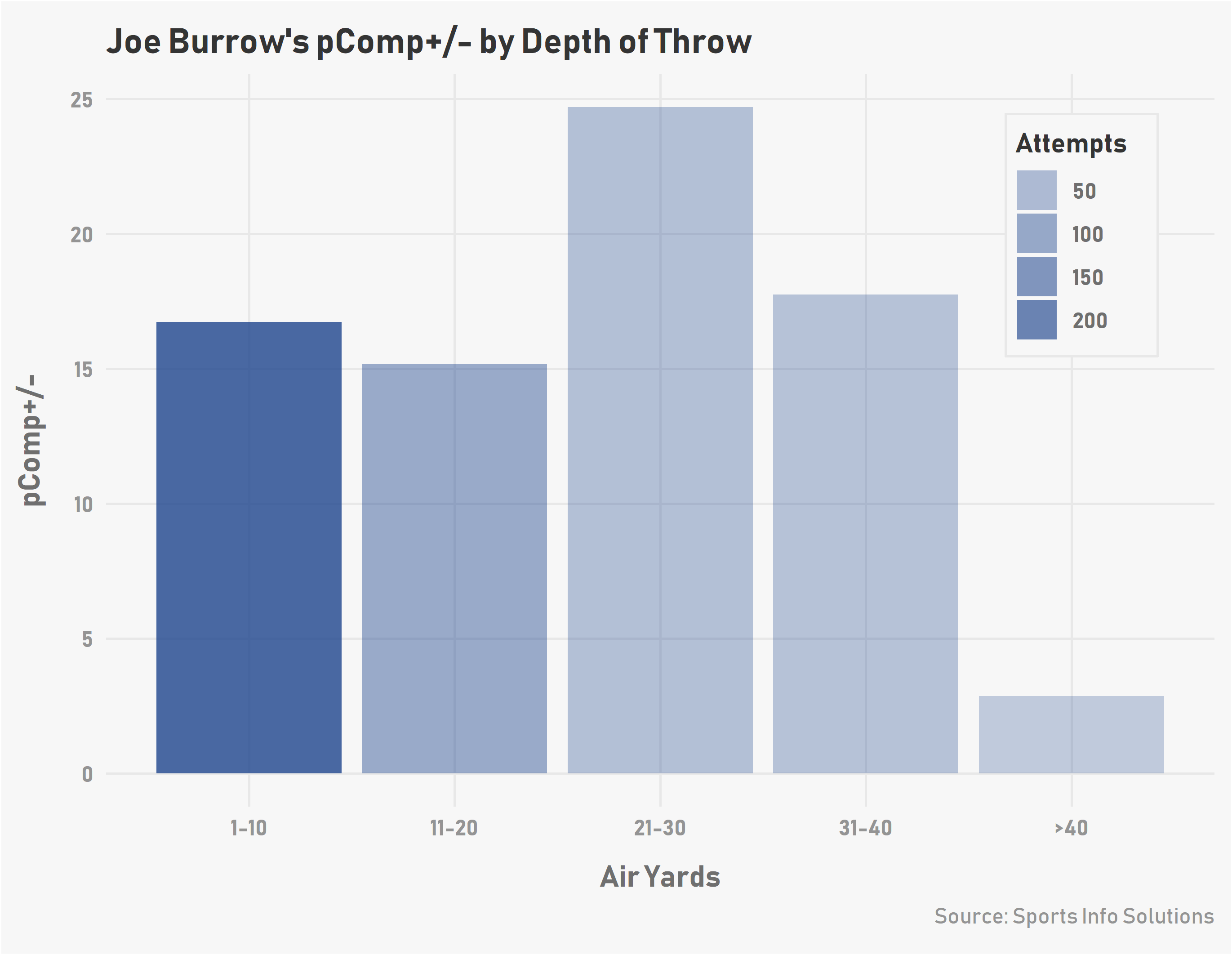
Burrow’s pComp+/- becomes more impressive when breaking it down by throw depth. Using buckets of five air yards, Burrow is actually at his best in the intermediate and deeper portions of the field. He posted a pComp+/- of 24.7 on throws between 21 and 30 air yards and 17.8 on throws between 31 and 40 air yards (he completed 14-of-29 but was expected to complete only 9 of those passes).
Another way to use pComp that has been popularized within the analytics “dark web” is to assess how many air yards a quarterback has completed above what would have been expected, or Air Yards Plus/Minus (AY+/-). As an example, a pass that travels 20 yards in the air with a pComp of 50% has an “expected air yards” of 10. A completion would net the quarterback +10, and an incompletion would be worth -10.
Joe Burrow leads comfortably by this metric as well. On a per attempt basis, he completed 1.6 air yards above what would have been expected based on the difficulty of each throw. Jalen Hurts, who trailed only Burrow in pComp+/-, also cracks the top five here with an AY+/- of 1.2.
Evaluating Receivers
Predicted Completion Percentage can also be flipped on its head in a few different ways to evaluate receivers and defensive backs. For receivers, pComp+-/ is just the quarterbacks pComp+/- when targeting the receiver.
Pacing all receivers in pComp+/- are LSU’s Ja’Marr Chase and Justin Jefferson. It’s hard to parse their performances from Burrow’s entirely, but there is still no denying that Chase and Jefferson are among the best in the country. Chase led the nation in both receiving yards and touchdowns and won the Biletnikoff Award as the county’s best receiver. Jefferson projects to be a late day one or early day two pick in the coming NFL draft.
Evaluating Corners
Flipping the metric again, we can look at which corners were the best at preventing completions as the primary defender. The metric is calculated the exact same way as it is for quarterbacks and receivers, meaning that a plus/minus below zero is good.
Virginia Tech’s Caleb Farley was the best in the country by this metric. His actual completion percentage when targeted of 27.9% was 20.2 percentage points lower than what would’ve been expected. Trevon Diggs and potential top ten pick Jeffrey Okudah rank as the best among prospects who have entered the draft.
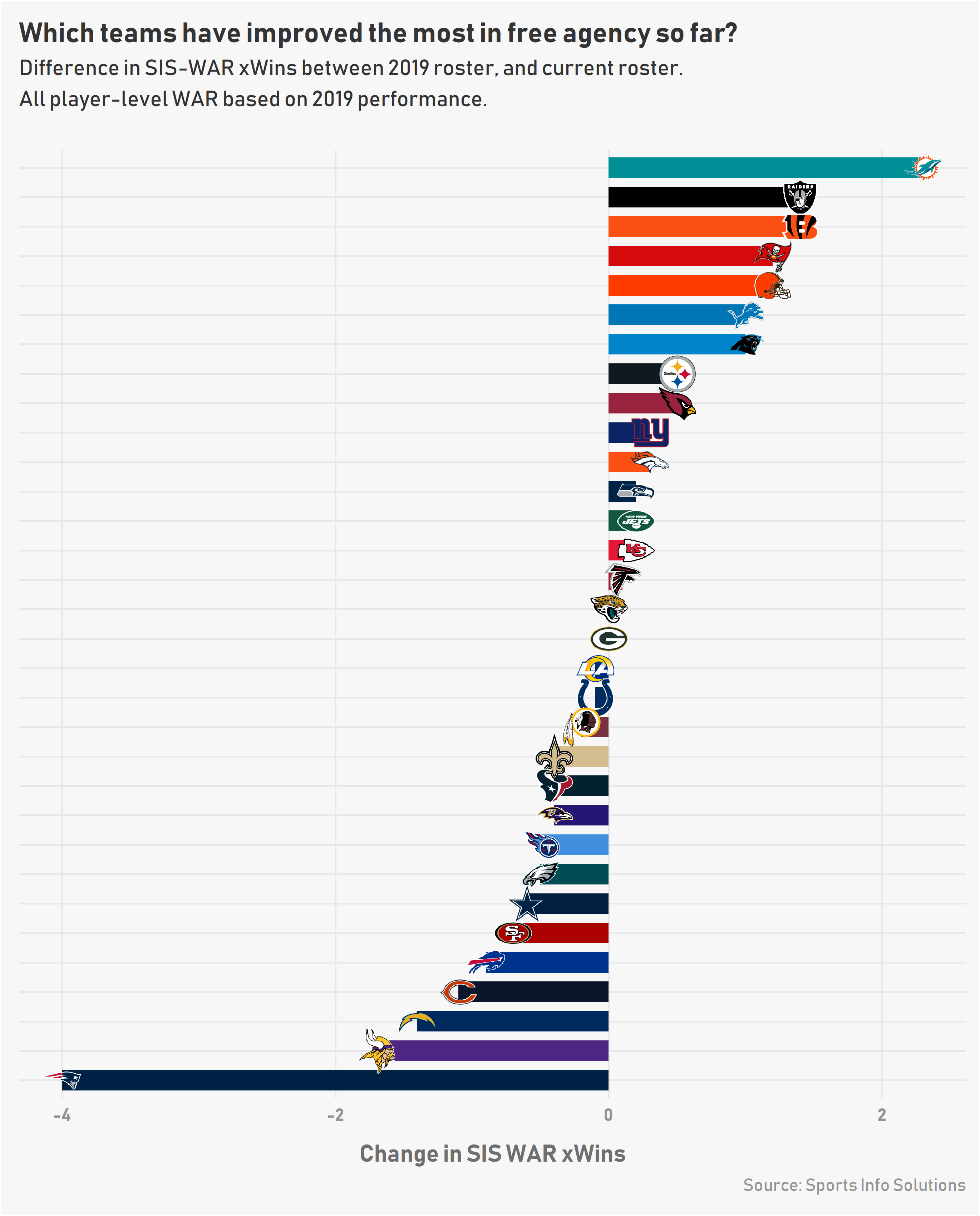
While the rest of the sports world has come to a screeching halt, the NFL offseason has been as chaotic as ever. SIS-WAR xWins can be a helpful tool to make some sense of what exactly has gone down at a high-level.
SIS’s Wins Above Replacement (WAR) uses a similar framework as Total Points (explained in more detail here). It compares a player’s Total Points per snap to that of a replacement-level player and scales it to win total. WAR xWins is the just sum of an entire team’s WAR plus two, the number of games a team of replacement level players would be expected to win.
A few small caveats before everyone gets mad about where their team ranks:
This is not a pure projection of the 2020 season. This does not make any assumptions about playing time or a player’s role on his new team. This is just a high-level overview of what’s gone down in free agency so far.
This is only using a player’s 2019 WAR, which means it’s going to feel very strongly about players coming off career years, and not like guys who either were hurt or struggled in 2019.
This only includes players who have signed with or been traded to new teams. A player who is a free agent but has not yet signed will still be included with the team he played for in 2019.
With all of that said, here is where things stand a little more than one week into the new league year.
Biggest Winner: Miami Dolphins
2019 xWins: 0.7 | Current xWins: 3.0
A roster with the talent-level of the 2019 Dolphins would barely be expected to win one game on average, making them the only team to finish 2019 below replacement-level (though the Bengals did come very close). That was always the plan, though, and so far this offseason, they have added more than two wins’ worth of talent to their roster.
Leading the way are a couple strong signings within their front seven. Shaq Lawson is coming off a career year in Buffalo, where he posted a WAR of 0.6 with a career-high in both sacks (6.5) and pressures (40). It’s hard to say whether Lawson can match that performance moving forward—he only accumulated 0.6 WAR in his three previous seasons combined—but he has a chance to be a very valuable signing for the Dolphins. The Dolphins also added Kyle Van Noy, who is coming off of a season where he tallied 0.5 WAR thanks to 6.5 sacks and 54 pressures.
The biggest splash for the Dolphins was the addition of Byron Jones. Jones has been among the most consistent corners in the league since 2016, posting a WAR of 0.3 last season and 0.4 in each of the three seasons prior. Jones will play across from Xavien Howard and form one of the best cornerback tandems in the NFL.
Honorable Mention: Oakland Raiders
2019 xWins: 7.5 | Current xWins: 8.9
The Raiders haven’t made any headline-generating moves but have quietly had a solid offseason. The signings of Nick Kwiatowski, Carl Nassib, and Maliek Collins were worth 0.3 WAR each. The Raiders also parted ways with Tahir Whitehead, who managed a WAR of minus-0.7 in 2019, the worst among linebackers, and the fourth-worst among all players.
Biggest Loser: New England Patriots
2019 xWins: 11.4 | Current xWins: 7.4
The obvious place to start is the departure of Tom Brady. Even in a down year where Brady clearly saw the effects of both his age and the Patriots’ lack of receiving talent, Brady was still worth a little more than two wins. Making the problem worse, the Patriots don’t have a clear heir apparent. Jarrett Stidham, a 4th-round pick last year, appears to be the next in line if the Patriots don’t make a run at one of the remaining free-agent quarterbacks.
The departure of Brady still only accounts for about half of the value lost by the Patriots this offseason, though. The Patriots also lost Jamie Collins (0.9 WAR), Kyle Van Noy (0.5 WAR), and Duron Harmon (0.2 WAR). Collins and Van Noy led the Patriots in sacks last season and combined for 84 pressures on one of the league’s best defenses.
The Patriots have made a handful of small signings to try and recoup some value, but none of the players they have signed have been worth more than 0.1 WAR. Most of the offseason is still ahead for the Patriots, and betting against Bill Belichick has been a terrible idea historically. Still, as of now, the end of the Patriots dynasty is appearing more and more likely.
Not-So-Honorable Mention: Minnesota Vikings
2019 xWins: 11.0 | Current xWins: 9.3
The most notable departure for the Vikings this offseason is top receiver Stefon Diggs. Diggs was worth half a win in 2019, and while the Vikings got a solid haul of draft picks in return, they didn’t receive any proven help. The Vikings also lost Trae Waynes (0.6 WAR), Andrew Sendejo (0.4 WAR), and Laquon Treadwell (0.3 WAR). Minnesota did make a solid depth signing in Tajae Sharpe (0.2 WAR), but they still have a lot of work left to do this offseason to break even.
It’s been a highly-intense week of free agency since the NFL’s legal tampering window opened on Monday. The “offseason of the quarterback” has lived up to the hype, headlined by Tom Brady officially ending his 20-year run in New England and joining the Tampa Bay Buccaneers.
From a talent standpoint, it’s pretty easy to see the allure of playing quarterback in Tampa. The Bucs receiving talent runs laps around anything New England has put on the field in the last few seasons, and their defense quietly put together a very strong campaign in 2019. The marriage between Arians and Brady doesn’t immediately make sense on paper though.
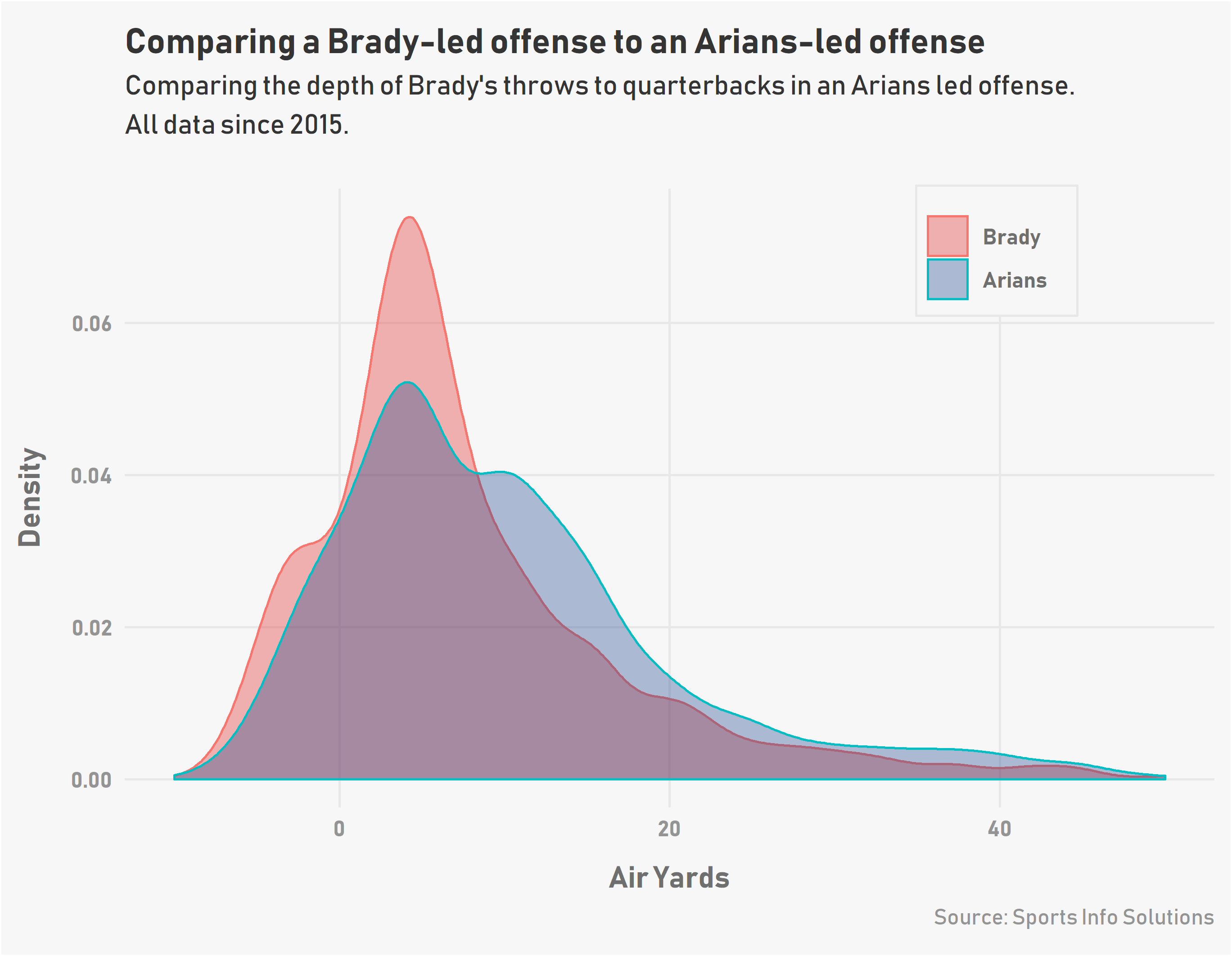
It’s not a secret that Arians prefers his quarterbacks to push the ball downfield. A lot. And while it didn’t take much nudging to get Jameis Winston to be reckless with the football, Carson Palmer also posted an Average Depth of Target (ADoT) of 10.6 yards under Arians in 2015, followed by two more seasons above 9.0 to finish his career. Outside of an outlier season in 2017 in which he posted an ADoT of 8.8, Brady’s ADoT has generally been a shade under 8.0, including only 7.1 in 2019.
Looking at the distribution of throw depth for both Brady and Arians’ quarterbacks, the difference becomes even more stark. Brady had a higher percentage of throws at every depth under 9 yards. Arians’ quarterbacks consistently attacked the intermediate and deep portions of the field more than Brady.
More importantly, Brady wasn’t great last season in the intermediate and deep portions of the field that Arians likes to attack. On throws between 10 and 19 air yards, Brady’s EPA per Attempt (EPA/A) of 0.32 ranked 23rd best in the league, and his 52% positive percentage (percentage of plays with a positive Expected Points) was 29th. He fared better on throws that traveled at least 20 yards in the air, though his EPA/A of 0.34 still ranked 14th, and his Positive% of 41% ranked 12th.
Some of this is due to his aging, but some of this can undoubtedly be linked to Brady’s receivers. Behind Julian Edelman, the Patriots’ most targeted receivers last season were James White and Phillip Dorsett. Brady will now be throwing to arguably the most dynamic receiving duo in the NFL in Mike Evans and Chris Godwin.
Last year Godwin turned 95% of his catchable targets into catches, the highest rate in the league among receivers who were targeted at least 50 times. Jakobi Meyers and Dorsett paced the Patriots in that metric at only 84% and 83%.
On 45 targets between 10 and 19 yards, Godwin didn’t record a single drop and turned 94% of catchable targets into a reception, 5th best in the league. Edelman, Brady’s top target when attacking this part of the field, posted a Catchable Catch% of only 77% on intermediate throws. Mike Evans isn’t nearly as efficient as Godwin but is still among the most dangerous deep threats in the NFL, a role the Patriots were never able to fill last year despite their best efforts.
Having receivers will undoubtedly help Brady, but it would be shocking to see Brady run the same offense Arians ran with Winston last season, or even the offense Arians ran with Palmer. Arians may utilize more quick-hitting route concepts than he has historically. As he’s aged, Brady has shown less willingness to stand the pocket, and also posted an Independent QB Rating of 63.3 when pressured last season, 26th in the league, neither of which mesh well with long-developing route concepts.
Brady also found a lot of success passing from ’21’ personnel last season, something only four teams utilized more than the Patriots, and something the Bucs used sparingly. On 74 dropbacks from 21 last season Brady posted an IQR of 108.8 and an EPA/A of 0.19.
Using SIS-WAR, which allows us to estimate team win totals, the Buccaneers would’ve been expected to win a game and a half more by replacing Winston with Brady, and this comes on the tails of a season where the Bucs already under-performed against their SIS-WAR expected Wins and Pythagorean Wins total.
It’s hard to project exactly what the Bucs offense will look like, or the kind of performance they will get from Brady, but it’s reasonable to think that average quarterback play and anything less than 30 interceptions is enough for the Bucs to make a legitimate playoff push.
With the draft a little more than a week away, teams and draft analysts alike are finalizing their draft boards. For the most part, they look a lot different than they did only a few months ago. A couple of the highest rated prospects from the SIS Rookie Handbook are among those whose stock has taken a hit during the pre-draft process.
Greedy Williams
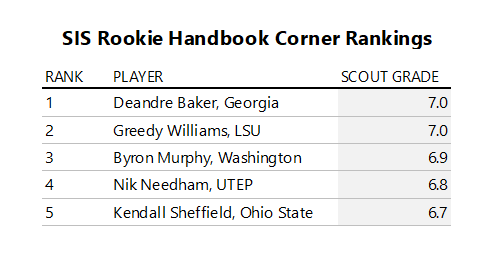
In the SIS Rookie Handbook, Greedy Williams was one of nine players to receive a grade of 7.0 or better, and was tied with DeAndre Baker as the highest rated corner grade. Initial mock drafts had Williams as a potential top 5 pick, and a virtual lock for top 10. Since then though, Williams has seen his stock taking a bit of a tumble. Mel Kiper has Williams 22nd on his big board, and his 3rd corner overall, trailing both Deandre Baker and Byron Murphy. Most mock drafts now have Williams as a mid to late first round pick, with some putting him as low as the top of the second round.
What he does well:
What’s interesting about Williams is that his ability to cover has never really been in question. In 2018 he allowed a deserved catch percentage of only 60%, and a QB Rating against of only 43.3. Both of those figures ranked as the second best among draft eligible cornerbacks, and were ahead of Baker and Murphy.
Part of what makes Williams so good in coverage is his ability to make quick transitions and stay patient on deep routes and double moves. While there was some worry after he struggled in his combine drills, particularly the pedal and turn, his numbers and film show little reason for concern overall.
On throws at least 20 yards downfield in 2018 Williams allowed only 6 completions for 172 yards and a touchdown on 22 targets, a yards per attempt of only 7.8. More impressive, while lined up on the outside in man coverage, receivers attempted a double move on Williams 9 times. The lone target fell incomplete. It is a relatively small sample, but illustrates his ability to suppress targets and is strong evidence of his ability to stay patient on long developing routes.
Where he comes up short:
The biggest reason for Greedy’s fall from the top of big boards is his tackling ability. Take this quote from Mel Kiper that echoes the concerns of a number of NFL teams:
“Opinions are already complete now, and I think the tackling and the ability to be an 11th man on that defense, and not play with 10 and have a big running back coming around the corner and make a business decision on whether you tackle or you don’t. Again, you’ve got to tackle these bigger receivers, these tight ends in space, because it’s an extension of the running game. Or these short passes. You can’t be missing tackles in the open field or around the line of scrimmage. Again, tackling not just running backs, but receivers and tight ends, that’s going to be the issue.”
There is room to debate just how important it is for corners to be strong tacklers, especially when they are as strong in coverage as Williams, but there is no denying that tackling is an issue. Williams had only 34 combined tackles in 2018, which did not even rank him in the top 200 among all college corners. He also had a broken tackle percentage of 15.4%, which was among the worst of all draft eligible corners. Put into perspective, fellow top prospects Deandre Baker and Byron Murphy came in at 2.4% and 8.2% respectively, both ranking in the top 10 among draft eligible corners.
Some of this is scheme related as Williams spent 63% of his snaps in man coverage in 2018, but his poor tackling technique is certainly a concern for teams that like to use corners in run support, and is the main culprit for his slide as we approach the draft.
N’Keal Harry
There has never really been a consensus among draft analysts about the top WRs in this years draft, and the picture hasn’t become much clearer as we approach the draft. One player that seems to be sliding though is N’Keal Harry, who comes in as the top receiver in the SIS Rookie Handbook.
Once in contention with Metcalf for the top spot among receivers, Harry has been usurped in a most rankings by the likes of A.J Brown, Deebo Samuel, Marqise Brown and even J.J. Arcega-Whiteside. What’s different about his slide though is that there is nothing new you can point to that explains it. Sure, D.K. Metcalf showing up to the combine looking like a super human didn’t help, but Harry had a strong combine performance in his own right, posting a 4.53 40-yard dash, 38.5″ vertical, and 27 reps on the bench.
What he does well:
In 2018 Harry turned 90 catchable targets into 73 catches, 1,088 yards and 9 touchdowns, a QB Rating when targeted of 114.9. His ability to use his size to make plays downfield is part of what makes him such an intriguing prospect. Harry ran 47.2% of his routes down the field 2018, and on those targets racked up 17 catches for 421 yards and 5 TDs. Good for a rating of 129.75.
Harry is also dynamic with the ball in his hands after the catch, using his unique combination of size and speed to generate additional yardage. In 2018 he averaged 7.1 yards after the catch, and his 308 yards after contact ranked 5th in the NCAA.
Where he comes up short:
While Harry has shown a knack for finding soft spots in zone coverage, he fails to consistently create separation against man – particularly on shorter routes – and rather relies on his size, length, and catch radius to make plays. While this served him well in the college ranks, relying solely on size and athleticism gets exponentially more difficult against NFL corners.
To get an estimate of separation we looked at the amount of yards between when a receiver first caught the ball, and when he was first contacted by a defender. (Pass breakups and interceptions are counted as zeroes.) When looking at targets less than 15 yards downfield, Harry averaged about 2.4 yards against zone, but only .13 yards against man coverage. His numbers against man ranked him 2nd worst among draft eligible receivers, and 303rd of 313 receivers with at least 25 targets overall.
Separation is not always everything though, especially for a player who has the size and athleticism of Harry. While he struggled to consistently separate, it is also worth pointing out that some of the players in the NFL who find themselves amongst the trailers in this metric include A.J. Green, DeAndre Hopkins, and Julio Jones.
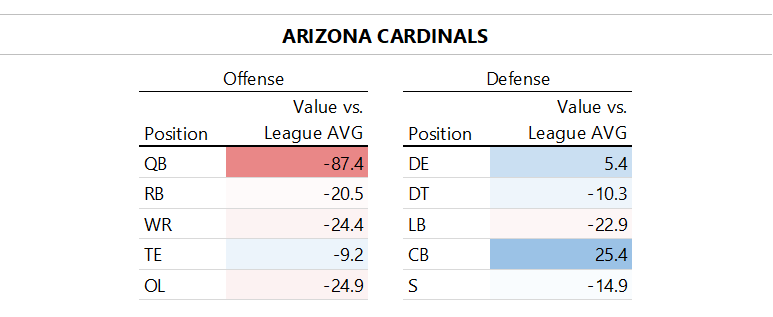
With the free agency finally slowing down, all eyes are turning towards the draft. With that in mind we looked at how teams at the top of the draft have used free agency to bolster their records, and how it may affect their decision come draft day. Team need charts are based on SIS’s unique Total Points metric compared against the league average at each position.
Biggest acquisitions:
The Cardinals have been relatively busy already this offseason, but have yet to make a splash signing. Terrell Suggs and Jordan Hicks were arguably the two biggest signings for the team, both signed in an attempt to bolster a linebacker unit that struggled in 2018.
Hicks was solid against the run in 2018, but struggled in the pass game. On 28 targets Hicks allowed 22 catches for 271 yards and a touchdown. A QBR against of a little bit over 100. Using Total Points, Hicks ranked as the 98th best linebacker in pass coverage among players with at least 10 targets.
The soon-to-be-37 years old Suggs, while listed as a linebacker, will slot in on the edge, and despite his age he should still be able to add value to a pass rushing unit that actually fared pretty well in 2018.
Additional signings:
In terms of weapons for whoever the QB is in 2019, the Cardinals signed TE Charles Clay, TE Ricky Seals-Jones, and WR Kevin White, a rather uninspiring trio for a team lacking weapons and moving into a Kliff Kingsbury offense in 2019. The Cardinals also added a couple of offensive linemen in Max Garcia and Marcus Gilbert and defensive lineman Darius Philon.
What to expect in the draft:
The speculation of Murray to the Cardinals seemingly won’t go away, and while Rosen’s rookie season was nothing short of a disaster, it seems crazy to think they would move on from him only one year removed from moving into the top 10 to select him.
Compounding the intrigue, Cardinals defensive ends were one of only two position groups that put up numbers above the league average in 2018. Outside of Murray, the only player’s who have been mocked at the top of the draft are pass rushers, namely Nick Bosa and Josh Allen. Either of those players would provide an immediate impact and be an upgrade over current Cardinals pass rushers, but it still makes the pick all the more interesting.
Biggest acquisitions:
It has been a relatively quiet offseason so far for the 49ers outside of sending second round pick to Kansas City for Dee Ford, adding a star player in a position of need.
Ford was a force in 2018, generating 13 sacks and 72 pressures, good for 9th and 2nd best respectively. Additionally, his 6 forced fumbles also tied with J.J. Watt for the lead league. Overall, Ford was far and away the top rated pass rusher by Total Points 2018 with 37.7 Points Earned, outpacing the like of Frank Clark, Aaron Donald, and J.J. Watt.
The 49ers also gave a massive 4 year deal to former Bucs linebacker Kwon Alexander, worth $54 million, including $25.5 million guaranteed. Alexander is a young high upside linebacker, but is coming off of a torn ACL. The 49ers are betting he can return to his 2017 form when he had 96 combined tackles, including 6.5 for a loss.
Additional signings:
The 49ers did also add another playmaker to their offense in Tevin Coleman. The 49ers were able to get solid production from a committee of running backs last season, namely Matt Breida, Alfred Morris and Raheem Mostert. Coleman will join a crowded but talented backfield, including a newly healthy Jerrick McKinnon.
What to expect in the draft:
The 49ers will have their fingers crossed hoping that the Cardinals take Murray with the 1st overall pick, allowing them to take whoever is on the top of their big board. 49ers GM John Lynch has made it clear he plans to take the “best player available”.
That “best player” is very possibly another pass rusher to go alongside Dee Ford. Nick Bosa or Josh Allen lining up opposite of Ford would quickly turn an impotent pass rush from last year into one of the more dangerous tandems in the league.
Defensive tackle was also a position of weakness for the 49ers last year, and the recent acquisition of Ford may allow the 49ers to select Quinnen Williams, a player many view as the best in the draft (including our rookie handbook). The Outland Trophy winner was dominant against the run, leading the nation in tackles for non-positive yards, and his hurry rate when pass rushing was also far and away the best among college defensive tackles.
Biggest acquisitions:
The Jets have been among the biggest spenders in free agency this season, most notably inking Le’Veon Bell to a four-year deal. Bell’s year off certainly adds some question marks, but it seems more likely than not that Bell will again find himself among the best at the position. Our Bryce Rossler took a deeper dive on what Bell does well earlier this offseason.
The Jets also added LB C.J. Mosley. The former Raven was productive over the course of his rookie contract, particularly against the run. In 2018 Mosley had 101 combined tackles, including 4.5 for a loss. Mosley did struggle in pass coverage in 2018 though, allowing a QBR against of 100 on 39 targets. By SIS’s Points Saved metric Mosley ranked as the 40th best linebacker in pass coverage this past season.
Additional signings:
Some other notable transactions for the Jets include WR Jamison Crowder, who they are hoping can turn into a reliable target for Sam Darnold, and also WR Josh Bellamy.
What to expect in the draft:
After selecting their franchise QB in last years draft, the Jets will likely be taking the “best player available” approach with the No. 3 pick. This would likely be one of Nick Bosa, Josh Allen, or Quinnen Williams, all of whom would provide tremendous value at positions of need.
It is also likely that the Jets will be fielding offers from QB-needy teams, especially if Murray slides past the Cardinals. This could allow the Jets to recoup some of the assets they parted ways with last year to get Darnold, and depending on the suitor could still leave them in position to get either Greedy Williams or Deandre Baker. Gaining assets while also grabbing the best player at arguably their biggest position of need may be the best case scenario for the Jets.
Biggest acquisitions:
After trading away Khalil Mack and Amari Cooper during the season, it appeared the Raiders were entering a lengthy rebuilding period. By trading for Antonio Brown they made it abundantly clear that was not the case. Brown immediately slots in as the best playmaker on the team, and the number one option for Derek Carr. I have already done a more detailed analysis on this trade here.
The Raiders also gave a record setting contract to offensive tackle Trent Brown, fresh off a Super Bowl win and the best season of his career. By Total Points, Brown was the 4th highest rated offensive lineman, and was especially strong pass blocking, earning 4.4 of his 5.7 Points in the pass game.
Additional signings:
The Raiders also added more talent to their wide receiving core by adding the speedy Tyrell Williams, who should find himself as their No. 2 option. LaMarcus Joyner was also brought in to help bolster the secondary, and more recently the Raiders added LB Vontaze Burfict.
What to expect in the draft:
Even after a busy start to the offseason, the Raiders have needs just about everywhere. They also conveniently have three picks in the first round this year. While their have been fun rumors about Kyler Murray throwing to Antonio Brown, it would be surprising to see them do anything other than replace the Khalil Mack-sized hole in their pass rushing unit. Depending on what happens in the first three picks this may mean one of Montez Sweat or Clelin Ferrell, but a run on quarterbacks at the top of the draft could certainly shake things up.
Biggest acquisitions:
Because of cap concerns, the Bucs have been forced into an uneventful offseason. The honor of being their biggest signee likely belongs to LB Deone Bucannon.
Bucannon played well in his time under Arians in Arizona, and now get’s a chance to be re-united with the coach who made him a first round pick in 2018. A converted safety, Bucannon will likely play a similar hybrid type role that he flourished in during his time in Arizona. In 2017 (his last season with Arians), he had 82 combined tackles, allowed a QBR against of only 76 on 44 targets, limited quarterbacks to 5.6 yards per attempt, and scored two defensive touchdowns.
Additional signings:
Outside of Bucannon, the Bucs have mostly looked to add depth. Other signings for the Bucs include S Kentrell Brice, G Earl Watford, and LB Shaqil Barrett.
What to expect in the draft:
By Total Points, the Bucs weaknesses aren’t quite as glaring as the rest of the top 5, but this is at least in some respects due to some Fitz-Magic early in the season. It is also worth noting that the future of their star defensive tackle, Gerald McCoy, is up in the air as the Bucs currently don’t have the cap to sign their upcoming draft picks.
Whether or not the Bucs are able to retain the services of McCoy will likely play a huge role in who they take with the number 5 pick. It is not impossible that Quinnen Williams is still their for the taking, and he would provide a solid, and more importantly, cost controlled, consolation for the loss of McCoy.
Two potential positions of need for the Bucs are at cornerback and on the offensive line. If the top of the draft goes as expected they will have the luxury of taking whoever is on the top of their board at either of the those positions, if they decide to go that route.
On the offensive line this would likely mean a debate between Alabama product Jonah Williams, or the incredibly athletic Jawaan Taylor. At corner, DeAndre Baker and Greedy Williams sit atop our big board. All four could provide an immediate impact for the Bucs in 2019.
The Bucs pick could also be a prime target for teams looking to make a move for a sliding QB. Projecting what Dave Gettelman will do at No. 6 is tricky, but the Giants taking a QB seems like the most likely outcome. A team like Washington or Cincinnati my need to jump to No. 5 if they want to grab their franchise QB in this draft.
The NFL passed a rule change at its owners meetings to make pass interference a reviewable call. In light of the development, we wanted to share a newsletter that we sent to our NFL team partners earlier this year.
After what can best be described as a controversial end to the season, both pass interference (PI) and the current instant replay system are at the forefront of conversation this NFL offseason. With this in mind, SIS looked at which penalties are the most influential over the course of a game, and specifically which penalties might warrant being included in the NFL’s review process moving forward.
SIS’s charting
data includes detailed information about penalties, reviews, receiver
participation and route information, and was analyzed in terms of both Expected
Points and actual Net Drive Points. The goal was to see both the expected and
actual impact of different penalties on the game, the different factors that
can drive those penalties, and how those plays compare overall to plays
reviewed under current NFL rules, namely touchdowns, turnovers, and
receptions.
Using Expected Points to Evaluate the Impact
of Penalties
From 2016 to 2018
an offensive touchdown was worth an average of 2.03 Expected Points. While this
seems low, it is worth reiterating that for a clear majority of touchdowns,
most of the value comes in the plays preceding the score, as opposed to the
scoring play itself. Turnovers, on the other hand, are among the most impactful
events during a game, costing the offense 3.97 Expected Points on average,
almost twice the value of the average touchdown.
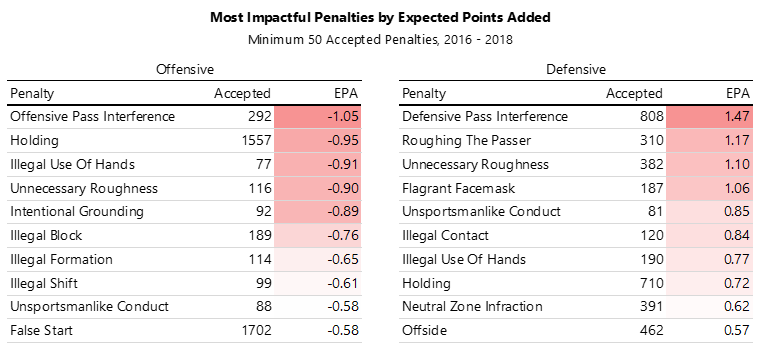
For comparison,
all accepted penalties from the last three seasons were analyzed, and the 10
most impactful penalties by EPA for each side of the ball are shown below:
On the defensive
side, pass interference is not only the most common penalty, but also the most
substantial based on Expected Points. On average, defensive pass interference
(DPI) nets the offense an additional 1.47 Expected Points. While this is not
quite on par with a scoring play or a turnover, it outpaces the next closest
defensive penalty by about a third of a point, and the most severe offensive
penalty by almost half a point.
While this
analysis primarily focuses on the defensive side of the ball, it is still
notable that offensive pass interference (OPI) has the most severe impact of
any offensive penalty with -1.05 EPA. It is called far less frequently than its
defensive counterpart, but, when called can play a large role in shaping a
drive or game, and it separates itself from the other more common offensive
penalties.
Using Net Drive Points to Evaluate Penalties
Another way to
look at this data is through the lens of Net Drive Points. Net Drive Points are
the eventual points scored on each drive, including negative points for
defensive touchdowns. From 2016 to 2018 the average offensive drive netted 1.62
point. To quantify how much each penalty can jump-start or stall a drive,
drives results were grouped by penalty type. Again, the top 10 penalties for
each side of the ball are listed below:
When
comparing the Net Drive Points for penalties it is important to understand the
relationship between the length of drives and the likelihood of penalties.
The
average drive that did not have a penalty was 4.9 plays long, compared to 8.3
for drives with a penalty. This is obviously not an indication that offensive
penalties extend drives, but simply that the more plays you run, the more
likely you are to take a penalty. With that in mind, the numbers for Net Drive
Points are slightly inflated, but still allow us to see which penalties had the
greatest impact on overall drive results.
DPI
was the most drastic, adding well over two points to the average drive, and was
about a quarter of a point higher than the second highest penalty.
Additionally, DPI occurred on 778 unique drives in the last three seasons, more
than any other defensive penalty, and was outdone only by holding and false
start on the offensive side.
Comparing
offensive and defensive penalties, almost all the most significant penalties
occur on the defensive side of the ball. The only offensive penalty that
rivaled the severity of a defensive penalty in terms of Net Drive Points was
intentional grounding, which includes both a loss of yardage and a loss of
down.
DPI as a Function of Play Calling
There are a few
factors that drive the increased impact of defensive penalties, the strongest
being that automatic first downs add a lot of value for the offense. When
looking at the overall EPA of penalties by down, this becomes very clear.
The average EPA
of a defensive penalty on first down is 0.64, but it doubles to 1.28 when the
penalty occurs on third down. This is likely a result of large EPA swings when
an offense is awarded a first down in third-and-long situations.
Further
illustrating this, the impact of offensive penalties remains consistent
regardless of down, with first, second, and third down having EPA values of
-0.77, -0.81, and -0.75, respectively.
Most importantly,
there is evidence that—at least on some level—offenses can force the defense
into penalties. Specifically, targeting vertical routes leads to more PI
calls.
When breaking down which routes are most likely to draw DPI, three routes stand out: hitch and go, fade, and go/fly. All three routes drew pass interference on about 7% of targets. No other route drew DPI on more than 3 percent of targets. The top 10 routes by their ability to draw DPI are shown below:
Not surprisingly,
the routes that stretch the field vertically put the most stress on defenders
and lead to the most pass interference calls. The average throw depth of a play
with DPI is 19.7 yards, about 8 yards higher than the average reception that
results in a review (11.8) and more than 10 yards higher than the average throw
(8.5).
Therefore, teams
that stretch the field, especially in high-leverage situations such as third
downs, would also be more likely to benefit from pass interference calls.
The go/fly also
stands out in terms of impact. It is not only among the most likely to draw a
DPI, but it also gains an average of 27.14 yards when flagged, well over double
the average reviewed catch, and has an EPA of 1.94, just shy of the average EPA
of a touchdown. The post and sluggo route draw DPI less frequently but have a
similar impact when called.
Final Thoughts
While DPI did not prove to be as impactful as scoring plays or turnovers by EPA, it did still stand out amongst penalties. DPI was a third of a point higher than any other penalty in terms of EPA and was also the most accepted defensive penalty. On the other side of the ball, offensive pass interference was the most impactful offensive penalty.
DPI also stood out in terms of Net Drive Points. Offenses scored an additional two points per drive on average when DPI was called. This ranked it as the most severe penalty overall, about a quarter of a point higher than the next penalty, all while occurring on the most unique drives among defensive penalties. (Only holding and false start occurred more often overall.)
Another important
finding is that offenses can play a role in defensive penalties. There were
three routes that stood out in their ability to draw DPI: hitch and go, fade,
and go/fly.
High yardage penalties, coupled with the impact of automatic first downs can lead to large swings in games, particularly when it is called in third down situations. Pass interference warrants inclusion in the NFL’s review system. The above analysis shows that PI is at least as impactful as plays that can currently be challenged, specifically receptions, and are among the most impactful plays in the game.
The league season is still a few hours from officially starting, and yet the last week has been among the most chaotic in recent memory. While record-breaking contracts have been given out left and right, the two biggest moves actually came via trade, as Antonio Brown was sent to the Raiders and Odell Beckham Jr. was sent to the Browns.
Odell to the Browns
Browns get: Odell Beckham Jr. Giants get: S Jabrill Peppers, 17th pick, 95th pick
Baker Mayfield excelled last season under then-interim OC Freddie Kitchens. From weeks 9 through 17, Mayfield posted an Independent Quarterback Rating (IQR) of 112.1, the fourth-best rating during that stretch, and a Yards per Attempt (Y/A) of 8.6, trailing only Patrick Mahomes by a tenth of a yard. With Kitchens now the head coach and with Baker having his first full offseason of preparation, that high level of play was already expected to continue into 2019. But now with Beckham in the fold, the Browns’ offense has the potential to be among the league’s most dangerous.
In 2018, Beckham was only targeted on throws more than 15 yards downfield 36 times, a criminally low rate for such a dangerous player. For reference, Julio Jones saw 65 such targets. To make matters worse, Eli Manning ranked 22nd in On-Target% (57.9) and 25th in IQR (81.2) on those throws.
Beckham should expect to be targeted downfield much more often with the Browns. During Kitchens’ tenure as OC, only Aaron Rodgers pushed the ball downfield more consistently than Mayfield. On those throws, Mayfield posted an On-Target% of 62.5 and an IQR 109.7, which ranked as the fifth- and seventh-best marks in the league during that span. Beckham should immediately become Mayfield’s go-to guy downfield, and Jarvis Landry can work the short and intermediate parts of the field where he is more comfortable. (In 2016 and 2017, 33 percent of Landry’s targets came on slants, drags, or screens, compared to only 21 percent in 2018.)
On the other end of the deal, this trade leaves the Giants in a precarious position, even before considering the dead salary cap ramifications. They’re only a handful of years away from owing Barkley a huge pay day, and have managed to trade away most of their young talent, all while not making any real effort to find a replacement for Eli. Maybe their quarterback of the future falls to them at the sixth pick this year, or maybe they use their new first round pick in a package to move up and draft their guy, but it’s hard to see a path to quick rebuild for the Giants.
The Browns also find themselves in an unfamiliar spot: betting favorites in the AFC North. It feels crazy to say about a team that is only two years removed from a winless season, but with a strong cast of skill position players on offense and a couple of young playmakers on defense, the Browns appear to be a legitimate threat in the AFC this year. It is possible that OBJ is the final piece in what has been a remarkably quick turnaround.
Brown to the Raiders
Raiders get: Antonio Brown Steelers get: 66th pick, 141st pick
This time last year, the Steelers were legitimate Super Bowl contenders. They had a future HOF quarterback; Antonio Brown and Le’Veon Bell who were both arguably the best at their respective positions; and young budding talent in players like JuJu Smith-Schuster. Fast forward to now, the Steelers are fresh off of their first playoff miss since 2013, and have managed to turn their two best players into a 3rd round pick, a 5th round pick, and $21 million of dead cap.
The Raiders, on the other hand, appeared to be entering a full on rebuild last year when they shipped their best player off to Chicago, but are seemingly trying to expedite that rebuilding process with this trade. Given the incredibly low price tag and their plethora of draft capital, it is hard to blame them.
Brown provides immediate help for an offense that mostly struggled in its first season under Jon Gruden. Derek Carr was efficient, completing 68.9% of his passes, but struggled to find big plays. His Y/A of 7.3 ranked as only 20th-best among QBs with at least 200 attempts. Despite his age, Brown should provide an immediate impact downfield. On throws of at least 15 yards, Brown turned 52 targets into 614 yards and 9 touchdowns. Raiders receivers as a whole had 1,029 yards and 7 touchdowns on such throws. The Raiders are hoping Brown can turn into the consistent downfield threat they thought they were getting with Amari Cooper.
Brown can also provide additional value in the shallow routes that are the staple of Gruden’s offense. While the Raiders were mostly efficient on these routes last year (they completed 81% of slants), Brown provides the big play threat and YAC ability that the Raiders lacked. Brown’s 8.8 YAC per reception on slant routes last year ranked 2nd in the NFL behind Tyreek Hill. Raiders receivers as a whole averaged only 6.4 YAC per reception, and only 5.3 if you remove Cooper from that equation.
A lot of the Raiders’ success this season will depend on what their three first round picks turn into, but Brown provides a clear boost to an offense lacking in playmakers. He should immediately become Carr’s favorite target and be the focal point of an offense hoping to turn things around this season.
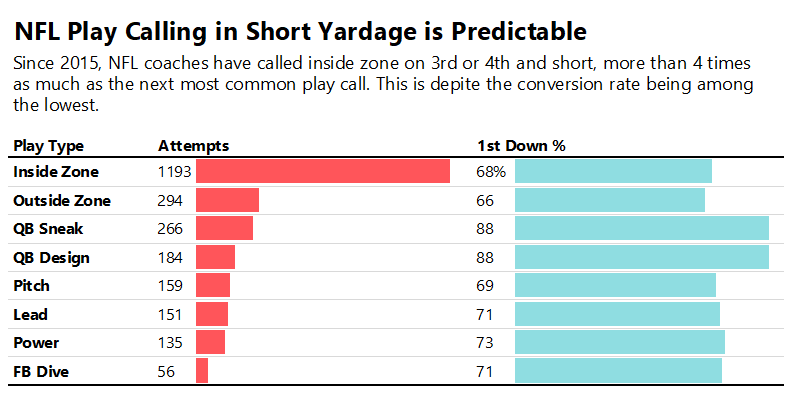
It doesn’t get any simpler than the QB sneak. The offensive line drives straight ahead, the quarterback hides himself behind the center and attempts to fall forward a few feet. It’s far from elegant, but it’s effective. And yet, NFL teams seem unwilling to utilize it.
On third or fourth down with a yard or less to go since 2015, teams have called an inside zone (a run up the middle with no pulling lineman or lead blockers) 1,193 times. It’s outside counterpart is a distant second with only 294 attempts. QB sneak ranks third with 266.
Despite being the most commonly run, the inside zone ranks as the second worst play call in terms of first down conversion rate at 68 percent, narrowly edging out the outside zone at 66 percent. By comparison, the QB sneak has a conversion rate of about 88 percent, 20 percentage points better than the inside zone, and 15 percentage points better than the closest play call to a running back.
In theory, based on these numbers, if a team in third- and-1 ran two consecutive quarterback sneaks, they would have approximately a 98 percent chance of converting a first down. This is obviously an imperfect approach, and doesn’t factor in defensive adjustments, but it does help illustrate how baffling it is that teams continue to take the ball out of their QBs hands in these situations.
What’s more, the QB sneak is not an acquired skill, and doesn’t require a particularly athletic quarterback. Since 2015, Blake Bortles, Nick Foles, Drew Brees, and Josh Allen have all boasted perfect conversion rates (Brees has the most successes, 23-of-23). Carson Wentz, Kirk Cousins and Matt Ryan have each failed only once, and no quarterback had a conversion rate lower than the inside zone’s 68 percent.
Increased volume would undoubtedly lead to a decreased success rate, and the list of quarterbacks with a 100 percent conversion rate would likely disappear, but it’s hard to imagine it dropping by 20 percent as a whole.
In the defense of teams, the QB sneak has seen a steady increase since 2016, while the inside zone has rightfully seen a sharp decrease. Even still, the inside zone remained the most common play call in short yardage in 2018, outpacing the QB sneak by almost 100 attempts.
The increase in volume showed almost no effect on the performance of the QB sneak. Its success rate in 2018 of 87 percent was only 1 percentage point lower than its 4-year mark. Likewise, the inside zone did not become more effective with it’s decrease in volume, its 68 percent success rate matched its 4-year total. If there is a point where increased volume decreases the effectiveness of the QB sneak, teams certainly haven’t found it yet.
In terms of personnel, teams have also shown a strong tendency towards heavy personnel when it comes to short yardage. To see the effects this has had, we looked at first down conversion rates against the number of players the offense has “in the box”. Men in the box on the offensive side is just a count of how many men are on or near the line of scrimmage, excluding the quarterback.
In similar fashion to the play types, the most effective personnel grouping is also the most infrequently used. The 6-man box, (most commonly a 4-wide set), had a first down conversion rate of 82 percent but was only used 89 times. The 9-man box, most frequently used by coaches at 692, had a conversion rate of only 71 percent.
Intuitively, having more blockers sounds like a good idea, but in practice it just allows the defense to stack the box and bring in heavier personnel, making the job of the lineman that much more difficult. Using spread-type personnel forces the defense to defend the whole field, and also likely forces them to bring in their smaller dime or nickel personnel, and creates better matchups on the interior.
At least until defenses adjust, teams need to start using their quarterback as a weapon more often in crucial short yardage situations, and stop insisting on heavy personnel. Offense as a whole has become more efficient than ever, and it’s time that expands into short-yardage downs as well.
Let’s take a brief look at some statistical notes and story lines ahead of the AFC Championship game between the Patriots and Chiefs.
Chiefs Pass Offense vs Patriots Pass Defense
Patrick Mahomes has an Expected Points Added (EPA) per pass of .37 when Sammy Watkins is on the field, and .22 when he is not. A healthy Sammy Watkins could be a big factor in the Chiefs offensive success
Having Watkins on the field makes it harder for teams to double Tyreek Hill. Hill’s rate EPA jumps from .39 without Watkins on the field to .59 when he is on the field.
In 260 regular season coverage snaps Patriots cornerback J.C. Jackson allowed a QBR against of only 37.7, ninth-best among corners who were targeted at least 20 times. Jackson will likely spend a good portion of Sunday matched up on Travis Kelce.
Patriots Pass Offense vs Chiefs Pass Defense
The Chiefs led the league in combined sacks with 53. Their pass rush was led by Chris Jones who finished the regular season with 15 combined sacks, all coming after week 4.
The Patriots offensive line was among the leagues best, allowing only 21 sacks in the regular season. Guard Joe Thuney ranked as the second-best linemen in the NFL by SIS’ Total Points Metric with 7.2 points earned.
When under pressure, Brady completed only 45 percent of his passes in the regular season, and posted an Independent Quarterback Rating of 81.1. In 2017 his IQR while under pressure was 115.4.
Julian Edelman will likely garner most of the attention, but Brady had a passer rating of 137.5 on 28 targets to Cordarrelle Patterson this season, the fifth- best QB/WR combo in the league by QBR
Chiefs corner Steven Nelson was the most targeted player in the NFL in 2018 (112), but quarterbacks only completed 46 percent of passes and posted a QBR of 69.3 when targeting him
The Run Game
The Patriots defense has a broken tackle percentage of 4.9, second best in the NFL. The Chiefs defense had a broken tackle percentage of 12.5, third worst.
Chiefs running backs averaged 2.6 yards after contact per attempt and had a broken tackle percentage of 10.3, both top 10 in the NFL.
The Patriots ranked fifth in the NFL in both rushing yards (2,037) and first downs picked up on the ground (132).
The Chiefs defense allowed 5.0 yards per attemopton the ground, the second worst in the league, and allowed a first downs on 30.4% of carries, the worst mark in the league