Category: MLB

  • What is Team Shift Runs Saved?

    You might have noticed a few new columns in the stat pages on Fangraphs.com. Fangraphs will have glossary definitions posted in the near future, but for now, you can learn more about these stats here. Here’s our explanation on Team Shift Runs Saved.

    In 2010, Baseball Info Solutions (BIS) began tracking defensive shifts for the first time. That season, Video Scouts observed 2,463 shifts on balls in play from watching video. That number decreased slightly to 2,350 in 2011, but after that shift usage exploded. In 2012, the number of shifts nearly doubled from the previous season. By 2014, that number was up to more than 13,000. In 2016, it jumped to more than 28,000.  In the 2018 season, there were nearly 35,000 observed shifts on balls in play.

    With it widely known that shift usage has skyrocketed, the obvious question that arises is: Which teams are most effective in using it? For that, there is the stat devised by BIS, Shift Runs Saved. It is listed on the Fangraphs team fielding pages as rTS.

    Calculation

    rTS measures whether a shift is doing what it is supposed to do – get outs on ground balls and short line drives that wouldn’t have been achieved with the traditional infield alignment. The calculation is done at the team level rather than the individual level.

    This stat takes how hard the ball was hit and what direction the ball was hit, and then it compares how often a team was able to make an out on that type of ball in play while using a defensive shift to how often the league was able to make an out on that type of ball in play on the whole. Positive credit is assigned for successful plays made and negative credit is given for plays not made, which is eventually converted to a Runs Saved value. The values are summed for all grounders and short liners against defensive shifts to get a seasonal value.

    For example, let’s say a batter hits a groundball 70 miles per hour through the infield at an angle 17 degrees off the first base line. This play may be made 25 percent of the time in an unshifted defense within a two-year period specific to that date. If the play is made, the defensive team gets a collective credit of 0.75 (1 minus 0.25). If the play is not made, the defensive team receives a 0.25 debit. The credit or debit is then converted into a run value, and all of those are summed into a seasonal total.

    Note that velocity is measured as distance divided by time, rather than speed off the bat

    Why Shift Runs Saved?

    Shift Runs Saved became necessary because of The Lawrie Defense. In 2012, the Blue Jays began playing third baseman Brett Lawrie in shallow right field during their defensive shifts. If Lawrie made a play, he was receiving an abnormal amount of credit in the BIS Range and Positioning system because third basemen don’t typically make plays on balls hit to short right field. Lawrie racked up value that other third basemen could not because their teams were not playing them in that area.

    Given that it is the team’s decision to use shifts and to position fielders, it was best to assign the value to the team as a collective unit.

    Shift Runs Saved became the solution to that issue and is the best way to measure performance specific to when a team is utilizing a defensive shift.

    How to Use Shift Runs Saved

    rTS shows how many runs a team saved or cost themselves on groundballs and short liners against a shift in a given season.

    rTS is more of a cumulative metric than an efficiency metric. Often teams that shift the most will have the most rTS, but that doesn’t mean they have the highest frequency of getting outs on a per-shift basis.

    Keep in mind that a team’s reasons for being good or bad in rTS could be due to other factors, such as how it positions its fielders within shifts and the quality of the players on the field at that time.  

    Context

    With the number of shifts continually increasing, the totals at the top of the rTS leaderboard are similarly increasing. Context is best determined by rank within the league within that given season. Almost every team has a positive rTS total because shifts do what they are supposed to do — they allow a team to defend more effectively against those hitters who tend to pull a lot of their grounders and short liners.

    The 2017 season was the first one in which a team recorded at least 30 rTS. In 2018, five teams had at least 30 rTS. The Diamondbacks led the majors with 39, followed by the Athletics (36), Rays (31), Twins (31), and Tigers (30). Four teams had negative rTS, meaning that using the shift cost them runs — the Phillies (-10), Pirates (-6), Nationals (-4), and Mariners (-4).

    Things to Remember

    – BIS categorizes shifts as follows:

    * If 3 infielders are on one side of the infield, it is considered a Full Shift. If at least 2 infielders have deviated significantly from their usual positioning, or if one infielder is playing deep into the outfield (Usually the second baseman playing shallow right field), that is considered a partial shift These are combined into one category on the Splits Pages, “Traditional Shifts.”

    * “Non-Traditional Shifts” are Situational shifts not covered under the definition of traditional shifts, such as playing the infield in.

    – Shifts are determined from video review by trained video scouts based on observations of game broadcasts.

    – Shifts are not recorded for balls that are not put into play (strikeouts, walks, home runs) and measuring shift effectiveness does not take anything other than grounders and short line drives into account.

    Links For Further Reading

    Shift Data! – Fangraphs

    2019 Shift Update – Bill James Baseball Handbook

    Why Baseball Revived a 60-Year-Old Strategy Designed to Stop Ted Williams – FiveThirtyEight

  • Michael Conforto the Met For Whom Beating the Shift Matters Most

    Michael Conforto the Met For Whom Beating the Shift Matters Most

    By BRIAN DEVINE

    The best way for defenses to contain Met outfielder Michael Conforto is to put a full Ted Williams shift on against him. When three infielders were aligned to the right of second base, Conforto’s BABIP on short line drives and groundballs dropped to .189 last season.

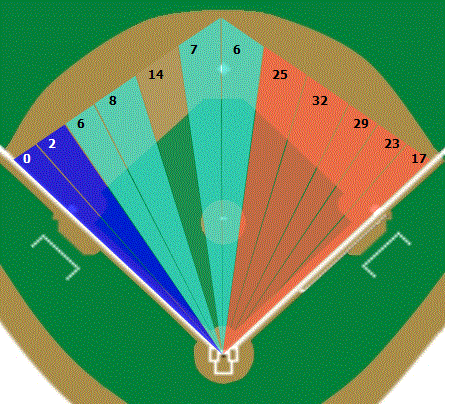
    Like many left-handed power hitters, Conforto is susceptible to the shift because he hits the ball to the right side of the infield at a high rate. The 26-year-old outfielder pulled 78 percent of his short liners and ground balls last season, so that explains why the full shift worked so successfully against him. Below is his ground ball/line drive distribution.

    Partial shifts, however, have proven to be ineffective against Conforto. When two infielders were aligned significantly out of position, Conforto had a .375 BABIP last season (12-for-40). While a BABIP this high against partial shifts certainly isn’t sustainable, it demonstrates that the partial shifts don’t work against him, which has been the case his entire career.

    Conforto entered 2019 with a career .301 BABIP on short line drives and groundballs against partial shifts, but he owns a .198 BABIP against full shifts. These numbers indicate that teams should abandon the partial shift against Conforto, and that they should use the full shift against him more frequently.

    A promising sign for Conforto is that he is now committed to adjusting his approach. Working this spring with the Mets’ new hitting coach Chili Davis, Conforto is trying to hit to the opposite field against the shift.

    Davis wants Conforto, and the rest of the team, to take a more situational and contact oriented approach. Conforto might be the Met for whom this is most important.

    Davis’ thinking represents a change in philosophy from previous Mets’ hitting coaches, like Kevin Long, who emphasized the home run. This new strategy could be exactly what Conforto needs to beat the shift, and help him reach his full potential.

    While Conforto posted solid overall numbers in 2018, the full shift stifled his production to a degree. According to SIS’s data, the full shift robbed Conforto of six hits (though he did gain two from partials).

    While that six may not seem significant on the surface, it drags his average down to .243 instead of .254. Small differences like this can make an impact over a course of a 162-game season where games are often won and lost by small margins.

    And thanks to Conforto’s power and excellent eye at the plate, he still was very productive despite his low average. Conforto posted a 120 wRC+ with 28 homeruns in 638 plate appearances last season, and he also managed to get on base at a solid .350 clip because of his high walk percentage. Conforto took ball four in 13 percent of his plate appearances, which ranked 21st in the majors among qualified hitters.

    The former first round pick has the power and patience to rank among the game’s elite. And now that he is fully recovered from the shoulder injury that cut his 2017 campaign short, the full shift is one of the few things that’s holding him back.

    Conforto’s upside will be limited if he can’t adjust to the shift. And once teams realize that partial shifts aren’t effective against him, He will face more of a challenge as he will see more full shifts (he only saw full shift the opening weekend). Therefore, it is important that Conforto heeds Davis’ advice and starts driving the ball to the opposite field more often.

  • What we can learn from Rougned Odor’s bunts against the shift

    What we can learn from Rougned Odor’s bunts against the shift

    By ANDREW KYNE

    With a new season upon us, teams are hoping that 2019 is the year they can beat the infield shift. Consider this out of Mets camp last week, via MLB.com’s Anthony DiComo:

    From the Dominican Summer League on up to the Majors, the Mets’ new front office is placing increased emphasis on bunting and situational hitting. When teams employ defensive overshifts on their Minor Leaguers, the Mets — for the first time — are encouraging their players to bunt to beat them.

    Bunting against the shift isn’t a new idea, but hitters haven’t really embraced it as a strategy.

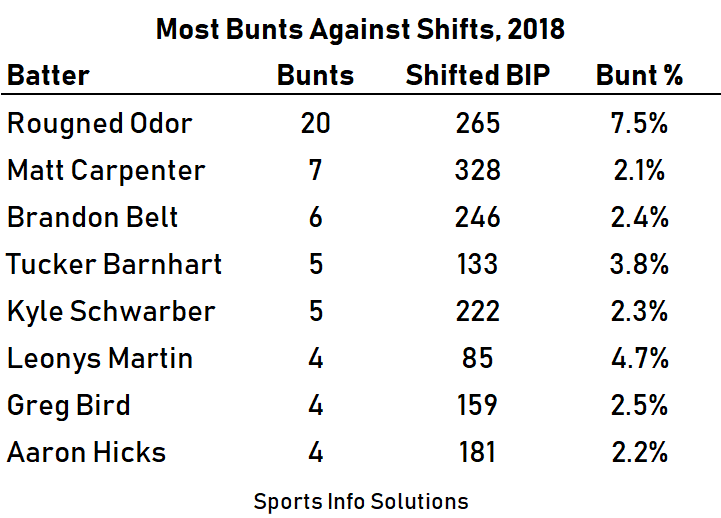
    One batter, however, did it far more than most in 2018: Rougned Odor of the Texas Rangers. Odor’s 20 bunts against infield shifts were by far the most in MLB:

    So, I decided to watch those 20 bunts and figure out what I could learn. Does it work? How do teams react? Let’s find out.

    It’s not foolproof

    First, how often was Odor actually successful?

    It turns out that he only went 7-for-18 on these bunts. (Two of the outs had men on base and went down as sacrifices.)

    Of course, .389 isn’t a bad batting average to own, but you have to consider these are only going for singles, and therefore providing nothing in the slugging department.

    The league as a whole hit .584 (122-for-209) on bunts against shifts last season. Not bad, but it’s not perfect and relates to a point Matt Carpenter made to ESPN.com last summer. Though he’s specifically talking about hitting grounders to the left side, it also applies to dropping down a bunt:

    “Let’s just say I sell out tonight, and I try it four times. The likelihood of me hitting four straight ground balls to short and ending up 4-for-4 are very slim. If I succeed once or maybe twice, at best I’m going to go 2-for-4 with two singles, where if I just play the game, I might go 2-for-4 with a homer and a double.”

    The accuracy needs to be pinpoint

    So how do you improve on Odor’s .389 average or even the league’s .584? The execution needs to be strong.

    Consider a play like this one against the White Sox. Odor bunts it to the third base side, yet Reynaldo Lopez gets off the mound and throws him out with relative ease.

    Ideally, the bunt will be further away from the pitcher than that one, and preferably as close to the third base line as possible. That obviously requires great accuracy.

    Here’s a look at a spray chart of all the bunts against shifts from left-handed hitters in 2018. The red points represent hits, and the blue points represent outs. There are a lot of hits down the third base line, especially if it can get past the pitcher.

    But even then, you can find pitchers who are able to get off the mound and make plays. Check out this play by Jose Berrios, who would have thrown out Odor here if Joe Mauer held onto the ball at first base.

    The defense will be ready

    This was my biggest takeaway from watching these plays. I think a lot of times when people talk about beating the shift and they suggest laying a bunt down, they’re imagining a defensive alignment like this:

    Either the shortstop or third baseman moves over to the right side, and the one who stays on the left side plays where the shortstop would traditionally be.

    Yet out of these 20 Rougned Odor bunts, this one against Baltimore was the only one I saw that didn’t have a fielder on the left side of the infield playing up near the edge of the infield dirt, protecting against the bunt. (And he still didn’t get a hit on it!)

    Kyle Seager mentioned this in the same ESPN.com article that’s referenced above: “I’ve tried to bunt a few times, and I’ve had a few successes. But the third baseman is usually still in there for the first two strikes, so the bunt is not as big a factor as it could be.

    This appears to be true for Odor as well. Our company charts the starting positions of infielders on grounders and short liners.

    Here’s a look at where third basemen, when in a shifted alignment, played against Odor in 2018 when he put grounder/liner into play with fewer than two strikes:

    3B Positioning vs. Odor: < 2 Strikes

    And here’s a look at where third basemen, when in a shifted alignment, played against Odor when he put a ball in play with two strikes:

    3B Positioning vs. Odor: 2 Strikes

    (The straight lines represent the base lines, rather than the true edges of the infield grass.)

    You can see that with fewer than two strikes, the 3B typically stayed at home to protect against the bunt. But with two strikes — and the threat of a bunt all but eliminated — the 3B would more often move back.

    The case of Rougned Odor shows that there’s difficulty in bunting against the shift. Perhaps the Mets will gain an edge by emphasizing it at the minor league level and developing accurate bunters, but opposing defenses will continue protecting against it to some degree.

  • 3 Things That Won’t Happen Again For The Astros

    By PATRICK ROWLEY

    In looking at the upcoming season for the Astros, I came across a few things that happened last season that probably won’t be duplicating themselves in 2019.

    1)Three Astros starters throw 200 innings

    Last season only 13 pitchers eclipsed the 200-inning threshold and three of them were on Houston. Justin Verlander (214), Dallas Keuchel (204 2/3), and Gerrit Cole (200 1/3). Verlander and Cole have each thrown 200-plus innings in three of the last four seasons, so it is not unreasonable to think they can replicate their workload. Getting a third pitcher to this mark will be the issue. Dallas Keuchel feasibly could re-sign with Houston, but if a reunion was going to happen, it probably would have happened by now.

    Charlie Morton and Lance McCullers Jr. were the next closest in innings with 167 and 128 1/3 respectively, but Morton has joined the Rays for the 2019 campaign and McCullers will be on the shelf for the year after undergoing Tommy John surgery in November.

    With those departures, the rotation will likely feature 2018 bullpen arms Colin McHugh and Brad Peacock and rookie spot starter Framber Valdez. All of these pitchers have experience starting, but they still only combined for 174 1/3 big league innings last year (McHugh was exclusively a reliever) and it seems unlikely the Astros would want to make such a drastic jump in their usage.

    Last year the Astros rotation was one of the best in baseball, ranking second in fWAR. Now they are without three pitchers who totaled 8.5 fWAR in their rotation and will likely have to rely on their bullpen more throughout the season. It is no easy feat to replace that production.

    2 )Tyler White was the best hitter after reaching the worst count

    Hitting a baseball is hard but hitting a baseball down 0-2 in the count is even harder. Last season only 15 batters were able to muster a wRC+ over 100 (league average).

    A lot of these names shouldn’t come as a surprise; Mike Trout (101), Justin Turner (118), Alex Bregman (132) and Mookie Betts (148) are a few of the marquee names with Betts having the second highest wRC+. The player in first? Tyler White whose 245 wRC+ dwarfs Betts’ total in second.

    Last season White had 18 hits in 45 at bats ending after the count went to 0-2, good for a .400 average. Boosted by six of his 12 homers on the season, White had an OPS of 1.284 in these counts, comfortably ahead of Betts’ .938 figure in second. Two of these homers came against elite-caliber closers Edwin Diaz and a walk-off against Jeurys Familia during Familia’s tenure with the Oakland.

    Why won’t this last? Tyler White had a HR/FB rate of 43 percent in these at bats and a BABIP of .500. Both rates were in the top 10 in the league and are hardly sustainable over time. He was also the only player with more RBIs (17) than strikeouts (16). Coupled with this is his production in past seasons in this situation point towards a precipitous decline.

    In 2016 and 2017 White combined for just 66 at bats after an 0-2 count and managed just eight hits over those for a batting average of .121 along with a strikeout percentage of 47 percent. Considering the last three seasons at-bats that go to 0-2 counts, White has put up a wRC+ of -23, -45, and 245. The BABIP and HR/FB should both go down in 2019 it’s more likely White falls back in to the negatives again than it is that he posts another wRC+ over 200.

    3) Jake Marisnick’s Defense was Worth a Win

    The standard calculation is that about 10 runs equates to a win, so posting a seasonal Defensive Runs Saved Total of 10 or more roughly translates to providing your team with an added win over the season. Last year only 17 outfielders were able to surpass the 10 DRS threshold, including Jake Marisnick and his 11.

    Marisnick primarily played center field when he was in the lineup, with George Springer moving over to right field. With the newly acquired Michael Brantley all but locked in to the starting left field job, Josh Reddick at the other corner, and George Springer between them it leaves little room to insert the defensive stud Marisnick who posted a meager 85 wRC+ last season. Compare that to Brantley (124), Springer (119), and Reddick (99) and it becomes hard to justify removing those pieces from the lineup with any regularity. Last year Marisnick could get in when Marwin Gonzalez would move to the infield to give a player a day off, but Brantley does not provide that same flexibility which could eat in to Marisnick’s playing time.

    This coming season the Bill James Handbook projects Marisnick (3), Reddick (3), Brantley (3) and Springer (-1) to combine for eight Defensive Runs Saved, lower than Marisnick’s 2018 individual total. Springer will also likely be tasked with patrolling center more frequently where he accumulated -5 DRS in 2018, compared to a league average of zero when he was moved over to RF.

  • Which catchers get strikes at the top of the zone?

    Which catchers get strikes at the top of the zone?

    The Houston Astros have long valued pitch framing. Over the last five seasons, only one team — the Dodgers — have saved more runs via framing than the Astros. (You can now find this and the rest of our Strike Zone Runs Saved data on FanGraphs, under the rSZ column within the Fielding leaderboards.)

    So it was noteworthy when Houston signed Robinson Chirinos to a one-year contract in December. Chirinos has historically rated as a negative pitch framer, including -6 Strike Zone Runs Saved in 2018.

    Even more interesting is what part of the strike zone Chirinos has struggled to frame. From Chandler Rome’s profile on Chirinos for the Houston Chronicle last month:

    “I told A.J. [Hinch] this (that) last year the pitch I was struggling (with) was the high pitch,” Chirinos said Thursday. “When I signed here in December, I knew from facing all these guys how they like to pitch. That high pitch is a pitch they use a lot.

    Gerrit Cole and Justin Verlander were among the league leaders at throwing fastballs in the upper-third of the zone and above in 2018. Yet it’s an area that Chirinos may not be comfortable with.

    So where does Chirinos rank among other backstops at getting high strikes?

    Using BIS’s pitch-charting data and standard strike zone, let’s consider called pitches (balls and called strikes) in approximately the top-fifth of the zone, plus a little above it and off the edges — essentially the area bordered in black here:

    The pitches in this area have a borderline called-strike expectation. Anything higher or further outside is very likely to be a ball; anything lower (in the zone) is very likely to be a strike.

    Among the 35 catchers with the most pitches caught in this area in 2018, here were the ten best at getting called strikes:

    RankCatcherStrikesPitchesStrike Rate
    1Yadier Molina521116744.6%
    2Sandy Leon31472043.6%
    3Wilson Ramos38392541.4%
    4Austin Hedges36790040.8%
    5Luke Maile21352940.3%
    6Chris Iannetta31277940.1%
    7Max Stassi22857939.4%
    8Kevin Plawecki24963839.0%
    9Omar Narvaez25566038.6%
    10Christian Vazquez26769238.6%

    And here were the ten worst:

    RankCatcherStrikesPitchesStrike Rate
    35J.T. Realmuto24689527.5%
    34Yan Gomes21778927.5%
    33Manny Pina18364828.2%
    32Tucker Barnhart29495630.8%
    31Jonathan Lucroy26284830.9%
    30Francisco Cervelli25682131.2%
    29Devin Mesoraco18558831.5%
    28Kurt Suzuki22469932.0%
    27Willson Contreras30493432.5%
    26Robinson Chirinos26981033.2%

    Chirinos does, in fact, appear among the trailers here. Meanwhile, Houston’s other catcher, Max Stassi, rates near the top. Stassi was tied with Yasmani Grandal and Tyler Flowers for the Strike Zone Runs Saved lead in 2018.

    The Red Sox, Cardinals, and Mets all appear to be taking advantage here. Those teams ranked first, second, and third, respectively, in throwing the highest percentage of overall pitches in the area we outlined. (The Astros were eighth.)

    And their catchers were strong at getting strikes there. Boston’s Sandy Leon and Christian Vazquez were both among the top ten at getting strikes in that area in 2018. The Cardinals’ Yadier Molina was the very best. And although the Mets traded Kevin Plawecki (8th) to Cleveland, they signed Wilson Ramos (3rd) to play behind the plate. (Pitching up in the zone was a key for Jacob deGrom in his Cy Young season.)

    Finally, we can also visualize how catchers differ in framing various parts of the zone. Here’s a look at Chirinos:

    This image compares Chirinos’ ability to get called strikes in each location to the league average. The red areas are where he’s better than average, and the blue areas are where he’s worse than average. As expected, we see a lot of blue at the top of the zone.

    And here’s a look at Molina, who ranked first on the above leaderboard and excels at getting high strikes (but not so much at low ones):

  • Luis Avilan brings unique pitching approach

    By NICK RABASCO

               Those who follow baseball closely knows that same-side changeups are extremely rare. They make much more sense thrown to opposite-side hitters, as a means to neutralize the platoon advantage. From 2016 to 2018, there were 160,371 pitches thrown by left-handed pitchers to left-handed hitters. Only 4 percent (6,421) of those pitches were changeups. Looking at this another way, just 9 percent of all changeups thrown by left-handed pitchers from 2016 to 2018 were to left-handed hitters.

    But there is a left-handed pitcher who likes to throw his changeup to lefties a lot more than the norm. Luis Avilán, signed by the Mets this offseason, has one of the most interesting repertoires in baseball. He’s a left-handed reliever who has thrown his changeup almost half the time in each of the past three seasons.

    Of the 55 left-handed pitchers who have thrown at least 500 changeups over the past three seasons, Avilan throws changeups to left-handed hitters far more often than anybody else.

    Highest % of Changeups by LHP vs LHB (since 2016)
    Luis
    Avilán
    41.3%
    Joey Lucchesi35.2%
    Jorge De La Rosa30.7%
    Jason Vargas21.7%
    David Price17.2%
    Tyler Anderson17.0%
    Alex Wood16.0%

               
    Avilán clearly loves to throw his changeup to lefties. His percentage is also a bit more of an outlier than it seems, because Joey Lucchesi’s “changeup” acts more like a curveball. In 2018, Lucchesi’s changeup averaged about a half an inch of glove-side run. Avilán’s changeup averaged about 6.5 inches of arm-side run, which is much more normal for a changeup.

                Avilan’s changeup usage over the past three years is not only an anomaly when compared to the rest of the league, but it’s a drastic change that he made from earlier in his career. He made his big league debut in 2012, and for the first four years of his career he threw nearly 1,400 pitches to lefties. Only 53 of those pitches were changeups, which comes out to under four percent.

    Clearly, Avilán made some major adjustments to his approach. It’s possible that the Dodgers told Avilán to start using his changeup more after his trade from Atlanta in July of 2015. With Atlanta in 2015, Avilán threw 10 percent changeups to lefties. After moving to LA, he threw 17 percent changeups to lefties. In a fairly small sample, Avilán increased his changeup rate at a pretty significant clip.

               With this change in approach, Avilán also saw an increase in strikeout rate. During the first four months of 2015 with Atlanta, he struck out 20 percent of hitters and with the Dodgers it jumped to 27 percent. And look at the difference in his strikeout rate and FIP as the lefty-changeup rate increased the last three seasons with the Dodgers, White Sox and Phillies.

    Luis Avilán  
      2012-2015 2016-2018
    K% 17.9% 27.7%
    FIP 3.46 2.87
    IP 197.7 111

              
    Avilán isn’t the only lefty who went from Atlanta to Los Angeles to make a change like that (pardon the pun). Alex Wood, who was in the same trade as
    Avilán back in 2015, saw a significant spike in his changeup usage against left-handed hitters as well. Looking back at the table above, you’ll find that Wood has the seventh-highest changeup rate against lefties from 2016-2018, 16 percent. Wood debuted with the Braves in 2013 and for the first three years of his career, he only threw changeups to lefties 9 percent of the time. But unlike Avilán, Wood didn’t see too much change in his results after heading to LA.

    Avilán now brings his approach to a Mets team with a significant need for a left-handed reliever after going through major bullpen issues last season. He will be one of the more interesting follows in 2019.

  • Stat of the Week: Who were baseball’s top overachievers & underachievers in 2018

    By Mark Simon

    Who were the overachievers and underachievers of the 2018 MLB season?

    It’s a question to consider for those evaluating their teams and conducting their fantasy drafts. Though there are no guarantees that the numbers will even out and that the player will return to his expected norms, understanding who overachieved and underachieved provides context to a player’s past performance.

    Our defense-independent batting statistics (DIBS) can give expected results on every ball in play for a hitter by comparing the ball’s trajectory, direction and velocity to other similar batted balls and assigning value based on those results. We can then compare those to his actual offensive numbers to determine if a player underachieved or overachieved.

    In other words, these numbers can tell us if a player may have hit into hard luck, played in an unfriendly ballpark, or been the victim of some good defense. Or perhaps he hit into good luck, got a few ballpark-friendly hits, or took advantage of some poor defense.

    Here’s a look back at several players from 2018, along with their projections for 2019.

    Overachievers

    Before the start of last season, Mookie Betts made the underachiever list. He was coming off a 2017 in which he hit .264/.344/.459 when the batted-ball profile was that of a .297 batting average and .886 OPS hitter. It was noted then “There’s not much reason for concern, and at 25 he should be an MVP-caliber player.”

    Much that went against Betts in 2017 turned in his favor in 2018. He won AL MVP honors in 2018, though the data indicated his numbers were better than what they likely should have been.

    Betts hit 32 home runs, six above expectations, and 47 doubles, nine above expectations. His 1.078 OPS was 133 points higher than expected, though even if it had just met expectations (.945), he still would have had a great season. The 133 points were the most above expectations for any player with at least 250 plate appearances in 2018.

    Betts was joined by J.D. Martinez and Steve Pearce in having the biggest positive differential between expected OPS and actual OPS. Martinez’s OPS was boosted by hitting 43 home runs, 10 more than the data indicated he was expected to hit.

    Betts’ 2019 projection: .303 BA, .923 OPS, 29 HR in 614 AB

    Martinez’s 2019 projection: .294 BA, .929 OPS, 36 HR in 555 AB

    Pearce’s 2019 projection: .262 BA, .806 OPS, 14 HR in 313 AB

    The player with the highest OPS above expectations who wasn’t on the Red Sox was Carlos Gonzalez, who hit .276 with a .796 OPS last season. Gonzalez’s batting average and OPS were 41 and 105 points above his expected performance respectively. Gonzalez was likely helped by Coors Field, where he hit .315 with a .941 OPS compared to .241 and .663 on the road. He’ll move to less-friendly Progressive Field as a member of the Indians in 2019.

    Gonzalez 2019 projection: .271 BA, .814 OPS, 24 HR in 542 AB

    Giancarlo Stanton is the one other player whose 2018 OPS was at least 100 points above expectation. Yankee Stadium likely helped a bit here as Stanton’s 38 home runs were seven more than the batted-ball data suggested he would hit. He had never been more than three home runs above expectations in a season while with the Marlins.

    Stanton 2019 projection: .260 BA, .887 OPS, 42 HR in 574 AB

    Underachievers

    Angels shortstop Zack Cozart hit .219 with a .658 OPS while dealing with injuries in 2018, not what the team had in mind when it signed him to a three-year deal last offseason. Cozart’s numbers were a bit out of whack given where he hit the ball and how hard he hit the ball.

    His expected batting average and OPS were .287 and .819 respectively. The 161-point differential between his OPS and expected OPS was the biggest negative differential between those stats in MLB.

    Cozart’s 2019 projection: .259 BA, .744 OPS, 13 HR in 421 AB

    Dodgers center fielder A.J. Pollock is another player whose numbers should have looked a little better. His .800 OPS in 2018 was 106 points below what was expected from his batted balls. Pollock, who finished his tenure with the Diamondbacks in 2018, may have been hurt by Chase Field’s humidor, as the ballpark was not the hitter-friendly place for right-handed batters that it had been in the past. It will be interesting to see how Pollock performs with his new team, the Dodgers, in 2019. His projected OPS (noted below) is right in line with his 2018 OPS.

    Pollock’s 2019 projection: .266 BA, .804 OPS, 19 HR in 466 AB

    One of the top prospects last season was Marlins center fielder Lewis Brinson, who hit a disappointing .199 with a .577 OPS in just over 400 plate appearances. Brinson should have been something closer to an average player in 2018 as his batted balls merited more home runs (15 expected, 11 hit) and a higher BABIP (.322 expected, .257 overall).

    Brinson’s expected batting average and OPS for 2018 were .242 and .697. He got off to a hot start this spring and it will be worth watching to note if there is any carryover into his 2019 season.

    Brinson’s 2019 projection: .219 BA, .644 OPS, 13 HR in 398 AB

    A reminder that you can purchase the updated 2019 Bill James Player Projections at this link

  • Athletics got an ‘A’ for their shift defense in 2018

    By MARK SIMON

    The Athletics were one of the surprise teams in baseball last season, winning the second AL Wild Card and challenging the Astros for the AL West title.

    Chances are that you know the Athletics had the best defensive player in baseball last season in third baseman Matt Chapman. But they were also good at something that had almost nothing to do with Chapman.

    As you can see in the newly-listed numbers on Fangraphs, Oakland ranked second in MLB with 36 Shift Runs Saved, trailing only the 39 by the Diamondbacks. It’s largely the reason that the Athletics led the AL in overall Defensive Runs Saved.

    Most Shift Runs Saved – 2018 Season
    Diamondbacks39
    Athletics36
    Rays31
    Twins31
    Tigers30

    Those two teams used shifts at dramatically different volumes. The Diamondbacks ranked eighth in the number of shifts they used on balls in play with 1,391. The Athletics ranked 25th, utilizing 883. But the Athletics got great value out of the instances in which they did shift.

    So what were the characteristics of the Athletics’ shift that allowed them to be so good despite the minimal usage, relative to the rest of MLB?

    Strategic Change

    In 2017, the Athletics used full shifts (ones with three infielders on the pull side) and partial shifts (two infielders on each side, but at least two fielders significantly deviating from normal positioning) about the same number of times (170 ground balls and short line drives into full shifts vs. 188 into partials). That’s a recipe for trouble. Full shifts are far more effective than partial shifts at thwarting base hits on grounders and short liners.

    Athletics Shifting Notes
    * Changed approach to use more full shifts
    * Switched up where Lowrie and Semien stood
    * Great vs. right-handed batters

    Case in point: the Athletics allowed a .182 batting average on those type of batted balls against full shifts that season and a .340 batting average on them in partial shifts.

    In 2018, the Athletics changed approaches. They used full shifts more than twice as often as partial shifts. Their success on full shifts continued. Opponents hit .162 against them on their grounders and liners, the second-lowest batting average allowed in MLB. And with greater selectivity on partial shifts, opponents’ batting average came down as well (.257 on grounders and liners).

    Sure-handed Middle Infielders

    The Athletics did something a little different than most teams and different than they had in 2017, sometimes playing their shortstop, Marcus Semien, in shallow right field when they shifted a left-handed batter. They took second baseman Jed Lowrie out of that spot and moved him to a spot more in line with where a shortstop would play in the shift. Semien is five years younger than Lowrie and can cover more ground. The move worked well for both.

    Semien, a much-improved defensive player in 2019 in non-shift situations, was highly valuable in this defensive alignment. Of the A’s 36 Runs Saved from shifts, 7 came from Semien, up from 2 the previous season.

    Similarly, the Athletics got 7 Shift Runs Saved on balls in which Lowrie was the primary fielder in a shift, up from -2 on a similar number of balls the previous season.

    Unrelated, but worth noting: The Athletics recorded only one run saved on balls hit to Chapman in shifts. This success was mostly about Lowrie and Semien (with a little help from Matt Olson).

    When shifting a righty, it almost always worked

    The Athletics were infrequent shifters of right-handed hitters, but when they used a shift, it usually did the trick. Righties who hit a ground ball against an A’s shift had a .165 reached-base percentage (how often they reached on hit or error) on 79 ground balls. They reached 13 times when the average hitter would have reached 22.

    That’s not a large sample by any means, but it shows how the Athletics helped themselves in the stat by converting these outs.

    Outlook

    The Athletics’ infield defense returns its two cornerstones in Matt Olson and Chapman at first and third, as well as Semien at shortstop. They’ll break in a new second baseman in Jurickson Profar, whose major league experience at the position consists of a little more than 500 innings. He’ll replace Lowrie, who signed with the Mets this offseason.

    The things to watch will be whether Semien maintains his improvement and whether Profar is comfortable in Oakland’s defensive alignments. Also worth keeping an eye on is the Athletics’ shift usage, both in total and in how often they play three infielders on the pull side. They’ll likely need similar success to contend with the Astros again.

  • Finding Candidates for a Four-Man Outfield

    Finding Candidates for a Four-Man Outfield

    By ANDREW KYNE

    Four-man outfields have been in the news this week, with Bryce Harper facing them in Grapefruit League play and acknowledging afterwards that he hoped he wouldn’t see them again.

    We began tracking four-man outfields on balls in play at Baseball Info Solutions last season, with Lucas Duda (12), Matt Olson (6), Joey Gallo (6), and Justin Smoak (5) being the most impacted sluggers.

    This could be a strategy that we see a lot more of in 2019. So who are some other top candidates to face a four-man outfield? August Fagerstrom went through a similar exercise for FanGraphs in 2016, and Devan Fink did so for Beyond the Box Score in 2017.

    Using BIS charting data for 2018, let’s find batters who hit few groundballs to the non-pull side of the infield (so you can leave that side of the infield vacated) and also hit a lot of balls in the air to the outfield (so your fourth infielder might be more useful out there). Those on both lists are bolded for emphasis.

    Lowest percentage of batted balls that were grounders/short liners to the non-pull side (2018 batters, minimum of 200 batted balls)
    1. Matt Carpenter (2.2%)
    2. Jay Bruce (2.5%)
    3. Joey Gallo (3.1%)
    4. Curtis Granderson (3.8%)
    5. Mike Zunino (4.0%)
    6. Rhys Hoskins (4.1%)
    7. Logan Morrison (4.2%)
    8. Jose Bautista (4.9%)
    9. Brian Dozier (4.9%)
    10. Kyle Seager (4.9%)

    Highest percentage of batted balls that were in the air and hit at least 250 feet (2018 batters, minimum of 200 batted balls)
    1. Matt Carpenter (47.6%)
    2. Brandon Belt (45.2%)
    3. Daniel Descalso (43.9%)
    4. Khris Davis (43.9%)
    5. Joey Gallo (43.7%)
    6. Mike Trout (43.6%)
    7. Max Muncy (42.9%)
    8. Teoscar Hernandez (42.7%)
    9. Rhys Hoskins (42.2%)

    10. Justin Turner (42.2%)

    Obviously there’s a correlation between those two variables. But which players are among the most extreme? Take a look at the hitters in the upper left of this graph.

    Besides Gallo (who, as noted, faced a handful of four-man outfields last year and will likely see more in 2019), it appears that Matt Carpenter, Jay Bruce, and Rhys Hoskins are among the most extreme examples and could be candidates to see the strategy. Others near the top include Curtis Granderson (who saw one four-man outfield last season) and, interestingly, Daniel Descalso (who notably changed his swing and hit far fewer grounders in 2018).

    Carpenter is perhaps a very obvious example. He had the lowest groundball percentage among qualified batters last season, and almost all of those grounders were pulled. Check out his spray chart:

    (The blue contour lines track the density of balls hit in the infield; the red lines track the density of balls hit to the outfield.)

    Carpenter barely hits any grounders to the left side of the infield, while hitting a high volume of balls all over the outfield.

    The Cubs tried a four-man outfield against Carpenter last year … and he responded with a bunt single. Yet taking away the possibility of an extra-base hit was a result the Cubs were likely okay with.

    Hoskins understands that and may not be one to change his approach. When asked about the four-man outfields that Harper has been seeing, Hoskins told Matt Breen of The Inquirer: “It doesn’t make you do anything different, because as soon as you try to do something different, they win. If I’m trying to hit a ground ball to the right side, then they’ve done their job and I’m not doing mine. You don’t want me to bunt, I promise you.”

    Hoskins very much looks like a four-man outfield candidate himself. While Carpenter had the lowest groundball rate in baseball, Hoskins was right behind him and also pulled an extreme amount of those balls.

    Of course, extreme infield shifting of right-handed hitters can be difficult. The first baseman can’t venture too far away from the bag, or else a significant hole can be created on the right side. Yet Hoskins almost never hits grounders over there, and he yanks a ton to where the third baseman and shortstop typically play. Given his high volume of balls to the outfield, it could be something that his opponents consider.

    As for Harper, if you were to find him on the scatter plot above, he’d be in the mix of players between 5-10 percent for non-pull grounder and liner rate and 35-40 percent for outfield air ball rate. He’s among the players who fit the mold, though not necessarily an extreme by this rudimentary methodology.

  • Stat of the Week: Running on Bryce Harper’s arm

    By Mark Simon

    One of the storylines to follow for new Phillies outfielder Bryce Harper this season will be how he fares defensively. Harper’s defense cost the Nationals 26 runs last season, tied with new teammate Rhys Hoskins for second-worst in the majors. Harper struggled defensively in both right field, where he’ll likely play for the Phillies, and center field, where he played just under 500 innings for the Nationals in 2018.

    Harper’s performance last season was about more than his inability to turn batted balls into outs at a high rate. Harper also cost his team with his troubles deterring baserunner advancement. Harper had -6 Outfield Arm Runs Saved last season, by far the worst total of his career (he saved five runs in the previous two seasons combined). He cost the Nationals five of those six runs in right field. From that position, Harper did not record any baserunner “kills” (a BIS term for throwing out a runner trying to advance without the help of a cutoff man). From 2015 to 2017, Harper totaled 16 assists in right field without using a cutoff man.

    Baseball Info Solutions Video Scouts chart defensive plays, categorizing them as “Good Fielding Plays” and “Defensive Misplays & Errors.” Harper had five Defensive Misplays & Errors that were grouped as “Wasted Throw After Hit/Error” that allowed a runner to take an extra base. The only players with more were Billy Hamilton and Ender Inciarte, who had seven.

    Harper is not the only star player to have a poor Outfield Arm Runs Saved total. In fact, one of the trailers in that stat is 2018 NL MVP Christian Yelich. Yelich cost his team seven runs with his arm, four in left field and three in right. Yelich has had this problem wherever he’s played. In 2017, he played the entire season in center field and cost the Marlins six runs with his arm. He did save four runs for the Brewers overall, making up for his arm issues with good Range & Positioning numbers.

    Another big free agent signee, A.J. Pollock, brings a lot of skill to center field with the Dodgers. However, his arm cost the Diamondbacks six runs at that position in 2018. Pollock allowed 71 percent of baserunners to take an extra base on a base hit (go first-to-third or second-to-home on a single, or first-to-home on a double). That was the highest advancement rate allowed by center fielders last season. In a smaller sample, Harper allowed a 67 percent advancement rate.

    Though Harper, Yelich, and Pollock are extremely valuable position players, they would be even more valuable if they can improve upon this aspect of their games in 2019.

    Fewest Outfield Arm Runs Saved in 2018
    Name Runs Saved
    Christian Yelich -7
    Derek Dietrich -7
    A.J. Pollock -6
    Brandon Nimmo -6
    Bryce Harper -6
    Rhys Hoskins -6
    Charlie Blackmon -6

    Another standout, Cubs left fielder Kyle Schwarber, tied Twins left fielder Eddie Rosario for second, one run behind Judge. Also worth spotlighting is Yelich’s teammate, Brewers center fielder Lorenzo Cain, who went from costing the Royals six runs with his arm in 2017 to saving his team five runs with it in an outstanding 2018 campaign.Though the focus is largely on Harper here, it doesn’t seem right to end this piece without referencing the leaders in this stat. One of them was one of the game’s biggest stars, Aaron Judge. Judge saved eight runs with his arm, the most of any outfielder in MLB.