Category: MLB

  • David Bote handled third base well in Bryant’s absence

    By WILL HOEFER

    If you’re a fan of baseball, chances are you’ve watched the David Bote walk-off grand slam at least 25 times by now. We’re talking about a perfect moment. In the wake of that, there have been excellent pieces written about the sheer magnitude of that play in terms of Win Probability Added and how Bote has hit baseballs harder than any human at the game’s highest level in 2018.

    What’s been less talked about, to an extent, is how Bote is not just a one-trick pony. Bote has a limited but solid track record of defensive performance this year at third base for the Cubs. Let’s give a little love for his glove as he did ably in replacing Kris Bryant, who just returned from the DL.

    Bote has four Defensive Runs Saved in his first 40 games at third base for the Cubs. He rates slightly above average on balls in the hole and down the line and hasn’t shown any weaknesses at the position. Additionally, he has 11 Good Fielding Plays and 3 Misplays and Errors as judged by our video scout staff. We have a rating given by Video Scouts for each play that assesses it on a 1-5 scale. Bote’s rating is such that he ranks fourth among third basemen, behind Matt Chapman, Nolan Areando and Anthony Rendon.

    Bote ranks well in Defensive Runs Saved and Scout’s Defensive Rating for all third baseman, which is mighty impressive considering how small his sample is at the major league level and how his numbers in the minors were mainly achieved at second base (where he rated well last season by our Minor League Defensive Runs Saved).

    Regression is probably coming for both his offensive and defensive metrics. Players in general rarely mash like Aaron Judge and pick it like Chapman for a sustained period of time; for fringe prospects like Bote such continued performance is a near impossibility. But for the sake of baseball breakouts, it would be cool if he kept it up.

  • Stat of the Week: Shifting is at an all-time high

    Stat of the Week: Shifting is at an all-time high

    Something monumental happened in baseball this past weekend—and it wasn’t the Orioles being given a nationally televised game.

    By the end of play on Sunday, teams had shifted on balls in play 28,249 times, surpassing the previous record of 28,130 set in 2016. They are now on pace to shift just under 35,000 times this season, which would represent a 31 percent increase over last season’s total.

    Shifts had been increasing steadily since 2009, when Sports Info Solutions first started tracking them, until declining slightly in 2017. But they now appear to be on the rise again. It’s not just one or two teams carrying the pack, either—25 of the 30 teams have increased their shift usage this season.

    SeasonChangePlotVert

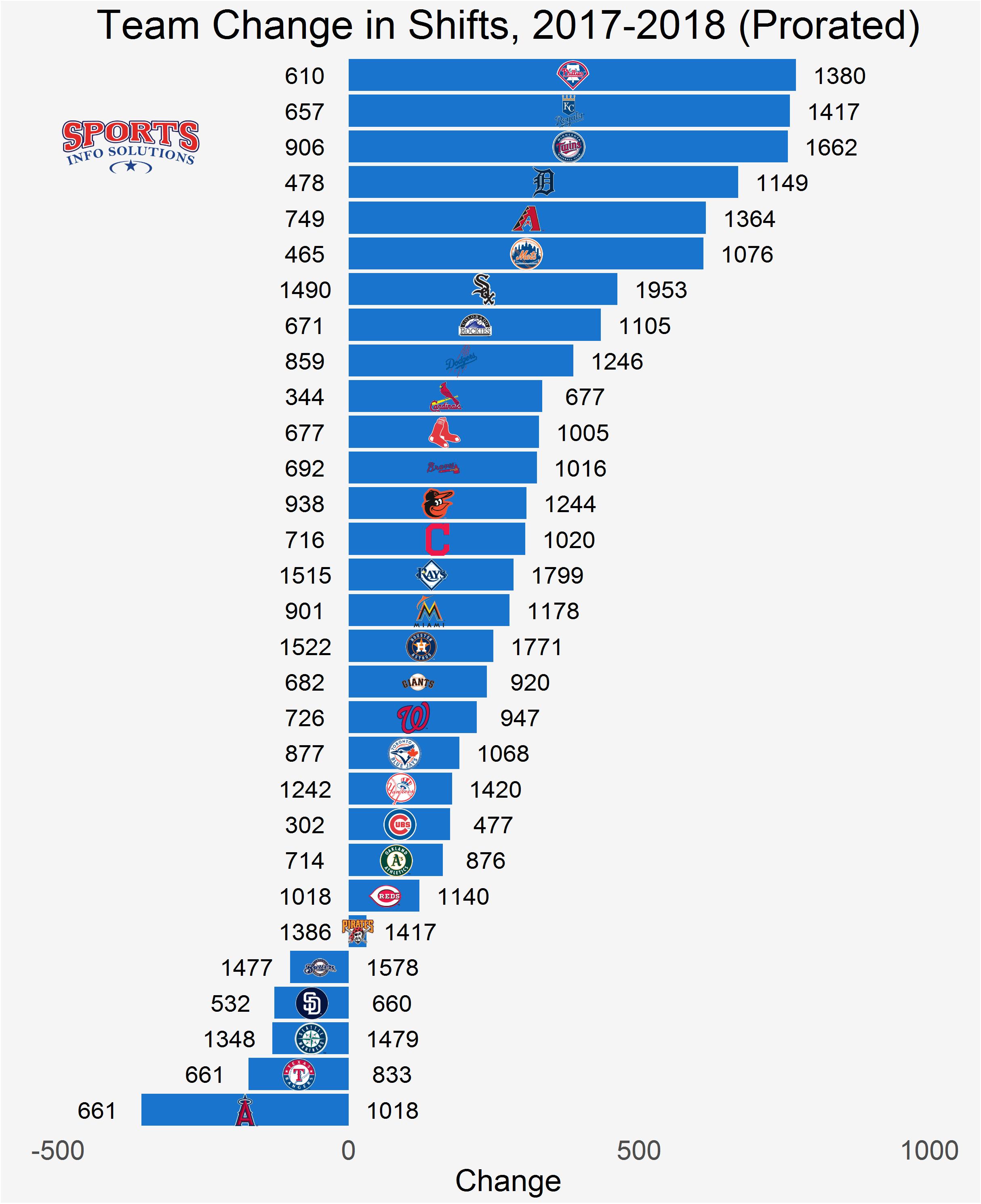
    The Phillies have made numerous headlines this year for their proclivity toward shifting under new manager Gabe Kapler. This shows itself in the data, with no other team on pace to increase their shift usage more than the Phillies. If they continue shifting at their current rate, they will shift nearly 800 more times on balls in play in 2018 than they did in 2017.

    Three AL Central teams follow right behind the Phillies in the Royals, Twins and Tigers, all on pace to increase their shift totals by more than 600. Whether those increases are related or not is hard to say, although all three teams still trail the White Sox, who shifted 1,490 times on balls in play last season and could potentially become the first team to reach the 2,000-shift mark this season.

    While teams are shifting more than ever, there are still improvements that can be made. SIS’s BIS-D software provides a recommendation for every player in MLB as to whether that player is a shift candidate or not, and about one-third of shifts this season have been against players for whom the software recommends playing a standard defense. There have also been about 18,000 balls in play where the defense did not shift when the system suggested one.

    How has the shift impacted the performance of those who get shifted? On the whole, the shift lowered shift candidates’ batting average on grounders and short line drives (BAGSL) by 23 points, while it had the opposite effect against all other batters, raising their BAGSL by 4 points.

    Weighted* Batting Average on Groundballs and Short Line Drives, 2017-18 

    BIS-D Recommendation No Shift Shift Difference
    Shift Candidate .271 .248 Helps by 23 points
    Non Shift Candidate .275 .279 Hurts by 4 points

    *The averages are weighted such that players with extreme shift tendencies (high or low) are not over-represented, thus separating the effect of the shift from batter quality. 

    With shifts comprising a larger percentage of balls in play than ever before, it’s never been more important to make sure that the correct batters are being shifted.

  • How are the Diamondbacks 200+ runs better than the Phillies on defense?

    By MARK SIMON
    All statistics through Saturday’s games

    I received a tweet recently that asked if I could demonstrate the difference between the team with the most Defensive Runs Saved (the Diamondbacks with 120) and the team with the fewest (the Phillies with -102).

    It seemed a reasonable question to wonder – can the difference between the two be more than 200 runs? We wouldn’t question the best and worst teams being that far apart in terms of their offense or their pitching. But for defense, we don’t have as good a feel for the value of certain statistics.

    It’s important to note that when we give a team’s DRS total, that represents the sum of their players’ DRS. It’s not a value solely assigned to the team, but rather the accumulation of many values.

    With that in mind, let’s go through a few notable positions around the diamond.

    Catcher: Diamondbacks 21 DRS, Phillies -9 DRS
    Differential: 30 Runs
    This is a substantial gap. It’s one of the biggest differentials we’ll see.

    The Diamondbacks are unusual in that they have three catchers, each of whom has been outstanding by SIS’ defensive metrics.

    Jeff Mathis leads all catchers with 12 Defensive Runs Saved. Alex Avila has 6. John Ryan Murphy has 3. Mathis rates near the top in our Strike Zone Runs Saved metric, and Murphy is right there with him. The three have combined for 13 Strike Zone Runs Saved in that stat.

    Mathis also excels at blocking pitches, with five runs saved there. He ranks second in our pitch-blocking stat, successfully blocking 97 percent of pitches in the dirt.

    Meanwhile Philadelphia’s primary catchers, prior to their acquisition of Wilson Ramos, Andrew Knapp (88 percent) and Jorge Alfaro (86 percent), ranked fourth-worst and worst respectively in that stat.

    Mathis, Murphy and Avila have combined for 940 pitch blocks and 54 wild pitches and passed balls.

    Knapp and Alfaro have combined for 490 and 74.

    Similarly, the Arizona trio has recorded 109 more strikes than expected for their pitchers based on pitch location, batter handedness and count.

    Alfaro rates well at this, but Knapp does not. Together, they’ve combined to cost their pitchers 15 strikes.

    Also Alfaro’s success catching runners stealing is negated by Knapp’s struggles in that area. And Alfaro has significant issues with bunt defense to where it’s cost the Phillies four runs.

    This is why they got Ramos.

    Shortstop: Diamondbacks 18 DRS, Phillies -14 DRS
    Differential: 32 Runs
    The Diamondbacks have one of the game’s best shortstops in Nick Ahmed, whose 17 DRS top the leaderboard.

    What makes Ahmed great is that he can go deep into the shortstop-third base hole to make plays that are difficult for other shortstops to make, either due to skill or positioning. The Diamondbacks have turned 74 percent of ground balls hit between second base and two-thirds of the way to third base into outs in an unshifted defense (mostly by Ahmed). Within that same area, the Phillies have converted 68 percent.

    For the Diamondbacks, the differential is nearly 30 extra plays made. And that doesn’t factor in other things Ahmed does well, like catch line drives and pops and turn the double play. And it doesn’t factor shifts (which we’ll get to).

    The Phillies have three shortstops who have cost the team four runs apiece: Scott Kingery, who rates well below average in the short-third hole, and J.P. Crawford and Pedro Florimon, who are both below average fielding balls hit up the middle. They’ve since turned the position over to Asdrubal Cabrera.

    Shifts: Diamondbacks 29 DRS, Phillies -9 DRS
    Differential: 38 Runs
    Much has been made of the Phillies’ struggles on shifts, but less known is that the Diamondbacks get the most value from their shifting of any team in baseball. It’s this simple:

    The Diamondbacks convert 80 percent of ground balls and short line drives into outs when in a shifted defense. The Phillies convert 70 percent. The difference is about 50 extra plays converted by the Diamondbacks to this point in the season, without even looking at whether those balls are singles or doubles.

    Center Field: Diamondbacks 15 DRS, Phillies -9 DRS
    Differential: 24 Runs

    The Diamondbacks’ 15 runs come from Jarrod Dyson, Chris Owings and A.J. Pollock and in each case, the key element is catching fly balls hit to the deepest part of the park (Arizona’s total would be higher if not for Pollock’s -5 DRS on throws). The key point to remember is that when those catches are made, the balls they’re snagging would be doubles and triples.

    Meanwhile Odubel Herrera (-10 DRS) is having issues on a ball he’s never had before: the one hit to shallow center field. Per Statcast, Herrera is playing at an average depth of 323 feet this season, seven feet deeper than he typically plays. He’s trading off balls falling in front of him for making catches on deep balls.

    But it’s been a net negative. He’s cost the team 11 runs on range and positioning. The Diamondbacks play their center fielder deeper than any other team’s center fielder at Chase Field. And for them, it works.

    Consider this: Let’s take the area 45 feet to left center and 45 feet to right center from straightaway center field.

    On balls hit at least 360 feet to that area, the Diamondbacks convert 67 percent of balls that stayed in the park into outs. The Phillies convert 60 percent. Without factoring exact hit probabilities, that’s about a dozen more doubles and triples spared, just on balls hit to those spots.

    Pitchers: Diamondbacks 11 DRS, Phillies -15 DRS
    Differential: 26 Runs
    A gap of 26 runs is sizable and is explained thusly: Zack Greinke, Patrick Corbin and Zack Godley, who have combined to save 13 runs, are all adept athletes, who put themselves in position to succeed with their follow-throughs and make more plays off the mound than most.

    The Phillies have only one pitcher above average in that regard: Enyel De Los Santos. He’s pitched 12 innings.

    That accounts for more than two-thirds of the differential. The rest comes from pitcher responsibility for stolen bases (the Phillies have allowed 40 more, but have only six more caught stealings).

    Those positions (and shifting) account for 150 runs of the differential. The other spots on the diamond are more of the same. In short, the Diamondbacks are really good. The Phillies have performed poorly. And the difference between them is pretty large.

    Defensive Runs Saved
    Position Dbacks Phillies
    Pitcher  11  -15
    Catcher  21  -9
    1st Base  5  0
    2nd Base  4  -6
    Shortstop  18  -14
    3rd Base  0  -12
    Shifts  29  -9
    Left Field  4  -20
    Center Field  15  -9  
    Right Field   13  -8  


  • Stat of the Week: NL Total Runs/MVP Race is Tight

    The National League MVP race is shaping up to be incredibly tight with a little more than a month left in the regular season, and it parallels the race for the lead in the Total Runs stat.

    Total Runs combines Runs Created (offense), Baserunning Runs and Defensive Runs Saved, along with a positional adjustment (but not a park adjustment) to account for a player’s total value.

    The candidates in the top spots among the playoff contenders are Cardinals third baseman Matt Carpenter, Rockies shortstop Trevor Story and third baseman Nolan Arenado, Braves first baseman Freddie Freeman and Cubs second baseman Javier Baez. Each has his strong points.

    Most Total Runs – NL Players
    Team
    Matt Carpenter Cardinals 115
    Trevor Story Rockies 115
    Freddie Freeman Braves 113
    Nolan Arenado Rockies 112
    Javier Baez Cubs 111
    Jacob deGrom Mets 110

    Carpenter went through a massive struggle early this season, with his batting average standing at .140 through games of May 15 (he had notable issues with defensive shifts). But since then, he’s arguably been as good as any player in baseball. He’s hitting .323/.430/.700 with 30 home runs in his last 82 games.

    Carpenter does it on the defensive end as well. Though he’s cost the Cardinals three runs at second base, he’s saved them a combined 10 at the corner infield spots. His seven Defensive Runs Saved at third base are the most he’s had in his career. Carpenter’s value is accentuated by his having 38 more total runs than the Cardinal with the second-most, Marcell Ozuna.

    Story has had an offensive bounceback, reestablishing himself as one of the top-hitting shortstops in baseball. Since June 26, he’s hitting .335/.373/.601. He’s created 83 runs, which surpasses his 2017 Runs Created total by 15 runs. He’s also saved four runs at shortstop, continuing his solid defensive reputation.

    Arenado’s Defensive Runs Saved total is surprisingly low (he’s saved three runs after averaging 21 the last five seasons). But his contributions with the bat remain as stellar as they’ve ever been. If Arenado has a strong defensive finish to the season, he could finish in the top three in Total Runs for the third straight season.

    Freeman is bidding to win his first batting title. He’s been a great hitter and has also been terrific in the field with seven Defensive Runs Saved, which ranks tied for third among first basemen. Though Freeman’s slugging percentage is down from 2017, it still looks impressive relative to offensive numbers throughout baseball. Freeman is one of two Braves with at least 100 Total Runs. Ozzie Albies is the other.

    Baez is highly touted by Cubs fans and he’s in the thick of the race. Many feel he’s been worth more than the six runs he’s saved the team at second base and shortstop. Since June 26, he’s hitting .333/.354/.644 with 38 RBI in 44 games. Similar to Carpenter, Baez has a sizable edge on his next-closest teammate, Willson Contreras, who has 84 Total Runs.

    Mets pitcher Jacob deGrom is one run behind Baez in the Total Runs race. He’s not a serious MVP contender, but is noted here for the amazing season he’s having in spite of a low wins total. He and Max Scherzer are nearly even in the race for most Total Runs among pitchers, just ahead of Red Sox ace Chris Sale.

    The gap between the top performers is small enough that it looks like whoever closes the season the best will come out on top in the Total Runs race and perhaps win the MVP as well.

  • Matt Olson’s quiet Gold Glove campaign

    By BRETT BITTIGER

    Few baseball pundits predicted that on August 16, the Oakland Athletics would be two games back in the AL West and in command of the second AL Wild Card spot.

    There has been ample coverage of several of the team’s sources of insurgence: Matt Chapman’s highlight reel has led an improved team defense; Blake Treinen’s turbo sinker and vanishing slider have headlined a superb relief corps; and Khris Davis and Jed Lowrie have anchored a productive lineup.

    But a main contribution has gone largely unnoticed—Matt Olson’s defense.
    Corner-of-the-field defenders usually don’t earn the lion’s share of praise. Oakland is an exception, with their top three Defensive Runs Saved leaders all manning a corner spot: Chapman at third base (+24), Matt Olson at first base (+9), and Chad Pinder in left field (+7). Chapman’s feats have been obvious—Jeff Sullivan of FanGraphs recently analyzed them. Requiring a closer look, perhaps, is the fact that Olson is the team’s second most valuable defender.

    On the surface, Olson ranks second among all first basemen on our Defensive Runs Saved leaderboard, topping the American League by a comfortable margin, and trailing only Brandon Belt overall.

    Most of this value comes from Olson’s ability to handle ground balls, especially to his glove side. In terms of range and positioning, only Belt, Joey Votto, and Freddie Freeman score higher on our leaderboard. Olson also has been very efficient on starting double plays, converting 10 out of 12 opportunities on the season. Beyond this, Olson’s value can best be assessed in how he impacts his fellow infielders.

    Consider Marcus Semien, who currently ranks 12th on our shortstop DRS leaderboard with five runs saved. Semien also ranks 26th by our Good Throw Rate metric among those who have made at least 100 throws to first base. Good Throw Rate factors in throwing errors as well as good plays by first basemen (like scoops and good tag plays) to assess an infielder’s throwing efficiency.

    The numbers show that Semien’s above average DRS figure belies his subpar throwing ability. They also indicate that his success has been largely dependent on the ability of Matt Olson (the two recently combined for this nifty play). In fact, no other shortstop this season has been picked up by his first baseman more than Semien, who has received 17 such plays. If we look at last season, six of Semien’s seven throwing errors occurred without Olson manning first base.

    Matt Chapman, the more capable left-side infielder in Oakland, ranks 11th on our Good Throw Rate among third basemen, but still has been picked up ten times by Olson this season, good for second most at his position.

    It’s also important to note that, while Olson leads the league in handling difficult throws in order to record outs (his current total of 33 easily outstrips Justin Smoak’s second-best figure of 25), his assistance to his infielders likely goes even further.

    Listed at 6’5”, Olson stands counter to NL standout Freddie Freeman as the tallest AL regular at first base. With a large wingspan even for his sizable frame, and deft footwork around the bag, Olson is often able to avoid the need to leave the bag or pick a throw out of the dirt when shorter first basemen would need to go above and beyond to record an out.

    Ultimately, there were many potential scenarios that could have played out at the corner infield spots this season for the A’s. Olson spent at least half of his minor league campaigns in 2015 and 2016 in right field, and Oakland received significant contributions at first base last year from Ryon Healy and Yonder Alonso.

    The A’s could have held onto Healy and paired him with Olson in a platoon. They could have extended Alonso and encouraged Olson to keep developing his outfield defense. Instead, they cleared their corner infield—realizing the obvious impact of Chapman and the subtler infield-wide buoying ability of Olson—and committed wholly to them both.

    Though it’s still early in both of their careers, it is already clear that Oakland’s front office deserves significant credit for their conviction.

  • Sandy Leon’s defense makes him highly valuable

    Sandy Leon’s defense makes him highly valuable

    By EZRA RAWDON

    Red Sox catcher Sandy León has been the topic of much conversation in the baseball universe of late, thanks to this play and the fact that his team is 40-15 when he catches a winning percentage nearly 30 points higher than their absurd overall pace of .698.

    As someone who got to see León when he was in the Nationals organization with my hometown Double-A Harrisburg Senators (I was a clubhouse assistant, I think I scrubbed his cleats on occasion), I’ve taken a special interest in following his progress. I decided to take a look at what he brings to the table for the Red Sox this season.

    León is tied with Jeff Mathis of the Diamondbacks and Austin Barnes of the Dodgers for the lead among backstops in Defensive Runs Saved with a total of nine thus far this year. The component-specific breakdown is as follows

    • Adjusted Earned Runs = 3 runs saved
    • Stolen Bases = 1 run saved
    • Bunts = 0 runs saved (despite the play linked above)
    • Strike Zone (pitch framing) = 6 runs saved
    • Good Fielding Plays/Defensive Misplays (pitch-blocking) = -1 run saved.

    Leon is doing well by the Red Sox pitching staff, mainly through his game calling (Adjusted Earned Runs Saved) and pitch framing (Strike Zone Runs Saved).

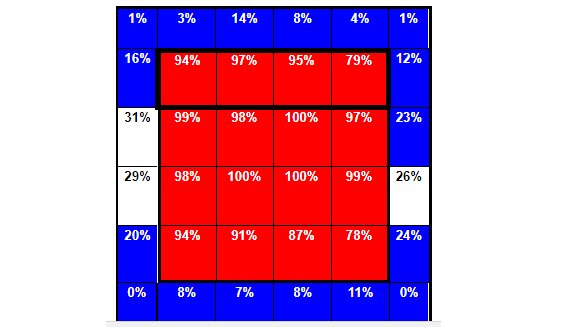
    This image shows the overall called strike rate for Red Sox pitchers by area within and outside the strike zone when Leon catches. Pay special attention to the second row in red, which covers the top of the strike zone. Leon is considerably better than MLB average at getting that pitch.

    Sandy León Called Strike % by location (Pitcher’s View)

    And here is the MLB average by location, with the same area highlighted.


    When looking at left and right-handed hitters individually, we also noticed that León gets his pitchers calls on pitches out of the strike zone, especially off the outside corner with a left-handed hitter up.

    As for the running game, León doesn’t completely stifle it. He has snuffed out only 24 percent of theft attempts this year. But his one run saved through base stealing indicates he is somewhat of a deterrent behind the plate. While Leon’s throwing isn’t going to star in highlight reels, he is pretty accurate with his throws.

    He rarely misses to the left-hand side of second base.It is far better for a catcher to miss on the right-hand side of the bag, where the fielder at least has a chance to make a tag.

    Ultimately, a fair assessment of León may be that while he is not amazing at anything, he is at the very least serviceable at everything, and good to very good at many things.

    After all, there has to be something to be said for being the personal catcher of one of the most dominant pitchers in baseball, Chris Sale.

    Tony La Russa once said of Yadier Molina; “I don’t care if he bats .000, I’m still running him out there because of his defense.”

    The Red Sox have no hesitance to do the same with Leon.

  • Stat of the Week: The Diamondbacks’ Amazing Defense

    BY MARK SIMON

    Though we shone a spotlight on the Milwaukee Brewers’ defense last week, we neglected to mention a team that was just a notch behind them.

    That team has since surpassed the Brewers statistically and currently has no equals on the defensive front—the Arizona Diamondbacks.

    The Diamondbacks have 108 Defensive Runs Saved this season. If that total holds, it will be the most since Sports Info Solutions began compiling the stat in 2003. The mark of 107 was set by the Cubs when they won the World Series in 2016.

    What makes them great?

    The Diamondbacks do so well defensively because they are good just about everywhere and great in more areas than any other team.

    Arizona’s fielders have saved at least three runs at every defensive position except one, third base, where they’ve cost themselves one run. The Diamondbacks have saved at least 10 runs at five positions: pitcher, catcher, shortstop, center field and right field. They are MLB’s leader in Defensive Runs Saved at pitcher, catcher and right field.

    What’s impressive is the group effort that is responsible for the lead at those three spots. The Diamondbacks have three starting pitchers who rate near the top in pitcher defense: Patrick Corbin (5 DRS), Zack Greinke (4) and Zack Godley (4). Corbin’s numbers come from his ability handling the area around the mound (especially on the third base side). Greinke and Godley have also played a role in limiting the running game, with five stolen bases allowed in only 13 attempts against them.

    Their three catchers—Jeff Mathis, John Ryan Murphy and Alex Avila—split playing time almost evenly. Mathis, one of the top pitch blockers and pitch framers in the game, is tied for the lead among all catchers with nine Defensive Runs Saved, with Murphy and Avila saving four each and also contributing largely in pitch framing.

    In right field, the combination of Jon Jay and Chris Owings has paired to save 11 runs (both got time there waiting for Steven Souza Jr. to return from injury). Owings has proven to be quite versatile, saving five runs in both center and right field.

    The team’s individual leader in Defensive Runs Saved is shortstop Nick Ahmed with 14. Ahmed has flirted with the lead among shortstops in that stat, and is currently tied with Addison Russell for the NL’s top spot, two runs behind overall leader Andrelton Simmons.

    Ahmed stands out because of outstanding arm strength and accuracy. His 98.4 percent good throw rating is the best among shortstops this season.

    Veteran outfielder Jarrod Dyson ranks second on the team with 10 Defensive Runs Saved, eight of which came in center field, where he filled in for A.J. Pollock during Pollock’s stint on the disabled list. Dyson’s laurels include a pair of home run-robbing catches.

    The shift

    Under second-year manager Torey Lovullo, the Diamondbacks have more than doubled their shift usage this season. They now rank 11th in MLB in shift usage. The payoff has been great. The Diamondbacks lead the majors with 28 Shift Runs Saved.

    They’ve held opposing batters to a .182 batting average on groundballs and short line drives when using a full shift (three players on the pull side) and a .199 batting average on those batted balls when using a partial shift (two defenders deviating significantly from normal positioning). Those are 36 points and 79 points below MLB average respectively, with the latter representing an MLB best.

    In other words, the Diamondbacks have done a good job at moving Ahmed and second baseman Ketel Marte around in partial-shift scenarios to cut off hitting lanes, playing them close to second base, but not on the pull side.

    Between good work in shifts, good work in the outfield, good work on the mound and good work behind the plate, the Diamondbacks seem to have solidified a position as a complete defensive team, in addition to being the best.

  • Who was July’s best defensive player?

    ​By MARK SIMON

    The Brewers are dominating defensively and their outfielders are dominating our Defensive Player of the Month award.

    We’re picking a Brewers outfielder again, giving Keon Broxton top honors for July. Among those Broxton edged out was his teammate, Lorenzo Cain, who won the award in May. Broxton’s offense did not match his defense though and he was sent to Triple-A on July 28 after hitting .146 in July. But that’s of no consequence for this award.

    Broxton finished July with seven Defensive Runs Saved, much of which was amassed during an amazing defensive display in the first week of July. That was highlighted by home run robberies of Joe Mauer and Brian Dozier in a series against the Twins.

    Broxton now has five home run robberies in the last three seasons, tied with Mookie Betts for the second most in that span. Justin Upton ranks first with six.

    Speaking of home run robberies, Cain had one on the final day of July. He’s saved 19 runs, the most by any center fielder in the majors. Amazingly, despite playing only 104 innings at the position this season, Broxton has saved 10 runs, which is tied for second.

    2018 Defensive Player of the Month
    Month
    April Matt Chapman
    May Lorenzo Cain
    June Trea Turner & Alex Gordon
    July Keon Broxton

    Brewers on verge of breaking a record

    Broxton and Cain have put the Brewers in position to shatter the mark for most Defensive Runs Saved in a season. The Brewers have 105, two shy of the 2016 Cubs, who saved 107 on the way to winning the World Series (Defensive Runs Saved has been tracked since 2003).

    What makes the Brewers so good?

    It starts with the outfield. With Cain and Broxton patrolling center, the Brewers have recorded 30 Defensive Runs Saved at that position, the most for any team at any position this season.

    They’ve also saved 14 in right field, with Domingo Santana, Eric Thames, Christian Yelich and Hernan Perez each saving at least two runs.

    In all, the Brewers turn 68 percent of balls hit in the air (that stayed in the ballpark) into outs, the highest rate in the majors. They are tied for the major league lead with four home run robberies. They also have five Defensive Runs Saved from the value of their outfielders’ arms, tied for the fifth-highest total among teams.

    Every infield position rates positively, with the left side rating particularly strong. Orlando Arcia has saved eight runs at shortstop, and Travis Shaw did likewise at third base prior to the trade for Mike Moustakas. Jonathan Villar had six DRS at second base before being traded to the Orioles in the deal for Jonathan Schoop. Jesus Aguilar has saved four runs at first base.

    The big boost on the infield comes from the impact of defensive shifting. The Brewers, who rank in the top 10 in shift frequency, have 19 Shift Runs Saved, sixth most in the majors.

    The Brewers pitchers and catchers have also chipped in, combining to save 11 runs. Seven of those come from currently injured pitchers Zach Davies and Brent Suter.

    But whether the Brewers will best be remembered as a great defensive team or a great team will likely come down to their October performance, where they’ll try to match the excellence of the 2016 Cubs in that regard too.

  • Who is baseball’s best backup catcher?

    By EZRA RAWDON

    Having spent most of my career as a backup catcher at the scholastic and collegiate level, I have developed into a fan of MLB backup catchers. In an attempt to satisfy my curiosity on who might be the most valuable in baseball at the moment, I decided to dig in using some of the interesting and illuminating data at Sports Info Solutions.

    The question of how to properly evaluate a backup catcher presents  a challenge. Backup catchers generally provide most of their value on the defensive side of the ball. There are few if any backups who can hit well enough to offset poor defense, especially in a role where defense is valued heavily. One could reasonably say that the ideal catcher would be a strong defensive presence, while also providing some offensive value.

    To find the best backup backstop in the league this season, I first had to determine who qualified as a backup catcher. I looked at all catchers who have appeared this season, and eliminated each team’s leader in games as a catcher, with a few exceptions for career backups having moved into starting roles due to injury. I also eliminated players with less than 10 games at catcher.

    I then decided to evaluate each backup by averaging their ranking among fellow backups across certain statistics I deemed to be representative of a productive and valuable backup catcher.

    I then ranked them among fellow backups by Defensive Runs Saved Per 100 Innings; and Runs Created.

    Defensive Runs Saved tells us how many runs a catcher cost or saved his team, and the per/100 innings rate helps to correct for the different amounts of playing time.

    Runs Created is simply how many runs that catcher has produced on offense this season. It combines the ability to get on base with the ability to hit for power.

    I felt these metrics (basically our Total Runs formula without the positional adjustment) would provide a good picture of the qualities possessed by a productive and valuable catcher, and in turn a desirable backup catcher.

    From that, the top three catchers were Austin Romine, Kurt Suzuki and Luke Maile.

    We’re going to give Romine the nod on two grounds. One is that he’s better on a per-inning basis than Suzuki. The other is that we feel defense should be prioritized for backup catchers and Romine is at his best in that aspect of the game. His seven defensive runs saved rank tied for third among all catchers.

    As we tweeted on Tuesday, Romine rates as the best pitch blocker in baseball. He’s successfully blocked 98 percent of potential wild pitches and passed balls, a rate well higher than the Yankees usual starting catcher, Gary Sanchez (88 percent). He also rates above average in getting extra strikes for his pitchers with the way he frames pitches (2 Strike Zone Runs Saved).

    Suzuki and Romine are comparable hitters, but Suzuki has cost nearly as many as Romine has saved (-6). Maile is on the positive side of things, with 4 Defensive Runs Saved, performing exceptionally well in pitch framing with 5 Strike Zone Runs Saved. He’s just not the hitter that Romine and Suzuki are.

    With Sanchez on the disabled list again with a groin injury, Romine will have his moment in the spotlight to show just how good of a backup he is.

    Top Backup Catchers
    BA OBP Slug Pct DRS
     Austin Romine  .261  .318  .470  7
     Kurt Suzuki  .264  .333  .433  -6
     Luke Maile  .245  .327  .367  4
  • Which players have been most affected by good and bad defensive plays?

    BY DON BROCKUS
    So far in 2018, 1.4 percent of plate appearances have included a Good Fielding Play (GFP) that robbed a base hit and 1.2 percent of plate appearances have included a Defensive Misplay (DM) that directly led to a base hit. In this article, we will identify the players whose hit totals have been most affected by these GFPs and DMs.

    Good Fielding Plays
    Here is a table of the players with the most hits robbed by GFPs this year.

     
    Player PAs GFPs % of PAs
     Jean Segura  379  13  3.4%
     Jon Jay  397  13  3.3%
     Chad Pinder  196  11  5.6%
     Nick Markakis  402  11  2.7%
     Starlin Castro  402  11  2.7%
     Trea Turner  412  11  2.7%
     Xander Bogaerts  326  11  3.4%

    Jean Segura and Jon Jay lead all players with 13 hits robbed by GFPs this year (3.4 percent and 3.3 percent of plate appearances, respectively), with most of these outs recorded on ground balls for both players. More specifically, Segura has had GFPs against him on seven ground balls, three line drives, and three fly balls, while Jay has had GFPs against him on 11 ground balls and two line drives.

    In this link, Segura is robbed of a base hit when Johnny Field runs to his left and makes a diving catch.

    Defensive Misplays
    On the opposite end of the spectrum, here is a table of the players with the most hits added this year due to DMs.

     
    Player PAs DMs % of PAs
    Ender Inciarte 395 15 3.8%
    Gorkys Hernandez 266 11 4.1%
    Albert Almora Jr. 292 11 3.8%
    Jose Altuve 415 10 2.4%
    Michael Brantley 351 10 2.8%
    Andrelton Simmons 334 10 3.0%
    Ian Desmond 350 10 2.9%

    Ender Inciarte leads all players with 15 hits added by DMs this year (3.8 percent of plate appearances), with hits added due to ground balls going through infielders, poor reads by outfielders, and fielders simply dropping the baseball. Note that errors are not included here since reaching base on an error does not count as a hit.

    As shown in this link, Inciarte hits a double when Brian Anderson gets turned around on a catchable fly ball.

    Combined GFPs and DMs
    To identify the players most affected by these plays, I calculated the difference between the GFP total and the DM total for each player, respectively. In the table below, a positive difference means the player should have more hits if not for exceptional defensive plays, while a negative difference means the player should have fewer hits if not for poor defensive plays.

     
    Player GFPs DMs Difference Absolute
    DIfference
    Chad Pinder 11 1 10  10
    Evan Longoria 10 0 10  10
    Mike Trout 0 8 -8  8
    C.J. Cron 10 2 8  8
    Miguel Rojas 10 2 8  8
    Lewis Brinson 9 1 8  8
    Eric Hosmer 8 0 8  8
    Ender Inciarte 8 15 -7  7
    Albert Almora Jr. 4 11 -7  7
    Eddie Rosario 2 9 -7  7
    Jon Jay 13 6 7  7

    Chad Pinder and Evan Longoria lead all players with a plus-10 hit differential, which means both players should have 10 more hits if not for good defensive plays. Mike Trout leads all players in the other direction with a -8 hit differential, which means he should have eight fewer hits if not for bad defensive plays.

    The average differential across all players is +0.5 hits (2.5 GFPs vs 2.0 DMs), so Pinder and Longoria have probably been a little unlucky, while Trout has probably been a little lucky.