Category: Baseball

  • NPB スカウティングレポート:佐々木朗希

    NPB スカウティングレポート:佐々木朗希

    Translation by Yuri Karasawa and @takumabbetc

    世界トップクラスのピッチャーの一人が、なるべく早くMLBでプレーすることを希望している。現時点で彼はどのようなピッチャーなのだろうか。弊誌のライター、ブランドン・テューは、すべての登板を観察し、評価を行った。

    佐々木朗希は、理想的な球種と優れたコントロールを兼ね備えた、世界で最高の投手の一人だ。彼は競争力の高い日本プロ野球において三年連続で圧倒的な投球を見せている。今オフ山本由伸がロサンゼルス・ドジャースと契約した後、佐々木はNPBで最高の投手と言えるだろう。

    佐々木はMLBでプレーする意志をロッテ球団に知らせているが、今のところ、彼は日本で少なくとも2024年シーズン、打者たちを苦しめ続けることになる。佐々木の最大のハードルは、シーズン全体を通じて健康を維持し、ローテーションを守ることだ。昨年佐々木は、7月下旬に左斜筋の怪我で2か月間欠場し、9-10月の先発登板はわずか3度だった。過去2シーズンの佐々木の先発を全て観た私の評価は以下の通りである。

    Season IP ERA Strikeouts Walks K-BB%
    2022 129 1/3 2.02 173 23 30.6%
    2023 91 1.78 135 17 34.2%

    佐々木の卓越した速球とフォークにより、 100マイル (160キロ) を超えるストレートから鋭く落ちるフォークボールを使い、2つの球種で相手を圧倒する投手だ。佐々木は2023年に質の高いスライダーを加えたが、半分以上はストレートに頼り続けた。

    佐々木のストレートのコントロールと、ストライクゾーンの下にフォークを投げる安定性により、打者から多くの空振りを奪うことができる。 昨シーズンの彼のフォークの空振り率51.5%は、日本だけでなく、世界の全投手が投げるあらゆる球の中でも最高の球種の一つだと言える。

    メカニクス

    via GIPHY

    佐々木は、常にセットポジションから投げ、細い体から爆発的な運動能力を発揮する。 右腕の彼はピッチャープレートの三塁側から前足を拾い上げ、膝を肩の高さ近くまで上げ、その背丈は188cmを誇る。

    足を前に出して膝を軽く曲げ、空に向かってつま先を上げる。彼は足と膝を胸へと引き戻すことで、マウンドから降りる際に勢いを生み出す。この最初の前進動作中、彼は腰をとぐろを巻いて逆回転させている。足をセンターに向けて、前腰で体重を落として後ろ足を曲げるような動きをする。これは「ドロップアンドドライブ」と呼ばれる。

    足が地面に着くとき、腕は必ずしも 90 度になるわけではないが、胸を三塁側に向け、腰を打者の方に向けることで、腰から肩までの距離は理想的である。彼のシーケンスは非常に理に適っていて、エネルギーがうまく流れるようになっている。車のアクセルを踏むかのような脚の動きにより、エネルギーを腕に伝えることができる。スムーズかつリズミカルな投球フォームにより、身体がアスリートのように流れ、スリークォーターのスロットから引き裂くような球が放出される。マウンドから降りるまで体が開かない。

    球種別

    ストレート 50.3%、 99 マイル (159.3 キロ)

    佐々木の速球は彼の2つの傑出した球種のうちの1つである。 彼のフォーシームは、昨シーズン規定投球回数をクリアしたMLBの先発投手の中では、平均時速99.1マイルを記録したボビー・ミラーに次いで2位だ。 佐々木のストレートも最高時速162.5マイルを記録した。 彼は昨年3月のWBCで、世界の舞台でその豪快なストレートを披露した。

    球速だけでなく、縦と横の変化も相まって、打者にとっては大きな凶器となる。 彼の速球には19 インチを超える Induced Vertical Break (速球の垂直変化量) と 15 インチの arm side run (投げ手側への横の変化) がある。彼はゾーンの上部に速球を投げ込むことで、理想的な一球を生み出すことができる。

    佐々木は通常、ストライクゾーンの上部3分の1に向かってストレートを投げ、打者はボールの下を振ってしまう。彼がゾーン下部に投げる時、速球の横変化が打者のソフトコンタクトを生み、ゴロを打たせることができる 。彼がアームサイド(投手の投げ腕側、右投手の場合右側)の低めに制球できれば、右打者は詰まらされ、左打者にとってはボールが外角に逃げていく。

    昨シーズンのストレートの空振り率は24%、ゴロ率は56%だった。打者は、ヒットを打てる唯一のチャンスと見て、ストレートに山を張って待つだろう 。 それでも、佐々木は昨シーズン、本塁打を1本しか許しておらず、彼のストレートは被打率.222、被OPS.592を記録した。

    佐々木は通常、ストレートを打者から遠ざけようとし、たとえシュート回転があるとしても、グラブ側(右投手から見て自身のグラブがある左側)に一貫して投げ続ける。 より優れた左打者に対しては、打者の腕の下、つまり内角を狙うこともある。 彼はゾーンから数インチ離れた位置で投球を開始し、ゾーンの隅に戻そうとする。

    佐々木に必要なのは、それなりのコントロールのみだ。。彼はゾーンの隅にストレートを完璧に配置する能力はある。 しかし、試合のほとんどで、彼はゾーン内で打者に挑戦し、ベース上を垂直または水平に二分割するように投げ分ける。速球の球速と変化は信じられないほどで、とにかくストライクを多く投げ込むだけで抑えることができる。彼の捕手は、捕手は、彼にただストライクゾーンに投げさようと、ストライクゾーンのど真ん中に構えることもあった。

    フォーク 33.9%、89.7 マイル (144.3 キロ)
    佐々木のフォークは彼の最高の球種であり、世界最高のスプリットかもしれない。千賀滉大選手のゴーストフォークに匹敵し、打者が空振りしたり追いかけたりする確率は驚異的に高い。佐々木選手のフォークの 2023 年の空振り率は 51.5% だった。比較すると、2022 年の NPB シーズンの千賀選手のフォークボールの空振り率は 52.3% であった。
    佐々木のフォークは、ストレートと同じ角度で打者へ向かい、最後の瞬間で地面に向かって急降下する。彼のスプリットが生み出すトンネル効果により、特に低めのストレートとの見分けが非常に困難だ。メキシコ代表のランディ・アロサレーナ選手は、WBC で佐々木選手と対戦したときにこれを経験した。

    佐々木は主にゾーン低めにフォークを集めるが、時折左打者に対して見逃しストライクを狙って高めに投げたり、ボールが抜けてしまってゾーン甘めに入ってしまうこともある。変化の仕方は不安定ながらも、佐々木はスプリットに対して一貫した感覚を持っているようだ。

    ある程度意図的に行っていると思われるのは、右打者に対してはグラブサイドにカット気味に変化させ、左打者に対してはシュート気味に逃げてるように変化させるということだ。 彼はこれを頻繁に行っているため、スプリットの投球の際に指先で加える圧力を調整していると思われるが、意図的に行っているという確証は得られていない。彼がこの特定の球種で見せる投球術は、彼を野球界で唯一無二の怪物にしており、その投球に対する一貫性も同様に印象的である。

    Pitching Ninja によるこのビデオでは、佐々木がフォークで生み出すカットの動きと、右打者としてその球捉えるのがいかに難しいかを見ることができる。

    ゴロ率70.5%、被OPS.272という驚異的な数字と、被打率.101を誇る投球は特別な武器だ。

    スライダー 14%、87.5 マイル (137.9 キロ)

    佐々木が頼もしい3球目として取り組んでいる球種はスライダーだ。 2022年にはカーブとスライダーをそれぞれ5パーセント程度使用していたが、昨シーズンはスライダーの使用率を14パーセントに増やし、カーブを廃止した。

    彼は主にスライダーでゾーンの底、グラブ側をターゲットにし、主に右打者にそれを使用して投球構成を多様化した。スライダーの制球が定まらなかったこともあったが 、それは秘密兵器として試合を通して定期的に登場するピッチとなった。

    Sequence to LHH (Slider backdoor, Fastball in, Splitter Down):

    via GIPHY

    彼のスライダーはより大きな可能性を秘めている。2023年の空振り率は47%で、横変化と球速を兼ね備えた素晴らしいオフスピードピッチになる可能性がある。彼に必要なのは、スライダーに対して自信を持ち続けることだ。 最初の 2 球が非常に優れているため、現状から使用頻度をそれほど増やす必要はない。

    佐々木も球速80マイルのカーブボールを持っていることは注目に値するが、昨シーズン彼が投げたのはわずか2回だった。 以前はカウントの早い段階で時折サプライズ投球として投げていたが、それはほぼ廃止された。

    今シーズンに期待できること

    佐々木朗希の他を圧倒するような投球はおそらく2024年も続くだろう。健康を維持してマウンド上にいること以外、彼には何の欠点もない。 彼が健康であれば、NPB で彼より優れた投手は誰もおらず、22 歳の天才は、おそらく今年最も楽しみな投手となるだろう。 日本での彼の将来とMLBへの移籍の可能性については、今は待たなければならないが、彼の投球はいつ見ても感動を与えてくれる。

  • NPB Scouting Report: Rōki Sasaki

    NPB Scouting Report: Rōki Sasaki

    Rōki Sasaki is one of the best pitching talents on the planet with a combo of nasty stuff and good command. He has obliterated his competition in Japan for three seasons now. He firmly holds the title of the best pitcher in NPB after Yoshinobu Yamamoto signed this offseason with the Los Angeles Dodgers.

    Season IP ERA Strikeouts Walks K-BB%
    2022 129 1/3 2.02 173 23 30.6%
    2023 91 1.78 135 17 34.2%

    Sasaki has made his MLB aspirations known to the Lotte Marines, but for now, he will continue to torment hitters for at least one more season in Japan. Sasaki’s biggest hurdle is staying healthy throughout an entire season and continuing his stellar production. Sasaki most recently missed two months with a left oblique injury in late July before pitching sparingly with 3 more starts in September and October.

    I’ve watched all of Sasaki’s starts the last 2 seasons and from that I’ve made the following evaluation:

    What makes him so special?

    Sasaki’s exceptional fastball and splitter allow him to be a dominant two-pitch pitcher using his devastating splitter off of his triple-digit fastball. Sasaki added in a good slider during 2023 but continued to lean on his fastball over half the time.

    His command of the fastball and consistency in throwing his splitter below the zone have batters guessing and whiffing a bunch. With a 51.5% whiff rate on his splitter last season it’s one of the best pitches in Japan, if not all of baseball.

    Mechanics

    via GIPHY

    Sasaki shows explosive athleticism out of a wiry frame on the mound while throwing exclusively out of the stretch. Working from the third base side of the rubber as a right-hander he picks up his front leg and brings it high into the air with his knee finishing close to shoulder height for his 6’2” frame. 

    With his leg and foot out in front of him and a slight knee bend, he points his toes to the sky. He creates momentum down the mound with his leg and knee returning to his chest. He’s coiling and counter-rotating his hips during this initial move forward. With his foot turned towards center field, he leads with his front hip in a drop-and-drive delivery sinking into his back leg. He stays closed throughout this move down the mound.

    At foot strike his arm doesn’t always get to 90 degrees, but the hip-to-shoulder separation he creates with his chest facing third base and his hip towards the plate is good. He sequences extremely well, letting the energy flow. A firm lead leg block, allows him to transfer energy to his arm. Throwing with a smooth and rhythmic delivery, he’s letting his body flow athletically to rip the baseball from a 3/4 arm slot.

    The Arsenal (2023 usage and Average Velocity)

    Fastball   50.3%, 99 mph

    Sasaki’s fastball is one of two unicorn-type pitches for him. The average velocity is hard to match, as his four-seamer would have put him second among qualified starters in MLB last season behind only Bobby Miller who averaged 99.1 mph on his four-seamer last season. Sasaki’s fastball has also touched 102.5 mph. He showcased his electric fastball on the world stage during the World Baseball Classic last March.

    To go along with the velocity is a deadly combo of vertical movement and horizontal run. The pitch has over 19 inches of IVB (induced vertical break) and 15 inches of horizontal movement arm side. He can carry the ball through the top of the zone, creating an elite pitch. 

    Sasaki routinely throws his fastball toward the upper third of the zone, with hitters swinging underneath the pitch in all quadrants of the zone. When he does pitch down in the zone the run on the pitch creates weak-contact grounders as well. The pitch is jamming righties, or moving away from lefties as he spots it down and arm side. 

    The fastball garnered a 24% whiff rate last season and a 56% GB rate. Hitters would sit on the pitch as it was their only chance to pick up a hit. He surrendered only 1 home run with it all last season and his fastball had a .592 OPS against with a .222 batting average against.  

    Sasaki will usually try to keep his fastball away from hitters and, even with the run he gets, he locates the pitch glove-side on the outer part of the plate consistently to righties. Against better left-handed hitters he will also target the inside part of the plate underneath the hands. He starts the pitch a couple of inches off the plate and tries to bring it back to the edge.

    Sasaki just needs decent command of the pitch. When he wants to, he can dot a fastball on the corner. However, most of the game he challenges hitters in the zone and will split the plate in half vertically or horizontally. 

    The pitch has ridiculous velocity and movement, and he just needs to fill up the zone like a buffet plate. His catchers sometimes set up in the middle of the plate just to get him back into the zone.

    Splitter 33.9%, 89.7 mph

    Sasaki’s splitter is his best pitch and it might be the best splitter in the world. It rivals Kodai Senga’s ghost fork and racks up the whiffs and chases at an astronomical rate. Sasaki’s splitter had a 51.5% whiff rate in 2023. By comparison, Senga had a 52.3% whiff rate on his forkball in his 2022 NPB season.

    Sasaki’s splitter darts toward the ground at the last second, as it holds plane with his fastball. It creates a tunnel effect that is hard to decipher, especially down in the zone with his four-seam. Randy Arrozarena experienced this when Sasaki faced him in the WBC.


    Sasaki peppers the bottom of the zone with the pitch but also will leave it up versus left-handed batters occasionally trying to steal called strikes or just throwing a pitch that slips and catches too much of the zone. Sasaki still has a consistent feel of the pitch, even with its volatile nature in movement.

    In what I have decided is intentional to some extent, Sasaki will cut the splitter to his glove side away from right-handed batters, and pronate more to fade it away from lefties. He does this often enough to almost have a feel for his finger pressure on the pitch, though I can’t confirm this. The pitchability he displays with this specific pitch makes him a unique oddity in baseball and his consistency with it is just as impressive.

    This video from Pitching Ninja earlier shows the cut Sasaki can create on his splitter and how hard it is to barrel the pitch as a right-handed batter.

    With a 70.5% GB rate and an absurd .272 opponents’ OPS along with a .101 batting average against, the pitch is an unhittable menace.

    Slider 14%, 87.5 mph

    A pitch that Sasaki has been working on as a reliable third pitch is his slider. In 2022, he used his curveball and slider at around 5 percent each, but last season he upped his slider usage to 14 percent and scrapped his curveball. 

    He mainly targeted the bottom of the zone, glove side with his slider, and used it primarily to righties to keep them off of his splitter and fastball. He did have inconsistent command of the pitch at times but it became a pitch that he would routinely feature throughout a game as a wrinkle.

    Sequence to LHH (Slider backdoor, Fastball in, Splitter Down):

    via GIPHY

    The pitch has great projectability and when he snaps one off it can be a nasty breaker with sweep and velocity, with a 47% whiff rate in 2023. The next step for him is continued belief in the pitch. With how good his first two pitches are, he doesn’t need to up the usage that much more from where it currently sits in his repertoire.

    It’s worth mentioning that Sasaki has a curveball that sits at 80 mph but he threw the pitch only twice last season. He used to throw it more as a strike stealer early in counts but has all but scrapped it.

    What to Expect this season.

    Sasaki’s utter dominance should likely continue in 2024. There are no flaws in his game other than staying healthy and on the bump. When he’s pitching there’s nobody better than him in NPB and the 22-year-old phenom will likely be the most exciting pitcher to watch come this spring. As for his future in Japan and possible move to MLB, that will have to wait for now, but he’s sensational to watch every time he pitches.

  • Imagining Bobby Witt As The Best Player in MLB in 2024

    Imagining Bobby Witt As The Best Player in MLB in 2024

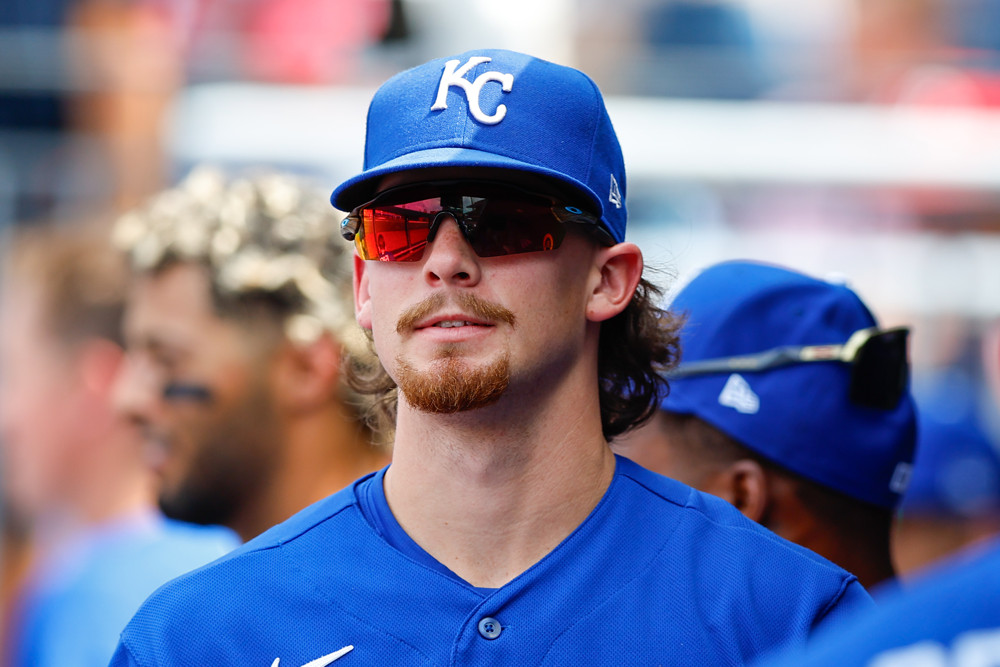
    Royals shortstop Bobby Witt Jr. finished with 4.4 bWAR last season. 

    I predict you’ll read that and not like it. Yes, we can get into a whole discussion over whether Baseball-Reference WAR is the “correct” WAR to use (FanGraphs has him at 5.7, Baseball Prospectus at 5.4). We’re not going to have that discussion here.

    Indulge me here and let’s work off the premise that 4.4 bWAR and his -6 Defensive Runs Saved was close to “correct” even though those other sources (and Royals fans) believe he was worth more in each of those stats.

    The best player in baseball in a season is usually worth between 8 to 10 bWAR.

    Given Witt’s improvement from 2022 to 2023, a similar improvement from 2023 to 2024 would be a big jump. It got me wondering: What would it look like for Witt to be the best player in baseball this season? 

    Or perhaps, we ask this: 

    How do you do better than 30 home runs and 49 steals playing a premium position at a high level every day?

    Fortunately there’s a recent shortstop season within that 8 to 10 WAR range that we can measure Witt against. That was Marcus Semien in 2019. 

    Semien played in all 162 games that season. Witt played in 158 in 2023.

    Let’s compare their production:

    BA OBP Slug OPS OPS+ DRS HR-SB bWAR
    Semien ‘19 .285 .369 .522 .891 139 7 33-10 8.5
    Witt Jr. ‘23 .276 .319 .495 .814 120 -6 30-49 4.4

    Even though Witt has a pretty big stolen base advantage, there are large gaps when comparing their offensive numbers. Semien reached base more often and hit for more power.

    For all of Witt’s excellence, he made a lot of outs as a hitter in 2023 (the 2nd-most in the AL).

    That kept his OBP and the number of runs he was able to create as a hitter down even with gaudy home run and stolen base numbers. And though he hit 30 home runs, his slugging percentage ranked 20th of the 29 players who hit that many.

    Dan Szymborski sent me his ZiPs projections for Witt in 2024. This is Witt’s 80th percentile projection. 

    .301 BA, .345 OBP, and .542 Slug Pct. 

    That’s an .887 OPS, which is almost even with Semien’s .891. That should move him a lot closer to being an 8-to-10 WAR player.

    So the next question is, how does Witt go from his hitting and defensive numbers to something that puts him in the caliber of the best players of the game?

    Note: For the sake of brevity, I’m going to work off the idea that Witt Jr.’s baserunning numbers (a small component of his WAR) are similar in 2024 to what they were in 2023

    Hitting

    To reach his 80th percentile ZIPs projection, Witt needs 18 more hits, 30 more total bases, and a similar walk level compared to 2023. 

    Our VP of Baseball, Bobby Scales, played 2 seasons in the majors and worked in player development for multiple major league teams.

    Scales said that the thing to watch with Witt is how he learns what pitches not to swing at.

    Fewer swings at pitches that cause Witt problems means more potential swings at pitches Witt could crush. 

    And as Scales pointed out, every indication was that Witt was doing that last season, his second season in MLB. 

    Witt’s chase rate was down by more than 3 percentage points from his rookie numbers. His rates of hitting the ball hard went up almost 7 percentage points and hitting the ball to the opposite field went up by more than 4 percentage points.

    In particular, Witt closed one hole in his swing in 2023. He became a better high-ball hitter (which went hand-in-hand with being better vs. fastballs). He was choosier against those pitches (a lower chase rate) and did more damage on what he could reach (his slugging percentage against those pitches went up 201 points and his OPS nearly 300 points as his home runs jumped from 2 in 2022 to 8 in 2023).

    Here are some examples (here, here, and here)

    Bobby Witt Jr. vs High Pitches*

    2022 2023
    BA .159 .237
    OPS .523 .821
    HR 2 8

    * SIS defines “high” as pitches that are in the upper-third of the strike zone or above it (also covering areas off the plate inside or outside that meet that height definition).

    Witt also seems aware that one of his key strengths is the ability to crush the inside pitch. He was choosier against those in 2023 too and his OPS against those pitches in his 2 MLB seasons has been at least 100 points above MLB average both years (.911 and .882).

    Here are some examples (here, here, and here)

    Bobby Witt Jr. vs Inside Pitches

    2022 2023
    BA .282 .294
    OPS .911 .882
    HR 12 14

    * SIS defines “inside” as pitches that are on the inner-third of the strike zone or further inside (also covering areas above and below the strike zone that meet that width definition)

    Still, there’s a gap between the elite hitters in MLB and what Witt is right now.

    The 2 areas in which Witt is weakest are pitches at the bottom of the zone and below it (low pitches) and pitches on the outer-third and further off the plate (outside pitches). 

    This chart shows those numbers with MLB averages in parentheses.

    Bobby Witt in 2023

    Vs Low Pitches Vs Outside Pitches
    BA .241 (.223) .232 (.221)
    OPS .649 (.652) .643 (.635)
    % Swings Missed 27% (33%) 30% (30%)
    Chase Rate 32% (32%) 26% (28%)

    * SIS defines “low” as pitches that are in the lower-third of the strike zone or further down, as well as areas off the plate inside or away that meet that height definition

    ** * SIS defines “outside” as pitches that are on the outer third of the strike zone or further outside(also covering areas above and below the strike zone that meet that width definition)

    Not coincidental, last season Witt’s numbers vs breaking pitches (particularly from righties) weren’t great either. 

    Here’s a few examples of Witt making outs on pitches that were down, away, or both (here, here, here, and here).

    Witt’s stats against these pitches are mostly close to MLB average (though it is good to see him with a relatively low rate of missed swings vs low pitches).

    And it stands to reason that pitchers will keep trying to get him out there, even as he’s gotten smarter about knowing what to hit and what to let go.

    So it will be interesting to see if Witt’s game becomes one in which he spits on those pitches more (or fouls them off to extend at-bats), and waits for the pitches he can muscle up (inside or over the middle of the plate) OR if Witt can adjust to hit those pitches better and do more damage against them, without losing what he can do against pitches in other areas.

    One other point: Witt’s expected stats, both via Baseball Savant and via our measures, were better than his actual year-end stats. So even if Witt just replicates his batted ball set from 2023, there’s a fair chance for better stats in 2024. So imagine what he’d be when you combine that and an improved batting eye.

    Defense

    Even though we may not have Witt as highly ranked as other defensive stat sources, we still have him as one of 2023s most-improved defenders. He went from -18 runs at shortstop in 2022 to -6 in 2023. He cut back on his mistakes (we call them Misplays & Errors) and he made more of what we call Good Fielding Plays (Web Gems and smart baseball plays, like keeping a ball on the infield to prevent baserunner advancement).

    Bobby Witt at Shortstop

    2022 2023
    Good Fielding Plays 17 29
    Defensive Misplays & Errors 37 35
    Innings Played at SS 826 1,280

    Let’s also look at Witt and Semien side-by-side defensively Remember that Semien finished with 7 Runs Saved in 2019. Witt totaled -6.

    To illustrate the gap, let’s focus on one aspect of their defensive play: How they fared on getting outs on balls hit to their left. It’s the biggest difference between the two of them.

    The numbers here are their plays made and opportunities (opportunities are any play with a >0 out probability), how successful they were (plays made divided by opportunities) and plays saved (our version of Outs Above Average).

    On Plays To Their Left

    Plays Made/Opportunities Success Rate Plays Saved
    Witt 2023 151/296 51% -7
    Semien 2019 157/225 70% +10

    You can see there’s a pretty big gap. Semien was very good at making these plays. Witt did not rate well (a few examples here, here, and here).

    Now, the point here is not that Witt needs to be better on balls to his left. It’s that – at least by our measures – Witt needs to improve somewhere. He was also -5 Plays Saved on balls hit to his right so that’s another area where he’s gotten better but rates below average.

    On the positive side, Witt was a +4 on balls that our system judged were hit at him, a bump from -4 in 2022.

    Again, there’s good news for Witt here. For one thing, he’s shown he can get better (we talked about this with him on the Sports Info Solutions Baseball Podcast last year). And he was our co-Defensive Player of the Month in July, a month in which he totaled 5 Runs Saved. He just needs to play at that level for an extended period of time, not just a month. 

    Why I wrote this

    The primary reason I wrote this piece was I was looking for a way to justify a world in which the Royals are a playoff contender. FanGraphs currently projects them for 76 wins, Baseball Prospectus for 71.

    Pushing Michael Wacha and Vinnie Pasquantino up a win in their projected WAR can only do so much. The Royals need a player to make the kind of jump that gives a team a jolt.

    The easiest knob to turn to accelerate the Royals to playoff-caliber status is one in which Witt goes from being the Royals best player in 2023 to baseball’s best player in 2024. That could change their win total by a decent amount.

    That’s asking a lot of someone so young who is trying to live up to a massive contract extension. But if the Royals are going to make the playoffs, they’re going to need something to be above and beyond expectations. Witt being the superduperstar we’ve written about here is that thing.

  • Stat of the Week: 2023’s Overperforming Pitchers

    Stat of the Week: 2023’s Overperforming Pitchers

    Photo: Steven King/Icon Sportswire

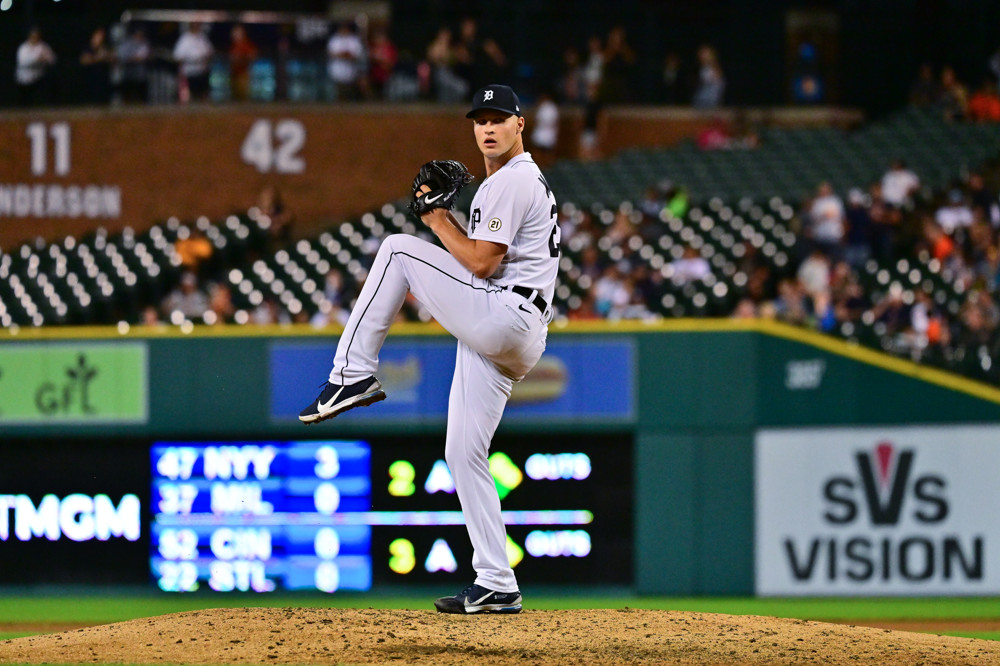
    Tigers pitchers Matt Manning and Tyler Holton were each pretty good in their own ways in 2023.

    Manning pitched to a 3.58 ERA in about a half-season’s worth of work as a starter. Holton got some of the best results of any reliever in MLB, with a 2.11 ERA in 85 1/3 innings, almost entirely out of the bullpen.

    The two of them had something in common. They each did this with strikeout rates that were a bit below MLB average, meaning they were relying on a combination of defense, sequencing (the order in which hits, walks, and outs came), and luck to keep their numbers down. Both pitchers outpitched their FIP by a considerable amount. Manning’s FIP was 4.81. Holton’s was 3.56.

    Additionally, Manning and Holton were the pitchers whose expected OPS was the most above their actual OPS among those pitchers who faced at least 300 batters in 2023.

    This is our 4th and final Stat of the Week in a series looking at overperforming and underperforming pitchers and hitters from 2023.

    A brief point of explanation:

    Sports Info Solutions tracks its own version of a player’s expected stats (like what you can find on Baseball Savant). Rather than basing a player’s hit probability (and subsequently single, double, triple, and home run probability) on a batted ball’s exit velocity and launch angle, SIS’ version estimates probabilities based on where balls are hit, how hard they are hit, and how long they spend in the air.

    This allows us to compare a player’s actual stats to his expected stats to see if they fared better or worse than perhaps they could have.

    Here’s the list of pitchers with the greatest differential between their expected OPS and their actual OPS. Think of them as a group whose actual 2023 numbers could have been worse under different circumstances.

    Greatest Differential – Expected Opponents’ OPS vs Opponents’ OPS

    2023 Season, Minimum 300 Batters Faced

    Pitcher Expected Opp OPS Opp OPS Differential
    Matt Manning .825 .649 .176
    Tyler Holton .639 .536 .103
    Tony Gonsolin .822 .722 .100
    Ty Blach 1.005 .918 .087
    Corbin Burnes .684 .598 .086
    José Berrios .776 .696 .080
    Reese Olson .729 .649 .080
    Shohei Ohtani .697 .618 .079

    Manning had a Top-20 fly ball rate last season (47%) and the Tigers caught 76% of all balls hit in the air against him, a rate that matched Justin Verlander as 5th-highest in MLB (minimum 100 balls hit in the air).

    Manning could thank the walls in Comerica Park being lowered prior to the season for this homer-robbing catch (click here to see it) and he had some good defense played behind him (this was a pretty good catch), but perhaps not overly so. The Tigers’ defense had 3 Runs Saved on batted balls behind Manning, leading us to surmise that perhaps it was factors other than fielding skill that kept Manning’s actual numbers so low.

    Holton is not a fly ball pitcher to the level that Manning is. He got 10 Runs Saved worth of support on batted balls, a total that ranked in the Top 20 among pitchers despite his not even having pitched 100 innings.

    The Tigers turned 84% of grounders and bunts into outs with Holton pitching, the 3rd-highest rate among pitchers who got at least 100 grounders ands bunts last season, and 11 percentage points better than MLB average.

    It’s not hard to find examples of the Tigers infield performing very well behind Holton (click here, here, here, and here for examples). And for good measure, the outfield was good behind him too. Here’s a home run saving catch by Riley Greene with Holton pitching.

    Manning and Holton were just above the batters faced qualifier we set. If we look a little further down the list of pitchers with the biggest difference between expected and actual OPS, you’ll notice some notable pitchers with higher innings totals.

    The most prominent of those is Corbin Burnes, who was recently traded by the Brewers to the Orioles. In Burnes’ case, defense likely played a significant role in the difference between his expected numbers and actual numbers. The Brewers defense saved 17 runs behind him on batted balls last season, the 2nd-highest total in MLB. José Berrios, who is also on our expected vs. actual leaderboard, got the most defensive support, 19 Runs Saved.

    Regarding Burnes, the Brewers were the 2nd-best defensive team by Runs Saved in 2023. The Orioles weren’t that far behind, ranking 8th in that stat and they return most of the team that put those numbers up (with No. 1 prospect Jackson Holliday probably in the mix).

    Our usual disclaimer: Results in 2023 don’t necessarily mean that those results will repeat themselves in 2024. But perhaps our data will reset your expectations for some of these pitchers heading into the coming season.

  • Stat of the Week: Hunter Greene Deserved Better in 2023

    Stat of the Week: Hunter Greene Deserved Better in 2023

    There was a lot of hype around Hunter Greene’s debut in 2022 and follow-up season in 2023. And Greene has had some spectacular starts the last 2 seasons, but these years have also been marked by injury and disappointment.

    Though Greene posted a 4.82 ERA in 112 innings last season, he pitched better than his final numbers indicated.

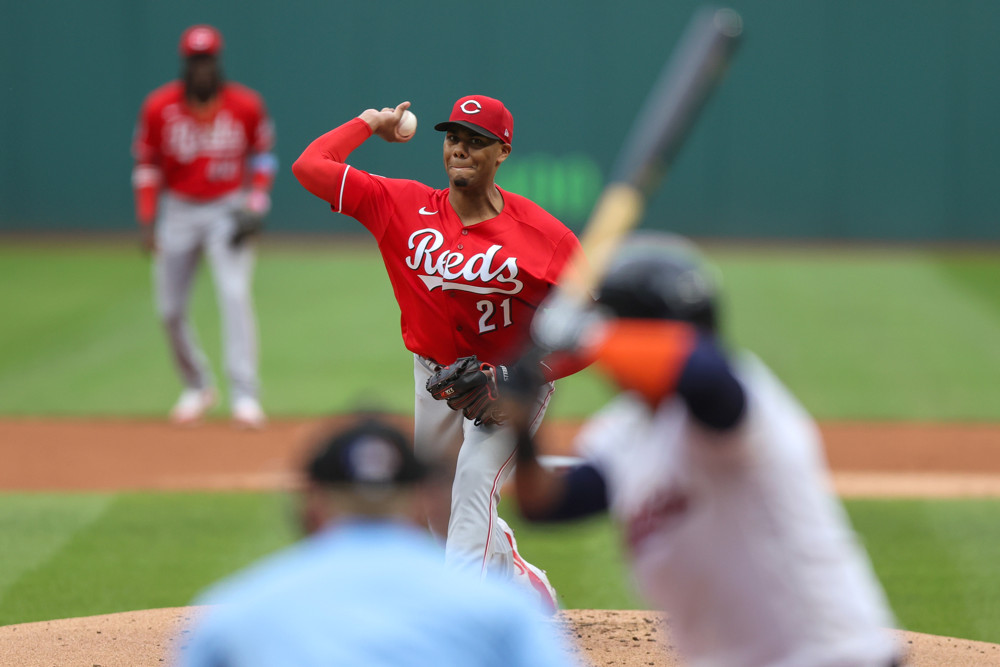
    Greene was the pitcher who underperformed relative to his expected stats the most of any pitcher that faced at least 300 batters in 2023.

    A brief point of explanation:

    Sports Info Solutions tracks its own version of a player’s expected stats (like what you can find on Baseball Savant). Rather than basing a player’s hit probability (and correspondingly single, double, triple, and home run probability) on a batted ball’s exit velocity and launch angle, SIS’ version estimates probabilities based on where balls are hit, how hard they are hit, and how long they spend in the air.

    This allows us to compare a player’s actual stats to his expected stats.

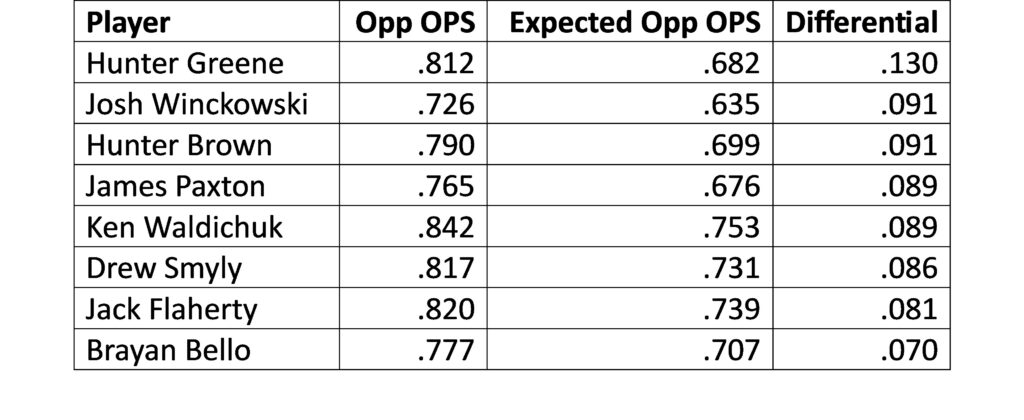
    Here’s the list of pitchers with the greatest differential between their expected opponents’ OPS and their actual opponents’ OPS.

    Greatest Differential – Expected OPS and Actual OPS

    2023 Season, Minimum 300 Batters Faced

    Here is Greene’s actual line compared to his expected line.

    Greene ranked right among the worst 20% of pitchers in opponents’ OPS but ranked right around the best 20% of pitchers in expected opponents’ OPS.

    I watched the 40 hits that Greene allowed with the lowest hit probabilities. Within that I saw a combination of some bad breaks and some defense that— had it been just a little bit better— would have made a difference in Greene’s numbers.

    For example with regards to bad breaks, if this ball is hit slightly to the left, it’s an inning-ending out instead of a 2-run single. Or if this ball is hit a little to the left, Will Benson makes the catch instead of just missing it, literally saving another run from his pitching line.

    Another instance of bad breaks, though this of a different kind: In Greene’s first game back from injury on August 20, he allowed 9 runs and 5 home runs in 3 innings against the Blue Jays. Yes, that’s a bad start. But 2 of the 5 home runs barely cleared the fence and were sub-25% home run probability balls by our measures (one would have been a homer in 5 parks, another 13, per Statcast).

    As for defense, Greene had the 3rd-worst Defensive Runs Saved support on batted balls of any pitcher in MLB last season. The Reds had -11 Runs Saved on the batted balls against him.

    There’s this fly ball to center field that seemed to be lost in the lights, a ball whose spin off the bat fooled shortstop Elly De La Cruz, and a ball that Greene himself just missed on which second baseman Jonathan India could not make the play quickly enough.

    The usual disclaimer applies: Just because Greene didn’t get good breaks or good defense doesn’t mean that he will in 2024. But the knowledge that he was on the right track in 2023, even if the results weren’t there, should be reassuring to him, Reds management, and their fans heading into the upcoming season.

  • Miguel Rojas is the Best Defensive Shortstop in Baseball

    Miguel Rojas is the Best Defensive Shortstop in Baseball

    Photo: Joe Robbins/Icon Sportswire

    The most remarkable defensive player in the game is an old man playing a kid’s position. An ageless wonder, you might say. He might rank last or next-to-last among his team’s position players in offensive production and he’s not even currently projected as his team’s regular starter.

    The Dodgers have a lot of luxuries on their roster, but the one that’s the most under-the-radar is the best defensive shortstop in baseball, Miguel Rojas. 

    The Numbers

    “Best defensive shortstop in baseball” is not a term we throw around lightly. We come with evidence. Rojas is either a leader or co-leader in Defensive Runs Saved at shortstop if we measure the last 2, 3, or 4 seasons. 

    Here are the shortstop leaders in Defensive Runs Saved over the last 3 seasons.

    Player Runs Saved Innings
    Miguel Rojas 32 3,140
    Jeremy Peña 23 2,493
    Taylor Walls 23 1,358
    Wander Franco 22 2,095
    Ha-Seong Kim 22 1,505
    Carlos Correa 21 3,562
    Isiah Kiner-Falefa 21 2,553
    Dansby Swanson 20 4,084

    Rojas ranked 5th in Runs Saved last season as a 34-year-old. The 4 shortstops ahead of him were a 29-year-old (Dansby Swanson) and three 22-year-olds (Wander Franco, Ezequiel Tovar, and Anthony Volpe). The shortstop who ranked right behind Rojas was Gunnar Henderson, who turned 22 midseason (and seems destined for third base with Jackson Holliday on the way). 

    The defensive aging curve is not kind to most players, but Rojas has defied it. He is the only shortstop who had at least 10 Runs Saved in both 2022 and 2023. He was plugged into the shortstop spot after Gavin Lux got hurt and though he didn’t hit, his glove kept him on the field as a regular.

    Could we have picked someone else as baseball’s best defensive shortstop? 

    Sure. 

    This is the part of the story where Cubs and Braves fans tell me “Dansby Swanson would like a word.” Swanson’s terrific and was a unanimous selection for a Fielding Bible Award last year. Rojas almost matched him on a Runs Saved per-inning basis in 2023 and bettered him when we took a longer view of multiple years. 

    Jeremy Peña is very good but is just a little bit behind Rojas in Runs Saved Per Inning. Ha-Seong Kim might’ve been the pick had he not moved to second base. Wander Franco doesn’t look like he’ll be playing in MLB anymore given the criminal charges he faces. One of his potential replacements on the Rays, Taylor Walls, just had hip surgery and we don’t know what he’s going to be when he returns. Anthony Volpe won an AL Gold Glove last year as a rookie. Ezequiel Tovar played well enough to win one in 2023 but lost out to Swanson. Maybe we’re talking about them as the best in MLB next year. Jorge Mateo was excellent two years ago, a little less so in 2023, so he’s a ‘not quite.’

    And the Defensive Runs Saved numbers just don’t back it up over the last 3 years for Carlos Correa, Javier Báez, Francisco Lindor, and Bobby Witt Jr. (yes, I know, Statcast rated Witt highly in 2023 … but it didn’t in 2022). 

    What I see when I watch Rojas

    I wanted to give Rojas a comprehensive lookover not just statistically, but with video. So, I watched 150 plays from the 2023 season.

    They included

    – Every batted ball that either added or subtracted at least 0.25 runs from his Runs Saved

    – Every Good Fielding Play or Defensive Misplay & Error that wasn’t among the previous set of plays

    – A group of randomly selected plays to get me to 150

    What did I see from watching all that video? (Click the links to watch the plays)

    * He goes to his left and right well whether with shuffle-steps or other means. The various broadcasters I heard praised his quick hands and smooth hands. His reactions are quick and his anticipation gives him the head start he needs to reach balls. I saw a good number of balls hit to the first base side of shortstop that he handled easily. As our VP of Baseball, Bobby Scales noted, his movements are still fluid.

    Without concern for the numbers, I thought that Rojas looked better at going to his left than going to his right but the numbers provided context to add to that assessment. He ranked No. 1 among shortstops at converting batted balls to his left into outs in 2023, doing so 62% of the time. 

    But he also ranked 2nd among shortstops in getting outs on balls hit to his right (68%) and that was worth more when it came to his end-year Runs Saved. 

    Out Conversion Rate Runs Saved
    Balls Hit To His Right 68% (2nd) 8
    Balls Hit To His Left 62% (1st) 3

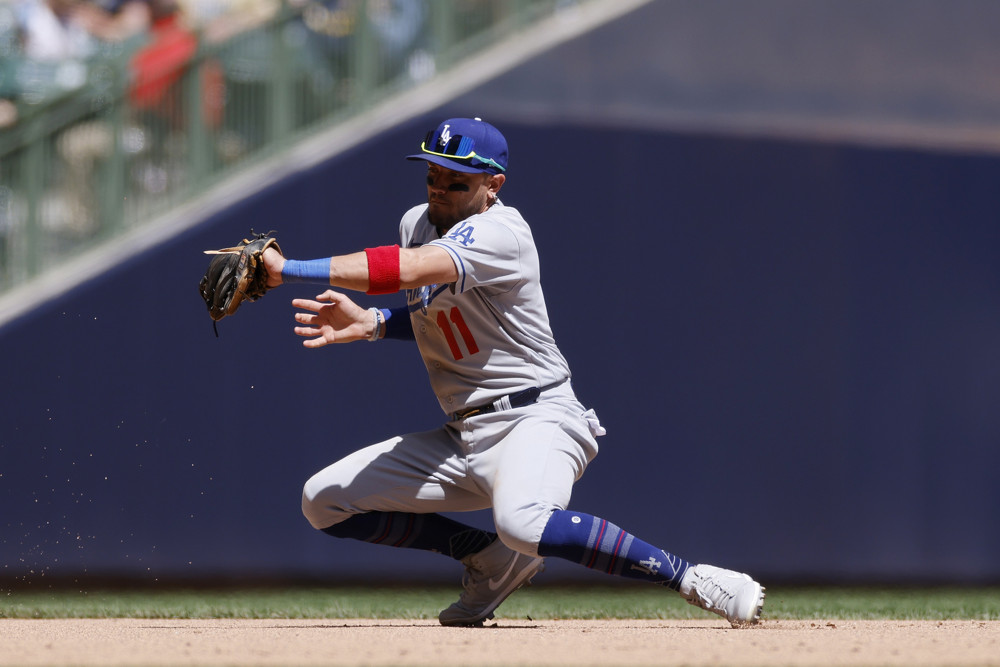
    * I once interviewed an older college basketball player who brought up the “old man tricks” he employed to keep up with younger players. For Rojas, one of his ‘old man tricks’ is the sliding stop

    Rojas slid to reach 20 batted balls in 2023. Of those 20, he got at least one out on 17 of them (85% success, MLB average is 60%). The slides served to extend his range on the toughest plays. Of the 4 batted balls worth the most positive value to Rojas’ Runs Saved, 3 of them were plays that required Rojas to slide to make them.

    * Rojas’ misses aren’t for lack of effort. The 4 defensive plays that cost Rojas the most in Runs Saved this season were all batted balls in which the effort was there, whether it be a leap, dive, reach, or charge. Speaking of diving, Rojas isn’t shy about doing that, even at his age and even though he misses on dives a lot more than he succeeds. He dove for 38 balls last season (getting at least one out on 7 of them). Only 4 shortstops had more diving attempts than Rojas did. When he does make a diving play, it’s usually a really good one.

    Did you know: 25 shortstops played at least 100 games at the position last season. Miguel Rojas was the oldest of those 25.

    * He doesn’t have a strong arm … and that’s ok. 

    Per Statcast’s leaderboards his 84.5MPH average velocity on the top 5% of his throws ranks 29th. His 90.5 MPH maximum speed ranks 26th. This lack of zip comes into play sometimes though not a lot. 

    But eye-popping velo isn’t a necessity for the position. Though Tovar and Henderson throw harder than Rojas does, Peña and Volpe both throw slower to first base on average than Rojas does. Swanson, who has beaten out Rojas for the last 2 NL Gold Glove Awards, throws almost 5 MPH slower than Rojas does (79.7). And Rojas still can make a hard throw when it’s most needed.

    * Our stat tracking provided considerable help when it came to watching video of Rojas’ mistakes, as it turned out that it was rare that we saw any. 

    Our Video Scouts watch every play of every game and track plays we previously mentioned, known as “Good Fielding Plays” and “Defensive Misplays.” Good Plays include your typical dives, slides, and jumps to get outs, but also things like keeping the ball on the infield to prevent a runner from taking an extra base. Defensive Misplays are errors but also are plays  not scored errors but that could be, like failing to complete a double play, or initially breaking back on a ball that lands just in front of you.

    In the last 3 seasons, Rojas ranks 2nd in both most Good Fielding Plays and fewest Misplays & Errors per 1,000 innings among shortstops (24 and 17). 

    In 2023 by itself, he ranked 6th in Good Plays and 1st in Misplays and Errors per 1,000 innings, respectively (19 and 15).

    2024 Outlook

    Currently, Rojas is a backup, not just to a now-healthy Lux at shortstop, but at the other 3 infield positions for the Dodgers too, as he has at least 70 career games of experience at each. He’ll report to spring training in a few weeks, turn 35, and will try to keep himself healthy and useful.

    Hitting a little more would help. Rojas actually hit better than his final results indicated. That’s another story for another time (or click here to read the article and leaderboard and see what I’m talking about).

    There’s a funny thing in all of this. While we feel definitive about our perspective about how well Rojas plays defense, there’s much less certainty when it comes to how much he’ll play in 2024.

  • Q&A: Orioles pitching strategy coach Ryan Klimek

    Q&A: Orioles pitching strategy coach Ryan Klimek

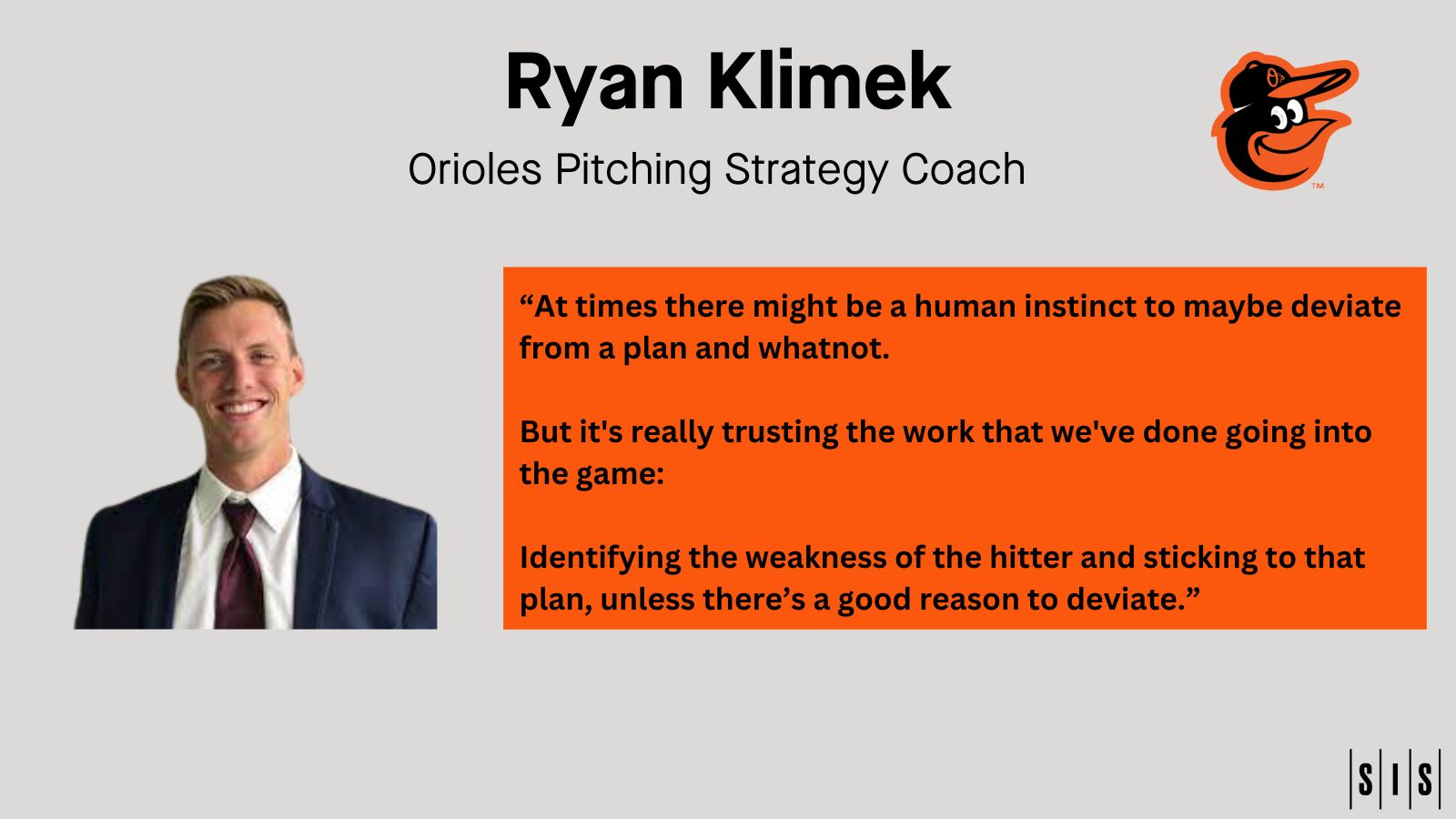
    Ryan Klimek is the pitching strategy coach for the Orioles. He’s also an alumnus of Sports Info Solutions having previously worked for us in 2014. Ryan is highly unusual in that he never played the sport at the college or professional level (he’s a graduate of SUNY-Geneseo). On The Sports Info Solutions Baseball Podcast, Mark Simon got to talk to Ryan about his background and what he does for the Orioles.

    You can hear the full interview here or below. The written interview has been edited both for length and so that it makes sense.

    Mark: Where did the passion for baseball and pitching strategy come from?

    Ryan: My dad played at Ithaca College. my brother went to St. Bonaventure and was drafted by the Orioles in 2015. Those two got more of the talent gene than I did. I had the fandom they did. Our childhood was spent visiting ballparks near Rochester: Toronto, Cleveland, Pittsburgh.

    Once I got into college, I majored in math, initially wanted to be a math teacher. But I decided that there was another side of baseball that I’m really interested in, the analytical side.

    Pitching strategy was by chance. When Brandon Hyde got brought on as manager, we divided the advance scouting department into run creation and run prevention. It just happened that I was on the run prevention side, so my energy and passion took me in this direction.

    Mark: Your baseball playing career ended early, right?

    Ryan: Yeah, I played through high school varsity baseball, messed around with some fall ball at Keuka College but I was a more talented basketball player than baseball player. So I never played professionally but I’ve been lucky to find an avenue that has fit me really well.

    Mark: You worked for SIS in 2014, worked for other teams in the minor leagues, the Mariners and Angels. What were some of the things you took away from those jobs that got you to where you are now?

    Ryan: I really did not have a ton on my resume that could support me getting a job with a major league baseball team. So I saw SIS was looking for Video Scouts. It was a great fit. It helped me get my feet in the door for the data and science behind the game. I watched a ton of baseball, multiple games every day. One of the biggest benefits for me was that I was able to just acquaint myself with players that maybe I wouldn’t watch when I was sitting at home.

    Mark: What did you get out of working with the Mariners and the Angels?

    Ryan: I was with the Mariners in 2015 as a Double-A video intern. That was just drinking water out of a fire hydrant.  The exposure to professional players and the process. and what goes into it every single day in the clubhouse was really eye opening.

    After the Mariners internship had ended, I was able to go to the Angels and work in the front office there and contribute on the advance scouting side as well as the amateur draft, sitting in on those meetings. That’s a really cool two years where I was able to expose myself to all different avenues of baseball operations player development, amateur scouting, advance scouting, So it was just really just a lot of learning and taking it all in.

    Mark: You’ve been with the Orioles since 2017, which means that you’ve not only seen the best of times, which happened this past year, and we’ll certainly talk about that, but you’ve seen the worst of times too. In 2018, 2019, the team lost 115 and 108 games. But you had to have gotten something out of that because you stuck it out.

    What did you get out of working those two years, with a team that struggled so much?

    Ryan: In 2017, I was down in Sarasota for the year, got to see where it all starts for these guys on the way to Baltimore and then 2018, I was much closer to the major league product where I was in the clubhouse, my first year as an advance scout.

    It was very eye opening to me to just be exposed to that side of the clubhouse, and the intensity of every single day. and yeah, our window had kind of closed, and it was tough. But at the same time, it was my first year where I was still learning so much.

    And then once we hired Brandon Hyde and Mike Elias in 2019, the process changed significantly. and I couldn’t be more grateful to see this thing from the bottom to present day. and the work that Mike and Brandon have done with instituting analytics. Our advance process is very crisp and clean right now.

    Those years were painful, but at the same time, it gave us some opportunity to try some new things and take our time. And I think the results have kind of shown itself over the last two seasons.

    Mark: Your current role is Major League pitching strategy coach. What does someone with that role do?

    Ryan: From 2019 to 2021 and kind of into part of 2022, I was kind of your traditional advance scout where I do all the scouting reports on the opposing hitters. formulate the game plan, and then try to convey that to our pitchers pre-game, as simple as I could. In 2022, I moved into a new role, where they threw me in the dugout, and the real kind of reasoning behind it is that we do all this conversation and, preparation before the game, but then once we get into the game, I wasn’t there to be a reference.

    So, It’s really kind of similar type of things that I was doing as an advance scout, but now I’m there for the players to rely on in game, when things pop up in the second time through the order or if they just have questions on certain hitters. I’m there for them to answer questions.

    Mark: What are you working with? You’re working with data, you’re working with video, you’re working with heat maps, I would imagine. What are the different things at your disposal?

    Ryan: Yeah, I think the analytics department does so much work for us and they make my job significantly easier than just relying on my thoughts and my brain and whatnot.

    So, we’re in lockstep, all season and, and they provide tons of references for me to use. It helps keep things simple for both the pitchers and for the catchers, too, because they’re the ones that are putting down the signs, or nowadays, pressing the button. so I work with those guys all the time. I can’t speak highly enough of Daniel Martin and the work that he’s done, for us.

    It’s important to be trusting the data that’s in front of you as the long-term picture of how we want to attack guys, but at the same time being able to use all those years of watching the opposing hitters and understanding the adjustments that they’ve made, and, and what they look like present day versus who they looked like two years ago or three years ago.

    I kind of blend that all all into my head and come to a concise, simple way of relaying it to both the pitchers and the catchers.

    Mark: So we had Adley Rutschman on the podcast last year and he spoke highly of you. He said you’re the voice of reason, which gets to what you’re talking about.

    What’s an example of a conversation that you’re having with Adley Rutschman or James McCann and the pitching coaches, about a hitter?

    Ryan: I try to keep it as simple as I can for Rutsch and McCann. These are two guys that I work with every single day, probably more than the pitchers, to be honest with you. and just try to keep it simple for them, because I know that those guys have a lot going through their head during the game. They’ve got to call the pitches and still play defense and still hit.

    There may be certain guys that I just feel confident that we can spin a lot. I think at times there might be a human instinct to maybe deviate from a plan and whatnot, but it’s really trusting the work that we’ve done going into the game, identifying the weakness of the hitter and sticking to that plan, unless there’s a good reason to deviate.

    Mark: How receptive were players to you when you first started essentially in a role like this?

    Ryan: I never played in the big leagues or never played in the minor leagues.

    That’s my background and it kind of is what it is and I acknowledge that there’s, there’s an experience part of the playing side that I’ll never be able to replace. But I’ve been in the clubhouse for quite a while now, since 2018. I think that as long as you come prepared and you’re knowledgeable, about the work that you’ve done, you’ll gain the respect and the attention of others. What I do is to just control what I can control. And that is to put in the effort every day and to know these teams and what our game plan is as well as I possibly can, and then over time, you gain trust with people.

    So, that’s kind of where, where we are now, where I’m humbled and, and so grateful to, to be able to kind of have this role, with the lack of playing experience that I have, and be able to have these guys respect me and the work that I do and, and what I can bring to it.

    Mark: Let’s use a pitcher as an example, and, you mentioned that you work more closely with the catchers, but when someone like Kyle Bradish pitches, when you’re game planning for him, and you’re trying to create something, and you’re looking at the opposing lineup … he had an interesting season in that he wasn’t necessarily thought of as an ace-caliber pitcher at the start of the season, but by the end of the season, he had gotten pretty close to that level.

    His usage changed 2022 to 2023, more sinkers, a number of things changed with how he pitched. How did your game plan for him evolve as you discovered things about how good he could be?

    Ryan: We treat every pitcher differently because they are all different. So the, the main thing that we want to make sure of beyond getting too sophisticated or too in-depth with creating a game plan is that the pitchers are using their strengths in what they do well.

    Towards the end of 2022,  Kyle was messing around with the sinker a bit. and then we saw it get into the mix a bit more heavily in ‘23. It’s known that he can really spin it in two different ways. So sometimes it’s really just being able to recognize what these guys do really well and to Kyle’s credit, he was able to really kind of hone in on, on the command of both the two-seam and his breaking balls that it gave us options for how we want to use these pitches. and it gave him the confidence and conviction that he could have throwing them in certain counts and he might’ve been uncomfortable throwing them beforehand.

    It’s important to understand what the pitcher does well and that we want to use that. We might turn some knobs here and there, depending on the hitter, of how many breaking balls he sees versus fastballs or changeups. But a lot of it was Kyle being able to really command those pitches and be comfortable using them in spots he might not have been ready to use them in his first season.

    Mark: Is it kind of like you’re playing chess?

    Ryan: A bit. I think that we are pretty scientific in the way that we do things. but at the same time, I do think that there’s a piece of it where it’s still a game and might have to make some adjustments as you gather more information. But that’s kind of the reason why I got into this.

    I never imagined myself being in a major league dugout. That was never in my career plan when I left SIS, but, it’s been pretty unbelievable to see it play out in this form where I do feel like I’m using kind of the analytical side of my brain and the math background and, at the same time,  still recognizing that it’s a game and being able to put all those years of watching video to use as well.

    Mark: What’s your best ‘I was in the dugout’ story? Did someone run over you trying to get a foul ball?

    Ryan: Sometimes those balls are hit so hard at the dugout that it’s terrifying.

    Especially when I’m standing there with no glove or any protection, besides a piece of paper in my hand. I think that when those guys started to do ‘the sprinkler’ that became viral, that was pretty funny to be a part of  or witness the first few times that it happened. It was a great celebration.

    Even the implementation of the birdbath in the outfield, it really caught on, so That was cool to be a part of and see that happen the first time.

    Mark: What advice do you have for someone pursuing a baseball career?

    Ryan: Be prepared for the hours. I think that once you get into this game, you sacrifice a lot of things in life, missing weddings, tons of family events, summer holidays and things of that sort. If you’re going to commit, then fully commit and, be ready for it to take away from those types of things.

    It’s not all glamour. You might see the major league clubhouse and the dugout and all that type of stuff, and I wouldn’t trade it for anything. Don’t get me wrong. But there’s plenty of days where it’s really long and then you got a rain delay and you don’t get back to the hotel until 2:30 a.m. Or you’ve got a flight somewhere else afterwards.

    I think that the hours pay off. Just really be ready to grind and to listen. I’ve been so lucky to work with so many different people in this game that it’s just great to hear their experience, their perspective on things and, always be willing to listen and adapt.

    Mark: What does a coach like you do during the winter?

    Ryan: I fully support the Buffalo Bills, so I’m still reeling from that.

    From the work side of things,  it’s a lot of ad hoc stuff from the front office with certain tasks that they might provide me and might be looking into our guys and what maybe we could have done differently usage-wise last year. I might be taking a look at a free agent we think that we could do something different with.

    But now as we get closer to spring training, kind of turning the attention, really focusing on our guys, our player plans, things that we want to institute this year, catching up with guys on what they’ve been working on in the offseason, and kind of starting to let the wheels turn in my head already about how we can use these weapons that guys have differently next year than maybe we did last year.

    Mark: Thanks, Ryan.

    Ryan: Thank you, Mark. I appreciate it.

  • Stat of the Week: CC Sabathia and the Hall of Fame

    Stat of the Week: CC Sabathia and the Hall of Fame

    I think there’s an interesting question to be raised when the next ballot for the Baseball Hall of Fame comes out.

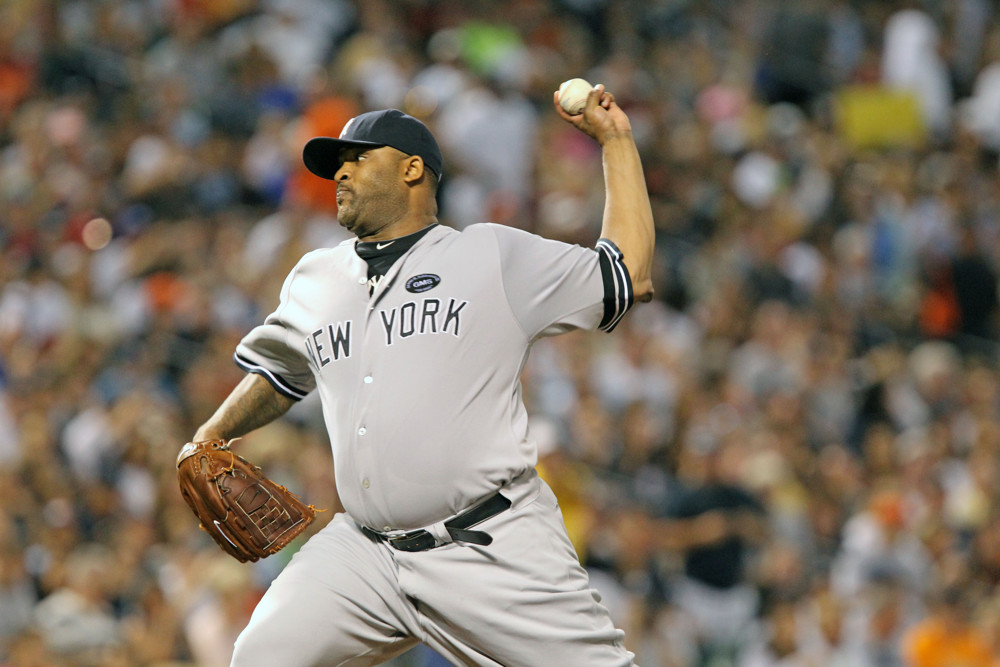
    The 2 new candidates on the ballot who stand the best chance of election will be Ichiro Suzuki and CC Sabathia.

    Ichiro is a no-doubt lock and it wouldn’t surprise me if he matched or bettered Adrián Beltré’s 95% from this year’s Hall of Fame class.

    But what about Sabathia?

    If we use statistical evaluation tools to evaluate his candidacy, he’s really, really close. Baseball-Reference tracks a player’s Hall of Fame Career Standards Score from a method devised by Bill James. Sabathia scores a 48. The average Hall of Famer scores a 50.

    Using more recently developed methodologies, Sabathia scores a 491.2 on Bill’s Hall of Fame Value stat, a stat devised in 2019 for which 500 was the intended target for the Hall.

    And in Jay Jaffe’s JAWS system, he ranks 55th among starting pitchers. His bWAR and 7-year peak WAR come out about 10.5 WAR below the average Hall-of-Famer.

    The question for voters is going to be, where do you set your personal bar among Sabathia’s contemporaries?

    There are some no-doubters that should be ahead of Sabathia on the Hall of Fame candidate list. Among active pitchers, Justin Verlander, Clayton Kershaw, and Max Scherzer fit that description. Zack Greinke checks out very well too even if he never throws another pitch. Some contemporaries are already in and deservedly so, like Roy Halladay.

    Statistically speaking, Sabathia slides in behind those guys but ahead of the likes of Mark Buehrle (who got 8% of the vote on the last ballot), Tim Hudson (5% and 3% on 2 ballots), Cole Hamels (not yet eligible), Adam Wainwright (not eligible), and another pitcher on the upcoming ballot, Félix Hernández.

    Sabathia’s credentials include

    – 251 wins and 3,093 strikeouts

    – The 2007 AL Cy Young Award and 4 other Top-5 Cy Young finishes

    – 6 All-Star selections

    – A World Series ring on a 2009 Yankees team for which he was an ace

    – An epic finish to his 2008 season 

    (1.65 ERA in last 17 starts, pitched the Brewers to the Wild Card)

    – Good standing in baseball as vice-president of The Player’s Alliance

    The thing that hurts his standing is his 3.74 career ERA, one that jumped almost a quarter-point in the last 7 years of his career when he was not as good as he was in his prime, as he learned to adjust to diminished velocity.

    But while 3.74 doesn’t look great on the surface, his ERA+ (ERA adjusted for the time he played and the ballparks he pitched in) is 116.

    There are definitely good pitchers with an ERA+ right around 116, guys you wouldn’t think of as Hall-of-Famers. But there are some all-time greats from other time periods too, like Hall-of-Famers Ferguson Jenkins (115) and Steve Carlton (115).

    My point here is that Sabathia’s ERA, relative to when he pitched, can be a diminishing factor but not an eliminating factor when it comes to a Hall vote. He’s still a good candidate even with a 3.74 ERA.

    I want to touch on one other point that I think favors Sabathia: his 3,577 1/3 innings pitched. No one has more among pitchers who debuted in the last 35 seasons.

    From 2007 to 2009, three years in which Sabathia was his best self, he threw 724 regular season innings and another 55 1/3 innings in the postseason. His regular season ERA, adjusted for ballpark was 44% better than league average. 

    In the last 3 seasons, the pitcher closest to Sabathia’s combined 779 1/3 total innings pitched in that time is Aaron Nola (628 innings pitched combining regular and postseason). That’s 151 fewer innings pitched. We can make a similar point if we look at 4,5, 6, or 7 seasons.

    Starting pitcher function is markedly different in 2024 than it was for most of Sabathia’s career. Once Greinke, Verlander, Scherzer, and Kershaw retire, it might be awhile before anyone reaches 3,000 innings. Gerrit Cole is probably 6 healthy years away.

    I’m of the belief that pitchers from Sabathia’s era should garner a level of appreciation commensurate with the workload those pitchers took on. That’s why I look at Sabathia with great respect. Pitchers are going to be hard pressed to pitch as much as he did and accomplish what he accomplished.

    Now, you could make a similar, perhaps even a better case about a lot of pitchers that came from other eras: Rick Reuschel, Dave Stieb, Kevin Brown just to name a few. But that’s not what we’re here for. They’re not on the BBWAA ballot anymore.

    We’re here to show that Sabathia, as good as you think he was, was arguably even better than you think. And he is a highly viable candidate for the Baseball Hall of Fame who deserves immediate consideration for the game’s top honor.

    We discuss Hall of Fame candidacies with SIS VP of Baseball Bobby Scales along with an interview of Orioles pitching strategy coach Ryan Klimek, and scouting reports on Yoshinobu Yamamoto and others from Brandon Tew on our latest baseball podcast.

  • Stat of the Week: 2023’s Leading Underachiever

    Stat of the Week: 2023’s Leading Underachiever

    BY MARK SIMON

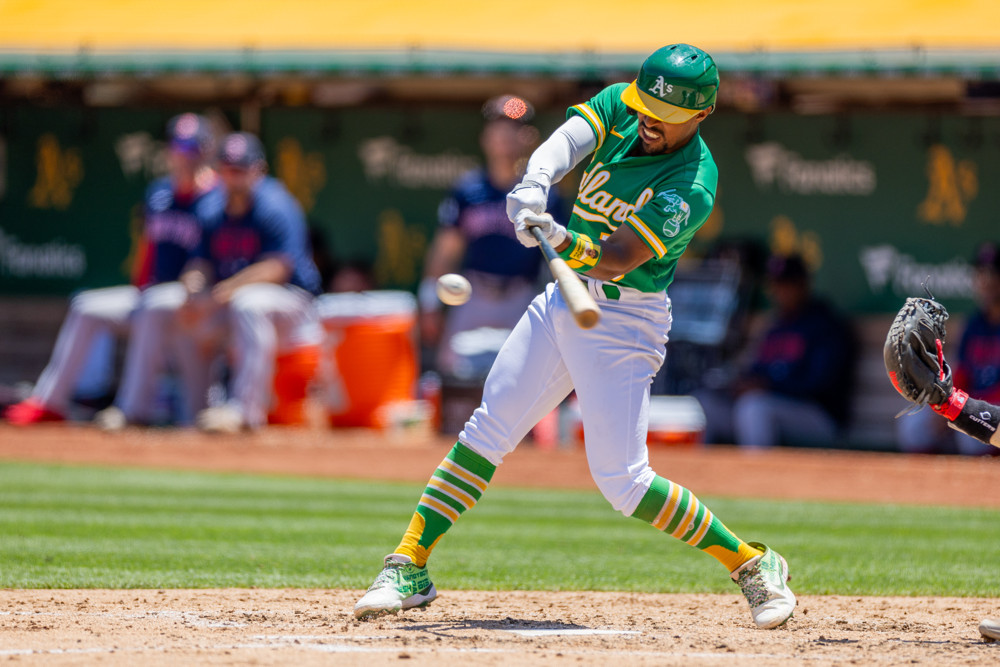
    Tony Kemp had a really, really rough go of it in 2023. Kemp, one of the veteran leaders of an Athletics team that lost 112 games, hit .209, slugged .304, and had a .607 OPS.

    But it probably shouldn’t have been anywhere near that bad.

    Last week, we explained how Luke Raley was 2023’s leading overachiever, posting an OPS 123 points higher than his expected OPS.

    Kemp was 2023’s leading underachiever. His .607 OPS was 136 points lower than his .743 expected OPS

    A brief point of explanation:

    Sports Info Solutions tracks its own version of a player’s expected stats (similar to what you can find on Baseball Savant). Rather than basing a player’s hit probability (and subsequently single, double, triple, and home run probability) on a batted ball’s exit velocity and launch angle, SIS’ version estimates probabilities based on where balls are hit, how hard they are hit, and how long they spend in the air.

    This allows us to compare a player’s actual stats to his expected stats.

    Here’s the list of players with the largest negative differential between their 2023 OPS and their expected OPS. This stat is the other end of the list that we presented last week.

    Biggest Negative Differential – 2023 OPS and Expected OPS

    Minimum 250 Plate Appearances in 2023

    Kemp’s ledger consists of a fair number of instances in which he hit a line drive that hung up long enough (for example: here and here). There were also some nice defensive plays both on fly balls and ground balls (here and here), and a couple instances of balls that hit the pitcher and caromed right to a fielder (here and here).

    There’s also an instance of losing a would-be hit to a force play (here). And, of course, he got bit by the abundance of foul territory in his home ballpark (though not often; only here).

    Here is what Kemp’s actual batting line looks like compared to his expected batting line.

    There is a huge difference between what Kemp was and what he could have been. By his performance, Kemp was one of the worst-performing hitters in baseball. By his expected performance, Kemp’s OPS would have been better than the average second baseman (.724) and almost a match for an average-hitting left fielder (.751).
    This graph shows the range of outcomes in expected BABIP differential and expected OPS differential. Kemp’s stats are outliers. They’re represented by the blue dot in the lower left of the graph.

    One more example on how Kemp’s hit total was less than expected: If you take all the batted balls he hit with an expected hit rate of between 20% and 60%, Kemp was expected to net 42 hits. He totaled only 26, a 16-hit difference.

    There are some prominent players among the others on the underachievers list. Among them is Vladimir Guerrero Jr. who hit .264 and slugged .444. His expected numbers would have made his season look a lot different. He tallied a .302 expected batting average and .507 expected slugging percentage.

    Guerrero Jr.’s loss of hits on those 20% to 60% balls isn’t quite as extreme as Kemp’s but was still prominent. He was expected to net 72 hits on those batted balls. He totaled 62.

    The usual disclaimer applies: We’re not necessarily saying that Kemp’s or Guerrero’s numbers will be better such as to make up for what happened in 2023 (though the Steamer projection on FanGraphs suggests a nice bounceback). We’re just pointing out that it would be difficult for an average player to put up Kemp’s line and Guerrero’s line, much like it would be tough to put up Raley’s overachieving line.

  • New Padres Pitchers: Yuki Matsui and Woo-suk Go Scouting Reports

    New Padres Pitchers: Yuki Matsui and Woo-suk Go Scouting Reports

    The San Diego Padres signed two relievers this off-season to bolster its bullpen, bringing in Yuki Matsui and Woo-suk Go. Matsui comes to MLB as an international free agent after 10 seasons with NPB’s Rakuten Eagles, while the more recent signing of Go came as a surprise after Go was posted by KBO’s LG Twins. Both will be pieces in a revamped Padres bullpen.

    Yuki Matsui

    Season IP ERA Saves/Save Opp. Strikeouts Walks K-BB%
    2022 51 2/3 1.92 32/34 83 19 33%
    2023 57 1/3 1.57 39/42 72 13 26%

    What does he do well?

    Standing at 5’8”, Matsui is on the smaller side for MLB pitchers (he’d have been the 3rd-shortest pitcher in the majors last season) but uses his small stature to create some good pitch-shape characteristics. His fastball creates some carry from a lower release point due to his height, especially through the top of the zone. 

    His splitter is a nasty platoon-neutral pitch that disappears at the bottom of the zone, with an insane 56% whiff rate in 2023. He used the pitch more down and away from RHHs, but he can also throw it below the zone to left-handed batters with good results. 

    Mechanics

    Matsui also has a glove tap as he gathers himself at the top of his delivery. Creating a weight shift back as he lifts his leg, there’s a little pause as he balances. With a tiny pat of the ball in his glove he then comes forward and extends his leg out as his hip leads.

    One quirk is that Matsui darts his eyes up to the sky as he comes into foot strike, and the eyes don’t fixate back on the target until after the ball is released.

    via GIPHY

    The Arsenal

    Pitch Type Usage Velocity Strike % Whiff %
    Fastball 52% 92.5 mph 66% 23%
    Splitter 35% 87.5 mph 64% 56%
    Slider 11% 86 mph 69% 35%
    Curve 2% 76 mph 74% N/A

    Matsui’s go-to pitches are his fastball and splitter. He works the fastball up and away from right-handed batters, tunneling his splitter out of that same spot the majority of the time, throwing the two pitches on the outer part of the plate. 

    via GIPHY

    via GIPHY

    Against left-handed batters, his splitter works more middle of the zone down and he still tries to spot his fastball away from lefties on the glove side. One weapon for Matsui, especially against lefties, is Matsui’s slider. With good movement, he’s able to pound the bottom of the zone glove side. He would usually break out the slider and curve against the better left-handed hitters in Japan.

    Here’s a slider and fastball against Kensuke Kondoh, the best pure hitter in Japan:

    via GIPHY

    The video below is a splitter and curveball followed by a slider. I cut out some pitches in the at-bat for the sake of time, but this seven-pitch at-bat against Yuki Yanagita displayed Matsui’s full arsenal. 

    via GIPHY

    The pitch becomes an offering that moves away from lefties, but he is unafraid to bury the pitch down and in toward righties knees. With flashes of above-average command last season, Matsui found a formula that worked for him. 

    While he has displayed below-average control in some past seasons, he might have turned the corner with a 5.9 BB% in 2023. You don’t become the youngest player in NPB history to 200 saves without having some control and nasty offerings.

    What to Expect

    Matsui will compete for the closer role in San Diego but also could work well as a setup man or seventh-inning guy to start the season. He has two above-average to plus secondaries that should help against both right and left-handed hitters. He might alter his pitch usage slightly, but his high carry four-seam should prove a weapon even if thrown more 92-93 mph.

    Matsui struggled to adjust to using a different ball during the WBC, so his acclimation to the league, like Go, might take some time. Still, if he can keep his walks down like he did in 2023 success as a high-leverage reliever should follow.

    Woo-suk Go

    Season IP ERA Saves/Save Opp. Strikeouts Walks K-BB%
    2022 60 2/3 1.48 42/44 80 21 24%
    2023 44 3.68 15/17 59 22 19%

    After seven seasons with the LG Twins, Go was posted with a more shallow market for his services after an injury-plagued 2023 in which he missed time in May and his ERA ballooned after some bad outings. The most notable clunker came on April 30 when he walked two and gave up a weird high chopper for an RBI single. Then, three pitches later, he threw his slowest fastball of the year on a three-run home run. He was lifted and didn’t pitch again until June 4 due to an injury in his lower back. 

    He compiled a 31% strikeout rate last season to go with a high 12% walk rate. Go is a power pitcher who aggressively sprays the ball in and out of the zone and is an uncomfortable at-bat when he’s hitting his spots.

    What does he do well?

    Go is the hardest-throwing reliever in KBO, touching 98 mph on his fastball and comfortably sitting around 95 mph. His fastball gets flat at times, but he still has decently loud stuff for an MLB bullpen.

    Go’s arsenal is MLB caliber but with spotty control and command; he must consistently harness his secondary pitches and keep his fastball out of the middle of the zone. At times, he tries to be too fine with his pitches instead of trusting his stuff to play in the zone.

    There are numerous examples of cycling through pitch types with the catcher and trying to spot pitches perfectly on the edges.

    LG combatted by having their catcher set up in the middle of the zone and letting him rip pitches. Middle-of-the-zone fastballs won’t play as well in MLB, but he still throws 95 mph with a decent curve.

    via GIPHY

    Go pitches and feeds off of emotion and confidence so when he’s rolling he becomes even better. Bad outings can get away from him quickly because of walks. His stuff in KBO would just overpower lineups but stateside he needs to limit the walks for success.

    via GIPHY

    Mechanics

    Go has tinkered with his windup mechanics in terms of rhythm and timing. At points, he incorporated a glove tap into his movements and then he would completely scrap it during some outings or lessen it. To end 2023, he went back to a more substantial glove tap at the top of his leg lift.

    The Arsenal 

    Pitch Type Usage Velocity Strike % Whiff %
    Fastball 57% 94.5 mph 60% 25%
    Cutter 24% 91 mph 64% 28%
    Curve 15% 83 mph 65% 49%
    Slider 3% 85 mph 50% 46%

    Go tunnels his arsenal best when he works the zone vertically. Peppering the top of the zone with fastballs and then snapping off sharp breakers below the zone for chase. His curve has a baby spike grip and he can work the pitch both in and out of the zone.

    Curveball Grip

    via GIPHY

    He gets some gnarly chase swings at pitches and uses his curve to both righties and lefties. Against lefties, he will backdoor curves deeper into counts as well.

    via GIPHY

    Go primarily uses his cutter to keep hitters off his fastball. He is comfortable throwing the pitch glove so that it’s in on the hands of lefites or down and away to righties. He  occasionally throws it arm side on the edge versus left-handed batters.

    via GIPHY

    via GIPHY

    He also has a slider that he will use against better hitters. His cutter and slider have very similar grips. 

    Slider

    Cutter


    With the cutter, Go stays behind the ball, and on the slider, he tries to get to the outside of the ball. There are subtle differences in movement and velocity but based on signs he has thrown both pitches. 

    via GIPHY

    In San Diego, the team might try to tweak his slider and play around with grips to get even more horizontal movement, and with pitchers like Darvish on the team who helped Rōki Sasaki with his slider, Go might find a tunnel horizontally that works for him.

    With his sporadic control, a more consistent slider could help Go pitch not only north and south but also east and west so he doesn’t have to be as fine and can still generate whiffs.

    What to Expect

    Go projects as a middle relief option who has experience at the back of a bullpen and if he can gain confidence and trust his stuff, could see his role expand during the season. With his fastball and curveball, he should have no issues facing both lefties and righties out of the pen.