Category: Baseball

  • The Hottest of Hot Zones: J.D. Martinez vs High Pitches

    The Hottest of Hot Zones: J.D. Martinez vs High Pitches

    Photo: Cliff Welch/Icon Sportswire

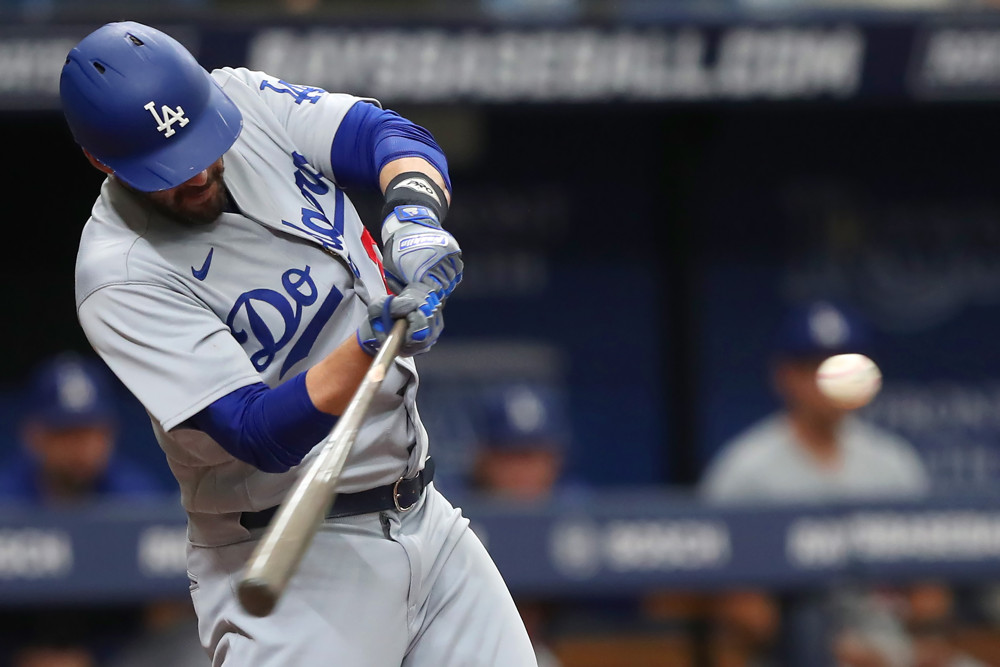
    J.D. Martinez has been one of the best hitters in baseball for multiple years now. One thing that really separates him from the rest is his willingness and ability to evolve at the plate.

    Since he signed with the Tigers in 2014 he’s had a wRC+ of at least 119 every full season. (2020 shortened season his wRC+ was 76). Teams must have thought Martinez would start to decline since he’s 35 years old now which is why the Dodgers were able to sign him for a 1 year, $10 million contract before the season started.

    The deal was an absolute steal for the Dodgers. He currently has the 6th best slugging percentage (.558), 7th best hard hit% (55%), 5th best barrel% (18%), and his 127 wRC+ is good for 31st in baseball.

    One of the areas Martinez has been able to transform is his ability to hit pitches up in the zone (and above it). He was never a terrible hitter against high pitches but this season he has turned into one of the better ones in baseball. Here are his numbers:

    J.D. Martinez vs Pitches in Upper-Third Of Strike Zone & Above

    AB AVG SLG OPS 2B HR K Miss%
    70 .288 .638 .971 5 7 29 31%

    Martinez’s numbers, especially his slugging percentage, blow away the league averages on pitches in the upper-third and above. League averages: .229 avg, .392 slug, .737 ops.

    In 2022 Martinez hit .303 against high pitches but he was not slugging nearly as well as he is this season. In 76 ABs he slugged .461 with 2 HR and 6 2B. He’s being more aggressive in 2023, swinging at 49% of pitches in this area (45% in 2022) and swinging and missing less (35% in 2022).

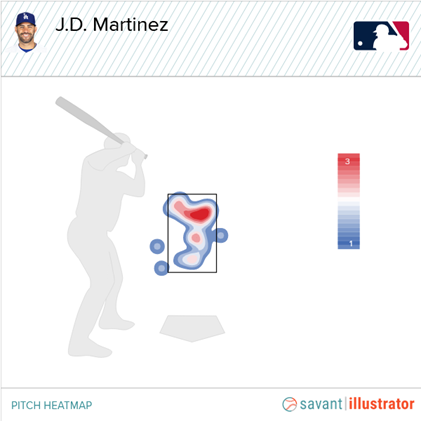
    This heat map from Baseball Savant shows Martinez’s HRs this season. The majority of his HRs have been hit on pitches located middle up or up and away.

    Martinez has done most of his damage up in the zone against fastballs, as you’d expect, with 5 of those 7 home runs hit against them. He’s 5-for-8 with 2 home runs against (likely inadvertently-thrown) high sinkers.

    Pitchers can get Martinez to chase fastballs if they get them up out of the zone in the right spot. He has a 47% chase rate and 39% whiff against 4-seamers up, striking out 22 times.

    Video Breakdown

    Martinez has spoken extensively in the past about how much watching video helps him at the plate. So what are a few things he’s looking for?

    Rubber band effect. Similar to what I touched on in my Mookie Betts breakdown, Martinez relies on the rubber band effect. When he lifts his leg he starts to load his hands backwards and up. Once his foot touches down he begins to bring his hands through the zone. The timing is key for J.D.

    Keeping the back elbow tucked. No matter where the pitch is located, Martinez likes to keep his back elbow tucked until he makes contact with the ball. It helps him stay through the ball and keep his barrel in the zone for as long as possible.

    Rotation of his top half. Martinez stands practically straight up and really doesn’t hit with his legs too much, which shows you how strong he is. All of his power is coming from his top half. Focus on his back foot, it doesn’t pivot as much as other hitters. Martinez isn’t building energy from the ground up. All the energy and power is being generated from his core and upper body.

    Ump cam view of 3 run HR vs Musgrove (hanging slider)


    Martinez takes full advantage of a 0-2 hanger from Musgrove. The ump cam is a great look at Martinez’s load and how he is able to keep his barrel in a great hitting position for as long as possible.

    Broadcast view


    Double vs Alvarado  

    This double off José Alvarado also comes with 2 strikes. Alvarado’s cutter is one of the nastiest pitches in baseball. Hitters are 7-for-39 against it and 4-for-31 when he throws it with 2 strikes.

    https://twitter.com/MLBReplays/status/1667408999031926784?s=20


    Martinez’s bat is at around a 45-degree angle when he’s ready to bring his hands down to swing. That angle helps him reach these pitches up since it minimizes the distance the barrel needs to travel.

    The rotation of his top half is really evident here, you can read his entire name on the back of his uniform when his front foot plants. Even though his top half is rotating so much his head is staying completely still and his eyes are focused on the point of contact.

    HR vs Trevor Williams

    On a 1-0 count Martinez is happy to go with this fastball away and drive it to the right center field gap.


    Most hitters try to pull this pitch. As I mentioned before, even on this up-and-away pitch, Martinez keeps his back elbow tucked until after he makes contact with the ball.

    Wrap up

    There are better hitters than Martinez when it comes to hitting the high pitch. Both Ronald Acuna Jr. (.407/.797) and Shohei Ohtani Jr. (.387/.882) are ridiculous up there. But I wanted to spotlight how Martinez’s evolution at the plate to be better against pitches in the upper part of the zone has taken him to a new level and made him a vital part of the Dodgers’ offense.

  • Defensive Excellence Q&A: Brennan Middleton, Diamond Defense Academy

    Defensive Excellence Q&A: Brennan Middleton, Diamond Defense Academy

    Brennan Middleton runs the Diamond Defense Academy, a camp exclusively devoted to teaching infield defense to scholastic and high school players in northern Virginia. He also coaches a travel baseball team.

    Middleton grew up in Baton Rouge and won two Louisiana state baseball championships in high school, then played infield at Tulane before a two-year pro baseball career after being drafted by the Nationals in the 10th round.

    He’s passionate about teaching defense and was the ideal person for our next Q&A. His answers below have been edited for clarity and length.

    Click here to see our other 8 interviews in this series of pieces about coaching defensive excellence.

    Mark: Who are your biggest influences in teaching you how to play defense?

    Brennan: My dad would take me to the field four or five days a week outside of our normal practices and travel stuff. Fundamentals were ingrained in me early as a kid. That kind of came naturally.

    The fielding aspect came naturally to me too, and I think he saw that as a young player that I was just quicker and fast enough to be able to stay in the middle of the field. And he always kind of preached that you stay in the middle of the field, you provide a little bit more of a contribution to a team, whereas if you’re just relying on hitting you get forced to the corners and you have to execute at the plate all the time.

    So, it was in my mindset that I wanna diversify a little bit and be able to stay in the middle and provide value there, even when I’m not hitting well. That concept was important to him, and it became important to me.

    Later, Jake Gautreau was an influencer. He played at Tulane and played in the Padres organization. He was an assistant coach at Tulane University. He’s an assistant coach at Mississippi State now. And Jeff Garber, the field coordinator for the Washington Nationals who was in charge of all things defense.

    Mark: What does defensive excellence mean to you?

    Brennan: Executing on the routine plays.

    I think any coach that knows what they’re doing or played at a high level knows that you need a Top-10 play sometimes, but you need to be relied upon to make the routine plays.

    And if you’re relied upon and you field and you catch and you throw the balls that are hit in your area without relying on the extreme outside-of-scope plays, then you’re gonna play for a long time and you’re gonna be relied upon.

    Mark: So how do you teach it?

    Brennan: I teach it very compartmentalized and broken down. Specifically for the infield, I believe there’s different types of ground balls. I explain to kids and young players how to view the infield in a way that breaks down the ground balls into different types.

    And along with those different types come different types of footwork and angles and range and glove positioning. So, I break the infield down into seven core ground balls. And I believe every ground ball, unless you’re gonna dive for it, falls into one of those seven categories.

    And each one of those categories has its own footwork, has its own glove position, has its own angle to the ball. And when you break it down like that, you can work on individual ground balls all the way down to the fundamental level. And then when you build it all back up, the infielder has a better understanding of:

    ‘When this ball’s hit to me, I practiced this ground ball or that ground ball hundreds of times, and I instantly know, okay, I’m supposed to do this. I’m supposed to put my feet here, I’m supposed to put my glove here, I’m supposed to move this way.’

    And it makes it easy to understand and it makes it easy to execute.

    And if you don’t break it down like that, especially for young players, they feel overwhelmed and they get stuck or they take a different angle or they’re in the wrong position.

    They may have caught the ball, but they’re not in the right position to make the play or make the throw as the game speeds up.

    Mark: What are the seven types of ground balls?

    Brennan: You’ve got a routine ground ball, which is obviously the most commonly hit ground ball. It’s one that’s hit right at you. Any ball that you can stay to the right of, as a right-handed throwing infielder, or to the left of for a left-handed throwing infielder.

    For most infielders who are right-handed, if you can create momentum and feel that ball in between your feet with momentum going back to the left side of the infielder it’s gonna be considered routine.

    If you cannot do that and you’re gonna end up having to turn your glove over, or you cannot create momentum, it’s gonna become a different type of ground ball.

    There are three types of backhands. One, I call ‘inside the body’ and you field it inside of your body and you use momentum back towards the infield with your feet open to press through it, down and through it, and with momentum back towards the infield area.

    And then there’s two types of extension plays. One where you field it with your feet open, and then one where you filled it with your feet crossed over. The one where you field it with your feet open does not require a shuffle. You field it, you shift back to center, you shuffle towards the target, and you throw.

    And then when you cross over, you’re clearly not in a good throwing position. Plus, you’re probably extending further than you want to, but that’s needed to catch the ball. It requires a sort of gathering step to kind of slow your body down. So that is the fourth type.

    And then there’s two types of forehands. One ball that’s hit to your glove hand side that is not fielded in between your feet, but a ball that’s hit to your glove hand side that is fielded outside of your feet. You’ll field that with one hand, meaning your glove, and you’ll stay inside when you shuffle. So, turn inside, keeping your chest towards the field.

    No. 6 would be a reverse pivot, so a ball hit a little bit further than that forehand play in which the infielder is angled towards the outfield but requires more than one shuffle inside to get turned back towards the target. Whereas they would be quicker to just reverse pivot their feet, turn gloveside back towards the infield, and then release the ball towards the target (a more detailed explanation with video can be found here).

    And then No. 7 would be a slow roller. There’s three different types of slow rollers, but I bucket them into one. Ball hit to your right, ball hit to your left, and then a barehand ground ball. Each of those has different types of footwork.

    So that’s the core seven. We break those down into different fundamentals. We break it down all the way up from the glove work to the footwork to the angles, and we build it all the way back up.

    Mark: Do you have any favorite drills or games that you do with the kids that really kind of get them thinking in a good way?

    Brennan: I’ve found that it’s sort of an ‘aha’ moment when you put them on their knees, and you’ve asked them to mimic the movements of how they move their glove once they catch the ball in all these different positions.

    Because you can set a player up on their knees and you can put him in literally all six of those types of ground balls (not the slow roller) and you have them focus not just on the feet and how they’re moving, but on what are they doing with the ball once they catch it. It starts the process of them understanding.

    You have them just funneling the ball into their center on a routine, pushing down through the ball as a backhand, extending as an extension or forehand, and then you mix in short hops in a controlled environment like that where they’re just fielding the short hop and not having to worry about the feet and the movements.

    And they get really good with the glove and then you stand them up. And then you slowly work into what you want the feet to be doing in each one of these. It’s a progression that none of them have really ever been taught, in my opinion. It’s not a dig at coaches, but they don’t really know how to teach it.

    They just don’t know what to say or do and how to approach it. People know how to teach hitting. But you ask a regular coach to teach defense, not hitting fungoes, but teach defense, and they don’t know how, and they don’t know what to say or how to break it down or how to make it simple.

    When you do that, the youngest of the kids say, ‘Wow, I can understand this.’ And they become a more complete defensive player versus just a decent fielder.

    Mark: What’s the hardest thing to teach?

    Brennan: It’s the slow rollers. I think the younger kids, the ones below 13, they’re growing so fast and they’re still so uncoordinated in how their body actually moves and understanding how their body moves.

    So, it’s very difficult to teach a somewhat quirky 11-year-old, who might be athletic but might have a little baby fat still and is not really coordinated, how to run and catch and bend over and get the footwork right. You start to see the understanding of how the body moves when they’re in their early teens.

    Other Interviews In The Series

    Coach Description Link
    Dunn Muramaru Hawaiian high school coach LINK
    Darren Fenster Red Sox infield coordinator LINK
    Nelson Cooper IV Pittsburgh Hardball Academy LINK
    Loren Torres Point Park University LINK
    Adam Everett Phillies minor leagues LINK
    Carlos Muñoz Team USA catching LINK
    Petr Baroch Czech Baseball LINK

    Mark: How much of an emphasis do you put on learning multiple positions?

    Brennan: A lot. Before 13, they should be playing all over the place. Catch if you want to. I don’t force catching.

    They should see the field from someone else’s viewpoint. You should understand how the right fielder sees the field. If you’re a shortstop, you should see how the first baseman sees the field. Get one of your bigger first basemen and put him at shortstop for an inning so that he can see what that position sees as the game evolves.

    Then, you have a 360-degree view of how your teammates view and understand the game.

    Mark: Explain the quote on your website: Baseball is a game of failure, but not on defense.

    Brennan: You should not fail at the routine ground balls. A fielder should be damn near perfect on balls that are hit within their range, and they should understand the fundamentals enough to where when the ball is hit to you, unless it takes a bad hop, or unless there’s some inadvertent physical breakdown where you trip over your feet or something, you should catch almost all of them.

    Mark: In summary, what would you say about your approach?

    Brennan: For me, I’ve found success when I start breaking things down into components and teaching them as if they were in a class. I’m teaching them how to prepare for the test.

    Will they be better instantly? No, they’ve got to work at it.

    You have to get scientific with it and break it down into the simplest bite-sized chunks for kids. They become more comfortable when they are prepared for anything. They come out the other side feeling more confident as an infielder.

    For more examples of what Brennan was talking about, check out the “Improve My Game” tab on his website.

  • MLB Draft Scouting Report: Miami 3B Yohandy Morales

    MLB Draft Scouting Report: Miami 3B Yohandy Morales

    To read all our scouting reports, click here.

    Yohandy Morales, 3B – Drafted No. 40 overall by Nationals

    College University of Miami (FL)
    Bio R/R 6-4, 225 lbs.
    Date of Birth 10/09/2001
    Hit 45
    Power 60
    Run 45
    Arm 60
    Field 50
    Future Value 50


    Written by Brandon Tew

    Analysis:

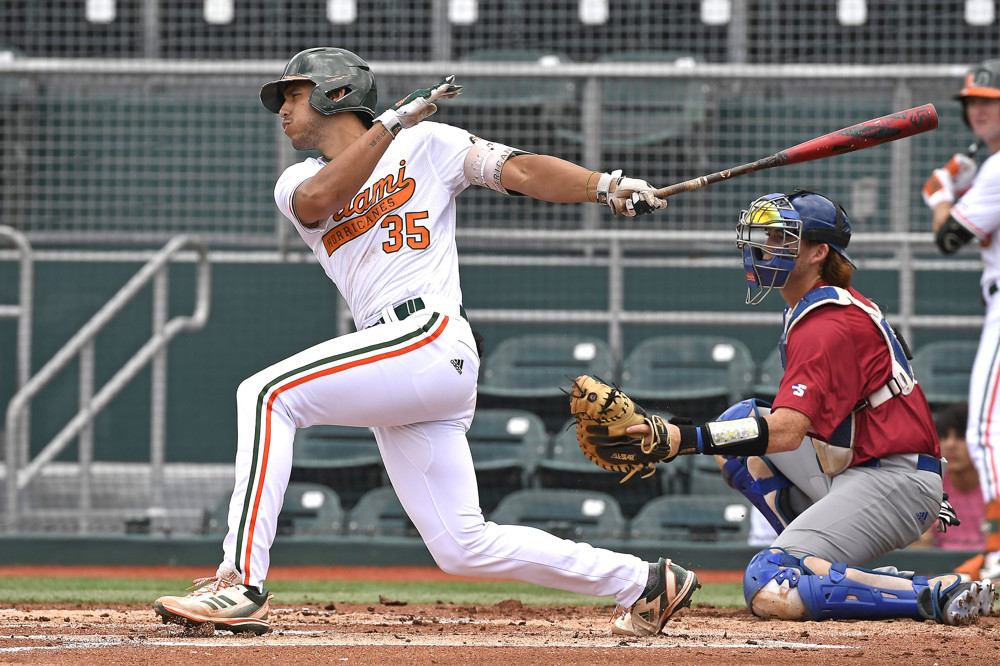
    Yohandy Morales is one of the most intriguing college bats from the 2023 MLB Draft. He was a consistent performer for three seasons at Miami (FL) starting 174 games at third base for the Hurricanes.

    Morales has big-time power from his extra-large frame, but there are concerns over his swing-and-miss. Although, he produces some eye-popping numbers in terms of exit velos with a 94.2 mph average EV and a 108.9 mph, 90th percentile mark, according to Baseball America.

    College Career:

    Morales’ slash line improved gradually every season as he grew into his role as a run producer in the middle of Miami’s lineup.

    As a freshman, Morales slashed .284/.343/.531 and backed that up with a .329/.411/.650 in his sophomore campaign. His HR and RBI totals also jumped with 11 and 18 HR and 45 and 59 RBI, respectively.

    Morales established himself as one of the best 3B prospects heading into 2023 and lived up to that as a junior, slashing .408/.475/.713 with 13 2B, 20 HR, 55 strikeouts and 30 walks.

    Batting Stance:

    Morales starts his stance with his feet shoulder-width apart and has a tiny sink into his legs, almost as a timing mechanism as the pitcher begins his delivery. He has minimal movement in his lower half, with some bend into his back hips as he stacks his back side.

    The barrel of his bat is squarely behind his head as he moves his hands back to create separation creating tension in his front shoulder and arm. The bat then turns upwards right before he starts coming forward.

    Morales keeps his hands back as he drifts forward, creating a good position of power as he rotates and unleashes a powerful punch to the baseball with his front leg straightening out at contact.

    His lower half is quiet, but some moving parts in his upper half can make it challenging to drop the barrel to the ball if he’s off time. His hands are so quick though he can still control the barrel and generate bat speed even when he’s out in front of pitches, especially non-fastballs.

    His power and quick bat make him a dangerous threat at any moment in the game, and he hit some towering home runs last season.

    Approach:

    Morales has an aggressive approach by hunting fastballs and trying to produce damage on these types of pitches.

    He’s susceptible to breaking ball spin, and good breaking balls can cause him to swing and miss. He has trouble identifying spin at points, but it’s more his swing-happy approach that can get him into trouble.

    Morales struck out in 20% of his plate appearances and walked in 11% of them. His whiff rate was 20% on fastballs, 37% on breaking balls, also per Baseball America. You would hope that seeing better breaking balls would get him thinking about being a more cautious swinger.

    Morales tends to be on his front foot on breaking balls while looking for fastballs to crush. Fastballs on the inner part of the plate can also tie him up.

    He does his most damage on pitches at the very top of the zone, though he does chase high fastballs a little too much. His fastball-first approach also causes him to freeze on slower pitches, especially curves and sliders.

    It’s a fine line because if he’s sitting fastball either down in the zone or up, he can unload on pitches and turns his raw power into home runs. Morales knows his strength, and that’s punishing fastballs.

    Two at-bats against James Tallon of Duke highlight Morales’ ability to hit the high fastball. He strikes out in the first at-bat, but in the second, he was sitting on a fastball and hit an opposite-field rocket out to tie the game.

    When Morales gets behind in the count, he uses his quick hands to let the ball travel in the zone and shoot it the other way.

    His barrel control also allows him to adjust and still square up the ball in an impressive manner during some at-bats. Morales has difficulty lifting pitches consistently at times.

    On breaking balls or even sinkers and changeups, he swings down on the ball. His hard contact still manages results as grounders sneak through the infield regularly.

    At higher levels of baseball, Morales will want to lift the ball just a tad more, but it’s fixable if his swing decisions improve.

    Defense:

    Morales is a sufficient defender at 3rd base and has good range for his size but inconsistency in making all the plays. Also, if he were to add more weight to his frame, he could be pushed off 3B to 1B or LF. With solid hands to go with athleticism and a strong arm, he should be able to provide serviceable defense wherever he plays in MLB.

     Projection:

    Morales is a big right-handed power hitter with plus power. His physicality and quick hands should produce plenty of pop from line to line. His inability to recognize good breaking ball spin may hinder him, but better swing decisions should help him cut down on swing-and-miss.

    MLB Comp: Yandy Diaz

  • Stat of the Week: The MLB Defensive All-Star Team

    Stat of the Week: The MLB Defensive All-Star Team

    Watching last night’s All-Star Game had us wondering:

    If we were going to make an All-Star team based entirely on defense, who would we pick?

    We’re not going to tie this to how an All-Star team is typically chosen. Our roster will consist of 20 position players and 4 pitchers. Our starting lineup will consist of the Defensive Runs Saved leader at each position, with the tiebreaker (which we applied once) being most innings played.

    We’ll primarily use Runs Saved at a position to pick the reserves too but without any requirements for number of players at a position other than pitcher.

    Here’s our starting lineup:

    Starters

    Position Name Runs Saved
    1B Carlos Santana 8
    2B Ha-Seong Kim 11
    SS Wander Franco 12
    3B Ryan McMahon 16
    LF Steven Kwan 8
    CF Kevin Kiermaier 14
    RF Fernando Tatis Jr. 15
    C Alejandro Kirk 9
    P Zack Greinke 5

    Pirates first baseman Carlos Santana’s 8 Runs Saved match the most he’s had in an entire season (he had 8 in 2017). He’d totaled 9 Runs Saved in the previous four years combined.

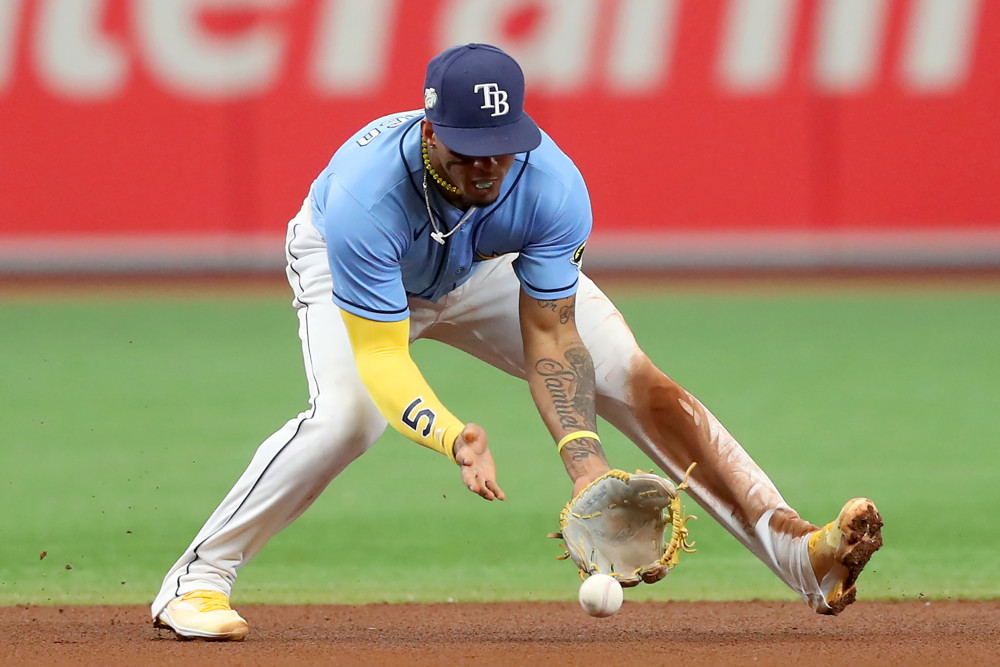
    Padres second baseman Ha-Seong Kim is both the leader in Runs Saved at that position and overall with 17 Runs Saved when totaling all positions. He’s also saved 4 runs at shortstop and 2 at third base.

    Rays shortstop Wander Franco’s 12 Runs Saved are double his total from 2021 and 2022. He rates among the top shortstops in MLB both at making plays on balls hit to his left and to his right.

    Rockies third baseman Ryan McMahon has run away with the positional lead at third base over the last few weeks. His 39 Runs Saved in the last 3 seasons at third base trail only Ke’Bryan Hayes’ 51. He’s well ahead of both Matt Chapman (22) and Nolan Arenado (21).

    None of the four leaders among these infielders has won a Fielding Bible Award. But two of the outfield leaders have.

    Guardians left fielder Steven Kwan got off to a slow start but is now in position to contend for a 2nd straight Fielding Bible Award. He won the award voting last season after finishing with an MLB-best 21 Runs Saved there.

    Blue Jays center fielder Kevin Kiermaier has looked a lot like his old self for much of the season. He’s won 2 Fielding Bible Awards. No one has won 3 in center field in the 17-year history of the honor.

    Padres right fielder Fernando Tatis Jr. has taken to his new position in a big way. He leads all players at the position in the range component of Runs Saved and is just behind Adolis Garcia for the lead in the Outfield Arm component.

    Blue Jays catcher Alejandro Kirk is tied for the lead in Runs Saved with Patrick Bailey, but we’re rewarding Kirk for playing more at a position that is physically challenging. He rates above average in our framing, blocking, and stolen base metrics.

    Royals pitcher Zack Greinke may have a 5.44 ERA, but he’s still going strong at age 39. He’s not only the 2023 pitcher leader in Defensive Runs Saved but also the overall pitcher leader since the stat was first tracked in 2003.

    And here are the reserves

    Reserves

    Position Name Runs Saved
    1B Nathaniel Lowe 5
    2B Andrés Giménez 9
    SS Dansby Swanson 9
    3B Ke’Bryan Hayes 11
    3B Matt Chapman 10
    IF Taylor Walls 10
    LF Austin Hays 5
    CF Luis Robert Jr. 7
    RF Alex Verdugo 12
    OF Daulton Varsho 16
    C Patrick Bailey 9
    C Nick Fortes 8
    P Patrick Sandoval 4
    P Clayton Kershaw 3
    P Marcus Stroman 3

    We won’t run through all the reserve selections here, just a few of the highlights. Third base is a very deep position this year and we couldn’t pick between Ke’Bryan Hayes of the Pirates and Matt Chapman of the Blue Jays, so we took both of them.

    We also felt that it was necessary to include a pair of outstanding utility players. Rays infielder Taylor Walls has 6 Runs Saved at third base but also has 2 Runs Saved at both second base and shortstop. Blue Jays outfielder Daulton Varsho leads all outfielders in Runs Saved. He’s got the second-most in both center field (9) and left field (7).

    Taking two catchers was also justified. We already mentioned Bailey, who has been excellent in his debut season with the Giants, and we’ll also add Nick Fortes of the Marlins, who has been particularly good at blocking pitches. He edges out Jonah Heim of the Rangers who also has 8 Runs Saved.

    Catcher was one of several positions at which we had to make some difficult decisions. And we can tell already that the Fielding Bible Awards decision-making isn’t going to be easy either because of how much high-quality defense is being played.

  • MLB Draft Scouting Report: Florida Pitcher Hurston Waldrep

    MLB Draft Scouting Report: Florida Pitcher Hurston Waldrep

    School University of Florida
    Bio R/R 6-2, 225 lbs.
    Date of Birth 03/01/2002
    Fastball 55
    Slider 60
    Curveball 60
    Splitter 70
    Control 45
    Future Value 55

    >> All grades on 20-80 scouting scale

    Written by Brandon Tew

    Draft Expectation: 1st Round

    Analysis:

    Hurston Waldrep possesses the best pure stuff of any pitcher in the 2023 MLB Draft including Paul Skenes.

    Waldrep’s four-pitch mix is undeniably electric and the presence and confidence he exhibits has scouts and teams dreaming about if he can reach his extremely-high upside.

    College Career:

    Waldrep transferred from Southern Miss after his sophomore season when he compiled 90 innings over 17 starts, finishing with a 3.20 ERA and 140 strikeouts.

    His junior season at Florida was up-and-down at times. He finished with a 4.16 ERA over 101 2/3 innings and 156 strikeouts, which was good for 3rd in Division I baseball.

    One major knock on Waldrep this past season was his 12.7 BB%, as his 57 walks were the eighth most in Division I and led to some of his struggles.

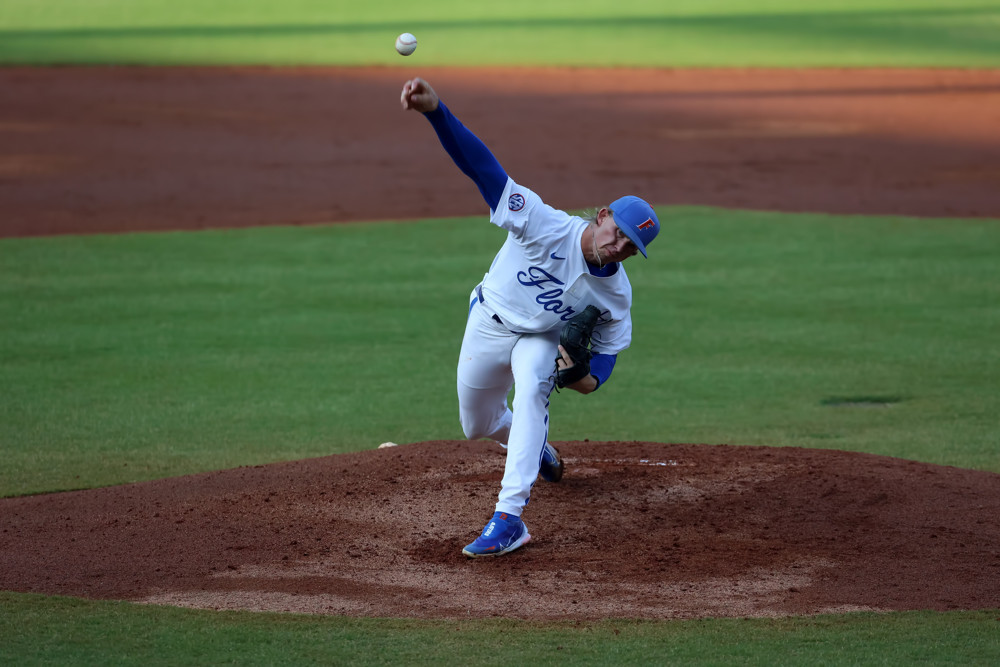
    Pitch Delivery:

    Waldrep is a well-built, athletic mover on the mound. From the windup, he keeps it simple using tiny steps for rhythm and timing to put himself in the same position he is in the stretch.

    Creating momentum as he drifts slightly forward with a big leg kick, he gathers himself at the top up to his letters before dropping deep into his back leg.

    Right after peak leg lift, he turns his lead foot inwards towards second base to build tension as he rotates and uncoils his hip landing in a powerful position at stride foot contact.

    His arm gets to an almost 90-degree angle with his arm in a good position at stride foot contact, and he does a good job of blocking his lead leg out. However, the delivery is up-tempo and his long arm swing can lead to inconsistency in the timing of the delivery.

    The significant tilt in his shoulders produces a high over-the-top arm slot and he struggles with command and control at times, with a violent movement of his head off to the side and some closed-off recoil in his finish. The side-head lean causes him to miss high and arm side when he’s out of sync and late.

    Waldrep’s athleticism allows him to succeed with these movements, but a team could opt to clean up his arm action with a shorter path. There’s a lot to like about his delivery but some concerns exist around repeatability and control.

    Pitch Profiles

    Fastball:

    The fastball is a make-or-break pitch and the key to Waldrep’s success. Waldrep sits 95-96 mph most games but has touched 99 this season and the ball jumps off his hand.

    At times, the pitch is inconsistent in shape and he can struggle with location but the cut-ride action of the pitch is compelling. Waldrep’s success will come if he’s able to throw the pitch glove side with regularity.

    The cutting action of the pitch makes it very hard to square up on the bat especially up in the zone.

    Waldrep, as a supinator, with low spin efficiency could opt for more of a true cutter in the same mold as Corbin Burnes.

    The pitch is very successful up in the zone but also misses bats down and away from righties especially. Waldrep’s ability to cut the ball in on the hands of lefties could make the fastball a devastating pitch for opposite-handed hitters as well.

    With his higher arm slot, Waldrep struggles with consistently getting the pitch to the top of the zone. He lives too much in the middle third of the zone vertically around the belt and thighs with his fastball.

    Slider:

    Waldrep’s slider is a gyro pitch with gaudy spin rates that generates depth at its absolute best in the upper 80s. Waldrep threw the pitch with less frequency early in the season, relying more on his curveball and splitter.

    The slider though is a pitch that Waldrep can backfoot to left-handed hitters but also dart it away from righties.

    With Waldrep’s propensity to supinate and spin the baseball, teams could help him develop a slider shape with more sweep or even a sweeper to pair with his gyro offering for right-handed hitters. He might have to lower his arm slot to accomplish this as well but the high arm slot makes Waldrep’s slider play well down in the zone.

    This is huge because he has a true out pitch for lefties in his split and a curve that can also neutralize lefties.

    There are a lot of options on the table but as with most of Waldrep’s pitches it comes down to the command of the pitch and getting it down in the zone. The slider could be a true weapon in MLB paired with his splitter as a tunneling option down in the zone.

    Curveball:

    The curve for Waldep is a banger with a downer shape and a tight spin in the low to mid-80s. Early in the season, he used the pitch a lot and especially ahead in counts.

    The shape of the pitch is great but he threw the pitch too much. He needs to start to sprinkle in the pitch as a strike stealer early in counts instead of as a chase pitch. He can throw the pitch for a chase below the zone but possesses better offerings in terms of chase pitches.

    These back-to-back at-bats highlight how good Waldrep’s curve can be but also what happens when he commands his fastball and curve allowing them to play off each other.

    Splitter:

    Waldrep’s splitter is demonic and dives into the depths of hell to get swings and misses with a 65% whiff rate on the pitch according to 6-4-3 charts. The pitch is one of the absolute best in the country.

    The grip allows Waldrep to kill spin and both cut and fade the pitch. Watching him pitch on a good camera angle behind the mound is an absolute treat because the splitter’s movement is absurd when thrown well. This is Waldrep’s actual putaway pitch. Even when hitters know it’s coming, especially in two-strike counts, they still swing over the top of it.

    Waldrep also can drop the pitch into the zone to keep hitters honest. The splitter will be a major factor in how successful he is as a pro. The pitch is a true double plus and can expose even the best of hitters.

    Pitch Usage:

    Pitch usage has been more of a detriment than anything this past season for Waldrep, though he seemed to figure some things out later in the season.

    Dropping his curveball usage and upping his slider usage led to great success for Waldrep in his first three NCAA tournament starts.

    Over 21 innings he struck out 37 batters, surrendering two runs while walking seven. This tweet explains Waldrep’s pitch usage and how he fixed some predictability during the season.

    Pitch usage can easily be fixed by Waldrep even though he struggled through 2 1/3 innings against LSU in the CWS finals. The tweaks in pitch usage before that are promising signs that Waldrep can be dominant with his explosive pitch arsenal.

    Summary:

    With 3 plus or double-plus secondary pitches, he also has a fastball that can be more plus if he fixes its inconsistency. In its current form, it still projects as an average to above-average big-league pitch.

    Waldrep can be a truly dominant starter if he harnesses his pitches, as this will determine his MLB role and his astronomically high ceiling.

    Projection: 

    An athletic righty with an electric pitch mix. His success as a starter will be determined by his control and the ability to throw consistent strikes.

     MLB Comp: Logan Gilbert

  • Blake Perkins Wins Defensive Player of the Month for June

    Blake Perkins Wins Defensive Player of the Month for June

    The Brewers rank 4th in MLB in Defensive Runs Saved and a large part of their success this season has come from their rookies.
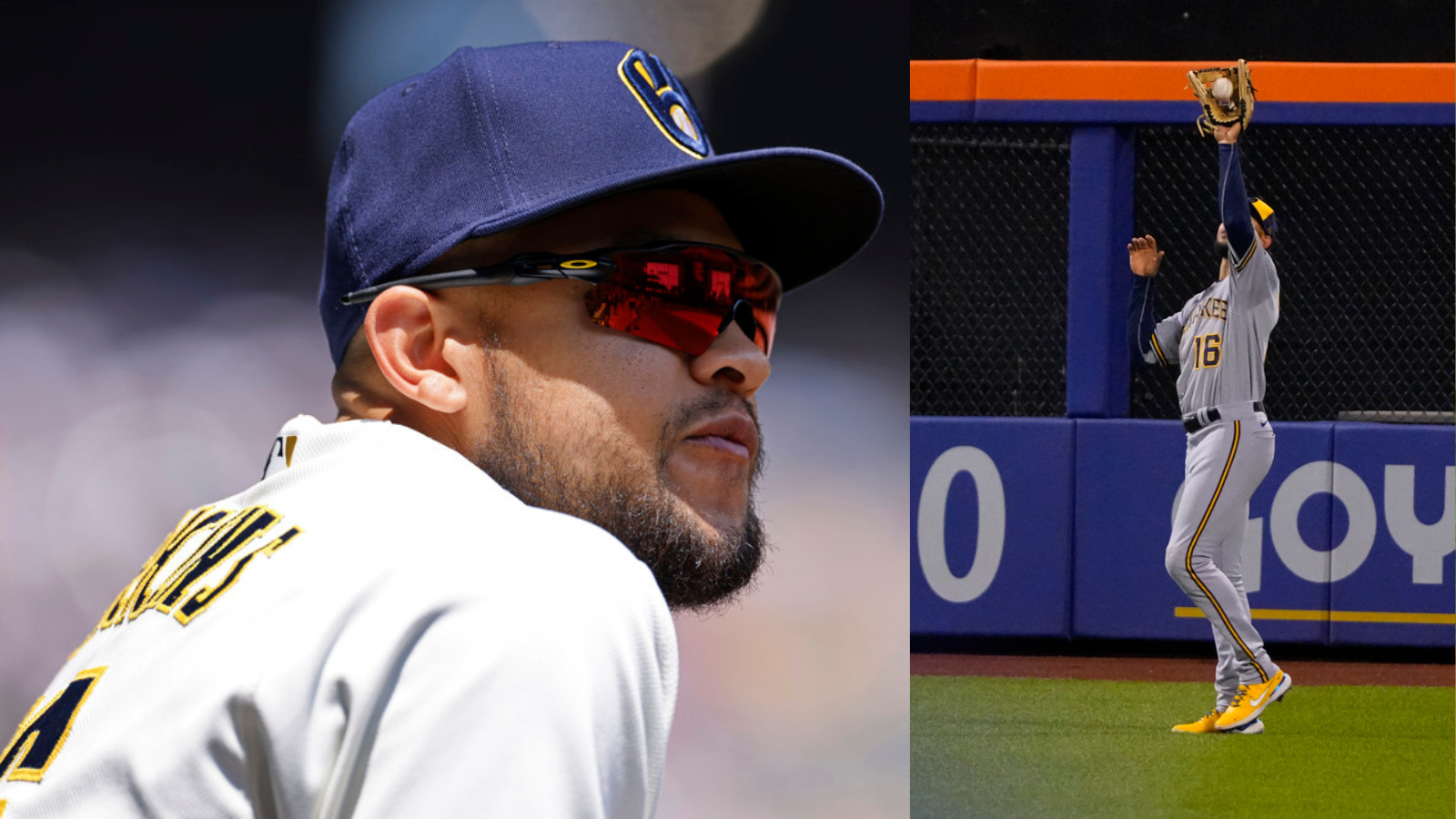
    Joey Wiemer and Brice Turang have each impressed this season. Last month, a third player joined them, our selection for the SIS/Fielding Bible Awards Defensive Player of the Month for June, corner outfielder Blake Perkins.
    Perkins led all players with 9 Defensive Runs Saved, 7 of those coming in right field. Perkins did it with a combination of his glove and his arm. He did this despite playing in only 20 games.
    Perkins’ specialty is closing ground quickly. He ranks second in Statcast’s Jump metric for outfielders, which takes into account how much more ground an outfielder covers on average than his peers. He trails only Blue Jays center fielder Kevin Kiermaier when it comes to how much more ground he covers from 1.6 to 3 seconds after the ball leaves the bat (known as “burst”). And his sprint speed ranks in the 98th percentile in MLB.
    Because he gets good initial jumps and has good “bursts,” Perkins doesn’t have to leave his feet often. In fact, he made only one catch that required leaving his feet. His specialty is the sprinting catch, like this one he made against Corbin Carroll and this one against Amed Rosario. He also threw out a pair of baserunners in June. His overall arm strength  ranks in the 82nd percentile per Statcast.
    Wiemer, Perkins, and others who have filled in have combined for 10 Runs Saved in right field. Only the Padres have more at that position.
    Perkins joins April winner Ke’Bryan Hayes (Pirates 3B) and May co-winners Kiermaier and Austin Hays (Orioles LF) as recipients of the honor.
    Others under consideration for the award were Giants catcher Patrick Bailey, who led all players at the position in Defensive Runs Saved for June, and Padres right fielder Fernando Tatis Jr., who finished the month with 6 Runs Saved and who led all right fielders with 8 Good Fielding Plays.
  • Stat of the Week: Doug Eddings & Bill Miller Call A Lot Of Strikes

    Stat of the Week: Doug Eddings & Bill Miller Call A Lot Of Strikes

    Sports Info Solutions has tracked umpire data back to the 2010 season.
    We track many things, including tendencies. How often is a pitch thrown to a certain area called a strike and how does that compare to other umpires?
    SIS divides credit for called strikes among the catcher, umpire, pitcher, and batter through a process that you can read about here. In doing so, we created two metrics: Extra Strikes Per 150 Called Pitches and Strike Zone Runs Saved, with the latter being calculated to provide a run value based on the raw number of extra strikes called.
    This allows us to gauge an umpire’s tendency to call more strikes than expected or fewer strikes than expected. An umpire who calls a lot more strikes than expected has a high Strike Zone Runs Saved total.
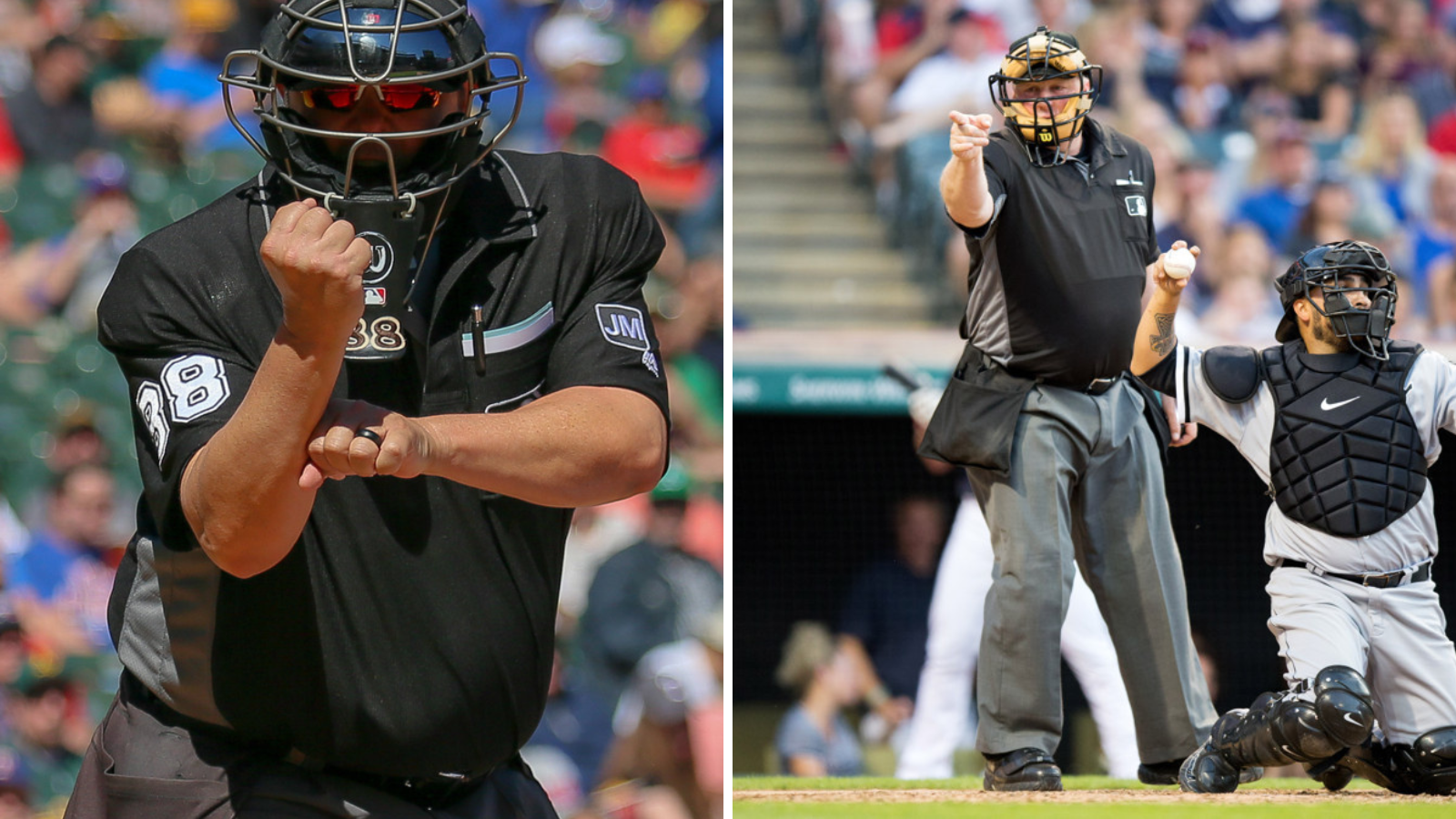
    In that initial year, the 2010 season, the top two umpires in both Extra Strikes Per 150 Pitches and Strike Zone Runs Saved were Doug Eddings and Bill Miller.
    Thirteen years later, the top two umpires in those stats for 2023 are, once again, Eddings and Miller!
    In terms of the impact this might have in games, that can vary. A rate of calling strikes more often than your peers doesn’t guarantee more strikeouts, for example.
    But it does seem worth noting that pitchers in Miller’s games the last two seasons have had a strikeout-to-walk ratio of 3.8-to-1, highest for any umpire in MLB. The MLB average is 2.7-to-1. The ratio in Eddings’ games in that time is a more modest 2.9-to-1.
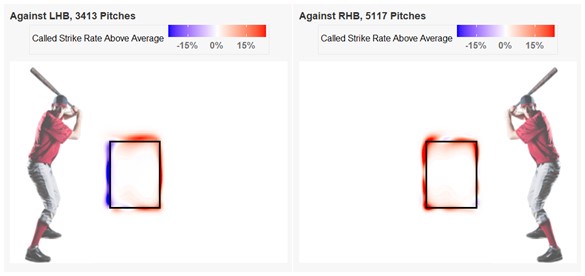
    Below are heat maps showing Eddings’ strike zone tendencies the last two years (June 30, 2021 to June 29, 2023). Areas in red are those in which Eddings calls strikes more often than his peers. Areas in blue are those in which Eddings calls fewer strikes.
    As you can see, other than that strip along the inside corner to lefties, Eddings’ heat map is a sea of red.
    Doug Eddings’ Strike-Calling Tendencies
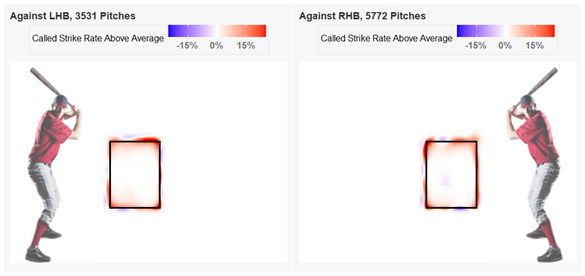
    Miller’s strike zone has a similar look
    Bill Miller’s Strike Calling Tendencies
    Since 2010 Eddings and Miller have both called more than 60,000 pitches each. Their number of Extra Strikes (both in total and per-150 called pitches) and their Strike Zone Runs Saved are well more than any other umpire.
    Eddings has 153 Strike Zone Runs Saved in that time. Miller has 152. The next-closest umpire is Phil Cuzzi, with 70 Strike Zone Runs Saved, not even half of Eddings’ or Miller’s total.  The differential is also quite large when looking at extra strikes on a per-pitch basis.
    Who are the other umpires that call more strikes than their peers? Looking at the last two seasons, seven umpires have at least 10 Strike Zone Runs Saved. They are listed in the chart below.
    If you see these umpires working one of your team’s games, expect to see a few more called strikes than you typically would.
    Most Strike Zone Runs Saved – Last 2 Seasons
    Umpire Strike Zone Runs Saved
    Bill Miller 15
    Doug Eddings 14
    Nick Mahrley 13
    Lance Barrett 12
    Phil Cuzzi 11
    Junior Valentine 10
    Dan Iassogna 10
  • Reeling Them In – Marlins Infield Positioning Working Well

    Reeling Them In – Marlins Infield Positioning Working Well

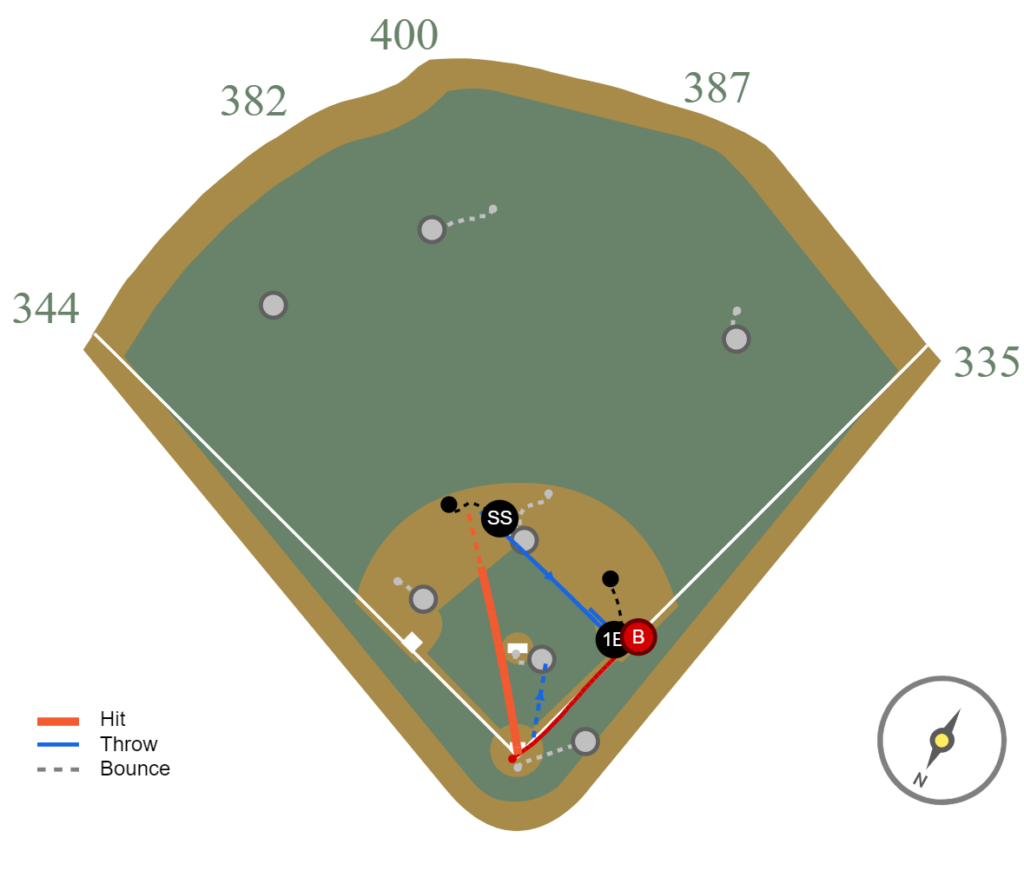
    If you were watching the third inning of this game between the Marlins and Pirates last Saturday, you would probably have glossed over this play by Joey Wendle and not thought much of it.

    Understandably so. Based on where Wendle is positioned, that ball – hit 86 miles-per-hour by Nick Gonzales – has a 78% out probability.

    But what you didn’t necessarily see was that the Marlins positioned Wendle ideally for that ball. Wendle wasn’t overly pull oriented for Gonzales, a right-handed batter and recent call-up. He was situated such that that ball was well within his reach.

    A fair number of balls hit to that spot and at that speed by right-handed hitters get through the infield.

    In fact, if we didn’t know where Wendle was standing, the out probability on that ball would have been just 21%.

    So to summarize, this ball has a 21% out probability when we don’t know where Wendle is positioned and a 78% out probability when we do.

    This play serves as a good example of how we credit for positioning within a team’s Runs Saved calculation.

    The Marlins team gets a credit of about 0.4 Runs Saved for increasing the out probability on this play from 21% to 78%

    To calculate how teams fare related to infield positioning, we look at every batted ball in this same fashion. Sometimes the team increases its out probability with its infield positioning. Sometimes it decreases it by putting a fielder in a spot in which he can’t make a play or has a more challenging play to make.

    In a season in which every run has truly counted for the Marlins (look at their 19-5 record in one-run games), good defensive positioning is one of those things that has fallen in their favor and could be a difference maker if maintained through 162 games.

    The Marlins currently lead the majors in their Runs Saved from infield positioning.

    Most Runs Saved From Infield Positioning

    Team Runs Saved
    Marlins 18
    Cardinals 13
    Brewers 10
    Yankees 9
    Braves 9

    As such, the Marlins rank tied for 2nd in the combined total of Runs Saved they’ve gotten from their four infield positions combined with their infield positioning. With 21 Runs Saved, they’re tied with the Rangers and 1 run behind the Rays.

    “They’re all extremely engaged,” said Marlins third base and infield coach Jody Reed. “Coming into this season there was talk that this was going to be a problem area for us and they took it personally. They set out to make it go the other way.”

    How we make the calculation

    To walk you through this again, the way we calculate positioning value is

    A) We calculate the out probability of a play using the variables available from our ball in-play tracking. Those inputs for balls hit on the ground include where the ball was hit, how hard it was hit, whether the defense was shifted, and how fast the batter is.

    And then

    B) We recalculate that out probability, adding the input of where the player was positioned.

    The positioning value, calculated in both plays saved and runs saved both in totality and on a per-play basis, comes from simple subtraction: B minus A.

    So for example:

    A ground ball up the middle may have a 50% out probability for the second baseman if we don’t know where he is positioned and presume “average” positioning.

    But if we know where he is positioned, which for the purposes of this example can be “almost behind second base” we can recompute the out probability to 90%. Thus, then we know the positioning value of the play to be .4 (90% minus 50% to reflect how much the out probability improved). The run value is then computed accordingly based on where and how hard the ball was hit to account for whether the ball might have been an extra-base hit.

    If on that same ball, the out probability went from 50% to 20% once we knew the second baseman’s positioning that would be an example of bad positioning. The team would be dinged .3 positioning plays saved (50%-20%).

    A team can be rewarded for its positioning on a play in which it didn’t record an out. A team can also be penalized for positioning on a play in which it did get an out.

    More on the Marlins

    The Marlins infield positioning success this year is a credit to the work done by both Reed and the team’s analytics department, which creates a series of positioning templates for each game for each pitcher (as most teams do in 2023).

    Their system is such that the players can look at a positioning card or look to the dugout where Reed will quickly guide them in time such that they’re ready before the first pitch to the next batter. A player has the freedom to move a step or two in a particular direction based on what they see.

    There are plenty of examples of the Marlins benefiting from their defensive positioning all around the diamond. Just from June, there’s the 106-MPH rocket hit by Julio Rodriguez right to first baseman Yuli Gurriel. The play was a routine one, a 79% out probability because Gurriel’s positioning increased the out probability by 43%.

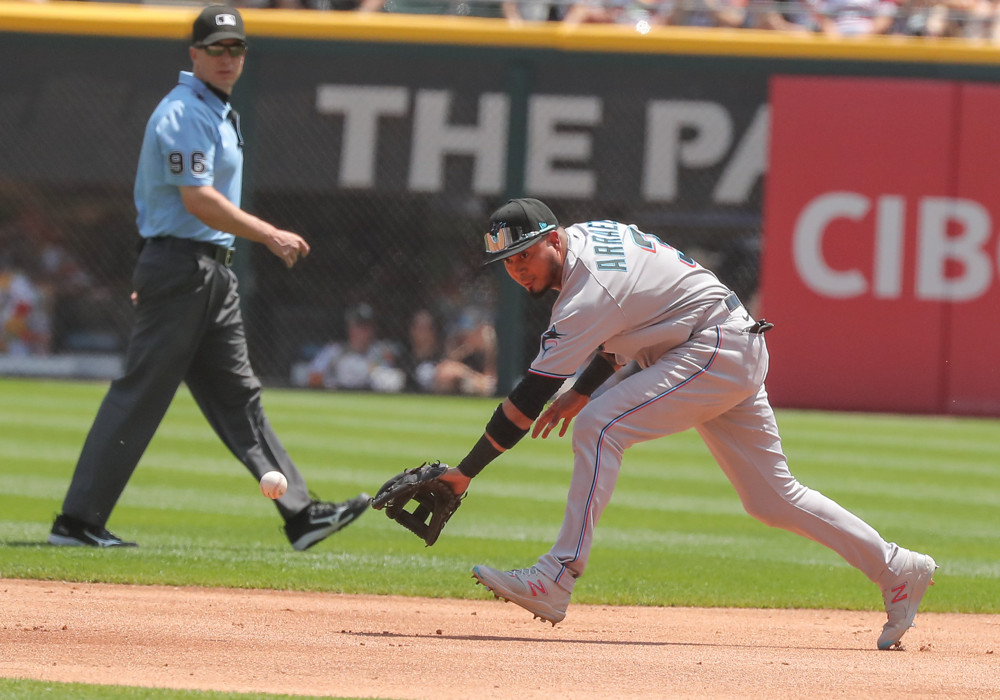
    At second base, there were some who wondered if Luis Arraez could handle the position well. He’s at 1 Run Saved but the Marlins have maximized his value through defensive positioning. They’ve recorded 7 Positioning Runs Saved relative to where they’ve played Arraez. That’s the most Positioning Runs Saved for any team of any player at a particular position this season (in other words, they’ve supplemented his skill by putting him in the best position to make outs.

    “He’s been overwhelmingly better than anyone expected,” Reed said.

    Here’s one Arraez example, a softly-hit ground ball hit by Vladimir Guerrero Jr. on which the out probability went from 51% to 83% because of where Arraez was located.

    And then at third base, Jean Segura has gotten the largest share of playing time but here’s a ball hit to Jon Berti, a 103-mph grounder by Andrew McCutchen where Berti’s positioning boosted the out probability from 50% to 88%.

    This is Reed’s first season with the Marlins after a long career coaching in the minor leagues. He played nearly 1,300 games as an infielder for five teams from 1987 to 1997. He acknowledged to being a traditionalist and pointed out that teams have been using spray charts for a long time. But they’ve gotten more precise over time. And right now, they’re one of many things working well for the Marlins.

    “I’m a believer,” said Reed. “I’ve seen how accurate it is.”

  • Stat of the Week: Patrick Bailey Is A Defensive Difference Maker

    Stat of the Week: Patrick Bailey Is A Defensive Difference Maker

    With all due respect to Diamondbacks catcher Gabriel Moreno and Mets catcher Francisco Álvarez, the best defensive catcher in a promising group of rookie catchers may be Patrick Bailey of the Giants.

    Bailey ranks tied for 2nd among catchers with 7 Defensive Runs Saved, one behind Moreno, despite playing in only 26 games this season. His strengths have been in throwing out basestealers (3 Runs Saved thanks to 8 caught stealing in 21 attempts) and pitch framing (2 Runs Saved).

    Most Defensive Runs Saved (2023) – Catchers 

    Name Team Defensive Runs Saved
    Gabriel Moreno Diamondbacks 8
    Patrick Bailey Giants 7
    Cam Gallagher Guardians 7
    Jonah Heim Rangers 6
    Seby Zavala White Sox 6
    Alejandro Kirk Blue Jays 6

    In his 215 innings, Giants pitchers have a 3.10 ERA and 4-to-1 strikeout-to-walk ratio with Bailey catching. The Giants pitchers have combined for a 4.27 ERA and a 2.8-to-1 strikeout-to-walk ratio with their four other catchers in 2023.

    Bailey is also hitting .318 with an .867 OPS in his first 95 plate appearances. He’s a big part of why the Giants are 25-10 in their last 35 games.

    Bailey was our player guest on the most recent episode of The Sports Info Solutions Baseball Podcast on Thursday. Here are 3 things we learned from him.

    1) A catcher should understand how pitches work

    “Growing up you face guys [and think] this guy’s not throwing hard, but I can’t hit it.

    Like, it seems invisible, right? I keep fouling it off. Well now it’s either got really good vertical [movement] or it’s in the approach angle and low release. And now you can quantify that a pitcher does this well. So our gameplan should be, alright, how do we maximize his strength?

    And then do some stuff to get hitters off the strength.”

    2) Positioning his body is key to framing a pitch on the corner

    “[First] I’m angling my body back towards the plate. Then I go into what I would call my glove prep. So I would kind of position my glove towards the right foot to kind of give myself an angle back to the plate.

    And then as I’m catching the ball, just trying to make it one fluid motion back to the zone.”

    3) He feels like he belongs and that’s reflected in his hitting

    “I think a lot of the hitting has come from just not having to feel pressure where, you know, [in the] minor leagues, sometimes you feel like you gotta hit your way to certain spots here.

    I know defense and catching is gonna be a lot of the value I bring to a team. So kind of whatever I can do at the plate will be a bonus. And it’s been a nice bonus so far, but I’m gonna just try to keep at it.”

    It’s going to be difficult for a rookie catcher to win a Gold Glove Award or Fielding Bible Award, but Bailey seems to be doing something every series to both help his team win and impress voters.

    Against the Marlins, he did terrific pitch-framing work.

    Against the Dodgers he threw out Mookie Betts trying to steal.

    In their most recent series, he threw out Fernando Tatis Jr. trying to steal and initiated a rundown to catch Ha-Seong Kim off third base.

    To listen to our interview with Bailey, check out The Sports Info Solutions Baseball Podcast, which you can find here or wherever you get your podcasts.

  • The Hottest of Hot Zones: Mookie Betts vs Inside Pitches

    The Hottest of Hot Zones: Mookie Betts vs Inside Pitches

    One of a series of four pieces looking at how the best hitters dominate pitches thrown to different areas.

    Every hitter in baseball has a certain part of the zone they absolutely love a pitch to be located in. I wanted to look at the outside and inside quadrants of the zone to see which players are the best and what makes them the best. 

    I looked at some data for each quadrant and picked the player that really stood out in each. Then I dove into some video to see why each hitter has the ability to do so much damage in that zone.

    Best Hitter vs Inside Pitches

    Mookie Betts

    The numbers

    AB AVG SLG OPS 2B HR K Miss%
    82 .329 .744 1.230 4 10 13 14%

    Betts’ .329 avg on inside pitches is around .100 points higher than league average (.244). His .744 slug is almost double the league average(.423). Betts isn’t just taking his hits, he’s mashing pitches inside. 

    When Mookie Betts is at the plate there’s three things he’s focused on:

    1. Lift the ball
    2. Pull the ball
    3. Hit the ball hard

    Betts ranks 12th in MLB in fly ball (48%) and 18th in pull percentage(48%). He also ranks 43rd in Hard Hit% (46%). This has translated to a .407 avg and a .898 slug when he pulls the ball. 

    This spray chart from Baseball Savant is for all of his balls in play. The majority of his hits are to the left side of the field, especially when he goes for extra bases.

    This is why Mookie is able to crush pitches inside, primarily inside and down. On pitches down and in and in the strike zone, Mookie has 9 hits (2 2B and 5 HR). His average exit velocity is 98.7, his highest in any zone. 

    If you’re trying to get a swing and miss inside, good luck. He has a 14% miss rate on those pitches.

    Mookie’s favorite pitches inside are sinkers and sliders and it doesn’t matter if he’s facing a lefty or righty. Six of his home runs have come against those pitches.  He has no real holes inside against righties.

    Betts does struggle somewhat against 4 seamers from lefties, mostly if they pitch them up and in but he still crushes sinkers and sliders from lefties. 

    Video Breakdown

    A few things in Mookie’s swing that make him one of the best hitters in baseball:

    • “Rubber band effect”. Betts has the drift just like we saw with Corbin Carroll (article about him here). The difference is Mookie’s hands are moving backwards as the rest of his body is moving forward. Once his front foot touches down he starts to explode his hands through the zone.
    • The direct path of the barrel. He doesn’t waste any motion in the swing. The barrel takes the shortest path possible. A lot of hitters that want to lift the ball have long loopy swings but Mookie’s is short and direct.
    • The follow through. He doesn’t have a big follow through like we see so often in baseball now. Betts holds on with both hands and a lot of times the bat doesn’t go past his left shoulder. 

    I was watching the U.S. Open while writing this and noticed Betts swing is very similar to a golfer hitting a wedge: Dropping the head of the club/bat directly to the ball and having no follow through.

    Searching Twitter I found a video of Betts golfing in 2022 and the swings are very similar. 

    Side view of HR  vs Josh Hader (96 MPH 4s middle in)

    Turning on a 96 MPH fastball from Josh Hader is not something you see every day. Mookie’s short swing and bat speed is on full display here.

    HR vs Luis Severino 4-seam

    Severino wanted to throw this pitch away but misses middle in and Betts makes him pay. Betts does so well to pull his hands in and get the barrel to this 95 MPH fastball. 

    Watch how short of a path his barrel takes. What helps him have that short path to the inside quadrant is the vertical position of his bat before he swings. This is unlike Carroll (again, read what I wrote about him here) who holds his bat more horizontal. 

    HR vs Logan Webb sinker

    Logan Webb produces a grounder on 67% of the balls in play on sinkers to right-handed batters. Normally a sinker in that location is a fantastic pitch, but not to Mookie. 

    As Betts’ hands move down into the zone the barrel follows right behind them. Because he’s so direct to the ball he’s able to get under this sinker. His back elbow is touching his belt and he can still generate enough power to drive this to left center. 

    Betts has a plan at the plate and is able to execute it to perfection. Of course, he makes it seem way easier than it actually is. His eye at the plate, hand speed and pure athleticism really separate him from other players.

    COLD ZONE

    Focusing on pulling and lifting the ball is great for pitches on the inside quadrant, but not so much on the outside quadrant. Mookie really struggles on pitches away: In 114 AB ending with a pitch outside he has 20 hits (.175 avg).  

    If a pitcher needs a strikeout they have to attack him away, his swing and miss percentage is 24.5% and he’s struck out 38 times. The heat map from Baseball Savant below shows all of Betts’ strikeouts this season.

    Baseball is a difficult game, every hitter has a hole in their swing. The best hitters take advantage when pitchers make a mistake and throw it where they like it. Betts is just one example of that.