Category: Baseball

  • World Baseball Classic Preview: Yoshinobu Yamamoto & Roki Sasaki

    World Baseball Classic Preview: Yoshinobu Yamamoto & Roki Sasaki

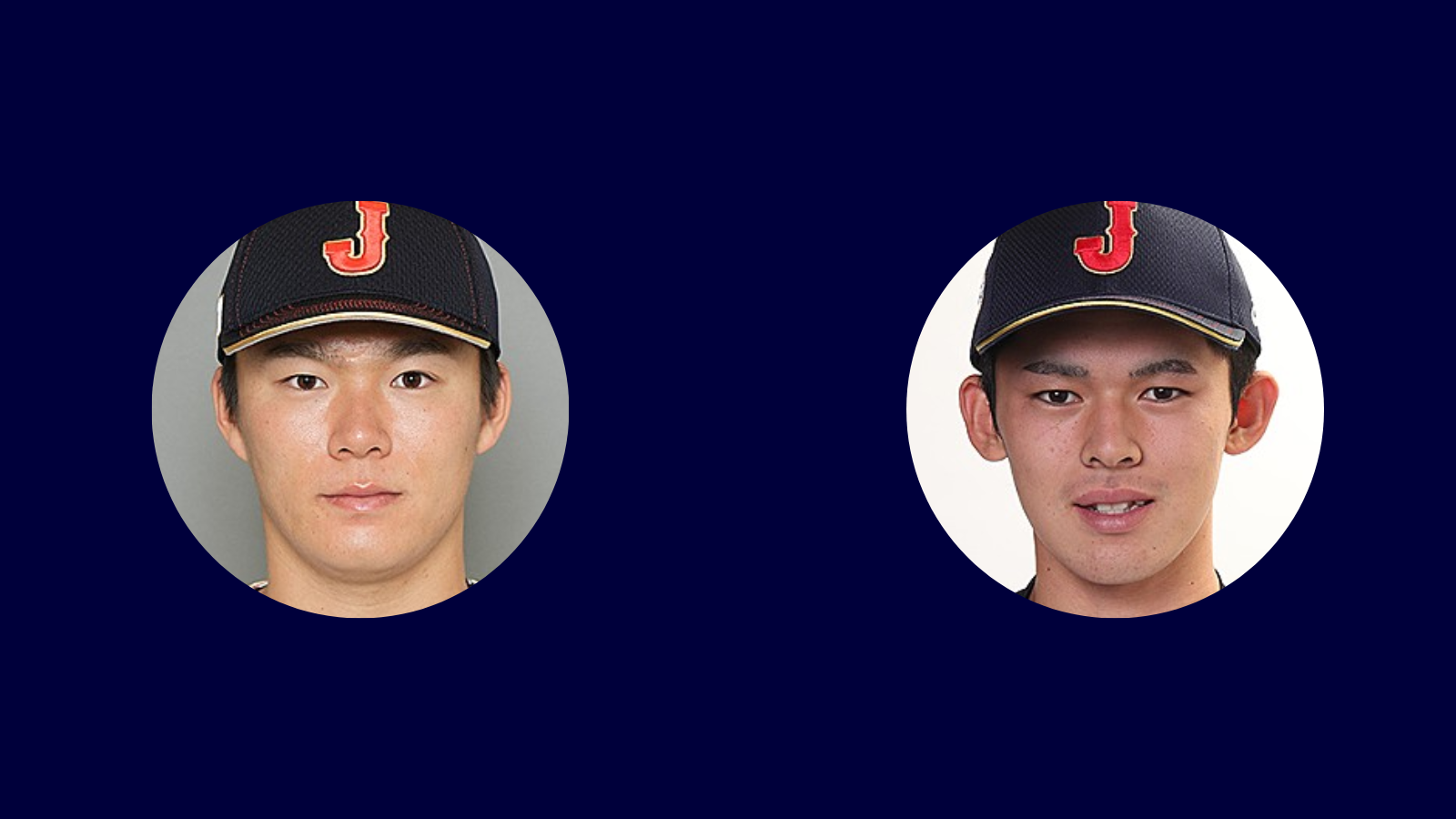
    Samurai Japan has one of the best pitching staffs in the WBC this year. The names Shohei Ohtani and Yu Darvish will be known by MLB fans but a couple of young pitchers across the Pacific Ocean have been making waves in NPB. 

    The young aces

    Two of the best young pitchers in baseball reside in NPB and will be critical factors in Team Japan’s success in this upcoming WBC. Starting with the best pitcher in NPB the last few seasons, Yoshinobu Yamamoto. Yamamoto has dazzled as the Ace of the Orix Buffaloes and was a major factor in why they won the 2022 Japan Series title over the Yakult Swallows. 

    Yamamoto is coming into the WBC off of back-to-back stellar seasons in NPB. In 2021 he had an ERA of 1.39 in 193 2/3 IP with 206 Ks to 40 BBs. He finished with a FIP- of 55. Yamamoto was truly dominant in 2021 and backed that up with more dominance in 2022.

    Last season Yamamoto continued his success with a 1.68 ERA in 193 IP and 205 Ks to 42 BBs almost identical numbers to 2021. His FIP- of 60 led the pack among qualified pitchers. 

    Yamamoto has one of the prettiest curveballs in the world. With excellent command of the pitch as a get-me-over pitch for a strike or a swing-and-miss pitch in the dirt.

    Here are some different ways Yamamoto uses his curveball:

    via GIPHY

    via GIPHY

    Yamamoto has an interesting way of throwing his curveball and it makes the pitch even more effective than most curves. The Ginoza Grip, which I pointed out in my deep dive piece a few months ago, is worth revisiting. Yamamoto shows the back of his hand and flicks the ball or pushes it with his thumb, creating topspin on the ball at a higher efficiency and causing sharp movement. 

    via GIPHY

    Yamamoto’s curveball averaged 79.6 mph which is a high velocity for this type of curveball. Last season. He got 54 Ks with the pitch and it had the lowest slugging percentage of any pitch in his arsenal at .165. 

    There’s a deadly combo between Yamamoto’s fastball and curve. His fastball is electric. He can throw 97 mph with ease and he routinely sat around 94 mph last year.

    Although fastball command is a true separator for Yamamoto as there are countless examples of him painting the edges of the plate, like an artist. Going back to his no-hitter against Seibu he was pinpoint most of the game, spotting the fastball where he wanted it.

    Just look at some of these fastballs knife through the edges of the zone:

    via GIPHY

    via GIPHY

    He’s able to spot his fastball in all four quadrants of the strike zone at any point in the at-bat so hitters have to respect it.

    What I had originally called his splitter or even a sinker-type splitter is more of a sinker than a splitter or forkball. Yamamoto creates a little bit of sidespin and backspin on the ball, almost throwing a hybrid between the two pitches. This is what most Japanese pitchers refer to as the shuuto, which more or less is a sinker.

    Yamamoto’s ability to throw this pitch both for a strike at the bottom of the zone and diving away starting at the knees makes it a true strikeout weapon for him. He recorded 76 strikeouts with the pitch last season and routinely used it with two strikes. He had a 40.3 % whiff rate on the pitch last season.

    via GIPHY

    Yamamoto, who also throws a slider and a cutter, has one of the best pitch repertoires in NPB and he’s about to showcase it on the world stage again.

    Roki Sasaki is probably the best pitching prospect not in MLB. I broke down his perfect game last season when he struck out 19 Orix Buffaloes on April 10th. He backed that performance up with another 8 innings of perfect baseball before being pulled at 102 pitches. 

    The young ace of the Chiba Lotte Marines has started only 31 games in his NPB career going back to 2021 but he’s been a phenom so far.

    In those 31 starts he has a 1.95 ERA and has struck out 241 batters in 192 2/3 IP with an 11.3 K/9 and a 1.8 BB/9. Like Yamamoto, Sasaki controls the strike zone and pumps in strikes. He might not throw with as much command as Yamamoto to this point but he locates to both the arm and glove side with his fastball which sets up his nasty splitter. 

    He is also one of the hardest throwers in the world, routinely touching triple digits with his four-seam fastball. He averaged 98.3 mph last year and struck out 58 batters with his heater. He’s also able to throw with smoothness and ease. Add in long limbs and a powerful move down the mound as he gets great extension toward the plate, making his fastball even better.

    via GIPHY

    via GIPHY


    via GIPHY

    The fastball has life and carry through the zone and it explodes out of his hand. Above you can see even a little tailing action back to the plate. The fastball control – in the zone and down at the knees – sets up his splitter.

    Sasaki’s splitter is a roller coaster ride of a pitch that waits until the last split-second to drop out of the sky as it darts toward the dirt. His splitter is one of the best strikeout pitches in the world. He got 106 strikeouts with it last season 95 of them swinging. Nearly half the swings against it resulted in misses.

    Batters have to commit to the pitch because of his fastball and the late action on the pitch causes batters to routinely swing over the top of it. He’s also able to create different movements either cutting or fading the pitch depending on what he wants. 

    via GIPHY

    via GIPHY


    via GIPHY

    The slider and curveball are works in progress as Sasaki is mainly a two-pitch pitcher for now but the slider does have promise as he can create depth with just a little bit of cut away from the batter to keep them off of his splitter. It produces a 48% whiff rate which is actually better than his splitter.

    He throws the splitter sparingly though, same as his curveball and slider, which he threw 90 times each last season. He throws the slider more in two-strike situations and his curve as a strike stealer early in counts.

    via GIPHY

    Sasaki and Yamamoto at ages 21 and 24 respectively are some of the best young pitchers on the planet. Japan is expected to advance to the knockout stages of the tournament and Team USA might be on a collision course to face one or both of these young pitchers in the semifinals.

  • Stat of the Week: Baseball’s Rising Defensive Stars

    Stat of the Week: Baseball’s Rising Defensive Stars

    This is the time of year when baseball fans get excited about everyone.

    Understandably so. Watch a few games and it’s easy to feel good about players, often rising stars or prospects. And usually you’re watching home runs because they make for good highlights, so you tend to think about them as hitters. But who are the game’s rising young defensive stars?

    In terms of those already in the major leagues, these were the top 6 players in Defensive Runs Saved by a player in his age-23-or-younger season in 2022.

    Name Team Runs Saved
    Andrés Giménez Guardians 17
    Oswaldo Cabrera Yankees 12
    Nick Allen Athletics 10
    Alejandro Kirk Blue Jays 9
    Michael Harris Braves 8
    Alek Thomas Diamondbacks 6
    Akil Baddoo Tigers 6

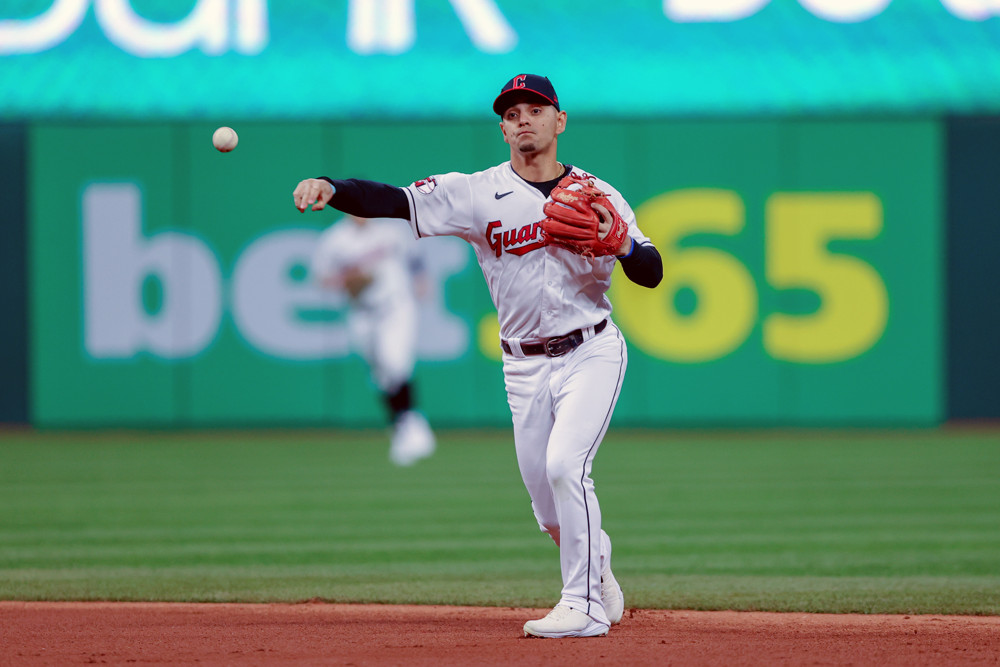
    Andrés Giménez won a Gold Glove and finished sixth in the AL MVP voting in his third MLB season. He looks like he’s going to be a standout, whether he plays second base or shortstop, for years to come.

    Oswaldo Cabrera tallied 12 Runs Saved in only 43 games in the field. He played six positions for the Yankees and could fill a super utility role this year. Right field was his best spot – he finished with 6 assists and 9 Runs Saved there.

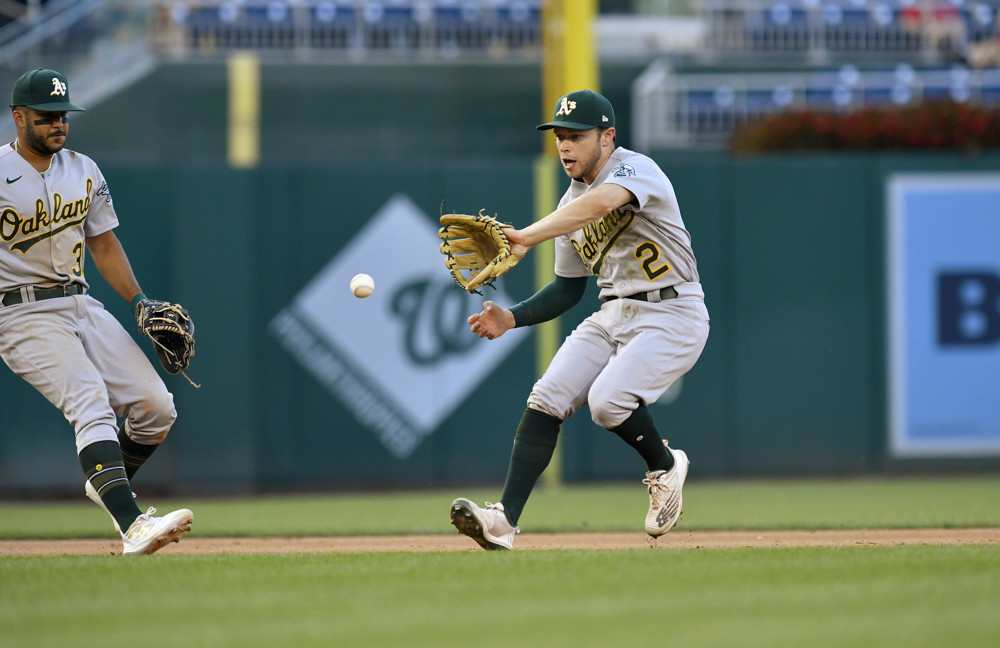
    We just wrote about Nick Allen, another shortstop/second baseman, in an article for our website. He was the most aggressive shortstop at going to his backhand last season and it was an effective approach for him.

    Alejandro Kirk split time between catcher and DH because the Blue Jays wanted to get him in the lineup a lot. In addition to being a Silver Slugger, Kirk also ranked 3rd in Runs Saved from blocking pitches and ranked tied for 6th in Runs Saved among catchers.

    We featured Michael Harris prominently in The Bill James Handbook 2023, and for good reason. He totaled 19 home runs and 20 stolen bases to go with his 8 Runs Saved last season. He’s arguably the most likely player to have a 20-20-20 season (20 homers, 20 steals, 20 Runs Saved).

    Alek Thomas was similar to Allen in that he didn’t hit much but stood out for his glove. His 17 Good Fielding Plays in center field ranked 3rd at the position behind Myles Straw (24) and Victor Robles (18).

    Akil Baddoo is another whose hitting needs some work, in his case to get back to the success he had in 2021. The glove played well in left field last season and with the Tigers in rebuilding mode, he should continue to get chances to prove he can be a solid big leaguer.

    There was a time when Scott Rolen was one of the game’s rising defensive stars. Read about Rolen’s reign of defensive excellence in an oral history on our website.

  • World Baseball Classic Preview: KBO Hitters & Fielders

    World Baseball Classic Preview: KBO Hitters & Fielders

    South Korea is typically a strong nation in international baseball competitions, and this year’s World Baseball Classic team is a favorite to advance out of their pool. Team Korea’s lineup will be headlined by Cardinals shortstop Tommy Edman and Padres infielder Ha-seong Kim, with former Orioles outfielder Hyun-soo Kim playing a supporting role, among others. 

    Outside of those three, many players in key spots will be unfamiliar to many North American fans. So let’s preview some of their key players from the KBO, a league that we watch intently here at Sports Info Solutions:

    The Young Bats

    Team Korea has two young left-handed hitters who will line up in the middle of the order for the WBC. The first is Jung-hoo Lee, a 24-year-old outfielder for the Kiwoom Heroes. Lee is the best pure hitter in the KBO, with a career batting average of .342 and more career walks than strikeouts. Last season Lee did his best Tony Gwynn impression, posting a tiny 5% strikeout rate with an 11% walk rate.

    His bat to ball skills and discipline are paired with modest game power, though his raw power suggests more room for growth. Lee ranked fourth in the KBO last season with an average exit velocity of 89 MPH according to our Synthetic Statcast model (SIS replicates Statcast data for non-MLB leagues), and he also finished in the top 10 in hard-hit rate (38%) and expected BABIP (.388). His swing currently produces a lot of line drives, which limits his ability to drive balls out of the park, though the raw power he has suggests he could sacrifice some batting average for more power with mechanical changes.

    Defensively Lee has played exclusively in center field the last two seasons, and will likely line up in center for Team Korea. He is a natural athlete, but doesn’t have the elite instincts needed to play a high-end center field and profiles better in a corner spot long-term. His baserunning is similar, as he is a good baserunner due to his natural athleticism, but does not have elite speed or base stealing ability.

    Lee will be hoping to use the WBC as a chance to showcase his hitting skills against elite pitchers, as he is expected to be posted by Kiwoom after the 2023 season. His first chance to test himself will be against Team Japan in pool play, with Japan having one of the deepest pitching staffs in the tournament.

    Joining Lee in the heart of the lineup will be KT Wiz first baseman Baek-ho Kang. Kang is very much a bat-first player who has adjusted his approach during his time in the KBO. In his rookie season Kang set his career highs in home runs (29) and strikeouts (124), but since then has traded some home run power for more contact and gap power.

    Despite his strong performances in the KBO, there are some storylines worth following with Kang in the WBC. He took a lot of criticism for how he reacted to Korea’s disappointing fourth- place finish in the Tokyo Olympics, though he did hit .308 with a double and 4 RBI over the tournament.

    Kang also dealt with some adversity in the KBO for the first time last year. He missed the first couple of months of the season with a toe injury, and also missed a month and a half with a hamstring injury. Between the injuries Kang struggled to produce at the plate for the first time in his career, posting career lows in many categories in his statline. 

    His advanced metrics show how much the injuries limited his game. His hard-hit rate dropped from 33% to 26%, and his average exit velocity was down by 1 MPH. Despite increasing his average launch angle in 2022, he set a new career low with only 6 home runs and a .371 SLG over 62 games. He will be looking to rebound in 2023, and hopefully a strong showing in the WBC will help him get off to a good start this year.

    The KBO Veterans

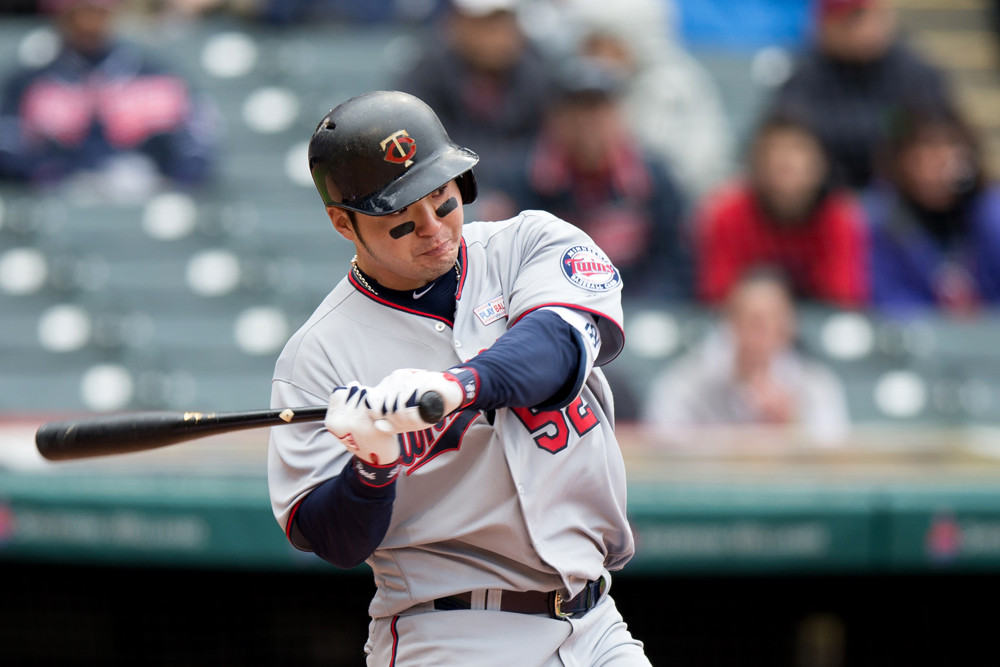
    Beyond the MLB players and potential future stars, Team Korea has some veteran players rounding out the lineup from the KBO. Alongside Hyun-soo Kim, who fans likely remember from his time in Baltimore, Byung-ho Park is the other position player with MLB experience. Park signed a four-year deal with the Minnesota Twins before 2016, but struggled in his limited MLB opportunities. He requested his release two years into the contract to return to the KBO.

    Park was a notable prospect for his power, which he did show in his brief MLB look, hitting 12 home runs in 62 games. Now 36 years old, Park is still hitting the ball hard as he led the KBO in hard hit rate last year at 41%, while also finishing second in average exit velocity (just under 90 MPH) and sixth in average launch angle (just over 18 degrees).

    Park’s continued success hitting for power has him fourth all-time in KBO home runs despite a slow start to his career and missing two of his prime years playing in North America. At 362 career home runs, he is only 12 behind Dae-ho Lee for third all-time.

    Park will likely line up at first base for Team Korea, with fellow KT Wiz teammate Baek-ho Kang will likely be the DH. The veteran Park is a much better defender, and won the KBO Fielding Bible Award at first base this past season.

    Across the diamond at third base will be another KBO veteran, and one of the most accomplished KBO hitters in history, in Jeong Choi. He produced a SLG above .500 in each season since 2010 and from 2010-2021 he had an OPS of .900 or better every year, falling just below that benchmark in 2022 (.891).

    Choi ranks 17th in KBO history in hits and is second all-time in home runs. He is only 7 hits away from reaching 2,000 career KBO hits, and is 38 home runs behind Seung-yeop Lee  in all-time KBO home runs.

    Choi’s formula for success is quite simple, as he hits the ball hard and in the air. Choi led the KBO in average launch angle last season, checking in just under 22 degrees. Combining that with his good raw power (he’s in the top 25 in average exit velocity and hard hit rate) allows him to maximize his power output.

    Team Korea will also rely on a veteran behind the plate, with 14-year veteran catcher Eui-ji Yang of the NC Dinos. Yang is a solid defender, having won the 2020 KBO Fielding Bible Award at catcher, and has plenty of experience calling games and leading pitching staffs.

    However, Yang really shines in the batter’s box. He has always been able to make contact, evidenced by high batting averages and low strikeout rates, but he tapped into more power later in his career by increasing his launch angle. He has walked more than he has struck out in four of the last five seasons, while posting his best power numbers during that time as well.

    In the outfield, Sung-bum Na will look to add some power from the left side of the plate to Team Korea’s lineup. Na attracted some interest from MLB teams after the 2020 season, but was unable to find a contract to his liking and returned to the KBO. Na has big power, and in 2021 he finished in the top 5 in average exit velocity and hard hit rate in the KBO. He didn’t quite match that in 2022 but still had solid numbers in those areas.

    Na also features some flaws in his game that can be exploited. He strikes out a lot, with his strikeout rate sitting between 20% and 25% each of the last few seasons. He has been in the top three in the KBO in strikeouts in each of the last three seasons.

    Na also dealt with a gruesome injury in 2019, and his mobility has suffered since returning. He is not a threat on the bases, and he has lost range in the outfield. Expect him to be replaced with a defensive replacement or pinch runner in the WBC.

    The KBO Fielding Bible Award Winners

    The KBO is not a league known for having elite defense. Most position players in the league are rated below MLB average by DRS, and some drastically so. However, Team Korea has made sure to fill the roster with some of the best defensive players in the country, particularly ones who grade out as MLB average or better.

    On the infield, Hye-seong Kim of Kiwoom has won two KBO Fielding Bible Awards at second base (2020 and 2022), as well as the 2020 multi-position Fielding Bible Award. Primarily a second baseman with Kiwoom, he was the double play partner of Ha-seong Kim before he joined the Padres. Hye-seong Kim has also played shortstop and left field in recent seasons, and could also pinch run for Team Korea in the WBC (he has three seasons of at least 30 steals, with a career best of 46).

    Also available on the infield is Ji-hwan Oh, who has won the KBO Fielding Bible Award at shortstop in each of the last two seasons. He likely would have battled Hye-seong Kim for a starting role on Team Korea had Tommy Edman not joined the team for the WBC.

    Since we started awarding the KBO Fielding Bible Awards in 2020, the center field award has been won by either Hae-min Park (2020 and 2022) and Ji-hoon Choi (2021). Both players are on Team Korea for the WBC, and could either start in center field (moving Jung-hoo Lee to a corner) or more likely come off the bench to upgrade the corner outfield defense in the late innings.

    Park is a speedster who covers a lot of ground and can steal bases, though he has cut back on his stolen bases a little as he entered his thirties. At 25 years old, Ji-hoon Choi is 7 years younger than Park, though he is a very similar player as a left-handed hitting speedster with modest power.

    Team Korea has built a well-balanced roster for the WBC, with some young stars, veteran leaders and quality supporting players. A big test for this position player group in pool play will be how they manage to do against the powerful pitching staff of Team Japan. Once out of pool play, the pitching it faces is expected to be much tougher, and their hitters ability to adjust to high-end pitchers will determine how far the team goes.

  • WBC Preview: Team Korea Pitchers to Watch

    WBC Preview: Team Korea Pitchers to Watch

    Almost every team in the World Baseball Classic struggles with pitching depth. With pitch counts and pitchers still stretching out for the season, teams need contributions from all over their roster. Team Korea is no exception, as it will be missing two pitchers who could have been rotation anchors in Hyun-jin Ryu and KBO ace Woo-jin An (note, you may see some of these names differently depending on where you see them – Korean naming convention is traditionally last name first).

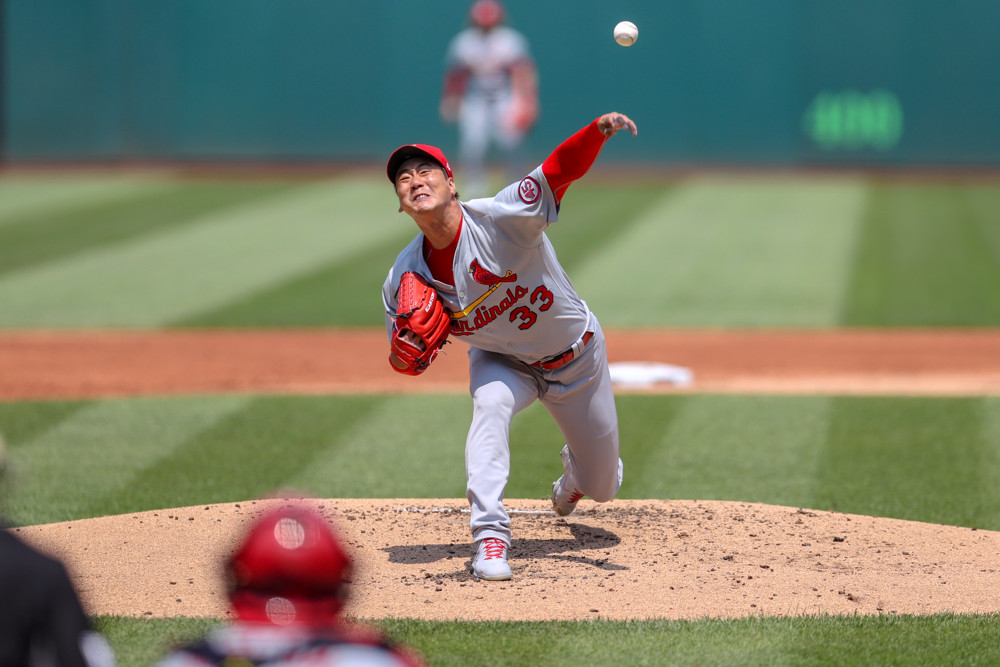
    Team Korea will still feature pitchers with plenty of experience in the KBO, and a couple with MLB experience as well in Kwang-hyun Kim (2020-21 with St. Louis) and Hyeon-jong Yang (2021 with Texas). Beyond those two, the team features pitchers who have performed well domestically in the KBO as well.

    At Sports Info Solutions, we watch a lot of KBO as part of the data tracking we do. So we’re well-versed in their players. We will be highlighting some of their top pitchers here.

    Potential Starters

    Kwang-hyun Kim will be the ace of Team Korea, but how the rest of the rotation lines up is still up in the air. Fellow lefty Chang-mo Koo will likely also start in the WBC, and is one of the best KBO pitchers when healthy. Health is a bit of a concern for Koo, who has thrown only 205 innings over the past three seasons, and missed all of the 2021 season.

    Koo gained popularity for his lights-out performance early in the 2020 KBO season, before getting hurt later in the season. Koo commands his fastball well, which is necessary as he averages 89 MPH with the pitch. His slider is one of the best breaking balls in the KBO, and while he doesn’t throw it very hard at 82 MPH, it has good horizontal movement and had a 36% whiff rate last season.

    Koo also throws a good splitter almost exclusively to right-handed hitters, who clearly struggled with it as evidenced by a 38% whiff rate against the pitch. He also rounds out his repertoire with a slow, loopy curveball that he uses as a change of pace pitch.

    Tae-in Won from the Samsung Lions will also likely start games for Team Korea. Won lacks a power fastball (he averaged 90 MPH last season), but he has a great changeup with a strong 12 MPH velocity differential from his fastball with really good two-plane fade. He also has improved his slider and added a cutter, as we covered last season.

    Won is also a good fielder at his position, winning the 2022 KBO Fielding Bible Award at pitcher. For a right-handed pitcher, Won is exceptional at controlling the running game. In 2022 he allowed only 6 stolen bases all season, while also picking off 6 runners.

    Eui-lee Lee  may start or come out of the bullpen for Team Korea, but the Kia Tigers’ lefty is one of the best young pitchers in the KBO. Lee can be effectively wild at times, but he provides Team Korea with their strongest arm from the left side (his average fastball velocity was 91 MPH as a starter last year).

    Lee also throws one of the hardest curveballs in the KBO, which averages 78 MPH. He rounds out his repertoire with a slider that he will use against left-handed and right-handed hitters, and a changeup that he uses exclusively against right-handers. The slider and changeup are his least used pitches, but he sets them up well which makes them his best swing-and-miss pitches.

    Doosan Bears starter Been Gwak is the most likely of the starters to transition to the bullpen for Team Korea, as he is less established than the other starters. Gwak has more velocity on his fastball than most KBO starters, averaging 92 MPH as a starter last season. Team Korea could be hoping that his fastball plays up in short stints, but it is also worth noting that his fastball was hit quite hard by KBO hitters last year.

    Gwak brings a deep repertoire to the table, and he could cut it down to just his best pitches working in shorter stints. His slider, splitter and curveball all had whiff rates above 30% last season.

    LG Twins Relievers

    As a league, the KBO does not feature a lot of pitchers with high velocity, with most pitchers featuring high 80s fastballs and good offspeed pitches. The LG Twins have two of the best power relief prospects in the league, and both will be featured on Team Korea.

    Woo-suk Go is LG’s closer, and the hardest throwing relief arm in the KBO. His fastball sits at 95 MPH and touched 98 last year, and he has thrown it over 50% of the time. Instead of featuring a changeup or splitter, Go relies on three breaking balls (a cutter, slider and curveball). His breaking balls can all overlap in shape and velocity, but he throws them all well above the KBO average velocity for each pitch type.

    Go is still young at 24 years old, and he has steadily brought his walk rate down the last few years. He also has a lot of experience in high leverage situations with 124 career KBO saves, including a career best 42 saves in 44 opportunities in 2022. Expect him to be pitching high- leverage innings for Team Korea.

    While having a flamethrower like Go in the bullpen is a luxury for most KBO teams, the Twins have two relievers with big fastballs to shut down opponents late in games. Woo-young Jung, LG’s 23 year old setup man, just trails Go in average velocity at 94 MPH on his fastball which still makes him one of the hardest throwers in the KBO.

    Unlike Go, who primarily pitches from a standard ¾ arm slot, Jung is a sidearming righty who gives batters a bit of a different look. Due to his arm slot, Jung’s fastball gets a lot of sink and tail which makes it difficult to square up and elevate. In 2022 Jung’s fastball produced grounders on 72% of balls in play and he  gave up only 3 home runs all season. This is even more impressive when you consider he threw the fastball over 90% of the time, so hitters were often sitting on fastballs.

    Overall, Team Korea may be light on power in the pitching department, but the staff is fairly deep with pitchers who have had success in a strong league. Should the team make it out of pool play, the depth of their staff will be tested by the strong offenses of teams that make it to the knockout rounds.

  • An Oral History of Scott Rolen’s Defensive Excellence

    An Oral History of Scott Rolen’s Defensive Excellence

    As a hitter, Hall of Fame inductee Scott Rolen’s numbers are outstanding, but perhaps not distinct, comparable as they are to those posted by very good third basemen like Ken Boyer, Ron Cey, and David Wright. None of them is in or appears on his way to the Hall.

    What Rolen had that the others didn’t was defensive excellence, represented by eight Gold Glove Awards. Had Defensive Runs Saved been tracked for the first seven seasons of his career (DRS debuted in 2003, meaning Rolen played only 10 seasons with the metric in place), he’d likely be neck-and-neck for category leadership with Adrián Beltré (whose defense was DRS-measured across 16 of 21 active seasons).

    Both Runs Saved and its predecessor on Baseball-Reference, Total Zone Runs, elevate Rolen’s credentials. Rolen ranks tied for 17th in the offensive component of Wins Above Replacement for third basemen; his Defensive WAR ranks 6th. And it’s his defense in tandem with his offense (and his highly-praised baserunning) that made him a Hall of Famer.

    To better understand how Rolen played defense—dating all the way back to its beginnings—I reached out to those who experienced it first-hand and from close range to ask one overarching question:

    What was it like to watch Rolen save runs?

    (Teammate seasons with Rolen are listed in parentheses).

    Rolen’s defensive origin story began in Jasper, Indiana, a town of about 10,000 people. It’s where Rolen grew up and where he and his friends played baseball (and variations thereof) every day. Rolen and one friend kept track of the games in a notebook. He was the Dodgers of Steve Garvey and Pedro Guerrero. His friend Cory was the Cardinals of Jack Clark and Ozzie Smith.

    Cory Luebbehusen (Little League and Jasper High teammate, 1985-1992): “We always took a tennis racket and hit tennis balls over electric wires. We would hit pop flies to each other, whoever caught the most won. If I was down one or he was down one, we made it pretty darn hard for [the other person] to catch it. He was good at that game. Everything he touched, he was pretty good at.”

     At age 10, Rolen was playing with the 11- and 12-year olds. He pitched and Luebbehusen caught, and then they’d switch and Rolen would also play shortstop, which honed his arm.

    Andy Noblitt (Jasper High, 1991-1993): “We had a track meet where we had to throw a softball and he had the ability to throw it from our high school softball field all the way to the Little League field, which is probably 150, 160 yards, as a seventh-grader.”

    A growth spurt was a few years away. High school teammate Noblitt watched Scott rise from 5-9, 155 pounds as a sophomore to 6-3, 190 as a junior and transition from shortstop to third base.

    Noblitt: “I remember him making diving plays in the 5/6 hole that no one else would make. A lot of the guys would call him ‘Web’ because it felt like he had a Spider-Man web on him that could catch anything.”

    Luebbehusen: “You had coaches that would hit ground balls on a high school gym floor as hard as you could. That ball got on you quick. So if you weren’t ready to play defense, you were gonna take one in the chops.”

    Noblitt: “We were 32-2 and a majority of our team played a college sport, but he was just so much more skilled than our college-bound players.”

    Rolen was drafted in the second round by the Phillies, 46th overall in 1993. His first minor league roommate was another third baseman, Bryan Wiegandt, an undrafted infielder out of Bellarmine University (Kentucky) who was four years older than Rolen. Wiegandt says he was Rolen’s Crash Davis, the grizzled veteran who taught the kid how to pay rent and do laundry. They roomed together in the low minors and Rolen then roomed with Bryan’s older brother (another Scott) when he reached Triple-A.

    Bryan Wiegandt (Minor League IF, 1993-1994): “There were times we didn’t even need a shortstop. He was like a gazelle. One-hundred percent. Just smooth every step of the way. He ran first to third or second to home as quick as anybody. That carried over to his defense. If the batter hits one down the line, I’m thinking double off the bat and the next thing I know, the ball’s in my chest and I’m turning a double play. Or if the ball’s to his left, all of a sudden he’s playing shortstop and he’s flipping the ball to me within 1.2 seconds off the bat. He’s playing third and he’s on top of me, like, ‘Here’s the ball, are you going to throw it to first?’”

    Bronson Heflin and Scott Rolen got called up to the major leagues together and then both debuted on the same day, August 1, 1996. Rolen’s career spanned 17 seasons and more than 2,000 games, with his performance in his first full season earning him 1997 National League Rookie of the Year honors. Heflin allowed seven runs in three games in a seven-day period and was sent back to the minors; he pitched four more years in the minors but never another major league game.

    Bronson Heflin (Phillies org. P, 1994-1996): “The biggest play he ever made when I was pitching that I can remember was against the Braves’ Triple-A team. There was a swinging bunt, and I was crossed up. I was trying to get untangled to get back to pick the ball up and all I remember was this monster coming out of nowhere, throwing it while still running towards the catcher and throwing the guy out at first base.

    “It was just one of those plays where I was just like, ‘Wow, did that really happen?’”
    Todd Zeile was Scott Rolen’s first major league first baseman and an experienced third baseman in his own right. The 1996 Phillies were the third of Zeile’s 11 MLB teams. He had a lot of teammates, but few compared to Rolen defensively.

    Todd Zeile (Phillies 1B, 1996): “There’s a timing mechanism that good third basemen have [so] that they know how much time they have to deliver the ball to get the runner by a step. Scott, for as athletic as he was at third base, had that built-in clock. I had really struggled with that and made a lot of unforced errors. He would dive and sprawl and roll and come up and throw it from weird angles but he always seemed to have that clock that would give him just enough time to get his balance, make accurate throws, and not make unforced errors.”

    Mike Lieberthal (Phillies C, 1996-2002): “He was also amazing on the fly ball hit over his head, going down the left field line. He was very light on his feet for his size.”

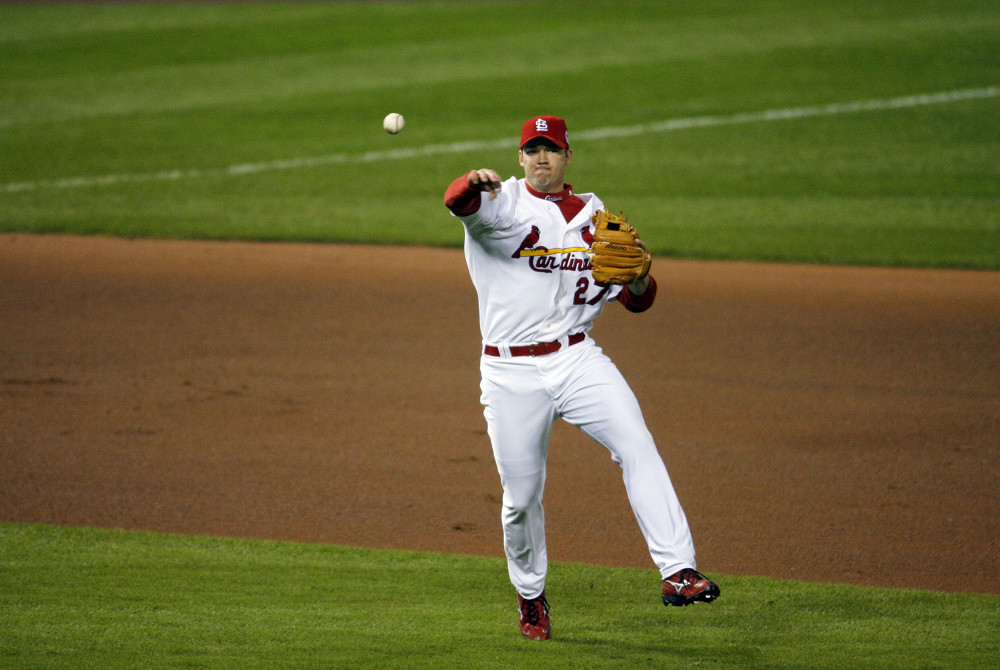
    Desi Relaford (Phillies SS, 1996-2000): “He did this slide thing where he could slide on his knee or ass, a slide-scoop, know what I’m saying? Backhand. And he would either throw it from his knees or he’d pop up if he had time and show off the cannon. I saw that one a lot.”

    Zeile: “He was very good at throwing on the run, especially moving away from first base. He had arm strength when he needed it.”

    The impressions Rolen made early were echoed by impressions he’d continue to make as his career unfolded.

    David Eckstein (Cardinals SS, 2006-2007, Blue Jays, 2008): “The first movement to the ball was catlike. You know how you see a cat that’s sitting there, they see something and they explode to it?”

    Nelson Figueroa (Phillies P, 2001): “The thing about Rolen is he was so big but so agile. His reads were instantaneous, and he could cover so much ground. He had the range of a shortstop with the stopping power of a brick wall.”

    Paul Janish (Reds SS, 2009-2011): “You’re talking about a 6-4 or 6-5 guy that was probably pushing 240, like a really big individual, and he just made it look easy.”

    Jim Edmonds (Cardinals CF, 2002-2007): “Scott was like this solid wall of defense.”

    Lieberthal, twice a National League All-Star as a Phillie, said one of the first things he noticed about Rolen was that Rolen’s legs looked like they were three times the size of his average-sized legs. He was impressed by Rolen’s ability to get to balls so easily despite that size. So Lieberthal let Rolen know about one type of play that Scott could have to himself.

    Lieberthal: “I hated popups. So I would tell him, especially in [windy] San Francisco, and any place that had a large area behind home plate, ‘Scotty, you can have all the popups. I’m not dealing with it.’”

    Relaford: “When you have someone on your team who was as good as he was and being able to watch him every day, not only does he make your team better, but you can learn from that, and implement. Whether it’s the tenacity or getting good jumps. You can’t teach me 6-5, 230 pounds, but just being able to take it all in and see what he brings to the park from a mindset standpoint.”

    “He played the game like it was supposed to be played. He played hard. He ran hard. He threw hard.”

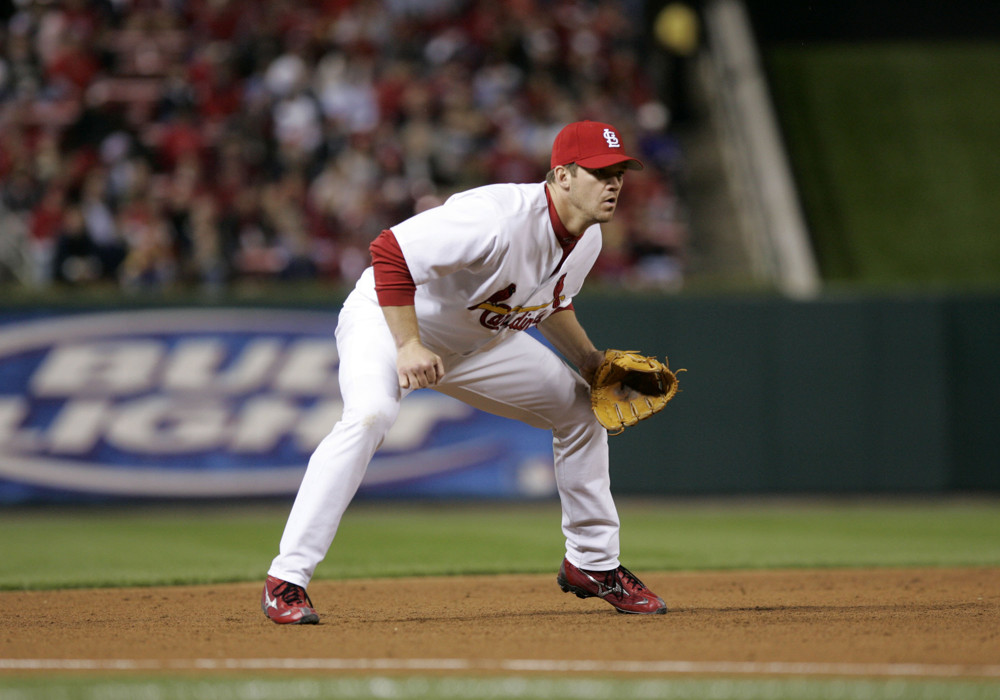
    Rolen moved to St. Louis when he was traded to the perennial contender Cardinals in 2002. It proved to be the definitive step in his career. In 2004 he had an MVP-caliber season, totaling 34 home runs, a 1.007 OPS, and 30 Defensive Runs Saved, the latter the most by a third baseman in the 20-year history of the stat, all en route to hitting the deciding home run against Astros pitcher Roger Clemens in Game 7 of the NLCS.

    Jeff Suppan was the winning pitcher in that Game 7. Suppan didn’t throw hard and relied on trickery and outsmarting hitters. Like Figueroa in Philadelphia, he relied on his third baseman.

    Jeff Suppan (Cardinals P, 2004-2006): “When I throw a changeup to a right-handed hitter, I’m trying to get him to hook it. But if he keeps it fair, it’s going to be a rocket. Or if I pitch inside to open up pitches away, if they make contact, they’re rockets to third base. So any time I pitched inside, I let him know. His backhand ability was off the charts. And I can’t remember, unless a ball was right down the line or way in the hole, a ball ever getting by him.”

    Figueroa: “When I was in hitters’ counts I used offspeed pitches a lot to take advantage of their aggressiveness. And if it was hit to my right on the ground, I knew it was an out. As sure as the hands were, his arm was just as reliable. He made the ordinary plays look ordinary, but the extraordinary plays look routine.”

    Suppan’s earned run average with the Cardinals was 3.95, markedly better than his 4.70 career ERA. Rolen and the Cardinals infield was integral to that.

    Still, even an eight-time Gold Glover isn’t impervious to imperfection. In Game 7 of the 2006 NLCS, a Rolen throwing error set up an inning in which the Mets loaded the bases with one out in a tie game. Suppan escaped and the Cardinals won the pennant on Yadier Molina’s home run in the 9th inning.

    Suppan: “He thanked me after the game. He didn’t have to thank me. He had picked me up so many times.”

    Another player Rolen often picked up was shortstop David Eckstein, MVP of the 2006 World Series, in which Rolen batted .421 and claimed his only world championship.

    Eckstein: “When I signed with the Cardinals in 2006, Tony La Russa said to me that we don’t need you to play phenomenal defense. You just have to be able to get the ball hit to you, because you have a guy that’s going to be playing to your right that will make every play, and he’ll make you look like a better shortstop because of his range to his left. As everyone knows, my range on the backhand was subpar at best, but that’s what Scotty did. It took the pressure off of worrying about the balls that were difficult for me.”

    Janish: “He was a very talented individual, but he was just really good at doing the same thing over and over again.”

    Eckstein: “I always say he ‘ate’ the ball. And all of a sudden the ball was in his massive hands and he worked the ball through to first base. He had that first step where he was in front of you before you even knew it.”

    Abraham Núñez (Cardinals 2B/SS/3B, 2005): “It was amazing to see his preparation, his dedication. He showed up early to the field and every ground ball mattered. Every day, he took a round of live batting practice at third base, reading balls off the bat. He was gifted by his preparation in every aspect. It was something I never saw before from a superstar like that.”

    Edmonds: “He was just so far above as far as positioning and being ready and thinking everything through… knowing that so-and-so is going to throw a forkball in a situation or a slider, and that he needs to adjust his feet or move into a different spot. There were very few people you would hear talk about that stuff. He was one of them.”

    Edmonds won eight Gold Gloves, the same number Rolen did. So he knows defensive excellence quite well.

    Edmonds: “If you watched him take ground balls at 3 o’clock in the afternoon, he’d take ground balls in the same rhythm. He would get it into his glove, he would take a little jog step and then he would throw it. His rhythm was so perfect.”

    When Rolen was with the Cardinals, sometimes first baseman Eduardo Perez was warned of something Rolen liked to do to maintain the rhythm Edmonds cites.

    Eduardo Perez (Cardinals 1B/OF, 2002-2003): “I remember Tino Martinez telling me, ‘On a ground ball to third, don’t take your eye off the ball.’ I said, ‘What do you mean?’ Tino played far from first base. So did I. Rolen would sometimes throw the ball to first base without the first baseman being anywhere near there. So every time there was a ground ball to third, it was a sprint to get to first. I’m like, ‘Are you kidding me?’ And [Rolen] is cracking up.”

    Eckstein: “That was Scotty. He’s like, ‘I’m not changing who I am. I’m gonna field the ball and throw it straight to the base.’ The accuracy of the arm was very impressive.”

    Perez: “His throws looked like a true four-seamer from third to first. It continued to have carry and gravity wouldn’t defy his throws.”

    Edmonds, now a Cardinals broadcaster, said what separated Rolen from other third basemen was how relaxed he was and how in tune he was with his pitchers.

    Edmonds: “It’s weird when you watch the really good player, how uncanny it was to watch their calmness. That was the best thing about Scott. He never looked like there were any nerves.”

    If Rolen was instrumental in bringing down his own pitcher’s ERA, it would figure his defense would take a toll on more than a few opponents’ offensive stats.

    Moises Alou, whose career spanned 1990 to 2008, recorded more than 2,100 hits and a .303 career batting average. But he hit more balls that Rolen turned into outs than any other hitter (50, per the Elias Sports Bureau).

    Moises Alou: “He got me out on a lot of hard shots. I could’ve hit .305 instead of .303 [Alou laughs]. I was a dead pull hitter. Some balls that I hit could have been hits if it was another third baseman.”

    An elite hitter might find himself frustrated by Rolen, but if you were on the field in another role, such as umpire, you couldn’t help but be impressed.

    Dale Scott (MLB Umpire, 1986-2017) “If I was working second and didn’t have a decision to make, you could just watch the talent and the athleticism and sometimes the amazement of how he was able to get to the baseball and also get off a throw that was true, right to where he wanted it to go.”
    In January of 2008, Rolen, who’d missed significant time due to injuries two of his three previous seasons in St. Louis, was traded to Toronto, for whom he played a year-and-a-half. Travis Snider was a 20- and 21-year-old rookie on those Blue Jays teams, playing the corner outfield spots. Before Snider made his MLB debut, Rolen, who was hitting one spot in front of him, told him, “You only get one debut. So no matter whether you go 3-for-3 or strike out three times, enjoy every minute of it because you only get one.” Snider appreciated all the advice he got.

    Travis Snider (Blue Jays OF, 2008-2009): “I remember I made an error in left field one time. I was being pretty aggressive because we preached taking aggressive angles to make plays. Scott came over and said, ‘Hey, as long as you make mistakes aggressively, you’ll never have a problem with me.’ From hearing that, I was able to play with a little more freedom. It was great to hear it from a guy like Scott Rolen.”

    Snider surely enjoyed the clear view he had of third base from left field.

    Snider: “One of the unsung beauties of playing the outfield is getting to watch really good infielders make plays in front of you. Scott’s body had hit the ground probably thousands of times before I got a chance to play with him and you would never know it by the way he played, getting in the dirt, getting after it.”

    The Reds traded for Rolen in the middle of the 2009 season and he played the next three-and-a-half years for them before retiring. When Rolen was healthy, his defensive stats continued to reflect his reputation within the game. Janish, who regularly stood to Rolen’s left from 2009 to 2011, doesn’t want to use the term vanilla, but…

    Janish: “It was very much like [being] in a good position to field, like it wasn’t flashy. Could he make the barehanded play? Sure. But did he do it when he didn’t have to? No. He didn’t dress up a whole lot of it, He made as many plays easy as you could, if that makes sense. He didn’t make plays harder than they had to be.

    “He was more concerned with getting the guy out, which, that’s kind of who he is, right? It’s about the result, not about what it looks like.”

    To completely appreciate what Rolen brought to third base, you have to talk about the position with somebody who not only played it, but was compelled by circumstances to do so as Rolen’s teammate and replacement.

    Entering 2005, new Cardinals utility infielder Abraham Núñez had played 445 games in the field; only eight of them were at the hot corner. Núñez expected to fill in at the other infield spots, because after all, Rolen played every day. But then Rolen injured his shoulder in a collision in May, and Núñez filled in for five weeks. Rolen came back and played third base for a month, only to opt for season-ending shoulder surgery in July.

    The position became Núñez’s for the rest of the season. Fortunately for the career backup, he had once asked Rolen for some tips on playing third base… just in case he was ever needed there.

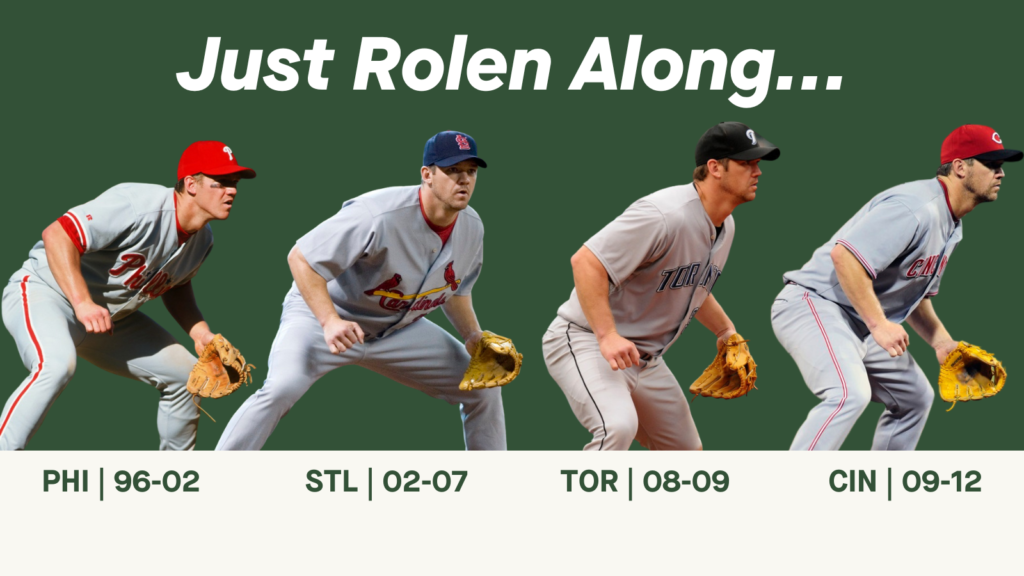
    Núñez: “At shortstop, it took me a little longer to get set up on defense because I had more time. So I asked him how you set up at third base. He says to me, ‘You don’t have time to make a big move. You’ve gotta be short and compact with a quick first step. I don’t want to be flatfooted. I want to be more on the balls of my feet when the ball is crossing the plate. I’m in sync with the pitcher so I can be on time for every ball.’

    “It made sense. It was hard for me. But it was easy for him.”

    Flash forward a couple of months to Núñez playing every day and holding the position down reasonably well and Rolen doing his rehab exercises to try to get back to health.

    Núñez: “I remember this like it happened today. He said, ‘Dude, you’re doing an outstanding job. I wanted to tell you face-to-face how good of a job you’re doing.’ That meant a lot coming from him. That’s a big memory.”

    Núñez has since worked in the Royals minor league system. He has used video of Rolen’s pre-pitch setup for instructional purposes, an indicator—along with the comments from his teammates—that Rolen’s Hall of Fame defensive legacy will be long-lasting.


  • 2023 Defensive Player to Watch: Riley Greene

    2023 Defensive Player to Watch: Riley Greene

    Why is Riley Greene a defensive player to watch in 2023?

    I’ve talked enough to the Tigers broadcast crew (for whom we do statistical research) to know that the team has extremely high expectations for Riley Greene, the No. 5 pick in the 2019 MLB Draft, who debuted last season. Those expectations extend to both his bat and his glove.

    Greene had an OPS+ of 99 last season to go with 2 Defensive Runs Saved.

    Greene’s Runs Saved had an unusual look to it. He finished tied for last in our plus-minus rating, which is similar to MLB’s Outs Above Average, on shallow fly balls (9 fewer plays made than expected) but first in plus-minus on deep fly balls (10 more plays made than expected).

    Greene played an average depth of 331 feet in center field when he played at Comerica Park. This was about 4 feet deeper than center fielders played there on and thus may have given him a better shot at the deepest fly balls, while making the shallow ones harder to get.

    The positioning was understandable given a)how big Comerica Park was and b)that four of the top five Tigers in innings pitched last season allowed more than 1 HR per 9 innings.

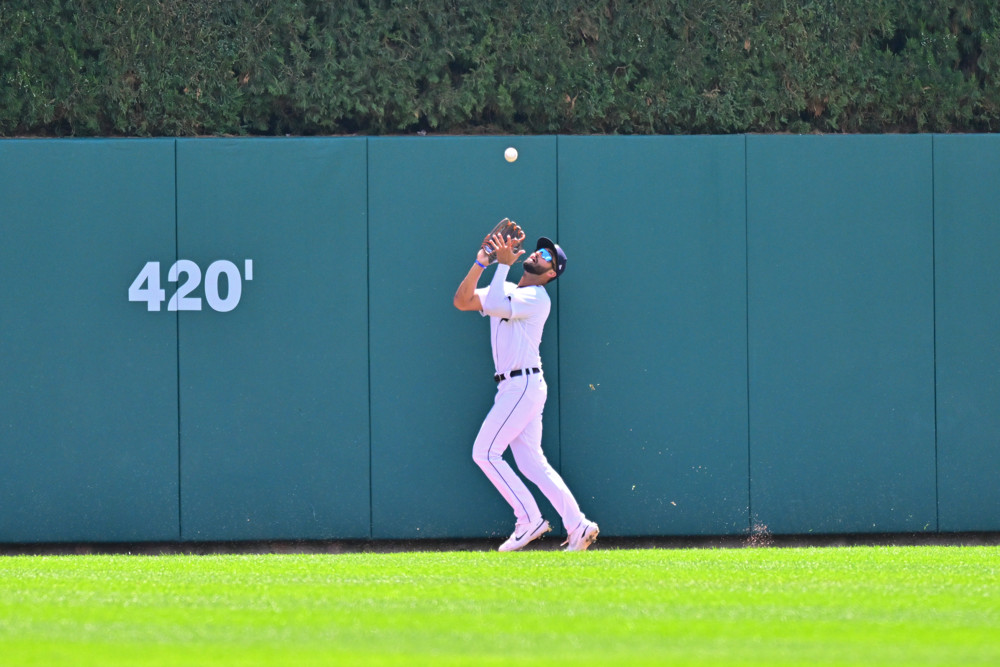
    But one of those two things has changed heading into 2023. The Tigers have changed Comerica’s dimensions to cut 10 feet off the distance in center field. What we’ll be watching for is how this impacts where and how Greene plays. By the way, the fences are lowered a little bit too, (to 7 feet in center and right center) so there’s more chance to see something like this.

    One other thing to watch for: Greene led all center fielders with 9 diving catches. That sounds great, but the stat can be a double-edged sword as Mike Cameron (coincidentally the father of former Tiger Daz Cameron) pointed out with regards to Julio Rodriguez.

    Cameron is wary of diving because it “tears down your shoulders and low back.” So keep an eye on whether Greene is as aggressive as he was in 2022.

  • 2023 Defender to Watch: Nick Allen

    2023 Defender to Watch: Nick Allen

    Why is Oakland Athletics shortstop Nick Allen a defensive player to watch in 2023?

    Five different shortstops have won an Fielding Bible Award in the last five seasons: Andrelton Simmons, Nick Ahmed, Javier Baez, Carlos Correa, and Jorge Mateo.

    If there’s going to be a sixth in six years, that player could be Allen.

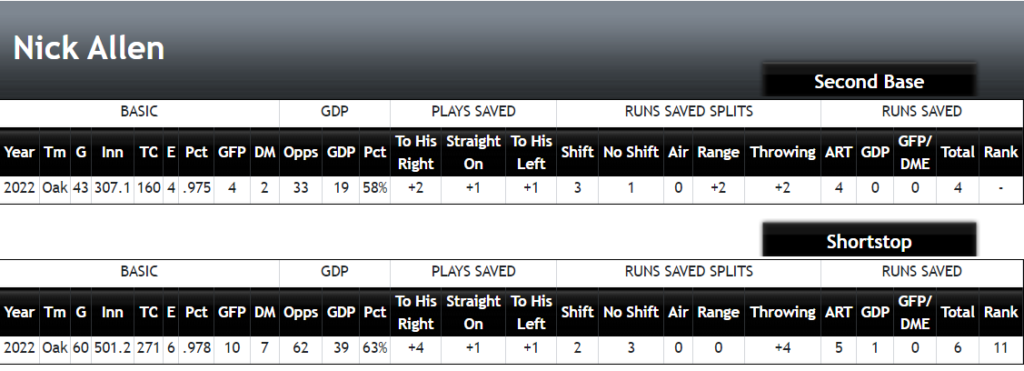
    Allen saved 6 runs in just over 500 innings at shortstop for the Athletics last season. He also saved 4 runs in a little more than 300 innings at second base. Shortstop will likely be his spot in 2023, particularly given that he played his last 43 games there last season.

    Allen’s strength was that he didn’t have a weakness. This is his page on FieldingBible.com. Take note of the absence of negative numbers that would indicate below-average performance.

    Aesthetically, Allen looks most impressive when he’s going deep into the shortstop-third base hole, like this one.

    We’re not sure if this is by design, but Allen went to the backhand a lot relative to other shortstops.

    We track fielding methods for players on any ball they touch. Allen had 141 forehand plays and 102 backhand plays at shortstop in 2022 (along with 2 barehand plays counted separately). Allen’s 42% rate of attempting to field the ball on his backhand was the highest of any of the 35 shortstops with the most opportunities in 2022.

    There are many ways to skin a cat, so to speak. Top defenders Allen, Andrew Velazquez, and Taylor Walls are among those with the highest backhand percentages. Peña, Crawford, and Carlos Correa are among the shortstops with the lowest percentages.

    We should point out that Allen is among the best at fielding balls on his forehand.

    Highest Success Rate on Forehand – Shortstops in 2022

    Player Success Rate
    Carlos Correa 95.5%
    Nicky Lopez 95.3%
    Xander Bogaerts 94.9%
    Miguel Rojas 94.5%
    Nick Allen 94.3%

    Allen’s out rate on backhands wasn’t up among the best in the league. At 84.3%, he ranked 20th among those 35 qualifiers, though that doesn’t take into account play difficulty and how Allen may be able to touch more balls than others.

    Regardless, he’s a little bit of an outlier in terms of approach  and it will be interesting to see if that style carries over to 2023.

  • Stat of the Week: Defensive Support Behind Pitchers

    Stat of the Week: Defensive Support Behind Pitchers

    We can calculate how many Defensive Runs Saved a team recorded for a pitcher on batted balls. Think of it as similar to a team’s defensive efficiency behind a pitcher, but with a run value instead of a percentage.
    Here’s a list of the pitchers who received the most Defensive Runs Saved in that regard in 2022.

    Most Defensive Runs Saved By Team For Pitcher – 2022

    Pitcher 2022 Team DRS For P
    Zac Gallen Diamondbacks 18
    Jameson Taillon* Yankees 17
    José Quintana* Pirates/Cardinals 16
    Justin Verlander* Astros 13
    Yu Darvish Padres 12
    Corbin Burnes Brewers 12
    Tony Gonsolin Dodgers 12
    Cal Quantrill Guardians 12

    * Changed teams this past offseason

    Let’s take a closer look at the top four pitchers on this leaderboard, three of whom changed teams this offseason.

    Zac Gallen had a fantastic 2022 for the Diamondbacks, pitching to a 2.54 ERA and leading the NL in both WHIP (0.91) and hits allowed per 9 innings (5.9).
    The Diamondbacks’ infield turned 80% of groundballs and bunts into outs for Gallen (the MLB out rate is 74%) last season, which ranked in the top 10% of pitchers who allowed 120 grounders and bunts (14th out of 138). Fielding Bible Award winning first baseman Christian Walker was no doubt instrumental in that.
    The Nos. 2, 3, and 4 pitchers all changed teams this past offseason. Jameson Taillon went from the Yankees, who led the majors in Defensive Runs Saved in 2022, to the Cubs after signing a four-year deal as a free agent.
    The Cubs could be one of the better defensive teams in 2023 if things break right. They moved a standout fielder, Nico Hoerner, from shortstop to second base to accommodate the signing of Gold Glove Award winner Dansby Swanson. They also added Cody Bellinger in center field and Tucker Barnhart at catcher. All of these players have solid defensive reputations.
    Something to keep an eye on with Taillon will be his groundball rate, which ranged from 46 to 52% with the Pirates from 2017 to 2020, but dropped to 33% and 40% in his two seasons with the Yankees.
    Taillon’s rate of getting outs on grounders and bunts was just about identical to Gallen’s, 80%. The Cubs infield defense figures to be strong up the middle but may not be as good as the Yankees at the corners (with Eric Hosmer and Christopher Morel instead of Anthony Rizzo and Josh Donaldson/DJ LeMahieu).
    José Quintana and Justin Verlander, both headed to the Mets, are contrasts in the defensive support they got last season.
    Quintana’s was largely predicated on the skill of the Pirates and Cardinals teammates behind him. He led all pitchers in Runs Saved that came from player performance excluding positioning with 14.
    For Verlander, 9 of the Astros 13 Runs Saved came from defensive positioning, indicative of defensive shifts being of notable benefit to him.
    Also contrasting was their defensive support on balls hit in the air that stayed in the ballpark. Verlander got the third-highest out rate on those balls (77%). Quintana ranked in the bottom 10% (153rd out of 165 pitchers with 120 balls allowed in the air) with a 60% rate.
    The Mets defense will be challenged to be as good as Verlander’s Astros or the Cardinals one that Quintana had behind him the last two months of the season. New York ranked 15th in Defensive Runs Saved last season and return a nearly identical defensive lineup to that of 2022.
    Keep an eye on how this impacts Verlander’s and Quintana’s ERAs. It may be hard for them to maintain their 2022 performance levels.
    For more baseball content, check out our Defensive Players To Watch series at the Sports Info Solutions website.
  • 2023 Defenders To Watch: C.J. Abrams & Luis Garcia

    2023 Defenders To Watch: C.J. Abrams & Luis Garcia

    Why are Nationals shortstop C.J. Abrams and second basemen Luis Garcia defensive players to watch in 2023?

    Whatever Abrams does at the position as a full-time starter will almost surely be better than what the Nationals got for much of 2022.

    Nationals shortstops ranked last in Defensive Runs Saved in 2022 with -34. That was the worst Runs Saved total at shortstop for any team in the 20-year history of Defensive Runs Saved.

    Fewest Defensive Runs Saved By Shortstops – 2022 Season

    Team Runs Saved
    Nationals -34
    Royals -18
    Blue Jays -15
    Phillies -13
    Rockies -12

     In 2022 Nationals shortstops ranked last in our plus-minus (comparable to Outs Above Average) on both balls hit to their left (19 fewer plays made than expected) and right (15 fewer).

    Abrams was only with the Nationals for about a quarter of the season. In that time, he finished with -4 Defensive Runs Saved in 43 games. SIS alum Eric Longenhagen put an OFP (Overall Future Potential) scouting grade on Abrams’ defense of 45 on the 20-80 scouting scale, meaning the expectation is that he’ll be a below-average defender (and perhaps moved off the position). But below-average is still a big step up.

    The biggest beneficiary of this could be Garcia, who was one of the other shortstops last season and had a brutal time (-17 Runs Saved in 59 games) but has looked comfortable at second base the last two years (5 Runs Saved in 92 games).

    With the acquisition of Abrams, whose first start with Washington was August 15 and the reinstallation of Garcia at second base 11 days later, the Nationals got much better defensive results the rest of the season.

    Nationals Ground Ball and Bunt Out Rate – 2022

    Out Rate Rank
    Through August 14 69.5% 30th
    Rest of Season 75.6% 7th

    The Nationals will have new infielders at the corners with Dominic Smith at first base and Jeimer Candelario at the third. We’ll be watching to see just how much the results change in 2023.

  • 2023 Defender To Watch: Eduardo Escobar

    2023 Defender To Watch: Eduardo Escobar

    Why is Eduardo Escobar a defender to watch in 2023?

    Escobar, who signed with the Mets with a reputation as a decent defensive third baseman, finished with a career-worst -11 Defensive Runs Saved at third base in 2022. Only two third basemen finished worse in the stat than he did.

    Fewest Defensive Runs Saved In 2022 – Third Base

    Name DRS
    Alec Bohm -17
    Yandy Diaz -14
    Eduardo Escobar -11
    Maikel Franco -10

     Team Weakness

    The Mets infield ranked 26th in turning ground balls and bunts into outs last season, 29th if we look at balls hit to an area from two-thirds of the way between second and third base to the third base line.

    As such, both shortstop Francisco Lindor and Escobar finished with negative Defensive Runs Saved in 2022.

    Primary issue

    Escobar’s trouble was with balls hit to his right, in particular balls that he tried to backhand. Escobar made 11 fewer plays than expected on balls hit to his right, worst among third basemen. He converted 52 of 94 (53%) when – by the stats- he should have converted 63. By comparison, Yankees third baseman Josh Donaldson rated slightly above average. He turned 70% of balls hit to his right into outs.

    His 81% play conversion rate when he fielded a ball on his backhand ranked fourth-worst among the 30 third basemen with the most backhand chances.

    Outlook

    The Mets have multiple other options at third base with utility infielder Luis Guillorme and minor leaguers Brett Baty and Mark Vientos waiting for their turn. Escobar improved his hitting last year when he needed to in the latter part of the season. For 2023, keep an eye on if he can get his defense to a better level too.