Two weeks ago, we did an episode on women working in baseball analytics – Emily Curtis and Kiri Oler. This week, we turn our attention to people of color working in this field. Mark Simon (@MarkASimonSays) talked to 3 of them – Javier Duren (@JD_Fresh20) of the Cardinals, Spencer Weisberg of the Mariners, and Karim Kassam (@professormullet) of the Twins.
Javier, in his third year with the Cardinals, explained how he went from graduating Yale to playing basketball professionally, to his current role as the Cardinals coordinator of technology and innovation. He shared stories from his basketball career, including what he takes from that to both watching baseball and to his current job. He explained what his role entails and what a typical day is like. He also gave advice to members of the African-American community who aspire to work in analytics and/or become athletes. (0:43)
Spencer, in his second year with the Mariners after graduating from Cal State-San Luis Obispo, explained his path to becoming a baseball analyst. He discussed his role with the team, his interactions with the front office and coaching staff, and the work he’s specialized in. He also talked about what intrigued him about defensive metrics. Lastly he offered advice to others seeking to break into the baseball world as he did. (15:52)
Karim, the Twins director of baseball research, shared the story of his career path, which includes stops as a college professor, at a movie studio, and with the Pittsburgh Steelers. He talked about what’s surprised him in his first year on the job, how other sports influenced him, what he finds most interesting to watch in baseball, which pro athlete he’s most enjoyed working with, and what advice he has for others who want to work in his position. (34:04)
Thank you for listening to our podcast. If you liked the show, please rate and review us. Stay safe and stay well.
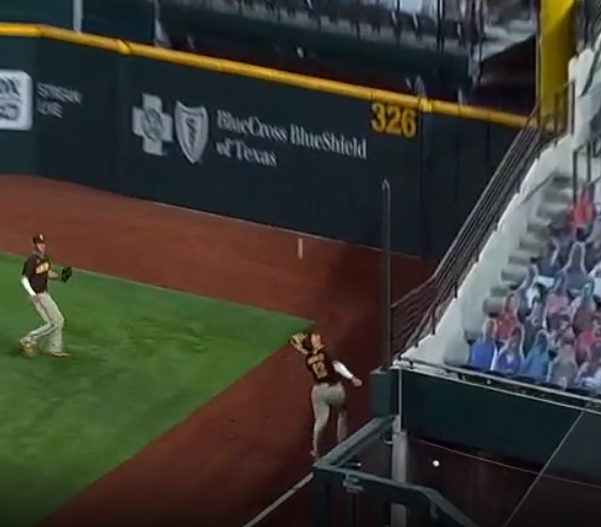
A day after one Padres star infielder was in the spotlight, third baseman Manny Machado turned some virtual heads on a play where he made a catch here:
A few more feet to the right and those fans might have had a souvenir. Bummer.
Of course, Machado wasn’t playing a “typical” third base on that play. He started in shallow right field as part of a Full Ted Williams Shift. But even given that, it’s shocking to see an infielder make a play nearly 300 feet from home plate.
That got me thinking: is that the weirdest place we’ve seen someone catch a flyball (given the position they were playing)?
The answer is “yes,” perhaps unsurprisingly. If you consider where each position tends to be aligned (shifts notwithstanding), Machado’s catch was an incredible 300 feet from where you’d expect a third baseman to catch a flyball.
Of course, nowadays, the notion of a player’s “position” is a little fuzzy. Infield shifts are as common as “standard” alignments, not to mention the slow growth of outfield shifting, four-man outfields, and five-man infields. Like I said before, there’s no way that any infielder—especially not a third baseman—is in position to make that catch if shifts aren’t a thing.
Just for fun, let’s put ourselves in the mindset of a baseball viewer ten years ago and check out the wonkiest locations for each position to field a ball since 2012 (when shifts started ramping up).
Pitcher
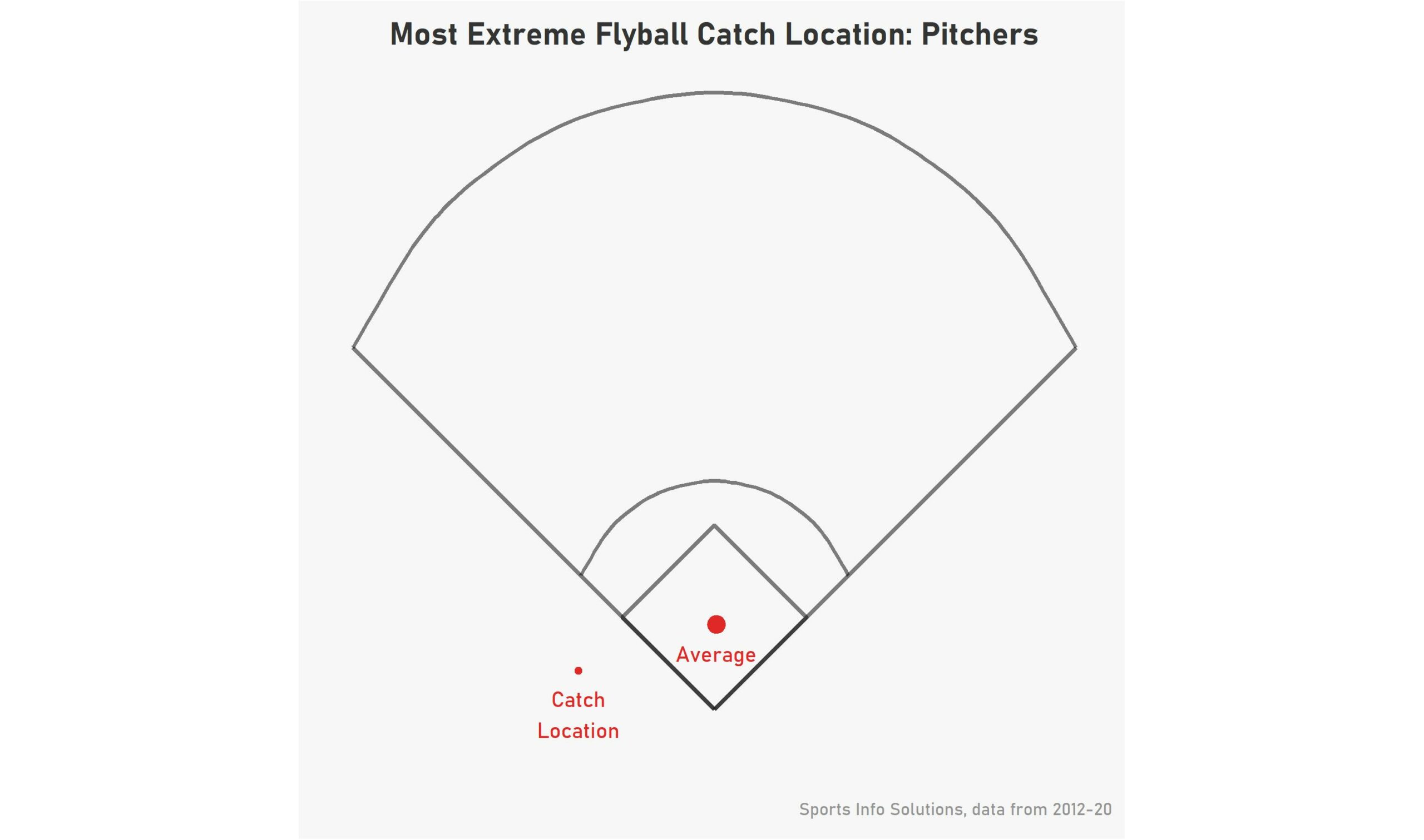
Unsurprisingly, pitchers have the shortest distances from typical positioning. They’re not shifting, they are trained to defer on balls in the air, and they start the play falling off the mound. The most extreme play I found was a nice play by Rays reliever Jaime Schultz, but he only had to range 100 feet to get there.
Honorable Mention: Mike Fiers has thrown two no-hitters and has been newsworthy in other ways, but here we get to watch him stumble his way to a rather incredible foul out.
Catcher
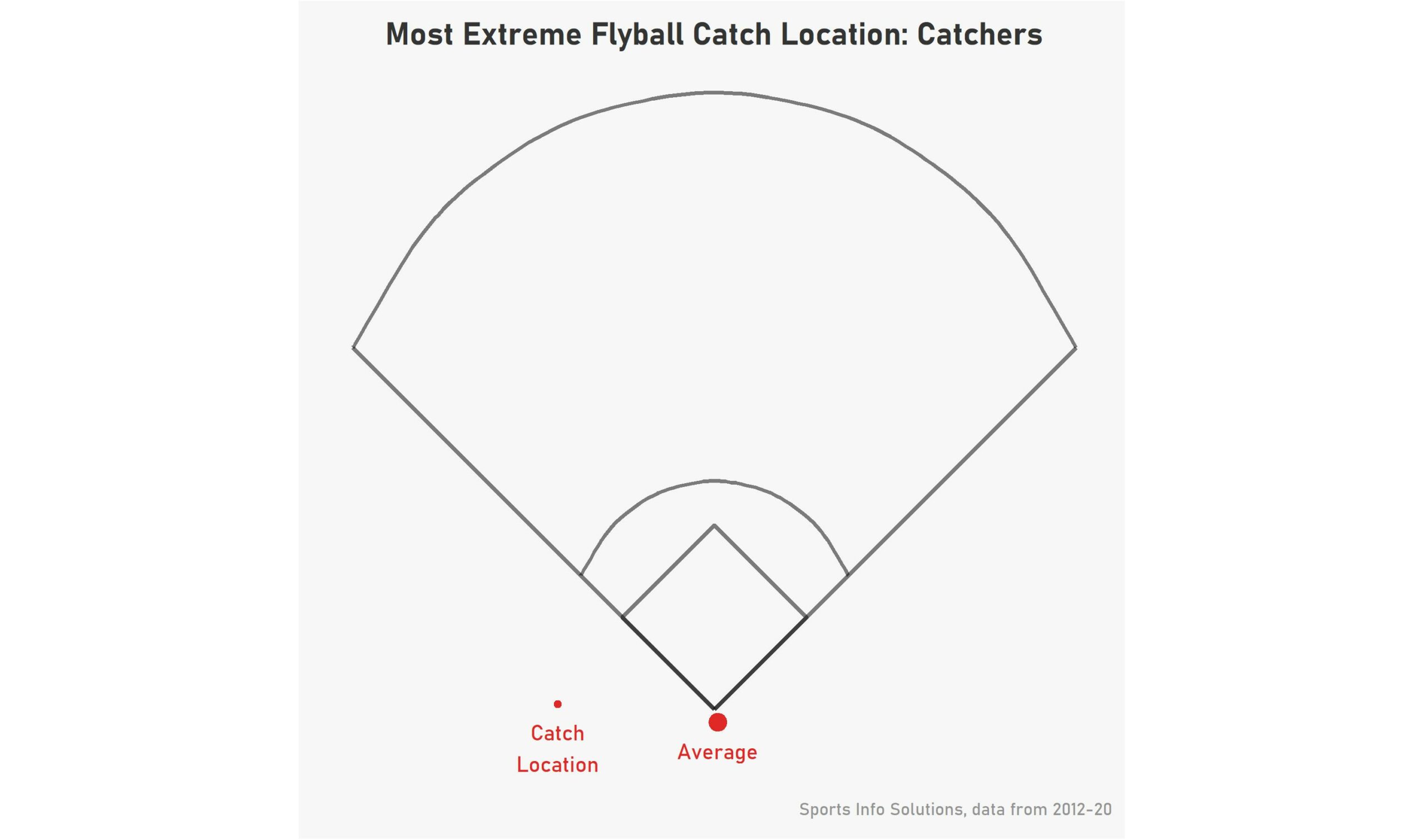
Foul territory in Oakland is notoriously extensive, so it’s no surprise that the most extreme catch location for a catcher was made in the Coliseum. On this play, Josh Phegley gets on his horse to make a play just before getting to the dugout. Again, this isn’t so notable a play from the perspective of this article for similar reasons to pitchers.
First Base
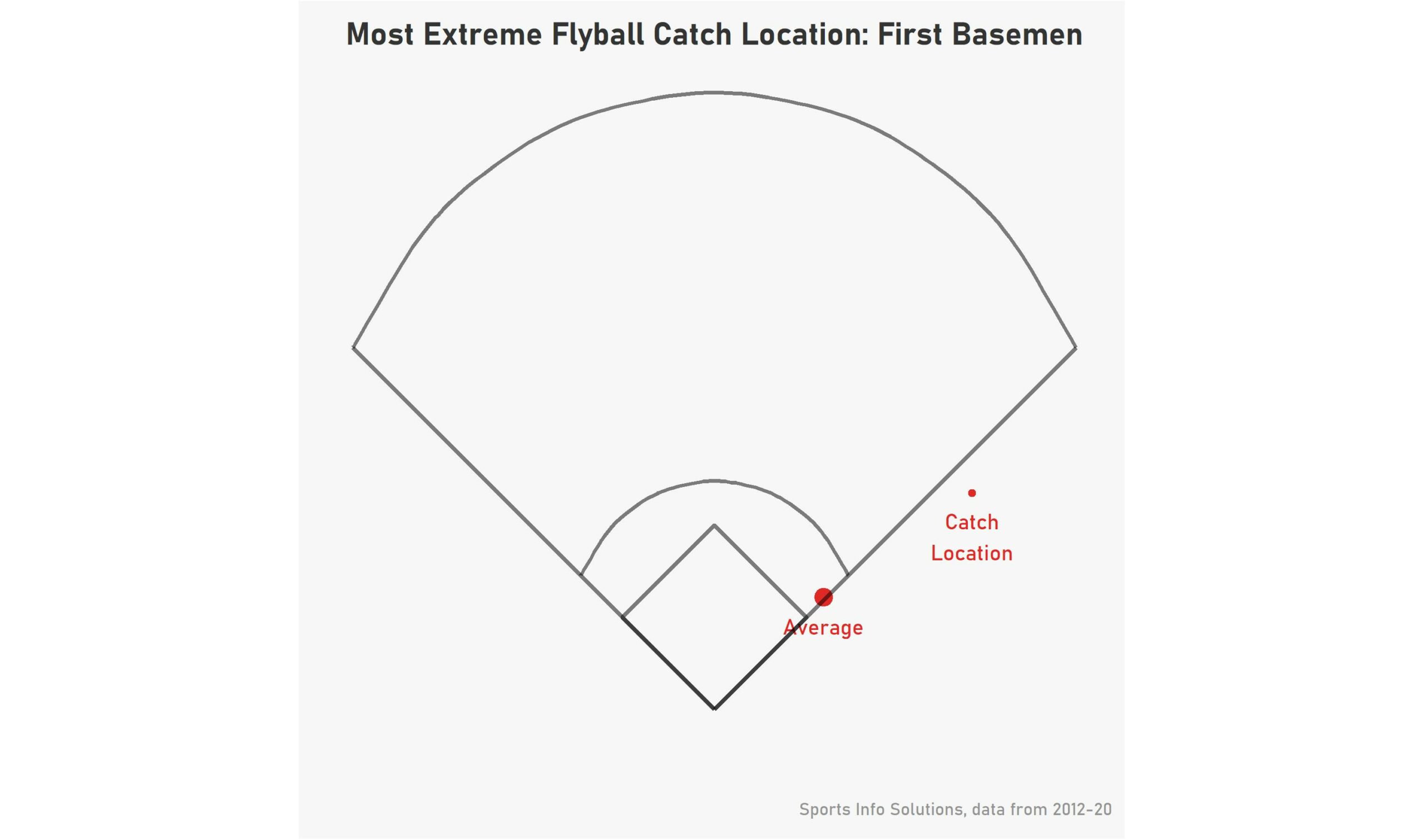
We’re still in tepid waters thanks to first basemen having to be anchored to their base to cover on groundballs. This play by Ryan O’Hearn takes him pretty deep into foul territory, but it’s only 125 feet from where first basemen typically field balls.
Second Base
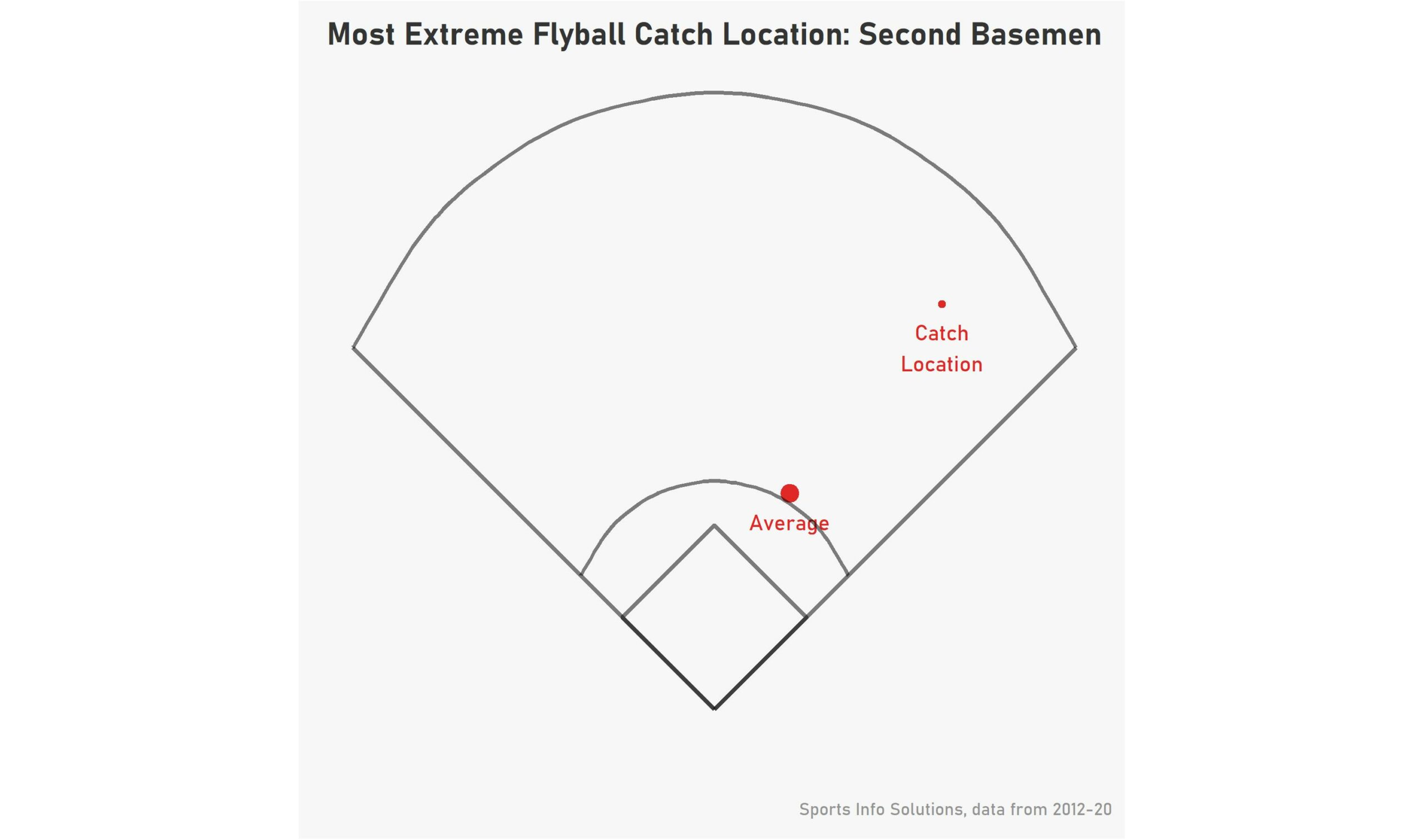
Now we’re talking. You might think that catch location looks an awful lot like where a right fielder would normally stand. And you’d be right! The Rays employed a four-man outfield with three infielders on the right side of second base against Rio Ruiz up by a run in the ninth inning. Second baseman Brandon Lowe makes a routine play that is a small step for a right fielder, but a giant leap for a second baseman.
Third Base
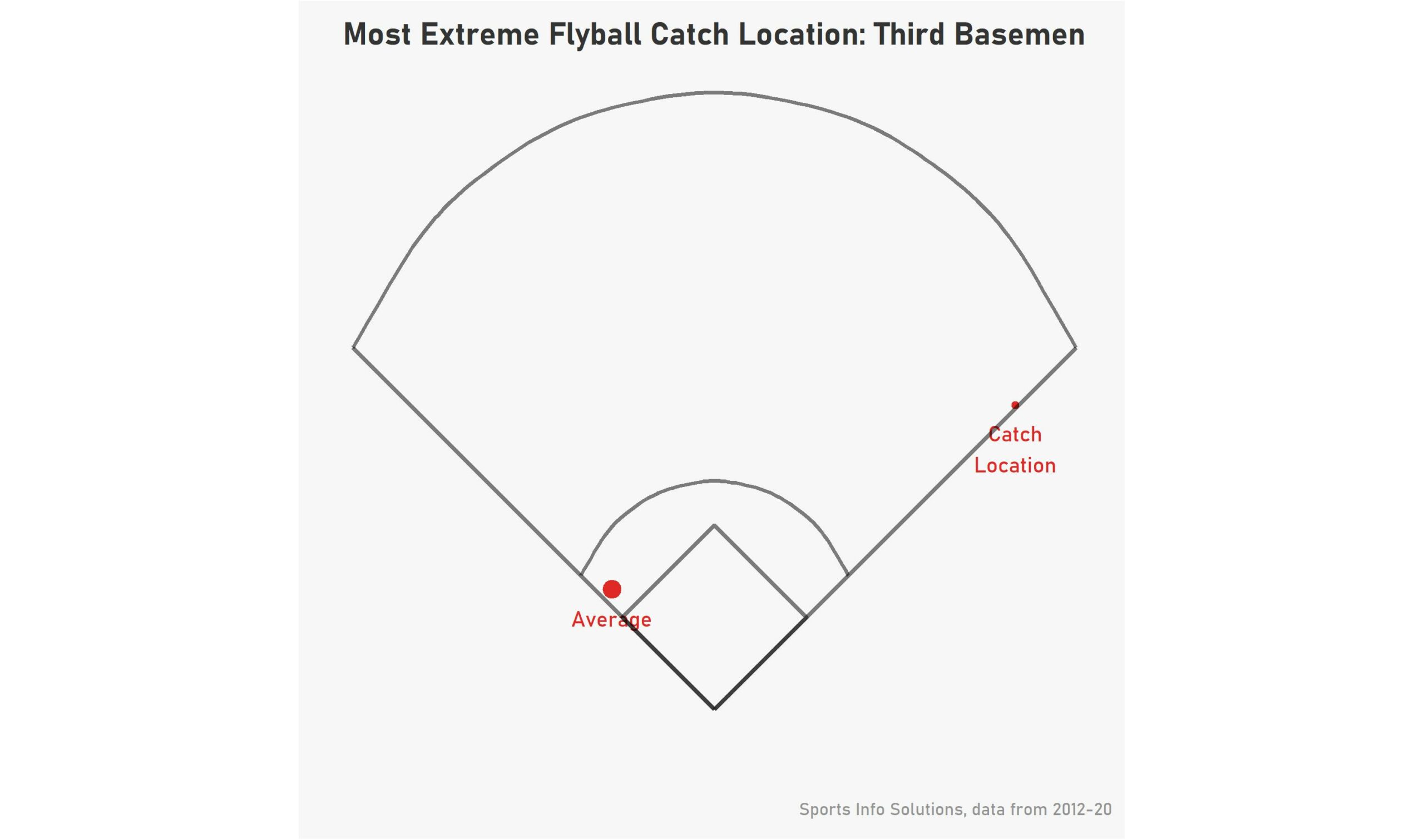
Here we have the Machado play. This one’s unique on this list because it combines extreme positioning with pretty good range, so it’s no surprise that it’s the wonkiest fielding location we’ve seen.
Honorable Mention: For a short time, infield shifts were destroying defensive metrics. Teams would play their third baseman in short right field and he would get credit for incredible range when it wasn’t warranted. Because he was the poster boy for this phenomenon at the time, we at SIS call this the “Brett Lawrie Problem.” Here’s an example of the kind of thing we were seeing at the time.
Shortstop
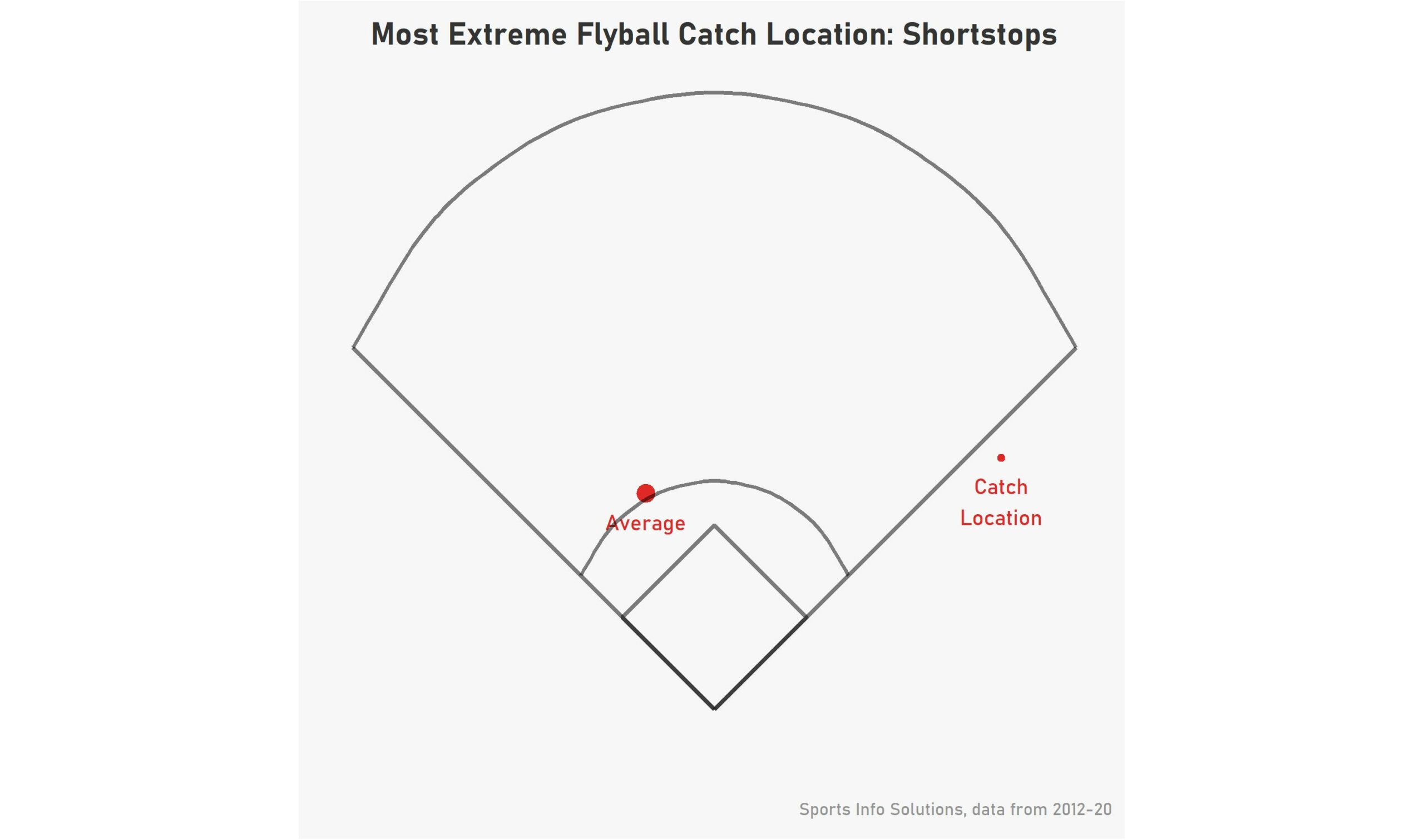
This might be the most impressive play of the group, as Darwin Barney ranges from a similar position to Machado on the previous play to make a sliding grab near the wall in foul territory.
Like with Oakland, Toronto’s foul ground features heavily in plays like this. In fact, there was a similar play from the same game where second baseman Devon Travis went a long way to make a catch.
Left Field
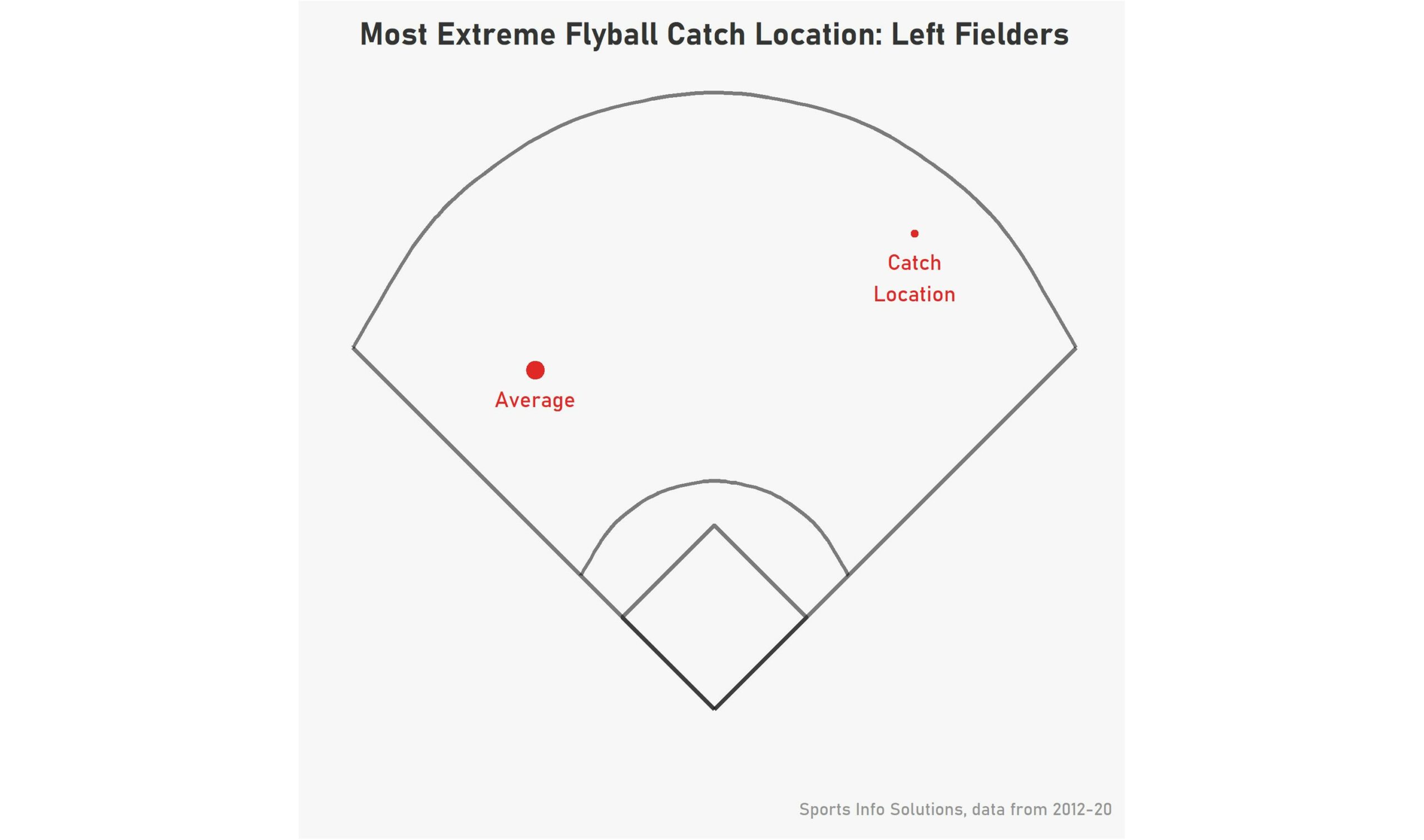
We’ll just call this the DJ LeMahieu Appreciation category. Multiple of the weirdest catch locations for left fielders involve NL West teams heavily shading their outfielders to right field to defend the former Rockies second baseman’s oppo-heavy approach. Of course, that calls into question whether we should be calling him a left fielder to begin with, but that’s a larger question for another day.
Honorable Mention: Another fun LeMahieu example is this play by Matt Szczur, who starts the play in left center field and records the out in deep center field.
Center Field
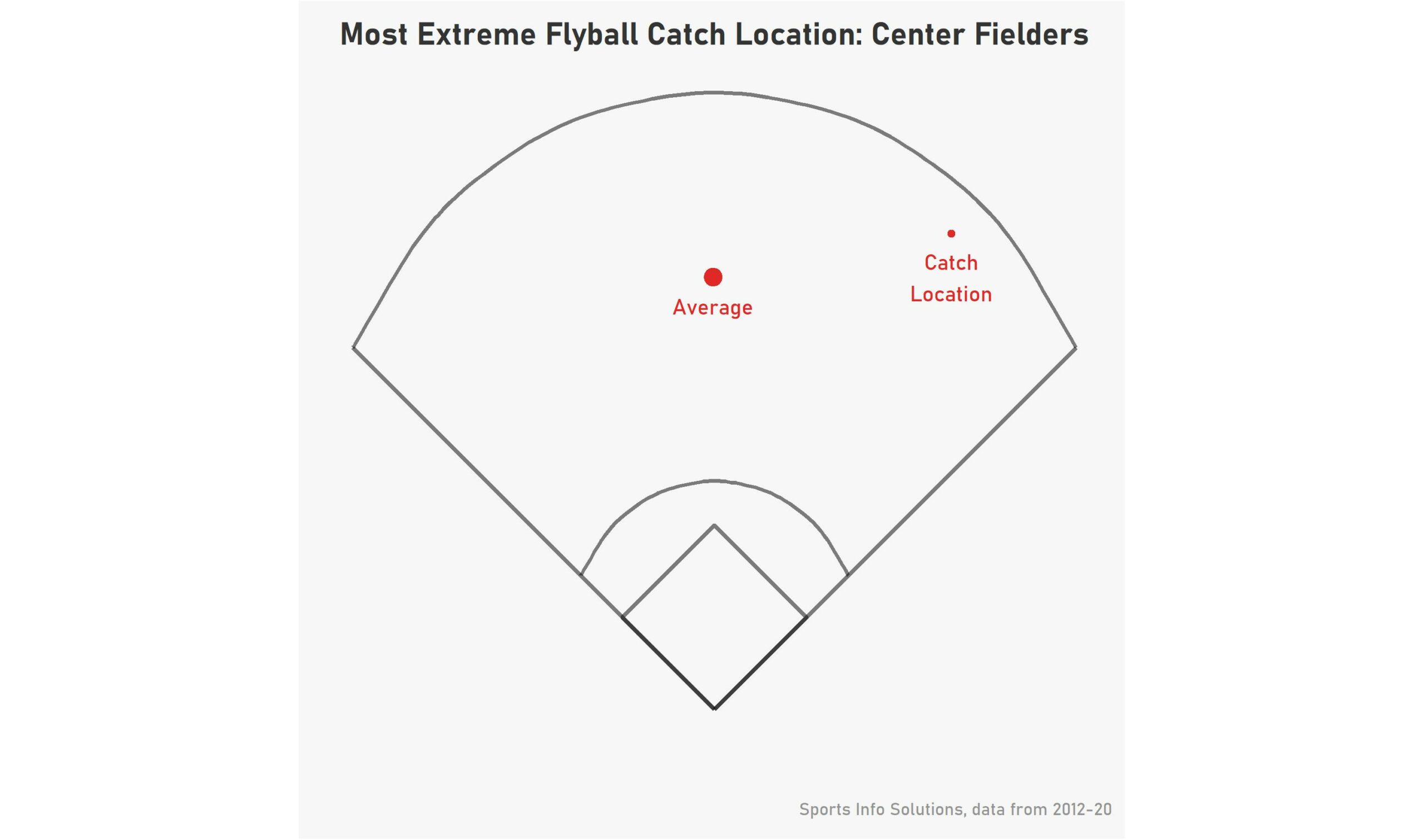
When the Dodgers traded for Mookie Betts, I was kind of hoping that they would put him back in center field, where he had started his outfield career. This play from his first month as a major leaguer shows the kind of range Mookie has from that position.
After a handful of plays whose uniqueness is very much driven by positioning, it’s nice to see a rangy play that’s more “pure.”
Right Field
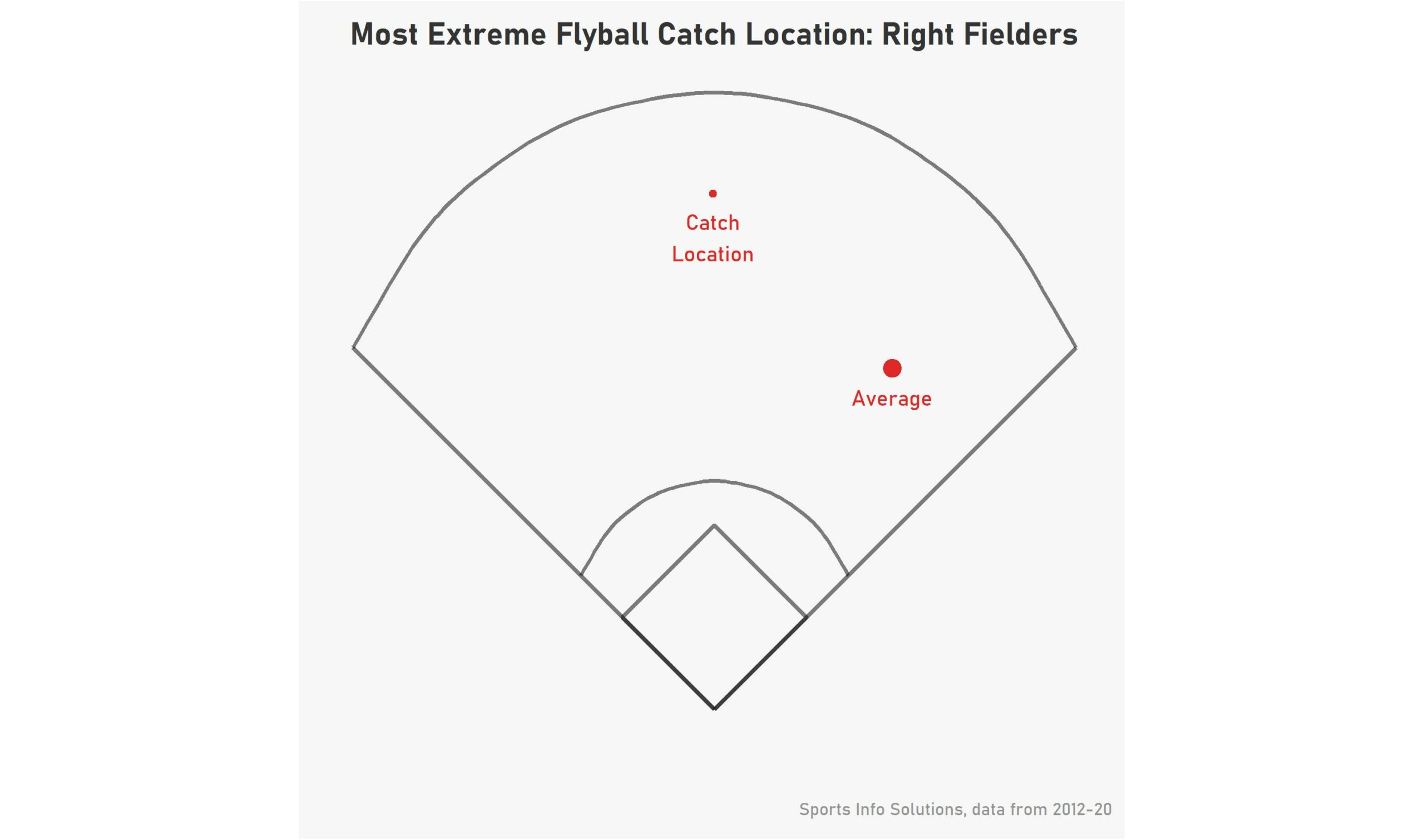
What DJ LeMahieu presents outfields from the right side of the plate, Joe Mauer presented from the left side. His heavy opposite-field profile led many teams to shade their outfielders towards left field, and this dead-center catch by Avisail Garcia is a great example of it.
The last two World Series champions, the Red Sox and Nationals, are off to slow starts. There are many reasons why, but poor defensive performance is definitely on the list.
Team
Defensive Runs Saved
Angels
-12
Red Sox
-11
Nationals
-10
Pirates
-9
Royals
-9
If you watched the Statcast broadcast of Sunday Night Baseball, you probably heard it said repeatedly that the Red Sox ranked last in the majors in how often they turn ground balls and bunts into outs.
They’re not just last. They’re a distant last at 69%, nearly 4 full percentage points behind the next-closest team.
This isn’t a new thing. The Red Sox infield has rated below average the last few seasons, including 2018 when the team won the World Series. Shortstop Xander Bogaerts and third baseman Rafael Devers combined to cost the Red Sox 28 and 24 runs respectively, on defense the last two seasons. They’re already at -9 Runs Saved in 2020.
Both are capable of fantastic plays, like this.
But they’re also liable for some that leave broadcasters (and fans) asking questions.
The Red Sox infield issues extend to the right side. Their second baseman have combined to cost the team five runs.
The Nationals’ issues are primarily in the outfield where as a group, they’ve combined to cost the team 10 runs, tied with the Angels outfield for worst in the majors.
The Nationals’ overall out conversion rate isn’t out of line with the MLB average, but there have been a few missed balls that had a high impact on their Runs Saved total. Adam Eaton lost one in the sun against the Blue Jays and couldn’t get to a few balls out of his reach (whether his fault or not) during a recent series with the Mets.
When considering the Nationals’ defensive struggles, remember that our outfield Runs Saved calculation combines a player’s range and positioning into one number. Sometimes, a missed ball may be caused by the player’s ability to make the play. Other times it may be due to his being positioned in a spot in which he couldn’t get to the ball. And still other times, we should remember that plays can be tough to make.
Center fielder Victor Robles led all players with 23 Runs Saved at that position last season. He’s cost the team one run with his defense through 18 games.
Robles’ great Runs Saved total last season was partly the product of his throwing arm. He had 12 assists that didn’t require a cutoff man, which led MLB. In the first three weeks of the season, five runners took an extra base on a base hit against him. He hasn’t thrown out anyone unaided yet and his defense has otherwise been average.
The other defensive problem for the Nationals is at catcher where Kurt Suzuki is at -4 Runs Saved. This could be a tougher one to address than the outfield as Suzuki has one season with a positive Runs Saved total at the position since 2011.
The same caveat applies as does to everything else written about in the first few weeks of the season. The sample is small here, so keep that in mind when you consider whether the past can predict the future of these two teams. There have been plenty of times where it can’t. Just look at the 2019 Nationals as an example of that.
On this edition of the Sports Info Solutions Baseball Podcast, Mark Simon (@MarkASimonSays) is joined by ESPN and Sirius XM’s Eduardo Perez (@PerezEd) to talk about the meaningful names and numbers from the season’s first few weeks. Eduardo gives his take on low batting averages and pitcher injuries and with the latter explains why a change of scenery was good for Dylan Bundy (0:49).
He also talks about the game’s top Latino stars, like Fernando Tatis (4:30), and the rise of Colombia as an MLB talent producer (7:11). They then look at a couple of players putting up video-game numbers in Charlie Blackmon and Shane Bieber (8:05), mull the staying power of the Rockies and the struggles of the Mets (10:28), and pick out something to watch in the next couple of weeks (16:40). Eduardo also shares his thoughts on what impressed him most in broadcasting KBO games (17:53).
Mark closes the show by challenging Eduardo to tell baseball stories on 3 random subjects – the color blue (18:47), large quantities of food (21:00), and pets (with a nod to his father, Tony Perez) (23:01), and gives a brief tribute to a Dodgers infielder who’s off to a strong defensive start (25:17).
A tip of the cap to New York sportscaster Len Berman, as our show title is a tribute to his fun work. Thanks for tuning in. Please rate and review the podcast wherever you can. Stay safe and stay well.
This Sunday I spent some of my afternoon watching top prospect Spencer Howard’s debut for the Phillies. His debut was forgettable, but the opposing starter, the Braves’ Max Fried, caught my eye with a strong outing. After five shutout innings allowing four hits and striking out six, Fried is among the early leaders in Fangraphs’ Pitching Wins Above Replacement.
One thing that Fried showed early in Sunday’s contest was confidence throwing his curveball to lead off an at-bat. He started three hitters off with a curve in the first inning, getting two calledstrikes. Over the course of the game, he threw seven first-pitch strikes, and none of them were swung at.
Despite being part of a strong start for the young lefty, Fried’s curve hasn’t been an effective pitch. This season, it’s been the least valuable curveball in the league by Fangraphs pitch values. But getting it over early in the count gives him an opportunity to “pitch backwards” and keep hitters off balance a bit.
Starting a hitter off with a “get me over” pitch every once in a while makes sense given how passive hitters tend to be in that spot. Here’s a quick comparison between the first pitch of an at-bat and any other pitch.
Swing %
Misses / Swing
Hard Hits / Swing
First Pitch
21%
33%
14%
All Others
49%
32%
14%
Hitters swing nearly twice as often on curveballs after the first pitch, but their general performance when swinging is similar. So if you’re a pitcher concerned about hitters getting after a shaky hook, leading with it is a nice option.
Here’s a list of the pitchers who have started hitters off with a curveball most often this season.
Player
First Pitch Curveballs
Curve % – First Pitch
Curve % – After First Pitch
Lance McCullers Jr.
34
39%
31%
Sonny Gray
33
35%
23%
Alex Cobb
26
42%
11%
Jose Berrios
26
29%
27%
Dylan Bundy
25
31%
5%
Lance McCullers Jr. , who famously threw 24 consecutive curveballs to close out Game 7 of an ALCS against the Yankees, tops the list. He threw 10 first-pitch curveballs to the Giants in his no-hit bid against the Giants on Monday night.
Sonny Gray—who was the only pitcher to throw more first pitch curveballs than Fried on Sunday—is having an outstanding start to the season. That’s been driven by an excellent curveball, which has been the most effective in MLB.
Alex Cobb and Dylan Bundy stand out because they throw their curveballs more than three times as often on the first pitch compared to any other point in the at-bat. Bundy in particular is having a resurgence to start his Angels career, with his curveballs already accumulating more value than any other season of his career.
Let’s continue down this rabbit hole, with Bundy as the poster boy.
So far, hitters have swung only twice at his 25 0-0 curveballs. He’s taken advantage with 16 called strikes, but he’s also taken advantage by avoiding any risk of hard contact. Thanks to a combination of batter patience and the element of surprise, he can afford to leave his breaking ball out over the plate a bit more.
With that in mind, we can try to find candidates who could benefit from mixing things up to lead off an at-bat and get away with an underperforming curveball. For example, here’s a list of players who since the start of 2019 have allowed hard contact on at least 15 percent of swings on curveballs, thrown at most 10 percent curveballs on the first pitch, and have thrown at least10 percent curveballs after the first pitch. Players also needed to have thrown at least 1,000 pitches in that time, as well.
Candidates to Throw More First Pitch Curveballs
Clayton Kershaw, Dodgers
Walker Buehler, Dodgers
Antonio Senzatela, Rockies
Jon Gray, Rockies
Daniel Mengden, Athletics (since moved to the bullpen)
One thing that jumps out from this list is that multiple names appear from two teams. There’s some possibility that a team approach or game plan leads to more or less “pitching backwards.” This brings to mind that any kind of recommendation like “throw more curveballs to start off a plate appearance” has to be taken within the context of the broader strategy that a team or pitcher wants to employ.
But it’s interesting that even players with tremendous track records (e.g. Kershaw) or varying degrees of recent success (e.g. Buehler in recent seasons or Senzatela in recent weeks) still would benefit from finding new opportunities to keep hitters off balance.
Entering Monday, the MLB ground ball & bunt out rate was 75.5%. It has been 73.8% in 3 of the last 4 full seasons. Put that it terms of batting average (or reached base average) and it’s the equivalent of going from .262 to .245.
Similarly, the out rates on balls hit in the air that stayed in the ballpark have gone from 65.5% overall (and 58% on those hit to the outfield) from 2017 to 2019 to 67.7% and 60.3% in 2020.
We can put it in big bold type. This is THREE SEASONS of data versus 2.5 WEEKS. But it’s interesting because there are unusual blips, especially in July and August when hitters normally thrive.
What can we tell from looking at some of the defensive numbers so far? Maybe we can’t predict anything, but we can give an assessment of what has happened and these are the things that stand out.
The Dodgers are good, no surprise
It was only a handful of days before the Dodgers moved to the top of the Defensive Runs Saved team leaderboards. This isn’t shocking. The Dodgers were the best defensive team in baseball last season, returned almost everyone, and added a defensive superstar in right fielder Mookie Betts.
The Dodgers defense has saved 11 runs, the most in the NL and tied with the Twins for second-most in the majors behind the Indians (13).
Three Dodgers have already saved at least 4 runs, including two of their most versatile players – Kike Hernandez (5), Chris Taylor (4), and Betts (4). Betts has already shown he can handle the right field corner at Dodgers Stadium in the same way he handled it at Fenway Park and that he has one of the best outfield arms in the game.
Ground Ball Gobblers
The Dodgers rank third in the majors in ground ball & bunt out rate at 81%. They trail the Cubs (85%) and the Indians (82%). The Indians lead the majors in Defensive Runs Saved. The Cubs would be right there if not for the struggles of Ian Happ in center field (-5 Runs Saved).
The Cubs are among the teams that have significantly increased their rate of using defensive shifts. They ranked next-to-last in overall shift usage against balls in play in 2019 (5.5 per game) but are at 12.3 in 2020 (even with that increase, they still rank 23rd).
Another team that has dramatically changed its infield defense approach is the Tigers who have increased their shift usage by 80% from 2019 and now rank second in shifts on balls in play per game (16.9).
The Tigers’ ground ball out and bunt out rate in those shifts is nearly 85%. They’ve turned potential hits into humdrum ground outs.
The Tigers ranked last in MLB in turning ground balls into outs last season at 70%. They’re at 78% overall in 2020.
By the way, shifts are up 29% measuring the beginning of the season against 2019.
The top five teams in shift usage are the Dodgers, Tigers, Twins, Mariners, and Braves.
The bottom five are the Rockies, Mets, Padres, Yankees, and Athletics.
Hunting Flies
Looks like Byron Buxton is healthy again. He’s already got 4 Runs Saved in center field for the Twins, with a ledger that includes this running catch against the Padres.
Not to be outdone, Kevin Kiermaier continues to do his thing in center field for the Rays.
The two of them stand atop the centerfield leaderboard lead and figure to battle it out all season for both the AL Gold Glove and our Fielding Bible Award. The Twins head the leaderboard for Runs Saved by outfielders with the Rays and Orioles just behind them.
On the other end of things, the Mets outfield has cost the team 9 runs this season, the worst total in MLB. Brandon Nimmo and Michael Conforto share equally here, each having been dinged for 4 runs in center field and right field, respectively. They’re each one run off the MLB basement (shared by Happ and Rays catcher Mike Zunino).
The Giants have some problems
Did you see Hunter Pence lose a fly ball in the sky, a play that ended Johnny Cueto’s no-hit bid in the sixth inning on Saturday?
That play was somewhat symbolic of the Giants’ season so far. They’ve committed 44 Defensive Misplays & Errors*, the most in the majors this season.
Second baseman Donovan Solano has the most with 7, though he’s made up for that by hitting .455 with 14 RBI in 15 games. Catcher Tyler Heineman has 6, including 3 errors. Shortstop Brandon Crawford has five, though that’s partly offset by 5 Good Fielding Plays.
The Rays and Royals are tied for second with 40 Misplays & Errors. They’ve got some things to be concerned about on that front too.
* SIS tracks Good Fielding Plays and Defensive Misplays & Errors. There are more than 60 categories of Defensive Misplays & Errors, including slipping and falling, overthrowing the intended target, and failing to complete a double play in a situation in which is was possible to record one. They also include wild pitches and passed balls.
There are about 30 categories of Good Fielding Plays, which include variants of what many people know as Web Gems, but also include cutting off balls to prevent extra-base advancement, and turning a double play with a runner bearing down on you.
When we planned out Season 2 of our podcast, our goal was to make the show more thoughtful and more diverse. We continue to work towards that with this episode, which spotlights two women working in baseball analytics who recently spoke at a Women in Baseball event – Emily Curtis (@emweecurt) with the Mariners and Kiri Oler (@glitter_corpse) with the Phillies.
Emily details her path to baseball from growing up in Norman, Oklahoma and becoming a Cardinals fan, then landing a job with the Mariners as a baseball analyst (1:04). She talks about learning the different groups in baseball operations and how she communicates with each of them (5:30), then describes working on pitcher injury analysis (6:30), how the Mariners analytics team works hand-in-hand with a very busy and analytically-inclined GM and explains how data travels through the organization (8:15), and the challenge of developing models (12:30). Then she shares her thoughts on making the field of baseball analytics more inclusive (16:54). And we got in one question on the amazing start of Kyle Lewis! (22:13)
Kiri similarly explains her path from majoring in Math AND English to teaching to working in baseball, first with the Twins and now with the Phillies as a quantitative analyst (25:10). She explains her role working with the coaching staff (27:10), the different projects she’s taken on (29:40), the difference in working with people who like charts vs those who like visuals (32:25), and the usefulness of the “poop” emoji (33:22). Kiri also provides tips to women interested in working in baseball analytics, emphasizing that you never know what happens when you apply (36:43). We end by talking about her interest in the role Roman Quinn will play with the extra innings rule this season (39:29).
Mark finishes the show by sharing one way for women interested in learning about baseball analytics could find a mentor and discusses inroads made by women in baseball broadcasting (41:00).
For more information about Measurables Office Hours, check out www.measurablespod.com/officehours. The second session of the #HANIC Women in Baseball panel will be this Sunday night at 7 ET. You can learn more at #HANIC or sign up for the Zoom session at https://www.hanic-analytics.com/
On this edition of the Sports Info Solutions Baseball Podcast, Mark Simon (@MarkASimonSays) is joined by two beat writers to discuss the 2020 season outlooks for their respective teams.
Mark first talks to Derrick Goold (@dgoold), Cardinals beat writer for the St. Louis Post-Dispatch and the host of “The Best Podcast in Baseball.” Derrick explains how odd it has been to cover the team (1:04), then talks about what to make of a Cardinals team that isn’t necessarily abiding by the traditional Cardinals Way (3:56). He shares a stat that he is interested in following all season (7:12), explains why they are so good defensively (10:28), gives a “State of the Yadi” on the Cardinals catcher (15:02) and provides scenarios by which the Cardinals win the division and miss the playoffs – while also posing a question about why the Cubs “tickle the sims.” (17:38)
Mark is then joined by Pedro Moura (@pedromoura) of The Athletic who explains the unusual nature of covering the Dodgers in Los Angeles this season (24:11). He then offers his take on the weirdness of the first 4-game series with the Giants (26:04) and explains why performance in high-leverage situations will be his stat to watch (28:08). He shares what impresses him most about Mookie Betts (29:47), why Justin Turner is still so good at his age (31:14), and what Max Muncy does better than anyone on the team (32:27). He also looks at the Dodgers defense and pitching, offering predictions on ERA for Clayton Kershaw and saves for Kenley Jansen (33:10). He also picks an unheralded pitcher to watch (36:35). They close the interview by trying to figure out the 4% scenario by which the Dodgers don’t make the playoffs (37:40).
After both interviews, Mark offers his 2020 predictions for baseball’s MVD (Most Valuable Defenders). (39:18)
Thanks for tuning in. Don’t forget to rate and review. Stay safe and stay well.
It’s the second go-round for most MLB starters as teams’ cycle back to the top of their starting rotations.
What should we note from the first appearance by these aces in terms of what’s worth watching?
Max Scherzer, Nationals
On the one hand, Scherzer got 13 misses on 17 swings against his slider, which is awesome. The pitch, which comes in a couple different variations resulted in seven outs against one hit and one walk. The problem was that the Yankees were right-on Scherzer’s fastball, going 5-for-11 including Giancarlo Stanton’s mammoth home run against it. Opponents hit .216 against his fastball last season.
Jacob deGrom, Mets
DeGrom’s fastball was impressive in his five innings against the Braves. It averaged 98.4 MPH, the highest average velocity it has ever had in a start.
DeGrom got seven outs with it and didn’t allow a baserunner. He barely broke a sweat in inducing 9 misses on 17 swings.
Kyle Hendricks, Cubs
Hendricks has the A+ version of his changeup in his Opening Day shutout of the Brewers. He got misses on 9-of-21 swings against it (per his 2019 numbers, you would have expected 5 missed swings). The 9 missed swings was only one shy of his 2019 high.
Charlie Morton, Rays
Morton didn’t have his best signature curveball against the Blue Jays, as it netted four outs compared to the 8 he averaged last season. Morton’s curve got only one miss on 12 swings against it. Last season, Morton got misses at a rate of about 4.5 per 12 swings.
Mike Soroka, Braves
Soroka’s results lined up well with his season norms. His fastball produced 11 outs, his slider 7 more and he allowed three harmless singles and one hit by pitch.
Lucas Giolito, White Sox
Opposing batters hit .203 against Lucas Giolito’s fastball last season, but the Twins went 4-for-9 against it on Opening Day. He also allowed two home runs with that pitch, something he did only twice last season. It was one of the least effective pitches for any pitcher thus far.
Matthew Boyd, Tigers
Boyd got misses on 6-of-10 swings against his slider, commensurate with how things go when the pitching working for him. But sliders are usually more turn-enders for him. He netted three outs with it, but walked a Reds batter and hit another with it. Opponents had a .238 OBP in plate appearances against his slider last season.
On this episode of the Sports Info Solutions Baseball Podcast, Mark Simon (@MarkASimonSays) is joined by his former ESPN colleagues, the Sunday Night Baseball radio broadcast team of Jon Sciambi (@BoogSciambi) and Chris Singleton (@Singytweets) to preview the 2020 season. Jon and Chris seek to make their broadcasts smart, interesting, and fun and their listeners better baseball people, which fits well with what we try to do on this podcast.
The two dive right in with picks for ‘sneak-attack’ teams for 2020 and offer thoughts on which team has the widest possible win variance (1:10). They offer their takes on the new rules (12:14), which are the best defensive teams in baseball (16:43) and pick a player who could be a surprise MVP candidate (18:40). They close by explaining the philosophy of their game broadcasts (20:46).
Thanks for tuning in. Don’t forget to rate and review us. Stay safe and stay well.