Category: Baseball

  • Stat of the Week: A Surprising Win Shares Leader

    By Brian Reiff

    Everybody loves a good surprise.

    One example might be winning the lottery. You may claim that it wasn’t a surprise, that you knew playing the birthday of your father’s brother’s nephew’s cousin’s former roommate was always going to win, but you’d be lying to yourself.

    There are also things that are not all that surprising. One of those things is Mike Trout being good at baseball. He’s led MLB in Win Shares four of the last six years, with fellow AL West player José Altuve surpassing him the other two times. Therefore, it’s not all that surprising that, for a seventh consecutive season, the (as-of-yet-unreal) Win Shares trophy is staying in the division. What may be surprising is its recipient.

    Marcus Semien led the way in 2019 with 36 Win Shares, three more than any of his competitors (Trout, Christian Yelich, and DJ LeMahieu all had 33). It was a career year for the shortstop, who accumulated more Win Shares this season than in his previous two combined and increased his career total (dating back to 2013) by 50%.

    Eight other players had at least 29 Win Shares, the threshold set forth by this book’s namesake to designate MVP candidates: Trout, LeMahieu and Alex Bregman from the AL, and Yelich, Cody BellingerAnthony RendonKetel Marte and Ozzie Albies from the NL.

    The AL MVP finalists are Trout, Bregman, and Semien. The NL finalists are Yelich, Bellinger, and Rendon. The winners will be announced Thursday at 6pm ET on MLB Network.

    This essay was an excerpt from a section on Win Shares in the 2020 Bill James Handbook, which is on sale now at ACTA Sports and wherever you buy your books.

    Most Win Shares – 2019 Season
    Name Win Shares
    Marcus Semien 36
    Christian Yelich 33
    DJ LeMahieu 33
    Mike Trout 33
    Anthony Rendon 31
    Cody Bellinger 31
    Alex Bregman 31
    Ozzie Albies 29
    Ketel Marte 29
    Gleyber Torres 28
    Freddie Freeman 28
    Ronald Acuna Jr. 28

    For more baseball content, check out the Sports Info Solutions Blog or the SIS Baseball Podcast.

  • Who has the best chance to reach MLB milestones? (Bill James Handbook excerpt)

    The following is an excerpt from the 2020 Bill James Handbook, available now at ACTA Sports, Barnes & Noble, Amazon, and wherever you buy your books

    By Andrew Kyne
    Bill James devised “The Favorite Toy” to estimate a player’s probability of breaking a record or reaching a milestone.

    In last year’s Handbook, the highest probability of such an event belonged to Albert Pujols, who was projected to have a 97% chance to someday reach 2,000 career runs batted in. With 1,982 RBI entering the season, Pujols was very likely to not only reach the milestone, but to do so early in 2019. Sure enough, he notched his 2,000th with a solo home run on May 9 in Detroit.

    This year, the highest probability of reaching a career batting target belongs to another generational talent, Miguel Cabrera. He is now estimated to have a 75% chance of reaching 3,000 hits. Although his power numbers were limited this season, Cabrera still hit for a .282 average and added 139 hits to his career ledger. He now sits 185 hits shy of 3,000.

    Some records may never be broken, and the rest of the batting targets feature many longshots. But an obvious player to keep an eye on is Mike Trout, whose name can be found in several places in this section. After hitting a career-best 45 home runs in 2019, Trout is now projected to have a 43% chance to hit 500 home runs, a 29% chance to hit 600 home runs, and a 14% chance to hit more than 762 home runs, the all-time record.

    Additionally, BIS has developed a system, separate from The Favorite Toy, that estimates the likelihood that a pitcher will throw a no-hitter. Free agent pitcher Gerrit Cole is currently the most likely to do so at an astonishing 62%, far ahead of any other pitcher. In 2019, Cole had two outings in which he allowed only one hit and three outings in which he allowed two hits. He also found his strikeout touch with the Astros, recording double-digit strikeouts in 21 starts this year.

    A couple new names to watch on the most likely no-hitter list are Lucas Giolito (27%) and Luis Castillo (21%). Young pitchers Jack Flaherty (23%) and Blake Snell (23%) were featured on last year’s list as well.

    Justin Verlander, Cole’s teammate in Houston, was listed as having a 32% chance at a future no-hitter in last year’s Handbook. Verlander held the Blue Jays without a hit on September 1 for the third no-hitter of his career. Only Nolan Ryan and Sandy Koufax have thrown more than three career no-hitters. With a 26% chance of another, it’s possible that Verlander could join them.

    % Chance to Reach 762 HR
    Name % Chance
    Mike Trout 14%
    Cody Bellinger 6%
    Nolan Arenado 1%
    Pete Alonso <1%
    % Chance to Reach 800 HR
    Name % Chance
    Mike Trout 10%
    Cody Bellinger 3%
    % Chance to Reach 600 HR
    Name % Chance
    Mike Trout 29%
    Nolan Arenado 21%
    Eugenio Suárez 16%
    Bryce Harper 16%
    Manny Machado 15%
    Cody Bellinger 13%
    Francisco Lindor 11%
    Pete Alonso 11%
    Christian Yelich 10%
    % Chance to Reach 500 HR
    Name % Chance
    Miguel Cabrera 68%
    Edwin Encarnación 66%
    Mike Trout 43%
    Nolan Arenado 32%
    J.D. Martinez 31%
    Nelson Cruz 29%
    Giancarlo Stanton 27%
    Bryce Harper 26%
    Manny Machado 24%
    % Chance to Reach 2,298 RBI (Record)
    Name % Chance
    Albert Pujols 7%
    Nolan Arenado 3%
    Bryce Harper < 1%
    % Chance to Reach 2,296 Runs (Record)
    Name % Chance
    Mookie Betts 11%
    Mike Trout 6%
    Francisco Lindor 1%
    % Chance to Reach 793 Doubles (Record)
    Name % Chance
    Nicholas Castellanos 16%
    Xander Bogaerts 14%
    Mookie Betts 11%
    Francisco Lindor 7%
    Rafael Devers 6%
    Alex Bregman 5%
    Ozzie Albies 2%
    José Ramírez 2%
    Anthony Rendon 2%
    Freddie Freeman 1%
    % Most Likely To Throw No-Hitter 
    Name % Chance
    Gerrit Cole 62%
    Robbie Ray 32%
    Chris Sale 29%
    Lucas Giolito 27%
    Justin Verlander 26%
    Blake Snell 23%
    Jack Flaherty 23%
    Max Scherzer 22%
    Luis Castillo 21%
    Yu Darvish 21%
    % Chance to Reach 3,000 Hits
    Name % Chance
    Miguel Cabrera 75%
    Nick Markakis 30%
    Robinson Canó 26%
    Starlin Castro 25%
    José Altuve 24%
    Freddie Freeman 23%
    Elvis Andrus 20%
    Eric Hosmer 20%
    Nolan Arenado 19%
    Manny Machado 17%
    Christian Yelich 16%
    Mookie Betts 15%
    Xander Bogaerts 15%
    Nicholas Castellanos 15%
    Francisco Lindor 13%
    Adam Jones 12%
    Mike Trout 12%
    DJ LeMahieu 10%
    Jean Segura 9%
    Bryce Harper 9%
    Ozzie Albies 7%
    Alex Bregman 7%
    Cody Bellinger 7%
    Rafael Devers 6%
    Anthony Rizzo 6%
    Andrew Benintendi 5%
    Trevor Story 4%
    Anthony Rendon 4%
    Paul Goldschmidt 4%
    Charlie Blackmon 3%
    Javier Báez 2%
    José Ramírez 2%
    J.D. Martinez 2%
    Trea Turner 2%
    Ketel Marte 2%
    Amed Rosario 1%
    Ronald Acuña Jr. 1%
    Eddie Rosario < 1%
    Marcus Semien < 1%
    Michael Brantley < 1%
    Tim Anderson < 1%
    Eugenio Suárez < 1%
  • Bill James Handbook excerpt: The year in fathers and sons

    The following is an excerpt from the 2020 Bill James Handbook, available now at ACTA Sports, Barnes & Noble, Amazon, and wherever you buy your books

    By Mark Simon

    A Guerrero excelled at the Home Run Derby.

    A Biggio reached double figures in home runs and stolen bases.

    A Yastrzemski stood in front of the Green Monster at Fenway Park.

    No, this was not the 1970s, 1980s or 1990s. It was the 2019 season, in which a new generation of young stars lived up to their family legacies. This was a great year for sons and even a grandson of former major leaguers to make their mark in the major leagues for the first time.

    Vladimir Guerrero Jr. (son of Vladimir)

    The Blue Jays had three prominent sons of former major leaguers begin their big league careers.

    The game was a challenge early on for one of the team’s and game’s top prospects, but in the shadow of the 2019 All-Star Game, Guerrero Jr. thrived.

    At the Home Run Derby in Cleveland, he hit 91 home runs before falling to Pete Alonso in the finals. His father, Vladimir Guerrero, won the 2007 Home Run Derby.

    Guerrero’s season took a more positive turn after the Derby, as he fared better against the offspeed pitches that were a bugaboo in the early part of his season. He hit .293/.349/.452 in his last 62 games, besting his OPS in his first 61 games by 60 points. He’ll try to carry that momentum into the Blue Jays’ 2020 season.

    Vladimir Guerrero Jr. – Season Highlights

    –     Finished 2nd at HR Derby (Hit 91 HR)

    –     Hit .293/.349/.452 after All-Star Break

    Vladimir Guerrero – Career Highlights

    –     2018 Baseball Hall of Fame inductee

    –     449 HR (tied for 40th all-time)

    Cavan Biggio (son of Craig)

    Don’t look at batting average when it comes to judging Biggio’s first season. Though Biggio hit .234, he showed a great eye, modest power, and good baserunning instincts.

    Biggio’s 16% chase rate was the second-lowest in the majors among players with at least 250 plate appearances. His .364 on-base percentage bested the career mark of his father, Hall of Famer Craig Biggio, by one point.

    Cavan scratched the surface of the 26-homer power he showed in Double-A in 2018 by hitting 16 home runs with the Blue Jays. He was perfect on the basepaths, with 14 steals in 14 attempts. Biggio also fared well in taking extra bases on hits and wild pitches, enough to finish tied for eighth in our Net Baserunning Gain stat (+ 33 bases).

    Cavan Biggio – Season Highlights

    –     .364 OBP, 16% chase rate (2nd-lowest)

    –     14-for-14 in SB attempts (T-8th in Net Baserunning Gain)

    Craig Biggio – Career Highlights

    –     2015 Baseball Hall of Fame inductee

    –     3,060 hits, 668 doubles (5th all-time), 414 stolen bases

    Bo Bichette (son of Dante)

    Bichette was an instant star for the Blue Jays, as he set major league records by hitting a double in nine straight games and recording 15 extra-base hits within the first 15 games of his career. He posted a .311/.358/.571 slashline in a season shortened to 46 games by a concussion.

    Bichette showed he could catch up to major league fastballs, hitting .376 against them. That’s league-leader caliber if maintained for a full season. He also played a respectable shortstop, saving three runs with his defense.

    Bichette’s presence made his team better. Toronto was 22-24 when he started, 45-71 when he didn’t.

    Bo Bichette – Season Highlights

    –     .311/.358/.571

    –     First player to double in nine straight games

    Dante Bichette – Career Highlights

    –     .299 BA, 274 HR in 14 MLB seasons

    –     Runner-up for 1995 NL MVP (led NL with 40 HR, 128 RBI)

    Fernando Tatis Jr. (son of Fernando)

    When he was on the field, Tatis Jr. was one of the best players in baseball. Tatis hit .317/.379/.590 with 22 home runs and 16 stolen bases in 84 games but missed two long stretches due to injuries.

    How impressive was Tatis? The last two players to match or better all three of his slashline stats in their debut season were Ted Williams (1939) and Albert Pujols (2001) (minimum 300 at-bats). Tatis’ .969 OPS was 12 points better than his father’s best season. Fernando Sr. had a .957 OPS in 1999, the year he hit two grand slams in the same inning.

    Tatis Jr. didn’t do that, but he did do just about everything else. Though he finished two runs below average in Defensive Runs Saved, he had his share of highlight-reel plays.

    Fernando Tatis Jr. – Season Highlights

    –     .317/.379/.590

    –     22 HR and 16 SB in 84 games

     Fernando Tatis Sr. – Career Highlights

    –     .265 BA, 113 HR in 11 MLB seasons

    –     34 HR in 1999 (including 2 grand slams in one inning)

    Mike Yastrzemski (grandson of Carl)

    One of the coolest moments of 2019 came when the Giants visited the Red Sox in September and Mike Yastrzemski got to walk around the Fenway Park outfield with his grandfather, who spent much of his Hall of Fame career in left field there.

    For the younger Yastrzemski, homering that night capped an improbable rookie season. It was a long path to the majors  but he found a home in the Giants outfield. He tied for the team lead in home runs with 21 and ranked second on the Giants in Defensive Runs Saved with eight.

    Mike Yastrzemski established himself as one of the top hitters in the game against low pitches. He slugged .582 on pitches in the bottom-third of the strike zone or below. Only Mike Trout slugged better against those pitches (.623).

    Mike Yastrzemski – Season Highlights

    –     21 HR tied for team lead

    –     Homered in first game at Fenway Park

    Carl Yastrzemski – Career Highlights

    –     Hall of Fame inductee, 1989

    –     3,419 hits, 452 HR, all with Red Sox

    These five join a long line of second and third-generation players thriving in the major leagues. At the top of that list is Cody Bellinger (son of Clay), who had himself an MVP-caliber year for the Dodgers this season. The level that Bellinger reached is one to which these young standouts can aspire.

  • Which ‘Modern Era’ candidates are Hall of Fame worthy?

    If you like this article, you’ll probably like The 2020 Bill James Handbook, available now at ACTA Sports and wherever baseball books are sold.

    By Mark Simon

    The Baseball Hall of Fame recently announced that its Modern Game ballot for this year will be comprised of nine players who had standout careers in the 1970s, 1980s, and 1990s, and labor leader Marvin Miller.

    By Bill James’ Hall of Fame Value stat, four of these players clear the threshold for being Hall of Fame caliber – Lou Whitaker, Dwight Evans, Ted Simmons, and Tommy John.

    Hall of Fame Value is a stat introduced in the 2019 Bill James Handbook that combines Win Shares with Baseball-Reference’s Wins Above Replacement. You can read a full description of it here. A score of 500 or better indicates that a player has cleared the Hall of Fame Value standard for induction.

    Whitaker fared very well in this statistic (as you can see the list at the bottom of this article). Last year, Bill declared him the second-most deserving position player not in the Hall of Fame who should be in the Hall of Fame (trailing 19th century star Bill Dahlen).

    As Bill noted, Whitaker had more Wins Shares and more WAR than Alan Trammell, who was elected to the Hall of Fame in 2018. By Bill’s Similarity Scores, Whitaker’s three most comparable players from a statistical perspective are Hall of Famers – Ryne Sandberg, Trammell, and Roberto Alomar.

    Evans ranked right behind Whitaker on Bill’s ‘Most Deserving’ list. He’s an eight-time Gold Glove winner who ranks in the top 90 players in home runs, RBI, times on base, and Runs Created. Had Evans played in an era in which on-base percentage was more highly valued than batting average, the perception of his career among Hall of Fame voters from the BBWAA might have been different. Alas, he’s had to wait patiently for an opportunity like this to come up.

    Simmons is a catcher who rates well compared to his contemporaries, even if his basic statistical line doesn’t scream “Hall of Famer” to those unfamiliar with his play. The most comparable player to him for the prime years of his career is Iván Rodríguez. Simmons ranks fourth all-time in Runs Created among catchers, accumulating that over 21 seasons from 1968 to 1988. The only players to have more Runs Created  who caught at least 40% of their games are Rodríguez, Mike Piazza, and Carlton Fisk.

    John’s legacy is the surgery that bears his name. But he was a very good pitcher too, one who lasted from 1963 to 1989. He pitched more than 4,700 innings to a 3.34 ERA (as well as a 2.65 postseason ERA in 88 1/3 innings). John’s best argument is that eight of his 10 most statistically similar pitchers are in the Hall of Fame. He’s 20th all-time in innings pitched, 26th in shutouts.

    Two players fell a smidge below the Hall of Fame Value standard – Dave Parker and Dale Murphy. Parker was one of the most dominant players of the mid-to-late 1970s, posting a .909 OPS with an average of 23 home runs and 17 stolen bases from 1975 to 1979. Murphy had a .913 OPS averaging 36 home runs and 18 stolen bases over a six-season span from 1982 to 1987. There’s a Hall of Fame case to be made for each, but Hall of Fame Value isn’t necessarily the best stat for it.

    Hall of Fame Modern Era Ballot
    Name Hall of Fame Value
    Lou Whitaker 651
    Dwight Evans 615
    Ted Simmons 606
    Tommy John 537
    Dave Parker 487
    Dale Murphy 484
    Thurman Munson 467
    Don Mattingly 433
    Steve Garvey 431
    * 500 is threshold for Hall of Fame status


  • Stat of the Week: Scherzer, Strasburg similarities

    By Lindsay Zeck

    The following is an excerpt from a section on Pitcher Repertoires in the 2020 Bill James Handbook, which is on sale now at ACTA Sports and wherever you buy your books.

    Let’s talk about two pitchers, Max Scherzer and Stephen Strasburg of the Nationals. Their career stats have been circulating this season for being nearly identical. Take a look:

    ERA WHIP K/9 BB/9 H/9 HR/9
    Max Scherzer 3.20 1.092 10.6 2.4 7.4 1.0
    Stephen Strasburg 3.17 1.086 10.6 2.4 7.4 0.9

    It’s amazing to see the similarities in their career stats, but [in this section of the book] we can look at the pitches they threw this season to see if there are similarities here too.

    Both threw fastballs 48% of the time, with Scherzer edging out Strasburg in velocity by one mile per hour (94.9 to 93.9). It’s in their secondary pitches this season that we begin to see a difference. Scherzer’s was the slider which he threw 21% of the time (it was his most effective pitch), whereas Strasburg threw that pitch less than one percent of the time.

    His secondary pitch was a curveball that he threw 31% of the time with great effectiveness. Scherzer threw a curveball only nine percent of the time. Scherzer and Strasburg align again with their tertiary pitch, the changeup. They threw it 14% and 21% of the time, respectively.

    They have both seen a steady decline in their fastball usage. Scherzer threw the heat 72% of the time during his rookie season. Strasburg’s usage peaked at 73% in 2011—right after his Tommy John surgery.

    Speaking of Tommy John surgery—Scherzer is the only pitcher in the 2019 Nationals starting rotation not to have had it. Along with Strasburg, whose season ended abruptly in 2010, Patrick Corbin, Aníbal Sánchez, and sometimes starter Erick Fedde have all had the surgery. Corbin and Fedde both went under the knife in 2014.

    Scherzer’s career numbers give him a good chance at Hall of Fame enshrinement. We’ll see if Strasburg can pitch well enough in his 30s to someday share a common bond with Scherzer there too.

    For more baseball content, check out the Sports Info Solutions Blog or the SIS Baseball Podcast.

  • Infield Defense in PARTs: A Major Update to Defensive Runs Saved Coming Soon

    A major update is coming soon to Baseball Info Solutions’ Defensive Runs Saved (DRS) system to improve our evaluation of infield defense.

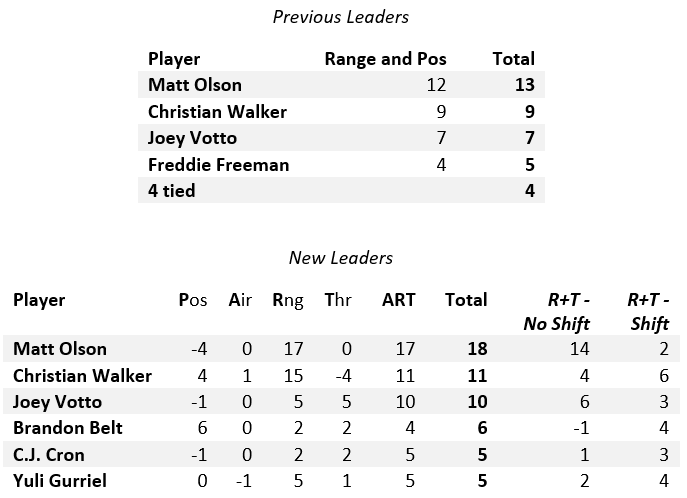
    Currently, DRS does not account for infielder positioning, thus relying on one “Range & Positioning” component to assess a fielder’s ability to convert batted balls into outs. It also considers shift plays entirely as a team defense, attributing runs saved/lost to the team overall.

    That, however, is about to change. We’ll be breaking the DRS system into PARTs.

    PART stands for Positioning, Air Balls, Range, and Throwing. This new system isolates each of these elements for individual fielders. It also allows us to evaluate how individual players perform defensively in shifts. BIS has been charting pre-pitch infielder positioning since 2013, which makes it possible for positioning to be evaluated.

    Given that positioning is largely controlled by the team rather than individual player, it is now its own separate component. Positioning Runs Saved will be added to the team’s DRS total, but not the individual player’s total. Thus, an infielder’s DRS is now the sum of:

    * His Air Ball Runs Saved
    * His Range Runs Saved
    * His Throwing Runs Saved

    How does this change the way we think about infield defense? We are transitioning from evaluating “how often did a player make that play?” to “how often did a player make that play given where he was positioned?” Additionally, we’re able to evaluate all infield plays, not just ones involving an unshifted defense. The result, we believe, is a more accurate overall depiction of defensive performance.

    How do we actually estimate the effects of positioning? The system evaluates the chance a play would be made without considering fielder positioning (using information about the batted ball’s trajectory, location, and velocity and the batter’s speed) and compares it to the chance it would be made considering those variables and the fielder’s positioning. If a batted ball is estimated to be a high percentage out, but a fielder isn’t close to it, then the team will get penalized in the form of Positioning Runs Saved—but the fielder will not.

    What does all this look like in action? Let’s consider Matt Chapman of the Oakland A’s, one of baseball’s top defensive players.

    The current DRS system awarded him 18 Defensive Runs Saved for 2019. The new system, however, will have him at 34 Defensive Runs Saved. Stripping out positioning and including shift plays gives Chapman a significant boost.

    Here’s the breakdown at how we arrive at the new number:

    * Range Runs Saved: +19
    (+11 in non-shifts, +8 in shifts)

    * Throwing Runs Saved: +11
    (+10 in non-shifts, +1 in shifts)

    * Air Ball Runs Saved: 0

    * Other Runs Saved: +4
    (Good Fielding Plays/Defensive Misplays, Double Plays, Bunts)

    * Total Defensive Runs Saved: +34

    What doesn’t get included here is positioning, and the system calculates that Chapman accumulated -13 Positioning Runs Saved (-10 in non-shifts, -3 in shifts). Again, this number will still be included in the team total, but the individual player will not be penalized for it.

    We can also see the gains for Chapman from including shift plays, as he was +8 for Range and +1 for Throwing in shifts. Even though the A’s shifted the least of any team per BIS charting, that’s a significant Runs Saved total that was previously uncredited to Chapman.

    This data for Chapman and all other Major League players will soon be rolling out on FieldingBible.com, and it will also be featured in The Fielding Bible – Volume V (coming in the spring of 2020) and in The Bill James Handbook 2020 (out November 1).

    Stay tuned for more information and updates regarding this improvement to DRS.

  • Modeling the Subjective: 2019 Gold Glove Awards

    By Chris Weikel and Sam Weber

    The Rawlings Gold Glove, given annually to the MLB players who exhibit superior defensive performances, is a fickle and ever-changing award. Despite how much weight the Gold Glove is granted when discussing Hall of Fame careers, its actual inputs are vague and amorphous. The award has long been voted upon by MLB managers and coaches, but since 2013, in an attempt to combat its subjectivity, the SABR Defensive Index metric has accounted for 25% of the vote.

    This statistic is a combination metric that integrates Ultimate Zone Rating’s (UZR) zone-based method with the hybrid play by play/zone based formula of Defensive Runs Saved (DRS) and Chris Dial’s Runs Effectively Defended. This change has allowed us to build a model that attempts to predict the award recipients, as we now have enough seasons of winner data under the new criteria.

    Due to the award’s 75% reliance on subjective voters, we first had to test whether any public defensive statistics were actually taken into account by these managers, as they hold the most weight. Below is a visualization for all the Pearson coefficients of major defensive metrics and Gold Glove winners, bucketed into three-year stretches since 2003, the first year that DRS was available.

    The original correlations start out very weak because in 2003 the voters’ buy-in for defensive metrics was almost nonexistent. But as time goes on, they slowly pick up more and more steam, with the 2013 shift to more analytical selection methods marking the final large jump in bucket 2. The current correlations convinced us that modeling this very subjective award is now possible, as long as we also take into account voter biases like previous award winners and flashiness (we used the Good Fielding Play component of DRS for this – SIS Video Scouts reward players for making notable plays that would not be acknowledged in a box score).

    Our final model is a binary logistic regression with variables ranging from the DRS components and UZR (up to September 23) to previous Gold Gloves won. The model also incorporates a Gold Gloves-per-age factor to help weed out aging winners, while adding extra weight to young stars.

    We performed rigorous 10-fold cross validation testing and determined our model to be the best predictor with a .97 sensitivity and .44 specificity. This may seem low, but for the training and validation set, the model does not realize that only one person at each position, in each league, can win each year; it just takes a winner as anyone over a certain probability cutoff set to pick the appropriate proportion of victors for that sample.

    We then filter the winners by probability and delegate the award to the top probability player in each league, at each position, each year who played enough innings to qualify. We excluded both catcher and pitcher as their limited metrics and far more unique defensive requirements require different modeling than the other fielders.

    The MLB uses three finalists to build up suspense, so here are our model’s projected Gold Glove winner and the top three finalists for each award. We also included extra information on the top probability earner.

    NL 1B:

    1. Paul Goldschmidt
    2. Anthony Rizzo
    3. Eric Hosmer

    AL 1B:

    1. Matt Olson
    2. Ronald Guzman
    3. Carlos Santana

    Overall Probability Leader 1B: Matt Olson

    Oakland’s Matt Olson is an artist. He makes an at-times-mundane position, first base, as exciting as shortstop. Anchoring one of the better defensive infields in the league, Olson allows teammates Matt Chapman and Marcus Semien to shine while also making quite a few highlight plays himself.

    He was by far the rangiest first baseman in the league, posting 12 runs saved from the Range and Positioning DRS component alone. Where Rizzo thrives is in handling difficult throws, securing 32 of these attempts for his teammates (second to Pete Alonso’s 33). Rizzo gets a huge bump here, but unfortunately the other aspects of his defense bring him back down to the pack.

    Our model sees Olson’s consistent, across-the-board production and decided it outweighs the previous Gold Glove resumes of Goldschmidt and Rizzo, so it selected him as the top contender.

    NL 2B:

    1. Kolten Wong
    2. Max Muncy
    3. Adam Frazier

    AL 2B:

    1. DJ LeMahieu
    2. Yolmer Sanchez
    3. Hanser Alberto

    Overall Probability Leader 2B: DJ LeMahieu*, Kolten Wong

    Although the Yankees’ DJ LeMahieu was the model’s selection at second base, we decided to discuss the second highest probability winner, Kolten Wong, because of LeMahieu’s significant use this season at multiple other positions, such as first and third. Even though Wong has never won a Gold Glove, he has been seen favorably by DRS. In the past two years, he’s taken a major step forward, accumulating 19 total runs saved last season and 14  this season (his previous high was 9 in 2014). Compared to LeMahieu, he also seems to handle difficult line drive outs well, amassing five of these GFPs compared to LeMahieu’s one at the position:

    NL 3B:

    1. Nolan Arenado
    2. Evan Longoria
    3. Brian Anderson

    AL 3B:

    1. Matt Chapman
    2. David Fletcher
    3. Kyle Seager

    Overall Probability Leader 3B: Nolan Arenado

    Nolan Arenado comes in as the overall probability favorite to win the Gold Glove at third base in 2019. Three 20-plus DRS seasons in the last six years have helped the Rockie win the NL award every year since 2013. His 2013 season was particularly stunning, amassing 14.6 UZR and 17.7 Fielding Runs Above Average to go along with his 30 total Runs Saved. Since our model takes into account the subjectivity of voting, Arenado is helped tremendously by the fact he’s won the NL award every year since 2013. Second overall was Oakland’s Matt Chapman, who’s arguably had better defensive seasons at third base in recent years, though he was still great in 2019:

    Year Name UZR FRAA DRS
    2017 Nolan Arenado 6.7 5 20
    2017 Matt Chapman 9.4 12.6 19
    2018 Nolan Arenado 5.8 9.1 5
    2018 Matt Chapman 10.9 15.6 29
    2019 Nolan Arenado 7.5 10.3 7
    2019 Matt Chapman 12.8 13.5 16

    With Chapman’s sole win coming last year, the model heavily favored a five-time Gold Glover in Arenado to be the top pick. That’s not to say Arenado hasn’t been superb throughout his career, as evidenced by plays like this one that will keep him a formidable force at the position for years to come:

    NL SS:

    1. Nick Ahmed
    2. Trevor Story
    3. Javier Baez

    AL SS:

    1. Andrelton Simmons
    2. Francisco Lindor
    3. Adalberto Mondesi

    Overall Probability Leader SS: Andrelton Simmons

    At shortstop, we have another case of a perennial winner taking home the overall top spot. Andrelton Simmons of the Angels comes in as the favorite at the position. A winner in 2013, 2017, and 2018, Simmons, for a period of time, was considered possibly the best defender in Major League Baseball. His range and ability to make tough ground ball outs (like this one) contribute strongly to his Good Fielding Play totals and other metrics like UZR.

    Like Arenado, his 2013 season was pretty remarkable. Simmons totaled 14.8 UZR, 27.2 FRAA and 41 DRS, the second-highest total for the statistic behind Kevin Kiermaier’s 2015 season.

    Last year’s NL winner Nick Ahmed came in at second and, like Chapman, was hurt by the model for not winning as many previous awards.

    NL LF:

    1. David Peralta
    2. Joc Pederson
    3. Marcel Ozuna

    AL LF:

    1. Alex Gordon
    2. Andrew Benintendi
    3. Michael Brantley

    Overall Probability Leader LF: David Peralta

    David Peralta would be our theoretical overall winner in left field. Peralta’s a name that may not have gotten a lot of attention playing in Arizona this year, but the 32-year-old outfielder was an anchor at the position. He put up an impressive 6.2 UZR and 10 defensive runs saved this season, considerably better than his runner up Alex Gordon, who only had a 3.2 UZR and -1 DRS. Again, we see an example of a six-time winner in Gordon being assisted by his previous prowess, but Peralta has performed well enough to win at a position that’s slightly devoid of talent.

    NL CF:

    1. Victor Robles
    2. Lorenzo Cain
    3. Harrison Bader

    AL CF:

    1. Kevin Kiermaier
    2. Jackie Bradley Jr.
    3. George Springer

    Overall Probability Leader CF: Kevin Kiermaier

    Kevin Kiermaier of the Rays comes in as the top probability winner, with Victor Robles behind him. Both have had strong seasons, with Kiermaier leading Robles in UZR, but Robles having 22 DRS compared to Kiermaier’s 13. With what’s become a theme of this piece, Kiermaier is helped by the model favoring players with previous wins, as he’s a two-time Gold Glover compared to Robles’ none. As previously mentioned, some of Kiermaier’s seasons have been remarkable, especially his 2015 campaign in which he totaled 42 DRS, the highest total since its inception in 2003. He’s certainly not a bad choice for the award by any means.

    NL RF:

    1. Jason Heyward
    2. Cody Bellinger
    3. Hunter Renfroe

    AL RF:

    1. Mookie Betts
    2. Josh Reddick
    3. Max Kepler

    Overall Probability Leader RF: Jason Heyward

    Right field turned out as effectively a tie between the Dodgers’ Cody Bellinger and the Cubs’ Jason Heyward. Taking a quick look at their 2019 defensive stats , this might be a bit striking: Bellinger had 19 Runs Saved and a 9.5 UZR. Heyward had 7 Runs Saved and a 2.4 UZR.

    If we’re looking at this year’s numbers, the Gold Glove shouldn’t even be a contest between these two. Heyward, though, is helped tremendously, probably too much, by the fact he’s won five times by his age 29 season, whereas Bellinger has yet to win. Before any previous Gold Glove inputs were added to the model, Bellinger was the overall favorite to win, showing that subjectivity of voting and previous wins can play a major role in who ends up with the hardware.

    Conclusion

    This was our first attempt at building a Gold Glove model and it’s clear it needs some tweaking. It performs fairly well on most occasions but does tend to overvalue players who have won previous Gold Gloves. One potential way to fix this overemphasis on past winners is to eliminate more of the older years from the training data. We do need to go back in time relatively far in order to incorporate enough positive results in the sample, but voting in the pre-defensive index days was far more friendly to past winners than the current system (for example: Derek Jeter)

    Removing some of the pre-2013 years — along with adding team record as a small adjustment to account for more bias — could make the model more robust and accurate. Overall, our model appears to be a successful way to judge Gold Glove contenders. Nevertheless, the true measure of whether our model performed admirably won’t come until we see the final votes.


  • The Nationals are a different team (and outfield) defensively

    By Mark Simon

    The Astros are an elite defensive team. The Nationals are, in totality, an average one. They actually ranked 12th in a National League that was crowded with good defensive teams, in Defensive Runs Saved (18th overall).

    But you have to take that number with a grain of salt. The Nationals are a different team from the one that started 19-31. And one of the ways that they’re better is their defense. That’s been driven by two of their young standouts.

    Their star
    Rookie Victor Robles led all center fielders with 22 Runs Saved, passing Lorenzo Cain for the lead late in the season. Robles has a very good glove and a very good arm. His 11 Range & Positioning Runs Saved ranked third at the position and were the product of catching a number of balls in the shallowest part of the outfield that his fellow center fielders didn’t typically catch. The Nationals position him shallow, allowing him to make catches on shallow line drives and fly balls. They also put him in good position to throw. His nine Outfield Arm Runs Saved and 12 assists without the help of a cutoff man were the most among all outfielders.

    Through the team’s first 50 games, Robles had cost the Nationals one run with his defense in center field. The rest of the season, he saved an MLB-best 23.

    The ups and the downs
    Juan Soto is one of the game’s rising superstars. He’s come up with big hit after big hit this postseason. On the defensive side, Soto is capable of excellence. He had seven Range & Positioning Runs Saved in the regular season, and his phenomenal catch of a Clayton Kershaw line drive in an NLDS Game 2 win against the Dodgers helps validate those numbers.

    Soto’s issue is with his arm, which cost the Nationals five runs per our Outfield Arm Runs Saved stat. Forty-six runners took an extra base on a base hit he fielded. He didn’t throw out anyone all season.

    Through those first 50 games, Soto had cost the Nationals five runs. Despite the outfield arm issues, he found ways to save six runs the rest of the year. What looks to have happened (from a little bit of video review) is that the Nationals figured out how to best position Soto. That allowed him to make plays like this one on Harold Castro, a play with a 1% out probability because of the kind of batted ball it was, where it was hit, and how hard it was hit. And also this one on Yoan Moncada, where he had to sprint back and make an athletic reach to catch a ball with an 8% out probability.

    As the defense goes …
    This probably isn’t that surprising, but it fits for those who point out that you can’t judge the Nationals on their 19-31 start. Washington was tied with the Orioles for 28th in the majors in Runs Saved through May 23. Since then, the Nationals have saved 33 runs, which ranks sixth in that time.

    Robles and Soto were the sparks. We’ll see if they have one great series left in them.

  • What makes the Astros defense great?

    By Mark Simon

    This shouldn’t come as a surprise if you watched them during the ALCS: The Houston Astros led the American League in Defensive Runs Saved with 89 in 2019. Houston’s defensive excellence is the product of a collective effort. Thirty players on other teams had more Runs Saved than the Astros leader, George Springer, who had 11.

    Astros Defensive Keys
    * OF led MLB in Catch Rate on Flies & Liners
    * Infield led AL in Shift Runs Saved
    * Carlos Correa makes many great plays, few mistakes
    * Martin Maldonado, Robinson Chirinos: great pitch blockers
    * Zack Greinke: Nimble on the mound

    A great outfield

    But Springer was part of an outfield that combined to save 45 runs with its defense, the second-highest total in the majors and 19 runs more than the next-best AL team (the Yankees, 26).

    The Astros caught an MLB-high 62% of fly balls and line drives hit to the outfield (but not out of the ballpark) this season. Springer, Jake Marisnick, Josh Reddick, and Michael Brantley were the players integral to that.

    Springer split his time and his Runs Saved between center field (6 Runs Saved in 75 games) and right field (5 in 59). That was a big jump from 2018, when he cost his team five runs with his defensive play. He’s usually best on fly balls to the shallowest part of the outfield (you’ll see that’s a trend here). Watch him on deep balls in right field. The numbers indicate that’s not his strength.

    Marisnick is the team’s best ‘go back and get it’ outfielder, hence a valuable center fielder. He’s totaled at least 10 Runs Saved in a season as an outfielder four times. Since 2014, he ranks seventh among outfielders in Runs Saved despite ranking 60th in innings. He finished 2019 with five Runs Saved, with his strength being catching the shallow fly ball rather than the deep fly, as it had been in years past. The Astros have been using him as a defensive closer this postseason, bringing him in to protect late-game leads.

    Jake Marisnick on Shallow Fly Balls
    Opportunities* 78
    Plays Made 59
    Expected Plays Made 50
    Plays Above Expected 9**
    * Balls with Catch Probability >0%
    ** T-2nd among CF

    In Game 6 of the ALCS, he replaced Brantley (with Springer and Reddick moving so Marisnick could play center). But Brantley is no slouch. He made a great diving catch to preserve the Astros lead that game. Brantley tied for the lead among left fielders with 10 Defensive Runs Saved in 2019.

    The Astros play Brantley an average of four feet shallower than the average left fielder plays at Minute Maid Park. That likely helped him too in catching shallow flies, as he fared well above average in doing that. You saw that in the LCS catch.

    Springer just missed DJ LeMahieu’s game-tying home run in the ninth inning of Game 6. That kind of ball is one that Reddick has made his season on. He’s snagged five home run robberies this year (here’s one), matching Carlos Gomez (2013) and Lorenzo Cain (2019) for the most in a season since Sports Info Solutions began tracking them fully in 2004.

    Reddick’s nine Runs Saved in right field are largely boosted by those five catches. Otherwise, Reddick is a slightly above-average glove (he has a nice catch in Game 6 too). It will be worth watching how he throws. His Outfield Arm Runs Saved dipped from 3 to -3 from 2018 to 2019. He averaged five assists without a cutoff man from 2016 to 2018 but had only one unaided in 2019.

    Shifts key to infield success

    The Astros recorded 35 Shift Runs Saved in 2019, the third-highest total in the majors and easily the most in the American League. Houston put Yuli Gurriel, Jose Altuve, Carlos Correa, and Alex Bregman in position to succeed, and those players made plays pivotal to the team’s success.

    Most Shift Runs Saved – 2019 Season
    Dodgers 48
    Diamondbacks 44
    Astros 35
    Cardinals 30

    There’s versatility there if needed. When Correa got hurt, Bregman moved from third base to shortstop and Gurriel moved from first base to third base. The team survived until Correa returned. When Correa’s healthy, you can see he is a difference maker with plays like the double play conversion in Game 6 of the ALCS.

    SIS tracks Good Fielding Plays and Defensive Misplays & Errors using a set of rules devised by Bill James that rewards both Web Gem-type plays and things like a nifty double play turn and punishes for things like slipping and falling or failing to convert a makable double play.

    Correa averaged the most Good Fielding Plays per 1,000 innings and the fewest Defensive Misplays per 1,000 innings among shortstops in 2019. He’s the highlight reel star this year after Bregman played that role in years past.

    Carlos Correa vs. Trea Turner
    Good Fielding Plays Misplays & Errors
    Carlos Correa 25 9
    Trea Turner 16 35

    Bregman, Gurriel and Altuve are the consistent ones. Altuve’s not as nimble as he used to be, but Gurriel helps make up for that by the ground he covers at first base (and he helps his teammates out – Gurriel had only one Misplay & Error related to catching a throw).

    In all, the Astros turned 76% of ground balls and bunts into outs last season, the third-highest total in the majors.

    Pitch and Catch

    Behind the plate, the Astros split between Martin Maldonado and Robinson Chirinos. Maldonado is Cole’s personal catcher and could start if the Astros use a bullpen game again. Maldonado has a reputation of being one of the best defensive catchers in the game. He ranked among the best pitch blockers this season and is typically one of the leaders in pitch framing and basestealing deterrence, though he was just a smidge above average in both this season.

    Cole’s fine with that. He has a 1.30 ERA and a nearly 8-to-1 strikeout-to-walk ratio in the 90 1/3 innings Maldonado has caught him.

    Gerrit Cole By Catcher (includes postseason)
    Maldonado Chirinos
    ERA 1.3 2.44
    K-BB Ratio 7.6* 6.2
    Innings 90 1/3 103 1/3
    * 9.8 in regular season and LDS (137/14)

    Chirinos is a below-average pitch-framer and average when it comes to basestealing deterrence. However, he’s an outstanding pitch blocker. His 96% block rate on potential wild pitches was highest in the majors. Chirinos was Verlander’s personal catcher. He’s caught every pitch Verlander has thrown this season.

    As for the Astros pitchers, Cole and Verlander have one Misplay & Error between them and handle their positions well. They pale in comparison to Greinke, who might be the best fielding pitcher in baseball. He led all pitchers in putouts and tied Max Fried for the lead in assists. He also limited basestealers to 2-for-6 in stolen base attempts. This is something Greinke has been good at for a long time. He ranks second among pitchers in Defensive Runs Saved since the stat was first tracked in 2003.

    We know that the Astros can pitch and that their best defense is when the ball isn’t hit at all, which happens often for Cole and Verlander. But it’s a great luxury to have the defense they do. It puts them in position to win their second World Series in three seasons.

  • Scouting the future: Japan’s top players who may get posted down the road

    By Will Hoefer

    At SIS, part of our baseball operation involves collecting data on all of the Nippon Professional Baseball (NPB) games. We’ll be sharing detailed profiles on a player from each of these teams. This piece, the last in our series, focuses on players who could be posted in future years.

    Part I – Position Players

    Part II – Pitchers

    Kohei Arihara, RHP, Nippon-Ham

    Age: 27 | Posting Eligibility: 2021

    Kohei Arihara has long been on the radar of Pacific Rim scouts, due in no small part to his rotation mate Shohei Ohtani drawing massive interest during his first three seasons as a pro. Nevertheless, Arihara has maintained the interest of MLB scouts well after the departure of Ohtani. The 27 year old right hander has ascended to ace status for the Fighters, and has enjoyed a breakout season on the strength of increased changeup usage that allows him to fare much better against left handed hitters. His 25.2 K% and 2.46 ERA this season are by far career highs, and it was encouraging to see him get to 160 innings pitched after a shoulder injury prior to the 2018 season limited him to 110 innings.

    Arihara features a four seamer with decent run and rise as his primary fastball, which will range anywhere from 88 to 95 MPH in a given start. It’s hard to get a great gauge of where he sits with, but his ability to maintain most of the higher range of his velocity late into games suggests he likes to mix speeds rather than try to blow hitters away.

    Against right handed hitters, Arihara goes to his slider and splitter to finish off plate appearances. The slider is his primary breaking ball, and an above-average offering with nice bite that is commanded well gloveside to the black. The splitter features good slashing movement that can get down and in on the shoetops of righties, but it can leak over the plate at times and projects more as an average offering.

    Against left handed batters, Arihara likes to go to his changeup and cutter. The cutter, which has been used less in recent years, is an average offering that Arihara can locate fairly well on the hands of lefties and generate weak contact. The changeup is the one true plus offering that Arihara features, as he demonstrates plus depth and fade with more consistent feel than the splitter. Rounding out his repertoire is a mid to high 80s two seamer that will likely be scrapped at the next level, along with an eephus curve that serves as a change of pace pitch.

    With only being a year away from that all too valuable sixth year of NPB service time, don’t expect Kohei Arihara to be posted until after the 2020 season. He has grown into his wide arsenal of offerings, and seems to have found a pitch mix that best suits him as a starter. Arihara demonstrates strong command of his three best pitches–an above average four seamer, a plus change, and a slider that flashes plus. That, along with his resourceful deployment of his lesser secondary offerings to keep hitters off balance, projects Arihara as a middle of the rotation starter for an MLB team as soon as 2021.


    Kohei Arihara W L IP ERA WHIP HR/9 K% BB%
    2019 15 8 164.1 2.46 0.92 0.8 25.2% 6.3%
    Career 52 41 703.1 3.79 1.22 1.0 17.8% 5.6%

    Masataka Yoshida, OF, Orix

    Age: 26 | Posting Eligibility: 2023

    The shining star in an otherwise bleak Orix sky, Masataka Yoshida is one of the best pure hitters in the NPB. He’s had back to back 25-home run seasons, is one of three qualified hitters to walk more than he struck out in 2019, and has been consistently among the leaders in OPS throughout his NPB career. The only thing Yoshida doesn’t do is run–he’s 9 for 14 in career stolen base attempts–but there are few better inside the batter’s box than this Buffaloes’ basher.

    Yoshida exhibits plus bat speed and plus raw power from the left side, with quiet lower half swing mechanics. His load gets a little long due to a hand hitch keeps him from getting out in front of the ball more on high velocity pitches, but he still has the hand quickness and feel for hitting to spray consistently and drive those pitches up the middle. Being able to get out in front and drive those balls pull side with some regularity is the next step. Defensively, Yoshida is limited to left field, as he has fringe average arm strength and foot speed. He moves very tentatively in the field and doesn’t seem to get good reads on fly balls, which projects him to have below average range.

    Yoshida’s power relative to his size, feel for hitting from the left side, and fringy defensive ability reminds me a lot of Texas Rangers’ DH/LF Willie Calhoun–whose offensive breakout in 2019 shows promise for Yoshida getting an offer to play everyday as a middle of the order masher. Due to a lower back injury that sidelined him for most of 2017, Yoshida is likely not going to gain the requisite six years of service time required to eligible for a major league contract in the posting process until after the 2022 season. Considering his value is almost entirely tied to his bat, he should be able to retain his value over the next three seasons provided he stays healthy–though it remains to be seen if Orix will be willing to post their superstar.

    Masataka Yoshida PA AVG OBP SLG HR SB BB% K%
    2019 610 .322 .413 .543 29 5 13.0% 10.5%
    Career 1734 .315 .401 .535 77 9 12.2% 11.8%

    Atsuki Taneichi, RHP

    Chiba Lotte (Posting: 2026)

    R/R 6-00, 183 lbs

    Date of Birth: 09/07/1998

    NOTE: Due to Taneichi’s age, I’ve decided to take a more pure scouting report approach to his entry in the series. We’ll cover his frame, mechanics, each pitch and his overall command, along with overall thoughts and a long term projection.

    Fastball: 40 (50), Slider: 45 (55), Splitter: 55 (60), Command: 40 (50)

    Build and Mechanics: 6’0”, 183 lbs. Mostly filled out, might be able to add a bit more muscle to his frame. Pitches out of a three-quarter armslot, shows good arm speed and extension with smooth lower-half mechanics; though shortening up his arm action might help him get a bit more zip on his fastball.

    Fastball: Sits 88-91, Tops out at 92. Could probably add some muscle onto his frame, but the velo is going to be no better than average. Can get plus run on it and has shown effectiveness getting weak contact working up in the zone. Gets good rise on his 4-seamer and good sink on 2-seamer.

    Slider: Average pitch that flashes above average bite and depth. Think it should be used more as a change of pace against lefties but should be an out pitch against righties as he refines his command of it.

    Splitter: Plus depth and fade, shows advanced feel but can leak it over the middle. Demonstrates an ability to tunnel it off of sinker against lefties and slice it down against righties.

    Command: Secondary command is developing, showing some difficulty getting over the top of his slider. Both split and slider will miss over the plate, but motion is repeatable and fluid enough to project an increase in hitting spots.

    Overall: Taniechi has been impressive as a second year out of high school in the NPB. His upside is limited due to a fastball with a strong movement profile but lackluster velocity, but he has a splitter that projects as plus along with a slider that should be a reliable out pitch versus righties. Secondary command is still a work in progress, but he generally keeps his fastball out of the middle of the zone. Refinement of his slider will be key for him. If he can consistently get over the top of it he has bottom of rotation upside in an MLB rotation.

    Atsuki Taneichi W L IP ERA WHIP HR/9 K% BB%
    2019 8 2 116.2 3.24 1.41 0.8 26.7% 10.1%
    Career 8 6 155.0 3.95 1.42 0.9 24.1% 9.5%