Category: Baseball

  • A rocky outfield situation in Colorado

    A rocky outfield situation in Colorado

    By Will Hoefer

    A lot has been made of “The Coors Effect.” Some liken it to a hangover, though any Coors drinker will tell you that requires a lot of Coors to get you in such a state of disrepair. The phrase has usually been deployed to describe a dramatic road and home effect on Rockies’ hitters, but I’d like to focus on a different subject matter as it relates to how Colorado players perform differently in their constantly shifting environs.

    Outfield defense, in particular range and positioning, has been subject to vastly differing levels of performance by Rockies outfielders depending on if they are in Denver or not.

    The charts below show how many plays the Rockies outfielders were above or below an average defense on balls hit to different parts of the outfield. The higher the number, the better the team is. The lower the number, they worse the outfield was at catching balls.

    Rockies Plays Made Above/Below Average

    All stats below are entering Tuesday

    Coors 2016-2018  Shallow  Deep  Total
    Plus-Minus
    3-Year Plus-Minus Total -35 2 -34
    Road 2016-2018
    3-Year Plus-Minus Total 17 -11 8
    Coors  2019  Shallow  Deep Total

    Plus-Minus

    Home Pace -21 -7 -49
    Road 2019
    Road Pace -5 10 15

    As you can see, the Rockies as a team struggled with shallow hit fly balls and line drives into the cavernous confines of Coors from 2016 to 2018. However, they mostly corralled the deeper hit balls in Denver, which makes sense conventionally– singles turn into doubles and doubles turn into triples.

    The downside is that playing the outfielders so deep ceded so many plays in front of the Rockies’ outfield that there ended up being 34 fewer plays made than the league average.

    On the road, it was a different story; the Rockies outfielders ended up preventing a significant amount of plays in front of them while ceding some plays on deep flies.

    They had above average range and positioning on the road and were a whopping 40 plays better away from Coors from 2016-2018. Going into 2019, the Rockies seemingly made an effort to get better at reaching shallow balls into the outfield at Coors and deep balls on the road.

    That’s reflective in the 2019 tables above, but as you can see they ceded so many more plays on the opposite ends of the spectrum–deep flies at Coors and shallow flies and liners on the road–that they’ve been worse overall at preventing runs with their outfield range and positioning.

    There are additional reasons that the Rockies’ range and positioning has declined at Coors in 2019 apart from decisions about where to position their outfielders. The choice to make Ian Desmond the everyday center fielder has been much maligned by about every advanced metric available to evaluate defensive performance.

    Desmond ranks toward the bottom of the list in outfielder jump and outs above average among qualifying outfielders on Baseball Savant, and he is dead last in Defensive Runs Saved (-19 Runs Saved) to date in 2019.

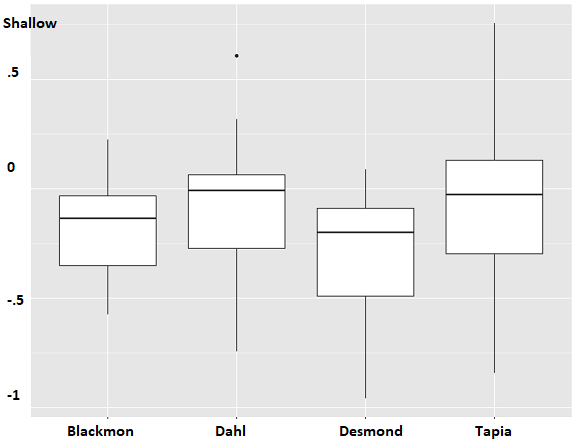
    On the box and whisker plots below, the whiskers represent the overall range of the plays made or not made, and the line in the box is the average (mean) run value for a player on balls hit to him.

    CoorsShallow2019 for blog


    Coors Deep for Blog

    You can see that Desmond has essentially failed to make any play on shallow balls at Coors, and as a result, he loses about a run defensively on every five balls hit in front of him.

    Conversely, younger and more fleet-of-foot outfielders David Dahl (who recently went on the IL with a sprained ankle) and Raimel Tapia have more or less held their own in making plays on deep and shallow balls at Coors. Neither are perfect fits; Dahl has a -10 DRS and Tapia has a -8 DRS on the year.

    This speaks to a larger point about Coors; it’s an extraordinarily hard place to prevent runs, both on the mound and in the field. Over the 17 years Baseball Info Solutions has been keeping track of DRS, Rockies’ outfielders have been 371 runs below league average. That encompasses everything we calculate — range, throwing, and making good defensive plays while avoiding mistakes.

    That’s the worst, and it’s not even close; the White Sox outfielders are 29th with 191 runs below league average, which is a 180-run difference. By Range and Positioning, the Rockies do move up two spots to a tie for 27th.

    It’s always going to be an uphill battle to save runs in the outfield for Colorado at home, but it’s also imperative that they make the best decisions possible with so many runs at stake. While Dahl and Tapia aren’t going to be topping the DRS leaderboards, they could be better options to track down balls at a premium position than Desmond. The Rockies tried a different look in the outfield on their last road trip, moving Desmond to left and Dahl to center (Dahl subsequently got hurt and others have played center since then). It may be worth making that a permanent change.

  • More valuable on D: Chapman or Baez?

    By Mark Simon

    In the course of writing our articles in this space and at The Athletic, we’ve heard from more Javier Báez fans than those supporting any other player. People love both how he plays defense and how well he plays defense.

    So with the Chicago Cubs playing the Oakland Athletics, we thought we’d pose a question: which player is more valuable to his team on defense right now, Báez or Athletics third baseman Matt Chapman?

    Defensive Runs Saved

    By Defensive Runs Saved in 2019, Chapman has a 14-to-9 advantage. Chapman, who has the most Runs Saved for a third baseman, provides a value that Báez can’t. Chapman is the best in baseball at out conversion on balls hit down the third base line. Those balls are largely would-be doubles.

    When Báez takes away a hit, it’s usually going to be a single, because he’s got an outfielder behind him who can get to the ball quickly.

    Let’s add in individual value for shift defense, which isn’t factored in our basic Defensive Runs Saved, but can be computed using our internal data.

    Of the Cubs’ Runs Saved in shifts, seven have come on plays Báez made. That bumps him to 16. But making the same calculation gives Chapman five runs.

    The advantage narrows to 19-16, still in favor of Chapman.

    Good Fielding Plays

    Our Video Scouts chart every play of ever game, categorizing some plays as “Good Fielding Plays” and “Defensive Misplays & Errors.”

    Good Fielding Plays are Web Gems – the diving, sliding or jumping catch that you’ll see in highlights, but also things like keeping the ball on the infield to prevent a baserunner from gaining an extra base, or preventing a single from being a double. There are approximately 30 categories from which to choose.

    Defensive Misplays & Errors are errors, plus plays in which a fielder’s actions had a negative consequence. These include your basic bobbles and drops, but also cover other ground. Official scorers may not give an error if a fielder fails to convert on an attempted double play, since one can’t be assumed but Video Scouts can award a Misplay for an errant throw or a drop after the catch by the relay man. There are approximately 60 categories of these kinds of plays.

    Chapman is having a phenomenal year when it comes to making the great plays and avoiding mistakes. He has 35 Good Fielding Plays and 14 Misplays & Errors.

    Chapman’s 35 are the most in MLB by a non-first baseman (first basemen tend to record more than other positions because of scooped throws). That’s a big improvement over last season, when he finished with 41 Good Plays and 35 Misplays & Errors.

    Báez has 21 Good Fielding Plays and 28 Misplays & Errors. He’s two shy of the most Good Plays at shortstop. He garners attention because his Good Plays are so good, like the one-of-a-kind tags he’s made that get shown repeatedly on TV and go viral on social media.

    In Sum

    It’s difficult to compare across positions. But we can tell you that Chapman is the top defensive third baseman in baseball by the numbers. Báez has won our Fielding Bible Award for multi-positional excellence three years running. He’ll be in for a tough fight at shortstop this season Nick Ahmed of the Diamondbacks has 20 Runs Saved plus he’s accounted for 16 of his team’s Runs Saved in shifts).

    Perhaps this article should have been one comparing Ahmed and Chapman’s value too. We’ll save that for another time.

    In the meantime, ponder where a very, very good shortstop rates compared to the top third baseman, and vote in our poll. We’re curious how people weigh the numbers in their consideration.

  • New baseball podcast: Kevin Pillar talks about sliding, diving, and jumping catches

    LISTEN HERE

    This week’s episode of the SIS Baseball Podcast highlights defensive excellence in the Bay Area.

    Senior research analyst Mark Simon (@MarkASimonSays) points out how well Chad Pinder has played recently, with help from Oakland Athletics coach Ryan Christenson (1:04).

    Then, Mark talks to San Francisco Giants outfielder Kevin Pillar (@KPILLAR4). They discuss the challenges of making sliding, diving, and jumping catches including dealing with injuries (3:00), how Pillar learned to play that way (5:13), what being the leader in those kinds of catches says about a player (10:00), learning a ballpark (11:02), how much he uses scouting information (13:24), and what advice he would give to kids who want to play defense like him (15:19).

    Mark is then joined by research associate Andrew Kyne (@Andrew_Kyne) and intern Jon Becker (@jonbecker_). They review Pillar’s comments (18:29), discuss a pitcher who changed approach upon joining a new team (20:56), answer a listener question about the Mount Rushmore of stats (22:45), preview Andrew’s presentation at Saberseminar (24:07) and challenge listeners to figure out the Ridiculous Stats of the Day (25:21).

  • Stat of the Week: Who were July’s top defenders?

    By Mark Simon

    The San Diego Padres have known that Hunter Renfroe could hit for power since he made his big league debut in 2016. But after being known primarily as a home run hitter in the early part of his career, Renfroe is now known for something else: his defense.

    Renfroe is the Sports Info Solutions Defensive Player of the Month for July. He edged out Oakland Athletics utility man Chad Pinder in a very close vote among SIS staff.

    Renfroe is the second consecutive Padres player to win Defensive Player of the Month this season. Padres catcher Austin Hedges took the honor for June. Brewers outfielder Lorenzo Cain (March/April) and Dodgers outfielder Cody Bellinger (May) are the other winners this season.

    Renfroe led all players with 13 Defensive Runs Saved (DRS) for the month. He saved eight runs in right field, four in left field and one in center field. No other player finished the month in double figures in Runs Saved.

    Among Renfroe’s highlights were a diving grab against Alex Verdugo and a leaping catch against Joe Panik of the Giants.

    As documented recently on the Sports Info Solutions blog, Renfroe has made significant defensive improvements this season. He’s saved 17 runs overall and recently overtook Bellinger for the lead for most DRS as an outfielder this season. Renfroe has been excellent at both catching balls and deterring baserunner advancement. His five Outfield Arm Runs Saved are one shy of Bellinger for the MLB lead.

    “I want to win a Gold Glove more than I want to win a Silver Slugger,” Renfroe told The Athletic about a month ago. He’ll make an interesting candidate for our Fielding Bible Awards. His nine DRS in right field rank fourth behind Bellinger. His seven DRS in left field are one off the MLB lead. He could be a candidate for the Fielding Bible Award for best multi-position player.

    So could Pinder, especially given how he played in July. He saved at least one run as a left fielder (3), right fielder (1), second baseman (1), and third baseman (1). Sports Info Solutions Video Scouts credited him with eight Good Fielding Plays, one shy of the most by a non-first baseman (first basemen tend to have the most due to scooped throws). He did this while committing only one Misplay or Error.

    Pinder’s presence makes the Athletics a highly formidable defensive team along with first baseman Matt Olson and third baseman Matt Chapman.

    Among Pinder’s highlights this month were a pretty good impersonation of Chapman at third base to take a hit away from Jorge Polanco, a diving catch in right field to rob Eric Thames of extra bases, as well as this play in left field to take a hit from J.P. Crawford.

    Left field is where Pinder fares best. He’s saved six runs in just over 200 innings there this season. But his ability to make plays at other spots adds considerably to his value.

    For more on defensive excellence, check out the upcoming episode of the Sports Info Solutions Baseball Podcast (available Monday). San Francisco Giants center fielder Kevin Pillar talks about the challenges of making the diving, sliding, and jumping catch.

  • Analyzing the Impact Bats Added at the Trade Deadline

    By Jon Becker

    The MLB trade deadline has come and gone, and as is usually the case, it was pitching that dominated the headlines. Trevor Bauer went to the Cincinnati Reds, Shane Greene to the Atlanta Braves, and Zack Greinke to the Houston Astros. While there weren’t names quite as big or seasons quite as good acquired on the offensive side of things, there were still a small handful of meaningful position players acquired. Let’s take a look at some of them.

    OF/DH Franmil Reyes, traded from San Diego Padres to Cleveland Indians

    Reyes has been one of the most under-the-radar hitters in baseball this year, with a 34% hard-hit rate that puts him in the top 50 among the nearly 200 batters with 300-plus at-bats. His 27 home runs this year gives him 43 for his career in under 600 at-bats, though interestingly enough he’s hit only 18 doubles and driven in 77 runs. The righty swinger actually does most of his damage against same-sided pitching, with a 36% hard-hit rate against such pitchers (25% against southpaws) and 24 of his 27 round-trippers.

    A big factor in the Padres’ willingness to trade Reyes was likely his poor defense, which our Sam Weber wrote about yesterday. He’ll probably spend most of his time in Cleveland as the designated hitter.

    RF Nicholas Castellanos, traded from Detroit Tigers to Chicago Cubs

    Despite this being the most homer-happy season in MLB history, Castellanos hasn’t quite gotten the memo, hitting just 11 home runs after clubbing 23 last year. He has hit 37 doubles, to lead MLB, only 9 off of his career-high with one-third of the season still to be played. The Cubs’ biggest offensive woes have come against lefties, and Castellanos will definitely help there. He’s hitting .347 this year when holding the platoon advantage, with four of his home runs and a 43% hard-hit rate. That hard-hit rate puts him just outside the top 10 of the 200+ hitters with at least 50 at-bats against lefties.

    One thing that ought to worry the Cubs, though, is Castellanos’ defense; he’s improved, but has still been well below average, with a -6 DRS after -19 last year. The acquisition will also give Jason Heyward more time in center and less in right; Heyward’s fifth amongst right fielders with 9 DRS, but has cost the Cubs six runs when playing up the middle.

    RF Yasiel Puig, traded from Reds to Indians

    It’s been a weird season for Puig, who slashed just .218/.268/.391 through the end of May but was excellent in the next two months, batting .290/.340/.568. His hard-contact rate has improved a lot as well; it’s been 33% over the last two months after having a hard-hit ball in less than a quarter of his at-bats prior. Similarly to new teammate Reyes, he’s a bit of a reverse-splits hitter: his batting average is 14 points higher against lefties but his hard-hit rate is almost two percentage points higher against righties, against whom he’s hit 17 of his 22 home runs.

    Puig, unlike the other two names above, is an above-average fielder, with 3 DRS in right field this year and four outfield assists, with runners taking the extra base on less than 50% of opportunities. Puig has 16 Good Fielding Plays, one shy of the MLB lead at the position. He does sometimes try to do too much — he has 13 Defensive Misplays & Errors — but that doesn’t offset his positives.

    INF/OF Eric Sogard, traded from Toronto Blue Jays to Tampa Bay Rays

    The most out-of-nowhere impact trade candidate on the market, Sogard parlayed a minor-league deal with the Blue Jays into an excellent .300/.363/.477 slashline, hitting 10 home runs in 330 plate appearances after slugging just 11 in over 1,700 career plate appearances prior. He hasn’t hit the ball particularly hard, with a hard-hit rate of just over 30%, but that still represents a career high. He’s also been excellent at using the whole field, pulling just 37% of batted balls and hitting 63% up the middle or to the left side.

    The bespectacled Sogard has started games at second base, third base, shortstop, left field and right field this year.  He’s cost his teams four runs at second base, and has been +1 at the other positions.

  • Why Padres may have preferred Hunter Renfroe to Franmil Reyes

    By Sam Weber, Sports Info Solutions

    The San Diego Padres have certainly been an interesting team to watch this season. Building around a young core that includes the likes of Manny Machado, Fernando Tatis and Chris Paddack, Padres fans will have an entertaining and competent product on the field for years to come.

    However, two outfielders the Padres had coming into the season began to outperform their expectations on the backs of their stellar power numbers – Hunter Renfroe and Franmil Reyes. As the trade deadline approached, both names were floated around as potential pieces on the move. With Reyes now on his way to Cleveland, it became evident San Diego saw greater long-term potential in Renfroe, but with similar offensive production, why was this the case?

    Renfroe and Reyes are similar hitters, Renfroe is currently sixth in the league in home runs with 29, and Reyes sits right behind him ranked No. 11 at 27.  With a .563 slugging percentage, Renfroe currently ranks No. 14 in the league. Reyes is no slouch either, slugging at a .535 clip.  Renfroe and Reyes each rank in the top 10 percent in isolated power at .324 and .280, respectively. Both are outpacing their past slugging numbers.

    They both hit the ball pretty hard. Both rate well in metrics like average exit velocity, barrel percentage and hard-hit percentage. Consistent solid contact and hitting for power made these guys strong offensive contributors for the Padres, with almost identical contributors based on wRC+ and wOBA.

    Player Avg. Exit Velocity BIS Hard-Hit Rate wRC+ wOBA
    Hunter Renfroe 90.6 34% 116 .346
    Franmil Reyes 92.3 34% 117 .348


    Taking a bit of a closer look, however, we start to see where Renfroe separates himself. One element is the kinds of pitches he’s chosen to swing at that’s made him a better hitter. He’s made major strides hitting the pitches he’s supposed to hit. Here are his numbers from last year and this year for pitches in the middle third of the plate height-wise, where Renfroe is significantly more successful (in other words, pitches that are neither high nor low)

    Year BA SLG Swing Rate
    2018 .256 .608 51%
    2019 .323 .828 63%


    Renfroe has also added to his value by turning himself into a very good defender this season. He ranks tied for second among leftfielders with 7 Defensive Runs Saved and is also tied for third among rightfielders with 11 DRS.

    His defensive improvements come from a combination of everything – turning more balls into outs and his improved ability to throw runners out. He’s had more plays like this full-extension diving catch against Alex Verdugo (we call these “Good Fielding Plays) and this throw to nail Stephen Vogt of the Giants at second base..

    Here’s some of his DRS numbers in left field from the past two years. He’s seen more playing time there than in right recently.

    Year Throws GFP/DME Total
    2018 0 -1 2
    2019 3 1 7


    Like Renfroe has done, I think the next step in Reyes’ game is going to be better pitch selection and improved defense. The past two seasons, he’s tallied -1 and -10 DRS, certainly not trending in the right direction. We’ve also seen him take a bit of a step back in terms of swinging at and chasing offspeed pitches – pitches you don’t necessarily want to swing at on a consistent basis.

    2018:

    Pitch Type Swing Pct Chase Rate
    Curveball 43% 28%
    Slider 48% 33%
    Changeup 47% 34%


    2019:

    Pitch Type Swing Pct Chase Rate
    Curveball 53% 39%
    Slider 55% 38%
    Changeup 50% 37%


    This may be a reason why San Diego decided to part ways with Reyes instead of Renfroe at the deadline. With similar power numbers, Renfroe’s defense and plate discipline set him apart and is possibly why he’s still in a Padres uniform today.

  • How does Aaron Judge already have 10 Defensive Runs Saved?

    By MARK SIMON

    There are 18 players with at least 10 Defensive Runs Saved this season. Of those 18, the one who has played the fewest innings is Yankees rightfielder Aaron Judge, who has saved 10 runs in 375 innings (45 games).

    Judge has the same number of Runs Saved at that position as three-time Fielding Bible Award winner Mookie Betts in fewer than half as many innings played. So how did Judge amass so many Runs Saved so quickly?

    Half of Judge’s runs have come from Range & Positioning and Judge has earned his value there. Prior to getting hurt, his best plays were a diving catch on Niko Goodrum (on which our system gave him an 8% chance of recording an out) and a home run robbery against Jose Abreu.

    His most valuable catch since returning is one in the gap to take a hit away from Daniel Murphy of the Rockies. Remember that some of the value in Judge’s DRS comes from being in the right spot at the right time, but he’s made enough solid plays for there to be a fair amount of merit in what he’s done in catching fly balls.

    Judge has two DRS for plays related to this throwing arm, which isn’t unusual considering that he had two in 2017 and an MLB-leading eight in 2018. Judge has four unaided assists, which ranks third at the position. Those are of considerable value.

    Erasing those runners also counts in Judge having allowed 15-of-36 runners to advance on hits he’s fielded, an above-average rate which gives him a little DRS boost (average advance rate is 50%). The last three seasons, Judge has the lowest baserunner advancement rate, 40 percent.

    Judge is helped somewhat by playing in Yankee Stadium, in that it gives him opportunities that others might not get elsewhere. But if you’re wondering about his arm strength, just ask one of his victims, Max Stassi.

    Judge’s assists and the home run robbery get additionally counted in his Good Fielding Plays Runs Saved. He gets an initial bump for making the play itself and then add-on value related to the run value in what he did.

    SIS Video Scouts watch every game, categorizing Good Fielding Plays & Defensive Misplays and Errors. Good Plays include Web Gems as well as things like cutting the ball off in the gap to prevent a runner from advancing. Misplays and Errors include drops, muffs and bobbles, but also things like slipping and falling.

    In all, Judge’s Nine Good Fielding Plays offset his Five Misplays & Errors considerably (hence why he recorded three Runs Saved). The best thing Judge has done is minimize his mistakes. Five Misplays & Errors in 375 innings is a good ratio. It comes out to 1.3 per 100 innings, which ranks sixth-best among the 30 players who have played right field the most (he’s essentially tied for fourth).

    In sum, the evidence is there in favor of Judge’s performance in right field this season. It will be interesting to see come Fielding Bible and Gold Glove Awards time how he fares in the balloting, weighing his excellence against his time missed. In other words, how will the jury weigh in?

    Most Defensive Runs Saved – RF
    Innings
    Cody Bellinger 15 747
    Aaron Judge 10 375
    Mookie Betts 10 785
    Jason Heyward 8 522

    For more information about Sports Info Solutions, click here.

  • The Longest Active Homerless Streaks

    This year, baseballs have been flying over fences at a record pace, with 4,215 home runs entering Thursday’s games, 29 more than there were for the entire 2014 season.

    There are 556 non-pitchers who have taken at least one trip to the plate in 2019; 456 of them have at least one long ball. The math there says that 100 guys haven’t gotten the memo about the ball being “juiced”, though some of them have gotten very few plate appearances. Some of them, though, have gotten hundreds. Here’s who’s gone the longest without taking a trot around the bases.

    Billy Hamilton, KC (378 PA without a HR; last HR was August 29, 2018)

    A wholly unsurprising name to lead the list, Hamilton has yet to hit a home run in Royals blue, and it might stay that way with the trade deadline just six days away and teams likely coveting his glove, arm and speed. He’s never been much of a hitter (.624 career OPS, .553 this season), but his previous career-low in home runs is three, and his OPS is 10 points lower than his previous career low.

    The closest he’s come to a homer since taking Freddy Peralta deep to lead off the Reds’ turn at bat last August was this double last month, which hit the warning track on a fly but wasn’t hit all that hard (97 mph exit velocity).

    Another fun Hamilton fact: despite his speed, he’s never hit an inside-the-park home run at the MLB level, but he does have a walk-off home run… against Josh Hader, no less!

    Matt Duffy, TB (334 PA without a HR; last HR was June 16, 2018)

    Injuries to his hamstring and back kept Duffy out of MLB action for 2019 until Tuesday, which is why he has only roughly a half-season’s worth of plate appearances in a thirteen-month span. Duffy’s still been pretty good since his last homer, though, with a .282 batting average and a 24% hard-hit rate. He came agonizingly close in his first game off the IL, stroking a double off of Chris Sale. Unfortunately for him, it was hit to the deepest part of the ballpark.

    Joey Wendle, TB (300 PA without a HR; last HR was August 19, 2018)

    Unfortunately for the Rays, they’ve got two infielders on this list, and unlike Duffy, Wendle has not gotten good results recently. In games since the one in which he hit his last homer, he’s hitting a respectable .266 with a 28% hard-hit rate, but this season those figures are down to .209 and 22%. He might’ve come even closer to a homer than Duffy, roping a belt-high changeup to the warning track in Baltimore just a couple weeks ago, at nearly 100 MPH off the bat.

    Jon Jay, CWS (261 PA without a HR; last HR was July 15, 2018)

    Jay, like Hamilton, has seen his drought span multiple teams, spending the latter half-or-so of 2018 with the Diamondbacks before signing with the White Sox in the offseason. And like Duffy, he was limited by injury. A hip injury that turned into a groin injury that led to some knee and back ailments pushed Jay’s Sox debut back to June 24, and despite his lack of power output, he’s produced a .743 OPS in 89 plate appearances, thanks to a .317 batting average. Jay’s performed eerily similarly to Wendle since his last longball, with a .270 average and a 28% hard-hit rate.

    Jay’s had a couple of close calls: he hit a 410-foot double high off the center field wall in Kansas City just last week, and a long flyout a few weeks prior, necessitating a leaping grab from Max Kepler.

    Joe Panik, SF (181 PA without a HR; last HR was May 28, 2019)

    Hey, someone who’s actually got a home run this year! Panik’s had a season to forget; his OPS was .700 following that game on May 28th, but since then it’s just .548, dropping his season OPS to a well-below-average .626. There are positives in that time, though: his K-BB ratio is an excellent 16-to-14, and his hard-hit rate is north of 30%.

    Panik’s come closer than anyone in the top five to ending his drought, crushing a middle-middle fastball for a triple, 101 MPH off the bat, on June 26th. Unfortunately, it came to the deepest part of Oracle Park, high off the archways near Triples Alley. His next homer will have to wait.

    Here’s who rounds out the top 10:

    PlayerTeamDate of Last HRPA Since Last HR
    Tim LocastroARZN/A (0 MLB HR)174
    Tony WoltersCOL5/22/2019148
    Nicky LopezKC6/13/2019141
    David FletcherLAA6/15/2019139
    Mallex SmithSEA6/16/2019138


  • No Worse For Wear: The Best at Taking HBPs Like a Champ

    By Jon Becker

    All stats through Sunday’s games

    Hit by pitches are obviously pretty common, with about one every one-and-a-quarter games this season (1198 of them in the first 1,490 games). Some players are more prone than others; the Reds’ Derek Dietrich has gotten hit 22 times in just 260 plate appearances!

    It doesn’t seem fun to walk to the plate and have an 8% chance of getting drilled by a projectile, but that’s a big part of his game. I don’t want to investigate who’s gotten hit the most or at the greatest rate, though; that’s easy enough for anyone to find on their own.

    What I do want to know is this: who’s most adept at getting hit by pitches without getting harmed by pitches?

    SIS has been tracking player injuries since the onset of the 2015 season. With each injury, our Video Scouts assign an Injury Severity on a scale of 1 to 5, which is then validated by our expert, a former clinical research specialist. This is completely separate from any diagnosis, and is based almost entirely on observing the player’s reaction. The most basic way to describe each level of severity is:

    1: No visible reaction, no stoppage of play
    2: Slight visible reaction, possible delay in game
    3: Definite visible reaction, longer delay of game
    4: Looks very painful, gets trainer visit, needs extensive time to recover
    5: Very bad injury, basically immobile, needs help leaving field

    So, with those descriptions in mind, I wanted to categorize hit-by-pitch types. It’s an inexact science, but I decided to group severity types 1 and 2 together, calling them “No Big Deal Hit By Pitches” (NBD HBP, for short).

    These are hit by pitches where a batter doesn’t react much if at all, and is no worse for wear as he takes his base almost immediately. When dividing their NBD HBP by all HBP, we can get a percentage of HBP where the batter was basically totally fine.

    Amazingly, of the 167 players to be hit by at least 15 pitches since 2015, 29 of them (17%) haven’t had a hit-by-pitch of severity 3 or greater, for a perfect 100% “NBD HBP rate.” Here are those players (Reminder: all stats through Sunday):

    PlayerTeam(s)HBP
    Jon JaySTL/SD/CHC/KC/ARZ/CWS36
    Adam EatonCWS/WSH34
    Joc PedersonLAD33
    Russell MartinTOR/LAD32
    Chase UtleyPHI/LAD29
    J.T. RealmutoMIA/PHI25
    Chris DavisBAL24
    Jose PerazaLAD/CIN24
    Lucas DudaNYM/TB/KC/ATL24
    Jung Ho KangPIT23
    Joey VottoCIN22
    Curtis GrandersonNYM/LAD/TOR/MIL/MIA22
    Paul GoldschmidtARZ/STL22
    Brian AndersonMIA22
    Yolmer SanchezCWS20
    Aaron AltherrPHI/SFG/NYM19
    Matt OlsonOAK18
    Logan MorrisonSEA/TB/MIN18
    Chase HeadleyNYY/SD18
    Joe PanikSF17
    Jose BautistaTOR/ATL/NYM/PHI17
    Mitch MorelandTEX/BOS17
    Addison RussellCHC16
    Ryan BraunMIL15
    Cesar HernandezPHI15
    Whit MerrifieldKC15
    Neil WalkerPIT/NYM/MIL/NYY/MIA15
    Scooter GennettMIL/CIN15
    Jake LambARZ15

    Bringing up the rear of the list is Jean Segura, who has reacted with a severity of 3 or greater on 12 of his 28 hit-by-pitches (43%). Only six of the 167 players have an NBD HBP rate below 70%. The league-average rate is 89% since we’ve begun tracking severity (103 of the players who’ve been plunked at least 15 times are above the league average).

    When looking at the above list and considering our injury severity system in general, it’s important to note that severity doesn’t necessarily line up with diagnoses or long-term effects or whether or not the player had to go on the Injured List.

    Segura isn’t necessarily the most unlucky of our sample of 167 players, but he has reacted to hit-by-pitches the worst severely, on average. Everyone reacts to injuries differently, and this isn’t a measure of toughness or mental fortitude so much as it is an exercise in determining who’s “best” at not getting too hurt by baseballs being hurled right at them.

  • New podcast: Kirk Gibson and Dan Brooks

    LISTEN HERE

    In this episode of the Sports Info Solutions podcast, senior research analyst Mark Simon (@MarkASimonSays) recounts the Indians recent success (1:22), then talks to Tigers broadcaster & special assistant Kirk Gibson (@23KGibby) about what stats he’d like to see related to mentally getting through a season (3:30), teaching hitters proper swing techniques (8:34), what interests him about analytics (19:19), and the work he’s doing to raise awareness for Parkinson’s Disease (20:15).

    Mark is also joined by Dan Brooks (@brooksbaseball), who co-runs the annual Saberseminar (Sabermetrics Scouting and the Science of Baseball) at Boston University. Dan recounts the history and past highlights (22:28), discusses the impact the conference has (especially on students) (25:48), and what to expect at this year’s event which raises money for the Angioma Alliance (28:40).

    Mark and SIS research associate Andrew Kyne (@Andrew_Kyne) review research on how often balls hit up the middle result in a baserunner (34:15) and which hitters are best at getting in and succeeding in hitters counts (35:56).

    They also answer listener questions on how Hall of Fame analysis has changed (38:07), which past trade-deadline acquisition was of greatest analytic value (39:47), which analytics would be best used when a batter comes to the plate from former major-leaguer Doug Glanville (@dougglanville) (41:39) and which metrics teams are looking for that they don’t already have (43:46). Mark and Andrew close by picking a player to watch (46:12) and share their Ridiculous Numbers of the Day (47:23).

    If you have feedback on the program, please send it to mark@ww2.sportsinfosolutions.com.