Category: Baseball

  • Why does Xander Bogaerts have such a low Defensive Runs Saved total?

    By MARK SIMON
    With one out and nobody on in the second inning of Game 2 of the ALCS, Astros shortstop Carlos Correa hit a ground ball in the shortstop-third base hole. Xander Bogaerts got to the ball, but took his time in making a throw to first base. Correa beat it out for what was scored an infield hit.

    Two batters later, Josh Reddick popped out for what would have been the third out of the inning had Bogaerts made the play. Instead, George Springer doubled, plating two runs in what could have been a huge moment in the game.

    Baseball Info Solutions received a few inquiries on Twitter as to why Bogaerts has the worst Defensive Runs Saved total of any shortstop in the majors (-19).

    Simply put: It’s because he doesn’t make plays like that one. And that’s whether he gets to the ball or he doesn’t.

    Bogaerts rates worse getting outs on balls hit in the shortstop-third base hole than any shortstop in the 16 years that BIS has collected data. He was 36 plays below average, breaking the mark of 34 below set by Jimmy Rollins in 2013.

    In fairness to Bogaerts, some of this is due to where he’s positioned (he often cheats up the middle), it doesn’t factor in how he fares in shifts (which would likely help him a little), and he’s pretty good at fielding balls hit up the middle and the area in which a shortstop typically plays.

    Let’s explain via example: If we divided the area between second base and third base into thirds, it would be important for our purposes to know how Bogaerts gets outs in that middle-third area, which would cover a lot of the shortstop-third base hole. Here’s the answer in context.

    The average team gets an out on a ground ball hit into that middle-third area by a right-handed batter about 77 percent of the time (the Astros are right at the average).

    The Red Sox got an out about 68 percent of the time on the nearly 400 balls hit to that spot. The difference of about nine percentage points accounts for about 35 fewer balls turned into outs than average over the course of the season.

    To the Red Sox and Bogaerts’ credit, they’ve turned 20 of 22 ground balls and bunts hit into that area into outs this postseason.

    But as we saw in Game 2, one missed play can mean a couple of runs that sent Red Sox Nation into a bit of a panic.

    Fewest Defensive Runs Saved – Shortstops in 2018
    Xander Bogaerts Red Sox -19
    Amed Rosario Mets -16
    Manny Machado 2 Teams -13
    Alcides Escobar Royals -12


  • Who made the biggest improvements vs. pitch types in 2018?

    Who made the biggest improvements vs. pitch types in 2018?

    By MARK SIMON

    Which hitter made the biggest improvement against a pitch type from 2017 to 2018?

    The answer should be no surprise – it’s Christian Yelich, though it wasn’t one pitch type, it was two.

    In 2017, Yelich hit .149 and slugged .194 against curveballs. He had 10 hits, three for extra-bases and recorded 62 outs.

    This season, Yelich hit .370 and slugged .685 against curveballs. He doubled his hit total to 20, had eight extra-base hits, including four home runs, and recorded 33 outs.

    Yelich had a 649-point gain in OPS against curveballs (from .450 to 1.099), the highest of any hitter against any pitch type this season.

    Among those Yelich beat out for the top spot … himself. He had a 447-point improvement in OPS against changeups, going from .507 to .954. He had four extra-base hits on the 401 he saw in 2017. He upped that to 10 on 331 changeups in 2018.

    Biggest Improvement in OPS vs. Pitch Type
    2017 to 2018 (Top player listed for each type, min. 50 PA)
    Pitch Type Points Improvement
    Christian Yelich Curveballs 648
    Cory Spangenberg Sliders 518
    Christian Yelich Changeups 447
    Luke Maile Fastballs 446

    So how does Clayton Kershaw get Yelich out in Game 1? He doesn’t have many options.

    Yelich didn’t make the overall list for sliders, but against sliders from left-handed pitchers, he fared well, going 14-for-46 (.304 batting average) with three doubles and three home runs. That was a vast improvement from 2017, when he went 3-for-35 against sliders from lefties.

    In other words, he made roughly the same number of outs from one year to the next, but added 11 hits to the ledger.

    Yelich had four hits against Kershaw, three vs. sliders, this season – the same number of hits he totaled on sliders from all left-handed pitchers in 2017.

    Given that Kershaw’s fastball took a dip in performance this season, that doesn’t give him many options with which to work. It’s rare that we’d say this about anyone going up against Kershaw, but it looks like Yelich will have the edge in this matchup.

    Thanks to BIS intern Spencer Harrison for his assistance.

    2018 Milwaukee Brewers Photo Day

  • Stat of the Week: 2018 Defensive Runs Saved Leaders

    By Mark Simon

    With the 2018 regular season concluded, let’s look at the leaders in Defensive Runs Saved (DRS). Athletics third baseman Matt Chapman finished as the overall leader with 29. Chapman dominated all season, with his work being particularly outstanding on balls hit down the third base line. The next-closest third baseman in Runs Saved was Adrian Beltre with 10.

    It also helped Chapman that he had an excellent defender on the other side of the diamond to handle his throws. The leader there was his teammate, Matt Olson, with 14. With Olson and Chapman at the corners, the Athletics allowed only 20 ground-ball doubles, tied with the Red Sox for fewest in MLB.

    The outfield leader was a surprise — JaCoby Jones of the Tigers. Jones saved 21 runs, 11 in 55 games in left field and 10 in 67 games in center field. His 15 jumping catches (including a pair of HR robberies) tied for second in the majors behind Billy Hamilton’s 18.

    The DRS leaders at the individual outfield positions were (from left to right) Alex Gordon, Lorenzo Cain and Mookie Betts. Cain’s 20 Runs Saved were a career-high, with the key reason being an 11-run improvement from last season in his arm rating (from costing the Royals six runs to saving the Brewers five). Gordon and Betts each led their position for the third time in their careers, with Betts having done it each of the last three seasons.

    Andrelton Simmons was the co-leader at shortstop, joined by Diamondbacks shortstop Nick Ahmed. Simmons was a standout defender in both directions and tied for the MLB lead with four Double Play Runs Saved. Ahmed had his best season at the position, with his super-strong throwing arm helping him record the bulk of his Runs Saved on balls hit in the shortstop-third base hole. Kolten Wong of the Cardinals finished as the top second baseman. He had a 20-run improvement from 2017, finishing with 19 DRS.

    The Diamondbacks led MLB with 157 Runs Saved, so it’s not surprising the team had three positional leaders. Joining Ahmed is catcher Jeff Mathis, whose 17 Runs Saved in only 523 innings were five better than anyone else there. Also, pitcher Zack Greinke finished tied with Julio Teheran and Masahiro Tanaka with each saving his team seven runs. Mathis was Greinke’s personal catcher and helped him with outstanding numbers in both pitch framing (9 DRS, one shy of the MLB lead) and pitch-blocking (he led the majors with a 96.4 percent blocking success rate).

    Greinke, one of the better athletes among pitchers, will be trying for his first Fielding Bible Award. Those winners will be announced just after the conclusion of the World Series.

    2018 Defensive Runs Saved Leaders
    Position Name DRS
     C  Jeff Mathis 17
     1B  Matt Olson 14
     2B  Kolten Wong 20
     SS (tie)  Andrelton Simmons 21
     SS (tie)  Nick Ahmed 21
     3B  Matt Chapman 29
     LF  Alex Gordon 18
     CF  Lorenzo Cain 20
     RF  Mookie Betts 20
     OF (Overall)  JaCoby Jones 21
     P (tie)  Zack Greinke 7
     P (tie)  Julio Teheran 7
     P (tie)  Masahiro Tanaka 7
     Team  Diamondbacks 157

    Let’s also note that September’s top defensive player is Giants third baseman Evan Longoria. The month represented a significant turnaround for Longoria, who struggled on defense early in the season, then was injured and missed 34 games from mid-June to late July.

    In September, Longoria performed like the player who had 11 Defensive Runs Saved last season and who saved an average of 13 runs defensively from 2008 to 2013. He finished with 9 Defensive Runs Saved for the month, pushing his season total from -3 to 6. His six Good Fielding Plays tied for the most of any third baseman. Longoria totaled five plays by either sliding, diving or jumping in September. He totaled eight for the season prior to that month.

    Defensive Players of the Month
    Month Player Team, Pos
    April Matt Chapman Athletics, 3B
    May Lorenzo Cain Brewers, CF
    June (tie) Trea Turner Nationals, SS
    June (tie) Alex Gordon Royals, LF
    July Keon Broxton Brewers, CF
    August Adam Engel White Sox, CF
    September Evan Longoria Giants, 3B
  • Odd season for Jon Gray, capped by slider struggles

    Odd season for Jon Gray, capped by slider struggles

    By ANDREW ZENNER

    Jon Gray’s 2018 season has been something of a roller coaster ride.

    Following a 2017 campaign in which he posted a 3.67 ERA and 3.18 FIP in 20 starts, along with a start in the NL Wild Card game, Gray earned the opening day nod for the Rockies in 2018. Things didn’t quite go as planned out of the gate, however, and Gray earned a demotion to Albuquerque on June 30th, largely due to his underwhelming 5.77 ERA.

    Gray’s subsequent return on July 14th led to some promising early returns: his first four starts yielded a 1.52 ERA, 0.71 WHIP, and a 3.05 FIP. It looked as if he was back and better than ever after a refresh in the minor leagues.

    But in the eight starts since, Gray has again been disappointing, with a 6.05 ERA and 6.63 FIP over that stretch.

    So what’s the deal with Gray?

    It’s complicated.

    Let’s start with the demotion to AAA. If we were simply to evaluate Gray’s performance through June 30th by using his ERA, the move makes a great deal of sense. However, Gray’s peripheral numbers over that stretch were as strong as ever: he posted a 3.13 FIP, 2.65 xFIP, and a 29 percent K rate – all top-15 marks in the majors and all better than even his sparkling 2017.

    Though these strong peripherals may have signaled that some natural ERA regression was ahead, the Rockies clearly felt something needed to change for Gray to turn that success into run prevention. One issue Gray was having was with runners on base.

    Prior to June 30, his 63 percent “strand rate” was tied with Jason Hammel for the worst in baseball among pitchers with at least 75 innings. Put more simply, when runners reached base with Gray on the mound, they were more likely to score than with any other pitcher.

    In 12 starts since his recall, some of those issues have been alleviated. His strand rate has come back to a much healthier 76 percent and he has even induced eight double plays, compared to just two in his first 17 starts.

    But his eight most recent starts have inarguably been worse than any stretch before his demotion. In addition to the inflated ERA and FIP, his K rate has dipped to 17 percent and his HR/Fly Ball rate has ballooned from 16 to 26 percent.

    It’s difficult to say what, exactly, the Rockies asked Gray to focus on in Albuquerque. Perhaps they sought a mental adjustment to allow him to pitch more confidently with runners on base. But one thing we can point to as a cause for his struggles since returning: the performance of his slider.

    Since his return on July 14 Gray has increased his slider usage from 32 percent to 36 percent

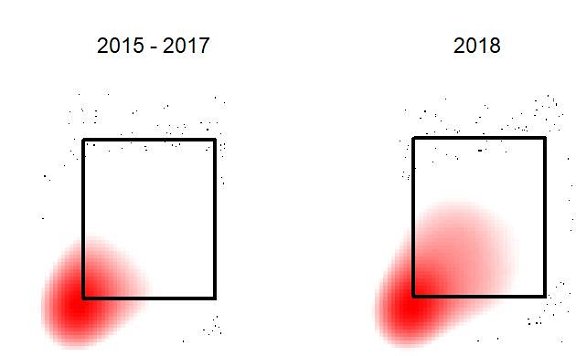
    One thing that has stood out about the slider since his return is how Gray has located it. Below, you’ll find two images that show the locations of Gray’s sliders: on the left, for everything before 2018, and on the right, what he’s done this season.

    The difference is noticeable. His sliders have been near the center of the plate far too often this season, which has been to his detriment since his return to the majors. Before 2018, Gray had thrown 1,258 sliders and allowed only five home runs. Since June 30, he has thrown 390 sliders and allowed seven home runs.

    This dramatic change in performance is possibly due to the fact that hitters have been able to lift his slider more easily: Since his return, 38 percent of the sliders that have been put into play have been fly balls, compared to just 25 percent before 2018. The heat maps possibly speak to why that would be the case.

    Whatever the cause for this development is: whether it’s something mechanical, mental, or just a loss of feel for the pitch; Gray’s ability to rebound from this ugly stretch will depend on the adjustments he makes.

    The slider has actually seen a roughly 2-mph velocity dip, along with a slight change in the movement profile since his recall. So maybe it will simply take time for him to figure out how to locate this slightly different pitch where he wants.

    Some may still view the overall run prevention issues as most problematic going forward, but that can often be an inappropriate way to evaluate pitchers that call Coors Field home.

    Regaining the ability to locate the slider near the edges of the plate would be a major step toward returning to the form that had the Rockies believing he would be their ace for years to come.

  • Why does Bryce Harper have -25 Defensive Runs Saved?

    BY MARK SIMON

    After winning the Home Run Derby, Washington Nationals outfielder Bryce Harper got his hitting back on track in the second half of the season. Since the All-Star Break, he’s hitting .304 with a 1.004 OPS in 55 games. With Harper hitting free agency for the first time this winter, this was significant, as he showed again that he could dominate from that side of the field.

    But the defensive side continues to be an issue for Harper, as it has been all season. He’s never recovered from his early-season struggles.

    Harper has cost his team 25 runs with his defense this season. He ranks tied for second-worst among all players in Defensive Runs Saved. He has fared poorly both in right field (-16 DRS) and center field (-9).

    Range rating gone south
    Harper is 16 runs to the negative in his range and positioning rating, meaning quite simply that he’s not recording outs on balls that most right fielders or center fielders turn into outs.

    As a right fielder, he ranked third-worst in runs saved specific to both balls hit into the right center gap and along the right field line. As a center fielder, he rates well below average on balls hit into both the left and right center field gap. Some of that is due to positioning, but there’s definitely something to the idea that Harper doesn’t have the range he used to have from watching video.

    Negative value from his arm
    This will also be the first season in Harper’s career in which the deterrent value of his throwing arm rates poorly. He’s cost his team six runs with his throwing, partly due to his recording only one assist without a cutoff man (last season he had seven).

    Two seasons ago, 35 percent of baserunners advanced an extra base on hits to right field that were handled by Harper. That number increased to 45 percent in 2017 and 54 percent this season (MLB average is 50 percent). In center field, 21-of-31 (68 percent) advanced on Harper, 13 percentage points higher than MLB average.

    Good Plays and Misplays
    Lastly, Harper’s Good Fielding Play and Defensive Misplay numbers are way out of line with his historical norms. Harper has six Good Fielding Plays (GFPs) and 31 Defensive Misplays & Errors (DM&E).

    There is precedent for Harper having such a high misplay total, but the six GFPs pale in comparison to just two seasons ago when he had 24 in a comparable number of innings (he had 12 last season.

    Harper’s ledger includes six of what SIS calls “wasted throws” that allowed a runner to advance a base, four instances of mishandling a ball after a hit, again allowing runners to advance, and three bad routes, in which he took a poor path to the ball, allowing a ball to drop for a hit. An example of a recent miscue would be slipping and falling on the warning track in a game against the Braves last week, allowing a Ronald Acuna Jr. hit to become a triple instead of a double.

    Harper did make a home run robbing catch against Andrew Susac of the Orioles in late May, but such plays have been few this season.

    Harper could end up in a new home next season, as he is expected to be a highly- wooed free agent. Perhaps a fresh start there will do him good on the defensive end.

  • First things first: Christian Yelich aggressiveness pays off

    First things first: Christian Yelich aggressiveness pays off

    By SEAN ZERILLO

    Welcome to the more aggressive Christian Yelich.

    Yelich is in the midst of his best offensive season to date, with 63 extra base hits in 124 games and an OPS+ of 146 for the Brewers.

    Since the MLB All-Star break, Yelich leads or co-leads the National League in batting average (.354), home runs (16), runs scored (36), runs batted in (42), and slugging percentage (.724). This past week, he checked off a bunch of big career accomplishments – first grand slam, first multi-homer game, six hits in one game, and a cycle. The press from these feats has likely turned Yelich into Milwaukee’s leading candidate for National League MVP.

    One key to his success is that he may have quietly doubled down on what has long been one of his secret strengths – jumping on first pitches.

    Increased Aggressiveness, Continued Dominance

    Yelich has swung at the first pitch 29 percent of the time in 2018, after swinging at just 18 percent of the first pitches he saw the previous two seasons. An 11-percentage point increase equates to nearly 70 more first-pitch swings over a 600-plate appearance season. The significant part of the jump came in the upper half of the strike zone, as you can see the red shading in the image below, which shows his swing rate by area.


    Perhaps as a result of swinging even more often, Yelich has been the best first-pitch hitter in baseball this season, with a .508 average and a 1.102 slugging percentage. He has more extra base hits and twice the number of home runs (8) than his previous two seasons combined.

    Throughout his career, Yelich has consistently been an excellent hitter on the first pitch of his at-bats, with a .444 on-base percentage and a .715 slugging percentage, good for a 1.159 OPS. But he’s never been this good.

    Year MLB First Pitch OPS Yelich’s First Pitch OPS Difference
    2014 .867 .962 .095
    2015 .900 1.204 .304
    2016 .935 1.140 .205
    2017 .941 .991 .050
    2018 .925 1.618 .693

    More Opportunities To Drive the Ball

    Yelich’s first-pitch strike rate is 61 percent this season, five percentage points higher than his career average and a nine-point increase over the rate he saw in 2017. He is swinging more often at those pitches, missing only slightly more often, and driving many more in the air with authority. The extra aggressiveness has been worth it.

  • David Bote handled third base well in Bryant’s absence

    By WILL HOEFER

    If you’re a fan of baseball, chances are you’ve watched the David Bote walk-off grand slam at least 25 times by now. We’re talking about a perfect moment. In the wake of that, there have been excellent pieces written about the sheer magnitude of that play in terms of Win Probability Added and how Bote has hit baseballs harder than any human at the game’s highest level in 2018.

    What’s been less talked about, to an extent, is how Bote is not just a one-trick pony. Bote has a limited but solid track record of defensive performance this year at third base for the Cubs. Let’s give a little love for his glove as he did ably in replacing Kris Bryant, who just returned from the DL.

    Bote has four Defensive Runs Saved in his first 40 games at third base for the Cubs. He rates slightly above average on balls in the hole and down the line and hasn’t shown any weaknesses at the position. Additionally, he has 11 Good Fielding Plays and 3 Misplays and Errors as judged by our video scout staff. We have a rating given by Video Scouts for each play that assesses it on a 1-5 scale. Bote’s rating is such that he ranks fourth among third basemen, behind Matt Chapman, Nolan Areando and Anthony Rendon.

    Bote ranks well in Defensive Runs Saved and Scout’s Defensive Rating for all third baseman, which is mighty impressive considering how small his sample is at the major league level and how his numbers in the minors were mainly achieved at second base (where he rated well last season by our Minor League Defensive Runs Saved).

    Regression is probably coming for both his offensive and defensive metrics. Players in general rarely mash like Aaron Judge and pick it like Chapman for a sustained period of time; for fringe prospects like Bote such continued performance is a near impossibility. But for the sake of baseball breakouts, it would be cool if he kept it up.

  • Stat of the Week: Shifting is at an all-time high

    Stat of the Week: Shifting is at an all-time high

    Something monumental happened in baseball this past weekend—and it wasn’t the Orioles being given a nationally televised game.

    By the end of play on Sunday, teams had shifted on balls in play 28,249 times, surpassing the previous record of 28,130 set in 2016. They are now on pace to shift just under 35,000 times this season, which would represent a 31 percent increase over last season’s total.

    Shifts had been increasing steadily since 2009, when Sports Info Solutions first started tracking them, until declining slightly in 2017. But they now appear to be on the rise again. It’s not just one or two teams carrying the pack, either—25 of the 30 teams have increased their shift usage this season.

    SeasonChangePlotVert

    The Phillies have made numerous headlines this year for their proclivity toward shifting under new manager Gabe Kapler. This shows itself in the data, with no other team on pace to increase their shift usage more than the Phillies. If they continue shifting at their current rate, they will shift nearly 800 more times on balls in play in 2018 than they did in 2017.

    Three AL Central teams follow right behind the Phillies in the Royals, Twins and Tigers, all on pace to increase their shift totals by more than 600. Whether those increases are related or not is hard to say, although all three teams still trail the White Sox, who shifted 1,490 times on balls in play last season and could potentially become the first team to reach the 2,000-shift mark this season.

    While teams are shifting more than ever, there are still improvements that can be made. SIS’s BIS-D software provides a recommendation for every player in MLB as to whether that player is a shift candidate or not, and about one-third of shifts this season have been against players for whom the software recommends playing a standard defense. There have also been about 18,000 balls in play where the defense did not shift when the system suggested one.

    How has the shift impacted the performance of those who get shifted? On the whole, the shift lowered shift candidates’ batting average on grounders and short line drives (BAGSL) by 23 points, while it had the opposite effect against all other batters, raising their BAGSL by 4 points.

    Weighted* Batting Average on Groundballs and Short Line Drives, 2017-18 

    BIS-D Recommendation No Shift Shift Difference
    Shift Candidate .271 .248 Helps by 23 points
    Non Shift Candidate .275 .279 Hurts by 4 points

    *The averages are weighted such that players with extreme shift tendencies (high or low) are not over-represented, thus separating the effect of the shift from batter quality. 

    With shifts comprising a larger percentage of balls in play than ever before, it’s never been more important to make sure that the correct batters are being shifted.

  • How are the Diamondbacks 200+ runs better than the Phillies on defense?

    By MARK SIMON
    All statistics through Saturday’s games

    I received a tweet recently that asked if I could demonstrate the difference between the team with the most Defensive Runs Saved (the Diamondbacks with 120) and the team with the fewest (the Phillies with -102).

    It seemed a reasonable question to wonder – can the difference between the two be more than 200 runs? We wouldn’t question the best and worst teams being that far apart in terms of their offense or their pitching. But for defense, we don’t have as good a feel for the value of certain statistics.

    It’s important to note that when we give a team’s DRS total, that represents the sum of their players’ DRS. It’s not a value solely assigned to the team, but rather the accumulation of many values.

    With that in mind, let’s go through a few notable positions around the diamond.

    Catcher: Diamondbacks 21 DRS, Phillies -9 DRS
    Differential: 30 Runs
    This is a substantial gap. It’s one of the biggest differentials we’ll see.

    The Diamondbacks are unusual in that they have three catchers, each of whom has been outstanding by SIS’ defensive metrics.

    Jeff Mathis leads all catchers with 12 Defensive Runs Saved. Alex Avila has 6. John Ryan Murphy has 3. Mathis rates near the top in our Strike Zone Runs Saved metric, and Murphy is right there with him. The three have combined for 13 Strike Zone Runs Saved in that stat.

    Mathis also excels at blocking pitches, with five runs saved there. He ranks second in our pitch-blocking stat, successfully blocking 97 percent of pitches in the dirt.

    Meanwhile Philadelphia’s primary catchers, prior to their acquisition of Wilson Ramos, Andrew Knapp (88 percent) and Jorge Alfaro (86 percent), ranked fourth-worst and worst respectively in that stat.

    Mathis, Murphy and Avila have combined for 940 pitch blocks and 54 wild pitches and passed balls.

    Knapp and Alfaro have combined for 490 and 74.

    Similarly, the Arizona trio has recorded 109 more strikes than expected for their pitchers based on pitch location, batter handedness and count.

    Alfaro rates well at this, but Knapp does not. Together, they’ve combined to cost their pitchers 15 strikes.

    Also Alfaro’s success catching runners stealing is negated by Knapp’s struggles in that area. And Alfaro has significant issues with bunt defense to where it’s cost the Phillies four runs.

    This is why they got Ramos.

    Shortstop: Diamondbacks 18 DRS, Phillies -14 DRS
    Differential: 32 Runs
    The Diamondbacks have one of the game’s best shortstops in Nick Ahmed, whose 17 DRS top the leaderboard.

    What makes Ahmed great is that he can go deep into the shortstop-third base hole to make plays that are difficult for other shortstops to make, either due to skill or positioning. The Diamondbacks have turned 74 percent of ground balls hit between second base and two-thirds of the way to third base into outs in an unshifted defense (mostly by Ahmed). Within that same area, the Phillies have converted 68 percent.

    For the Diamondbacks, the differential is nearly 30 extra plays made. And that doesn’t factor in other things Ahmed does well, like catch line drives and pops and turn the double play. And it doesn’t factor shifts (which we’ll get to).

    The Phillies have three shortstops who have cost the team four runs apiece: Scott Kingery, who rates well below average in the short-third hole, and J.P. Crawford and Pedro Florimon, who are both below average fielding balls hit up the middle. They’ve since turned the position over to Asdrubal Cabrera.

    Shifts: Diamondbacks 29 DRS, Phillies -9 DRS
    Differential: 38 Runs
    Much has been made of the Phillies’ struggles on shifts, but less known is that the Diamondbacks get the most value from their shifting of any team in baseball. It’s this simple:

    The Diamondbacks convert 80 percent of ground balls and short line drives into outs when in a shifted defense. The Phillies convert 70 percent. The difference is about 50 extra plays converted by the Diamondbacks to this point in the season, without even looking at whether those balls are singles or doubles.

    Center Field: Diamondbacks 15 DRS, Phillies -9 DRS
    Differential: 24 Runs

    The Diamondbacks’ 15 runs come from Jarrod Dyson, Chris Owings and A.J. Pollock and in each case, the key element is catching fly balls hit to the deepest part of the park (Arizona’s total would be higher if not for Pollock’s -5 DRS on throws). The key point to remember is that when those catches are made, the balls they’re snagging would be doubles and triples.

    Meanwhile Odubel Herrera (-10 DRS) is having issues on a ball he’s never had before: the one hit to shallow center field. Per Statcast, Herrera is playing at an average depth of 323 feet this season, seven feet deeper than he typically plays. He’s trading off balls falling in front of him for making catches on deep balls.

    But it’s been a net negative. He’s cost the team 11 runs on range and positioning. The Diamondbacks play their center fielder deeper than any other team’s center fielder at Chase Field. And for them, it works.

    Consider this: Let’s take the area 45 feet to left center and 45 feet to right center from straightaway center field.

    On balls hit at least 360 feet to that area, the Diamondbacks convert 67 percent of balls that stayed in the park into outs. The Phillies convert 60 percent. Without factoring exact hit probabilities, that’s about a dozen more doubles and triples spared, just on balls hit to those spots.

    Pitchers: Diamondbacks 11 DRS, Phillies -15 DRS
    Differential: 26 Runs
    A gap of 26 runs is sizable and is explained thusly: Zack Greinke, Patrick Corbin and Zack Godley, who have combined to save 13 runs, are all adept athletes, who put themselves in position to succeed with their follow-throughs and make more plays off the mound than most.

    The Phillies have only one pitcher above average in that regard: Enyel De Los Santos. He’s pitched 12 innings.

    That accounts for more than two-thirds of the differential. The rest comes from pitcher responsibility for stolen bases (the Phillies have allowed 40 more, but have only six more caught stealings).

    Those positions (and shifting) account for 150 runs of the differential. The other spots on the diamond are more of the same. In short, the Diamondbacks are really good. The Phillies have performed poorly. And the difference between them is pretty large.

    Defensive Runs Saved
    Position Dbacks Phillies
    Pitcher  11  -15
    Catcher  21  -9
    1st Base  5  0
    2nd Base  4  -6
    Shortstop  18  -14
    3rd Base  0  -12
    Shifts  29  -9
    Left Field  4  -20
    Center Field  15  -9  
    Right Field   13  -8  


  • Stat of the Week: NL Total Runs/MVP Race is Tight

    The National League MVP race is shaping up to be incredibly tight with a little more than a month left in the regular season, and it parallels the race for the lead in the Total Runs stat.

    Total Runs combines Runs Created (offense), Baserunning Runs and Defensive Runs Saved, along with a positional adjustment (but not a park adjustment) to account for a player’s total value.

    The candidates in the top spots among the playoff contenders are Cardinals third baseman Matt Carpenter, Rockies shortstop Trevor Story and third baseman Nolan Arenado, Braves first baseman Freddie Freeman and Cubs second baseman Javier Baez. Each has his strong points.

    Most Total Runs – NL Players
    Team
    Matt Carpenter Cardinals 115
    Trevor Story Rockies 115
    Freddie Freeman Braves 113
    Nolan Arenado Rockies 112
    Javier Baez Cubs 111
    Jacob deGrom Mets 110

    Carpenter went through a massive struggle early this season, with his batting average standing at .140 through games of May 15 (he had notable issues with defensive shifts). But since then, he’s arguably been as good as any player in baseball. He’s hitting .323/.430/.700 with 30 home runs in his last 82 games.

    Carpenter does it on the defensive end as well. Though he’s cost the Cardinals three runs at second base, he’s saved them a combined 10 at the corner infield spots. His seven Defensive Runs Saved at third base are the most he’s had in his career. Carpenter’s value is accentuated by his having 38 more total runs than the Cardinal with the second-most, Marcell Ozuna.

    Story has had an offensive bounceback, reestablishing himself as one of the top-hitting shortstops in baseball. Since June 26, he’s hitting .335/.373/.601. He’s created 83 runs, which surpasses his 2017 Runs Created total by 15 runs. He’s also saved four runs at shortstop, continuing his solid defensive reputation.

    Arenado’s Defensive Runs Saved total is surprisingly low (he’s saved three runs after averaging 21 the last five seasons). But his contributions with the bat remain as stellar as they’ve ever been. If Arenado has a strong defensive finish to the season, he could finish in the top three in Total Runs for the third straight season.

    Freeman is bidding to win his first batting title. He’s been a great hitter and has also been terrific in the field with seven Defensive Runs Saved, which ranks tied for third among first basemen. Though Freeman’s slugging percentage is down from 2017, it still looks impressive relative to offensive numbers throughout baseball. Freeman is one of two Braves with at least 100 Total Runs. Ozzie Albies is the other.

    Baez is highly touted by Cubs fans and he’s in the thick of the race. Many feel he’s been worth more than the six runs he’s saved the team at second base and shortstop. Since June 26, he’s hitting .333/.354/.644 with 38 RBI in 44 games. Similar to Carpenter, Baez has a sizable edge on his next-closest teammate, Willson Contreras, who has 84 Total Runs.

    Mets pitcher Jacob deGrom is one run behind Baez in the Total Runs race. He’s not a serious MVP contender, but is noted here for the amazing season he’s having in spite of a low wins total. He and Max Scherzer are nearly even in the race for most Total Runs among pitchers, just ahead of Red Sox ace Chris Sale.

    The gap between the top performers is small enough that it looks like whoever closes the season the best will come out on top in the Total Runs race and perhaps win the MVP as well.