Category: MLB

  • The Dodgers’ dominant defense

    By Mark Simon

    The Dodgers are poised to not just dominate the NL West again, but to dominate all of baseball in defensive performance.

    The Dodgers lead MLB with 62 Defensive Runs Saved. The next-closest team entering Thursday is the Astros with 45. What’s impressive about the Dodgers is that they’ve done this after they let standout catcher Yasmani Grandal leave as a free agent, traded Yasiel Puig to the Reds, and got negative defensive value out of free agent signee A.J. Pollock before Pollock got hurt. Others have stepped up and stood out.

    Bellinger a Defensive MVP

    The departure of Puig cleared a full-time spot in right field for Cody Bellinger. Bellinger has delivered as both a hitter and a fielder.

    Bellinger has saved 11 runs as a right fielder. His 12 runs saved overall lead the majors. Those include four Outfield Arm Runs Saved, which is tied for the most in the majors. Only 4-of-21 baserunners have taken an extra base on hits against him. He also gained value from a home run-robbing catch against Brewers star Christian Yelich.

    This is the first time that Bellinger has played right field full time in the majors. He played most of 2017 and 2018 at first base, though he got just over 300 innings in left field in 2017 and nearly 500 innings in center field last season.

    Alex Verdugo: Defensive Rookie of the Year?

    Alex Verdugo came to the major leagues with a reputation for having a solid bat. But his defense has stood out too. Verdugo has saved 10 runs split between the three outfield positions. He’s thrown out a runner trying to advance without the help of a cutoff man at each of the three outfield positions.

    Shifting and infield success go hand in hand

    The Dodgers are getting solid value from their infield defense, particularly at second base and shortstop, where Kiké Hernández and Corey Seager have saved five and four runs, respectively.  Seager has previously saved as many as 10 runs in a season, so his performance isn’t a surprise. Hernández has been a good defender at other positions. This is the most playing time he’s gotten at second base in his career. He’s made the most of it.

    The Dodgers are also on pace to increase their defensive shifting by almost 55 percent from last season. The likely reason for this: it’s working well for them. The Dodgers have 18 Shift Runs Saved. Only the Astros (21) have more.

    Opposing hitters have a .214 batting average when hitting a groundball or short line drive against the Dodgers when they play three defenders on the pull side of second base (a full shift), 20 points below the MLB average. They hit .163 when the Dodgers play a partial shift, meaning they play two infielders on each side but move at least two significantly from their usual position. That’s 107 points below MLB average.

    Looking for why Hyun-Jin Ryu has been so good? Only 8-of-70 batters have reached when hitting a groundball against him. In his case, the Dodgers have been great defensively with him on the mound both when shifting and when playing straight up.

    Looking ahead

    The most Defensive Runs Saved in a season by a team is 157 set by the Diamondbacks last season. The way the Dodgers are playing they look like they’ll pose a threat to that mark. But more importantly, it may help them win their first World Series since 1988.

    Most Defensive Runs Saved (2019)

    Dodgers62
    Astros45
    Giants36
    Diamondbacks31
    Rays28
    Reds28
    Brewers26
  • The Rise of Minor League Defensive Shifts

    The Rise of Minor League Defensive Shifts

    By ANDREW KYNE

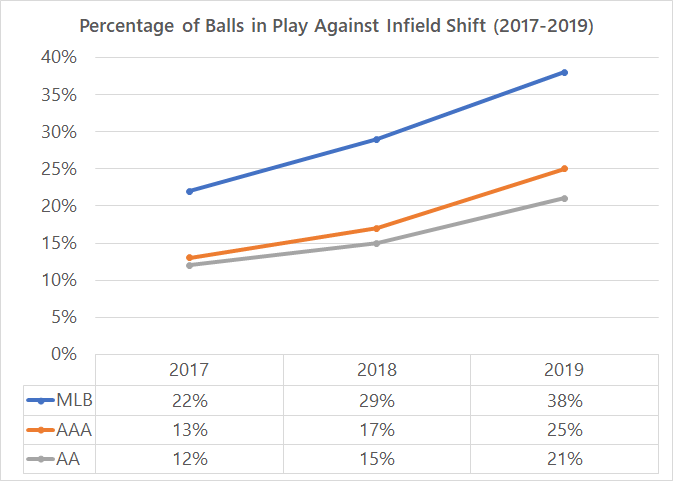
    Infield shifts are on the rise in Major League Baseball again this season. On balls in play, Baseball Info Solutions recorded 26,705 shifts in 2017 (22% of balls in play) and 34,671 in 2018 (29% of balls in play). This year, there have been 13,272 shifts (38% of balls in play), which prorates to more than 44,000 for a full season.

    And while our company and others in the industry have talked a lot about shifts at the MLB level, what about shifts in the minor leagues? Are they rising like they are in the majors? Are they are as common?

    BIS charts all AAA games and nearly all AA games (about 90-95%), so let’s take a look.

    Here’s a comparison of MLB, AAA, and AA in terms of percentage of balls in play against an infield shift over the last three seasons.

    Although the infield shift isn’t as common in the upper minors as it is in the majors, it is increasingly prevalent. This season, both AAA and AA teams have had a shift on for more than 20% of balls in play for the first time.

    Here are the leaders and trailers in shift usage at the AAA level this year, combining the International and Pacific Coast leagues:

    And here are the leaders and trailers at AA, combining the Eastern, Southern, and Texas leagues:

    The Twins have shifted the highest percentage of balls in play in the majors this year, so it’s not surprising to see their affiliates near the top in AA and AAA as well. Teams like the Rays and Pirates have also historically shifted a lot and have minor league clubs listed near the top here. And the Marlins have increased their shift usage this year, and their Jacksonville affiliate leads all AA teams.

    How well does a minor league team’s shift usage track with the shift usage of its parent club? For 2019, the correlation between MLB and AAA…

    … appears stronger than the correlation between MLB and AA.

    So while teams don’t shift as much in the minors as they do in the majors, they are becoming more popular. Infielders, pitchers, and hitters are getting accustomed to extreme infield alignments before they even get the call to MLB.

  • What’s been behind Justin Verlander’s great season?

    By MARK SIMON

    What’s the secret to Justin Verlander’s success this season? Verlander’s slider has been one of the best-performing pitches in baseball. And the defense behind Verlander has been pristine.

    Verlander has a 2.38 ERA and a 3.85 FIP. The latter is driven by 11 home runs in 64 1/3 innings, but FIP doesn’t expect what Verlander’s slider has done. So far this season, opponents are 4-for-72 against that pitch (.056 batting average, along with five walks). By Fangraphs’ run value stats, the pitch has gotten the second-best overall results of any pitch thrown by any pitcher in 2019 (Martin Perez’s cutter ranks first).

    Verlander had a lights-out slider in his last start against the Tigers. He threw 20 of 26 for strikes, got 12 misses on 19 swings, and got eight outs (five strikeouts) and allowed only one baserunner with it (a walk). The spin and release point don’t differ much from what they were last season.

    Verlander’s slider has usually rated good to very good. It rated elite by run value in 2016 but dropped in value the last two seasons. It’s typically his third-best pitch. But in 2019, it has been by far his best. Verlander’s slider gets the highest rate of chases in the majors (55 percent). The pitch is a little more often on the edge of the plate to a right-handed hitter than last season, netting some tough swing decisions for the hitter. Chases lead to misses (Verlander’s 36 percent miss rate is just above middle-of-the-pack) or unimpressive contact.

    Unimpressive contact leads to easy plays for the defense, and it’s worth noting that batters are 4-for-43 when they actually hit a Verlander slider, and 0-for-22 when hitting a ground ball against a Verlander slider.

    In fact, the Astros defense has done very well behind Verlander regardless of which pitch he throws. They’ve saved 6 runs with their range and positioning when he has pitched, which ranks fourth. They also don’t have any Defensive Misplays or Errors on batted balls behind him.

    The Astros have done this with most of their pitchers. They lead the AL with 41 Defensive Runs Saved, as well as an MLB-best 20 Shift Runs Saved. Opponents are hitting .179 when hitting a ground ball or short line drive against an Astros infield that has three defenders on the pull side. That’s 55 points below major league average. They’ve had plenty of chances, a major-league high 252.

    The negative differential between Verlander’s ERA and 3.85 FIP is the second-largest in baseball, which doesn’t bode well for Verlander’s ERA down the road. How long can a good slider and some great defense last? He’s going to find out.

  • Who can we combine into the best 5-tool player?

    By PATRICK ROWLEY

    In major league baseball there is always talk of finding a “five-tool prospect”. A player who can hit for both average and power, excels fielding the ball as well as throwing it, and has the foot speed and baserunning skills to round out their game devoid of any flaws. Having a five-tool player on the roster is quite an asset for a manager. You don’t have to take their bat out of your lineup late for defensive help or pull them for a pinch hitter or runner in a big spot. You can pencil them into the lineup and largely forget about them for the duration of the game.

    In short: Mike Trout.

    Plenty of prospects have been billed as the next great five-tool player and have failed to materialize. However, the point of this article is not to identify the next super prospect, but to build one comparable to Trout using different aspects of current MLB players.

    All stats entering May 20

    Fielding: Harrison Bader

    Much of our work is related to defensive performance, so we’ll start on the defensive side. The first component we are going to focus on is fielding, to show how well a fielder turns batted balls into outs. To evaluate this, I isolated the “Range and Positioning” component of Defensive Runs Saved (DRS), divided the total for each player by their innings played (minimum 750 innings since the start of 2018), and then multiplied that number by 1,000 to get Defensive Range and Positioning Runs Saved per 1,000 innings in the field.

    After doing this there were four players with over 15 runs saved per 1,000 innings, but the only one who was over 20 per 1,000 was Harrison Bader (the other three were Kolten Wong, Matt Chapman, and Adam Duvall). Last season Bader was moved all over the outfield, splitting time in center with Tommy Pham and filling in at the corners on the other days. With Tommy Pham now in Tampa, Bader now has a firm hold on the starting centerfield job in St. Louis and continues to perform well.

    Arm/Throwing: Ramón Laureano

    Laureano had a memorable debut last August when he hit a walk-off single for his first career hit in his MLB debut. Less than a fortnight later Laureano showcased the strength of his arm for the first time with an incredible double play against the Angels on August 11 and since then his arm has easily been the strongest part of his game.

    How strong is his arm? Since the start of 2018 Laureano is fifth in Outfield Arm Runs Saved with seven. The four players with more than Laureano since the start of 2018 have anywhere from 100-600 more innings in the field than he does.

    Hitting for Average: Michael Brantley

    Since the start of 2018 there are 141 batters who have had the requisite number of at-bats to qualify for a batting title. Among those, only Michael Brantley’s contact rate of 91% is greater than 90%. No one is better at putting the bat on the ball when they do take a swing. Brantley’s history as a great contact hitter isn’t exactly a secret as he has the 15th highest career batting average among active players, but he is off to an even better start this year.

    At Sports Info Solutions we a metric called Defensive Independent Batting Statistic, or DIBS. DIBS looks at a player’s batted ball profiles (where the ball was hit, what type of batted ball it was, and how hard it was hit.) and calculates what the expected batting line of a player should be. Since the start of 2018 Michael Brantley has an expected batting average of .334, edging out reigning NL MVP Christian Yelich for the best mark among players with at least 500 plate appearances between the last two seasons.

    Hitting for Power: Christian Yelich

    Yelich was just beaten out by Michael Brantley for the hitting for average portion of this exercise, but he decisively takes the power component. DIBS has Yelich with the highest projected home run total over the last two seasons with 53.5, just ahead of Khris Davis (53.0).  

    When you look at expected slugging instead, Yelich has an even clearer advantage. His .626 is considerably ahead of Anthony Rendon’s .568 in second.

    If you change the time filter to start from last year’s all-star break until now, then Yelich’s DIBS slugging percentage jumps up to .735. The guy has been mashing.

    Baserunning: José Ramírez

    José Ramírez is performing well below the excellent numbers he posted across 2017 and most of 2018, but luckily for Ramírez, speed doesn’t slump. Our Net Baserunning Runs Saved metrics creates an all-encompassing stat that measures all activity on the base paths that considers things such as avoidance of double plays and ability to take an extra base as well as just base stealing.

    This metric is broken down into two main components: SB Gain which reflects the player’s frequency and success stealing bases and BR Gain which focuses on all other aspects of their baserunning. Since the start of 2018 Ramírez has a net gain of 62 bases between the two stats, 19 ahead of Billy Hamilton in second.

    That huge lead is from being tied with Trea Turner and Jonathan Villar for first in SB Gained and first in BR Gained. Adalberto Mondesí is an interesting player to watch for with regard to this metric as he is within three of Billy Hamilton for second place since the start of 2018 and he wasn’t called up until June, but for now Ramírez is the gold standard on the bases.

    He completes our tool set that makes the complete baseball player.

  • Mets moving away from the inside fastball

    Mets moving away from the inside fastball

    By ANDREW KYNE

    In 2018, the New York Mets strongly emphasized an inside-pitching philosophy, with pitching coach Dave Eiland wanting his staff to be more aggressive. Eventual Cy Young winner Jacob deGrom was among several Mets who increased his usage of inside fastballs from 2017 to 2018, as we wrote about last summer.

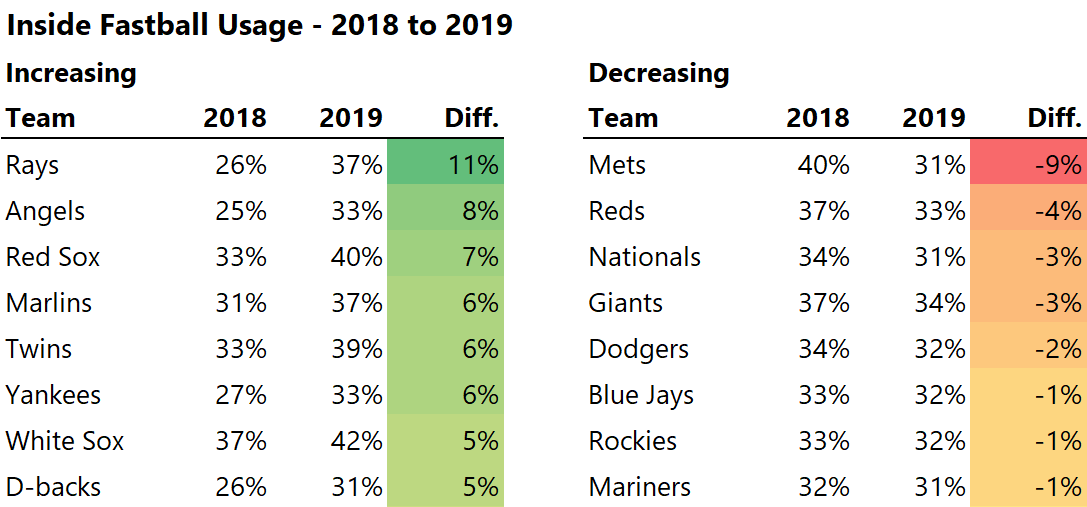
    By Baseball Info Solutions’ pitch charting, 40% percent of the Mets’ fastballs in 2018 were over the inner-third of the plate or further inside. That was the highest percentage in Major League Baseball.

    Interestingly, they have cut back on that approach in 2019. This season, 31% of the Mets’ fastballs have been thrown inside, a mark that ranks 28th in MLB.

    Pitching inside with the fastball has increased across the league this year. The Mets, however, are by far the most significant decliners in terms of percentage-point difference.

    Which pitchers are driving this change in New York? Let’s look at the 120 MLB pitchers who threw at least 750 fastballs last year and have thrown at least 200 so far this year.

    There are seven Mets in this sample of pitchers. Six of them have contributed the most significant percentage-point declines in inside fastball usage.

    (The seventh, Seth Lugo, has declined from 41% to 39%.)

    For deGrom, most of his decrease has come against left-handed batters. He’s still working up in the zone a lot with his fastball, but the emphasis has been more on up-and-away than up-and-in.

    On the other hand, Noah Syndergaard‘s decrease has come mostly against right-handed batters. He worked both corners with the fastball against them in 2018, but is focusing much more outside in 2019.

    How does this alter effectiveness? Here’s how the Mets’ fastballs have performed in 2018 and 2019 based on location.

    Inside fastballs haven’t generated as many misses per swing for them as non-inside fastballs, but they have resulted in less hard contact and slugging.

    We’ll see if this trend continues for the Mets throughout the season. For now, it’s a notable change in approach, given the organization’s clear emphasis on it in 2018.

  • Do fielders dive more when a potential no-hitter is on the line?

    By PATRICK ROWLEY

    Not long ago my sister and I were watching a minor league baseball game and when Gregor Blanco came up to bat I told her about his diving catch to save Matt Cain’s perfect game in 2012.

    “I’m curious if players are more likely to dive if their pitcher has a perfect game or no-hitter going” she said

    This struck me as an interesting question. I think most of us would like to believe that players are giving it their all on every play, but most of us aren’t naïve enough to believe that. However, there is a certain mystique to no-hitters, particularly with complete games becoming a rare feat themselves. Each no-hitter seems to have that one defensive play that “saves” the no-hitter and becomes synonymous with the event.

    Then, only days after talking about Blanco, Jurickson Profar laid out in shallow right field to make a diving catch to keep Mike Fiers’ second career no hitter intact and we felt compelled to do some research.

    To look at this we used a combination of two defense metrics we track. The first being our “Scout’s Defensive Rating” which is a rating on a scale from 1-5 of how difficult it will be to convert a ball in play to an out. One is considered a “routine play” whereas a five is considered “uncatchable”. By isolating the focus to play difficulty grades 2-5 we remove the easiest plays the fielders shouldn’t need to dive for.

    The resulting balls in play were then separated into two groups- the balls in play in the seventh inning or later of a no-hitter and everything else.

    At SIS, we chart diving plays as part of our “Descriptive Defense Information” package, so we then looked at what percentage of balls in play that fielders were diving for in each of the two scenarios laid out. Our company has only tracked dives by fielders since the start of 2013, so our sample is slightly more than six seasons of data. What we found is that the likelihood of a player diving did go up when a pitcher had a late no-hit bid intact.

    Situation % of Plays with a Dive
    No-Hitter in 7th or Later 14.6%
    All Other Situations 8.9%

    What this data shows us is that in this time, a pitcher’s defender is about 64% more likely to dive when they have not allowed hit through six or more frames.

    The next question this brought up was whether these were “desperation dives” by players going for balls they can’t reach, or if the players are able to kick it into an extra gear and reach those extra balls. What we found is that not only do players dive more, but they have converted those dives into outs at a higher frequency.

    Situation Diving Success Rate
    No-Hitter in 7th or Later 39.5%
    All Other Situations 31.8%

    One thing that is important to consider is the relatively small sample size of the “No-Hitter in 7th or Later” category. The infrequency with which a no-hit bid extends beyond six innings lends itself to having a sample size that is less than 0.1% of the “All Other Situations” category.

    Even while considering this, the uptick in frequency with which a player dives in no-hitters as well as their success is noteworthy. It seems that if a pitcher wants to hang a zero in the “H” column for a game, they may need one of their players behind them to leave their feet for a ball at some point. 

  • Home Run robberies are up … at least recently

    By MARK SIMON

    If it seems like there have been a lot of home run robberies lately, it’s true.

    There have been five in the last three days, most notably Jackie Bradley Jr.’s climb to steal a walk-off home run from Trey Mancini on Wednesday, and Josh Reddick’s snatch of Hunter Pence’s potential go-ahead home run in the ninth inning on Thursday. In all, there have been 19 this season.

    That sounds like a lot. Is it?

    Well, if home run robberies continue happening at this pace, it would be. This pace would produce 83 home run robberies for the season.

    Sports Info Solutions has been tracking home run robberies since 2004. Video Scouts watch every game and confer on any potential home run robbery call. Each one is scrutinized carefully via video review to ensure the ball would have been over the fence if not caught.

    The most home run robberies in a season is 65, which was done in 2018. So the current pace would shatter that mark.

    However, it’s worth noting that last season, there were 20 home run robberies through games played on May 9th, one more than this season.

    Also of note: Adam Jones recorded his 11th home run robbery on Thursday. That total ties for third in our data set. Jones is one of five players with at least 10 home run robberies.

    Carlos Gomez13
    Torii Hunter12
    Adam Jones11
    Mike Trout11
    Ichiro Suzuki10

    Reddick’s catch on Thursday marked the third time this season that a potential game-tying or go-ahead home run was robbed in the ninth inning or later. The other two were by Bradley on Wednesday and by Lorenzo Cain against Jose Martinez to end the Brewers’ Opening Day win over the Cardinals.

    Cain leads the majors with three this season. Ramon Laureano has two and is the only other player with more than one.

    There have been three robberies apiece at Camden Yards and Miller Park in 2019, the most in the majors.

    If you’re looking for a home run robbery at Wrigley Field, keep looking. It’s the one current ballpark that has never had one.

    For more home run robbery info, check out our article from The Athletic from last season or episode 3 of the SIS Baseball Podcast.

  • Stat of the Week: Who is the World’s No. 1 Starting Pitcher?

    By Mark Simon

    The role of the starting pitcher in 2019 is a little different than it was 20, 10, or even five years ago. Pitchers are rarely asked to go long into games as deep bullpens allow managers to pursue the most favorable matchups at the end of games.

    But the role of starting pitcher is still important. Aces are still a notable part of the game. But who are the best of the best?

    The Bill James World’s No. 1 Starting Pitcher Rankings attempt to answer that question. The rankings are based on the Game Score metric and a pitcher’s sustained excellence over a lengthy body of work. You can read more about the methodology here and here.

    There is a tight race for the No. 1 spot with Nationals ace Max Scherzer trying to hold off former teammate Justin Verlander of the Astros. Scherzer has slipped with a couple of bad starts. His average Game Score is 57 this season. It was 66 in each of the previous two seasons. Verlander’s average Game Score is 63 thanks to a run of four straight starts in which he allowed one run.

    Jacob deGrom, Chris Sale, and Trevor Bauer round out the top five, with Gerrit Cole just behind Bauer in the No. 6 spot. Zack Greinke may find his way into the top five soon. He’s currently No. 7, supported by a recent streak of three straight starts allowing one run or fewer.

    Moving Up

    The intrigue in this list is in pitchers who have made big jumps early in the season. These may be your future aces. The most notable of those is Reds starter Luis Castillo, who ended the 2018 regular season ranked No. 53, but now ranks 28th. Castillo has a 1.97 ERA in his first eight starts, including two starts with a Game Score of 75 or higher.

    Castillo’s success has come because his changeup has been elite. His 52 percent miss rate (79 misses on 151 swings) is the highest of any starting pitcher who has thrown at least 100 changeups this season. Opponents are 8-for-79 (.101 batting average) in at-bats ending with a Castillo changeup.

    Another big mover is Tigers starter Matthew Boyd, who ranked 58th at the end of the 2018 season but has jumped to 33rd. Six of his eight starts have had a Game Score of 60 or higher. He’s also the AL leader with a 2.30 FIP.

    Boyd has two pitches that rate elite so far in 2019 – his fastball (.198 opponents’ batting average) and his slider (.176). That he can throw both for strikes has allowed him to maintain a strikeout-to-walk ratio of nearly 6-to-1.

    One last big mover is Rangers starter Mike Minor who has gone from 102nd at the end of the 2018 regular season to 53rd. Another good start on Thursday night might vault Minor into the top 50. Minor has had three highly-impressive starts this season – a three-hit shutout of the Angels, a 13-strikeout game against the Mariners, and eight scoreless innings versus the Blue Jays.

    Minor is one out away from averaging seven innings in his first seven starts. His winning combination has been fastball-changeup. Opponents are hitting .185 against the former and .140 versus the latter.

    It’s pitchers like Minor who show that having someone who can go deep into games is a major benefit.

    Player Team Current Score
    1. Max Scherzer Nationals 525.9
    2. Justin Verlander Astros 525.2
    3. Chris Sale Red Sox 513.0
    4. Jacob deGrom Mets 512.0
    5. Trevor Bauer Indians 481.7
    6. Gerrit Cole Astros 480.3
    7. Zack Greinke Diamondbacks 478.1
    8. Stephen Strasburg Nationals 476.4
    9. Clayton Kershaw Dodgers 472.7
    10. Corey Kluber Indians 471.5

    The Bill James World’s No. 1 Starting Pitcher rankings are updated daily here

  • Visualizing Shortstop Range

    Visualizing Shortstop Range

    By ANDREW KYNE

    As noted in last month’s look at Rougned Odor’s bunting against shifts, Baseball Info Solutions charts the starting positions of infielders on groundballs and short line drives.

    Combining those starting positions with batted ball information, let’s try to visualize the range of some of baseball’s best and worst defensive shortstops. We’ll focus on lateral range here (a good proxy for overall range). If a ball is hit 20 or 30 feet to a player’s left, how likely is he to field the ball? (What happens afterwards isn’t considered here; we’re just checking if it was fielded by the shortstop. How many balls can he get to?)

    This requires a few steps and filtering. Here was my approach:

    • Grounders measured between 1.25 and 2.00 seconds from the time it was hit to the time it was either fielded or reached the outfield grass. This gives us balls that aren’t hit too slowly (and would require an extreme charge), but also not super hard (and thus impossible to field unless perfectly positioned).
    • Excluding balls fielded by other infielders. The shortstop had to have had an opportunity to make the play.
    • To determine the lateral distances, I calculated the chord length between the fielder’s starting position and the path of the ball. Essentially, it’s the straight-line distance the shortstop would have to move between his starting position and the path of the ball at the same depth. Charging the ball can obviously impact this calculation/distance, but the 2.00-second cutoff is meant to limit those opportunities.
    • All applicable plays since 2016 to get a large enough sample.
    • For plotting, I bucketed balls in bins of 10 feet in either direction. And on the images below, negative distances are to the player’s right (into the SS/3B hole, if traditionally positioned) and positive distances are to the player’s left (up the middle).

    With that said, here’s the league average distribution for these balls in play.

    These balls in play, when hit right at the shortstop, are fielded nearly 100% of the time. Balls hit about 10 feet in either direction are still above 90%. It dips to about 60-70% at 20 feet from the starting position, then down to about 30% at 30 feet away. And around 40 feet and beyond is where the rate of being fielded drops to 10% and below.

    Let’s compare that with Arizona’s Nick Ahmed, who has the most Range & Positioning Runs Saved at shortstop since the start of 2018.

    Ahmed (blue line) has been consistently above average to his left/up the middle (and can make highlight-reel plays like this one). He’s fielded a similar amount of balls as his peers going 10-20 feet to his right, but has reached more than the typical shortstop beyond that (like this one). And in addition to range, Ahmed’s arm helps separate him from other shortstops in converting outs.

    How about Andrelton Simmons?

    Interestingly, he tracks pretty closely with all shortstops, with the exception of a boost in the 30-foot bucket to his right. Like Ahmed, Simmons boasts a great arm to complement his range, elevating him further above other shortstops.

    But instead of comparing him to all shortstops, what about comparing him to one with poor range? Here’s Simmons (blue line) versus Jordy Mercer (orange line).

    Mercer has fielded a high percentage of balls hit within 10 feet in either direction, but Simmons has been better than him beyond that. Mercer has cost his teams 25 runs by our Range & Positioning system since the start of 2016.

    The only shortstop who has lost more Range & Positioning runs in that time is Boston’s Xander Bogaerts (-39). Our system has significantly penalized Bogaerts for balls hit to his right (SS/3B hole), and his limited range on those balls is confirmed here.

    Bogaerts has been close to his peers on balls hit to his left, but well below average at reaching balls hit to his right.

    The margins here are pretty small. After all, those who play shortstop — and stay there — tend to have the necessary range to reach enough batted balls in their zones. But since shortstops have a high volume of balls hit to them, those small differences can add up over the course of a season.

  • The Effectiveness of “Infield In” Defense

    The Effectiveness of “Infield In” Defense

    By ANDREW KYNE

    Since 2015, Baseball Info Solutions has tracked situational defensive alignments like “infield in” and the rare five-infielder defense, among several other variations.

    The “infield in” strategy is particularly interesting. You might hear commentators mention how substantially batting averages increase when the infielders are all pulled in. But what do the numbers show?

    First, let’s consider groundballs and short line drives (since those are the types of balls in play affected by the infield’s alignment here) hit against “infield in” alignments with fewer than two outs since the beginning of 2015. The batting average on those balls in play: .366.

    The overall goal in these situations, though, is to cut down the runner scoring from third. On grounders and short liners with the infield in, the batting team scored at least one run 49% of the time.

    Now, how does that compare to when the defense plays a traditional alignment in similar game contexts?

    Let’s consider grounders and short liners hit against a normal infield defense in similar situations where it would be beneficial to prevent the runner on third from scoring: seventh inning or later; tied or one-run game; fewer than two outs with a runner on third (and possibly second, but not first — so a double play is not in order). Because that’s not the most common situation (only 35 since the start of 2015), we’ll take any of these late-and-close balls dating back to 2010.

    In those situations, batters hit .296 on grounders and short liners — about 70 points worse than against a drawn-in infield.

    However, the batting team scored at least one run on 63% of these plays — compared to 49% with the infield in.

    So, there’s clearly a trade-off here for the defense. Bringing the infield in will increase the likelihood of a hit on a groundball or short line drive, as the infielders have less time to react. But playing the infield in will do a better job of preventing runs. Even regular groundouts can score the runner when the infield is back; meanwhile, a ball fielded in a drawn-in infield can stop the runner from trying to score, or he can be more easily thrown out at home.

    In 2018, the teams that played the most balls in play with “infield in” were the Padres (98), Phillies (93), and White Sox (82). The teams that played the fewest were the Angels (32), Brewers (32), and Mariners (34).