Category: MLB

  • What has happened when 4-man outfields were used this season?

    By NICHOLAS BEHRENDT

    Stats through April 29

    Sports Info Solutions began tracking the four-man outfield shift in 2018, but the result was only 37 balls in play against it for the season. It gained some attention in Spring Training this year, and Andrew Kyne wrote about candidates for the unusual defensive approach. Now the 2019 MLB season is more than a month old, so let’s look at the status of the four-an outfield so far.

    Batters have already put a ball in play against a four-man outfield 34 times this season despite it being used by only three teams, down from five last year. The Minnesota Twins, who led MLB with 27 four-man outfield uses in 2018, have yet to show it against a ball in play this season. The Cincinnati Reds, on the other hand, have gone from using it zero times in 2018 to leading the majors with 22 usages versus balls in play this season.

    What’s most interesting between these two teams is the difference in their overall shift tendencies. The Twins were among the league leaders in defensive shifts used in 2018 with 1,723, presumably making them more willing to experiment with different alignments. Three of the top four teams to use the four-man outfield last year ranked first, third, and fourth in total defensive shifts.

    The Reds, however, don’t follow this pattern. They ranked 18th in defensive shifts with 1075 in 2018. This year, they are on pace to increase shift usage by only about nine percent and rank 19th among teams. It doesn’t appear that this more aggressive approach from the Reds has influenced a major increase in overall shift usage.

    The Tampa Bay Rays (11) and San Francisco Giants (1) are the other teams to deploy the four-man outfield this season. The Rays are the only team to use the shift in both 2018 and 2019, showing it twice last season. Like the Reds, an increase in four-man outfield usage has not correlated with a more aggressive overall shift increase for the Rays. They are on pace for about 300 fewer defensive shifts after leading MLB in 2018.

    The four-man outfield has become more common in the first month of the 2019 season, but how is it fairing against batters? It’s difficult to assess something that is still used so infrequently and by so few teams, but let’s look at the numbers anyway. Last year, batters posted a batting average on balls in play (BABIP) of just .189, well below the league average of .296. This season, batters have had much greater success, posting a BABIP of .441, well above the league average of .293.

    Of course, there are many factors that determine the result of a ball in play. Perhaps the best way to assess the four-man outfield shift is to watch every ball in play against it. Luckily, that’s easy to do when it’s only happened 34 times. Here are some of the balls in play that I found to be most notably affected, all against the Reds:

    Yasmani Grandal, April 1

    Max Muncy, April 16

    Freddie Freeman, April 24

    Matt Carpenter, April 26

    The four-man outfield allows the defense to cover more open space in the outfield. With an extra player, the defense can position itself closer to both the left field and right field line without sacrificing open space in the middle of the field. That doesn’t just increase the chance of turning fly balls and line drives into outs, but also holding runners to fewer bases on any ball hit into the outfield. The Reds have taken advantage.

    Yasmani Grandal, Freddie Freeman, and Matt Carpenter have all placed line drives down the right field line against the Reds this season. All three resulted in a single for the batter. The well positioned right fielder (second baseman against Freeman) was able to cut the ball off and keep the batter out of scoring position. A win for the defense.

    The result isn’t always so favorable. When a team uses the four-man outfield it must decide where to leave a gap in the infield. This isn’t always a problem as the batter is usually a heavy pull hitter and would attract a full Ted Williams shift (three infielders to the pull side of second base) in a typical situation.

    This is true of Max Muncy of the Dodgers. He has pulled over 90 percent of ground balls and short line drives to the right of second base this season and has seen 149 full Ted shifts on balls in play since the beginning of 2018, including seven by the Reds.

    However, when the Reds elected to play four outfielders against him on April 16 with a runner on base, they were forced to keep their third baseman within a reasonable distance of third base and only two infielders on the pull side. A ground ball up the middle went for a single where the shortstop likely would have been playing with a full Ted Williams shift. A win for the offense.

    Any team that elects to use defensive shifts of any kind is going to see both positive and negative consequences. But with a more unusual shift like the four-man outfield, there are new consequences that teams must consider before positioning its players.

    It will be interesting to see if the Reds keep up this pace for the remainder of the season, and if any other teams will begin to experiment with the four-man outfield. As I mentioned earlier, the Twins haven’t deployed the shift after leading MLB last season. However, players they used it on last season have had only 15 at-bats against them this season, so maybe they just haven’t found it necessary yet.

    With nearly five months remaining in the 2019 MLB season, we’ll just have to wait and see.

  • Which players do the most good & bad things on the bases?

    By PATRICK ROWLEY

    Baserunning continues to be an overlooked part of baseball that is often viewed as an ancillary aspect of the game. There tends to be an oversimplification in the narrative around good baserunning that speed and talent on the bases are one and the same. Although foot speed is certainly beneficial, it is not the best way to truly evaluate play on the bases.

    That is why at Sports Info Solutions, we evaluate baserunning on a plus/minus scale, with Good Baserunning Plays (GBP) resulting in a plus and Bad Baserunning Plays (BBP) resulting in a minus. GBP and BBP are based on review by our Video Scouts, who use specific criteria in determining good and bad baserunning. There are eight types of good plays and 16 types of bad plays.

    The most common GBP is “Baserunner takes an extra base” which is essentially just being aggressive in taking one more base in a situation where most wouldn’t. There are other, more nuanced GBPs such as “avoiding the tag” or “quick reaction to pitch in dirt/dropped pitch.”

    Here are the leaders in Good Baserunning Plays since the start of 2018:

    Player Good Baserunning Plays
    Javier Baez 15
    Ozzie Albies 10
    Billy Hamilton 9

    What is remarkable about Javier Baez’s total is that six of his GBPs have come in 2019 alone, as many as or more than the 2018 total of all but 19 baserunners (and with one more GBP, that number will shrink to six).

    Of those six GBPs, five have been from plays where Baez took an extra base. The sixth GBP was credited for avoiding a tag, which he managed to do five times in 2018 helping to reinforce his moniker as “El Mago.”

    Another way to provide value on the bases is to simply not make mistakes, or Bad Baserunning Plays. As you can see in the table above, Albies has more GBP since the start of 2018 than anyone except Baez, but the BBP leaderboard may give some insight as to why he is not heralded as one of the most disruptive baserunners.

    The most Bad Baserunning Plays since the start of 2018:

    Player Bad Baserunning Plays
    Francisco Lindor 13
    Ozzie Albies 12
    Bryce Harper 12
    Ketel Marte 12
    Willson Contreras 12

    Most of Albies’ BBP have been on plays in which he attempted to stretch a base hit an extra base or was caught trying to advance on a ground ball (which fall into two of the BBP categories). Between his GBP and BBP, Albies was one of the most aggressive players on the bases and, with slightly better decision-making, could rise the ranks and be a real nuisance on the base paths.

    Due to some players, like Albies, driving up their GBPs (or BBPs) with volume, it is best to look at Good and Bad Baserunning Plays through the context of Net Good Baserunning Plays. Looking at this leaderboard, you really start to see some of the names you would expect to see on this list based on the eye test.

    Player Good BR Plays Bad BR Plays Net
    Javier Baez 15 8 7
    Byron Buxton 6 1 5
    Jason Heyward 6 1 5
    Billy Hamilton 9 5 4
    Kolten Wong 6 2 4

    Despite being tied for 24th for BBP since the start of 2018, Baez remains the most dangerous player on the bases, due to having more than double the number of GBPs as all but three players over that same time frame.

    This year, Baez has 6 GBP already, more than double the next-closest baserunner, but also is tied for the most BBP. Still, after taking the difference, Baez is in sole possession of first place atop the Net Good Baserunning Plays in the majors.

    After finishing second in this metric behind Mookie Betts in 2017, Baez’s start has him in a good position to pace the league for a second straight year.

  • Cody Bellinger is Having a Plate Discipline Renaissance

    Cody Bellinger is Having a Plate Discipline Renaissance

    BY ALEX VIGDERMAN

    Sunday’s game between the Dodgers and Brewers featured a nice little moment between the two players dominating the National League with the bat, Christian Yelich and Cody Bellinger. Yelich, who would go on to win NL Player of the Week honors for his eight homers the rest of the week, was robbed of a ninth by Bellinger himself. I guess he’s really taking the early MVP race seriously.

    After that performance (in a game which also included Bellinger hitting an un-robbed home run), the Dodgers right fielder sits with five Defensive Runs Saved (one of those at first base) and a .424/.500/.882 slash line. One could have expected him to have an excellent defensive season in right given that he patrolled center field for nearly 500 innings at an above-average rate in 2018. But after a remarkable rookie campaign in ’17 and a merely above-average year to follow it up, it wasn’t clear what to expect from him at the dish.

    Let’s review the ups and downs through the lens of Defense Independent Batting Statistics (DIBS). Sports Info Solutions uses several pieces of information about each batted ball—from distance and hang time to handedness and whether there was a shift on—to determine the expected rate of singles, doubles, triples, and home runs for each batted ball. Add all those up and you get an expected batting line that corrects for things like bad luck and good defense.

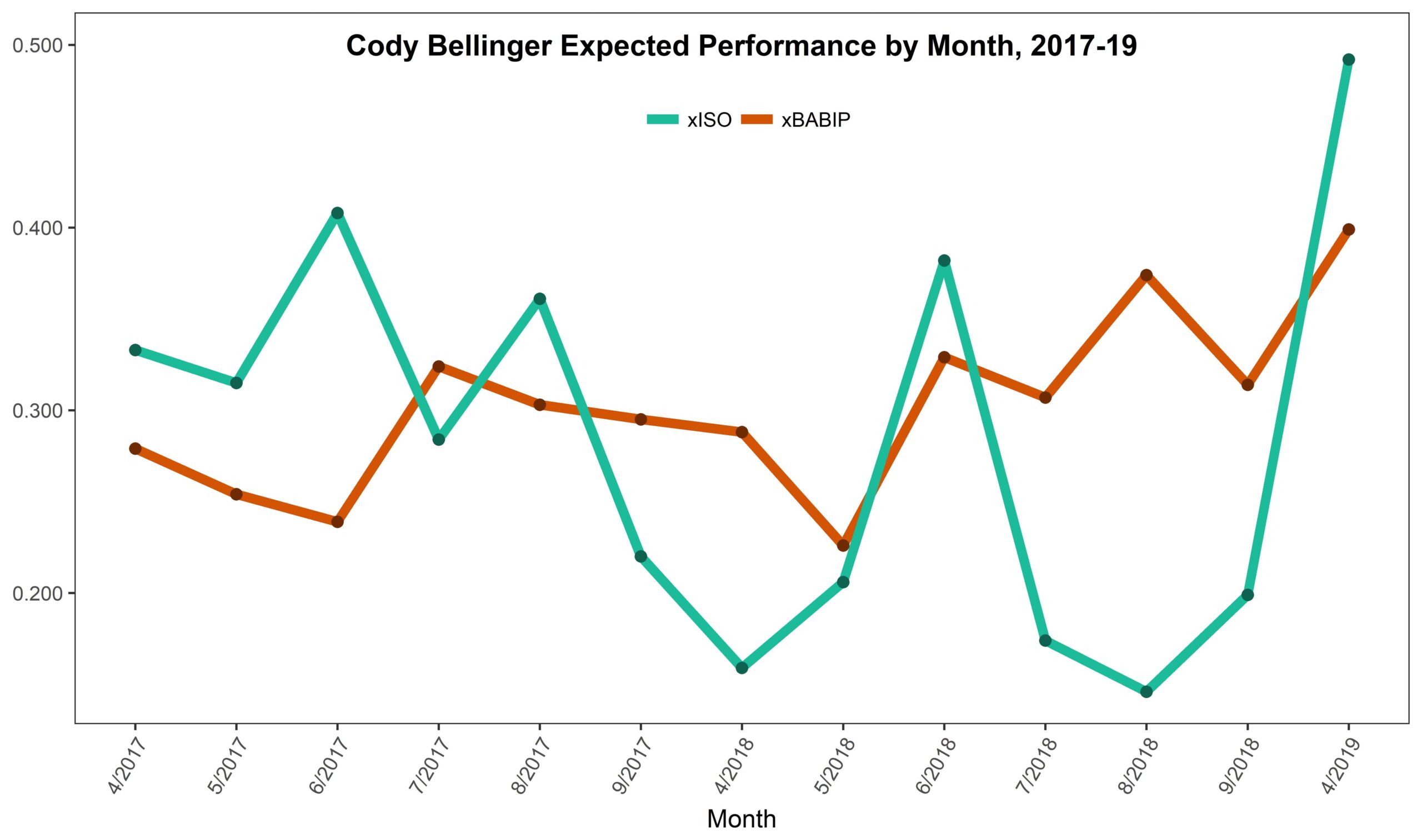
    In this plot, we’ll show Bellinger’s expected Batting Average on Balls in Play (BABIP) and expected Isolated Power (ISO, or slugging percentage minus batting average). These two metrics focus only on balls in play, helping to show his overall hitting ability as well as his power specifically.

    Besides a surge in power last June, Bellinger’s xISO was higher in every month in 2017 than it was in any month in 2018. In fact, there was a downward trend in his power profile even within 2017. As 2018 wore on, though, Bellinger was able to maintain a positive trend in his xBABIP, suggesting that he was still hitting the ball hard, just not in a way that generates a lot of power. It’s worth pointing out here that, even at those low points around a .200 expected Isolated Power, we’re still looking at an above-average power profile. Just not otherworldly.

    Through the first few weeks of the 2019 season, Bellinger has been demolishing the ball, to the tune of nearly a .400 xBABIP and .500 xISO. Because we’re still only a few weeks into the season and Bellinger’s only hit so many balls in play, we can feel comfortable that those rates won’t last long. But there are reasons to believe he could be back to his 2017 form, and perhaps better.

    In particular, his batting eye has improved substantially. Plate discipline stats are really useful this early in the season because they’re on a per-pitch level instead of a per-plate-appearance level, and that’s where Bellinger’s made an obvious leap.

    After chasing 28 percent of balls outside the strike zone the previous two years, he’s chased only 22 percent this year. He’s swung and missed at just 5 percent of pitches this year (21 out of 418) after whiffing on 13 percent in his first two seasons.

    Teams have tended to stay on the outer edge of the plate against Bellinger, trying to avoid him yanking one out to right field and instead trying to get him to weakly ground into the shift. Eventually they have to come inside, though, and Bellinger has really made the most of those opportunities. On those pitches, he’s been incredibly selective, particularly in spitting on pitches too far inside.

    Cody Bellinger Plate Discipline, Inner Third and Inside, 2018-19

    What has he gotten out of that improved selectivity? How about a 2.134 OPS on 29 plate appearances ending with a pitch on the inner third and in, compared to .681 in 2018. That’s also more than 900 points higher than his performance against pitches on either the outside or middle.

    Not only has he addressed what was a hole in his game last year, he’s taken advantage of pitches he should crush. In 2018, he whiffed on 18 percent of his swings and had a .914 OPS against pitches in the zone and belt-high. This year, he’s only whiffed once in 35 swings and has a 2.429 OPS against those same pitches.

    Sure, Christian Yelich has an MVP trophy in his case already and is on an incredible home run pace. But if early returns are any indication, the guy who robbed him of a home run on Sunday might rob him of something else come October.

  • Quantifying Aaron Nola’s Early Season Command

    Quantifying Aaron Nola’s Early Season Command

    By ANDREW KYNE

    Aaron Nola was one of baseball’s best pitchers in 2018, but currently has a 6.84 ERA and 6.05 FIP through five starts in 2019. His walk rate, which sat around 6 to 7 percent in his first few seasons, is currently north of 10 percent.

    After his April 15th start against the Mets, Nola’s manager Gabe Kapler said the following (via MLB.com):

    “I’m concerned about his command. His command is his calling card. He’s got movement, deception, life, and those things are still there. He just needs to put the ball where he wants to throw it.”

    As part of our pitch charting operation at Baseball Info Solutions, we chart not only the location of the pitch, but also the location of the catcher’s mitt. Comparing the distance between the pitch location and mitt location gives us, on average, a pretty good proxy for a pitcher’s command.

    For the entire league, we take all of those distances from the mitt and divide pitches into four buckets, based on percentiles:

    • Closest to Mitt (25th percentile and lower)
    • Close to Mitt (26th to 50th percentile)
    • Far from Mitt (51st to 75th percentile)
    • Farthest from Mitt (76th percentile and higher)

    Some of the leaders in 2018 in throwing close to the catcher’s target (combining the Closest to Mitt + Close to Mitt buckets) were names you would probably expect: Dallas Keuchel, Kyle Hendricks, Zack Greinke, etc.

    Nola was pretty good, too. Among the 100 pitchers who threw the most innings last year, Nola ranked 18th in “close percentage” (Closest to Mitt + Close to Mitt).

    This year, however? Among the 100 pitchers who have thrown the most innings so far, Nola ranks 75th in close percentage.

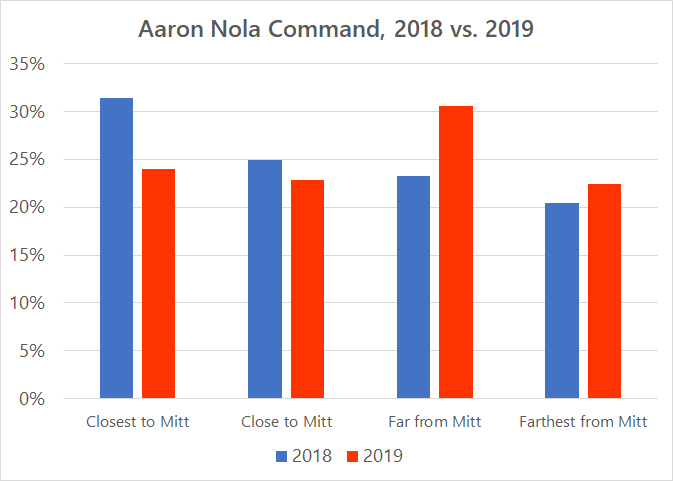
    Here’s a look at his distribution of pitches in terms of proximity to the catcher’s target, using those league-wide percentile buckets:

    SeasonClosestCloseFarFarthest
    201831%25%23%21%
    201924%23%31%22%

    Last year, 31 percent of Nola’s pitches were in the Closest to Mitt category, but that percentage is down to 24 percent so far this year. Additionally, he’s seen a big jump in the Far from Mitt pitches (those that fall in the 51st to 75th percentile across the league).

    That said, Nola’s start against Colorado on Saturday may have been a step in the right direction. He struck out nine and walked only one, and the command numbers were much better than his previous outings:

    DateClosestCloseFarFarthest
    3/28 (ATL)19%21%39%20%
    4/3 (WSH)29%18%25%29%
    4/9 (WSH)19%28%28%24%
    4/15 (NYM)19%11%40%30%
    4/20 (COL)35%33%20%12%

    Perhaps he’s shaking off some early season rust or still getting acclimated with his new catcher, but Nola’s command will be something to keep an eye on as the Phillies look to make a push for the NL East.

  • The Cost of Defensive Mistakes

    The Cost of Defensive Mistakes

    By ANDREW KYNE

    As mentioned on our podcast this week, one of my biggest takeaways from the first few weeks of the season was how the Mariners were winning in spite of their defensive performance.

    Seattle started 13-2 before a six-game losing streak this week. The team’s offense is cooling off after its hot start, but the defense has been poor the entire way.

    The Mariners currently have the worst Defensive Runs Saved in Major League Baseball (-27) and have committed the most Defensive Misplays (49).

    Our Defensive Misplays system at Baseball Info Solutions tracks all mistakes in the field, beyond your typical fielding or throwing errors. Defensive Misplays range from dropping flyballs to taking poor routes to missing the cutoff man. A Defensive Misplay must have a cost to the defense — either the loss of a base, an out, or the opportunity to make an out.

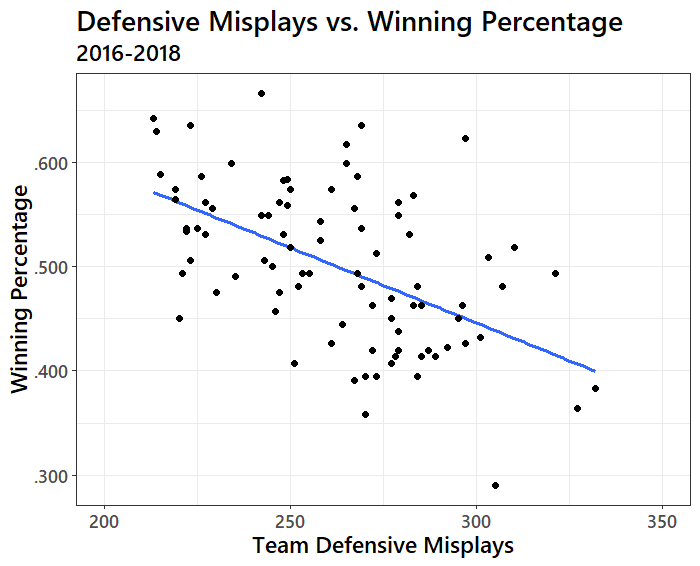
    Do Defensive Misplays correlate with winning? Similar to Scott Lindholm’s Baseball Mistake Index, let’s see if our defensive mistakes correlate with team success.

    The above plot shows a team’s Defensive Misplays correlated with its winning percentage for seasons between 2016 and 2018. Not a super strong correlation (R-squared = 0.28), but clearly a trend where, on average, teams with fewer misplays tend to win more games and teams with more misplays tend to win fewer games.

    What if we look at net Defensive Misplays? Let’s look at opponent misplays minus team misplays (so a higher number is favorable).

    The correlation is stronger here (R-squared = 0.40). Over the course of the season, it generally helps to have your opponents making more defensive mistakes than you do.

    But what about in individual games? Here’s how teams fared over the last three seasons when making different amounts of Defensive Misplays in a game:

    Of course there are many variables that decide a baseball game, but when teams didn’t make a Defensive Misplay, they won almost 63 percent of the time. And as teams made more and more misplays, they won less and less.

    And here are the net Defensive Misplays, again presented as opponent misplays minus team misplays. These are the winning percentages on the favorable side of it — when your opponent makes more mistakes than you do:

    When two teams had the same amount of Defensive Misplays in a game, they went exactly .500. But as the balance of misplays tipped in one team’s direction, the team’s winning percentage went up and up.

    Needless to say, it pays to limit your mistakes — and helps to have your opponent making mistakes, too.

  • Breaking Down Plate Discipline by Pitch Type

    Breaking Down Plate Discipline by Pitch Type

    By ANDREW KYNE

    Last week, I presented a way to visualize plate discipline, referencing some of the numbers on FanGraphs like O-Swing% and Z-Swing% that make use of Baseball Info Solutions’ pitch charting data.

    For each player, those plate discipline metrics obviously come at an aggregated level across pitch types. When we see that Joey Votto swung at 16 percent of pitches thrown outside the strike zone last year, that’s his total performance — against fastballs, curveballs, sliders, changeups, etc.

    But what if we split those out? What kind of discipline does Votto — and the rest of the league — have against different types of pitches?

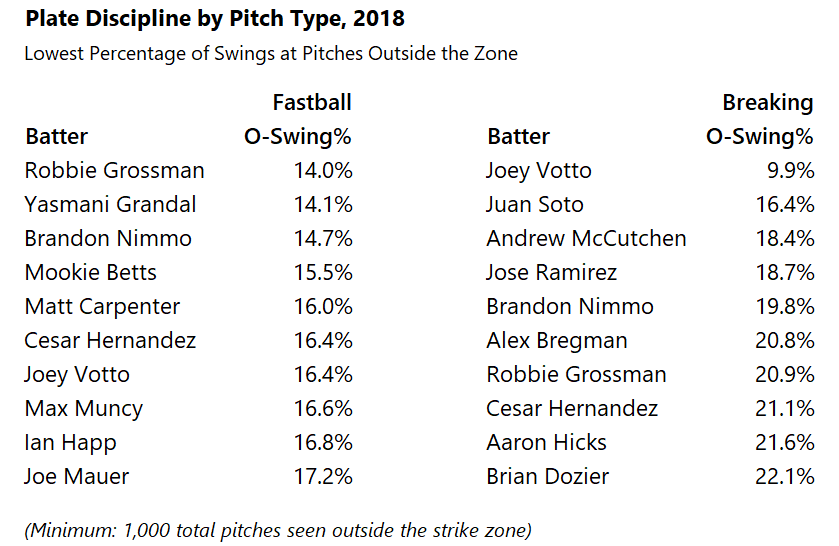
    Let’s consider the chase rates — the percentage of swings taken on pitches outside the zone (O-Swing%) — for the 179 batters who saw at least 1,000 total pitches out of the zone in 2018. For now, let’s just break it down by O-Swing% on fastballs and O-Swing% on breaking balls (curves and sliders).

    Here’s a look at the leaderboard for each:

    And here’s the correlation between those two metrics for these players:

    And some takeaways:

    — There’s a positive relationship, which is expected — batters who chase (or don’t chase) fastballs probably also chase (or don’t chase) a lot of breaking balls.

    — However, the rate of chasing breaking balls is, understandably, higher. Using the trend line on the graph, note that a 20 percent fastball O-Swing% corresponds with something more like a 26 percent breaking ball O-Swing%, on average.

    — Overall, the batters in this sample swung at out-of-zone fastballs 27 percent of the time, compared to 33 percent for out-of-zone breaking balls.

    — Of the 179 batters, 29 had a lower O-Swing% against breaking balls than against fastballs. Three notables are those labeled on the graph: Votto, Juan Soto, and Jose Ramirez. All three showed excellent discipline against all pitch types, but were particularly impressive against breaking balls. And all three are great offensively.

    — On the other side of that is Yasmani Grandal. Overall, he had a very good O-Swing% at 23 percent. But he was outstanding against fastballs (14 percent), and only about average against breaking balls (33 percent). Last season, he hit .279 with a 1.046 OPS in at-bats ending with a fastball, but only .210 with a .555 OPS in at-bats ending with a slider or curveball.

  • The Orioles are fully embracing shifting

    BY MARK SIMON

    While you were distracted by Chris Davis’ futility pursuit, you might not have noticed something interesting.

    The Mike Elias/Sig Mejdal/Brandon Hyde-run Orioles have gone full-scale Houston Astros when it comes to defensive shifting.

    The Orioles have used a defensive shift on just under 60 percent of the balls in play against them this season. That’s the third-highest rate in the majors behind the Marlins (73 percent), whose outlier shifting performance we wrote about, and the Brewers (62 percent), who have been willing proponents of that defensive approach.

    Here are the top five teams in shift usage this season.

    Team20192018
    Marlins73%33%
    Brewers62%42%
    Orioles60%30%
    Twins58%48%
    Pirates57%39%

    It should be pointed out that the previous regime, led by GM Dan Duquette and and manager Buck Showalter, wasn’t necessarily anti-shift. The Orioles were middle of the pack in shift usage last season at about 30 percent. It’s just that this year they’ve taken it to an extreme in the first couple of weeks.

    What’s distinct about the Orioles’ approach is what they’re doing against right-handed hitters. They’re shifting against them on 55 percent of the balls in play. That’s more than double the MLB average of 25 percent and nearly double the Astros’ 28 percent rate. We mention the Astros, not just because they’re Elias’ and Megdal’s former employer, but because they’ve ranked top five in shift usage against right-handed batters in each season from 2013 to 2018.

    Who are they shifting?

    Where have the Orioles changed? Here are a few examples:

    Yankees catcher Gary Sanchez was shifted 12 times on the 14 balls he put into play. Last season, the Orioles shifted him in only three of 15 such instances.

    Sanchez’s teammate Luke Voit was shifted once on 10 balls in play against the Orioles last season. He was full shifted on 13 of the 15 balls in play in the first two series’ against the Yankees this season.

    Blue Jays outfielder Randal Grichuk drew a shift alignment from the Orioles 13 times on 47 balls in play last season. In the first series against the Orioles, Grichuk was shifted on all five balls he put in play in which we could determine if a shift took place.

    All of these players pulled at least 83 percent of their last 120 grounders and short liners, thus making them legitimately shift-worthy. The Orioles also regularly shifted right-handed hitting Brandon Drury (79 percent) who falls just below the shift-recommendation threshold of 80 percent.

    They did draw the line at spray hitter DJ LeMahieu, though he did see a partial shift (two fielders significantly deviating from normal spots) once.

    Sound strategy

    Is it working?

    The Orioles have converted 74 percent of ground balls hit against them when shifting into outs, comparable to last year’s 75 percent, which happened to be the MLB average. But shifts have been a much better option than non-shifts. The Orioles’ ground ball out rate in non-shifts is 63 percent (at least one out on 41 of 65 ground balls). That ranks last in MLB.

    Let’s also note that the Orioles are playing with a highly-inexperienced shortstop, Rule V pick Richie Martin. He’s at -4 DRS in non-shifts so it seems that the Orioles are doing what they can to help him succeed.

    Like with most things, the jury is still out on whether this will be a long-term commitment by the Orioles. If nothing else, it does send a message that Baltimore is willing to think differently and aggressively when it comes to trying to compete in the AL East.

  • Visualizing Plate Discipline

    Visualizing Plate Discipline

    By ANDREW KYNE

    Baseball Info Solutions’ pitch charting data allows for many interesting applications — one being as a way to evaluate a player’s plate discipline.

    By checking out the plate discipline leaderboards at FanGraphs, we can do things like confirm that Joey Votto rarely swings at pitches out of the strike zone or learn that Freddie Freeman swings at a ton of pitches in the strike zone. (O-Swing% shows how frequently hitters chased pitches out of the zone; Z-Swing% shows how frequently hitters swing at pitches in the zone.)

    We can put a number on it. But what does it actually look like? Where are hitters taking their swings, and how far do they extend their zones?

    Using methods similar to what Jim Albert has demonstrated on the Exploring Baseball Data with R blog with generalized additive models and what FanGraphs has on its site, let’s visualize the swing tendencies of baseball’s most and least disciplined hitters.

    The plots below show how likely a batter is to swing if a pitch is thrown in a certain location, using data from the 2018 season. As the legends show, anything above a 25% expected swing rate is colored in red, with darker red indicating a higher swing rate. All plots are from the pitcher’s perspective.

    Out-of-Zone Differences

    First, let’s compare some of the extreme hitters who either swung a little or a lot at pitches out of the zone last year.

    Low O-Swing%: Joey Votto

    The stat: Swung at 16% of pitches outside the zone in 2018 (lowest among qualified batters)

    Votto’s plate discipline has long been elite, and his expected swing rate locations almost perfectly fit the strike zone borders. While he covered all in-zone pitches to some degree in 2018, it appears that there’s a bit higher expected swing rate on down-and-in pitches (like this pitch he got from Edgar Santana).

    Low O-Swing%: Andrew McCutchen

    The stat: Swung at 19% of pitches outside the zone in 2018 (second-lowest among qualified batters)

    McCutchen followed Votto among the O-Swing% leaders last year. His 19.4% O-Swing was a career-best. There’s a small patch of dark red there in the heart of the zone, about belt-high, that appears to have been his most likely swing (like this one against Andrew Chafin).

    Now, a couple players who do extend beyond the zone…

    High O-Swing%: Salvador Perez

    The stat: Swung at 48% of pitches outside the zone in 2018 (highest among qualified batters)

    He’ll miss the 2019 season after undergoing Tommy John surgery, but Perez’s tendency is too extreme not to include here. The plot shows how willing he was to swing at anything within the vicinity of the zone.

    High O-Swing%: Javier Baez

    The stat: Swung at 46% of pitches outside the zone in 2018 (second-highest among qualified batters)

    Baez extends the zone in similar fashion, though maybe not as much on far outside pitches as Perez. Interestingly, the up-and-in pitch looks like one that he offers at a lot (or at least did in 2018). Here are some examples of that: a swinging strike against Brandon Woodruff; a popup against Luke Weaver; a home run against Gerson Bautista.

    Votto and Baez each had a 131 wRC+ in 2018, but took different approaches to get there. Here’s a GIF to show their swing rate differences back-to-back:


    In-Zone Differences

    Next, let’s look at two batters who were at the extremes of swinging at pitches in the zone.

    High Z-Swing%: Freddie Freeman

    The stat: Swung at 85% of pitches inside the zone in 2018 (highest among qualified batters)

    If a pitch is anywhere in the strike zone, Freeman is likely to swing. Prior to his 85% rate last year, he swung at 84% of pitches in the zone in 2017 and 81% in 2016.

    Low Z-Swing%: Brett Gardner

    The stat: Swung at 53% of pitches inside the zone in 2018 (second-lowest among qualified batters, behind the now-retired Joe Mauer)

    Gardner’s plot features a much lighter shade of red all around, indicating how much less likely he is to swing at pitches in the zone than Freeman. His Z-Swing% has consistently hovered in the 50-55% range for his career. There appears to be a slightly darker band of red across the middle of the zone, but Gardner is definitely willing to let pitches pass through everywhere.

    And here’s a GIF to compare Freeman and Gardner:

  • What is Strike Zone Runs Saved?

    You might notice a few extra columns of stats now available on Fangraphs.com stat pages. They’ll have glossary explanations up in the near future, but for now, here is the definition for Strike Zone Runs Saved.

    Strike Zone Runs Saved (rSZ) is a stat created by Baseball Info Solutions (BIS) that ascertains the contribution each player is making in getting more or fewer called strikes than average, converted to a run value. It can be found on the Fangraphs stat pages. The catcher, pitcher, batter and umpire all have an independent influence on whether a pitch is called a strike or a ball. For the purposes of the Fangraphs stats pages, our concern is with the performance of the catcher and whether he is performing above or below average in this regard.

    The idea of framing pitches is that the catcher is trying to ensure that taken pitches in the strike zone are called strikes and attempting to get called strikes on pitches thrown out of the strike zone through a variety of means (pre-pitch body positioning, subtle body movements upon catching the pitch, or keeping the body and glove still when catching the pitch).

    Catchers who are good at this can have a significant positive impact on the performance of their pitching staff. They have good rSZ numbers. Conversely, catchers who are not good in this area can negatively impact their pitchers’ performance and have a poor rSZ value.

    Calculation

    Before computing rSZ, the calculation starts with Strike Zone Plus/Minus.

    To compute Strike Zone Plus/Minus, the pitch is categorized by its location, the count the pitch was thrown in, the proximity of the pitch to the catcher’s target, and the batter’s handedness. That allows the determination of the percent likelihood that each pitch is to be called a strike. The full array of these strike percentages represents our Strike Zone Plus/Minus Basis, i.e., the basis by which credit is assigned if the pitch is called a strike or debit if the pitch is called a ball. This uses a rolling basis of four years of data to determine how to bucket our pitches.

    If a pitch is called a strike, there is positive credit to be awarded (plus) to the players involved. If a pitch is called a ball, there is negative credit to be assigned (minus). The amount of positive or negative credit given depends on how likely that pitch was to be called a strike in the first place, which is known from the Basis that was previously calculated.

    For example, if a pitch is thrown that is one inch off the outside edge of the plate and 20 inches off the ground, to a left-handed batter, in a 3-2 count, and misses the catcher’s horizontal target  by 3.5 inches, there is an estimated 46 percent chance that the pitch will be called a strike. Therefore, if the umpire calls the pitch a strike, then there are plus-0.54 Strike Zone Plus/Minus points (or “extra strikes”) to be allotted to the participants on the pitch. However, if the umpire calls the pitch a ball, then there are minus-0.46 points to be divvied up among the four parties.

    An iterative approach is used to divide up the credit or debit for each pitch. You can learn more about that here.

    Each catcher’s seasonal Strike Zone Plus/Minus is the sum of his Plus/Minus for every pitch he caught that season. From there, the Plus/Minus can be converted to a run value. The run value is calculated by taking our pitch results from the four-year period, calculating the run expectancy associated with each ball/strike count, and then finding the difference in the change in run expectancy between the next pitch being called a ball and the next pitch being called a strike. Those changes in run expectancy are averaged into a single run value.

    Why Strike Zone Runs Saved?

    As is noted in the definition for Defensive Runs Saved, the value of this statistic is in its allowing you to compare all players using the same set of parameters. A run value stat allows you to assess a player’s ability relative to how much it helped his team win.

    rSZ also is notable for its ability to divvy up the value between all involved parties, rather than give all the credit to the pitcher, batter, catcher or umpire. As such, rSZ tends to value catchers less extremely than other publicly available pitch-framing metrics.

    How To Use Strike Zone Runs Saved

    The best way to think of rSZ is relative to the average catcher. A player with 10 rsZ is 10 runs better than the average catcher.

    rSZ works best as a player accumulates more sample size for the season. A catcher could have had a couple of good days or a couple of bad days within a small sample that would distort his value.

    One thing worth remembering is that if you have two catchers with the same rSZ value, but one has caught 100 games and the other has caught 80, the two may be tied in rsZ, but the catcher with 80 games caught is faring better on a per-pitch basis.

    Context

    In 2014, Hank Conger and Mike Zunino shared the major league lead by saving 16 runs with their pitch framing. Dioner Navarro ranked last. He cost his team 17 runs with his framing. The gap between best and worst was 33 runs. The differential dropped to 25 runs in 2015 and 24 in 2016 before climbing back to 31 runs in 2017.

    In 2018, Max Stassi, Yasmani Grandal and Tyler Flowers led the majors with 10 Strike Zone Runs Saved. Tucker Barnhart and Nick Hundley ranked last with -9. The gap between best and worst shrunk to 19 runs.

    With that in mind, rSZ can be broken into the following tiers:

    Strike Zone Runs Saved Rules of Thumb

    Defensive Ability rSZ
    Gold Glove Caliber +10
    Above Average +5
    Average 0
    Below Average -5
    Poor -10

    Things to Remember

    – Pitch locations for each pitch are hand-charted by Baseball Info Solutions video scouts. BIS does its best to ensure the accuracy of this information and that it is the best information that is publicly available.

    – rSZ is one component of catcher defense that goes into Defensive Runs Saved. BIS also charts how catchers fare at thwarting stolen bases (rSB), blocking pitches (which makes up most of the value of rGFP), and handling a pitching staff (rCERA).

     Links for further reading

    Who is responsible for a called strike? Sports Info Solutions

    Which catchers are best at stealing strikes? Sports Info Solutions

    Is pitch-framing cheating? Fangraphs

  • March’s Most Interesting Team Was… the Marlins?

    March’s Most Interesting Team Was… the Marlins?

    BY ALEX VIGDERMAN

    The NL East might have been the buzziest division in baseball over the offseason, with every team making big trades and/or signings. You know all that because you’ve been paying attention. You’re reading this blog after all.

    The Marlins’ primary buzz surrounded their pursuit of offloading J.T. Realmuto, so once that was done all the NL East attention went back to the four teams jockeying for position at the top.

    What if I told you that the Marlins are on pace to use infield shifts on balls in play more than any team in history? How about over 1,000 more times than the next-closest team?

    Well, first you’d say stop playing the on-pace game. But next you’d probably say, “Really? The Marlins?”

    (As should come with any April baseball article, all small sample caveats apply to the following paragraphs.)

    The Marlins had 78 shifts on balls in play in their series against the Rockies. That’s a pace of 3,159 for the season.

    Remember that the prorated numbers are particularly silly this early. But to use that many shifts is a pretty crazy start to the season. The shiftiest teams on record recorded totals in the 1,800’s.

    In fact, this year’s Marlins team shifted on 73 of its first hundred balls in play, which outpaces any team on record (the 2017 Angels had 65).

    Perhaps just as interesting, Miami has really committed to full shifts (the traditional three-to-one-side version). Since the start of 2018, the league as a whole has favored full shifts to partial shifts (two on each side but with a noticeable shift in positioning), but only slightly.

    This runs counter to what BIS has recommended many times in the past, which is that partial shifts are not nearly as effective. Over the last four-plus seasons (quite a large sample), groundballs and short line drives hit into full shifts have a .222 batting average, compared to .274 with partial shifts.

    Bucking the league trend, 61 of the Marlins’ 73 shifts mentioned above were full shifts. That’s 12 more than any team has ever used in their first hundred balls in play.

    So what gives? It’s not like the Marlins’ opponent this past weekend, the Rockies, is chock full of shift candidates. Current Rockies hitters combined to be shifted on just 23 percent of their balls in play last season, eighth-fewest in MLB.

    It turns out this has been a bit of an M.O. for the Marlins the last few seasons. In each of 2017, 2018, and (as of now) 2019, they have increased their shift rate substantially to start the season. Compared to their shift rates in both the previous season as a whole and just the last month of the previous season, they’ve added 10 percentage points or more each April the last three years. They’re the only team to do that.

    Marlins Shift Percentage on Balls In Play
    (March/April vs. Previous Seasons)

    Per Sports Info Solutions

    As you might notice from this table, though, even with substantial upticks in shifting to start each season, they’ve ended up with much lower rates by the end of the season. In 2018, for example, they shifted on 33 percent of their balls in play through April, but ended up at 29 percent (meaning they were below that from May on).

    Should we expect anything like this going forward? Of course not. Given that annual trend, it’s probably fair to assume that the Marlins aren’t going to blow away shift records and single-handedly bring the league to ban the shift or anything like that.

    That’s especially true if their performance with shifts doesn’t improve. Thus far they have zero Shift Runs Saved, which measures shift effectiveness compared to an average defense. Considering the volume with which they’ve shifted, that’s not great.

    The big trouble with their performance in the shift is that the players are botching plays where the shift might otherwise have been successful. The Marlins have committed nine Defensive Misplays or Errors with the shift on, six more than any other team (acknowledging that they also have more shifts than anyone).

    The Phillies had a similar situation last year when their shifts were being criticized (Andrew Kyne wrote about it last spring). The shift can only help so much when the fielders don’t complete the plays presented to them. Philadelphia saw substantial improvement in their performance over the second half of 2018, so it’s fair to assume that the Marlins will get more out of their shifts going forward as well.

    Obviously this is a wait-and-see situation. But given how outlandishly aggressive Miami has been in shifting so far, it will be very interesting to see how they follow up against the Mets this week.