Category: NFL

  • TYREEK HILL: WHAT MAKES HIM SO GOOD?

    TYREEK HILL: WHAT MAKES HIM SO GOOD?

    by COREY MARCH

    Tyreek Hill, or “TyFreak” as he will be referred to from this point forward, is underrated if you ask me.

    Expected Points Added by WR (when targeted) – 2018

    1. Michael Thomas: 77.3
    2. Davante Adams: 74.0
    3. DeAndre Hopkins: 71.9
    4. Julio Jones: 68.8
    5. TyFreak Hill: 66.4

    The thing is, he’s actually “rated” pretty highly by the football community, say as a top-10 wideout, but numbers like this suggest he’s more like top-5.

    What makes him so good? He’s a dynamic athlete who specializes in catching deep passes, running past defenders with and without the ball, and attacking you from every skill position alignment – so basically all the things.

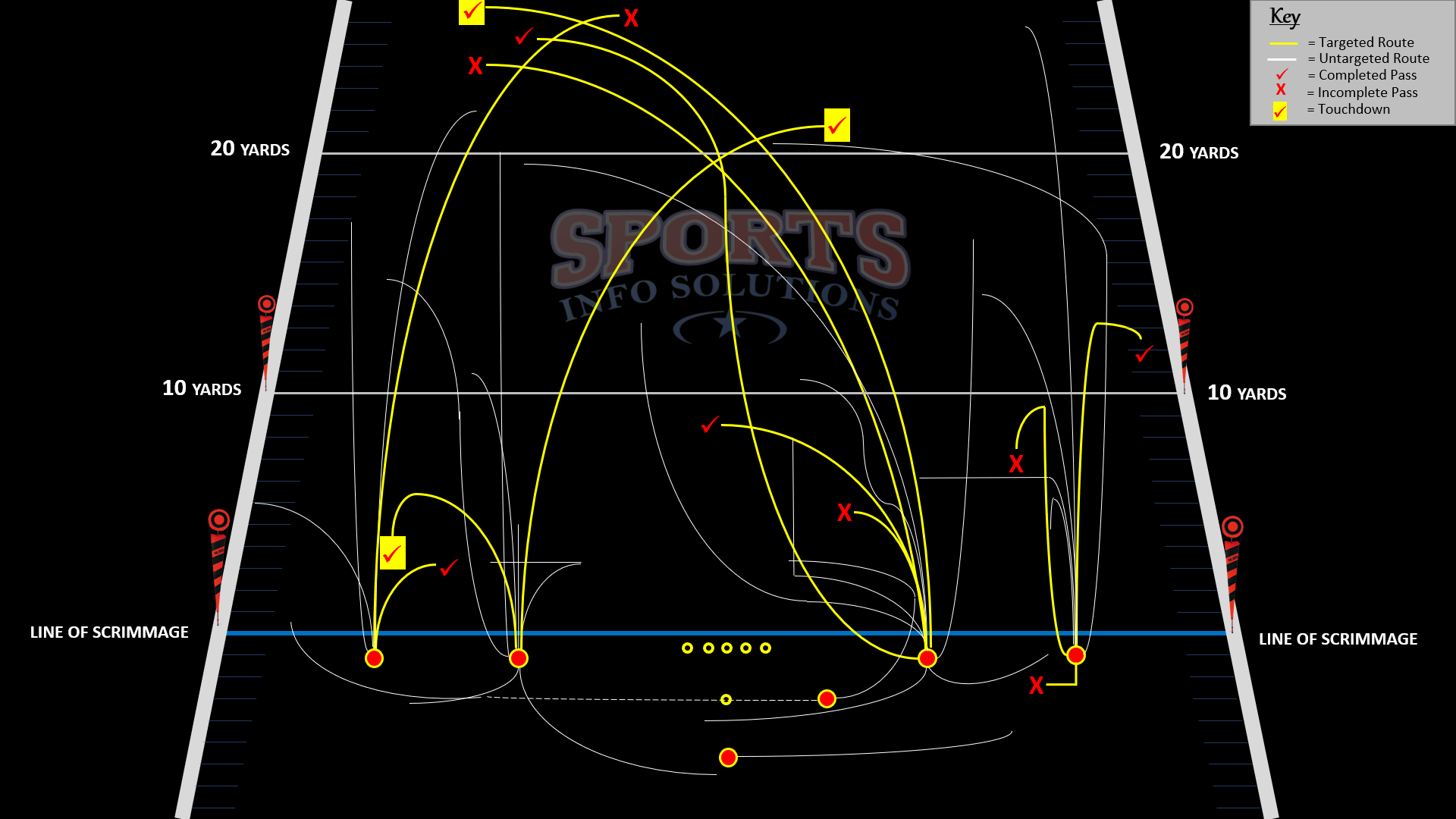
    I got a good look this week when I charted and mapped all his snaps from the Chiefs 43-40 loss at New England back in Week 6.

    Hill lined up all over the field. He played at least 3 and as many as 12 snaps from Slot Right, Slot Left, Wide Right, Wide Left, and the Backfield (in order of frequency).

    Unless you’re strictly shadowing him with a top-tier Cornerback, he’s going to find a lot of mismatches over the course of a game. According to Aaron Schatz on this week’s “Off The Charts” podcast, in Week 6, the Patriots used Stephon Gilmore to cover Sammy Watkins, while Jason and Devon McCourty were tasked with stopping Hill as a duo. This was mostly true by my observations, but Hill still managed to draw coverage from three different linebackers and three different safeties on a total of 12 routes (33%).

    He beat them for 99 yards and 3 TDs.

    Most Frequent Coverage on TyFreak in Week 6 (snaps)

    1. Jason McCourty (13)
    2. Stephon Gilmore (5)
    3. Jonathan Jones (4)
    4. Patrick Chung, Devin McCourty (3)

    Part of what makes TyFreak so unique is his versatility. There were seven receivers who were targeted on at least 20 passes that were thrown behind the line of scrimmage and 20+ air yards downfield: Hill, Antonio Brown, Brandin Cooks, Davante Adams, Nelson Agholor, Juju Smith-Schuster, and Stefan Diggs.

    If you add “receivers who carried 20+ times” to the criteria, Hill becomes the only qualifier.

    Among this group of six elite receivers and Agholor, Hill ranked second in YAC on receptions behind the line of scrimmage and first in On-Target Catch Rate on deep balls.

    More than his speed and playmaking ability, this emphasizes his skill for catching the football, which is an overlooked weapon in his arsenal.

    Here is a leaderboard that sorts Wide Receivers and Tight Ends by On-Target Catch Rate. Again, a very strong group of qualifiers – notice the Yards per Reception.

    On to Sunday’s AFC Championship Game.

    The Patriots play the highest rate of Man Coverage in the NFL (79.2% in last week’s win over the Chargers). This is especially interesting because the Chiefs are coming off a matchup against the Colts, who play the league’s highest rate of Zone Coverage.

    The numbers suggest, that while both Hill and Kelce are tremendous across the board, Hill tends to be the biggest threat against Man and Kelce against Zone.

    Here is the breakdown of how Hill performs against the coverage types that he’s most likely to see a lot of on Sunday:

    I heard Bart Scott say something interesting this week on Good Morning Football. He said that the field conditions will be a favorable factor for the Chiefs because the grass surface responds differently to the freezing cold than the artificial surface at Gillette Stadium, specifically citing that it will be hard for defenders to hold their footing in pursuit of ball-carriers. I trust this man’s opinion to mine on field conditions considering my only football playing experience was barely contributing to a flag football dynasty at Marist College.

    This week’s “Off The Chartspodcast also provided evidence that bolsters that theory. Schatz (who was quoting Dave Brown) referenced that in the last six seasons on the road/neutral sites, the Patriots are 21-5 with a 22.2% DVOA on artificial surfaces, but are just 13-14 with a 6.4% DVOA on grass.

    It sounds like TyFreak will once again be in position to thrive this weekend on the biggest stage of his career.

    If you liked this article then you’d probably like the SIS DataHub – $99.99/month for the tool that was used to research most of the data in this article. Sign up for a free week-long trial today at www.SISDataHub.com or email me to subscribe.

  • Preview: AFC Championship – Patriots vs. Chiefs

    By Nate Weller

    Let’s take a brief look at some statistical notes and story lines ahead of the AFC Championship game between the Patriots and Chiefs.

    Chiefs Pass Offense vs Patriots Pass Defense

    • Patrick Mahomes has an Expected Points Added (EPA) per pass of .37 when Sammy Watkins is on the field, and .22 when he is not. A healthy Sammy Watkins could be a big factor in the Chiefs offensive success
    • Having Watkins on the field makes it harder for teams to double Tyreek Hill. Hill’s rate EPA jumps from .39 without Watkins on the field to .59 when he is on the field.
    • In 260 regular season coverage snaps Patriots cornerback J.C. Jackson allowed a QBR against of only 37.7, ninth-best among corners who were targeted at least 20 times. Jackson will likely spend a good portion of Sunday matched up on Travis Kelce.

    Patriots Pass Offense vs Chiefs Pass Defense

    • The Chiefs led the league in combined sacks with 53. Their pass rush was led by Chris Jones who finished the regular season with 15 combined sacks, all coming after week 4.
    • The Patriots offensive line was among the leagues best, allowing only 21 sacks in the regular season. Guard Joe Thuney ranked as the second-best linemen in the NFL by SIS’ Total Points Metric with 7.2 points earned.
    • When under pressure, Brady completed only 45 percent of his passes in the regular season, and posted an Independent Quarterback Rating of 81.1. In 2017 his IQR while under pressure was 115.4.
    • Julian Edelman will likely garner most of the attention, but Brady had a passer rating of 137.5 on 28 targets to Cordarrelle Patterson this season, the fifth- best QB/WR combo in the league by QBR
    • Chiefs corner Steven Nelson was the most targeted player in the NFL in 2018 (112), but quarterbacks only completed 46 percent of passes and posted a QBR of 69.3 when targeting him

    The Run Game

    • The Patriots defense has a broken tackle percentage of 4.9, second best in the NFL. The Chiefs defense had a broken tackle percentage of 12.5, third worst.
    • Chiefs running backs averaged  2.6 yards after contact per attempt and had a broken tackle percentage of 10.3, both top 10 in the NFL.
    • The Patriots ranked fifth in the NFL in both rushing yards (2,037) and first downs picked up on the ground (132).
    • The Chiefs defense allowed 5.0 yards per attemopton the ground, the second worst in the league, and allowed a first downs on 30.4% of carries, the worst mark in the league

  • Preview: NFC Championship – Rams vs. Saints

    By John Shirley

    Let’s take a brief look at some statistical notes and story lines ahead of the NFC Championship game between the Rams and Saints

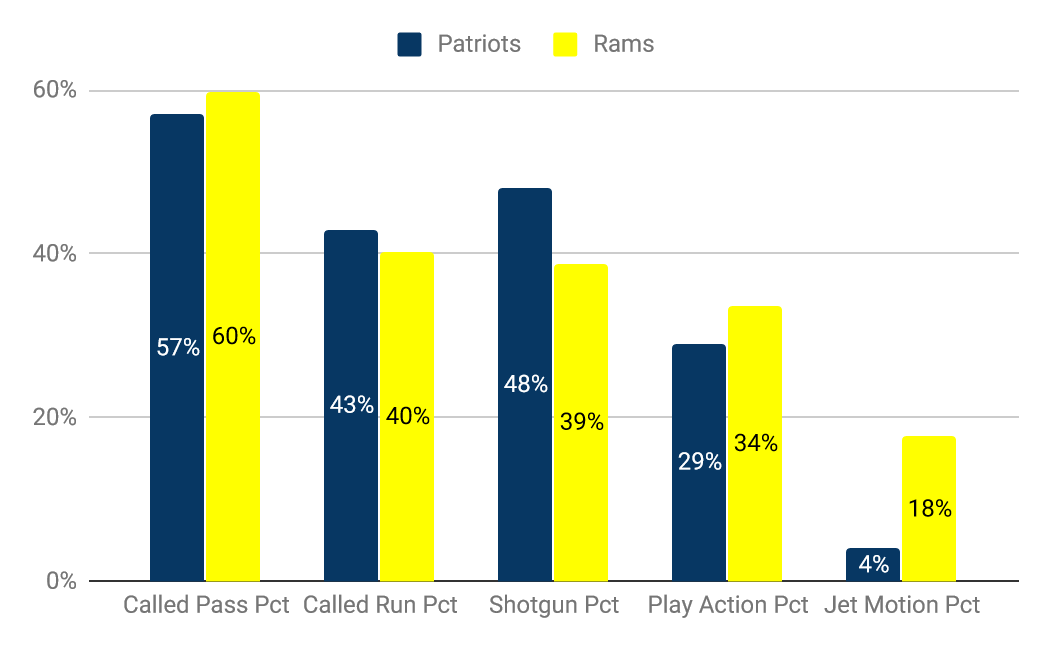
    Lots of Motion and Play-Action, but not much Shotgun

    • The Rams’ offense ranks first in the use of jet motion, using it on 17 percent of their plays. The Saints also use jet motion quite a bit, using it on 6.5 percent of plays, which ranks fifth highest.
    • When the Rams are on offense get ready to see a lot of play-action. They use play-action on 32 percent of their dropbacks, which is the highest usage in the league. The Saints’ offense is on the other end of the spectrum as they only use play-action on 19 percent of their dropbacks, which ranks 26th.
    • While there will be a lot of play-action and motion in this game, there probably won’t be much use of shotgun. The Rams use shotgun the least of any team in the league at only 38 percent. The Saints, who use shotgun on only 49 percent, are also one of just four teams that use shotgun under 50 percent of the time.

    The Saints use of Michael Thomas

    • During the regular season Saints receiver Michael Thomas was responsible for 29 percent of his team’s targets. This was the second highest target share in the league next to DeAndre Hopkins’ 33 percent target share.
    • In the first meeting between the Saints and Rams, Thomas’ target share was an incredibly high 42 percent.
    • The Rams will need to contain Thomas this time around. It will help that they will have corner Aqib Talib this time.

    The Rams Running Game vs the Saints Defense:

    • The Rams running game has been impressive this year ranking third in yards per carry at 4.9 yards. They also ranked first in positive percentage (the percentage of running plays with a positive EPA) at 51 percent. This success continued into the playoffs last week as both CJ Anderson and Todd Gurley ran for over 100 yards.
    • The Rams will have a tough matchup this week when they face a Saints run defense. The Saints defense ranked second by only allowing 3.6 yards per carry. They only allowed 1.9 yards after contact per carry, which also ranked second best in the league.

    The Offensive Lines vs the Defensive Lines:

    • The Rams offensive line ranks fifth (6 percent) in blown block percentage, while the Saints offensive line ranks sixth (6.4 Percent). The Rams defense ranks fourth (11.3 percent) in forced blown block percentage, while the Saints defense ranks 11th (9.5 percent).
    • The Saints offense ranks second in percentage of pass plays with a pressure (hit, hurry, knockdown, or sack) allowed at 27 percent. The Rams offense ranks seventh, allowing a pressure on 30 percent of pass plays.
    • The Rams defense ranks second in pressure percentage, getting pressure on 40 percent of opponents pass plays. The Saints defense ranks sixth, getting pressure on 36 percent of opponents’ pass plays

  • Aqib Talib should have big impact vs Saints

    By PATRICK ROWLEY
    Last time the Rams and Saints played against each other was week 9, when Michael Thomas had 211 yards and a touchdown on 12 catches. Thomas became such a focal point of the Saints offense in this game that his longest reception (72 yards) was a higher yardage total than the next highest Saints receiver had for the game (Ben Watson, 62 yards).

    Marcus Peters was the one responsible for Thomas most of the game and he was exposed throughout the night on his way to -9 total points, most of which occurred when Peters was defending Thomas in the slot. Eight of Thomas’ 12 receptions came when he was lined up in the slot, which led to 157 of his yards for the day. On the season 917 of Thomas’ 1,405 receiving yards (65 percent) came when he was lined up in the slot.

    For this matchup the Rams have a healthy Aqib Talib back on the field. He will almost certainly take over the assignment of covering Michael Thomas. Aqib Talib figures to be an upgrade over Marcus Peters. Over the last two seasons he has allowed 6 yards per target when targeted compared to 8 yards for Peters.

    The disparity is even larger when looking at how they do specifically against receivers in the slot. Again, looking at the last two years of data since Talib missed a large portion of this season, Talib has been considerably better. He has allowed just 6 yards per target to slot receivers, four yards  better than Marcus Peters’ 10-yard mark.

    Another effect of Aqib Talib taking over for Peters is that Peters can in turn take away some responsibility from Sam Shields. Shields has been torched throughout the season when he has been in the game and has averaged -0.55 total points per target when targeted this season, the fifth-worst rate in the NFL among corners (minimum 30 targets). Shields also owns the single lowest pass defense total points figure in a game this season with an egregious total of -15.8 week 11 against the Chiefs.

    The Saints have an elite offense that will be hard to slow, particularly in the Superdome. Adding Talib back in to the mix for this rematch should help contain the explosive Michael Thomas and have ripple effects across the rest of the defense. This is why the Rams traded for Talib this offseason.

  • The Rams’ Rushing Success is More Than Just Todd Gurley or C.J. Anderson

    The Rams’ Rushing Success is More Than Just Todd Gurley or C.J. Anderson

    The resurgence of C.J. Anderson in Los Angeles has seemingly breathed life back into the debate about the relevance of running backs in the modern NFL. On Saturday night, Anderson went for 123 yards on 23 carries, adding two touchdowns. On the opposite side of the ball, superstar running back Ezekiel Elliott turned his 20 carries into only 47 yards.

    It was the latest chapter in a season in which James Conner gained close to 1,500 scrimmage yards in only 13 games, and a 33-year-old Adrian Peterson get back over the 1,000 yard mark for the first time since 2015. Meanwhile, teams like the Jaguars, whose run game carried them to a conference championship only a year ago, failed to have a single 100-yard rusher.

    Based on pretty much any metric, passing provides more value than running, but what that really means for play calling is still hotly debated. And if it’s so inefficient, why were the Rams, Chiefs, and Patriots able to win this weekend by dominating on the ground?

    Stop Trying to Establish the Run

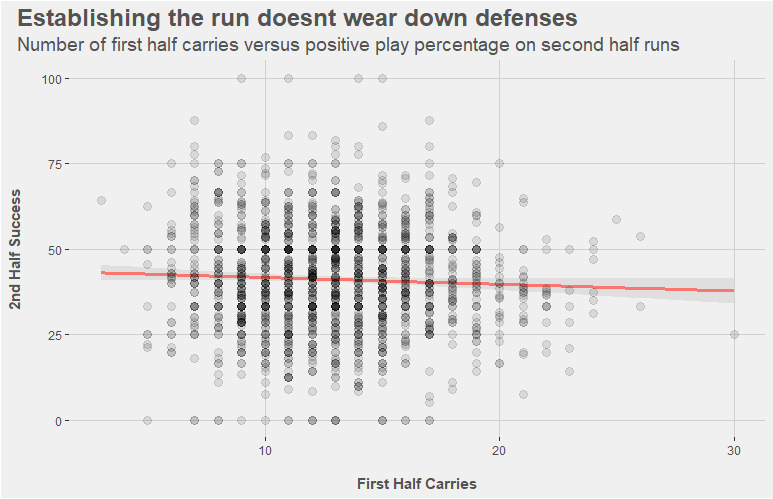
    Conventional wisdom has always stated that establishing the run is crucial to an offense’s success. Even if you aren’t running the ball particularly well, you should stick with it because you will wear down the down the defense and have more success as the game wears on.

    To look at this, we compared a team’s first half carries versus their positive play percentage (Positive%) on second half carries. (Positive% is an Expected Points-based metric that represents the percentage of plays a player earned a positive Expected Points Added value.) Establishing the run in the first half shows almost no correlation to second half success. In fact, it actually shows a small negative correlation, indicating at some level that rushing performance actually decreases the more carries are forced onto a running back early in the game.


    This potentially indicates a few things: that running the ball a lot early does not cause the defense to fatigue more than a normal offensive split, at least not enough to affect performance in a meaningful way, and that predictable play calling can lead to decreased offensive performance.

    Despite this, coaches continue to stick by this strategy. As recently as Wild Card weekend the Seahawks ran the ball 24 times for 3.0 yards per carry, waiting until the final quarter to open up the pass game. This is despite Russell Wilson averaging 8.6 yards per attempt and posting a QB Rating of 115.3.

    This also illustrates another important point: passing success generally acts independent of rushing success. Since 2016, the correlation between a teams Positive% on the ground and their Positive% through the air is close to zero, and this correlation even holds true when looking at play action. On average, success rate on play action passes tended to stay around 50 percent, with some noise on either side, regardless of a team’s success on the ground.

    Creating Mismatches at the Line of Scrimmage

    Teams that are successful on the ground in the modern NFL are not doing so by staying patient, or “establishing the run” early. They are doing so by putting their running backs and linemen in advantageous situations.


    C.J. Anderson is the perfect case study. During his 2017 campaign with Denver, Anderson ran into a stacked box on 33 percent of attempts, and had a Positive% of 36 percent. In weeks 16 and 17 with the Rams this season, Anderson ran into a stacked box on only 19 percent of his carries, and flipped that into a Positive% of 62 percent. Among running backs with at least 25 carries in that time period, that ranked second behind fellow Rams running back Malcolm Brown (69 percent). Put into context, no running back with more than 100 attempts in 2018 had a success rate above 50 percent.

    Even without considering that he was unemployed for most of the season, Anderson has been impressive, and McVay’s creative play calling deserves a lot of credit. While the Rams predominantly stick to one personnel grouping, they use a wide variety of formations and move players around a lot to generate mismatches, including some of the most creative use of motion in the league.

    Nobody Uses Motion More Effectively Than the Rams

    In 2018, teams averaged 1.6 yards before contact (YBC) and 4.1 yards per attempt (Y/A) on runs that didn’t use motion. When using motion in any capacity those numbers jumped to 1.9 and 4.5, and jumped further to 2.2 and 4.9 on plays using jet motion (YBC and Y/A exclude jet sweeps and QB scrambles).

    No team made use of this more than the Rams, who led the league in jet motion usage by a long shot. In total, the Rams used jet motion on 17 percent of offensive snaps in 2018. The next closest teams were the Chargers and Titans who used jet motion on 14 and 8 percent of offensive snaps respectively.

    The Rams averaged an astonishing 2.7 YBC on plays utilizing jet motion, significantly better than their overall average on runs plays of 2.0, and almost a full yard better than the average run play in the NFL (1.8).

    There’s more to this than simply using jet motion more, and having a talented running back certainly adds value, but the point is that scheme plays an important role too. Nobody will argue that Anderson is a better running back than Ezekiel Elliott, but Elliott wasn’t good enough on Saturday to overcome facing a stacked box on 40 percent of his carries.

    Running the ball still has an important role in modern offenses, but for teams to be successful they need to start moving away from the more traditional ground-and-pound methods. The Rams are creating a blueprint; now it’s time for other teams to start using it.

  • A statistical comparison of Outland winners Quinnen Williams and Ed Oliver

    BY BRYCE ROSSLER

    For the first time in six years, the NFL Draft will feature two Outland Trophy winners, both of whom figure to be selected early. But, this occurrence is especially strange because both players in question, Houston’s Ed Oliver and Alabama’s Quinnen Williams, are defenders (the award is given to the best interior linemen, on offense or defense).

    The last time that two defensive winners of the trophy were in the same draft was 1978, which featured Notre Dame’s Ross Brown and Texas’s Brad Shearer. And perhaps that’s fitting since the defensive line is considered the strength of this class, a group that Oliver and Williams still manage to stand out from.

    For most of last offseason, Oliver was billed by some as the surefire top selection in the class, but that was before Williams ascended to the throne with a dominant 2018 campaign. Whereas the former has been a known commodity for some time now, the latter seemingly came out of nowhere. Both of Williams’ running mates at Alabama, Isaiah Buggs and Raekwon Davis, were certainly attracting more attention in preseason. But, once he hit the field, Williams quickly became the focus of opposing teams.

    The Crimson Tide sophomore ranked first in run stuff rate (i.e. solo tackles for non-positive yardage) among 339 defensive tackles with at least 100 run snaps. His rate of 6.8 percent was about a full percentage point higher than the next-best interior player, South Alabama’s Tyree Turner (5.8). And in case you were wondering – his Outland predecessor ranked third with a rate of 5.3 percent.

    That difference is even further accentuated when you consider that teams aimed runs towards Williams on 19 percent of their rushing attempts, as opposed to 29 percent of the time for Oliver. And when teams did run at Williams, he caused the ballcarrier to bounce the play 43 percent of the time – nearly ten-plus percentage points more often than Oliver did (34 percent).

    Williams was an even bigger difference-maker as a pass-rusher, boasting a hurry rate of 13.8 percent. That dwarfs the second-highest figure, which belongs to San Jose State’s Boogie Roberts, by 2.8 percentage points. Oliver once again ranks fourth with a still-excellent hurry rate of 10.5 percent. But, to give you an idea of just how impactful Williams was, his hurry rate outpaced that of several edge rushers who will merit first round consideration in April, namely: Clemson’s Clelin Ferrell (12.1 percent), Florida State’s Brian Burns (11.5), Mississippi State’s Montez Sweat (10.5), and Michigan’s Rashan Gary (9.5).

    While the NFL will present a new set of challenges for Williams, his hurry rate this year was comparable to Aaron Donald’s at the NFL level. This doesn’t mean that he’ll be able to maintain that productivity on Sundays, but it does serve to illustrate his level of collegiate dominance. (If anything, it should serve to illustrate how futile the search for the next Aaron Donald is)

    The bottom line is that both players project to be three-down difference-makers early in their careers. The advanced metrics seem to favor Williams, but an argument could be made that the already-established and obviously-talented Oliver suffered from a junior-year drop off as Jadeveon Clowney and Myles Garrett once did, and that he was capable of imposing his will more often. At any rate, statistics can only begin to contextualize a player’s performance, and film is what tells the full story.

    A more traditional perspective on each (and more advanced stats like these) can be found in the Football Rookie Handbook (details to come on that in the near-future).

  • How the Eli Apple Trade Helped Transform the Saints Defense

    How the Eli Apple Trade Helped Transform the Saints Defense

    In the first game following their Week 6 bye, the Saints faced a 17-7 deficit heading into the 4th quarter against the Ravens. Thanks to the Saints potent offense, they were able to salvage a one-point win that moved them to 5-1 on the season.

    Despite the win and the league’s third-best winning percentage, the Saints took to the trade market to address a secondary that notoriously keyed their exit from the 2017 playoffs and had so far surrendered 8.9 Yards/Att (27th) and an opponent QBRating of 115.5 (31st) to a group that included Ryan Fitzpatrick, Tyrod Taylor, Matt Ryan, Eli Manning, Alex Smith, and Joe Flacco.

    They acquired Eli Apple from the Giants in exchange for fourth- and seventh round picks.

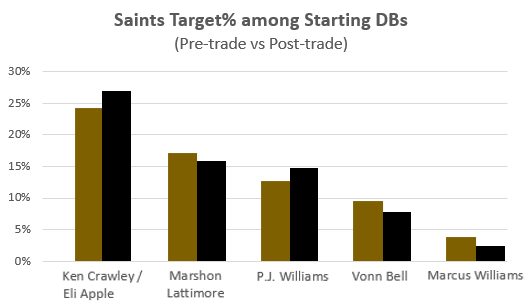
    Prior to the trade, their secondary featured Ken Crawley and Marshon Lattimore lined up on the outside, P.J. Williams in the Slot, with Vonn Benn and Marcus Williams at Safety.

    Lattimore, who was coming off Defensive Rookie of the Year honors, hadn’t quite been living up to the same standards with slightly below average Yards/Att (8.7) and QBRating Allowed (96.4) but his talent was obvious – it was also obvious that Crawley was the main culprit.

    Looking at the 80 CBs with the most coverage snaps through Week 7, Crawley ranked 79th in both Yards/Att ( 12.3) and QBRating Allowed (152.1).

    Among the same sample size since the acquisition, Apple has ranked 46th in Yards/Att (7.7) and 32nd in QBRating Allowed (81.0).

    Going from a league-worst CB as the their most-targeted player to a league-average CB has helped improve the Saints secondary by 26 Passing YPG, 21 points on their QBRating Allowed, and resulted in the league’s largest jump in terms of Pass Defense Points Saved from 30th to 4th.

    What else changed?

    As Keegan Abdoo pointed out on Twitter, the Saints have transitioned from 31.7% Man Coverage to 43.3% Man Coverage following the trade. Across the league, Man Coverage has resulted in a 37.9% Pressure Rate compared to 31.2% in Zone.

    More Man Coverage and better coverage in general has helped the Saints double their Pressure Rate from 21.2% (30th) to 46.0% (1st) since Week 7 despite the same four players leading the team in Pass Rushes.

    The Saints prepare for their Divisional Round matchup with the Eagles, an offense that features Nick Foles, who leads the NFL in On-Target% under pressure (82.4%) and boasts the 7th-lowest Sack% (4.4%).

    With pressure figuring to play less of an impact, the role of Apple and the Saints secondary will be more important than it has been all season.

  • Preview: NFC Divisional Round – Eagles vs. Saints

    Let’s take a brief look at some statistical notes ahead of the NFC Divisional Round playoff game between the Eagles and Saints.

    Saints Passing vs. Eagles Pass Defense

    • Drew Brees on passes of at least 20 yards downfield: 52 percent completion percentage (1st among QBs with at least 30 such throws), 66 percent on-target rate (1st), 18 percent touchdown rate (1st).
    • On throws of 20-plus yards downfield, Eagles’ opponents recorded a positive play (based on Expected Points Added) 41 percent of the time. That was tied for sixth-worst among NFL defenses.
    • One key for Brees and the Saints: avoiding sacks. Brees’ 3.5 percent sack rate in the regular season was tied with Tom Brady for third-lowest in the NFL, behind Andrew Luck (2.7%) and Ben Roethlisberger (3.4%).
    • Saints left tackle Terron Armstead was the only lineman to play at least 100 pass-blocking snaps and not have a blown block credited to him. However, he has missed time due to a pectoral injury and sat out in Week 17.
    • Philadelphia’s Michael Bennett (58) and Fletcher Cox (56) ranked tied for fourth and sixth, respectively, in quarterback pressures this season.

    Saints Rushing vs. Eagles Run Defense

    • Both members of the Saints’ backfield can be found among the top ten running backs (min. 100 carries) in positive play percentage: Alvin Kamara at 47 percent and Mark Ingram at 46 percent.
    • The Eagles’ run defense tightened things up late in the season. In Weeks 15 through 17, Philadelphia allowed only 3.4 rush yards per attempt (3rd in NFL) and 1.7 yards after contact per attempt (1st).
      • Similarly, the Eagles surrendered only 65 rushing yards on 18 attempts (3.6 YPA) in Chicago last weekend.

    Eagles Passing vs. Saints Pass Defense

    • Among quarterbacks who attempted 60+ passes in Weeks 15 through 17, Nick Foles ranked first in completion percentage (77 percent), on-target rate (86 percent), and yards per attempt (8.5).
    • Among receivers with at least 15 targets in that same time, Alshon Jeffery ranked first in yards per target (16.7) and Nelson Agholor ranked first in Receiver Rating (148.3).
    • The Saints allowed 8.2 yards per pass attempt in the regular season, which ranked fifth-worst in the NFL.
    • New Orleans can bring pressure, having ranked third in pressure percentage (35.4%) – led by Cameron Jordan’s 58 QB pressures.
    • That said, it doesn’t always rattle Foles. Among QBs with 50+ attempts under pressure, he ranked first in on-target rate (82.4 percent) and sixth in yards per attempt (7.5) when pressured this season.

    Eagles Rushing vs. Saints Run Defense

    • The Saints’ run defense was excellent in the regular season: second in yards per attempt (3.6), second in yards after contact per attempt (1.9), fourth in broken tackle percentage (6.7%), and tied for fourth in positive play percentage (40%).
    • The Eagles have not had great success running the football, especially with the injuries to Jay Ajayi and Corey Clement.
      • Over the last six weeks of the regular season (since they last played New Orleans), Philadelphia ranked last in the NFL with an average of 3.6 yards per attempt and tied for 25th with a 38 percent positive play rate on rushes. Of course, they still managed five wins in those six weeks.
  • Preview: NFC Divisional Round – Cowboys vs. Rams

    By NATE WELLER

    Let’s take a brief look at some statistical notes and storylines ahead of the NFC Divisional Round playoff game between the Cowboys and Rams.

    Prescott Needs to Use His Legs to Negate the Rams Pass Rush

    Aaron Donald led the league with 20.5 combined sacks this year, 4.5 more sacks than runner up J.J. Watt. He also leads the league in pressure rate, pressuring the quarterback on just shy of 17 percent of pass rush snaps. Dak Prescott though has excelled when he has been able to escape the pocket. His Independent Quarterback Rating (IQR) on throws from outside the pocket is 113.2, versus 99.5 on throws from inside the pocket. Looked at another way, using SIS’s total points metric, he earned 2 points from outside the pocket, and -13.2 from inside the pocket.

    If the Rams’ defensive ends can contain Prescott and keep him in the pocket, their pass rush will be very disruptive. If the Cowboys’ offense is going to be successful, Prescott will need to extend some plays with his feet and continue making plays from outside of the pocket.

    The Cowboys Need to Run Smart

    On runs against a defense with less than 8 men in the box, Ezekiel Elliot leads the NFL with 5.1 yards per attempt (Y/A). This number drops drastically to 3.3 when facing a stacked box. Unfortunately for the Cowboys, the Rams stacked the box on defense more than any team in the NFL this year, doing so on 17.5 percent of defensive snaps.

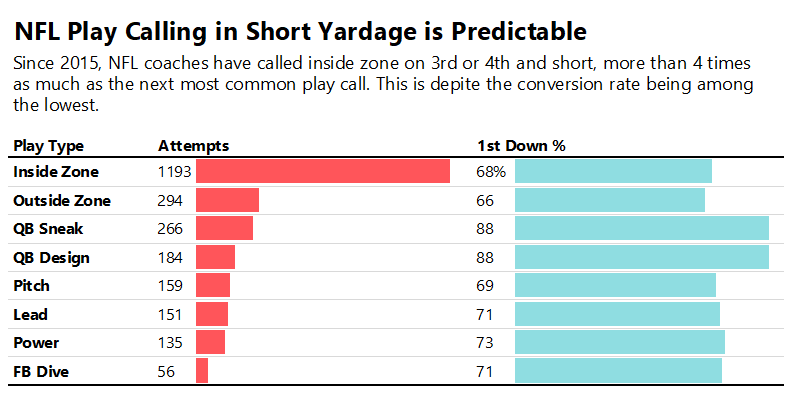
    On third or fourth down with less than a yard to go, this number jumps all the way to 46 percent (3rd in the league). Elliot is a crucial part of the Cowboys offense, and the Rams will likely make it a priority to stop him.  If the Cowboys are going to find offensive success, they will need to use audibles to prevent sending Elliot into a stacked box consistently, and Prescott will likely need to make some plays with his arm on short yardage downs to take advantage of an aggressive Rams defense.

    Goff Needs to Find a Way to Beat the Cowboys Zone

    The Cowboys play in zone coverage 52 percent of the time, the 8th most in the NFL, and in man coverage 35 percent of snaps. (Screen, prevent, and combo coverages make up the remaining percentage). Against man coverage this season Jared Goff posted an IQR of 114.4 (4th), compared to an IQR of only 96.7 (18th) on passes versus zone coverage. The 17.7 split is the 6th largest among quarterbacks with at least 100 attempts. Additionally, Goff has thrown 9 of his 12 interceptions against zone coverage.

    Player

    IQR vs Man

    IQR vs Zone

    Split  

    Cam Newton

    118.9

    78.6

    -40.3

    Ryan Fitzpatrick

    118.6

    89.6

    -29

    Drew Brees

    131.5

    111.7

    -19.8

    Ben Roethlisberger

    103.8

    84.8

    -19

    Matthew Stafford

    101.1

    83.1

    -18

    Jared Goff

    114.4

    96.7

    -17.7

    Sam Darnold

    82

    72.4

    -9.6

    Kirk Cousins

    107.2

    98.8

    -8.4

    Jameis Winston

    101.9

    93.6

    -8.3

    Deshaun Watson

    110.6

    102.6

    -8


    The Rams Offense Needs to Get Back on Track

    Since the bye, Goff’s IQR of 79.7 ranks 30th among quarterbacks. This number is mostly due to a particularly bad three game stretch coming out of the bye where he posted IQR’s of 78.1, 23.5, and 75.1 in consecutive games.

    Through week 15, the Rams had used 11 personnel (1 RB, 1 TE) on 96 percent of offensive snaps, almost 20 percentage points higher than the next closest team. In weeks 16 and 17, the Rams only ran 56 percent of plays out of 11, and used 12 personnel (1 RB, 2 TE) on 40 percent of offensive snaps. In limited action in these two games, Goff threw out of 12 personnel 11 times (he had 1 such attempt in the 14 games prior), completing 8 of them for 88 yards with two touchdowns and no interceptions, an IQR of 147.

    The Rams also found success running the ball out of 12 personnel in the team’s final two games. C.J Anderson and John Kelley ran the ball a total of 37 times for 161 yards and a touchdown. Put into context, the Rams ran the ball out of 12 personnel a total of 16 times the first 14 games of the season. With Gurley back in the lineup, it’s possible the Rams will continue to lean on 12 personnel sets.

  • Preview: AFC Divisional Round – Colts vs. Chiefs

    By MARK SIMON

    Let’s take a brief look at some statistical notes ahead of the AFC Divisional Round playoff game between the Colts and Chiefs.

    Colts Passing vs. Chiefs Pass Defense

      • Andrew Luck had the most Points Earned of any quarterback from Week 8 through the end of the regular season. Patrick Mahomes ranked second. Luck had one fewer pass attempt than Mahomes in that span, but his throws totaled 156 more air yards, and he took only eight sacks to Mahomes’ 19.
      • The Chiefs tied for the NFL lead in sacks with 53 and ranked third in quarterback pressures with 211. The top player in Points Saved via Pass Rush this season was linebacker Dee Ford, who ranked ninth in the NFL with 13½ sacks and ranked seventh in the league in pressure percentage (13.8 percent).
      • The Colts offensive line has allowed only 18 sacks on the season, the lowest total in the league, despite having the second most pass attempts. They are led by star rookie lineman Quenton Nelson whose blown block rate of 0.5 percent ranks as fifth-best in the league.
      • Though Eric Ebron led the Colts in touchdown receptions, T.Y. Hilton was the more valuable receiver by our Points Earned metric. Sixty percent of Hilton’s targets had a positive Expected Points Added (EPA) value (in other words, they were valuable plays). Ebron’s rate was 53 percent.
      • The Chiefs’ defense allowed the most passing yardage in the NFL, though that’s likely due to teams trying to play catch up against them. Overall, the pass defense ranked 11th in the NFL in Points Saved. The Chiefs did have two cornerbacks – Steven Nelson and Orlando Scandrick, who ranked in the top 12 in the league in lowest completion percentage against, minimum 40 targets. Nelson ranked fifth (46 percent) and Scandrick ranked 12th (49 percent).

    Colts Rushing vs. Chiefs Run Defense

      • The Colts ranked 22nd in Points Earned from rushing in the first 14 weeks of the season, though they were 13th in the last three weeks, thanks to a pair of 100-yard rushing games from Marlon Mack, who had another last week against the Texans
      • The Chiefs are susceptible to the run, as 52 percent of rushes against them had a positive Expected Points value. That was the highest rate in the NFL by six percentage points. The difference between the Chiefs and the second-highest team was the same as the difference between second and 24th.
      • Marlon Mack had a big game in the Wild Card win over the Texans. For the season, Mack averages 5.2 yards per rush when running left, 4.2 per rush when running right.

    Chiefs Passing vs. Colts Pass Defense

      • Patrick Mahomes threw for 5,097 yards and 50 touchdowns in 2018. Mahomes threw the seventh-most passes in the league, but the most that were at least 20 yards downfield. His 43 percent completion percentage on those passes ranked fifth. As a result, he averaged 82 yards per game on deep passes, easily best in the NFL.
      • 57 percent of pass plays the Colts gave up had a positive Expected Points value. That ranked second highest in the NFL this season. The Colts allowed a 43 percent completion percentage on 20-plus yard passes, fourth-highest in the NFL.
      • Chiefs wide receiver Tyreek Hill had the most deep targets in the NFL (42 in which he was at least 20 yards downfield) and the most receptions (18). Next-most on the Chiefs was tight end Travis Kelce (7). Kelce, the Chiefs leading receiver, led NFL tight ends with 24 third-down receptions.

    Chiefs Rushing vs. Colts Rushing Defense

      • With Kareem Hunt suspended and released, the Chiefs will go with Damien Williams as their primary ball carrier. Williams averaged 6 yards per run in the last three games of the season, which ranked fourth in the NFL in that span. That includes 6.8 yards per outside and off-tackle run (on 27 runs), which ranks fifth in that time.
    • The Colts’ rushing defense ranked 14th in points saved in the regular season. But one thing they were good at, relative to the rest of the league, was stopping outside runs, allowing only 4.3 yards per carry. They were fifth-best in the NFL in Points Saved on those runs.

    Independent Quarterback Rating is Sports Info Solutions’ proprietary quarterback metric. It builds on the traditional Passer Rating formula by accounting for results that are outside of the quarterback’s control – dropped passes, dropped interceptions, throwaways, etc. – to form a better benchmark of QB value.

    Nate Weller also contributed to this post.