Tag: Jacob deGrom

  • Bill James Handbook Excerpt: The Favorite Toy

    Bill James Handbook Excerpt: The Favorite Toy

    By SARAH THOMPSON

    The following essay is an excerpt from The Bill James Handbook 2022, available now from ACTA Sports.

    Bill James devised a system, dubbed “The Favorite Toy,” that determines the likelihood of a player achieving a certain milestone.

    Since most of these milestones are counting stats, the shortened 2020 season did a number on most people’s chances of hitting milestones already difficult to reach. But not all.

    Our most likely milestone to be achieved is 3,000 hits by Miguel Cabrera, clocking in at 98%. This number makes sense—he only needs 13. He began the 2021 season 134 hits short of the mark and did a good job to cover some ground. He has a non-trivial chance (28%) at reaching 2,000 RBI, though with 1,804 to the day, that’s much less guaranteed.

    What’s interesting is that in 2021, he had his most RBI collected (75) since 2016 (108), a year in which he slashed .316/.393/.563.

    Best chance of reaching 3,000 hits:
    Miguel Cabrera (98%), Freddie Freeman (28%), Manny Machado (20%)

    Best chance of reaching 2,000 RBI:
    Miguel Cabrera (28%), Rafael Devers (10%), Manny Machado (10%)

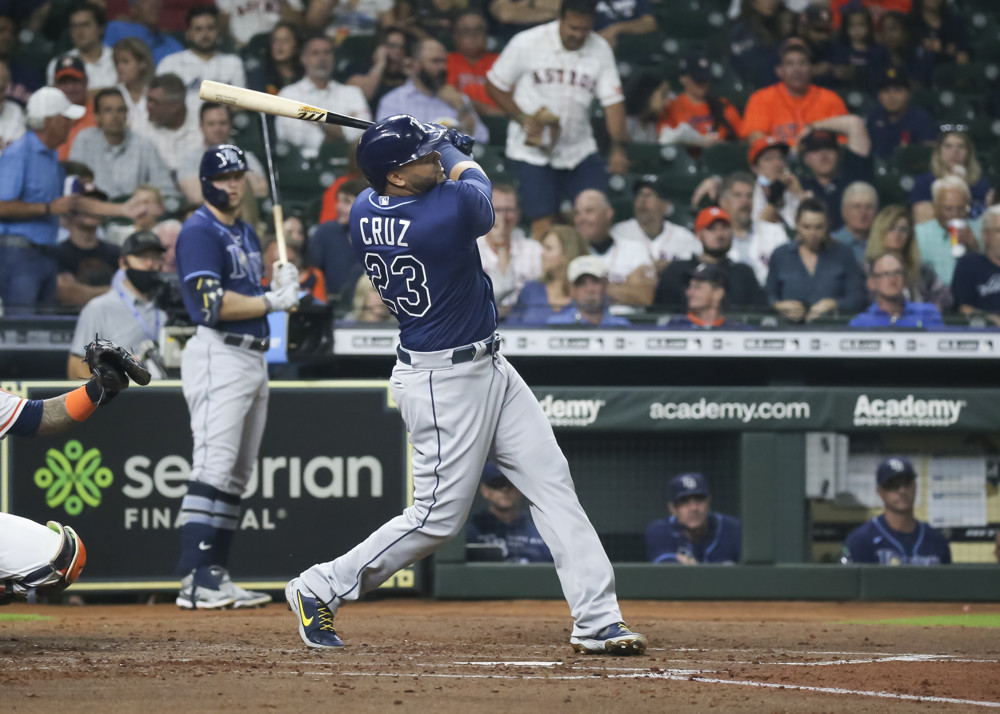
    The next-most-likely milestone is Nelson Cruz’s chance to hit 500 home runs. Having hit 32 homers in his age-40 season, it’s certainly not out of the question that he collects 51 more before he hangs up the cleats.

    Best chance of hitting 500 HR:
    Nelson Cruz (56%), Giancarlo Stanton (36%), Bryce Harper (34%)

    A name you’ll see around a lot is Fernando Tatis Jr. The combination of his youth and demonstrated power gives him non-trivial odds to hit a lot of these milestones. They’re long shots—I don’t know if we’ll ever see 762 home runs surpassed—but it’s still exciting to have these possibilities in the back of your head every time you see Tatis hit one out of the park.

    Fernando Tatis Jr. Potential Milestones

    600 HR: 11%
    700 HR: 8%
    762 HR: 4%

    We also calculate likelihoods of a pitcher throwing a no-hitter. It’s not a hard sell to present Jacob deGrom as the most likely guy to throw a no-no with a 44% chance.

    You might be surprised to see Dylan Cease not too far behind him at 37%, though. He had two one-hitters this year, but both were through 6 innings and with pitch counts of 103 and 98. While he can keep the hits down, whether or not he can be efficient enough to finish a no-hitter remains to be seen.

    Best chance of pitching a no-hitter:
    Jacob deGrom (44%), Corbin Burnes (40%), Freddy Peralta (39%)

  • Mets moving away from the inside fastball

    Mets moving away from the inside fastball

    By ANDREW KYNE

    In 2018, the New York Mets strongly emphasized an inside-pitching philosophy, with pitching coach Dave Eiland wanting his staff to be more aggressive. Eventual Cy Young winner Jacob deGrom was among several Mets who increased his usage of inside fastballs from 2017 to 2018, as we wrote about last summer.

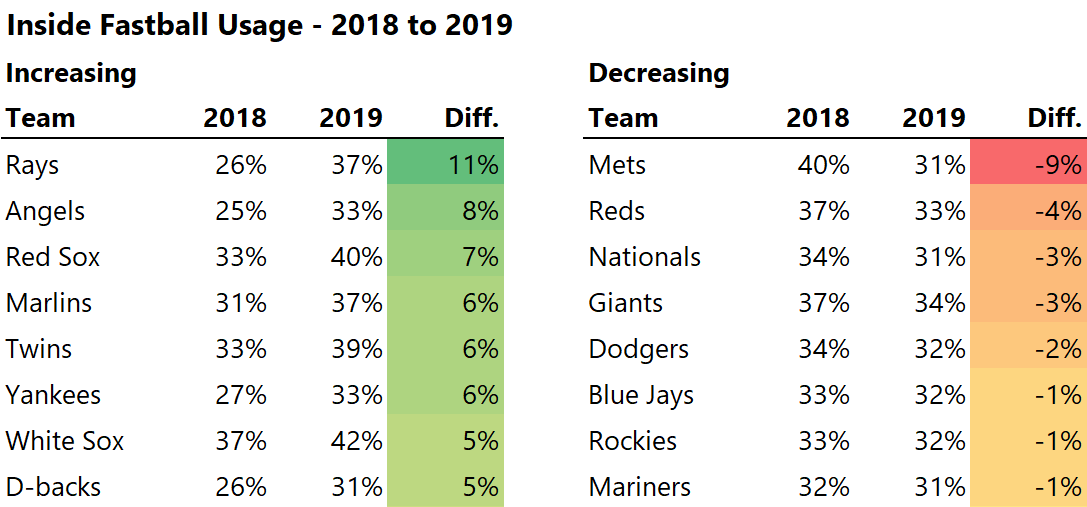
    By Baseball Info Solutions’ pitch charting, 40% percent of the Mets’ fastballs in 2018 were over the inner-third of the plate or further inside. That was the highest percentage in Major League Baseball.

    Interestingly, they have cut back on that approach in 2019. This season, 31% of the Mets’ fastballs have been thrown inside, a mark that ranks 28th in MLB.

    Pitching inside with the fastball has increased across the league this year. The Mets, however, are by far the most significant decliners in terms of percentage-point difference.

    Which pitchers are driving this change in New York? Let’s look at the 120 MLB pitchers who threw at least 750 fastballs last year and have thrown at least 200 so far this year.

    There are seven Mets in this sample of pitchers. Six of them have contributed the most significant percentage-point declines in inside fastball usage.

    (The seventh, Seth Lugo, has declined from 41% to 39%.)

    For deGrom, most of his decrease has come against left-handed batters. He’s still working up in the zone a lot with his fastball, but the emphasis has been more on up-and-away than up-and-in.

    On the other hand, Noah Syndergaard‘s decrease has come mostly against right-handed batters. He worked both corners with the fastball against them in 2018, but is focusing much more outside in 2019.

    How does this alter effectiveness? Here’s how the Mets’ fastballs have performed in 2018 and 2019 based on location.

    Inside fastballs haven’t generated as many misses per swing for them as non-inside fastballs, but they have resulted in less hard contact and slugging.

    We’ll see if this trend continues for the Mets throughout the season. For now, it’s a notable change in approach, given the organization’s clear emphasis on it in 2018.

  • The changes that made Jacob deGrom and Blake Snell Cy Young worthy

    The changes that made Jacob deGrom and Blake Snell Cy Young worthy

    By MARK SIMON

    Pitchers are always making tweaks and adjustments to their deliveries and repertoires in an effort to stay a step ahead of the hitters. In the case of Mets pitcher Jacob deGrom and Rays pitcher Blake Snell, the tweaks made those pitchers Cy Young worthy.

    DeGrom’s big adjustment came by suggestion from pitching coach Dave Eiland, who wanted the Mets pitchers to pitch inside more. For deGrom, this meant completely changing his approach to left-handed batters.

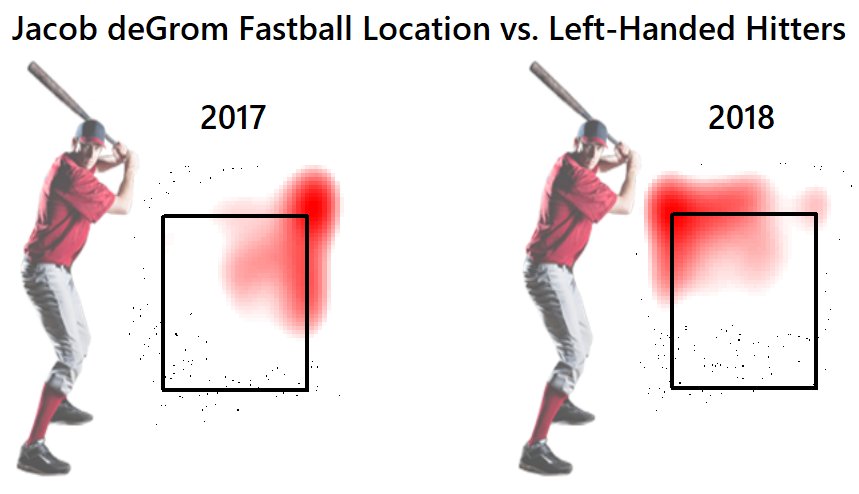
    As my colleague,  Andrew Kyne, noted  earlier this season,  in 2017, deGrom threw only 23 percent of his fastballs inside to left-handed hitters (we’re defining “inside” as on the inner-third of the plate or further inside). In 2018, he more than doubled that to 49 percent, the second-highest percentage in MLB (Kyle Gibson of the Twins was a smidge higher). Here’s what that looks like visually:

    Andrew Kyne/Sports Info Solutions

    DeGrom also upped how often he threw his fastball at the top of the strike zone (or above it) to them, bumping that from 58 percent of pitches to 67 percent. The inside fastballs backed hitters up off the plate. The high heat finished them off. Lefties hit .219/.267/.312 against him in 2018, his best numbers in a season against left-handed hitting. Combine that with even greater dominance against right-handed hitters and deGrom was at the top of his game for almost the entire season.

    DeGrom finished with the second-highest chase rate among pitchers with at least 100 innings pitched (38 percent). He ranked 10th in miss rate (29 percent).

    The pitcher who ranked first in miss rate was Rays pitcher Blake Snell (33 percent). Snell’s breakthrough season was a surprise. He posted ERAs of 3.54 and 4.04 in his first two seasons; you could not have seen his 1.89 ERA coming.

    What hitters apparently had trouble seeing was Snell’s curveball. He threw the pitch about 10 percent of the time in 2017, but netted misses on 51 percent of swings against it. In 2018, Snell’s strategy was to increase his curveball use, cutting back a little bit on his fastball and slider. He doubled his curveball usage to 20 percent of the time. Hitters continued to miss the pitch on more than half of their swings.

    Paired with a 1.5 mile per hour increase in average fastball velocity to nearly 96 MPH, the Rays suddenly had something special. When Snell started on five days rest, those pitches were perfect. In 15 such starts, he pitched to a 1.08 ERA with a 4-to-1 K to BB rate. Three of Snell’s pitches – his fastball, curveball and slider – experienced major jumps in value per FanGraphs’ pitch data. He became a completely different pitcher, one whose performance was suddenly Cy Young worthy.

    Now he and deGrom have trophies to honor the successful changes they made.

    Blake Snell – Curveball Ranks
    Opp BA .126 4th
    Miss Rate 52% 2nd
    Strikeouts 93 7th
    >> Minimum 300 thrown
  • What helps make Jacob deGrom great?

    What helps make Jacob deGrom great?

    BY MARK SIMON, SPENCER HARRISON AND ANDREW KYNE
    Mets ace Jacob deGrom started the season outside the top 10 in Bill James’ starting pitcher rankings, but he’s ascended to No. 5 with an incredible start to 2018. You might be aware that deGrom has received poor support from the Mets. He has a 1.69 ERA, but the Mets have won only six of his 16 starts.

    You might also know that deGrom has become the master of the high fastball, using it as one of his weapons to strike out more than 11 hitters per 9 innings.

    But what else should you know about deGrom’s success in 2018?

    Four great pitches
    Per Fangraphs’ pitch value stats, DeGrom is the only pitcher in baseball to have at least three runs saved for each of the four primary pitch types (fastball, curveball, slider or changeup) and the only starting pitcher to have at least one run saved per 100 pitches for all four of those pitch types.

    In other words, the hitter has to be ready for more than just deGrom’s fastball.

    Working Inside
    Pitching coach Dave Eiland said before the season started that Mets pitchers would take a much more aggressive approach at pitching hitters inside, going as far to say he hoped the Mets led the NL in hit batsmen.

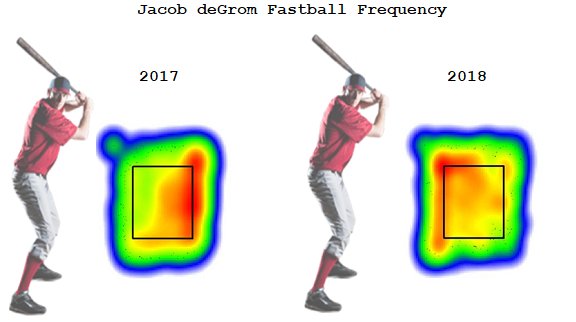
    DeGrom is among those who have taken Eiland’s message to heart. This pair of heat maps shows how deGrom has gone from pitching left-handed batters primarily away with his fastball to attacking inside with it (the red indicates where deGrom has pitched most frequently, the blue is where he has pitched least often).

    We can put numbers to it: This season, 46 percent of deGrom’s fastballs to left-handed hitters have either been on the inner edge of the plate (defined as the inner-fourth) or off the inside corner.

    That’s up from 19 percent in 2017. The 27 percentage point increase ranks first among MLB pitchers.

    Much of deGrom’s improvements from last season to this one have come against right-handed hitters, but left-handed hitters have been held to a .654 OPS against him this season, down 39 points from 2017.

    First-Pitch Curveballs
    A few times a game, deGrom likes to change things up and throw his curveball to start an at-bat.

    He’s done this with significant success this season, throwing 41 of 48 first-pitch curves for strikes, with a major-league best 76 percent called strike rate (22 strikes on 29 first-pitch takes).

    The Shift
    Though the Mets rate as a poor defensive team, they’ve managed to succeed in one area. They are one of the best teams in baseball at defensive shifting and when deGrom is on the mound, they often get the results they’re looking for.

    There have been 32 ground balls, or line drives hit less than 175 feet, against a shifted Mets defense with deGrom on the mound. They’ve gotten at least one out on 30 of those 32. The 94 percent out rate is the best in baseball for a starting pitcher.

    His teammates seem to have risen to the occasion around him in the field, if not at the plate.