Category: John Dewan’s Stat of the Week

  • Stat of the Week: Trevor Story’s New Homes

    Stat of the Week: Trevor Story’s New Homes

    Trevor Story is a man on the move in more ways than one.

    Story signed a six-year deal with the Red Sox where, at least for 2022, he’ll be their everyday second baseman. Xander Bogaerts will be the Red Sox starting shortstop. Story has never played second base in the major leagues and hasn’t played there at any level since playing 24 games in the minors in 2015.

    There are a couple of things to unpack in Story’s story (couldn’t resist).

    Goodbye Coors, Hello Fenway

    Story is leaving the most hitter-friendly ballpark in baseball in Coors Field. There isn’t a stadium that plays close to as hitter-friendly as Coors does, but Story’s still in a pretty good spot.

    Over the last three seasons, Fenway Park ranks first in the AL in our Ballpark Index rankings in doubles and runs scored, and ranks second in batting average.

    Our Ballpark Index compares stats for a team and its opponent in home games and road games. For example, from 2019 to 2021, the Red Sox and their opponents had 884 doubles in Red Sox home games and 652 doubles in Red Sox road games. There were 36% more doubles in home games, giving Fenway Park a Ballpark Index of 136.

    One thing worth noting: Coors Field had a Ballpark Index of 116 for home runs by right-handed hitters the last three seasons. Fenway Park’s Ballpark Index for home runs by right-handed batters is 95.

    In The Bill James Handbook 2022, our projections for Story were a .280/.353/.545 slashline with 36 home runs.

    Our spring update, with his home ballpark changed to Fenway Park, dropped those numbers to .262/.338/.510 with 33 home runs. The move is projected to cost Story about 50 points in OPS, as he was at .898 in the Handbook and .848 in our update.

    That sort of decline would not be as steep as those experienced by other prominent Rockies, like Troy Tulowitzki and Nolan Arenado, upon leaving Coors Field.

    Fenway Park vs Coors Field – Ballpark Factors – Last 3 Seasons


      Fenway Park Coors Field
    AVG (RHB) 106 122
    Runs 112 134
    Doubles 136 120
    Home Runs (RHB) 95 113

    The move to second base

    Red Sox manager Alex Cora said that Bogaerts, a potential free agent after this season will remain at shortstop, even though Story’s numbers at the position are far better. In fairness, there are concerns regarding Story’s arm, as an elbow injury significantly impacted his throwing last season.

    Story could move back to shortstop in the future, but for now, let’s consider him as a second baseman, and he should be a pretty good one.

    Even with the elbow issue, Story’s 9 Runs Saved were the most by an NL shortstop last season. His 36 Runs Saved as a shortstop since 2019 trail only Javier Baez’s 40 in that span.

    Story is a good athlete and a smart defender. His 78 Good Fielding Plays over the last three seasons are easily the most among shortstops.

    The shortstop-to-second base switch is one that a fair number of players have handled without issue. Marcus Semien, who had saved 11 runs at shortstop in 2018 but then cost the team 6 in 2020, made the switch for the Blue Jays and finished second among second basemen with 11 Runs Saved in 2021. Jorge Polanco cost the Twins 39 runs at shortstop from 2016 to 2020, but saved 3 at second base in 2021. Jean Segura is another current example of a player who made the switch.

    It’s tough to put a number on Story’s projected defense but given all that we know, it wouldn’t be surprising if he was one of the better defensive second basemen in the game – which even with the drop-off in offense would still make him a highly-valuable player.


  • 2021’s Top Minor League Bat Missers

    2021’s Top Minor League Bat Missers

    Last week we looked at some prominent minor league hitters and the quality of their contact. This week, we shift to minor league pitchers and which ones were best at avoiding contact.

    A reminder that we track minor league data at the Single-A, Double-A, and Triple-A levels and that includes the specificity of whether pitchers net a swinging strike or a called strike.

    Among pitchers with at least 1,000 pitches tracked at those levels last season, the one with the highest miss rate (misses/swings taken) was Twins lefty reliever Jovani Moran, at 42%.

    Moran, who will turn 25 in April, struck out 109 batters in 67 1/3 innings pitched and posted a 2.41 ERA as a multi-inning reliever at Double-A and Triple-A last season. His primary miss-pitch is a nasty changeup. FanGraphs ranks him as the team’s 36th-best prospect, though he did get an MLB look last season, striking out 10 in 8 innings pitched.

    Among pitchers who met the 1,000-pitch qualifier AND were ranked in the Top 100 across all organizations on FanGraphs’ Board, the top miss-getter in the minors was Brewers swingman Aaron Ashby.

    Ashby got misses on just over 38% of swings against him at Triple-A Nashville, where he struck out 100 batters in 63 1/3 innings. FanGraphs ranks Ashby as its No. 46 MLB prospect. He also pitched 31 2/3 MLB innings last season and induced a miss rate of 29%.

    A highly-touted prospect we’ll likely see in the minors at the start of the season is 22-year-old Orioles starter Grayson Rodriguez. Rodriguez is FanGraphs’ No. 3 prospect overall and its top-ranked pitching prospect.

    Rodriguez had the 10th-highest miss rate among minor league pitchers last season at 37%. He also ranked 27th (among more than 500 qualifiers) in called strike rate (the percentage of pitches taken that were called strikes). As such, his strikeout-to-walk ratio was just shy of 6-to-1 in 103 innings. He had 161 strikeouts, a rate of better than 14 per 9 innings.

    Like Moran, Rodriguez has a nasty changeup but he is able to pair it with a 99-MPH fastball and standout slider.

    One other Top-100 pitching prospect rated in the Top 25 in both miss rate and called strike rate last season. Reid Detmers of the Angels had rates of right around 36% in each stat. Detmers, who FanGraphs ranked No. 42 among prospects, also nearly had a strikeout-to-walk rate of 6-to-1 in 62 minor league innings. In 5 MLB starts, he totaled 19 strikeouts and 11 walks in 20 2/3 innings pitched.

  • Putting (Synthetic) Statcast Numbers on Top Minor League Sluggers

    Putting (Synthetic) Statcast Numbers on Top Minor League Sluggers

    For the moment, let’s focus on baseball that we know will be played this season – Minor League Baseball.

    SIS is an industry leader in Minor League Baseball coverage with advanced data collected from more than 5,000 games each season.

    In 2018, SIS built a machine-learning model, Synthetic Statcast, that was trained using actual MLB Statcast data and SIS internally-collected batted ball data to simulate exit velocity, launch angle and more for MLB players back to 2010, as well as for the minor leagues, NPB (Japan), and KBO (Korea).

    The result is a unique perspective on quality of contact for players across levels and how those players measure up to MLB standards.

    Let’s look at a few of the top minor league prospects through the prism of that data. For now, we’ll focus on those not on 40-man rosters at the moment, meaning that they should be playing in the minor leagues come April.

    Let’s start with the No. 1 prospect on FanGraphs writer (and SIS alum) Eric Longenhagen’s Top 100 Prospects rankings, Orioles catcher Adley Rutschman. Rutschman hit .285 with 23 home runs, playing about two-thirds of his games in Double-A and the rest in Triple-A.

    Our data also allows us to construct expected batting averages and slugging percentages on balls in play based on where balls are hit and how hard they’re hit. We can then compare a player’s actual batting average and slugging percentage on balls in play (BABIP and SLGBIP) to their expected numbers (xBABIP and xSLGBIP)

    Rutschman’s BABIP and SLGBIP were .350 and .618 respectively, not far from his expected numbers of .347 and .608. His 86.5 MPH average exit velocity and 15.0 degree average launch angle resemble those of MLB catchers Kurt Suzuki (85.2, 14.6), Francisco Mejia (85.7, 14.9) and Tucker Barnhart (87.1, 15.5).

    Rutschman’s value may be significantly enhanced by his glove, as he ranked No. 2 among minor league catchers in Defensive Runs Saved, a number that is largely driven by his pitch framing stats.

    FanGraphs No. 2 prospect, Royals shortstop Bobby Witt Jr., had 33 home runs and a .936 OPS split almost evenly between Double-A Northwest Arkansas and Triple-A Omaha last season.

    Witt had a .392 BABIP and a .775 SLGBIP. In both cases, he overshot his expected numbers, his xBABIP by 46 points and his xSLGBIP by 88 points. He overachieved more than his fellow top prospects.

    Witt’s 88.5 MPH average exit velocity and 18.3 degree average launch angle are about the same as what Dodgers utility man Chris Taylor did in the major leagues last season (88.2 and 17.4, respectively).

    The Tigers have the next-highest ranked prospects among position players not currently on a 40-man roster in corner infielder Spencer Torkelson (No. 4) and outfielder Riley Greene (No. 5).

    Torkelson played at three minor league levels last season, finishing with 40 games in Triple-A. Overall, he hit .267 with a .935 OPS (brought down a little bit by hitting .238 with an .881 OPS at Toledo, his final stop).

    Torkelson’s .359 BABIP was a near-match for his .365 xBABIP and his .731 SLGBIP wasn’t far from his .714 xSLGBIP.

    Torkelson’s 90.1 MPH average exit velocity and 18.7 degree average launch angle are about the same numbers that Mookie Betts posted in MLB last season (90.3 and 18.9).

    Greene split time between Double-A and Triple-A last season and handled the latter better than Torkelson did. Between the two levels, he hit .301/.387/.534 with 24 home runs.

    However, Greene did overachieve a bit, particularly in slugging. His .775 SLGBIP was 104 points higher than his .671 xSLGBIP. His 89.6 MPH average exit velocity and 8.9 degree average launch angle were a close match to Marlins infielder Jazz Chisholm Jr.’s MLB numbers last season (90.2 and 9.0).

    Look for more minor league content in this space as the season approaches.

    Synthetic Statcast For Top Minor
    League Prospects

    Player Avg Exit
    Velo
    Avg
    Launch Angle
    MLB Comparable*
    Adley Rutschman 86.5 15.0 Tucker Barnhart
    Bobby Witt Jr. 88.5 18.3 Chris Taylor
    Spencer Torkelson 90.1 18.7 Mookie Betts
    Riley Greene 89.6 8.9 Jazz Chisholm Jr.

    Corey March also contributed to this article.

    Note: Updated Bill James Projections are typically released on March 1 every year. However, given the current situation with the MLB lockout, 2022 updated projections will be released at a date to be determined once the lockout has been resolved and MLB team rosters have been settled.

  • Stat of the Week: Aaron Donald’s Dominance

    Stat of the Week: Aaron Donald’s Dominance

    By MARK SIMON

    It’s been three years since the Rams last Super Bowl appearance and Aaron Donald is almost as dominant now as he was then.

    It’s fair to call Donald, a four-time Defensive Player of the Year winner, an all-time great. What’s so impressive about him is how much he stands above others at his position, defensive tackle.

    Donald has led defensive tackles in our player value stat, Total Points, in each of the six seasons for which SIS has tracked it. This season he finished with 61, 18 points ahead of the next-closest DT, Christian Wilkins of the Dolphins.

    The gap between Donald and Wilkins in 2021 was the same as the gap between Wilkins and the player who ranked 10th.

    And the gap between Donald and the defensive tackle with the second-most Total Points in the last six seasons (Fletcher Cox) is the same as the gap between Cox and the 43rd-best defensive tackle in that time.

    Most Total Points By Defensive Tackle – Since 2016

    Name Total Points
    Aaron Donald 308
    Fletcher Cox 185
    Chris Jones 172
    Ndamukong Suh 172
    DeForest Buckner 170

    What makes Donald great is that he gets to the opposing quarterback more than anyone else. His 77 quarterback pressures were the most in the NFL … by 20. In 2018, the season the Rams last went to the Super Bowl, he had 92 and led the NFL by 23.

    And what’s most important for a player who is that valuable is that he’s stayed healthy. Donald has played in 127 out of a possible 129 games in his eight-year career and hasn’t missed any games in the last four seasons.

    He’ll be on the field again a week from this Sunday. And you’ll want to be watching what he does.

    If you want to go more in-depth on Donald, his pressure rate, and the stat Pressures Above Expectation, check out our piece at Sharp Football Analysis on the NFL leaders in expected pressures.

  • Stat of the Week: Upcoming Hall of Fame Classes

    Stat of the Week: Upcoming Hall of Fame Classes

    With this year’s Baseball Hall of Fame elections now complete, we can now look forward to the upcoming Baseball Writers Association of America ballot classes.

    Scott Rolen will have some strong momentum going into next year’s ballot, having received 63% of the vote in the most recent election. That’s up a little more than 10 percentage points from a year ago. We’ve written about Rolen’s Hall of Fame-caliber numbers and you’ll probably see another missive on that come the next ballot season.

    Among the ballot newcomers, there is one name that stands well above the rest: center fielder Carlos Beltrán. Though part of Beltrán’s candidacy will come down to how voters view his participation in the Astros cheating scandal, his overall numbers would almost certainly warrant selection.

    Beltrán is one of baseball’s all-time best switch-hitters. He was a nine-time All-Star and three-time Gold Glove Award winner. He ranks 47th all-time in home runs, 29th in doubles, 37th in RBIs and has the highest stolen base percentage (86.4%) among players with at least 200 attempts. He’s one of eight players with at least 300 home runs and 300 stolen bases.

    By the Bill James-devised Hall-of-Fame value scale— which combines Win Shares and Baseball-Reference’s Wins Above Replacement— Beltrán scores a 649.4, comparable to Hall-of-Fame second baseman Roberto Alomar (645.1). A score of 500 is considered Hall of Fame caliber.

    With no other strong candidates among first-timers on next year’s ballot, let’s skip ahead to the ballot that will elect the class of 2024.

    There will be several strong newcomers on that ballot: Adrián Beltré, Joe Mauer, and Chase Utley.

    Beltré ranks 16th all-time in hits, 11th in doubles, 31st in home runs, and 25th in RBIs. He’s also the leader in Defensive Runs Saved since SIS began tracking that stat in 2003 and won five Gold Gloves at third base. His 747.0 Hall of Fame Value score is higher than that of Ken Griffey Jr. (738.4).

    Mauer clears the Hall of Fame bar at 590.4, slightly ahead of Rolen’s 584.4. Mauer was a six-time All-Star in a 15-year career with the Twins. He won five Silver Slugger Awards and three Gold Gloves to go along with 2009 AL MVP honors. He also won three batting titles, each coming in a season in which his primary position was catcher.

    Utley is probably going to be the toughest call of these three for the BBWAA voters. His Hall of Fame value score is 549.2, a little higher than that of David Ortiz (537.2).

    Utley was a six-time All-Star and four-time Silver Slugger in his 16 years with the Phillies and Dodgers. He has the highest career stolen base percentage if we lower the minimum to 150 attempts (87.5%).

    From 2005 to 2009, Utley averaged close to 8 bWins Above Replacement per season, thanks in part to strong Defensive Runs Saved totals. He ranks second among second basemen in Runs Saved since SIS began tracking it in 2003. Utley also had strong postseasons in 2008 and 2009, helping the Phillies reach the World Series in both years (they won in 2008).

    Players With Hall of Fame Value Score of 500 or Higher

    On Next 2 Hall-of-Fame Ballots

    Name HOF-V
    Alex Rodriguez 961.1
    Adrián Beltré 747.0
    Manny Ramirez 685.2
    Gary Sheffield 672.2
    Carlos Beltrán 649.4
    Bobby Abreu 596.7
    Joe Mauer 590.4
    Scott Rolen 584.4
    Todd Helton 565.0
    Jeff Kent 560.8
    Chase Utley 549.2
    Andruw Jones 526.8
  • Stat of the Week: Who Was The Total Points Leader?

    Stat of the Week: Who Was The Total Points Leader?

    As we wait for baseball news (we’re looking forward to the Hall of Fame announcements next week), we’ll stick with a football theme for this week.

    There will be a lot of great players playing in this weekend’s Divisional Round of the NFL Playoffs.

    But the No. 1 ranked player in our value stat, Total Points, will not be among them.

    Chargers quarterback Justin Herbert finished the season as the league’s leader in that stat. He also led all quarterbacks in Total Points on a per-play basis, so he was the best in both quantity and quality. Herbert made the jump to the top spot after ranking 7th in Total Points in 2020, his rookie season.

    Total Points takes nearly everything that SIS measures about a play and uses it to evaluate each player on a scale that allows you to compare them more easily.

    In traditional stats, Herbert ranked second in passing yardage, third in touchdown passes, and fourth in sack percentage. He had 77 more pass attempts in 2021 than he did in 2020 but had one fewer sack.

    Herbert led in Total Points for a few reasons. For one, he had Aaron Rodgers beat by about 150 dropbacks. More dropbacks means more chances to do good things and Herbert was rewarded for that.

    Herbert was also playing behind an offensive line that rated near league average, while Tom Brady was playing behind a line that ranked near the top of the league. Factor that into each quarterback’s performance and Herbert’s performance becomes more impressive.

    Putting Herbert against Patrick Mahomes, Herbert has the edge in catchable pass percentage and touchdown percentage. And Mahomes had several more turnover-worthy plays than Herbert did (fumble, interception, dropped interception).

    Herbert faced pressure at a rate higher than all three of these quarterbacks, and he performed better than them when facing that circumstance. He ranked 6th in Passing Points Earned per play under pressure. Mahomes ranked 10th. Brady ranked 12th. Rodgers ranked 24th. Herbert ranked a smidge below the one other quarterback in the Top 5 in Passing Points Earned under Pressure, Josh Allen, but had a considerable edge over Allen in passing on unpressured dropbacks.

    It’s also worth noting another element to Herbert’s game. He ranked 5th among quarterbacks in Rushing Points Earned and 7th on a per-play basis and again that ranked better than the other top quarterbacks in the league.

    Herbert may not get a lot of voter support in the MVP race as his team didn’t reach the postseason and he doesn’t have the reputation of some of the elite quarterbacks in the NFL. But his numbers the last two seasons have shown he’s someone worthy of having his name known.

    Most Total Points – 2021 NFL Season

    Name Team Total Points
    1. Justin Herbert Chargers 186
    2. Tom Brady Buccaneers 161
    3. Josh Allen Bills 149
    4. Patrick Mahomes Chiefs 148
    5. Aaron Rodgers Packers 133

    For more on Total Points, you can read this primer by Alex Vigderman

  • Stat of the Week: Best Teams by Total Points

    Stat of the Week: Best Teams by Total Points

    We’ve been largely devoted to the baseball offseason, but with the NFL playoffs beginning on Saturday, a football cameo seemed in order for this week’s post.

    All season long we’ve been keeping track of our player value stat, Total Points, on a team level to create a power ranking of sorts.

    A brief primer on Total Points

    Total Points takes nearly everything that SIS measures about a play and uses it to evaluate each player on a scale that allows you to compare them more easily across positions.

    It’s always useful to be able to understand the different ways in which players can be valuable. Does he break a lot of tackles? Does he get a lot of yards after the catch? Does he make the best out of a poor offensive line?

    Total Points offers the opportunity to take all of those elements and get a quick picture of how well a player is performing overall. It gives you a perspective on team performance too.

    Click here for a more detailed description.

    Overall Ranks

    The No. 1 team in Total Points when evaluating teams on a per-play basis is the Buccaneers.

    Tampa Bay has the most complete team, with the No. 1 ranked offense and No. 4 ranked defense. On offense, the Buccaneers rank in the Top 3 in both passing and blocking. On defense, their strength is their pass coverage, which ranks No. 4 among teams.

    If our power rankings hold up, we’re looking at a potential Super Bowl rematch. The Chiefs are the No. 2 team in our rankings. They rank No. 3 in offense and No. 12 in defense. Patrick Mahomes ranked No. 3 among quarterbacks in Total Points behind Justin Herbert of the Chargers and Tom Brady of the Buccaneers.

    If you’re looking for potential Wild Card teams to ride, the Patriots rank No. 6 overall, but are Top 8 in both offense and defense. And the 49ers rank No. 8 overall and rank No. 8 in offense and No. 9 in defense.

    Neither of these teams has a Top 10 quarterback. They’ve found other ways to win. The 49ers rank No. 1 in receiving, run defense, and pass rush. The Patriots rank in the top half of the league in every offensive and defensive area we measure (passing, rushing, receiving, blocking, run defense, pass rush, and pass coverage).

    The heavyweight clash this weekend will be between the division rival Rams and Cardinals. They rank No. 3 and No. 5 overall, respectively. The Rams’ No. 4 offense will be tested by the Cardinals’ No. 3 defense.

    The biggest disparity between NFL playoff seeding and our power rankings is with the AFC No. 1 seed Titans. Tennessee ranks No. 18 overall in Total Points, even trailing five teams that didn’t make the playoffs (Broncos, Saints, Colts, Chargers and Seahawks).

    The Titans rank No. 20 on offense and No. 7 on defense. Ryan Tannehill ranked 16th among quarterbacks and star running back Derrick Henry was limited to eight games due to injury. The Titans can compensate for this with strong run defense and pass coverage units (each of which ranks in the Top 8) but their pass rush ranks No. 24. Nonetheless, they’ll have home-field advantage throughout the AFC playoffs.

    We’ll close by noting that it was a tough year to be a New York football fan. The Jets and Giants ranked No. 31 and No. 32 in Total Points in 2021.

    NFL Playoff Teams – As Ranked By Total Points
    In Order of Seed

    AFC

    Name Rank
    1. Titans 18th
    2. Chiefs 2nd
    3. Bengals 10th
    4. Bills 4th
    5. Patriots 6th
    6. Raiders 17th
    7. Steelers 24th

    NFC

    Name Rank
    1. Packers 7th
    2. Buccaneers 1st
    3. Cowboys 9th
    4. Rams 3rd
    5. Cardinals 5th
    6. 49ers 8th
    7. Eagles 16th


  • Stat of the Week: 2021 MLB Year-End Awards

    Stat of the Week: 2021 MLB Year-End Awards

    As 2021 ends, it’s once again time for our supplemental MLB awards, ones that are statistically driven. These will salute some of the leaders in specific areas of our recordkeeping.

    The Hard-Hitter Award

    Sports Info Solutions charts every batted ball as hard-, medium- or soft-hit, based on the ball’s location and velocity. The winner of the Hard-Hitter Award is the player who had the highest percentage of batted balls that were hard-hit among those batters with a minimum of 350 plate appearances.

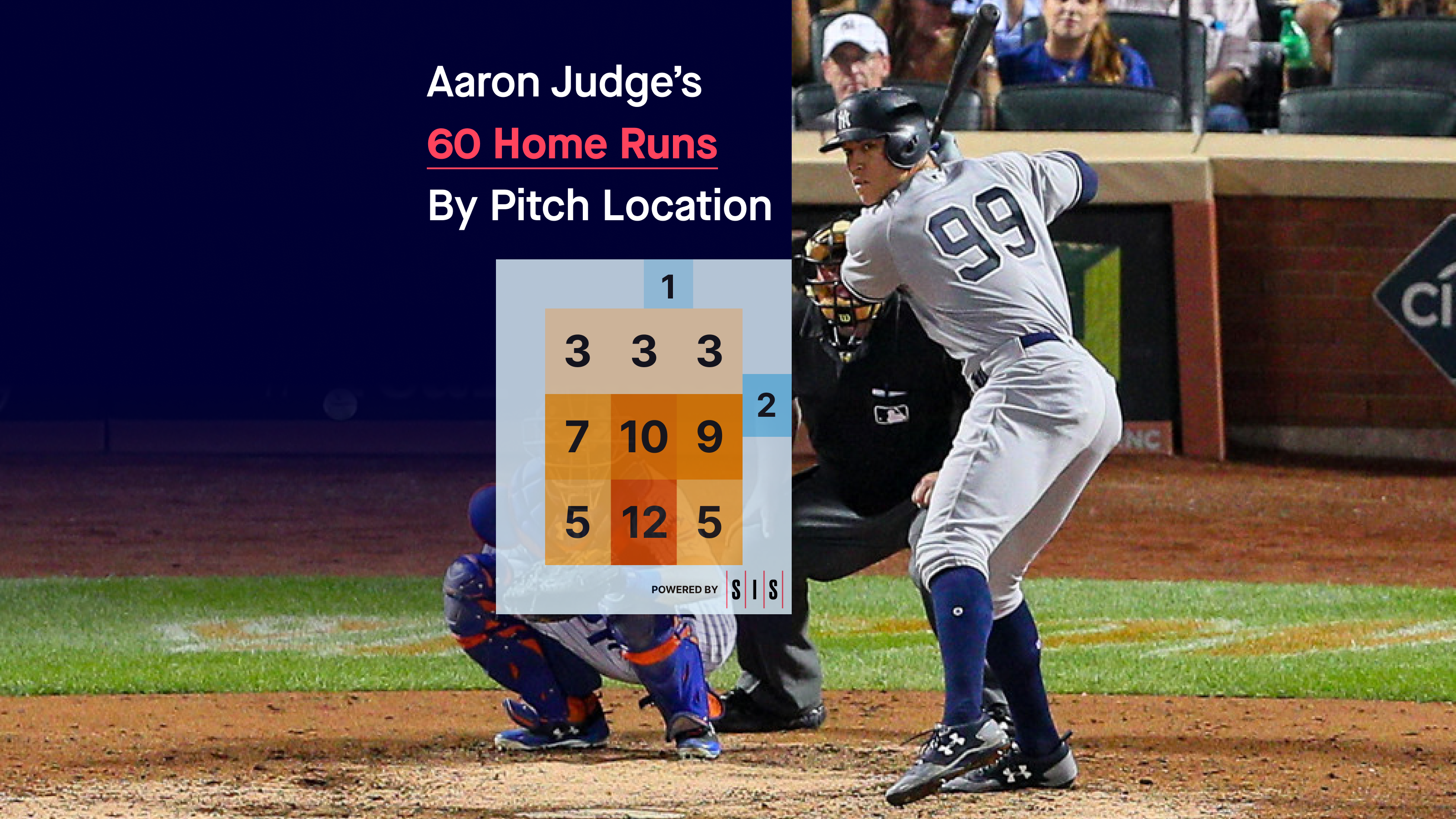
    For the second straight year, our winner is Fernando Tatis Jr., who recorded a hard-hit ball on 48% of his batted balls in 2021. He edged out Aaron Judge (47%) for the overall lead. Miguel SanoPatrick WisdomShohei Ohtani, and Joey Votto (all at 46%) rounded out the top six.

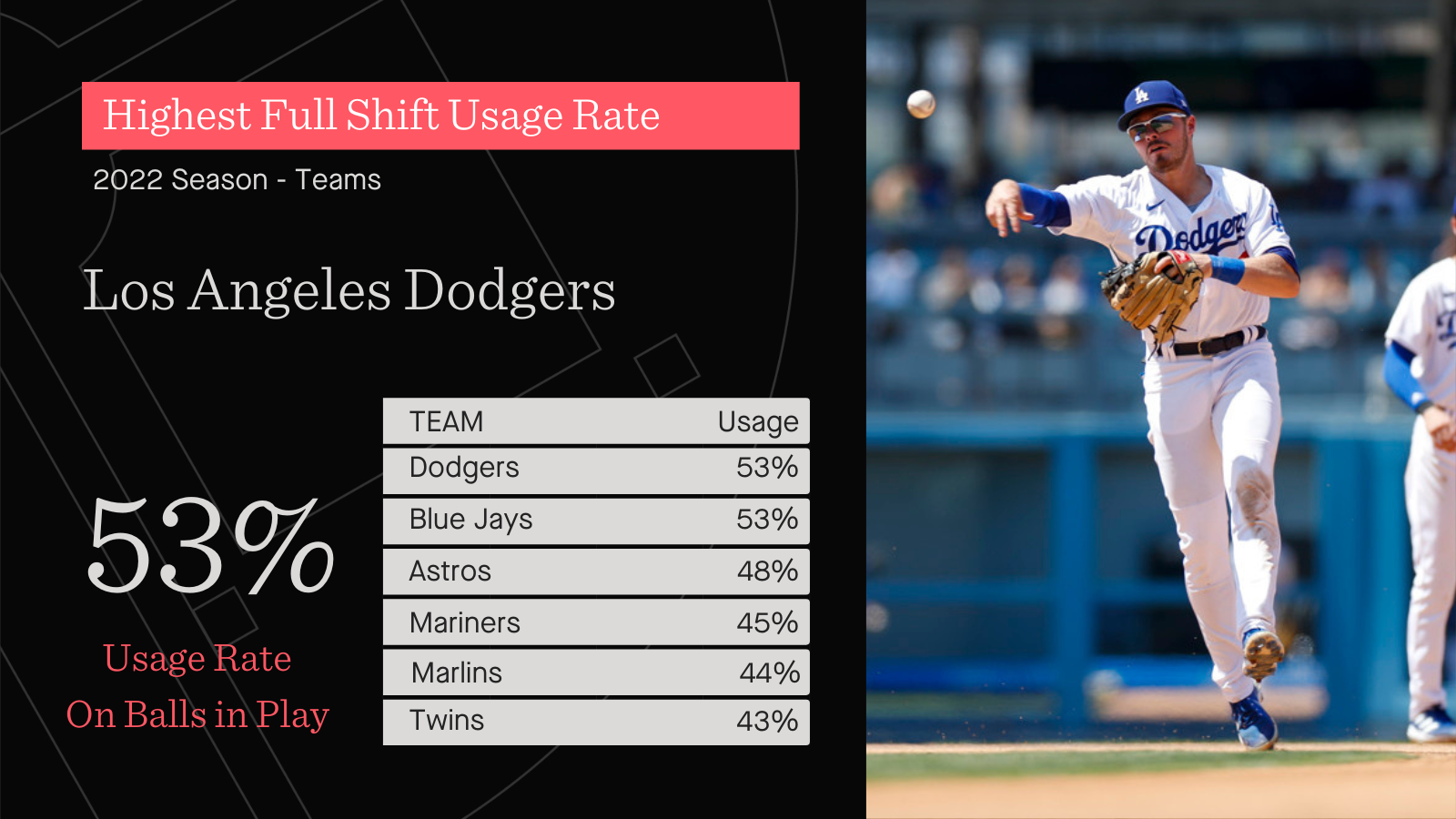
    The Dodgers led the majors in team hard-hit rate for the third straight season with 35% of their batted balls classified to be hard-hit. They were followed by the TwinsReds, and Blue Jays (34%).

    The Contact Minimizer Award

    The Contact Minimizer goes to the pitcher who most limited hard contact in 2021 (minimum 100 innings pitched).

    The winner is Zack Wheeler, who allowed hard contact in 22% of the batted balls against him. He was followed by Brewers teammates Adrian Houser and Corbin Burnes (both 25%). Six pitchers were at 26%, a list that included up-and-comers Alek ManoahRyan YarbroughRanger Suarez, and Logan Webb, as well as standouts Max Fried and Wade Miley.

    The Dodgers (29%) edged out the GiantsAstrosPhillies, and Yankees (each at 30%) for the lowest hard-hit rate among team pitching staffs.

    The Flat Bat Award

    The Flat Bat Award is given annually to the best bunter of the year. To determine the winner, we look at run value–run expectancy gained or lost–for both successful and unsuccessful sacrifice bunt and bunt-for-hit attempts for each player.

    This year’s winner is Nicky Lopez of the Royals, who had an AL-best 12 successful sacrifice bunts and only one failed attempt, along with six bunt hits (and no failed bunt hit attempts).

    The runner-up was Daulton Varsho of the Diamondbacks, who also had six bunt hits without an unsuccessful one, though only one sacrifice bunt. Joey Gallo, of the Rangers and Yankees, who tied with Garrett Hampson of the Rockies for most bunt hits, finished third.

    Click here to read about the methodology behind the Flat Bat Award.

    The Vacuum Cleaner Award

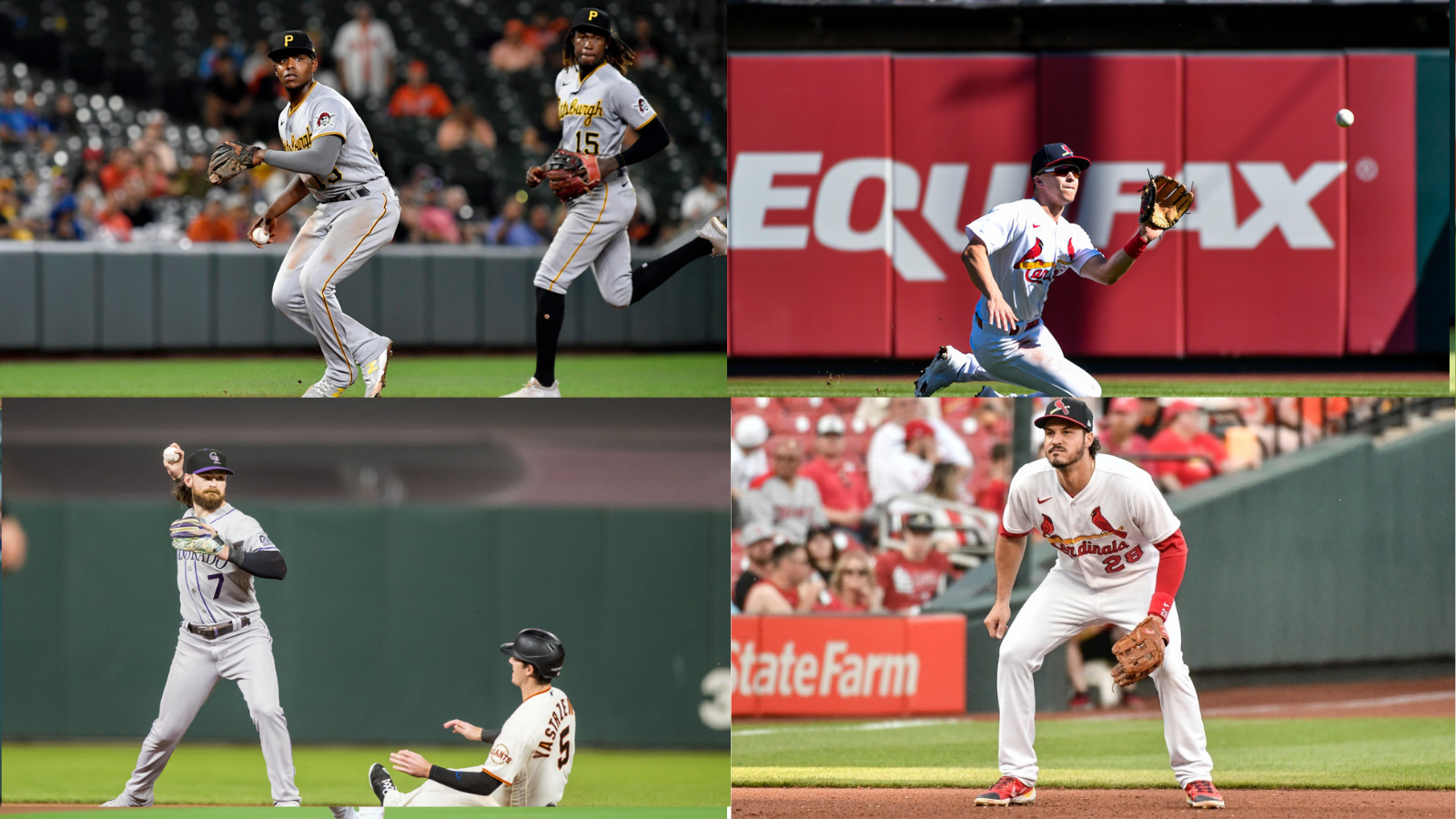
    SIS Video Scouts also track what are known as “Good Fielding Plays,” which are often those that lead to the unlikely recording of an out. Those can be broken up into different subtypes, including one just for groundballs. The leader in Good Fielding Plays on groundballs is the winner of our Vacuum Cleaner Award.

    For this year, that honor goes to Braves third baseman Austin Riley. He led all players with 18 Good Fielding Plays on groundballs, one more than Nolan Arenado and Luis Urías.

    Riley also made a significant jump in Defensive Runs Saved at third base from 2020 to 2021, going from -10 to 13.

    The Fly Swatter Award

    This is a similar award to The Vacuum Cleaner, except it’s for Good Fielding Plays resulting in outs on fly balls and line drives.

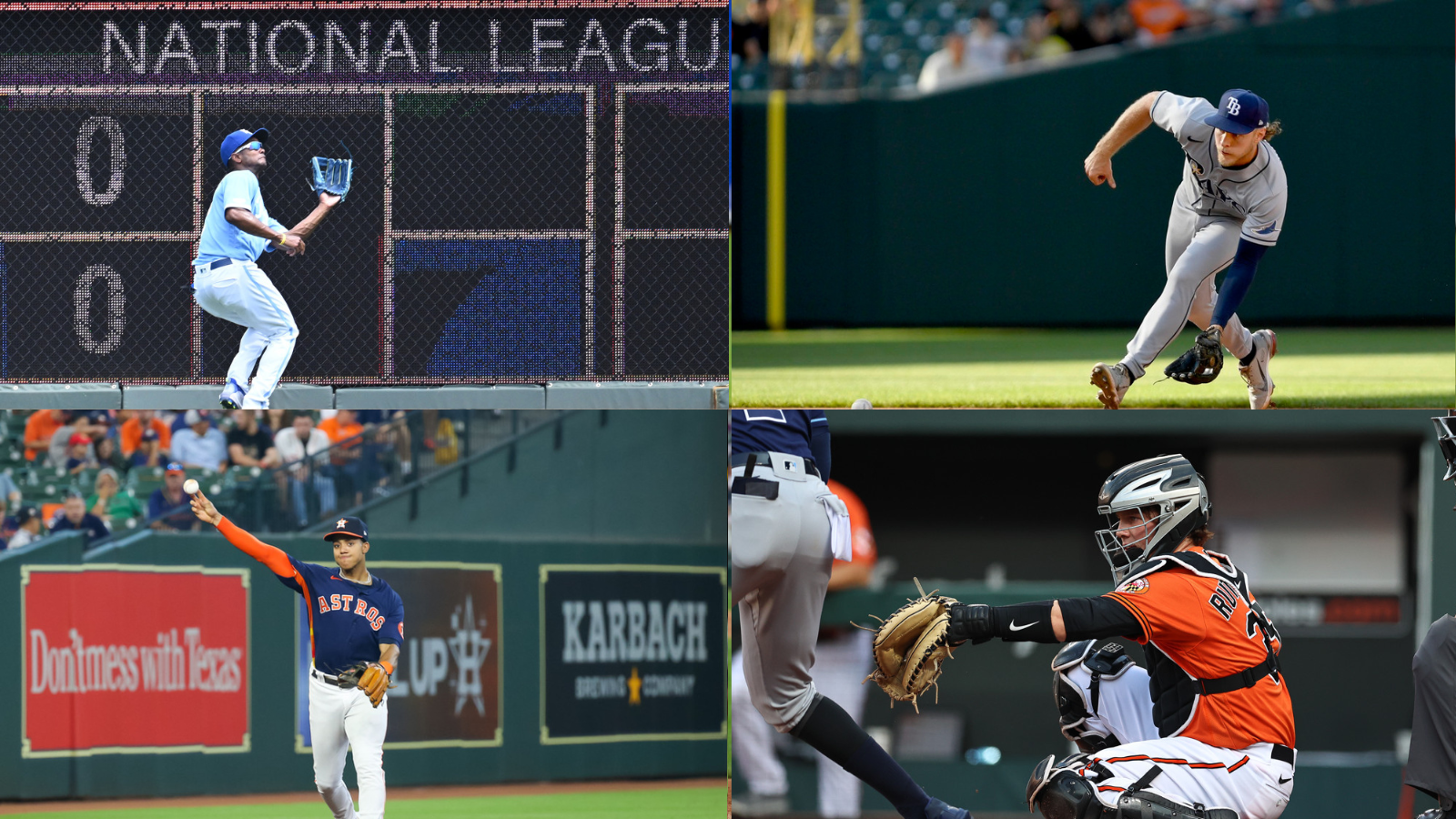
    The MLB leader in this stat was Pirates outfielder Bryan Reynolds, who had 16. Cardinals utility man Tommy Edman ranked second with 13, just ahead of teammate Harrison Bader and Astros/Indians outfielder Myles Straw, who each had 12.

    The Stolen Base Stopper

    The award for the Stolen Base Stopper goes to the pitcher and catcher who had the most Stolen Base Runs Saved in 2021.

    Elias Díaz of the Rockies was the leader among catchers with 6 Stolen Base Runs Saved, edging out Tomás Nido and Salvador Perez (5 each). Díaz made tremendous all-around defensive improvements the last two seasons, going from -21 Runs Saved in 2019 to 9 Runs Saved in 2021. Díaz had 14 caught stealings against 22 stolen bases allowed (a 39% caught stealing percentage) and also picked off five baserunners.

    Ryan Weathers of the Padres led all pitchers with 4 Stolen Base Runs Saved, one more than Wade Miley of the Reds. Weathers had an MLB-best 9 combined pickoffs and pitcher caught stealings in 94 2/3 innings pitched in 2021.

    The Hall of Framer

    The Hall of Framer award goes to the catcher who had the best pitch-framing numbers in 2021. In our world, that means the catcher who had the most called strikes above expectations (Strike Zone Plus-Minus).

    The runaway leader for that was Angels catcher Max Stassi, who was credited with 81 more strikes than expected. Mike Zunino of the Rays and Will Smith of the Dodgers ranked second with 65.

    You can hear Stassi talking about pitch framing in an appearance on The Sports Info Solutions Baseball Podcast from September.

    On a per-pitch basis, among catchers with at least 2,000 pitches caught, Nido edges Stassi out. He’s at 1.4 strikes more than expected per 100 pitches caught. Stassi is at 1.3.

    To learn more about our pitch-framing methodology, read the paper from our award-winning presentation at the Sloan Sports Conference.

    For more statistical leaders, check out The Bill James Handbook – 2022  which makes a great holiday gift.

  • Stat of the Week: Appreciating Mark Buehrle and Tim Hudson

    Stat of the Week: Appreciating Mark Buehrle and Tim Hudson

    By MARK SIMON

    Four pitchers threw at least 200 innings in 2021. Sandy Alcantara, Walker Buehler, Adam Wainwright, and Zack Wheeler deserve a special salute for doing so in MLB’s first full season since the start of the COVID pandemic.

    We are in the dinosauring-out stage of the 200-inning pitcher. As recently as 2005, 50 pitchers threw at least 200 innings in a season. By 2015 that number had dropped by nearly half, but was still at 28. From 2016 to 2019, the number ranged from 13 to 15.

    I mention that in the context of the downballot portion of the 2022 Hall of Fame ballot, where we find Mark Buehrle and Tim Hudson. Buehrle got 44 votes and 11% of the vote in 2021, his first year on the ballot. Hudson barely met the 5% threshold needed to stay on the ballot, netting 21 votes among the 401 ballots cast.

    Buehrle and Hudson didn’t pitch that long ago. But they’re products of a different era, one in which the starting pitcher was the long link in the chain from the first inning to the ninth.

    Buehrle pitched at least 200 innings 14 times in his career and had he gotten four more outs in 2015, his final season, he would have done so in 15 straight seasons. Hudson had eight 200-inning seasons and cleared 3,100 innings for his career.

    The 3,000-inning benchmark is significant. Among active pitchers, Zack Greinke has cleared it. Justin Verlander is 12 innings shy. Max Scherzer needs 463 1/3 innings and Clayton Kershaw needs 545 1/3. They should get there. But after that … ? Does David Price have 900-plus innings in his arm? Does Madison Bumgarner?

    Mark Buehrle & Tim Hudson

    Category Buehrle Hudson
    Seasons 16 17
    200-IP Seasons 14 8
    ERA 3.81 3.49
    Hall of Fame Value 456 450


    This is not to argue that Buehrle and Hudson are Hall-of-Famers. By the criteria often applied to the Hall of Fame ballot by those using traditional stats or analytics, they come up short. Bill James’ Hall of Fame Value stat scores Buehrle at 456 and Hudson at 450 when considering their Win Shares and Baseball-Reference WAR, with 500 being the standard for Hall-of-Fame worthiness.

    But we can still make these guys look pretty good.

    Buehrle had eight seasons with 200 innings pitched and an ERA+ of 120 or better (that’s an ERA 20% better compared to league average, when factoring in the ballpark in which they pitched).

    Only six pitchers have had more such seasons since 1990. Buehrle has the same number as Roy Halladay, though Halladay’s combined efforts were much more dominant.

    Hudson had five such seasons. He outdoes Buehrle, four seasons to two, if we move the qualifier to a 130 ERA+. Neither quite put him in an elite class. He’s more along the lines of Hall-of-Very-Good.

    With each year, pitchers like Buehrle and Hudson are going to look better and better as they’re compared to contemporary pitchers because their pitching type – the workhorse – is becoming extinct. They should be respected for the work they did, which might not be Hall-of-Fame worthy, but still reached a level of excellence that should net them considerable praise.

  • Stat of the Week: New Hall-of-Famers

    Stat of the Week: New Hall-of-Famers

    by MARK SIMON

    With little positive news to report on the MLB lockout, Sunday was a good day to celebrate baseball history.

    It was also a good day for those who like to celebrate great defense in baseball.

    The Baseball Hall of Fame elected six candidates – Bud Fowler and Buck O’Neil were voted in by the Early Baseball Era Committee. Gil Hodges, Minnie Miñoso, Tony Oliva, and Jim Kaat were elected by the Golden Days Era Committee.

    Fowler is regarded as baseball’s first African-American pro player. He played 10 seasons of organized professional baseball in the latter part of the 19th century. The street leading to Doubleday Field in Cooperstown is named in his honor.

    O’Neil was a first baseman in the Negro Leagues who later became MLB’s first Black coach, and as a scout he signed future Hall of Famer Lou Brock for the Cubs. He later became one of the greatest ambassadors for the sport and was best known in his later years for his appearance in the Ken Burns documentary, Baseball.

    We mentioned it being a great day to celebrate defense. O’Neil was heralded for his glovework. It was a key talking point for Negro League Hall of Fame president Bob Kendrick in promoting O’Neil’s election.

    “There were very few who played defense like Buck O’Neil,” Kendrick said.

    The election was a long time coming for Hodges, whose candidacy had been considered since his first appearance on the BBWAA ballot in 1969.

    Hodges hit 370 home runs and won three Gold Gloves in an 18-year career in the 1940s, 50s, and 60s, then won a World Series managing the 1969 Mets. He likely would have won more Gold Gloves had the award existed in the earlier part of his career. He was a three-time leader in a predecessor to Defensive Runs Saved, Total Zone Runs (found on Baseball-Reference.com).

    As a hitter, Hodges’ prime years were with the Dodgers from 1950 to 1957, during which he hit .283 with an .897 OPS and averaged 33 home runs and 107 RBI. He won a World Series with them in 1955 and 1959.

    Miñoso is another player who would have won more Gold Gloves than the three he copped in the latter part of his prime years. Including three seasons in the Negro Leagues, he hit .299 with a .387 on-base percentage for his career, primarily with the White Sox. He played from 1946 to 1964 then had a couple of plate appearances in cameo appearances in later years).

    Miñoso led his league in triples four times, stolen bases three times, and hit by pitches 10 times. He was a 13-time All-Star whose No. 9 was retired by the White Sox in 1983.

    Oliva was a base hit machine in his prime with the Twins, the only team he played with over 15 seasons. He led the AL in hits five times in seven seasons from 1964 to 1970 and he won the batting title three times. Like Hodges, he was a three-time leader in Total Zone Runs. He won a Gold Glove in 1966. Newspaper stories from the time salute his “rifle arm” and defensive improvement due to hard work.

    Oliva’s longtime teammate, Kaat, won 16 Gold Gloves as a pitcher in a career that lasted from 1959 to 1983. He ranks 17th all-time in games started, 25th in innings pitched, and he won 283 games with five teams. In a 2018 interview with Cardinals broadcaster Dan McLaughlin, Kaat said he modeled his fielding after a pitcher he grew up admiring, Bobby Shantz of the Philadelphia Athletics, throwing a baseball against a garage door to practice his reactions.

    Congratulations to all the new Hall of Famers!