Category: Baseball

  • The Longest Active Homerless Streaks

    This year, baseballs have been flying over fences at a record pace, with 4,215 home runs entering Thursday’s games, 29 more than there were for the entire 2014 season.

    There are 556 non-pitchers who have taken at least one trip to the plate in 2019; 456 of them have at least one long ball. The math there says that 100 guys haven’t gotten the memo about the ball being “juiced”, though some of them have gotten very few plate appearances. Some of them, though, have gotten hundreds. Here’s who’s gone the longest without taking a trot around the bases.

    Billy Hamilton, KC (378 PA without a HR; last HR was August 29, 2018)

    A wholly unsurprising name to lead the list, Hamilton has yet to hit a home run in Royals blue, and it might stay that way with the trade deadline just six days away and teams likely coveting his glove, arm and speed. He’s never been much of a hitter (.624 career OPS, .553 this season), but his previous career-low in home runs is three, and his OPS is 10 points lower than his previous career low.

    The closest he’s come to a homer since taking Freddy Peralta deep to lead off the Reds’ turn at bat last August was this double last month, which hit the warning track on a fly but wasn’t hit all that hard (97 mph exit velocity).

    Another fun Hamilton fact: despite his speed, he’s never hit an inside-the-park home run at the MLB level, but he does have a walk-off home run… against Josh Hader, no less!

    Matt Duffy, TB (334 PA without a HR; last HR was June 16, 2018)

    Injuries to his hamstring and back kept Duffy out of MLB action for 2019 until Tuesday, which is why he has only roughly a half-season’s worth of plate appearances in a thirteen-month span. Duffy’s still been pretty good since his last homer, though, with a .282 batting average and a 24% hard-hit rate. He came agonizingly close in his first game off the IL, stroking a double off of Chris Sale. Unfortunately for him, it was hit to the deepest part of the ballpark.

    Joey Wendle, TB (300 PA without a HR; last HR was August 19, 2018)

    Unfortunately for the Rays, they’ve got two infielders on this list, and unlike Duffy, Wendle has not gotten good results recently. In games since the one in which he hit his last homer, he’s hitting a respectable .266 with a 28% hard-hit rate, but this season those figures are down to .209 and 22%. He might’ve come even closer to a homer than Duffy, roping a belt-high changeup to the warning track in Baltimore just a couple weeks ago, at nearly 100 MPH off the bat.

    Jon Jay, CWS (261 PA without a HR; last HR was July 15, 2018)

    Jay, like Hamilton, has seen his drought span multiple teams, spending the latter half-or-so of 2018 with the Diamondbacks before signing with the White Sox in the offseason. And like Duffy, he was limited by injury. A hip injury that turned into a groin injury that led to some knee and back ailments pushed Jay’s Sox debut back to June 24, and despite his lack of power output, he’s produced a .743 OPS in 89 plate appearances, thanks to a .317 batting average. Jay’s performed eerily similarly to Wendle since his last longball, with a .270 average and a 28% hard-hit rate.

    Jay’s had a couple of close calls: he hit a 410-foot double high off the center field wall in Kansas City just last week, and a long flyout a few weeks prior, necessitating a leaping grab from Max Kepler.

    Joe Panik, SF (181 PA without a HR; last HR was May 28, 2019)

    Hey, someone who’s actually got a home run this year! Panik’s had a season to forget; his OPS was .700 following that game on May 28th, but since then it’s just .548, dropping his season OPS to a well-below-average .626. There are positives in that time, though: his K-BB ratio is an excellent 16-to-14, and his hard-hit rate is north of 30%.

    Panik’s come closer than anyone in the top five to ending his drought, crushing a middle-middle fastball for a triple, 101 MPH off the bat, on June 26th. Unfortunately, it came to the deepest part of Oracle Park, high off the archways near Triples Alley. His next homer will have to wait.

    Here’s who rounds out the top 10:

    PlayerTeamDate of Last HRPA Since Last HR
    Tim LocastroARZN/A (0 MLB HR)174
    Tony WoltersCOL5/22/2019148
    Nicky LopezKC6/13/2019141
    David FletcherLAA6/15/2019139
    Mallex SmithSEA6/16/2019138


  • No Worse For Wear: The Best at Taking HBPs Like a Champ

    By Jon Becker

    All stats through Sunday’s games

    Hit by pitches are obviously pretty common, with about one every one-and-a-quarter games this season (1198 of them in the first 1,490 games). Some players are more prone than others; the Reds’ Derek Dietrich has gotten hit 22 times in just 260 plate appearances!

    It doesn’t seem fun to walk to the plate and have an 8% chance of getting drilled by a projectile, but that’s a big part of his game. I don’t want to investigate who’s gotten hit the most or at the greatest rate, though; that’s easy enough for anyone to find on their own.

    What I do want to know is this: who’s most adept at getting hit by pitches without getting harmed by pitches?

    SIS has been tracking player injuries since the onset of the 2015 season. With each injury, our Video Scouts assign an Injury Severity on a scale of 1 to 5, which is then validated by our expert, a former clinical research specialist. This is completely separate from any diagnosis, and is based almost entirely on observing the player’s reaction. The most basic way to describe each level of severity is:

    1: No visible reaction, no stoppage of play
    2: Slight visible reaction, possible delay in game
    3: Definite visible reaction, longer delay of game
    4: Looks very painful, gets trainer visit, needs extensive time to recover
    5: Very bad injury, basically immobile, needs help leaving field

    So, with those descriptions in mind, I wanted to categorize hit-by-pitch types. It’s an inexact science, but I decided to group severity types 1 and 2 together, calling them “No Big Deal Hit By Pitches” (NBD HBP, for short).

    These are hit by pitches where a batter doesn’t react much if at all, and is no worse for wear as he takes his base almost immediately. When dividing their NBD HBP by all HBP, we can get a percentage of HBP where the batter was basically totally fine.

    Amazingly, of the 167 players to be hit by at least 15 pitches since 2015, 29 of them (17%) haven’t had a hit-by-pitch of severity 3 or greater, for a perfect 100% “NBD HBP rate.” Here are those players (Reminder: all stats through Sunday):

    PlayerTeam(s)HBP
    Jon JaySTL/SD/CHC/KC/ARZ/CWS36
    Adam EatonCWS/WSH34
    Joc PedersonLAD33
    Russell MartinTOR/LAD32
    Chase UtleyPHI/LAD29
    J.T. RealmutoMIA/PHI25
    Chris DavisBAL24
    Jose PerazaLAD/CIN24
    Lucas DudaNYM/TB/KC/ATL24
    Jung Ho KangPIT23
    Joey VottoCIN22
    Curtis GrandersonNYM/LAD/TOR/MIL/MIA22
    Paul GoldschmidtARZ/STL22
    Brian AndersonMIA22
    Yolmer SanchezCWS20
    Aaron AltherrPHI/SFG/NYM19
    Matt OlsonOAK18
    Logan MorrisonSEA/TB/MIN18
    Chase HeadleyNYY/SD18
    Joe PanikSF17
    Jose BautistaTOR/ATL/NYM/PHI17
    Mitch MorelandTEX/BOS17
    Addison RussellCHC16
    Ryan BraunMIL15
    Cesar HernandezPHI15
    Whit MerrifieldKC15
    Neil WalkerPIT/NYM/MIL/NYY/MIA15
    Scooter GennettMIL/CIN15
    Jake LambARZ15

    Bringing up the rear of the list is Jean Segura, who has reacted with a severity of 3 or greater on 12 of his 28 hit-by-pitches (43%). Only six of the 167 players have an NBD HBP rate below 70%. The league-average rate is 89% since we’ve begun tracking severity (103 of the players who’ve been plunked at least 15 times are above the league average).

    When looking at the above list and considering our injury severity system in general, it’s important to note that severity doesn’t necessarily line up with diagnoses or long-term effects or whether or not the player had to go on the Injured List.

    Segura isn’t necessarily the most unlucky of our sample of 167 players, but he has reacted to hit-by-pitches the worst severely, on average. Everyone reacts to injuries differently, and this isn’t a measure of toughness or mental fortitude so much as it is an exercise in determining who’s “best” at not getting too hurt by baseballs being hurled right at them.

  • New podcast: Kirk Gibson and Dan Brooks

    LISTEN HERE

    In this episode of the Sports Info Solutions podcast, senior research analyst Mark Simon (@MarkASimonSays) recounts the Indians recent success (1:22), then talks to Tigers broadcaster & special assistant Kirk Gibson (@23KGibby) about what stats he’d like to see related to mentally getting through a season (3:30), teaching hitters proper swing techniques (8:34), what interests him about analytics (19:19), and the work he’s doing to raise awareness for Parkinson’s Disease (20:15).

    Mark is also joined by Dan Brooks (@brooksbaseball), who co-runs the annual Saberseminar (Sabermetrics Scouting and the Science of Baseball) at Boston University. Dan recounts the history and past highlights (22:28), discusses the impact the conference has (especially on students) (25:48), and what to expect at this year’s event which raises money for the Angioma Alliance (28:40).

    Mark and SIS research associate Andrew Kyne (@Andrew_Kyne) review research on how often balls hit up the middle result in a baserunner (34:15) and which hitters are best at getting in and succeeding in hitters counts (35:56).

    They also answer listener questions on how Hall of Fame analysis has changed (38:07), which past trade-deadline acquisition was of greatest analytic value (39:47), which analytics would be best used when a batter comes to the plate from former major-leaguer Doug Glanville (@dougglanville) (41:39) and which metrics teams are looking for that they don’t already have (43:46). Mark and Andrew close by picking a player to watch (46:12) and share their Ridiculous Numbers of the Day (47:23).

    If you have feedback on the program, please send it to mark@ww2.sportsinfosolutions.com.

  • The Indians defense is rocking and rolling

    By MARK SIMON

    Circle June 21, the first day of summer, as a notable day in the Indians’ season, especially if they find their way from 34-33 (their record a few days prior) into the postseason.

    The Indians scored two runs in the bottom of the eighth inning to take 7-5 lead over the Tigers into the ninth. But it took only six pitches for the Tigers to chop a run off the lead and they threatened for more with their best hitter, Nicholas Castellanos, at bat.

    Castellanos hit a low-arcing line drive into right center field. It looked like a ball headed on a few hops to the wall, which would give the tying run a chance to score from first base.

    But right fielder Tyler Naquin had none of it. He cut across, dove, and caught the ball an inch from the ground. Not only did he make the play, he got up quickly enough and made a strong enough throw to first base to turn a double play. One out later, the Indians had a win.

    That the Indians are 23-8 in their last 31 games and back in contention for the AL Central lead is a credit to many things. One of them is the team’s defense. The Indians rank second in MLB with 18 Defensive Runs Saved since June 18. Let’s pinpoint three reasons why.

    Naquin for the Win

    The Indians are 37-17 when Naquin starts. Yes he can hit, but his glove has been valuable too.

    Naquin has saved 5 runs this season with his defense, including 4 since June 18. It has been a solid conversion to right field for Naquin, who struggled in 2016, finishing with -17 Runs Saved in center. He had 6 Runs Saved in 39 games in right last season.

    Most impressive this season is that he rates well in our Good Plays & Defensive Misplays system. By video review, he has 14 Good Fielding Plays (think Web Gems) and only two Misplay & Errors in 2019, after posting 3 & 5 respectively there in 2018.

    He had two more Good Fielding Plays in their last series against the Royals, giving him seven since June 18. Only Kole Calhoun (9) has more among outfielders in that span. The Indians rank among the leaders in Good Fielding Plays in that time.

    Most Good Fielding Plays Since June 18
    Yankees 47
    Cubs 46
    Phillies 43
    Indians 41

    Naquin isn’t the only Indians outfielder contributing positive value. Jake Bauers, who was at -4 Runs Saved in left field through June 17, has posted 3 Runs Saved there since then.

    Indians Shifts

    The Indians are sparing in their shift usage, one of the few teams whose shift total hasn’t increased much since 2018. Shift usage is up about 30% from last season in MLB, but the Indians rank 26th in the number of shifts observed when a ball was put in play.

    But when the Indians do shift, it’s a strategy that gets the intended result. The Indians have turned 81% of ground balls and bunts against their shifts into outs, the highest rate in MLB by two percentage points. During this hot streak, they’re converting outs at a similar rate – 78%.

    Ground Ball & Bunt Out Rate
    When Indians Shift 81%
    When Indians Don’t Shift 72%

    The Indians’ success in shifts isn’t unusual. They ranked first, second and eighth in this stat the previous three seasons.

    As noted previously in The Athletic, an integral part of the Indians shifting success is second baseman Jason Kipnis, whose non-shifting numbers are unimpressive (-5 Runs Saved). Kipnis’ plays have accounted for six of the Indians’ 18 Shift Runs Saved. In looking through the different plays, Kipnis doesn’t usually do something spectacular, but he’s reliable if the ball is hit in a spot that he can reach.

    Roberto Perez

    We previously mentioned Naquin’s Runs Saved total during this hot streak. But the player who has the most Runs Saved in that time is his teammate, catcher Roberto Perez (8).

    Perez may be the most well-balanced defensive catcher in baseball. He’s an excellent pitch-framer (7 Strike Zone Runs Saved ranks tied for second overall), a great pitch blocker (96% block rate on potential wild pitches, best among everyday catchers) and is solid at deterring potential basestealers (32% caught stealing rate).

    With the departure of Yan Gomes in the offseason, Perez has gotten increased playing time and made the most of it. Like many hitters, his power numbers have increased. His 16 home runs are three more than he hit in the last three seasons combined. He may not get any MVP votes, but Perez has been one of the Indians’ most valuable players in this run and in 2019.


  • Poor Alex Bregman!

    Poor Alex Bregman!

    If you’re someone who has been watching baseball avidly for more than a decade, chances are you have certain instinctive reactions to the ball hitting the bat. But there’s one that you’ve had to reset: whether or not a ground ball up the middle (past the pitcher’s mound) is going to produce a baserunner by hit or error.

    Let’s quantify that just to be able to better understand the difference.

    If you grew up in a time in which shifts were highly unusual, the ball up the middle consistently produced a positive result for the batter.

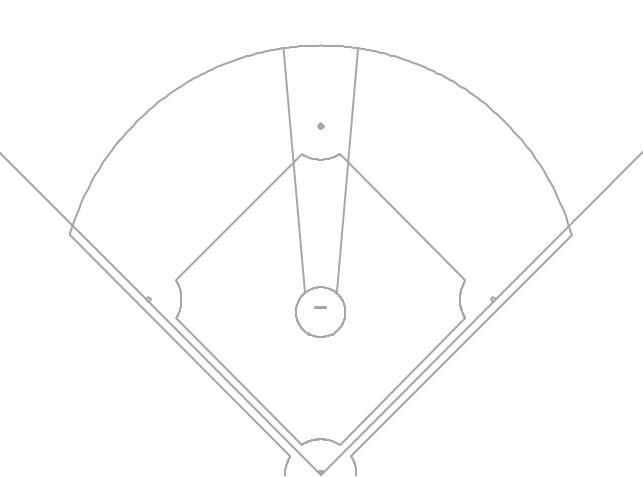
    In 2010, there were just over 3,300 ground balls that were hit in-between the two lines shown in this image. This was a season when shifting was highly unusual.

    Up the middle

    Batters reached base on those balls 70% of the time.

    But in 2019, it’s a different game. There have been just over 2,000 of those types of ground balls hit there.

    Batters are reaching base only 48% of the time.

    Teams have grown more successful at protecting this part of the field, regardless of whether a shift is on, as this chart shows.

    Reached Base Rate – Ball Hit Up The Middle
    2010 – Straight-Up Defense 70%
    2019 – With Shift On 35%
    2019 – Straight-Up Defense 59%

    Batted ball distributions are such that an individual player is only going to be minimally affected by this.

    The one “suffering” the most this season is Alex Bregman, who has reached in 2-of-12 instances in which he hit a ground ball up the middle (he reached for the second time over the weekend).

    This jibes with how defenses are playing Bregman.

    In 2018, he was defended straight up on about 70% of the ground balls and short line drives he hit. In 2019, that has dropped to an almost 50-50 split.

    We mentioned Bregman is 2-for-12 in reaching on balls up the middle this season. Prior to this season, he was 16-for-22 in reaching base when hitting a ground ball there.

    Bregman enters the day hitting .269. If he had gotten hits on even five more ground balls up the middle, he’d be batting .283, almost exactly what he batted in 2017 and 2018.

    Longer term, Giancarlo Stanton can do enough damage to where hitting ground balls up the middle isn’t that important to him. He’s reached 23 percent of the time when hitting a ball over the middle the last four seasons, lowest of anyone with at least 30 ground balls. You would figure the top of the list features hitters who are unpredictable in their hitting patterns, meaning the defense can’t shift him. Hunter Pence is one. He’s at the top, having reached 83% of the time (45-of-54).

    Pence is one of the fortunate ones. More hitters are finding it harder to push balls through. And more fans are having to get used to seeing those hitters repeatedly frustrated.

  • Remembering Mike Mussina as a Hall-of-Fame Fielder

    By Mark Simon

    This is a rare year in which the best defensive player in the Baseball Hall of Fame class is a pitcher.

    Former Yankees and Orioles pitcher Mike Mussina won seven Gold Gloves, the first and last coming 12 years apart (1996 and his final season, 2008). Only five others won that many at that position, led by Greg Maddux, whose 18 are the most of any player at any position.

    Trying to quantify Mussina’s excellence is challenging. Pitchers don’t typically have highlight reels to showcase their best plays, instead they have ones that show their best pitches. The one time a ball hit at Mussina was a national story was when he got drilled by a line drive hit by Sandy Alomar Jr. in 1998, which resulted in a broken nose. Fielding a comebacker takes skill, but often isn’t viewed as a great play.

    SIS began calculating Defensive Runs Saved for 2003, so that omits a good portion of Mussina’s career. The best of his final six seasons was 2003, when he saved seven runs, second-most among pitchers in MLB. That season he had 47 chances without making an error and allowed nine stolen bases in 19 attempts. He totaled six Defensive Runs Saved in his last five seasons.

    Mussina’s Gold Gloves weren’t so much about great plays as they were consistency.

    “It was the accumulation of many things,” said Mussina’s former Orioles teammate, Chris Hoiles. “He could get everything that was hit at him. And he could move laterally off the mound. When you have an extra infielder in there (as a pitcher) it makes the defense that much stronger.”

    One of his coaches at Stanford, Dean Stotz, went one step further.

    “He could have played infield if he had to,” Stotz said by phone last week. “He has great hand-eye coordination. He had the agility to throw from different arm angles. He was always a great fielder.”

    Former Yankees catcher John Flaherty, now a broadcaster for YES, noted that we shouldn’t be too surprised by Mussina’s current job coaching basketball at Montoursville High in central Pennsylvania.

    “He finished in a perfect fielding position,” Flaherty said. “When he finished his delivery, he was almost like a basketball defender.”

    For much of the early part of his career, Mussina stood out for being able to limit the running game. In his first seven seasons, opponents were 42-for-87 (48%) in steal attempts against him and his catchers, a time when the average yearly success rate was usually around 70%. Mussina was deliberate in his preparation to make pitches, leaning forward before carefully rising into a standing position.

    “He played mind games with baserunners,” Hoiles said, explaining how Mussina would hold the ball in the set position a few extra beats in some instances, and quick pitch in others. “He gave me the opportunity to throw someone out each time there was someone on base. He had a very quick move to the plate.”

    Mussina, known for his perfectionist tendencies, was modest on his Hall of Fame conference call last week, saying of his baserunner holding: “I was decent at it.”

    And though he couldn’t cite a play he made in the majors, he seemed proud regarding his defensive accomplishments.

    “I feel good about the plays I made,” Mussina said. “It wasn’t just two bounces back to me and flip it to first. I feel like I helped myself being able to field my position.”

    He helped both his team in games and his Hall of Fame hopes, too.

    Most Gold Gloves – Pitchers
    Greg Maddux 18
    Jim Kaat 16
    Bob Gibson 9
    Bobby Shantz 8
    Mike Mussina 7
    Mark Langston 7


  • Which Starting Pitchers Have Had Their Hard-Hit Rates Change the Most?

    by Jon Becker

    On Friday, I identified which hitters have changed their hard-hit rates the most from 2018 to 2019, whether it came in the form of a large increase or large decrease. Now, I’d like to do the same with starting pitchers.

    Note that this version of hard-hit rate is calculated as Hard-hit balls/(At-Bats + Sacrifice Flies). Our denominator rewards a pitcher for strikeouts. The denominator on Statcast and FanGraphs is “Batted Balls” which does not reward the pitcher for a strikeout.

    The number you get from the calculation allows you to say “Pitcher X has allowed a hard-hit ball in Y% of the at-bats against him.”

    I’ll start with the three pitchers who’ve improved their hard-hit rate the most. I set a minimum of 400 at-bats against in 2018 and 200 this season; 95 pitchers fit that criteria, though not all are starting pitchers this season.

    1. Lucas Giolito, 26.5% to 20.2% (6.3% decrease)

    It would be hard to argue that Giolito isn’t the most improved pitcher this season, and his large drop in hard-hit rate reflects that. His ERA has been nearly halved (6.13 to 3.15), with his K% almost doubling (16% to 30%). His most dramatic improvement has come with his signature pitch, the changeup: his hard-hit rate has dropped 11% on that pitch, from 27% to 16%.

    2. Cole Hamels, 30.9% to 25.8% (5.1% decrease)

    The Chicago renaissance continues for the veteran southpaw, who’s surely hoping that he won’t be on the shelf for too much longer with a mild oblique strain. In close to a full season’s worth of starts as a Cub, Hamels has been as good as ever:

    29 starts, 2.71 ERA, 176 IP, 146 H, 171 K, 58 BB, 15 HR allowed

    His hard-hit rate since being traded to the Cubs is 26.7%, putting him in 22nd place of the 64 pitchers who have at least 500 at-bats against in that time.

    3. Stephen Strasburg, 22.0% to 17.0% (5.0% decrease)

    Strasburg was 15th out of the 95 pitchers in our pool with his 22% had-hit rate in 2018, which is obviously excellent, but he’s taken it to another level in 2019. His 17% hard-hit rate is over 3% ahead of Giolito for best in MLB this year of the 95 qualifiers; the gap between him and Giolito is bigger than the gap between Giolito and Max Scherzer, who’s in 12th place.

    Strasburg’s elite hard-hit rate puts him in company with much smaller samples–his hard-hit rate is similar to relievers Aaron Bummer, Kyle Crick and Jake Diekman, who’ve faced about 40% of the batters Strasburg has.

    And now for the arms whose hard-hit rates have gone up the most:

    1. Nick Pivetta, 22.6% to 33.5% (10.9% increase)

    A common pick by analysts to break out in 2019 following a 2018 where he struck out 188 batters in 164 innings and, the Phillies righty has unfortunately gone backward this season, with an ugly 5.81 ERA in 12 starts and just 54 strikeouts in 66 2/3 innings. He’s been a bit better after a short minors stint, with a 4.84 ERA in eight starts, but he’s allowed 11 homers and still has a hard-hit rate of 28.4% in that time.

    2. Mike Foltynewicz, 24.5% to 35.2% (10.7% increase)

    Folty’s currently in AAA after an abysmal 11 starts with the big league club after coming off the IL, wherein he struck out just 7.6 batters per 9 (down from 9.9 last season). He allowed 16 homers in 59 1/3 innings, just one fewer than he allowed all of last season, when he completed 183 innings and faced almost three times as many batters. His time down at Gwinnett has gone somewhat better, with a 4.08 ERA in 17 2/3 innings, along with 19 strikeouts and four walks. He’s allowed 22 hits, but no home runs.

    3. Kyle Freeland, 24.8% to 34.7% (9.9% increase)

    Every year, we see pitchers who take pretty large steps back, but none in recent memory have fallen harder and faster than Freeland, who’s elicited memories of Steve Blass and Ricky Romero. After a 2.85 ERA in 2018 led to a fourth-place Cy Young Award finish and a staggering 8.4 WAR (per Baseball-Reference), Freeland began this year with a 7.13 ERA in 12 starts, allowing 16 home runs. He was then sent down to AAA to try to work out those kinks… where he then had an ERA of 8.80 in 6 starts. Undeterred, the Rockies brought him back up for a start on Saturday; he gave up nine hits and five runs in four innings, with a hard-hit rate of 30% (6-for-20).

    Here’s the top 10 pitchers and bottom 10 pitchers in hard-hit rate change.

    PitcherHardHitRate 2018HardHitRate 2019HHR Change
    Lucas Giolito26.5%20.2%-6.3%
    Chris Stratton33.9%28.5%-5.4%
    Stephen Strasburg22.0%17.0%-5.0%
    Kenta Maeda26.3%21.4%-4.9%
    Luis Castillo28.5%23.8%-4.7%
    Shane Bieber32.7%28.4%-4.3%
    Zack Greinke30.6%26.6%-4.0%
    Mike Minor29.6%25.9%-3.7%
    Tyler Mahle31.7%28.1%-3.6%
    Dylan Bundy25.1%21.8%-3.3%

    Largest Increase

    Jake Arrieta21.6%29.9%8.3%
    Zach Eflin22.0%30.6%8.6%
    Vince Velasquez23.3%32.1%8.8%
    J.A. Happ22.2%31.0%8.8%
    Justin Verlander18.2%27.2%9.0%
    Aaron Nola17.6%26.6%9.0%
    CC Sabathia21.5%30.6%9.1%
    Kyle Freeland24.8%34.7%9.9%
    Mike Foltynewicz24.5%35.2%10.7%
    Nick Pivetta22.6%33.5%10.9%
  • Which Batters Have Changed Their Hard-Hit Rate The Most?

    By Jon Becker

    Now that we’re after the All-Star Game and have seen more than half of 2019’s regular season games come and go, we’ve got a plenty large sample to evaluate players this season. One of my favorite things to do is look at players who’ve changed drastically–positively or negatively–from season to season. Today, I’ll be taking a look at the batters who’ve changed their hard hit rates the most, for better or for worse.

    Note that this version of hard-hit rate is calculated as Hard-hit balls/(At-Bats + Sacrifice Flies). Our denominator penalizes a hitter for strikeouts. Those you would see from Statcast and on FanGraphs use a denominator of “Batted Balls” which does not incorporate strikeouts.

    The number you get from our calculation allows you to say “Player X has recorded a hard-hit ball in Y% of his times at bat.”

    Let’s start with the top three hard-hit rate improvements, from the 2018 season to the first half of this season. A minimum of 400 at-bats last season and 200 at-bats this season are required to qualify.

    1. Scott Kingery, 19.2% to 34.7% (15.5% increase)

    When you increase your triple-slash from .226/.267/.338 (.605 OPS) to .292/.344/.545 (.889 OPS), you have to have changed something. For Kingery, that’s hitting the ball way harder. He’s made an even more dramatic increase against left-handed pitching, raising his hard-hit rate against southpaws from 16.9% to 53.7%. That’s the highest hard-hit rate against lefties this year of those with at least 50 at-bats against them.

    2. Cody Bellinger, 29.3% to 42.7% (13.4% increase)

    As Mark Simon noted on Monday, the NL’s leader in OPS+ and leader in DRS amongst non-catchers and its leading MVP candidate is also its leader in hard-hit rate. He was middle of the pack in 2018 (75th out of 179 hitters with at least 400 at-bats), but has been anything but this season. His most pronounced change has been against sliders, raising his hard-hit rate against those pitches from 28.2% to 50%. He has the highest hard-hit rate this season against that pitch type (minimum 25 at-bats ending with sliders).

    3. Josh Bell, 26.9% to 38.1% (11.2% increase)

    Perhaps the biggest breakout of the season, Bell came into the season with a career OPS of .784 and a WAR  of 2.2 (per Baseball-Reference), largely due to well-below-average defense at first base. This season? A 1.024 OPS and 3.0 WAR to go along with vastly improved defense (-9 DRS last year, 0 this year). The switch-hitting Bell has gotten better from both sides of the plate, with a 11.1 percentage-point increase as a righty and 10.9 percentage-point jump from the left side.

    And now, for those who’ve seen their hard-hit rates plummet the most:

    1. Jackie Bradley Jr., 29.3% to 22.9% (6.4% decrease)

    Bradley’s put his March/April funk (.406 OPS) behind him, slashing .272/.377/.497 (.874 OPS) since May 1, but his hard-hit rate hasn’t quite rebounded yet. His hard-hit rate since the beginning of May is actually lower than his season average, at 21.4%.

    2. Rougned Odor, 33.4% to 27.4% (6% decrease)

    After a slightly below-average season in 2018 (.253/.326/.424, for a 97 OPS+), Odor’s production has cratered in 2019, as he is batting just .198/.264/.407 (an OPS+ of 69). The lefty swinger actually hasn’t been much worse against same-sided pitching (a 4 percentage-point decrease), but righties have given him trouble (a 6.9 percentage-point decrease). Fortunately for Odor, he’s still just 25 years old, so there is time to improve.

    3. Matt Carpenter, 35.4% to 29.6% (5.8% decrease)

    Of the three trailers on this list, Carpenter was by far the best in 2018, putting up a  .257/.374/.523 triple-slash, setting a career high with 36 homers, and finishing 9th in NL MVP voting. He’s currently in the midst of his first career below- average season (88 OPS+) and has struck out in almost a quarter of his plate appearances, by far the highest rate of his career. 

    Here’s the top 15 and bottom 15:

    Batter 20182019Change
    Scott Kingery19.2%34.7%15.5%
    Cody Bellinger29.3%42.1%12.8%
    Josh Bell26.7%37.9%11.2%
    Carlos Santana27.3%38.0%10.7%
    Justin Smoak23.2%33.6%10.4%
    Cesar Hernandez17.9%27.6%9.7%
    Jonathan Schoop20.5%29.9%9.4%
    Anthony Rendon32.3%41.1%8.8%
    Rhys Hoskins25.0%33.0%8.0%
    George Springer26.1%34.0%7.9%
    Yasmani Grandal29.3%37.2%7.9%
    Ozzie Albies28.2%35.5%7.3%
    Nomar Mazara28.6%35.8%7.2%
    Dansby Swanson26.6%33.7%7.1%
    Marcus Semien25.8%32.7%6.9%
    Freddie Freeman32.7%39.6%6.9%
    Nick Markakis35.6%33.2%-2.4%
    Edwin Encarnacion30.8%28.1%-2.7%
    Freddy Galvis30.2%26.4%-3.8%
    Mitch Haniger28.0%24.0%-4.0%
    Nick Ahmed30.8%26.8%-4.0%
    Stephen Piscotty33.5%29.0%-4.5%
    David Peralta37.7%33.0%-4.7%
    Yonder Alonso28.9%24.2%-4.7%
    Todd Frazier30.4%25.6%-4.8%
    Lorenzo Cain31.5%26.7%-4.8%
    Andrew McCutchen32.5%27.4%-5.1%
    Nicholas Castellanos36.3%31.2%-5.1%
    Matt Carpenter35.3%29.9%-5.4%
    Rougned Odor33.3%27.1%-6.2%
    Jackie Bradley Jr.29.1%22.6%-6.5%
  • Jeff McNeil’s excellence is multi-faceted

    In this week’s SIS Baseball Podcast, our opening monologue is on the excellence of Mets utility man Jeff McNeil. Here’s some additional information to supplement what we talked about.

    By Mark Simon

    On SNY’s broadcast of last Friday’s Mets-Yankees game, analyst Ron Darling described 27-year-old Jeff McNeil as the kind of player that MLB had been waiting for.

    This had been in reference to McNeil’s ability to repeatedly beat defensive shifts, as he did in that game with a ground ball infield single to conclude an eight-pitch at-bat in the first inning against James Paxton. But it could be applied in a number of different areas.

    Despite the Mets’ many shortcomings, McNeil has turned into an All-Star, though the scoreboard at Progressive Field ran Jacob deGrom’s picture when he came to bat. He’ll be a fun player to watch in the second half for a number of reasons.

    For one thing, there’s the aforementioned hitting against the shift. McNeil is hitting .472 on ground balls and short line drives when shifted (he’s 25-for-53 … the .449 we noted on the podcast omitted shifts in which the infield was in or in at the corners in addition to shifting). Sports Info Solutions has a plus-minus system that rewards hitters who get hits versus shifts on balls that aren’t typically hits versus a straight-up defense. McNeil is a plus-9, meaning that the 22 hits are nine more than he would have gotten had the defense played straight-up against him. The plus-9 is the best in the majors this season.

    McNeil essentially baits the defense into shifting him. When the defense plays him straight up, he’s hit 39 of 46 ground balls and short line drives to the pull side (85%). But when the defense shifts him, he’s pulled 33 of 53 (62%). He finds the open hole either way.

    McNeil is challenging not just because of where he hits the ball, but because you can’t beat him with any pitch. He’s hitting .363, .375 and .316 against the three pitch types he sees most frequently (fastballs, changeups and sliders). He’s hitting “only” .259 when an at-bat ends with a curveball, but he has three doubles and two home runs in 27 at-bats against them, so the result is positive run value against all four pitch types.

    McNeil can do this as one of the game’s most aggressive hitters. He’s second in the majors in swing rate (58%) behind Jonathan Schoop of the Twins (59%). McNeil swings a lot, but he is still discerning. His 84% swing rate on pitches in the strike zone leads the majors. Since he is swinging at so many good pitches, it keeps his strikeout total down. His strikeout rate of 12% ranks 12th-lowest among batting-title qualifiers. His 11 times being hit by a pitch helps offset a low walk rate and push his on-base percentage to .409.

    Jeff McNeil MLB Ranks
    BA 0.349 1st
    Swing Rate 58% 2nd
    Strikeout Pct 12% 12th

    Racking up all these hits put him in an elite class, as one of three players with at least 170 hits in his first 500 at-bats since 1935, per the Elias Sports Bureau. The others are Hall of Famers Wade Boggs and Joe DiMaggio.

    McNeil isn’t someone with great speed. Three steals in eight attempts (including one after the infield single referenced atop this piece) have brought down his baserunning metrics. But he’s hit into only three double plays in 48 opportunities. His 6% double play rate is below the MLB average of 10%.

    Lastly, what makes McNeil distinct is that he can fill a Ben Zobrist-like role on the roster. He’s played four positions this season – second base, third base, left field and right field, and totaled four Defensive Runs Saved. Though he may not be a Fielding Bible Award candidate at any of these positions, his combined effectiveness may put him in the running for our Multi-Position honor.

    Simply put, Darling is right. McNeil’s the kind of player that baseball should embrace. His play should ensure that there won’t be any cases of misidentification in what should be a very bright future.

  • New podcast: John Dewan & Ben Lindbergh + Midseason Review

    On the SIS Baseball Podcast, Mark Simon (@MarkASimonSays), senior research analyst for Sports Info Solutions, shows us how baseball analytics are cool, interesting, and fun. SIS develops analytics and provides them to MLB teams, media, and fantasy baseball outlets. On the podcast, we’ll give you a peek into our world, talk to important people around the industry about analytic storylines, and share what we find to be cool, interesting and fun.

    In this episode, Mark begins with an interview of the founder of Sports Info Solutions, John Dewan (@FieldingBible), where they discuss everything from the history of baseball analytics to advice on how to create new stats today.

    Then, Mark is joined by writer/podcaster Ben Lindbergh (@BenLindbergh), whose new book The MVP Machine explores the forward-thinking use of analytics in player development. They take closer looks at Cody Bellinger, Mookie Betts, catcher framing, The Mike Trout Award For Analytic Excellence and more.

    Finally, Mark sits down with Andrew Kyne (@Andrew_Kyne) to go around the horn on the midseason advanced stat leaderboards. They also answer a listener e-mail on what stat they would have like to have known 50 years ago, hand out awards for Zack Greinke-ness and “Catcher Balance.”

    This episode is brought to you by SISbets.com, the website that can help you beat the Prop Betting odds. Click here to create a free SISbets.com trial account.