Category: MLB

  • Who’s Hit More Homers Than Expected? Fewer?

    By Jon Becker

    Every batter loves hitting home runs, and every pitcher hates giving them up. On the flip side, hitting a ball to the warning track or knowing you “just missed it” as a hitter is surely infuriating while inducing a sigh of relief on the mound. On the scoreboard and in the basic stat logs, home runs are home runs, and outs are outs. But, with the help of batted ball data, SIS is able to assign an expected value on each ball in play. 

    This is similar to Statcast’s expected stats, though different inputs are used. Ours consider where the ball was hit and how far it was hit.

    For example, let’s take an absolute no-doubt home run: a ball in play that, based on ball speed, trajectory and location, will always be a home run. Something like this Vladimir Guerrero Jr. home run. This is basically a home run anywhere. And since it actually was a home run, the difference between his actual home runs and his expected home runs for that at-bat was zero.

    Then you get wall-scrapers, like this Jason Heyward home run from earlier this week. So, he hit one more home run than expected. If the expected home run value had been, say, 0.05, he would have hit 0.95 more home runs than expected.

    If a player hit a well-struck ball that was caught at the warning track (or was any other result besides a home run) that had an expected home run value of 0.75, he would have hit 0.75 fewer home runs than expected for that plate appearance. So, to end up with a player’s season total, we add up their actual home run totals, and then subtract out their expected home run totals.

    First, let’s take a look at who’s sneaking more balls over the fence than we think they should be:

    PlayerTeamActual HRExpected HRDifference
    Rhys HoskinsPhillies149.84.2
    Alex BregmanAstros1813.94.1
    Hunter PenceRangers1410.13.9
    Jesse WinkerReds106.43.6
    Clint FrazierYankees117.53.4
    Gleyber TorresYankees1410.53.4

    And now, some hitters who are hitting the ball well quite often but not getting to trot around the bases as much as we’d expect them to:

    PlayerTeamActual HRExpected HRDifference
    Adam JonesDiamondbacks1216.2-4.4
    Brandon BeltGiants912.7-3.8
    Josh BellPirates1922.7-3.7
    Paul GoldschmidtCardinals1215.4-3.4
    Josh
    Donaldson
    Braves912.0-3.0
    Joe PanikGiants35.9-2.8

    When looking at the hitters’ names in isolation, there isn’t really much of a pattern as to who’s on the first table versus the second. Hoskins and Bregman are both well-known for raw power; so too are Goldschmidt and Donaldson. Winker isn’t exactly known for being a slugger; neither is Panik. But, when digging deeper, with plenty of help from video of the balls in play, we can see an obvious trend: the ballpark matters!

    Take a look at this home run that Hoskins hit off of Diamondbacks closer Greg Holland earlier this week. Yes, it went 365 feet and went at least five rows into the stands, but it was just under 99 miles per hour off the bat; he clearly didn’t get all of it. It looked like a more impressive home run than it was because of the ballpark and hit location, but the reality of the matter is that it wouldn’t have even been a home run at every ballpark.

    Now let’s watch a clip of Panik hitting a double. He hit that pretty well! In fact, it was just three miles per hour slower off the bat than Hoskins’ round-tripper. But, unfortunately for the Giants’ second baseman, his own home ballpark let him down.

    Oracle Park is well-known for its jet stream knocking down fly balls, and if you look closely, you can see that those flags above the wall are indeed blowing in a bit. And, of course, there’s the height of the wall itself; at 25 feet, it’s the tallest right field wall in the majors. And so, despite a high expected home run value (higher than two of his three home runs this season), Panik had to settle for two bases.

    There are so many variables that go into hitting a home run. Next time you see one sail just over the fence, ask yourself: how fortunate was the hitter to have hit that one?

  • Stat of the Week: Kevin Kiermaier’s amazing Defensive Runs Saved total

    Stat of the Week: Kevin Kiermaier’s amazing Defensive Runs Saved total

    By Mark Simon

    By now you know just how good Kevin Kiermaier of the Rays is in center field. He frequently amazes with great plays, chasing down fly balls all around the major leagues. The biggest issue with his game is in how often he’s been on the field, as he’s frequently dealt with injuries.

    But this season, Kiermaier has been healthy enough to save 11 runs, which ranks second among players at his position. With that, he’s moved into the top 10 in overall Defensive Runs Saved since the stat began being tracked in 2003.

    Kiermaier has more than 3,000 fewer innings played than anyone else in the top 10. If you prorate Kiermaier’s numbers, he’s averaging nearly 26 Runs Saved per 1,000 innings. Next-best among anyone on this list is Angels’ shortstop Andrelton Simmons, who is averaging 22 Runs Saved per 1,000.

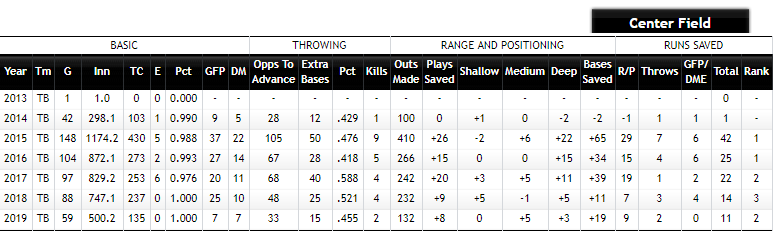
    A check of Kiermaier’s player page at the relaunched FieldingBible.com shows that he is going for his fifth straight season finishing among the top center fielders in Defensive Runs Saved. You can see that a large part of Kiermaier’s value comes in tracking down fly balls hit to the deepest parts of the outfield.

    D6sHcNTWsAAWy-A.jpg:large

    Kiermaier made 53 more plays than the average center fielder would have made against the deep balls Kiermaier saw from 2015 to 2018, including three straight seasons of at least 10 plays saved. Additionally, you can see that Kiermaier gets supplemental value from both his arm (Throws) and Good Fielding Plays (GFP/DME) such as robbing home runs or cutting balls off in the gap to prevent advancement. You can also see Kiermaier’s season totals (Total) and rank, which show how he’s been consistently great even when he’s missed considerable time.

    Kiermaier isn’t the only active player to move into the top 10. Another center fielder, Lorenzo Cain, has saved 13 runs, the most at the position this season. He’s now in 10th place, just behind Kiermaier.

    Most Defensive Runs Saved
    Since Stat First Tracked in 2003
    Player DRS Innings
    1. Adrian Beltre 222 18,354
    2. Andrelton Simmons 188 8,383
    3. Yadier Molina 167 15,919
    4. Jason Heyward 145 10,735
    5. Chase Utley 141 15,260
    6. Albert Pujols 136 16,146
    T7. Mark Ellis 131 10,956
    T7. Brett Gardner 131 11,282
    9. Kevin Kiermaier 128 4,964
    10. Lorenzo Cain 125 8,009


    SIS has relaunched FieldingBible.com to be your source for defensive metrics and information. The site features daily updates of player stats and provides background on how our stats are collected and calculated.

  • New podcast episode: What does Moneyball look like in 2019?

    In this episode, Sports Info Solutions senior analyst Mark Simon (@MarkASimonSays) is joined by three baseball writers – Susan Slusser (@susanslusser) of the San Francisco Chronicle, Marc Topkin (@TBTimes_Rays) of the Tampa Bay Times and Dan Hayes (@DanHayesMLB) of The Athletic.

    Slusser talks about how the Athletics are struggling to match the success of last season, particularly in relief pitching. Topkin discusses how the Rays operate in lock-step, from ownership down. Hayes explains how the Twins found untapped power both from their bats and their arms. Each also shares how the teams they cover find talent on the margins and how much they value defense.

    Mark is also joined by research associate Andrew Kyne, who explains the methodology and shares the results from his study on which teams position their infield best. Mark and Andrew answer listener mail, share who’s getting the best and worst results when they hit the ball hard and close the show with some Ridiculous Stat of the Day trivia. Tune in and play along!

  • Zack Greinke slider not what it once was

    By Eric Fitch

    Since 2015, Zack Greinke ranks 10th in the majors in Fangraphs Pitching WAR (17.1). But after a dominant 2015, Greinke’s pitch performances began to change. His changeup has often been his most effective pitch as opposed to other seasons in which he had that pitch and a great slider.

    Greinke slider began to slightly drop in production following the 2017 season, in which he threw the pitch 715 times, the most in the last five seasons.

    Below, is Greinke’s slash line from his slider in the past three seasons.

    SeasonBASlug PctOPS
    20170.1820.3550.582
    20180.2460.4150.693
    20190.2690.4330.711

    Perhaps Greinke has sensed that his slider isn’t as effective as it used to be. He’s throwing it less often. And it’s getting a lot fewer missed swings and chases.


    SeasonMiss RateChase Rate
    201744%50%
    201833%47%
    201924%41%

    Greinke’s solution to this issue has been throwing a slow curveball that seems to fool hitters (.106 opp BA) and maintaining an effective changeup (.171). We’ll see in the next four months if those continue to be effective and if he can figure out how to find value with his slider.

  • MLB’s Best Positioned Infields

    MLB’s Best Positioned Infields

    On the most recent episode of the SIS Baseball Podcast, our guest Joe Sheehan mentioned how teams like the Dodgers and Astros are aggressive in their positioning of defenders, whether they ultimately cross the lines that we draw to measure defensive shifts or not.

    With that in mind, let’s try to measure which teams have put their infielders in the best position to field groundballs.

    As mentioned a few weeks ago, Baseball Info Solutions charts the starting positions of infield defenders on grounders, in addition to batted ball information. Thus, we can calculate both the angle at which the ball was hit and the angle at which the fielders are standing.

    We divide the field into 90 degrees from foul line to foul line. Using the fielder and batted ball information, we can find the angle difference between where the ball was hit and where the closest fielder was standing.

    Since the first baseman will always be positioned near the bag and the other infielders are the ones being moved around, I only evaluated groundballs hit outside the first base area (the rightmost fifth of the infield). Additionally, I only looked at grounders hit at least 100 feet and not fielded by the pitcher or catcher.

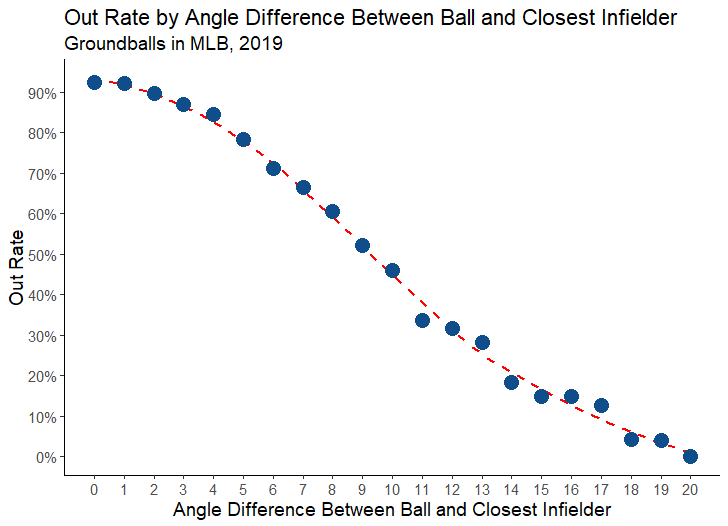
    On a league-wide level, this plot shows the rate of getting an out on a play by how far the closest infielder was from the ball (laterally), in terms of angle difference.

    The trend is obvious: the farther your closest infielder is from the ball, the less likely an out is to be recorded.

    Within three degrees of the ball’s path is where the expected out rate climbs north of 85%. So, based on all of the criteria above, which teams have played the highest percentage of groundballs with an infielder within three degrees of the path of the ball?

    The Astros and Dodgers rank in the top ten (as expected), and other shift-heavy teams like the Rays, Pirates, and Yankees rate well. There are exceptions, however; the Cubs don’t shift much at all but have been well positioned, and the Orioles have rapidly increased their shift usage and rank at the bottom.

    But what if teams played with traditional, straight-up positioning on each of these grounders? With that positioning, what percentage of plays would they have an infielder close to the ball, and how does that compare to their actual percentages? Is there a benefit?

    Overall, teams have had a 2B, 3B, or SS within three degrees of the ball on 39% of these plays. If they played with straight-up positioning (using the average angles of infielders on non-shift plays), teams would have been close on 33% of these plays.

    The Diamondbacks have had the most benefit of moving their infielders around. They would have only been close on 30% of plays with traditional positioning, so their actual 41% rate is a significant boost.

    Consider this play from last week, where the Diamondbacks had the Mets’ J.D. Davis played perfectly. The shortstop and third baseman were positioned similarly to league average, but the second baseman moved over to the left side and the ball was hit right to him.

    The Reds (39% actual vs. 28% with traditional), Yankees (43% vs. 33%), Tigers (40% vs. 30%), and Astros (40% vs. 31%) have also gained significant advantages.

    The important takeaway is that nearly every team has had a higher percentage of close plays with their positioning compared to if they just used traditional positioning. The only team slightly worse off has been Boston, and the difference is basically zero (36.6% vs. 37.2%).

    Of course, this doesn’t speak to fielder quality. Range, arm, and other factors are important to out conversion as well. But from a positioning perspective, teams are doing what they can to put infielders in the proper areas to be as close to potential grounders as possible.

  • How does J.T. Realmuto have 10 Defensive Runs Saved?

    By Mark Simon

    There are currently five players with at least 10 Defensive Runs Saved this season. By far, the most surprising of that group is Phillies catcher J.T. Realmuto, who has exactly 10. The only catcher with more is Austin Hedges, whose defensive reputation far surpasses Realmuto.

    From 2016 to 2018, Realmuto cost the Marlins 25 runs with his catching. That 25 runs was actually attributable to our Adjusted Earned Runs Saved stat, which involves cross-comparing catcher ERA by starting pitcher with the other catchers on the team.

    For example, in 2016, Marlins pitchers had a 4.23 ERA with Realmuto catching and a 3.28 ERA with Jeff Mathis catching and almost every comparison of pitchers with both catchers favored Mathis, so he got rewarded and Realmuto got penalized. This is part of our stat to account for the game-calling aspect of catching.

    That’s been a non-issue for Realmuto in 2019. Phillies pitchers have a 4.22 ERA with him catching this season and a 4.27 ERA with Andrew Knapp behind the plate. This might not hold up all season, but for now, Realmuto is faring all right. He has 1 Adjusted Earned Run Saved.

    If we look at areas beyond this stat, Realmuto the Marlin doesn’t look as bad. He comes up as someone who was good at deterring basestealers (4 DRS), thwarting bunts (3 DRS), and blocking pitches (3 DRS), but poor at pitch framing (-10 DRS) in that three-season span.

    But now the question becomes – how did he go from this with the Marlins to great with the Phillies? Matt Gelb foreshadowed this with a look at Realmuto’s open-mindedness this spring. Realmuto seems to be following through.

    Stolen Base Runs Saved

    The first is a transformation into Yadier Molina-like status with throwing out baserunners. He’s caught 17-of-37 and has two pickoffs. The 17 caught stealing are three more than he had last season and only five shy of his career high of 22 in 2016.

    By our measures, that equates to seven Stolen Bases Saved, which has been worth 6 Runs Saved. That makes sense given that catching a runner stealing takes a runner out of scoring position.

    Good Fielding Play Runs Saved (Pitch Blocking)

    Our Video Scouts track every pitch a catcher blocks and fails to block in situations which a batter or baserunner can advance. At the end of the season, MLB average is 91 to 92 percent. The top catchers last season were Mathis, then of the Diamondbacks, Tucker Barnhart of the Reds, and Austin Barnes of the Dodgers, all at around 96%.

    Realmuto was at 90.5% — he had 380 successful blocks on 420 pitches. He was a little below average (after having previously rated well). The difference between Realmuto and the best catchers is that he blocked 380, they would have blocked a little more than 400. Twenty extra wild pitches and passed balls over a season costs runs.

    But this season, Realmuto has flipped back to positive form. His block rate is 95.2%. He’s doing well and he’s playing a lot, so as a result, that’s worth 3 Runs Saved.

    Pitch Framing

    Though Realmuto has rated poorly at getting extra strikes, he has been inching up. His Strike Zone Runs Saved totals were -5, -3, and -2 the last three seasons.

    This season, he’s a positive at 1 Run Saved. The difference comes from an improvement in a key area for a catcher – how often does he get a strike on a close pitch?

    For Realmuto, two seasons ago, he had a 15.5% called strike rate on pitches we deemed within two inches of one of the edges of the strike zone. This is a world where 17% is average and the leaders are in the low 20s. Realmuto got to 17% last season. So far in 2019, he’s at 18.2%.

    What’s the difference between his 18.2% now and his 15.5 of two seasons ago?

    Over a full season, Realmuto probably catches 4,000 of these pitches. A 2.7% differential equates to 108 more strikes.

    More strikes mean more favorable situations and more outs for his pitchers. Hence, positivity so far this season, negative numbers in the past.

    Add it all together

    To summarize, Realmuto’s 10 Defensive Runs Saved come from:

    6 for Stolen Bases

    3 for Pitch Blocking

    1 For Pitch Framing

    1 for Game Calling

    -1 for Bunts (which we didn’t discuss, but it’s based on two hits allowed on balls he fielded)

    That gives him 10, a huge improvement both over his past and what the Phillies have had of late. We’ll see if he can keep it up.

    For further breakdowns on Realmuto and other players, check out the SIS Baseball Podcast at this link

  • Which Pitchers Are Forced to Throw the Most Extra Pitches?

    At Sports Info Solutions, we put much of our baseball-related focus on defense—unsurprisingly so, since our flagship metric is Defensive Runs Saved (DRS). For those unaware, DRS factors in not only errors, but Defensive Misplays (DM), which don’t show up in the traditional scorebook.

    You’ll often watch or listen to MLB broadcasts on TV or radio and notice that a player makes an error. At some point, either immediately after that error or later in the inning, the pitcher will continue to throw pitches, even if the inning should have been over at that point. Many broadcasters and analysts will take note of how many extra pitches the man on the mound had to throw on account of that error. So, that got us wondering: since the beginning of the 2018 season, who’s had to throw the most extra pitches, due to not just errors but also Defensive Misplays?

    Here’s a look at the top ten in extra pitches thrown over the past season-and-a-third:

    All stats through Sunday’s games

    PitcherTeam(s)Extra
    Pitches
    % of
    Total Pitches
    Marco GonzalesMariners2476.6%
    Jake ArrietaPhillies2466.2%
    Rick PorcelloRed Sox2255.3%
    CC SabathiaYankees2226.8%
    Mike LeakeMariners2185.5%
    Lance LynnTwins/Yankees/Rangers2085.0%
    Kyle HendricksCubs2075.1%
    Reynaldo LópezWhite Sox2034.7%
    Jacob deGromMets2014.5%
    Trevor BauerIndians2004.7%

    Gonzales has seen the defense behind him change dramatically over the past two seasons: not a single player started both Opening Day 2018 and Opening Day 2019 for the Mariners while playing the same position both years (Dee Gordon started 2018 in CF and 2019 at 2B; Mitch Haniger started 2018 in RF and 2019 in CF). Clearly, though, no matter who’s playing behind him, he’s being forced to throw a lot of extra pitches; he’s leading pitchers in 2019 with 104 extra pitches thrown, after ranking at 13th-most in 2018.

    On the flip side of the same coin, the extreme roster turnover the Phillies experienced from last season to this has served to better Arrieta’s extra pitch numbers. After leading all pitchers with 180 extra pitches thrown in 2018, the right-hander is down to 10th on the list for 2019 (tied with the Rockies’ Germán Márquez) with 66 extra pitches thrown. That’s still not great, but it’s a slight improvement that helps to verify that trading Carlos Santana and moving Rhys Hoskins from left field (where his DRS was an astounding -24) back to his natural position at first base was probably the right move.  

    In terms of percentages, though, it’s Sabathia who reigns supreme amongst the ten names above since the beginning of last season. No longer the hard-throwing power-arm he once was, the big pitch-to-contact lefty has had to rely on his defense more and more with each passing season as he wraps up his career in 2019. The oft-reviled defense of Miguel Andújar (-25 DRS at 3B in 2018) was a main culprit last season; Sabathia’s most common pitch thrown to righties is his cut fastball, which bears in on the batter’s hands and leads to many ground balls to the left side and thus many opportunities for Andújar. But, not everything can be pinned on one defender. Thus far this season—largely without Andújar, who is now out for the season with a labrum tear—Sabathia has had to throw 71 extra pitches out of 751 total: an astounding 9.5%!

    So, the next time you’re watching or listening to your favorite MLB team play, pay extra attention to those pesky errors and misplays. They may end up coming back to bite the pitcher in more ways than one, whether it’s in the form of an earlier move to the bullpen or more runs coming in. These extra pitches affect more than just the man throwing them, and might just be the difference in more games than you’d think.

  • Stat of the Week: Who is May’s top defensive player?

    Prior to 2019, Cody Bellinger had established himself as a good defensive player, showing himself to be capable at both first base and center field. But this season, Bellinger has shown himself to be a great defensive player.

    Bellinger is the Sports Info Solutions Defensive Player of the Month for May. He joins Lorenzo Cain as a winner of the monthly award this season. Bellinger edged Athletics third baseman Matt Chapman in the voting. He received five first-place votes to four for Chapman. Voting was conducted by selected SIS employees and media members.

    Bellinger tied Marlins shortstop Miguel Rojas for the major league lead with eight Defensive Runs Saved for the month. The most impressive aspect of his game may have been his throwing arm.

    Among the highlights: He threw Stephen Strasburg out at first base on what Strasburg figured was a single, and he recorded two assists in a game against the Mets, including a rocket to nail Carlos Gomezattempting to go to third base on a flyball. His best catch was a running snag of a Ronald Acuna Jr. flyball inches from the grass.

    Bellinger has saved a major league-leading 17 runs with his defense this season (including one at first base). Those are split with eight being for Range and Positioning, six being for his Outfield Arm and three for Good Fielding Plays and Defensive Misplays (including a home run robbery against Christian Yelich on April 21). The six runs saved by his arm come from six unaided assists and that only 4-of-25 runners have advanced an extra base on hits he fielded (16%). The MLB average advancement rate is nearly 50 percent.

    PlayerTeamDRS
    Cody BellingerDodgers17
    Lorenzo CainBrewers13
    Austin HedgesPadres12
    Nick AhmedDiamondbacks11
    Kevin KiermaierRays10
    J.T. RealmutoPhillies10

    Chapman was a highly formidable foe for top honors. He saved seven runs with his defense and had nine Good Fielding Plays in May, one shy of Anthony Rendon for the lead at third base. Chapman’s seven Defensive Runs Saved this season are the most among third basemen.

    Be sure to check out the Sports Info Solutions Baseball Podcast. The most recent episode includes a talk with baseball writer Joe Sheehan about how the top defensive teams were put together and much more. Click here to tune in.

  • How are the Twins getting it done?

    By Mark Simon

    The Minnesota Twins currently have the best record in baseball this season. There is skepticism about whether their record makes them worthy of being dubbed the best team because the Twins haven’t spent like the Red Sox or Yankees or developed players like the Astros or Rays.

    So how are the Twins doing this?

    Offense

    The Twins are winning by hitting home runs at an amazing pace. They have an MLB-leading 106 through 55 games.

    But is their offense overachieving? Sports Info Solutions computes an expected batting line using hit probabilities based on the type of batted ball, where balls are hit, and how hard they’re hit.

    Comparing a player’s expected stats to his actual stats can show if a player has overachieved or underachieved or has been positively or negatively impacted by his ballpark or the opposing defense.

    The Twins player whose expected numbers are the most below his actual numbers is shortstop Jorge Polanco, who would still be having a very good season even if he was just performing to expectations.

    Jorge Polanco

    BASlug PctHitsXBH
    Actual.335.5836928
    Expected.287.5175926

    Catcher Mitch Garver, currently on the injured list, has also done more than expected in limited playing time.

    Mitch Garver

    BASlug PctHitsXBH
    Actual.329.7472614
    Expected.264.6072112

    However other key players, including outfielders Max Kepler and Eddie Rosario, are not overachieving on their batted balls. Kepler is hitting .275 with 12 home runs. His expected totals are a .271 batting average and 12 homers. Rosario has a .278 batting average and .557 slugging percentage compared to expected averages of .280 and .542.

    Pitching

    The Twins have the third-best ERA in the American League (3.91) with two starting pitchers posting sub-3 ERAs in Jake Odorizzi and Martín Pérez.

    Odorizzi’s 2.16 ERA seems to be a bit low given his 3.02 FIP (an ERA estimate based on strikeouts, walks and home runs allowed). The expected numbers peg him for an opponents’ OPS of .611, 91 points above his actual OPS.

    However, .611 would still be a 132-point improvement from last season and put him in position to have a strong season.

    Pérez added a cutter to his repertoire this season and that has become a huge pitch for him. Opponents are hitting .119 against it with two extra-base hits on the 318 he’s thrown. It has also been a reliable pitch for him when it’s not an at-bat ender. He’s throwing it for a strike 69% of the time.

    In the bullpen, Blake Parker has eight saves despite a strikeout-to-walk ratio of just over 2-to-1. The top performing reliever is 30-year-old rookie Ryne Harper, a 37th round pick in 2011 by the Braves. He has the lowest FIP among their relief pitchers (2.61).

    Fielding

    The Twins’ rank fifth in the majors in Defensive Runs Saved. Thanks to Byron Buxton (6 DRS), Kepler (5 DRS), and Rosario (4 DRS), their outfielders are ranked third in the majors with 19 DRS.

    The Twins infield rates solidly above-average overall (18 DRS including their Shift Runs Saved) but has one number that stands out in a negative way. The Twins are allowing a .311 batting average on ground balls and short line drives when they use a full shift (when three infielders play on the pull side of second base), the highest in the majors. The MLB average is .237.

    Given that the Twins have used full shifts more often than any team, it’s worth watching to see if things will get better for them in this area. It’s potentially their biggest obstacle in trying to shift the balance of power in the American League.

    On the latest edition of the Sports Info Solutions baseball podcast, baseball writer Joe Sheehan talked about whether Jorge Polanco was overachieving and much more. You can tune in here.

  • On Catcher Injury Risk and Managerial Decision-Making

    On Catcher Injury Risk and Managerial Decision-Making

    In April, ESPN published an excellent feature on Farhan Zaidi and his path to becoming the Giants’ President of Baseball Operations. One story details how Zaidi, while in the doctorate program at UC Berkeley, studied irrational decision-making and the human tendency to “overweight low-probability events and underweight high-probability events.” The article explains:

    “…in baseball, Zaidi’s favorite small-probability event is the industry-wide reluctance to use the backup catcher. ‘Oh, what if he gets hurt? Then we don’t have a catcher and disaster will strike.’ … ‘The likelihood of the catcher getting hurt in the last two or three innings of a game is tiny. But when you’re making this decision, you’re not thinking, There’s a tiny chance. You’re thinking, There’s a chance.’”

    It’s an interesting dilemma. Being forced to play a non-catcher behind the plate is suboptimal, but should managers fear that scenario?

    Baseball Info Solutions has been tracking detailed injury information for a few seasons, so let’s take a look at some data on catcher injuries.

    First, how often does a catcher sustain an injury that forces him to leave the game immediately? Since the start of 2017, there have been 12,870 instances of a player appearing in a game behind the plate. Of those players, only 53 left any of those games immediately because of an injury. That’s 0.4% — or as Zaidi calls it, a tiny chance.

    All 53 of those players were the starting catcher in the game — so in this time frame, no player came off the bench, appeared behind the plate, and had to leave immediately due to injury.

    Though those extreme injuries are rare, playing behind the dish does include more injury risk overall relative to other positions. Looking at injuries that occurred while playing the field, catchers come out way ahead of the pack in terms of total injury events.

    This is a little deceiving. We try to be as comprehensive as possible with our injury data collection and track even the slightest incidents on the field (like hit by pitches or foul balls off the body that may not incur much of a reaction). So a lot of those catcher injuries are low-risk.

    But our Video Scouts also provide a severity rating of each injury on a scale of 1 to 5. Ratings 1 and 2 are injuries with no or slight visible reactions, while 3 and up include clearly visible reactions and are more severe. To focus on higher-risk injury events, here’s the positional breakdown of injuries with a severity of 3 or higher:

    Pitchers surpass catchers in terms of severe injury events, but catchers are still at far more risk than other positions in the field. The more significant takeaway is that out of over 5,000 games played since the beginning of 2017, there have only been about 250 injury events to catchers (while on defense) that warranted a severity 3 rating or higher.

    The most common of our charted injury events to catchers fall under the category of being struck by a ball or bat. Recently, Roberto Perez of the Indians and Francisco Cervelli of the Pirates have suffered concussions on such events. Given the catcher’s exposure to foul tips and backswings, they’re certainly at more risk than someone in the infield or outfield.

    But overall, the chance of an extremely severe injury is rare. Perhaps more managers should be willing to use the backup catcher if the situation warrants it, even if it presents the low-probability risk of needing an emergency catcher to step in.