Category: NFL

  • Evaluating offensive line needs for teams that use certain run schemes the most

    By LOGAN KING

    Sports Info Solutions (SIS) brings you the second annual edition of The SIS Football Rookie Handbook, with scouting reports and statistical breakdowns on over 280 college football players who are likely to be drafted or signed as rookie free agents in 2020 (a glossary for the below stats can be found here). New features for this year include unique and informative NFL team pages, research deep-dives by the SIS R&D team, and—for the first time ever—the NCAA version of their flagship football statistic, Total Points

    With the 2020 NFL Draft right around the corner, this article focuses on potential draft targets for the 2019 league leaders in percentage of run plays from zone and man blocking schemes. 

    Each team is examined in terms of its rushing scheme last season, projected rushing scheme for this season (based on coaching changes), and potential draft picks (based on scheme fit, roster needs, and draft position). More information on these prospects can be found in the SIS Football Rookie Handbook.

    The table below displays the league leaders in percentage of run plays from both zone and gap schemes. 

    2019 Rushing Scheme Leaderboards
    Gap Run Zone Run
    Rank Team Percent of Runs Rank Team Percent of Runs
    1 Texans 62% 1 Bengals 76%
    2 Dolphins 59% 2 Vikings 73%
    3 Bills 57% 3 Titans 71%

    Houston Texans

    The Texans lead the league in percentage of gap scheme runs in 2019, finishing just inside the top half of the league in EPA per gap scheme run. The trade of DeAndre Hophins for David Johnson is indicative of Houston’s commitment to establishing the run game, moving forward. Though offensive play-calling responsibilities will be in OC Tim Kelly’s hands this upcoming season, the scheme isn’t expected to drastically change, as Kelly has worked with head coach Bill O’Brien since 2012 at Penn State. 

    Given the return of each of the team’s offensive line starters from 2019, Houston is not hard-pressed to find an immediate starter on the offensive front in this year’s draft. Rather, the Texans can address their need at wide receiver in the early rounds. There are several prospects who project to fit into Houston’s gap blocking scheme which may be available in the later rounds:

    • Robert Hunt, Louisiana Lafayette; Projected Position: T
    • Kevin Dotson, Louisiana Lafayette; Projected Position: G
    • Logan Stenberg, Kentucky; Projected Position: G

    Miami Dolphins

    While the Dolphins called the second most run gap scheme run plays in 2019, next season will likely be a different story, as Chan Gailey is now the offensive coordinator. Gailey’s history with the New York Jets points to a zone running scheme, as his 2015 and 2016 Jets squads ranked 9th and 1st in percentage of zone run plays called. Though only one player in next season’s OL position group finished above 60th in total points per snap at their position in 2019 (Ereck Flowers, 7th), Miami has 12 picks in the 2020 Draft, meaning plenty of opportunities to improve along the line. 

    With three picks in the first round and a total of six in top 70 picks, Miami has the ability to add several top talents to fit into Gailey’s zone scheme, such as the following:

    • Andrew Thomas, Georgia; Projected Position: T
    • Tristan Wirfs, Iowa; Projected Position: T
    • Netane Muti, Fresno State; Projected Position: G

    Buffalo Bills

    The Bills called the third highest percentage of runs from gap schemes in 2019. Buffalo retains their offensive play caller in Brian Daboll and also returns all five starting O-Linemen from last season. Only one of those starters finished outside of the top 26 in total points at their position (T-Cody Ford, 41st). With the ability to focus on other needs in the early rounds of the draft, potential options for Buffalo’s zone scheme include:

    • Robert Hunt, Louisiana Lafayette; Projected Position: T
    • Isaiah Wilson, Georgia; Projected Position: T
    • Tyre Phillips, Mississippi State; Projected Position: G

    Cincinnati Bengals

    In Zac Taylor’s first season leading the team, Cincinnati led the league in percentage of zone runs called. This offseason, the Bengals released guard, John Miller who was second on the team’s OL in terms of total points. Miller was replaced with Xavier Su’a-Filo who played only 307 offensive snaps for the Cowboys at guard, last season. The most dire need for this position group comes at left tackle, where snaps were split between John Jerry, Cordy Glenn, and Fred Johnson. 

    With the first overall pick in hand, the Bengals hold immense leverage; potential options for their zone-heavy scheme include:

    • Andrew Thomas, Georgia; Projected Position: T
    • Jedrick Wills, Alabama; Projected Position: T
    • Matt Hennesy, Temple; Projected Position: C

    Minnesota Vikings

    Of the Viking’s run plays in 2019, 73% were zone scheme runs. Despite former OC Kevin Stefanski’s departure to Cleveland, the team should retain scheme consistency with Gary Kubiak taking the reins. Minnesota returns four starters from last season’s OL, after moving on from RG Josh Kline. 

    After big losses to the defensive back and wide receiver position groups this offseason, the team will likely not address the offensive front early on in the draft. Potential options in for the Viking’s zone scheme include:

    • Netane Muti, Fresno State; Projected Position: G
    • Jonah Jackson, Ohio State; Projected Position: G
    • John Simpson, Clemson; Projected Position: G

    Tennessee Titans

    The Titans ranked third in percentage of zone scheme run plays and ranked 5th in EPA per play on those runs. Tennessee enters the 2020 season with the same offensive play caller and four (three of which finished in the top 14 at their position in total points in 2019) out of five primary starters on the OL from last year, losing Jack Conklin to Cleveland. Dennis Kelly, who earned 10 total points in limited snaps last season, is expected to fill in for Conklin. 

    The Titans are limited to six picks in the draft, with their first one coming at number 29. With limited opportunities to add depth, some players which could fit into the Titans’ zone scheme include:

    • Josh Jones, Houston; Projected Position: T
    • Lucas Niang, TCU; Projected Position: T
    • Shane Lemieux, Oregon; Projected Position: G
  • Jadeveon Clowney is better than he showed in 2019

    Jadeveon Clowney is better than he showed in 2019

    By NATE WELLER

    After a hectic start to the NFL offseason, things have slowed considerably as GMs do their final draft prep and learn how to use Zoom. At some point, though, the market will pick back up, and the biggest non-QB domino left to fall is Jadeveon Clowney.

    It’s a weird time to be an NFL free agent, and Clowney is undoubtedly feeling the effects, probably more than any other player. Given his checkered injury history and team’s inability to perform a physical with their own doctors, Clowney has been unable to generate as much of a market as one might expect for a talented 27-year old pass rusher. Beyond that, teams are no doubt hesitant to throw top edge rusher money at a guy coming off of a three-sack campaign, even if that’s not really a fair reflection of Clowney’s performance.

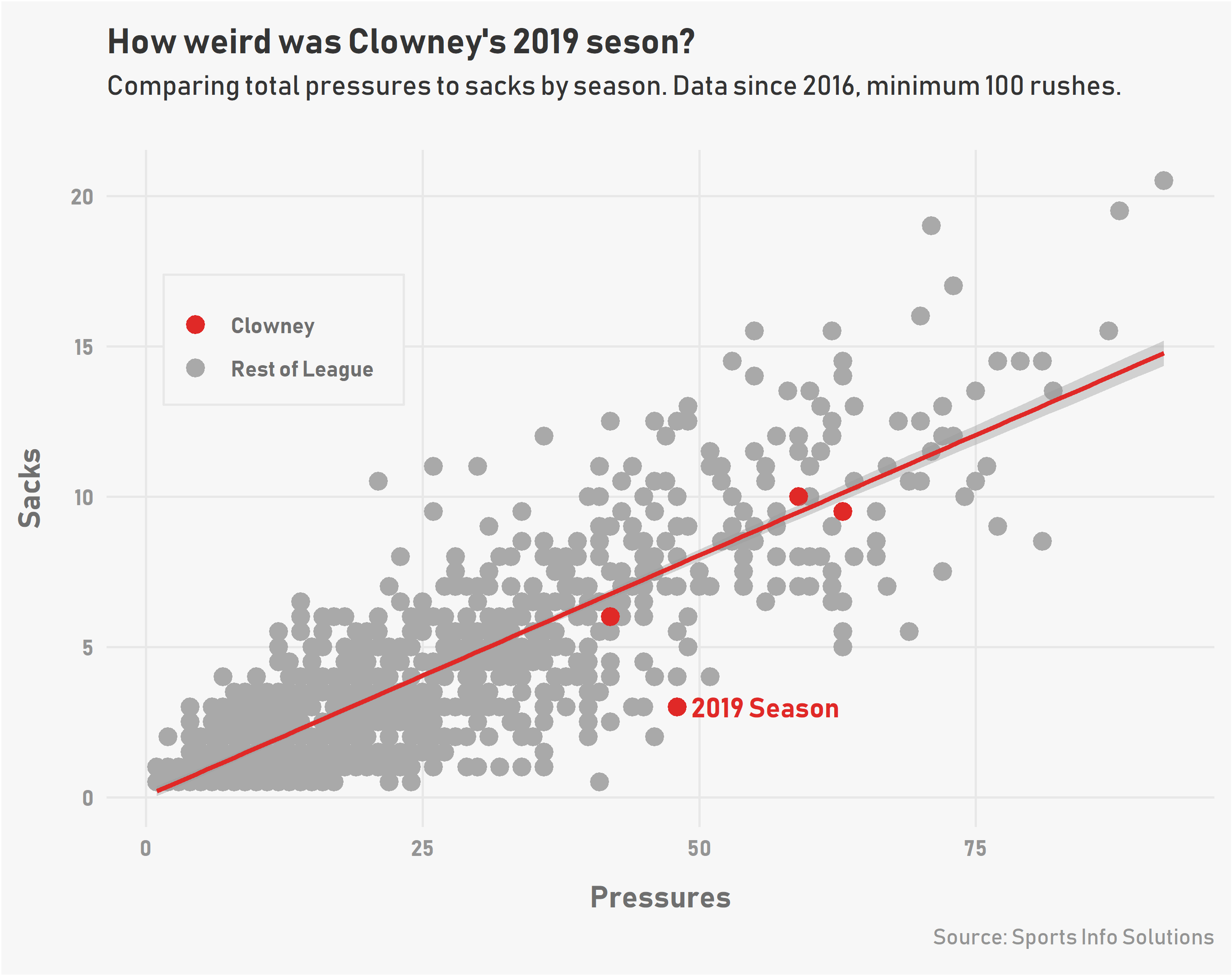
    Clowney generated 48 pressures in 2019, which still ranked him tied for 29th in the league despite missing time. The problem was that Clowney only turned those pressures into sacks a little less than six percent of the time, which ranked him 50th of 51 players with at least 40 pressures. Turning pressures into sacks is an inherently noisy metric, and there’s plenty of reason to believe Clowney will bounce back. Between 2016 and 2018 Clowney ranked 13th in the NFL in pressures with 163, and he turned 16 percent of those into sacks.

    Arguably the best part of Clowney’s game, though, is his ability against the run. Clowney was solid as a run defender 2019. His 13 Run Defense Points Saved in 2019 (a stat explained here) ranked him 12th among defensive ends. But even after a (relatively) down year against the run, Clowney still leads all defensive ends by this metric since 2016, edging out Calais Campbell.

    It’s impossible to say precisely how much of Clowney’s limited market can be attributed to his medical history and how much is a reaction to his stats in 2019. Regardless, Clowney is likely to have a strong market once things return to relative normalcy. And whatever team does pay Clowney will likely be getting production that is much closer to his performance between 2016 and 2018 than what we saw last season

  • Evaluating The Downfield Aggression Of Quarterbacks

    By JOHN SHIRLEY

    Quarterbacks are often labeled by their propensity for taking risks down the field. Throw it deep often and you get labeled a “Gunslinger.” Throw it short and rely on your receivers to make plays and you get labeled a “Game Manager.”

    These designations are usually only provided by anecdotal evidence and fans’ feelings towards different players. But, the underlying principle of analyzing quarterback aggression by using throw depth can be a useful tool when predicting certain quarterback metrics and playing styles.   

    Throw depth has been shown to be a major driver in quarterback accuracy metrics and to be relatively stable year to year. Intuitively this makes perfect sense due to the fact that shorter throws are generally easier than throws down the field. This is why throw depth is a key factor in our metrics such as pComp and why average depth of target (ADoT) has been used to compare similarity between college quarterbacks.

    Factoring throw depth into these types of analysis is extremely important, but using raw ADoT to evaluate a quarterback’s downfield aggression ignores the fact that all offensive schemes are not the same. Some offenses are predicated on a quick passing game, while others incorporate more field stretching concepts. This can skew ADoT in either direction and our view of certain quarterback’s downfield aggression.

    In the NFL

    By using ADoT +/- we can see which NFL quarterbacks were the most aggressive (the first five QBs listed on this leaderboard) and which were most conservative (the last five QBs) this past season.

    2019 NFL Quarterbacks by ADoT +/- (Minimum 250 Attempts)

    RankPlayerTeamADoTADoT +/-
    1Ryan TannehillTitans9.51.6
    2Matthew StaffordLions10.81.6
    3Jameis WinstonBuccaneers10.41.4
    4Dak PrescottCowboys9.40.9
    5Baker MayfieldBrowns8.40.8
        
    26Jimmy Garoppolo49ers6.5-0.6
    27Tom BradyPatriots7.5-0.6
    28Lamar JacksonRavens8.6-0.7
    29Derek CarrRaiders6.6-1.2
    30Drew BreesSaints6.5-1.4

    This provides an interesting look at the new quarterback situation in Tampa Bay, as the Buccaneers’ previous starter, Jameis Winston, has consistently been among the league’s most aggressive passers and their new starter, Tom Brady, has consistently been among the league’s most conservative.  

    It also provides nice examples of why ADoT can be misleading in AFC North quarterbacks Baker Mayfield and Lamar Jackson. These are two players who have very similar ADoT’s, with Mayfield averaging 8.4 yards and Jackson averaging 8.6. However, based on their downfield opportunities, Mayfield is the more aggressive passer, as his ADoT +/- is 1.5 yards higher. 

    The 2020 Draft Class

    The same analysis done in the NFL can also be done for college quarterback prospects. Shown here are the ADoT +/- numbers for the Top 10 quarterbacks in this year’s SIS Football Rookie Handbook.  

    Top 10 SIS Football Rookie Handbook Quarterbacks by ADoT +/- 

    PlayerSchoolADoTADoT +/-
    Jordan LoveUtah State9.61.5
    Jalen HurtsOklahoma10.61.3
    Tua TagovailoaAlabama8.31.0
    Justin HerbertOregon8.41.0
    Jake FrommGeorgia9.70.9
    Jacob EasonWashington8.70.5
    Tyler HuntleyUtah8.40.3
    Steven MontezColorado8.0-0.1
    Joe BurrowLSU9.1-0.2
    Anthony GordonWashington State6.7-1.2

    This is one of the few times you will see LSU’s Joe Burrow near the bottom of a leader board. Although he had a relatively high ADoT, his almost even ADoT +/- suggests he was not airing it out or taking risks more than you would expect. The offense he was playing in simply called deeper routes on average. Not surprising considering LSU coaches could put their trust into one of the best offensive lines in the country, high-level NFL prospects at all skill positions, and a historically-accurate quarterback.

    On opposite ends of the spectrum we have Utah State’s Jordan Love and Washington State’s Anthony Gordon. Love aired the ball out more than any other prospect. Though, this aggressive style for Love resulted in the worst On-Target% of the 17 quarterback prospects within the Rookie Handbook at 68%. Gordon was ultra-conservative within the Air Raid offense, which led to the fourth highest On-Target% in the Rookie Handbook at 80%.

  • Which positions are deepest in the 2020 NFL Draft

    By LOGAN KING

    Sports Info Solutions (SIS) brings you the second annual edition of The SIS Football Rookie Handbook, with scouting reports and statistical breakdowns on over 280 college football players who are likely to be drafted or signed as rookie free agents in 2020 (a glossary for the below stats can be found here). New features for this year include unique and informative NFL team pages, research deep-dives by the SIS R&D team, and—for the first time —the NCAA version of their flagship football statistic, Total Points

    Coming on the heels of my previous article detailing which teams have improved and regressed the most this offseason from a Total Points perspective, this week’s article focuses on the depth of the 2020 draft class by position, using The SIS Football Rookie Handbook. Each position group summary also includes draft outlooks for the teams which regressed the most through the offseason. 

    2020 NFL Draft Position Depth Rankings
    Rank Position Players in Book Strong Starters  Starter Percent
    1 Tackle 19 5 26%
    2 Safety 27 7 26%
    3 Center 9 2 22%
    4 Receiver 37 8 22%
    5 Edge 23 4 17%
    6 Corner 36 1 14%
    7 Will 15 2 13%
    8 Running Back 24 3 13%
    9 Nose Tackle 8 1 13%
    10 Quarterback 17 2 12%
    11 Defensive Tackle 18 2 11%
    12 Mike 11 1 9%
    13 Guard 19 1 5%
    14 Tight End 21 1 5%

    Unless players are graded as having Pro Bowl level potential, all grades are treated as the player’s projection for the start of their second season. 

    Given that a different number of players take the field at each position, position depth is not determined by the total number of players listed in the book nor the total number of players projected to be strong starters at each position. Instead it is determined by the percentage of players at each position who are projected to become strong starters by the start of their second season.

    Note: Due to the versatility of the position, edge is included in both the defensive line and linebacker summaries below.

    Offense

    Quarterback

    Headlined by Joe Burrow and Tua Tagovailoa, this year’s quarterback class ranks 10th in position depth. With only two players projected to become strong starters, quarterback-needy teams may be forced to make moves to grab their next signal caller sooner, rather than later. New England, which has the 23rd pick, could be forced to trade up to replace Tom Brady. However, with proven starters like Cam Newton and Jameis Winston still on the free agent market (unless Bill Belichick believes he has found the future in Jarrett Stidham), the Patriots could choose to go elsewhere with the pick (perhaps addressing their need at linebacker). 

    Running Back

    Coming in at 8th in the positional depth rankings, this year’s running back class is led by D’Andre Swift and Jonathan Taylor. The Eagles are one team that might be interested in one of these players. While they have seemingly found their workhorse in Miles Sanders, there is a void that was left by Jordan Howard’s departure. Philadelphia shouldn’t feel rushed at this position and given its situation, should be able to rely on a less expensive draft pick to add depth to their backfield.

    Receiver

    The only offensive position with multiple blue-chip  prospects (Jerry Jeudy and CeeDee Lamb), this year’s receiver class earns the 4th place ranking for position depth. San Francisco was highlighted as the team who lost the most at the position this offseason and is in a great position to revamp their receiver room with two first round picks (13th and 31st). Even if the 49ers don’t land either Jeudy or Lamb, six other receivers project to become strong 3-down starters by the start of their second season. 

    Tight End

    This year’s tight end class ranks last in position depth, with Jared Pinkney as the only player projected to become a strong starter with both Y and H ability. The Panthers saw the biggest loss at the position this offseason with Greg Olsen’s move to Seattle. Owning the 7th pick and already having found their answer under center in Teddy Bridgewater, Carolina looks to be in a good position to fill this need while potentially gaining a few additional picks in the process. However, it should be noted that the Panthers have more pressing needs at defensive line.

    Offensive Line

    The tackle, guard, and center positions rank 1st, 13th, and 3rd, respectively, in position depth. Tackles are led by Andrew Thomas, guards by Ben Bredeson, and centers by Cesar Ruiz and Tyler Biadasz, all projected to become strong starters with two-position flexibility. Having lost the most on the offensive front this offseason, the Lions hold the 3rd overall pick and can potentially address this need early in the first or second rounds. 

    Defense

    Defensive Line

    On the defensive line, edge ranks 5th in position depth, and defensive tackle and nose rank 11th and 9th, respectively. Chase Young leads the edge position. Derrick Brown leads the defensive tackles, both graded as Pro Bowl level talents. Nose tackle is led by Ross Blacklock, who projects to become a strong 3-down starter. Gerald McCoy and Mario Addison headlined Carolina’s losses on the defensive front, giving the Panthers the most depleted D-Line this off-season. The addition of Linval Joseph slightly shores up the defensive interior, however there remain holes across the line. Acquiring Sean Weatherly, who lined up all across the box for Minnesota last season, also helps address this need. Depending how the top of the draft shakes out, Carolina could end up with a Pro Bowl caliber player to further improve the position group at No. 7. 

    Linebackers

    As stated previously, Chase Young and the edge position rank 5th in position depth. Meanwhile, the Mike and Will linebacker positions (ranked 12th and 7th in position depth, respectively) are led by Kenneth Murray and Isaiah Simmons, both projected to become strong 3-down starters. Losing prominent off-ball linebacker Jamie Collins and edge player Kyle Van Noy, the Patriots have big shoes to fill at the position group. While they may be able to wait until the later rounds for a solution at edge, the off-ball linebacker position likely needs to be addressed early on, due to the comparative lack of depth. New England holds 12 picks in the 2020 draft, so it certainly has the capital to trade up if needed.

    Defensive Backs

    Corner and safety rank 6th and 2nd in position depth. Graded as having Pro Bowl potential, Jeffrey Okudah headlines the corner class. At safety, Grant Delpit leads the way, projected to become a strong 3-down starter. With heavy losses at corner (Trae Waynes, Mackensie Alexander, and Xavier Rhodes), the Vikings own the most depleted secondary through this offseason. Luckily, Minnesota owns the 22nd and 25th pick in the draft, where they may address this need. 

  • Evaluating Draft Prospects Using Predicted Completion Percentage

    Evaluating Draft Prospects Using Predicted Completion Percentage

    By Nate Weller

    NextGen’s Completion Percentage Above Expected (CPOE) became one of the staple metrics for evaluating quarterback (and receiver and defensive back) performance this past NFL season. Due to its reliance on tracking data though, it was not able to evaluate NCAA players the same way. SIS’s two newest metrics—Predicted Completion Percentage (pComp) and Predicted Completion Percentage Plus/Minus (pComp+/-)—can add the same context to a player’s performance as CPOE, and can also be expanded into the NCAA ranks.

    Evaluating Quarterbacks

    A player’s pComp is calculated with SIS’s charting data. It uses route type, the defensive coverage, distance of throw, and whether or not the defensive line was able to generate pressure to determine how likely each pass was to be completed. pComp+/- is how much better or worse a player’s actual completion percentage was than what was predicted. Breaking down completion percentage in this way adds a lot of context to a player’s performance.

    2019 pComp+/- Leaders – Quarterbacks (Minimum 250 attempts)

    PlayerpCompActualpComp+/-
    Joe Burrow61.8%77.6%15.8
    Jalen Hurts60.2%71.7%11.5
    Tyler Huntley64.2%74.3%10.1
    Justin Fields59.9%70.0%10.1
    Kedon Slovis65.6%74.0%8.4

    Not surprisingly, presumptive number one overall pick Joe Burrow tops the leaderboard by a fairly wide margin. Burrow also led the NCAA in SIS’s Total Value Metric, Total Points (his 251 was 71 more than the next closest player), and trailed only Tua in EPA per Attempt (EPA/A).

    Burrow’s pComp+/- becomes more impressive when breaking it down by throw depth. Using buckets of five air yards, Burrow is actually at his best in the intermediate and deeper portions of the field. He posted a pComp+/- of 24.7 on throws between 21 and 30 air yards and 17.8 on throws between 31 and 40 air yards (he completed 14-of-29 but was expected to complete only 9 of those passes).

    Another way to use pComp that has been popularized within the analytics “dark web” is to assess how many air yards a quarterback has completed above what would have been expected, or Air Yards Plus/Minus (AY+/-). As an example, a pass that travels 20 yards in the air with a pComp of 50% has an “expected air yards” of 10. A completion would net the quarterback +10, and an incompletion would be worth -10.

    2019 AY+/- Leaders – Quarterbacks (Minimum 250 attempts)

    PlayerADoTAY+/-
    Joe Burrow9.11.6
    Tanner Morgan11.41.3
    Jalen Hurts10.61.2
    Layne Hatcher11.01.1
    Tyler Huntley8.51.1

    Joe Burrow leads comfortably by this metric as well. On a per attempt basis, he completed 1.6 air yards above what would have been expected based on the difficulty of each throw. Jalen Hurts, who trailed only Burrow in pComp+/-, also cracks the top five here with an AY+/- of 1.2.


    Evaluating Receivers

    Predicted Completion Percentage can also be flipped on its head in a few different ways to evaluate receivers and defensive backs. For receivers, pComp+-/ is just the quarterbacks pComp+/- when targeting the receiver.

    2019 pComp+/- Leaders – Wide Receivers (Minimum 100 targets)

    PlayerpCompActualpComp +/-
    Justin Jefferson62.4%82.6%20.2
    Ja’Marr Chase53.8%68.0%14.2
    Easop Winston64.6%78.7%14.1
    Terrell Jana57.8%71.8%14.1
    Hasise Dubois57.6%71.4%13.8

    Pacing all receivers in pComp+/- are LSU’s Ja’Marr Chase and Justin Jefferson. It’s hard to parse their performances from Burrow’s entirely, but there is still no denying that Chase and Jefferson are among the best in the country. Chase led the nation in both receiving yards and touchdowns and won the Biletnikoff Award as the county’s best receiver. Jefferson projects to be a late day one or early day two pick in the coming NFL draft.


    Evaluating Corners

    Flipping the metric again, we can look at which corners were the best at preventing completions as the primary defender. The metric is calculated the exact same way as it is for quarterbacks and receivers, meaning that a plus/minus below zero is good.

    2019 pComp+/- Leaders – Corners (Minimum 40 targets)

    PlayerpCompActualpComp+/-
    Caleb Farley48.1%27.9%-20.2
    Trevon Diggs49.5%30.6%-18.9
    Charles Oliver53.8%36.4%-17.4
    Jeffrey Okudah56.3%39.6%-16.7
    Parnell Motley51.5%36.2%-15.3

    Virginia Tech’s Caleb Farley was the best in the country by this metric. His actual completion percentage when targeted of 27.9% was 20.2 percentage points lower than what would’ve been expected. Trevon Diggs and potential top ten pick Jeffrey Okudah rank as the best among prospects who have entered the draft.

  • Statistically speaking, who’s better for the Bears: Nick Foles or Mitch Trubisky?

    By BRYCE ROSSLER

    Yesterday, the Jaguars and the Bears announced a blockbuster trade, the exchange of Nick Foles for a fourth-round pick. In trading for Foles, Ryan Pace has created some competition at quarterback and has given 2016 Third Team All-ACC selection Mitch Trubisky something to think about. 

    It is ironic that two players who were once the subject of imaginary bidding wars now share a quarterback room. Pace infamously jumped himself in order to take Trubisky, and David Caldwell is a year removed from giving Foles an above-market contract to buy him respect in the locker room.

    Now, the fate of the Bears top bosses hangs in the balance and it’s up to either Foles or Trubisky to come through. The question is, which one?

    Simply put, Foles represents a significant upgrade over Trubisky from a Total Points perspective (Total Points is our player value metric, which can be looked at in sum or on a per-snap basis). His 90.2 Passing Points/1000 Snaps in 2019 nearly lapped Trubisky’s (45.3). For a Bears team that was on the playoff bubble and had a negative point differential, a few extra points might have gone a long way for changing the fortunes of the team. 

    This is not to say that Foles is a long-term solution at the position, but Trubisky wasn’t even one of the 32 best QBs in the NFL by this metric in 2019, ranking 36th. This is curious considering he was just a year removed from ranking 31st en route to a bid as a Pro Bowl alternate — the great shining hope of Chicago.

    But, Foles is something of a Pro Bowl alternate himself and has at least shown flashes throughout his career. His best season in recent memory came in 2018, when he ranked 11th in the NFL in Passer Points/1000 Snaps (147.9). A career-high in completion percentage that year (72.3%) could partially be attributed to the rate at which the Eagles used RPOs. 

    Philadelphia ranked 3rd in RPO usage in 2018 and Foles is now with a team that has ranked first and second in RPO usage the past two years. While most QBs averaged a higher EPA/throw off RPOs than other dropbacks, Trubisky was only marginally better in this area, ranking 30th out of 42 quarterbacks with at least 100 total attempts. 

    Foles, on the other hand, ranked 10th. Foles has also been a slightly more effective deep ball passer since 2017, posting a 36% success rate on throws of at least 20 air yards. Lastly, his ability to avoid disaster (2.6% turnover-worthy throw rate) is superior to Trubisky’s (3.9%).

    If the Foles experiment is to work in Chicago, it is unlikely to be because Foles caught lightning in a bottle and recaptured his Super Bowl magic of yesteryear. It will be because of improved performance within an offensive staple, better deep ball success, and a general avoidance of the misfortune and bad turnover luck that comes with drafting a backup quarterback with the second overall pick.

  • Which QBs received the most/least help from receivers on completions?

    By John Shirley

    Here at Sports Info Solutions our video scouts chart many things within each NFL game, including multiple in-depth data points pertaining to quarterback accuracy. Our in-depth quarterback accuracy is charted on three scales: 

    • Whether the pass was Completed 
    • Whether the pass was Catchable 
    • Whether the pass was On-Target (Includes throws that are over/under thrown and ones that are in-front/behind the receiver)

    While all three measure a similar concept, by differentiating them, we can begin to separate the value between quarterback and receiver. By comparing completion percentages on throws that were deemed Catchable but Off-Target, we can look at which quarterbacks were bailed out the most by their receivers. These throws, which are Catchable but Off-Target, are ones in which the receiver has a chance to make the catch but would require significant adjustment to complete the catch. In essence, think diving or leaping catches that you would see in highlight reels.

    The list of quarterbacks who were bailed out by their receivers the most features the faces of this year’s free agency class and Giants rookie Daniel Jones.

    PlayerTeamAttemptsComp%
    Philip RiversChargers4459%
    Drew BreesSaints2157%
    Jameis WinstonBuccaneers3450%
    Daniel JonesGiants2148%
    Tom BradyPatriots5347%

    New Colts quarterback Philip Rivers was helped quite a bit by his receiving core in Los Angeles last year, as he led the league in Off-Target Completion% with 59%. This does not bode well for him in Indianapolis, as he will be without trusted receivers Keenan Allen (8/13 on Off-Target Throws), Mike Williams (4/8), and Hunter Henry (4/8) to help him out on off-target passes. Also, last year, the Colts ranked only 18th in Off-Target Completion% at 37%.

    On the opposite end of the spectrum are the quarterbacks who were rarely bailed out by their receivers. 

    PlayerTeamAttemptsComp%
    Aaron RodgersPackers3727%
    Andy DaltonBengals3727%
    Dak PrescottCowboys4524%
    Deshaun WatsonTexans1724%
    Baker MayfieldBrowns3222%
    Gardner MinshewJaguars4020%

    Jaguars rookie, Gardner Minshew, ranked last among the 32 quarterbacks who threw at least 15 passes that were deemed Catchable and Off-Target. He received little help from his number one option DJ Chark (2/11 on Catchable Off-Target passes) and running back Leonard Fournette (1/6). 

    Analysis such as this is a simple way to see which quarterbacks were helped quite a bit by their receivers and which were not. This also shines a light on why metrics such as On-Target% are better barometers of success for quarterbacks than Completion%. Completion% is not a bad metric, but it is a simple one that can lead to the wrong conclusion of how accurate a quarterback is.

    As shown above by analyzing Off-Target Completion%, completions and incompletions are not always on the quarterback.

  • Who were the top red zone receivers among NFL prospects?

    By Kyle Rodemann

    Red zone receivers can get a reputation as jump-ball specialists. They go up, win 50-50 balls, and score touchdowns. It is essential that the QB trusts the receiver, allowing the QB to throw the ball up and believe his teammate will come down with it. Tee Higgins has the size and skill of a  50-50 ball specialist, but does that make him a top red zone threat in this year’s draft class?

    This article will look to answer that question, as well as shed light on other red zone threat prospects.

    For our purposes, we’re referring to targets within the red zone (Opposing 20 to goal line).

    All prospects found in the leaderboards below are found in The 2020 SIS Rookie Handbook, unless otherwise stated.

    The Opportunists

    These receivers are targeted the most in the red zone. Their QBs looked for them in these crucial situations and rely on them to score when the team needs it most.

    Receiver School Red Zone Targets (Receptions)
    James Proche SMU 35 (17)
    Tyler Johnson Minnesota 30 (18)
    Gabriel Davis UCF 22 (8)
    Justin Jefferson LSU 20 (17)
    Omar Bayless Arkansas State 20 (11)
    Antonio Gandy-Golden Liberty 19 (5)
    Jauan Jennings Tennessee 19 (10)

    Even though we don’t associate slot receivers with red zone targets, these receivers are getting targets all over the field. James Proche leads in red zone targets with 35, receiving 21% of those targets near the end zone. Another surprise on this list is Justin Jefferson, another receiver that primarily played slot during 2019. Jefferson also led his team in targets with 134, second in FBS only to Proche.

    We should note that Tyler Johnson had the highest red zone target share in FBS (meaning the highest percentage of targets on his team) at 52%, followed by Gabriel Davis (42%),  Proche (39%), and Bayless (38%)

    Taking Advantage

    Getting red zone targets is one thing, turning them into receptions is another. Below shows a leaderboard of the wide receiver prospects that caught the highest percentage of their red zone targets.

    Receiver Completion %
    Isaiah Hodgins 92%
    K.J. Hill 92%
    Tee Higgins 88%
    Henry Ruggs III 86%
    Justin Jefferson 85%
    Lawrence Cager 83%
    Van Jefferson 82%


    Isaiah Hodgins of Oregon State caught 92% of his red zone looks. His QB targeted him a total of 13 times, catching 12 of those and turning 9 of them into touchdowns. A close second is slot receiver K.J. Hill from Ohio State. He saw 12 targets, catching 11 of them in the process. Justin Jefferson (17 receptions on 20 targets) also makes this list. He was used on a consistent basis and was effective when targeted.

    High Scorers

    Targets and completion percentages don’t matter if the player is not able to score. The whole point of a red zone target is to find paydirt. The following prospects scored touchdowns on the highest percentage of  their red zone targets:

    Receiver Touchdown Percentage (TDs)
    Tee Higgins 75% (6)
    Isaiah Hodgins 69% (9)
    Justin Jefferson 60% (12)
    K.J. Hill 58% (7)
    Lawrence Cager 50% (3)
    Donovan Peoples-Jones 50% (5)
    Omar Bayless 45% (9)


    Tee Higgins tops the list with 75% of his red zone targets turning into a touchdown. While he only saw eight targets, Higgins was very efficient in turning them into six touchdowns.

    Justin Jefferson has seen more targets, caught a higher percentage of his targets, and now turned a higher percentage of the targets into touchdowns than the average receiver. It seems the LSU standout receiver shows up in the most important part of the field.

    Helping the QB Look Good

    A quarterback’s Passer Rating can help put performance into a concrete number. This number can vary depending on the receiver that is targeted, and the depth of the target. Similarly, we can define Receiver Rating as the Passer Rating earned when any particular receiver is targeted. The table below shows which prospects return the highest Receiver Rating when targeted in the red zone:

    Receiver Receiver Rating
    Tee Higgins 148.4
    Isaiah Hodgins 141.2
    Justin Jefferson 136.0
    Lawrence Cager 129.9
    K.J. Hill 127.4
    Donovan Peoples-Jones 112.9
    Bryan Edwards 112.7


    This list shares a lot of names with the previous list, which is unsurprising given the efficiency of these receivers when seeing a target in the red zone. Another list, another showing from Jefferson, who was a weapon for LSU when targeted within 20 yards of the goal line.

    Conclusion

    Red zone threats are hard to come by. They are reliable receivers that help their team score whenever near the goal line. Jefferson is the only receiver to make it onto every single leaderboard found in this article, making him one of the best weapons in the red zone found in this draft.

  • Who improved/lost the most at each position in NFL free agency?

    By LOGAN KING

    Before reading this article, it is essential to understand the Total Points metric that is being used to evaluate each team’s off-season moves. Read it here.

    Despite the uncertainty surrounding pro sports schedules across the country, the NFL free agency frenzy has taken hold. In the first week, several high profile moves have occurred, some expected (Phillip Rivers to Indianapolis), others not so much (Tom Brady in a Buccaneers uniform?). 

    Below, SIS’s proprietary Total Points metric is used to evaluate the extent to which teams have improved or regressed the most at each position group during the off-season so far (as of March 25). A team’s improvement or regression is based on a position group’s Total Points production in the 2019 season (including postseason). The entire position group is taken into account for all positions except quarterback, where the comparison is between last year’s starter and this year’s current projected starter. It is important to note that players that are unrestricted free agents are not included as members of their previous team.

    QB

    At the quarterback position,the Buccaneers have made the biggest improvement so far this off-season. Tampa Bay’s transition from Jameis Winston to Tom Brady nets the team a 47 point gain in Total Points. Coincidentally, the Patriots have regressed the most at the position this off-season. Retaining Jared Stidham (-3 Total Points) and acquiring Brian Hoyer (-9 Total Points), New England is entering uncharted territory at a position in which they have had incredible stability over the last two decades. Should Stidham end up the starter, there will be a dropoff of 91 Total Points for the Patriots quarterback position, and an even greater dropoff should Hoyer take the reins. 

    RB

    In the backfield, the Dolphins improved the most, while the Eagles regressed most. The transition of Jordan Howard caused an 18 point swing for both teams. As the 3rd ranked running back in terms of Total Points Per Snap, Howard adds much-needed production to a Dolphins backfield that ranked last in Total Points with -5. While the Eagles will miss Howard’s efficiency, they retain the services of Miles Sanders, who finished the season with 23 Total Points. Philadelphia also gained 3 Total Points from the retirement of Darren Sproles.

    WR
    The Panthers gained a total of 29 Total Points at the receiver position, the biggest improvement so far this off-season. The additions of Pharoh Cooper and Robby Anderson added 5 and 12 points, respectively. Furthermore, Carolina gained 12 Total Points from the removal of Bobo Wilson, Chris Hogan, and Jarius Wright. Among all receivers, Wright cost his team the most Total Points (-10) in the league last year.

    Meanwhile, the 49ers lost their leading wide receiver in Emmanuel Sanders (20 Total Points, over the course of the entire season) to New Orleans. This loss, coupled with their signing of Travis Benjamin (-5 Total Points) gives San Francisco the biggest Total Points loss at the position this offseason, with -25. On the bright side, this year’s draft features a very deep receiver class.

    TE

    In a tie for the biggest improvement at tight end, the Bears and Raiders both added 18 Total Points. Chicago’s additions of Jimmy Graham and Demetrius Harris added 9 Total Points a piece and brings some much needed production to a TE group that ranked 27th in the league in Total Points in 2019. Las Vegas added depth with Jason Witten (16 Total Points) and Nick O’Leary (2 Total Points) to a tight end group which includes Darren Waller, who ranked 3rd in Total Points amongst the position last season.

    While making strides at the receiver position, the Panthers have fallen behind at tight end this off-season. Greg Olsen’s departure to Seattle takes away 18 Total Points, and leaves Carolina with a combined 7 Total Points at the position, between Chris Manhertz and Ian Thomas.

    OL

    After finishing last by a wide margin in last season’s OL Total Points, 33 points behind the second-to-last place team, the Dolphins had nowhere to go but up. The additions of Ted Karras and Ereck Flowers, who ranked 6th in Total Points Per Snap among guards, adds 52 Total Points for the Dolphins. This, paired with 14 total draft picks, may point to a Miami bounce-back from a disastrous 2019 season.

    The Lions’ 24th ranked OL in 2019, in terms of Total Points has lost a total of 42 Total Points this off-season. The departures of Graham Glasgow, Kenny Wiggins, and Rick Wagner cost the team 51 Total Points. While the signing of Halapoulivaati Vaitai adds 9 Total Points and fills the void left by Wagner, the transition nets a 7 point drop at the RT position (though it should be noted that Vaitai was not a full-time starter in 2019).

    DL

    Mirroring their improvement on the offensive front, the Dolphins more than doubled their 2019 Total Points output with additions to the defensive line. Shaq Lawson and Emmanuel Ogbah add a combined 49 Total Points to Miami’s defensive front, ranking 3rd and 30th in Total Points Per Snap, respectively. 

    As it stands, the Panthers are only returning three players from last year’s group of defensive linemen. With a total of seven players leaving or unsigned, headed by Gerald McCoy and Mario Addison, the Panthers are facing a loss of 73 Total Points. The acquisition of Stephen Weatherly (12 Total Points) from the Vikings slightly softens the blow, but more needs to be done to offset this.

    LB

    Coming off of a season with the 31st ranked LB group in terms of Total Points, the Raiders have used free agency to make big improvements to this position group. The additions of Cory Littleton, Carl Nassib, and Nick Kwiatkoski add a total of 84 Total Points, keep in mind that the 2019 Raiders LB’s only accounted for 63 Total Points. 

    Contrasting the Raiders’ improvement at the position, the Patriots’ LB group has lost the most value this off-season. The departures of Jamie Collins (9th in LB Total Points), Kyle Van Noy (20th in LB Total Points), and Elandon Roberts all to former Belichick disciples has cost the Patriots 110 Total Points. The team’s only acquisition has been Brandon Copeland (14 Total Points). Another top-five finish in Total Points for the Patriots LB group seems unlikely, but it’s unwise to count out this coaching staff.

    DB

    Tied for last place in last season’s DB Total Points rankings, the Bengals have improved the most in the league at this position over the off-season. Through both acquisitions and removals, the Bengals have improved their secondary by 81 Total Points. The additions of Von Bell (6th in S Total Points), Trae Waynes (T-20th in CB Total Points), Mackensie Alexander, and LeShaun Williams account for 90 Total Points. Moving on from Tony McRae (-4 Total Points), B.W. Webb (-3 Total Points), and Clayton Fejedelem (-1 Total Points) nets the team an additional 8 Total Points.

    Tied into the Bengals improvements, the Vikings have lost the most value at DB this off-season. In addition to the departures of Waynes and Alexander, Andrew Sendejo (19 Total Points), Xavier Rhodes (7 Total Points), and Jayron Kearse (2 Total Points) are no longer with the team. The Vikings, who finished 6th in DB Total Points last season with 186, currently sits at 110 Total Points from returning players.

  • The Winners and Losers of the NFL Offseason… So Far

    The Winners and Losers of the NFL Offseason… So Far


    While the rest of the sports world has come to a screeching halt, the NFL offseason has been as chaotic as ever. SIS-WAR xWins can be a helpful tool to make some sense of what exactly has gone down at a high-level.

    SIS’s Wins Above Replacement (WAR) uses a similar framework as Total Points (explained in more detail here). It compares a player’s Total Points per snap to that of a replacement-level player and scales it to win total. WAR xWins is the just sum of an entire team’s WAR plus two, the number of games a team of replacement level players would be expected to win. 

    A few small caveats before everyone gets mad about where their team ranks:

    • This is not a pure projection of the 2020 season. This does not make any assumptions about playing time or a player’s role on his new team. This is just a high-level overview of what’s gone down in free agency so far. 
    • This is only using a player’s 2019 WAR, which means it’s going to feel very strongly about players coming off career years, and not like guys who either were hurt or struggled in 2019.
    • This only includes players who have signed with or been traded to new teams. A player who is a free agent but has not yet signed will still be included with the team he played for in 2019. 

    With all of that said, here is where things stand a little more than one week into the new league year. 

    Biggest Winner: Miami Dolphins

    2019 xWins: 0.7  | Current xWins: 3.0

    A roster with the talent-level of the 2019 Dolphins would barely be expected to win one game on average, making them the only team to finish 2019 below replacement-level (though the Bengals did come very close). That was always the plan, though, and so far this offseason, they have added more than two wins’ worth of talent to their roster. 

    Leading the way are a couple strong signings within their front seven. Shaq Lawson is coming off a career year in Buffalo, where he posted a WAR of 0.6 with a career-high in both sacks (6.5) and pressures (40). It’s hard to say whether Lawson can match that performance moving forward—he only accumulated 0.6 WAR in his three previous seasons combined—but he has a chance to be a very valuable signing for the Dolphins. The Dolphins also added Kyle Van Noy, who is coming off of a season where he tallied 0.5 WAR thanks to 6.5 sacks and 54 pressures. 

    The biggest splash for the Dolphins was the addition of Byron Jones. Jones has been among the most consistent corners in the league since 2016, posting a WAR of 0.3 last season and 0.4 in each of the three seasons prior. Jones will play across from Xavien Howard and form one of the best cornerback tandems in the NFL. 

    Honorable Mention: Oakland Raiders

    2019 xWins: 7.5 | Current xWins: 8.9

    The Raiders haven’t made any headline-generating moves but have quietly had a solid offseason. The signings of Nick Kwiatowski, Carl Nassib, and Maliek Collins were worth 0.3 WAR each. The Raiders also parted ways with Tahir Whitehead, who managed a WAR of minus-0.7 in 2019, the worst among linebackers, and the fourth-worst among all players.


    Biggest Loser: New England Patriots

    2019 xWins: 11.4 | Current xWins: 7.4

    The obvious place to start is the departure of Tom Brady. Even in a down year where Brady clearly saw the effects of both his age and the Patriots’ lack of receiving talent, Brady was still worth a little more than two wins. Making the problem worse, the Patriots don’t have a clear heir apparent. Jarrett Stidham, a 4th-round pick last year, appears to be the next in line if the Patriots don’t make a run at one of the remaining free-agent quarterbacks.

    The departure of Brady still only accounts for about half of the value lost by the Patriots this offseason, though. The Patriots also lost Jamie Collins (0.9 WAR), Kyle Van Noy (0.5 WAR), and Duron Harmon (0.2 WAR). Collins and Van Noy led the Patriots in sacks last season and combined for 84 pressures on one of the league’s best defenses.

    The Patriots have made a handful of small signings to try and recoup some value, but none of the players they have signed have been worth more than 0.1 WAR. Most of the offseason is still ahead for the Patriots, and betting against Bill Belichick has been a terrible idea historically. Still, as of now, the end of the Patriots dynasty is appearing more and more likely. 

    Not-So-Honorable Mention: Minnesota Vikings

    2019 xWins: 11.0 | Current xWins: 9.3

    The most notable departure for the Vikings this offseason is top receiver Stefon Diggs. Diggs was worth half a win in 2019, and while the Vikings got a solid haul of draft picks in return, they didn’t receive any proven help. The Vikings also lost Trae Waynes (0.6 WAR), Andrew Sendejo (0.4 WAR), and Laquon Treadwell (0.3 WAR). Minnesota did make a solid depth signing in Tajae Sharpe (0.2 WAR), but they still have a lot of work left to do this offseason to break even.