Category: MLB Draft

  • Scouting some of Japan’s top potential major league hitters

    By Will Hoefer

    At SIS, part of our baseball operation involves collecting data on all of the Nippon Professional Baseball (NPB) games. We’ll be sharing detailed profiles on a player from each of these teams.

    Our first section will focus on the best MLB-eligible hitters (eligible through the posting system). We’ll touch on pitchers in the next piece.

    There will be some notable exceptions from this series, mainly SS Hayato Sakamoto from Yomiuri, OF Seiya Suzuki from Hiroshima, and OF Yuki Yanagita from Fukuoka SoftBank. But whether it be lack of interest in leaving their current situation (Sakamoto), a more imminent posting candidate on their team (Suzuki), or injury concerns relative to a comparable teammate (Yanagita), I thought it was best to focus on one of their teammates instead of them.

    While the primary focus of this series is to examine the skills and performance of NPB players that I think are most likely to be on the radar of MLB organizations, it should not be taken strictly as a list of players coming to the United States to play baseball in 2020. External factors may contribute to the decisions of some. Also, 10 of the 12 players in this series can only be signed through the posting system. Since the new posting system was ratified in 2013 only five players have been signed through it.

    I hope you enjoy reading this series as much as I have enjoyed writing it. All of the players featured are fun to watch, and I hope this encourages you to learn more about leagues that are outside of affiliated and amateur baseball.

    Stats through September 24
    Tetsuto Yamada, 2B, Yakult

    Yamada is often referred to as the “Mike Trout of Japan.” He has accumulated 311 total runs since the start of the 2018 season, the most among NPB batters by quite a large margin. For comparison purposes, his compatriot Trout has led MLB hitters with 317 total runs over the same timeframe.

    Yamada mixes plus hitting and running ability with above average power that could be a plus if he can demonstrate more barrel control through the zone. He’s also a good defender at second base, registering 8 PART (Positioning, Airball, Range and Throwing) runs above average from the start of 2018 to present day action.

    The multi million dollar question, though, is will any MLB team be willing to match the supremely high posting fees Yakult asks for the right to negotiate a contract with Yamada. Yamada profiles as a middle of the order offensive threat with above average defensive at a premium position, which should command a nine figure payday on the open market when you factor in his relatively young age (27) among other options. The Giants make sense on paper, since they expressed an interest in going after Bryce Harper to jumpstart their rebuild last offseason and have a need in the middle infield.

    Tetsuto Yamada PA AVG OBP SLG HR SB BB% K%
    2019 514 .274 .403 .566 35 33 17.1% 19.1%
    Career 4260 .297 .401 .534 202 168 14.1% 17.1%

    Shogo Akiyama, OF, Seibu

    Shogo Akiyama is certainly a name to watch right now for MLB teams, as he is a free agent at the end of the 2019 season and won’t be subject to the posting system because he has over nine years of NPB service time. Seibu has reportedly offered a 4 year, ¥ 2 billion contract–the equivalent of $19 million USD–to try and keep their star player a Lion for years to come. This puts us in a unique situation to try and evaluate Akiyama’s market. Any MLB team that’s interested will likely need to see him as a starting outfielder for their club, lest he be willing to take a fairly significant pay cut to play in America.

    The good news on that front is that Akiyama has starting outfielder tools right now. His quick hands and good bat speed give him above-average game power and hit tools, albeit with some concerns about rigidity in his wrists and his occasional issues falling out of the batter’s box on contact. He’s an above-average runner in his early 30s, and while he does show good range and jumps in center, advanced defensive metrics–which should be taken with a grain of salt since they are a fairly new phenomenon in evaluating NPB players–are lukewarm at best and show a decline in Runs Saved from his earlier years in center field.

    Akiyama’s combination of strong on base skills and solid power, in addition to solid center field defense should be plenty to stick in the everyday lineup for a first division team in 2020. But there’s reason to believe that this is the beginning of a decline phase defensively for Akiyama, in which case interested teams might need to consider what a move to a corner spot long term would do to their valuation of him. Cleveland would be a strong fit, since it needs offensive in the outfield badly and could probably afford to give Oscar Mercado the reins in center field going forward.

    Shogo Akiyama PA AVG OBP SLG HR SB BB% K%
    2019 675 .305 .394 .474 20 12 11.6% 15.0%
    Career 5181 .301 .376 .454 116 112 9.9% 15.0%

    Yoshitomo Tsutsugoh, OF/1B/3B, Yokohama

    Tsutsugoh has long been viewed as a player who could immediately contribute to any MLB team. One look at his swing and you can see why. He exhibits the bat control and hand quickness of a plus hitter with the bat speed and lower half mechanics to generate plus power. He’s arguably the most polished hitter of any domestic hitter in the NPB, as there’s no wasted movement in his load and his wrists are loose and quick.

    There’s defensive issues that will cap his value. Tsutsugoh is a well below-average runner who shows poor reactions both in the infield and the outfield, though with his plus arm he could be hidden in right field with strong positioning. Yokohama has used him as a third baseman with some frequency this year, but he lacks the foot speed and reflexes necessary to field that position with any long term success.

    With that said, Tsutsugoh should be considered by teams as a DH/1B type if he ends up on the posting market. The White Sox, who not only have a massive hole at DH but will have to make a decision on whether or not they can afford to retain pending free agent first baseman José Abreu, make a lot of sense as a fit for Yokohama’s franchise slugger.

    Yoshitomo Tsutsugoh PA AVG OBP SLG HR SB BB% K%
    2019 553 .272 .388 .511 29 0 15.9% 25.3%
    Career 3426 .285 .382 .528 205 6 13.3% 20.8%

    Ryosuke Kikuchi, 2B/SS, Hiroshima

    Simply put, Ryosuke Kikuchi is one of Japan’s premier glovemen. He leads all NPB second basemen with 20 Defensive Runs Saved since the beginning of 2018–when BIS started keeping track of Runs Saved for NPB fielders. He’s got a plus-plus glove at second base, but he lacks the arm strength to really excel anywhere else on the diamond. He’d probably be OK at shortstop, but his best fit is an everyday role at the keystone.

    Kikuchi’s offensive contributions are light; he’s been a slightly above-average hitter in his career to date. He’s a very small guy–5’7”, 152 lbs–that puts the ball in the air too much. He shows decent bat speed, controls the plate, and demonstrates quick wrists when he’s in a groove that allows him to whip the bat through the zone and hit line drives.

    This approach also lets him take advantage of plus speed to beat out grounders and stretch hits for extra bases. When he starts trying to elevate he loses barrel control and doesn’t really have the requisite strength to take advantage of the juiced ball even if he did control the barrel well on elevated strikes.

    Kikuchi has expressed interest in a move to MLB via the posting system this offseason. He lacks the power to really contribute with his bat, but there are teams that could definitely use his defensive contributions at second base that could take the offensive hit. He’d profile as a bottom of the order contact nuisance that offers plus defense at second base.

    Ryosuke Kikuchi PA AVG OBP SLG HR SB BB% K%
    2019 595 .261 .312 .404 13 14 6.7% 16.6%
    Career 4671 .271 .315 .391 85 107 5.6% 16.2%
  • Which Teams Are Best at Drafting, Developing and Displaying DRS?

    Here at Sports Info Solutions, we have lots of data. One subset of data we have is MLB Draft data. In exploring it, it got me thinking: which teams are the best at drafting players who end up producing lots of Defensive Runs Saved for the team that drafted them?

    Here are the top five and bottom five teams since we began tracking DRS in 2003.

    TeamDRS
    Cardinals412
    Braves366
    Blue Jays294
    Red Sox293
    Giants277
    —–—–
    Rockies-58
    Tigers-61
    Phillies-77
    Yankees-122
    Pirates-182

    A lot of this checks out; the Cardinals are known for prioritizing good defense and also home-grow lots of players. On the other side of things, the Pirates have had a lot of really bad teams since 2003, and really bad teams tend to have really bad defenses.

    Now, let’s take a look at who the main contributors and culprits are for the top and bottom teams. Let’s start with the good: who’s padded that Cardinals number? Keep in mind there are plenty of other players who’ve posted a positive DRS, and also a handful whose DRS is negative.

    PlayerPosition(s)DRS
    Yadier MolinaC169
    Albert Pujols1B/3B/LF/RF119
    Brendan RyanSS/3B/2B52
    Kolten Wong2B/CF42
    Harrison BaderCF/RF27

    Just about every national broadcast–and Cardinals broadcast to boot–finds a way to talk about how good Molina’s defense is, and with good reason: he’s really good! More than any other aspect of his game, Molina’s value has come from throwing out runners on the bases, having saved 54 runs doing so. But he also excels at making Good Fielding Plays without making many Defensive Misplays or Errors (46 GFP/DME Runs Saved) and framing pitches (41 Strike Zone Runs Saved).

    Now with the Angels, Pujols is no longer the relatively fleet-of-foot multi-positional star he once was, but back in the day, he was the guy on defense. His 2007 season, in which he saved 31 runs, remains the single-season DRS zenith for a first baseman. Since DRS started in 2003, we’ll never know what Pujols’ all-over-the-diamond rookie season was like, but, for what it’s worth, most of his value came from his time at first base: he’s at -4 in left field from his time there in 2003, and at a net zero at 3B (-1 in his last season with the Cardinals, +1 in his first season with the Angels). Even without Pujols, though, the Cardinals would still be the sixth-best team; that’s how good they’ve been at drafting MLB-quality bats who can also produce positive defense.

    And now, for the not so good. Here are the five biggest culprits of the Pirates’ league-low defensive drafting.

    PlayerPosition(s)DRS
    Andrew McCutchenCF-68
    Jose Bautista3B/RF/CF-45
    Pedro Alvarez3B/1B-40
    Ryan DoumitC/RF/1B-36
    Nate McLouthCF/RF/LF-25

    McCutchen was a perfectly adequate center fielder in his first five years in the majors, with a DRS of -5; not good, but not horrible. It’s his last four years as a Pirate that really tanked his defensive value, with seasons of -13, -8, -28 and -16. He wasn’t even close to average in any direction in those last four seasons in Pittsburgh; his total Plays Saved in that time was -14 on shallow fly balls, -15 on medium fly balls, and a staggeringly low -28 on deep fly balls.

    For Bautista–the very same player who ended up slugging hundreds of memorable home runs while finding a home in right field as a Blue Jay–the main issue was in his time at third base. From 2006-07, he played about 1,300 innings at the hot corner, and combined to put up a -34 Plays Saved, including -11 on just 82 total defensive chances in 2006. His time in center field didn’t help either, where his DRS in 2006 was -10.

    Teams draft players based on not just offense, but projected defensive contribution as well, and while teams may be willing to give up a little bit on the defensive side of the ball when they have hitters as good as McCutchen, most teams can’t afford to. When looking at all 30 teams, it’s no surprise that the Cardinals are competitive just about every year, racking up homegrown DRS like nobody else. On the flip side, the teams at the bottom of the list are going to need better defense from their draftees.

  • Sports Info Solutions 2019 MLB Mock Draft

    The Sports Info Solutions video scouts recently conducted a two-round mock draft in conjunction with SIS’ college draft prospects series, which featured scouting reports on each of the top 50 draft-eligible Division I players. Below is the first round of picks, along with a brief explanation on why each pick makes sense for that team. While expected draft position is taken into account, picks are more so based on each team’s recent draft strategy, farm system composition and overall competitive outlook over the next few years.

    Full coverage:
    Catchers
    Corner Infield (Part 1)
    Corner Infield (Part 2) 
    Middle Infield (Part 1)
    Middle Infield (Part 2)
    Outfield (Part 1)
    Outfield (Part 2)
    Left-Handed Pitching (Part 1)
    Left-Handed Pitching (Part 2)
    Right-Handed Pitching (Part 1)
    Right-Handed Pitching (Part 2)


    Round 1

    PickTeamSlot ValuePlayerPositionSchool
    1Orioles$8,415,300 Adley RutschmanCOregon State

    The Orioles are currently undergoing a long and complicated rebuild, and Rutschman is the best overall player. He is an extremely rare plus-hitting, plus-fielding catcher.

    Selected by Joe Hirsch

    PickTeamSlot ValuePlayerPositionSchool
    2Royals$7,789,900Andrew Vaughn1BCalifornia

    A safe pick for a franchise that is trying to expedite their rebuild. Vaughn should move quickly through the minors and complement the college pitchers the Royals took in the first five rounds last year.

    Selected by Dominic Asta

    PickTeamSlot ValuePlayerPositionSchool
    3White Sox$7,221,200Bobby Witt JrSSColleyville Heritage HS

    Bobby Witt Jr. is widely considered to have the highest upside of any prospect in this draft. He is projected to be a five-tool player, making him the ideal choice for a White Sox team looking for the future face of their franchise.

    Selected by Thomas Maguire

    PickTeamSlot ValuePlayerPositionSchool
    4Marlins$6,664,000JJ BledayOFVanderbilt

    Bleday is coming off a fantastic season in which he led Division I with 25 regular season home runs . He is arguably the best hitter available at this point in the draft, and makes sense for a rebuilding Marlins team.

    Selected by Kory Reinsfelder

    PickTeamSlot ValuePlayerPositionSchool
    5Tigers$6,180,700Josh Jung3BTexas Tech

    The Tigers are in dire need of an offensive presence in the system, so they jump on the most proven college bat on the board. Jung could even be an under-slot candidate.

    Selected by Shawn Larner

    PickTeamSlot ValuePlayerPositionSchool
    6Padres$5,742,900Hunter BishopOFArizona State

    With JJ Bleday gone, the Padres should go with the other elite left-handed-hitting college bat in Hunter Bishop. He is a high-upside player who could move fast and complement San Diego’s plethora of right-handed bats.

    Selected by Quinn Ireland

    PickTeamSlot ValuePlayerPositionSchool
    7Reds$5,432,400Nick LodoloLHPTCU

    Lodolo is arguably the most major league-ready arm in the draft, and he projects to be a top-of-the-rotation starter. The Reds also lack left-handed pitching depth within their farm system.

    Selected by Brandon Phillips

    PickTeamSlot ValuePlayerPositionSchool
    8Rangers$5,176,900CJ AbramsSSBlessed Trinity HS

    The super-athletic shortstop gives Texas a future building block and eventual replacement for Elvis Andrus. Texas has taken prep players with their last four first-round picks.

    Selected by Grant VanLiew

    PickTeamSlot ValuePlayerPositionSchool
    9Braves$4,949,100Jackson RutledgeRHPSan Jacinto JC

    If neither Bleday nor Bishop fall, the Braves should look to add to their pitching depth. With some of the best all-around stuff in the draft, Rutledge has front-of-the-rotation upside.

    Selected by Brandon Tew

    PickTeamSlot ValuePlayerPositionSchool
    10Giants$4,739,900Bryson StottSSUNLV

    With Brandon Crawford in his age-32 season, the Giants should be looking for his replacement. Stott’s advanced approach at the plate should allow him to rocket through the Giants’ system.

    Selected by Bryan Guo

    PickTeamSlot ValuePlayerPositionSchool
    11Blue Jays$4,547,500Riley GreeneOFHagerty HS

    The Blue Jays have been connected to several college arms, but can’t pass on Greene’s upside if he falls to 11. He has arguably the most advanced bat in this year’s high school crop.

    Selected by Sam Danes

    PickTeamSlot ValuePlayerPositionSchool
    12Mets$4,366,400Alek ManoahRHPWest Virginia

    By trading away last year’s first-round pick for big league veterans, Brodie Van Wagenen proved that he is going with a win-now approach. Manoah has a bright future as either a mid-rotation starter or a late-inning reliever.

    Selected by Harris Yudin

    PickTeamSlot ValuePlayerPositionSchool
    13Twins$4,197,300Zack ThompsonLHPKentucky

    Even with an elbow injury in his past, Thompson’s command and polished repertoire should be appealing to a Twins team that lacks talented left-handed pitching in both the majors and minors.

    Selected by Oscar Kwon

    PickTeamSlot ValuePlayerPositionSchool
    14Phillies$4,036,800Corbin CarrollOFLakeside HS

    Carroll is one of the top-rated players left on the board. The Phillies could give him time to develop while they are pretty set at the big league level for the next few years.

    Selected by Matt Noskow

    PickTeamSlot ValuePlayerPositionSchool
    15Angels$3,885,800Brett Baty3BLake Travis HS

    Billy Eppler has chosen a promising, young bat with his first pick in each year he’s been with the Angels, and that trend could continue this year if Baty, who has an advanced bat for his age, is available at 15.

    Selected by David Mandelberg

    PickTeamSlot ValuePlayerPositionSchool
    16Diamondbacks$3,745,500Will WilsonSSNC State

    Offensive-minded college shortstop provides an immediate boost to a struggling farm system. The Diamondbacks have the largest bonus pool in the draft, and this allows them to go over slot on their next pick at No. 26.

    Selected by Glen Mueller

    PickTeamSlot ValuePlayerPositionSchool
    17Nationals$3,609,700George KirbyRHPElon

    The Nationals have mostly gone college in the first round this decade. Washington’s top three starters will all be older than 30 by this August, and the front office should look to shore up that rotation with a potentially quick-mover like Kirby.

    Selected by Corey Eiferman

    PickTeamSlot ValuePlayerPositionSchool
    18Pirates$3,481,300Shea LangeliersCBaylor

    An elite defensive catcher, Langeliers is a low-risk selection with the 18th pick. With Francisco Cervelli nearing free agency and Elias Diaz proven to be a shaky defender, the Baylor backstop is a great fit for the Pirates.

    Selected by Logan Boling

    PickTeamSlot ValuePlayerPositionSchool
    19Cardinals$3,359,000Kameron MisnerOFMissouri

    Local kid with immense potential and tools. Cardinals have the player development staff to help Misner reach his potential.

    Selected by Justin Stine

    PickTeamSlot ValuePlayerPositionSchool
    20Mariners$3,242,900Jack LeiterRHPDelbarton HS

    One of the best prep arms in the draft, Leiter is a very high-risk, high-reward pick. He could be tough to sign away from Vanderbilt, but he would bolster a farm system that lacks starting pitching depth.

    Selected by Kerby Callison

    PickTeamSlot ValuePlayerPositionSchool
    21Braves$3,132,300Quinn PriesterRHPCary-Grove HS

    Priester is a cold-weather arm with lots of potential and upside. The TCU commit has fewer signability concerns than some of the other high school arms in this draft.

    Selected by Brandon Tew

    PickTeamSlot ValuePlayerPositionSchool
    22Rays$3,027,000Brennan MaloneRHPIMG Academy

    High-upside pitcher who fits the mold of what the Rays like to develop. IMG is close to Tampa, so they are definitely very familiar with him. They also have enough bonus money to sign him away from his commitment to North Carolina.

    Selected by Noah Gatsik

    PickTeamSlot ValuePlayerPositionSchool
    23Rockies$2,926,800Matt WallnerOFSouthern Miss

    Rockies need to find replacements at the corner outfield positions in the next couple of years. Wallner is a big, powerful college bat who would thrive at Coors Field.

    Selected by Chris Glahn

    PickTeamSlot ValuePlayerPositionSchool
    24Indians$2,831,300Gunnar HendersonSSMorgan Academy HS

    The Indians have shown a recent tendency to draft high school players early. Cleveland has a great track record developing infielders, and Henderson has the arm and athleticism to move all around the infield.

    Selected by Max Glasser

    PickTeamSlot ValuePlayerPositionSchool
    25Dodgers$2,740,300Kody Hoese3BTulane

    Dodgers take their third college bat in the first round in the last four years. Hoese adds an impact power bat to a farm system devoid of bats at the upper levels.

    Selected by James McIntyre

    PickTeamSlot ValuePlayerPositionSchool
    26Diamondbacks$2,653,400Matthew AllanRHPSeminole HS

    While the Diamondbacks have not taken a prep pitcher in the first round since 2014, it is hard to pass on a pitcher of Allan’s caliber this late in the 1st round.

    Selected by Daniel Sarna

    PickTeamSlot ValuePlayerPositionSchool
    27Cubs$2,570,100Braden ShewmakeSSTexas A&M

    Cubs continue their trend with a college bat. Shewmake may not stick at short, but he has the versatility and hit tool that the Cubs love.

    Selected by Mitch Glessner

    PickTeamSlot ValuePlayerPositionSchool
    28Brewers$2,493,900Seth JohnsonRHPCampbell

    Johnson adds a much needed arm to a farm system that has been depleted of starters in recent years. He is new to pitching and has a surprising amount of upside for a college arm.

    Selected by Kyle Saathoff

    PickTeamSlot ValuePlayerPositionSchool
    29Athletics$2,424,600Greg JonesSSUNC Wilmington

    A’s take another college shortstop early in the draft. Jones has some of the best speed in the draft and should start at SS long-term.

    Selected by David Salway

    PickTeamSlot ValuePlayerPositionSchool
    30Yankees$2,365,600Michael BuschOF/1BNorth Carolina

    The Yankees seem to be using the best available approach over the past few years. Busch is reliable, consistent and versatile, and his power would play up in the small confines of Yankee Stadium.

    Selected by Stephen Marciello

    PickTeamSlot ValuePlayerPositionSchool
    31Dodgers$2,312,000Josh WolfRHPSt. Thomas HS

    A strong spring has pushed Wolf into round 1 consideration. Tough sign for the Dodgers, but an over-slot deal is certainly possible here.

    Selected by James McIntyre

    PickTeamSlot ValuePlayerPositionSchool
    32Astros$2,257,300Daniel EspinoRHPGeorgia Premier Academy

    Power arm with a plus breaking ball and potential average-above average changeup, all of which can all benefit greatly from from Houston’s proven ability to develop pitchers.

    Selected by Sales Pinckney

    COMPENSATION ROUND

    PickTeamSlot ValuePlayerPositionSchool
    33Diamondbacks$2,202,200J.J. GossRHPCypress Ranch HS

    Selected by Glen Mueller

    PickTeamSlot ValuePlayerPositionSchool
    34Diamondbacks$2,148,100Rece Hinds3BIMG Academy

    Selected by Daniel Sarna

    COMPETITIVE BALANCE ROUND A

    PickTeamSlot ValuePlayerPositionSchool
    35Marlins$2,095,800Jimmy LewisRHPLake Travis HS

    Selected by Kory Reinsfelder

    PickTeamSlot ValuePlayerPositionSchool
    36Rays$2,045,400Keoni Cavaco3BEastlake HS

    Selected by Noah Gatsik

    PickTeamSlot ValuePlayerPositionSchool
    37Pirates$1,999,300Graeme StinsonLHPDuke

    Selected by Mark Lyman

    PickTeamSlot ValuePlayerPositionSchool
    38Yankees$1,952,300Logan DavidsonSSClemson

    Selected by Stephen Marciello

    PickTeamSlot ValuePlayerPositionSchool
    39Twins$1,906,800Ethan SmallLHPMississippi State

    Selected by Oscar Kwon

    PickTeamSlot ValuePlayerPositionSchool
    40Rays$1,856,700Chase Strumpf2BUCLA

    Selected by Noah Gatsik

    PickTeamSlot ValuePlayerPositionSchool
    41Rangers$1,813,500Evan FittererRHPAliso Niguel HS

    Selected by Grant VanLiew

  • 2019 Top 50 College Baseball Draft Prospects

    Sports Info Solutions’ Dominic Asta and Harris Yudin compiled their consensus top 50 NCAA Division I prospect rankings for the 2019 MLB draft class. Links direct to scouting reports for each of the 50 prospects. Also be sure to check out the SIS Mock Draft.

    RankingNamePositionSchool
    1Adley RutschmanCOregon State
    2Andrew Vaughn1BCalifornia
    3Hunter BishopOFArizona State
    4Nick LodoloLHPTCU
    5JJ BledayOFVanderbilt
    6Josh Jung3BTexas Tech
    7Bryson StottSSUNLV
    8Alek ManoahRHPWest Virginia
    9Kameron MisnerOFMissouri
    10Shea LangeliersCBaylor
    11Logan DavidsonSSClemson
    12George KirbyRHPElon
    13Zack ThompsonLHPKentucky
    14Michael Busch1B/OFNorth Carolina
    15Braden ShewmakeSS/3BTexas A&M
    16Will WilsonSSNC State
    17Seth JohnsonRHPCampbell
    18Logan Wyatt1BLouisville
    19Kody Hoese3BTulane
    20Ryne NelsonRHPOregon
    21Matt CanterinoRHPRice
    22Matt WallnerOFSouthern Miss
    23Isaiah CampbellRHPArkansas
    24John DoxakisLHPTexas A&M
    25Greg JonesSSUNC Wilmington
    26Michael Toglia1B/OFUCLA
    27Josh SmithSSLSU
    28Nick Quintana3BArizona
    29Chase Strumpf2B/OFUCLA
    30Noah SongRHPNavy
    31Drew Mendoza3BFlorida State
    32Matt CroninLHPArkansas
    33Brady McConnellSSFlorida
    34Cameron Cannon2B/3BArizona
    35Drey JamesonRHPBall State
    36Ethan SmallLHPMississippi State
    37Dominic FletcherOFArkansas
    38Kyle StowersOFStanford
    39Ryan GarciaRHPUCLA
    40Bryant PackardOFEast Carolina
    41Ryan ZeferjahnRHPKansas
    42Will HollandSSAuburn
    43Aaron Schunk3B/RHPGeorgia
    44Zack HessRHPLSU
    45Tommy HenryLHPMichigan
    46Will RobertsonOFCreighton
    47Erik MillerLHPStanford
    48Zach WatsonOFLSU
    49Spencer Brickhouse1BEast Carolina
    50Tyler BaumRHPNorth Carolina
  • 2019 Top College Baseball Draft Prospects: Right-Handed Pitching (Part 2)

    Leading up to the 2019 MLB Amateur Draft, Baseball Info Solutions has been publishing a series of position-by-position scouting reports from our Video Scouts for the top-50 collegiate draft prospects. This is the last of the position previews. Each player is graded by the 20-80 scouting scale, given a comprehensive evaluation, and assigned a floor and a ceiling comparison, which indicate–if a player makes the Major Leagues–the range of the type of player into which he can develop.

    Full coverage:
    Catchers
    Corner Infield (Part 1)
    Corner Infield (Part 2) 
    Middle Infield (Part 1)
    Middle Infield (Part 2)
    Outfield (Part 1)
    Outfield (Part 2)
    Left-Handed Pitching (Part 1)
    Left-Handed Pitching (Part 2)
    Right-Handed Pitching (Part 1)
    Right-Handed Pitching (Part 2)

    This post covers the remaining right-handed pitchers in our top 50. These six possess far less upside than that of the first group of righties, but should still come off the board within the first four rounds on draft day.

    Ryan Zeferjahn, Tyler Baum and Ryan Garcia project as middle to back-end rotation pieces if they can each develop a better changeup. Zack Hess is all but guaranteed to end up in the bullpen, where he has the makings of an impact late-inning guy. Noah Song and Drey Jameson have exciting stuff and dominant college numbers, but pitching in weaker conferences could affect their draft stock.


    Drey Jameson, RHP
    Ball State University (SO, 2019)
    R/R 6-00, 165 lbs
    Date of Birth: 08/17/1997

    Fastball- 60 (65) Curveball- 50 (55) Slider- 45 (50) Changeup- 45 (55) Control- 40 (45)

    Written by Harris Yudin

    Analysis
    Drey Jameson has been terrific in his short time at Ball State, dominating MAC hitters over the last two years. In 2019, the draft-eligible sophomore posted a 3.05 ERA with 136 strikeouts (fourth-most in Division 1) and 29 walks, drawing immediate attention with six no-hit innings against Stanford in his season debut.

    At just 6 feet and 165 pounds, Jameson’s small frame is a bit concerning, especially since there is some effort in his delivery. He uses his whole body through the delivery, finishing towards first base and generating velocity with an incredibly quick arm. While he repeats his mechanics fairly well, his release point can be inconsistent, and he often ends up spiking the ball well before the plate.

    Jameson’s plus fastball sits in the mid 90s and can sniff triple digits. He elevates it up in the zone, getting hitters to chase the heater up and away where they can’t catch up to it. He throws two distinct breaking balls- a curveball in the upper 70s and a tight slider in the mid 80s. The curve is the better of the two pitches right now, and is used to successfully mix speeds and change a hitter’s eye level. He can front door it to righties for strikes and bounce it in the dirt to get chases, but will occasionally leave it over the middle of the plate. The slider is more of a get-me-over pitch right now, and lacks the sharp break of a swing-and-miss breaking ball. A power changeup is Jameson’s fourth offering. Although it doesn’t have a ton of fade, he throws it with good arm speed and decent velocity separation from his fastball, giving it the potential to develop into an above-average major league pitch.

    All of his secondary pitches flash plus at times, but there is a lot of work to be done on all three. His command of all four pitches can be shaky, and he sometimes loses the strike zone. That said, he has displayed poise and composure on the mound, working out of jams by trusting his arsenal.

    Outlook
    Jameson’s raw stuff has allowed him to dominate weaker competition in college, but he will need more consistency and better command in order to retire big league hitters. While he has shown that he can go deep into games — at least 100 pitches in 10 of his 15 starts — his size and mechanics raise concerns about his long-term durability. His velocity and secondary stuff could play up in the bullpen, however, where he profiles as a high-leverage option.

    Projection: Undersized right-hander with significant upside but a profile of a late-inning reliever.

    Ceiling: Roy Oswalt
    Floor: David Robertson
    Draft Expectation: Rounds 2-3

    Ryan Zeferjahn, RHP
    University of Kansas (JR, 2019)
    R/R 6-05, 225 lbs
    Date of Birth: 02/28/1998

    Fastball- 60 (65) Slider- 55 (55) Changeup- 40 (50) Control- 40 (45)

    Written by Mitch Glessner

    Analysis
    As a former 37th-round pick out of high school, Ryan Zeferjahn looked to climb further up draft boards after a solid junior season at the University of Kansas. The second-team All-Big 12 selection in 2018 provides a powerful combination of a mid-90s sinker, power slider and developing changeup. As the Jayhawks’ Friday night starter, Zeferjahn went 5-2 in 15 starts, posting a 3.97 ERA with 107 strikeouts in 88.1 innings.

    Zeferjahn commands a solid presence on the mound with his big, 6-foot-5 frame. While he has the promising makeup in his arsenal of a future starting pitcher, the biggest question has been the consistency of his control. His 4.5 BB/9 looks looming, but his 10.9 K/9 gives reason to be highly optimistic of his potential if his control improves. When he is commanding his fastball at his best, Zeferjahn eats up innings while maintaining velocity and arm action deep into games.

    His first step off the rubber sets up the slow tempo in his wind up. While it may cause concern for consistency in his delivery, he repeats the motion and tempo consistently and comfortably. His slow first step and high three-quarters arm slot combine for very good deception in his sinker that will sit 92-94 mph and top out at 96. His slider is his preferred wipeout pitch, sitting in the low to mid 80s. He doesn’t shy away from throwing his slider behind in counts, and has the ability to add and subtract depth to the pitch. He provides consistent arm action in his changeup, which can be an even better pitch than his slider when he has the feel for it. At low to mid 80s velocity, it is a hard changeup that disappears with good tumble. Zeferjahn’s calm demeanor and strong lower half allow him to go deep into games with the ability to rear back for 96 whenever he wants as a starter. However, he consistently throws more strikes with higher fastball command from the stretch. He is quick to the plate at 1.41 seconds, and doesn’t lose any arm action or velocity. At times he looks more comfortable working from the stretch, where his delivery becomes more compact.

    Outlook
    If Zeferjahn can show continuous improvement in his ability to throw strikes, he could become a regular No. 3 or No. 4 starter. With his fallback being a solid, mid- to late-inning bullpen role, he gives many teams good reason to take him anywhere from the second to third round of this upcoming draft.

    Projection: Back-end starter with control issues or a back-end reliever with power fastball-slider combination.

    Ceiling: Brad Keller
    Floor: Kyle Crick
    Draft Expectation: Rounds 2-3

    Noah Song, RHP
    Naval Academy (SR, 2019)
    R/R 6-04, 200 lbs
    Date of Birth: 05/28/1997

    Fastball- 60 (65) Slider- 50 (55) Curveball- 45 (55) Changeup- 40 (50) Control- 50 (55)

    Written by Dominic Asta

    Analysis
    Noah Song has been the most dominant pitcher in Division 1 baseball the past two seasons. He led all of Division 1 with 161 strikeouts in 94 innings for Navy in his senior season. He was not drafted last season because of his strong desire to return for his senior year and graduate. He is an extremely polished starter with a four-pitch mix and power velocity. The major drawback for major league teams will be the fact he must complete two years of service in the Navy before he can pitch professionally. This current U.S. Department of Defense policy, implemented in 2017, means Song will be 24 years old before starting his baseball career. He has the talent and polish, however, to entice teams to take a chance on him in the first five rounds and be patient for his arrival in the majors.

    Song has a large, lean frame with good athleticism. He operates with an easy, simple delivery from the first base side of the rubber. He throws from a three-quarters arm slot with minimal effort. He shows some stride inconsistency, landing at different points on the mound, which makes him throw from different release points at times, but this should be easily cleaned up at the professional level. Song shows confidence on the mound, with a good pickoff move and the ability to control the run game, as well.

    His fastball explodes out of his hands and sits mid 90s with flashes of upper 90s. He has great arm-side run and on his two-seam fastball. He backs righties off the plate with it and even backdoors it for strikes. His slider features good tilt and lateral break with cutterish movement at times. The pitch sits 83-86 mph with the potential for upper 80s. The shape and break of the pitch are not consistent, and he struggles to throw it for strikes at times. His curveball is thrown less frequently than his slider, but flashes above- average potential. The pitch has serious depth and drop to it with 12-to-6 movement and sits mid 70s. He has confidence in the pitch to throw it in any count and the ability to backdoor it to lefties. Song’s changeup, like his two-seamer, has good arm-side movement and similar arm speed to his fastball. He does not throw it very often, but will break it out a handful of times to keep lefties honest. He is very hard to barrel up with his fastball movement and his extreme velocity range. Song has average control at the moment, and projects for slightly above-average control in the future. When he misses, it is usually low in the zone, and he only allowed 11 home runs in his college career with a 1.04 WHIP.

    Outlook
    Song has dominated the Patriot League in his college career with 428 strikeouts in 334 innings. He has had similar success, albeit in a small sample size, against stiffer competition in the Cape Cod league. He has pitched 18 innings over the past two summers in the Cape with 18 strikeouts and a 3.00 ERA. He has the talent and stuff to be a first round-pick this season, but won’t be drafted that high due to his military requirement. Teams with a sizable bonus pool should be interested in drafting Song and hopeful that after his military service he can return to the mound without too much rust.

    Projection: Front-line starter potential with great velocity and four future above-average pitches.

    Ceiling: Jack Flaherty
    Floor: Luke Hochevar
    Draft Expectation: Rounds 3-5

    Ryan Garcia, RHP
    UCLA (JR, 2019)
    R/R 6-00, 180 lbs
    Date of Birth: 01/24/1998

    Fastball- 50 (55) Slider- 50 (55) Curveball- 50 (55) Changeup- 40 (50) Control- 50 (55)

    Written by Will Hoefer

    Analysis
    An undersized righty from UCLA, Garcia has improved on a stellar sophomore year and carved up the Pac-12 in 2019. Sporting a conference-best 1.42 ERA among qualified starters, he boasts an impressive combination of strikeouts (11.96 K/9) and control (2.84 BB/9).

    Garcia, who arrived on campus as a two-way player and was quickly told to stick to the mound, pitches with the ease of a shortstop using his plus arm to zing a routine throw across the diamond to first base. Working out of a high three-quarters arm slot, he has a good down-mound stride with very easy and fluid mechanics throughout his delivery to the plate. He generally commands his fastball to the black, and his occasional misses are up and out of the zone where a hitter can’t do serious damage. He can hang a breaker from time to time, but shows, on average, 55-grade command across all four of his offerings.

    The Bruins’ ace features four pitches, three of which project to be above average. The fastball sits in the low 90s and can touch 94, with good arm-side run and rise. His slider has a sharp hook and will occasionally flash plus depth, and his curveball is a big, 12-6 breaker that also occasionally flashes plus. These are both above-average secondaries, and will usually be deployed against right- and left-handed hitters, respectively. Filling out Garcia’s arsenal is a changeup, which has decent depth and fade but can get a little firm at times. There’s still advanced feel and location, though, which helps bump it up to a 50-grade offering.

    Outlook
    Garcia’s overall polish, which comes from his clean and easy delivery, is the definitive quality that has pushed him up draft boards. He lacks any sort of projection on his stuff, and the slight frame could scare some teams off if they don’t think he can hold up pitching 150 innings year after year. But neither of these things disqualify Garcia from being developed as a starter, as his combination of stuff, command and ability to handle a college starter’s workload project well to a role in the back of a major league rotation.

    Projection: Back-end major league starter with above-average command.

    Ceiling: Jeremy Guthrie
    Floor: Javy Guerra
    Draft Expectation: Rounds 3-4

    Tyler Baum, RHP
    University of North Carolina (JR, 2019)
    R/R 6-02, 180 lbs
    Date of Birth: 01/14/1998

    Fastball- 55 (60) Curveball- 50 (55) Changeup- 45 (50) Control- 50 (60)

    Written by Harris Yudin

    Analysis
    Baum followed a stellar freshman showing with a disappointing sophomore campaign, but has righted the ship in 2019, transitioning back into Carolina’s Friday night role midseason. The 6-foot-2 righty managed a respectable 3.91 ERA with 82 strikeouts and 22 walks on the regular season. He has thrown over 200 innings across his three years at Carolina, including extensive postseason experience.

    Working mainly out of a low three-quarters arm slot, Baum has a clean delivery with no wasted motion and quick, fluid arm action. He hides the ball fairly well, and can mess with a hitter’s timing. He is a bit undersized, with a medium frame, but he’s very athletic and should be able to pack on some weight in pro ball.

    Baum’s fastball typically sits in the low-to-mid 90s with heavy arm-side run, but he can reach back for 95 or 96 to put hitters away. He maintains velocity throughout the game, but could likely throw even harder if he were to work out of the bullpen. He alters his arm slot to throw an 11-5 curveball that sits in the upper 70s. The hammer is his best secondary pitch, and it projects to be above-average at the major league level, with good two-plane break. He also employs a mid-80s changeup that, while not an out pitch, has decent fading action and good velocity separation from his fastball.

    Baum is more command over control right now, but has made strides with regards to throwing strikes, cutting his walk rate down from 11.2 percent as a sophomore to 6.8 percent as a junior. When he’s on, he can paint the corners with fastballs, using all edges of the zone to steal strikes and get hitters to chase. He pitches with emotion and isn’t afraid to attack up in the zone with two strikes.

    Outlook
    With three average offerings, solid command and above-average durability, Baum has the potential to be a workhorse mid-rotation starter at the next level. That said, if the changeup doesn’t develop enough, he could have a strong future as a multi-inning reliever, where his velocity could play up more consistently. Regardless, his track record in the ACC will make him appealing early on Day 2.

    Projection: Reliable right-hander with two potential plus pitches and mid-rotation upside.

    Ceiling: Jeremy Hellickson
    Floor: Josh Fields
    Draft Expectation: Rounds 3-4

    Zack Hess, RHP
    Louisiana State University (JR, 2019)
    R/R 6-06, 220 lbs
    Date of Birth: 02/25/1997

    Fastball- 60 (70) Slider- 50 (60) Changeup- 30 (40) Control- 30 (40)

    Written by David Salway

    Analysis
    Zack Hess has had an up-and-down career at LSU. He started as a late-inning reliever for the Tigers, en route to their runner-up finish in the College World Series. In that CWS, he appeared in five of their seven games, recording three saves with 11 strikeouts in seven innings. Since the 2017 season, Hess has struggled as a starter, posting a 5.05 ERA in 2018 and a 4.70 ERA thus far in 2019. This year he has 78 strikeouts in only 67 innings, but has managed just a 1.63 WHIP and a .288 opponents’ batting average. He was relegated to the LSU bullpen on May 1 of this season.

    Despite being one of the largest pitchers in this draft, coming in at 6 feet 6 inches and 220 lbs, Hess struggles to use his lower half on a consistent basis. While he has shown the ability to ramp his fastball up to 96 on multiple occasions — and has even touched 98 — he will typically sit between 90-93 mph. He throws from a three-quarters arm slot and does a decent job of repeating his mechanics, but can at times lose his release point and extension at the end of his delivery. He has pretty fluid arm action, but is susceptible to short arming, especially when he is struggling within a game. Hess uses his height to his advantage, getting good downhill plane on his fastball and extension at times. However, there are some mechanical issues that can arise anytime he is getting hit around or cannot find the zone.

    Hess exclusively uses a three-pitch mix, mostly throwing fastball and slider, with an occasional changeup. He will use this pitch mix differently depending on his role. As a starter, he will utilize the changeup more often, while throwing his fastball in the lower 90s. When coming out of the bullpen, his fastball will sit in the mid 90s and he will throw fewer changeups. He struggles to command his fastball, often leaving it up in the zone, and will often lose control completely. His slider is by far his best pitch of the three. It has sharp, downward movement with tight spin. He has the ability to throw it in the zone for strikes, but also in the dirt in two strike counts. It is a plus pitch to pair with his slightly above average fastball. His changeup is a work in progress, but sits 8-10 mph off of his fastball, around 82-84. It is currently a below-average pitch, with small potential for growth. There is little arm-side fade and he leaves it up in the zone too often. He does have the ability to throw his changeup for strikes, but will need to command it low and away to lefties to have any success playing off of his other two offerings. The development of a changeup will determine whether he will be a starter or reliever in the future.

    Outlook
    Hess has seen his stock decrease rapidly over the past two seasons. While he has the potential to put it all together, he will most likely top out as a reliever. He has the arm talent to get by as a starter and will be given an opportunity to do so in the minors, but should ultimately end up in the bullpen, where his combination of a mid 90s fastball and devastating slider will play up.

    Projection: Middle reliever with the possibility of becoming a high-leverage bullpen piece.

    Ceiling: Tyler Clippard
    Floor: Chad Sobotka
    Draft Expectation:
    Rounds 3-4


    Other right-handers to keep an eye on:
    Alec Marsh, Arizona State University
    Ryan Pepiot, Butler University
    Andre Pallante, UC Irvine
    Tyler Dyson, University of Florida

  • 2019 Top College Baseball Draft Prospects: Right-Handed Pitching (Part 1)

    Leading up to the 2019 MLB Amateur Draft, Baseball Info Solutions will be publishing a series of position-by-position scouting reports from our Video Scouts for the top-50 collegiate draft prospects. Each player is graded by the 20-80 scouting scale, given a comprehensive evaluation, and assigned a floor and a ceiling comparison, which indicate–if a player makes the Major Leagues–the range of the type of player into which he can develop.

    Full coverage:
    Catchers
    Corner Infield (Part 1)
    Corner Infield (Part 2) 
    Middle Infield (Part 1)
    Middle Infield (Part 2)
    Outfield (Part 1)
    Outfield (Part 2)
    Left-Handed Pitching (Part 1)
    Left-Handed Pitching (Part 2)
    Right-Handed Pitching (Part 1)
    Right-Handed Pitching (Part 2)

    This post covers the first half of a deep crop of right-handed pitchers– 12 in our top 50, several more just barely missed the cut. All six pitchers mentioned in this piece could come off the board in the first two rounds on draft day.

    Alek Manoah, Seth Johnson, Matt Canterino and Ryne Nelson all possess electric, mid-to-upper-90s fastballs and one plus breaking ball, but inconsistency and unpolished third pitches make each of them a candidate to end up in the bullpen. George Kirby and Isaiah Campbell have more refined repertoires, and while they lack the raw tools of the other four, their stuff plays up due to superior command.


    Alek Manoah, RHP
    West Virginia University (JR, 2019)
    R/R 6-6, 260 lbs
    Date of Birth: 01/09/1998

    Fastball- 65 (70) Slider- 60 (65) Changeup- 45 (55) Control- 50 (55)

    Written by Quinn Ireland

    Analysis
    Alek Manoah has seen his stock gradually rise, from a big-bodied guy with plenty of potential to a dominant arm who is soaring up draft boards. In 2018, he showed flashes of brilliance that have been on display week in and week out this season. He has compiled a 1.85 ERA for the Mountaineers with 135 strikeouts in 102.1 innings. Manoah has pushed himself into top-10 pick consideration in the upcoming draft, and should definitely be one of the top college arms selected.

    A 6-foot-6, 260-pound specimen, Manoah boasts a three-pitch arsenal with at least his fastball and slider as plus pitches. He sits at around 94-96 mph, and his command has shown vast improvement from last year. His fastball plays up a tick, as well, as a result of his long stride. It jumps on the batter and has excellent tilt to boot. The slider is used as a strikeout pitch against both left- and right- handed batters, albeit with differing styles. This year, he is using the slider as more of a front door pitch against righties, and has mainly thrown it back foot to lefties. This unique style has led to an uptick in strikeouts and more consistency from the right-hander. His changeup is still under development, and while it has shown flashes, he is going to have to get comfortable throwing it a lot more in order to succeed after college. It has the potential to be slightly above-average, but right now is mostly a change-of-pace pitch that catches hitters off guard.

    Since he scrapped the windup and started throwing exclusively from the stretch, Manoah’s command and composure have both seen swift improvements. Concerns over stamina and moving to the pen have seemingly been put to rest because of his sheer dominance this year, although a move to the pen could fast track him to the majors.

    Outlook
    Manoah will not make it out of the first round, and will probably hear his name called within the first 15 picks. His dominance of solid Big 12 competition has made teams take notice of his talent, and a lot of teams are going to have to take a long, hard look at the power right-hander from West Virginia on draft day.

    Projection: No. 2 starter with big strikeout numbers and All-Star potential.

    Ceiling: Josh Johnson
    Floor: Adam Ottavino
    Draft Expectation: Top-15 Pick

    George Kirby, RHP
    Elon University (JR, 2019)
    R/R 6-04, 200 lbs
    Date of Birth: 02/08/1998

    Fastball- 55 (65) Curveball- 50 (55) Slider- 45 (50) Changeup- 50 (55) Control- 55 (60)

    Written by Dominic Asta and Harris Yudin

    Analysis
    George Kirby has been the most dominant starter in a very impressive Elon rotation this season. He has posted eye-popping numbers over his last two seasons, including a 2.75 ERA across 81.1 innings with 107 strikeouts and just six walks as a junior– his 17.5 strikeout-to-walk ratio was the best in all of Division 1 by a wide margin. He has very few, if any, red flags, and should become the first first-round pick in Elon baseball history.

    Kirby has a large, projectable frame with room to add weight and strength. He has a smooth, repeatable delivery with short, compact arm action. He throws from a three quarters arm slot and gets good extension with his long limbs. He gets most of his power from his upper body, and does not utilize his lower body in his delivery as much as he could.

    Kirby features a four-pitch mix with an above-average fastball, a changeup and two distinct breaking balls. He commands his fastball to both sides of the plate and has good arm-side run on the pitch. He operates mostly from 91-94 mph, but will flash 95-96 in shorter outings. He gets most of his strikeouts on his fastball, often challenging hitters up in the zone. Kirby should be expected to add velocity once he fills out and adds strength to his big frame. His changeup is his most reliable secondary pitch, thrown with fastball arm speed. It flashes good arm-side fade, and he will throw it to both righties and lefties. His curveball and slider will show above-average potential at times, but are not consistent with break and shape. The curveball, which comes in around the upper 70s, looks to be the better of the two pitches at this time, while the tighter, mid-80s slider has proven more erratic. Despite not currently having a plus secondary pitch, Kirby’s stuff plays up due to his control of the strike zone and command of all four pitches.

    Outlook
    Kirby has faced weaker competition over the last few years than most of the other college arms in this draft class. However, he dominated the Cape Cod league in 2018, allowing just two earned runs across 15 innings on the summer, striking out 28 batters and walking just four. As long as he can continue to build up his secondary pitches as he gains experience against tougher opponents, there shouldn’t be concerns about Kirby remaining a starter at the next level. He has mid-rotation upside, and could hear his name called within the first 20 picks of the 2019 draft.

    Projection: Mid-rotation command artist with developing breaking balls.

    Ceiling: Rick Porcello
    Floor: Trevor Cahill
    Draft Expectation: Round 1

    Seth Johnson, RHP
    Campbell University (JR, 2019)
    R/R 6-01, 200 lbs
    Date of Birth: 09/19/1998

    Fastball- 65 (70) Slider- 55 (60) Curveball- 45 (50) Changeup- 45 (55) Control- 50 (55)

    Written by Noah Gatsik

    Analysis
    Seth Johnson is one of the most interesting prospects in the draft. He was a shortstop his first two years in college, but made the transition to a full-time pitcher in the fall of 2018. Since he has only been focusing on pitching for less than a year, he is not as advanced as most college-level pitchers, and is more of a project. However, he is one of the best pure arm talents, and has as high of a ceiling as any pitcher in this draft. In 59.1 innings pitched this season, Johnson has posted a 4.55 ERA with 28 walks and 76 strikeouts.

    Johnson has a medium frame and a strong lower half. He is very athletic and fields his position very well. He displays a smooth and very repeatable delivery out of a three quarters arm slot that looks effortless. He throws on a downhill plane with impressive loose and free-easy arm action. He generates above-average extension and has a very relaxed finish. He also shows above-average deception while throwing all his pitches out of a similar release point.

    Johnson’s fastball is electric. He routinely sits in the 92-95 mph range, often hitting the mid-to-upper 90s and topping out as high as 98. The ball really explodes out of his hands and gets in on hitters quickly. He throws a heavy ball that has some tailing action. It is not just a flat fastball that relies solely on speed. He shows an advanced feel to elevate his fastball to generate a lot of swing and miss. His slider is his best secondary offering. He throws it hard — typically in the mid 80s — with sharp, downward movement. He also throws more of a looping curveball that shows 12-6 tendencies with a reported velocity range of 78-83 mph. His development of a changeup is going to be what dictates his future. It shows signs of developing into a plus pitch, with late fade and sinking action with reported velocity ranging from 83-86 mph.

    He actually displays far better control than one would think for someone who has been a full-time pitcher for less than a calendar year and also has the type of arm Johnson possesses. He likes to attack hitters and is frequently in or around the zone. When he misses, he tends to miss up with his fastball and down and out of the zone with his secondary pitches. His command is what he needs to work on the most. Fortunately, logic would dictate that as he gets more experience pitching, as well as help from professional coaching staffs, he will be given all the tools necessary to develop the command to take that next step as a pitcher.

    Outlook
    Johnson really is one of the most intriguing players in this draft class. He displays the arm talent and raw stuff to develop into a potential front-line starter. He also has a pretty safe floor as a reliever, where his plus velocity would play up and he can focus on being just a two-pitch pitcher. He is more of a project than most college arms, but if he’s able to reach his full potential, he can end up being the steal of this draft.

    Projection: Mid-rotation starter with flashes of ace potential and a floor of an effective reliever.

    Ceiling: Ben Sheets
    Floor: Luke Jackson
    Draft Expectation: Rounds 1-2

    Matt Canterino, RHP
    Rice University (JR, 2019)
    R/R 6-03, 222 lbs
    Date of Birth: 12/14/1997

    Fastball- 50 (55) Slider- 55 (60) Curveball- 50 (55) Changeup- 40 (50) Control- 50 (55)

    Written by Dominic Asta

    Analysis
    Matt Canterino has been in the Rice rotation since the beginning of his freshman year. He has proven to be very durable, throwing over 90 innings and improving his ERA each season. He has dominated opponents while pitching in Conference USA, and looked even better pitching against great competition in the Cape Cod League this past summer. He features a four-pitch mix and solid control. With a thin crop of college arms in the draft, Canterino stands out for his solid, raw stuff and big, durable frame. He has the chance to sneak into the first round, but will certainly be gone by the end of the second round.

    Canterino has a thick, durable frame with a strong lower half. He uses a funky, repeatable delivery with a high three-quarters arm slot. His delivery has an interesting hitch before he delivers to the plate. As he brings his stride leg up, he jerks his hands and leg away from his body before he separates his hands, pauses and strides towards the plate. With these mechanics, Canterino has a long arm circle and good explosion off the mound. He repeats his unique mechanics well, keeping balance over the rubber and his upper body in sync with his lower body, while also adding some deception. Teams may try to tinker with his mechanics by increasing his arm speed or having a more direct path to home plate in order to increase his velocity.

    Canterino operates with a low-90s fastball with the ability to bump the velocity to the mid 90s at times. He has a big, mid-70s 12-to-6 knuckle curve with which he will often start at-bats. He struggles with snapping it off consistently and will leave the pitch up in the zone. When he commands it well, it has serious depth and break, making it a great asset. The development of his mid-80s slider this season has given him another great weapon for the future. The pitch has very tight spin and looks like a true cutter at times. He can show more lateral movement on the pitch, and can also throw it in the upper 80s. Canterino effectively uses his slider on the inside part of the plate to lefties, and has more consistent command with it than he does his curveball. He has a seldom-used changeup that he will flash a handful of times a game to keep the hitters from sitting on his fastball. The pitch is below average at this point, and he does not show a good feel for it. The development of this pitch will be key in determining how high of a ceiling he will have.

    After walking 49 batters in 96 innings his freshman year, Canterino has greatly reduced his walk numbers the past two seasons, walking only 23 batters in 99.1 innings this season. He has better command of his fastball and slider at this point, and while his delivery may never allow him to have plus plus control, he should be able to develop above-average control of all of his pitches.

    Outlook
    Canterino has shown the ability to be a workhorse-type starter while also dominating in college. He has held opponents’ batting averages to below .200 every season at Rice, accumulating 348 strikeouts in 289.1 innings in the process. He has pitched very well against stiff competition in the Cape Cod League, generating a 2.59 ERA with 29 strikeouts in 24.1 innings for the Falmouth Commodores. His funky, high-effort, delivery and an underdeveloped changeup could be red flags for some teams, but Canterino has proven his delivery works and his pure stuff is good enough to get hitters out at any level.

    Projection: Mid-rotation arm with promising breaking stuff and a floor of an effective long reliever.

    Ceiling: Matt Cain
    Floor: Joba Chamberlain
    Draft Expectation: Rounds 1-2

    Isaiah Campbell, RHP
    University of Arkansas (RS JR, 2019)
    R/R 6-04, 225 lbs
    Date of Birth: 08/15/1997

    Fastball- 60 (65) Cutter- 55 (60) Curveball- 50 (55) Splitter- 50 (55) Control- 55 (60)

    Written by Dominic Asta

    Analysis
    Isaiah Campbell has shown flashes of dominance in his time at the University of Arkansas. He has also dealt with elbow injuries that forced him to redshirt his sophomore season after only 0.2 innings. He had an up-and-down 2018 that ended in 75 strikeouts over 69.2 innings. He had an impressive start against Florida in the College World Series last year that showed his top-of-the-rotation potential. He was drafted in the 24th round in the 2018 draft, but decided to come back for his redshirt junior year. Campbell has produced a 2.37 ERA and 100 strikeouts in 95 innings this season. His superb 2019 season and his durability has helped solidify him as a top-three round draft pick.

    Campbell is a big-bodied, athletic, 6-foot-4, 225-lb righty that has strengthened his body from last season. He has a smooth delivery with some lean back in his motion, a big leg kick, and a high ¾ arm slot. Campbell repeats his delivery well and gets good downhill extension. He has a long arm circle and a direct path to home plate. Campbell could increase his velocity by throwing with a stiffer front side at the next level.

    Isaiah features an exciting four-pitch mix that includes a low-to-mid-90s fastball that maintains velocity deep into his starts. Campbell should be capable of adding a couple of ticks to his fastball velocity, which he has thrown up to 98 mph, by adding strength to his large frame.Campbell can throw his fastball into the mid 90s and will command it low in the zone and challenge hitters up in the zone with it. He also has a curveball in the high 70s and a cutter/slider in the mid 80s.His cutter has become a great weapon to lefties and has tight spin on it. His curveball has 11-to-5 movement with big break and he will drop it for strike one to start at-bats. He has added a splitter to his repertoire this season and it flashes the potential to be an above average pitch in the future. The pitch is thrown mostly to lefties and shows some late diving action to it. Campbell has the stuff and frame to be a power pitcher at the next level with an above average fastball and cutter as well as a big curveball and developing splitter. He will mix his pitches well and control the strike zone when he is dealing. He has shown improved command in 2019 with a 1.71 BB9 and only three home runs allowed.

    Outlook
    Campbell has shown flashes of his potential against some of the best competition in the country. He has alleviated concerns about his health and durability in 2019 with a healthy season. It will be hard to pass on Campbell in June if he continues to dominate the SEC with his impressive four-pitch mix and his ability to throw them all for strikes. Isaiah Campbell has the upside of a No. 3 starter at the major league level and a floor of an effective late-inning reliever.

    Projection: No. 3 starter with flashes of dominance with a late-inning reliever floor.

    Ceiling: Josh Beckett
    Floor: Tommy Hunter
    Draft Expectation: Round 2

    Ryne Nelson, RHP
    University of Oregon (JR, 2019)
    R/R 6-03, 184 lbs
    Date of Birth: 02/01/1998

    Fastball- 65 (70) Cutter- 55 (60) Curveball- 45 (50) Changeup- 40 (45) Control- 40 (50)

    Written by Harris Yudin

    Analysis
    Ryne Nelson has largely worked out of the bullpen during his time at Oregon, totaling just five starts over three seasons– four of them coming in 2019. He also played shortstop for the Ducks, but struggled mightily at the plate, and has since given that up to focus on pitching full-time. As a junior, he managed just a 4.29 ERA with 104 strikeouts and 41 walks across 65 innings, pitching mostly out of the ‘pen but often handling multiple frames in an outing.

    Nelson has a large frame and a long, athletic build, throwing from a three-quarters arm slot. While there is some room for physical maturity, there probably isn’t much left in the tank in terms of velocity, which he mainly generates from his exceptional arm speed and loose, whip-like arm action. His delivery is clean and repeatable, and he uses his length to get great extension toward the plate. The ball explodes out of his hand, making it hard to pick up from such a short distance.

    Headlined by one of the best fastballs in the draft class, Nelson’s repertoire also features two breaking balls and a changeup. His fastball sits 95-97 mph and can hit triple digits, and he has shown the ability to maintain velocity beyond his first couple of innings. He likes to attack up in the zone with his four-seam, which has a ton of late life, and bury a less common power sinker in the dirt. His best secondary offering is a hard, sharp cutter that has proven to be a legitimate out pitch. It has late break away from right-handed hitters and can jam lefties up and in. He throws a big curveball with 12-6 movement and a ton of depth. While it is not currently much of a swing-and-miss pitch, it does play pretty well off his high fastballs, allowing him to change a hitter’s eye level. Additionally, he’s broken out an occasional changeup that is passable against college hitters terrified of the fastball, but has little fade to it and will require a lot of work in order to become even an average major league pitch.

    Concerns surrounding Nelson begin with his below-average command and control. He misses a ton of bats with both his fastball and his cutter, but sometimes struggles to hit his spots and can get hit hard as a result. He has yet to display the ability to consistently pound the zone, and while this is something he can improve upon in pro ball, he is unlikely to ever be much of a strike-thrower. Nelson is unafraid to attack all hitters, exhibiting a strong competitive streak and pitching with emotion.

    Outlook
    Control issues and lack of a refined third (or fourth) pitch likely point to a future in a big league bullpen, but developing into a starter hasn’t been ruled out as a possibility. In order to get there, Nelson will need to transform from a thrower into a pitcher with the help of a professional player development staff. Amidst an underwhelming junior campaign, first-round aspirations have turned into what could possibly be a wait until Day 2, but Nelson still possesses the raw tools and upside to be an impact pitcher at the next level. Regardless of whether a team is willing to give him a shot as a starter or decides to use him strictly in the bullpen, he would certainly benefit from some kind of established, consistent role.

    Projection: High-upside arm with two plus pitches and serious control issues.

    Ceiling: Mike Foltynewicz
    Floor: Brad Lidge
    Draft Expectation: Rounds 2-3


    Other right-handed pitchers to keep an eye on:
    Kyle Brnovich, Elon University
    Evan McKendry, University of Miami
    Garrett Stallings, University of Tennessee
    Levi Stoudt, Lehigh University

  • 2019 Top College Baseball Draft Prospects: Left-Handed Pitching (Part 2)

    Leading up to the 2019 MLB Amateur Draft, Baseball Info Solutions will be publishing a series of position-by-position scouting reports from our Video Scouts for the top-50 collegiate draft prospects. Each player is graded by the 20-80 scouting scale, given a comprehensive evaluation, and assigned a floor and a ceiling comparison, which indicate–if a player makes the Major Leagues–the range of the type of player into which he can develop.

    Full coverage:
    Catchers
    Corner Infield (Part 1)
    Corner Infield (Part 2) 
    Middle Infield (Part 1)
    Middle Infield (Part 2)
    Outfield (Part 1)
    Outfield (Part 2)
    Left-Handed Pitching (Part 1)
    Left-Handed Pitching (Part 2)
    Right-Handed Pitching (Part 1)
    Right-Handed Pitching (Part 2)

    This post covers the remaining left-handed pitchers in our top 50. There is certainly less to dream on with this group than with the previous four pitchers, but all three should still be valued on draft day.

    Tommy Henry and Erik Miller lack the upside and consistency to realistically develop into front-line starters, but they have both displayed the skills to make it in the major leagues, whether at the back-end of a rotation or in the bullpen. Matt Cronin has been a reliever all throughout college, and projects to be a reliable, late-inning option at the next level.


    Matt Cronin, LHP
    University of Arkansas (JR, 2019)
    L/L 6-02, 200 lbs
    Date of Birth: 09/20/1997

    Fastball- 60 (65) Curveball- 55 (60) Control- 50 (55)

    Written by Dominic Asta

    Analysis
    Matt Cronin is a 6-foot-2, 200-lb power left-handed reliever at the University of Arkansas. He has been one of the most dominant relievers in the country in his first three years in college, recording 129 strikeouts in 91 1/3 innings over that span. He set a school record with 14 saves last season, and has been the primary closer for the Razorbacks again in 2019. He has posted a 2.13 ERA in his junior season with 39 strikeouts in only 25 1/3 innings. Although Cronin projects as a reliever at the next level, teams will be enticed by his power stuff, and he should be the first reliever drafted.

    Cronin has a muscular build with a thick lower half and looks bigger than his listed weight. He throws from an over-the-top arm slot with good arm speed and considerable effort in his delivery. He hides the ball well with his deceptive delivery and finishes with a stiff front side. He uses his powerful lower half to generate velocity, and has a high leg kick and recoil in his delivery. He has the tenacity and demeanor you regularly see from successful relievers at the professional level.

    He attacks hitters with a fastball that sits 92-96 mph and a mid-to-upper-70s, 12-6 curveball with tight spin. Cronin racked up 11.0 strikeouts per nine innings last season, and has increased that number to 13.9 this season using his lethal, two-pitch mix. He relies predominantly on his fastball and is unafraid to challenge hitters on the inside part of the plate. His curveball is used infrequently, but it has the makings of an above-average pitch with good movement and depth. Hitters are routinely fooled by his breaking ball when he decides to throw it.

    Cronin has shown average-to-above-average control of his pitches, posting a 2.6 BB/9 in his sophomore season. He has struggled with his control at times in 2019, but continues to limit hits and strikeout plenty of batters. He has issued 14 walks in 25.1 innings this season, and may need to quiet his delivery if he wants to improve his command. He will be limited to the bullpen at the next level because of his lack of a third pitch and the effort in his delivery, but he has regularly pitched more than one inning in his Razorback career, and could have a future as a multi-inning weapon out of the bullpen.

    Outlook
    Cronin may have limited draft value because of his reliever projection, but with his track record of domination and his success as a closer, he should be an appealing option for teams looking for a quick mover through the minors. He has the upside of an elite closer if he can improve his control. Cronin should not need much time in the minors to polish his craft, and with the current trend of bullpen usage in Major League Baseball, he could push himself into the second round in the draft.

    Projection: All Star-caliber closer with extreme strikeout numbers.

    Ceiling: Sean Doolittle
    Floor: Jonny Venters
    Draft Expectation: Rounds 2-3

    Tommy Henry, LHP
    University of Michigan (JR, 2019)
    L/L 6-03, 205 lbs
    Date of Birth: 07/29/1997

    Fastball- 55 (60) Slider- 50 (55) Changeup- 50 (55) Control- 60 (60)

    Written by Shawn Larner

    Analysis
    After posting a 3.09 earned run average as a sophomore in 2018, Tommy Henry carried that momentum to begin his junior season and caught the eye of many with his complete game, one-hit shutout with 13 strikeouts in just his second start. He continued to dominate throughout February and March, but opponents have gotten to him a bit more in April and May, perhaps due to a dip in velocity. He finished the season with a 3.69 ERA, striking out 95 batters and walking just 21 across 85 1/3 innings.

    Henry, a pretty tall and long southpaw, uses a high-three-quarters arm slot to drive the ball downhill. His delivery could be smoother, but it is not something that he struggles to repeat, and he even creates a little deception with his length and by hiding the ball.

    Henry attacks hitters with his fastball early and often. Early in the year, it was sitting 90-92 with some run and even touched 94. As the season has gone on, he has been sitting 88-90, which could be a slight cause for concern. He has a capable, two-plane slider that ranges from 78-82 to pair with that fastball, and also mixes in some fading changeups at 80-82 with good arm action that could develop into a strong weapon.

    Outlook
    Overall, Henry has very good control but sometimes lacks command in the zone. His tendency to leave a pitch over the middle or a little elevated can get him in trouble. He has reduced his walk rate every year in college, so perhaps there is still time to harness the command. Being left-handed helps his chances. Even if starting doesn’t work out, he could be a useful arm out of the bullpen.

    Projection: Innings-eater with good control but no true out pitch.

    Ceiling: Mike Minor
    Floor: Dan Jennings
    Draft Expectation: Rounds 2-3

    Erik Miller, LHP
    Stanford University (JR, 2019)
    L/L 6-05, 240 lbs
    Date of Birth: 02/13/1998

    Fastball- 50 (55) Slider- 55 (60) Changeup- 35 (50) Control- 35 (45)

    Written by Will Hoefer

    Analysis
    Erik Miller, a lifelong Cardinals fan out of De Smet Jesuit High School in St. Louis, has developed into an integral part of the Stanford Cardinal rotation in the past three years. As a junior in 2019, he posted a 2.93 ERA with 80 strikeouts and 36 walks across 67 2/3 innings.

    Miller is a big, imposing mound presence with a physically matured, XL frame. He throws out of a high three-quarters arm slot, generating good extension and easy velocity. His delivery is repeatable and smooth, but he will need to show the ability to make in-game adjustments.

    The big lefty has added 20 pounds since arriving on campus in Palo Alto, which in turn has bumped up his fastball from the low 90s into the low-to-mid 90s. It’s a lively fastball with good rise, and Miller has gotten it to touch 97. It’s an above-average heater that he pairs with a plus slider that drops out of the sky with impressive depth and sweeping, two-plane movement. His changeup is still developing, but Miller demonstrates good feel for the pitch and it will flash above-average depth.

    The main area of concern for Miller at the moment is his fastball command. He will often leave his front shoulder open and the fastball sails on him. He will then make a concerted effort to close his shoulder and overcompensates, spiking the pitch into the dirt. Miller needs to work effectively in the top of the zone with his fastball, as it enhances his primary swing-and-miss secondary pitch, the slider. Otherwise, the walks are going to continue to add up (4.7 BB/9 in 2019) and Miller will have to move to the bullpen.

    Outlook
    Miller has some of the best raw stuff of the lefties in this draft class, but his command issues are more problematic than the top-tier arms. Significant reliever risk has caused his stock to drop and moved him out of first-round discussions, but there is No. 4 starter upside for a club that believes they can fix Miller’s upper half mechanics and establish a consistent release point.

    Projection: Back-end starter with command issues and potential future in bullpen.

    Ceiling: Sean Manaea
    Floor: Will Smith
    Draft Expectation: Rounds 2-3


    Other left-handed pitchers to keep an eye on:
    Graeme Stinson, Duke University
    Mason Feole, University of Connecticut
    Jack Dashwood, UC Santa Barbara
    Chris Murphy, University of San Diego

  • The Rise of Minor League Defensive Shifts

    The Rise of Minor League Defensive Shifts

    By ANDREW KYNE

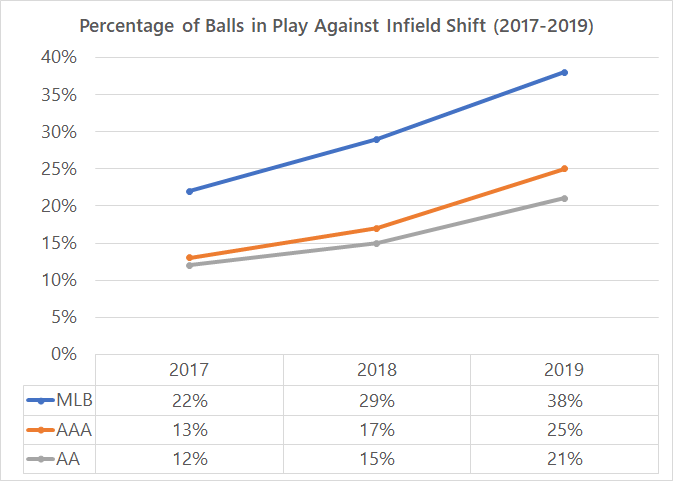
    Infield shifts are on the rise in Major League Baseball again this season. On balls in play, Baseball Info Solutions recorded 26,705 shifts in 2017 (22% of balls in play) and 34,671 in 2018 (29% of balls in play). This year, there have been 13,272 shifts (38% of balls in play), which prorates to more than 44,000 for a full season.

    And while our company and others in the industry have talked a lot about shifts at the MLB level, what about shifts in the minor leagues? Are they rising like they are in the majors? Are they are as common?

    BIS charts all AAA games and nearly all AA games (about 90-95%), so let’s take a look.

    Here’s a comparison of MLB, AAA, and AA in terms of percentage of balls in play against an infield shift over the last three seasons.

    Although the infield shift isn’t as common in the upper minors as it is in the majors, it is increasingly prevalent. This season, both AAA and AA teams have had a shift on for more than 20% of balls in play for the first time.

    Here are the leaders and trailers in shift usage at the AAA level this year, combining the International and Pacific Coast leagues:

    And here are the leaders and trailers at AA, combining the Eastern, Southern, and Texas leagues:

    The Twins have shifted the highest percentage of balls in play in the majors this year, so it’s not surprising to see their affiliates near the top in AA and AAA as well. Teams like the Rays and Pirates have also historically shifted a lot and have minor league clubs listed near the top here. And the Marlins have increased their shift usage this year, and their Jacksonville affiliate leads all AA teams.

    How well does a minor league team’s shift usage track with the shift usage of its parent club? For 2019, the correlation between MLB and AAA…

    … appears stronger than the correlation between MLB and AA.

    So while teams don’t shift as much in the minors as they do in the majors, they are becoming more popular. Infielders, pitchers, and hitters are getting accustomed to extreme infield alignments before they even get the call to MLB.

  • 2019 Top College Baseball Draft Prospects: Left-Handed Pitching (Part 1)

    Over the next month leading up to the 2019 MLB Amateur Draft, Baseball Info Solutions will be publishing a series of position-by-position scouting reports from our Video Scouts for the top-50 collegiate draft prospects. Each player is graded by the 20-80 scouting scale, given a comprehensive evaluation, and assigned a floor and a ceiling comparison, which indicate–if a player makes the Major Leagues–the range of the type of player into which he can develop.

    Full coverage:
    Catchers
    Corner Infield (Part 1)
    Corner Infield (Part 2) 
    Middle Infield (Part 1)
    Middle Infield (Part 2)
    Outfield (Part 1)
    Outfield (Part 2)
    Left-Handed Pitching (Part 1)
    Left-Handed Pitching (Part 2)
    Right-Handed Pitching (Part 1)
    Right-Handed Pitching (Part 2)

    With 31 position players already covered in previous posts, this next installment focuses on the top tier of left-handed pitchers. There are only seven lefties in our top 50, but they have all done enough at the college level to warrant being drafted in the first four or five rounds.

    This group is headlined by two likely top-15 picks, with two other guys who should come off the board early on Day 2. Nick Lodolo has the most upside of any college pitcher in this class, but he still has a lot of development left ahead of him. Zack Thompson, John Doxakis and Ethan Small are more floor over ceiling, but are all coming off of a 2019 season in which they dominated SEC competition.


    Nick Lodolo, LHP
    Texas Christian University (JR, 2019)
    L/L 6-06, 185 lbs
    Date of Birth: 02/05/1998

    Fastball- 55 (65) Slider- 55 (65) Changeup- 45 (55) Control- 50 (55)

    Written by Harris Yudin

    Analysis
    Despite being drafted 41st overall by the Pittsburgh Pirates in 2016, Nick Lodolo decided to put off professional baseball in favor of a career at TCU. He flashed moments of brilliance over his first two years in college, but allowed his ERA to inflate over 4.00 both seasons. He has enjoyed a breakout junior campaign, however, and even with a couple of rough outings in Big 12 play, he still managed a 2.18 ERA across 91 innings over the regular season, compiling 113 strikeouts with just 19 walks in the process. His 5.95 strikeout-to-walk ratio led all Big 12 pitchers with at least 50 innings pitched.

    Operating out of a low three-quarters arm slot, Lodolo has a unique but smooth delivery that he repeats surprisingly well– he has made significant strides in this area over the last three years. He has an athletic build and a lean, wiry frame — a combination that oozes projectability — and he uses his length to get good extension and deception, the latter more so against lefties.

    Lodolo’s repertoire is headlined by a low-to-mid-90s fastball with late life. He has touched 96 on occasion, and given his frame, he is expected to pack on at least 20 pounds over the next few years, which should allow him to add a couple of ticks. His best secondary pitch is a wipeout breaking ball that he manipulates and can tailor to the current situation and batter, getting both called strikes and chases against both lefties and righties. He throws it with a cutter grip but calls it a slider, and the fact that he can change its shape and use it in different ways suggests a possibility of turning it into two separate pitches at the next level. He also works in a rare changeup, mostly to righties in an effort to keep them off-balance, and while it is largely a work in progress, he has flashed the potential to develop it into at least an average offering.

    Lodolo’s control is mostly good, but it can get away from him at times, particularly with the fastball. He commands each of his pitches pretty well, but the command will need to catch up to his stuff if he wants to maximize his overall arsenal. He has a habit of taking too long to settle in, often struggling in the first inning, but even when he doesn’t have his best stuff or is let down by a subpar TCU defense, he has demonstrated the ability to keep his composure and stay level-headed.

    Outlook
    Lodolo is widely considered the top arm in the 2019 draft class — albeit a relatively weak class, pitching-wise — and while he has the raw tools to back it up, he has a long way to go to reach his full potential. If he can turn that changeup into an above-average major league pitch and command all of his pitches more consistently, the talented lefty could one day find himself atop a big-league rotation. On the other hand, failure to make these improvements would likely lead to a future in the bullpen, where he has the fastball-slider combination to be an electric late-inning option.

    Projection: Potential front-line starter with two plus pitches and inconsistent command.

    Ceiling: Madison Bumgarner
    Floor: Andrew Miller
    Draft Expectation: Top-10 Pick

    Zack Thompson, LHP
    University of Kentucky (JR, 2019)
    L/L 6-03, 225 lbs
    Date of Birth: 10/28/1997

    Fastball- 55 (60) Slider- 55 (60) Curveball- 50 (55) Changeup- 50 (55) Control- 45 (55)

    Written by Kyle Price

    Analysis
    Thompson is a three-year starter for Kentucky, coming out of the bullpen his freshman year in addition to being a mid-week starter. Injuries have been a concern for the Wildcats’ lefthander since coming out of high school, when he failed a post-draft physical for a shoulder issue after being drafted in the 11th round by the Rays. He also missed two months of his sophomore season due to an elbow injury that didn’t require surgery. He overcame any injury concerns in 2019, tossing 90 innings across 14 regular season starts and displaying the ability to consistently go deep into games– he’s thrown at least six innings in 12 of those starts, including two complete games. In addition to the increased workload, Thompson has been pretty dominant as a junior, striking out 130 batters with a 2.40 ERA and a .184 batting average against.

    Thompson has a medium, athletic build with a strong lower half that generates good drive towards the plate. He has a high three quarters release point and finishes bent over his lead leg, typically following through facing third base. His delivery is very smooth and repeatable, which is why he is able to go deep into games while maintaining velocity and movement, and should translate well into a lengthier season at the pro level.

    Thompson features a solid, four-pitch mix with a fastball, slider, curveball and changeup. His fastball and slider work very well off each other, with his fastball topping out at 96 mph but sitting 91-93 with good run. His slider is another plus pitch that can be cutterish at times in the low-to-mid 80s, and could ultimately develop into two different pitches. His curveball, like his slider, has a very good spin rate, is very loopy but doesn’t play as well off his fastball. He mostly uses his changeup to keep hitters off-balance, and he has the potential to develop it into a fourth above-average pitch.

    Besides injuries, control is Thompson’s biggest concern, as walks have been an issue throughout his career at Kentucky. While he was able to get a lot of hitters to chase and create swings and misses in college, hitters at the next level should be able to lay off some of those pitches, draw more walks and increase his pitch count.

    Outlook
    Thompson might be the most polished left-handed pitcher in this draft, and could have the highest floor. However, his frame and build have little room for growth, which could limit his ability to add velocity and break to his pitches. He seems to have put the injuries behind him, and his biggest concern is his control, but that should improve as he makes his way to the majors. At worst, he should be a back-end starter, but he has the makings to be a very solid number two.

    Projection: Future mid-rotation starter with four potential above-average pitches.

    Ceiling: Jon Lester
    Floor: Tyler Anderson
    Draft Expectation: Top-15 Pick

    John Doxakis, LHP
    Texas A&M University (JR, 2019)
    L/L 6-04, 215 lbs
    Date of Birth: 08/20/1998

    Fastball- 50 (55) Slider- 50 (55) Changeup- 45 (55) Control- 55 (60)

    Written by Dominic Asta

    Analysis
    John Doxakis has excelled in his role as the Aggies’ Friday night starter this season. He has posted a 2.01 ERA and 96 strikeouts in 89.2 innings as a junior, besting his sophomore year numbers of a 2.70 ERA and 92 strikeouts. Doxakis has shot up draft boards this season by dominating in SEC play and increasing his strikeout numbers. With the potential for three above-average pitches and good control, he should hear his name called in the first couple of rounds in the upcoming draft.

    Doxakis has a large frame with a strong lower half and room to add weight. He has a repeatable delivery and a low three-quarters arm slot. He works quickly through his windup with a high leg kick and a drop-and-drive delivery towards the plate. He keeps good balance over the rubber and is consistent with his stride and plant foot. He starts in the middle of the rubber and strides directly towards home plate, creating good extension.

    Doxakis works his fastball in the upper 80s and low 90s with great arm-side sink. He may only have average fastball velocity, but the pitch plays up because of the movement and his unique arm slot and extension. He has the frame and strength to project an increase in velocity on his fastball, which flashed mid-90s as a reliever his freshman year. His slider is his strikeout pitch, and has great depth and late action. He throws the pitch mostly in the low 80s, but can manipulate the velocity and shape. He has the ability to throw the slider for strikes and also back-foot the pitch to righties for strikeouts. His changeup is a work in progress that flashes above-average potential with good fade, thrown with the same arm speed as his fastball. He does not throw it very often, but it has good velocity separation from his fastball, sitting mostly 81-84.

    Doxakis controls all three pitches well and pounds the strike zone consistently. He decreased his BB/9 from 2.8 last season to 2.2 this year, and limited opponents to only four home runs in almost 90 innings of work. He works quickly and has great tempo on the mound.  There are some concerns with his delivery and low arm slot, leading some to project him as a future bullpen arm. He has proven to be very durable in college, through, with a repeatable delivery and above-average control. He should be able to remain a starter at the professional level

    Outlook
    Doxakis is young for his draft class. He will be only 20 years old when the draft occurs in June. He does not have the raw stuff to be a front-line starter, but he has a high floor, and the frame and pitchability to be a reliable starter. He pitches with tenacity and toughness on the mound and is a great competitor. If he can add a few ticks to his fastball, he has the potential to be a solid mid-rotation guy at the next level. If he is moved to the bullpen in pro ball, he has shown increased velocity in shorter outings in the past.

    Projection: Back-end rotation arm with flashes of dominance and a floor of an effective reliever.

    Ceiling: Alex Wood
    Floor: Tony Watson
    Draft Expectation: Rounds 2-3

    Ethan Small, LHP
    Mississippi State University (RS JR, 2019)
    L/L 6-03, 214 lbs
    Date of Birth: 02/14/1997

    Fastball- 50 (55) Curveball- 45 (55) Changeup- 40 (45) Control- 55 (60)

    Written by John Todd

    Analysis
    Ethan Small is a two-year starter for Mississippi State, having made 15 relief appearances in his 2016 freshman campaign and missing all of the 2017 season after undergoing Tommy John surgery the previous summer. He bounced back in 2018 to make an SEC-high 18 starts as the Bulldogs’ number two, leading the team in strikeouts and ERA, and was taken by the Arizona Diamondbacks in the 26th round of the MLB Draft that summer. Small returned to school, however, and has since raised his level of play again, just two years removed from surgery. So far this season, the left-hander is second in the country in K/9 and WHIP, at 15.2 and 0.78, respectively, through 13 starts.

    Small has a medium, slightly wiry frame with decent athleticism, some muscle in his lower half, and upper body strength growth potential. He has a full-circle delivery, showing the ball well behind his body before getting to his overhand. He has a cross-body finish well toward third, ending with his back to the plate. He pitches hunched over and lacks some lower body extension to the plate. Despite a bit of lankiness and a long-limbed finish, he has repeatable arm actions and clears out his elbow and body well, limiting elbow stress. Small will vary his windup in advantageous counts occasionally, keeping hitters off-balance by mixing in a full-stop in his leg kick. He has shown, on numerous occasions, a high level of competitiveness, self-confidence and visible passion when challenged by opponents.

    He relies heavily on a high-80s-to-low-90s fastball, mixing in a curve and changeup with decent separation. Despite the low overall velocity, Small gets good carry on his fastball and induces a high number of swings and misses. He pounds the zone and shows impressive command to both sides of the plate. The curveball doesn’t always bite consistently, but he controls it well, and it has shown flashes of being a two-plane, hammer-breaking pitch. He doesn’t have a great feel for throwing his changeup for strikes, but he keeps it down and changes eye levels.

    Small is a rhythm pitcher who attacks batters and doesn’t waste pitches. He runs on adrenaline and pumps his velo up on out pitches. He’ll need to improve on his ability to getting hitters to chase out of the zone with his offspeed offerings moving forward.

    Outlook
    Small has made serious improvements in his two years as a starter, suggesting he’s just beginning to scratch the surface of his potential, but his ceiling may be capped by a lack of plus tools. He has two future average offerings with plus control and makeup. Small will win at the next level with his ability to consistently throw strikes from the left side and pitch with command and an attack-minded approach. He should continue to develop as a starter as he works on his offspeed pitches, and projects as a back-end guy with a ceiling of a No. 3. At the very least, though, he could be a high-end left-handed arm out of the bullpen, where he can maximize his velocity in shorter outings and prioritize his two pitches that consistently miss bats.

    Projection: Reliable, back-end starter with above-average command and some upside.

    Ceiling: Barry Zito
    Floor: Brett Cecil
    Draft Expectation: Rounds 3-4


    Other left-handed pitchers to keep an eye on:
    TJ Sikkema, University of Missouri
    Brandon Williamson, Texas Christian University
    Ben Brecht, UC Santa Barbara
    Jake Agnos, East Carolina University

  • 2019 Top College Baseball Draft Prospects: Outfield (Part 2)

    Over the next month leading up to the 2019 MLB Amateur Draft, Baseball Info Solutions will be publishing a series of position-by-position scouting reports from our Video Scouts for the top-50 collegiate draft prospects. Each player is graded by the 20-80 scouting scale, given a comprehensive evaluation, and assigned a floor and a ceiling comparison, which indicate–if a player makes the Major Leagues–the range of the type of player into which he can develop.

    Full coverage:
    Catchers
    Corner Infield (Part 1)
    Corner Infield (Part 2) 
    Middle Infield (Part 1)
    Middle Infield (Part 2)
    Outfield (Part 1)
    Outfield (Part 2)
    Left-Handed Pitching (Part 1)
    Left-Handed Pitching (Part 2)
    Right-Handed Pitching (Part 1)
    Right-Handed Pitching (Part 2)

    This post covers the second tier of our top-ranked outfielders for the upcoming MLB Draft in June. Though there are no first-rounders here. All four should be drafted within the first five rounds.

    Unlike some of the guys from the previous group, none of these outfielders possess much of a power-speed combination, but they should all provide one or the other to whichever team drafts them. Matt Wallner and Will Robertson are small-school right fielders with impressive power. Kyle Stowers has played all three outfield positions but fits best in left. Zach Watson has the best speed of the group, and is the only true center fielder.


    Matt Wallner, OF
    University of Southern Mississippi (JR, 2019)
    L/R 6-05, 220 lbs.
    Date of Birth: 12/12/1997

    Hit- 35 (45) Power- 50 (55) Run- 45 (40) Arm- 55 (55) Field- 50 (45)

    Written by Will Hoefer

    Analysis
    Wallner, an immense corner outfielder with easy plus raw power, has gotten off the mound and focused solely on hitting in his junior year at Southern Miss. The numbers are down a little bit in 2019, but a third straight season with a chance at an OPS greater than 1.000 is still a very impressive feat. Wallner is currently batting .293/.405/.585 with 15 home runs and a 16 percent walk rate.

    Swing and miss is likely to be an unavoidable consequence of Wallner’s lengthy stroke at the plate, and there’s a long leg kick load that could stand to be shortened up in a effort to polish timing issues. However, he does have solid hands, plus bat speed and a strong command of the strike zone, with plenty of loft generated on contact. Getting to that impressive raw power more consistently, whether it be through adjustments in hand position, closing his stance or smoothing out the rhythm of his lower body, will be the key to how far Wallner can go as a pro.

    On defense, Wallner moves decently in right and has strong instincts in the field. Though he’s likely to lose a step due to his size and turn into a below average runner as he gets older, Wallner has the requisite arm strength and accuracy to stick in right field. It’ll be important for him to maintain the leanness of his body, as any additional loss of lateral quickness could move Wallner to first base and put additional pressure on his bat.

    Outlook
    Wallner has some of the best raw power in this draft class, with 50 home runs in his college career, and there’s an advanced enough eye and approach to mitigate the whiffs. With a full-time role, expect at least 20 homers annually with fringe-average on-base skills that are depressed by a low BABIP and a high strikeout rate.

    Projection: Defensively-capable right fielder with above-average arm strength and power.

    Ceiling: Jay Bruce
    Floor: Garrett Jones
    Draft Expectation: Rounds 2-3

    Kyle Stowers, OF
    Stanford University (JR, 2019)
    L/L 6-3, 200 lbs
    Date of Birth: 01/02/1998

    Hit- 40 (50) Power- 45 (55) Run- 50 (50) Arm- 40 (40) Field- 55 (60)

    Written by Mitch Glessner

    Analysis
    After a stellar sophomore season — in which he was an All-Pac 12 honorable mention — and a great summer in the Cape Cod League, Kyle Stowers entered the 2019 season as one of the top outfielders in his class. He was named to the Golden Spikes Award Preseason Watch List and Baseball America preseason first-team All-America. He struggled out of the gate in his junior campaign, but has hit .326 with a .966 OPS and five home runs in Pac-12 conference play. Stowers’ unorthodox but effective hitting ability combined with solid outfield play makes him an intriguing draft prospect.

    Stowers stands very tall at the plate with a narrow base, and his hands start around chest height. A slight bat wiggle and long stride provide his load and timing, while his hands raise and separate. Mechanically, the swing itself looks much like Joc Pederson’s. While there are inconsistencies in his timing, his explosive hands can rip the barrel through the zone for solid contact even when his body is not in sync. He takes a very short path to the baseball and controls the barrel on both high and low pitches.

    Stowers will run into trouble when his timing isn’t exceptional. His narrow base and long open stride can sometimes trigger his lower half too early in his swing. He will bail out with his body when he is fooled by off-speed pitches. With some mechanical adjustments, his inconsistencies can be ironed out at the next level.

    Stowers has played a majority of his junior campaign in center field, with some action in left field, as well. He possesses very good outfield instincts, consistently makes good reads and has good first-step quickness, allowing him to cover a good amount of ground. He is not the fastest player in terms of pure running speed, but has shown that he can play every day in the outfield based on his instincts. The only concern for Stowers in the outfield is his arm. He has a very short circle, almost like an infielder’s, which does not produce much arm action, and his ball does not retain a lot of carry in its flight. His arm isn’t the strongest, but he can make it work by getting the ball out quickly and accurately to his target.

    Outlook
    Stowers does have the potential to be an every day contributor at the major league level, but he will have to make mechanical adjustments to be more consistent, and broaden his approach by going the other way, considering the prevalence of shifting in today’s game. His glove will play in the outfield, although he will likely move to left field.

    Projection: Starting left fielder with good power and inconsistent hit tool.

    Ceiling: Colby Rasmus
    Floor: Jeremy Hermida
    Draft Expectation: Rounds 2-3

    Will Robertson, OF
    Creighton University (JR, 2019)
    L/L 6-02, 210 lbs
    Date of Birth: 12/26/1997

    Hit- 40 (50) Power- 55 (60) Run- 50 (45) Arm- 50 (50) Field- 50 (55)

    Written by Dominic Asta

    Analysis
    Will Robertson was lightly recruited out of high school, but has become one of the best college outfielders while at Creighton. He has shown impressive power in college while playing in TD Ameritrade Park, a ballpark with huge dimensions. He is hitting .294/.388/.567 with 11 homers and 16 doubles in his junior season, and performed quite well in the Cape Cod League this past summer, batting .300/.380/.435 with four home runs and 11 doubles. Robertson has played exclusively right field for Creighton in his three years as a starter. He stands out for his immense raw power and his production in college and Cape Cod.

    Robertson has a strong, muscular build with average athleticism. He has a wide-crouched, open stance at the plate, and his leg kick helps to square his shoulders and get his front foot down. He holds his hands chest level and brings them back in his load while using his lower half well to drive the ball. He has a level swing and a quick bat that produces great pull-side power and line drives. His stance and swing mechanics are reminiscent of Kyle Schwarber. Robertson does not use the opposite field consistently and may need to adjust his stance and be more upright to use the entire field. He has kept his strikeout numbers down in college, with strikeout rates of 14 percent last season and 17 percent this season. Robertson does not walk at a great rate, either, posting walk rates of 8 and 9 percent the last two seasons.

    Robertson has been a right fielder his entire college career and has enough speed and range to stick there, but his arm is only average and would fit better in left field. He gets good reads and takes efficient routes in a big right field in his home ballpark. Robertson is an average runner with mostly 4.2-4.3 times from home to first. He has only stolen five bases in his college career and should not be a stolen base threat at the next level.

    Outlook
    Having flown under the radar coming out of a small Missouri high school, Robertson has had to consistently prove doubters wrong. He opened eyes in the Cape Cod League last summer and has backed his performance up with another impressive year at Creighton. His powerful lefty swing and ability to play in right field will be very attractive come draft day.

    Projection: Solid corner outfielder with future 25-home run power.

    Ceiling: Geoff Jenkins
    Floor: Brad Hawpe
    Draft Expectation: Rounds 3-4

    Zach Watson, OF
    Louisiana State University (JR, 2019)
    R/R 6-00, 164 lbs
    Date of Birth: 06/25/1997

    Hit- 35 (45) Power- 35 (45) Run- 70 (70) Arm- 45 (50) Field- 60 (65)

    Written By Max Schell

    Analysis
    Zach Watson is one of the fastest and most decorated players eligible for the for the 2019 MLB Amateur draft. In 2017, he was named Baseball America’s No. 1 pro prospect in the Northwoods League. In the summer of 2018, he was a member of Team USA’s collegiate team, leading the team in runs scored. He has been LSU’s starting center fielder for  each of the three seasons he has been in Baton Rouge. At LSU, he has been named 2017 Freshman All-SEC, 2017 Freshman All-American, 2018 SEC All-Defensive Team and 2018 ABCA Gold Glove Team.

    Watson has a slightly open batting stance at the plate with his feet just further than shoulder-width apart. He has a quick, but large leg kick in his swing and has very fast hands. At times he will get burned on the inside fastball because he gets his front foot down right as or after the pitcher releases the ball. He hits to all fields, and can do so with power, as well. Speed is the best part of his game. He has a chance to beat out almost any ground ball. He has good stolen base numbers in his collegiate career, with 36 steals in 45 attempts.

    With a similar build to Billy Hamilton, it would be beneficial to him to add some weight via the weight room. This would help his power numbers, and could have him hitting close to 20 home runs per season. The other aspects of his game he needs to work on are knowing when to steal and reading and understanding the opposing pitchers’ moves. With Watson’s speed, he should be a 35-stolen base threat each season as a professional. He needs to develop better pitch recognition in order to get on base and utilize his speed more. He has totaled 124 strikeouts to only 46 walks over his career at LSU.

    Outlook
    Watson currently has two major league-ready tools with his speed and fielding. If he can prove that he can hit professional pitching and put some serious effort into the weight room, he could become an above-average, everyday center fielder in the majors. Watson is more of a risky pick, though, with the adjustments he needs to make while he develops his baseball instincts.

    Projection: Everyday center fielder with massive stolen base potential.

    Ceiling: A.J. Pollock
    Floor: Peter Bourjos
    Draft expectation: Rounds 4-5


    Other outfielders to keep an eye on:
    Jake Mangum, Mississippi State University
    Tommy Jew, UC Santa Barbara
    John Rave, Illinois State University
    Pat DeMarco, Vanderbilt University