Category: MLB

  • Limiting damage, improved walk rate keying Phillies’ success

    By ALEX VIGDERMAN

    At least through the first third of the year, 2018 is shaping up to be the Year of Philadelphia. The Eagles finally won the Super Bowl, the Villanova Wildcats (admittedly merely a Philly suburb) won their second National Championship in three years, and the 76ers seem to finally be rewarding their fans’ Trust in the Process. The Flyers don’t fit with this narrative so we will not mention them.

    The Phillies made a few moves in the offseason and made an exciting managerial hire that signaled they were ready to take a leap after winning between 63 and 73 games each of the previous five seasons. And they proceeded to fall right on their spreadsheet-loving faces the first week of the year, starting 1-4 and making numerous pitcher-management and defensive-positioning blunders along the way.

    Well, since then the team has gone 13-3 and now sits just a half game out of the division lead. In fact, since April 5 they’ve scored the most runs in the National League and allowed the fewest.

    So they must be mashing, right? Well, sort of. They’re middle of the pack in both batting average and slugging percentage, but where the team is really making its bones is with plate discipline.

    They are walking an MLB-high 12 percent of the time so far this year, a four percentage-point jump from 2017 (when they ranked 22nd).

    You can thank a full complement of Rhys Hoskins and the addition of Carlos Santana for that. Phillies first basemen walked 56 times last season. Santana has topped that by at least 30 in each of the last seven seasons. The Phillies totaled 160 walks from their outfielders last season. They’re already at 40.

    If they were to maintain their walk percentage pace, it would be the largest year-to-year jump in walk rate since the 1940’s by nearly a full percentage point.

    Of course, the pitching is where the team has really performed excellently, even with much of the same cast of characters. Their starter ERA of 3.01 ranks fourth in the majors and tops in the NL, and after the whole kerfuffle about pulling Aaron Nola too early in the season opener, they rank in the top ten so far in the percentage of innings coming from starters.

    It seems possible they’ll be able to keep up this performance, as well, as the pitching staff as a whole has the lowest Hard Hit Rate in the major leagues at 17 percent.

    MLB Hard Hit Rate Allowed Leaders, 2018

    Rank Team Hard Hit %
    1 Phillies 17%
    2 Astros 18%
    3 Nationals 20%
    4 Mets 21%
    5 Cubs 21%

    That pitching success is coming in spite of a lackluster defensive showing, both from the fielders themselves and from the more aggressive defensive positioning adjustments the new coaching staff has implemented.

    The Phillies are last in the majors with -14 Defensive Runs Saved, including -4 Shift Runs Saved, which also ranks last in MLB. The team as a whole is new to shifting, of course, as they are projected to more than double their shift usage from any previous season.

    Some improvement is likely to come in that department as the fielders get more comfortable with the new approach to positioning, but this was a team whose defense cost itself 50 runs last season, so let’s not get carried away with those expectations.

    Heading into the last week of April this is one of the more surprisingly good starts of any team in baseball, and a vastly-improved approach at the plate and underperforming defense thus far suggest that they might be able to keep this up a bit longer.

    Follow us on Twitter at @Sportsinfo_SIS

  • Who are the best infielders at avoiding mistakes?

    By MARK SIMON
    A couple of weeks ago, we ran an article in The Athletic explaining our detailed scoring system for tracking Defensive Misplays and Errors. The piece focused mostly on those who were frequent mistake-makers, so we thought that we would share a look at the game’s best at avoiding defensive mistakes. We’ll do one post covering the infield and another looking at outfielders.

    For our purposes, we’ll look at extended runs of play – the referenced leaders will all be within the last four seasons entering play on April 23, and will have played at least 1,500 innings at that position.

    The leaderboard is based on video tracking that assesses Good Fielding Plays for 30 types of defensive excellence and Defensive Misplays & Errors for about 60 types of mistakes.

    First Base: The most mistake-free players here are Paul Goldschmidt of the Diamondbacks and Joe Mauer of the Twins, each of whom averages just over one Misplay & Error per 100 innings. With Goldschmidt, that’s not surprising given that he’s won three Gold Glove Awards and three Fielding Bible Awards. Mauer hasn’t won one at first base yet. But he has by far the best Good Fielding Play to Misplay & Error ratio of any first baseman.

    Second Base: Robinson Canó of the Mariners and Joe Panik of the Giants rank 1-2, each averaging just under 2 Misplays & Errors per 100 innings. Though neither ranks close to the leaders in Defensive Runs Saved at the position in that time, each plays a highly fundamentally sound brand of defense that limits miscues.

    Shortstop: The leader here is unsigned former Orioles shortstop J.J. Hardy, who was one of the game’s top infield defenders from 2012 to 2016. He averaged just under 2 Misplays & Errors per 100 innings, a hair ahead of Tigers shortstop José Iglesias. Though Andrelton Simmons dominates the shortstop position from a defensive perspective. Iglesias is better in this regard, averaging 2 Misplays & Errors per 100 Innings to Simmons’ 2.4 (which ranks fifth at the position).

    Third Base: Nationals third baseman Anthony Rendon is one of those players who is very good in many areas and avoiding mistakes is one of them. Rendon is the only player averaging fewer than 2 Misplays & Errors per 100 innings at third base. Injured Dodgers third baseman Justin Turner ranks second (2.2 Misplays & Errors per 100 innings).

    For those wondering, Nolan Arenado ranks 12th, as his style of play lends itself to an abundance of Good Fielding Plays (his 213 are 73 better than the player who ranks second) and Misplays & Errors (116 – only Todd Frazier has more with 119)

     We will look at outfielders in a future post

  • Breaking Down Mike Zunino’s Swing Changes

    Breaking Down Mike Zunino’s Swing Changes

    If you haven’t noticed, Mike Zunino has been smashing baseballs lately. Since his call-up from Triple-A (May 22) where he underwent mechanical changes, he’s hit .311/.364/.667 with nine home runs and five doubles. He’s driving the ball to center field and making an honest effort to use all parts of the field. And the mechanical changes he made are proof of this new found approach. So what’s changed?

    The Set-Up
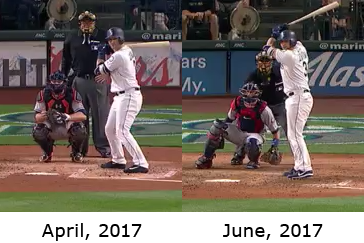
    In April, Zunino’s set-up featured an open stance, with the bat comfortably rested on his shoulder, and his feet spread about shoulder width. Since being recalled, Zunino has brought his feet closer together and is starting his left foot in a slightly-more closed stance. He also has raised his hands a bit above his head, similar to Nelson Cruz.


    The Stride
    As you grow up playing baseball, you’re generally taught to stride towards the pitcher. In April, Zunino’s front foot would have a tendency to land in what’s commonly known as “the bucket”, meaning he was striding away from the plate. His initial stride looked to be headed towards the pitcher, but right as his front leg started to come down, his foot swung his hips open and his front foot landed towards third base. That type of stride typically makes it more difficult for batters to cover the outer half of the plate, and Zunino’s hot-and-cold zones from April demonstrate that he faced similar problems:

    Zunino SLG Before Demotion

    For that period, Zunino slugged just .130 in the three outside zones combined. Compare that to Zunino’s heat map over the last month since he was recalled:

    Zunino SLG After Demotion

    Zunino’s mechanical changes now have his front foot landing parallel to the pitcher, and the evidence supports that he’s now able to do damage on the outer half.

    You’ll also notice that he’s no longer striding to a pointed toe, instead choosing to land more on the balls of his feet. The result is that once he decides to swing, his trigger (front-foot) can fire faster, creating more time for him to process the pitch. Basically, there’s less wasted movement which results in a more explosive and compact swing.

    Zunino’s always been touted as being incredibly strong, and this newfound approach and mechanical adjustments give him more opportunities to take advantage of his natural power.

    April swing

    June swing

  • The Strike Zone and the Umpires That Control It

    The Strike Zone and the Umpires That Control It

    Introduction 

    One of the most discussed issues in Major League Baseball is the consistency of the strike zone. The Rule Book strike zone states “The STRIKE ZONE is that area over home plate the upper limit of which is a horizontal line at the midpoint between the top of the shoulders and the top of the uniform pants, and the lower level is a line at the hollow beneath the kneecap. The Strike Zone shall be determined from the batter’s stance as the batter is prepared to swing at a pitched ball.” After watching games throughout the regular season and playoffs, it is easy to realize this is not the strike zone that is called. Each umpire has tendencies and dictates his own strike zone and how he will call a game. With the rise of PITCHf/x and Trackman in the last few years, umpires have been increasingly monitored and judged for their accuracy and impartiality. For this reason, umpires are criticized for incorrect calls more than ever before and I believe are now trending towards enforcing the Rule Book strike zone more than in years past.

    The purpose of this research will be to do two things. First, I will focus on identifying overarching themes where I look at finding how umpires are adjusting to modern  technology but also how the Rule Book strike zone is not the strike zone we know. After this, I will dive into a few umpire-specific tendencies. The latter would be helpful to teams in preparing their advance reports by knowing how certain umpires call “their” strike zone dictated by situations in a game.

    Analysis

    Using PITCHf/x downloaded through Baseball Savant, I have looked at major league umpires since 2012 in regards to their accuracy in correctly labelling pitches, primarily strikes, and their tendencies dictated by specific situations. While the height of the strike zone is often influenced by the height of the batter, there are other factors to take into account such as the how the batter readies himself to swing at a pitch. Unfortunately, the information publicly available to conduct this research does not include the batter handedness, pitcher name, or measurements of individual strike zone limits. For this reason, a stagnant strike zone serves our needs best. The height of the strike zone shall be known as 1.5 feet from the ground to 3.6 feet from the ground. This is the given strike zone of a batter while using the pitchRx package through RStudio when individual batter height is not included. All PITCHf/x data is from the Catcher/Umpire perspective, having negative horizontal location to the left and positive to the right. The width of home plate is 17 inches, 8.5 inches to both sides where the middle of the plate represents 0 inches. After calculating the average diameter of a baseball at 2.91 inches, we add this to the width of the plate. Therefore our strike zone width will be 17 + 5.82, or 22.82 inches. The limits we will then set are going to be -.951 to .951 feet (or 11.41/12 inches). Throughout the paper I will be referring to pitches that fall within the boundaries of our zone as “Actual Strikes” and pitches correctly identified as strikes within this zone as “Correctly Called Strikes.”

    Called Strike Accuracy By Year

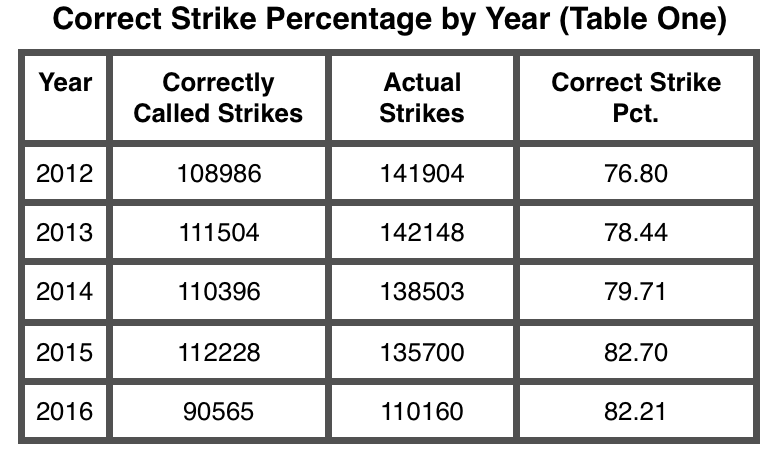
    As Table 1 shows, correctly identifying strikes that fall in the parameters of the Rule Book strike zone has risen substantially. While 2015 has a higher percentage of correctly called strikes, 2016 PITCHf/x data from Baseball Savant was incomplete with 28 days worth of games unavailable at the time of this research. A rise of 5.90 percent correctly called strikes from 2012 to 2015 shows the Rule Book strike zone is being more strictly enforced.

    Table 1
    table-one

    While this provides some information, we can also look into where strikes are correctly being called using binned zones. Understanding that the evolution of umpires over the last 5 years is taking place and trending towards correctly identifying strikes more today than in years past, we can analyze where in the strike zone, strikes have been correctly labeled.

    Called Strike Accuracy by Pitch Location

    In Table 2, we can see a tendency amongst umpires. Strikes are called strikes more routinely over the middle of the plate and to the left (from umpire perspective). As I have mentioned before, the publicly available PITCHf/x data I used did not include batter handedness and I am unable to determine who is receiving the benefit or disadvantage of these calls. Presumably from previous research on the subject, lefties are having the away strike called more than their right handed counterparts, explaining the separation between correctly identifying strikes in zones 11 and 13 versus 12 and 14.

    Binned Strike Zone
    binned-strike-zone

    Table 2
    table-two

    While one may argue that there should not be strikes in these bordering zones, we consider any pitch that crosses any portion of the plate a strike. Due to our zone including the diameter of the baseball on both sides of the plate, the outer portion of the plate includes pitches where the majority of the ball is located in one of these zones.

    Called Strike Accuracy by Individual Umpire

    When gauging an umpires ability to correctly identify a Rule Book strike, an 85.67% success rate sets the mark with Bill Miller, while Tim Tschida ranks at the bottom of this list, only calling 71.57% correctly. We can infer from Tables Three and Four along with Table One, that while umpires are calling strikes within the strike zone more often, they are still missing over 17% of these pitches. It is important to note that this information does not take into account incorrectly identifying pitches outside the Rule Book strike zone as strikes, which when considering an umpire’s overall accuracy, should absolutely be taken into account.

    Table 3
    table-three

    Table 4
    table-four

    Called Strike and Ball Accuracy by Count

    One of the most influential factors in whether a taken pitch is called a strike or a ball is the count of the at bat. We have all seen pitches in a 3-0 count substantially off of the plate called a strike, just as we have seen 0-2 pitches over the plate ruled balls. Table Five shows the correct percentage of strikes and balls by pitch count. While this shows that umpires are overwhelmingly more accurate at identifying strikes as strikes in a 3-0 count (91.06%) as compared to an 0-2 count (56.66%), we must acknowledge this only paints part of the picture. Umpires are conversely most likely to correctly labels balls in 0-2 (98.73%) counts and misidentify balls in 3-0 (90.32%) counts. I included their accuracy of correctly identifying both strikes and balls here as opposed to throughout the entire paper because we can clearly tell through this information that umpires are giving hitters the benefit of the doubt over pitchers. Umpires are far more likely overall to correctly identify a ball than a strike, as evidenced by the fact that there are no counts during which umpires correctly call less than 90% of balls.

    Table 5
    table-five

    The data in Table Five is corroborated by the visualizations in Figure One and Figure Two. These visualizations of the strike zone include pitches off of the plate and we can see that in a 3-0 count, a more substantial portion of the Rule Book strike zone is called strikes while also incorrectly identifying balls as strikes. While in a 0-2 count, a smaller shaded area of the Rule Book strike zone works with our findings that less strikes are identified correctly but more balls are correctly called.

    Figure 1 and Figure 2
    figure-one-and-two

    Called Strike Accuracy by Pitch Type

    The next area I looked at was whether pitch type significantly altered the accuracy of umpires. In order to do this, I grouped all variations of fastballs into “Fastball” and all other pitches into “Offspeed”, while omitting pitch outs and intentional balls. I was able to see how umpires fared in correctly identifying strikes by pitch type in Table Six.

    Table 6
    table-six

    Not surprisingly, we see Bill Miller near the top of the list with both Offspeed and Fastball accuracy. For umpires as a whole, the difference in accuracy between the two is not large (79.05% Offspeed accuracy vs. 78.91% Fastball strike accuracy). On the other hand, what may come as a surprise is the fact that eight of the top ten highest accuracies were for Offspeed pitches.

    Called Strike Accuracy for Home and Away

    One of the most mentioned tendencies of referees or umpires in any sport is home team favoritism. Whether a foul or no foul call in basketball, in or out of bounds call in football, or a strike or ball ruling in baseball, many think that the home team receives more of an advantage than their visiting counterparts. Looking at top and bottom half of innings, away and home team respectively, we can identify trends and favoritism in major league umpire strike zones.

    While a difference of .62% accuracy may seem like a lot, especially in a sample size of over 650,000 total pitches, we can look at this on a game by game level to see the actual discrepancies. For simplicity’s sake, we can assume 162 games a season, making for roughly 11780 games played in our data set (this subtracts all games from the unavailable 2016 data). This leaves us with 23.03 Correctly Called Strikes out of 29.05 Actual Strikes for away teams per game, meaning that 6.02 strikes were not called. As for home teams, we have 22.04 Correctly Called Strikes a game with 28.02 as the Actual Strikes, averaging 5.98 missed strikes a game. By this measurement we can see that more hitter leniency was given to the away team than the home team.

    During this time frame, while a higher percentage of strikes were judged correctly, hitters were given more leniency as the away team than the home team on a game-by-game basis.

    Table 7
    table-seven

    Called Strike Likeliness in Specific Game Situation

    Included in Table Eight are the three most and least likely umpires to call any non-fastball a strike below the vertical midpoint of our zone. I split the strike zone at 2.55 vertical feet and looked at any pitch (not necessarily within the zone) below that height. Here, we are not judging an umpires accuracy of correctly identifying pitches but rather looking at where a certain umpire may call specific pitches. We can see that Doug Eddings is 5.34% more likely to call a strike on a non-fastball as compared to Carlos Torres.

    While this does not paint the entire picture, we are able to see how their tendencies can play an important role in the game. Information like this may be valuable to a team in deciding how to pitch a specific batter, which reliever to bring into a game, or factor into being more patient or aggressive while at the plate.

    Table 8
    table-eight

    Conclusion

    External pressures and increased standards are undoubtable effects on umpire strike zones. As evidenced throughout this paper, strike zones are called smaller than the Rule Book strike zone specifies. And while umpires are trending towards correctly identifying strikes, situations such as count and pitch type can affect their judgment.

    While the system in place is not 100%, we must understand that these umpires are judging the fastest and most visually deceptive pitches in the world and are the best at what they do. Major League Baseball must use modern technology to their advantage and provide the best training for umpires to achieve the goal of calling the Rule Book strike zone. Another option, while more drastic and difficult to implement, may include adapting the definition of the Rule Book strike zone, something that has not been changed since 1996.

  • My Fielding Bible Awards Ballot

    Filling out my Fielding Bible awards ballot for the first time was exciting and difficult.  Fielding is tough to measure, but Baseball Info Solutions helps provide data to help with that issue.  As video scouts, we get to watch baseball for hours every day, giving us a pretty good idea how good defenders in MLB are. Obviously, we cannot watch every inning of every game. That’s why the data we collect at BIS is so helpful.

    In making my selections, I started by looking at the DRS leaders and went from there. I attempted to find a balance where all or most of the defensive metrics agreed on a player. After DRS, I dug into the more detailed data we keep at BIS, including “good fielding plays,” “defensive misplays,” as well as scout’s defensive rating. I also looked at how often players converted on each difficulty grade (1 through 5). Different things can be looked at for different positions as well, but I’ll explain those later.

    FIRST BASE

    First base is one of the tougher positions to evaluate.  It’s unique in that there is a lot more to look at than just balls hit in their general direction. If a ground ball is hit anywhere on the infield, it is likely that the first baseman will be attempting to make a play.  Handling difficult throws from infielders is something that can go unnoticed, because when a first baseman can’t catch a throw in the dirt, the error usually goes to the thrower. At BIS, we mark down a defensive misplay if we feel the throw should have been handled at first.

    Wil Myers is my pick as the top defensive first baseman in baseball for 2016. The converted outfielder is very athletic and can move around well. He was fourth among first baseman in defensive runs saved with eight. The leader was Anthony Rizzo with 11 DRS. I liked Myers because he was consistently atop the leaderboards with our data at BIS. He led all first baseman with a scout’s defensive rating of 11.3, while Rizzo had just a 0.4 rating. Myers also led all first baseman with at least 250 opportunities in percentage of 2’s and 4’s converted. He made 95.7% of plays that were deemed 2’s on the difficulty scale and 27.8% of plays that were deemed 4’s. Also, not to go unnoticed, he converted 100% of 1’s, which are routine plays.

    As I mentioned before, handling throws from infielders is one of the most important things a first baseman can do. For the most part, handling difficult throws account for a large chunk of a first baseman’s GFP total. Myers had the second most GFP’s among first baseman with 59, and 33 of those were handling difficult throws, also second most. He also had only six DM’s in which he failed to catch the throw from an infielder. Rizzo, meanwhile, had 11 such DM’s and just 24 handling a difficult throw GFP’s. This isn’t a knock on Rizzo, I just think that overall, Myers was the better defender at first base.

    SECOND BASE

    Dustin Pedroia graded out exceptionally well across the board. This is also a player I got to watch a ton of in 2016, and the eye test confirms all the terrific metrics for Pedroia. He has always been an elite defensive second baseman, but his metrics were down in 2015 and people started talking about a defensive decline for him. He quickly proved he’s still at the top of his game in 2016. He was tied with Ian Kinsler for the lead among all second baseman in Defensive Runs Saved with 12. Pedroia was also second in scout’s defensive rating by a slim margin. He had a 10.5 scout’s rating while D.J. LeMahieu had a 10.6 mark. LeMahieu and Pedroia were also neck and neck when it came to net GFP-DM/E. LeMahieu had 60 GFP’s, 19 DM’s, and six errors, while Pedroia had 60 GFP’s, 20 DM’s, and six errors. Also, of players with at least 350 opportunities, Pedroia had the highest percentage of 2’s converted, the third most 3’s, and the sixth most 4’s. Overall, DRS and our scout’s defensive rating agreed that Pedroia is either the best second baseman in the league, or extremely close to being the best second baseman in the league. The same cannot be said for other second basemen.

    SHORTSTOP

    To start off, I want to note that of all the shortstops I watched this year, Simmons was the most impressive. The combination of range, unbelievably quick hands, and accuracy and strength of throws makes him the best and most complete shortstop in the game, in my opinion. The numbers back it up. Brandon Crawford and Addison Russell led shortstops with 20 and 19 DRS respectively, but Simmons was right behind them with 18. Simmons also made the second most GFP’s of any shortstop, with Carlos Correa leading the pack. The issue with Correa, even though he made 14 more GFP’s than Simmons, was mistakes. Correa had 34 DM’s and 14 errors while Simmons had just 21 DM’s and 10 errors. Simmons’ net GFP-DM/E was second as well to Jose Iglesias. Also, of players with at least 400 opportunities, he had the highest percentage of 2’s and 4’s, and the fifth highest percentage of 3’s. So, in making a ton of GFP’s and making a lot of “difficult” plays, Simmons’ range is off the charts. As I mentioned before, his throws are always accurate as well. Of shortstops that made at least 200 throws to first base, Simmons had the fifth highest “good throw rate.” None of the players mentioned above (Russell, Crawford, Correa) had a better good throw rate than Simmons. He made just one throwing error and had zero additional bad throw misplays on the season.

    THIRD BASE

    Third base was one of few positions where I didn’t have as much trouble coming up with a winner. Obviously, there is an abundance of defensive talent at the position, including Manny Machado, Josh Donaldson, Adrian Beltre, Anthony Rendon, and so on. However, there is one player that stands above the rest, and that is Nolan Arenado. He had the most DRS of any third baseman with 20. Kyle Seager and Adrian Beltre tied for second with 15. Incredibly, he also had the most GFP’s by far, with 75. The next closest was Donaldson with 51 GFP’s at third. Arenado made some mistakes, but he still had the highest net GFP-DM/E as well by a pretty good margin. He had the highest scout’s rating at 21.2, with Anthony Rendon coming in second at 16.7. Arenado also had the highest percentage of 4’s converted, at 24.8%. Also, according to Fangraphs, Arenado made the most out of zone plays with 95. The next closest was Seager with 69. Arenado had about an average good throw rate, but he made 307 throws to first, which was over 20 more than the next most, indicating he got to a lot more balls than other third baseman. Once again, anyone who watches Arenado can see how impressive he is at third.

    RIGHT FIELD

    Right field was a tough position with three players that could make a case for the Fielding Bible Award. However, between Mookie Betts, Adam Eaton, and Jason Heyward, Betts comes out on top. First of all, he not only led right fielders with 32 DRS, but he led all of baseball with that total. Betts was also tied with Eaton for the highest Net-GFP/DM total with 11. He was second with 27 GFP’s and made just 16 mistakes with 15 DM’s and one error. The former minor league second baseman showed off a tremendous arm as well, with nine kills and four runs saved from throwing, which were both second in the MLB. He was also fourth in scout’s rating at 6.0.  Betts also had 403 opportunities, which led right fielders. This could be due to his 158 games played, but Fenway Park’s difficult, quirky, and spacious right field may have been a factor in all those opportunities as well. People often say the Red Sox need a good center fielder to play right field because of all the ground to cover. We saw it with Shane Victorino in 2013, when he played an outstanding right field for Boston after spending a majority of his career in center. Betts started 130 games in center for Boston in 2015, and had 10 DRS. His athleticism, speed, and arm have allowed him to make a tremendous transition to right field.

    CENTER FIELD

    Center field was the toughest position to make a decision on, in my opinion. Between guys like Kevin Pillar, Kevin Kiermaier, and Billy Hamilton, you could almost close your eyes and point to one to make the choice.  I closed my eyes and picked Billy Hamilton. Okay, that’s not true, but I still picked Billy Hamilton. That may be a bit surprising since he finished third in DRS among the three guys I mentioned above. Having said that, Hamilton still posted a very impressive 15 Defensive Runs Saved. I trust the numbers and the scout’s we have at BIS, and those numbers along with what I saw from Hamilton this summer is what set him apart for me. Hamilton was tied with Pillar for the lead in scout’s defensive rating at 12.7. They were well ahead of Kiermaier, who had a 3.2 rating. Hamilton also had the most GFP’s and the highest Net-GFP/DME among center fielders. He had 34 good fielding plays and a net of 16. He also did some damage with his arm, with six kills and four runs saved from throwing. What impressed me the most was his conversion rate of 33.3% on plays deemed difficult plays. That’s incredible, but when you watch Hamilton play and see the speed he has, it’s very believable.

    LEFT FIELD

    Starling Marte was the choice for me in left. Marte led all left fielders with 19 DRS. Although he made his fair share of defensive misplays, Marte made up for it and then some with his GFP’s and his arm. He made 22 GFP’s, which was tied for the second most among left fielders. He also had 16 kills, which was double the amount of the next most for left fielders. He also had nine runs saved with his arm, which led left fielders as well. In addition, Marte had the fourth highest percentage of “difficult” plays or 4’s among left fielders that had at least 150 opportunities.

    CATCHER

    For me, this was the easiest position to pick a winner. It’s Buster Posey. He had 23 DRS, with the next closest being Derek Norris at 15. Posey is elite as an all-around defensive catcher, from framing, to blocking, to throwing. Posey led catchers who had at least 300 attempts at blocking a ball with a .952 Catcher Block Rate. He had just two passed balls and only 19 wild pitch misplays. He also grabbed a very impressive 89 extra strikes for his pitchers while throwing out 33% of would-be base stealers. Specifically, his throws to second base are what impressed me the most. The accuracy is incredible, as almost every single one of his throws are either on the bag or to the right of the bag, which is important because the player on the receiving end does not have to reach and waste time for the tag. On these throws to second, Posey threw out 21 of 48 runners.

    MULTI-POSITION

    Jarrod Dyson was my pick here, with Javier Baez a close second. Dyson had the most DRS among players who qualified for multiple positions with 19. What was incredible to me about Dyson, however, was that Dyson saved at least five runs in all three outfield positions. Being able to play all three outfield spots at an elite level is pretty incredible. He also recorded eight kills with his arm, including five from right field, where the arm is relied on more heavily.

    PITCHER

    Yes, I had the 43-year old Bartolo Colon as my winner for best defensive pitcher. Colon led pitchers with eight Defensive Runs Saved. He fielded his position exceptionally well, and did a great job of holding runners on first base. Just 15 runners attempted to steal off Colon, which is wise considering his average time to the plate of 1.30 seconds. Of those 15, four were caught stealing, three were picked off and then caught stealing, and two more were simply picked off by Colon. He controlled the running game about as well as you can. As far as fielding balls back at him, Colon had the second best scout’s rating. He converted 50-50 plays at a much higher rate than 50%, converting on 8 of 9 plays that were deemed a three on the difficulty scale.

  • Defensive Philosophies

    In this era of baseball, there are now two philosophies on how to play defense. Each philosophy is trying to demonstrate which way is best to convert balls into outs. The traditional way of playing a straight up defense has been slowly dying out while the idea of moving defenders around is taking over the league. Teams all around the league are incorporating shifts whether big or small to try to get the advantage on hitters with certain batted-ball tendencies.

    As of today, the two top defensive teams according to Defensive Runs Saved (DRS), a statistic created by Baseball Info Solutions to measure defensive play, are the Chicago Cubs and the Houston Astros. The Cubs have saved 103 runs on defense and the Astros have saved 86. When it comes to defensive philosophies, these teams are polar opposites. The Astros have been leading the new wave of defensive positioning, while the Cubs seem content to keep traditional positioning and only shift when really necessary.

    The Astros have been at the forefront of this new defensive philosophy as they have been the most frequent user of shifts for the past three seasons. This season, they have shifted 1,675 times on balls in play, already a record for a single season, and are on pace for 1,859 shifts. On the other hand, the Cubs have used the fewest shifts of any team in the MLB with 358, with only 181 of those being on groundballs and short line drives—the balls in play shifts effect. Table 1 breaks down the different shifts used by both teams.

    Table 1: Full and Partial Ted Williams Shifts on Groundballs and Short Line Drives as of 9/15/16

    Team Total TW Shifts Full TW Shifts Partial TW Shifts
    Chicago Cubs 181 64 117
    Houston Astros 817 602 212

    Data collected from Baseball Info Solutions 

    While every team has their own philosophy on defense and may only use shifts in certain situations, these teams are at the extremes. The Astros use shifts for the majority of batters in any situation while the Cubs are very selective when using shifts. Both teams have extremely talented infielders that are capable of making highlight-reel plays, but they utilize them differently. Here is a breakdown of each team’s infield defense looking at groundballs and short line drives:

    The Houston Astros

    This season, the Astros have used the most Full Ted Williams shifts (FTW), which is when a team places three fielders on one side of the infield. They have used FTW shifts so much, they may be trying to change the norm of defensive positioning. To put that into perspective, on groundballs and short line drives, they have used a FTW shift 602 times. The next closest is the Colorado Rockies with 466. Overall this season, they have used a FTW shift on 31 percent of balls in the infield. When they are in those shifts this season, they have seen more balls get through the infield than league average. While they are in this positioning almost a third of the time, one would expect to see balls get through for hits, as with a typically positioned defense.

    The Astros seem to enjoy the phrase “go big or go home” when it comes to shifting. They don’t believe in using Partial Ted Williams Shifts as much as, or even in place of, FTW shifts. Partial shifts are when two infielders are shifted well outside of their normal positions but are still on their side of the infield. The Astros prefer using the extreme shifts compared to Partials but have still used them effectively. Of the 215 times they have employed them, they have turned more balls in the infield into outs than the league has on average.

    When the Astros don’t shift, they allow a .256 batting average on balls in the infield, one of the five lowest in baseball. So when the Astros don’t believe the hitter has a strong pull tendency and decide to play traditional defense, they are still having better success than the league. This could be attributed to their talented infield of Alex Bregman, Carlos Correa, and Jose Altuve. These batting averages can be seen in Table 2 below.

    Overall, the Astros are enamored with shifting their defense and trying to take away hits from pull-happy hitters. They believe that if a batter is going to hit the ball on the ground, there is an extremely high chance that it will be to their pull side. They have been successful with that strategy as they have allowed a lower batting average than the league average on all groundballs and short liners, but there are areas for improvement. The Astros prefer to be overhauled to a hitter’s pull side instead of moving slightly toward the batter’s tendencies. This is leading to more opportunities for the defense to get beat by a hitter laying down a bunt, trying to punch the ball through the other way, or getting lucky on a ball off the end of the bat. The Astros are getting beat more than league average on FTW shifts but are producing better results through other shifts. With their talented infielders, the Astros should be able to turn some FTW into Partials in an attempt to stop even more balls from going through.

    Table 2: Batting Average on Groundballs and Short Liners as of 9/15/16

    Team Full Ted Williams Partial Ted Williams No Shift
    Chicago Cubs .203 .179 .207
    Houston Astros .254 .237 .256
    MLB Average .230 .273 .266

    Data collected from Baseball Info Solutions

    The Chicago Cubs

    This season, for all at-bats resulting in groundballs and short line drives, the Cubs have only been shifted on 18 percent of them. While playing in their traditional defense, the Cubs have held opponents to a .207 batting average. That leads the league by 28 points. They have done a better job converting those balls into outs in a traditional defense than any other team in the league and it isn’t close. However, when it comes to shifts, the Cubs still rank highly on defense.

    In their limited showings, the Cubs have been better than the league when using Full shifts. They have only used FTW shifts 64 times on grounders and short liners this year, a whopping 90 percent less than the Astros have. But in those showings, they have held teams to a lower batting average, which is good enough to rank in the top third of the league in that category. The Cubs have used Partial shifts more often than FTW shifts, but their 117 Partials still rank in the bottom third of the league. Although they haven’t used many, the results have been fascinating for them. They have by far the lowest batting average allowed on balls on the infield at .179. The closest team in that category is the Cleveland Indians at .218. While the Cubs do not use shifts nearly as often as other teams in the league, they have seen greater success than any other team in the league.

    How have they had this success? Well, along with having an extremely talented infield consisting of three positional DRS leaders (Addison Russell, Javier Baez, and Anthony Rizzo), the Cubs are extremely selective shifters. They only shift on the likeliest pull candidates (Jay Bruce, Chris Carter, Joc Pederson, etc.), so they are not at the same risk of being beat the other way as many other teams. The Cubs also tend to exaggerate their positioning to the point where isn’t quite enough to be considered a shift. So when it comes to those who have borderline spray charts or are capable of beating a shift, they adjust their positioning to continue benefiting from the range and the arms of their infielders who have shown they can convert most of those balls into outs. They haven’t been wrong.

    This stinginess with shifting has led them to an overall .207 batting average on groundballs and short line drives. So for every five balls that is hit within the infield, only one actually goes for a hit. That is a remarkable number and displays the highest execution of infield defense the game has seen in some time. If they can continue this pace, they will be the first team to hold teams below .220 since the Athletics held opponents to a .216 average in 2005, before shifts had taken over the game.


    Both teams are having defensive success this year, but clearly have pleased DRS in different ways. The traditional Cubs have successfully used shifts throughout the year and have accrued 10 runs saved on defense by using those few shifts. The Astros have saved the second most runs in the league (21) by using shifts this year. Since the Astros have used shifts more, it makes sense that they would be among the best in the league, but it shows that the shifts have been working. Instead of using shifts, the Cubs have allowed their infielders to range more to make plays and it has paid off as their infield has saved 43 runs, most coming from their range and positioning on plays. Meanwhile the Astros, whose shifts can lead to jams when infielders go for balls between them, only have four saved runs by infielders this year. Their leader is Alex Bregman, who joined the team at the end of July, with 4 DRS.

    While their DRS totals come from different areas, it is interesting to see how the two top defensive teams use their players. Both have young, talented infielders that any team would love to have, but each team uses them differently and are still enjoying success. Whether they are positioned perfectly when the ball is hit or they have to range to a side to complete a play, they are preventing batters from reaching base on those balls hit on the infield.


  • WHAT IS WRONG WITH JASON HEYWARD?

    WHAT IS WRONG WITH JASON HEYWARD?

    Jason Heyward’s offensive performance—or lack thereof—in 2016 has been very well documented. He is currently on pace to finish the year with career lows in just about every offensive category, including batting average, slugging percentage, and on-base percentage. To that point, his current wRC+ of 70 is by far the worst of his career, and well below the league average of 100. Needless to say, Heyward’s arrival on the North Side of Chicago has been rather underwhelming, especially when you consider that the Cubs are paying him $184 million over the next 8 years.

    If you ask anybody who has seen even five of Heyward’s at-bats in 2016, he will most likely tell you the same thing: he’s consistently late on pitches.  You cannot hit when you are late.  Hitting is partially the batter reacting to what he sees, but the actual swing should be an attacking movement, not a reacting one.  But what is causing Heyward to be so late on all of his swings?  Is his swing simply out of whack because he is feeling the pressure of his lucrative contract? Perhaps, but it seems to me like Heyward’s offensive production could return to its previous all star level with a few mechanical tweaks.

    Not all hitters hit the same way, but all great hitters do share one common trait: they hit the ball on the barrel with consistency. Although Heyward’s swing has always been more “hitchy” than a classic swing, he has found a way to consistently barrel baseballs in each of his previous six big league seasons leading up to this season. So what has gone wrong this season? Let’s take a look.

    This is a swing on a double that Heyward hit on Opening Day in 2015.
    5wfqjbvuovhyixuob9ajid5zqw
    Videos courtesy of mlb.com

    Meanwhile, this swing comes from a home run that Heyward hit this year on May 17 in a game against the Brewers.
    105na9aimjn6ec
    Video courtesy of mlb.com

    The two biggest differences between these two swings that I see are 1) his new toe tap, and 2) his hand positioning.  The first point that I want to analyze is the part that worries me the least: the toe tap.  Heyward didn’t have a toe tap for the first six years of his career.  According to Tom Verducci of USA Today, he added it in mid-April after he found himself hitting .188 after two weeks with the Cubs.  Despite the result of the swing, Heyward looks terribly uncomfortable with his new toe tap in the swing on May 17.  Many hitters use a toe tap as a timing mechanism to get their bottom and top halves loaded on time.  The key to the toe tap is to keep your front foot moving throughout the whole motion, creating rhythm within your load.  As you can see, Heyward’s toe tap is broken up into two distinct movements, causing him to overstride, throwing his timing off, and, you guessed it, causing him to be routinely late on pitches.

    Still, I am not worried about Heyward’s toe tap, and this home run against the Mariners on July 29 shows why:

    7uartfkzym1bc
    Video courtesy of mlb.com

    As you can see, the toe tap has become one fluid motion, and Heyward is no longer overstriding.  His toe tap is now actually a useful timing mechanism, and he has been more on time recently.  So why is Heyward still not hitting?

    The second major change in Heyward’s swing this season is his hands, specifically how high they are.  As you can see below, Heyward’s top hand is on the same plane as before, but his bottom hand is much higher in the swing from May, which is flattens out his bat angle.  This is causing his swing to become longer to the ball since his hands have to travel farther to get to the baseball.
    Screen Shot 2016-08-04 at 5.54.46 PM
    Courtesy of mlb.com

    The picture below is from 2012, the year that Heyward hit a career high 27 home runs as a member of the Atlanta Braves.  Heyward’s hands were even lower then than they were in St. Louis.

    Screen Shot 2016-08-04 at 8.25.19 PM
    Courtesy of pastimeathletics.com

    Following his in-season adjustments, Heyward’s lower body is now in rhythm, and his foot is getting down on time.  However, his swing is still too long because of his hand positioning, and that is why he’s still not hitting with any consistency.

    Screen Shot 2016-08-04 at 9.19.03 PM
    Courtesy of mlb.com

    Some players have success with higher hands—Bryce Harper has high hands and he won the MVP in 2015—but that approach is clearly is not working for Heyward.  As I said earlier, the key to hitting is “finding the barrel” consistently and, with his hands in a lower position, Heyward consistently barreled up baseballs for six years before coming to the Cubs.  I think that if he would simply lower his hands by 4-6 inches, Heyward’s swing would shorten, he would be more on-time, and he would start to hit the way that the Cubs hoped that he would when they signed him in December.  If Heyward could make those adjustments in time to get hot for the playoffs, Cubs fans would no doubt be quick to forgive Heyward’s poor regular season.

  • When will the phrase “hit into the shift” become outdated?

    When will the phrase “hit into the shift” become outdated?

    As a baseball fan, you hear it all the time on any MLB broadcast. As I was recently watching the Nationals play the Mets on ESPN, Curtis Granderson hit a groundball right into the heart of a “Full Ted Williams shift”, where Daniel Murphy, the second baseman playing in shallow right field, scooped it up and threw to first to record the out.

    1 - Full Ted Williams shift

    Image of a Full Ted Williams shift on the Orioles’ Chris Davis, obtained on YouTube, courtesy of Major League Baseball and MASN.

    The baseball community generally accepts when the broadcaster says the line of “he hits a groundball into the shift”, but, in reality, what was once viewed as an out-of-the-ordinary defensive alignment reserved exclusively for the big, left-handed power bats, is becoming the standard way to play defense.

    Think about it: in the NFL, the defense calls plays to prevent the offense from being successful. Teams use different formations to prevent the offense from advancing the ball. In contrast, baseball has historically deployed the same seven fielders in their seven “natural” positions. But why shouldn’t baseball feature similar advancements in defensive strategy as football? If it makes sense to move players to positions that prevent the other team from getting base hits, then baseball shouldn’t be stuck aligning players the way it did in the days of Abbott and Costello.

    2 - Abbot and Costello

    The famous Abbot and Costello “Who’s on First”

    Baseball is changing rapidly before our eyes, and before you know it, phrases like “grounding into the shift” will no longer carry meaning. The “shift” isn’t anything new; it has been around for a long time, as demonstrated in the next image of a Barry Bonds at bat in a game against the Florida Marlins on August 23rd, 1998.

    3 - Bonds shift

    Image of a Full Ted Williams shift on Barry Bonds, obtained from YouTube, courtesy of the Florida Marlins and San Francisco Giants.

    As you can see in the image above, the Marlins utilized what we now call a Full Ted Williams shift almost 20 years ago in an attempt to prevent Barry Bonds from getting a base hit through the right side of the infield. (Spoiler: He didn’t hit a groundball; he smashed his 400th career home run on a 1-1 pitch, making him the first member of the 400-HR, 400-SB club.) However, while the actual alignment isn’t anything new, the rate at which teams are shifting on players is skyrocketing, thanks in part to the great work Baseball Info Solutions (BIS) is doing.

    Look at the rapid increase in shifts on batted balls over the last five seasons:

    Season Shifts
    2011 2,350
    2012 4,577
    2013 6,682
    2014 13,299
    2015 17,744

    And this year, teams are on pace to shift over 28,000 times. Shifting is quickly becoming the rule rather than the exception. With the increase in shift pace in 2016, teams are now shifting on nearly a quarter of all groundballs.

    Season Groundballs Shifted GBs Shifted %
    2010 57,483 1,167 2%
    2011 57,706 1,149 2%
    2012 56,426 2,074 4%
    2013 53,654 2,972 6%
    2014 54,528 5,895 11%
    2015 53,310 8,093 15%
    2016 32,383 7,784 24%

    When you consider the factors, the reason why teams employ a shift is simple. If a hitter pulls the majority of his groundballs and short liners, then it makes sense to play players in accordance to the data. This works for both left-handed batters, which we have seen more commonly, but also right-handed hitters as the next image is going to show.

    4 - Right-handed batter shift

    Image of a Full Ted Williams Shift on Kris Bryant, obtained on YouTube in a game between the Milwaukee Brewers and Chicago Cubs.

    The Full Ted Williams Shift is the name for the shift when there are three players playing on one side of the infield, and for left-handed batters, you will often see the second baseman playing shallow right field. The same criteria is met for right-handed batters with the exception being the players are on the left side of the infield. These “Full Ted” Shifts are depicted in the images above.

    There are also times in which the defense adjusts where the players are positioned, but not over far enough to be considered as a Full Ted Williams Shift. We consider them to be Partial Shifts.

    5 - Partial Ted Williams shift

    Image of a Partial Ted Williams Shift. Obtained via MLBtv.

    The shift shown in the image above is on a left-handed hitter, specifically Kenny Vargas of the Minnesota Twins. Although he is left-handed, the partial shift is not limited to left-handed hitters. It is also being used increasingly for right-handed batters.

    In 2015, there were only two teams that shifted at least 1,000 times on balls in play. This year, we are on pace to see as many as nine teams utilizing the shift on balls in play at least 1,000 times.

    The top 10 teams that have shifted the most so far this year are: Astros, Rays, Brewers, Mariners, Pirates, Rockies, Angels, Yankees, Braves and Reds.

    Interestingly, the Brewers and the Mariners both saw changes at the top of their organizations. The Brewers hired David Stearns and the Mariners hired Jerry Dipoto to run their teams. Last season, the Brewers shifted 382 times on balls in play, and the Mariners 352. This season, they are both expected to shift over 1,000 times. Clearly, the new regimes decided it was best to follow the revolution that is going on in the game of baseball by shifting more.

    Teams are shifting more and more, and the data supports this claim. So what are the obstacles that are standing in the way of the the phrase “hit it into the shift” becoming non-existent?

    It could come down to the managers and coaches becoming more reliant on the data that the teams are providing. But that doesn’t mean they like it. In an article posted to ESPN.com on April 26th by Andrew Marchand, there were some interesting quotes by Yankees Manager Joe Girardi.

    “It is an illegal defense, like basketball,” said Girardi, referring to defensive three seconds in the NBA. “Guard your man, guard your spot. If I were commissioner, they would be illegal.”

    Strong comments by the Yankees manager whose team, according to the data, have shifted the 8th most times in Major League Baseball.

    “As long as it is legal, I’m going to play it,” said Girardi, whose team routinely aligns untraditionally.

    6 - Ortiz shift

    Image of a Full Ted Williams shift by the Yankees on Boston Red Sox DH David Ortiz, obatined on riveraveblues.com

    Even a gentleman who is fundamentally against the idea of the shift realizes the importance of the shift in the game. The data indicates the success of the changing of defensive alignment, and teams are using it more and more.

    There was once a time where the perception was that teams only shifted on the power-hitting left-handed hitters. That perception is now a false reality. What is true is that teams are shifting consistently more and more, regardless of the side in which the batter is standing.

    There is no longer a normal defensive alignment in baseball, and so the concept of traditional positions for infielders will soon fade. From the integration of all players to the implementation of the designated hitter, America’s pastime has always found a way to evolve into a better version of itself.  The same will happen with shifting, and, pretty soon, the remarkable event will not be the use of a shift but rather the non-use of one.

    The data is becoming stronger and stronger every season. There is an increased amount of important information that teams are gaining more access to, and it is impacting the way the game is being played. As the games are played, and the seasons go by, when will we finally feel the the phrase “hit into the shift” or “the shift is on” become outdated? Before you know it, the shifting experienced by some players will become the norm.

    Twitter: @mikechernow

  • How has Mike Trout’s Glove Declined?

    How has Mike Trout’s Glove Declined?

    “Five-tool player” is a term that gets thrown around in baseball circles a bit more than it probably should these days, but one player we can unequivocally agree who fits that mold is the man patrolling center for the Angels most nights: Mike Trout. The 24-year-old comfortably leads baseball with 42.5 Wins Above Replacement according to FanGraphs (fWAR) since 2012. He is the only player with at least 100 home runs and 100 stolen bases in that span, too. And according to Bill James’ Skills Assessment metrics, Trout ranks at or above the 92nd percentile of all hitters with respect to hitting for average, hitting for power, running, and plate discipline; and, among center fielders, he ranks in the 78th percentile for fielding. In other words, Trout is as close to the prototype of a five-tool player as one can hope to find.

    Given the way 2016 has started for Trout—he ranks second in fWAR and has 17 home runs and 11 stolen bases—his reputation doesn’t appear to be in much danger. However, one of those five important tools might be on the decline: his glove.

    Trout’s outfield defensive chops looked elite at the start of his career. In his rookie season of 2012, Trout finished second among center fielders with 21 Defensive Runs Saved (DRS). However, since then, Trout has cost the Angels 19 runs, tied for sixth worst at the position.

    The surface numbers suggest a decline for Trout’s glove in recent seasons, a trend supported by some of BIS’s categorical data: Descriptive Defensive Information and Play Difficulty Grades. In 2013, BIS video scouts began tracking the lateral movements (back, forward, right, left, everything in-between), fielding approach (standing, jogging, sprinting, diving, jumping, etc.), fielding method (forehand, backhand, over the shoulder) and difficulties (routine, easy, moderate, difficult, impossible) of every play over the course of the entire regular season. The data serves as a valuable means in understand and evaluating defense.

    After sifting through Trout’s Descriptive Defensive Information, I identified several areas in which Trout may have already taken a step backward this season. We will begin with the following graph:

    [googleapps domain=”docs” dir=”spreadsheets/d/1hCnNZV8vrE8xLdr7ikAkJORffYWKhOSigNqLZ_7niMI/pubchart” query=”oid=1507324198&format=image” width=”600″ height=”371″ /]

    The data presented above shows Trout’s fielding conversion rate by specific Play Difficulty Grade from 2013-16. What is important to notice here is the decline shown on plays in the two most difficult categories: 50/50 plays, and difficult plays. Generally speaking, moderate plays are plays that a league-average fielder could get to roughly half the time; a “toss-up” one might say. Difficult plays take things to the next level; any play filtered under this category by BIS video scouts are plays that might be considered Web Gem quality. As such, conversion rates on moderate and difficult plays are a good way to identify fielders with above-average range at their respective position on the diamond.

    Having said that, the trends above now appear to be rather concerning. This season, Trout has had 12 fielding opportunities classified under “moderate” for an average center fielder and has converted only 7 (58.3 percent) of them into outs. Additionally, he has had 22 opportunities to convert a “difficult” play into an out and has yet to convert one. Those are both considerable drop-offs from past seasons. In fact, from 2013-2015, Trout converted 88.6 percent of moderate plays and 18 percent of difficult plays as a center fielder. For comparison, the league-average center fielder converted 73 percent of moderate plays and 18.3 percent of difficult plays during that stretch. So, Trout could have been considered slightly above average in making tough outs.

    What reason(s) could be behind this plunge in defensive ability? Certainly, there is evidence to suggest that defense and running are two tools that peak the earliest in a player’s career. Perhaps Trout could already be experiencing some decline in this respect. According to BIS’s baserunning data, Trout’s average home-to-first time in double-play opportunities is 4.17 seconds this season. That still grades out well for most right-handed hitters, but it does represent his slowest average home-to-first time in a season since BIS began tracking that data in 2013 (4.07 in 2013, 4.12 in 2014, 4.16 in 2015).

    Another theory? Perhaps Trout has simply become more risk-averse.

    [googleapps domain=”docs” dir=”spreadsheets/d/1hCnNZV8vrE8xLdr7ikAkJORffYWKhOSigNqLZ_7niMI/pubchart” query=”oid=495043280&format=image” width=”600″ height=”371″ /]

    We have already established that Trout was a better defender earlier in his career, specifically due to his ability to convert difficult balls in play into outs. Part of the reason he was able to get to those balls? Perhaps it had something to do with his “all-out” approach in center. As you can see above, Trout was much more likely to dive for a ball in order to convert an out earlier in his career than he is in 2016. In fact, of his 265 fielding opportunities in center field this season, Trout has yet to attempt one dive for a ball in play. That is a remarkable statistic considering where he has come from in this respect. In 2013, Trout was far more likely to dive than the league-average center fielder, with 2.17 percent of his fielding chances classified as “diving.” Every year since, that has decreased.

    Trout Movement

    As a possible net result, Trout’s overall range in center field has been compromised. Above, you will see a GIF image comparison of Trout’s fielding success rates based on movement type from 2013-16. This is another important component of BIS Descriptive Defense, as it quantifies defensive strengths and weaknesses based on a fielder’s route to balls hit in play. Essentially, we are looking at a birds-eye view of Trout in center field and his conversion percentage based on how he moved to each ball; straight back, straight forward, to the left (again, from that bird’s eye view), to the right, and so on. To help contextualize everything, I have included a league-average number for center fielders and directly compared it to Trout in each season. This gives us a good reference point as to where Trout might be lagging behind in 2016.

    What we are noticing this season is clear: Trout isn’t getting to balls hit in front of him or behind him. In fact, Trout has converted only 54.2 percent of balls in play against which he would need to move directly backward. That is the worst mark BIS has on record for Trout, and also serves as the latest point in a three-straight-year decline in this department (84.2 percent in 2014; 67.3 percent in 2015). The story is similar on balls hit directly in front of him. This season, Trout’s conversion rate when attempting to field a ball “straight forward” is 48.6 percent. That is significantly lower than the mark he managed last season, when he converted 69.7 percent of such fieldable balls into outs.

    We don’t need to dig deep into the metrics to understand Trout’s place in baseball history. His career trajectory looks better than Ken Griffey Jr.’s at this point in his career, and, by all accounts, he still is the prototypical ‘five-tool’ player. As we have discovered, however, Trout’s defensive ability in center has declined markedly in 2016. Already losing some of his top-end speed, Trout isn’t getting to difficult or moderate balls at the pace he once did. He isn’t rolling the dice with all-out dives, either, and his range and overall defensive value has diminished because of it.

    The Griffey comparison seems particularly appropriate and makes me wonder whether his diminished range and more conservative approach in center could be somewhat tactical. Trout is set to make roughly $138 million from 2016 through 2020 with Los Angeles, and logic supports the argument that a healthy Trout is the best Trout. If the Angels decide to take the approach of the Mariners and Reds in Griffey’s prime—allowing the focal point of the franchise put his body in harm’s way for the sake of a few highlight-reel catches—they would inherit the risk of not having Trout at his best sometime down the road. Is it the smart move? Truthfully, only time will tell.

  • Shifting To A New Era of Baseball

    Shifting has become increasingly common in baseball and companies like Baseball Info Solutions (BIS) are at the forefront for bringing this information to light. Shifts are employed strategically by placing infielders in positions where batters have dictated with previous performance that they are more likely to hit ground balls and short line drives (GSL). In just 7 seasons, the number of shifts on balls in play in the Major Leagues has skyrocketed from 2,463 in 2010 to a prorated estimate of nearly 30,000 in 2016.

    Various shift types exist, including but not limited to, Full and Partial Ted Williams where there are 3 infielders on one side of second base or 2 displaced infielders, respectively, as well as Situational shifting. Situational shifts, which accounts for All-In, Corners In, and others are dictated more by the situation in the game than by the batter. While looking deeper into the rise of shifts in Major League Baseball, we will not be counting Situational shifts because they can inaccurately label a batter.

    Among the team leaders this year in shifts on balls in play are the Houston Astros, Tampa Bay Rays, and most surprisingly the Seattle Mariners. The Astros and Rays are widely known for their use of analytics in their decision processes and team makeup, each having finished 2015 with 400 more shifts (1417 and 1465, respectively) than the 3rd place team (the Colorado Rockies with 1010). On the other hand, the Mariners, under a new front office regime, have already surpassed their 2015 total of 352 shifts and are on pace for over 1700 in 2016.

    One thing that really jumps out are the 2011 Philadelphia Phillies. The Phillies, known as one of the last teams to embrace the analytical side of baseball, shifted a total of 6 times in 2011. To put that into perspective, as of May 27th 2016, the Houston Astros (baseball’s leading shifters), are averaging just around 12 shifts PER GAME.

    While shifts are aggressively growing, the types of players that are being shifted are expanding as well. In 2010, it was seldom found that someone would be shifted unless they were a left-handed, power-centric batter. Certain names come to mind such as Ryan Howard and David Ortiz, as these names represent the 2 most shifted batters in 2010, both by totals and the percentage of their plate appearances. Howard was shifted in 85.8 percent of his 555 plate appearances (PAs) with video in 2010, while Ortiz was just a tick behind him with 85.3 percent of his 556 similar PA’s.

    While left-handed batters are still shifted more often, righties are being shifted exponentially more today than in the past. When looking at players with at least 50 PAs in 2016, 14 batters (all left-handed) have seen shifts in over 90 percent of their PAs, while Giancarlo Stanton takes the cake for the right-handed bats with shifts in 73.5 percent. Even just 6 seasons ago, no one could fathom that a right-handed bat would be shifted as often as Stanton. In 2010, Marcus Thames led right-handers with a 2.5 percent PA shifted rate having seen 6 shifts in his 237 PAs, with Dioner Navarro taking second at a measly 1.5 percent.

    Not only was I surprised to see the percentage rates throughout the 6 seasons but I was even more shocked to see splits. In 2010, 95 different batters were shifted, only 29 of which were right-handed. Since then the disparity has diminished, and to my surprise, every year since 2013, there have been more righties shifted than lefties. In 2010, lefties were shifted 2.3 times as much as righties compared to 2016 where the number currently stands at 0.8, a number that represents the 201 (L) to the 266 (R) shifted split.

    The table below shows a year-by-year breakdown of the splits between handedness of the batters and their shifted PA percentage for those hitters.

    [googleapps domain=”docs” dir=”spreadsheets/d/1T-Z537PV1PpnBWFazaAAQqBNXMPcqC0vb8kyexjtet0/pubhtml” query=”widget=true&headers=false” width=”500″ height=”250″ /]
    (Note that these numbers represent all shifts, not just on balls in play)

    As you can see, the amount of players shifted is growing greatly and the percentage of PAs that these batters are shifted in is much larger than even 2010. And so the big question is “do shifts work?” and the resounding answer is “YES, YES, YES!” Shifts have significantly affected both the batting averages of players as well as their approaches, which is another subject entirely. Of the 95 players from 2010 to 2015 that were shifted at least 50 times on GSL, only 23 had a higher batting average against the shift. The highest of this was Josh Donaldson, who batted 20 points higher against the shift, and only 4 of the 23 players hit 10 points higher. Considering this same group, the overall numbers point directly to batters faring much worse against the shift, hitting roughly .243 against the shift and .259 against no shift.

    While baseball purists contend that the shift needs to be abolished, it has become an undeniable part of the game and appears to be staying. One can wonder what we will see from shifts in the future, but only time will tell.