Category: Baseball

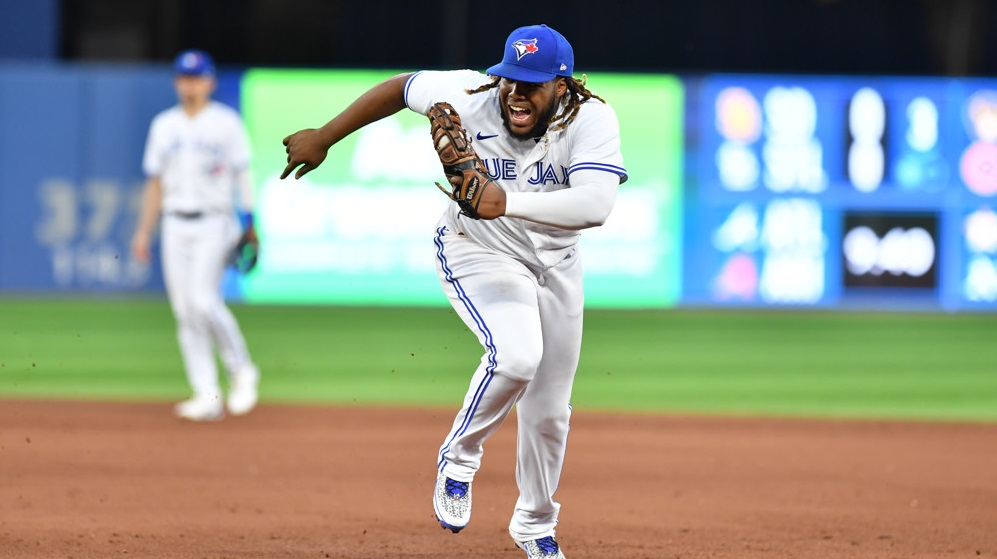
  • Vladimir Guerrero Jr. Has Found His Defensive Game

    Vladimir Guerrero Jr. Has Found His Defensive Game

    I will admit to some surprise when I looked at the list of Defensive Runs Saved leaders at first base.

    That Christian Walker of the Diamondbacks ranked first with 10 – and first by a wide margin – wasn’t what got me. It was that Vladimir Guerrero Jr. ranked No. 2. Better than Matt Olson, and Freddie Freeman, and Anthony Rizzo and many others (see the full list here)

    Yep, Guerrero has 6 Defensive Runs Saved at first base (he had -4 in 2020 and 2 in 2021). And there are a few things to point out about that.

    One is that Guerrero is pretty good at going to his right. The Blue Jays give him a lot of responsibility when a right-handed batter is up because of how aggressively they shift some of those hitters. Guerrero is often left to cover a wide swath of ground and he has been up to the challenge.


    And though some of his tosses to the pitcher covering may be a little askew, he does have a rifle arm when it’s needed.

    Over the last three seasons, Guerrero has converted 43% of opportunities on balls hit to his right into outs (he’s at a still-robust 40% this season). Only Walker (50%) and Evan White (44%) rank higher among first basemen among the 35 players with the most opportunities in that time.

    With as good as Guerrero was at going to his right, that came with meh numbers on ‘at-em balls’ and balls hit to his left. But this season, Guerrero has cleaned that up. He’s turned 45 of 47 opportunities on those balls into outs this season (96%). His success rate on them in 2020 and 2021 was 78%.

    While we can give Guerrero credit for good range, he’s also been much better at handling throws.

    In 2021, our Video Scouts charged Guerrero was 15 Defensive Misplays & Errors for failing to catch a throw from a teammate. In 2022, he has only 2 such Misplays & Errors.

    Part of that is that the Blue Jays are situated better, with Matt Chapman now regularly at third base and Bo Bichette’s throwing a little bit better than it was last season at shortstop.

    But that’s not to say that Vlad can’t pick it.


    We’ve credited Guerrero with 13 Good Fielding Plays related to catching throws – in line with the 19 he had last season – but without all those mistakes that brought down his and the Blue Jays’ defensive numbers.

    So yes, Guerrero hasn’t hit like he did last season, when he walloped 48 home runs and was an MVP candidate. But it does seem like – at age 23 – he’s still growing as a player – just in a little bit of a different way than you might have expected.

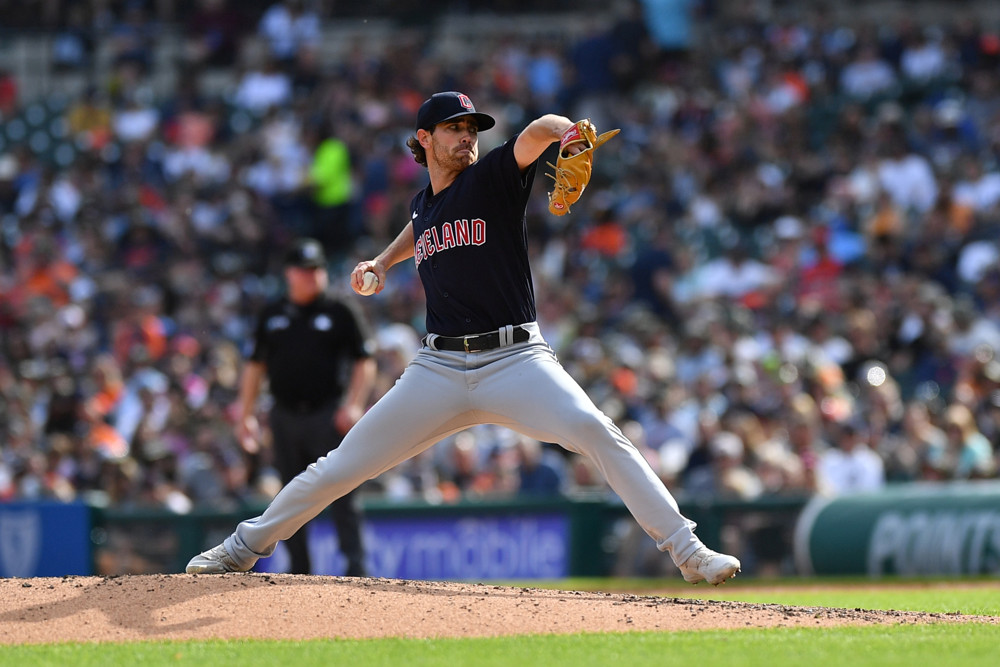
  • Shane Bieber Showing That Velocity Isn’t Everything

    Shane Bieber Showing That Velocity Isn’t Everything

    Remember when Kevin Pillar was hit in the face last year and he talked about how, in today’s game, velocity was more important than pitchability?

    When you look around the league you realize Pillar is completely right. If you can throw 95 MPH or harder, you’ll get a chance to pitch. It doesn’t matter if you know where it’s going or not. The average fastball velocity in MLB continues to increase each year.

    But Guardians pitcher Shane Bieber is breaking the trend of velocity over pitchability. Over the past 3 seasons Bieber’s average fastball velocity has dropped. There was a noticeable decrease once Bieber came back from a shoulder injury in 2021, and that injury could be playing a factor. When looking at his stats, he’s still an elite pitcher. His overall stats are not too different than past seasons, including his 2020 Cy Young season.

    Shane Bieber Fastball Usage

    Season Usage
    2018 57%
    2019 46%
    2020 38%
    2021 36%
    2022 38%<<

    >> 41% slider usage, up from 26% in 2021

    Bieber’s average fastball velocity dropped from 94 to 93 from 2020 to 2021 and then from 93 to 91 in 2022. With the lower-velocity fastball, his gameplan has completely changed, Bieber is throwing more SL than ever before. But his fastball is still his most important pitch because Bieber gets elite tunneling on his pitches and they all play off each other exceptionally well.

    The slider and curveball stay on the same plane as the fastball, and then they completely drop. Both breaking balls have great depth, which makes it even harder for hitters to pick up. Bieber does a fantastic job of commanding all his pitches to play off this tunneling effect.

    The Baseball Savant heat maps for his pitches are beautiful. He has a gameplan and executes it how he wants. He uses the fastball up to play off the big break of his slider and curveball. The best example of Bieber’s tunneling ability can be seen here, thanks to the Pitching Ninja. It makes him incredibly difficult to hit and Bieber’s intelligence on the mound is adding to the difficulty.


    With a lower average fastball velocity Bieber is pitching to more contact. His walk rate is down to 5.7% this season. The last season in which he had a lower rate was 2019. His pitches per plate appearance (3.69), which would be the lowest of his career if maintained. His strikeout rate isn’t as high as it usually is. It’s currently at 26.5% this season. That’s down from 41% in 2020 and 33% in 2021, but still good for 12th among qualified pitchers.

    Of course, fewer walks and strikeouts mean Bieber is giving up more contact. His contact rate is 71%, well below the league average of 76% but higher than either of his last two seasons. The key though is the quality of contact.

    Bieber’s hard-hit rate is currently at 31%, slightly above league average. The Guardians do rank 2nd in Defensive Runs Saved and I’m sure this gives Bieber more confidence in pitching to contact, knowing that he has a good defense behind him.

    Bieber does a great job of keeping hitters off balance. As we saw with his pitch usage, he has become a slider first pitcher, but depending on the count, he isn’t afraid to attack hitters with fastballs. He will attack RHBs and LHBs very differently, righties have seen only 30 of the 218 curveballs he’s thrown this season.

    Bieber Pitch Usage – vs LHB (RHB in parentheses)

    Pitch Type Usage              Bieber Ahead Bieber Behind 
    Slider 26%   (52%) 21%    (60%) 36%    (52%)
    Fastball 29%   (43%) 19%    (31%) 43%    (45%)
    Curveball 37%    (4%) 56%    (7%) 16%    (1%)


    Pitch Type First Pitch 2 Strikes Full Count
    Slider 32%    (47%) 12%    (59%) 35%    (50%)
    Fastball 35%    (51%) 24%    (29%) 35%    (45%)
    Curveball 17%    (.5%) 63%    (13%) 30%    (4%)

    The fastball gets its highest usage when Bieber needs a strike. This is when hitters need to attack him or else the at-bat gets more and more difficult.  His slider and curveball both get around 40% whiff rates, which is why he loves going to these pitches when he’s ahead and with 2 strikes.

    Left-handed batters have an incredibly difficult task when trying to figure Bieber out. He uses all three of his main pitches consistently against them. Righties only have to worry about the fastball and slider.

    He also mixes in a nasty backdoor slider to LHBs that he can spot on the corner consistently. The splits certainly prove this.

    LHB slashline     .195/.231/.293                 32% K rate

    RHB slashline    .285/.335/.424                22% K rate

    Bieber does mix in a changeup 3% of the time, with all but one being thrown to LHBs. The majority of those changeups are thrown first pitch to those lefties, when Bieber is trying to steal a strike. That’s just another wrinkle he keeps in his back pocket.

    Other than one start against the Blue Jays, Bieber has been elite all year. He’s allowed 3 runs or fewer in 12 of 13 starts and pitched at least 6 innings in 9 of 13. His 3.00 ERA is good for 28th in MLB among those with at least 50 innings pitched (which puts him in the top 25% of that group). He’s showing that if you throw 91 MPH fastballs you can still get outs by pitching intelligently and commanding your pitches.

    Even with all the changes Bieber has made, he is still considered one of the best pitchers in baseball. Usually when pitchers lose velocity and have to change, they struggle for a season or two.  The 27-year-old Bieber, has proved even before his prime that he is one of the more intelligent pitchers in the game today. I’m excited to watch him transform as he progresses and maybe he will be able to add velocity again, or maybe he will use the Justin Verlander strategy, and save some for late in games.

    Either way, Bieber is one of the best pitchers in baseball to watch today, and one of my favorite pitchers to watch and try to think along with. Try to lock in on one of his starts and see how difficult it is for hitters to try and figure him out!

  • Stat of the Week: Guardians of the Defensive Galaxy

    Stat of the Week: Guardians of the Defensive Galaxy

    BY MARK SIMON

    The Guardians are on a hot streak, with wins in 17 of 21 games entering Thursday’s matchup with the Twins.

    The Guardians were not expected to be a contender in the AL Central this season, but have proven themselves as a formidable team in the first half of the season. And one of the biggest reasons for that is their defense.

    Cleveland enters Thursday No. 2 in the majors in Defensive Runs Saved, just behind the Yankees. They are MLB’s strongest defensive team up the middle by a good margin. The Guardians have saved 24 runs with their defense at catcher, second base, shortstop and center field. The next-closest team is the Cardinals (16 Runs Saved).

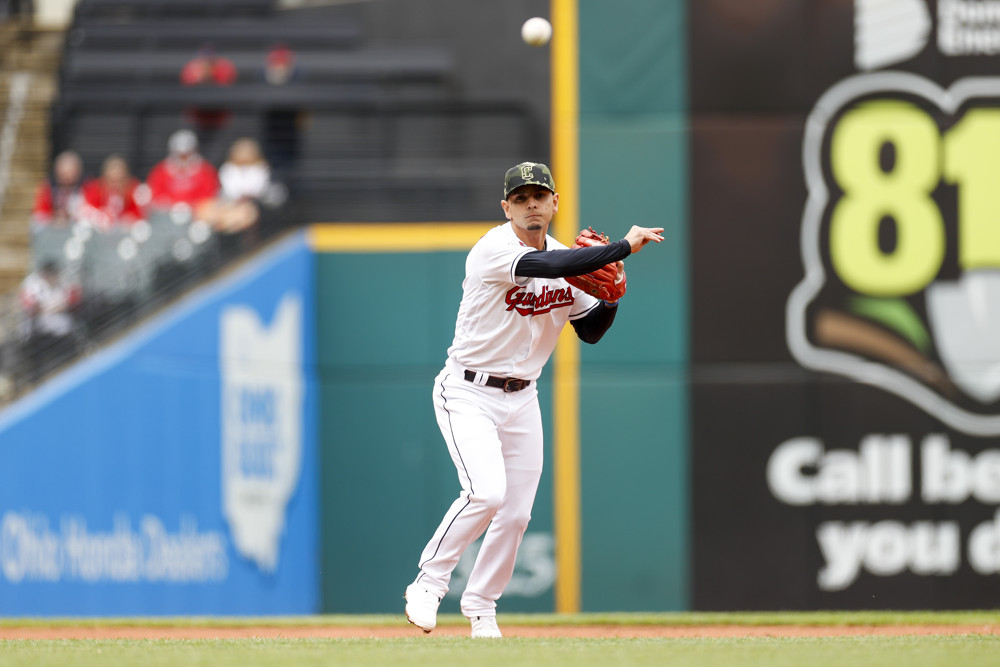
    Their best infield defender this season has been Andrés Giménez, who has excelled at second base and also played a little shortstop this season. Giménez’s 9 Runs Saved are the most on the Guardians.

    Giménez and Amed Rosario were obtained from the Mets in the Francisco Lindor trade prior to last season. Rosario has stepped up his defensive game in a big way, saving 5 Runs at shortstop in 2022. Rosario had cost his teams 29 runs with his shortstop defense in the previous five seasons.

    Rosario has largely eliminated mistakes from his game. Last season, he had 34 Defensive Misplays & Errors as charted by our Video Scouts. This season, he has 8. He also has more Good Fielding Plays (7) in 52 games than he had last season (6) in 121 games.

    In the outfield, Myles Straw leads all center fielders with 8 Runs Saved. Half of those come from his outfield arm, where he’s thrown out 5 runners attempting to advance without using a cutoff man (he had only 2 such assists last season). The Guardians lead all MLB teams with 8 Outfield Arm Runs Saved this season.

    And at catcher Austin Hedges and Luke Maile have combined for 5 Runs Saved. Hedges has been his usual stellar self, with 4 Runs Saved and value added in pitch framing, pitch blocking, and defensing bunts. Hedges leads all catchers in Defensive Runs Saved over the last 6 seasons.

    Though up-the-middle play is largely responsible for the Guardians’ defensive success, players at other positions have also factored in. The most notable of those is left fielder Steven Kwan, who ranks second at the position with 7 Runs Saved.

    That the Guardians have been this good defensively this season is something of a surprise, considering that the team finished 19th in Runs Saved in 2021.

    It’s also worth noting that there’s room for growth here. Third baseman José Ramírez, who had 10 Runs Saved last season, ranks last on the team, having cost them 4 runs with his defense.

    Ramírez has more than made up for that with his bat, as he entered Thursday ranked fourth in the majors with 56 Runs Created. He’s carried his teammates on the offensive end and they’ve picked him up with their defensive play.

  • Defensive Excellence: Q&A: Darren Fenster (Red Sox minor league infield coordinator)

    Defensive Excellence: Q&A: Darren Fenster (Red Sox minor league infield coordinator)

    This is the second in a series of interviews with people from different backgrounds who teach defense at different levels from scholastic to college to the pros. Our previous interview with Hawaii high school coaching legend Dunn Muramaru can be found here.

    Darren Fenster is the minor league infield coordinator for the Red Sox. He’s previously been the team’s minor league outfield and baserunning coordinator and a minor league manager, as well as a coach for the 2020 Olympic baseball team.

    Darren’s passion is teaching baseball to people of all ages – his Twitter handle is @CoachYourKids. In this interview, Darren talks about teaching principles of defensive excellence.

    Mark: What does defensive excellence mean to you?

    Darren: The short answer is the ability to change a game with your glove. Obviously, you could go down into some different depths of that, but when you talk about excellence, I think that’s the ultimate. Being an elite defender is your ability to change a game defensively with your glove.

    And I think that looks a little bit different for infielders as it might for outfielders. I’m the infield coordinator for the Red Sox now, but I was the outfield coordinator the previous three years.

    Understanding infield allowed me to look at outfield in a completely different light and then understanding different parts of outfield really kind of shifted a lot of my belief system when it came back to doing a lot of the stuff on the infield side. So for both, when you’re talking about elite defenders, I think your foundation is, are you reliable?

    Do you make the routine play routinely? No matter how many highlight-reel plays you make, if you can’t be relied upon to make that routine play every single time, then I don’t think you can be considered an elite defender. I don’t think that it’s defensive excellence if the foundation isn’t there for an infielder.

    There is an intellect aspect of defensive excellence. You combine those two in good decisions. Are they in the area where they’re throwing the ball to the right base? Are they fearless in not being afraid to make a challenging play? Others may not be comfortable even thinking about—let alone trying to make—a challenging play.

    You think about like a guy like Nolan Arenado and the things that he’s able to do at third base. He’s a complete game changer. And he makes so many different plays in so many ways. And part of that is, obviously, he’s very talented, but there’s some athleticism there and there’s some instinct there that allows him to do some things that a lot of guys won’t even try and he’s the best defensive third baseman of this generation.

    I think on the infield side that there’s also obviously an athleticism aspect. So I think the infield is more cerebral, in addition to all of those fundamental physical skills.

    And then on the outfield side, I just think about an elite defender as being someone who’s just flying all over the place making plays that most guys don’t make, like Jackie Bradley Jr. or Kevin Kiermaier. On our minor league side, there’s Ceddanne Rafaela (in Double-A) who is cut from that same cloth, where he’s doing things in the outfield you don’t teach.

    You look up and they’re already running full speed. They get incredible jumps. They have the instinct for the breaks and for the routes and all those sorts of things. And they just cover a ton of ground, and they turn that 50-50 play into outs more than those drop for hits. They’re able to shut down the extra base whether it be by just sheer effort of getting on the ball as quick as they can by being able to be athletic with their feet and be able to be accurate with their arms. For me, that’s the epitome of outfield play.

    Mark: How do you integrate everything you just talked about into teaching kids how to play defense?

    Darren: It starts with the fundamentals.

    Andy Fox was our infield coordinator prior to his jumping on the big-league staff this year. And I remember my very first year with the organization in 2012, one of the first days of spring training, Andy grabbed 10 of our infielders.

    He was just doing these very simple hand rolls that guys were not missing. And it was just so easy.

    I asked Andy if we could give them more challenging reps than what we’re doing right now. And he said absolutely. But this is the foundational stuff that we need to get ingrained into guys’ systems so that they have the good habits for when we do have the more challenging types of reps and the more challenging types of plays, they have a foundation from which to build off.

    Those fundamental reps were complete game-changers in terms of being able to help make guys fundamentally sound, and I was completely hooked on the importance of foundational reps that allow you to focus on something as simple as glove angle, where you’re turning your glove into the biggest area for the ball to go in.

    I use the expression, ‘We don’t catch raindrops.’ If you think about how you would catch a raindrop, that’s what we would call a flat glove versus if your fingers were down. There’s way more area for the ball to go into the glove and just something as simple as that can make a huge difference in a guy’s ability to play defense.

    Whether it be on the infield or on the outfield body position, you know how you’re bending at your knees, how you’re hinging at your waist, how your feet are working through the ball, all those little things that you can isolate in foundational drill work can get ingrained into a guy’s system and that opens up a multitude of things for them to be able to do.

    I believe that if they do not have that base, then it’s gonna be a really inconsistent road as you kind of work your way up and try to develop into a reliable and eventually, hopefully an elite defender.

    Mark: Another phrase you emphasize is “Engage the game.” What does that mean?

    Darren: It starts with your pre-pitch. Are you consistently putting yourself in an athletic position to get a great first step, every single pitch for 150 pitches a night? And so it may sound simple but think about the mental focus that you need to be able to do that over the course of (a year).

    Engaging the game is just understanding the situation, understanding the scoreboard, meaning that if there’s a man on, where am I supposed to be on a certain type of ball and where am I supposed to throw the ball?

    When you are constantly teaching that side of the game – and that might be in between innings when a guy makes a good decision, when a guy makes a bad decision, when you’re consistent with that teaching aspect in the same way that you’re consistent teaching the physical aspects, now we’re kind of tag-teaming the two parts of defensive play that are required to become an elite defender.

    And those apply on the infield side as well as the outfield side equally. I think the consistency of teaching that part of the game is just as important as teaching the physical aspect consistently.

    Mark: Isiah Kiner-Falefa talked on our podcast about learning every position. Can you speak to that?

    Darren: I don’t know when this happened, but people got stuck on a position saying, ‘Hey, I’m only a shortstop. I’m only a center fielder, I’m only a catcher.’

    The example that I would always use would be if you were a minor leaguer who played shortstop coming up with the Yankees, you weren’t going to play shortstop (with Derek Jeter there). So you were either gonna get traded or you had to be open to playing a different position.

    When you learn how to play different positions, you’re giving your manager, you’re giving your coach different options on how to use you. If Alex Cora or any coach has interchangeable parts, then game-to-game, they can fit the pieces in different ways to put their best puzzle together every night.

    When guys move off shortstop, I always love to use the expression, ‘If you move to second base, you’re not a second baseman, if you move to third base, you’re not a third baseman. You’re a shortstop playing second or playing third.’

    Shortstop is the spot on the infield where you have to be most active with your feet. You can’t be lazy, pre-pitch. You always have to be moving, mentally engaged, and knowing so much about so many different things.

    And I think if you keep that same type of mindset, when you move off shortstop, now, all of a sudden, you’re playing different spots with the athleticism at shortstop that puts you now in a position to be an above average defender at those other spots.

    I think the physicality of being able to play different spots, the mental side of being able to play other spots just provides so much more value for you as a player. In the sense of how you’re allowing a manager to use you.

    Mark: If you could fix one thing about how people at a young age are taught defense, what would it be?

    Darren: A lot of kids are ingrained on a very fundamental base, everything perfect with two hands and being very ‘textbook’ in how to field ground balls. And that’s a really good thing.

    I played for Fred Hill at Rutgers, an old-school baseball guy. Everything was two-handed, everything was fundamentally sound.

    When Rey Ordóñez first came up with the Mets, he had a signature play where he would slide to catch the ball, and in one motion, would catch the ball, pop up and fire across the diamond.

    I taught myself how to make that play. And my freshman fall at Rutgers, I make that play during a practice and Coach Hill says, ‘Pretty nice play, Darren. Make it again and your ass is gonna be on the bench. Make the play the right way.’

    Now with some perspective, I think that fundamental approach took away from the athleticism that a Nolan Arenado plays with. Nolan knows how to make fundamental plays, but he’s an artist with how he does stuff, in that he does stuff that coaches wouldn’t teach.

    I’ve come to an understanding now, being around it over the last 20-plus years on the professional level and then with those six years in the middle as a college coach, to be able to understand how athleticism opens up so many different options on how you might be able to make a play.

    I wish more kids would be able to be exposed to (that) at an early level. Yes, you need that fundamental base, but I think guys need to be given the option – to let athletes be athletes.

    That doesn’t mean you turn what should be a fundamental play into ridiculous highlight-reel play when it doesn’t need to. But I think when you give guys that option to be able to show off their athleticism, now, all of a sudden, you’re able to build something off that foundational base.

    The better athletes can make better plays. And the more ways a guy can make a play, the better of an infielder that they’re going to be.

    We’ll drill something with two hands and the very next rep would be one hand, and then we go back to two hands, and sometimes it’s setting our feet up to throw, sometimes it’s everything on the run. And these are all with the same exact types of ground balls.

    It’s to help guys understand that they have options and to allow their athleticism to shine through to find the best option for them to make a play. And I think that gets taken away when guys are ingrained in the idea that you’re only allowed to be a fundamental player. And sometimes it takes time to get them out of making the play perfectly when they’ve been hammered on it for so many years. It takes some time to build off that, for them to get out of.

    Mark: Last thing: Can you give me an example of a player that you could point to and say: that guy did a great job of learning how to play defense?

    Darren: Carlos Asuaje opened the season as a utility-guy backup playing three, four days a week.

    He started to swing the bat well and that provided him more opportunities. He never played third base before. He had this bad habit of letting the ball play him.

    And so he would constantly turn routine ground balls into base hits because he would backtrack on the ball such that his body would be going into left field when he would have to make a throw in the complete opposite direction. It took a long time to get the backtracking out of his system.

    At one point he went to go get the ball and he made an error. It was what I would call an aggressive error. And when he came into the dugout, he was pissed off about making an error.

    I went up to him and I gave him a big hug because I was so excited because that was like one of those moments where it clicked for him, even though he didn’t make the play, it clicked for him in terms of going after the ball the right way. Slowly but surely, those plays became routine outs.

    To see that progress, weeks and months in the making, that’s what defense is. It’s about being able to progress in that manner. It was a credit to him for putting the work in, and by being able to isolate a specific type of play over and over in a practice setting, over time it does translate.

    He wasn’t a star major leaguer, but he got to the big leagues as someone who, I don’t think a lot of people ever thought that he would’ve made it. To see that all happen was really exciting.

    This interview has been edited for clarity and length

     

  • Dominance Deep Dive: Roki Sasaki’s Perfect Game

    Dominance Deep Dive: Roki Sasaki’s Perfect Game

    Nippon Professional Baseball (NPB),  Japan’s professional baseball league, has featured three no-hitters and one perfect game so far in the 2022 season. 

    What fascinated me about these is the uniqueness and similarities of each of these three starts, as well as how the quest for perfection or hitless ball by a pitcher can be achieved by three completely different approaches to pitching. 

    I’m going to review those four games, one in this article and the other three in the near future. 

    Rōki Sasaki’s Perfect Game 

    On April 10, arguably the best pitcher in Japan and one of the best on the planet right now, dazzled. 

    Twenty-year-old Rōki Sasaki of the Chiba Lotte Marines tossed the first perfect game in 28 years, striking out 19 Orix Buffaloes during the game. 

    Sasaki masterfully filled the strike zone with 82 strikes and just 23 balls.

    Sasaki pounded the zone with a first-pitch exploding fastball in 21 of the 27 at-bats. It averaged 99 MPH and touched 102 that day.

    Sasaki’s fastball displays late life and pops through the  zone, and when he is dialed in he commands the inner and outer thirds of the plate and loves to work down in the zone.

    The fastball, especially knee-high, sets up his go-to pitch: a nasty splitter that batters constantly swing over the top of.

    This dive-bomb splitter comes in at around 91 mph and masquerades as his four-seam fastball for 50 feet before darting down into the ground.


    Sasaki displays the unique ability to manipulate the pitch and cut the splitter too, creating movement more like a slider when thrown to right-handers. When this happens, the pitch takes off and darts away from righties.

    In the picture below, Sasaki fades this splitter away, applying even pressure on the ball, where he’s more worried about the pronation or the turning of his arm over, and letting the pitch run away from a left-handed batter.

    This pitch variation allows Sasaki to be a dominant two-pitch pitcher, as he threw only three curveballs and three sliders during the perfect outing – two pitches behind his stellar fastball and splitter. And that he has great feel for the splitter at this stage of his career – that’s highly impressive.

    The slider is getting better, but he lacks the excellent command of his splitter and currently the curveball is a get-me-over change-of-speed in the upper 70s. Oftentimes, both breaking pitches were used early in counts to keep hitters honest. The four-pitch mix is still crazy impressive from the young Sasaki, but the split remains his go-to weapon as was the case in his perfect outing.

    With the ability to control the strike zone and attack the lower third, Sasaki’s splitter and fastball cause serious problems for hitters. He struck out 15 Buffaloes with the split and the other four with fastballs that were on the black and in the middle of the zone.

    The attacking of the zone down with an elite fastball causes hitters to commit early on his nasty splitter that can drop out of the zone in the blink of an eye.

    This approach is a stark contrast to most other starters in the league and most of baseball.

    Sasaki is a true unicorn on the mound and creates a completely different pitching profile than what hitters see on a daily basis.


  • Stat of the Week: Braves Very Much In The Swing Of Things

    Stat of the Week: Braves Very Much In The Swing Of Things

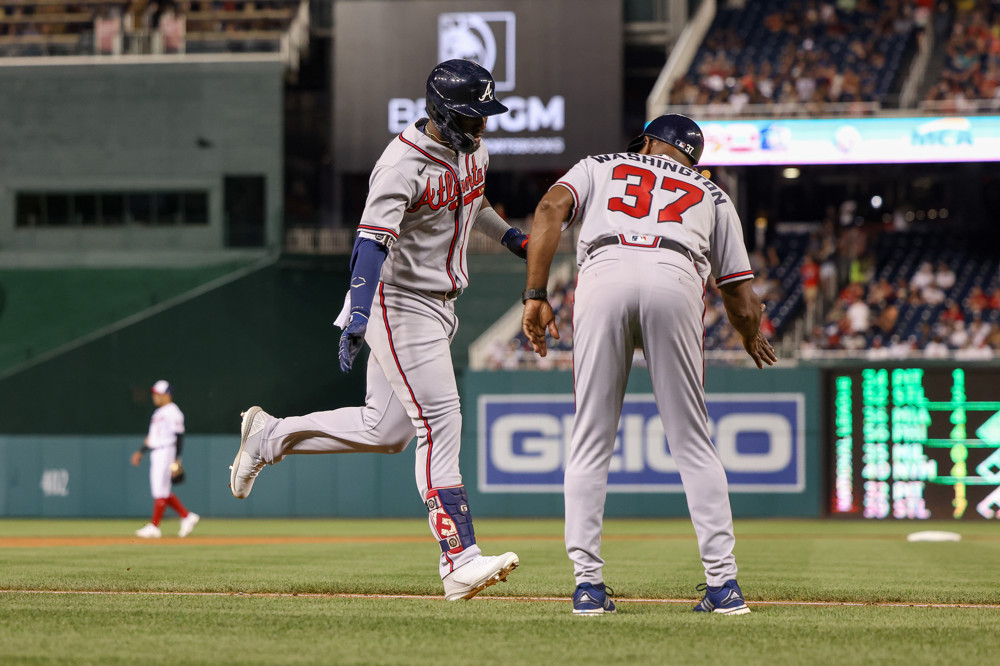
    The Braves have won 14 consecutive games and the story of their winning streak is rooted in their aggressiveness.

    The Braves have been a hyperaggressive team at the plate. They rank first in swing percentage in June (swinging at 52% of pitches). They are both the No. 1 team in swinging at pitches in the strike zone and the No. 2 team in chase rate, which is the rate at which they swing at pitches out of the strike zone.

    This leads to a fascinating contrast.

    No. 1 team in chase percentage: Tigers – 30 runs scored in June

    No. 2 team in chase percentage: Braves – 101 runs scored in June

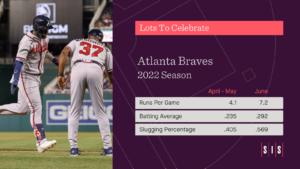
    Wherever the ball has been pitched, when the Braves have hit the ball in June, they’ve done massive damage. They’ve hit .292 and slugged .569, which rank No. 2 and No. 1 in MLB in June, respectively. In fact, the Braves’ June batting average is higher than the Tigers’ June slugging percentage (.279).

    But we’re not here to talk about the Tigers. We’re here to focus on the Braves and their amazing winning streak.

    Most of the Braves’ everyday players – Ronald Acuña Jr., Dansby Swanson, and Travis d’Arnaud among them– have been hot hitters for at least the last couple of weeks. But the most interesting player during this Braves run is their rookie center fielder, Michael Harris II. Harris is hitting .328 with an .894 OPS in 18 games and has started every game during the winning streak.

    Harris is among the Braves’ most aggressive hitters at swinging at pitches outside the strike zone (41%) and one of their least aggressive hitters at swinging at pitches in the strike zone (71%), but it’s an approach that’s working for him in the short term.

    In the long term, he’ll likely have to deal with a drop in BABIP (which currently stands at .400).

    What’s likely to become more notable about Harris in the future is his defense. Last year, he led minor league outfielders in Defensive Runs Saved. He’s MLB average thus far (0 Runs Saved) but has a couple of nifty catches under his belt.

    Harris has definitely been a spark after what was a lackluster start by the defending champs. The pendulum has now swung in a favorable direction. The bats have swung in that direction as well.

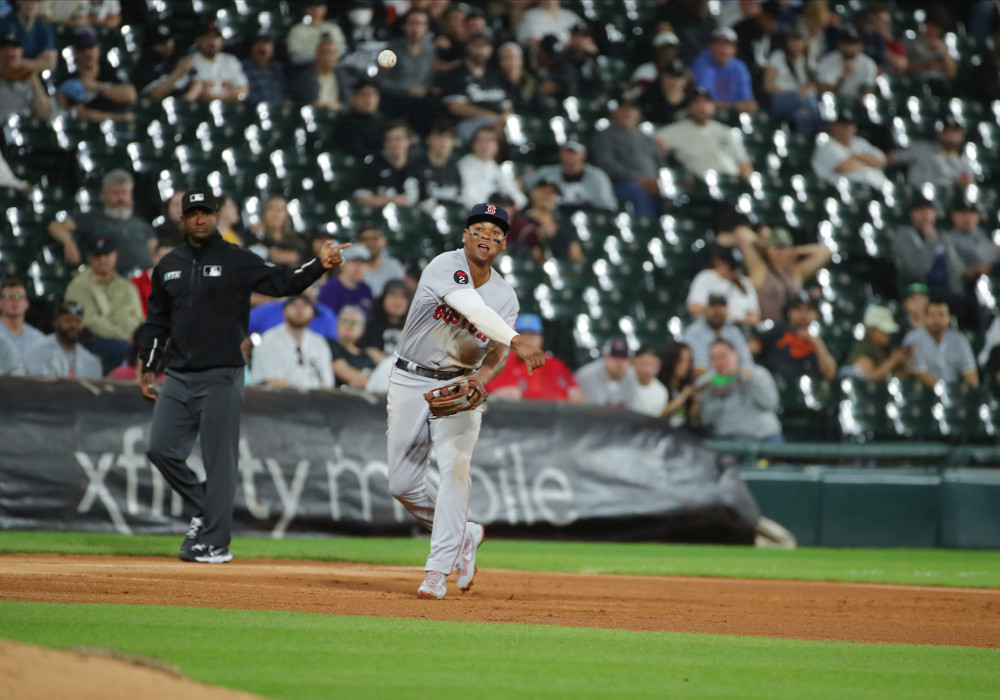
  • The Improved Playmaking of the Red Sox Infield

    The Improved Playmaking of the Red Sox Infield

    As good as they were in other things in 2021, the Red Sox ranked last in the percentage of ground balls and bunts that their defense turned into outs.

    I worked with Alex Cora at ESPN and know how much he values defensive excellence, so I’m sure that rankled him.

    In 2022, the Red Sox infield has been far better. They’ve converted 76.2% of ground balls and bunts into outs, the eighth-highest rate in MLB and an increase of 5.2% from last season (when they had the lowest rate in the league).

    That’s the highest increase in the majors from last season to this season, one-tenth of a percentage point better than their arch rivals, the Yankees.

    And they’re tied for second overall in Defensive Runs Saved with the Yankees.

    Most Defensive Runs Saved – 2022 Season

    Team DRS
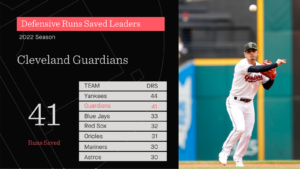
    Guardians 41
    Red Sox 31
    Yankees 31
    Astros 29
    Padres 29

    >> Full list here

    We can divvy up the credit for the Red Sox infield improvements in several different ways:

    1) Trevor Story changed the look and skill level of the defense

    2) Below-average infielders in the past have improved to average levels

    3) The team’s infield positioning gives their players a better chance

    Trevor Story

    The Red Sox signed Story to a huge contract this past offseason and moved him to second base, with Xander Bogaerts staying at shortstop.

    The benefit to putting a Fielding Bible Award-caliber shortstop at second base is that it’s turned the right side of the infield into a brick wall.

    The Red Sox have converted 85% of ground balls and bunts hit between the first base line over to the second base bag into outs. That’s the highest out rate in the majors. For reference, average in this stat is about 77%. The Red Sox finished 28th last season, turning 75% of ground balls and bunts into outs.

    Had the 2022 Red Sox turned grounders to the right side into outs at the same rate as the 2021 team, they would have turned 27 fewer balls to that side into outs, just less than one every two games.

    Story’s defensive success coincided with his offensive success after a rough start to the season. In a stretch from May 16 to June 1, Story had 22 RBI in 16 games AND had 4 Runs Saved from turning batted balls into outs.

    If we were going to pick two plays that best represents Story’s value, it’s these two game-enders, the first of which has a 15% out probability, the second of which has a 35% out probability but literally saved the game.


    Making Negatives Positive

    To solely credit Story doesn’t tell the whole story though (ha). Bobby Dalbec, Xander Bogaerts, and Rafael Devers don’t have great statistical histories on the defensive side, but in 2022, they’ve been alright.

    Dalbec was at -7 Runs Saved at first base in 2021. He’s at 0 in 2022.

    Bogaerts has had eight straight seasons of negative Runs Saved but is holding steady just above league average (1 Run Saved) so far.

    And Devers, who had a negative total at third base in each of his five seasons, including a -13 in 2021, is also at 1 Run Saved for 2022.

    If we were going to pinpoint one point of improvement among them, we’d refer to Devers and how he’s gotten better at what we call finishing plays.

    The way that SIS expected out rates work, we break down out probability at various points, allowing us to look at a fielder’s ability to get to the ball (range) and the fielder’s ability to complete the play.

    Completing the play encompasses a variety of things. Usually it refers to throwing, but it can also mean instances of a fielder getting a glove on the ball but not being able to field it, or a slow roller that is fielded but no throw is made.

    In 2021, Devers had 38 instances in which he was penalized at least .5 plays saved for not completing a play and finished with -9 Runs Saved related to completing plays (on Fielding Bible.com, we refer to that as Runs Saved from throwing).

    This season, he’s only had 6 plays of that nature, and he’s at 2 Runs Saved for completing plays. Much better so far.

    In watching video, we noticed that Devers had trouble last season with slow rollers and other plays on which he had to hurry. But this season, the numbers show that he’s thus far been better at handling those.

    Rafael Devers on “Slow Hit” Ground Balls

      Plays Made-Opportunities Success Rate
    2021 57/111 51%
    2022 29/45 64%

    He’s also been considerably better at completing plays (on balls hit at any speed) when he’s fielded a ball on his backhand.

    Rafael Devers When Backhanding a Ball

      Plays Made-Opportunities Success Rate
    2021 116/138 84%
    2022 53/56 95%

    Here’s a play that Devers made earlier this season that he’s had trouble with in years past.

    Dalbec, Bogaerts, and Devers combined for -26 Runs Saved last season. Right now, they’re at +2. Even if they dipped to -10 the rest of the season and finished with a comparable innings total to 2021, that’s still a sizable bump in defensive performance. And perhaps they’ll be able to hold or better their current numbers.

    Positioning

    The last component in the Red Sox infield improvement is in their defensive positioning. By our crediting, the Red Sox have 10 Runs Saved specific to how they’ve positioned their infielders, with this almost exclusively being in their defensive shifting. Trying to source this can get a little tricky, so we’ll use one player as an example with help from my colleague, Alex Vigderman.

    His work shows that the Red Sox have done their best to put Bogaerts in a pre-pitch spot in which he can get an out, with 37% of his opportunities coming on plays in which the expected out rate (knowing positioning) was at least 80%.

    That’s seven percentage points better than MLB average (30%), which is the largest gap of Bogaerts’ career. Simply put: This season, Bogaerts has been in a notably better spot to make a play than other shortstops.

    The Red Sox just completed a 10-game road trip on which they went 8-2 and their pitching staff allowed three runs or fewer seven times. Yes, their pitching stood out, but infield defense was part of that winning formula, with nearly 80% of ground balls and bunts being turned into outs. It’s a key component of the early-season turnaround that’s pushed them to respectability.

  • What’s Wrong Is Right (Field)

    What’s Wrong Is Right (Field)

    By MARK SIMON

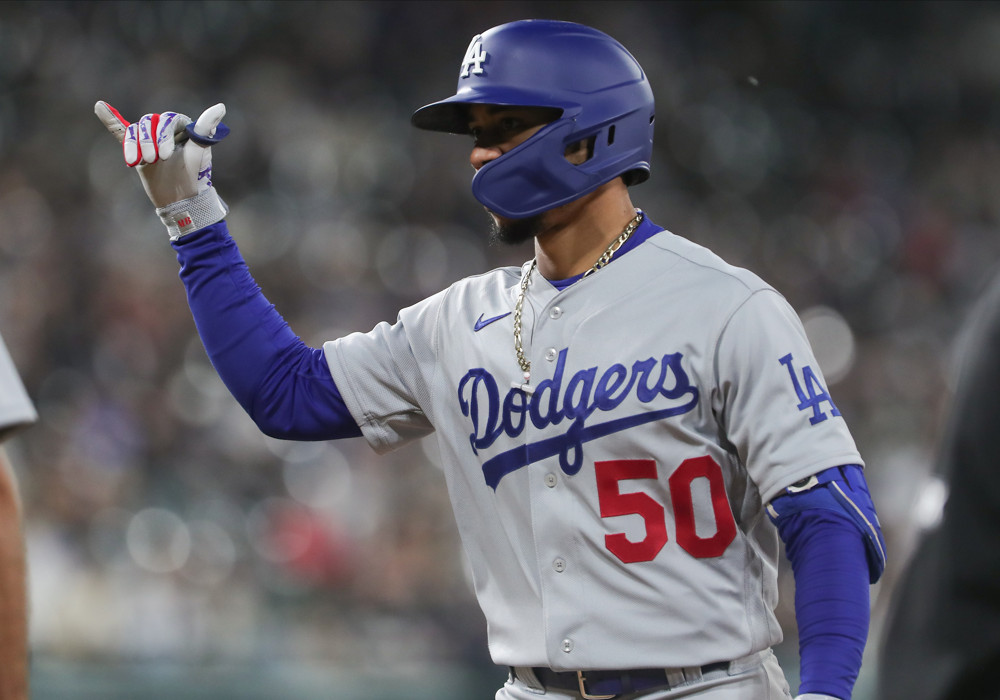
    Dodgers right fielder Mookie Betts is having a fantastic offensive season. He entered Thursday ranked 3rd in the NL with a .950 OPS and shares the league lead with 16 home runs. He’s looking like a leading candidate to be NL MVP.

    Similarly, Aaron Judge and Giancarlo Stanton, who have both played a good amount of right field this season, are among the biggest reasons for the Yankees’ phenomenal start. Judge is having an all-timer of a year with an MLB-best 1.058 OPS and 22 home runs. Stanton has 12 home runs and 36 RBI in 44 games.

    But if you look beyond these two teams, you might notice that the sport is considerably lacking in production at that position.

    Yankees & Dodgers Right Fielders:   .302 BA, .577 Slug Pct

    Everyone Else’s Right Fielders:         .235 BA, .380 Slug Pct

    The combined right field OPS this season is .703. Last season, it was .774.

    The 71-point drop-off is the biggest decline for any defensive position from 2021 to 2022.

    There are currently 10 teams with a right field OPS below .650, five whose right fielders are below .600.

    There are a variety of reasons for the right field sluggishness. Here are a few:

    * For the Phillies, an injury took Bryce Harper off the position and made him a full-time DH. His replacement, Nick Castellanos has not performed anywhere near his norms, let alone what the Phillies usually get from right field. They rank 20th in right fielder OPS this season (.655). They were the No. 1 team last season (.981).

    * Meanwhile, the Reds let Castellanos walk and haven’t been able to match his production. Their right fielders have a .592 OPS, which ranks 25th. They ranked 4th last season (.898).

    * Another player you’d expect to be an MVP candidate, Juan Soto of the Nationals, is having a down year by his standards. His 2022 overall OPS is .828, down from .999 in 2021.

    There is reason for optimism. The warmer weather should produce more offense. We would expect Soto’s numbers to improve based on his track record. We’d also expect the Braves’ numbers to improve now that Ronald Acuña Jr. is healthy. They currently stand at 16th with a .677 right fielder OPS. Acuña had a .990 OPS overall last season.

    Angels fans are hoping for Taylor Ward’s return from a hamstring injury soon. Ward has gone step for step with Judge and Betts when healthy, with a 1.101 OPS in 35 games in right field. But his replacements are struggling in the midst of a lengthy losing streak.

    Angels right fielders other than Ward have a combined batting average of .182 with one home run in 88 at-bats.

    And that kind of sums up the position this season. It’s been more “wrong field” than “right field” in 2022

  • How Trevor Larnach Is At The Top of the Outfield Leaderboard

    How Trevor Larnach Is At The Top of the Outfield Leaderboard

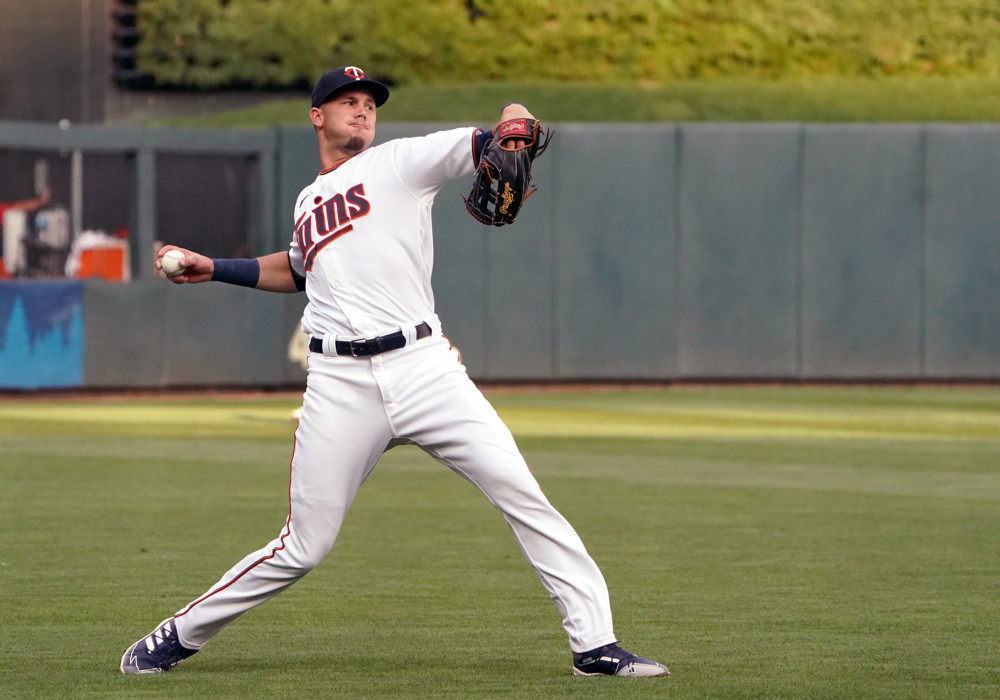
    Twins outfielder Trevor Larnach has 10 Defensive Runs Saved this season, the most for any outfielder in MLB.

    That’s an unusually high total for someone who has played such a small number of innings this season. It’s an especially high total for someone who doesn’t sprint all over the outfield making amazing catches, like his teammate Byron Buxton.

    Larnach has earned more than half of his Runs Saved with his arm.

    But though he has three outfield assists this season, there’s more to it than that.

    Larnach has allowed only 2 of 14 runners to advance an extra base on a hit, error or a caught fly ball/line drive as a left fielder. The average runner advances on about 40% of opportunities, or about 5.6 of every 14 chances.

    He’s allowed only 1 of 7 runners to advance an extra base on hits, errors, or caught balls as a right fielder. The average runner advances on a right fielder on 52% of opportunities, about 3.6 times in 7 chances.

    Larnach has allowed only 3 opportunities to advance on 21 chances. The average runner would have advanced approximately 9 times (5.6 + 3.6).

    Though that’s without knowing anything about the depth of the fielder or the speed of the runner (which Runs Saved does take into account and by which Larnach fares alright – we explained things the way we did for the purpose of simplicity).

    Add that to the three situations in which Larnach literally saved a run by throwing a runner out at home plate and it’s fair to say that he’s been a strong deterrent in the field.

    And we can even add something else into the mix.

    SIS tracks Good Fielding Plays and Defensive Misplays. An outfielder can earn them for things like a sliding or diving catch, robbing a home run, or throwing out a baserunner. But our system is such that we also award value for other plays, such as cutting a ball off in the gap to hold a batter to a single.

    This play against Vladimir Guerrero was worth about one-quarter of a Defensive Run Saved.

    It’s a small gain in the grand scheme of things, but it does count for something in our world, and it pushes Larnach ever-so-slightly higher in our Runs Saved tally.

    And we should note that Larnach been fine in the field too. He has 3 Runs Saved from his range, with plays like these on his ledger and a minimal number of missed out opportunities.

    But we probably wouldn’t be writing about Larnach if not for his arm. It’s been a valuable piece as part of the Twins run to the top of the AL Central.


  • MLB Defensive Player of the Month for May

    MLB Defensive Player of the Month for May

    Orioles shortstop Jorge Mateo was ranked the No. 26 prospect by Baseball America prior to the 2016 season.

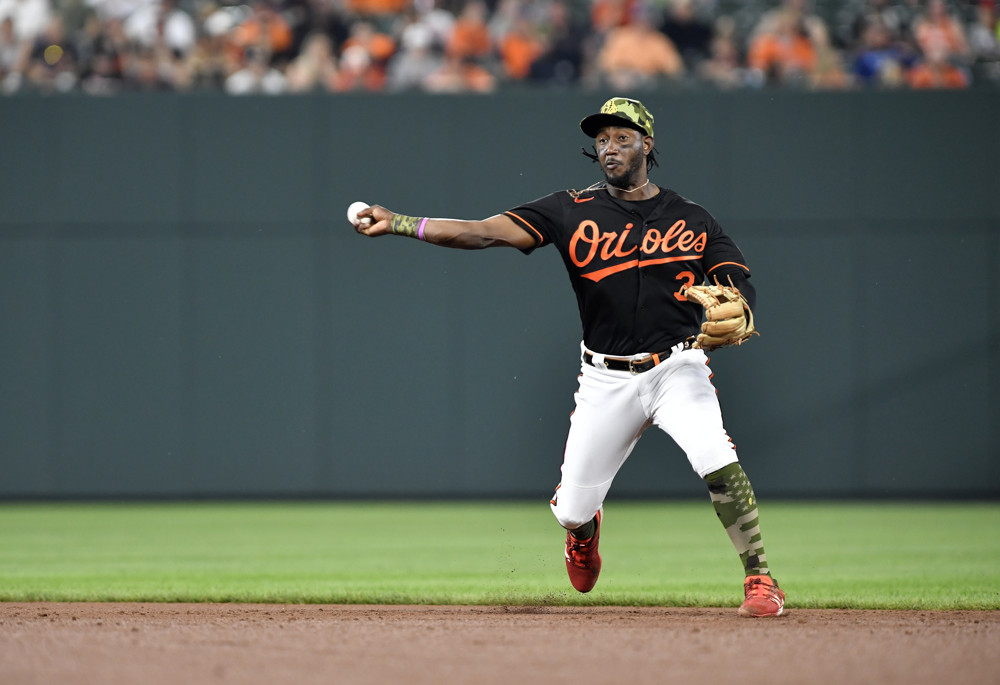
    It’s taken awhile but Mateo has finally found an opportunity to play every day. And he’s thriving in the field. He’s the Sports Info Solutions Defensive Player of the Month for May.

    Mateo’s 9 Defensive Runs Saved were the most of any player last month. No other player had more than 6 Runs Saved in May. Mateo is currently tied with Reds outfielder Aristides Aquino for the MLB lead with 10 Runs Saved.

    We noted how Mateo’s story is one of opportunity. The opportunities in the field have come in abundance. Mateo leads the American League in putouts, assists, double plays turned, and range factor so far this season.

    He’s been the best shortstop in the majors at getting outs on balls hit to his right. He’s converted 43 of 69, six plays better than an average infielder would have fared on the same set of balls.

    That Mateo can play the position is of particular importance to the Orioles. Combining 2018 to 2021, the Orioles ranked 29th in Runs Saved at shortstop (-44). The team entered June ranked tied for 5th in Defensive Runs Saved overall.

    “His athleticism, his range, his first-step quickness, the arm strength, the ability to throw the ball from all arm angles,” Orioles manager Brandon Hyde said, ticking off the list of Mateo’s attributes for us for an article on some of the new top defensive shortstops a few weeks ago. “He’s got great footwork, so he’s always in position to make a strong throw, which is why we’ve turned so many double plays this year.”

    Two Guardians players – middle infielder Andrés Giménez and center fielder Myles Straw – were the runners-up for Defensive Player of the Month.

    Each saved 6 runs in May, with Straw tying Aquino for most Runs Saved by an outfielder for the month. Additionally, each finished with 4 Good Fielding Plays and no Defensive Misplays or Errors.