Category: Baseball

  • A New Era In Defensive Excellence At Shortstop?

    A New Era In Defensive Excellence At Shortstop?

    Over the last decade you’ve probably gotten used to certain names popping up among the shortstop Gold Glove and Fielding Bible Award winners.

    Andrelton Simmons, Nick Ahmed, Brandon Crawford, Carlos Correa and Javier Báez are probably the first players you think of.

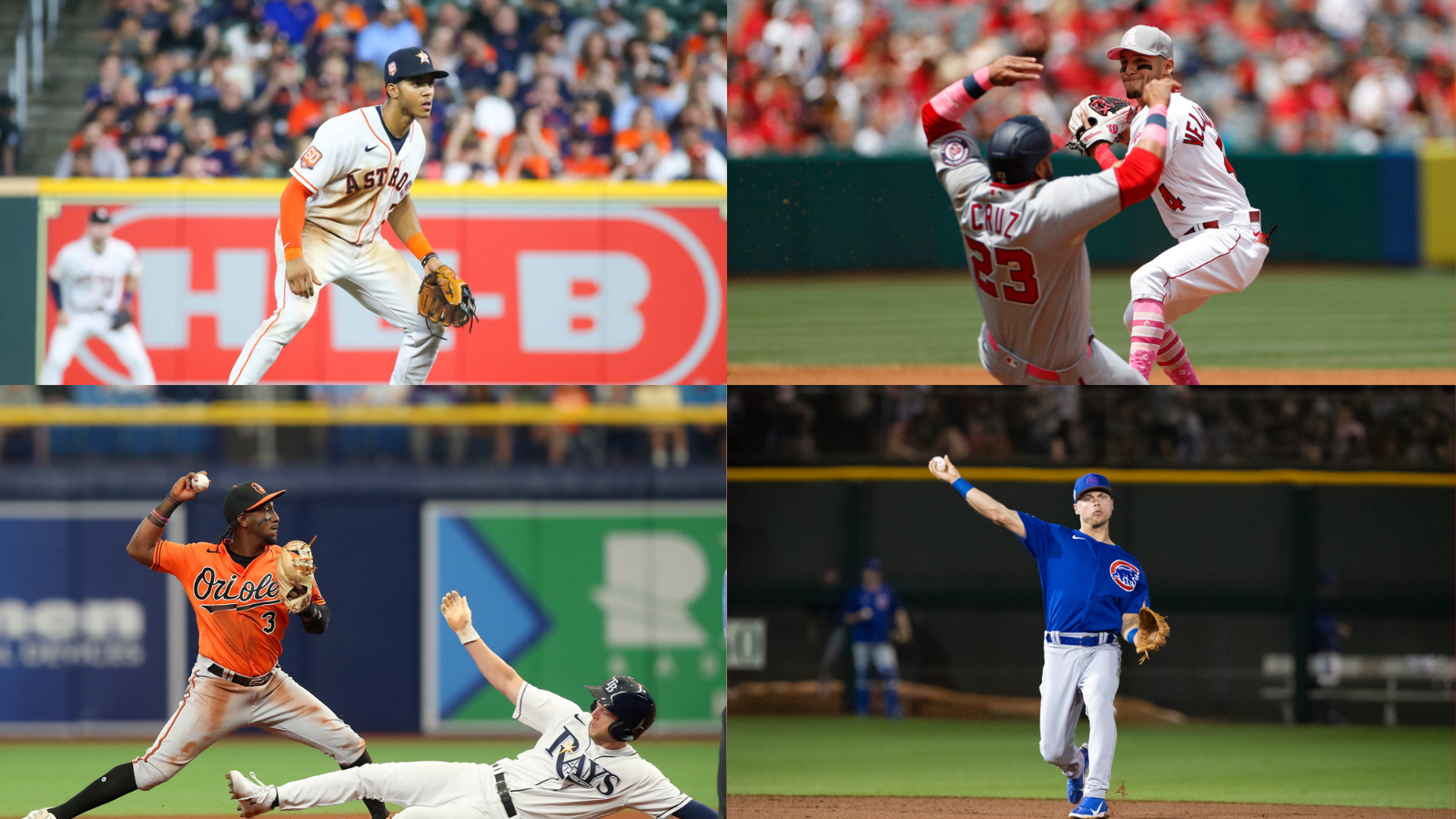
    Although it may be too early to offer proclamations of excellence, the early-season editions of the Defensive Runs Saved leaderboard may offer some clues to some new names (ones not as well known as Wander Franco) trying to establish a high standard of defensive excellence.

    We’ve already mentioned a couple of them – Astros rookie Jeremy Peña for one.

    Peña has replaced Correa at shortstop and the Astros defense hasn’t missed a beat. Houston leads the majors in Defensive Runs Saved and Peña has hovered around the shortstop leaderboard since Day 1.

    “Jeremy has shown elite defensive skills,” said Astros bench coach Joe Espada. “He has a quick first step and smooth and natural actions to both his left and right. He demonstrates good decision-making capabilities which will keep him at shortstop for his long-term future.”

    Also in the AL West, the Angels have been right there with the Astros both in overall record and in shortstop defensive play.

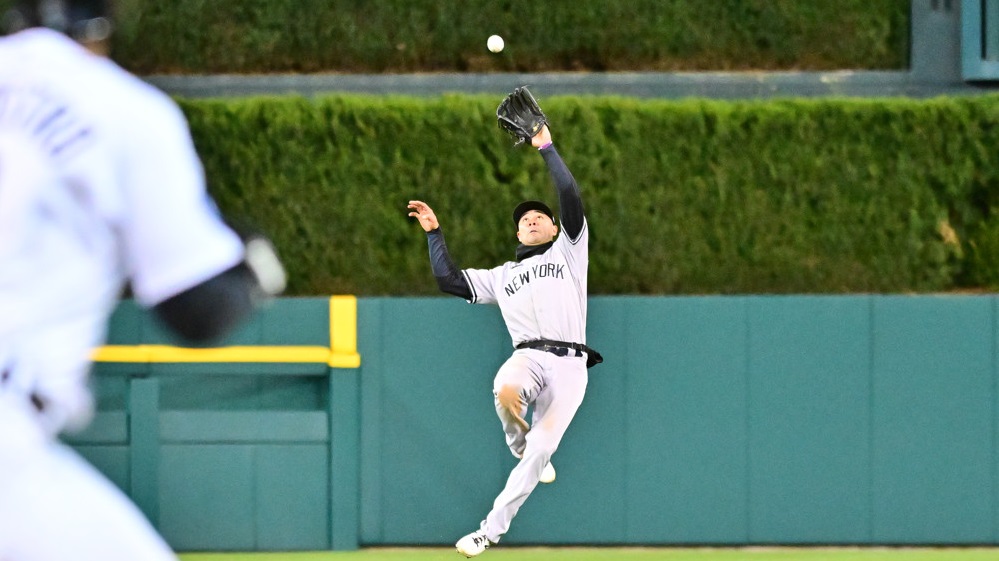
    This was a case in which the team had a change of plans. When shortstop David Fletcher got hurt early in the season, the Angels turned to Andrew Velazquez, a waiver claim from the Yankees.

    Velazquez plays defense such that he lives up his nickname, “Squid.” Simply put, he has a lot of range.

    And that’s not necessarily the best part of his game.

    “What impresses me most about the way ‘Squid’ plays defense is how quick and smooth and accurate his arm is,’ Angels manager Joe Maddon said earlier this week. “He’s never in a hurry. He’s got this internal clock about him. I know that dog is man’s best friend. Squid is a pitcher’s best friend.”

    In about a half-season’s worth of innings at shortstop, Velazquez has 10 career Defensive Runs Saved, in line with what an elite defender would do.

    The Orioles have a long climb upward and prospects like Adley Rutschman and Grayson Rodriguez coming to lead the charge.

    But another player, Jorge Mateo, may carve out a future role for himself if he keeps playing defense like he has this through the first month-plus of the season. He currently leads the majors in double play conversion rate, having converted 31 in 37 opportunities (84%).

    “His athleticism, his range, his first-step quickness, the arm strength, the ability to throw the ball from all arm angles. ” Orioles manager Brandon Hyde said, ticking off the list of Mateo’s attributes. “He’s got great footwork, so he’s always in position to make a strong throw, which is why we’ve turned so many double plays this year.”

    Lastly, Nico Hoerner of the Cubs just went on the injured list, suffering a sprained ankle after colliding with an umpire. But before he did, he played as steadily at shortstop filling in for Simmons as he previously had at second base (9 Runs Saved in 68 career games at second). Maybe he won’t go back to shortstop when he returns, but wherever Hoerner plays, he impresses.

    “Versatility isn’t the right word,” said Cubs broadcaster Doug Glanville. “He’s kind of the ultimate shift defender, a modern player who can function at a high level on defense no matter where they put him. He can go in the hole to his right, backhand and execute that really well.

    And then you’ll see him shift on the right side of the field, play really deep and make throws from tough angles going right or left. He seems to teleport. He has good instincts, sense of fundamentals, and anticipates really well. He’s fun to watch.”

    So watch out Andrelton, Nick, Brandon, Carlos, and Javier. There are some newcomers with dazzling ability coming for your awards.

    For more smart baseball talk, check out the latest episode of our baseball podcast, featuring Padres outfielder, Tony Gwynn Jr.

  • Major Improvements for Jazz Chisholm, Marlins D

    Major Improvements for Jazz Chisholm, Marlins D

    The Marlins are 17-20 and have lost 12 of their last 17 games after starting the season 12-8. They’re performing below expectations – they’ve outscored opponents by 19 runs and their Pythagorean win-loss mark translates to 21-16.

    So why are we writing about them?

    There are two things that were worthy of their being chosen for Stat of the Week.

    One is that their infield defense has improved a lot from last season.

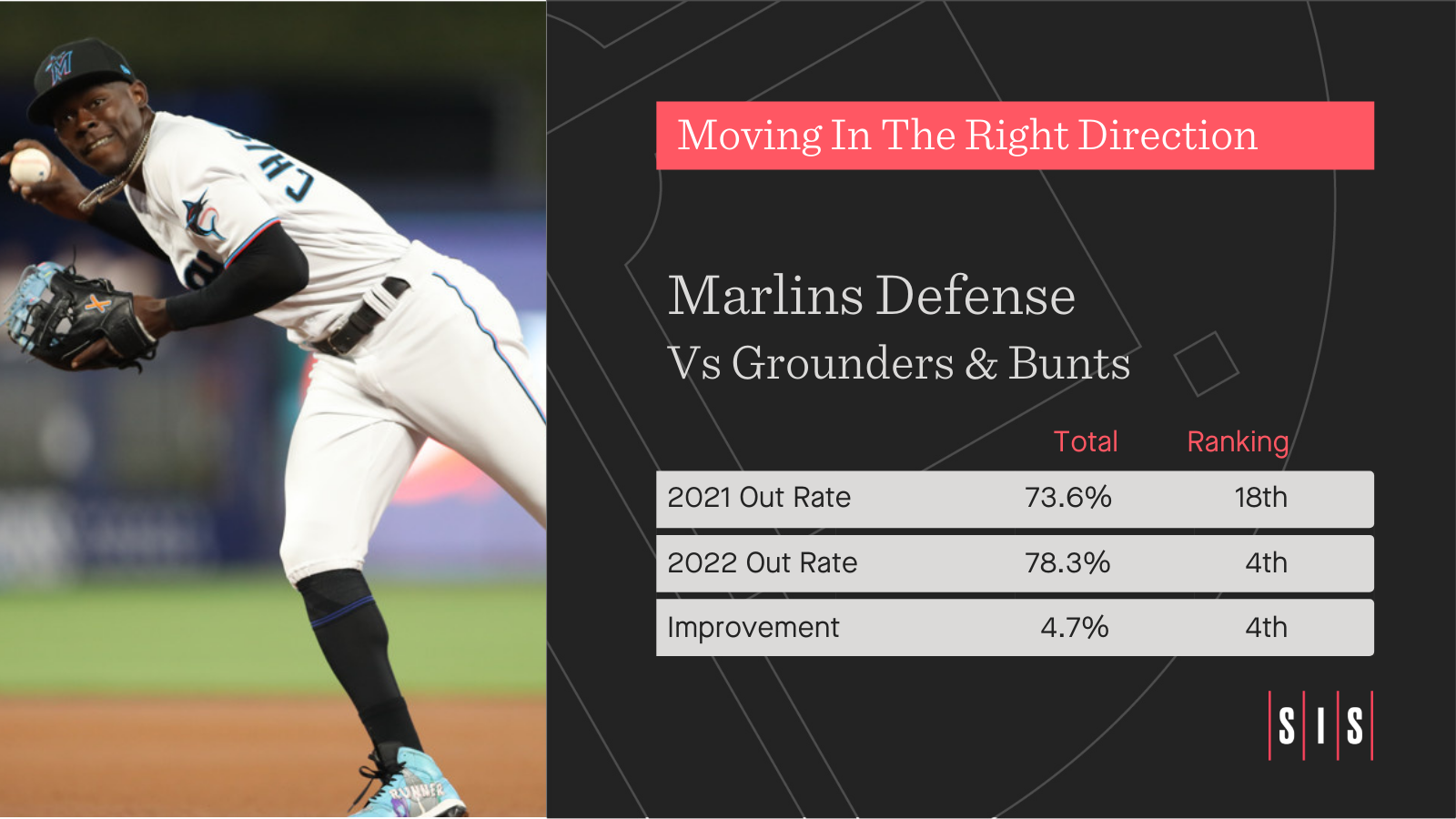
    In 2021, the Marlins turned groundballs and bunts into outs at a 73.6% rate, which ranked 18th. This season, they rank 4th at 78.3%.

    The 4.7 percentage-point improvement ranks 4th behind the Angels (6.1%), Yankees (5.2%), and Red Sox (4.9%).

    The Marlins have followed the overall MLB trend of increased shift usage, particularly with what we call full shifts – three infielders playing on the pull side.

    Just over 50% of balls in play against the Marlins have come against a fully-shifted defense, the 4th-highest rate in the majors and a sharp jump from 34% usage in 2021 (which ranked 8th).

    This is an instance in which the shift has accomplished the overall goal. Miami has recorded an out on 154 of the 183 groundballs and bunts hit against a full shift. The 84% out rate trails only the Guardians (88%) and Padres (85%).

    One of the reasons that the Marlins have done so well is because their positioning has been on point. SIS divvies up credit for any groundballs or bunts between positioning and player skill (their range and throwing).

    The Marlins have been credited with 9 Defensive Runs Saved from infield positioning. Only the Rangers (13), Giants (13), and Blue Jays (10) have more.

    The other big key to their infield defense is a player who may be on the verge of becoming a star – second baseman Jazz Chisholm.

    Chisholm played both second base and shortstop last season, his first as a full-time major leaguer, and took to second base a little better. Since the start of 2021, he’s played exactly 1,000 innings at second base and saved 9 runs, which ranks tied for 5th-most at the position.

    Chisholm was billed as a Top-100 prospect by Baseball America for three straight years and thus far in 2022, he’s lived up to it both at the plate and in the field. He’s hitting .304, leads the NL with 4 triples, and has 27 RBI in 31 games.

    More than 40 years ago, Bill James devised a stat, Offensive Winning Percentage, to estimate how a team would perform if it had 9 players who hit like the selected player in their starting lineup, with average pitching and average defense.

    A team of 9 Chisholms would have a winning percentage of .768. That’s the 4th-highest mark in the NL (Manny Machado leads at .829).

    Combine all aspects of Chisholm’s game and you get a player who has been among the very best in baseball this season. He ranks tied for 5th in the majors in Baseball-Reference’s Wins Above Replacement (2.2) and tied for 6th in our Total Runs (36).

    Things have gone swimmingly for Chisholm and the infield defense this season, even if they have not necessarily done so for the Marlins when it comes to wins and losses.

    A reminder that you can find the full team leaderboard for Defensive Runs Saved at FieldingBible.com.

  • Stat of the Week: The Astros Are Playing Some Stellar Defense

    Stat of the Week: The Astros Are Playing Some Stellar Defense

    It would have been reasonable to expect that with the departure of 2021 Fielding Bible Award-winning Carlos Correa that the Astros’ defense would suffer a slight dip in performance. Houston finished third last season in Defensive Runs Saved, with Correa leading all shortstops.

    But at least through the first 31 games, the Astros haven’t missed a beat. They entered Thursday as the 2022 MLB leaders in Defensive Runs Saved.

    The Astros have the second-highest rate of converting balls hit in the air into outs at 71%, trailing only the Dodgers (72%).

    A couple of players in their outfield have track records of success. Right fielder Kyle Tucker leads all players at the position in Defensive Runs Saved since the start of last season (he tied for third among right fielders in Runs Saved in 2021).

    Left fielder Michael Brantley has been a contender for a Fielding Bible Award multiple times. He’s played at least 81 games in left field in seven different seasons and finished with positive Runs Saved six times.

    Tucker and Brantley have thus far combined for 9 of the Astros’ 26 Runs Saved. Rookie center fielder Jose Siri has started half of the Astros’ first 30 games and has 4 Runs Saved, thanks to a series of sprinting catches in shallow center field like this one.

    The Astros also have the seventh-highest rate of turning groundballs and bunts into outs, 77%. They’ve been particularly good when using what SIS calls a partial shift.

    A partial shift is a defensive alignment in which two players play on each side of second base, but at least two are aligned radically different from what would be considered “normal” positioning.

    Houston’s defense has recorded at least one out on 73 of 85 groundballs hit against partial shifts. That’s an 86% out rate, highest in MLB.

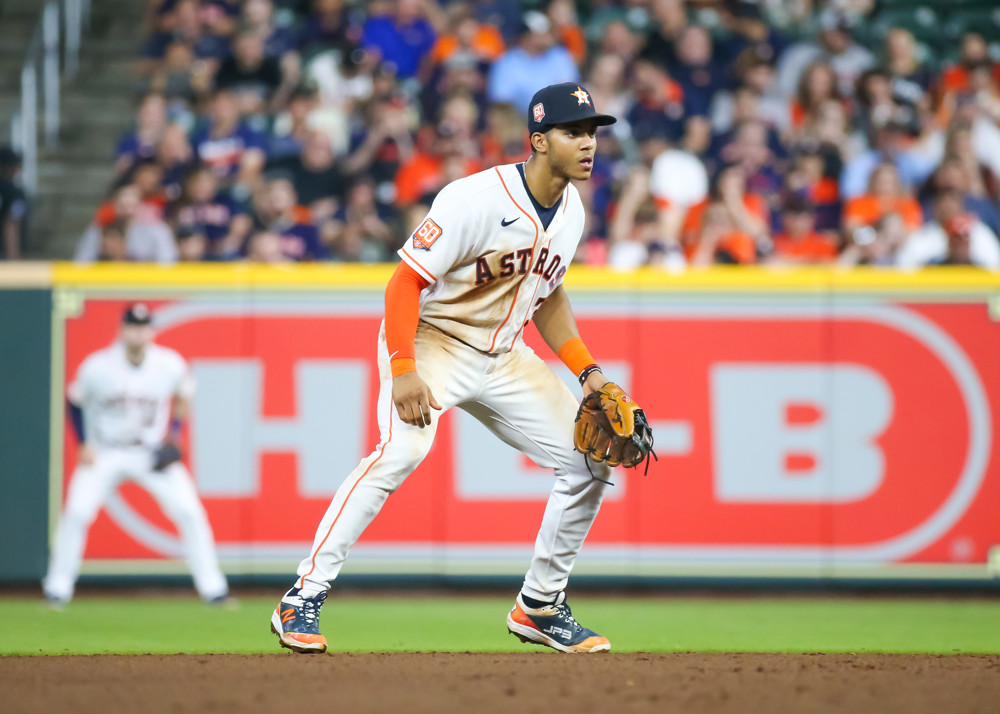
    Rookie shortstop Jeremy Peña is off to a strong start in trying to replace Correa (Thursday’s error notwithstanding). In particular, he’s made a few nice plays going to his left to take away potential hits.

    By our measures, Peña has had 61 opportunities to make a play going to his left (an opportunity is defined as a ball on which he has a >0% chance of making the play). He’s converted 41 of them. The average shortstop would be expected to convert 36.

    Combine that with some early stellar work in converting double plays and Peña has 7 Runs Saved. Early-season performance does not guarantee the same success midseason and late-season but within this initial set of games, Peña and his teammates have done the job and then some.

    A reminder that you can find the full team leaderboard for Defensive Runs Saved at FieldingBible.com.

  • Q&A: Hawaii Baseball Coaching Legend Dunn Muramaru

    Q&A: Hawaii Baseball Coaching Legend Dunn Muramaru

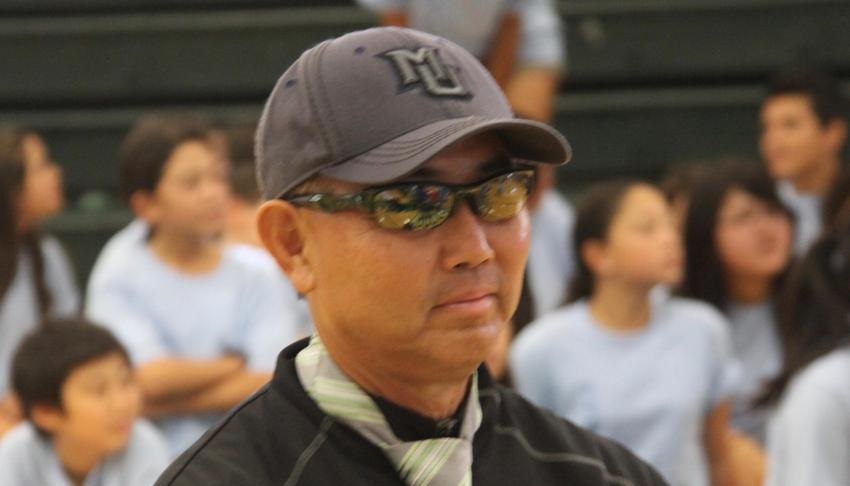
    Dunn Muramaru is a high school baseball coach (and former math teacher) at Mid-Pacific Institute in Hawaii, where he’s coached since 1987. Muramaru, who is of Japanese heritage, has more than 40 years experience coaching baseball and has had a long run of success in producing Division I and MLB-level talent.

    He’s considered one of the legendary high school baseball coaches in the state. One of his star alumni is Yankees Gold Glove-winning shortstop Isiah Kiner-Falefa.

    Since one of our company’s pillars is in promoting defensive excellence and to honor Asian-American/Pacific Islander Heritage Month, we talked to Muramaru to learn how he teaches defense.

    The interview below has been edited for clarity and length.

    Mark: How do you define defensive excellence?

    Coach Muramaru: Making the plays. You’re supposed to make the routine plays. Sometimes you make a great play, but it’s mostly just making the plays you’re supposed to make so that you have a baseline to work with. That’s basically what it is.

    Mark: And when you’re teaching it to 15 to 18 year old kids, what are the keys that you’re teaching to work towards defensive excellence?

    Coach Muramaru: One is throwing, throwing actively all the time. It’s gotta become a habit. Even when we warm up before practice, we have our pitching coach go out there and he just stands there and watches. So there’s someone watching them all the time.

    And it’s just about getting good habits.

    When I play catch with them, I (throw) to the little space just below their neck, and I say this a habit, I do it all the time and they notice.

    I don’t have a bad throw in my mind. If it’s not in your brain [to throw well], then you won’t make it right. As Napoleon Hill said: ‘What the mind of man can conceive and believe he shall achieve.’

    So whatever is in your head, it comes out. So in that way, we try to create habits. I try to dispel the errors. I tell them when I make an out,  I run past first base, I’m coming back to the dugout and it is already gone.

    We practice the routine, like, okay, you acknowledge the error, you turn around, you get rid of it. And then you see yourself making a good play. It’s connecting the mental part with the physical part.

    I liken it to guys shooting free throws. They dribble twice. They come set by the waist and then they put it in. Watch Stephen Curry shoot free throws. He does the same thing over and over and over again. And the guys that are shooting poorly, they do things a little bit different every time.

    Mark: What is your origin story for coaching and understanding things like that?

    Coach Muramaru: I never played college baseball. I played high school. I always played semi-pro and I had some really good mentors. There was Pop Eldredge. He’s a legend. He was a grandfather type. I learned to love the game because of him. I got to play for legends in Hawaii like Dick Kitamura and Masa Yonamine. This one guy Carlton Hanta: He’s in the Hall of Fame at the University of Houston. He came back and coached us. He taught me to do a lot of stuff, like hitting a fungo properly.

    And then, I just put my own spin on stuff.

    Mark: Isaiah Kiner-Falefa said that you taught him discipline, technique, and character. I’m curious what you would say about teaching that.

    Coach Muramaru: Discipline is that you’ve got to do the same things every day that you’re supposed to do.

    I used to watch Bobby Knight. One of his teams practiced here (during a tournament in Hawaii). It was very enlightening. He has a bad reputation but he’s a teacher. So I took stuff from watching that. It’s about how much you want what you teach to sink in.

    There’s a level of peaking, right?

    You have A level, B level, C level. Sometimes they are not capable of getting the A’s. So you got to settle for the B plus or the C, but maybe you can raise them up the ladder higher.

    Mark: What skills and traits does Isiah have that have allowed him to be so good?

    Coach Muramaru: He’s very quiet. He plays very quiet. You don’t even notice him there. He’s not flashy. He does the job. If the ground ball goes there, he’s going to get the out. Though in our state championship game, he made a play, dove up the middle and flipped it to second [for the force]. That saved us.

    Mark: When you’re teaching middle infielders at high school age, is there anything beyond the repetition that you really focus on?

    Coach Muramaru: We teach them to read hops.

    I took some ground balls the other day and I was trying to see what I see when the ball comes off the bat.

    What I came up with was this thing called Elastic Man.

    I tell the kids: Get your hands out. Some of you just get your hands out and have no reason. So I told them to make believe they were Elastic Man and that their arms could go as far as you like.

    I said to them ‘Where would your hands be?’ (when the ball is hit) and they say ‘Over here’ [out wide]

    And I said no. Your hands would be out right where the ball is hit – the contact point. But since your hands can’t be there, you have to use your eyes as your hands and you have to follow the ball all the way, using your eyes.

    Your hands would be out right where the ball is hit – the contact point. But since your hands can’t be there, you have to use your eyes as your hands and you have to follow the ball all the way, using your eyes.

    So then we hit some ground balls and a kid said ‘Coach, the ball looks slower now.’

    The other thing we tell them is ‘Field the whole line.’

    If I hit a ground ball, there’s a line that comes to you. You field the whole line. Sometimes a kid fields a ground ball and just fields it at the spot where they catch the ball. We tell them field the entire line of the ball. Follow the ball as if it’s a line at you. Field the whole line. Keep the glove down a little longer, pick it, and go.

    We also do stuff with hops. Guys would spot hops using a yellow ball. And then we can ask them, what kind of hop would you have gotten if you came up on the ball? Then, we counted hops. Anything to see the ball a little farther out in front.

    Mark: You’ve taken teams to Japan and had Japanese teams come visit yours. What was that like?

    Coach Muramaru: I was in Japan in 1993 and I wanted to see a real practice. So we drove up a mountain and I’m wondering where the heck is the field. And then we walked down what was like a volcanic crater. And there’s 100 kids. I’m walking down and the practice stops. They all bow to me.

    And I’m watching their practice. Talk about discipline. They had two coaches for 100 kids. It’s like it was all self-run. In, out, in, out. I asked the translator: ‘Where’s the golf cart to fix the infield?’ He points to 60 rakes [(the kids raked the field)].

    In 2020, a team came to visit us. They lined up their bags. I don’t know that the Marines could line them up any nicer. Their shoes are put on so nicely. I thought we had a pretty good team, but they beat us 7-2. They were good. They could have beaten us 20-2.

    Mark: Do you have any other players coming up that we should be aware of?

    Coach Muramaru. We’ve got shortstops.

    We’ve got one right now with the Mets in Triple-A.  Wyatt Young. That guy has earned everything he’s ever gotten. If he makes it to the major leagues, he’d be one of the greatest stories.  He’s 5-foot-6. Junior year of high school he hit something like .212. Before they put in rules about this, he’d go and work out in our weight room with his dad at 4 AM while I was walking my dog. And he’d hit, and hit, and hit, and hit.

    He got to Pepperdine and got invited to the Cape Cod League as a temporary guy to fill in for guys playing in the College World Series. He ends up making the All-Star team. He hit .339.

    He came home and told me something funny. He went to the All-Star Game and the guys from Georgia, LSU, South Carolina are all asking him about his approach.

    And he’s thinking, shouldn’t I be asking them?

    To learn more about Dunn Muramaru, read this tribute to him at the Mid-Pacific Institute website.

  • The Phillies Shift Their Shifting Strategy

    The Phillies Shift Their Shifting Strategy

    A word association exercise kicked off with “Phillies defense” may yield responses like, “bad” or “worst team in MLB by DRS in 2021.”  

    While those descriptions may not be inaccurate, today we’re not here to talk about the Phillies’ defensive performance as a whole, but rather, a shift in their defensive strategy that may be leading to positive early returns.  

    The Phillies have never been considered pioneers of defensive positioning. SIS has tracked shift usage on balls in play since 2009, and the Phillies have been in the bottom-5 of shift usage in 6 of those seasons. The most recent of those years is 2021, in which they employed a shift on 40% of balls in play, ahead of only the White Sox.

    Phillies Shift Usage through the years*(BIP) 

    Season  Shift Usage  Rank  MLB Average 
    2022  52%  25  64% 
    2021  40%  29  55% 
    2020  65%  9  60% 
    2019  36%  21  45% 
    2018  38%  9  32% 

     * Shift usage = % of Balls In Play vs a Defensive Shift

    The 2020 season notwithstanding, there’s a gradual increase in shift usage as the years progress. Another note of interest is that in 2018, the Phillies’ low shift rate (from today’s perspective) was considered semi-aggressive compared to the rest of MLB. However, as their shift rates remained in the same neighborhood, shifting around the league trended upwards at a steeper rate.  

    Defensive strategy cannot be evaluated based solely on how often you stick your infielders somewhere unfamiliar, however. It’s certainly possible that an unshifted defense can be as effective as a shifted one in the correct circumstances.  

    That begs the question—with the increase in shifting, is the Phillies defense getting any better?  

    In 2021, when shifted, the Phillies converted 72% of groundballs and bunts to outs—good for 28th in MLB. This season, that rate has jumped to 74%, which thus far ranks 18th. If you watch the Phillies on a nightly basis, an about-average infield defense is a breath of fresh air.  

    Additionally, the Fightins have accrued 6 Defensive Runs Saved specific to their shift positioning, the 5th-best total in MLB (and that’s despite ranking 25th in shift usage). Last season, their 9 DRS from shift positioning was the 2nd-lowest total, behind the Royals. 

    So, what’s different? 

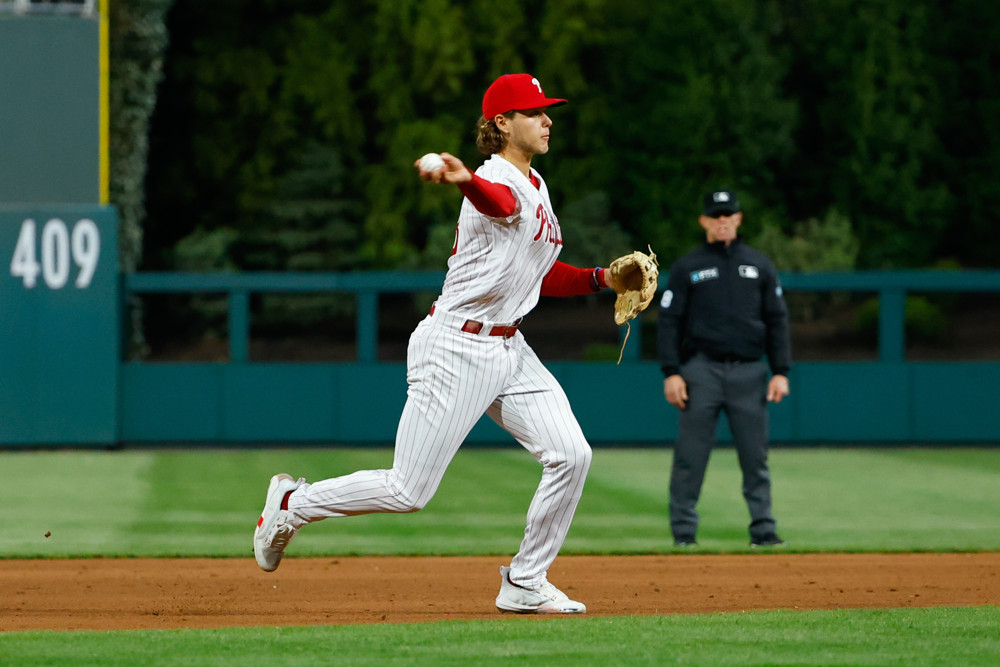
    For one thing, Jean Segura got taller.  

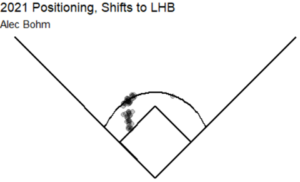
    Wait, that’s Alec Bohm positioned in shallow right field. Forgive me, I’m used to seeing this:  

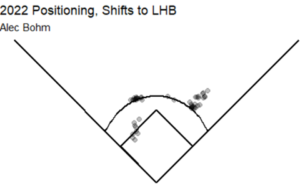
    And what I got was this: 

    The earliest instance of Alec Bohm being positioned there is from an April 20 game against the Rockies. He wasn’t involved in any plays from there that day, but we can get a sense of where he was positioned from this clip—as deep as the edge of the infield dirt and closer to first base than second.  

    We can see a bird’s eye view of the differences of Alec Bohm’s positioning on shifts to LHBs below. For fair-comparison’s sake, I used only plays from 2021 leading up to May 9. Rest assured that even after May 9, Bohm is never positioned that far to the right of the second base bag as he is in 2022.  


    The consequences of this are interesting. Most importantly, Bohm is no longer out on an island on the left side of the infield when a lefty is up. The more rangy Didi Gregorius or Johan Camargo can handle the occasional oppo grounder when left all alone. That was a lot to ask of your defensively-shaky, young third baseman.  

    However, now that he’s playing to the right of second base, Bohm will be reading balls of the bat from an angle he’s likely unfamiliar with, which could prove problematic, but that remains to be seen for certain. 

    The more important wrinkle to Bohm’s change in positioning, however, is how deep he can play when a lefty is batting. When playing on the left side of the infield, infielders’ maximum depths are somewhat limited because the farther away they start from first base, the less time they have to throw—so, while playing deep can increase an infielder’s range, it can come at the cost of accurate, unrushed, timely throws.  

    This is null and void when the third baseman is playing in the right field grass. Their closer proximity to first allows them to play much deeper (depending on their arm strength/talent)–the consequence of this is that Bohm has much more time to react to a groundball or short line drive when he’s playing deep. This is super valuable for a guy whose range isn’t something to write home about—again, the long-term returns remain to be seen. 

    We have Bohm positioned approximately 184 feet from home plate in the clip below, which is the deepest we have him on a ball in play to date. In 2021, his greatest depth was approximately 153 feet from home plate (playing on the left side of the infield in a full shift against a LHB). The average estimated exit velocity on groundballs this season is approximately 85 mph (~125 feet/second)–the extra 30 feet gives Bohm about a fifth of a second longer to get to an average groundball.  

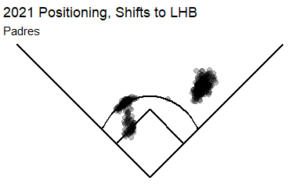
    This placement of the third baseman in the hole between first and second isn’t exactly trailblazing, but it’s not the norm by any means. The Braves, Yankees, and Marlins all placed their third baseman there more than a few times, but no team did so as much as the Padres—the former home of current Phillies infield coach, Bobby Dickerson.


    Previously, the Phillies rolled out talent-agnostic infield alignments that contributed to their title as one of the worst defensive teams in baseball last year. But, trends in their recent defensive alignments indicate a (long-awaited) move towards a system of maximizing the limited defensive talent they have.  

  • Start Spreading The News: A Great Month for the Yankees Infield

    Start Spreading The News: A Great Month for the Yankees Infield

    The Yankees enter Friday tied with the Mariners for second in the majors in Defensive Runs Saved.

    That’s pretty remarkable given that in 2021, they finished next-to-last in the majors in that stat.

    It’s only a month into the season but the remaking of the Yankees infield has been a significant contributor to their 18-7 record and 2.5 game lead in the AL East.

    This was a necessity. Last season, the Yankees got negative Runs Saved at each of the four infield spots.

    What impact have the changes had?

    The Yankees have converted 78% of groundballs and bunts into outs this season. That’s the fifth-highest out rate in MLB. The Yankees ranked 23rd in that stat in 2021 at 73%.

    The difference of 5 percentage points equates to this – The Yankees have turned 216 of 277 groundballs and bunts into outs this season. Had they performed at the 2021 rate, they would have converted 201.

    That’s not just 15 potential baserunners wiped out. It’s trading potential baserunners for outs.

    On an individual level, three things have paid dividends. Runs Saved is one way to illustrate that but let’s go one step beyond that and show the out-getting numbers to provide a more tangible illustration.

    One was that the Yankees moved Gleyber Torres back to being a full-time second basemen. Torres saved 5 runs there in 2018, then struggled at both second base and shortstop the next three seasons.

    Torres has played 18 games at second base this season. He’s gotten at least one out on 39 of 55 balls on which he had a >0% chance of recording an out (we’ll call the potential outs “opportunities” going forward).

    In 2021, he played 19 games at second base. That season, he got outs on 39 of 67 opportunities. That’s the same number of plays made on 12 fewer opportunities.

    Torres moved to second base because the Yankees traded to get shortstop Isiah Kiner-Falefa. Kiner-Falefa saved 10 runs at shortstop last season. Torres was the Yankees primary shortstop last season. He cost them 10 runs with his defense.

    Torres got an out on 60% of his opportunities as a shortstop last season. His expected out rate against those balls (yep, we track that) was 62%.

    Kiner-Falefa has turned 60 of 96 opportunities into outs this season. That’s a 63% out rate. He was expected to convert 55, an expected out rate of 57%.

    Though Gio Urshela’s defense at third base last season passed the eye test, it was a net negative for the Yankees, costing them 4 runs.

    The Kiner-Falefa trade also brought Josh Donaldson, a third baseman with a good defensive track record.

    Donaldson and DJ LeMahieu have combined to convert 63 of 89 opportunities into outs. That’s a 71% out rate within a small sample. Urshela’s out rate last season was 61%.

    You may be wondering why we haven’t mentioned first baseman Anthony Rizzo yet. That’s because Rizzo’s defensive numbers aren’t good since he joined the Yankees last season. He’s cost them 6 runs in his 74 games, including 1 in 25 games in 2022.

    But Rizzo’s track record is pretty good. He posted positive Runs Saved in every season from 2013 to 2020. If he performs at the level he’s shown in the past and the other Yankees infielders maintain what they’ve done, we may be talking about this as the best defensive infield in the American League in a few months.

  • Stat of the Week: April’s Defensive Player of the Month

    Stat of the Week: April’s Defensive Player of the Month

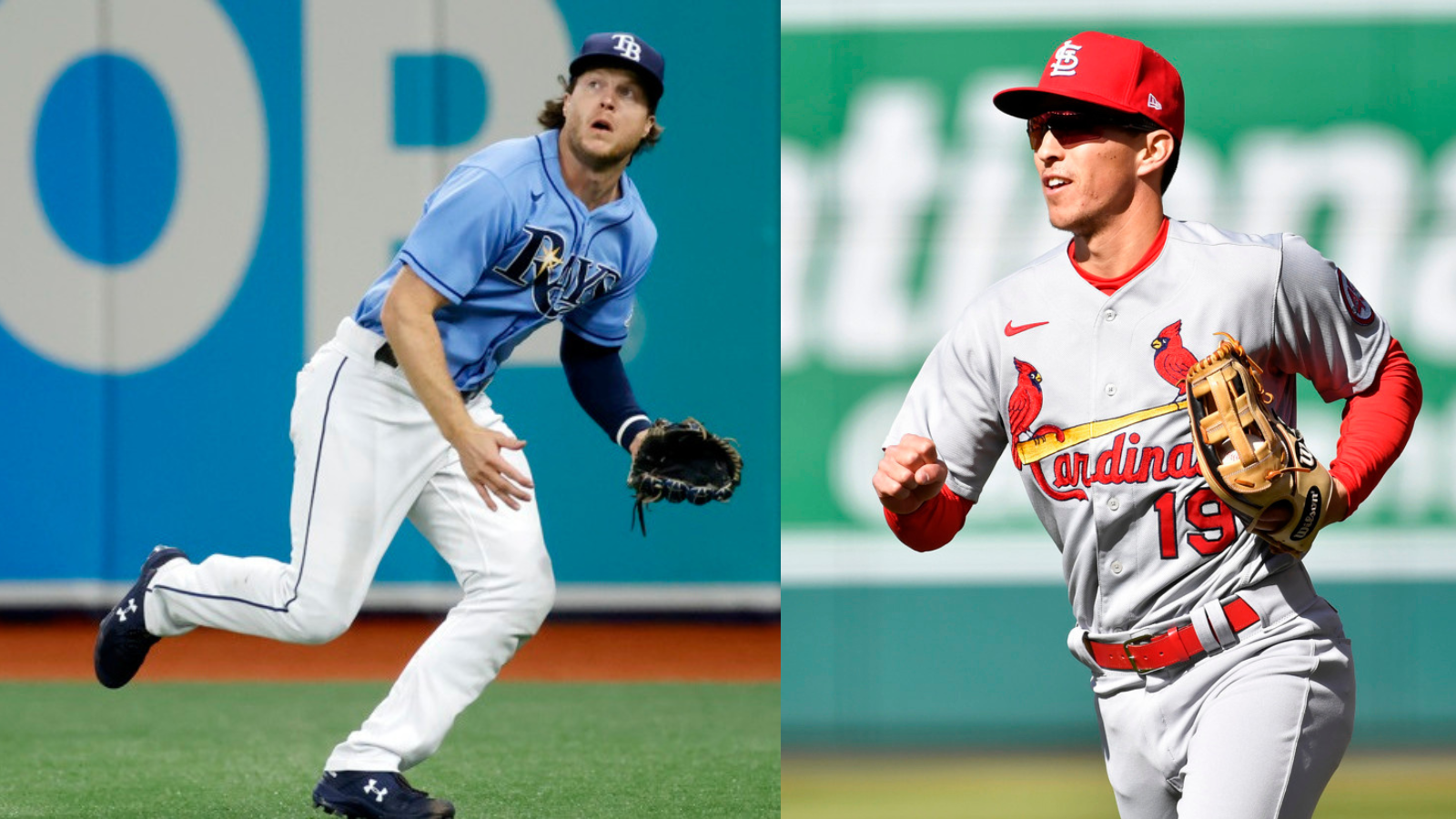
    Rays outfielder Brett Phillips is unlikely to play 1,000 innings in the field this season. But if he did, he’d put up some kind of Defensive Runs Saved numbers.

    In fact, he’s currently playing at a 54 Runs Saved per 1,000 innings pace!

    Phillips is our choice for April’s Defensive Player of the Month, a selection made by members of Sports Info Solutions’ R&D team.

    His 5 Runs Saved are currently tied for the most among outfielders. The only player with more is Cardinals second baseman Tommy Edman, who was runner-up for the honor.

    We wrote an appreciation of Phillips’ defense a couple of weeks ago, and his penchant for defensive excellence has continued through his first 91 innings in 2022.

    The piece noted that Phillips ranked among the best outfielders in both Range Runs Saved and Arm Runs Saved on a per-inning basis. Both areas contributed to his success in April.

    Phillips has made 5 Good Fielding Plays this season:

    On April 11, he robbed Billy McKinney with a catch in the right field corner, then made a sliding catch by the visiting dugout while eating up an inning as a pitcher in a lopsided game.

    On April 15, he made a diving catch on Yasmani Grandal’s fly ball in shallow right, then took a potential home run away from Grandal the next day.

    Lastly, on April 28, Phillips helped preserve a one-run lead in the ninth inning by recovering and getting a force play at second base on a ball that one of his teammates muffed.

    Phillips was preserving his own lead that day. He’d driven in both of the Rays’ runs in a 2-1 win.

    To his credit, Edman had a fantastic month as well, leading all players with 7 Runs Saved. Among his highlights was robbing former Cardinals second baseman Kolten Wong with a diving play and a leaping play on a line drive hit by Bryan Reynolds, in which he got the out despite dropping the ball.

    Edman too has excelled on a per-inning basis. Since 2019, he ranks tied for second among second basemen in Defensive Runs Saved despite ranking 14th in innings played.

  • Stat of the Week: The Angels Are Looking Good

    Stat of the Week: The Angels Are Looking Good

    It’s only 20 games, but the Los Angeles Angels look like a completely different team from last season’s squad in a couple of important areas.

    For one thing, take a look at their chase rate (best known as O-Swing% on FanGraphs). In 2021, the Angels’ chase rate of 33% ranked 25th. To this point in 2022, they rank second-lowest at 26%.

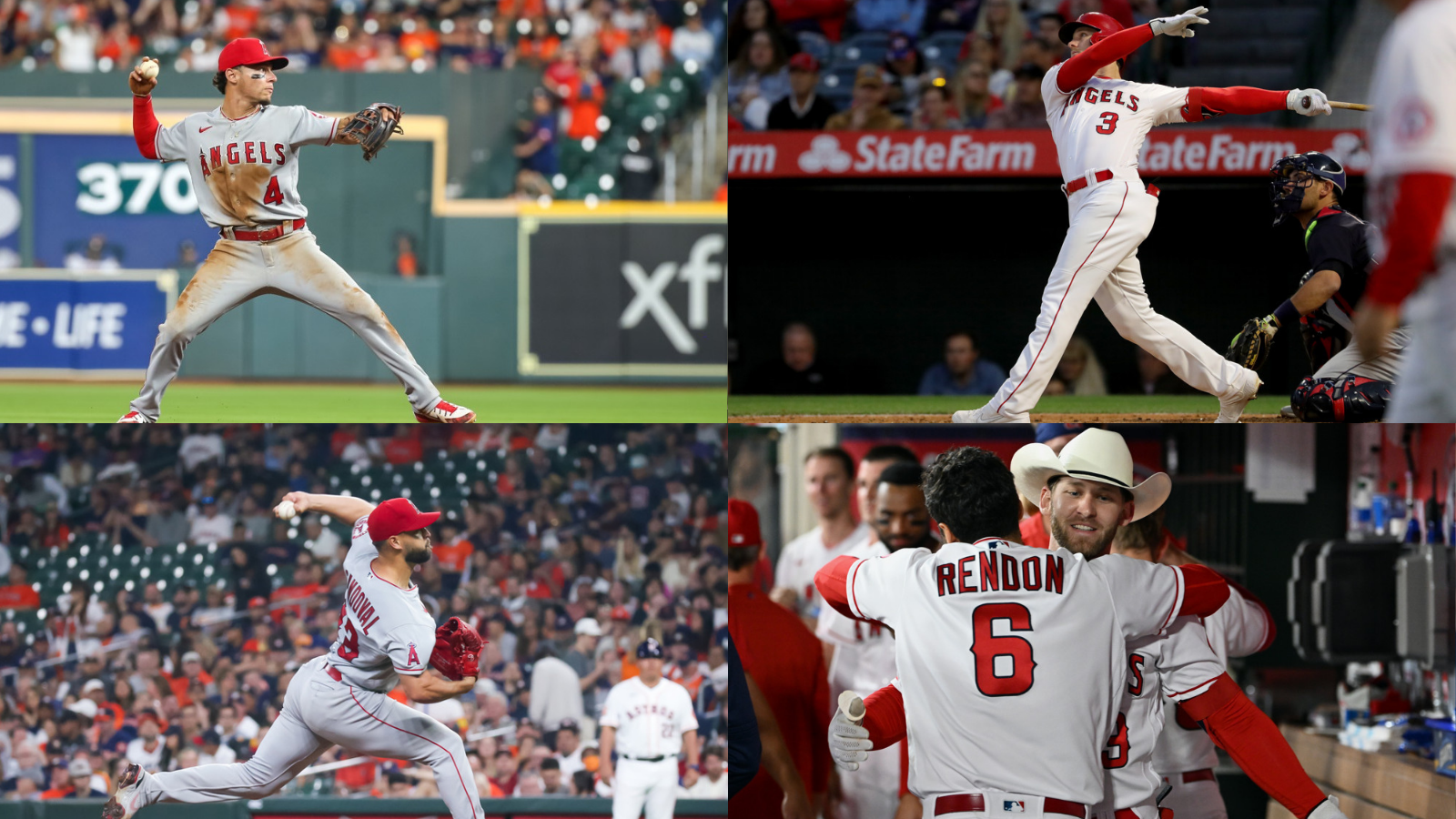
    This can be explained by a few things. For one, two of the team’s most discerning hitters – Mike Trout and Anthony Rendon – are healthy. They’re each at 21%.

    For another, the team’s top chaser among its regulars in 2021, José Iglesias, is now in Colorado. And one other note: a couple of hitters, most notably Taylor Ward, have shown a little more patience than usual within a small sampling of at-bats this season.

    Ward’s chase rate is 20%. His rate last season was 29%. He’s been a big contributor, with a .509 on-base percentage in 53 plate appearances. His 1.271 OPS is 16 points higher than Trout’s. Outfielder Jo Adell’s chase rate is 34%. It was 40% in 2021.

    The reduction in chasing seems to have translated into positive results. The Angels rank first in the American League in batting average (.253), on-base percentage (.333) and slugging percentage (.428). They ranked 6th, 9th, and 7th in those stats, respectively, last season.

    The Angels also have shown themselves to be a good defensive team in 2022. They rank 3rd in the majors in how often they turn a groundball or bunt into an out (nearly 81% of the time) and 5th in how often they turn a ball hit in the air into an out (just over 71% of the time).

    In 2021, they ranked 27th in both out rate on grounders and bunts (72%) and out rate on balls hit in the air (65%).

    What’s noteworthy here is that the Angels plan to move David Fletcher to shortstop was thwarted when Fletcher went out with a hip injury after playing five games.

    Fletcher’s replacement, Andrew Velazquez, hasn’t hit well at all. But he’s been excellent in the field, recording 5 Good Fielding Plays, tied for the most among shortstops.

    We don’t generally advise using 14-game samples as meaningful evaluations, but Velazquez has played good defense at shortstop throughout his career, saving 9 runs in not even a half-season (476 innings).

    Pitching-wise, the Angels’ numbers look considerably better than last season’s, but admittedly, the numbers look better for just about every team. The Angels currently rank 11th in the AL in FIP, after ranking 8th in that stat last season.

    But there have been some bright spots, most notably Patrick Sandoval, who has not allowed an earned run and has 20 strikeouts in 15 innings. Newcomers Noah Syndergaard and Michael Lorenzen also have ERAs under 3.00 thus far. Four of the team’s five most-used relievers have ERAs under 2.00.

    The team’s looked better at the plate and better in the field, and has some bright spots on the pitching staff, but perhaps the best thing that could be said about the Angels start is this:

    The Angels are 13-7 and we didn’t even mention Shohei Ohtani (.691 OPS, 4.19 ERA) until the next-to-last sentence of this article.

    What will the team be like once he gets going?

  • Stat of the Week: The Padres’ Spectacular Groundball Defense

    Stat of the Week: The Padres’ Spectacular Groundball Defense

    By MARK SIMON

    Padres pitchers took a no-hit bid into the seventh inning in their first game of the season and a no-hit bid into the eighth inning of their second game of the season.

    They allowed five hits or fewer in each of their first four games of the season and eight times in 14 games overall.

    That’s great pitching. But it’s also great infield defense.

    Through 14 games, the Padres have converted 87% of groundballs and bunts into outs. This is easily the highest rate in MLB. The Mariners rank second at 82%.

    The Padres are one of the most aggressive defensive shifting teams in MLB. Just under 79% of balls put in play against them have come against a shifted defense. That’s the fifth-highest rate in MLB.

    The payoff for that usage comes in the form of a 91% out rate on groundballs and bunts when the Padres use a shifted defense. That’s 92 instances in which they’ve recorded at least one out on the 101 groundballs they’ve faced.

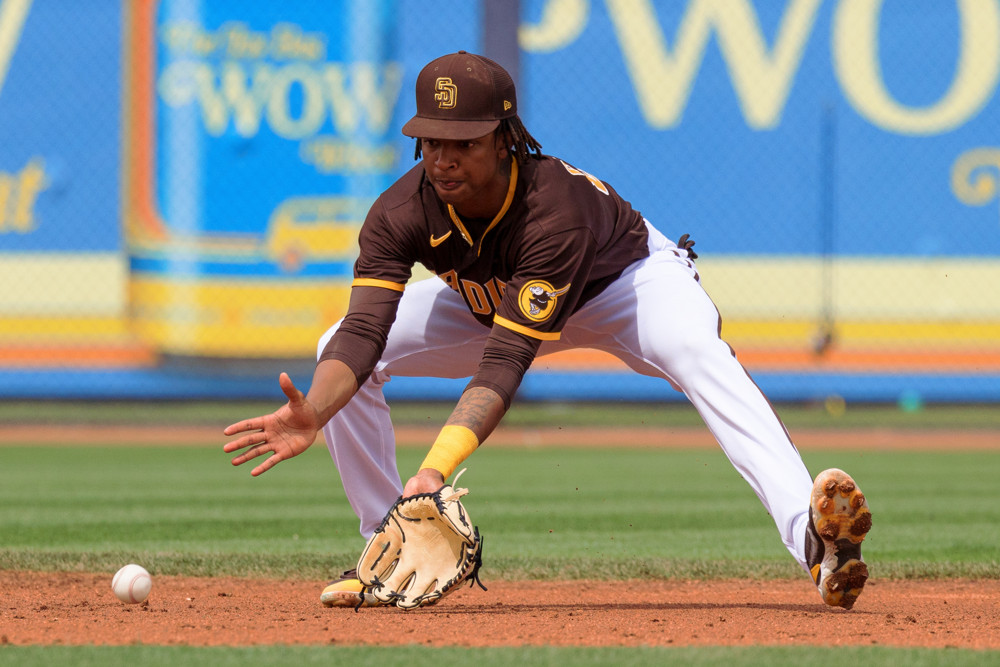
    Credit where due to the Padres starting infielders: first baseman Eric Hosmer, second baseman Jake Cronenworth, shortstop C.J. Abrams, and third baseman Manny Machado, all of whom are off to a strong start.

    Machado has a strong track record, though his best defensive seasons are circa 2013 to 2016. Cronenworth has 10 Defensive Runs Saved in just over 1,200 innings at second base. Abrams has looked credible while replacing injured shortstop Fernando Tatis Jr. Hosmer’s history at first base has had mixed results but all has been fine so far in 2022.

    The Padres numbers, both overall and when using shifts, are a bit aberrational and will likely level off at least a little bit with time. The highest out rate on groundballs and bunts in MLB last season was 77% by the Cardinals. The highest out rate on grounders and bunts when shifted was 78% by the Indians.

    But thus far it has been harder to reach base on a ground ball than it typically is. The average groundball and bunt out rate in 2022 is 76%.

    Just to illustrate, practically speaking, how much better the Padres have been than average. If they had turned batted balls into outs at a 76% rate overall, they would have converted 101 of 133 overall. They’ve made 116 plays – 15 more than the expected rate.

    And to show how much better they are than the team that ranks last in groundball and bunt out rate, here are the numbers:

    The Reds have converted groundballs and bunts into outs at a 70% out rate.

    If the Padres matched the Reds’ conversion rate, they would have converted 93 groundballs and bunts into outs. They’ve made 23 more plays than that.

    This is a team that has gotten the nickname “Slam Diego” for its penchant for hitting grand slams. The way it’s playing, it might need a new nickname. Can we suggest “San Defensive Runs Saved?”

  • Stat of the Week: Adam Engel’s Amazing Home Run Robberies

    Stat of the Week: Adam Engel’s Amazing Home Run Robberies

    By MARK SIMON

    DHs aren’t carrying their weight as MLB offenses are off to a slow start. Defensive shifting is up considerably, particularly in Toronto where the Blue Jays are using them on almost every batter.

    But we’re only a week into the season. Sample sizes are so small. Let’s wait at least another week before jumping to any sort of meaningful conclusions or observations.

    And while we do that, let’s look at something fun that only SIS tracks: Home run-robbing catches

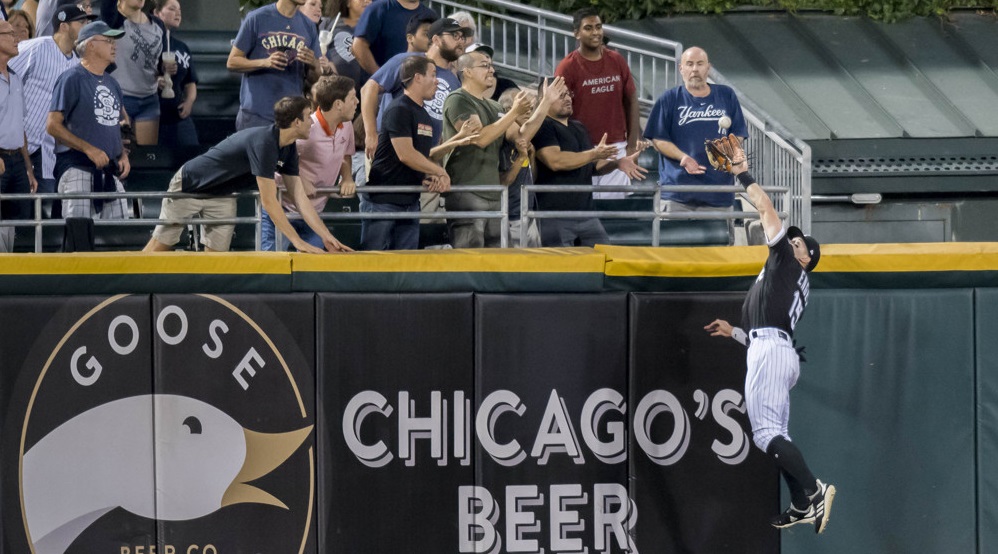
    Specifically, I want to address White Sox outfielder Adam Engel, who stole another home run on Wednesday, this one from Jesse Winker of the Mariners.

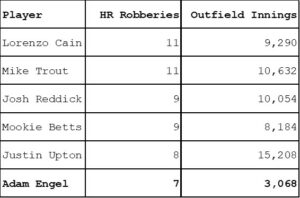
    That marked the seventh home run robbery of Engel’s career. Seven is a lot. Engel ranks sixth among active players in home run-robbing catches. And that’s particularly impressive when you look at how often he’s played compared to those who rank ahead of him in number.

    There are no cheap home run robberies in Engel’s collection, no instances of going into an outfield corner that had a short porch and just snagging the ball without too much effort. Every one of these catches has required a legitimate leap.

    Wednesday’s was arguably the easiest, as he got back to the right field wall with time to spare and timed his leap correctly in order to make the play.

    Among the other types of homer-robbing catches in his repertoire are the change-of-direction and one that showed off his NBA-calber ups. The latter came in 2018 and was his third home run robbery within a seven-day span. He’s the only player to have that many in that short a time in the 19 seasons for which we’ve tracked home run takeaways.

    In order to keep climbing up the home run robberies list, Engel needs to stay healthy and hit enough to justify his lineup spot. Staying on the field has been a challenge. Engel missed time last season due to both hamstring and shoulder injuries.

    But the offense has been there. In his first three seasons, Engel had a .601 OPS. In 2020 and 2021, that jumped to .823. He’s found something in his offensive game that has enabled him to become more than a one-note player.