Category: Baseball

  • Stat of the Week: Who were baseball’s top overachievers & underachievers in 2018

    By Mark Simon

    Who were the overachievers and underachievers of the 2018 MLB season?

    It’s a question to consider for those evaluating their teams and conducting their fantasy drafts. Though there are no guarantees that the numbers will even out and that the player will return to his expected norms, understanding who overachieved and underachieved provides context to a player’s past performance.

    Our defense-independent batting statistics (DIBS) can give expected results on every ball in play for a hitter by comparing the ball’s trajectory, direction and velocity to other similar batted balls and assigning value based on those results. We can then compare those to his actual offensive numbers to determine if a player underachieved or overachieved.

    In other words, these numbers can tell us if a player may have hit into hard luck, played in an unfriendly ballpark, or been the victim of some good defense. Or perhaps he hit into good luck, got a few ballpark-friendly hits, or took advantage of some poor defense.

    Here’s a look back at several players from 2018, along with their projections for 2019.

    Overachievers

    Before the start of last season, Mookie Betts made the underachiever list. He was coming off a 2017 in which he hit .264/.344/.459 when the batted-ball profile was that of a .297 batting average and .886 OPS hitter. It was noted then “There’s not much reason for concern, and at 25 he should be an MVP-caliber player.”

    Much that went against Betts in 2017 turned in his favor in 2018. He won AL MVP honors in 2018, though the data indicated his numbers were better than what they likely should have been.

    Betts hit 32 home runs, six above expectations, and 47 doubles, nine above expectations. His 1.078 OPS was 133 points higher than expected, though even if it had just met expectations (.945), he still would have had a great season. The 133 points were the most above expectations for any player with at least 250 plate appearances in 2018.

    Betts was joined by J.D. Martinez and Steve Pearce in having the biggest positive differential between expected OPS and actual OPS. Martinez’s OPS was boosted by hitting 43 home runs, 10 more than the data indicated he was expected to hit.

    Betts’ 2019 projection: .303 BA, .923 OPS, 29 HR in 614 AB

    Martinez’s 2019 projection: .294 BA, .929 OPS, 36 HR in 555 AB

    Pearce’s 2019 projection: .262 BA, .806 OPS, 14 HR in 313 AB

    The player with the highest OPS above expectations who wasn’t on the Red Sox was Carlos Gonzalez, who hit .276 with a .796 OPS last season. Gonzalez’s batting average and OPS were 41 and 105 points above his expected performance respectively. Gonzalez was likely helped by Coors Field, where he hit .315 with a .941 OPS compared to .241 and .663 on the road. He’ll move to less-friendly Progressive Field as a member of the Indians in 2019.

    Gonzalez 2019 projection: .271 BA, .814 OPS, 24 HR in 542 AB

    Giancarlo Stanton is the one other player whose 2018 OPS was at least 100 points above expectation. Yankee Stadium likely helped a bit here as Stanton’s 38 home runs were seven more than the batted-ball data suggested he would hit. He had never been more than three home runs above expectations in a season while with the Marlins.

    Stanton 2019 projection: .260 BA, .887 OPS, 42 HR in 574 AB

    Underachievers

    Angels shortstop Zack Cozart hit .219 with a .658 OPS while dealing with injuries in 2018, not what the team had in mind when it signed him to a three-year deal last offseason. Cozart’s numbers were a bit out of whack given where he hit the ball and how hard he hit the ball.

    His expected batting average and OPS were .287 and .819 respectively. The 161-point differential between his OPS and expected OPS was the biggest negative differential between those stats in MLB.

    Cozart’s 2019 projection: .259 BA, .744 OPS, 13 HR in 421 AB

    Dodgers center fielder A.J. Pollock is another player whose numbers should have looked a little better. His .800 OPS in 2018 was 106 points below what was expected from his batted balls. Pollock, who finished his tenure with the Diamondbacks in 2018, may have been hurt by Chase Field’s humidor, as the ballpark was not the hitter-friendly place for right-handed batters that it had been in the past. It will be interesting to see how Pollock performs with his new team, the Dodgers, in 2019. His projected OPS (noted below) is right in line with his 2018 OPS.

    Pollock’s 2019 projection: .266 BA, .804 OPS, 19 HR in 466 AB

    One of the top prospects last season was Marlins center fielder Lewis Brinson, who hit a disappointing .199 with a .577 OPS in just over 400 plate appearances. Brinson should have been something closer to an average player in 2018 as his batted balls merited more home runs (15 expected, 11 hit) and a higher BABIP (.322 expected, .257 overall).

    Brinson’s expected batting average and OPS for 2018 were .242 and .697. He got off to a hot start this spring and it will be worth watching to note if there is any carryover into his 2019 season.

    Brinson’s 2019 projection: .219 BA, .644 OPS, 13 HR in 398 AB

    A reminder that you can purchase the updated 2019 Bill James Player Projections at this link

  • Athletics got an ‘A’ for their shift defense in 2018

    By MARK SIMON

    The Athletics were one of the surprise teams in baseball last season, winning the second AL Wild Card and challenging the Astros for the AL West title.

    Chances are that you know the Athletics had the best defensive player in baseball last season in third baseman Matt Chapman. But they were also good at something that had almost nothing to do with Chapman.

    As you can see in the newly-listed numbers on Fangraphs, Oakland ranked second in MLB with 36 Shift Runs Saved, trailing only the 39 by the Diamondbacks. It’s largely the reason that the Athletics led the AL in overall Defensive Runs Saved.

    Most Shift Runs Saved – 2018 Season
    Diamondbacks39
    Athletics36
    Rays31
    Twins31
    Tigers30

    Those two teams used shifts at dramatically different volumes. The Diamondbacks ranked eighth in the number of shifts they used on balls in play with 1,391. The Athletics ranked 25th, utilizing 883. But the Athletics got great value out of the instances in which they did shift.

    So what were the characteristics of the Athletics’ shift that allowed them to be so good despite the minimal usage, relative to the rest of MLB?

    Strategic Change

    In 2017, the Athletics used full shifts (ones with three infielders on the pull side) and partial shifts (two infielders on each side, but at least two fielders significantly deviating from normal positioning) about the same number of times (170 ground balls and short line drives into full shifts vs. 188 into partials). That’s a recipe for trouble. Full shifts are far more effective than partial shifts at thwarting base hits on grounders and short liners.

    Athletics Shifting Notes
    * Changed approach to use more full shifts
    * Switched up where Lowrie and Semien stood
    * Great vs. right-handed batters

    Case in point: the Athletics allowed a .182 batting average on those type of batted balls against full shifts that season and a .340 batting average on them in partial shifts.

    In 2018, the Athletics changed approaches. They used full shifts more than twice as often as partial shifts. Their success on full shifts continued. Opponents hit .162 against them on their grounders and liners, the second-lowest batting average allowed in MLB. And with greater selectivity on partial shifts, opponents’ batting average came down as well (.257 on grounders and liners).

    Sure-handed Middle Infielders

    The Athletics did something a little different than most teams and different than they had in 2017, sometimes playing their shortstop, Marcus Semien, in shallow right field when they shifted a left-handed batter. They took second baseman Jed Lowrie out of that spot and moved him to a spot more in line with where a shortstop would play in the shift. Semien is five years younger than Lowrie and can cover more ground. The move worked well for both.

    Semien, a much-improved defensive player in 2019 in non-shift situations, was highly valuable in this defensive alignment. Of the A’s 36 Runs Saved from shifts, 7 came from Semien, up from 2 the previous season.

    Similarly, the Athletics got 7 Shift Runs Saved on balls in which Lowrie was the primary fielder in a shift, up from -2 on a similar number of balls the previous season.

    Unrelated, but worth noting: The Athletics recorded only one run saved on balls hit to Chapman in shifts. This success was mostly about Lowrie and Semien (with a little help from Matt Olson).

    When shifting a righty, it almost always worked

    The Athletics were infrequent shifters of right-handed hitters, but when they used a shift, it usually did the trick. Righties who hit a ground ball against an A’s shift had a .165 reached-base percentage (how often they reached on hit or error) on 79 ground balls. They reached 13 times when the average hitter would have reached 22.

    That’s not a large sample by any means, but it shows how the Athletics helped themselves in the stat by converting these outs.

    Outlook

    The Athletics’ infield defense returns its two cornerstones in Matt Olson and Chapman at first and third, as well as Semien at shortstop. They’ll break in a new second baseman in Jurickson Profar, whose major league experience at the position consists of a little more than 500 innings. He’ll replace Lowrie, who signed with the Mets this offseason.

    The things to watch will be whether Semien maintains his improvement and whether Profar is comfortable in Oakland’s defensive alignments. Also worth keeping an eye on is the Athletics’ shift usage, both in total and in how often they play three infielders on the pull side. They’ll likely need similar success to contend with the Astros again.

  • Finding Candidates for a Four-Man Outfield

    Finding Candidates for a Four-Man Outfield

    By ANDREW KYNE

    Four-man outfields have been in the news this week, with Bryce Harper facing them in Grapefruit League play and acknowledging afterwards that he hoped he wouldn’t see them again.

    We began tracking four-man outfields on balls in play at Baseball Info Solutions last season, with Lucas Duda (12), Matt Olson (6), Joey Gallo (6), and Justin Smoak (5) being the most impacted sluggers.

    This could be a strategy that we see a lot more of in 2019. So who are some other top candidates to face a four-man outfield? August Fagerstrom went through a similar exercise for FanGraphs in 2016, and Devan Fink did so for Beyond the Box Score in 2017.

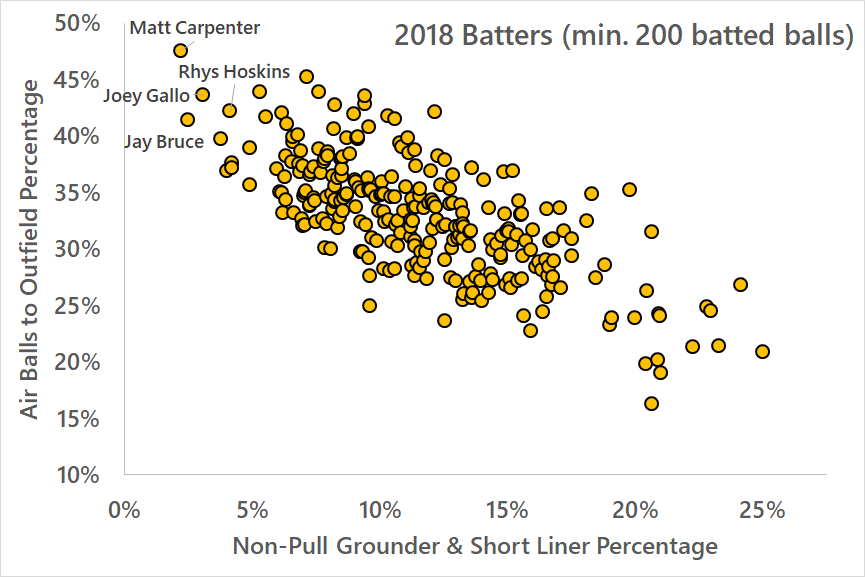
    Using BIS charting data for 2018, let’s find batters who hit few groundballs to the non-pull side of the infield (so you can leave that side of the infield vacated) and also hit a lot of balls in the air to the outfield (so your fourth infielder might be more useful out there). Those on both lists are bolded for emphasis.

    Lowest percentage of batted balls that were grounders/short liners to the non-pull side (2018 batters, minimum of 200 batted balls)
    1. Matt Carpenter (2.2%)
    2. Jay Bruce (2.5%)
    3. Joey Gallo (3.1%)
    4. Curtis Granderson (3.8%)
    5. Mike Zunino (4.0%)
    6. Rhys Hoskins (4.1%)
    7. Logan Morrison (4.2%)
    8. Jose Bautista (4.9%)
    9. Brian Dozier (4.9%)
    10. Kyle Seager (4.9%)

    Highest percentage of batted balls that were in the air and hit at least 250 feet (2018 batters, minimum of 200 batted balls)
    1. Matt Carpenter (47.6%)
    2. Brandon Belt (45.2%)
    3. Daniel Descalso (43.9%)
    4. Khris Davis (43.9%)
    5. Joey Gallo (43.7%)
    6. Mike Trout (43.6%)
    7. Max Muncy (42.9%)
    8. Teoscar Hernandez (42.7%)
    9. Rhys Hoskins (42.2%)

    10. Justin Turner (42.2%)

    Obviously there’s a correlation between those two variables. But which players are among the most extreme? Take a look at the hitters in the upper left of this graph.

    Besides Gallo (who, as noted, faced a handful of four-man outfields last year and will likely see more in 2019), it appears that Matt Carpenter, Jay Bruce, and Rhys Hoskins are among the most extreme examples and could be candidates to see the strategy. Others near the top include Curtis Granderson (who saw one four-man outfield last season) and, interestingly, Daniel Descalso (who notably changed his swing and hit far fewer grounders in 2018).

    Carpenter is perhaps a very obvious example. He had the lowest groundball percentage among qualified batters last season, and almost all of those grounders were pulled. Check out his spray chart:

    (The blue contour lines track the density of balls hit in the infield; the red lines track the density of balls hit to the outfield.)

    Carpenter barely hits any grounders to the left side of the infield, while hitting a high volume of balls all over the outfield.

    The Cubs tried a four-man outfield against Carpenter last year … and he responded with a bunt single. Yet taking away the possibility of an extra-base hit was a result the Cubs were likely okay with.

    Hoskins understands that and may not be one to change his approach. When asked about the four-man outfields that Harper has been seeing, Hoskins told Matt Breen of The Inquirer: “It doesn’t make you do anything different, because as soon as you try to do something different, they win. If I’m trying to hit a ground ball to the right side, then they’ve done their job and I’m not doing mine. You don’t want me to bunt, I promise you.”

    Hoskins very much looks like a four-man outfield candidate himself. While Carpenter had the lowest groundball rate in baseball, Hoskins was right behind him and also pulled an extreme amount of those balls.

    Of course, extreme infield shifting of right-handed hitters can be difficult. The first baseman can’t venture too far away from the bag, or else a significant hole can be created on the right side. Yet Hoskins almost never hits grounders over there, and he yanks a ton to where the third baseman and shortstop typically play. Given his high volume of balls to the outfield, it could be something that his opponents consider.

    As for Harper, if you were to find him on the scatter plot above, he’d be in the mix of players between 5-10 percent for non-pull grounder and liner rate and 35-40 percent for outfield air ball rate. He’s among the players who fit the mold, though not necessarily an extreme by this rudimentary methodology.

  • Stat of the Week: Running on Bryce Harper’s arm

    By Mark Simon

    One of the storylines to follow for new Phillies outfielder Bryce Harper this season will be how he fares defensively. Harper’s defense cost the Nationals 26 runs last season, tied with new teammate Rhys Hoskins for second-worst in the majors. Harper struggled defensively in both right field, where he’ll likely play for the Phillies, and center field, where he played just under 500 innings for the Nationals in 2018.

    Harper’s performance last season was about more than his inability to turn batted balls into outs at a high rate. Harper also cost his team with his troubles deterring baserunner advancement. Harper had -6 Outfield Arm Runs Saved last season, by far the worst total of his career (he saved five runs in the previous two seasons combined). He cost the Nationals five of those six runs in right field. From that position, Harper did not record any baserunner “kills” (a BIS term for throwing out a runner trying to advance without the help of a cutoff man). From 2015 to 2017, Harper totaled 16 assists in right field without using a cutoff man.

    Baseball Info Solutions Video Scouts chart defensive plays, categorizing them as “Good Fielding Plays” and “Defensive Misplays & Errors.” Harper had five Defensive Misplays & Errors that were grouped as “Wasted Throw After Hit/Error” that allowed a runner to take an extra base. The only players with more were Billy Hamilton and Ender Inciarte, who had seven.

    Harper is not the only star player to have a poor Outfield Arm Runs Saved total. In fact, one of the trailers in that stat is 2018 NL MVP Christian Yelich. Yelich cost his team seven runs with his arm, four in left field and three in right. Yelich has had this problem wherever he’s played. In 2017, he played the entire season in center field and cost the Marlins six runs with his arm. He did save four runs for the Brewers overall, making up for his arm issues with good Range & Positioning numbers.

    Another big free agent signee, A.J. Pollock, brings a lot of skill to center field with the Dodgers. However, his arm cost the Diamondbacks six runs at that position in 2018. Pollock allowed 71 percent of baserunners to take an extra base on a base hit (go first-to-third or second-to-home on a single, or first-to-home on a double). That was the highest advancement rate allowed by center fielders last season. In a smaller sample, Harper allowed a 67 percent advancement rate.

    Though Harper, Yelich, and Pollock are extremely valuable position players, they would be even more valuable if they can improve upon this aspect of their games in 2019.

    Fewest Outfield Arm Runs Saved in 2018
    Name Runs Saved
    Christian Yelich -7
    Derek Dietrich -7
    A.J. Pollock -6
    Brandon Nimmo -6
    Bryce Harper -6
    Rhys Hoskins -6
    Charlie Blackmon -6

    Another standout, Cubs left fielder Kyle Schwarber, tied Twins left fielder Eddie Rosario for second, one run behind Judge. Also worth spotlighting is Yelich’s teammate, Brewers center fielder Lorenzo Cain, who went from costing the Royals six runs with his arm in 2017 to saving his team five runs with it in an outstanding 2018 campaign.Though the focus is largely on Harper here, it doesn’t seem right to end this piece without referencing the leaders in this stat. One of them was one of the game’s biggest stars, Aaron Judge. Judge saved eight runs with his arm, the most of any outfielder in MLB.

  • Citizens Bank Park is ideal for Bryce Harper’s power.

    by PATRICK ROWLEY

    Earlier this offseason, a number of writers were talking about how Bryce Harper’s vicious, left-handed swing was “made for Yankee Stadium,” making pinstripes a perfect fit for the young star who grew up a Yankees fan.

    That thought intrigued us, so we looked a bit deeper to see which ballpark would be an ideal fit.

    In 2018, Yankee Stadium ranked second in park factors for HRs as a LHB with a factor of 132, just behind Angels Stadium’s 134. Last season Harper pulled 42 percent of balls in play, not far from his career pull percentage of 39 percent, which looks perfect for a stadium in which the fence is 314 feet down the right field line (much to the ire of opposing teams).

    Digging a bit deeper into the splits shows that the frequency with which Harper pulls balls in play is skewed dramatically by his ground ball tendencies, pulling 62 percent of grounders to the right-third of the field However, on fly balls, Harper hit the ball the other way 50 percent of the time and pulled the ball just 16 percent.

    As park factors are better at showing league trends than individual performance, our R&D department then looked at every Bryce Harper fly ball over the last two seasons and calculated how many of the flies would have gone out at each park.

    We then divided by his total number of games played over the last two seasons and multiplied by 81 to bring it in to the context of a full season’s worth of games at the home park.

    A few caveats to this exercise: we were unable to incorporate factors such as wall height, atmosphere, and wind speed and direction in these calculations. To account for this, a five-foot cushion was incorporated into the calculation, giving the total he likely would have hit at each park.

    The results came out with Yankee Stadium as just the 10th best park for Harper to pick up a few extra homers on the season. Citizens Bank Park, on the other hand, was second with about 24 balls projected to go out. For context, the difference between Citizens Bank Park and Nationals Park was 5.7 extra home runs at home over a season. 

    Conservatively rounding down, an extra five homers this season would have brought Harper’s total up to 39 (good for tied for 4th in baseball). Depending on what the original result of these batted balls were, Harper’s OPS would jump from .889 (16th) to anywhere between .908 (if all the added home runs were originally doubles) to .933 (if they were originally outs). Manny Machado, for those interested, had a .905 OPS this season, good for 11th.

    We’re not the only ones to feel confident about Harper’s home run performance. A study earlier this winter came to a similar conclusion.

    Also noteworthy is the lone park that came out ahead of Citizens Bank Park- Minute Maid Park in Houston. On November 10, Ken Rosenthal of The Athletic wrote an article about how Houston and Washington had a deal in place to move Harper ahead of the non-waiver trade deadline that was ultimately rejected by Nationals ownership. As we mentioned, we were not able to put these balls into context with wall height, so it’s fair to assume at least a few of these would end up as doubles or even long singles considering the 19-foot high wall in left field, but it’s fun to imagine how things could have shaken out differently if the Astros had Harper in the lineup in their title defense.

    With this said, the Astros were never concretely connected to the 26-year old superstar this offseason, whereas the Phillies had said they were willing to pay “stupid money” and appeared to be the most aggressive suitor in the Harper sweepstakes. This could be both the best available financial option for Bryce as well as the best statistical career option for him in the long run.

    Oh, and by the way, Harper doesn’t even come out as the biggest home run gainer using this system. New Phillies catcher J.T. Realmuto comes out eight home runs ahead if we compare Citizens Bank Park to Marlins Park.

  • Who has been a better defender at third base: Arenado or Machado?

    With Manny Machado signing a 10-year contract with the Padres and Nolan Arenado inking an eight-year extension with the Rockies, the question comes to mind: Which one of them has been the better defensive third baseman?

    Machado is moving back to third base this season after playing most of 2018 at shortstop for the Orioles and Dodgers. He has saved 84 runs in just shy of 6,500 innings at third base, including 35 in 2013, the most in a season by any player since Defensive Run Saved (DRS) was first compiled in 2003.

    Machado’s career total amounts to 13 DRS per 1,000 innings.

    Arenado has saved 109 runs in a little less than 7,500 career innings. That comes out to 14.6 per 1,000 innings. It’s fair to say that Arenado has fared a little better over the course of his career, though not overwhelmingly so.

    The difference between Arenado and Machado is minimal when it comes to Range & Positioning. Both are good at turning balls hit down the line and “straight on” (the area where a third baseman typically plays) into outs. Arenado is a little better when it comes to balls hit in the shortstop-third base hole.

    But Arenado has accumulated a big edge in Runs Saved from Good Fielding Plays & Defensive Misplays. He has 14 for his career, compared to 1 for Machado.

    Good Fielding Plays & Misplays are charted by Video Scouts using criteria originally designed by Bill James and modified by BIS staff. They account for situations in which a player made an above-average effort to make a play, or in the case of Defensive Misplays, erring in a way that had a negative consequence.

    Examples of Good Fielding Plays include Web Gems such as the kind you would see on a highlight reel, but also things like preventing a single from being a double by cutting it off, or making a quick pivot to convert a double play. Misplays can be something like slipping, breaking in the wrong direction, or failing to hustle during a play.

    Here are some types of Good Plays & Misplays in which Arenado has some of his biggest advantages.

    Type of PlayArenado CareerMachado CareerArenado Advantage
    Cutting off a runner at home1263.8 runs
    Keeping the ball in the infield1452.9 runs
    Giving up on the play (misplay)172.5 runs
    Good force play1661.6 runs

    Arenado’s advantages come from one to two plays a year in each of these types. Sometimes little things can make all the difference.

  • Stat of the Week: Top Draft Prospects

    By NATHAN COOPER, JOHN TODD, and MARK SIMON

    With the football season over, it’s time to shift attention to the future and the upcoming NFL Draft.

    In recent years SIS has tracked NFL and FBS games in a similarly-detailed manner to how it tracks baseball. That allows the company to cover the Draft thoroughly.

    This season, SIS Video Scouts combined to chart each FBS game a minimum of four times to track specifics such as formation, personnel, route type, and type of run. The compiled information was supplemented with observations of skills and other critical factors so that players could be evaluated at each position.

    Players were graded by Video Scouts on a 1-to-9 scale both in individual skills and critical factors, and then overall among those at their position. If a player’s final grade is 6.5 or higher, he is generally a starting-level NFL player. If a player is graded 7.0 or higher, he is thought to have a Pro Bowl-caliber future. Each scouting report is written by a Video Scout and cross-checked by others in the scout group.

    Nine college players graded at least a 7.0 in the inaugural set of rankings. Seven of the players play on the defensive side.

    Highest Grades, 2019 NFL Draft-Eligible Players

    NameSchoolPositionGrade
    Quinnen WilliamsAlabamaDT7.4
    Ed OliverHoustonDT7.1
    Josh JacobsAlabamaRB7.1
    T.J. HockensonIowaTE7.0
    Nick BosaOhio StateDE7.0
    Devin WhiteLSULB7.0
    DeAndre BakerGeorgiaCB7.0
    Greedy WilliamsLSUCB7.0
    Taylor RappWashingtonS7.0

    Alabama redshirt sophomore defensive tackle Quinnen Williams earned the highest grade among all players. He was described by the SIS video scout as “an explosively powerful defensive talent, whose rare interior contact balance creates consistent overwhelming backfield chaos, resulting in a next-level force for years to come.”

    Statistically speaking, Williams ranked first among SEC defensive linemen with 57 pressures, 43 hurries, and 30 quarterback hits. Not bad for someone who was in his first season as a starter.

    Williams’ teammate, junior running back Josh Jacobs, graded out highest among offensive players with a 7.1. The Video Scout’s description noted that “Jacobs plays with elite tenacity, and with his lower-body strength and quick footwork, has the makings of a future star.”

    What stood out for Jacobs was that when he ran the ball, good things tended to happen. Jacobs had a positive play percentage of 59 percent, meaning that on 59 percent of his carries, Alabama had an increase in Expected Points Added (EPA). No other running back among those draft prospects who were graded by SIS had even a 55 percent positive play percentage.

    These grades and stats can be found in the 2019 SIS Football Rookie Handbook, which will be out in mid-February. More than 250 players are evaluated by the SIS scouting staff, with two pages devoted to each player’s skills and stats. You can learn more about the book and pre-order it at the ACTA Sports website.

    Happy scouting!

  • Stat of the Week: Active players on Hall of Fame path

    With this year’s Hall of Fame class announced, here’s a look at which active players have cleared the bar of Bill James’ Hall of Fame Value Standard.

    As a reminder, a player’s Hall of Fame Value (HOF-V) is his Win Shares plus four times his Baseball-Reference Wins Above Replacement (WAR). The standard for Hall of Fame worthiness is a score of 500.

    Not surprisingly, Angels DH and first baseman Albert Pujols leads the way. With 477 Win Shares and 99.9 WAR, he’s at 876.6 on the HOF-V scale. That ranks 27th all-time, sandwiched between legends Mike Schmidt (894.2) and Carl Yastrzemski (873.6).

    Miguel Cabrera is also well above the HOF-V line at 670.6. A ruptured biceps limited Cabrera to 38 games last season, but his .316/.395/.551 career slash line and 465 home runs solidify his status among the game’s greats.

    Robinson Cano’s Hall of Fame candidacy was addressed in an earlier Stat of the Week . A PED-related suspension complicates his status, but his numbers (.304/.355/.493 with 311 home runs) easily clear the HOF-V threshold. He’s at 613.8, not far from Hall-of-Fame second baseman Ryne Sandberg (618).

    Ichiro Suzuki says he wants to play in 2019, and for the purposes of this exercise, let’s presume he sees considerable time. By HOF-V, he’s Hall of Fame worthy at 561.2, just behind Hall of Famers Mike Piazza (562.4) and Vladimir Guerrero (561.6).

    Reds first baseman Joey Votto has a .311/.427/.530 slashline, in a 12-year career and has led the National League in on-base percentage seven times including each of the last three seasons. His Win Shares and WAR combination produces an HOF-V of 533.2, a little over the line for worthiness.

    Lastly, Mike Trout is only 27 years old and has played eight MLB seasons. But he’s already surpassed the HOF-V bar. He’s at 523.2, a remarkable total for a player of his age and experience. Trout has added at least 70 points to his HOF-V total in six of the last seven seasons. If he does so in the next two seasons, he’ll rank among the top 100 players in this stat (and having played 10 seasons, he will officially be Cooperstown eligible).

    If he averages 70 HOF-V over the next 10 seasons, he’ll be at 1,223.2, not far behind Willie Mays (1,267.6) for fifth all-time.

    Yadier Molina (499.9) is as close as you can come to reaching the bar. He should clear the threshold almost immediately, presuming no injuries or major performance issues.

    You might have noticed that there are no active pitchers on this list. The pitcher who is closest to a 500 HOF-V is Yankees starter CC Sabathia(489.8). Sabathia has averaged 21.6 HOF-V the last three seasons, so he’s got a good chance to surpass the 500 mark in 2019. Likewise,Justin Verlander (467.6) should clear 500 so long as he pitches at the level he did in each of the last three seasons, in which he averaged an HOF-V of 45.5.

    Perhaps surprisingly Zack Greinke (465.8) is in a similar spot. Another season matching his 2018 campaign (17 Win Shares, 4.8 WAR, 36.2 HOF-V) would push him over the line.

    For those wondering about Clayton Kershaw (444.4) and Max Scherzer (387), public perception may differ from this form of statistical analysis. Both still have a little way to go. Kershaw has been hurt by injuries the last three seasons that have limited his innings. Scherzer didn’t reach a level of consistent excellence until his sixth MLB season, so he still has some ground to make up.

    Three players retired in 2018 who surpassed 500 on the HOF-V scale.Adrian Beltre (755.8), Joe Mauer (631.7), and Chase Utley (552.6) and will all have their names come for discussion in five years. By the measure of this stat, they are Hall Of Fame worthy.

    If you want to check where your favorite player stands in the Hall of Fame Value Standard, go to Bill James Online. If you would like to read more about the Hall of Fame Value Standard, purchase the 2019 Bill James Handbook or visit the SIS Blog.

    Active Leaders in HOF-V
    NameHOF-V
    Albert Pujols876.6
    Miguel Cabrera670.6
    Robinson Cano613.8
    Ichiro Suzuki561.2
    Joey Votto533.2
    Mike Trout523.2
    Yadier Molina499.9
    CC Sabathia489.8
    Ian Kinsler475.2
    Justin Verlander467.6
    Zack Greinke465.8
  • Stat of the Week: Hall of Fame Value Standard Part II

    Last week’s Stat of the Week looked at Bill James’ newest creation, the Hall of Fame Value Standard (HOF-V), and how it analyzes the worthiness of some of the debatable position player candidates on this year’s Hall of Fame ballot. To supplement that, here’s a look at the pitcher candidates of a similar debatable status.

    As a reminder, HOF-V is calculated by adding a player’s Win Shares and four times their Baseball-Reference Wins Above Replacement (WAR). A score of 500 is considered to be the standard for Hall of Fame worthiness.

    Mike Mussina has the highest HOF-V score of any pitcher on the ballot not named Roger Clemens (who would be a certain Hall-of-Famer if not for PED allegations against him). Mussina’s HOF-V of 601.6 is higher than those of fellow former Orioles ace Jim Palmer (587.6) and a contemporary Hall-of-Famer, John Smoltz (565.0).

    Curt Schilling is a notch below Mussina statistically, with 252 Win Shares and 79.6 WAR (to Mussina’s 270 and 82.9). Schilling crosses the threshold with an HOF-V of 570.4, and that’s without even counting his postseason numbers (2.23 ERA in 133 1/3 innings).

    Roy Halladay is polling very well among Hall of Fame voters, indicating that his election is likely. By the HOF-V, he comes up a little short at 479.2. James’ assessment is that the system looks at overall numbers rather than peak performance, and that penalizes Halladay enough to bring him below the line. There are Hall-of-Fame pitchers with an HOF-V below 500 — among them is ex-Yankees ace Whitey Ford (488.6) — so Halladay wouldn’t be alone in that regard. James acknowledged he would vote for Halladay if he had a vote.

    Andy Pettitte is also below the HOF-V line at 465.2, as he was deemed to have had a number of very good years, but not enough great years to add up to Hall of Fame status.

    The system has imperfections when it comes to evaluating relief pitching. Both
    Mariano Rivera (497.8) and Billy Wagner (292.8) come in below the HOF-V bar. Rivera is widely considered to be the best relief pitcher of all-time. Wagner posted incredible numbers in strikeouts and saves.

    But as James wrote in the
    2019 Bill James Handbook, WAR and Win Shares don’t produce a number that represents a closer’s true value.

    “Although MLB field staff don’t think in those terms, they act as if they believe that the Leverage Index for a closer is about four to five … Win Shares and WAR both use Leverage Indexes for closers around 2.00. Let’s say Billy Wagner works 70 innings a year. With a Leverage Index of 2.00 his impact is more as it would be if he was pitching 140 innings a year at the same level of effectiveness … Wagner appears to have much less impact on his team than a good starting pitcher … But is this fair to Billy Wagner? … Wagner’s value is in essence kept in a cage because other people are acting on false assumptions. It’s not his fault. His value doesn’t reflect his performance level.”

    If you want to check where your favorite player stands in the Hall of Fame Value Standard, go to
    Bill James Online. If you would like to read more about the Hall of Fame Value Standard, purchase the 2019 Bill James Handbook or visit the SIS Blog. The BBWAA will announce the newest inductees on January 22. Happy debating!

    2019 HOF Eligible Pitchers
    Roger Clemens 995.4
    Mike Mussina 601.6
    Curt Schilling 570.4
    Mariano Rivera 497.8
    Roy Halladay 479.2
    Andy Pettitte 465.2
    Roy Oswalt 372.4
    Derek Lowe 311.6
    Billy Wagner 292.8
    Freddy Garcia 275.6
    Ted Lilly 220.4
    Jon Garland 209
    Darren Oliver 207.8
  • Larry Walker meets the Hall of Fame standard

    Larry Walker is a high-end Hall of Fame candidate. But not everyone seems to have figured that out yet.

    This year, Bill James introduced a new Hall of Fame Value Standard in the 2019 Baseball Handbook (excerpted here). The methodology combines James’ Win Shares metric with four times Wins Above Replacement into one number. The cutoff score for Hall of Fame worthiness is 500.

    Walker clears the bar with plenty of room to spare, at 599.4. That puts him right in line with Hall-of-Famer Andre Dawson (599.2) and places him just outside the top 100 in that stat all-time. He’s higher than Edgar Martinez by about 20 points, though Walker’s vote total is not close to Martinez’s.

    Walker is hindered by a perception that his numbers were inflated by playing regularly in Coors Field for much of his career. From 1995 to 2002, he slashed .341/.425/.636, averaging 30 home runs and 124 games per season. By the Jamesian metric Offensive Winning Percentage, a team of nine Walkers at the plate (along with average pitching and defense) would have won nearly 75 percent of the time. That ranks 29th all-time.

    Walker did have a strong defensive reputation, though most of his seasons predate Defensive Runs Saved (which was devised in 2003). He did tally 10 DRS in 2003 and did well in the Total Zone Runs stat that is a predecessor to Defensive Runs Saved. Overall, he ranks eighth among right fielders in the Total Zone metric.

    Walker’s standing as Hall of Fame worthy may be slightly hindered by where he played, but in the end, it’s not debatable that he put up numbers that match up well among others who have been enshrined.