Category: NBA

  • NBA Eastern Conference Playoff Preview

    NBA Eastern Conference Playoff Preview

    With the Eastern Conference Playoffs beginning today, we wanted to break down each first-round matchup using our proprietary data. Each tile chart below outlines how teams faired in their head-to-head matchups this season including all possessions played, and all metrics given are Per 100 Possessions and do not include garbage time unless otherwise stated.

    For a primer on Advantage Creation and some of the other metrics mentioned in these articles, check out our Twitter @SIS_Hoops and reach out if you have any questions!

    Milwaukee Bucks (1) vs Miami Heat (8)

    The Milwaukee Bucks defense is once again an elite unit, ranking 3rd in Opponent Points Per Chance (1.007), contesting the most shots in the league, and placing 1st in Adjusted Def Shooting Foul Rate (13.2), where players are penalized for fouls drawn by the offense.

    The Bucks are primed to make an up-and-down Miami Heat offense work for every basket. A good helping of the Heat’s scoring comes by way of the foul line, where they rank 6th in free throw rate this season (22.4).

    Shots in the paint outside of the restricted area, where Milwaukee gives up the most looks of any team in the league (8.6) and Miami happens to be the league leader in shot frequency (7.3) with a 49.6% FG% (6th), could be the battleground where this series is decided.

    Flipping ends of the court, Miami has been able to deter opponents from shooting at the rim, ranking 1st in Opponent Rim Attempts (30.5). Once opponents get there, however, Erik Spoelstra’s squad has not contested well, ranking 29th in Above Average Rim Contest % (32.6%). With the immense rim pressure that Giannis Antetokounmpo puts on defenses — ranking in the 99th percentile in rim FGAs with 18.0 and in the 83rd percentile in rim TS% at 70.4% — the points in the paint battle will be of paramount importance. Keeping Giannis away from the rim will prove difficult as he is 2nd overall in Advantage Creation (36.5), but Giannis’ TS% falls to the 11th percentile when rim FGAs are removed (43.1%).

    Boston Celtics (2) vs Atlanta Hawks (7)

    The Boston Celtics measure as one of the best offenses this season, ranking 1st in Expected Offensive Rating (104.2) and 2nd in Points Per Chance (1.116). It is hard to envision how the Atlanta Hawks slow Boston’s attack, as the Hawks rank 26th in Expected Defensive Rating (104.0) and 19th in Points Per Chance (1.046). Additionally, the Celtics rank in the top 10 in Advantage Creation (8th, 74.7) and are the best in the NBA at maintaining those advantages throughout the possession (1st, 34.3), while the Hawks rank 26th in Advantage Prevention (29.5).

    Because their chances of stopping the Celtics are low, the Hawks’ best path to victory involves outscoring the Celtics. Since the All-Star Break, the Hawks rank 2nd in Offensive Rating (122.1) and are led by one of the NBA’s most prolific Advantage Creators, Trae Young, who ranks 2nd in the league this season with 33.3 Advantages Created per 100 Possessions.

    And while the Celtics’ defense is very good, the team has allowed the 2nd most advantages per 100 possessions against Isolations, a place where two Hawks thrive. In Isolation, Young creates 4.9 Advantages per 100 Possessions (94th Percentile) and Murray creates 3.5 per 100 Possessions (88th Percentile).

    If he can create advantages, Young is capable of getting good shots for himself and his teammates. Young averages 22.4 Potential Assists per 100 Possessions (99th Percentile), but the main question will be if the Hawks can convert on those shots, where they have been inconsistent all season.

    Philadelphia 76ers (3) vs Brooklyn Nets (6)

    Since the Brooklyn Nets traded away superstars Kevin Durant and Kyrie Irving at the deadline, this series presents one of the largest star disparities: MVP favorite Joel Embiid and former Net James Harden versus Mikal Bridges and Spencer Dinwiddie. For the Nets to pull off the upset, they will need all of their players to contribute on both ends of the floor.

    Since the All-Star Break, the Nets have struggled on the offensive end, but they have shown some promising signs on the defensive end, ranking 6th in Above Average Contest % (32.2%), which includes Blocks, Alters, and Plus contests, 1st in Least Defensive Miscues (6.12), and 1st in Least Advantages Allowed (45.0).

    While these are great signs for Brooklyn’s future, it will be much more difficult to execute in these areas against Embiid, who is in the 96th percentile for Advantages Created (27.4) and the 92nd percentile for Points Per Chance (1.181) and a Philadelphia 76ers team that ranks 6th in eFG% against Above Average Contests (38.4%).

    A particular area of interest with Embiid is the fact that Philadelphia ranks 1st in the NBA in Adjusted Shooting Foul Rate (13.8), where players get additional credit for fouls they draw. However, last season we saw the Sixer’s Adjusted Shooting Foul Rate decrease in the postseason.

    Lastly, how the Nets choose to guard Embiid is key – Claxton had a great year on defense, rating in the 98th percentile for Defensive Points Per Chance (0.944), the 95th percentile in Foul% on Contests (8.3%), and the 98th percentile in Advantage Prevention (12.8), but defending Embiid is a lot to ask of the young center.

    Cleveland Cavaliers (4) vs New York Knicks (5)

    This matchup will be defined by how the Knicks’ offense fares against the Cavaliers’ defense.

    The Cleveland Cavaliers measured as one of the best defensive teams in the NBA according to SIS data, ranking 2nd in Defensive Rating (106.4) and 1st in Expected Defensive Rating (98.6). This indicates that they forced their opponents into difficult shots by driving down the value of those shots through high-quality contests.

    The Cavs rank 1st overall in Above-Average Contest % (37.4%), and they avoid below-average contests (3rd, 13.6%) and fouling (6th, 12.0%). On the other side of the matchup, the Knicks rank 22nd in eFG% against Above-Average Contests, which means they will have to convert those shots at a higher rate than they did in the regular season or create more open looks if they are going to challenge the Cavaliers’ indomitable defense.

    Additionally, the Knicks rank 4th in SIS Offensive Rating (119.2) but only 21st in Points Per Chance (1.057). The key to their success is in the SIS Advanced 4 Factors where the Knicks rank 2nd in Adjusted Shooting Foul Rate, they rank 3rd in Adjusted Turnover Rate, where players are penalized for unforced turnovers, and most importantly, they rank 1st in Contested Offensive Rebound %.

    The Knicks’ offensive rebounding will be key to their success, but it will not come easily as the Cavaliers rank 1st in Contested Defensive Rebound %. Who controls the glass when the Knicks are on offense could be a significant factor in the outcome of this series.

    Huge thanks to Matt Bolaños, Noah Thro, Connor Ayubi, Blake Benjamin, Rebecca MaWhinney, and Stewart Zahn for helping pull together research for these previews!

  • NBA Western Conference Playoff Preview

    NBA Western Conference Playoff Preview

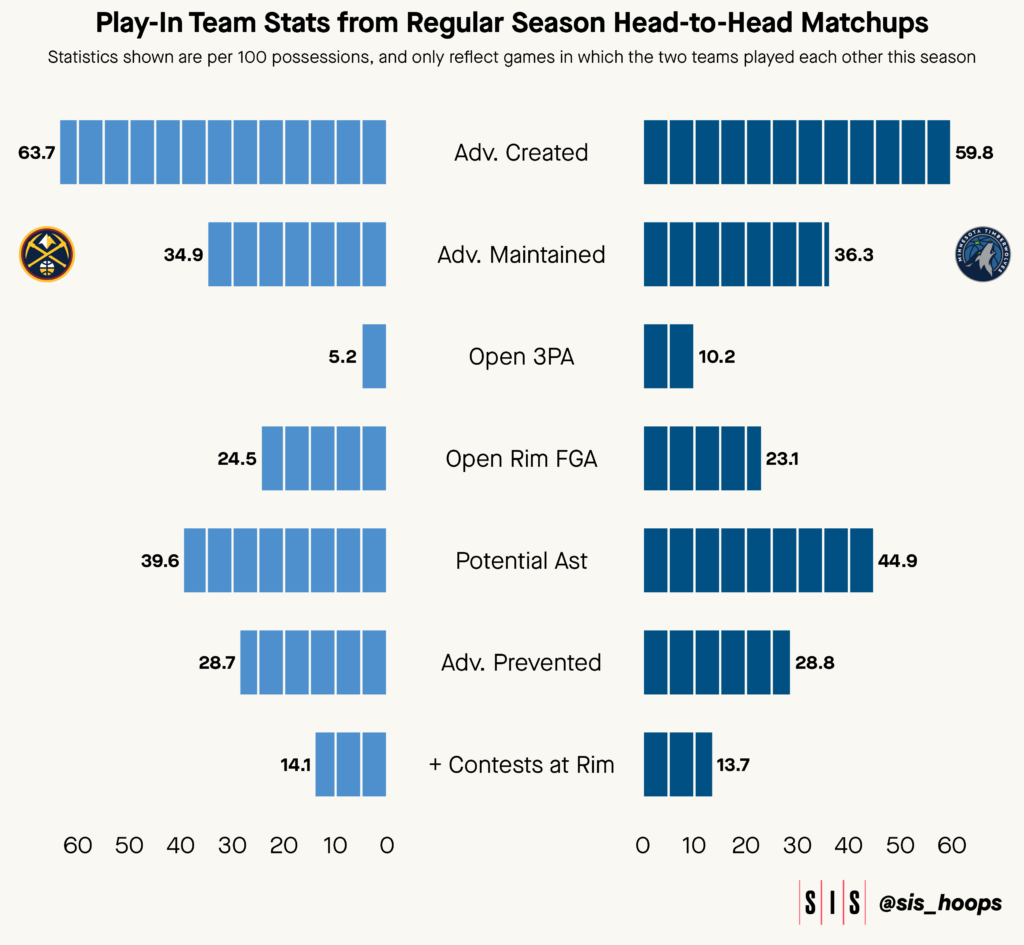
    With the Western Conference Playoffs beginning today, we wanted to break down each first-round matchup using our proprietary data. Each tile chart below outlines how teams faired in their head-to-head matchups this season including all possessions played, and all metrics given are Per 100 Possession and do not include garbage time unless otherwise stated.

    For a primer on Advantage Creation and some of the other metrics mentioned in these articles, check out our Twitter @SIS_Hoops and reach out if you have any questions!

    Denver Nuggets (1) vs Minnesota Timberwolves (8)

    The Denver Nuggets enter the playoffs with a powerhouse offense, ranking 2nd in Offensive Rating (119.5), 1st in eFG% (57.3%), and 3rd in Expected Points Per Chance (1.081). That potent unit is led by two-time MVP and current MVP candidate Nikola Jokic, who ranks 10th in Advantage Creation (28.1) and 3rd in eFG% Above Expected (+12.7%).

    Despite placing 3rd in the league in Advantages Prevented (33), the Minnesota Timberwolves will have their hands full with the efficient Denver attack, especially absent defensive stalwart Jaden McDaniels, out due to a hand injury, who placed in the 78th percentile in Advantages Prevented (7.7) and 81st percentile in positive Defensive Playmaking (3.2).

    Offensively, Minnesota has struggled with overall efficiency (111.1, 25th in the league), but the team’s offensive process has been better than the results, evidenced by the 16th-best Expected Offensive Rating (102.2) and 11th-most Advantages Created (72.9).

    While Minnesota has also maintained advantages relatively well (28.9, good for 11th in the league), Naz Reid, the team’s most prolific maintainer of advantages (8.4, good for 100th percentile), is sidelined for this series following wrist surgery. Making good on the team’s advantage creation absent its best connector/play finisher will be a crucial inflection point in this series.

    However, Denver’s defense could present an opportunity for Minnesota as Denver sits just 22nd in Expected Defensive Rating (103.3). While Jokic buoys one of the league’s premier offenses, he bears some blame for Denver’s porous defense, as his 15.6 advantages allowed place in the 0th percentile among qualified players.

    To make matters worse, Denver struggles to cover for its defensive lapses due to lacking off-ball defensive talent, ranking 25th in Off-Ball Advantages Prevented (10.4). If the Nuggets cannot tighten up their defense, they could leave a small window open for Minnesota.

    Memphis Grizzlies (2) vs Los Angeles Lakers (7)

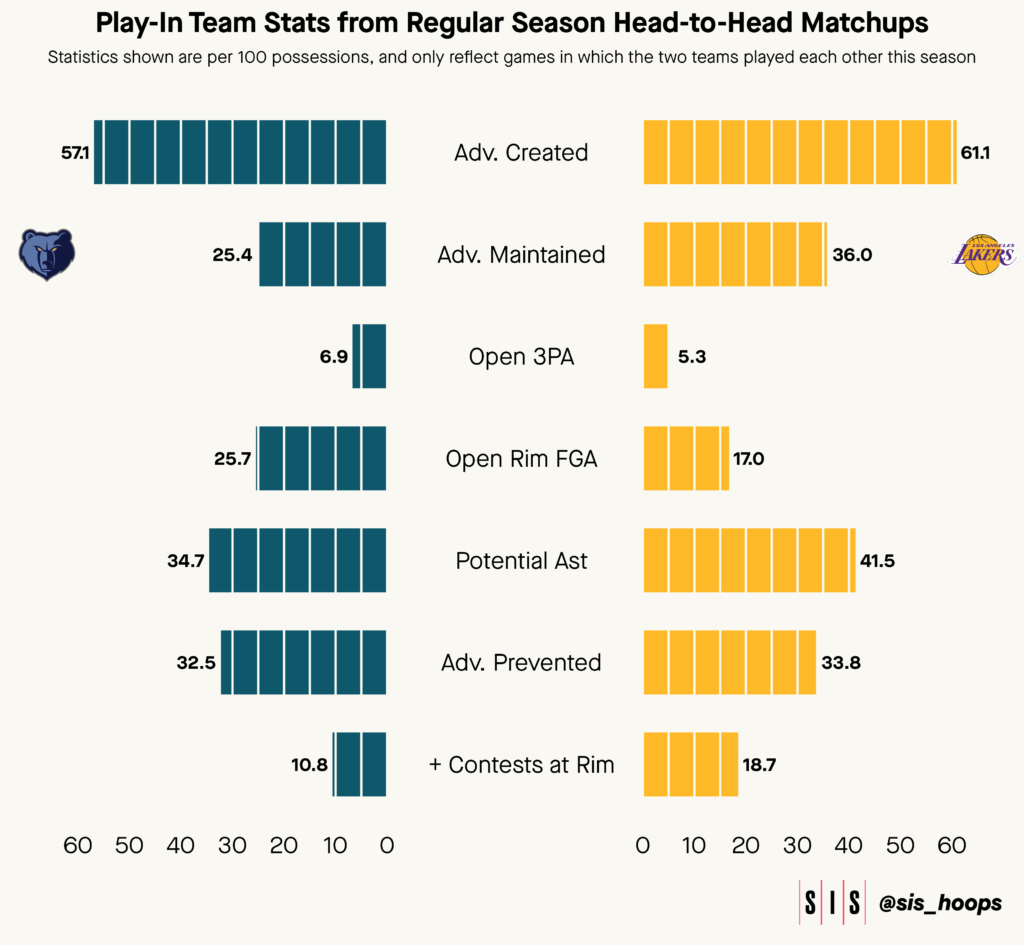
    With major roster turnover since the All-Star Break and LeBron missing time, the full-strength Lakers are still a bit of an unknown, but looking at their data since the All-Star Break will paint a better picture of what we can expect from this squad in the Playoffs.

    Dangerous and efficient when they push the pace, both the Lakers and the Grizzlies rank in the Top 5 in Points Per Chance in Transition at 1.552 and 1.515 respectively, and they average more than 10 Transition Possessions per 100 at 10.8 and 10.1 respectively. We can expect both teams to get out in transition; however, LA has been much better at defending in Transition ranking 1st in Opponent Points Per Chance (1.124) so it will be interesting to see if the Grizzlies can still take advantage in Transition.

    Moving into the halfcourt, both teams are effective at actively deterring shots at the rim with Memphis ranking 3rd overall (0.56) and LA ranking 3rd since the trade deadline (0.74), but this could have an outsized impact on Memphis’s offense as they are 2nd in the NBA in FGA at the Rim (40.3) and even though are the 24th most efficient team on these shots (62.7% TS%), these attempts still contribute to efficient offense overall.

    To keep the Grizzlies away from the rim, the Lakers will need to contain Ja Morant who is 5th in the NBA in Advantage Creation (32.9). They have the personnel to help prevent advantages with Anthony Davis (95th Percentile) and Jarred Vanderbilt (78th Percentile), but containing Ja will be a team effort.

    On the flip side, LeBron is also one of the NBA’s most prolific advantage creators ranking 8th (28.9), but Memphis is well positioned to defend anchored by Jaren Jackson Jr. who is in the 99th percentile for Advantages Prevented (13.1).

    Sacramento Kings (3) vs Golden State Warriors (6)

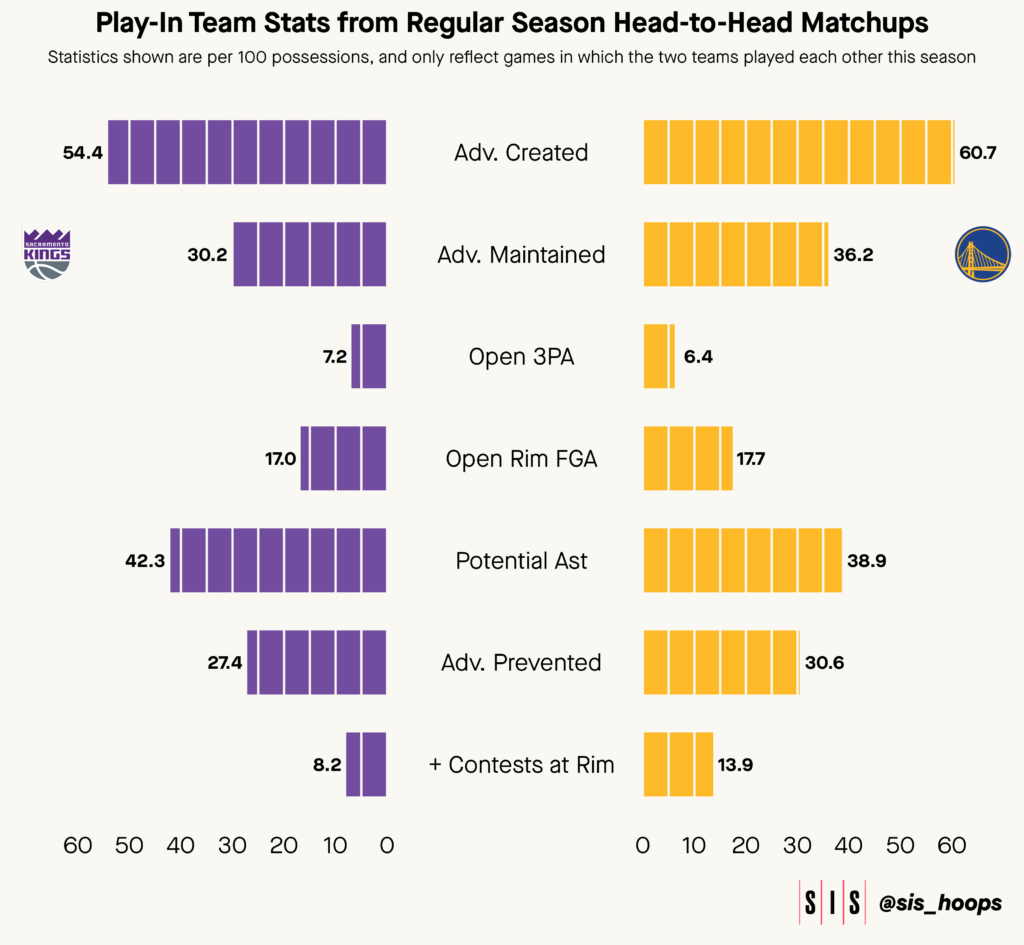
    The Sacramento Kings have reached the playoffs for the first time in 16 years, and they will face one of the most successful playoff teams of the last decade in the Golden State Warriors, but make no mistake, the Kings have been the better team this year. However, questions remain about which version of the Warriors we will see as the team reintegrates All-Star Andrew Wiggins, who missed the final 25 games of the season due to personal reasons, into the rotation.

    The Kings were the most potent offense in the NBA this season with an Offensive Rating of 119.9, but they ranked as only the 7th best in Expected Offensive Rating (103.4). They made up the difference by shooting the 4th best eFG% above expected (+2.9%). Led by De’Aaron Fox, who ranks 16th in Advantage Creation (25.3), the Kings were the 4th best team at creating advantages this season, averaging 76.4 per 100 possessions.

    The Warriors will need to slow down the Kings’ offense, and they have shown that capability defensively, ranking 4th in Expected Defensive Rating (99.6), 4th in Least Advantages Allowed, and 2nd in Above Average Contest % (35.1%). That last element could prove pivotal, as the Kings have the best eFG% in the league against Above Average Contests (41.3%).

    On the other side of the ball, the Warriors boast a prolific offense with the following rankings:

    6th in Points Per Chance (1.103)

    3rd in eFG% Above Expected (+3.1%)

    2nd in Advantage Creation (77.6)

    They’re led by Stephen Curry, who is 15th in Advantage Creation (25.7) and 4th in eFG% Above Expected (+10.8%). As has been the case throughout Golden State’s dynasty, the team struggles with turnovers, ranking 29th in Adjusted Turnover % (17.1%), where players get penalized for unforced turnovers.

    While the Kings do not force a lot of turnovers, they have been solid on the defensive end, ranking 4th in Least Defensive Miscues (7.8) and 4th in Above Average Contest % (33.4%). Though Sacramento’s quality contests may be mitigated as the Warriors have the 6th best eFG% against Above Average Contests (38.4%). Ultimately, this matchup may come down to which team can hit more tough shots.

    Phoenix Suns (4) vs Los Angeles Clippers (5)

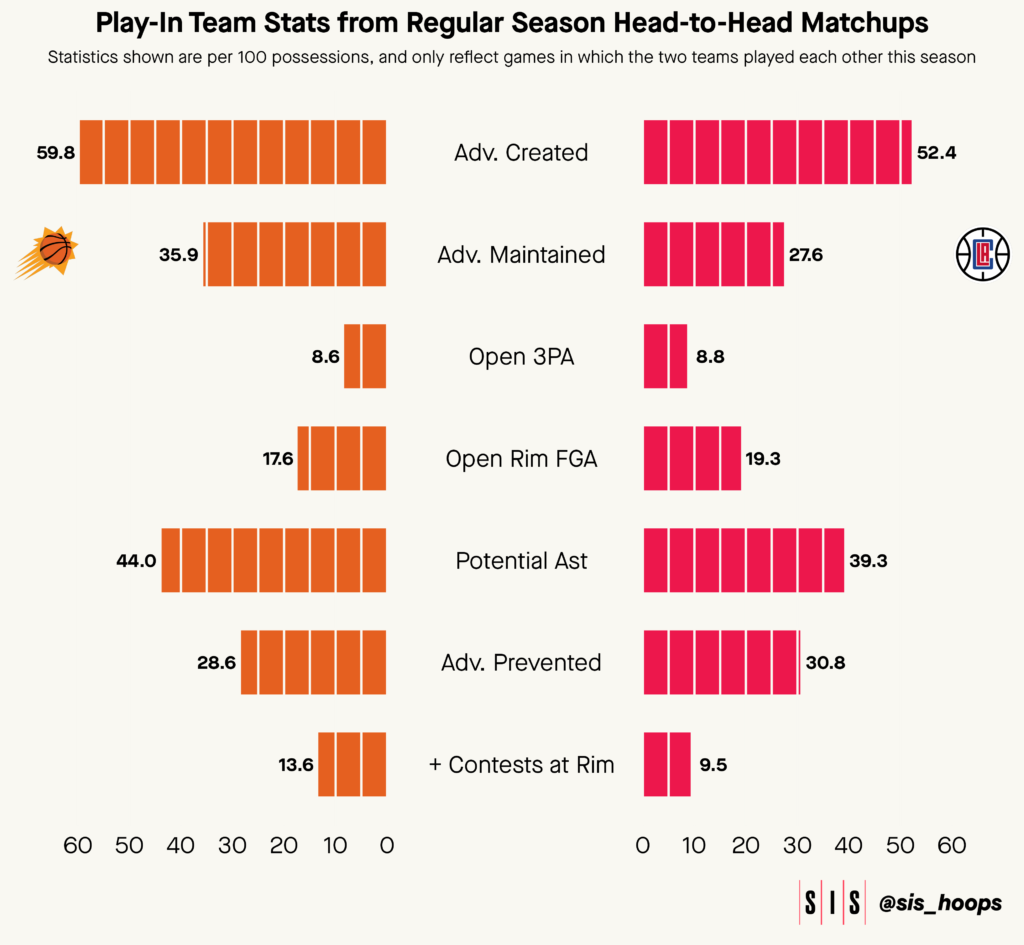
    Very little data exists on the current version of the Phoenix Suns, who are undefeated in 8 games with Kevin Durant in the lineup, but for this analysis, we will look at what both teams have done since February’s trade deadline.

    Given the talent on these teams, it is no surprise that they both rank in the Top 10 in Advantage Creation (Phoenix 10th at 75.4 and Los Angeles 4th at 78.4); however, losing Paul George to a knee sprain, who averages 21.8 Advantages Created Per 100 (12th in the among all players), leaves a big hole for the Clippers to fill.

    Both teams subsist off a similar shot diet, ranking in the top 10 in Pull-up Jumpers per 100 (Phoenix 1st at 17.7 and Los Angeles 8th at 14.7), but Phoenix has an edge as it leads the league shooting 45.2% on these shots. The Clippers, on the other hand, are one of the most efficient shooting teams in the NBA across all shot types, ranking 2nd in eFG% (58.3%) and 2nd in True Shooting (61.6%), but they struggle to take care of the ball (26th in Adj Turnover %), which hurts their overall offensive efficiency.

    Outside of scoring, Phoenix has the upper hand, leading in both Adjusted TOV% (2nd vs 26th), and Offensive Rebound % (8th vs 23rd). On the other end of the floor, the Clippers have struggled to stay solid on defense, ranking 27th in Least Advantages Allowed (54.8) and 26th in Least Defensive Miscues (10.76) compared to the Suns, who rank 17th (49.5) and 9th (8.58) respectively.

    Lastly, if games get close down the stretch, a factor that could come into play is that the Suns and Clippers rank 5th and 6th respectively in Points Per Chance on Baseline/Sideline Out of Bounds Plays (Phoenix at 1.168 and Los Angeles at 1.165).

    Huge thanks to Matt Bolaños, Noah Thro, Connor Ayubi, Blake Benjamin, Rebecca MaWhinney, and Stewart Zahn for helping pull together research for these previews!

  • NBA Podcast debut: “Playing In Space” with Henry Ward

    NBA Podcast debut: “Playing In Space” with Henry Ward

    This week, SIS Basketball is launching its podcast Playing in Space.
    The show, hosted by Basketball Strategy Analyst Henry Ward, covers the NBA with conversations on league-wide trends through a philosophical lens, driven by insights derived from SIS’s NBA data.
    While some NBA coverage can tend to hover on league-wide happenings, many of which take place off the court, “Playing in Space” will focus more on what’s going on in between the lines and how our data can help tell those stories.
    In addition, the show will host philosophical discussions about better understanding the processes that go into basketball decision-making across the sport.
    In Episode 1, Henry is joined by Senior Basketball Strategy Analyst Max Carlin for a discussion of what the SIS Basketball group has been up to recently and to dive into some analysis of players and teams who found themselves in motion at the trade deadline.
    The two begin by walking through how their work on the NBA side differs from work they’ve done in the past and how it’s helped them develop their views on basketball at large.
    They then get into granular discussions on the development of Tyrese Haliburton, the fit of Domantas Sabonis on the Kings, the Celtics trade for Derrick White, James Harden joining forces with Joel Embiid in Philadelphia and Ben Simmons’ role with the Nets, before closing with an overview on a couple of other moves.

  • Stat of the Week: A Fresh Look at NBA Assists

    Stat of the Week: A Fresh Look at NBA Assists

    While we patiently wait for the MLB lockout to end and for baseball to begin, we thought we’d update you on some of the cool work we’re doing in another sport.

    In 2020, Sports Info Solutions expanded its sport coverage to include college basketball (you might recall this Stat of the Week). In 2021, we further expanded to fully cover the NBA.

    We’re doing the same kind of thing for basketball that we are for baseball – digging deeper to provide insights that help with player evaluation and game strategy. A team of 16 Video Scouts is watching every play of every game, charting things that have never been charted before.

    We’re often dealing with the world of opportunities.

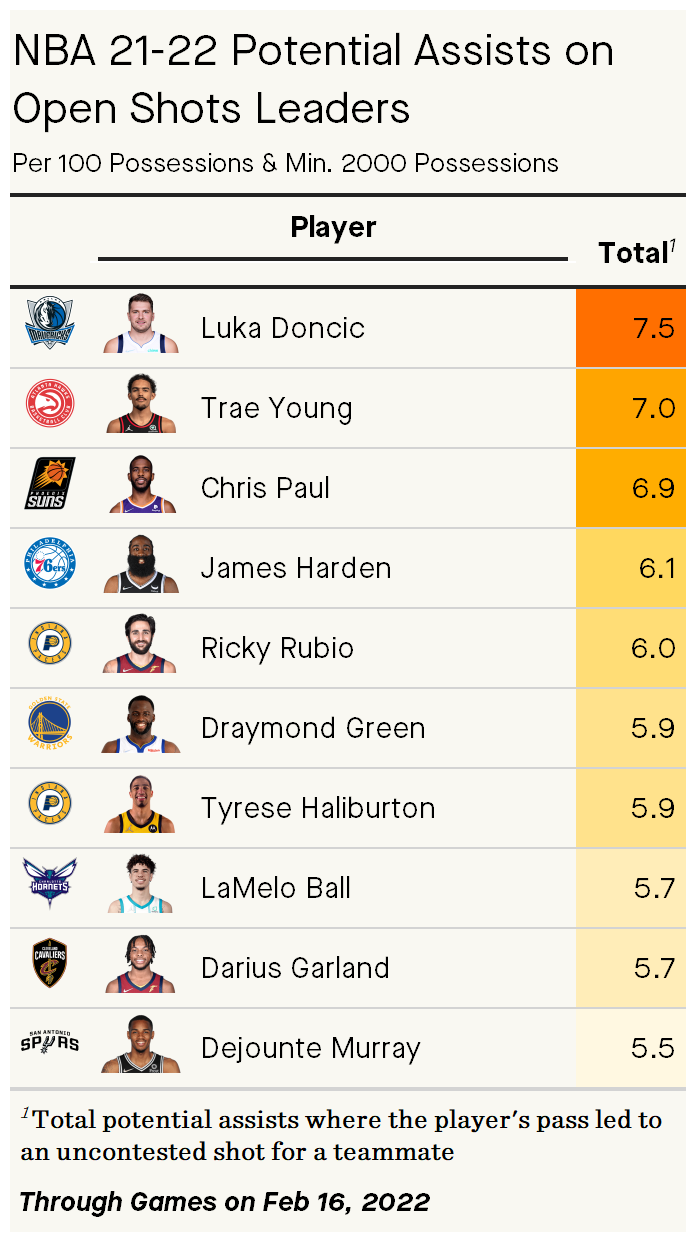
    When judging whether an NBA player is a good passer, we look to his assist total. But that doesn’t tell the whole story. What about the instances in which that player created an opportunity for an uncontested shot?

    That’s the kind of thing that we’re tracking.

    If you want to learn more of the specifics, check out this article, which includes explanations and video review.

    But let’s get to the leaderboard.

    The top three NBA players at creating uncontested looks for their teammates are three of the game’s top stars, Luka Dončić, Trae Young, and Chris Paul.

    Here’s the top 10:

    A reminder that whether the shooter made or missed the shot is not factored in here. What you can garner from this is that Dončić is the best at creating a lot of high-quality opportunities for his teammates, doing so more than any other player on a per-possession basis.

    Just missing the cut on the leaderboard is the NBA’s rookie leader in this stat, 19-year-old Australian-born point guard Josh Giddey of the Thunder (5.4). Though the Thunder are near the bottom of the Western Conference, Giddey’s passing skills have provided prominent value.

    Beyond the Top 10, one player for whom this stat is educational is Cory Joseph of the Pistons. The Pistons currently have the worst record in the NBA and though Joseph’s numbers are unimpressive on the surface, he ranks 26th at 4.4 potential assists on open shots per 100 possessions. At age 30, it seems like Joseph still has something left to offer in terms of aiding his teammates’ shot creation.

    For more basketball stats and insights, follow the SIS Hoops team on Twitter and be on the lookout for their Playing in Space podcast, which debuts next week.

  • Rethinking Defensive Impact

    Rethinking Defensive Impact

    it’s time to look beyond the defensive metrics we were given.

    By MAX CARLIN AND CONNOR AYUBI

    Public NBA draft analysis is a game of proxies. With some 3,000 games played by 100 or so NBA-relevant prospects each year, no individual could possibly consume — let alone accurately evaluate — the complete sample of players that make up an NBA draft class. So, scouts turn to stand-ins, whether they be subsets of the games each prospect plays, statistical indicators, or ideally some combination of the two.

    In some areas, this approach is relatively sound. Armed with tools like play type information, shot locations, and assist data, one can begin to check and legitimize observations from film analysis. You could, for example, verify that a prospect who appears to self-create a high frequency of rim attempts on film does so with the above information.

    Yet defense remains something of an unquantifiable anomaly. Most commonly, those looking to corroborate their eyes on the defensive end turn to steal, block, and the composite stock (steal + block) percentage. The idea behind using these measures as surrogates rests upon the notion that they correlate to notable defensive impact (or at least to basketball IQ or physical tools). 

    The issues block, steal, and stock percentage present as proxies are two-fold: what they do capture and what they don’t capture.

    An instructive block

    Consider this sequence from Precious Achiuwa, whose lunge at the ball-handler for no discernible reason generates a layup attempt. Likewise, his ability to plant hard, explode in the opposite direction, rise quickly off one, and extend for the block erases it:

    This block represents a false positive in the department of winning impact. Purely by the measure of blocks, this play is indistinguishable from a textbook rotation punctuated by a swat. Instead, a faithful retelling of this scenario would capture that Achiuwa has the physical tools and wherewithal to recover but created his team’s disadvantage in the first place. There are laudable and noteworthy projectional elements to the sequence but it is not a positively impactful one–pieces of information that we at Sports Info Solutions insist on keeping distinct and evaluating separately.

    Instead of approximating what we don’t see, we’re empowered to watch everything and log every defensive contribution a prospect makes (or fails to make) for an entire season.

    Meanwhile, the limitations of what blocks and steals don’t capture far outweigh what they do. Typically, blocks and steals provide results-based information on the conclusions of 2-3% of a prospect’s defensive possessions, while entirely missing the rest of the approximately 80% of possessions in which a prospect engages in at least one meaningful defensive action, according to our research.

    At SIS, we’re lucky to have a staff of basketball experts capable of consuming and evaluating the hundreds of thousands of possessions prospects put on film each draft season.

    Among others, we have at our disposal an overall defensive impact statistic called Defensive Winning Impact (DWIMP). Instead of approximating what we don’t see, we’re empowered to watch everything and log every defensive contribution a prospect makes (or fails to make) for an entire season. With such a powerful metric at our disposal, we are enabled to investigate questions like the validity of stock percentage as a defensive proxy.

    Our findings? Neither stock percentage nor its component parts are particularly useful stand-ins for defensive impact:

    For this analysis, we focused on quality-controlled data from the 2020 NBA Draft. The unimpressive visual relationship between stock percentage and DWIMP translates to a statistically insignificant correlation. 

    Furthermore, a player’s stock percentage provides no indication of their ratings in our Basketball IQ or Physical Tools metrics:

    An illustrative pair

    Since DWIMP is both more comprehensive in its scope and nuanced in its evaluation than stock percentage, we see some players with highly discordant DWIMPs and stock percentages:

    DWIMP diverges most from stock percentage for a pair of instructive ball-handlers. Both Malachi Flynn and Tyrese Maxey underwhelmed by conventional defensive playmaking stats last year, but the more comprehensive defensive analysis underlying DWIMP captures the steady impact both guards provided through reliability.

    Flynn and Maxey ranked first and second respectively in off-ball defensive consistency among the 18 ball-handlers in our sample last year. While neither player made a ton of plays on the ball, both satisfied their responsibilities as team defenders. It was rarely electric, but it was clinical, and the two significantly improved their teams’ defenses accordingly:

    A tag here, a stunt there, throw in a nice dig to force a ball pickup–the box score tells you Maxey does nothing on this possession, but his true impact is undeniable. 

    On the ball, the pair maintained their steadiness. Flynn sat first and Maxey third among ball-handlers in our point-of-attack defense metric, driven by unsexy factors like ranking first and second respectively in screen avoidance:

    On top of technical excellence, traditional stats fail to even capture the full gamut of defensive playmaking. They miss the effort, activity, and spatial awareness underlying the non-steal deflections that were routine to Flynn, who ranked second among ball-handlers in our On-Ball Disruptions metric, which accounts for things like pressures and deflections in addition to steals and blocks.

    Just as the two did what was demanded of them to add value, they avoided crippling mistakes that concede value. Flynn placed first in our entire 50-player sample in both defensive discipline and defensive IQ, while Maxey ranked second among ball-handlers in those metrics. Avoiding low-effort plays and limiting bad gambles, Flynn and Maxey added defensive value not through occasional excitement but mundane excellence.

    Though Flynn and Maxey succeeded through — broadly speaking — one defensive style, none of this is to say the only way to provide defensive value is by eschewing defensive playmaking in favor of reliability. High lottery picks like Patrick Williams and Onyeka Okongwu, for example, posted both gaudy DWIMPs and stock percentages; high block, steal, or stock percentage does not mean bad defense.

    they do as they say

    Instead, our research indicates block, steal, and stock percentage don’t mean much of anything. They’re not indicative of positive or negative defensive impact, outlier or ordinary physical tools, basketball ingenuity or incompetence.

    Block, steal, and stock percentage are not bashful. They are exactly what they say they are: the rates at which players accumulate blocks and steals. They are limited by the constraints of what blocks and steals themselves are–an inaccurate pass that simply falls into a player’s hands is a steal. 

    To infer more from block, steal, and stock percentage does a disservice to those metrics. As such, basketball discourse is better served by using stock percentage and its components for their designed purposes rather than as proxies for true defensive impact.

  • Quantifying Winning Basketball

    Quantifying Winning Basketball

    An introduction to SIS Hoops and our objective to modernize the box score.

    By JAKE LOOS

    There’s a wrong way to ball.

    My 7th grade coaching staff shared box scores with the team the morning after games with players ordered by Overall : a linear combination of box score elements into an all-in-one stat[[[Possibly the beginning of my disdain for all-in-one basketball metrics]]]. Usually a shoot-first, defense-optional player, I became obsessed with this ridiculous stat. I started passing up open jumpers (missed shots counted as -1) to chase assists (+2). On defense, I’d often be out of position gambling for steals (+3) and recklessly crashing the glass for defensive rebounds (+2) despite my -2 wingspan and 10-inch vertical leap.

    After starting the season ranking in the middle of the pack each game, I regularly led our team in “Overall” by the Playoffs. I felt like I had really improved as a player, and our team won most of its games[[[Milwaukee’s northern suburbs are a bit deprived of high-level competition]]]. I knew I was never going to be a professional player, but I still thought there was a chance I was going to end up riding the bench for a Big Ten school.

    Before high school even ended, my organized basketball career was over.

    Over 15 years later[[[A lot to unpack here… maybe another time]]], I was lucky enough to spend 5 seasons with the Phoenix Suns obsessing over how to best quantify basketball players and teams, and apply it in roster construction and in-game strategy. Despite the blessings of working in a dream job, I let how the game is discussed and presented – on broadcasts, podcasts, Twitter, video games, or even in internal meetings – drive me insane. The main reason why is so familiar: the same overreliance on the box score as my childhood basketball career.

    And that makes sense! If your job is to succinctly summarize a player’s impact on winning a particular game, you’re going to use what’s available to you. It’s easy for the audience to understand, and often highlights the players with the most direct involvement in scoring. But that doesn’t mean it’s the right way.

    Can there be a better box score?

    Basketball is too complex a sport to be defined by its possession-ending events. It’s a game that requires instantaneous, random decision-making on every offensive and defensive possession while executing within defined roles to optimize team performance. That’s a wordy way of saying “playing basketball is super hard.” Playing it at a high level requires an intimidating mix of skill, intelligence, athleticism, and winning desire.

    Unfortunately, the statistics available to us merely summarize possession-changing events and forsake the beauty of the how and why of each possession. The traditional box score measures only a subset of on-ball offensive plays – those leading to a shot, foul, or turnover – and omits all other on-ball plays, the actions of the players away from the ball, and almost the entirety of defense. While it’s fun to discuss shot charts and triple-doubles, we’re missing some massive pieces to the puzzle on why a particular team won the game, and which of those team’s players contributed the most to that win.

    Thankfully, we have come a long way as a basketball community. So many talented people have furthered the public discourse through their written pieces, video, and podcasts. There are now better places to get in-depth, well-presented statistics[[[The NBA has done an excellent job improving its Stats site and Cleaning the Glass is serious front-end goals]]]. But those sites still rely on box scores, play-by-plays, and, at best, basic Tracking stats[[[These stats are a step forward, but are mostly a regurgitation of result-driven info]]]. There is still so much information missing.

    With only +/- stats available to the public and Player Tracking data’s significant limitations measuring decision-making and defense, it’s difficult for even the most informed evaluators to summarize which players are actually impacting winning on the court. Studying all 10 players at once for 40-48 minutes of action is both challenging and exhausting for one game, let alone many.

    So, can we create better basketball data?

    At SIS Hoops, we’ve spent the last year striving to fill those gaps. Though at the moment we cannot release our data to the public due to our team business, we plan on sharing some of our internal research to hopefully further the discourse on how basketball is understood.

    Our initial project concentrated on the last 2 NBA Draft classes, achieving enough success to expand our coverage to include the NBA in the coming months[[[And hopefully other levels of basketball in the near future]]]. We feel that access to granular player- and team-level winning-impact data will help us better understand what actually matters the most on the court, who is the best at those things, and how those skills develop.

    Our evaluation framework is grounded on accumulating every on-court event that could alter a team’s chances of scoring or preventing a score.

    This can be as simple as a late-shot clock pick & roll where the ball-handler takes two dribbles and passes to a teammate on the wing. It can also be as complex as assigning blame to on- and off-ball defenders on an eventual shot at the rim. Over the course of a game, all of those plays matter. Collecting data of that scope requires a consensus on what a “good” and “bad” basketball play entails, an assessment of the difficulty of the context surrounding the play, and knowledge of the offensive and defensive schemes at play. But with proper training, you’d be surprised at how consistent basketball experts are at identifying winning and losing basketball plays.

    Access to data of this breadth is really exciting. We can better understand how a player scored rather than just the fact they scored. We can properly assign credit to players for creating great looks for teammates despite the shot being missed. We can even evaluate how a player impacted a defensive possession, and whether their impact occurred at the point-of-attack or away from the ball.

    We can now identify players who help their team win, even if they lack production in the box score.

    High-level role players are the key to any good basketball team.

    Maybe rooting for players who do the “little things” is an overcorrection to how I played and the way I first valued players, but I stan the hardest for players who do exactly what they’re supposed to do at a high level consistently[[[Mikal Bridges will forever be in my heart]]]. And given how many decisions each player has to make in a game[[[For a typical Draft prospect, this ranges from 100-200+]]], playing consistent ball is not an easy task. With the attention naturally on players who score the most, dish out the most assists, or grab the most rebounds, not enough credit is attributed to the role players who allow the stars to focus on what makes them stars.

    With my concentration on Draft prospects over the last year, I admittedly missed most of the NBA season. So, it came to my surprise when watching the (incredible) Warriors-Lakers play-in game to observe how good some of Dubs’ role players had become[[[Yes, I realize I’m writing about the “winning role players” for the Warriors in a game they lost]]].

    Playing next to gifted playmakers like Stephen Curry and Draymond Green requires instinctual engagement away from the ball on offense. Sometimes an excellent off-ball read can help create a great look, and other times it doesn’t affect the result of the possession at all. But players should get credit for the potential chances they created in some way.

    The best role players are reliable, willing, and disruptive defending away from the ball. Given the importance of team defense in a team’s overall success, we need to find better ways to value that off-ball defensive consistency, willingness, and impact.

    Considering the importance of getting early looks on offense[[[Transition / Early Offense opportunities usually give NBA teams a 0.2-0.3 PPP boost in their scoring efficiency]]], players with a steady and possession-altering motor in both offensive and defensive transition are crucial to a team’s success. Our favorite role players thrive here as well.

    It’s still (mostly) about getting buckets.

    We can flaunt quantifying discipline, IQ, and motor all we want, but in the end, buckets win ballgames – the elite advantage creators and shot-makers are still the most important players. The real fun part of the job is studying those unicorns.

    Our framework devotes the most detail to the most important part of the game. Not all buckets are created equal, requiring faithful analysis to explore the countless contextual details. Did the player start their on-ball chance in an advantageous situation? Were they pressured by the opponent? Were they able to create an advantage? If so, how did they create that advantage? What kind of shot, if any, was created? Did they make the optimal decision? We will learn so much more about a player’s on-ball talent from answering these questions instead of relying on the number of points their chances resulted in, as long as it resulted within 2 passes. As any good evaluator knows, the process is more important than the results.

    Sometimes the process and the results can be fun. Here are some ludicrous Steph buckets from that game showcasing his ability to create all sorts of advantages.

    We want to better understand hoop.

    Our content in the upcoming month will center on the NBA draft: the next main event after the Finals, the subject of our data, and our analysts’ specialty. It is also where public and front office discussions have the most room for growth. Having myself championed prospects in the Draft Room due to their box score production or perceived upside, I’ve had to learn the hard way how challenging it is to project teenagers as professional basketball players. My projections improved drastically once I started focusing on their actual basketball-playing ability. And our content will do the same.

    We’ll explore in-depth the traits that build the best basketball players, why they’re important, and how you can better evaluate them from your couch. Please engage with us and let us know your ideas – our experienced staff of scouts and researchers will be tackling these topics, and I promise their work will be much more interesting than this piece.

    Our data is a completely new way to quantify basketball and we have no idea where it will take us, especially as we analyze an ever-evolving game. But we will learn as we go, just as I did when I turned that failed childhood basketball career into my life’s work.

    Thank you for joining us.

  • New podcast: Dean Oliver on evaluating defense in basketball

    New podcast: Dean Oliver on evaluating defense in basketball

    LISTEN HERE

    On this edition of the Sports Info Solutions Baseball Podcast, Mark Simon (@MarkASimonSays) is joined by Washington Wizards assistant coach Dean Oliver (@DeanO_Lytics), a pioneer in basketball analytics, to discuss some of the challenges of measuring defense in his sport.

    Dean talks about the differences in basketball analysis contrasting 25 years ago to now (2:18), the parallels between tracking defense in basketball and baseball (5:23), and trying to chart the effectiveness of double-teams, getting hands in the face of shooters, and deflections (8:07). He also explains the influence that coaches have on defensive performance (14:07).

    Lastly, he discusses the different perspectives on fouling when up by 3 points in the final seconds (18:32) and offers advice to aspiring statistical analysts (22:32).

    Thanks for listening and stay safe.