Category: College Football

  • NFL Draft: First Round Recap

    By LOGAN KING

    Sports Info Solutions (SIS) brings you the second annual edition of The SIS Football Rookie Handbook, with scouting reports and statistical breakdowns on over 280 college football players who are likely to be drafted or signed as rookie free agents in 2020 (a glossary for the below stats can be found here). New features for this year include unique and informative NFL team pages, research deep-dives by the SIS R&D team, and—for the first time ever—the NCAA version of their flagship football statistic, Total Points

    Last night’s broadcast of the first-ever virtual NFL Draft went off seemingly without a hitch, providing fans with a much-needed return to sports. Today we’ll use the Football Rookie Handbook in a recap of the first round, highlighting the most active teams along with the biggest steals and reaches of the round. Additionally, we’ll look ahead to the upcoming rounds by highlighting the top prospects remaining. 

    Active Teams

    Four teams stood out in terms of their activity level in Round 1: the Dolphins, Chargers, 49ers, and Vikings. 

    The Dolphins entered the night with three first round picks and were able to fill three holes on their roster while gaining additional draft capital in the process (by sending pick 26 to Green Bay in return for pick 30 and a fourth-round pick). Miami gained its presumptive starting quarterback in Tua Tagovailoa with the fifth pick.

    Picked at number 18, Austin Jackson fits nicely into Chan Gailey’s zone-heavy offensive scheme and will improve an offensive line group which finished last in Total Points in 2019. Finally at pick 30, the Dolphins added Noah Igbinoghene who fits well into their man-coverage based defense. With Xavien Howard facing league discipline, Igbinoghene could play a significant role in this secondary early on in his career.

    The Chargers made waves with their new uniforms earlier this week and continued to do so in the first night of the draft. With the sixth pick, Los Angeles staked its future under center in Justin Herbert. Following this, the Chargers traded back into the first round (sending a second and third-round pick to New England) to add SIS’s top graded Mike linebacker in Kenneth Murray, with the 23rd pick. Murray joins a linebacker group who ranked 24th in Total Points in 2019 and lost their Total Points leader, Thomas Davis Sr., this offseason to the Redskins.

    After a static start to round one, the 49ers and Buccaneers swapped picks 13 and 14 to test Zoom’s draft trade feature, opening the floodgates for trades throughout the night. San Francisco used pick 14 to replace DeForest Buckner, who ranked 4th among defensive tackles in Total Points in 2019. 

    Javon Kinlaw was the second ranked defensive tackle in the class and his rookie contract will come at a steep discount from what Buckner is due in 2020. The 49ers then traded up from pick 31 to 25 to select Brandon Aiyuk, who should see work immediately given the loss of Emmanuel Sanders this offseason. 

    Through this offseason, Minnesota lost productive players at both receiver and corner; these needs were addressed towards the end of the first round. With the 22nd pick (acquired from Buffalo in the trade for Stefon Diggs), the Vikings drafted Justin Jefferson. Jefferson has the shoes to fill of the 24th-ranked WR in Total Points, and will attempt to do so in an offense that lined up in two-receiver sets (12 and 21 personnel) on 57% of plays in 2019. 

    After trading with San Francisco back to the 31st pick, Minnesota partially addressed their need at corner with Jeff Gladney. This offseason, the Vikings lost three of their top four corners in terms of Total Points (Trey Waynes, Mackensie Alexander, and Xavier Rhodes). Gladney was SIS’s 4th-ranked corner and has the ability to play both inside and outside. 

    Biggest Steals

    The biggest steals of the night come at the receiver position. There was only one receiver off the board by the time Denver picked, at number 15. Both Denver and Dallas (pick 17) were able to snag receivers in Jerry Jeudy and CeeDee Lamb who grade as Pro Bowl-level prospects. All other prospects to receive such a grade were off the board by the seventh pick (Chase Young, Jeffrey Okudah, Derrick Brown). 

    Biggest Reach

    The biggest reach of the night came with Tennessee’s selection of Isaiah Wilson at pick 29. Wilson was ranked 19th out of 19 offensive tackles in the Football Rookie Handbook, projecting to become a backup right tackle by the start of his second season.

    Furthermore, though Wilson fits best into a gap running scheme Tennessee ranked third in the league in zone rushing percentage in 2019. While Tennessee needed help at right tackle after the departure of Jack Conklin this offseason, there were several options still available which graded higher than Wilson and better complemented the team’s primarily zone-rushing scheme. 

    Inactive Teams

    There were several teams which did not make a selection on the draft’s opening night: the Bills, Bears, Texans, Colts, Rams, Patriots, and Steelers. New England entered the night holding pick 23, but chose to trade down and now owns five picks on Day 2 of the draft. 

    Top Players Remaining

    The following is a list of the top-graded players (in no particular order) from the Football Rookie Handbook remaining, entering Day 2. All project to become strong starters by the beginning of their second season. 


    Player Position School Grade
    Grant Delpit S Louisiana State 6.9
    D’Andre Swift RB Georgia 6.8
    Jonathan Taylor RB Wisconsin 6.8
    Laviska Shenault Jr. WR Colorado 6.8
    Terrell Lewis EDGE Alabama 6.8
    Antoine Winfield Jr. S Minnesota 6.8
    Xavier McKinney S Alabama 6.8


    Below is a recap of every pick in Round 1:


    2020 NFL Draft – Round 1
    # Team Acquired From Player Position School
    1 Bengals Joe Burrow QB Louisiana State
    2 Redskins Chase Young EDGE Ohio State
    3 Lions Jeffrey Okudah CB Ohio State
    4 Giants Andrew Thomas OT Georgia
    5 Dolphins Tua Tagovailoa QB Alabama
    6 Chargers Justin Herbert QB Oregon
    7 Panthers Derrick Brown DT Auburn
    8 Cardinals Isaiah Simmons WLB Clemson
    9 Jaguars C.J. Henderson CB Florida
    10 Browns Jedrick Wills OT Alabama
    11 Jets Mekhi Becton OT Louisville
    12 Raiders Henry Ruggs III WR Alabama
    13 Buccaneers Colts via 49ers Tristan Wirfs OT Iowa
    14 49ers Buccaneers Javon Kinlaw DT South Carolina
    15 Broncos Jerry Jeudy WR Alabama
    16 Falcons A.J. Terrell CB Clemson
    17 Cowboys CeeDee Lamb WR Oklahoma
    18 Dolphins Steelers Austin Jackson OT Southern California
    19 Raiders Bears Damon Arnette CB Ohio State
    20 Jaguars Rams K’Lavon Chaisson EDGE Louisiana State
    21 Eagles Jalen Reagor WR Texas Christian
    22 Vikings Bills Justin Jefferson WR Louisiana State
    23 Chargers Patriots Kenneth Murray MLB Oklahoma
    24 Saints Cesar Ruiz C Michigan
    25 49ers Vikings Brandon Aiyuk WR Arizona State
    26 Packers Texans via Dolphins Jordan Love QB Utah State
    27 Seahawks Jordyn Brooks MLB Texas Tech
    28 Ravens Patrick Queen WLB Louisiana State
    29 Titans Isaiah Wilson OT Georgia
    30 Dolphins Packers Noah Igbinoghene CB Auburn
    31 Vikings 49ers Jeff Gladney CB Texas Christian
    32 Chiefs Clyde Edwards-Helaire RB Louisiana State


  • Which college programs produce the best NFL players by position?

    By John Shirley

    College fan bases love to argue over which school produces the best players. Monikers such as “Linebacker U” or “DB U”’ get thrown around a lot, but are normally backed up solely based on opinion or by how many players have been drafted from each school in the last few years. By using SIS’s Total Points value metric, we can actually show how much NFL value different colleges have produced at each position. 

    To determine which college can claim the title at each position group, we will sum each NFL player’s Total Points over the previous three seasons (2017-2019), and the school with the most total value wins. 

    Running Back

    Top Colleges by 2017-2019 NFL Total Points 

    CollegePlayersTotal Points
    Alabama9214
    Stanford2152
    Oklahoma6141
    Georgia3121
    Miami (FL)6115

    Carried by two former Heisman Trophy winners, Mark Ingram and Derrick Henry, Alabama takes the crown as “Running Back U”. Henry leads the way with 61 Total Points and Ingram follows close behind with 60 Total Points. There has also been significant depth produced from Alabama, as Kenyan Drake, Josh Jacobs, and T.J. Yeldon have each contributed over 20 Total Points. 

    Next Up for Alabama: Najee Harris 

    Wide Receiver

    Top Colleges by 2017-2019 NFL Total Points 

    CollegePlayersTotal Points
    Clemson10297
    California8255
    USC7223
    Alabama8206
    LSU8199

    New Arizona Cardinal, DeAndre Hopkins, has been Clemson’s key player at receiver, as he has contributed 109 of their 297 Total Points over the past three seasons. Other former first round receivers Mike Williams (48 Total Points) and Sammy Watkins (40 Total Points) have contributed as well. Clemson has also produced solid NFL contributors Adam Humphries (42 Total Points), Martavis Bryant (26 Total Points), and Hunter Renfrow (13 Total Points during his rookie year in 2019).

    Next Up for Clemson: Tee Higgins 

    • 37 College Total Points in 2019
    • SIS’s 7th-Ranked WR in the 2020 NFL Draft 

    Tight End

    Top Colleges by 2017-2019 NFL Total Points 

    CollegePlayersTotal Points
    Stanford7205
    Iowa5153
    Cincinnati1139
    Western Kentucky3136
    Notre Dame6128

    It should be no surprise that Stanford and Iowa are at the top of the list for producing NFL caliber tight ends. Iowa might be able to take the crown in a few seasons, if George Kittle continues to dominate and 2019 first rounders T.J. Hockenson and Noah Fant emerge as legitimate weapons. But, for now Tight End U belongs to Stanford. Zach Ertz and Austin Hooper have led the way with 72 and 64 Total Points, respectively, while Stanford has also gained positive contributions from Levine Toilolo, Coby Fleener, Kaden Smith, Dalton Schultz, and Ryan Hewitt.

    Next Up for Stanford: Colby Parkinson

    • 25 College Total Points in 2019
    • SIS’s 15th-Ranked TE in the 2020 NFL Draft 

    Offensive Line

    Top Colleges by 2017-2019 NFL Total Points 

    CollegePlayersTotal Points
    Wisconsin10468
    Notre Dame8450
    Florida12390
    LSU8332
    Ohio State10331

    Wisconsin has a reputation as an offensive line factory, and it is well earned based on Total Points. An impressive 10 former Badger linemen have seen snaps in the NFL over the past three seasons, including five who have accumulated at least 50 Total Points: Ryan Ramczk (108), Rob Havenstein (88), Kevin Zeitler (83), Rick Wagner (74), and Travis Frederick (53).

    Next Up for Wisconsin: Tyler Biadasz

    • 41 College Total Points in 2019
    • SIS’s 2nd-Ranked C in the 2020 NFL Draft

    Defensive Line

    Top Colleges by 2017-2019 NFL Total Points 

    CollegePlayersTotal Points
    Ohio State10413
    Michigan10372
    USC9349
    Miami (FL)11327
    Alabama13323

    Ohio State has consistently produced some of the NFL’s elite defensive ends over the past few seasons. Cameron Heyward leads the way with 109 Total Points, with Joey Bosa following closely with 100 Total Points.

    Ohio State has also gotten large contributions from Johnathan Hankins with 71 Total Points and Nick Bosa, who accumulated an impressive 61 Total Points in his rookie year. Other solid Total Points contributors include: Sam Hubbard (39), Tyquan Lewis (16), and Dre’Mont Jones (12).

    Next Up for Ohio State: Chase Young

    • 64 College Total Points in 2019
    • SIS’s 1st-Ranked Edge in the 2020 NFL Draft
    • SIS’s Top Overall Prospect in the 2020 NFL Draft

    Next Up for Ohio State: Davon Hamilton

    • 23 College Total Points in 2019
    • SIS’s 6th-Ranked NT in the 2020 NFL Draft

    Linebacker

    Top Colleges by 2017-2019 NFL Total Points 

    CollegePlayersTotal Points
    Kentucky7467
    Georgia9466
    UCLA8458
    Alabama11381
    Mississippi State5379

    Kentucky claiming the title as “Linebacker U” is probably the biggest surprise of these lists (it finished ahead of Georgia by one point). But, when broken down by individual, it is easy to see the talent Kentucky has produced. Bud Dupree (138 Total Points) and Za’Darius Smith (82) have both become pass rushing threats on the edge, while Danny Trevathan (84), Wesley Woodyard (81), and Avery Williamson (53) have put together solid careers as off-ball linebackers. Though, the most talented of them all might end up being Jaguars edge rusher Josh Allen, who had 29 Total Points in his rookie season. 

    Next Up for Kentucky: Jamar Watson

    • 35 College Total Points in 2019
    • Entering Senior year in 2020

    Defensive Back

    Top Colleges by 2017-2019 NFL Total Points 

    CollegePlayersTotal Points
    Alabama13728
    LSU11599
    Ohio State12575
    Florida State10485
    Florida13384

    “DB U” might be the most hotly debated among all the position groups, with fan bases from LSU, Miami, Ohio State, Florida State, and Florida all laying some sort of claim. But based on Total Points, Alabama claims the title, and it’s not really that close. While LSU might have the top single player among those schools in Tre’Davious White (142 Total Points), Alabama’s incredible depth wins out. Alabama has produced nine defensive backs who have 40 or more Total Points over the past three NFL seasons: Marlon Humphrey (128), Kareem Jackson (122), Eddie Jackson (90), Landon Collins (86), Ha Ha Clinton-Dix (80), Minkah Fitzpatrick (64), Dre Kirkpatrick (55), Ronnie Harrison (53), and Levi Wallace (40). 

    Next Up for Alabama: Trevon Diggs

    • 53 College Total Points in 2019
    • SIS’s 2nd Ranked CB in the 2020 NFL Draft

    Next Up for Alabama: Xavier McKinney

    • 66 College Total Points in 2019
    • SIS’s 3rd Ranked S in the 2020 NFL Draft


  • Check out our NFL Draft scouting videos!

    Check out our YouTube page

    We’ve got scouting videos up on

    Markus Bailey

    Joe Burrow

    Rodney Clemens

    Dane Jackson

    Van Jefferson

    Larrell Murchison

    Netane Muti

    Jared Pinkney

    Jalen Reagor

    K’Lavon Chiasson

    With comprehensive analysis from prospect expert, Nathan Cooper. Check it out!

  • Introducing the Total Points System to College Football

    The following is an excerpt from the 2020 SIS Football Rookie Handbook, your guide to this year’s NFL Draft prospects. In the book, we took the Total Points player valuation system we used to evaluate NFL players and put it to use to evaluate college football players, with an emphasis on this year’s draft class. The book is on sale for $15 at ACTASports.com.

    By ALEX VIGDERMAN

    Initially released at the start of the 2018 NFL season, the Total Points system is Sports Info Solutions’ answer to the conundrum of evaluating players at any position using a single framework. Total Points starts by apportioning the Expected Points Added of a play to the different players involved, but also uses the wealth of charting data collected by SIS to adjust as the events of the play dictate.

    For example, take two incomplete passes, which for all intents and purposes are considered equal by most metrics, but would give very different Total Points values (for the quarterback in particular, but to some extent for many players).

    Play 1: On 3rd-and-8, the quarterback drops back to pass and is forced out of the pocket because the left guard blows a block. He throws it to his tight end right at the sticks, but he drops the pass.

    On this play, the left guard is penalized for having blown a block, and the quarterback and intended receiver recoup that value because their job is made more difficult. The throw is on-target and in the hands of the receiver, so the quarterback is credited as though it were completed. The receiver loses a whole bunch of value, especially because the play would have resulted in a third down conversion.

    Play 2: On 1st-and-10, the quarterback drops back to pass and throws a slant eight yards downfield to the tight end, but the throw sails way over the head of the intended receiver.

    Here not only does the down-and-distance affect the value available to the players (the incompletion isn’t as damaging in this case), but the effective blocking by the offensive line and the off-target throw cause the quarterback to take most of the blame for the play’s failure. The offensive line and intended receiver don’t lose any value because (as far as the charting data on the play is concerned) they did their jobs effectively.

    All 22 players on the field are evaluated in this way using a breadth of charting data, and the set of data being used is expanding each year as SIS adds new data points.

    The result of this calculation is a raw Points Above Average value that centers around zero for each season. From there, that value is transformed into Total Points by re-scaling it to center each team’s game-level total around the average points per game instead of around zero.

    FBS Total Points Leaders

    Following are the leaders in Total Points from the 2019 college football season. Unsurprisingly, quarterbacks dominate the list of the most valuable players. As a result, there are three leaderboards: the top quarterbacks, the top non-quarterback offensive players, and the top defensive players.

    Top FBS Players by Total Points, 2019

    Quarterbacks

    Player School Total Points
    Joe Burrow LSU 252
    Anthony Gordon Washington State 180
    Justin Fields Ohio State 170
    Jalen Hurts Oklahoma 162
    Sam Howell North Carolina 153


                                                     Non-Quarterback Offense
    Player Pos School Total Points
    Travis Etienne RB Clemson 84
    Clyde Edwards-Helaire RB LSU 83
    Zack Moss RB Utah 80
    Jonathan Taylor RB Wisconsin 72
    J.K. Dobbins RB Ohio State 71
    Kennedy Brooks RB Oklahoma 65
    Ja’Marr Chase WR LSU 62
    Javian Hawkins RB Louisville 60
    Najee Harris RB Alabama 60
    Jaret Patterson RB Buffalo 58


                                                                Defense
    Player Pos School Total Points
    Isaiah Simmons LB Clemson 76
    Chris Orr LB Wisconsin 74
    Antoine Winfield Jr. S Minnesota 74
    Nick Bolton LB Missouri 68
    James Lynch DT Baylor 67
    Xavier McKinney S Alabama 67
    Derek Stingley Jr. CB LSU 66
    Alijah Halliburton S Wyoming 65
    Kyahya Tezino LB San Diego State 65
    Joseph Ossai LB Texas 65
    Akileis Leroy LB Florida Atlantic 65

    Adjusting for Strength of Opponent

    Much more than is the case in the NFL, the spread of talent across teams in college matters a lot in how we must evaluate a player’s performance. To address this concern within Total Points, a team quality estimate is calculated for both sides of the ball, and then each play is modified using a multiplier that is based on the quality of the unit on the other side of the field.

    This adjustment (done the same way for offense or defense) is calculated over a rolling twelve-week window for each team by combining multiple calculations, all based on Expected Points Added per game (EPA/G):

    • EPAt: The team’s average EPA per game in the 12-week sample
    • EPAo: Their opponents’ performance in the other games in the sample (i.e. excluding games against the original team)
    • EPAoo: Their opponents’ opponents’ performance in the other games in the sample (i.e. excluding games against both the original team and their opponents)
    • EPAavg: The overall average EPA per game

    Each team’s (offensive and defensive) quality rating is based on its EPA per game compared to average, adjusted for strength of schedule. It is calculated by comparing each team’s opponents’ performance (EPAo) to their opponents’ allowances in other games (EPAoo), and then using that to modify the team’s EPA per game (EPAt). Finally, the average EPA per game across all teams (EPAavg) is subtracted out.

    Put mathematically,

    Team Rating = EPAt – (EPAo – EPAoo) – EPAavg.

    From there, the team rating is turned into a multiplier by converting the EPA difference calculated above into a percentage of the average EPA available in a game (i.e. the absolute value of all EPA accumulated in a game on average). The adjustment will range from about a 25% downgrade (e.g. a defensive player facing the Akron or UMass offense) to about a 25% upgrade (e.g. a defensive player facing the Ohio State offense).

    Example Use Cases for Total Points at the College Level

    Total Points is incredibly useful as a quick way to measure players against each other because it distills player value into a single number. This is especially true for defensive players, because it’s not clear how one should compare a tackle in the run game to a sack or a pass defensed, for example. Total Points allows us to discuss players with different roles and statistical profiles apples-to-apples.

    With the strength-of-schedule adjustment added on top of the existing Total Points methodology we can quickly evaluate a player compared to the full swath of college football players, which can help point scouting staffs in the direction of players whose raw statistics don’t tell the full story (for better or for worse).

    One such comparison could be drawn between running backs Zack Moss of Utah and Chuba Hubbard of Oklahoma State. Moss nearly leads the position in Total Points despite only ranking 11th in yards from scrimmage, buoyed by strong performances against above-average defenses. Hubbard, the leader in yards from scrimmage, doesn’t even crack the leaderboard above in part because of a weak set of opposing defenses and in part due to a handful of fumbles and pedestrian output after contact.

    Exploring Total Points Further

    This edition of The SIS Football Rookie Handbook represents the initial release of these Total Points numbers. You can find them in the Deep Dive section of the player pages as well as the leaderboards for each position.

    The Football Rookie Handbook is on sale for $15 at ACTASports.com

  • Which positions are deepest in the 2020 NFL Draft

    By LOGAN KING

    Sports Info Solutions (SIS) brings you the second annual edition of The SIS Football Rookie Handbook, with scouting reports and statistical breakdowns on over 280 college football players who are likely to be drafted or signed as rookie free agents in 2020 (a glossary for the below stats can be found here). New features for this year include unique and informative NFL team pages, research deep-dives by the SIS R&D team, and—for the first time —the NCAA version of their flagship football statistic, Total Points

    Coming on the heels of my previous article detailing which teams have improved and regressed the most this offseason from a Total Points perspective, this week’s article focuses on the depth of the 2020 draft class by position, using The SIS Football Rookie Handbook. Each position group summary also includes draft outlooks for the teams which regressed the most through the offseason. 

    2020 NFL Draft Position Depth Rankings
    Rank Position Players in Book Strong Starters  Starter Percent
    1 Tackle 19 5 26%
    2 Safety 27 7 26%
    3 Center 9 2 22%
    4 Receiver 37 8 22%
    5 Edge 23 4 17%
    6 Corner 36 1 14%
    7 Will 15 2 13%
    8 Running Back 24 3 13%
    9 Nose Tackle 8 1 13%
    10 Quarterback 17 2 12%
    11 Defensive Tackle 18 2 11%
    12 Mike 11 1 9%
    13 Guard 19 1 5%
    14 Tight End 21 1 5%

    Unless players are graded as having Pro Bowl level potential, all grades are treated as the player’s projection for the start of their second season. 

    Given that a different number of players take the field at each position, position depth is not determined by the total number of players listed in the book nor the total number of players projected to be strong starters at each position. Instead it is determined by the percentage of players at each position who are projected to become strong starters by the start of their second season.

    Note: Due to the versatility of the position, edge is included in both the defensive line and linebacker summaries below.

    Offense

    Quarterback

    Headlined by Joe Burrow and Tua Tagovailoa, this year’s quarterback class ranks 10th in position depth. With only two players projected to become strong starters, quarterback-needy teams may be forced to make moves to grab their next signal caller sooner, rather than later. New England, which has the 23rd pick, could be forced to trade up to replace Tom Brady. However, with proven starters like Cam Newton and Jameis Winston still on the free agent market (unless Bill Belichick believes he has found the future in Jarrett Stidham), the Patriots could choose to go elsewhere with the pick (perhaps addressing their need at linebacker). 

    Running Back

    Coming in at 8th in the positional depth rankings, this year’s running back class is led by D’Andre Swift and Jonathan Taylor. The Eagles are one team that might be interested in one of these players. While they have seemingly found their workhorse in Miles Sanders, there is a void that was left by Jordan Howard’s departure. Philadelphia shouldn’t feel rushed at this position and given its situation, should be able to rely on a less expensive draft pick to add depth to their backfield.

    Receiver

    The only offensive position with multiple blue-chip  prospects (Jerry Jeudy and CeeDee Lamb), this year’s receiver class earns the 4th place ranking for position depth. San Francisco was highlighted as the team who lost the most at the position this offseason and is in a great position to revamp their receiver room with two first round picks (13th and 31st). Even if the 49ers don’t land either Jeudy or Lamb, six other receivers project to become strong 3-down starters by the start of their second season. 

    Tight End

    This year’s tight end class ranks last in position depth, with Jared Pinkney as the only player projected to become a strong starter with both Y and H ability. The Panthers saw the biggest loss at the position this offseason with Greg Olsen’s move to Seattle. Owning the 7th pick and already having found their answer under center in Teddy Bridgewater, Carolina looks to be in a good position to fill this need while potentially gaining a few additional picks in the process. However, it should be noted that the Panthers have more pressing needs at defensive line.

    Offensive Line

    The tackle, guard, and center positions rank 1st, 13th, and 3rd, respectively, in position depth. Tackles are led by Andrew Thomas, guards by Ben Bredeson, and centers by Cesar Ruiz and Tyler Biadasz, all projected to become strong starters with two-position flexibility. Having lost the most on the offensive front this offseason, the Lions hold the 3rd overall pick and can potentially address this need early in the first or second rounds. 

    Defense

    Defensive Line

    On the defensive line, edge ranks 5th in position depth, and defensive tackle and nose rank 11th and 9th, respectively. Chase Young leads the edge position. Derrick Brown leads the defensive tackles, both graded as Pro Bowl level talents. Nose tackle is led by Ross Blacklock, who projects to become a strong 3-down starter. Gerald McCoy and Mario Addison headlined Carolina’s losses on the defensive front, giving the Panthers the most depleted D-Line this off-season. The addition of Linval Joseph slightly shores up the defensive interior, however there remain holes across the line. Acquiring Sean Weatherly, who lined up all across the box for Minnesota last season, also helps address this need. Depending how the top of the draft shakes out, Carolina could end up with a Pro Bowl caliber player to further improve the position group at No. 7. 

    Linebackers

    As stated previously, Chase Young and the edge position rank 5th in position depth. Meanwhile, the Mike and Will linebacker positions (ranked 12th and 7th in position depth, respectively) are led by Kenneth Murray and Isaiah Simmons, both projected to become strong 3-down starters. Losing prominent off-ball linebacker Jamie Collins and edge player Kyle Van Noy, the Patriots have big shoes to fill at the position group. While they may be able to wait until the later rounds for a solution at edge, the off-ball linebacker position likely needs to be addressed early on, due to the comparative lack of depth. New England holds 12 picks in the 2020 draft, so it certainly has the capital to trade up if needed.

    Defensive Backs

    Corner and safety rank 6th and 2nd in position depth. Graded as having Pro Bowl potential, Jeffrey Okudah headlines the corner class. At safety, Grant Delpit leads the way, projected to become a strong 3-down starter. With heavy losses at corner (Trae Waynes, Mackensie Alexander, and Xavier Rhodes), the Vikings own the most depleted secondary through this offseason. Luckily, Minnesota owns the 22nd and 25th pick in the draft, where they may address this need. 

  • Evaluating Draft Prospects Using Predicted Completion Percentage

    Evaluating Draft Prospects Using Predicted Completion Percentage

    By Nate Weller

    NextGen’s Completion Percentage Above Expected (CPOE) became one of the staple metrics for evaluating quarterback (and receiver and defensive back) performance this past NFL season. Due to its reliance on tracking data though, it was not able to evaluate NCAA players the same way. SIS’s two newest metrics—Predicted Completion Percentage (pComp) and Predicted Completion Percentage Plus/Minus (pComp+/-)—can add the same context to a player’s performance as CPOE, and can also be expanded into the NCAA ranks.

    Evaluating Quarterbacks

    A player’s pComp is calculated with SIS’s charting data. It uses route type, the defensive coverage, distance of throw, and whether or not the defensive line was able to generate pressure to determine how likely each pass was to be completed. pComp+/- is how much better or worse a player’s actual completion percentage was than what was predicted. Breaking down completion percentage in this way adds a lot of context to a player’s performance.

    2019 pComp+/- Leaders – Quarterbacks (Minimum 250 attempts)

    PlayerpCompActualpComp+/-
    Joe Burrow61.8%77.6%15.8
    Jalen Hurts60.2%71.7%11.5
    Tyler Huntley64.2%74.3%10.1
    Justin Fields59.9%70.0%10.1
    Kedon Slovis65.6%74.0%8.4

    Not surprisingly, presumptive number one overall pick Joe Burrow tops the leaderboard by a fairly wide margin. Burrow also led the NCAA in SIS’s Total Value Metric, Total Points (his 251 was 71 more than the next closest player), and trailed only Tua in EPA per Attempt (EPA/A).

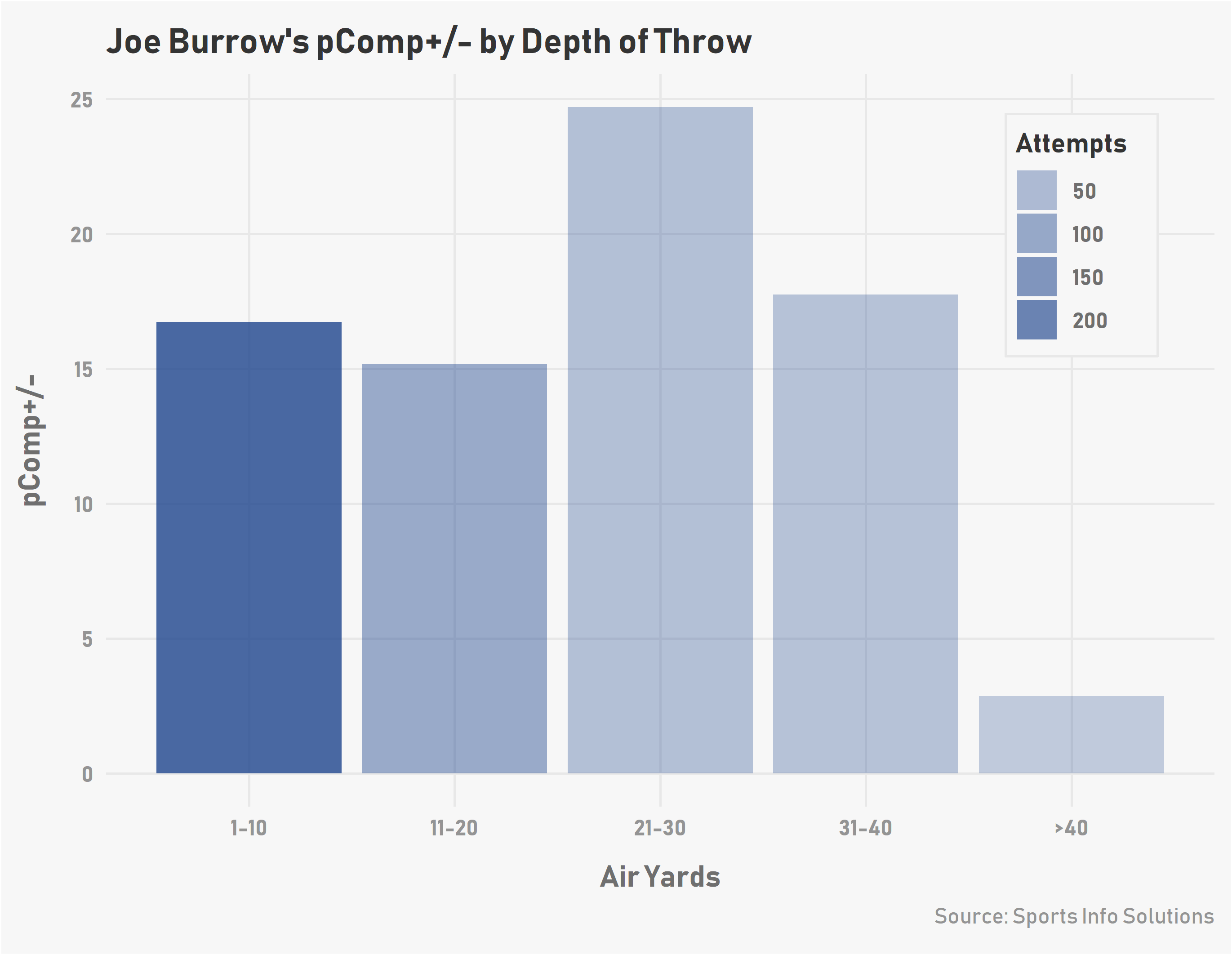
    Burrow’s pComp+/- becomes more impressive when breaking it down by throw depth. Using buckets of five air yards, Burrow is actually at his best in the intermediate and deeper portions of the field. He posted a pComp+/- of 24.7 on throws between 21 and 30 air yards and 17.8 on throws between 31 and 40 air yards (he completed 14-of-29 but was expected to complete only 9 of those passes).

    Another way to use pComp that has been popularized within the analytics “dark web” is to assess how many air yards a quarterback has completed above what would have been expected, or Air Yards Plus/Minus (AY+/-). As an example, a pass that travels 20 yards in the air with a pComp of 50% has an “expected air yards” of 10. A completion would net the quarterback +10, and an incompletion would be worth -10.

    2019 AY+/- Leaders – Quarterbacks (Minimum 250 attempts)

    PlayerADoTAY+/-
    Joe Burrow9.11.6
    Tanner Morgan11.41.3
    Jalen Hurts10.61.2
    Layne Hatcher11.01.1
    Tyler Huntley8.51.1

    Joe Burrow leads comfortably by this metric as well. On a per attempt basis, he completed 1.6 air yards above what would have been expected based on the difficulty of each throw. Jalen Hurts, who trailed only Burrow in pComp+/-, also cracks the top five here with an AY+/- of 1.2.


    Evaluating Receivers

    Predicted Completion Percentage can also be flipped on its head in a few different ways to evaluate receivers and defensive backs. For receivers, pComp+-/ is just the quarterbacks pComp+/- when targeting the receiver.

    2019 pComp+/- Leaders – Wide Receivers (Minimum 100 targets)

    PlayerpCompActualpComp +/-
    Justin Jefferson62.4%82.6%20.2
    Ja’Marr Chase53.8%68.0%14.2
    Easop Winston64.6%78.7%14.1
    Terrell Jana57.8%71.8%14.1
    Hasise Dubois57.6%71.4%13.8

    Pacing all receivers in pComp+/- are LSU’s Ja’Marr Chase and Justin Jefferson. It’s hard to parse their performances from Burrow’s entirely, but there is still no denying that Chase and Jefferson are among the best in the country. Chase led the nation in both receiving yards and touchdowns and won the Biletnikoff Award as the county’s best receiver. Jefferson projects to be a late day one or early day two pick in the coming NFL draft.


    Evaluating Corners

    Flipping the metric again, we can look at which corners were the best at preventing completions as the primary defender. The metric is calculated the exact same way as it is for quarterbacks and receivers, meaning that a plus/minus below zero is good.

    2019 pComp+/- Leaders – Corners (Minimum 40 targets)

    PlayerpCompActualpComp+/-
    Caleb Farley48.1%27.9%-20.2
    Trevon Diggs49.5%30.6%-18.9
    Charles Oliver53.8%36.4%-17.4
    Jeffrey Okudah56.3%39.6%-16.7
    Parnell Motley51.5%36.2%-15.3

    Virginia Tech’s Caleb Farley was the best in the country by this metric. His actual completion percentage when targeted of 27.9% was 20.2 percentage points lower than what would’ve been expected. Trevon Diggs and potential top ten pick Jeffrey Okudah rank as the best among prospects who have entered the draft.

  • When a sack is not a sack (Part II)

    By Mike Churchward

    In June,  I wrote about a specific play in college football–in which a quirk in the NCAA scoring rules results in a sack not actually being scored as such. Now I’m sharing another type of play in which the logical scoring of the play should be a sack, but it is not.

    According to the 2019 NCAA statistical guide:

    “For plays that end either on the line of scrimmage or beyond, there is no pass sack credited, but rather it is considered a rushing play. There can be no pass sack (or tackle for loss) without loss of yardage.”  

    The reason why this ruling is significant is that there are plenty of sacks that also have fumbles. If the ball is fumbled forward to, or beyond, the line of scrimmage then the play is considered a rush and not a sack.

    This ruling does not include whether the ball is recovered by the offense or the defense, just that the ball is fumbled to, or beyond, the line of scrimmage. This means that the defender that hit the quarterback, and caused the fumble, does not get credit for a sack because the result of the play did not lose any yards.

    Much like our previous example, this play is a rarity, but it occurs enough to where it can affect this major statistical category.

    While Chase Young (who is the current leader in sacks) has not been affected by his rule, there are other notable players who have been. Alabama’s Anfernee Jennings (lost a sack vs South Carolina),  Oregon State’s Hamilcar Rashed Jr. (lost a sack vs Cal Poly), West Virginia’s Dante Stills (lost a sack vs Kansas) and Wisconsin’s Zack Baun (lost a sack vs Michigan) are just a few players whose sack totals have been affected by this obscure rule.

    The NFL addresses this type of play in a completely different manner.

    According the 2019 NFL Guide for Statisticians:

     “If a teammate or opponent recovers beyond the line of scrimmage, credit the passer with a sack for 0 yards.”

    This seems like a better way to record this play, as it gives credit to all the players that are involved in the play. The defender that hits the quarterback and causes the fumble will get credit for a 0-yard sack, a tackle for loss and a forced fumble.

    The way the NCAA handles this situation is shortchanging the defensive player who caused the fumble. The NCAA only gives credit for the fumble while the NFL appropriately assigns the correct defensive statistics to the right player. Once again, the two most popular levels of football do not agree on how to record a sack.

  • New football podcast: College Football Preview

    LISTEN HERE

    Former NFL scout Matt Manocherian (@mattmano) of Sports Info Solutions and football analytics pioneer Aaron Schatz (@FO_ASchatz) of Football Outsiders (@fboutsiders) welcome Brian Fremeau (@bcfremeau), creator of the College Football FEI Ratings, to the show to preview the 2019 NCAA Football season. The group explains the FEI Ratings (1:48) and then looks at each major conference to examine the top National Championship contenders, starting with the SEC (4:59) and moving to the ACC (9:31), Big Ten (14:30), Big 12 (17:49) and finishing up with the Pac 12 (22:20) before ending the show with College Football Playoff predictions (27:35).

  • Star College Quarterbacks: 5 You May Not Know

    By Corey March

    The most entertaining thing about college football is that with so many teams, there are star players out there that most people have never heard of.

    Depending on your level of college football fandom, you may know one or even all of these guys. But regardless, this article will hopefully add a new level of appreciation for these five standout quarterbacks.

    Nathan Rourke (Ohio, SR)

    Overview:

    Based on the numbers you are about to read, you’d think Nathan Rourke would be getting more attention as a draft prospect.

    Rourke, the 6’2”, 208 lbs senior, doesn’t quite measure up to the impressive physique of Josh Allen, but his style of play mirrors the former first-round pick with performance metrics to back up the comparison.

    This man is a menace to bring down once he takes off running, which he does about one-third of the time.

    His 6.4 yards/rush trailed only Kyler Murray among QBs with at least 100 rush attempts in 2018 and his 33% Broken Tackle rate was ranked No. 1. His Broken Tackle rate was still top-10 even with RBs factored back in. On 102 career attempts that came on designed runs and scrambles, Rourke is averaging 10.9 yards per carry – easily #1 over that span.

    His 36 rushing touchdowns trailed only Devin Singletary among all FBS players over the past two seasons.

    He also adds stellar contributions with his arm and isn’t afraid to push the ball downfield. His completions have traveled an average distance of 9.1 air yards. Over half of his deep ball attempts have been on-target.

    For those starting to come around on his draft stock, Rourke finished just behind Justin Herbert on the 2018 IQR leaderboard.

    Why he’s here:

    • Rushing Ability: The numbers speak for themselves, Rourke should be the favorite to produce the top rushing stats by a QB in 2019.
    • Dealing with Pressure: Last season, he posted the highest IQR rating the nation when under duress (128). He has also used pressure to his advantage at times as a runner, delivering 10.5 yards per rush on 22 scrambles caused by pressure in the last two seasons.

    Areas to improve:

    • Consistency: Last season, Rourke had three games where 80% of his passes were on target and three games where he was less than 60% accurate.
    • Performance vs Man Coverage: Rourke has been much more effective against Zone coverage (77% on-target, 64% completion in the last two seasons) compared to Man (57% on-target, 47% completion).


    Brock Purdy (Iowa State, SO)

    Overview:

    In a flash, Brock Purdy went from carrying a clipboard to carrying the 2018 Cyclones offense on an unexpected run to salvage bowl eligibility.

    Iowa State went into the 2018 season receiving a handful of top-25 votes and expecting to compete. Those feelings quickly dissipated after a lifeless offense sputtered to a 1-3 start.

    Purdy didn’t get the start the following week but saw the field for the first time after things had gotten off to another rocky start in Stillwater against a ranked Oklahoma State team. He seized the opportunity, not only leading the team to victory but leading the box score in passing and rushing yards.

    That was only the beginning for the freshman, who led Iowa State to wins in seven of its remaining nine games. After he became the starter, only Kyler Murray (10.9) and Tua Tagovailoa (10.5) averaged more passing yards per attempt than Purdy’s 10.3.

    That stat and that company are representative of Purdy’s arm strength, and accuracy. Comparing his stats again to Tagovailoa, the Alabama phenom barely edged him on deep ball accuracy (65% to 61%), but consider that 23% of Purdy throws traveled at least 20 air yards, while Tua was more involved in the short/intermediate game, going deep on 15% of his attempts.

     Why he’s here:

    • Deep Ball Accuracy: Among 57 QBs with at least 50 deep ball attempts, Purdy was the third-most accurate (77% on-target), while throwing deep at the second-highest rate (23% of total attempts).
    • Making Difficult Plays: Purdy was the only QB to finish the top-3 in the nation in both Yards per Pass Attempt on deep throws (18.8 Y/A) and throws under pressure (10.2 Y/A).

    Areas to improve:

    • Decision-making: His stats paint him as a capable runner (100/308/5) but with his passing prowess, the offense might benefit from Purdy taking off on less than 30% of his dropbacks. Seven interceptions compared to 15 touchdowns is also a ratio that Cyclones fans hope trends in a positive direction.
    • Spreading the ball around: How will he perform without his favorite target, Hakeem Butler? About one-third of Purdy’s targets and 56% of his completed air yards went to the Cyclone-turned-Arizona Cardinals receiver.


    Khalil Tate (Arizona, SR)

    Overview:

    We hope to see Khalil Tate, the runner, back on display in 2019.

    As a sophomore in 2017, Tate ran for as many as 327 yards in a game and eclipsed the 100-yard plateau in six straight games. He failed to follow that up, managing just 224 rushing yards all season and topping out at a single-game high of 46 yards.

    Last year, Tate suffered his first ankle injury in the Wildcats’ second game of the season – he left that game temporarily and was visibly affected when he returned. It’s important to note, his rushing performance in the Wildcats’ first game (8 rushes for 14 yards) would have represented his lowest rushing yardage total of the previous season – so it’s unlikely that the injury was the only factor at play. It was reported that first-year OC Noel Mazzone’s emphasis on pocket passing caused conflict with Tate and had the dual-threat QB considering options other than returning to Arizona for his final season.

    When the curtain closed on his junior season, Tate’s year-over-year run% had dropped from 44% to 19% and his percentage of throws from the pocket increased from 66% (lowest in FBS) to 86%.

    The latter was a positive adjustment considering Tate has been on-target with 72% of his throws from inside the pocket compared to 62% on throws from outside the tackle box.

    Why he’s here:

    • Aggressiveness: His passes have been caught at an average depth of 7.8 yards downfield and 26% of his throws traveled 20+ air yards (last two seasons).
    • Rushing Ability: His 9.2 yards per carry in 2017 is the highest QB mark in FBS in the three seasons of SIS data collection , however, this fell to 3.0 YPC in 2018.

    Areas to improve:

    • Accuracy: Tate posted a 71% on-target throw% on all throws and a rate of 52% on deep throws (last two seasons).
    • Clutch Performance: Tate has put up a 77 IQR on 125 pass attempts in the 4th quarter and a 79 IQR on 82 pass attempts in the second half of one-score games.


    Mason Fine (North Texas, SR)

    Overview:

    Mason Fine’s college career has been on a steady upward trajectory since he took his first snaps as a freshman. The fourth-year starter is on pace to become just the 18th FBS quarterback to crack the 13,000 passing yard mark.

    After an inauspicious first season, Fine has propelled the Mean Green to consecutive 9-win seasons and become the face of a program that recently captured some elusive recognition by grabbing three votes in the preseason Coaches Poll.

    Fine’s terrific past two seasons, combined with the efforts of the North Texas Athletics Department (6forheisman.com), have been the catalyst for some well-deserved hype as he enters his senior year.

    The pocket-passer delivered his highest TD total (31) as a sophomore but his 2018 junior campaign is the one that catapulted him onto the map. He opened the season in style, by throwing 21 touchdowns and just one interception in his first 10 games (compared to 12 INTs in his previous 10).

    Fine has thrown more passes than any other QB over the last two seasons and averaged an impressive 8.0 Y/A. North Texas figures to rely heavily on him again in 2019.

    Why he’s here:

    • Pure Passing Ability: Since taking over as the starter early on as a freshman, Fine has dropped back to pass more than anyone in the nation, and the Mean Green are 22-15 over that span. He’s been on target with 76% of his passes.
    • Annual Improvement: Fine’s critical stats have improved year-over-year. He started out throwing 1.2 TD per INT in 2016, then upped it to 2.1 (2017) and 5.4 (2018). As a result, his IQR has increased each year from 77 to 105 to 120.

    Areas to improve:

    • Off-Schedule Throws: His results from inside a clean pocket (82% on-target, 8.1 Y/A, 112 IQR) are far more impressive than his numbers when flushed from the pocket due to pressure (44% on-target, 5.4 Y/A, 74 IQR).
    • Playing from behind: Fine has shown a better ability to protect a lead than overcome a deficit. He’s thrown 46 TD/6 INT with a lead compared to 18 TD/18 INT when trailing. Luckily only 21% of his passes came from behind last season compared to 79% in year one.


    D’Eriq King (Houston, SR)

    Overview:

    D’Eriq King is the definition of a playmaker – to get a sense of that, look no further than the scoreboard. In his first full season as the Houston starter, the Cougars averaged 48 points per game prior to King suffering a torn meniscus.

    Aside from the injury shortened game, King contributed a minimum of 3 touchdowns in every contest, including 4 TDs in three games and at least 5 TDs in five games.

    The Cougars used play action on 49% of their plays (FBS average = 28%), as a savvy way to get an edge offensively. King used the deception to his advantage, registering a 131 IQR and completing passes at an average depth of 8.0 yards downfield.

    King will also beat you on the ground, averaging 8.3 Y/A (3rd-most) and 4.3 Yards After Contact per Attempt (1st) on designed runs and scrambles. To add to his running efficiently, King scored a rushing touchdown in every game he played last season.

    Houston is 11-7 the 18 games that King started over the last two seasons. The Cougars are otherwise 4-5 during that span.

    Why he’s here:

    • Downfield Passing: When it came to intermediate and deep passes, only Trevor Lawrence (133) posted a higher IQR than King (132).
    • Clutch Performance: King led the nation with a 140 IQR and 83% on-target rate on third downs. On the rare occasion that Houston allowed its opponents to hang around in a game last season, King threw more touchdowns (5) than incompletions (4) in the second half of one score games.

    Areas to improve:

    • Performance vs Zone Defense: King has been less explosive and more susceptible to mistakes against Zone coverage (10 TD/5 INT) compared to Man coverage (27 TD/2 INT).
    • Running Post-Injury: King has proven to be a weapon on the ground, so this is more of a situation to monitor. Coming off a surgically-repaired knee, will King be able to continue attacking opponents with the same level of versatility?

    For more information about Sports Info Solutions, visit our website. To learn more about the SIS DataHub Pro and register for a free trial, visit pro.sisdatahub.com.

  • Using the Football Rookie Handbook to rate the Draft

    By NATHAN COOPER AND JOHN TODD

    Which team fared best in the NFL Draft per our rankings in the 2019 Football Rookie Handbook?

    We tried to find out.

    Not every player from the Handbook was drafted and not every player that was drafted was in the Handbook. For players that weren’t in the book, we assigned them a flat 5.7 grade, as that is the grade that would’ve just missed inclusion in the book.

    We assigned all of the grades from the Handbook, along with 5.7 grades, and divided by the number of selections each team had. The Titans came away with our 2019 Best Draft Class with an average grade just above 6.6. They had six selections and used all six of them on players that were featured in the Handbook. The Titans and Ravens were the only teams that selected Handbook players as their entire draft class.

    The Titans draft class is seen in the table below.

    Tennessee Titans Draft Class
    Pick Pos Player College Grade
    19 DT Jeffery Simmons Mississippi State 6.9
    51 WR A.J. Brown Ole Miss 6.8
    82 OG Nate Davis Charlotte 6.8
    116 SAF Amani Hooker Iowa 6.4
    168 EDGE D’Andre Walker Georgia 6.7
    188 LB David Long West Virginia 6.2

    In our opinion, the Titans drafted solid, 3-down starters with their top three selections in Jeffery Simmons, A.J. Brown, and Nate Davis. They also got great value late in the 5th Round when they selected D’Andre Walker to come off the edge.

    The top five draft classes were, in order were:

    1) Titans

    2) Bills

    3) Cardinals

    4) Ravens

    5) Bengals

    The bottom three were the Chiefs, Lions, and Seahawks.

    Four of the eleven players the Seahawks selected weren’t in the Handbook . The Lions picked four of their nine who were not in the book. The Chiefs chose four of their six from players who were not in the Handbook.

    The Chiefs made solid selections with Juan Thornhill and Khalen Saunders, but their reach of Mecole Hardman in the 2nd Round made it tough to earn a solid grade.

    How the Handbook Compared to the Draft

    Taking a look at top five position ranks, the SIS Rookie Handbook and the NFL had the same first group of five tight ends selected, and the first five centers drafted exactly in order. The Handbook also matched the first group of four wide receivers and defensive tackles. Sports Info Solutions graded Daniel Jones as a top three quarterback in January. The book also matched four of the first five offensive guards selected in the draft.

    Players we believed were drafted much higher than they should have been include Marquise Blair, Terry McLaurin, David Long (CB), Bobby Okereke, Trey Pipkins, and Chuma Edoga. Out of the over 400 players with written reports for this book, these players were scouted and not given grades high enough to be included, while NFL teams believed they were worthy of Day 2 selections.

    Players who were rated in the top five at their positions in the SIS Rookie Handbook who were not drafted are Nik Needham (our No. 4 CB), Beau Benzschawel (No. 4 OG), Terrill Hanks (No. 5 LB), and Kenny Bigelow, (No. 5 NT). These players have all been picked up in undrafted free agency, and we believe they have strong chances to make their respective 53-man rosters and contribute in their careers.

    Inversely, players who were taken as top five players at their position that the Handbook did not have a report on are Mecole Hardman (5th WR taken), Sean Bunting (4th CB taken), Sione Takitaki (5th LB taken), and PJ Johnson (5th NT taken).

    The process for determining which players to scout, our report writing and cross-checking operations, and ultimately our rankings and evaluations all have certain qualifications. Sports Info Solutions has already implemented improvements to make the Rookie Handbook more accurate and informative in 2020, though we think this year’s edition turned out very well.

    Releasing the book at the end of January, before the Combine, Pro Days, and quotes from “anonymous scouts” occur, has allowed us to keep our evaluations based purely on the most important part of the scouting process: the film. Our Video Scouts put in a great deal of work in the fall and winter to put this first edition together, and we’re already looking ahead to next season.