Category: College Football

  • 2022 SIS Conference USA All-Conference Teams

    2022 SIS Conference USA All-Conference Teams

    It’s finally time to release our SIS All-Conference teams. We used our all-encompassing player value stat, Total Points, along with other metrics and our scouting work as leading references in putting together our team of selections for 2022, plus a few honorable mentions.

    You can learn more about Total Points and the statistics referenced here.

    These picks are meant to honor this season’s best-of-the-best in Conference USA.

    Offense

    Position Name School
    QB Frank Harris UTSA
    RB DeWayne McBride UAB
    WR Luke McCaffrey Rice
    WR Trea Shropshire UAB
    TE Oscar Cardenas UTSA
    FLEX Jaylin Lane Middle Tennessee
    OT Ethan Onianwa Rice
    OT Kadeem Telfort UAB
    OG Gabe Blair North Texas
    OG Matthew Trehern UAB
    OC Manase Mose North Texas

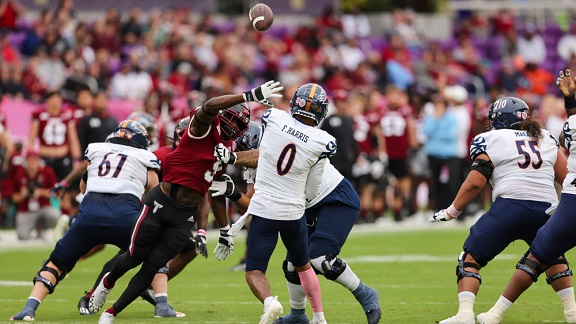
    Frank Harris of UTSA was one of the easiest selections in any conference. He had more than TRIPLE the Total Points of the next highest QB in the conference while leading UTSA to another conference championship. DeWayne McBride had an impressive 28.3% Blocked Tackle and Missed Tackle % this season on his way to over 1,700 rushing yards. 

    Luke McCaffrey, Trea Shropshire, and Jaylin Lane all finished top-8 in the conference in Drop% (minimum 50 targets), and they finished 1st, 2nd, and 3rd in Receiving Total Points respectively. Oscar Cardenas narrowly edged out Jake Roberts due to his incredible 96.7% On-Target Catch%.

    Gabe Blair, Manase Mose, Matthew Trehern, and Ethan Onianwa were the Top-4 offensive linemen in Total Points in the conference and Kadeem Telfort was T-4th lowest BB% among offensive linemen with at least 200 snaps.

    Defense

    Position Name School
    DT Marley Cook Middle Tennessee
    DT Brodric Martin Western Kentucky
    EDGE Jordan Ferguson Middle Tennessee
    EDGE JaQues Evans Western Kentucky
    LB Myron Morrison Rice
    LB Cal Wallerstedt UTEP
    CB Corey Mayfield Jr. UTSA
    CB Starling Thomas V UAB
    S Kaleb Oliver Western Kentucky
    S Clifford Chattman UTSA
    FLEX Decorian Patterson Middle Tennessee

    Marley Cook led all DTs in pressures and Pass Rush Total Points in the conference while Broderic Martin finished 2nd in Pass Rush Total Points. JaQues Evans led the conference in pressures as well as holds drawn. Jordan Ferguson finished 2nd in pressures and led the conference in passes deflected/batted at the line of scrimmage. Barely missing the team was Jadrian Taylor who, despite leading the conference in sacks, was 9th in pressures.

    Myron Morrison led all linebackers by a large margin in Total Points and had a QB Rating Against of just 15.6 (2nd in the conference, regardless of position). Cal Wallerstedt led off-ball linebackers in Run Defense Total Points. Corey Mayfield Jr. led the conference in Pass Coverage Total Points while his teammate Clifford Chattman was 2nd in the conference with 5 INTs. Starling Thomas V led all CBs in Deserved Catch% at a stingy 48.6% and Kaleb Oliver was T-2nd among DBs in Yards Per Coverage Snap with 0.2. Decorian Patterson tied for the FBS-lead with 7 INTs, but he also allowed a conference-high 8 TDs which almost kept him off the team.

    Specialists

    Position Name School
    K Gavin Baechle UTEP
    P Kyle Ulbrich Middle Tennessee
    Returner Smoke Harris Louisiana Tech

    Gavin Baechle went 22-of-24 on FGs including 9-of-11 on 40+ yard FGs. he was also 31-of-31 on extra points. Kyle Ulbrich led the conference in punt average as well as punts downed inside the 20. Smoke Harris led the conference in punt return yards, was 4th in kick return yards, and had a top-5 average in both return types.

    Honorable Mentions

    Name School
    Jake Roberts North Texas
    Jadrian Taylor UTSA

    Total Points, stats, and ranks as of 2/1/2023

  • 2022 SIS Mountain West All-Conference Team

    2022 SIS Mountain West All-Conference Team

    It’s finally time to release our SIS All-Conference teams. We used our all-encompassing player value stat, Total Points, along with other metrics and our scouting work as leading references in putting together our team of selections for 2022, plus a few honorable mentions.

    You can learn more about Total Points and the statistics referenced here.

    These picks are meant to honor this season’s best-of-the-best in the Mountain West Conference.

    Offense

    Position Name School
    QB Jake Haener Fresno State
    RB Brad Roberts Air Force
    WR Tory Horton Colorado State
    WR Elijah Cooks San Jose State
    TE Caleb Rillos Air Force
    FLEX Jordan Mims Fresno State
    OT Everett Smalley Air Force
    OT John Ojukwu Boise State
    OG Isaac Cochran Air Force
    OG Preston Nichols UNLV
    OC Thor Paglialong Air Force

    While Brad Roberts was aided by a high-powered Air Force offense, not allowing his Total Points number to be very intriguing, he still led the entire FBS in rushing yards with 1,728. An SIS All-America selection, Isaac Cochran was an easy pick here, leading all FBS OL with 51 Total Points. While Elijah Cooks ranked 7th in Total Points among MW receivers, his 21 receiver Total Points ranked 3rd, behind only Horton and Remigio.

    Defense

    Position Name School
    DT Jonah Tavai San Diego State
    DT Scott Matlock Boise State
    EDGE Viliami Fehoko San Jose State
    EDGE Adam Plant Jr. UNLV
    LB Ezekiel Noa Boise State
    LB Michael Shawcroft San Diego State
    CB Nohl Williams UNLV
    CB Cameron Lockridge Fresno State
    S Jayden Goodwin Air Force
    S JL Skinner Boise State
    FLEX Jerrick Reed II New Mexico

    Jonah Tavai’s 54 pressures ranked 2nd-most in the entire FBS, which is a ridiculous stat from an interior defender, and Fehoko and Plant Jr. both put up good sack numbers in 2022. Lockridge and Reed both ranked in the FBS top 50 in Passer Rating Against. Williams led the conference with 28.6 Points Above Average in coverage.

    Specialists

    Position Name School
    K John Hoyland Wyoming
    P Jack Browning San Diego State
    Returner Nikko Remigio Fresno State

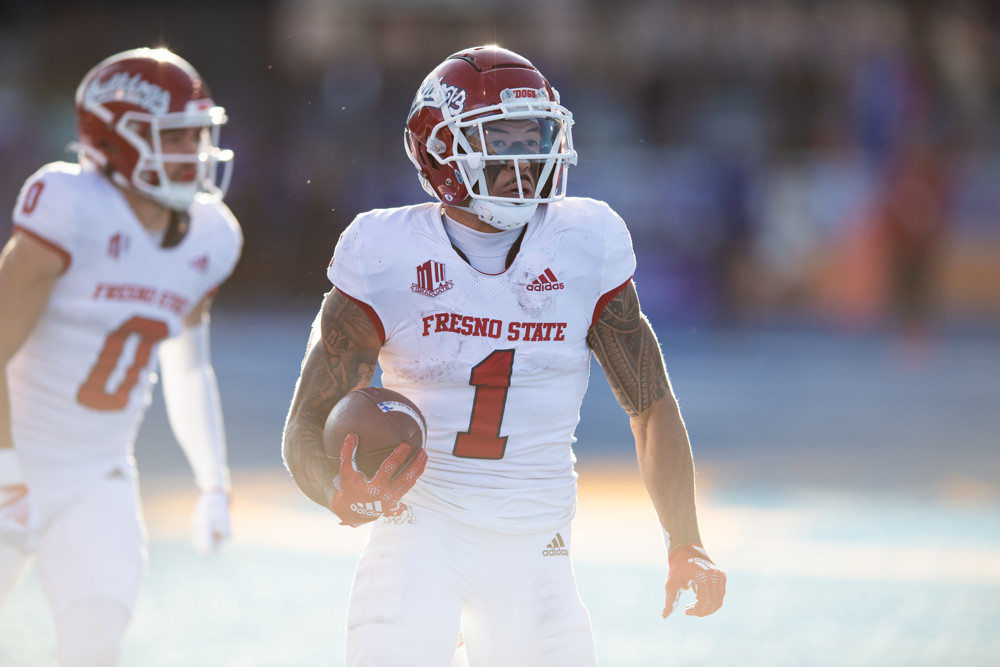
    Jack Browning and Nikko Remigio were SIS All-Americans this season. Browning is the definition of a dual-threat as a kicker and punter. Browning’s 14 punts inside the 10 tied for 2nd-most in the FBS. Remigio could have easily made the team as a receiver with 25 Total Points on offense, but he had 2 PR TDs, had the highest yards per punt return in the FBS, and also added nearly 21 yards per kick return.

    Honorable Mentions

    Name School
    Chevan Cordeiro San Jose State
    John Lee Eldridge III Air Force
    George Holani Boise State
    Wesley Ndago Air Force
    David Perales Fresno State
    Jordan Byrd San Diego State

    Chevan Cordeiro actually had one more Total Point than Jake Haener with a lot of production coming on the ground. John Lee Eldridge led the MW RBs in Total Points, though much of it aided as a blocker. David Perales and his 11.5 sacks ranked 2nd in the FBS with 48 pressures. Jordan Byrd was also an SIS Honorable Mention All-American after being the only player in FBS who returned both a kick and punt for a touchdown in 2022.

    Total Points, stats, and ranks as of 2/1/2023

  • 2022 SIS SEC All-Conference Teams

    2022 SIS SEC All-Conference Teams

    It’s finally time to release our SIS All-Conference teams. We used our all-encompassing player value stat, Total Points, along with other metrics and our scouting work as leading references in putting together our team of selections for 2022, plus a few honorable mentions.

    You can learn more about Total Points and the statistics referenced here.

    These picks are meant to honor this season’s best-of-the-best in the SEC.

    Offense

    Position Name School
    QB Jayden Daniels LSU
    RB Quinshon Judkins Ole Miss
    WR Malik Nabers LSU
    WR Jalin Hyatt Tennessee
    TE Brock Bowers Georgia
    FLEX Jahmyr Gibbs Alabama
    OT Darnell Wright Tennessee
    OT Will Campbell LSU
    OG Nick Broeker Ole Miss
    OG Beaux Limmer Arkansas
    OC Caleb Warren Ole Miss

    LSU’s Jayden Daniels wins a tight race for the SEC QB selection. Even though Daniels ranked 5th in Total Points as a Passer in the conference, he was far and away the best running threat at the position totaling 34 more Total Points than the next QB in the SEC. Daniels is joined by two other Tigers on the offense in Malik Nabers and Will Campbell, both who had breakout seasons in their sophomore and freshman campaigns, respectively. 

    The two Tennessee Volunteers who made the team were also 1st-Team SIS All Americans as well. Jalin Hyatt, the 2022 Biletnikoff Award Winner, led the entire SEC in receiving yards and touchdowns among all eligible pass catchers. Meanwhile Darnell Wright, who led all SEC linemen in Total Points earned, anchors the offensive line group.

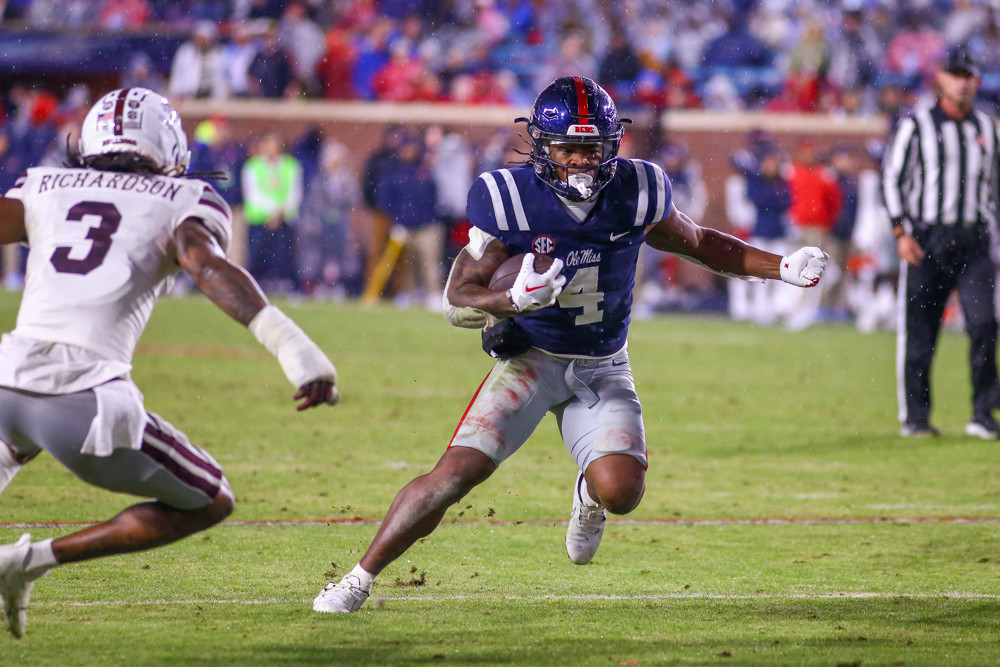
    Ole Miss is tied with the LSU Tigers for most selections, who each had three on the offensive side of the ball. The three Rebels selected are led by one of the best true freshmen in the country, Quinshon Judkins. He finished in the top 10 in the country in both rushing yards and touchdowns this season.

    Defense

    Position Name School
    DT Mekhi Wingo LSU
    DT Jalen Carter Georgia
    EDGE Will Anderson Alabama
    EDGE Harold Perkins Jr. LSU
    LB Smael Mondon Jr. Georgia
    LB Nathaniel Watson Mississippi State
    CB Dwight McGlothern Arkansas
    CB Kool-Aid McKinstry Alabama
    S Brian Branch Alabama
    S Christopher Smith Georgia
    FLEX Emmanuel Forbes Mississippi State

    It’s no surprise that future top-5 2023 NFL Draft hopefuls Georgia’s Jalen Carter and Alabama’s Will Anderson Jr. lead the way for all SEC Defense. Two more LSU Tigers round out the front four with Mekhi Wingo and Harold Perkins Jr.. Wingo led all SEC defensive tackles in Pass Rush Points Saved and was second only to Carter in Points Saved as a run defender. Perkins burst onto the scene in his true freshman season totaling 7.5 sacks, 4 forced fumbles and an interception.

    Alabama leads the way with most selections on the defensive side of the ball as Brian Branch and Kool-Aid McKinstry join Anderson. Besides having one of the best names in college football, McKinstry was 2nd in Total Points among all SEC cornerbacks only to his counterpart from Arkansas, Dwight McGlothern. Meanwhile Branch, who spent over 70% of his snaps in 2022 in the slot, was second in Total Points amongst SEC safeties along with the leader from the Georgia Bulldogs, Christopher Smith

    Specialists

    Position Name School
    K Will Reichard Alabama
    P Kai Kroeger South Carolina
    Returner Lideatrick Griffin Mississippi State

    Alabama’s Will Reichard made 22-of-26 field goal attempts this season making 9 field goals of 40+ yards. South Carolina’s Kai Kroeger led the SEC in net average amongst all punters while also leading the conference in punts that were downed inside the 20 and 10 yard line.

    Honorable Mentions

    Name School
    Bryce Young Alabama
    Hendon Hooker Tennessee
    Raheim Sanders Arkansas
    Darnell Washington Georgia
    Tavius Robinson Ole Miss
    Kelee Ringo Georgia
    Demarcco Hellams Alabama
    Mekhi Garner LSU
    Kris Abrams-Draine Missouri

    Alabama’s Bryce Young and Tennessee’s Hendon Hooker both made strong cases to be the All-SEC quarterback but came up just short. Darnell Washington also deserves some praise as he earned 15 Total Points this season, only coming in second to a player in his own tight end room at Georgia, Brock Bowers

    Total Points, stats, and ranks as of 2/5/2023

  • 2022 SIS American All-Conference Team

    2022 SIS American All-Conference Team

    It’s finally time to release our SIS All-Conference teams. We used our all-encompassing player value stat, Total Points, along with other metrics and our scouting work as leading references in putting together our team of selections for 2022, plus a few honorable mentions.

    You can learn more about Total Points and the statistics referenced here.

    These picks are meant to honor this season’s best-of-the-best in the American Athletic Conference.

    Offense

    Position Name School
    QB Clayton Tune Houston
    RB Tyjae Spears Tulane
    WR Nathaniel Dell Houston
    WR Keylon Stokes Tulsa
    TE Alec Holler UCF
    FLEX Keaton Mitchell East Carolina
    OT Demontrey Jacobs South Florida
    OT Rashad Green Tulane
    OG Samuel Jackson UCF
    OG Lokahi Pauole UCF
    OC Sincere Haynesworth Tulane

    Houston’s Clayton Tune leads the way for the offensive group. Leading the conference in Total Points with 159, Tune played his way to Mobile and the Senior Bowl, along with his teammate Tank Dell who led the country with 1,399 receiving yards and 17 TDs.

    Tyjae Spears and Keaton Mitchell ran wild in the conference. Spears accumulated 54 Total Points and tied-3rd in the NCAA with 19 rushing TDs, while Mitchell’s 27.4% Broken+Missed Tackle rate tied for 10th among all players with at least 150 rushes.

    On the offensive line, UCF really led the way with its up-tempo, high-powered offense. Samuel Jackson and Lokahi Pauole led all OL in the conference in TP with 38 and 39, respectively. Tulane’s revitalized program in 2022 still showed out with Rashad Green and Sincere Haynesworth holding down the offensive line.

    Defense

    Position Name School
    DT Ricky Barber UCF
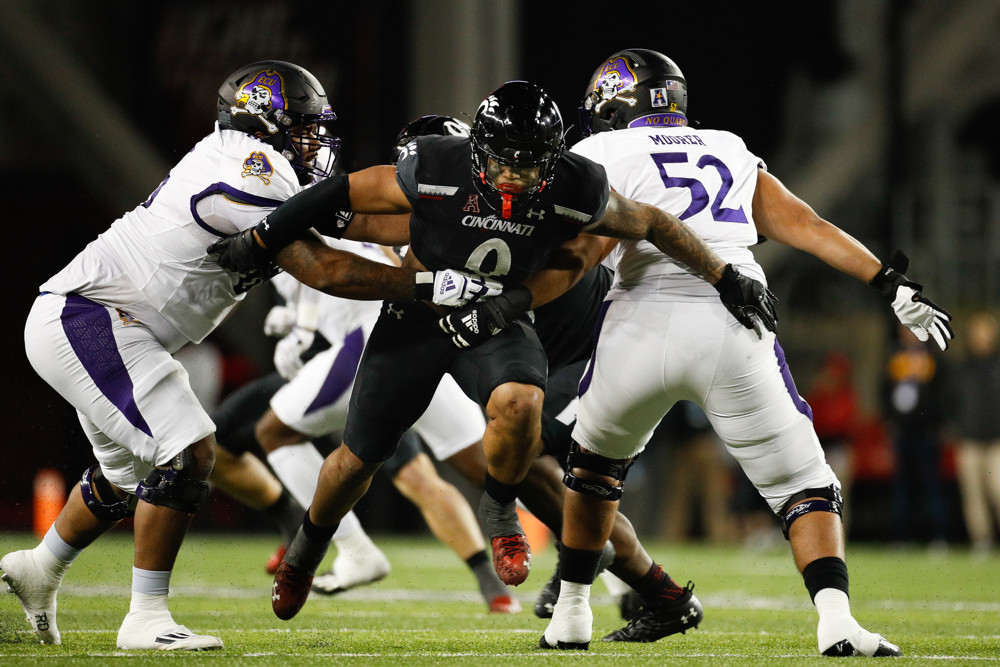
    DT Dontay Corleone Cincinnati
    EDGE Jaylon Allen Memphis
    EDGE Nicholas Straw Navy
    LB Ivan Pace Jr. Cincinnati
    LB Nick Anderson Tulane
    CB Tyon Davis Tulsa
    CB Jarius Monroe Tulane
    S Quindell Johnson Memphis
    S Bryson Powers Tulsa
    FLEX John Marshall Navy

    Ivan Pace Jr. and John Marshall are two guys who made our All-America squads. Not only did both of them finish the season with double-digit sacks, but they also dominated the rest of the defensive players in the conference in Total Points. An intriguing name is Quindell Johnson out of Memphis who ranked 2nd among all safeties in the FBS with a 33.1 Passer Rating Against.

    Specialists

    Position Name School
    K Chris Howard Memphis
    P Mason Fletcher Cincinnati
    Returner Lawrence Keys III Tulane

    Chris Howard’s 21 FG made were tied-11th most in FBS, going 21-of-24 overall and Mason Fletcher’s 29 punts inside the 20-yard line were tied for 4th-most. Lawrence Keys III may not have returned any kicks for touchdowns, but his 624 KR yards tied for 6th-most with an average over 27-yards per return.

    Honorable Mentions

    Name School
    Holton Ahlers East Carolina
    Brian Battie South Florida
    Tylan Grable UCF
    Matthew Lee UCF
    Dorian Williams Tulane

    Holton Ahlers threw for the 10-most yards in all of FBS, and also came out and was named the MVP of not one, but two All-Star Games (Hula Bowl and NFLPA Collegiate Bowl). Matthew Lee may not have made the 1st Team, but he was in the discussion, allowing only 4 blown blocks all season which was tied for the fewest in all of FBS among offensive linemen with at least 500 snaps.

    Total Points, stats, and ranks as of 2/1/2023


  • 2022 SIS Big Ten All-Conference Team

    2022 SIS Big Ten All-Conference Team

    It’s finally time to release our SIS All-Conference teams. We used our all-encompassing player value stat, Total Points, along with other metrics and our scouting work as leading references in putting together our team of selections for 2022, plus a few honorable mentions.

    You can learn more about Total Points and the statistics referenced here.

    These picks are meant to honor this season’s best-of-the-best in the Big Ten Conference.

    Offense

    Position Name School
    QB C.J. Stroud Ohio State
    RB Mohamed Ibrahim Minnesota
    WR Emeka Egbuka Ohio State
    WR Marvin Harrison Jr. Ohio State
    TE Payne Durham Purdue
    FLEX Blake Corum Michigan
    OT Paris Johnson Jr. Ohio State
    OT Aireontae Ersery Minnesota
    OG Zak Zinter Michigan
    OG Chuck Filiaga Minnesota
    OC Olusegun Oluwatimi Michigan

    Leading the discussion on phenomenal play in 2022 is quarterback C.J. Stroud, who nearly led the nation with 41 passing touchdowns. Stroud also produced tremendous value, ending the year in the top-5 amongst all QB’s in the nation in Total Points (TP), Points Above Average (PAA), and Expected Points Added (EPA).

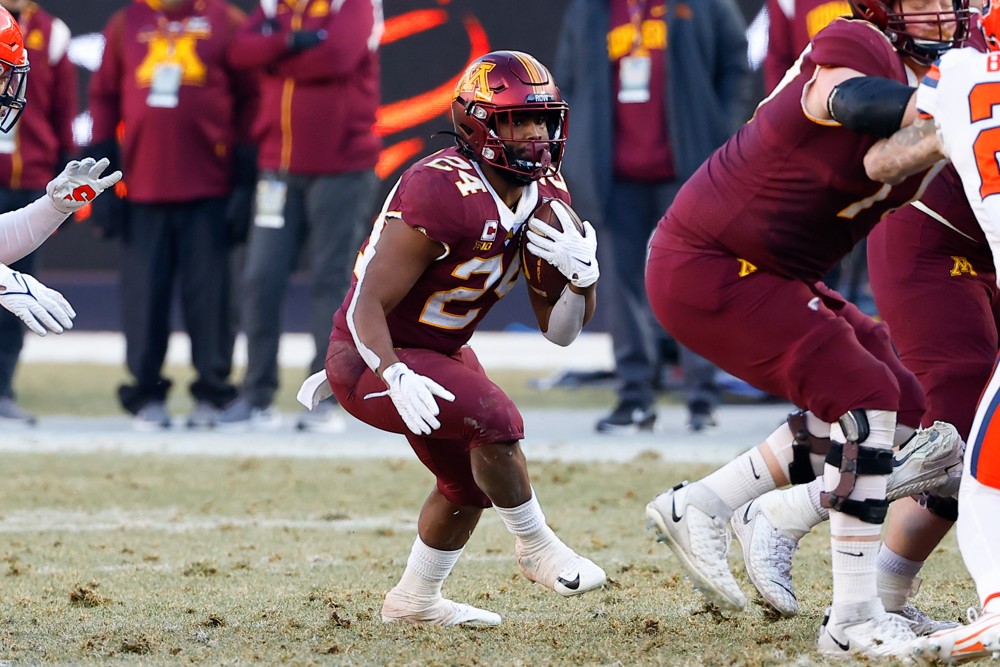
    While the quarterbacks always get the glory, 2022 was the year of the star running back in the Big Ten. Minnesota’s Mohamed Ibrahim proved that a torn Achilles in 2021 would not hinder his durability and consistency. He toted the rock 320 times and ended the year tied for the most rushing touchdowns in the nation (20) and 3rd in yards (1665).

    Michigan’s Blake Corum was not to be outdone. Though he lost some carries to the dynamic Donovan Edwards, Corum still logged 247 carries, good for 13th in the nation, and found the end zone 18 times on the ground.

    After transferring to Michigan for his final year of college football, Olusegun Oluwatimi became a leader and finished the year 1st in Total Points among linemen in the conference and 2nd in PAA among all linemen in the country.

    Defense

    Position Name School
    DT Jer’Zhan Newton Illinois
    DT Mazi Smith Michigan
    EDGE Zach Harrison Ohio State
    EDGE J.T. Tuimoloau Ohio State
    LB Seth Benson Iowa
    LB Tommy Eichenberg Ohio State
    CB Devon Witherspoon Illinois
    CB Riley Moss Iowa
    S Cooper DeJean Iowa
    S Kaevon Merriweather Iowa
    FLEX Sydney Brown Illinois

    After two years of defensive play that could rival the historic run from Georgia, Iowa players filled our All Big Ten team. Riley Moss, Cooper DeJean, and Kaevon Merriweather were all top-10 amongst defensive backs in the Big Ten in Points Saved (PS), PAA, and EPA.

    The 2022 Illinois defense deserves to be lauded and they were led by All-World cornerback, Devon Witherspoon. Witherspoon led all Big Ten DB’s in PS, PAA, and EPA, as well as finishing top-3 amongst all DB’s in the nation in those three categories and looks to be the first DB off the board in this year’s draft.

    Specialists

    Position Name School
    K Jake Moody Michigan
    P Adam Korsak Rutgers
    Returner Jaylin Lucas Indiana

    Jake Moody is the standout here, leading the nation with 29 Field Goals made, while making 83% of his kicks, along with 100% of his PAT’s. He was also viable from distance, making 3 FG from 50 or more yards, one off the nation’s best.

    Honorable Mentions

    Name School
    Chase Brown Illinois
    Charlie Jones Purdue
    John Michael Schmitz Minnesota
    Garrett Nelson Nebraska
    Chop Robinson Penn State
    Jack Campbell Iowa
    Quinton Newsome Nebraska
    Kalen King Penn State
    Deonte Banks Maryland
    Ji’Ayir Brown Penn State
    Jordan Howden Minnesota
    Bryce Baringer Michigan State
    Tory Taylor Iowa

    With the phenomenal running back play in the Big Ten this year, Chase Brown became the odd man out for this endeavor. His 328 carries was second in the nation and his 1,643 yards was good for fourth. 

    Perhaps no player in the country changed their national perspective more than Purdue’s Charlie Jones, Chucky Sizzle if you’re nasty. After accumulating only 21 catches in two years at Iowa, Jones teamed up with childhood friend and Purdue QB, Aidan O’Connel. Jones proceeded to lead the nation in receptions, as well as finish 2nd in yards and 5th in touchdowns.

    While Iowa has played lights out defense the past two years, Penn State looks to be primed to produce in a similar fashion in 2023. With studs at every level all playing in their second or third year, Manny Diaz has every tool desirable to make a run at the Broyles award in 2023 and earn another shot at a head coaching gig.

    After transferring in from Maryland, Chop Robinson hit the ground running and produced the second most pressures in the conference. In the secondary, Kalen King finished top-5 in the Big Ten in PS, PAA, and EPA on pass plays.


    Total Points, stats, and ranks as of 2/2/2023

  • What Will Happen When Georgia Has The Ball

    What Will Happen When Georgia Has The Ball

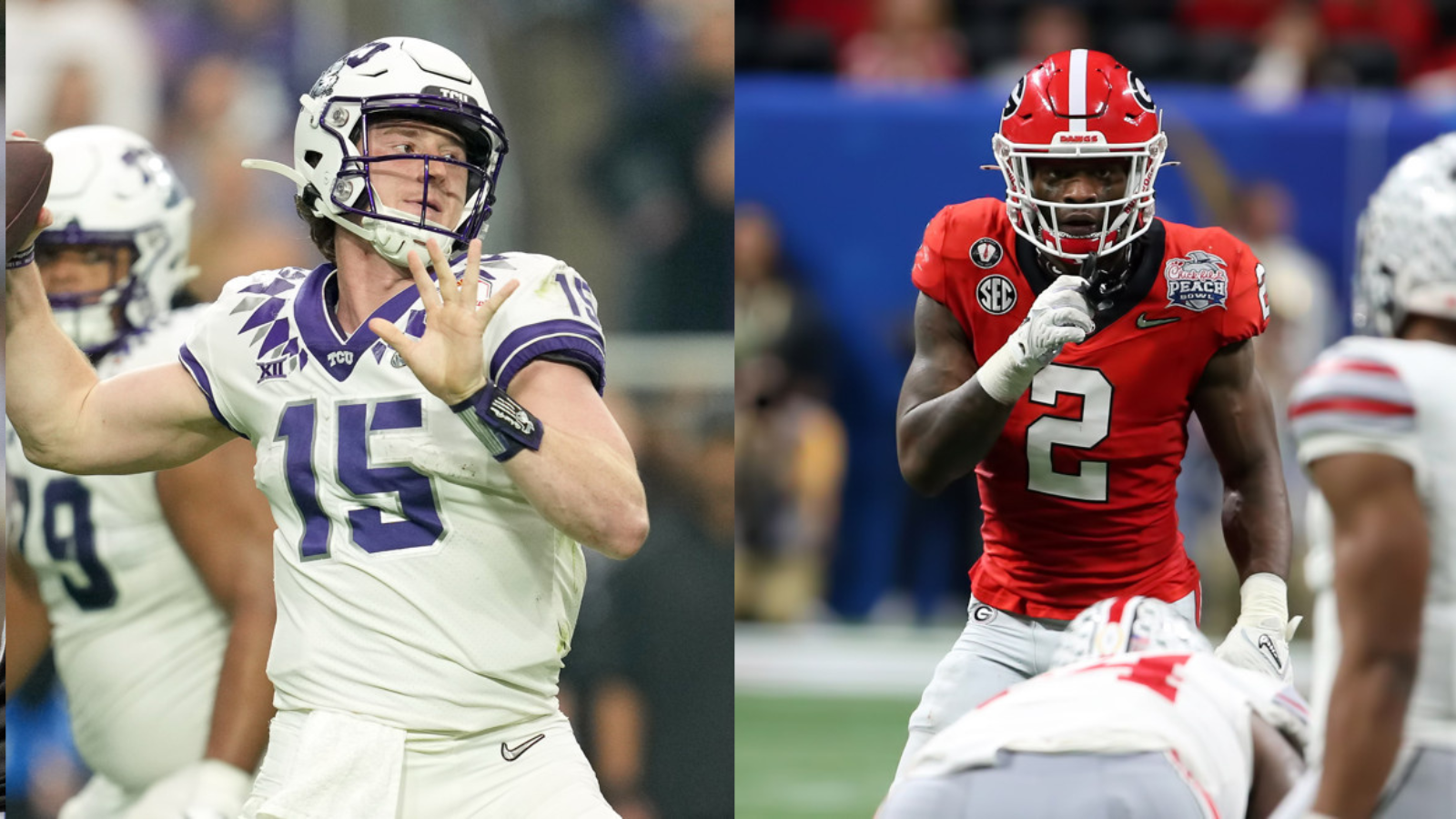
    Returning former walk-on and junior college transfer Stetson Bennett, Georgia’s offense performed even better this year than last, going from .13 EPA (Expected Points Added) per play to .18 and from 6th to 4th among FBS teams. In comparison, TCU’s defense ranks 39th, an apparent mismatch on paper. But given the Horned Frog’s strengths and improvements, the Bulldogs may face trouble.

    TCU runs the 3-3-5, almost always featuring a head-up nose on the center. At linebacker, Dee Winters aligns to the wide side of the field, Johnny Hodges the short, and Jamoi Hodge the middle. Safety Bud Clark aligns according to the receivers, Mark Perry away from the receivers, and Millard Bradford in the middle. Jim Thorpe award winner Tre’Vius Hodges-Tomlinson and Josh Newton complete the secondary, locking down the corners.

    While also their largest unit, the secondary ranks as the Horned Frogs best as well, at 11th in Total Points per play. The linebackers place lower at 42nd, and the defensive line even lower at 116th. In spite of the weakness up front, TCU rarely sends four or more to rush the passer, doing so only 45% of the time, the least in the FBS. Instead, the Horned Frogs normally sit in a three-high shell, from which they play Cover 3 on 34% of passes and Cover 1 on 35%.

    Given their small, nickel personnel and relative lack of experience, with only four multi-year starters, the Horned Frogs look ill-suited to stop the Bulldogs smashmouth offense. TCU has  faced 12 personnel on only 20% of its defensive downs, but Georgia runs it on 59% of its downs. Its package also features two of the best tight ends in the country.

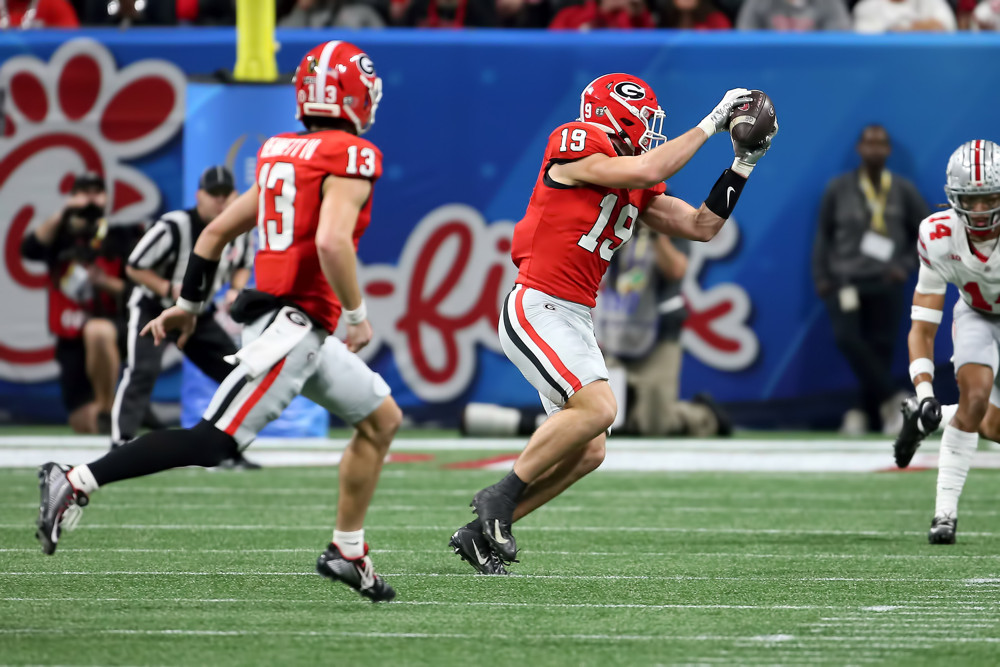
    Brock Bowers and Dwayne Washington average .06 and .05 Total Points per play, both top-10 among tight ends with 400 or more snaps, and prove nearly impossible for linebackers to cover or safeties to shed. Bowers has even run the ball on a few occasions, toting the rock on jet sweeps, ends around and reverses. Despite their design for small, shifty, and fast receivers, these runs have netted the 6 ‘4, 230-pound Bowers 94 yards and 6.6 Total Points on 7 attempts. 

    What TCU can handle

    But surprisingly enough, TCU defends against two tight ends rather effectively, allowing -0.19 EPA per play against this package. To match run-heavy personnel on the field, the Horned Frogs compensate for their lack of size by quickly adjusting their alignment to the formation at hand. 

    Given heavy packages, TCU can either go base, one-high and drop two safeties closer to the line of scrimmage, or drop Bradford into the box. Putting the two overhang safeties down low lets them force runs inside to the linebackers much more quickly, and moving Bradford’s positioning gives the Horned Frogs an extra body to stop the run. These adjustments also leave TCU’s coverage mostly intact, as it can rotate safeties to their proper spots depending on whether it calls zone or man.

    Normally teams struggle when forced to adjust their base defense, but TCU has thrived in this situation. As a whole, switching defenses has actually improved the unit, not weakened it.

    Transitioning from Gary Patterson’s 4-2-5 match quarters to Joe Gillespie’s 3-3-5 three-high base, the Horned Frogs have lowered their points allowed per game by 8.5, risen 85 spots in EPA per play and 78 spots in Total Points per play from last season. TCU continues to improve too, having increased its EPA per play ranking from 73rd to 28th and its Total Points per play ranking from 49th to 28th between their first and last seven games.

    The Bulldogs have a lot of weapons

    Were Georgia limited to 12 personnel and keeping the ball on the ground, TCU’s defense would pose severe problems for the Bulldog offense. But fortunately for the Bulldogs, they have more weapons at their disposal and other ways to attack the defense. 

    Georgia has a reputation for smashmouth football, and given its personnel choices and EPA per run ranking (17th) it is deserved. But it earns more EPA per play out of 11 personnel than 12, and rank higher in EPA per pass (2nd) than they do per run. With Adonai Mitchell returning from injury and joining Ladd McConkey, the two tight ends, and Kenny McIntosh, the passing game should do even better.

    Even more important for this matchup, these strengths of Georgia’s offense align with relative weaknesses of TCU’s defense. Even with five defensive backs on the field, the Horned Frogs allow .12 more EPA per play against 11 personnel than 12. Though TCU does defend the pass better than the run, Georgia’s EPA per play margin between the pass and run more than doubles that of the Horned Frog defense. To add to the Horned Frogs’ difficulties, certain sets and formations give the defense even more trouble.  

    Against formations with different personnel to each side, for convenience called “unbalanced” formations and consisting of sets like trips, TCU allows only -.13 EPA per play. Facing balanced formations on the other hand, such as twins or a wideout and tight end to each side, the Horned Frogs give up .11 EPA per play. 

    Exposing a potential weakness: Twins

    At face value, this split seems rather strange, but judging from the Horned Frogs normal alignment, the issues become clear. TCU can align at least five in the box against unbalanced sets, align enough defensive backs over the receivers and fill the alleys if the offense runs outside. But against balanced sets, particularly twins, TCU must either keep only four in the box to stop the run, or match a safety, and one who will likely not have help, with a slot receiver. 

    Unfortunately for TCU, Georgia produces .34 EPA per play from twins. Even worse for the Horned Frogs, the Bulldogs’ most basic play stresses the seams in their defense. Out of the twins set, Georgia likes to run the inside zone, but with a pre-snap RPO for the receivers running the bubble screen, quick screen, or hitch. Depending on the look of the defense, Bennett can either carry out the zone-read against a shorthanded, misaligned, or blitzing box or throw the screen against an understaffed secondary.

    The empty set exacerbates the issues in pass defense that TCU faces versus twins. The Horned Frog defense must either forfeit space to the receivers, risk a receiver burning an isolated defensive back for a big gain, or both. In the Peach Bowl, Georgia’s Kenny McIntosh took advantage of the space against Ohio State to score a 25-yard touchdown off a tunnel screen. In the Fiesta Bowl, Michigan’s Ronnie Bell beat TCU’s backside safety for a 44-yard gain off a corner post.

    Georgia will likely come out in 12 personnel and attempt to pound TCU into submission. The Horned Frogs could cave, but they have the scheme and the guts to stay in this game and force the Bulldogs to look for other answers. Georgia may find them, given enough time to test the right personnel, formations, and plays. But the TCU defense will not make it easy.

  • What Will Happen When TCU Has The Ball

    What Will Happen When TCU Has The Ball

    TCU’s offense has completely changed course from just a season ago, jumping from 65th to 5th in points per game and 36th to 15th in Expected Points Added (EPA) per play.  Georgia’s defense, on the other hand, has continued its dominance from last season, ranking 5th in points allowed per game and 10th in EPA per play. Despite their different histories and styles, both will play Monday for all the marbles. For the week leading up to it, both will project how the other will play and prepare for what they anticipate.

    How TCU Aligns

    Like most offenses Georgia has faced this season, TCU bases out of 11 personnel, running on 46% of its offensive plays. 10 personnel ranks second amongst TCU’s most frequently used packages at 29%. From both these packages the Horned Frogs go Twins and Trips, occasionally detaching the tight end in 11. 

    As the only other package used more than 15% of the time, 12 personnel allows the Horned Frogs to put two tight ends to one side and twin receivers to the other.

    For defenses whose fronts and secondaries align according to the same principles, they likely will have too few defenders over the tight ends or receivers, depending on which position they emphasize covering. Defenses that align the front according to the interior and secondary according to the receivers, also known as detaching the secondary, can better manage this. But not without costs. They still may struggle with defensive backs facing tight ends in the running game.

    Approach

    From these packages the Horned Frogs run the ball 52% of the time. TCU bases out of Inside Zone, but changes it up with Power and Outside Zone. Off these runs Max Duggan provides another threat, as he can keep the ball off the Zone Read, run the Power, or take the Draw. Emari Demercado may take the bulk of the carries depending on Kendre Miller’s condition, a tribute to TCU’s depth at running back but Miller’s absence would be a  blow nonetheless. 

    When passing, Duggan takes a 3-step drop 47% of the time, 0/1 steps 32% of the time, with hardly any screens or rollouts. Snag, Shock, Switch, Stick, and Cross all play major roles in TCU’s passing repertoire, usually with Quentin Johnston as Duggan’s primary target.

    Kirby Smart, the second Saban disciple Sonny Dykes will face this season,  runs a similar 3-4 scheme to Alabama. The nickel package, however, plays the most, with Javon Bullard on the field 63% of the time.

    The Bulldogs will go four down quite often, with linebacker Robert Beal Jr. putting his hand in the dirt. Georgia primarily aligns its safeties in a two-high shell pre-snap, from which it rotates to Cover 3 on 48% of passing plays. When showing a one-high shell, the Bulldogs still run Cover 3, but can also mix it up with Cover 1, which they run on 37% of their plays. The Bulldogs also prefer Cover 1 when blitzing, which they do on 26% of passes.

    Throughout the defense, none of the units exhibit glaring weaknesses. All three starting linebackers rank in the top 36% in Total Points per play among FBS linebackers with at least 300 snaps, including Smael Mondon Jr. at 13th. All starting defensive backs ranked in the top third of their position in Total Points per play, despite the primary players being two sophomores and two freshmen. But between starting three upperclassmen, featuring potential NFL draft first pick Jalen Carter, and ranking 12th among all FBS defensive lines in Total Points per play20, Georgia’s front three leads the defense.

    Defending the spread rushing attack

    Georgia’s strongest unit will need to come to play against TCU’s spread rushing attack. The Horned Frogs exposed the Michigan defense when its defensive line, the Wolverines strongest unit as well, failed to control the line of scrimmage. But blaming the unit’s performance for the defense’s woes fails to account for other issues.

    Throughout the entire game Michigan played with two standup ends, a difficult position from which to defend the run. Other times its center, Alan Ali, would face no tackle aligned on him, allowing him to either get an easier double team or to block the linebacker without hindrance. Both of these alignment issues left open space for TCU’s best and most popular run, inside zone. Off the zone cutback, TCU gained 140 yards on 11 attempts, good for 9.1 Expected Points Added.

    Georgia will likely put Robert Beal Jr. in a three-point stance throughout the night, as it looks to prevent such easy yards for the run game. To vary the front, the Bulldogs may also put the three down linemen in a bear front to take away the A and B gaps.

    In addition to poor alignment, unnecessary risks doomed the Wolverines. Blitzing five, six, and even seven did not get the anticipated pressure, and instead left the secondary short-handed and exposed. 

    With what they perceive as the talent advantage, the Bulldogs will not go abroad in search of monsters to slay. Instead, they will likely stay in the two-high shell until TCU either runs through their defensive line or dots the field with short passes. 

    Choices

    TCU may have room to do just this. Without playing the safety closer to the line of scrimmage, Georgia will either have an alley exposed or apex a linebacker to fill the space. Which they prefer to do will depend on the situation and each team’s respective performance. Early in the game the Bulldogs may keep a linebacker, most likely Smael Mondon Jr., closer to or in the box. As the game progresses that linebacker may align closer to the receivers.

    Against the expected alignments and coverages, TCU has options. If Georgia keeps its two-high shell, TCU could align in trips and either run or pass to that open space. TCU tried this a few times against Michigan, with mixed results. Outside zone, Stick, and Snag appear the most likely candidates for this role in TCU’s playbook.

    The Horned Frogs can also create similar opportunities by motioning its receivers across the formation. Georgia’s defensive backs often follow players in motion, and depending on whether this happens TCU can decide whether to attack to the numbers advantage toward or away from motion.

    Ohio State did this incredibly well in their first drive against Georgia. In four plays, the Buckeyes utilized formations and motions that not only revealed flaws in the defense, but gave the Buckeyes insight into how the Bulldogs would align and cover the rest of the game. Not to mention, they also drove 71 yards and scored.

    Counter approach

    Even more basic than formations and plays, the Horned Frogs may change their personnel. Kirby Smart has built the Bulldogs to defend the SEC’s 11 personnel offense. Only four of their opponents this season used 10 personnel more than 7% of the time, compared to TCU’s 29%. By going 10 personnel, the Horned Frogs can put pressure on the linebacker and safety alignment, leaving either too few in the box or the open space in the alley.

    Georgia’s defense expects to have the better talent in this game. But TCU’s offense has road graders as well, and given a great gameplan by Sonny Dykes and Garrett Riley, the Bulldogs may have to stray from their base to keep a lid on the Horned Frogs. With the close margin between the talents and schemes of each team, the TCU offense and Georgia defense will need to plan, execute, and perform to their greatest potential in order to take home the crown.

  • The Return of the Schembechler Approach

    The Return of the Schembechler Approach

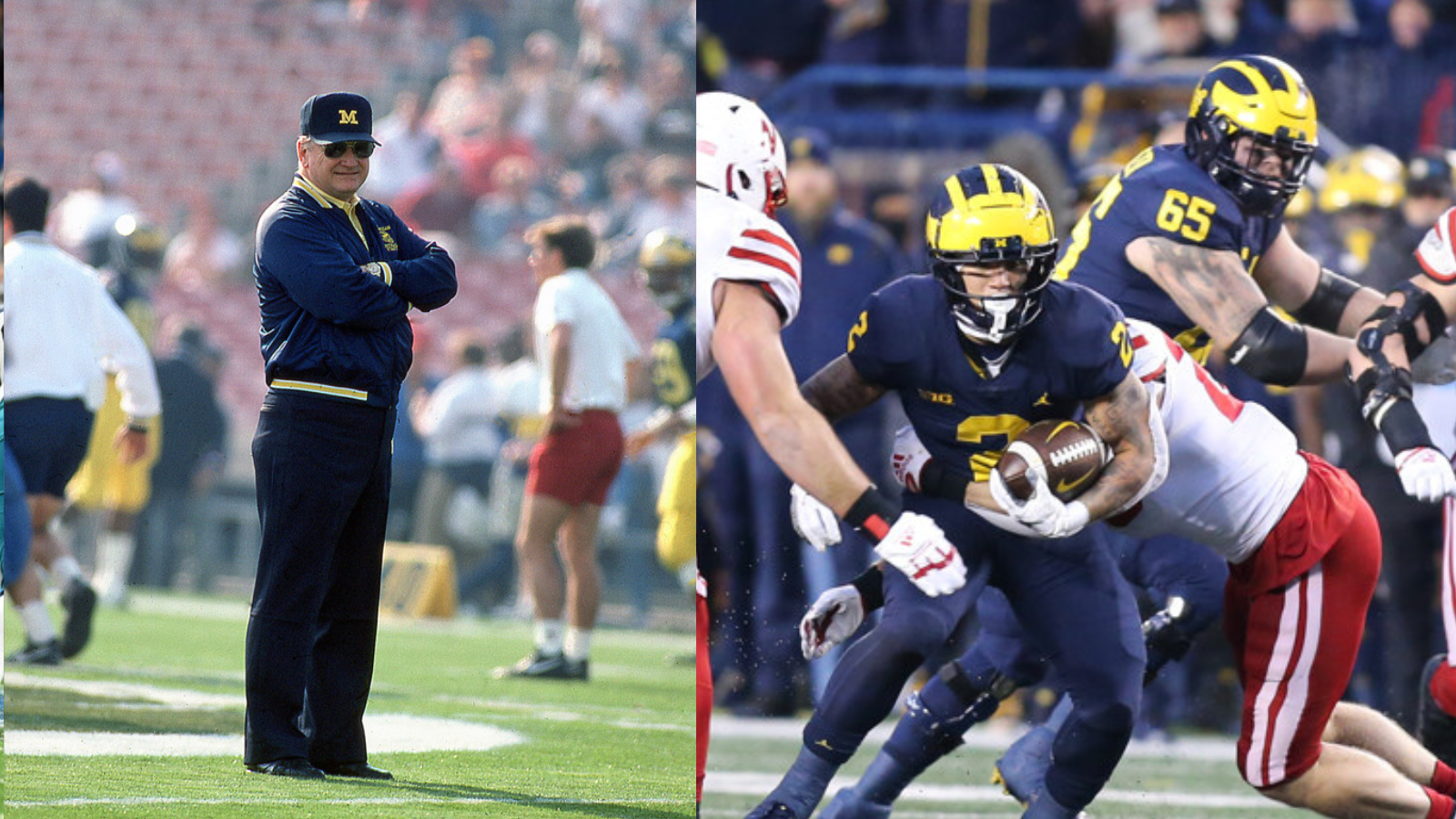
    Since his 2015 arrival in Ann Arbor, Jim Harbaugh has resurrected the Michigan program in Bo Schembechler’s image. From donning the glasses to emphasizing “The Team, The Team, The Team”, Harbaugh introduced the visuals. With consecutive Big Ten championships and College Football Playoff appearances, the wins have followed.

    Harbaugh has even continued the offensive tradition he himself ran as quarterback under Schembechler back in 1986. With 36 years and several offensive revolutions between the two teams, the tactics have definitely changed. But while the methods differ, the philosophy remains the same. The Wolverines, both old and new, jab defenses continuously with the run behind their superior offensive lines, patiently waiting to knock them out with the play action pass.

    Between the different styles, rules, and innovations of each era, comparing offenses from one period in time to another rarely provides any useful information. But even with these issues, the 2022 Wolverines look statistically similar to those from 1986. The 1986 Wolverines ran 69% of the time, compared to the 63% that the 2022 Wolverines do. When ranking each among their respective peers, the 1986 team ranked 21st in rushing attempts FBS teams, while the 2022 team ranked 9th.

    In the backfield, players from both teams share several similarities. Both quarterbacks,  Harbaugh in 1986 and J.J. McCarthy in 2022, have nearly identical lines in most major metrics.

    Harbaugh: 65% comp pct, 2,729 pass yards, 151.7 passer rating

    McCarthy: 65% com pct, 2,376 pass yards, 155.4 passer rating

    At running back, Jaime Morris ran 209 times for 1,086 yards in 1986, good for 5.2 yards per carry. Blake Corum and his injury replacement Donovan Edwards have done even better this season, with Corum averaging 5.9 yards per carry on 247 attempts, and Edwards gaining 7.5 yards per carry on 117 attempts.

    But the offensive line makes this production possible. John Vitale, later voted a member of the 1988 College Football All-America team, led the 1986 team at center. Jumbo Elliot, a future Pro-Bowler,” started at tackle for Schembechler.

    For the 2022 Wolverines, Outland Trophy Winner Olusegun Oluwatimi centers the line, which as a unit has won the Joe Moore Award in consecutive seasons. The line as a whole ranks 3rd in Total Points (PE per play) and 8th in Expected Points Added per play (EPA/A) this season. Among all FBS linemen who have played over 500 snaps, no Michigan starter ranks lower than the 78th percentile in PE per play.

    Despite similar tools and a shared philosophy, the teams differ in their offensive packaging. Schembechler’s offenses operated under center, almost always with two running backs, and often three. Harbaugh’s offenses work from the gun usually with only 1 running back, instead adjusting the number of tight ends and receivers in the formation according to the situation.

    With many runners in the backfield, the Wolverines of old had a variety of ways to run the ball. To attack quickly inside, Michigan ran dive or iso. To hit off tackle, the Wolverines called power. To stretch the defense outside, the quick pitch and stretch came into play. To get all backs involved, Schembechler would break out the Wishbone and run the veer. 

    Modern Michigan stresses the same points in the defense, but in different ways. Inside zone makes up the plurality of all Michigan runs at over 44%, while Duo ranks as its best base run. The Wolverines rank 2nd in Duo usage among all FBS teams, and among high-usage offenses average the 2nd-highest PE per play.

    While the modern run game differs greatly from that of the past, power remains a popular run at all levels. The Wolverines have run it 61 times this season and rank 8th in PE per play when using it. Paired with counter, the Wolverines have two time-tested ways to run the ball in the C gap.

    To get the ball to the perimeter, the Wolverines typically call either the sweep on the ground or screen in the air. Their most effective method, however, comes from the option. Schembechler used the option with veer to get the quarterback involved in the run game and to attack multiple parts of the defense at once. Harbaugh pairs the option with inside runs, usually zone, for a similar goal, as he gets an inside threat with the running back and an outside threat with the quarterback on the same play. Ranking 1st in PE per play when the quarterback keeps the ball on the option, Harbaugh’s Michigan can run effectively to the outside while also threatening the interior of the defense.

    As with their respective runs, Schembechler’s and Harbaugh’s play action passes differ in design and execution. But in purpose, the principles remain the same, and sometimes can make plays from 36 years apart look eerily alike. To attack the middle of the field, both offenses contain a concept with a cross and a post. In the clips below, Schembechler’s receivers run the routes on opposite sides of the formation, while Harbaugh’s align on the same side. Each team, however, called the play with the same idea in mind.

    To attack deep to the outside, each offense used a play sending a wideout down the seam only for a player from the backfield to wheel into the secondary.

    As with the runs, each offense’s play action passes reflect its respective era in terms of tactics, but represent Michigan’s philosophy with regard to its intentions.

    Football’s offenses and defenses constantly grow and change over time. While instilling the fighting spirit and methods of his mentor and predecessor Bo Schembechler, Jim Harbaugh has found a way to mesh this philosophy with modern offensive theory. By implementing the traditional smashmouth style with current strategy and tactics, the Wolverines have replicated, and could exceed, the program’s past successes.

  • The 2022 NCAA All-SIS Teams

    The 2022 NCAA All-SIS Teams

    With the end of the college football regular season, it’s time to release our All-SIS teams. In addition to a voting process in our Operations staff, we used our all-encompassing player value stat, Total Points, along with other metrics and our scouting work as leading references in putting together two teams of All-SIS selections for 2022, plus a few honorable mentions.

    You can learn more about Total Points and the statistics referenced here.

    These picks are meant to honor this season’s best-of-the-best in the sport.

    First Team Offense

    Position Name School
    QB Caleb Williams USC
    RB Bijan Robinson Texas
    RB Blake Corum Michigan
    WR Marvin Harrison Jr. Ohio State
    WR Jalin Hyatt Tennessee
    TE Michael Mayer Notre Dame
    OT Darnell Wright Tennessee
    OT Joe Alt Notre Dame
    OG Isaac Cochran Air Force
    OG Hadley Panzer Kansas State
    OC Olusegun Oluwatimi Michigan

    QB – Caleb Williams, USC

    The 2022 Heisman Trophy winner and Oklahoma transfer led USC into the Pac-12 Championship Game and nearly into the College Football Playoff. His 204 Total Points ranks 2nd among all quarterbacks. Of all quarterbacks with at least 250 pass attempts, his interception rate ranks 4th, impressive for a QB with 511 pass attempts, 9th-most. Additionally, his 129.4 IQR ranked 2nd only to Grayson McCall. However, Williams attempted over 150 more passes than McCall. Of the 102 passers pressured on at least 50 attempts, his 137.5 IQR under pressure blew out the rest of the competition.

    RB – Bijan Robinson, Texas

    The third-year player from Texas lived up to the preseason hype surrounding his 2022 campaign. He finished the regular season 5th in the FBS in rushing yards (1,578), 2nd in yards after contact (1,002), and 2nd in forced broken and missed tackles (50 & 35). He led all FBS running backs in Total Points this season (76) by a wide margin, contributing in both the running and passing game. Robinson’s running has put Texas in a great position to eclipse the 8-win mark for the 1st time since 2018, and he is expected to be a top NFL draft pick as well.

    RB – Blake Corum, Michigan

    In his first year as a full-time starter, Corum ran wild for Michigan’s offense. Corum was a part of a ground attack that led the country among all non-service academy teams in rushing yards. Additionally, he is a big reason why the Wolverines find themselves in the College Football Playoff. Both his total rushing yards and yards after contact rank 8th in the country. Additionally, his 96 1st Downs rank as 2nd-most among FBS backs.

    WR – Marvin Harrison Jr., Ohio State

    A human highlight reel waiting to happen every Saturday, Marvin Harrison Jr. dominated Big Ten defensive backs. He has the most receptions among receivers with 1 or fewer drops and possesses the 2nd-lowest drop rate at 1.2%. He makes catches at every level of the field, as shown by his 843 air yards, which rank 2nd in the country. Among WRs with at least 75 targets, he ranks 4th in yards per route run, 6th in 1st Down rate, and 6th in Receiver Rating.

    WR – Jalin Hyatt, Tennessee

    In his first year as a full-time starter, Hyatt exploded on the scene, highlighted by his 5-TD game in the upset victory over Alabama. He is tied-1st among FBS wide receivers in touchdowns (15), 4th in receiving yards (1,267), and 3rd in yards per reception (18.9) among those with at least 70 targets. His impact was also seen in more advanced stats as he leads FBS receivers in yards per target (13.9) and receiver rating (155.1) by a huge margin. Hyatt established himself as one of the best deep threats in college football this year and could be an early pick as he’s already declared for the NFL Draft.

    TE – Michael Mayer, Notre Dame

    Mayer’s 51 Total Points is 13 better than 2nd place among TEs this season. He leads all TEs in touchdown receptions with 9 and is the only player at the position to see more than 100 targets. Additionally, his 75 catchable targets and 67 receptions are 2nd most. Over the last two seasons, Mayer has solidified himself as one of the top tight ends in all of college football.

    OT – Darnell Wright, Tennessee

    Wright is tied for the lead among all OTs with 37 Total Points. He’s part of an offensive line unit at Tennessee that ranks 2nd in the country in pressure rate allowed and 6th in passing yards. Wright, himself, only has 5 blown blocks all season. His 0.6% Blown Block rate ties him for 10th-best among all OL with at least 700 snaps. As a run blocker, his 24 Total Points ranks him 8th-best among all FBS linemen.

    OT – Joe Alt, Notre Dame

    The massive, 2nd-year tackle out of Minnesota dominated for Notre Dame this season. He ranks top 10 among FBS tackles in Total Points (33) despite playing far fewer snaps than most of the other top tackles. His 0.3% Blown Block rate ranks 1st among FBS offensive linemen with at least 700 snaps. Alt made a big impact in the run game where he generated the 4th-most Total Points among all FBS linemen (25). South Bend will be glad to have him back next season and he should be a popular name on Preseason All-American teams.

    OG – Isaac Cochran, Air Force

    Leading all FBS offensive linemen in Total Points this season was Cochran with 45. The fifth-year player for Air Force was a major factor for the top rushing offense in the country. Air Force ran for more than 4,000 yards this season (excluding QB kneels) and Cochran’s 0.2% Blown Block rate on run plays was a key component. 

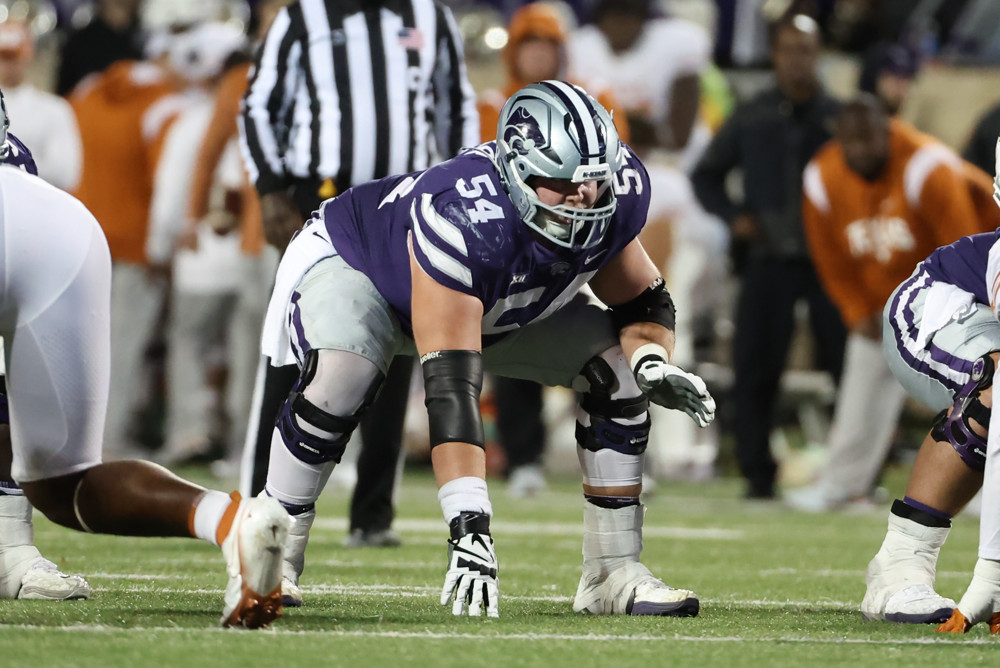
    OG – Hadley Panzer, Kansas State

    Panzer ranks 2nd behind fellow All-SIS member Isaac Cochran among OGs with 37 Total Points in 2022 and carries only a 1.8% Blown Block rate on the year. Panzer and Kansas State’s OL unit helped lead the Wildcats to a 10-win season and a Top 10 ranking. The unit also helped pave the way for the 10th-most rushing yards in FBS college football.

    OC – Olusegun Oluwatimi, Michigan

    Beginning his career at Air Force, before becoming a 3-year starter at Virginia, Oluwatimi had high expectations coming to Michigan, and he lived up to them. He won both the Rimington Award (college football’s top center) and the Outland Trophy (college football’s top interior lineman) in his only season in Ann Arbor. Unsurprisingly, he also dominated the metrics, leading FBS centers in Total Points (39). He also ranks top 10 in Blown Block rate (0.6%) among centers with at least 700 snaps and despite playing over 800 snaps, is 1st in Total Points per snap.

    First Team Defense

    Position Name School
    DT Jer’zhan Newton Illinois
    DT Jalen Carter Georgia
    EDGE Tyree Wilson Texas Tech
    EDGE Will Anderson Jr. Alabama
    LB Jaylan Ford Texas
    LB Cedric Gray North Carolina
    LB/DB John Marshall Navy
    CB Tre’Vius Hodges-Tomlinson TCU
    CB Devon Witherspoon Illinois
    S Jason Taylor II Oklahoma State
    S Brian Branch Alabama

    DT – Jer’Zhan Newton, Illinois

    Newton was the most disruptive force on one of the best defenses in college football this year. He leads the team in TFLs and sacks and recovered two fumbles as well. He leads all FBS defensive tackles in Total Points (42) and was equally effective against the rush and against the pass, ranking 1st and 2nd among defensive tackles respectively in Total Points. The third-year player leads all defensive tackles in knockdowns and is 2nd in total pressures, highlighting his disruption.

    DT – Jalen Carter, Georgia

    Carter is part of a Georgia team that sees themselves back in the College Football Playoff for the second straight season. While playing in 10 games, although sparingly in most, he’s still managed to churn out 22 pressures, good for a top 20 mark among DTs; that’s a pressure rate of 10.8%, which ranks tied for 11th. When Carter is on the field and healthy, he’s a force to be reckoned with, a large reason why he’s a likely top-5 pick in the NFL Draft come April.

    EDGE – Tyree Wilson, Texas Tech

    Wilson came on strong for the Red Raiders each of the past two seasons. His work on the field has led to him accepting an invitation to play in this year’s Senior Bowl. He’s collected 41 Total Points in 2022, which is helped by his 6.5 sacks and 40 pressures. The latter  is ranked top 15 nationally among edge defenders.

    EDGE – Will Anderson Jr., Alabama

    Anderson spent the majority of the year being double and triple-teamed, but still found a way to have a massive impact. He ranks top 10 in sacks and tackles for loss as well as leading all FBS defenders in pressures. He has averaged more than 1.5 TFLs per game for his CAREER and he is finally eligible for the NFL Draft. The likely top-5 draft pick and only 2-time All-SIS 1st-Teamer has been the most dominant defensive player in college football in back-to-back years and should be playing on Sundays next season.

    LB – Jaylan Ford, Texas

    Leading all FBS linebackers this season in Total Points (both off-ball and edge) is Ford with 66 Total Points. Teams have a positive percentage of just 31.5% on run plays when he’s in the game, 3rd-best among qualified FBS linebackers. Ford also ranks 2nd among FBS linebackers in Total Points in coverage (34). The first-year starter has double digit TFLs as well as 4 INTs and 3 FF. His well-rounded, impactful game earned him a spot on our All-American team.

    LB – Cedric Gray, North Carolina

    Gray’s 64 Total Points ranks 2nd amongst all front-seven defenders, trailing only Jaylan Ford. However, he tops Ford in Total Points in coverage (35). He also ranks 2nd in the country with 141 total tackles and is tied-3rd with 3 forced fumbles. Additionally, he possesses a mere 7.8% Broken+Missed Tackle rate and 2.7 yards average tackle depth.

    LB/DB – John Marshall, Navy

    One of the most exciting players in college football, Marshall finished the regular season top 5 in the FBS in TFLs with nearly 20 and 3rd in sacks at 11.5. Listed as a “Striker” on Navy’s roster, he lines up all over the field, primarily in the slot, but also seeing extensive time on the edge. He ranks 2nd among FBS safeties in Total Points (57) and has far more pressures (39) than any other defensive back, with the 2nd-highest at 16. Marshall’s versatility and play style make him a perfect fit for the LB/DB position and worthy of a 1st-Team selection.

    CB – Tre’Vius Hodges-Tomlinson, TCU

    The non-quarterback with the most Total Points (82) by a wide margin will be playing in the College Football Playoff. He ranks 2nd among FBS cornerbacks in coverage Total Points and 7th in run defense Total points, highlighting his impact. While he could be a little handsy (FBS-leading 8 pass interference calls), he’s still tied-2nd in the FBS with 0.5 yards per coverage snap with the 5th-lowest EPA per target (minimum 40 targets).

    CB – Devon Witherspoon, Illinois

    Witherspoon was part of an outstanding Illini defense in 2022, one that helped the team into a top 25 ranking for most of the season. Among DBs who have been targeted at least 40 times, Witherspoon far and away has the best Passer Rating Against (a ridiculous 1.0). He’s also 1st in yards per cover snap (0.4), 3rd in yards allowed (184), tied-7th in PBUs (14), and tied-10th in completions allowed (17).

    SAF – Jason Taylor II, Oklahoma State

    Taylor II was outstanding on the back end for a strong Oklahoma State squad this season. His 56 Total Points tied for 3rd-best among listed safeties. Among safeties who were targeted at least 25 times, his Passer Rating Against ranks 4th, yards per cover snap is tied-4th, and deserved catch rate is in the Top 10. Additionally, he consistently made plays on the ball, recording 6 interceptions and 9 PBUs.

    SAF – Brian Branch, Alabama

    Branch is tied-3rd in Total Points among safeties this season (56) and ranks 4th against the pass. He’s 2nd on Alabama in Total Points in coverage, Total Points against the run, and TFLs showing his value all over the field. The third-year player primarily lined up in the slot, but saw time out wide, in the box, at edge, and at safety as well. Per usual, another Alabama player will have a big NFL draft decision coming up.

    First Team Specialists

    Position Name School
    K Christopher Dunn NC State
    P Adam Korsak Rutgers
    Returner Nikko Remigio Fresno State

    K – Christopher Dunn, NC State

    Dunn is 2nd in the FBS in FG% after going 24-of-25 this season (minimum 10 attempts) and has converted the 2nd-most FGs. He is a perfect 14-of-14 under 40 yards, 2-of-2 over 50 yards (including tying a career long of 53 yards), and 30-of-30 on extra points. He has 9+ points six times this season and finished the regular season on the ultimate high-note after kicking a game-winning field goal against rival UNC in double-overtime.

    P – Adam Korsak, Rutgers

    The Ray Guy Award winner, Korsak put up some ridiculous numbers in 2022. His 32 punts inside the 20 is tied-1st, 14 punts inside the 10 is tied-2nd, 35 fair catches forced is tied-2nd, 44-yard net average is tied-7th, and 8 punts returned is tied-7th. However, the most ridiculous stat is the fact that Korsak and the Rutgers punt coverage unit allowed -11 punt return yards on the year. 75 punts, 8 returns, and negative return yards. What a season!

    Returner – Nikko Remigio, Fresno State

    Only four players returned two kicks/punts for touchdowns this season, and Remigio was one of them. Both of his return touchdowns came on punts (Derius Davis was the only other who had 2 PR TDs). He’s averaged 19.9 yards per punt return, nearly six yards more than Davis among players with double-digit punt returns. He was no slouch as a kick returner either. Across 23 kick returns, he accumulated 480 yards, or a 20.9 average.

    2nd Team All-SIS

    Position Name School
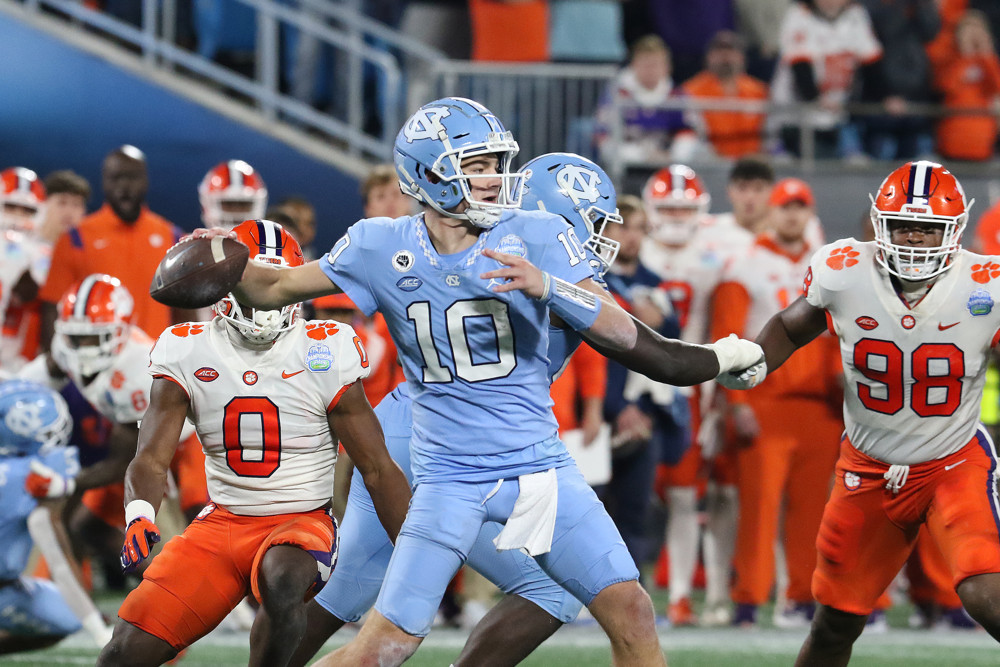
    QB Drake Maye North Carolina
    RB Mohamed Ibrahim Minnesota
    RB Quinshon Judkins Ole Miss
    WR Nathaniel Dell Houston
    WR Charlie Jones Purdue
    TE Brock Bowers Georgia
    OT Christian Duffie Kansas State
    OT Caleb Rogers Texas Tech
    OG Nick Broeker Ole Miss
    OG Zak Zinter Michigan
    OC John Michael Schmitz Minnesota


    Position Name School
    DT T.J. Jackson Troy
    DT Jonah Tavai San Diego State
    EDGE Jose Ramirez Eastern Michigan
    EDGE Tuli Tuipulotu USC
    LB Tommy Eichenberg Ohio State
    LB Ivan Pace Jr. Cincinnati
    LB/DB Tanner Ingle NC State
    CB Reddy Steward Troy
    CB Clark Phillips III Utah
    S Cole Bishop Utah
    S Sydney Brown Illinois


    Position Name School
    K Jake Moody Michigan
    P Ty Zentner Kansas State
    Returner Johnnie Lang Arkansas State

    Led by our leading Total Points getter Drake Maye, the 2nd Team is full of stars, as well. 

    The offense features the nation’s leader in receptions (Charlie Jones), the nation’s leader (tied) in receiving touchdowns (Nathaniel Dell), and arguably the best tight end in all of college football (Brock Bowers).

    The defense features the nation’s top 2 sack leaders (Tuli Tuipulotu & Joe Ramirez) and two of the players with the 2nd-most interceptions in the country (Clark Phillips III & Sydney Brown), while the special teams features the player with the nation’s most field goals made (Jake Moody). Additionally, for the second consecutive season Nick Broeker makes the team at OG and our 2nd-Team Returner hails from Arkansas State (Johnnie Lang).

    Honorable Mentions

    Position Name School
    QB Hendon Hooker Tennessee
    RB Zach Charbonnet UCLA
    WR Emeka Egbuka Ohio State
    WR Josh Downs North Carolina
    TE Dalton Kincaid Utah
    OT Cooper Hodges Appalachian State
    OT Davis Heinzen Central Michigan
    OG Cooper Beebe Kansas State
    OG Lokahi Pauole UCF
    OG Connor Finucane Army
    OC Hayden Gillum Kansas State
    DT Braden Fiske Western Michigan
    ED Owen Porter Marshall
    ED Andre Carter Western Michigan
    LB Jack Campbell Iowa
    CB Christian Gonzalez Oregon
    S Benjamin Morrison Notre Dame
    K Will Reichard Alabama
    P Tory Taylor Iowa
    P Jack Browning San Diego State
    Returner Jordan Byrd San Diego State
    Returner Derius Davis TCU
    Returner Anthony Gould Oregon State

    With this being our first year opening this up to a vote across our Football Operations department, we decided to list out some Honorable Mentions who just didn’t quite make the cut for the first two teams.

    Nine conferences plus Independents are represented by our teams. Our scouts put in a lot of hard work and dedication this season charting games and scouting players for every FBS team. After a successful reveal of our first annual All-SIS teams last year, we feel this was another great season of college football as shown by these selections.

    Total Points, stats, and ranks as of 12/14/2022

  • How Ohio State’s Defense Can Muzzle the Bulldogs

    How Ohio State’s Defense Can Muzzle the Bulldogs

    In three years at Ohio State, Ryan Day never fielded an offense scoring fewer than 41 points per game. Yet the defensive performance declined precipitously, falling from 1st to 39th to 56th in the FBS in Expected Points per Play (EPA/A) in each of his first three seasons. With the defense as the limiting factor, Day needed to make a change.

    Enter Jim Knowles, formerly the defensive coordinator at Oklahoma State. In his four years in Stillwater, his defenses consistently improved, going from 97th to 9th in points allowed per game and 93rd to 4th in EPA/A. Giving Knowles carte blanche over the defense, Day trusted that he would remedy the Buckeyes’ issues as they hoped to finally break through to their first title since 2014.

    Through eleven games, the hire looked like a resounding success. Through 11 games the defense allowed under 17 points per game and ranked 6th in EPA/A as Ohio State never failed to win by less than double digits. But come the Big Game, the defense once again let the rest of the team down.

    More specifically, the defense continued to give up the big play, allowing 5 scores of more than 45 yards to the Wolverines. Prior to this game, the Buckeyes had given up 15 plays adding more than 3 expected points, ranking 71st in the country, and this game added 6 more. More specifically, their man defense failed them once again, responsible for 4 of the 5 big plays.

    For the season, Ohio State’s man coverages ranked 73rd in EPA/A, compared to 3rd for their zone defense. When blitzing, the Buckeyes fared even worse, giving up nearly an extra 2 yards and .3 expected points per play. But with second life as they head into the playoffs, the Buckeyes will need to embrace their weaknesses in order to upset the Bulldogs.

    For the first time this season, the Buckeyes will face a talent deficit. In order to pull off the upset, Ohio State needs to increase the variance in this game by taking some risks. Among risky defenses, man blitzes come out on top.

    This season, man blitzes resulted in almost 80% more big plays for the defense, as defined by those adding more than 3 expected points, but also gave the offense over 150% more big plays. Ohio State would not want to play this way against Indiana or Rutgers, as this would give those opponents opportunities to even the playing field. But against Georgia, one of the very few teams superior to the Buckeyes, Knowles will need to take some chances.

    Aside from the game strategy, Georgia does not handle heavy blitzes well. Facing 5 or fewer rushers, the Bulldogs rank 4th in EPA/A and 11th in Total Points Per Play (PE Per Play) in the FBS. But against 6 or more rushers, the Bulldogs efficiency plummets to 45th and 73rd in EPA/A and PE Per Play. Missouri serves as the most successful use case of this strategy, as it blitzed 6 versus Georgia 8 times, giving up only 3.5 yards per play and only 2 plays of greater than 2 yards in their near upset in October.

    Blitzing 6 could also take Georgia’s best weapons, tight ends Brock Bowers and Darnell Washington, out of the passing game. Bowers leads the team in catches, Washington in PE per reception for those with 10 or more catches, and both take the field together on 50% of the Bulldogs’ snaps due to their abilities.

    Neither tight end normally takes part in pass protection, as usually the offensive line will block the front 4 while the running back can pick up an extra rusher. But when 6 rush the passer and the line and back prove incapable of protecting the pocket, the offense has no choice but to bring another man in to help. For Georgia, either Bowers or Washington would serve this purpose, and in slowing down the pass rush the Bulldogs would lose 1 of their 2 best receivers.

    Even when strategy and opponent weaknesses align, coaches hesitate, and rightfully so, to call plays that their teams execute poorly. But the numbers behind Ohio State’s man blitzes may not tell the whole story.

    While the Buckeyes have allowed a high percentage of big plays, such events happen too rarely to provide a stable indicator of defensive quality or to project big play percentage in the future. From 2021-2022, defensive quality measured by EPA/A had a correlation coefficient of .23  compared to .02 for big play percentage. This takes into account every snap, not just passes or certain coverages, so even the larger sample lacks predictive capabilities.

    Even more specifically, while its Cover 0 has underperformed, Ohio State’s Cover 1 has done much better, ranking 30th in EPA/A in a larger sample of 96 attempts. Rather than their Cover 1 and its deep middle safety actually producing much better results, the Buckeyes’ Cover 0 has likely not seen the field enough to make a proper determination of its quality.

    Other factors, such as regression, other man coverage performance, and the coaches’ evaluations of their players’ abilities may provide better evidence and reasoning as to how Ohio State’s man blitzes will perform.

    None of this suggests Ohio State should abandon its normal defense. In fact, it should continue to base out of Cover 3 and 4 with the occasional zone blitz, as the defense ranks among the best when it does. But in high leverage situations or as the occasional changeup, look for Knowles to dial up the man blitz to wreak some havoc. Doing so will give the Buckeyes their best shot at advancing to the College Football Championship.