Category: NFL

  • What if The NFL Had A 2021 Expansion Draft?

    What if The NFL Had A 2021 Expansion Draft?

    The NHL’s newest team, the Seattle Kraken, were welcomed into the league on July 21 during their Expansion Draft. Four years following the successful Expansion Draft of the Vegas Golden Knights, the Kraken were allowed to select one player from each team, minus Vegas, to begin compiling their inaugural roster. 

    Without getting too deep into the guidelines, basically every NHL team was allowed to protect a certain number of players, with others automatically protected due to them only being in the league for a year or two. Each team was allowed to protect either 9 or 11 players depending on how many of each position they chose to protect. 

    What if the NFL did something similar? How could it look? We decided to try it out – and you can too.


    Roster Submission Form


    Protection Rules

    In a perfect world, this would take place in March before the NFL Draft and Free Agency gets started, like the NHL, but that’s not the case. So, using the current Training Camp rosters (as of approximately July 28), we came up with a set of guidelines to protect players for each team.

    The guidelines are as follows:

    1. All players who entered the league in 2021, drafted or undrafted, are automatically protected and are not counted toward protection limits
    1. Players who already have season-ending injuries (e.g. Cam Akers) are automatically protected and are not counted toward protection limits
    1. Aside from those players, 12 total players can be protected
      • 6 must be from the offensive side of the ball, which includes Kicker
        • Only 1 QB can be protected
      • 6 must be from the defensive side of the ball, which includes Punter
        • There are no positional restrictions for defense

    It’s that simple. With those guidelines, we took our best shot at protecting twelve players from each team, taking into account salary, remaining years on contracts, age, and other factors. It’s not a perfect science, and I’m sure teams or you, the reader, would choose differently in some cases.

    In fact, we’re going to give you the chance to build your own team by going to this link, using the protections lists below, and following the listed guidelines.


    Roster Submission Form


    Protection Lists

    Now that the rules are set, who was protected? Let’s go in alphabetical order and start with the Arizona Cardinals. The number in parentheses is their Total Points number in 2020.


    Arizona Cardinals

    Offense Defense
    QB Kyler Murray (87) DE J.J. Watt (38)
    WR DeAndre Hopkins (37) LB Chandler Jones (8)
    WR Christian Kirk (5) LB Isaiah Simmons (15)
    OL D.J. Humphries (30) LB Markus Golden (34)
    OL Rodney Hudson (31) CB Byron Murphy Jr. (24)
    OL Kelvin Beachum (41) S Budda Baker (50)

    Arizona has a good mix of offensive weapons and line talent, and that’s apparent in its protection list. A.J. Green just signed to give Kyler Murray another weapon, but it’s only a 1-year deal and he’s 33 with injury concerns. Second-Round pick Rondale Moore would help ease the blow if Green were to get selected. 

    J.J. Watt is a top player in the league when healthy, so Arizona chooses to protect him and hope that’s the case. Malcolm Butler put up respectable numbers in 2020, but was targeted by far the most in the NFL as a member of the Titans, and his 1.3 Yards Allowed Per Coverage Snap was among the worst in the league.

    Atlanta Falcons

    Offense Defense
    QB Matt Ryan (107) DT Grady Jarrett (28)
    RB Mike Davis (25) LB Deion Jones (38)
    WR Calvin Ridley (30) LB Foyesade Oluokun (61)
    OL Jake Matthews (31) CB A.J. Terrell (15)
    OL Chris Lindstrom (26) CB Kendall Sheffield (4)
    OL Kaleb McGary (14) S Duron Harmon (11)

    The Julio Jones trade was a blow to the Falcons receiving corps, but it allowed them to protect newly acquired starting RB Mike Davis, who broke out last year with Carolina, filling in for the injured Christian McCaffrey. Additionally, 1st-round pick Kyle Pitts should soften the blow of losing Jones. 

    On defense, Dante Fowler Jr. is a consistent pass rusher that puts up numbers, but a bit of a down year in 2020 and a large cap number turn the organization away from him being on the list. Atlanta feels it has enough depth on the front seven that it chose to keep three players in the secondary to pair with 2nd-round safety Richie Grant.

    Baltimore Ravens

    Offense Defense
    QB Lamar Jackson (75) LB Patrick Queen (34)
    RB JK Dobbins (10) LB Tyus Bowser (40)
    TE Mark Andrews (12) CB Marlon Humphrey (57)
    OL Ronnie Stanley (12) CB Marcus Peters (47)
    OL Bradley Bozeman (43) S Chuck Clark (39)
    K Justin Tucker (22) S DeShon Elliott (29)

    On the offensive side, Gus Edwards and Marquise Brown are two vital pieces to the offense, but Dobbins is younger and the team just drafted Rashod Bateman. 

    On defense, the Ravens led the league in sacks by DBs and were Top-2 in pressures while blitzing, but were 5th-lowest in sacks and pressures by DL and 40% of those pressures came while the team was blitzing. So even though the Ravens do have rushers that they value, most of their pressure value comes from their blitz packages. Combine that with the Ravens propensity to play man-to-man defense and it makes sense to focus their defensive protections on the secondary.

    Ravens protection list provided by: Segev Goldberg

    Buffalo Bills

    Offense Defense
    QB Josh Allen (155) DT Ed Oliver (26)
    WR Stefon Diggs (49) LB Tremaine Edmunds (22)
    WR Gabriel Davis (10) LB Matt Milano (23)
    TE Dawson Knox (3) CB Tre’Davious White (61)
    OL Dion Dawkins (28) S Micah Hyde (30)
    K Tyler Bass (13) S Jordan Poyer (35)

    Tyler Bass is questionable here, but he made the SIS All-Rookie Team this past season with consistent production. Gabriel Davis had a good rookie season and will be a featured weapon for years to come. Other possibilities would’ve been choosing an average offensive lineman or protecting one of the backs with injury concerns. 

    On defense, with five easy selections, Oliver got the sixth spot due to his youth over some of the aging veterans along the defensive front.

    Bills protection list provided by: Evan Butler

    Carolina Panthers

    Offense Defense
    QB Sam Darnold (-8) DE Yetur Gross-Matos (13)
    RB Christian McCaffrey (7) DE Brian Burns (39)
    WR DJ Moore (29) DT Derrick Brown (21)
    WR Robby Anderson (19) LB Haasan Reddick (46)
    OL Taylor Moton (30) LB Shaq Thompson (35)
    OL Matt Paradis (21) LB Jeremy Chinn (29)

    The offense in Carolina doesn’t have a ton of pieces to build around. Outside of the six protected players, there weren’t many others who warranted being protected. 

    On the defensive side, the tough choice came down to picking two of the three between Reddick, Thompson, and Donte Jackson. Jackson has been solid for the Panthers, but gave up five touchdowns in 2020 and was outside the Top 100 in Yards Allowed Per Cover Snap. Carolina instead chooses to make sure the front seven is rock solid.

    Panthers protection list provided by: Jordan Edwards

    Chicago Bears

    Offense Defense
    RB David Montgomery (30) DE Akiem Hicks (25)
    WR Allen Robinson II (26) DT Eddie Goldman (N/A)
    WR Darnell Mooney (17) LB Khalil Mack (47)
    TE Cole Kmet (10) LB Roquan Smith (64)
    OL James Daniels (8) CB Jaylon Johnson (32)
    OL Cody Whitehair (26) S Eddie Jackson (8)

    With Justin Fields now on the roster, the organization decides not to protect a QB knowing they’ll at least roll out with Andy Dalton or Nick Foles if Fields isn’t ready. In addition, they’re able to keep a trio of young playmakers in Montgomery, Mooney, and Kmet with the hope they can convince Robinson to sign back on after 2021. 

    There’s a lot of talent on the defensive side of the ball in Chicago. It is able to keep their top guys, but have to offer up Bilal Nichols, Danny Trevathan, and Robert Quinn to the expansion team. Eddie Goldman is back after opting out and the team expects big things from him.

    Cincinnati Bengals

    Offense Defense
    QB Joe Burrow (49) DE Trey Hendrickson (24)
    RB Joe Mixon (-2) DE Sam Hubbard (28)
    WR Tyler Boyd (17) DT D.J. Reader (7)
    WR Tee Higgins (24) LB Logan Wilson (11)
    OL Jonah Williams (10) CB Chidobe Awuzie (10)
    OL Trey Hopkins (31) S Jessie Bates III (29)

    The Bengals have a strong starting group of playmakers. The questions come on the offensive line. While they look to be improved, it’s clear why four of the six players protected were skill players. 

    The defense has a couple of strong, core players at each level of the defense. Big names such as Trae Waynes and Vonn Bell in the secondary are possible protection list candidates, but it’s likely they view a younger player with more contract control in Chidobe Awuzie a better option for the long-term outlook.

    Cleveland Browns

    Offense Defense
    QB Baker Mayfield (83) DE Myles Garrett (38)
    RB Nick Chubb (44) LB Anthony Walker (20)
    WR Jarvis Landry (33) CB Denzel Ward (43)
    TE Austin Hooper (10) CB Troy Hill (30)
    OL Jedrick Wills Jr. (21) S John Johnson II (42)
    OL JC Tretter (25) S Grant Delpit (N/A)

    The biggest question involving the Browns offense is: Odell Beckham Jr. or Jarvis Landry? Both have high cap numbers and both are solid NFL receivers, but Odell missed half of last season while Landry has only missed one game in his entire career. While Odell is a Top 10 receiver in the NFL when healthy, the Browns opt for consistency here. Unfortunately, that still leaves stalwarts Joel Bitonio and Jack Conklin exposed, as the team protects Wills and Tretter instead.

    On defense, the secondary stays strong and guys like Jadeveon Clowney, Sione Takitaki, and Ronnie Harrison are left off the list. Grant Delpit missed all of last season due to injury, but the Browns feel like he could replace Harrison at safety if he were to be selected.

    Dallas Cowboys

    Offense Defense
    QB Dak Prescott (22) DE DeMarcus Lawrence (40)
    RB Ezekiel Elliott (-4) DE Randy Gregory (23)
    WR Amari Cooper (26) DT Neville Gallimore (10)
    WR CeeDee Lamb (6) LB Jaylon Smith (28)
    OL Zack Martin (23) LB Leighton Vander Esch (9)
    OL Tyron Smith (6) CB Trevon Diggs (21)

    The Cowboys offense is littered with weapons. Even with injuries taken into account all six of these players are staples in the offensive plans of the future. There are questions about Smith and Vander Esch on that defense with injuries and underperformance, but Dan Quinn wants them in the middle. 

    Trevon Diggs had plenty of trouble as a rookie last year, but still managed 21 Total Points. Randy Gregory has had his fair share of issues, to say the least, but could finally be turning the corner and hitting his stride.

    Cowboys protection list provide by: Chad Tedder

    Denver Broncos

    Offense Defense
    WR Courtland Sutton (-3) DE Dre’Mont Jones (18)
    WR Jerry Jeudy (6) LB Bradley Chubb (24)
    TE Noah Fant (20) LB Von Miller (N/A)
    OL Garett Bolles (35) LB Alexander Johnson (38)
    OL Dalton Risner (24) CB Kyle Fuller (54)
    OL Graham Glasgow (21) S Justin Simmons (31)

    In the midst of a quarterback battle, the Broncos choose not to protect either one of Drew Lock or Teddy Bridewater, opting to take the stance of “if one is selected, it helps make our decision.” Melvin Gordon III is on the block, but 2nd-round pick Javonte Williams eases that blow if selected. 

    On defense, Shelby Harris and Josey Jewell go unprotected, as well as rising young pass rusher Malik Reed. This protection list allows for most of the front seven to stay strong while plenty of youth and depth in the secondary could handle the blow if the expansion team looks in that direction.

    Detroit Lions

    Offense Defense
    QB Jared Goff (51) DE Michael Brockers (20)
    RB D’Andre Swift (5) LB Romeo Okwara (31)
    TE T.J. Hockenson (13) LB Trey Flowers (11)
    OL Taylor Decker (34) CB Jeff Okudah (10)
    OL Jonah Jackson (24) CB Amani Oruwariye (24)
    OL Frank Ragnow (30) S Tracy Walker (15)

    With as bad as the roster is in Detroit, there aren’t many other options on the offensive side of the ball. Vaitai is a possibility, but he underperformed in 2020 with an injury. Plus, the large contract from a previous regime likely steer the Lions away. 

    The defensive side features talented young starters in John Penisini and Will Harris with a rookie Pro Bowl punter in Jack Fox, but the last spot goes to Oruwariye with his size, length, and potential at the cornerback position.

    Green Bay Packers

    Offense Defense
    QB Aaron Rodgers (155) DT Kenny Clark (13)
    RB Aaron Jones (31) LB Za’Darius Smith (29)
    WR Davante Adams (37) LB Krys Barnes (8)
    WR Allen Lazard (12) CB Jaire Alexander (63)
    OL David Bakhtiari (30) S Adrian Amos (41)
    OL Elgton Jenkins (30) S Darnell Savage (32)

    If the Packers protect Rodgers in our hypothetical scenario, that exposes their 1st-round pick from a year ago. If they protect Love, they undoubtedly lose Rodgers for nothing in the Expansion Draft. They opt to protect Rodgers so they can ensure a return if they do trade him after 2021. The organization keeps all the main pieces together with this list, though recently acquired Randall Cobb is unprotected. 

    On defense, De’Vondre Campbell would be tough to lose, but his 12.6% Broken/Missed Tackle Rate and the play of rookie Krys Barnes in 2020 makes Green Bay feel better about it.

    Houston Texans

    Offense Defense
    QB Deshaun Watson (173) DE Shaq Lawson (26)
    RB David Johnson (6) DE Charles Omenihu (11)
    WR Brandin Cooks (26) DE Whitney Mercilus (3)
    OL Laremy Tunsil (26) DT Ross Blacklock (0)
    OL Max Scharping (13) LB Zach Cunningham (26)
    OL Tytus Howard (25) S Justin Reid (20)

    Even if the team decides to trade Deshaun Watson, it guarantees it can get a return by protecting him. A possible suspension is a concern but in our scenario, the Texans keep him. They did trade for Marcus Cannon during the offseason, but opt to protect their younger line talent and Cannon’s returning after opting out last season is a concern. 

    There are a few different ways the team can go on defense. Christian Kirksey is a reliable linebacker, Vernon Hargreaves III leads a depleted corner group, and Eric Murray is a young safety with a high cap hit. Hargreaves and his 1.4 Yards Allowed Per Cover Snap (11th worst) make the team feel easier about the decision. Bradley Roby’s cap hit is put up for the expansion team to take it off the books.

    Indianapolis Colts

    Offense Defense
    QB Carson Wentz (-20) DT DeForest Buckner (35)
    RB Jonathan Taylor (37) DT Grover Stewart (20)
    WR Michael Pittman Jr. (11) LB Darius Leonard (30)
    OL Quinton Nelson (33) CB Kenny Moore II (49)
    OL Ryan Kelly (28) S Julian Blackmon (9)
    OL Braden Smith (32) S Khari Willis (31)

    The Colts have a strong, young nucleus on both sides of the ball. T.Y. Hilton has been a mainstay in Indianapolis, but protecting him at 32 years old with only one year left on his deal at nearly $9 million means missing out on a valued key piece to the offense. 

    Darius Leonard is the headliner, but the other five form a strong interior DL tandem and a promising secondary. Xavier Rhodes is another big name not protected, but similar to Hilton, he’s 31 and is on just a 1-year deal.

    Colts protection list provided by: Jeremy Percy

    Jacksonville Jaguars

    Offense Defense
    WR DJ Chark Jr. (15) DE Josh Allen (4)
    WR Marvin Jones Jr. (18) DE K’Lavon Chaisson (7)
    WR Laviska Shenault Jr. (12) LB Myles Jack (44)
    OL Andrew Norwell (24) LB Joe Schobert (29)
    OL A.J. Cann (28) CB CJ Henderson (14)
    OL Jawaan Taylor (13) CB Shaquill Griffin (38)

    With the drafting of Trevor Lawrence, that means international superstar Gardner Minshew II goes unprotected. Breakout rookie RB James Robinson also misses the cut with Travis Etienne coming in. Cam Robinson is a big omission by notoriety, but has consistently been one of the worst OL in the league in terms of blown blocks. 

    With a bunch of turnover on the roster, the organization protects their big pieces, including offseason signing Shaquill Griffin. He was targeted 12th most in 2020 and gave up six touchdowns, but the Jags are betting on his career-high three interceptions.

    Kansas City Chiefs

    Offense Defense
    QB Patrick Mahomes (171) DT Chris Jones (27)
    RB C. Edwards-Helaire (13) DT Jarran Reed (17)
    WR Tyreek Hill (35) LB Anthony Hitchens (19)
    TE Travis Kelce (57) CB L’Jarius Sneed (16)
    OL Orlando Brown (43) S Tyrann Mathieu (44)
    OL Joe Thuney (39) S Juan Thornhill (15)

    It’s obvious the Chiefs have a great offense, with the downfall being they can only protect six of them. Young speedster Mecole Hardman is an odd man out as is Laurent Duvernay-Tardif on the line. The young depth along the line could make the team feel better if someone gets swiped by the expansion team. On defense, Frank Clark is the big name not protected. His recent off-field trouble and $25+ million cap hit make him a tough sell to make the list.

    Las Vegas Raiders

    Offense Defense
    QB Derek Carr (101) DE Maxx Crosby (23)
    RB Josh Jacobs (2) DE Yannick Ngakoue (28)
    WR Henry Ruggs III (-3) LB Cory Littleton (10)
    WR Hunter Renfrow (15) CB Trayvon Mullen (34)
    TE Darren Waller (31) CB Damon Arnette (-1)
    OL Kolton Miller (27) S Johnathan Abram (23)

    One of the big debates here is between Renfrow and fellow receivers Bryan Edwards and John Brown. Derek Carr is comfortable with Renfrow out of the slot and likes knowing he’s there as a security blanket. Edwards had a down year as a rookie and Brown is a 31-year old veteran in on a 1-year deal. It’s clear Clelin Ferrell hasn’t taken the next steps in his progression that a former Top-5 pick should after two seasons. Maxx Crosby has clearly outplayed him and that’s the route the organization goes when selecting its list.

    Los Angeles Chargers

    Offense Defense
    QB Justin Herbert (116) DE Joey Bosa (34)
    RB Austin Ekeler (24) DT Jerry Tillery (10)
    WR Keenan Allen (33) LB Kenneth Murray Jr. (9)
    WR Mike Williams (13) CB Chris Harris Jr. (17)
    OL Corey Linsley (21) S Derwin James Jr. (N/A)
    OL Bryan Bulaga (11) S Nasir Adderley (13)

    There’s not much to dispute here. The Chargers are able to protect their main six players on the offensive side of the ball with 1st-round pick Rashawn Slater stepping in on the offensive line as well. The defense has playmakers, but just needs to stay healthy. 

    The team decides to give Derwin James one more chance to stay healthy and bring the production he did in 2018. Linval Joseph is a consistent, reliable force inside, but is on the last year of his deal as a 33-year old and didn’t record a sack for the first time in his career in 2020.

    Los Angeles Rams

    Offense Defense
    QB Matthew Stafford (88) DT Aaron Donald (50)
    RB Darrell Henderson Jr. (9) LB Leonard Floyd (35)
    WR Robert Woods (14) LB Troy Reeder (26)
    WR Cooper Kupp (33) CB Jalen Ramsey (54)
    TE Tyler Higbee (15) CB Darious Williams (51)
    OL Rob Havenstein (46) S Jordan Fuller (25)

    With Cam Akers going down with injury, the team is able to protect Darrell Henderson to ensure it has a starting-caliber RB in 2021. DeSean Jackson is a popular name available to the expansion team as is starting LT Andrew Whitworth, but both are nearing the end of their careers. Van Jefferson was expected to be the No. 3 receiver, but couldn’t win the job in 2020. The defense has talent, so the organization is forced to leave players like A’Shawn Robinson, Kenny Young, and Taylor Rapp unprotected. Darious Williams had a breakout year in 2020 allowing the 3rd-lowest Passer Rating Against (39.7) and 4th-lowest Completion% (45.2).

    Miami Dolphins

    Offense Defense
    QB Tua Tagovailoa (25) DE Emmanuel Ogbah (40)
    WR DeVante Parker (12) DT Christian Wilkins (26)
    TE Mike Gesicki (18) DT Raekwon Davis (9)
    OL Austin Jackson (16) LB Andrew Van Ginkel (27)
    OL Solomon Kindley (19) LB Jerome Baker (20)
    OL Robert Hunt (21) CB Xavien Howard (67)

    What a draft Miami had in 2020 on the offensive line. Jackson, Kindley, and Hunt all proved to be reliable starters moving forward. Myles Gaskin was productive last season, but not enough for the team to tab him as being protected. DeVante Parker and Will Fuller is an interesting debate, and while Parker has a high cap, he’s put up numbers the last two seasons and is under control until 2024. 

    Xavien Howard wants out and he made that publicly clear. He’s likely to bring a good return in a trade and if unprotected, he’s almost a guarantee to be selected and lost for nothing. Byron Jones is a household name, but the team has the depth at corner and it would be fine with unloading that contract.

    Minnesota Vikings

    Offense Defense
    QB Kirk Cousins (88) DE Danielle Hunter (N/A)
    RB Dalvin Cook (34) DE D.J. Wonnum (11)
    WR Justin Jefferson (45) LB Anthony Barr (2)
    TE Irv Smith Jr. (10) LB Eric Kendricks (53)
    OL Ezra Cleveland (15) CB Cam Dantzler (43)
    OL Brian O’Neill (34) S Harrison Smith (35)

    The big name omitted from this list is Adam Thielen. While it’d be a big blow to lose him, he’s on the wrong side of 30 with an expensive contract and has been subpar as a whole for the last couple of years. With no more Kyle Rudolph, Irv Smith looks to have an expanded role where he has just been scratching the surface of his potential. 

    Outside of the easy Top-4 selections on defense, the Vikings choose to keep Wonnum and Dantzler. Both provided promising rookie seasons in 2020 and look to be part of the future in Minnesota. That means 2021 1st-rounder Jeff Gladney and two impactful interior linemen in Michael Pierce and Dalvin Tomlinson go unprotected.

    Vikings protection list provided by: Jeff Dean

    New England Patriots

    Offense Defense
    RB Damien Harris (8) DE Lawrence Guy (15)
    WR Jakobi Meyers (21) LB Dont’a Hightower (N/A)
    TE Hunter Henry (18) LB Matt Judon (25)
    OL Mike Onwenu (29) CB J.C. Jackson (55)
    OL Shaq Mason (29) S Devin McCourty (13)
    OL David Andrews (22) S Kyle Dugger (14)

    Jakobi Meyers just keeps getting better every year. He’s gone from late-round draft pick to the potential go-to receiver in New England. Even with Mac Jones automatically protected, the Patriots opt to not protect Cam Newton as well. He’s begun to regress and it’s obvious there are concerns about his health. Jonnu Smith was a huge offseason get, but Hunter Henry being protected leaves him as the odd man out. 

    The big name not on the list for the defense is Stephon Gilmore. Though a former DPOY, Gilmore has a huge cap hit with one season left on his contract paired with enough other young stars in the secondary for New England to feel okay with leaving him unprotected.

    Patriots protection list provided by: Stephen Marciello

    New Orleans Saints

    Offense Defense
    QB Taysom Hill (21) DE Cameron Jordan (34)
    RB Alvin Kamara (25) DE Marcus Davenport (18)
    WR Michael Thomas (13) LB Demario Davis (46)
    OL Terron Armstead (32) CB Marshon Lattimore (29)
    OL Erik McCoy (32) CB C. Gardner-Johnson (34)
    OL Ryan Ramczyk (40) S Malcolm Jenkins (58)

    With Drew Brees retiring, the Saints felt good enough about Jameis Winston being their starter they kept him in New Orleans on a 1-year deal. However, they gave swiss army knife Taysom Hill a huge contract and feel he’s too valuable to leave exposed. Hill, Kamara, and Thomas are all must keeps, but that exposes a very good offensive line. Andrus Peat and Cesar Ruiz draw the short end of the stick. 

    On defense, Marcus Williams is a candidate for protection, but ultimately the high cap hit and him being on the last year of his deal factor in. His 3rd-lowest Broken/Missed Tackle Rate among safeties will be a big draw for the expansion team.

    New York Giants

    Offense Defense
    QB Daniel Jones (36) DE Dexter Lawrence (14)
    RB Saquon Barkley (-3) DE Leonard Williams (39)
    WR Kenny Golladay (6) LB Blake Martinez (32)
    WR Darius Slayton (15) CB James Bradberry (48)
    OL Andrew Thomas (17) CB Logan Ryan (28)
    OL Nick Gates (28) S Jabrill Peppers (19)

    Evan Engram has had his troubles catching the ball, and while he finally played a full season in 2020, he had the worst drop rate in his career at 10.6%. It’s clear the organization is ready to move on. Nate Solder is another big name left unprotected on offense, but his regression since coming to New York and him opting out in 2020 help the Giants decision. 

    Offseason pickup Adoree’ Jackson is the odd man out in the secondary, but didn’t prove much in Tennessee to warrant him making the list.

    New York Jets

    Offense Defense
    WR Corey Davis (25) DE Carl Lawson (30)
    WR Denzel Mims (9) DE John Franklin-Myers (18)
    TE Chris Herndon (1) DT Quinnen Williams (33)
    OL Mekhi Becton (21) LB C.J. Mosley (N/A)
    OL Morgan Moses (25) CB Bryce Hall (18)
    OL Connor McGovern (28) S Ashtyn Davis (6)

    The six players on the offensive side of the ball put rookie Quarterback Zach Wilson in the best position to succeed. Additionally, with Alijah Vera-Tucker and Elijah Moore automatically protected as early 2021 draft picks, the offense could see drastic steps forward with this core. Jamison Crowder and Keelan Cole are solid veterans, but are on the outside looking in due to the young playmakers the team must protect. 

    Marcus Maye is the biggest name left off the defensive list, mainly due to a huge cap hit and him likely not being around after 2021 anyway. Franklin-Myers was the selection over Sheldon Rankins and Foley Fatukasi because of his pass-rush versatility.

    Jets protection list provided by: Alec Mallon

    Philadelphia Eagles

    Offense Defense
    QB Jalen Hurts (2) DE Derek Barnett (26)
    RB Miles Sanders (13) DE Brandon Graham (35)
    WR Jalen Reagor (8) DE Josh Sweat (22)
    TE Dallas Goedert (10) DT Fletcher Cox (26)
    OL Andre Dillard (N/A) CB Darius Slay (28)
    K Jake Elliott (5) S Anthony Harris (22)

    The third and final kicker on the protected lists, Jake Elliott has been one of the most consistent pieces for the Eagles offense over the last couple years. In regards to 2020 1st-Round pick Jalen Reagor, the organization feels it can’t abandon him after one season. Andre Dillard’s bicep rehab may have been a blessing in disguise to give him the added strength he’s needed since coming into the league. 

    On defense, the core stays intact with Cox, Graham, Barnett, and Slay. Sweat is due for a breakout season and Harris gives the safety position stability coming off a 2020 campaign where he played every defensive snap in Minnesota.

    Eagles protection list provided by: Ben Hrkach

    Pittsburgh Steelers

    Offense Defense
    QB Ben Roethlisberger (51) DE Cameron Heyward (50)
    WR JuJu Smith-Schuster (8) DT Stephon Tuitt (31)
    WR Chase Claypool (21) LB T.J. Watt (62)
    TE Eric Ebron (12) LB Devin Bush (9)
    OL Kevin Dotson (10) LB Alex Highsmith (23)
    OL Trai Turner (14) S Minkah Fitzpatrick (35)

    This is likely Big Ben’s last year, so the team will protect him to give the team one last shot with him. JuJu and Claypool are the weapons on the offense. Najee Harris was automatically protected and will man the RB position. The offensive line had some turnover during the offseason and Kevin Dotson was a huge get in the draft in 2020. 

    The defense has a lot of pieces, but it’s a mix between aging veterans and young stars. So, the team needed to keep most of their young stars plus Heyward. The team is fine with aging vets Tyson Alualu and Joe Haden being left unprotected, though Haden’s Deserved Catch Rate was Top 20 last season.

    San Francisco 49ers

    Offense Defense
    WR Deebo Samuel (12) DE Nick Bosa (4)
    WR Brandon Aiyuk (23) DE Arik Armstead (19)
    TE George Kittle (18) DT Javon Kinlaw (16)
    OL Trent Williams (29) LB Fred Warner (55)
    OL Mike McGlinchey (27) LB Dre Greenlaw (27)
    OL Alex Mack (19) S Jimmie Ward (38)

    With Trey Lance coming in, Jimmy Garoppolo’s time could be done in San Francisco if he were to be selected. Raheem Mostert is coming off an injury-riddled season, but if he reverts to 2019 form, he could be an intriguing name left unprotected. The do-it-all FB Kyle Juszczyk is left off the list as well, but it’s hard to find a spot for him. 

    Dre Greenlaw up against Dee Ford or Jason Verrett is a tough decision. However, both are 30, Ford is coming off a back injury that cost him most of 2020, and Verrett was middle of the pack in most coverage stats. Plus, Greenlaw is a young, productive linebacker who averaged 6.3 Tackles Per Game last year and only allowed 0.4 Yards Per Coverage Snap.

    Seattle Seahawks

    Offense Defense
    QB Russell Wilson (124) DE Carlos Dunlap II (22)
    RB Chris Carson (18) DE Kerry Hyder Jr. (30)
    WR DK Metcalf (28) LB Bobby Wagner (30)
    WR Tyler Lockett (21) LB Jordyn Brooks (27)
    OL Damien Lewis (16) S Jamal Adams (34)
    OL Gabe Jackson (30) S Quandre Diggs (40)

    The core of the offense is protected with this group. Tackles Duane Brown and Brandon Shell go unprotected, but Brown has a massive cap hit for a mediocre, aging veteran and Shell hasn’t been totally reliable and has battled injuries. 

    Kerry Hyder Jr. is an interesting name that made the list. After a breakout in 2016, Hyder struggled until his career-best season in 2020 in which he amassed 8.5 sacks and a 14% Pressure Rate in San Francisco. Poona Ford gets omitted despite a 1.6 Average Tackle Depth in 2020 which ranked him tied for 11th among DTs with at least 10 tackles.

    Tampa Bay Buccaneers

    Offense Defense
    QB Tom Brady (158) DE Ndamukong Suh (32)
    WR Mike Evans (23) LB Jason Pierre-Paul (52)
    WR Chris Godwin (13) LB Devin White (39)
    TE Rob Gronkowski (23) LB Shaquil Barrett (46)
    OL Tristan Wirfs (36) LB Lavonte David (56)
    OL Ali Marpet (30) S Antoine Winfield Jr. (29)

    The offensive line in Tampa is good, but there are other pieces that need protection. That leaves guys like Ryan Jensen and Alex Cappa as odd men out. Donovan Smith has improved, but has been too inconsistent for the organization to turn a blind eye to his overall body of work. Another big name is O.J. Howard. Howard is an intriguing, young tight end who just still hasn’t put it all together, and the team feels one more go with Tom and Gronk is the right move. 

    The defense is all about the linebackers. None of Vita Vea, Jordan Whitehead, Carlton Davis, or Sean Murphy-Bunting make the cut. Murphy-Bunting had a poor 97.9% Deserved Catch Rate in 2020 which was worst among all corners. Unfortunately with Vea, the team chooses production in Suh and JPP.

    Tennessee Titans

    Offense Defense
    QB Ryan Tannehill (107) DE Jeffery Simmons (25)
    RB Derrick Henry (56) LB Bud Dupree (26)
    WR A.J. Brown (28) LB Harold Landry III (22)
    WR Julio Jones (21) CB Kristian Fulton (7)
    OL Taylor Lewan (5) S Kevin Byard (18)
    OL Nate Davis (28) S Amani Hooker (10)

    With these six selections on the offensive side of the ball, the core pieces stay intact. Though he’s been extremely durable over the last handful of seasons, Rodger Saffold has a hefty cap number and is 33. Nate Davis really took a significant step in his progression in his second NFL season in 2020 and looks to be a star in the making. On defense, Rashaan Evans has been consistent, but is in the last year of his deal. While productive, Jayon Brown is also on the last year of his deal and has missed games recently. The Titans are buying into Kristian Fulton being a strong piece at corner.

    Titans protection list provided by: Dan Foehrenbach

    Washington Football Team

    Offense Defense
    RB Antonio Gibson (11) DE Chase Young (38)
    WR Terry McLaurin (20) DE Montez Sweat (46)
    WR Curtis Samuel (16) DT Jonathan Allen (27)
    TE Logan Thomas (15) DT Daron Payne (38)
    OL Brandon Scherff (26) CB Kendall Fuller (54)
    OL Chase Roullier (32) S Kamren Curl (36)

    Brandon Scherff may not be around after 2021, but the organization franchised him for a reason. Whether he leaves for nothing after this season, Washington delays the inevitable and keeps him around for one more season. Logan Thomas broke out in 2020 leading to a contract extension in recent days, ensuring he’s the likely face of the TE room. 

    The front four is this team’s strength, so they were an easy selection. Kamren Curl was a late-round gem in 2020 who’s a versatile defender that can play as a big nickel, in the box, or as a true safety. Matt Ioannidis is a tough call leaving unprotected, but coming off an injury in 2020 is a factor. Landon Collins is the biggest name omitted, but is on a bad contract and is coming off an Achilles tear.

    Washington protection list provided by: John Todd

    What’s Next?

    Now that the protection lists for each team have been determined, the next step is actually selecting the inaugural roster for the new franchise. 

    The link to do so is at the top of the article as well as here

    Roster Submission Form

    With available stars such as Cam Newton, Odell Beckham Jr., Adam Thielen, Dante Fowler Jr., Jadeveon Clowney, Stephon Gilmore, and Patrick Peterson, just to name a few, who are you going to choose? 

    Our next article will feature our selections and your selections. Please get them in by Sunday, August 8.

    If you love fantasy football, roster building, drafts, or are just a fan of football, this is your chance to put your General Manager hat on and show us if you have what it takes. Good luck!

  • Who will judge this year’s SIS Football Analytics Challenge?

    Who will judge this year’s SIS Football Analytics Challenge?

    Update: The competition will be held August 4 at 8pm ET.  You can make a donation here.

    Watch here!.

    In case you hadn’t heard, the second annual SIS Analytics Challenge is underway. If you’re not already entered, you can learn more about the contest here, but it’s more likely that you’ve come to find out who will be judging your research in the coming weeks.

    We are fortunate to have had so many great industry experts agree to take part in the challenge. Each track will have four judges. Their backgrounds cover a wide spectrum of expertise and we’re excited about the different perspectives they will provide.

    If you’re answering the football research prompt, your work will be judged by:
    Caio Brighenti, Detroit Lions football analyst
    Matt Manocherian, SIS VP of Football & Research and former NFL scout
    Najee Goode, 8-year NFL linebacker and Super Bowl LII champion
    Seth Walder, ESPN sports analytics writer
    And the sports betting track panel is comprised of:
    Aaron Schatz, Football Outsiders editor-in-chief and ESPN+ NFL analyst
    Dan Hannigan-Daley, SIS CEO
    Johnny Avello, Las Vegas legend and current DraftKings Sportsbook director
    Rick Neuheisel, former NFL offensive coordinator and Power 5 head coach for 12 years
     

    While we think you’ll be excited about the opportunity to present to these judges, SIS has other stuff in the works and wants to empanel even more judges before presentations are due. Stay tuned for further updates in the coming days.

  • Announcing The 2021 SIS Analytics Challenge

    Announcing The 2021 SIS Analytics Challenge

    Update: The competition will be held August 4 at 8pm ET. You can watch it here. 

    Make a donation to The Boys & Girls Club of America here.

    Sports Info Solutions (SIS) has recently made it a priority to make a bigger social impact. One of the initiatives we’ve undertaken has been the SIS Analytics Challenge, which shares some of our proprietary data with prospective researchers if they make a donation to a partner charity.

    Last year’s contest produced some great research projects that considered which defensive line position was the most valuable, and, more importantly, raised $4,382 for the United Negro College Fund.

    The competition’s winner, Emmett Kiernan, is now a full-time data scientist for a startup performing European soccer research and development, and finalists Andrew Rogan and Zach Feldman recently landed jobs with the Baltimore Ravens and Next Gen Stats, respectively. While we at SIS certainly can’t take credit for these individuals’ professional achievements, we do find it exciting that last year’s challenge was able to showcase the work of rising stars within the sports research industry.

    We want this year’s contest to be even more competitive and raise even more money for charity. Our goal is to raise upwards of $10,000 for The Boys and Girls Clubs of America and we think this year’s format will help us reach that target.

    Rather than pose a single question like last year, there will be two separate research tracks this year. In addition to a football analytics question, we’re also presenting a sports betting question.

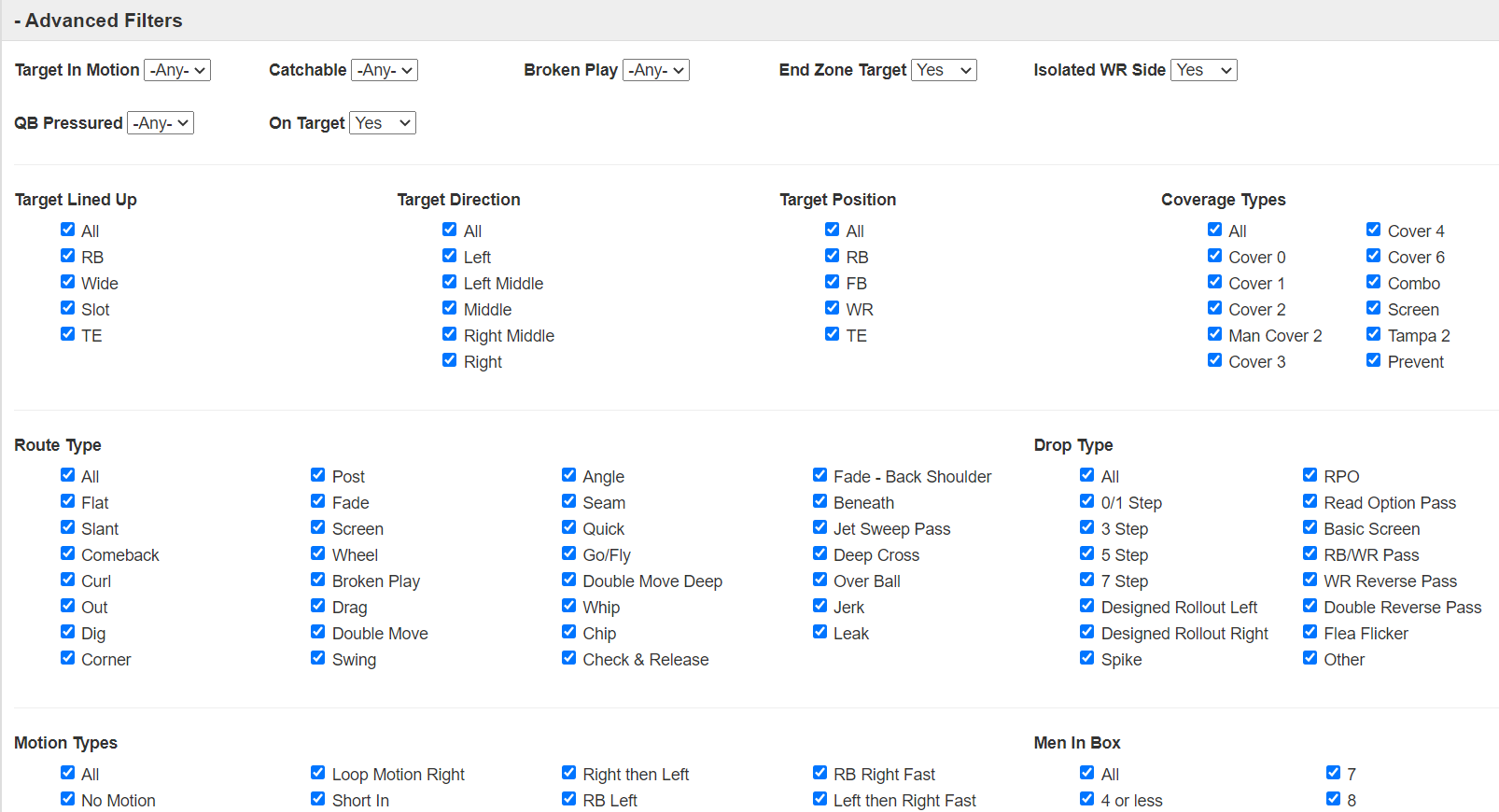
    For those interested in the football analytics track, we’re asking you to identify the most popular route concepts in the NFL in 2020, as well as ascertain which concepts perform the best versus the different coverage types. We will furnish all the necessary data for you to attack this problem, provided you make a minimum $1 donation to The Boys and Girls Clubs of America.

    If you are interested in developing betting insights, then we’d like you to consider how much of an effect quarterbacks and wide receivers should have on point spreads. SIS will once again provide the relevant data should you choose this track, and we’d like to reiterate that the $1 minimum donation still applies.

    With any luck, one of these tracks will appeal to you and we also hope that the opportunity to compete with other skilled up-and-comers and present your work to some industry titans, will excite you. Last year’s judging panel included our own Matt Manocherian, Football Outsiders’ Aaron Schatz, and the Colts’ Director of Research, John Park. Each track will have a separate judging panel and we’re excited to announce them all in the leadup to the final event. In the meantime, you can learn more about the competition and the datasets here.

    If the competition isn’t for you, then we understand and would just ask you to consider making a donation to The Boys and Girls of Clubs of America. The organization has been providing valuable after-school activities for children for over 150 years. You can donate here.

  • New podcast: The future of football analytics with Michael Lopez

    New podcast: The future of football analytics with Michael Lopez

    On this episode of the Off The Charts Football Podcast, Matt Manocherian (@mattmano) and Mark Simon (@MarkASimonSays) are joined by Michael Lopez (@StatsbyLopez), the Director of Football Data and Analytics for the NFL.

    This week:

    • Michael discusses his role with the NFL and what he’s working on now (0:47)
    • Gives an overview of Next Gen’s evolution (6:07)
    • Talks about using data to evaluate the game of football (7:24)
    • Gives the stat he likes the most (17:06)
    • Talks about the process of presenting data (26:16)
    • Mentions the Big Data Bowl (29:14).
    • Alex Vigderman (@VigManOnCampus) of the SIS Research Team then joins Matt to react to what Michael had to say (30:58).

  • A Primer for SIS’s NFL Wins Above Replacement (WAR) Metric

    A Primer for SIS’s NFL Wins Above Replacement (WAR) Metric

    BY ALEX VIGDERMAN

    This article is meant to be both an introduction and reference documentation for the “Above Replacement” stats added to the SIS DataHub Pro in April 2021.

    They say, “the greatest ability is availability.” That may not be entirely true, but the saying does reflect the true idea that a player’s ability to stay on the field consistently over the course of a season and over many seasons is crucial. Being able to not only perform better than one’s peers but to do so over a large sample makes a player truly valuable. Even being an average player over time has value because the alternative is to use a below-average player—in short, Efficiency x Volume = Value.

    In baseball, the Wins Above Replacement (WAR) statistic was created to measure a player’s ability to accumulate value relative to his peers, both by playing consistently and being consistently better than some benchmark. With WAR, the benchmark is a “replacement” player, conceptually one who can be easily acquired in free agency or promoted from the minor leagues (or from the practice squad in the case of football).

    Comparing to replacement level means that a player is valued relative to the easily-obtainable alternatives a team might have. That benchmark is, of course, different for different positions, as it’s more difficult to play certain positions competently than others. We would expect an average quarterback to be more valuable to a team than an average running back.

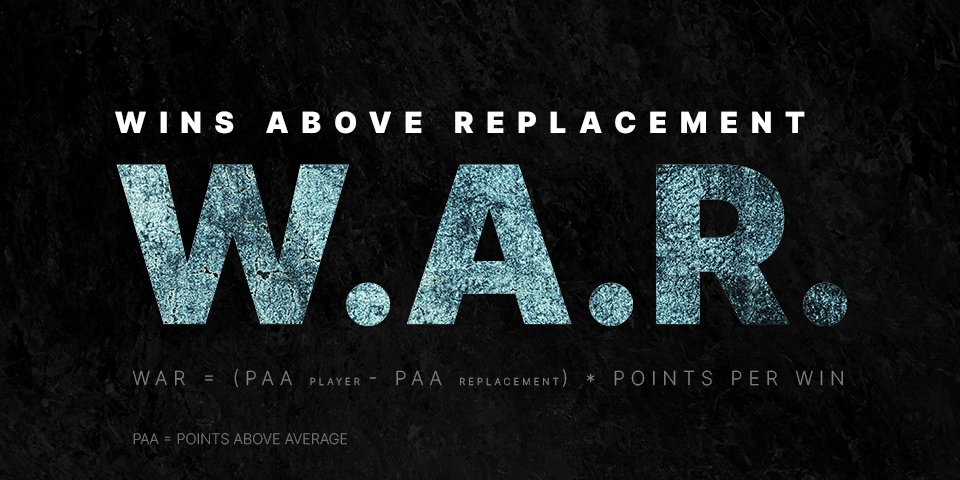
    Embracing the WAR concept in football, Sports Info Solutions has its own WAR metric, using concepts coming from baseball’s implementation (at Fangraphs and Baseball Reference specifically) as well as previous attempts in football by groups like Yurko et al. The metric builds off the structure created by SIS’s Total Points system—specifically, Points Above Average, or PAA—by adding two layers of computation on top of it: the comparison to the PAA of a replacement-level player, and a Points-to-Wins conversion that puts player contributions on the scale of team wins.

    WAR starts with the difference between a player's Points Above Average and the value that a replacement-level player would have accumulated, then multiplies it by a Points-to-Wins conversion factor.

    These WAR values (and the underlying Points Above Replacement, or PAR) are available on the SIS DataHub Pro in all the same places that you’d find Total Points, with all the same ability to filter and sort the results. These numbers are only available to SIS DataHub Pro subscribers and will not be made available on the free version of the DataHub.

    What’s the difference between Points Above Replacement and Total Points?

    In most cases, these metrics will tell you similar things. They both aim to express a player’s value in terms of points to his team, and so they’re roughly on the same scale, and both have Points Above Average as their basis.

    The key reason to consider using PAR (and correspondingly WAR) instead of Total Points is that there is a specific notion of the relative value of different positions and facets of the game. Total Points draws a distinction between quarterbacks and everyone else, but it does not make any distinction between the value gained by a guard run blocking and that of a wide receiver in the passing game. In reality, the former is less valuable than the latter, but because the extent of that difference is relatively small you can consider Total Points to be a reasonable facsimile of Points Above Replacement.

    Methodology

    Determining Replacement Level

    What makes a player “above replacement”?

    It could be taken in a few different conceptual directions. One option is to consider replacement level as the performance of backups, and another is the performance of players who are only on a roster part of the time. However, the latter group can be quite hard to measure because you need enough play data to evaluate those players accurately.

    SIS has chosen to use playing time in the first 15 offensive or defensive plays of a game as the determinant. The 15-play threshold was chosen to align with a “scripted play” structure that comes from Bill Walsh’s game-calling strategy. This makes it so that players who regularly fail to make it onto the field when the team’s plans are still in place are essentially considered backups or easily-replaced players.

    Specifically, players who appeared in the first fifteen snaps for either side in at least half of the games and at least a quarter of the total snaps in a given season are considered above replacement level, and any player who fails to qualify for that standard is “replacement level” (or below). This line for replacement level is a bit higher than might be ideal, but we can’t measure the performance of players who don’t make it onto the field, so this serves as a viable delineation.

    Steps Used to Determine Replacement Level Performance
    1. Start with only the first 15 offensive plays and defensive plays of each game of the last three years (and all special teams plays, for kickers and punters)
    2. For each season, identify the players who did not appear in enough games or enough plays to qualify as at least rotational players.
      1. Offense/Defense: at least half the games and at least a quarter of snaps
      2. Kickers/Punters: at least half the games and at least 15 kick events
      3. This list of limited-playing-time players could also include starters who missed substantial time to injury. That’s an unfortunate side-effect of this method. The effect of this is tempered by our using three years’ worth of data to inform our replacement level estimates, so a starting-level player who gets injured one year will still primarily be considered a starter.
    3. Replacement level performance is taken as the average per-play Points Above Average among “replacement level” players for each combination of position and facet of the game (e.g., running back receiving, offensive tackle run blocking, safety pass rushing)

    This replacement-level definition isn’t used directly for those players’ WAR, because it doesn’t take into account their performance on those plays. After all, a player who was considered a backup by this standard could perform so well in a small sample that he ends up above zero WAR.

    But the average performance of these backup-level players is used as the value standard for a replacement-level player. That standard leaves us with, for example, 32 quarterbacks, 109 wide receivers, 84 defensive tackles, and 107 cornerbacks who are considered at least rotational players, and everyone else is included in the determination of replacement level.

    Within that pool of “replacement level” players, the average per-play performance is calculated for every combination of position and facet of the game. Those values are taken as the average Points Above Average for the group of “replacement level” players within each position-phase combination. A player’s Points Above Replacement is just his Points Above Average in a given facet minus his position’s replacement-level Points Above Average in that facet.

    In general, when a skill has a low replacement level, it means that there’s a wide gap between the best and worst players, and therefore that skill is valuable. To illustrate how that works out in terms of positional value, here are the common position-phase combinations with the most and least average value relative to replacement level for the 2018-2020 seasons.

    Most and Least Valuable Skills by SIS WAR, 2018-20

    Rank Highest Average WAR Rank Lowest Average WAR
    1 Quarterback Passing 1 Defensive Tackle Pass Rush
    2 Running Back Rushing 2 Center Run Blocking
    3 Wide Receiver Receiving 3 Cornerback Pass Rush
    4 Cornerback Pass Coverage 4 Linebacker Run Defense
    5 Tight End Receiving 5 Defensive End Run Defense

    The biggest thing that pops out here—aside from the fact that Aaron Donald is single-handedly holding up the value of defensive tackles—is that running backs might matter after all, as they show up second on the list.

    While it is true that rushing performance is relatively valuable, RB rushing is closer in average value to the bottom of this list than the top. You can consider passing in one category and everything else in another, although there is still room to distinguish among the rest.

    Beyond that, the Total Points system gives backs more credit than other EPA-based systems because it makes an adjustment to each player on each play based on the likely EPA gain or loss on the play given the call (pass or run) and situation. While most 3rd-and-8 runs are dead in the water, it’s not held against the offensive players that such a call was made. This makes running backs in general more able to gain and lose value than you might think given how EPA on run plays tends to look.

    One last point is that we selectively remember the replacements who do well. We hold up players like Tony Pollard, Alexander Mattison, and Austin Ekeler as examples of replacements who can perform comparably to their better-compensated teammates. The counter to that is there are just as many examples of players who are given brief opportunities and squander it. And because running backs can really mess things up with a poorly-timed fumble, players like Jeremy McNichols and C.J. Prosise counterbalance the strong performances of the names above.

    Converting from Points to Wins

    The conversion from points into wins is to some extent a rough estimate, because it doesn’t take into account the context of the plays involved. We all understand that the same play can have very different effects on a team’s chance of winning depending on the context. But to more consistently evaluate players regardless of the situation around them, we treat all plays as having a neutral context in this respect. To that end, the points-to-wins conversion is instead a multiplier based on the concept of Pythagorean win percentage (or more specifically, Pythagenpat) which essentially uses points scored and allowed to estimate win percentage.

    Advanced mathematical interlude:

    We can use calculus to estimate, in essence, the slope of the line of wins vs. points, i.e., the extra points needed to add a win. Sabermetric writer Patriot—writing about baseball in a way that applies equally to football—shows how to start from the formula and use partial derivatives to convert it into a formula for points-per-win at a league level that depends only on the scoring environment (in points per game, PPG):, where x is the value that makes the Pythagorean win expectancy most accurate when it’s used as the exponent instead of squaring each term. For 2016 to 2019, with a PPG just over 45, z = 0.73.

    The actual number will vary over time, but the translation in recent seasons has hovered around 32 or 33 points per win. Put into different terms, we would expect that a team with a full-season Points Above Replacement of 160 would be around two wins better on average than a team with a total of 96.

    The last piece of the puzzle is that because there’s a defined number of wins available each year (although that number changes starting in 2021), there needs to be a constant number of Wins Above Replacement each year.

    For a 16-game season, SIS has chosen the number 192, which corresponds to the idea that a 2-14 team is replacement level. This is based on the notion that while teams do occasionally win fewer than two games, the “true talent” of those teams isn’t quite that poor, and a “true” replacement level team would align with that baseline. The total WAR is calculated in the following manner:

    Total WAR is the difference between the total wins available in the season minus the total wins if every team were replacement level.

    If after all the previous calculations the total WAR for the league in a season isn’t 192, the player values are adjusted slightly so that the total ends up at that number. This ensures each season is measured consistently.

    Note: From 2021 forward, with a 17-game season, we are still using a 2-win team as the baseline, and therefore there are an additional 16 WAR available, for a total of 208.

    What does it look like?

    Here’s a glimpse of the 2020 Passing WAR leaderboard found via the DataHub Pro (via the Value tab), with some other metrics that might help give context to how we get to WAR. You can see that Points Earned, Points Above Average, and PAR tell similar stories about the relative value of these MVP candidates, and in particular Tom Brady’s season stands out as one that deserves much more credit than the EPA of his throws would suggest.

    Player Team Att EPA Points Above Avg Points Earned PAR WAR
    Patrick Mahomes Chiefs 588 138.87 90.51 162.05 152.6 4.6
    Deshaun Watson Texans 544 115.39 78.32 157.58 145.9 4.4
    Tom Brady Buccaneers 610 82.05 80.12 158.70 138.6 4.2
    Josh Allen Bills 572 132.46 71.20 143.19 137.4 4.1
    Aaron Rodgers Packers 526 143.56 85.12 154.21 137.0 4.1

    Each year roughly half the quarterbacks in the league produce more WAR than any player at any other position, so you just get out of here with your RB-as-MVP conversations. In a 2,000 yard season where he was the centerpiece of his team’s offense, Derrick Henry produced about as much value as an about-to-retire Drew Brees and an about-to-be-shipped-out Teddy Bridgewater.

    We know that quarterbacks are much more valuable than other players, but WAR shows just how large that gap really is.

  • 2021 NFL Draft Review: From best (Lions) to worst (Rams)

    2021 NFL Draft Review: From best (Lions) to worst (Rams)

    By NATHAN COOPER AND JOHN TODD

    If you want our full thoughts on the players your team has added, you can buy the Football Rookie Handbook now at ACTA Sports or on Amazon. And if you’d like to contribute to next year’s edition, consider applying to our Football Video Scout position.

    This was Year 3 of the SIS Football Rookie Handbook. The idea is to have the top players at their respective positions make the book. With 318 players featured in the 2021 edition, not every player from the Handbook would be drafted and not every drafted player was in the Handbook. After having 69% (174 of 254) of drafted players in the book in 2019 and 78% (199 of 255) in 2020, we raised that number once again to 84% (218 of 259) this season.

    When taking out specialists and fullbacks, which we currently don’t put into the Handbook, there were only 36 players drafted who weren’t in the book and only 7 of which we didn’t watch or have a report on. That’s over 97% of the NFL Draft covered! Plus, by our count, 86 of the 98 players who were in the book and didn’t get drafted have already signed undrafted free agent deals with teams as of Monday morning.

    Now using the Handbook, we attempted to grade each team’s draft class. Just like in our article from last season, we assigned all grades from the Handbook and gave all players that weren’t in the book a 5.7 and divided that by the number of selections the team had. These rankings do not account for the value of where players were drafted or trades teams made, it is literally based on the grades we gave the players who were drafted.

    The 2021 Best Draft Class, with an average grade of 6.6, went to the Detroit Lions. They had seven draft picks and made the most of their picks by selecting players who were all featured in the SIS Football Rookie Handbook.

    The Lions draft class is in the table below.

    Detroit Lions 2021 Draft Class

    Pick Position Player College Grade
    7 OT Penei Sewell Oregon 7.2
    41 DT Levi Onwuzurike Washington 6.7
    72 NT Alim McNeill NC State 6.8
    101 CB Ifeatu Melifonwu Syracuse 6.6
    112 WR Amon-Ra St. Brown USC 6.4
    113 LB Derrick Barnes Purdue 6.2
    257 RB Jermar Jefferson Oregon State 6.3

    In our opinion, Brad Holmes, Dan Campbell, and the new regime in Detroit drafted a lot of players that we feel can contribute to both sides of the ball early on in their careers. Penei Sewell is a plug-and-play tackle who many scouts think was the one surefire Hall of Fame player in this class. Onwuzurike and McNeill are big time playmakers on the interior of the defense and will really help the team “bite a kneecap off.” 

    Melifonwu is a big, physical corner who can help bring some depth to a position that struggled with injuries in 2020. 

    St. Brown has the ability to become a No. 3 receiver who can play inside or out, 

    Barnes brings some grit and versatility to the middle of the defense, and Jefferson shows some pass and run game versatility and should compete for the No. 3 RB job. 

    That’s not to mention some undrafted free agents the team reportedly picked up after the draft, most notably Wake Forest WR Sage Surratt (6.7, No. 6 WR) and Notre Dame OG Tommy Kraemer (6.5, No. 10 OG).

    SIS Handbook Top Draft Classes

    Year Team Previous Season Following Season
    2019 Tennessee Titans 9-7 (No Playoffs) 9-7 (L, AFC Champ)
    2020 Cleveland Browns 6-10 (No Playoffs) 11-5 (L, Divisional)
    2021 Detroit Lions 5-11 (No Playoffs) ?

    Our previous two Top Draft Class winners, the Titans and the Browns, both made the playoffs the following year after not making it the season before. Both won in the postseason, as well. Detroit’s roster still needs a lot of work and is in no way similar to what Tennessee’s or Cleveland’s was the past two seasons, but it’s a huge step in the right direction for a new staff and rebuilding organization.

    Here are the draft classes ranked in order of their grade:

    Draft Class Final Rankings

    Rank Team # of Picks Draft Grade
    1 Lions 7 6.60
    2 Dolphins 7 6.46
    3 Browns 8 6.44
    4 Jaguars 9 6.40
    5 Falcons 9 6.38
    6 Packers 9 6.37
    7 Chargers 9 6.37
    8 Broncos 10 6.36
    9 Panthers 11 6.35
    10 Patriots 8 6.35
    11 Bengals 10 6.34
    12 Giants 6 6.32
    13 49ers 8 6.30
    14 Titans 8 6.30
    15 Raiders 7 6.30
    16 Bears 7 6.30
    17 Texans 5 6.30
    18 Ravens 8 6.28
    19 Eagles 9 6.26
    20 Steelers 9 6.23
    21 Chiefs 6 6.23
    22 Jets 10 6.22
    23 Vikings 11 6.20
    24 Cardinals 7 6.20
    25 Buccaneers 7 6.20
    26 Seahawks 3 6.20
    27 Washington 10 6.14
    28 Bills 8 6.14
    29 Saints 6 6.12
    30 Cowboys 11 6.11
    31 Colts 7 6.07
    32 Rams 9 5.82

    The Dolphins ranked No. 2 after a Top 10 ranking in 2020. Getting Jaylen Waddle, our top-ranked receiver, and Jaelan Phillips, our top-ranked edge rusher, in the 1st Round was a home run for Miami. Two more 6.7 players in Jevon Holland (No. 3 S) and Liam Eichenberg (No. 4 OT) really solidified an outstanding draft for an up-and-coming Dolphins squad.

    Coming off their first postseason win since 1994, the Browns checked in with another Top 5 class. This followed having the No. 1 Draft class in 2020. 

    Selecting Greg Newsome II (6.7, No. 4 CB) in the 1st Round and getting a steal in Jeremiah Owusu-Koramoah (6.8, No. 1 Will LB) in the 2nd Round was huge for that defense. They also got Tommy Togiai (6.7, No. 2 NT) in the 4th Round and Richard LeCounte (6.7, No. 6 S) in the 5th Round.

    The Jaguars got their QB of the future in Trevor Lawrence with the No. 1 pick and then followed it up by taking his Clemson teammate Travis Etienne later in the 1st Round. In addition, grabbing Andre Cisco (6.7, No. 5 S) in the 3rd Round and Jay Tufele (6.7, No. 4 DT) in the 4th Round really helped solidify their ranking.

    Rounding out the Top 5 was the Atlanta Falcons. They took arguably the top skill player in this class with the No. 4 overall pick in Florida’s Kyle Pitts, who should immediately help give Matt Ryan another weapon on offense. They also got Ryan some offensive line help early in the 3rd Round in Michigan’s Jalen Mayfield (6.7, No. 6 OT).

    The bottom three teams for 2021 were the Rams, Colts, and Cowboys.

    Dallas did start out with a huge pick in Micah Parsons and also grabbed Jabril Cox in the 4th Round to solidify the linebacker position (they declined Leighton Vander Esch’s 5th-year option), but we were a little lower on 2nd-Round pick Kelvin Joseph and 3rd-Round pick Chauncey Golston. 

    However, out of their 11 picks, Dallas took 10 who were featured in the Handbook. 

    The Colts got two big time defensive linemen with their first two picks in Kwity Paye (6.7, No. 3 Edge) and Dayo Odeyingbo (6.6, No. 7 DT), but then drafted fringe backups in Kylen Granson, Shawn Davis, and Sam Ehlinger, before taking Mike Strachan and Will Fries, who we thought weren’t good enough to make the Handbook.

    The Rams took home the 2021 Worst Draft Class. It’s hard to put together a top-end draft class when you don’t have a 1st Round pick, but not only that, five of their nine draftees we felt weren’t good enough to be a part of the Handbook’s 318. Tutu Atwell should be a playmaker for new quarterback Matthew Stafford out of the slot, but the rest of their picks were tabbed as fringe backups according to our scouts.

    The Green Bay Packers had the worst ranking for us in 2020, and while that was a slightly different situation, they still made the playoffs and were one of the top teams in the NFL. In addition to coming off a No. 7 class in 2020, there’s still hope for the Rams in 2021 and beyond.

    How the Handbook Compared to the Draft

    Comparing the SIS Rookie Handbook’s top five graded players at each position to how the NFL drafted them, there were plenty of similarities and some differences. Our No. 1  player in nine of our 14 position groups matched the NFL’s first player taken at each spot (only differing at wide receiver, center, will linebacker, cornerback, and safety). While in different orders, we had the same first five quarterbacks (as many did), and four of the first group of five running backs, wide receivers, tight ends, tackles, centers, and cornerbacks. We had at least three of our top five players taken within that initial group of selections at every position.

    Overdrafted?

    Some players we believe the NFL drafted much higher than we had them pegged include Milton Williams, Earnest Jones and Brandon Stephens. None of the three received grades high enough to make our final tally of players in the Handbook, yet each was taken before the third round ended. 

    With nearly 750 scouting reports submitted on over 460 players, which ultimately led to the 318 players in the Handbook, we feel we cast a wide net to find the best players for this class. Our lowest graded first round selections, based on their projected role, are Joe Tryon, Jamin Davis, Kadarius Toney, and Payton Turner, who was the only first round player to not receive at least a low-end starting grade.

    Underdrafted?

    Conversely, there were plenty of value picks in the later rounds based on their Handbook grades. Some of these players include Jaylen Twyman, Rodarius Williams, Cole Van Lanen, and Quincy Roche. All four of these players, taken in the sixth round, received strong starting grades from our scouts, and we believe whether they fell due to injuries, off-field concerns, or other intangibles we may not consider, they have a great chance to become impactful players. 

    Additionally, Trey Smith, Kylin Hill, Trey Hill, Larry Rountree III, Victor Dimukeje, Patrick Johnson, and Shaka Toney were taken in the last two rounds of the draft, yet received low-end starting grades within their respective position groups. These players may be more usage specific at the next level, but we like their chances of seeing the field and playing key roles by Year 2.

    Players who were graded and ranked within the Top 5 at their position in the Handbook and ultimately not drafted include Dylan Moses (No. 2 Will LB), Ar’Darius Washington (No. 2 S), Paris Ford (No. 4 S), and Amen Ogbongbemiga (No. 4 Mike LB). Each of these players has already reportedly signed with a team through the undrafted free agency process. Needless to say, we feel this group has a strong chance of sticking on a roster and proving the league made a mistake passing on them.

    Handbook Report Card

    As this is the third annual edition of the SIS Football Rookie Handbook, and thus the third edition of this post-draft recap, we’re pleased to look back at our previous work and see drastic progress. 

    Only two players drafted within the top five of their position group were not in the Handbook: DT Milton Williams – who would not be mentioned here if we had graded him as a true Edge, as he was drafted – and Mike LB Buddy Johnson. The number of drafted players not in the Handbook in total dropped from 56 to 41 (36 excluding specialists and fullbacks). And possibly our favorite statistic from this year, as it was mentioned in the outset, the number of drafted players on whom we didn’t have a report assigned at all dropped from 27 to just 7.

    While the first non-Handbook and non-report players were each taken earlier this year than in 2020, the percentage increases noted at the beginning of this article, as well as our raw contribution totals, tell us we’re trending in the right direction. The Handbook doesn’t claim to be perfect. Quite the opposite in fact, as it is presented with often contradictory scouting and analytical perspectives so you, the reader, can form your own opinions. 

    Publishing the Handbook as early in the pre-draft process as we do, in order to solely grade on-field ability as purely as possible, occasionally miscalculates our final projections, not to mention our lack of insider medical and character information and the natural variance of scouting opinions. Given the adversities of 2020, we’re thrilled and thankful for the hard work our scouts put in to chart and evaluate this class and, as usual, we’ve already begun scouting for 2022.

    The SIS Football Rookie Handbook will be back again next year, filled with even more data, more accuracy, better reports, and the same combination of deep-dive analytics and pre-Combine scouting we’re proud to share. In the meantime, if you want our full thoughts on the players your team has added, you can buy the book now at ACTA Sports or on Amazon. And if you’d like to contribute to next year’s edition, consider applying to our Football Video Scout position.

  • 2021 Sports Info Solutions Video Scouts Mock Draft

    Using traditional scouting and analytics in conjunction with the SIS Football Rookie Handbook, members of the Sports Info Solutions Operations department tried their hand at attempting to answer all your NFL Draft questions in a full 7-Round Mock Draft.

    Where are your favorite players going to land? Who is your favorite team going to select?

    Round 1
    Pick Team Scout Player College
    1 Jaguars John QB Trevor Lawrence Clemson
    2 Jets Alec QB Zach Wilson BYU
    3 49ers Justin QB Trey Lance North Dakota State
    4 Falcons Jordan TE Kyle Pitts Florida
    5 Bengals Ben OT Penei Sewell Oregon
    6 Dolphins Nathan WR Ja’Marr Chase LSU
    7 Lions Nathan WR Jaylen Waddle Alabama
    8 Panthers Jordan OT Rashawn Slater Northwestern
    9 Broncos John QB Justin Fields Ohio State
    10 Cowboys Chad CB Patrick Surtain II Alabama
    11 Giants Chad WR DeVonta Smith Alabama
    12 Eagles Ben DT Christian Barmore Alabama
    13 Chargers Stephen OT Christian Darrisaw Virginia Tech
    14 Vikings Jeff OG Alijah Vera-Tucker USC
    15 Patriots Stephen QB Mac Jones Alabama
    16 Cardinals Alec CB Jaycee Horn South Carolina
    17 Raiders Ben OT Teven Jenkins Oklahoma State
    18 Dolphins Nathan ED Azeez Ojulari Georgia
    19 Washington John LB Micah Parsons Penn State
    20 Bears Jeff LB Jeremiah Owusu-Koramoah Notre Dame
    21 Colts Chad ED Kwity Paye Michigan
    22 Titans Dan CB Gregory Newsome II Northwestern
    23 Jets Alec CB Caleb Farley Virginia Tech
    24 Steelers Nathan RB Najee Harris Alabama
    25 Jaguars John ED Jayson Oweh Penn State
    26 Browns John ED Jaelan Phillips Miami
    27 Ravens Segev WR Rashod Bateman Minnesota
    28 Saints Evan ED Gregory Rousseau Miami
    29 Packers Jeff WR Elijah Moore Ole Miss
    30 Bills Evan RB Travis Etienne Clemson
    31 Ravens Segev OG Alex Leatherwood Alabama
    32 Buccaneers Jordan ED Joe Tryon Washington
    ROUND 2
    Pick Team Scout Player College
    33 Jaguars John TE Pat Freiermuth Penn State
    34 Jets Alec OC Creed Humphrey Oklahoma
    35 Falcons Jordan ED Carlos Basham Wake Forest
    36 Dolphins Nathan RB Javonte Williams North Carolina
    37 Eagles Ben LB Zaven Collins Tulsa
    38 Bengals Ben DT Levi Onwuzurike Washington
    39 Panthers Jordan S Trevon Moehrig TCU
    40 Broncos John LB Jamin Davis Kentucky
    41 Lions Nathan CB Asante Samuel Jr. Florida State
    42 Giants Chad OT Samuel Cosmi Texas
    43 49ers Justin CB Eric Stokes Georgia
    44 Cowboys Chad ED Ronnie Perkins Oklahoma
    45 Jaguars John OT Liam Eichenberg Notre Dame
    46 Patriots Stephen LB Jabril Cox LSU
    47 Chargers Stephen CB Ifeatu Melifonwu Syracuse
    48 Raiders Ben DT Daviyon Nixon Iowa
    49 Cardinals Alec OG Wyatt Davis Ohio State
    50 Dolphins Nathan DT Jaylen Twyman Pittsburgh
    51 Washington John WR Kadarius Toney Florida
    52 Bears Jeff WR Rondale Moore Purdue
    53 Titans Dan WR Terrace Marshall LSU
    54 Colts Chad OT Dillon Radunz North Dakota State
    55 Steelers Nathan CB Elijah Molden Washington
    56 Seahawks Justin OT Jalen Mayfield Michigan
    57 Rams Justin OT James Hudson Cincinnati
    58 Chiefs Nathan ED Rashad Weaver Pittsburgh
    59 Browns John NT Alim McNeill NC State
    60 Saints Evan CB Tyson Campbell Georgia
    61 Bills Evan ED Shaka Toney Penn State
    62 Packers Jeff DT Jay Tufele USC
    63 Chiefs Nathan CB Aaron Robinson UCF
    64 Buccaneers Jordan OC Landon Dickerson Alabama
    ROUND 3
    Pick Team Scout Player College
    65 Jaguars John S Jevon Holland Oregon
    66 Jets Alec LB Dylan Moses Alabama
    67 Texans Alec TE Brevin Jordan Miami
    68 Falcons Jordan S Richie Grant UCF
    69 Bengals Ben WR Amon-Ra St. Brown USC
    70 Eagles Ben OG Trey Smith Tennessee
    71 Broncos John OT Walker Little Stanford
    72 Lions Nathan LB Nick Bolton Missouri
    73 Panthers Jordan WR Amari Rodgers Clemson
    74 Washington John QB Davis Mills Stanford
    75 Cowboys Chad OT Brady Christensen BYU
    76 Giants Chad ED Joseph Ossai Texas
    77 Chargers Stephen IOL Josh Myers Ohio State
    78 Vikings Jeff OG Kendrick Green Illinois
    79 Raiders Ben LB Baron Browning Ohio State
    80 Raiders Ben OT Spencer Brown Northern Iowa
    81 Dolphins Nathan OG Jackson Carman Clemson
    82 Washington John TE Tommy Tremble Notre Dame
    83 Bears Jeff QB Kyle Trask Florida
    84 Eagles Ben S Ar’Darius Washington TCU
    85 Titans Dan ED Quincy Roche Miami
    86 Jets Alec OG Quinn Meinerz Wisconsin-Whitewater
    87 Steelers Nathan LB Derrick Barnes Purdue
    88 Rams Justin LB Cameron McGrone Michigan
    89 Browns John LB Pete Werner Ohio State
    90 Vikings Jeff DT Marvin Wilson Florida State
    91 Browns John S Andre Cisco Syracuse
    92 Packers Jeff CB Rodarius Williams Oklahoma State
    93 Bills Evan LB Chazz Surratt North Carolina
    94 Ravens Segev ED Chris Rumph II Duke
    95 Buccaneers Jordan RB Kenneth Gainwell Memphis
    96 Patriots Stephen CB Marco Wilson Florida
    97 Chargers Stephen WR Tylan Wallace Oklahoma State
    98 Saints Evan WR Tutu Atwell Louisville
    99 Cowboys Chad NT Tommy Togiai Ohio State
    100 Titans Dan OG Cole Van Lanen Wisconsin
    101 Lions Nathan S Paris Ford Pittsburgh
    102 49ers Justin WR Sage Surratt Wake Forest
    103 Rams Justin EDGE Patrick Jones II Pittsburgh
    104 Ravens Segev TE Tre’ McKitty Georgia
    105 Saints Evan LB Amen Ogbongbemiga Oklahoma State
    ROUND 4
    Pick Team Scout Player College
    106 Jaguars John RB Michael Carter North Carolina
    107 Jets Alec TE Hunter Long Boston College
    108 Falcons Jordan QB Kellen Mond Texas A&M
    109 Texans Alec DT Dayo Odeyingbo Vanderbilt
    110 Browns John WR Dyami Brown North Carolina
    111 Bengals Ben CB Robert Rochell Central Arkansas
    112 Lions Nathan ED Elerson Smith Northern Iowa
    113 Panthers Jordan CB Paulson Adebo Stanford
    114 Broncos John RB Chuba Hubbard Oklahoma State
    115 Cowboys Chad S Hamsah Nasirildeen Florida State
    116 Giants Chad CB Tre Brown Oklahoma
    117 49ers Nathan OG Ben Cleveland Georgia
    118 Chargers Stephen LB Justin Hilliard Ohio State
    119 Vikings Jeff WR D’Wayne Eskridge Western Michigan
    120 Patriots Stephen OT Robert Hainsey Notre Dame
    121 Raiders Ben RB Demetric Felton UCLA
    122 Patriots Stephen S Damar Hamlin Pittsburgh
    123 Eagles Ben CB Kelvin Joseph Kentucky
    124 Washington John RB Rhamondre Stevenson Oklahoma
    125 Vikings Jeff TE Tony Poljan Virginia
    126 Titans Dan DT Osa Odighizuwa UCLA
    127 Colts Chad WR Jaelon Darden North Texas
    128 Steelers Nathan OT Foster Sarell Stanford
    129 Seahawks Nathan CB Darren Hall San Diego State
    130 Jaguars John CB Shaun Wade Ohio State
    131 Ravens Segev OT Kayode Awosika Buffalo
    132 Browns John DT Marlon Tuipulotu USC
    133 Saints Evan RB Trey Sermon Ohio State
    134 Vikings Jeff ED Adetokunbo Ogundeji Notre Dame
    135 Packers Jeff OG Aaron Banks Notre Dame
    136 Ravens Segev CB Keith Taylor Washington
    137 Buccaneers Jordan NT Tyler Shelvin LSU
    138 Cowboys Chad LB Monty Rice Georgia
    139 Patriots Stephen LB KJ Britt Auburn
    140 Steelers Nathan OC Drew Dalman Stanford
    141 Rams Nathan TE Kenny Yeboah Ole Miss
    142 Packers Jeff WR Josh Palmer Tennessee
    143 Vikings Jeff OT Adrian Ealy Oklahoma
    144 Chiefs Nathan WR Nico Collins Michigan
    ROUND 5
    145 Jaguars John OC Trey Hill Georgia
    146 Jets Alec RB Kylin Hill Mississippi State
    147 Texans Alec S Richard LeCounte Georgia
    148 Falcons Jordan CB Ambry Thomas Michigan
    149 Bengals Ben ED Cam Sample Tulane
    150 Eagles Ben WR Austin Watkins Jr. UAB
    151 Panthers Jordan RB Khalil Herbert Virginia Tech
    152 Broncos John DL Milton Williams Louisiana Tech
    153 Lions Nathan QB Jamie Newman Wake Forest
    154 Jets Alec ED Payton Turner Houston
    155 49ers Nathan CB Camryn Bynum California
    156 Dolphins Nathan DT Darius Stills West Virginia
    157 Vikings Jeff CB Benjamin St-Juste Minnesota
    158 Texans Alec LB Tony Fields II West Virginia
    159 Chargers Stephen ED Victor Dimukeje Duke
    160 Cardinals Alec WR Seth Williams Auburn
    161 Bills Evan TE John Bates Boise State
    162 Raiders Ben WR Cornell Powell Clemson
    163 Washington John S Jamar Johnson Indiana
    164 Bears Jeff S Talanoa Hufanga USC
    165 Colts Chad S Tyree Gillespie Missouri
    166 Titans Dan OT Brenden Jaimes Nebraska
    167 Raiders Ben OT Josh Ball Marshall
    168 Vikings Jeff S Aashari Crosswell Arizona State
    169 Browns John OG Deonte Brown Alabama
    170 Jaguars John WR Anthony Schwartz Auburn
    171 Ravens Segev S Caden Sterns Texas
    172 49ers Nathan DT Ta’Quon Graham Texas
    173 Packers Jeff LB Rashad Byrd Georgia Southern
    174 Bills Evan DT Malik Herring Georgia
    175 Chiefs Nathan LB Garret Wallow TCU
    176 Buccaneers Jordan CB Trill Williams Syracuse
    177 Patriots Stephen LB Blake Gallagher Northwestern
    178 Packers Jeff OC Jimmy Morrissey Pittsburgh
    179 Cowboys Chad TE Noah Gray Duke
    180 49ers Nathan TE Quintin Morris Bowling Green
    181 Chiefs Nathan OT Stone Forsythe Florida
    182 Falcons Jordan OC David Moore Grambling
    183 Falcons Jordan WR Tamorrion Terry Florida State
    184 Ravens Segev NT Roy Lopez Arizona
    ROUND 6
    Pick Team Scout Player College
    185 Chargers Stephen OG Tommy Kraemer Notre Dame
    186 Jets Alec WR Dax Milne BYU
    187 Falcons Jordan S Kary Vincent Jr LSU
    188 Patriots Stephen WR Ihmir Smith-Marsette Iowa
    189 Eagles Ben WR Shi Smith South Carolina
    190 Bengals Ben OG Alaric Jackson Iowa
    191 Panthers John S Divine Deablo Virginia Tech
    192 Cowboys Chad CB Bryce Thompson Tennessee
    193 Panthers Jordan ED Tarron Jackson Coastal Carolina
    194 49ers Nathan WR Dez Fitzpatrick Louisville
    195 Texans Alec NT Khyiris Tonga BYU
    196 Giants Chad OG Sadarius Hutcherson South Carolina
    197 Patriots Stephen S Joshuah Bledsoe Missouri
    198 Chargers Stephen TE Kylen Granson SMU
    199 Vikings Jeff RB Pooka Williams Jr. Kansas
    200 Raiders Ben CB Tre Norwood Oklahoma
    201 Giants Chad RB Elijah Mitchell Louisiana
    202 Bengals Ben S Mark Webb Georgia
    203 Texans Alec OC Drake Jackson Kentucky
    204 Bears Jeff OG William Sherman Colorado
    205 Titans Dan TE Nick Eubanks Michigan
    206 Colts Chad CB Shemar Jean-Charles Appalachian State
    207 Chiefs Nathan RB Larry Rountree III Missouri
    208 Bears Jeff WR Marquez Stevenson Houston
    209 Rams Nathan OG D’Ante Smith East Carolina
    210 Ravens Segev ED Patrick Johnson Tulane
    211 Browns John QB Ian Book Notre Dame
    212 Texans Alec CB Michael Carter II Duke
    213 Bills Evan ED Daelin Hayes Notre Dame
    214 Packers Jeff S Brady Breeze Oregon
    215 Titans Dan WR Cade Johnson South Dakota State
    216 Steelers Nathan ED Jordan Smith UAB
    217 Buccaneers Jordan WR Simi Fehoko Stanford
    218 Saints Evan QB Sam Ehlinger Texas
    219 Falcons Jordan ED Jonathon Cooper Ohio State
    220 Packers Jeff RB Jermar Jefferson Oregon State
    221 Bears Jeff LB Paddy Fisher Northwestern
    222 Panthers Jordan TE Luke Farrell Ohio State
    223 Vikings Jeff LB Max Richardson Boston College
    224 Eagles Ben QB Feleipe Franks Arkansas
    225 Eagles Ben OG Robert Jones Middle Tennessee
    226 Jets Alec K Jose Borregales Miami
    227 Cowboys Chad S Shawn Davis Florida
    228 Bears Jeff NT Bobby Brown III Texas A&M
    ROUND 7
    229 Saints Evan OT Landon Young Kentucky
    230 49ers Nathan OG Tristen Hoge BYU
    231 Dolphins Nathan LB Grant Stuard Houston
    232 Titans Dan K Evan McPherson Florida
    233 Texans Alec WR Frank Darby Arizona State
    234 Eagles Ben OT Tommy Doyle Miami (OH)
    235 Bengals Ben CB Avery Williams Boise State
    236 Bills Evan WR Josh Imatorbhebhe Illinois
    237 Broncos John OT Royce Newman Ole Miss
    238 Cowboys Chad WR Dazz Newsome North Carolina
    239 Broncos John DL Chauncey Golston Iowa
    240 Eagles Ben OC Sam Cooper Merrimack
    241 Chargers Stephen RB Jaret Patterson Buffalo
    242 Patriots Stephen OG Larry Borom Missouri
    243 Cardinals Alec WR/TE Jacob Harris UCF
    244 Dolphins Nathan CB DJ Daniel Georgia
    245 Steelers Nathan WR Tyler Vaughns USC
    246 Washington John ED Wyatt Hubert Kansas State
    247 Cardinals Alec RB Javian Hawkins Louisville
    248 Colts Chad WR Whop Philyor Indiana
    249 Jaguars John S Jacoby Stevens LSU
    250 Seahawks Nathan OG Joe Sculthorpe North Carolina State
    251 Buccaneers Jordan ED Janarius Robinson Florida State
    252 Rams Nathan CB Thomas Graham Jr. Oregon
    253 Broncos John CB Shakur Brown Michigan State
    254 Steelers Nathan QB Peyton Ramsey Northwestern
    255 Saints Evan DT Carlo Kemp Michigan
    256 Packers Jeff FB Ben Mason Michigan
    257 Browns John CB Zech McPhearson Texas Tech
    258 Washington John LS Thomas Fletcher Alabama
    259 Buccaneers Jordan WR Racey McMath LSU

    The members of the SIS Operations staff who took part in this Mock Draft are: Nathan Cooper, John Todd, Jeff Dean, Ben Hrkach, Jordan Edwards, Alec Mallon, Chad Tedder, Stephen Marciello, Evan Butler, Justin Stine, Dan Foehrenbach, and Segev Goldberg

  • DataHub Pro features many new NFL, CFB additions

    DataHub Pro features many new NFL, CFB additions

    BY ALEX VIGDERMAN

    The SIS DataHub Pro has put in some work in the offseason. And that work isn’t done.

    First, a quick bit of background.

    We have two portals for people to interact with our treasure trove of football data.

    One is the SIS DataHub, which is a great resource for dozens of statistics at the NFL level, including our proprietary total-value statistic, Total Points. That site is available to everyone free of charge.

    The other is the SIS DataHub Pro, which has a price tag but adds in the ability to sort, filter, and download data in whatever configuration you like, and also includes college football data. You can sign up for a demo here.

    This week, we are publishing updates to the DataHub Pro that seriously beefs up what it offers you as an analyst, especially on the college side. With the draft coming this week, it’s the perfect time to check out the DataHub Pro.

    Consistent Breadth and Depth Across Levels

    Aside from the fact that we’re adding dozens of new items to the site, we also made it a point to keep the available stats and filters consistent regardless of what you’re looking for. That means that you’ll find the same filters and statistics available on each of the NFL, CFB, player, and team leaderboards.

    So if you find that, for example, the Patriots were very poor when they used zone blocking against a light box in 2020, you can use the same filters to find a possible addition in the draft that might suit that deficiency (might I suggest Western Michigan tackle Jaylon Moore?).

    Major Overhaul to College Leaderboards

    Because we didn’t have quite as much available on the college side previously, you instantly feel the impact of these updates when you run your first query.

    Here’s an example. The DataHub Pro’s Receiving leaderboard for college players already had 18 statistics and 32 filters for you to slice and dice data on pass-catching prospects.

    Now, we’re offering 37 statistics and 43 filters. Here’s a slice of that.

    You could already find out that another Western Michigan product, receiver D’Wayne Eskridge, led the nation in yards per catchable target when lined up out wide against man coverage in 2020.

    Highest Yards per Target on Catchable Throws Lined up Wide Against Man Coverage, 2020 (min. 10 tgt)

    Player Team Tgts Y/Tgt ADoT
    D’Wayne Eskridge Western Michigan 13 21 9.4
    Cornell Powell Clemson 18 18.6 13.6
    Erik Ezukanma Texas Tech 14 18.1 13.5
    Dax Milne BYU 13 17.3 16.2
    DeVonta Smith Alabama 18 16.8 12.3

    Now you can truly go as deep with your analysis as you can anywhere on the Internet. We can now also find out who saw the most on-target throws into the end zone when they were isolated on their side of the formation. That was SIS’s 38th-ranked receiver headed into the draft, Jonathan Adams Jr. of Arkansas State, who had nine such targets and led the nation with 1.3 EPA per target on such throws.

    Like we have for the NFL side, statistics are now split into three tabs: one for Totals, one for Rates, and one for Value statistics.

    That last category is really exciting, because this release of the SIS DataHub Pro now offers the ability to explore EPA-based stats at the college level. That starts with Expected Points Added itself but moves on to things like Positive Play %, Boom% / Bust% (the percent of plays with an EPA above 1 or below -1), and of course our flagship metric Total Points. This was available for draft-eligible players via the SIS Football Rookie Handbook, but now you can pair it with the filtering functionality that the DataHub Pro provides.

    Most Points Saved per Play in 2020, Man Coverage Snaps Lined Up Outside (min. 10 targets)

    Player Team Cov. Snaps Positive% Points Saved / Play
    Deommodore Lenoir Oregon 64 36% 0.24
    Jaylon Jones Georgia State 61 13% 0.23
    Caelen Carson Wake Forest 78 28% 0.22
    Coney Durr Minnesota 41 50% 0.22
    Kenderick Marbles Louisiana-Monroe 46 31% 0.21
    Lenoir, SIS’s 30th-ranked CB entering the draft, was a man coverage asset in 2020

    What about the NFL?

    It’s draft season, so we’re really excited about what we’re adding on the college side. But that doesn’t mean we’re shirking on our responsibilities in providing the best NFL charting data around.

    Most of the filters that are new on the college side are also new on the NFL side. Here’s a sampling of the filters we’re excited about:

    • Passing – What was the QB’s footing like at the snap?
    • Rushing – Did the back use the designed gap?
    • Receiving – Was the throw into the end zone?
    • Blocking – How deep did the QB drop?
    • Pass Defense – Was the QB pressured on the play?
    • Pass Rush – What technique was the player lined up as?
    • Run Defense – Was there motion on the play?

    And beyond that, we still have plenty of stats up our sleeves for NFL analysts.

    Here are the NFL leaders in Wins Above Replacement on plays with the clearest of clear running lanes: through the designed gap, no blown blocks, not contacted for at least 5 yards downfield. For conciseness, we’ll call these “clean runs.”

    Most Wins Above Replacement on ÔÇ£Clean RunsÔÇØ, 2020

    Player Att WAR
    J.K. Dobbins 27 0.7
    Miles Sanders 21 0.6
    Derrick Henry 44 0.6
    Melvin Gordon 29 0.5
    6 tied 0.4
    Dobbins really capitalized on the opportunities afforded by his blocking and scheme in 2020

    We’re ecstatic to finally get these updates out the door and into your hands, especially in advance of the NFL draft. Sign up for a free trial and take the new features for a spin! And if you have any feedback, we definitely want to hear from you. We have more updates in the pipeline for this offseason, but we want to make sure we’re doing well by our users first.

  • The not-so-curious case of Mac Jones

    The not-so-curious case of Mac Jones

    By BRYCE ROSSLER

    It’s strange that a prospect as unassuming as Mac Jones has become so polarizing. It would be disingenuous to call his beginnings ‘humble’—Alabama’s out-of-state tuition barely outpaces what his high school alma mater charges—but it is fair to say that he’s been an afterthought for much of his football career.

    The Jacksonville native was glossed over by G5 grassroots recruiters UCF and USF and inexplicably wound up at Alabama despite being a three-star with the physique of a seventh-grader who swims with their shirt on. While less-coveted recruits aren’t quite dead on arrival in Tuscaloosa, just 8% of the last 120,000+ NFL snaps played by Alabama alumni have been played by former three-stars.

    Nevertheless, David joined Goliath and was seemingly on the fast track to a graduate assistant gig as a Saban-adjacent career backup. But, an unprecedented offseason resulted in a failure to launch for the incoming top quarterback recruit, Jones impressed during camp, and the rest is history.

    Now, with the NFL Draft approaching, Jones has become something of a Rorschach test. Many analysts have become enamored with his rhythm, his precision, and his high-volume, high-efficiency production, and we can sympathize with that. Jones’ 2020 campaign was the third-best passing season by volume, and the second-best on a per-snap basis, in the last three years.

    There are also those who see a physically limited prospect reminiscent of early Saban-era game managers.

    So, it would seem that statistical evaluation and traditional evaluation are at odds again, but that’s not really the case. Although numbers and film often induce cognitive dissonance in those who believe in the value of both, they’re actually two sides of the same coin in Jones’ case.

    For example, there are concerns about Jones’ mobility. The NFL is experiencing a changing of the guard at the quarterback position, and there are questions about whether Jones is well-suited for a league that is increasingly featuring some of its best athletes behind center. Only 17% of Jones’ throws in 2020 were made off-platform, one of the lowest rates among Power 5 quarterbacks. That kind of stationary play style is tough to reconcile when you consider the way the pro game is trending. Since 2019, about 27% of NFL throws occurred from a compromised throwing base. Pure pocket passers have been viable in the past, but the trend has been shifting towards mobility for some time now.

    Concerns about Jones’ pedestrian arm are validated by how long his passes spent in flight. Over expectation stats are all the rage nowadays, and we can devise such a method here. Contextualizing air time data with throw depth, where the ball is hashed relative to the target, and the quarterback’s throwing platform creates a baseline we can use to evaluate the relative quickness with which a quarterback’s passes arrive.

    In this category, Jones was dead average for a college quarterback, which is not particularly reassuring. Comparatively, the passes of Zach Wilson (-0.08), Trevor Lawrence (-0.07), Justin Fields (-0.03), and Trey Lance (-0.02) all arrived ahead of schedule. But, because it’s difficult to conceptualize how meaningfully different a few hundredths of a second are, this can be put in more practical terms. If Lawrence and Jones both throw a pass that travels 15 yards, we can expect Lawrence’s throw to win that race by about a yard and a half.

    There are other proxies by which we can judge Jones’ arm talent. His reluctance to throw to the outermost receiver in trips is one of them. A curiosity of the college-to-pro transition is the change in the playing dimensions. The fields are the same width, but the hashes are nearly twice as wide in college as they are in the pros. As a result, throwing the ball to the wide side of the field is more difficult in college, at least in a Pythagorean sense.

    In light of both this phenomenon and the relative inferiority in arm talent, defensive coaches at the college level generally like to know if they need to respect the outside receiver in trips. Wilson (27%), Fields (20%), and Lawrence (17%) came in above the average target rate (15%) to varying degrees, but Jones (11%) fell short of the mark. While this specific aspect is not directly translatable to the NFL, the fact that Jones targeted this alignment at a below average rate could be seen as a feather in the cap of his detractors.

    More generally, his low average depth of target (ADOT) of 8.3 yards is another stat we can use to judge his arm strength. Of course, this is admittedly simplistic and is confounded by the rate at which he threw RPOs and screens. 27% of his dropbacks were RPOs or screens, and while that’s comfortably above the NCAA average of 20%, it is less conspicuous than the players hovering in the 35-50% range. This is, however, a good opportunity to segue into more systemic concerns.

    A whopping 58% of Jones’ dropbacks were RPOs, screens, or play action passes.

    A whopping 58% of Jones’ dropbacks were RPOs, screens, or play action passes. That was the third-highest rate among eligible Power 5 quarterbacks (minimum 100 attempts) and can make evaluating Jones difficult, regardless of whether you choose to do so statistically or traditionally. While he might have been effective outside of this split (0.51 Total Points/Snap), 181 plays is not a lot to work with, especially considering how good his supporting cast at Alabama was.

    Although it is nowhere near as precise as tracking data, yards after the catch before contact (YACBC) is a crude instrument that can give us a sense for how open a quarterback’s receivers generally were. Jones’ receivers averaged 5.4 YACBC, which ranked 3rd among FBS teams and 2nd among Power 5 teams. This is likely unsurprising considering his connection with Heisman winner Devonta Smith.

    Furthermore, Jones was hurried six percentage points below the average rate, and when he was hurried, pressure arrived a tenth of a second later than the average. Of course, a quarterback owns some of his pressure rate, but things won’t be so easy in the NFL.

    Thus far, much of this article has been spent focusing on the criticisms of Jones, but advanced stats also convey the strengths he shows on film. He took great care of the football, as his turnover-worthy throw rate was just 2.0%—good for 7th in the country among the 134 players with at least passes. 

    He also processes quickly and gets the ball out in a timely manner. Time to Throw Over Expectation (TTOE) is a metric that considers drop type and play action to set a benchmark for how quickly the ball should come out. Jones’ TTOE of -0.24 ranked 14th among the aforementioned group, but he was far more productive. The thirteen players who ranked ahead of him combined for 244 Total Points. Jones himself accounted for 196.

    Lastly, he is very accurate by basically any statistical measure. He ranked first in the oft-misleading completion percentage (77.3%), but also placed first in On-Target Rate (85.1%) and fifth in *On-Target +/- (8.8%).

    *On-Target +/- is similar to NextGen’s CPOE, except that passes are judged by whether or not they were thrown accurately when compared to expectation. Read more about this in The SIS Football Rookie Handbook 2021.

    So, what do the stats indicate? They tell us that Jones is a statuesque mover who will need to prove he can be comfortable in NFL pockets after being royally protected in college.

    They tell us that he doesn’t have the juice to make all the throws and that tight windows may be a problem in the pros after making a lot of wide open throws at the college level.

    They also tell us that he avoids mistakes, is accurate, and sees the field and gets the ball out quickly.

    Witnesses to Jones’ play tell similar tales. So, we’ve achieved consensus on who Mac Jones is as a player. The red flags do indeed manifest themselves statistically. The question now is: who will bank on Jones continuing to overcome his physical limitations after leaving the nest?

  • The Statistical Side of the 2021 SIS Football Rookie Handboo‪k‬

    The Statistical Side of the 2021 SIS Football Rookie Handboo‪k‬

    LISTEN HERE

    On this episode, Matt Manocherian (@mattmano) and Mark Simon (@MarkASimonSays) are joined by SIS Senior Research Analyst Alex Vigderman (@VigManOnCampus) to discuss the statistical side of the SIS Football Rookie Handbook, including a breakdown of Total Points (1:23), a look at some of the other advanced stats in the book (6:14), how difficult it can be to project college numbers to the NFL (10:45), and some of the most interesting articles, including work on injuries (15:13) and press coverage (18:16).