Category: NFL

  • Who were some of the NFL’s best values in free agency? (Part 2)

    By Bryce Rossler

    Last week, we reviewed what some of the best value buys in free agency were by comparing average annual salary to our proprietary Total Points metric (if you wish to learn more about that stat, please click here). 

    In it, we assessed the best values according to 2019 performance and expressed them in terms of dollars per Total Points Per 1000 Snaps ($/TP1,000). There has been a lot of action since last Thursday, so we saw fit to circle back and highlight some of the newer deals that we believe to be good values for teams.

    Cornelius Lucas to the Redskins

    A few hours after the publication of the first installment, seventh-year offensive tackle Cornelius Lucas signed a two-year, $5.3M deal with the Washington Redskins. Lucas had been a career reserve before starting eight games in injury relief for the Bears last year, so the deal was just a small blip on the radar. Now, it may prove to have serious implications with Trent Williams’ agent once more calling for the organization to trade or release his client. But perhaps this is a deal we should have paid more attention to regardless.

    Not only has it long been apparent that Williams and the Redskins have irreconcilable differences, but Lucas was highly effective last year. He ranked 26th and 17th among tackles in run and pass blocking Total Points/1,000 Snaps with 37.8 and 34.6, respectively. 

    Serviceable tackles are hard to come by in the NFL and his deal is a bargain at a going rate of $53K/Total Points per 1,000, which looks especially favorable compared to the contract the Jets gave George Fant (3 years, $27.3M), who provided less value (28.7 TP/1,000) in 2019 and will cost significantly more per unit of value ($317K/TP1,000) moving forward. 

    While you might make the case that Lucas is an unknown commodity, he played nearly as many OL snaps in 2019 (462) as Fant has combined the past two years (474).

    Haha Clinton Dix to the Cowboys

    Another NFC East team deserves a mention for finding value in scooping up a former Bear. The Dallas Cowboys gave a 1-year, $4M deal to HaHa Clinton-Dix, who is now with his fourth team since 2018. 

    The 2019 season was Dix’s best in the Total Points era (2016-Present), as he ranked 11th among safeties in TP/1,000 with 45.3 points saved. That mark is better than the figure from his 2016 Pro Bowl campaign, when he finished 24th among safeties (33 TP/1,000). If he can continue that rate of production, his one-year rate of $88K/TP1,000 will be highly valuable and may earn him a more lucrative deal in 2021. 

    For now, it looks like the Cowboys are getting more bang for their buck than other teams did in the rental safety market, as the Browns are paying Karl Joseph $105K/TP1,000 and the Lions are paying Jayron Kearse $225K/TP1,000. 

    And to make matters sweeter, the player Clinton-Dix is replacing, Jeff Heath, is costing the Raiders $112K/TP1000.

    Stefen Wisniewski to the Steelers

    The term ‘hometown discount’ gets overused in football discourse, but Stefen Wisniewski’s deal appears to be just that. A Pittsburgh native, Wisniewski signed a 2-year, $2.85M deal with the Steelers after producing 36.8 TP/1,000 on 197 regular season snaps in 2019. That $39K/TP1000 is far and away the best value a team has gotten for an offensive lineman this offseason.

    Kevin Johnson to the Browns

    New Browns CB Kevin Johnson has been plagued by injuries throughout his career, but 2019 may have been a breakthrough year for him. He was a first round pick out of Wake Forest in 2015 and ranked 2nd in TP/1,000 in his second season, although that campaign was cut ten games short due to a broken foot. A sprained MCL limited him to 12 games in 2017 and he ranked just 106th in TP/1,000. 

    Johnson was a non-qualifier in 2018 as a concussion landed him on injured reserve after just one game. Although many first round busts have followed this pattern and burnt out of the league, Buffalo took a chance on Johnson and he rewarded them by ranking first in TP/1,000. 

    Based on his 2019 performance, Johnson comes at a massively inexpensive $33K/TP1,000. It remains to be seen whether he can sustain that type of production, but perhaps the structure of his deal will help. Incentives can bring the value of the deal from $3.5M up to $6M, in which case the Browns would still be getting a deal at $57K/TP1,000.

    There are still some big-name players left on the market and the lack of interest in some of them raises questions about what kind of money they’ll ultimately receive. It is possible that some teams squeeze extra value out of the top tier of the market, but, as it stands, the deals we’ve highlighted thus far are the best. 

    More generally, it appears that some positions are paid more per unit of value than others and that shorter-term deals seem like better values, at least initially. There is room for more encompassing research into these phenomena and perhaps we will revisit these ideas when the dust finally settles on free agency.


  • Stat-Based NFL Player Comparisons for the 2020 QB Class

    By: John Shirley

    Within the 2020 SIS Rookie Handbook, we provided a look at how well some player-level quarterback metrics correlate between the NCAA and the NFL. The following table and excerpt from the Handbook summarizes the results:

    Correlation of QB Rate Metrics

    MetricNFL Year-to-Year (n=71)Final NCAA Season to NFL Career (n=20)
    Scramble%0.760.50
    ADoT0.410.40
    Catchable%0.480.33
    ADoC0.330.29
    Comp%0.490.22
    Sack%0.340.04
    EPA/DB0.330.04
    TD/INT0.320.03
    Y/A0.310.00

    “The metrics that correlate the highest year-to-year are the ones that measure what quarterbacks have the most control over: accuracy (Catchable%), aggressiveness (ADoT), and the decision to scramble (Scramble%). These are also the same things that have a high correlation from college to the NFL. Performance value metrics have much lower year-to-year correlations and NCAA to NFL correlations, most likely due to the fact that these measure overall offensive performance instead of direct quarterback performance.

    “SIS’s Total Points value metric shows relative stability at the NFL level (correlation = .45), but as we only have NCAA Total Points data for 2018 and 2019, we do not have a large enough sample to model a relationship. This is also a drawback for all of the quarterback metrics, as any relationship based on a sample size of 20 should be taken as a first glimpse and not gospel.”

    Using this information, we can see that the top five metrics (Scramble%, ADoT, Catchable%, ADoC, and Completion%) show some relationship between a player’s performance in college and his performance in the NFL. By using these metrics and historical college data from previous draft classes, we can compare this season’s quarterback prospects to the college performance of current NFL players. We’ll use a similarity score on the scale of 0 to 100, with a higher number representing a more similar player.

    Results

    SIS Rookie Handbook Position RankPlayerMost Similar PlayerSimilarity Score
    1Joe BurrowBaker Mayfield73
    2Tua TagovailoaDwayne Haskins86
    3Justin HerbertDeshaun Watson92
    4Jordan LoveSam Darnold81
    5Jacob EasonDrew Lock89
    6Jake FrommCooper Rush88
    7Tyler HuntleyJake Browning69
    8Jalen HurtsKyler Murray74
    9Anthony GordonGardner Minshew II84
    10Steven MontezDaniel Jones87


    SeasonPlayerScramble%ADoTCatchable%ADoCComp%
    2017Baker Mayfield5.7%10.788.3%8.170.5%
    2019Joe Burrow7.4%9.191.2%7.776.3%

    Joe Burrow’s closest statistical comparison is fellow Heisman winner Baker Mayfield. Although, this is one of the weaker comparisons among the group. This is mainly due to how incredible Burrow’s season was. There are not many other quarterbacks that can compare to his high-level accuracy, while also pushing the ball down the field with an ADoT of 9.1.

    SeasonPlayerScramble%ADoTCatchable%ADoCComp%
    2018Dwayne Haskins5.0%7.985.3%6.370.0%
    2019Tua Tagovailoa4.0%8.387.8%6.171.4%

    If this result surprises you because of the difference in stature between the two quarterbacks, maybe their similar stat lines convince you otherwise. It’s worth noting that if we include height as a variable in our model, Deshaun Watson becomes Tua’s strongest comparison.

    SeasonPlayerScramble%ADoTCatchable%ADoCComp%
    2016Deshaun Watson4.0%8.585.1%5.667.0%
    2019Justin Herbert4.0%8.483.4%5.866.7%

    Justin Herbert and Deshaun Watson have the highest similarity score among the group, and when you look at their near-identical key statistics, it’s easy to see why. That said, if the 4 inch difference height between the two is too much for you to see past (pun intended), our height-inclusive model pegs Daniel Jones as most similar to Herbert, albeit with a similarity score of just 77.

    How It Works

    The first part of creating the similarity scores is to normalize the five input metrics, which essentially means that we are adjusting them so that they are all on the same scale of 0 to 1.

    We can then input the normalized metrics into the distance formula, which compares all players to each other and measures how far apart each player is based on the inputs. So, players with similar metrics will have short distances, while players with wildly different performances will be far apart.

    The final part of the process is to create a similarity score out of the distances. This will be done by using the formula: 1 / (1+Distance). The final output will be a similarity score on the scale of 0 to 100, with a higher number representing a more similar player.

    This doesn’t mean each player will have a similar NFL career path as their comparison. But, it can be a fun and useful way of analyzing prospects. For more in-depth stats and full scouting reports on the entire 2020 draft class purchase the 2020 SIS Rookie Handbook.


  • How does Tom Brady fit into a Bruce Arians offense?

    How does Tom Brady fit into a Bruce Arians offense?

    By NATE WELLER

    It’s been a highly-intense week of free agency since the NFL’s legal tampering window opened on Monday. The “offseason of the quarterback” has lived up to the hype, headlined by Tom Brady officially ending his 20-year run in New England and joining the Tampa Bay Buccaneers.

    From a talent standpoint, it’s pretty easy to see the allure of playing quarterback in Tampa. The Bucs receiving talent runs laps around anything New England has put on the field in the last few seasons, and their defense quietly put together a very strong campaign in 2019. The marriage between Arians and Brady doesn’t immediately make sense on paper though.

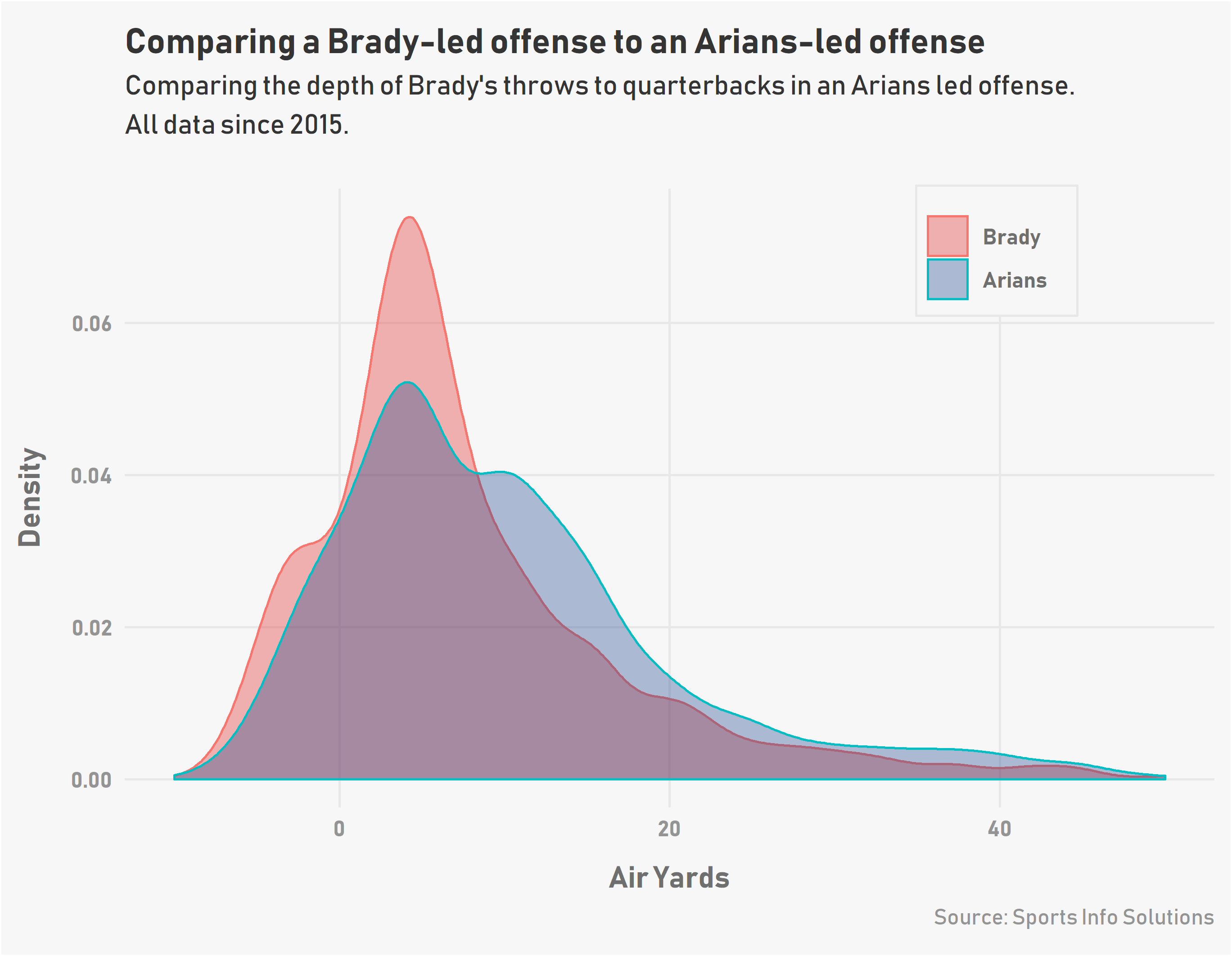
    It’s not a secret that Arians prefers his quarterbacks to push the ball downfield. A lot. And while it didn’t take much nudging to get Jameis Winston to be reckless with the football, Carson Palmer also posted an Average Depth of Target (ADoT) of 10.6 yards under Arians in 2015, followed by two more seasons above 9.0 to finish his career. Outside of an outlier season in 2017 in which he posted an ADoT of 8.8, Brady’s ADoT has generally been a shade under 8.0, including only 7.1 in 2019.

    Looking at the distribution of throw depth for both Brady and Arians’ quarterbacks, the difference becomes even more stark. Brady had a higher percentage of throws at every depth under 9 yards. Arians’ quarterbacks consistently attacked the intermediate and deep portions of the field more than Brady.

    More importantly, Brady wasn’t great last season in the intermediate and deep portions of the field that Arians likes to attack. On throws between 10 and 19 air yards, Brady’s EPA per Attempt (EPA/A) of 0.32 ranked 23rd best in the league, and his 52% positive percentage (percentage of plays with a positive Expected Points) was 29th. He fared better on throws that traveled at least 20 yards in the air, though his EPA/A of 0.34 still ranked 14th, and his Positive% of 41% ranked 12th.

    Some of this is due to his aging, but some of this can undoubtedly be linked to Brady’s receivers. Behind Julian Edelman, the Patriots’ most targeted receivers last season were James White and Phillip Dorsett. Brady will now be throwing to arguably the most dynamic receiving duo in the NFL in Mike Evans and Chris Godwin.

    Last year Godwin turned 95% of his catchable targets into catches, the highest rate in the league among receivers who were targeted at least 50 times. Jakobi Meyers and  Dorsett paced the Patriots in that metric at only 84% and 83%.

    On 45 targets between 10 and 19 yards, Godwin didn’t record a single drop and turned 94% of catchable targets into a reception, 5th best in the league. Edelman, Brady’s top target when attacking this part of the field, posted a Catchable Catch% of only 77% on intermediate throws. Mike Evans isn’t nearly as efficient as Godwin but is still among the most dangerous deep threats in the NFL, a role the Patriots were never able to fill last year despite their best efforts.

    Having receivers will undoubtedly help Brady, but it would be shocking to see Brady run the same offense Arians ran with Winston last season, or even the offense Arians ran with Palmer. Arians may utilize more quick-hitting route concepts than he has historically. As he’s aged, Brady has shown less willingness to stand the pocket, and also posted an Independent QB Rating of 63.3 when pressured last season, 26th in the league, neither of which mesh well with long-developing route concepts.

    Brady also found a lot of success passing from ’21’ personnel last season, something only four teams utilized more than the Patriots, and something the Bucs used sparingly. On 74 dropbacks from 21 last season Brady posted an IQR of 108.8 and an EPA/A of 0.19.

    Using SIS-WAR, which allows us to estimate team win totals, the Buccaneers would’ve been expected to win a game and a half more by replacing Winston with Brady, and this comes on the tails of a season where the Bucs already under-performed against their SIS-WAR  expected Wins and Pythagorean Wins total.

    It’s hard to project exactly what the Bucs offense will look like, or the kind of performance they will get from Brady, but it’s reasonable to think that average quarterback play and anything less than 30 interceptions is enough for the Bucs to make a legitimate playoff push.

  • Evaluating the best values in free agency by our Total Points metric

    It’s highly recommended that you read this article to get an understanding of our Total Points stat, which forms the basis of the evaluations below. Read it here.

    By Bryce Rossler

    Despite rumors that the NFL was considering pushing the start of its league year back, Roger Goodell and the owners ultimately decided that the show must go on. And even though the teams ultimately got started on schedule, the ensuing action was very much not your regularly scheduled programming.

    Allow us to summarize the most noteworthy items:

    Tom Brady announced he will not be re-signing with the Patriots, signalling the end of an era (dynasty?) in New England. We’ve also seen two big-ticket receivers traded.

    After months of cryptic tweets, the disgruntled Stefon Diggs was finally traded by the Vikings in exchange for a 2020 first-round pick, a 2020 fifth, a 2020 sixth, and a 2021 fourth. This occurred just hours after Bill O’Brien traded Deandre Hopkins and a 2021 fourth for the Cardinals’ 2020 second, a 2021 fourth, and David Johnson, who, apparently, is not retired. Now that you’re all up to speed, we’d like to highlight some of the best signings in free agency so far.

    Using our proprietary Total Points metric (read about it here) in tandem with average annual values (courtesy of Spotrac), we will assess the best values according to 2019 performance. Players are not always signed based on their most recent seasons, and age and guaranteed money play a factor, as well. However, this is a useful exercise for identifying deals of quality that is readily apparent. All values are expressed in dollars per Total Points/1,000 Snaps.

    While Byron Jones was the crown jewel of the cornerback market, the Jaguars’ Darqueze Dennard (3 years, $4.5M/year) is one of the best values of free agency thus far at a price tag of $125K/TP1000.

    Dennard has been very consistent the past three years, ranking 46th, 13th, and 45th in Total Points/1,000 in 2017, 2018, and 2019, respectively. As such, the Jaguars front office appears to have acquired a reliable and cost-controlled corner through his age-30 season.

    Elsewhere in Florida, the Dolphins killed two birds with one stone by stealing a young, productive edge rusher from the Bills. His 6.5 sacks in 2019 don’t pop off the page, but Shaq Lawson (3 years, $10M/year) ranked 10th in pressure rate (16%) among players with at least 200 pass rushing snaps. Furthermore, he ranked in the top ten at his position in Total Points/1,000 in both 2018 (9th) and 2019 (3rd).

    His cost of $135K/TP1000 looks particularly good when you consider what other edges got and how they compared in Total Points/1,000: Dante Fowler, Jr. ($341K/TP1000, 45th), Robert Quinn ($256K/TP1000, 11th), and Vic Beasley, Jr. ($282K/TP1000, 47th).

    The Raiders’ acquisition of Nick Kwiatkoski (3 years, $21M) is an under-the-radar signing for a team that needed to fortify its linebacker unit. Kwiatkoski had a breakout season for Chicago last year, ranking 24th in Total Points/1,000 at his position.

    At just $130K/TP1000, Kwiatkoski appears to be a better value than Christian Kirksey ($229K/TP1000), Joe Schobert ($269K/TP1000), Cory Littleton ($363K/TP1000), and Blake Martinez ($420K/TP1000), all of whom cost considerably more and were less efficient in 2019. It should be noted that Littleton was also signed by the Raiders and will join Kwiatkoski in Las Vegas.

    Moving to the NFC, the Lions have made not one, but two of the best value signings. While the Eagles and Bengals spent big on Javon Hargrave ($468K/TP1000) and DJ Reader ($448K/TP1000), respectively, the Lions poached a divisional rival to shore up their defensive interior. Former Chicago Bear Nick Williams (2 years, $10M) ranked sixth among defensive tackles in Total Points/1,000 in 2019 and was a comparatively huge bargain $101K/TP1000).

    At the second level, Detroit acquired a name that is more familiar to both the average fan and Head Coach Matt Patricia. Jamie Collins (3 years, $30M) ranked fourth among linebackers in Total Points/1,000 and cost the Lions just $138K/TP1000. Collins will turn 31 in October, so it remains to be seen how well the contract will age, but he should be able to immediately contribute to a defense that desperately needs linebacker help.

    It is purely coincidental that the five signings highlighted herein happened to be defensive players. The offensive market has not been as active (or as efficient), but there are still some big dominoes that have yet to fall. It may be that teams simply pay more for offensive production, but this nevertheless merits further investigation. Once the dust settles on free agency, we’ll circle back to put a bow on things.

  • New football podcast: Super Bowl props and previews

    LISTEN HERE

    Former NFL scout Matt Manocherian (@mattmano) of Sports Info Solutions and football analytics pioneer Aaron Schatz (@FO_ASchatz) of Football Outsiders (@fboutsiders) welcome SIS head of Business Development Corey March (@corey_march1) to the show to preview Super Bowl LIV. The trio opens with a look at some of the best prop bets for the big game (3:02), gives big-picture thoughts (10:08) and looks at the match-ups that will likely decide the outcome: 49ers offense vs. Chiefs defense (12:38), Chiefs offense vs. 49ers defense (23:12), and special teams/X-Factors (33:16).

    You can email the show with feedback at offthecharts@ww2.sportsinfosolutions.com and don’t forget to follow on Twitter @SportsInfo_SIS and Instagram @sportsinfosolutions. For more, check out: sportsinfosolutions.com footballoutsiders.com sportsinfosolutionsblog.com SISDataHub.com.

  • New football podcast: AFC/NFC Championship Game Review

    Former NFL scout Matt Manocherian (@mattmano) of Sports Info Solutions and football analytics pioneer Aaron Schatz (@FO_ASchatz) of Football Outsiders (@fboutsiders) break down last week’s AFC (1:33) and NFC (8:15) Championship games. Tune in next week for a full Super Bowl Preview show.

    You can email the show with feedback at offthecharts@ww2.sportsinfosolutions.com and don’t forget to follow on Twitter @SportsInfo_SIS and Instagram @sportsinfosolutions. For more, check out: sportsinfosolutions.com footballoutsiders.com sportsinfosolutionsblog.com SISDataHub.com.

  • A closer look at the Titans’ scoring tendencies

    By Logan King

    Coming off of two upset road wins in the AFC playoffs, the Tennessee Titans are scoring in a manner that is unmatched by any team in recent years. 

    Since Week 9, including postseason action, Tennessee has scored 39 offensive touchdowns while kicking just one field goal. When including the season’s first eight weeks, that total climbs to 56 touchdowns and eight field goals. Looking back to the beginning of the 2015 season, this 7-to-1 touchdown to field goal ratio (TD-FG Ratio) over the course of a season is unprecedented, with Tennessee almost doubling the ratio of the next closest team. 

    Season Scoring Ratio Leaders (Since 2015)
    Team Season TD FGs Made TD-FG Ratio
    TEN 2019 56 8 7.0
    NYG 2019 46 12 3.8
    PIT 2018 53 16 3.3
    KC 2018 77 26 3.0
    TEN 2015 41 14 2.9

    Shouldering some of the blame for this unbalanced scoring ratio are Tennessee’s struggles at the kicker position. The Titans have fielded four different kickers and are 8-of-18 on field goals (1-of-6, since Week 9). 

    A glimpse into Tennessee’s play calling tendencies provides a clear explanation for their scoring ratio. On fourth down, when compared to the rest of the NFL, the Titans have shown a propensity for conservative play calling outside of the red zone.

    The table below displays the decision-making comparison for the Titans and the rest of the NFL, broken down by area of the field. There is a clear upward trend in the Titans’ fourth down aggressiveness as they approach the end zone. Outside the red zone, Tennessee is notably more conservative than the rest of the league in its decision to go for it on fourth down. 

    4th Down Decision Making Comparison
    Team Field Position Not Go For It Go For It Plays
    Rest of NFL Inside RZ 78% 22% 590
    Rest of NFL Outside RZ, Opposing Side of Field 72% 28% 1,063
    Rest of NFL Own Side of Field 91% 9% 1,998
    Titans Inside RZ 40% 60% 10
    Titans Outside RZ, Opposing Side of Field 84% 16% 38
    Titans Own Side of Field 97% 3% 73

    Inside the red zone, the league reverts back to more conservative play calling while Tennessee nearly quadruples the rate at which they go for it on fourth down. This decision making has had a clear impact on their scoring ratio. As noted in Rich Hribar’s article for Sharp Football Analysis, under Ryan Tannehill, Tennessee has converted 18-of- 21 red zone third-and-fourth down opportunities into first downs or touchdowns. 

    Tennessee, while remarkably successful in its third and fourth down opportunities, has not necessarily shown considerable aggression on its third down red zone opportunities, when compared to the rest of the league. 

    The following table displays the play call comparison for the Titans and the rest of the NFL, broken down by area of the field. Conservative plays include all designed running plays (not scrambles) and screens, while aggressive plays include all designed pass plays (including scrambles) minus screens. 

    3rd Down Play Calling Comparison
    Team Field Position Conservative% Aggressive% AVG To-Go Plays
    Rest of NFL Inside RZ 25% 75% 5.5 1,041
    Rest of NFL Outside RZ, Opposing Side of Field 24% 76% 7.0 1,925
    Rest of NFL Own Side of Field 21% 79% 7.9 3,580
    Titans Inside RZ 29% 71% 5.9 28
    Titans Outside RZ, Opposing Side of Field 9% 91% 7.9 53
    Titans Own Side of Field 27% 73% 7.9 131

    On its own half of the field, Tennessee’s third-down play calling is less aggressive than its NFL counterparts. However, between the 50-yard line and the red zone, Tennessee becomes extremely aggressive with their third-down play calling. Though its average yards to go is higher in this situation than the rest of the league, a difference of less than one yard does not justify a nearly 15 percent higher rate of aggressive plays. 

    This disparity is likely due to Tennessee’s precarious kicker situation. In the red zone, the Titans actually become less aggressive in their third-down play calling, which has multiple possible explanations. While average yards to go in this situation are slightly higher than the rest of the league, Tennessee is comfortable with less aggressive third-down play calling as seen by their fourth-down tendencies in the red zone. Furthermore, having Derrick Henry in the backfield certainly justifies their conservative play calls on red zone third downs. 

    It will be interesting to see how the Titans’ scoring ratio holds up this weekend in their AFC Championship matchup with the Chiefs. If Tennessee can continue to convert in its high- leverage scenarios instead of settling for field goals, a Super Bowl could be on the horizon for the AFC’s hottest team.

  • New podcast: Conference Championship Preview

    Former NFL scout Matt Manocherian (@mattmano) of Sports Info Solutions and football analytics pioneer Aaron Schatz (@FO_ASchatz) of Football Outsiders (@fboutsiders) discuss some of the unexpected results from last week’s NFL Divisional Round (0:33) and then preview the Titans-Chiefs AFC Championship game (3:57) and the Packers-49ers NFC Championship game (14:10).

    You can email the show with feedback at offthecharts@ww2.sportsinfosolutions.com and don’t forget to follow on Twitter @SportsInfo_SIS and Instagram @sportsinfosolutions. For more, check out: sportsinfosolutions.com footballoutsiders.com sportsinfosolutionsblog.com SISDataHub.com.

  • New football podcast: Inside the Divisional Round

    Former NFL scout Matt Manocherian (@mattmano) of Sports Info Solutions and football analytics pioneer Aaron Schatz (@FO_ASchatz) of Football Outsiders (@fboutsiders) discuss the potential end of an era for the Patriots (0:47), NFL coaching hires (3:05) and preview all four Divisional Round playoff games: Vikings at 49ers (6:45), Titans at Ravens (13:05), Texans at Chiefs featuring SIS’s Cole Ratliff (@ColeRatliff23) discussing Patrick Mahomes (18:31), and Seahawks at Packers (25:04).

    You can email the show with feedback at offthecharts@ww2.sportsinfosolutions.com and don’t forget to follow on Twitter @SportsInfo_SIS and Instagram @sportsinfosolutions. For more, check out: sportsinfosolutions.com footballoutsiders.com sportsinfosolutionsblog.com SISDataHub.com.

  • Who were the best quarterbacks throwing long passes in 2019?

    By: Kyle Rodemann

    The deep ball is one of the most exciting plays in the NFL. Momentum can change at the drop of a hat the instant the football leaves the quarterback’s hand. Some quarterbacks are known as deep ball throwers, and this was noted during Sunday’s NFC Wild Card game  when Cris Collinsworth stated that Russell Wilson is the best deep passer in the NFL during the game’s broadcast. Was he right? This article will answer that question.

    For our purposes, we’re referring to passes thrown at least 20 yards downfield, unless otherwise stated.

    The Precision Passers

    Which quarterbacks are most accurate with their deep throws? The table below shows the players with the highest Catchable Percentage on passes that travel at least 20 yards down the field (minimum 30 attempts). This stat looks at the passes that should be caught by the receiver based on where the pass is placed. Keep track of the players on this list, and compare this list to the “gunslinger” table that follows.

    QuarterbackCatchable %
    Jimmy Garoppolo72%
    Matt Ryan67%
    Gardner Minshew60%
    Drew Brees60%
    Daniel Jones60%
    Kirk Cousins59%
    Carson Wentz/Baker Mayfield58%

     This list shows how dominant Jimmy Garoppolo has been when throwing the deep ball, throwing an accurate pass 72% of the time. Compare that to Jameis Winston’s 54%, and you can see why Winston was prone to interceptions.

    In terms of who is completing deep passes most often, Garoppolo leads the league with a 59% completion percentage (19-of-32). He’s followed by Gardner Minshew (22-of-45, 49%), Patrick Mahomes (29-of-62, 47%), Drew Brees (14-of-30, 47%) and Dak Prescott (33-of-74, 45%). 

    The Gunslingers

    A “gunslinger” is a quarterback that takes chances downfield by taking deep shots to their receivers. These quarterbacks are notorious for throwing the deep ball. The 2019 season had plenty of these quarterbacks, with the top gunslinger being known as a risk-taker. Here are the 2019 deep ball attempt leaders:

    QuarterbackNumber of Throws
    Jameis Winston101
    Aaron Rodgers88
    Dak Prescott74
    Philip Rivers73
    Russell Wilson71
    Carson Wentz69
    Deshaun Watson67

    Jameis Winston was a very aggressive quarterback in 2019. He threw 13 more deep balls than the second quarterback on the list, Aaron Rodgers. This comes as no surprise since Winston is known to chuck the ball deep to his top receivers, Chris Godwin and Mike Evans. Carson Wentz makes a surprise appearance on this list with 69 deep throws. This is a surprise considering most of his starting receivers were injured for a large part of the season. 

    The Touchdown Machines

    Touchdown percentage looks at the percentage of deep throws that result in a touchdown. The following list can help determine where negative regression is possible, as a high touchdown percentage is often unsustainable. Here is the table (minimum 30 attempts):

    QuarterbackTD%
    Jimmy Garoppolo22%
    Patrick Mahomes19%
    Daniel Jones17%
    Kirk Cousins14%
    Drew Brees13%
    Lamar Jackson13%
    Dak Prescott12%
    Tom Brady12%

    Garoppolo again leads this list of deep ball passers. He not only is throwing an accurate ball, but is finding success scoring touchdowns on such plays. Maybe this means Kyle Shanahan will draw up more shots for his quarterback in the postseason? Daniel Jones also makes it on his second list, showing that the rookie has a knack for throwing deep. Keep an eye on him in 2020.

    The Most Impactful

    Points Earned is one way to determine which quarterbacks have made the largest positive impact while throwing the deep ball. Here is a quick explanation of Points Earned, as written by Alex Vigderman:

    The core assumption of passing Points Earned is that each throw has a certain expected outcome based on information like the route, the depth, and the coverage. From that point, the passer and receiver split responsibility for how well they perform above that expectation. Throwing off-target passes and deserved interceptions (caught or not) will bury a signal-caller, while he will be rewarded for leading receivers to more yards after catch and making something out of a broken pocket.

    A more in-depth explanation can be found here. This stat shows which quarterback has helped their team win the most while throwing the deep ball. Check out the league leaders below:

    QuarterbackPoints Earned
    Russell Wilson31.4
    Kirk Cousins28.0
    Dak Prescott23.3
    Gardner Minshew22.3
    Jimmy Garoppolo22.1
    Kyler Murray19.6
    Patrick Mahomes18.6

    Wilson rates best. His 31.4 points is three higher than Kirk Cousins’ 28.0 at number two. This stat shows how impactful Wilson has been on his deep throws.

    Getting specific, Wilson was 30-of-71 (42%) with six touchdowns, two interceptions and 40 catchable throws (56% of throws were catchable). Wilson averaged just over 30 air yards per completion, which ranked second to Ryan Tannehill’s 31 among quarterbacks who completed at least 10 such passes.

    Kyler Murray is a surprise name on this list. The exciting rookie has room to grow in Kliff Kingsbury’s offense.

    Conclusion

    Collinsworth was right in this regard: Wilson is definitely the most impactful deep passer. But there are plenty of other quarterbacks right there with him, including a few who we’ll see this weekend in the Divisional Round. We’ll see which one comes out on top.