Category: MLB

  • Poor Alex Bregman!

    Poor Alex Bregman!

    If you’re someone who has been watching baseball avidly for more than a decade, chances are you have certain instinctive reactions to the ball hitting the bat. But there’s one that you’ve had to reset: whether or not a ground ball up the middle (past the pitcher’s mound) is going to produce a baserunner by hit or error.

    Let’s quantify that just to be able to better understand the difference.

    If you grew up in a time in which shifts were highly unusual, the ball up the middle consistently produced a positive result for the batter.

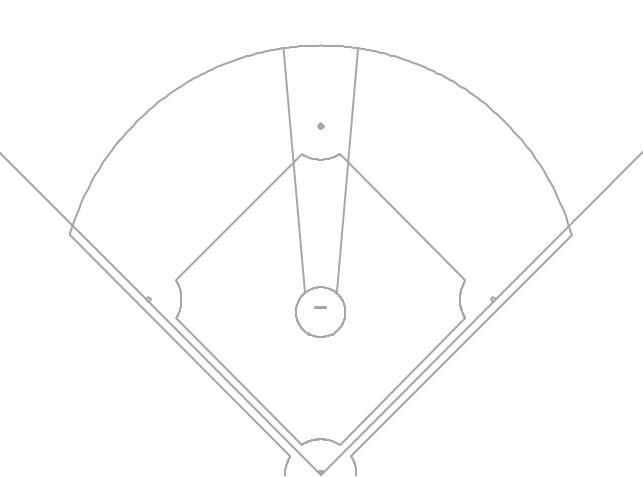
    In 2010, there were just over 3,300 ground balls that were hit in-between the two lines shown in this image. This was a season when shifting was highly unusual.

    Up the middle

    Batters reached base on those balls 70% of the time.

    But in 2019, it’s a different game. There have been just over 2,000 of those types of ground balls hit there.

    Batters are reaching base only 48% of the time.

    Teams have grown more successful at protecting this part of the field, regardless of whether a shift is on, as this chart shows.

    Reached Base Rate – Ball Hit Up The Middle
    2010 – Straight-Up Defense 70%
    2019 – With Shift On 35%
    2019 – Straight-Up Defense 59%

    Batted ball distributions are such that an individual player is only going to be minimally affected by this.

    The one “suffering” the most this season is Alex Bregman, who has reached in 2-of-12 instances in which he hit a ground ball up the middle (he reached for the second time over the weekend).

    This jibes with how defenses are playing Bregman.

    In 2018, he was defended straight up on about 70% of the ground balls and short line drives he hit. In 2019, that has dropped to an almost 50-50 split.

    We mentioned Bregman is 2-for-12 in reaching on balls up the middle this season. Prior to this season, he was 16-for-22 in reaching base when hitting a ground ball there.

    Bregman enters the day hitting .269. If he had gotten hits on even five more ground balls up the middle, he’d be batting .283, almost exactly what he batted in 2017 and 2018.

    Longer term, Giancarlo Stanton can do enough damage to where hitting ground balls up the middle isn’t that important to him. He’s reached 23 percent of the time when hitting a ball over the middle the last four seasons, lowest of anyone with at least 30 ground balls. You would figure the top of the list features hitters who are unpredictable in their hitting patterns, meaning the defense can’t shift him. Hunter Pence is one. He’s at the top, having reached 83% of the time (45-of-54).

    Pence is one of the fortunate ones. More hitters are finding it harder to push balls through. And more fans are having to get used to seeing those hitters repeatedly frustrated.

  • Remembering Mike Mussina as a Hall-of-Fame Fielder

    By Mark Simon

    This is a rare year in which the best defensive player in the Baseball Hall of Fame class is a pitcher.

    Former Yankees and Orioles pitcher Mike Mussina won seven Gold Gloves, the first and last coming 12 years apart (1996 and his final season, 2008). Only five others won that many at that position, led by Greg Maddux, whose 18 are the most of any player at any position.

    Trying to quantify Mussina’s excellence is challenging. Pitchers don’t typically have highlight reels to showcase their best plays, instead they have ones that show their best pitches. The one time a ball hit at Mussina was a national story was when he got drilled by a line drive hit by Sandy Alomar Jr. in 1998, which resulted in a broken nose. Fielding a comebacker takes skill, but often isn’t viewed as a great play.

    SIS began calculating Defensive Runs Saved for 2003, so that omits a good portion of Mussina’s career. The best of his final six seasons was 2003, when he saved seven runs, second-most among pitchers in MLB. That season he had 47 chances without making an error and allowed nine stolen bases in 19 attempts. He totaled six Defensive Runs Saved in his last five seasons.

    Mussina’s Gold Gloves weren’t so much about great plays as they were consistency.

    “It was the accumulation of many things,” said Mussina’s former Orioles teammate, Chris Hoiles. “He could get everything that was hit at him. And he could move laterally off the mound. When you have an extra infielder in there (as a pitcher) it makes the defense that much stronger.”

    One of his coaches at Stanford, Dean Stotz, went one step further.

    “He could have played infield if he had to,” Stotz said by phone last week. “He has great hand-eye coordination. He had the agility to throw from different arm angles. He was always a great fielder.”

    Former Yankees catcher John Flaherty, now a broadcaster for YES, noted that we shouldn’t be too surprised by Mussina’s current job coaching basketball at Montoursville High in central Pennsylvania.

    “He finished in a perfect fielding position,” Flaherty said. “When he finished his delivery, he was almost like a basketball defender.”

    For much of the early part of his career, Mussina stood out for being able to limit the running game. In his first seven seasons, opponents were 42-for-87 (48%) in steal attempts against him and his catchers, a time when the average yearly success rate was usually around 70%. Mussina was deliberate in his preparation to make pitches, leaning forward before carefully rising into a standing position.

    “He played mind games with baserunners,” Hoiles said, explaining how Mussina would hold the ball in the set position a few extra beats in some instances, and quick pitch in others. “He gave me the opportunity to throw someone out each time there was someone on base. He had a very quick move to the plate.”

    Mussina, known for his perfectionist tendencies, was modest on his Hall of Fame conference call last week, saying of his baserunner holding: “I was decent at it.”

    And though he couldn’t cite a play he made in the majors, he seemed proud regarding his defensive accomplishments.

    “I feel good about the plays I made,” Mussina said. “It wasn’t just two bounces back to me and flip it to first. I feel like I helped myself being able to field my position.”

    He helped both his team in games and his Hall of Fame hopes, too.

    Most Gold Gloves – Pitchers
    Greg Maddux 18
    Jim Kaat 16
    Bob Gibson 9
    Bobby Shantz 8
    Mike Mussina 7
    Mark Langston 7


  • Which Starting Pitchers Have Had Their Hard-Hit Rates Change the Most?

    by Jon Becker

    On Friday, I identified which hitters have changed their hard-hit rates the most from 2018 to 2019, whether it came in the form of a large increase or large decrease. Now, I’d like to do the same with starting pitchers.

    Note that this version of hard-hit rate is calculated as Hard-hit balls/(At-Bats + Sacrifice Flies). Our denominator rewards a pitcher for strikeouts. The denominator on Statcast and FanGraphs is “Batted Balls” which does not reward the pitcher for a strikeout.

    The number you get from the calculation allows you to say “Pitcher X has allowed a hard-hit ball in Y% of the at-bats against him.”

    I’ll start with the three pitchers who’ve improved their hard-hit rate the most. I set a minimum of 400 at-bats against in 2018 and 200 this season; 95 pitchers fit that criteria, though not all are starting pitchers this season.

    1. Lucas Giolito, 26.5% to 20.2% (6.3% decrease)

    It would be hard to argue that Giolito isn’t the most improved pitcher this season, and his large drop in hard-hit rate reflects that. His ERA has been nearly halved (6.13 to 3.15), with his K% almost doubling (16% to 30%). His most dramatic improvement has come with his signature pitch, the changeup: his hard-hit rate has dropped 11% on that pitch, from 27% to 16%.

    2. Cole Hamels, 30.9% to 25.8% (5.1% decrease)

    The Chicago renaissance continues for the veteran southpaw, who’s surely hoping that he won’t be on the shelf for too much longer with a mild oblique strain. In close to a full season’s worth of starts as a Cub, Hamels has been as good as ever:

    29 starts, 2.71 ERA, 176 IP, 146 H, 171 K, 58 BB, 15 HR allowed

    His hard-hit rate since being traded to the Cubs is 26.7%, putting him in 22nd place of the 64 pitchers who have at least 500 at-bats against in that time.

    3. Stephen Strasburg, 22.0% to 17.0% (5.0% decrease)

    Strasburg was 15th out of the 95 pitchers in our pool with his 22% had-hit rate in 2018, which is obviously excellent, but he’s taken it to another level in 2019. His 17% hard-hit rate is over 3% ahead of Giolito for best in MLB this year of the 95 qualifiers; the gap between him and Giolito is bigger than the gap between Giolito and Max Scherzer, who’s in 12th place.

    Strasburg’s elite hard-hit rate puts him in company with much smaller samples–his hard-hit rate is similar to relievers Aaron Bummer, Kyle Crick and Jake Diekman, who’ve faced about 40% of the batters Strasburg has.

    And now for the arms whose hard-hit rates have gone up the most:

    1. Nick Pivetta, 22.6% to 33.5% (10.9% increase)

    A common pick by analysts to break out in 2019 following a 2018 where he struck out 188 batters in 164 innings and, the Phillies righty has unfortunately gone backward this season, with an ugly 5.81 ERA in 12 starts and just 54 strikeouts in 66 2/3 innings. He’s been a bit better after a short minors stint, with a 4.84 ERA in eight starts, but he’s allowed 11 homers and still has a hard-hit rate of 28.4% in that time.

    2. Mike Foltynewicz, 24.5% to 35.2% (10.7% increase)

    Folty’s currently in AAA after an abysmal 11 starts with the big league club after coming off the IL, wherein he struck out just 7.6 batters per 9 (down from 9.9 last season). He allowed 16 homers in 59 1/3 innings, just one fewer than he allowed all of last season, when he completed 183 innings and faced almost three times as many batters. His time down at Gwinnett has gone somewhat better, with a 4.08 ERA in 17 2/3 innings, along with 19 strikeouts and four walks. He’s allowed 22 hits, but no home runs.

    3. Kyle Freeland, 24.8% to 34.7% (9.9% increase)

    Every year, we see pitchers who take pretty large steps back, but none in recent memory have fallen harder and faster than Freeland, who’s elicited memories of Steve Blass and Ricky Romero. After a 2.85 ERA in 2018 led to a fourth-place Cy Young Award finish and a staggering 8.4 WAR (per Baseball-Reference), Freeland began this year with a 7.13 ERA in 12 starts, allowing 16 home runs. He was then sent down to AAA to try to work out those kinks… where he then had an ERA of 8.80 in 6 starts. Undeterred, the Rockies brought him back up for a start on Saturday; he gave up nine hits and five runs in four innings, with a hard-hit rate of 30% (6-for-20).

    Here’s the top 10 pitchers and bottom 10 pitchers in hard-hit rate change.

    PitcherHardHitRate 2018HardHitRate 2019HHR Change
    Lucas Giolito26.5%20.2%-6.3%
    Chris Stratton33.9%28.5%-5.4%
    Stephen Strasburg22.0%17.0%-5.0%
    Kenta Maeda26.3%21.4%-4.9%
    Luis Castillo28.5%23.8%-4.7%
    Shane Bieber32.7%28.4%-4.3%
    Zack Greinke30.6%26.6%-4.0%
    Mike Minor29.6%25.9%-3.7%
    Tyler Mahle31.7%28.1%-3.6%
    Dylan Bundy25.1%21.8%-3.3%

    Largest Increase

    Jake Arrieta21.6%29.9%8.3%
    Zach Eflin22.0%30.6%8.6%
    Vince Velasquez23.3%32.1%8.8%
    J.A. Happ22.2%31.0%8.8%
    Justin Verlander18.2%27.2%9.0%
    Aaron Nola17.6%26.6%9.0%
    CC Sabathia21.5%30.6%9.1%
    Kyle Freeland24.8%34.7%9.9%
    Mike Foltynewicz24.5%35.2%10.7%
    Nick Pivetta22.6%33.5%10.9%
  • Which Batters Have Changed Their Hard-Hit Rate The Most?

    By Jon Becker

    Now that we’re after the All-Star Game and have seen more than half of 2019’s regular season games come and go, we’ve got a plenty large sample to evaluate players this season. One of my favorite things to do is look at players who’ve changed drastically–positively or negatively–from season to season. Today, I’ll be taking a look at the batters who’ve changed their hard hit rates the most, for better or for worse.

    Note that this version of hard-hit rate is calculated as Hard-hit balls/(At-Bats + Sacrifice Flies). Our denominator penalizes a hitter for strikeouts. Those you would see from Statcast and on FanGraphs use a denominator of “Batted Balls” which does not incorporate strikeouts.

    The number you get from our calculation allows you to say “Player X has recorded a hard-hit ball in Y% of his times at bat.”

    Let’s start with the top three hard-hit rate improvements, from the 2018 season to the first half of this season. A minimum of 400 at-bats last season and 200 at-bats this season are required to qualify.

    1. Scott Kingery, 19.2% to 34.7% (15.5% increase)

    When you increase your triple-slash from .226/.267/.338 (.605 OPS) to .292/.344/.545 (.889 OPS), you have to have changed something. For Kingery, that’s hitting the ball way harder. He’s made an even more dramatic increase against left-handed pitching, raising his hard-hit rate against southpaws from 16.9% to 53.7%. That’s the highest hard-hit rate against lefties this year of those with at least 50 at-bats against them.

    2. Cody Bellinger, 29.3% to 42.7% (13.4% increase)

    As Mark Simon noted on Monday, the NL’s leader in OPS+ and leader in DRS amongst non-catchers and its leading MVP candidate is also its leader in hard-hit rate. He was middle of the pack in 2018 (75th out of 179 hitters with at least 400 at-bats), but has been anything but this season. His most pronounced change has been against sliders, raising his hard-hit rate against those pitches from 28.2% to 50%. He has the highest hard-hit rate this season against that pitch type (minimum 25 at-bats ending with sliders).

    3. Josh Bell, 26.9% to 38.1% (11.2% increase)

    Perhaps the biggest breakout of the season, Bell came into the season with a career OPS of .784 and a WAR  of 2.2 (per Baseball-Reference), largely due to well-below-average defense at first base. This season? A 1.024 OPS and 3.0 WAR to go along with vastly improved defense (-9 DRS last year, 0 this year). The switch-hitting Bell has gotten better from both sides of the plate, with a 11.1 percentage-point increase as a righty and 10.9 percentage-point jump from the left side.

    And now, for those who’ve seen their hard-hit rates plummet the most:

    1. Jackie Bradley Jr., 29.3% to 22.9% (6.4% decrease)

    Bradley’s put his March/April funk (.406 OPS) behind him, slashing .272/.377/.497 (.874 OPS) since May 1, but his hard-hit rate hasn’t quite rebounded yet. His hard-hit rate since the beginning of May is actually lower than his season average, at 21.4%.

    2. Rougned Odor, 33.4% to 27.4% (6% decrease)

    After a slightly below-average season in 2018 (.253/.326/.424, for a 97 OPS+), Odor’s production has cratered in 2019, as he is batting just .198/.264/.407 (an OPS+ of 69). The lefty swinger actually hasn’t been much worse against same-sided pitching (a 4 percentage-point decrease), but righties have given him trouble (a 6.9 percentage-point decrease). Fortunately for Odor, he’s still just 25 years old, so there is time to improve.

    3. Matt Carpenter, 35.4% to 29.6% (5.8% decrease)

    Of the three trailers on this list, Carpenter was by far the best in 2018, putting up a  .257/.374/.523 triple-slash, setting a career high with 36 homers, and finishing 9th in NL MVP voting. He’s currently in the midst of his first career below- average season (88 OPS+) and has struck out in almost a quarter of his plate appearances, by far the highest rate of his career. 

    Here’s the top 15 and bottom 15:

    Batter 20182019Change
    Scott Kingery19.2%34.7%15.5%
    Cody Bellinger29.3%42.1%12.8%
    Josh Bell26.7%37.9%11.2%
    Carlos Santana27.3%38.0%10.7%
    Justin Smoak23.2%33.6%10.4%
    Cesar Hernandez17.9%27.6%9.7%
    Jonathan Schoop20.5%29.9%9.4%
    Anthony Rendon32.3%41.1%8.8%
    Rhys Hoskins25.0%33.0%8.0%
    George Springer26.1%34.0%7.9%
    Yasmani Grandal29.3%37.2%7.9%
    Ozzie Albies28.2%35.5%7.3%
    Nomar Mazara28.6%35.8%7.2%
    Dansby Swanson26.6%33.7%7.1%
    Marcus Semien25.8%32.7%6.9%
    Freddie Freeman32.7%39.6%6.9%
    Nick Markakis35.6%33.2%-2.4%
    Edwin Encarnacion30.8%28.1%-2.7%
    Freddy Galvis30.2%26.4%-3.8%
    Mitch Haniger28.0%24.0%-4.0%
    Nick Ahmed30.8%26.8%-4.0%
    Stephen Piscotty33.5%29.0%-4.5%
    David Peralta37.7%33.0%-4.7%
    Yonder Alonso28.9%24.2%-4.7%
    Todd Frazier30.4%25.6%-4.8%
    Lorenzo Cain31.5%26.7%-4.8%
    Andrew McCutchen32.5%27.4%-5.1%
    Nicholas Castellanos36.3%31.2%-5.1%
    Matt Carpenter35.3%29.9%-5.4%
    Rougned Odor33.3%27.1%-6.2%
    Jackie Bradley Jr.29.1%22.6%-6.5%
  • Jeff McNeil’s excellence is multi-faceted

    In this week’s SIS Baseball Podcast, our opening monologue is on the excellence of Mets utility man Jeff McNeil. Here’s some additional information to supplement what we talked about.

    By Mark Simon

    On SNY’s broadcast of last Friday’s Mets-Yankees game, analyst Ron Darling described 27-year-old Jeff McNeil as the kind of player that MLB had been waiting for.

    This had been in reference to McNeil’s ability to repeatedly beat defensive shifts, as he did in that game with a ground ball infield single to conclude an eight-pitch at-bat in the first inning against James Paxton. But it could be applied in a number of different areas.

    Despite the Mets’ many shortcomings, McNeil has turned into an All-Star, though the scoreboard at Progressive Field ran Jacob deGrom’s picture when he came to bat. He’ll be a fun player to watch in the second half for a number of reasons.

    For one thing, there’s the aforementioned hitting against the shift. McNeil is hitting .472 on ground balls and short line drives when shifted (he’s 25-for-53 … the .449 we noted on the podcast omitted shifts in which the infield was in or in at the corners in addition to shifting). Sports Info Solutions has a plus-minus system that rewards hitters who get hits versus shifts on balls that aren’t typically hits versus a straight-up defense. McNeil is a plus-9, meaning that the 22 hits are nine more than he would have gotten had the defense played straight-up against him. The plus-9 is the best in the majors this season.

    McNeil essentially baits the defense into shifting him. When the defense plays him straight up, he’s hit 39 of 46 ground balls and short line drives to the pull side (85%). But when the defense shifts him, he’s pulled 33 of 53 (62%). He finds the open hole either way.

    McNeil is challenging not just because of where he hits the ball, but because you can’t beat him with any pitch. He’s hitting .363, .375 and .316 against the three pitch types he sees most frequently (fastballs, changeups and sliders). He’s hitting “only” .259 when an at-bat ends with a curveball, but he has three doubles and two home runs in 27 at-bats against them, so the result is positive run value against all four pitch types.

    McNeil can do this as one of the game’s most aggressive hitters. He’s second in the majors in swing rate (58%) behind Jonathan Schoop of the Twins (59%). McNeil swings a lot, but he is still discerning. His 84% swing rate on pitches in the strike zone leads the majors. Since he is swinging at so many good pitches, it keeps his strikeout total down. His strikeout rate of 12% ranks 12th-lowest among batting-title qualifiers. His 11 times being hit by a pitch helps offset a low walk rate and push his on-base percentage to .409.

    Jeff McNeil MLB Ranks
    BA 0.349 1st
    Swing Rate 58% 2nd
    Strikeout Pct 12% 12th

    Racking up all these hits put him in an elite class, as one of three players with at least 170 hits in his first 500 at-bats since 1935, per the Elias Sports Bureau. The others are Hall of Famers Wade Boggs and Joe DiMaggio.

    McNeil isn’t someone with great speed. Three steals in eight attempts (including one after the infield single referenced atop this piece) have brought down his baserunning metrics. But he’s hit into only three double plays in 48 opportunities. His 6% double play rate is below the MLB average of 10%.

    Lastly, what makes McNeil distinct is that he can fill a Ben Zobrist-like role on the roster. He’s played four positions this season – second base, third base, left field and right field, and totaled four Defensive Runs Saved. Though he may not be a Fielding Bible Award candidate at any of these positions, his combined effectiveness may put him in the running for our Multi-Position honor.

    Simply put, Darling is right. McNeil’s the kind of player that baseball should embrace. His play should ensure that there won’t be any cases of misidentification in what should be a very bright future.

  • New podcast: John Dewan & Ben Lindbergh + Midseason Review

    On the SIS Baseball Podcast, Mark Simon (@MarkASimonSays), senior research analyst for Sports Info Solutions, shows us how baseball analytics are cool, interesting, and fun. SIS develops analytics and provides them to MLB teams, media, and fantasy baseball outlets. On the podcast, we’ll give you a peek into our world, talk to important people around the industry about analytic storylines, and share what we find to be cool, interesting and fun.

    In this episode, Mark begins with an interview of the founder of Sports Info Solutions, John Dewan (@FieldingBible), where they discuss everything from the history of baseball analytics to advice on how to create new stats today.

    Then, Mark is joined by writer/podcaster Ben Lindbergh (@BenLindbergh), whose new book The MVP Machine explores the forward-thinking use of analytics in player development. They take closer looks at Cody Bellinger, Mookie Betts, catcher framing, The Mike Trout Award For Analytic Excellence and more.

    Finally, Mark sits down with Andrew Kyne (@Andrew_Kyne) to go around the horn on the midseason advanced stat leaderboards. They also answer a listener e-mail on what stat they would have like to have known 50 years ago, hand out awards for Zack Greinke-ness and “Catcher Balance.”

    This episode is brought to you by SISbets.com, the website that can help you beat the Prop Betting odds. Click here to create a free SISbets.com trial account.

  • Which teams allow hard-hit balls least often?

    By Jon Becker

    In the final installation of our hard-hit balls series at the Sports Info Solutions Blog, we’ll take a look at which teams’ pitchers have allowed the lowest hard-hit rates.

    Note that this version of hard-hit rate is calculated as Hard-hit balls/(At-Bats + Sacrifice Flies). Our denominator rewards a pitcher for strikeouts. The denominator on Statcast and FanGraphs is “Batted Balls” which does not reward the pitcher for a strikeout.

    The number you get from the calculation allows you to say “Team X’s pitchers have allowed a hard-hit ball in Y% of the at-bats against them.”

    1. Nationals (24.4%)

    It figures that the team with the third-lowest starting pitcher ERA in baseball would do well by this metric, with Washington just edging out the next-closest team in hard-hit rate by two-tenths of a percentage point. As Mark Simon noted on Wednesday, Stephen Strasburg leads the majors with a ridiculously low 18.3% hard-hit rate. Max Scherzer (23.3%) is surprisingly not at the top. He’s actually a bit behind rotation-mate Anibal Sanchez (11th overall at 22.6%).

    2. Red Sox (24.6%)

    Boston may not have Stephen Strasburg’s MLB-best hard-hit rate, but they do have Chris Sale in fourth place (21.0%) and Eduardo Rodriguez in 6th place (21.5%). The BoSox are the best in baseball at limiting hard contact from right-handed batters, holding them to a 23.8% hard-hit rate. Matt Barnes is third-best among relievers with a 15.0% hard-hit rate allowed.

    3. White Sox (25.7%)

    Now this team sure is surprising. The White Sox have the fifth-highest ERA in baseball (5.04) and yet they’re in the 90th percentile at limiting hard contact. It sure helps that they have Lucas Giolito’s 20.1% hard-hit rate, leading the American League and behind only Strasburg in all of Major League Baseball. Lefty reliever Aaron Bummer doesn’t qualify for the individual pitcher leaderboard (he doesn’t have 200 AB against), but if we reduced the minimum to 100 AB against, he’d rank 5th in baseball (16.5%).

    4. Rays (25.9%)

    Tampa Bay might be unorthodox with how it uses its pitching staff, but they are getting good results out of it. Blake Snell leads their qualified pitchers with a 21.8% hard-hit rate, but all five of their qualifiers (Snell, Yonny Chirinos, Charlie Morton, Ryan Yarbrough, Jalen Beeks) all come in under 30%. Tyler Glasnow was under 20% before landing on the IL with a forearm strain, and reliever Emilio Pagan clocks in at 20.5%.

    5. Mets (26.6%)

    It’s been a season to forget for the Mets, but at least its pitching staff is elite at preventing rockets off the bat. Noah Syndergaard (21.6%) is ahead of ace Jacob deGrom (23.7%), with Zack Wheeler not too far behind at 24.8%. Oft-maligned closer Edwin Diaz is at 29.5%, almost double his 15.2% from 2018.

    Here’s where all 30 teams rank.

    1Nationals24.4%
    2Red Sox24.6%
    3White Sox25.7%
    4Rays25.9%
    5Mets26.6%
    6Cubs27.3%
    7Reds27.4%
    8Yankees27.6%
    9Astros27.7%
    10Brewers27.9%
    11Orioles27.9%
    12Indians28.1%
    13Dodgers28.3%
    14Pirates28.4%
    15Braves28.7%
    16Twins28.8%
    17Mariners29.0%
    18Marlins29.1%
    19Cardinals29.2%
    20Blue Jays29.3%
    21Rockies29.3%
    22Athletics29.5%
    23Phillies29.6%
    24Tigers30.1%
    25Diamondbacks30.3%
    26Padres30.4%
    27Angels30.8%
    28Royals30.9%
    29Giants31.3%
    30Rangers32.1%
  • MLB Leaderboard: Who allows hard contact least often?

    By Mark Simon

    Minimizing hard contact in 2019 is a significant challenge for a pitcher, given the rate at which balls are flying outfield fences. But there are still pitchers who are quite good at it.

    Let’s take a look at the top five starting pitchers in limiting hard-hit balls.

    Note that this version of hard-hit rate is calculated as Hard-hit balls/(At-Bats + Sacrifice Flies). Our denominator rewards a pitcher for strikeouts. The denominator on Statcast and Fangraphs is “Batted Balls” which does not reward the pitcher for a strikeout.

     The number you get from the calculation allows you to say “Pitcher X has allowed a hard-hit ball in Y% of the at-bats against him.”

    1. Stephen Strasburg, Nationals (18.3%)

    Stephen Strasburg probably deserves a little better than his 3.64 ERA. His strikeouts, walks, home runs combination produces a FIP of 3.18 and his MLB-best hard-hit rate seems to validate that he’s getting the most out of his pitches this season.

    Strasburg has done this with a fastball that has declined in velocity, to an average of 94 MPH. But his curveball and changeup have produced excellent results, giving him three pitches that he can use to limit damage.

    2. Lucas Giolito, White Sox (20.1%)

    It took Lucas Giolito a few years, but he’s finally fulfilling his promise after being heralded as one of the top pitching prospects in MLB. After repeatedly getting hit hard in 2018, Giolito has turned it around with a fastball, changeup and slider, all of which have played among the best of their type. The contact rate against him has dropped 11 percentage points from last season to this season, and as such, the hard-hit rate has dipped too.

    3. Dylan Bundy, Orioles (20.3%)

    That Dylan Bundy is on this list is a surprise, given that he’s allowed 20 home runs in 91 innings pitched this season. But what might explain it is that Bundy is giving up a lot of contact that doesn’t meet our classification of “hard” but can still do damage. His “medium-contact” rate is 40%, which is sixth-highest. By comparison, Giolito has allowed a medium-contact ball in 33% of the at-bats against him and Strasburg 36%.

    4. Chris Sale, Red Sox (21.0%)

    Despite an ERA of 4.04, Chris Sale is still a presence here because of the volume of hitters he eliminates via strikeout (153 in 107 innings). Of the hitters that are left, more have caught up to Sale’s fastball, which he’s throwing at 93 MPH on average these days, two MPH slower than he did in his dominant 2018.

    5. Yu Darvish, Cubs (21.0%)

    Another surprise. Darvish has allowed a home run on 25 percent of the fly balls against him this season, so when he’s been hit hard, he’s paid the price considerably. But this rate could be showing that he’s still got something left if he can find a way to harness pitches to supplement a cutter that is pretty sharp.

    Rank Name Nickname HHRate
    1 Stephen Strasburg Nationals 18.3%
    2 Lucas Giolito White Sox 20.1%
    3 Dylan Bundy Orioles 20.3%
    4 Chris Sale Red Sox 21.0%
    5 Yu Darvish Cubs 21.0%
    6 Eduardo Rodriguez Red Sox 21.5%
    7 Noah Syndergaard Mets 21.6%
    8 Blake Snell Rays 21.8%
    9 Gerrit Cole Astros 21.9%
    10 Kenta Maeda Dodgers 22.0%
    11 Anibal Sanchez Nationals 22.6%
    12 Max Scherzer Nationals 23.3%
    13 John Means Orioles 23.5%
    14 Jacob deGrom Mets 23.7%
    15 Luis Castillo Reds 23.7%
    16 Yonny Chirinos Rays 24.2%
    17 Charlie Morton Rays 24.5%
    18 David Price Red Sox 24.7%
    19 Chris Bassitt Athletics 24.8%
    20 Zack Wheeler Mets 24.8%
    21 James Paxton Yankees 25.5%
    22 Mike Minor Rangers 25.6%
    23 Matthew Boyd Tigers 25.7%
    24 Brandon Woodruff Brewers 25.7%
    25 Joey Lucchesi Padres 26.0%
    26 Caleb Smith Marlins 26.2%
    27 Patrick Corbin Nationals 26.2%
    28 Zack Greinke Diamondbacks 26.4%
    29 Robbie Ray Diamondbacks 26.5%
    30 Pablo Lopez Marlins 26.5%
    31 Cole Hamels Cubs 26.6%
    32 Kevin Gausman Braves 26.7%
    33 Justin Verlander Astros 26.7%
    34 Ross Stripling Dodgers 26.8%
    35 Drew Pomeranz Giants 26.8%
    36 Jon Gray Rockies 26.8%
    37 Trent Thornton Blue Jays 26.9%
    38 Spencer Turnbull Tigers 26.9%
    39 Marcus Stroman Blue Jays 26.9%
    40 Martin Perez Twins 27.0%
    41 Jordan Lyles Pirates 27.0%
    42 Aaron Nola Phillies 27.0%
  • MLB Leaderboard: Which teams hit the ball hard most often?

    By Jon Becker

    On Monday, Mark Simon investigated which hitters have hit the ball hard most often, unsurprisingly discovering that really good hitters hit the ball really hard quite often. Now, let’s zoom out and see which teams are crushing the ball on a consistent basis. Here’s a look at the top five teams.

    Note that this version of hard-hit rate is calculated as Hard-hit balls/(At-Bats + Sacrifice Flies). Our denominator penalizes a hitter for strikeouts. Those you would see from Statcast and on FanGraphs use a denominator of “Batted Balls” which does not incorporate strikeouts.

    The number you get from our calculation allows you to say “Team X has recorded a hard-hit ball in Y% of their times at bat.

    1. Dodgers (33.1%)

    This shouldn’t come as much of a surprise if you read Mark’s article; the Dodgers have both of the top two hitters in individual hard-hit rate (Cody Bellinger and Justin Turner) , another in the top ten (Alex Verdugo) and one more in the top 40 (Joc Pederson). The team feasts on changeups, with their 33% hard-hit rate against those pitches tops in the majors as well.

    2. Twins (32.9%)

    The team affectionately known as the #BombaSquad broke the MLB record with 166 home runs before the All-Star Break, and are on pace to become the first team in MLB history to hit 300 homers over a full season. Their highest-ranked hitter, Max Kepler, is just 24th in hard-hit rate, but it’s their top-to-bottom depth that has kept them just behind the Dodgers: they have three players (Kepler, Eddie Rosario and Jorge Polanco) in the top 51. They’re also best in the league at crushing fastballs and sinkers, ranking first in MLB with a 36.3% hard-hit rate on those pitches.

    3. Angels (31.6%)

    Mike Trout’s the best player of this generation. Shohei Ohtani’s the best two-way player since Babe Ruth. Tommy La Stella parlayed his newfound power stroke into his first All-Star selection. So, here’s a surprising team leader for you: Albert Pujols. The future Hall-of-Famer bested all of his qualified teammates with a 37.83% hard-hit rate, just ahead of La Stella’s 37.81%. It’s a fairly small sample, but the team as a whole leads MLB with a 34.0% hard-hit-rate on splitters (17-for-50).

    4. Cardinals (31.3%)

    They haven’t gotten what they wanted out of Paul Goldschmidt and Matt Carpenter in terms of actual production, but they’ve gotten resurgent seasons from Paul DeJong, Marcell Ozuna and Dexter Fowler. Ozuna leads the way with a 37.4% hard-hit rate, though Yadier Molina is (quite surprisingly considering that he only has four homers and a .654 OPS) not far behind at 35.5%.

    5. Braves (31.2%)

    Now we’re back to a team with a more typical team leader in hard-hit rate, with Freddie Freeman leading the way (and 6th overall in the majors) with a hard-hit rate just under 40%. Six of their seven qualified hitters are over 30%, with Austin Riley coming up short at 27.3%. Atlanta has no problem hitting curveballs, as they’re the only team in baseball with a hard-hit rate above 30% against them.

    Here’s the full 30-team leaderboard.

    1Dodgers33.1%
    2Twins32.9%
    3Angels31.6%
    4Cardinals31.3%
    5Braves31.2%
    6Astros30.9%
    7Athletics30.8%
    8Brewers30.4%
    9Rangers30.4%
    10Diamondbacks29.9%
    11Rays29.0%
    12Giants28.6%
    13Indians28.6%
    14Phillies28.5%
    15Reds28.4%
    16Marlins28.1%
    17Blue Jays28.0%
    18Red Sox28.0%
    19Padres27.8%
    20Pirates27.7%
    21Tigers27.6%
    22Yankees27.6%
    23Royals27.0%
    24Rockies26.8%
    25Mets26.5%
    26Nationals26.4%
    27Cubs26.4%
    28Mariners25.5%
    29Orioles23.6%
    30White Sox23.3%
  • MLB Leaderboard: Who’s hitting it hard most often?

    By Mark Simon

    There have been a lot of hard-hit balls this season and a lot more figure to be hit tonight in the Home Run Derby.

    With that in mind, it got us to wondering: Who is hitting the ball hard most often this season? We can answer that rather easily in this age of sabermetrics. Here are the top five players in hard-hit rate in 2019 among those with at least 200 at-bats.

    Note that this version of hard-hit rate is calculated as Hard-hit balls/(At-Bats + Sacrifice Flies). Our denominator penalizes a hitter for strikeouts. Those you would see from Statcast and on Fangraphs use a denominator of “Batted Balls” which does not incorporate strikeouts.

     The number you get from our calculation allows you to say “Player X has recorded a hard-hit ball in Y% of his times at bat.”

     1. Cody Bellinger, Dodgers (42.7%)

    What’s scary about Bellinger’s numbers at the All-Star Break is that our system of assessing expected performance believes Bellinger could have been even better. He had a .353 expected batting average and .738 slugging percentage based on where and how hard-hit his batted balls were hit. Those were bumps of 17 and 46 points from his batting average and slugging percentage.

    Bellinger probably deserved a few more breaks against breaking pitches. Last season, he had 37 hard-hit balls and totaled 36 hits against them. This season, he’s recorded 35 hard-hit balls against curves and sliders, but has “only” 19 hits to show for it.

    2. Justin Turner, Dodgers (42.3%)

    Justin Turner has ranked in this top 10 virtually all season, which isn’t a surprise given that he led the majors in this stat in 2018 (38%) and ranked second in 2017 (34%). His consistency has been impressive. Turner and Christian Yelich are the only players in this top 10 who had a hard-hit rate of 35% or higher last season.

    3. Christian Yelich, Brewers (42.0%)

    There hasn’t been any drop-off for Christian Yelich, who leads the majors with 31 home runs this season. The difference between Yelich this season is that despite a bit of a dip in production against breaking balls, he’s been all over changeups. He’s hitting .440 when an at-bat ends in one. In 2018 he had 25 hard-hit balls in 81 at-bats ending with that pitch. This season, he’s had 23 in 50 changeup-ending at-bats.

    4. Anthony Rendon, Nationals (40.8%)

    Anthony Rendon has been awesome in the final year of his contract and should be one of the top free agents this offseason if the Nationals don’t sign him to an extension. That there has been an abundance of home runs for Rendon isn’t that big a surprise if you look at the jump in his fly ball rate – about six percentage points from 2018 to 49% and his average launch angle, which has shot up two degrees to 20.1.

    5. Matt Olson, Athletics (39.8%)

    Matt Olson has the lowest batting average on this list (.250), a figure comparable to how he fared in 2018 with similar hard-hit rate and exit velocity numbers (he ranks in the top 10 percent in MLB). What’s hurting Olson this season is that he’s 7-for-45 when hitting a ground ball or line drive through a defensive shift (.156 batting average). Figuring out how to counter how defenses align against him might net Olson a few more hits. Though if he continues to drive the ball as he has, the Athletics probably will be willing to live with a few fewer.

    The top 50 players at the All-Star Break are in the chart below.

    Rank Name HardHitRate
    1 Cody Bellinger 42.7
    2 Justin Turner 42.3
    3 Christian Yelich 42
    4 Anthony Rendon 40.8
    5 Matt Olson 39.8
    6 Freddie Freeman 39.6
    7 Alex Verdugo 39.3
    8 Nelson Cruz 38.5
    9 Josh Bell 38.1
    10 Carlos Santana 38
    11 Howie Kendrick 38
    12 Albert Pujols 37.8
    13 Tommy La Stella 37.8
    14 Bryan Reynolds 37.7
    15 Yasmani Grandal 37.6
    16 Marcell Ozuna 37.4
    17 Shohei Ohtani 37.3
    18 Michael Brantley 37.1
    19 Tommy Pham 36.9
    20 Hunter Renfroe 36.7
    21 Nomar Mazara 36.6
    22 Ketel Marte 36.5
    23 Max Kepler 36.1
    24 Hunter Dozier 35.9
    25 Matt Chapman 35.8
    26 J.D. Martinez 35.8
    27 Andrelton Simmons 35.7
    28 Ozzie Albies 35.6
    29 Giovanny Urshela 35.5
    30 Eddie Rosario 35.5
    31 Yadier Molina 35.5
    32 Elvis Andrus 35.3
    33 Hunter Pence 35.2
    34 Mike Moustakas 35.2
    35 Francisco Lindor 35.2
    36 Eugenio Suarez 35
    37 George Springer 34.9
    38 Mookie Betts 34.8
    39 Scott Kingery 34.7
    40 Paul Goldschmidt 34.7
    41 Joc Pederson 34.6
    42 Danny Jansen 34.6
    43 Jeff McNeil 34.6
    44 Franmil Reyes 34.5
    45 Yandy Diaz 34.5
    46 Kendrys Morales 34.5
    47 Miguel Cabrera 34.5
    48 Shin-Soo Choo 34.4
    49 Evan Longoria 34.4
    50 Mike Trout 34.4
    51 Jorge Polanco 34.4