
Former NFL scout Matt Manocherian (@mattmano) of Sports Info Solutions welcomes SIS Business Development Analyst and fantasy sports expert Corey March (@marchmadness26) to the show to talk all things fantasy football. Matt and Corey break down the best value picks at quarterback (2:52), running back (12:42), wide receiver (20:27) and then discuss rookies that could make an impact on your fantasy team at the QB (31:36), WR (38:29) and RB (47:00) positions.
Category: NFL
-
Which players are underrated in Madden 20?
By BRYCE ROSSLER AND NATE WELLER
Last week, the John Madden Football team released its 2020 player ratings to a chorus of boos from angry fans, as is tradition when that video game is released. The ratings are good, but there’s room for difference of opinion. Analytics can help with that.
Below, we’ve profiled seven players who are underrated according to our Total Points model, which you can read more about here.
Damontae Kazee, Falcons S – 79 OVR
There may not be a player with a more legitimate gripe than Damontae Kazee.
Kazee led all defenders in Pass Defense Points Saved in 2018 and also tied for the league in interceptions. Outside of his penchant for creating turnovers, Kazee also ranks in the top 5 among safeties at suppressing targets. Despite all of this, he ranks as the second-best free safety on his own team, trailing Ricardo Allen (81 OVR) who missed most of last season with an injury.
George Kittle, 49ers TE – 90 OVR
George Kittle is Madden’s fourth-ranked tight end and may still be underrated. He was first amongst TEs in total receiving points earned with 66.9, trumping Kelce by a full four points while being targeted 15 fewer times. No other tight ends had even 40 total points earned in 2018. We aren’t saying that he’s outright better than Kelce, just that the gap in their overall grades shouldn’t be so wide.
Frank Clark, Chiefs EDGE – 83 OVR
You think it’d be hard for a $100M man to fly under the radar, especially after a 13-sack campaign, but alas, Frank Clark did. Sacks are a fickle statistic, but Clark ranked 13th in the more stable pressure rate (14%) among defensive ends, while ranking second in pass rush total points saved among edge defenders in 2018 (46.1). Nevertheless, his performance was only good enough for a meager 83 overall. He deserved higher.
Dee Ford, 49ers EDGE – 84 OVR
Dee Ford’s 84 overall rating places him firmly in the middle of the pack among Madden pass rushers. By SIS’s Total Points metric though, nobody was better at disrupting quarterbacks than Ford, outpacing the likes of Frank Clark and Aaron Donald for most Pass Rushing Points Saved. Outside of this, Ford was also tied for 2nd in the league with 6 forced fumbles and ranked 2nd in total pressures behind Donald.
T.J. Watt, Steelers EDGE – 82 OVR
Despite making a name for himself in 2018, T.J. Watt doesn’t find himself anywhere near the league’s elite in Madden.
Watt’s Pass Rush Points Saved ranked him as the 7th-best among all pass rushers (only 3 spots behind his brother, who earned a rating of 97) and 3rd-best amongst linebackers. Watt was one of the league’s most efficient pass rushers. Watt rushed the passer on only 76% of pass rush snaps (190th among players with at least 100 pass rush snaps), but generated a sack on 3.5% of those rushes, the 4th-best mark in the league.
Kerryon Johnson, Lions RB – 81 OVR
Kerryon Johnson played in only 10 games and totaled 118 carries, but still managed to rank eighth in rushing Total Points among running backs.
The players who rounded out the top eight received anywhere from 57 to 186 more carries than Johnson, which contributed to the former Auburn standout having the best Total Points per carry among the group. But, according to Madden, he’s not even one of the 32 best runners in the league.
Jordan Poyer, Bills S – 80 OVR
Jordan Poyer was a key piece in one the league’s best secondaries last season, but still finds himself as Madden’s 32nd best safety. Among safeties, Poyer ranked as the 11th-best pass defender, 5th-best run defender, and 7th best overall by Total Points. Like Kazee, Poyer added a lot of value through big plays, racking up 5 total turnovers. In the run game, he ranked 5th among safeties in tackles for loss with 4.5 and 8th in tackles short of a 1st down with 55.
-
New football podcast: All about injury risks
Former NFL scout Matt Manocherian (@mattmano) of Sports Info Solutions welcomes SIS Injury Coordinator John Verros (@VerrosJohn) to the show to examine some of the highest profile injury risks for the upcoming fantasy season. John gives his expert opinion on a handful of quarterbacks (1:48), running backs (15:13), wide receivers (22:00) and tight ends (28:33) who are coming off injuries and provides insight into what to expect from them in 2019.
-
New Off The Charts Podcast: Scott Spratt on Gordon, Pressure & The Panthers
New episode of the Off the Charts podcast is up.
Scott Spratt helped start the SIS Football Department in 2015, and he is the newest member of the Football Outsiders family.
Topics include Melvin Gordon’s holdout (1:30), what Scott’s research on pressure rates can tell us about the future performance of different quarterbacks and defenses (7:40), the history of the SIS-FO partnership (16:50), and what to expect from Cam Newton, Luke Keuchly, and the Carolina Panthers in 2019 (27:00).
-
Reactive Playcalling in the NFL
By Bryce Rossler
About a year ago, I became interested in the idea of “reactive offense,” a concept invented by Bill Walsh which he eventually detailed in his manifesto Finding the Winning Edge. The late, great 49ers coach was notoriously obsessive in his preparation and believed that it was valuable to understand how playcallers might behave differently following a particular outcome on a play.
“Defensive coaches base much of their game plans on the offensive tendencies of their opponents,” he wrote, “Such tendencies typically evolve from the offense’s reaction to such fundamental factors as down, distance, field position, personnel, situational circumstances, and contingency plans…Collectively, these special plays are commonly referred to as a team’s “reactive offense.”
Walsh asserted that the conventional reactive situations were:
- A first down call after getting a first down rushing.
- A first down call after getting a first down passing.
- A first down call after the completion of an explosive pass.
- A first down call after an explosive run.
- A first down call after a positive penalty (i.e., 1st and 5).
- A second down call after a sack.
- The next first down call to start a series after your team has lost the ball on a fumble or interception.
- A first down call to start a series after your opponent’s loss of a possession due to a turnover.
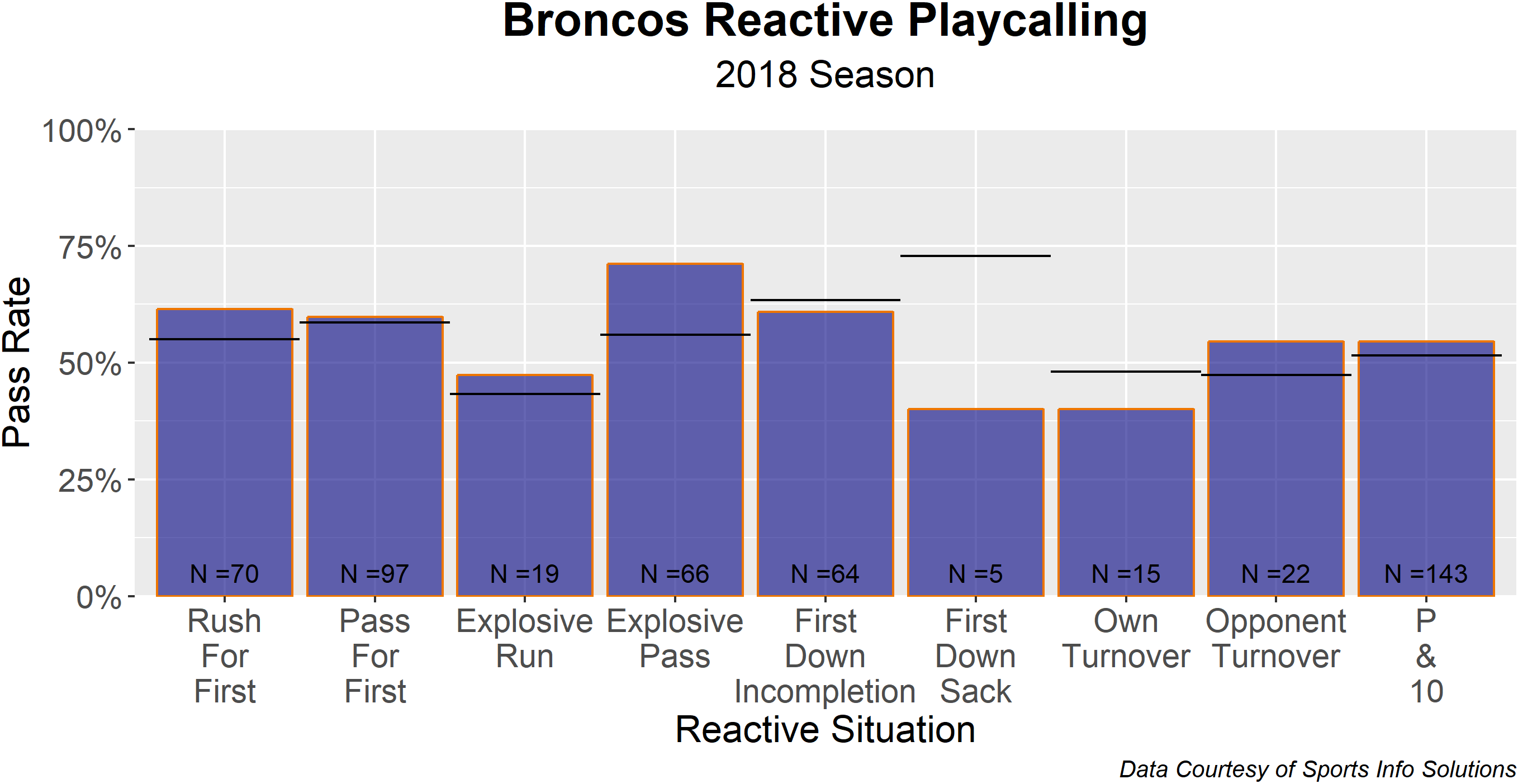
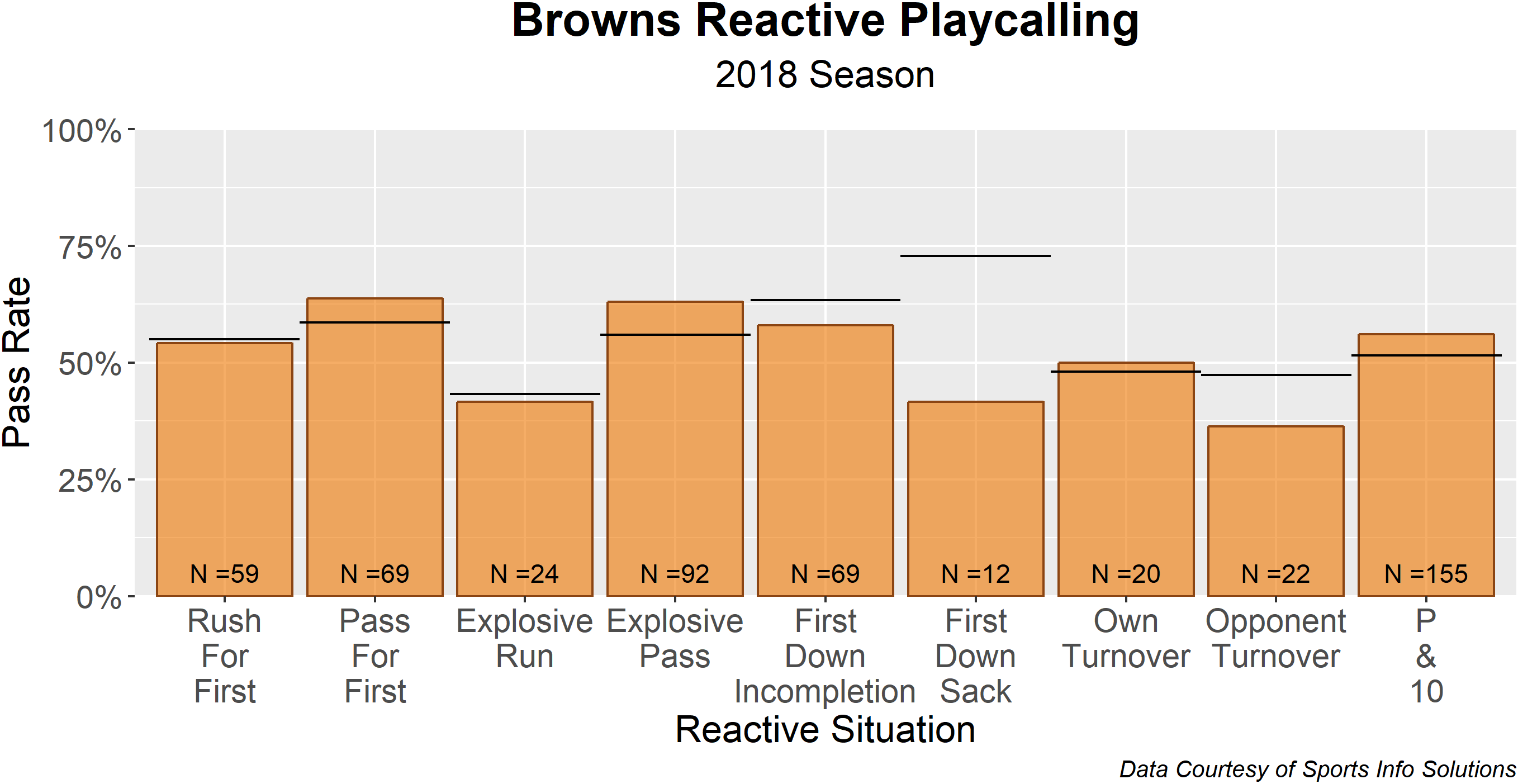
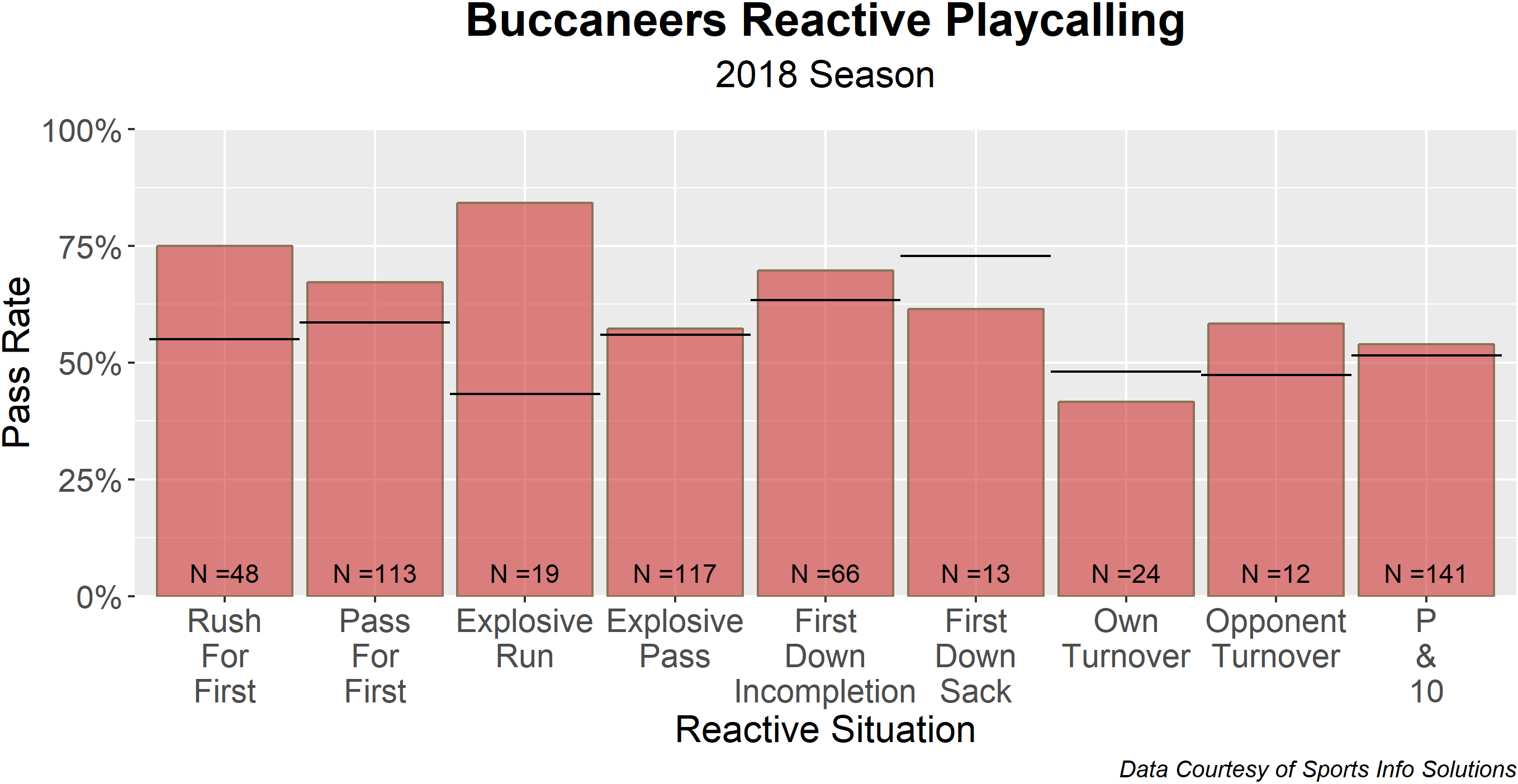
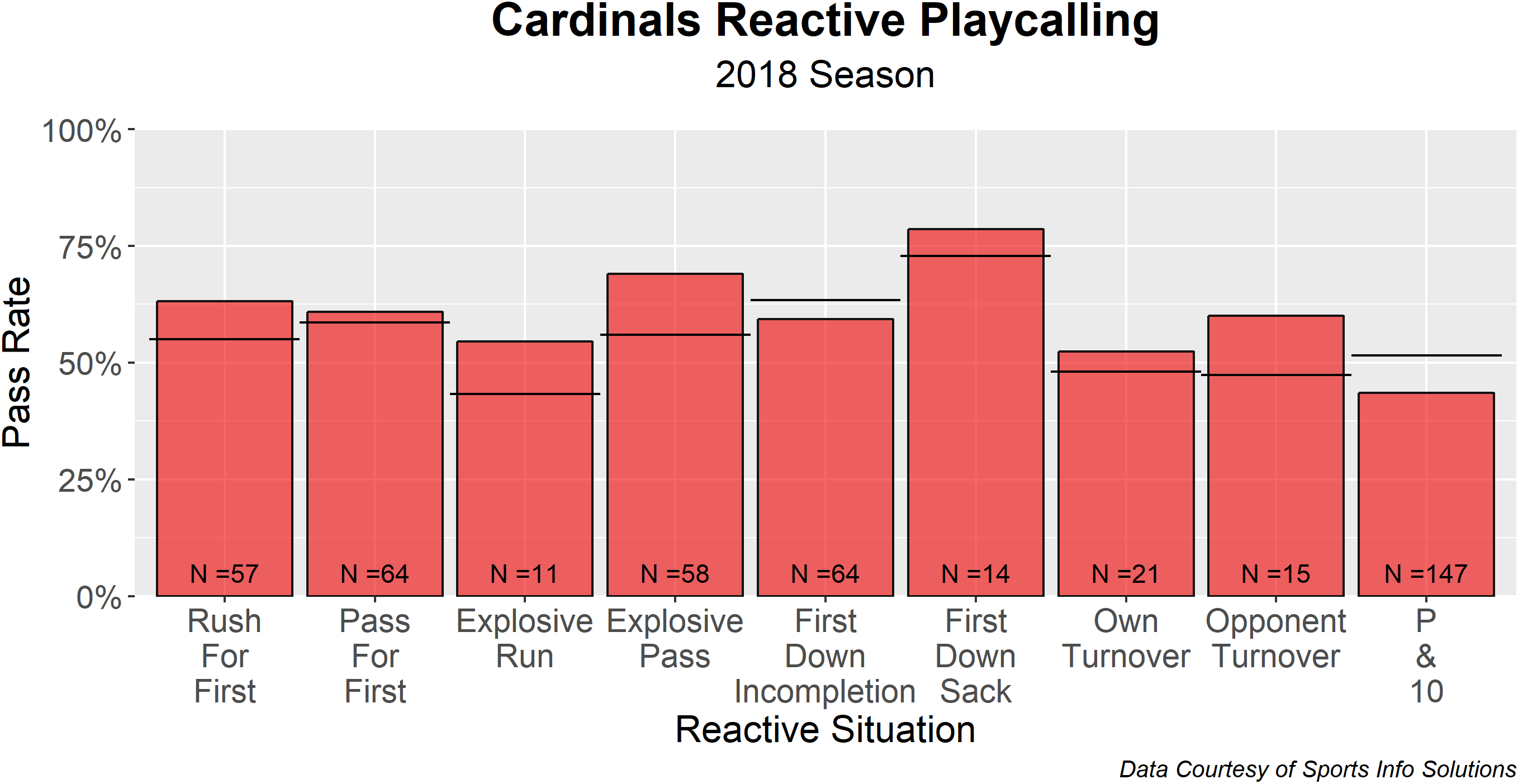
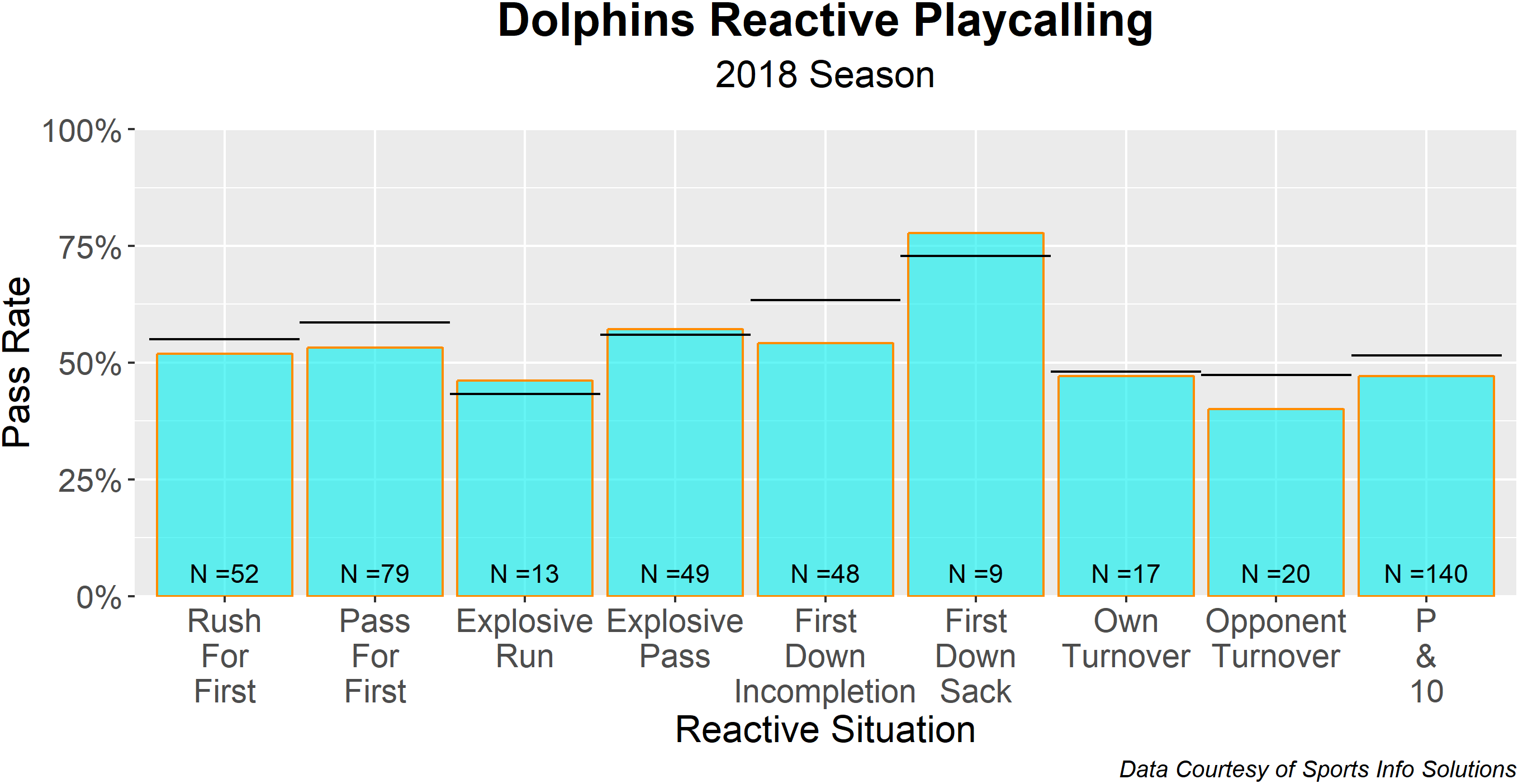
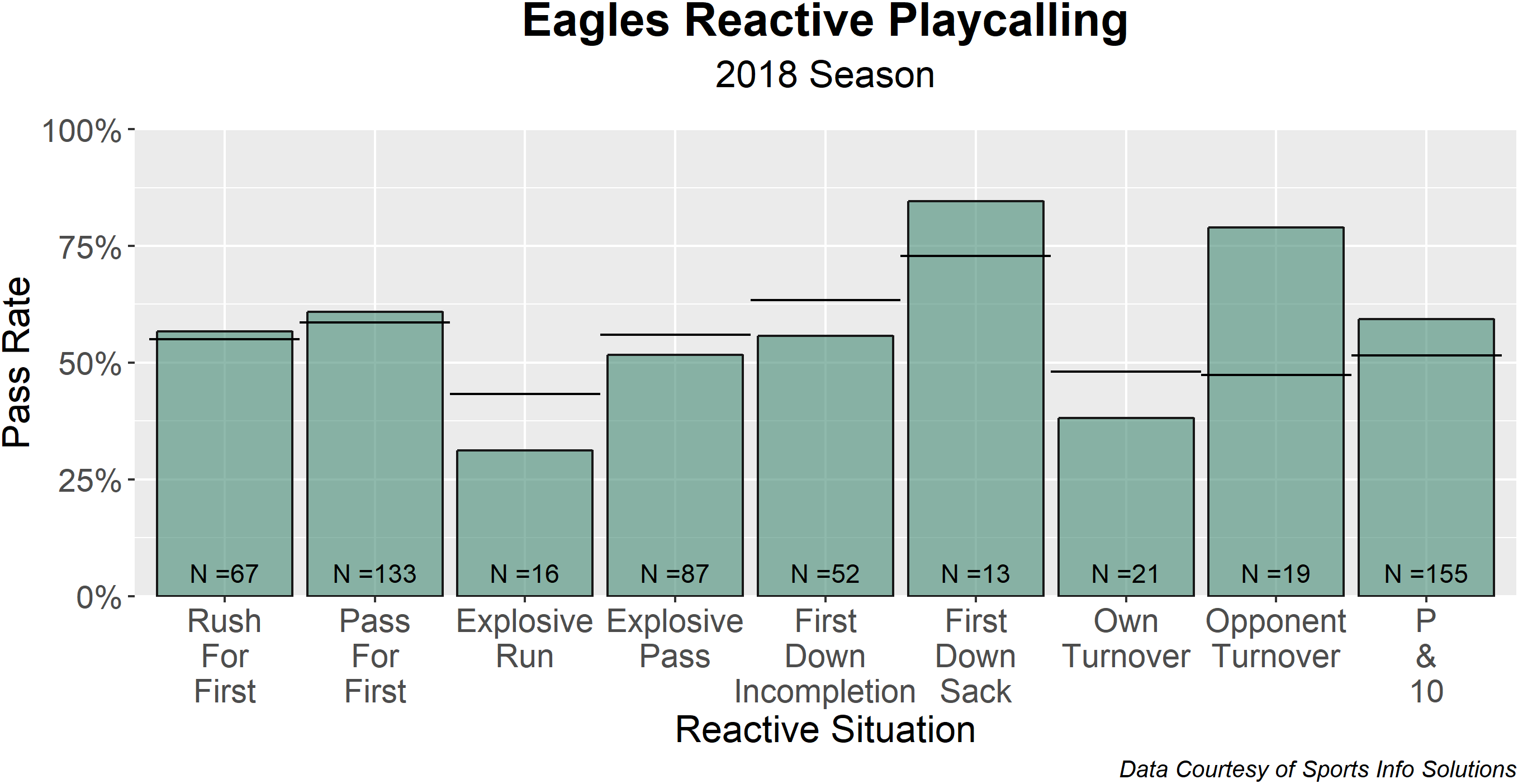
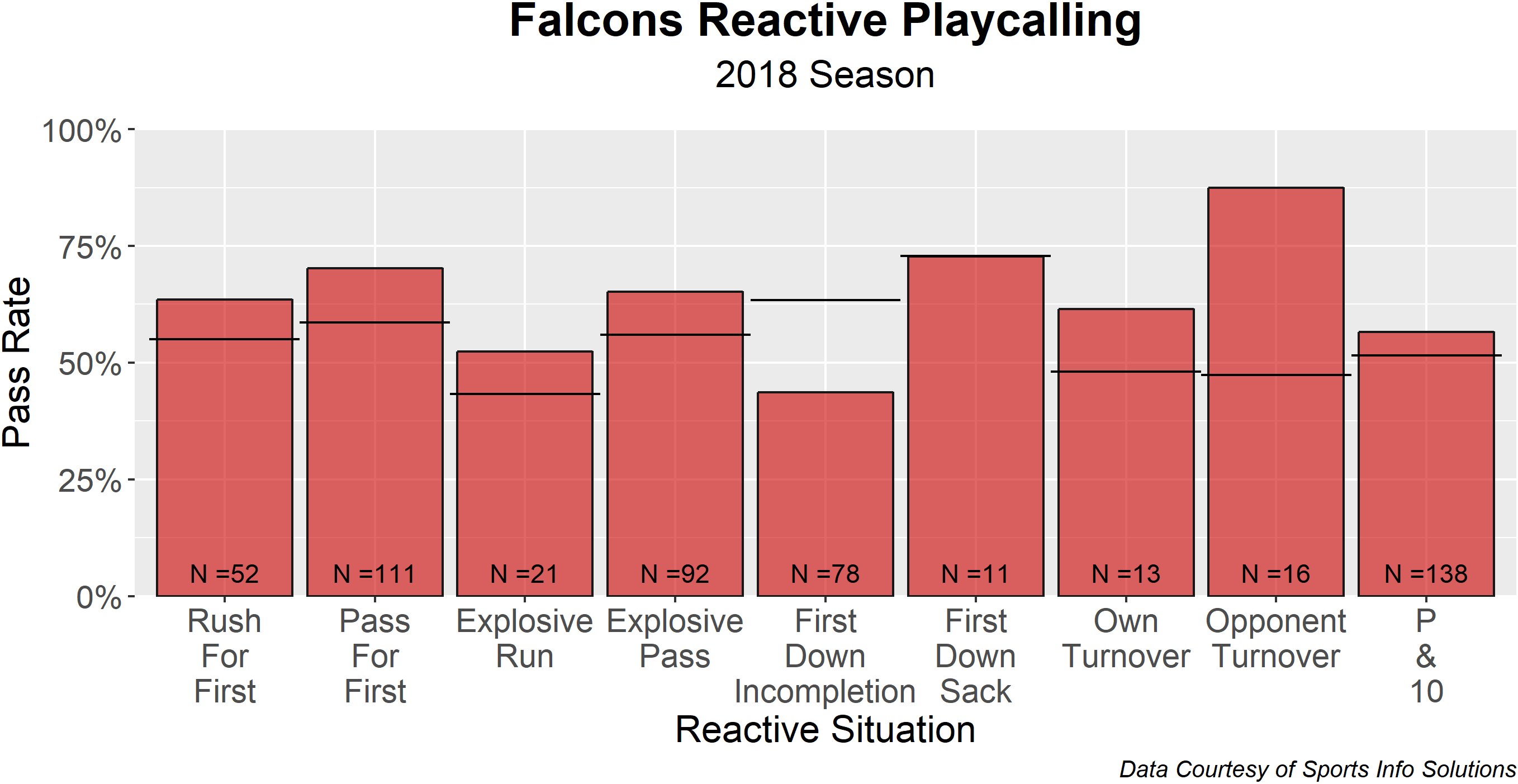
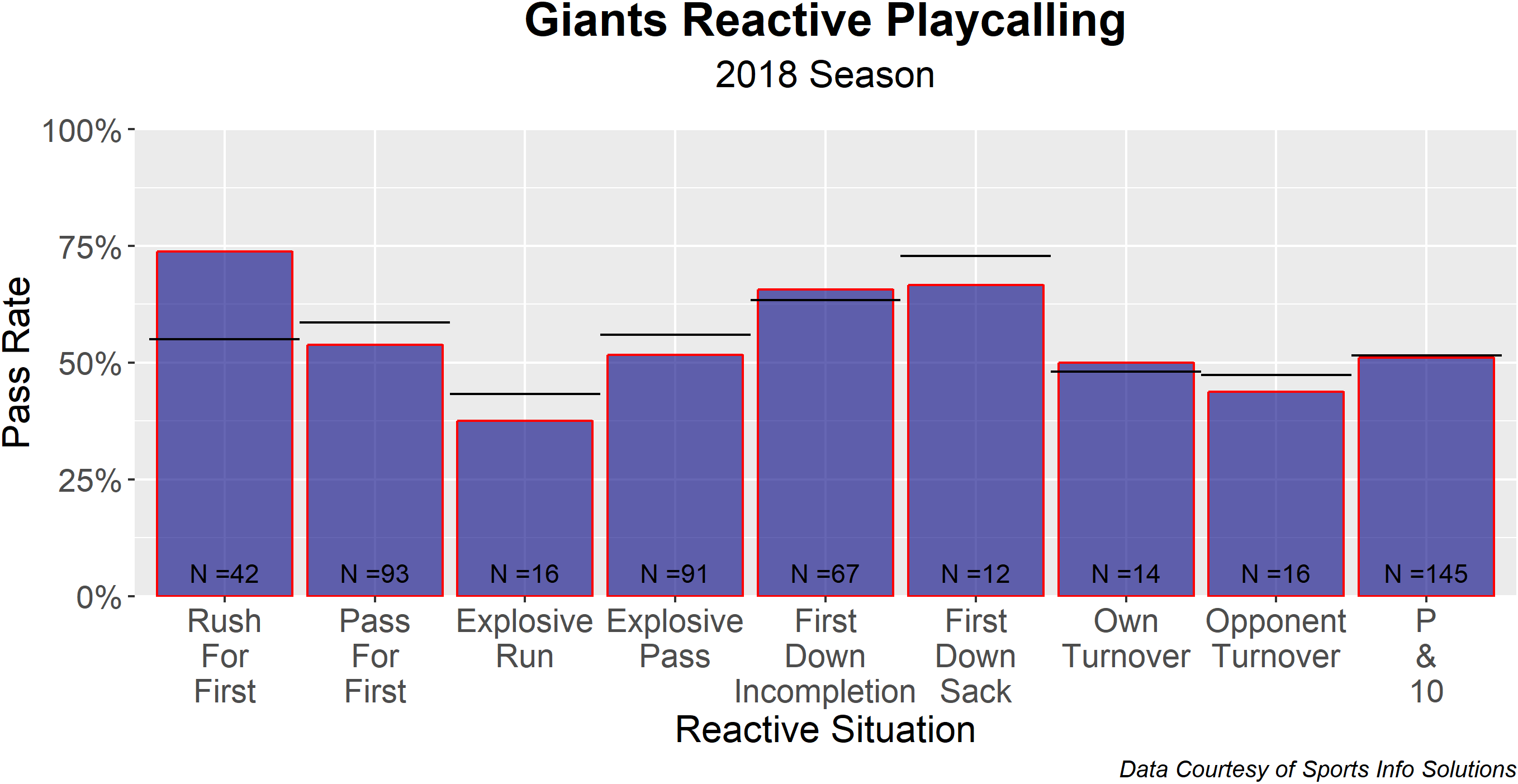
For the purposes of this piece, we will not examine first down calls after a positive penalty. Instead, we’ll replace it with an idea set forth by our friend Warren Sharp: a team’s tendency to throw the ball after an incompletion on 1st & 10. We’ll also tack on possession-and-10 (P & 10), which is just a fancy way of saying ‘the first play of a drive.’
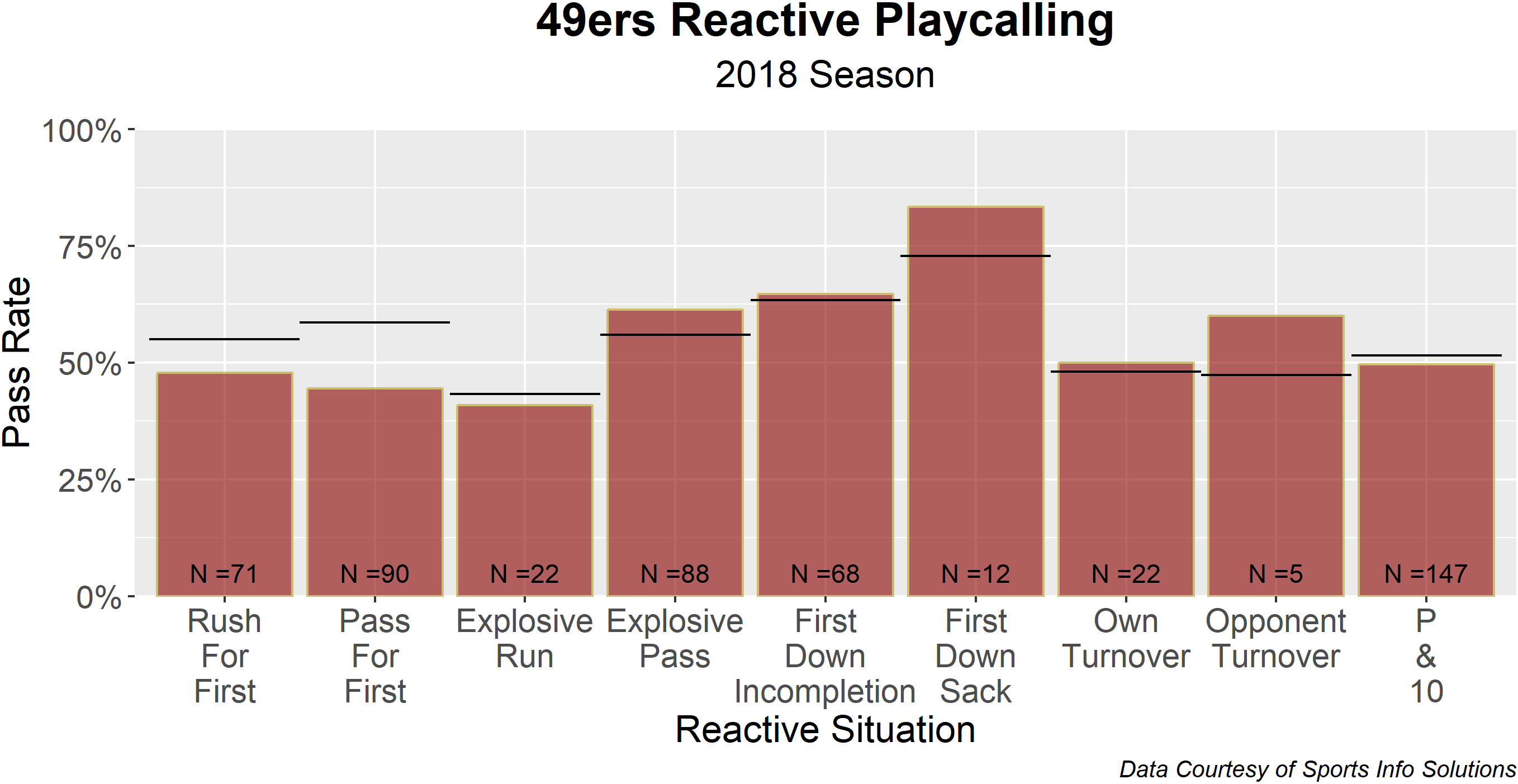
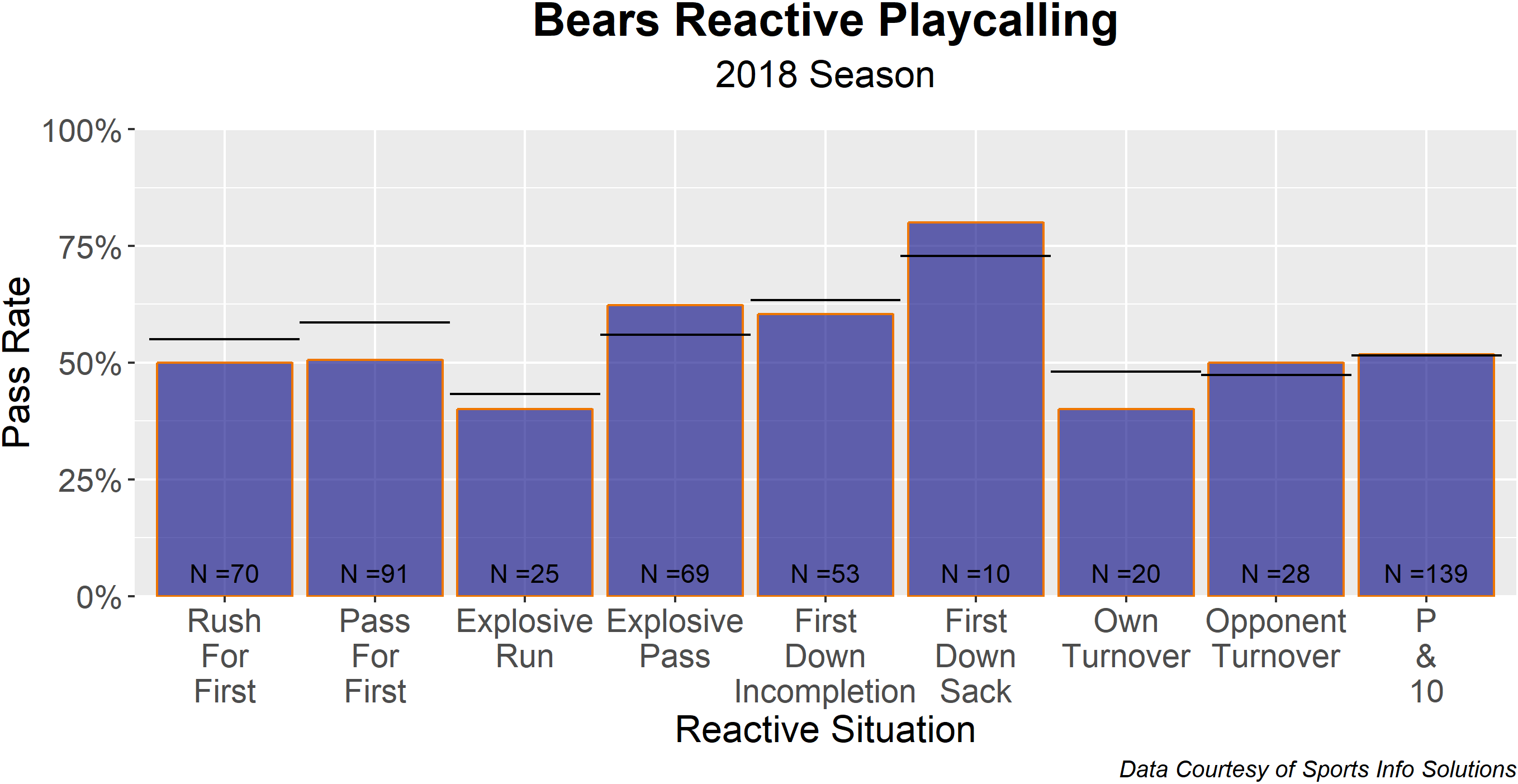
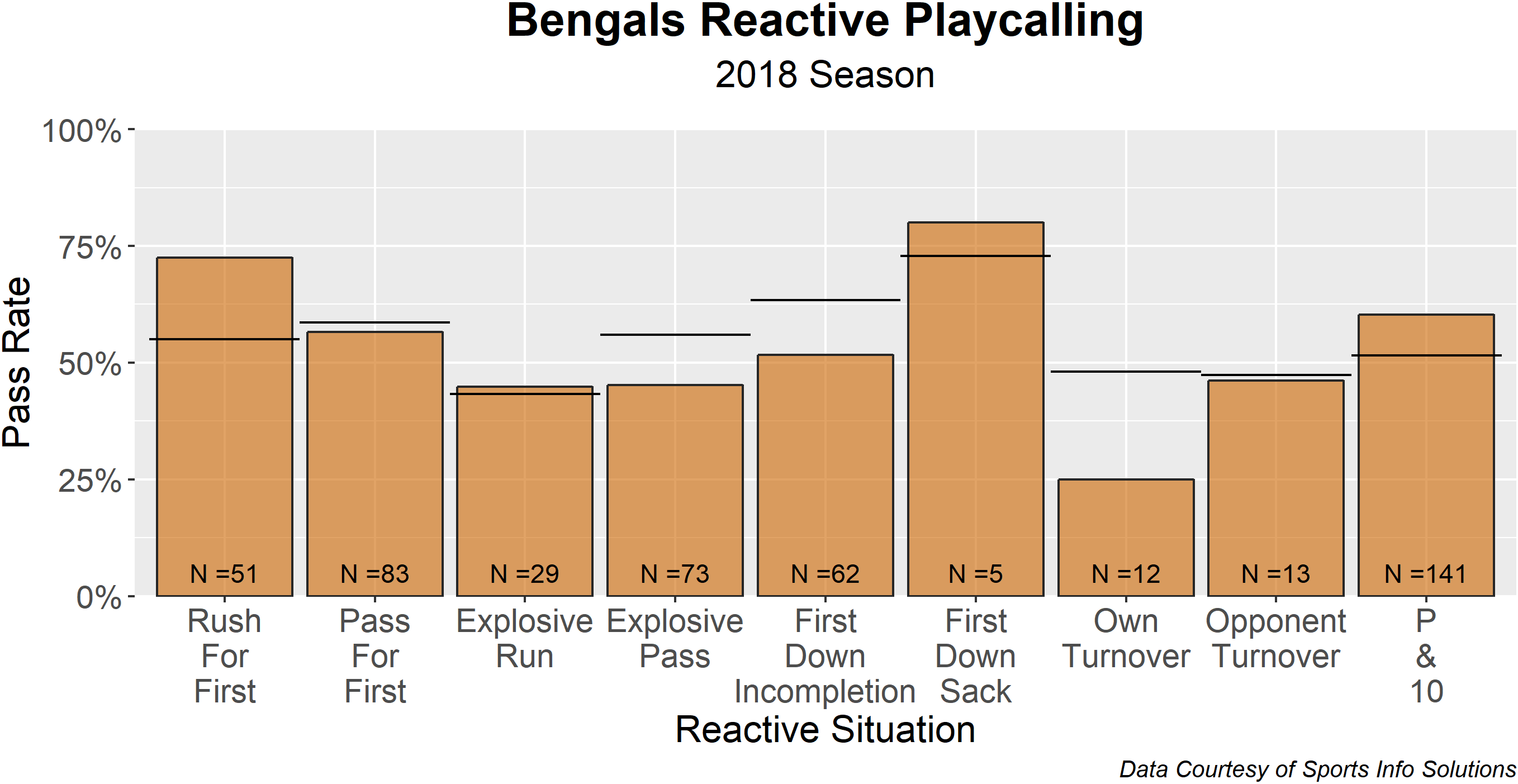
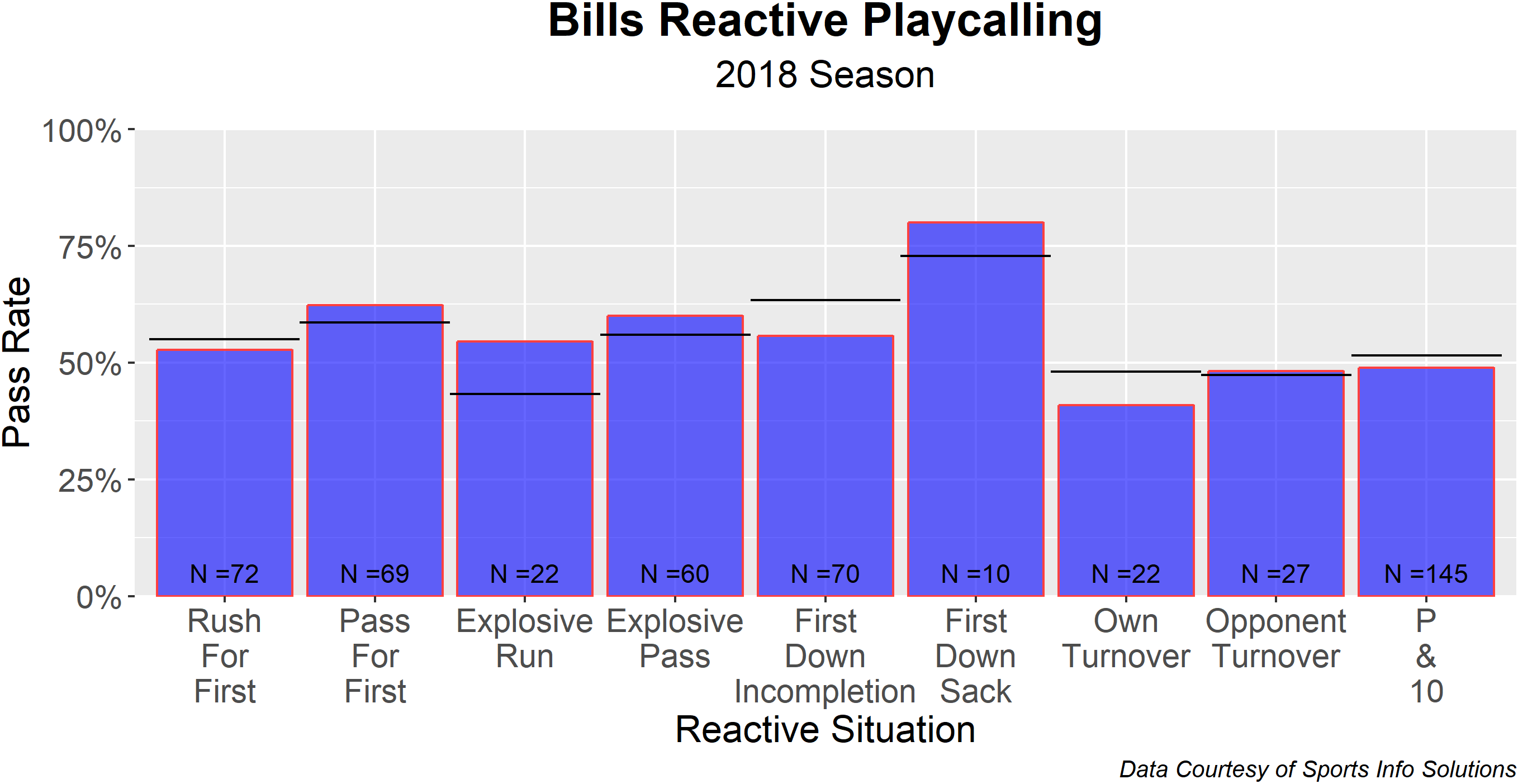
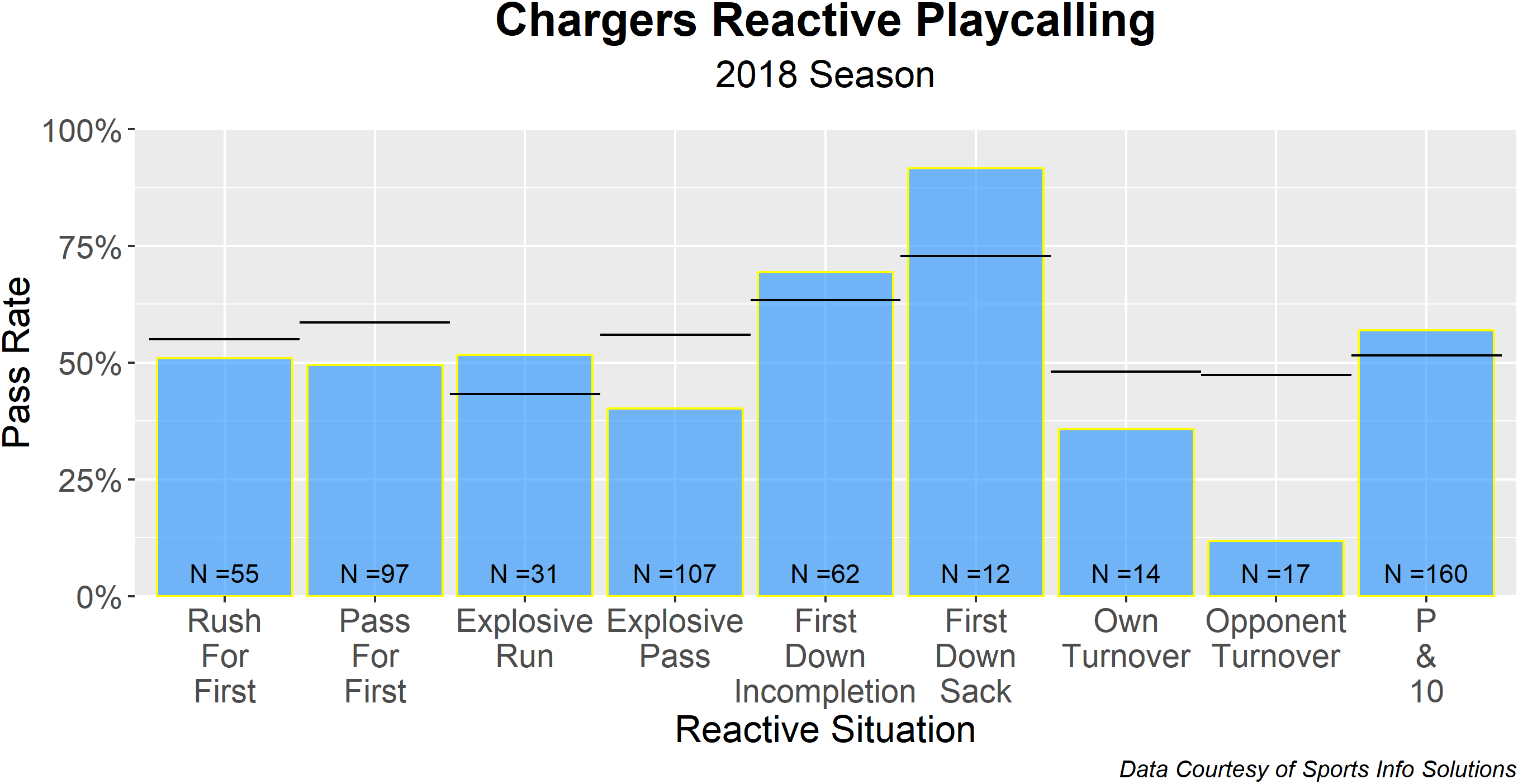
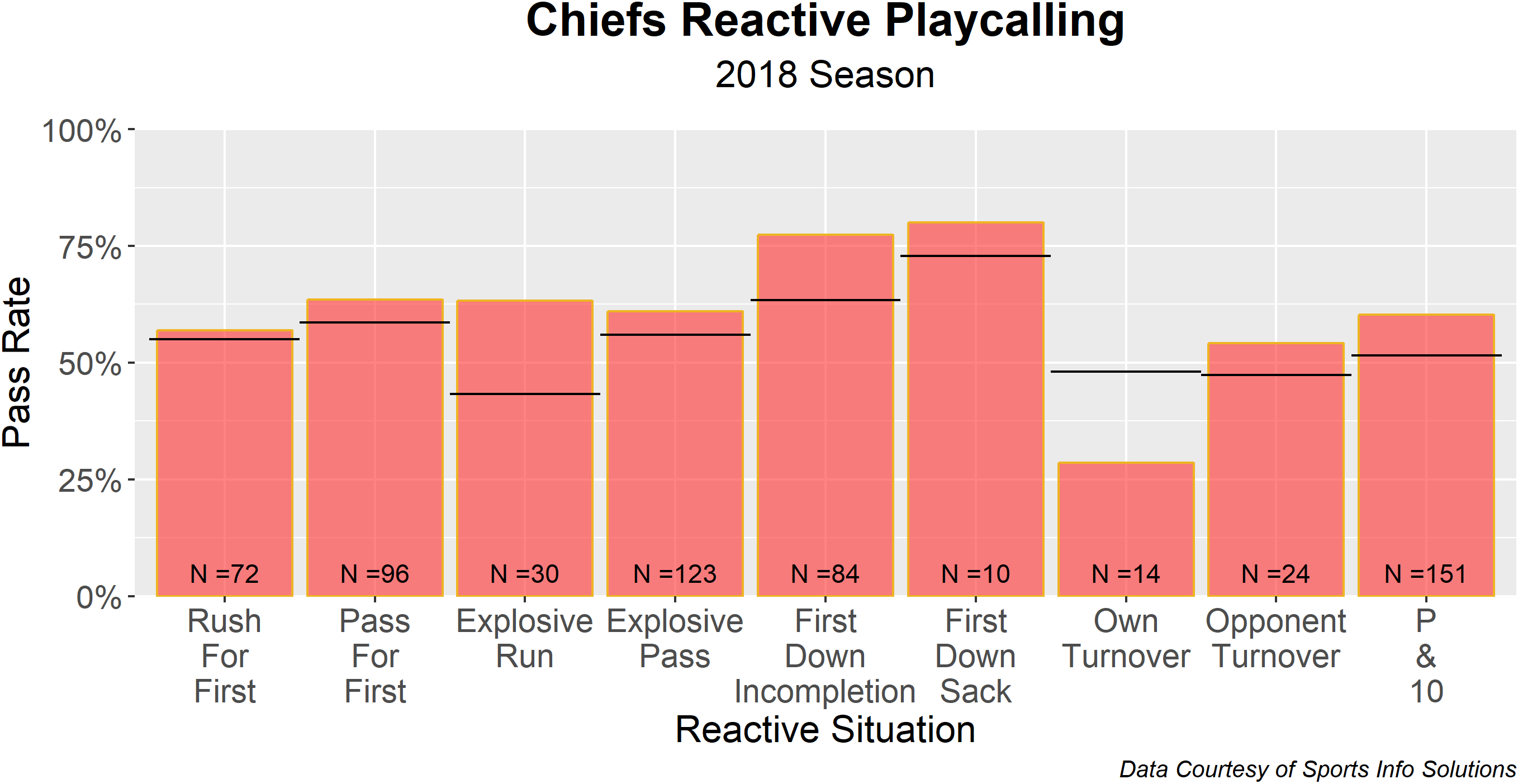
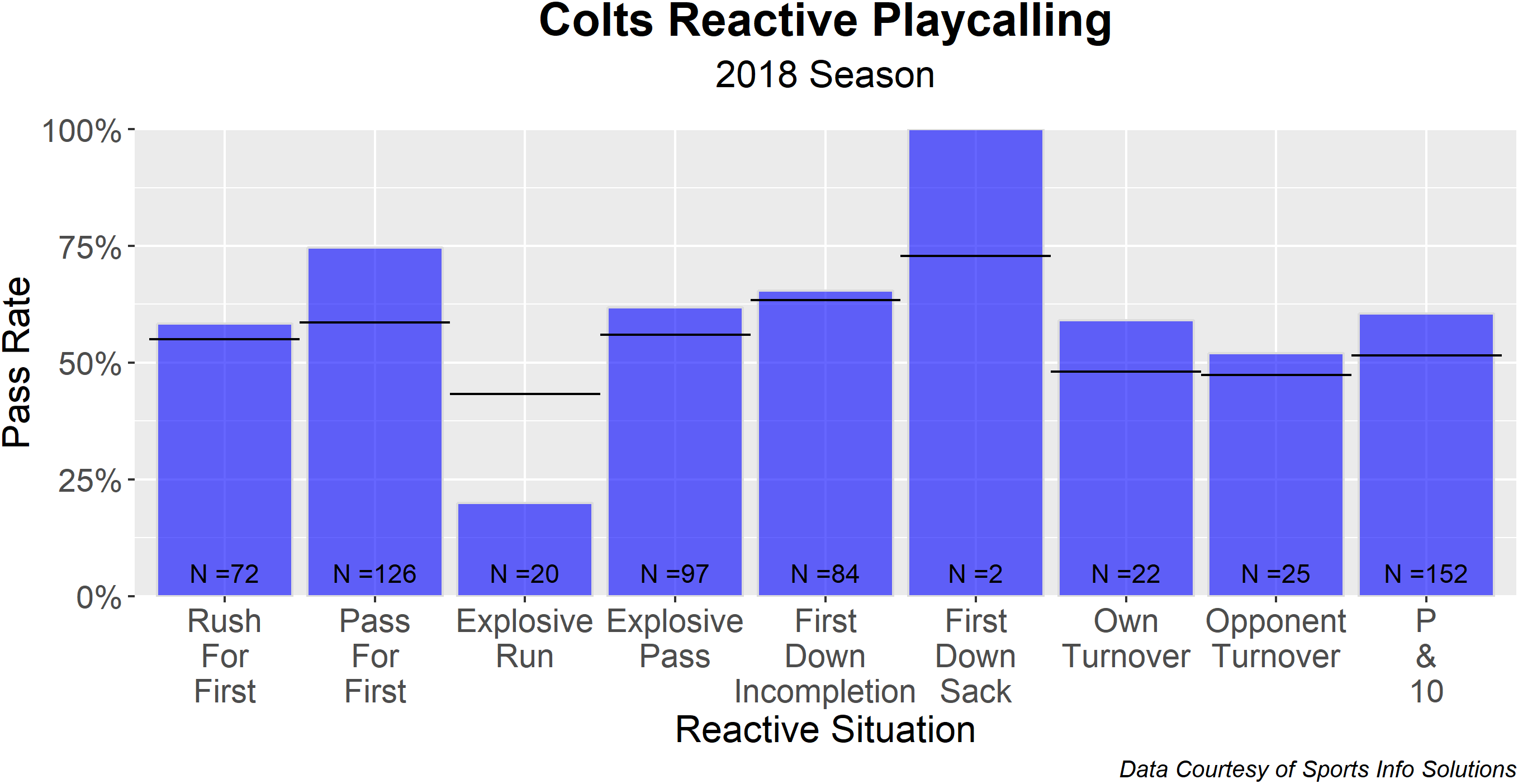
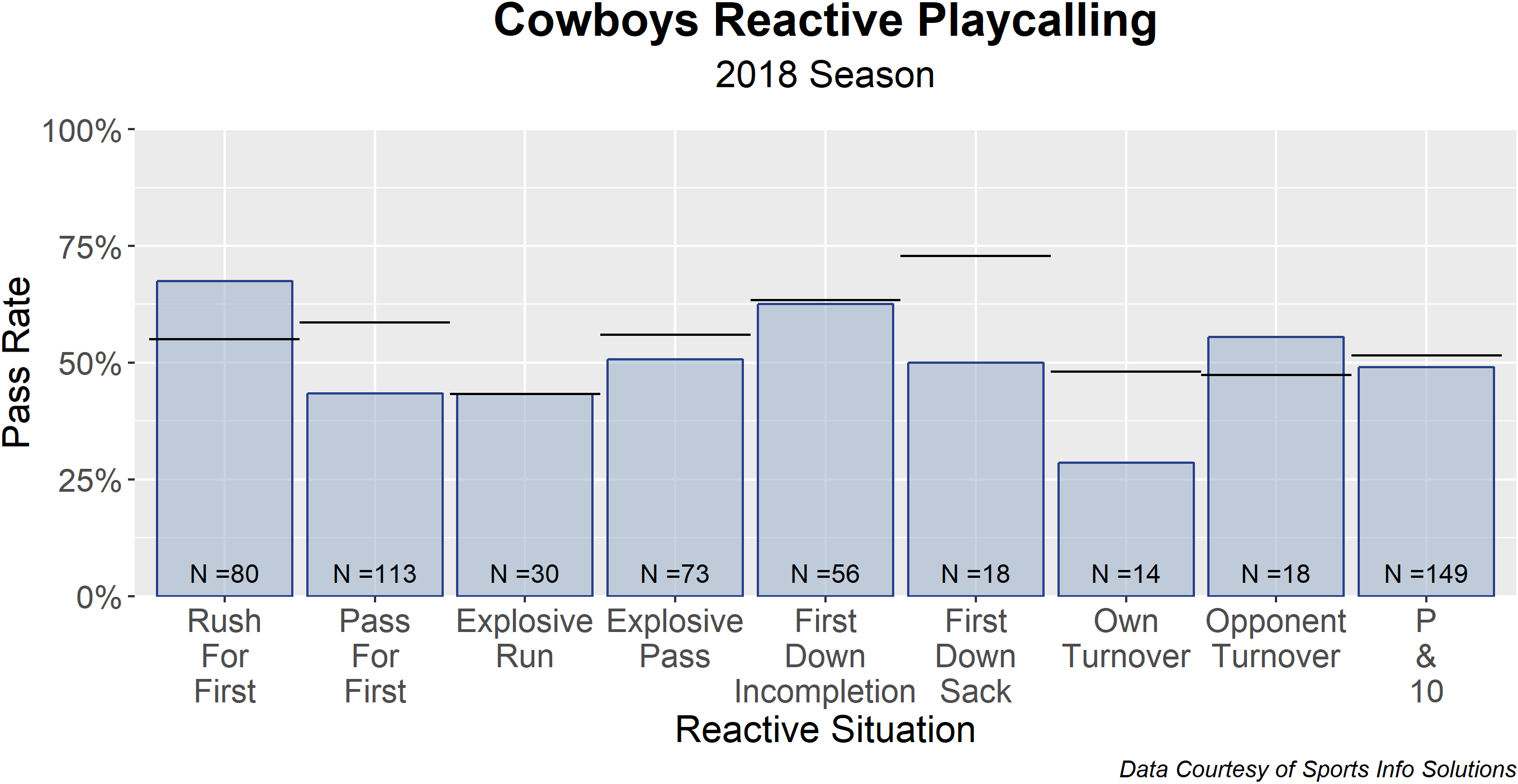
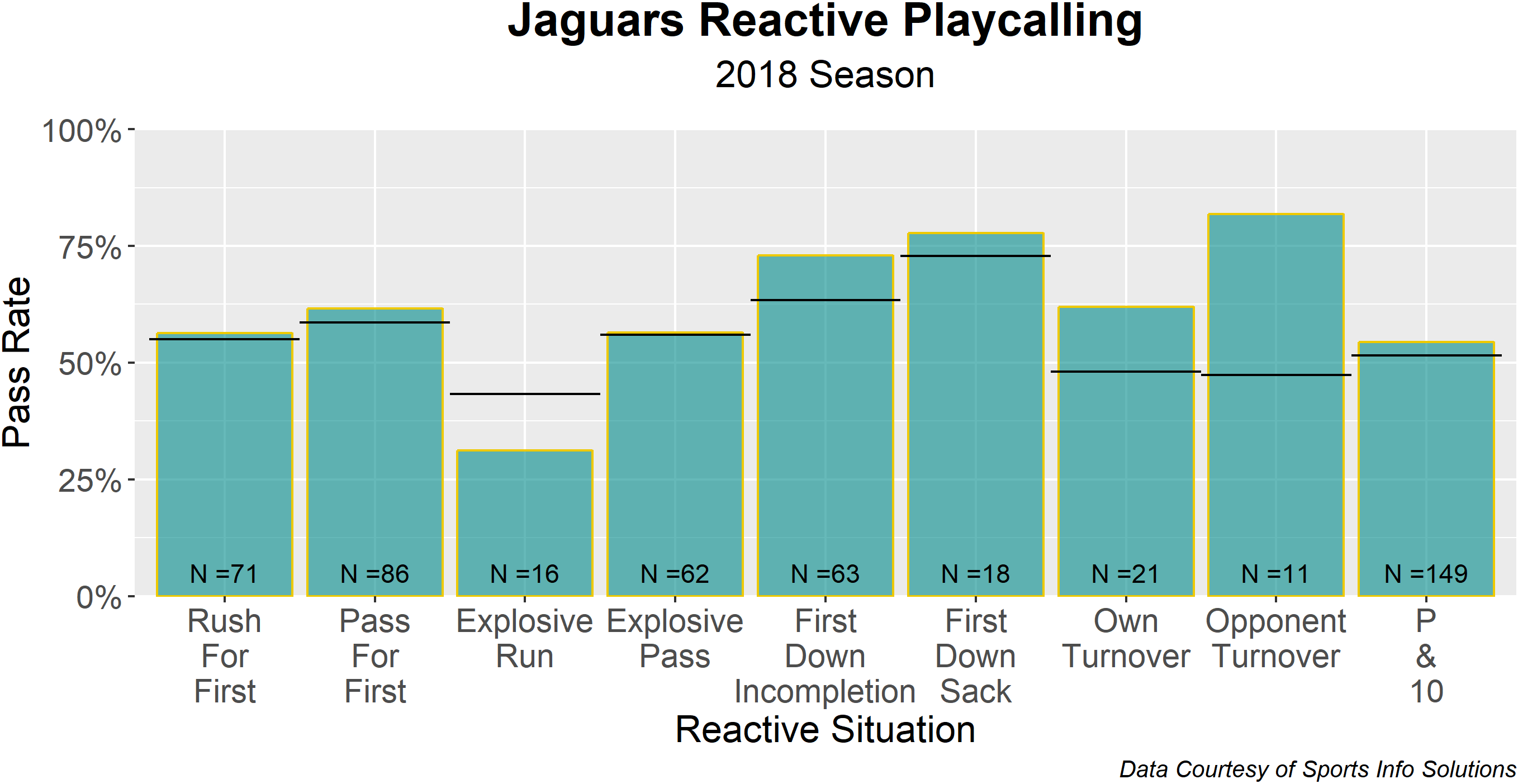
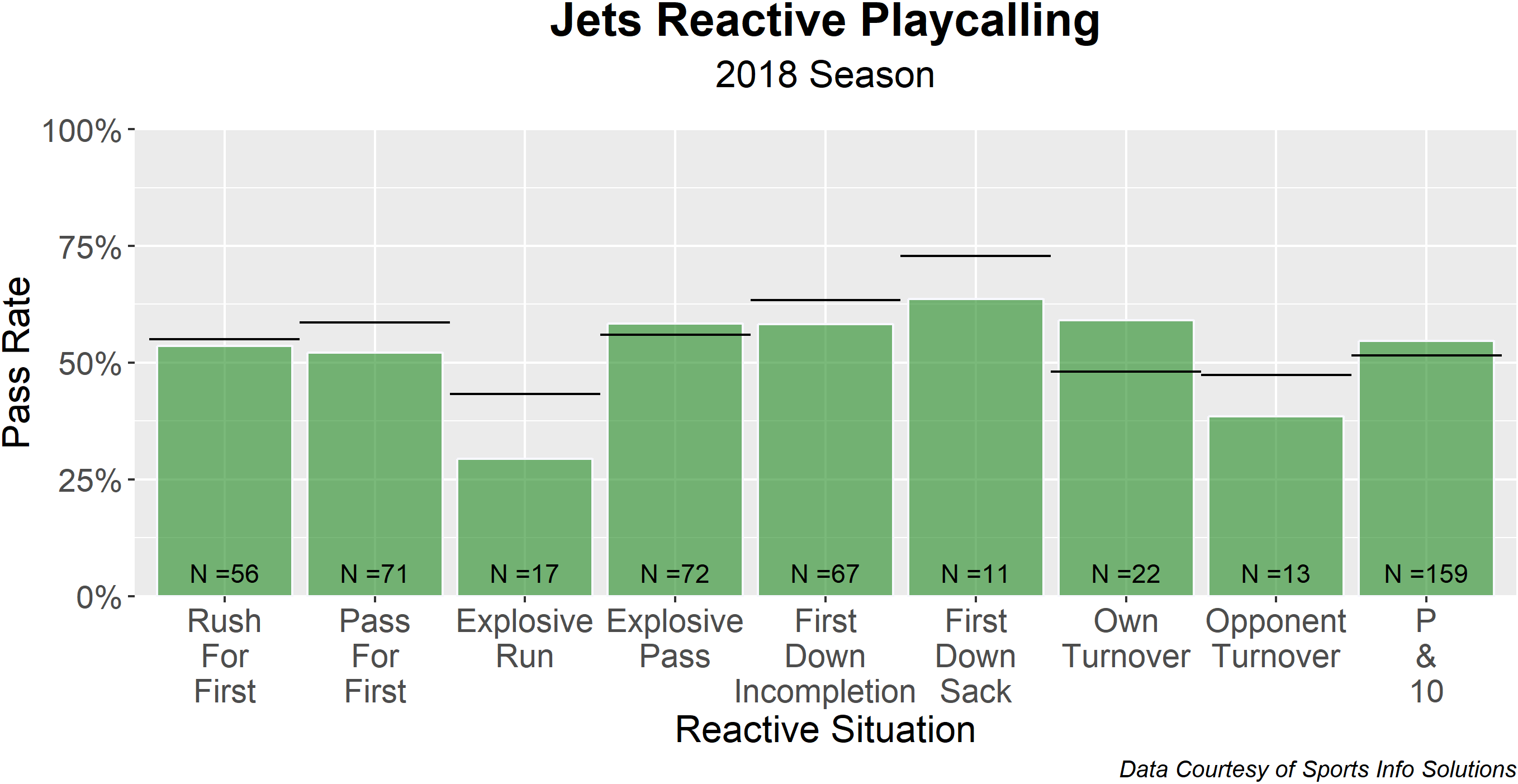
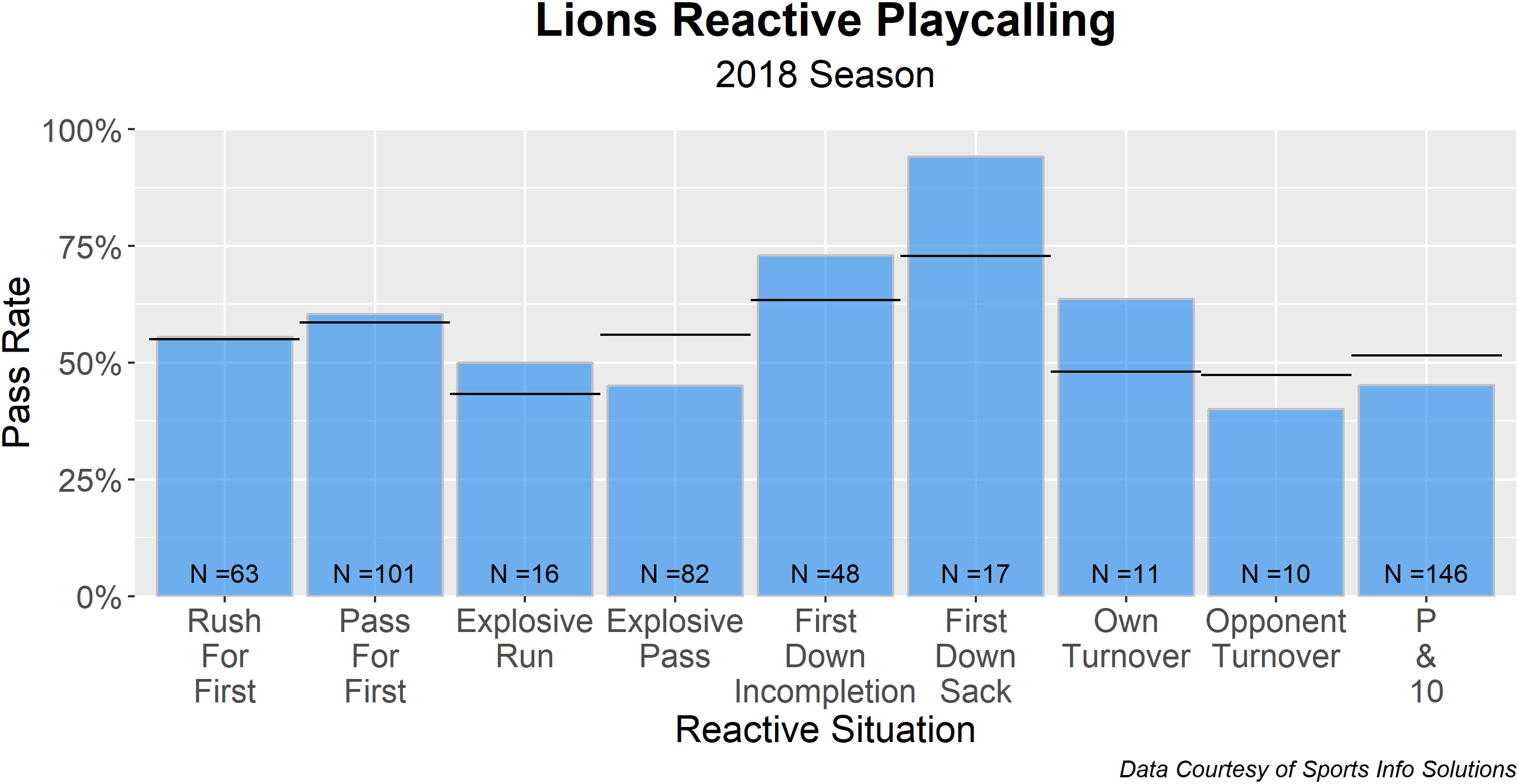
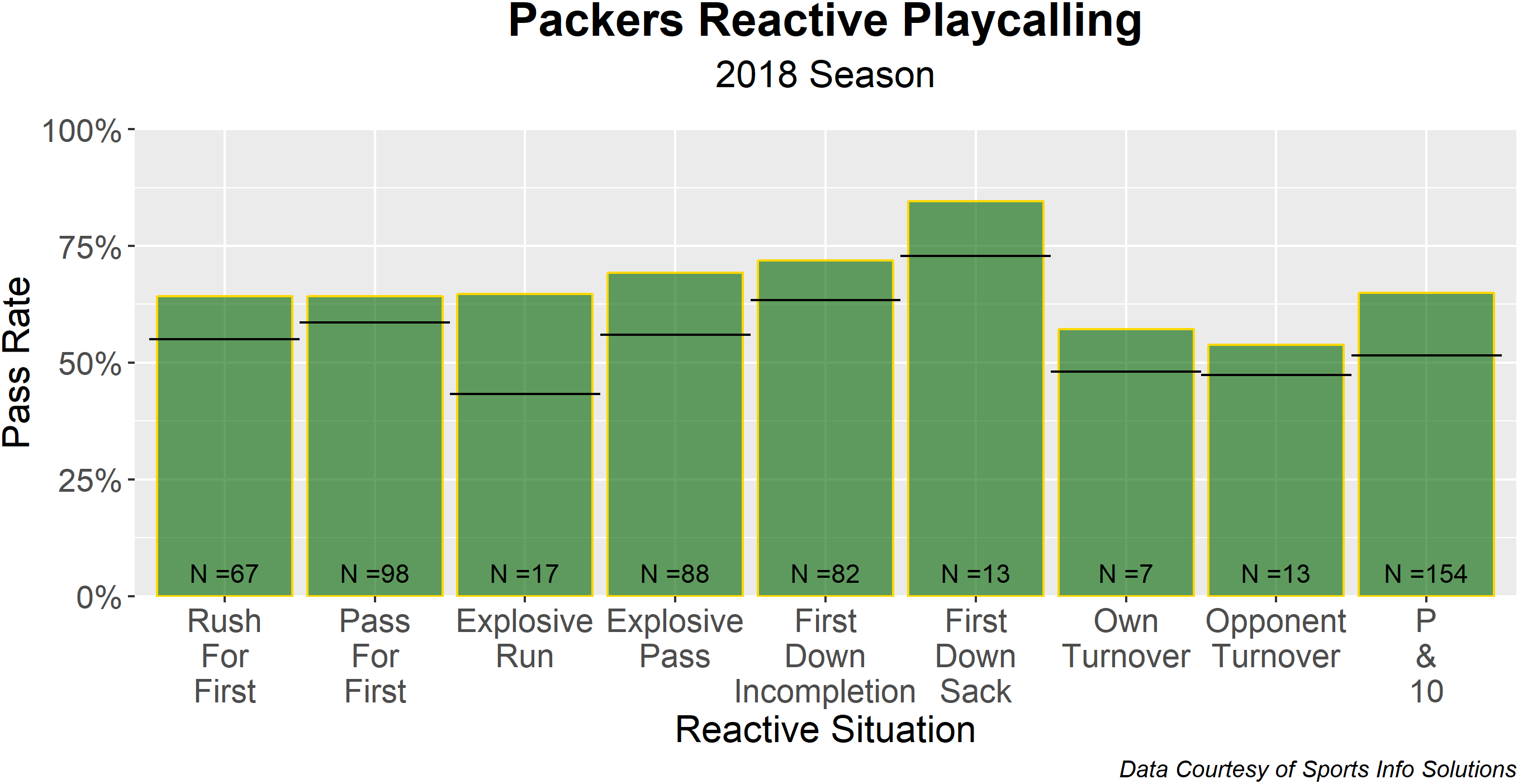
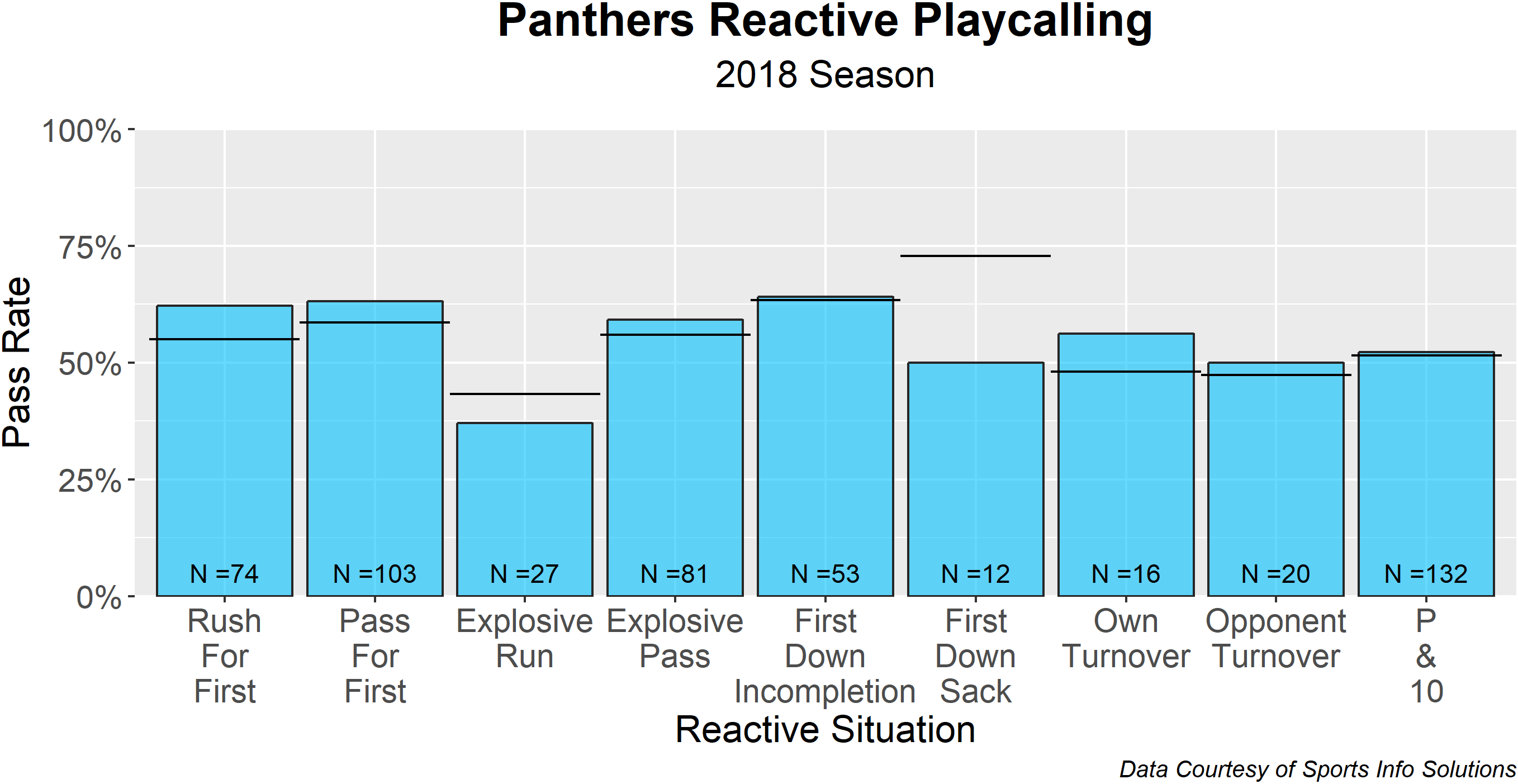
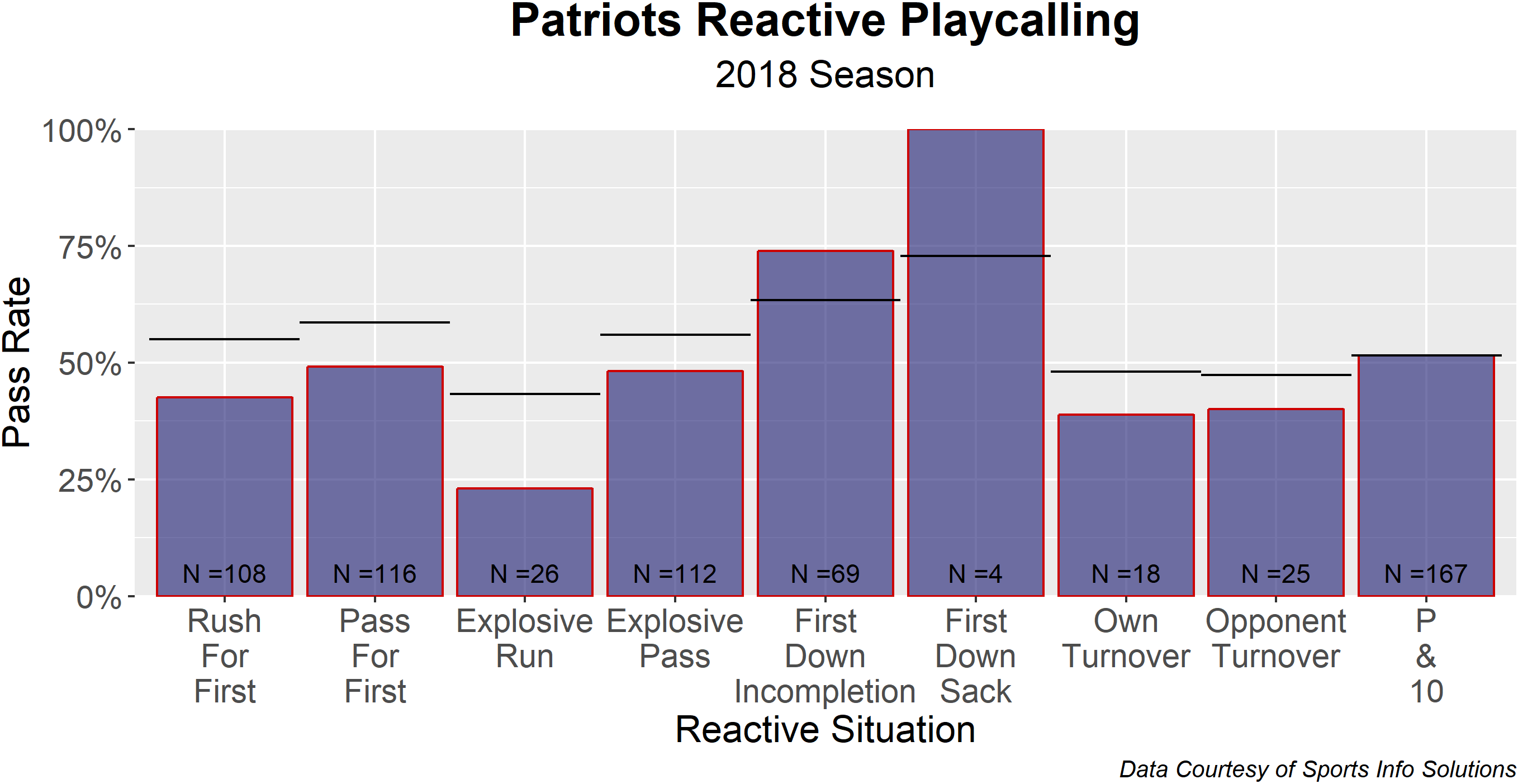
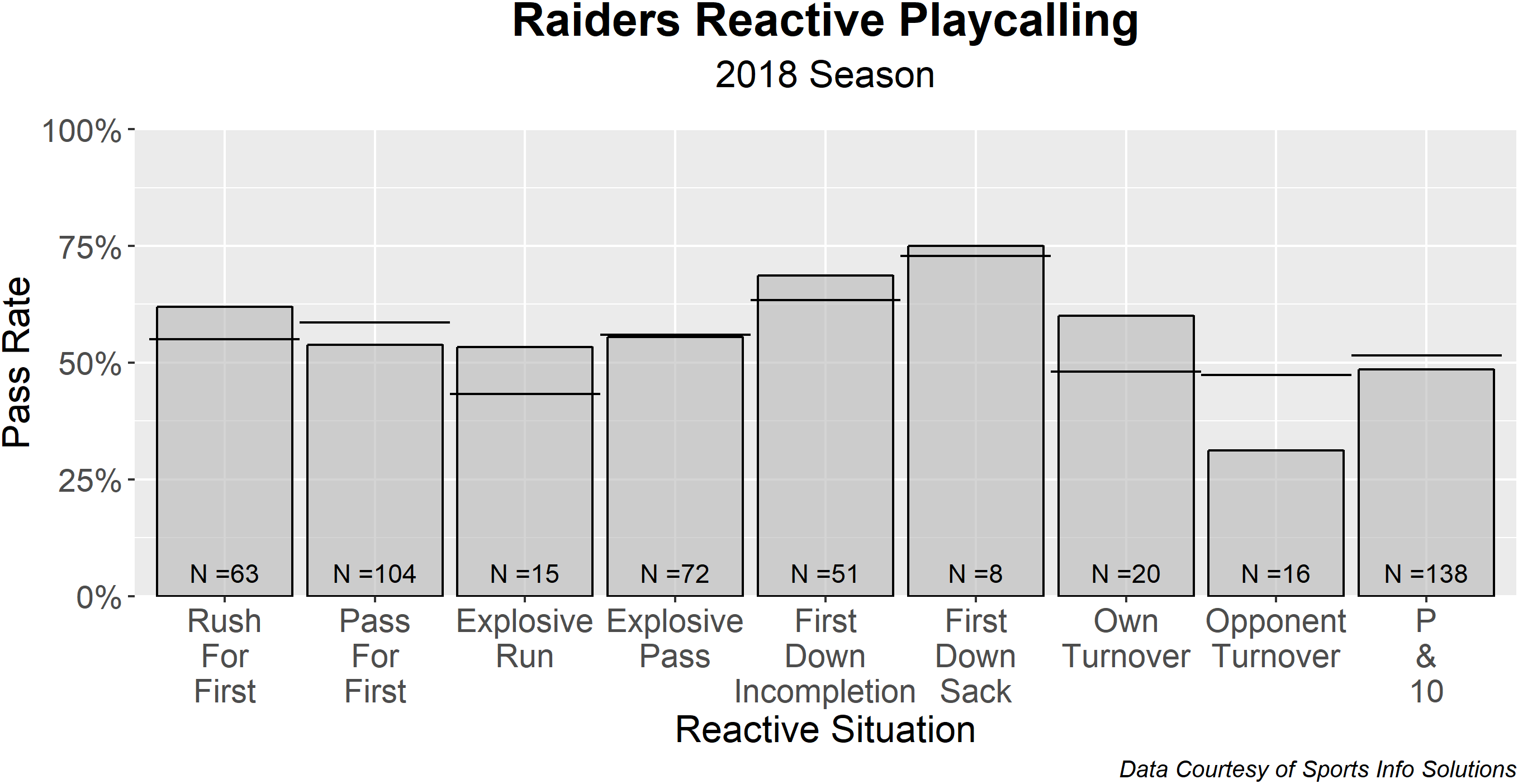
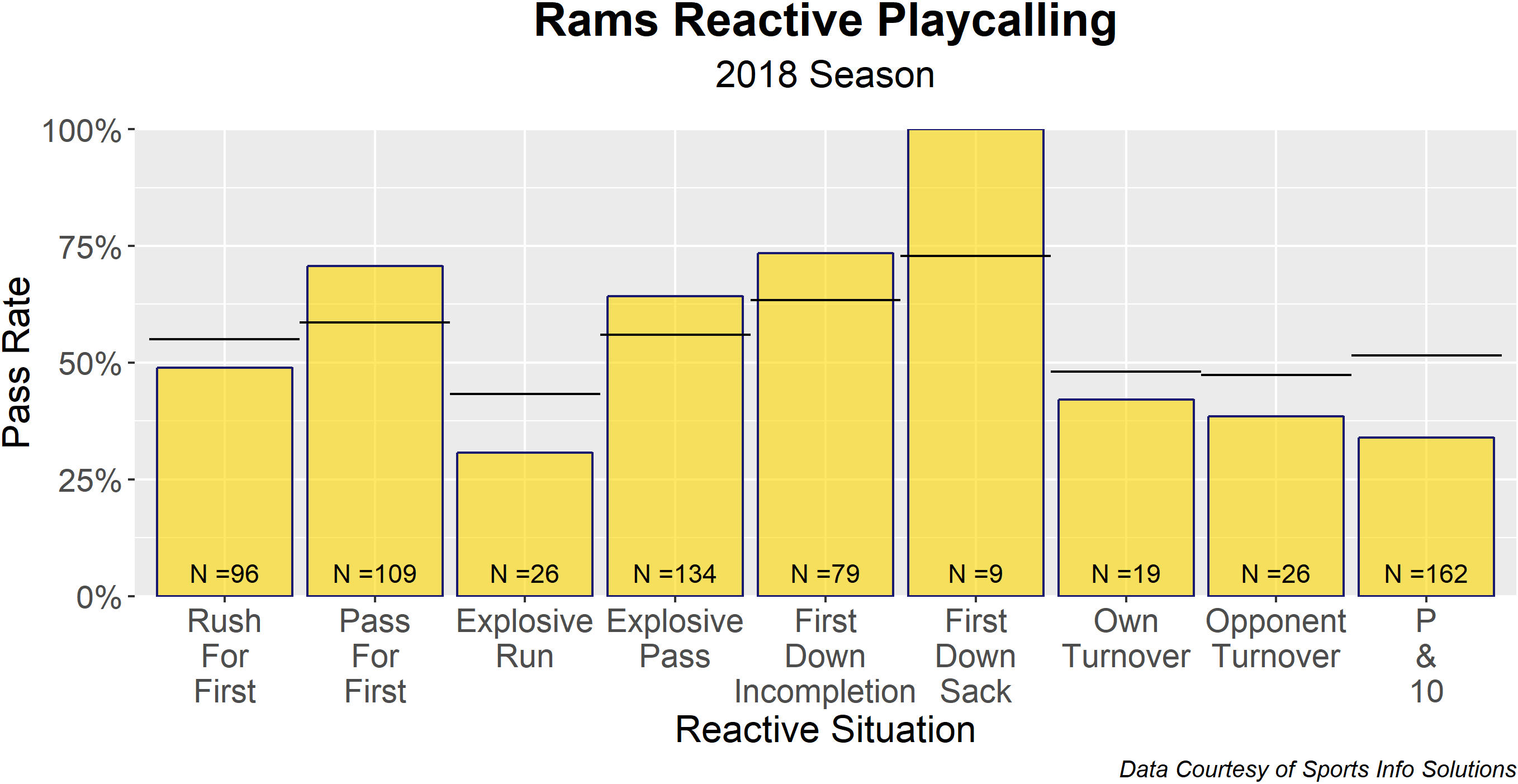
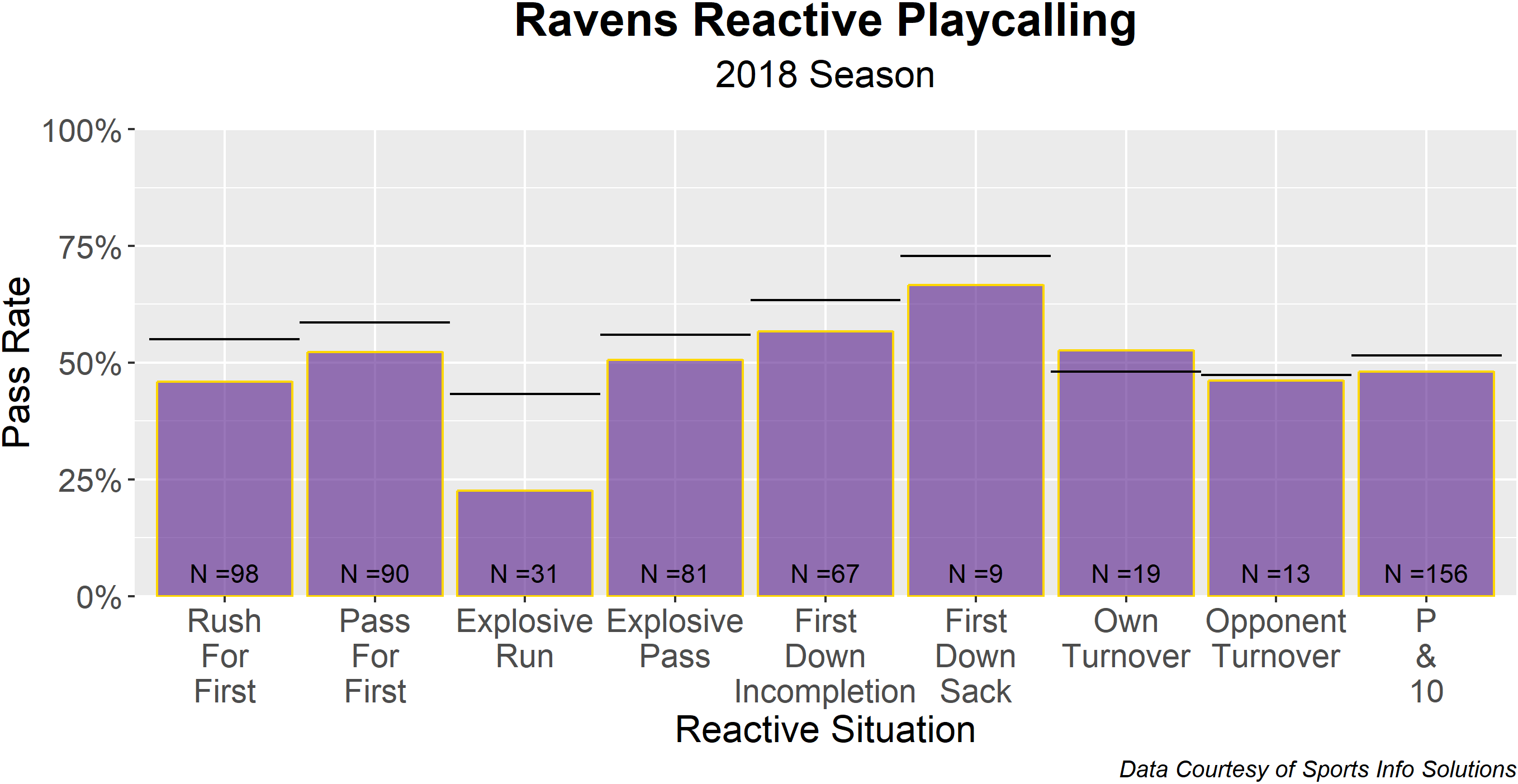
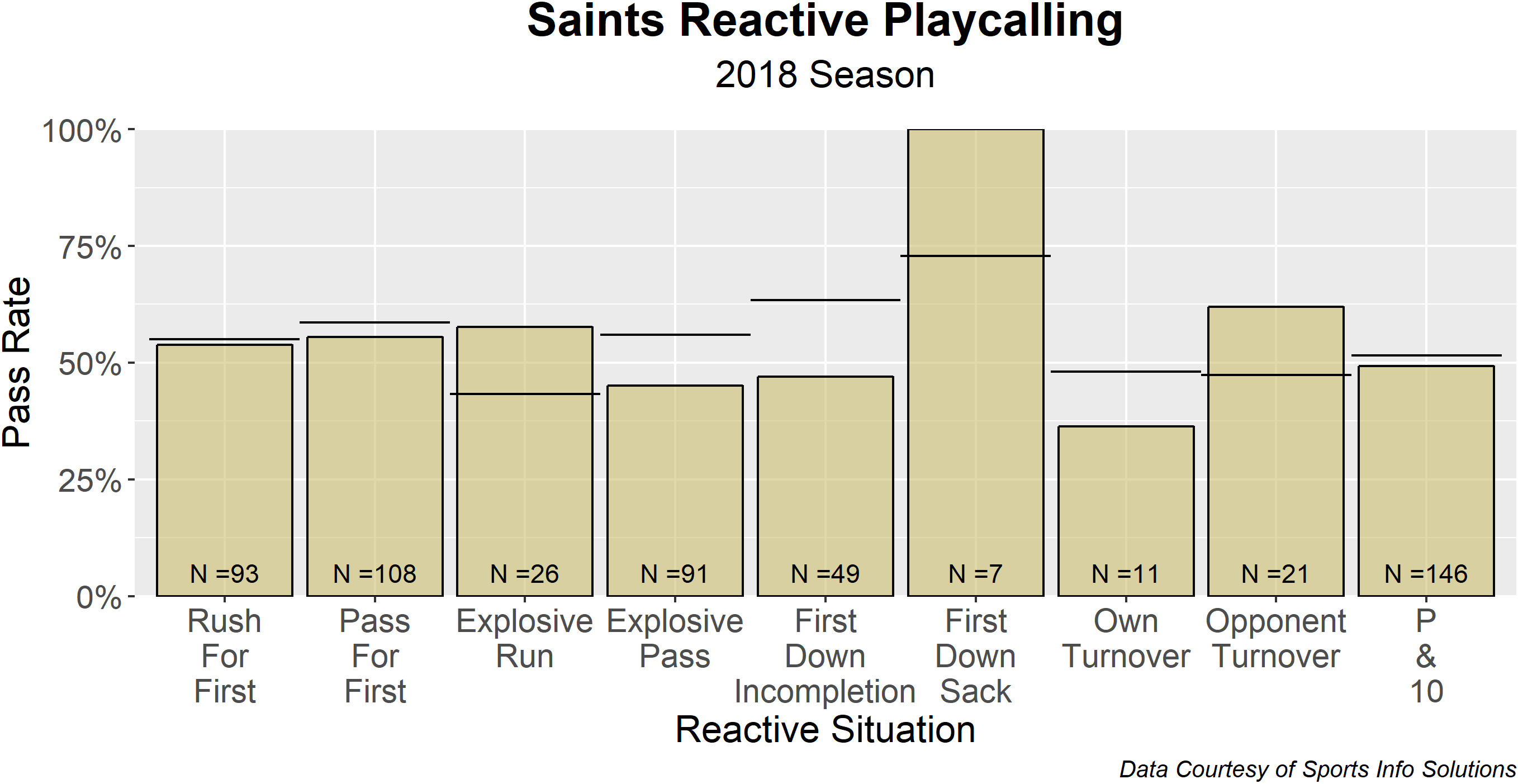
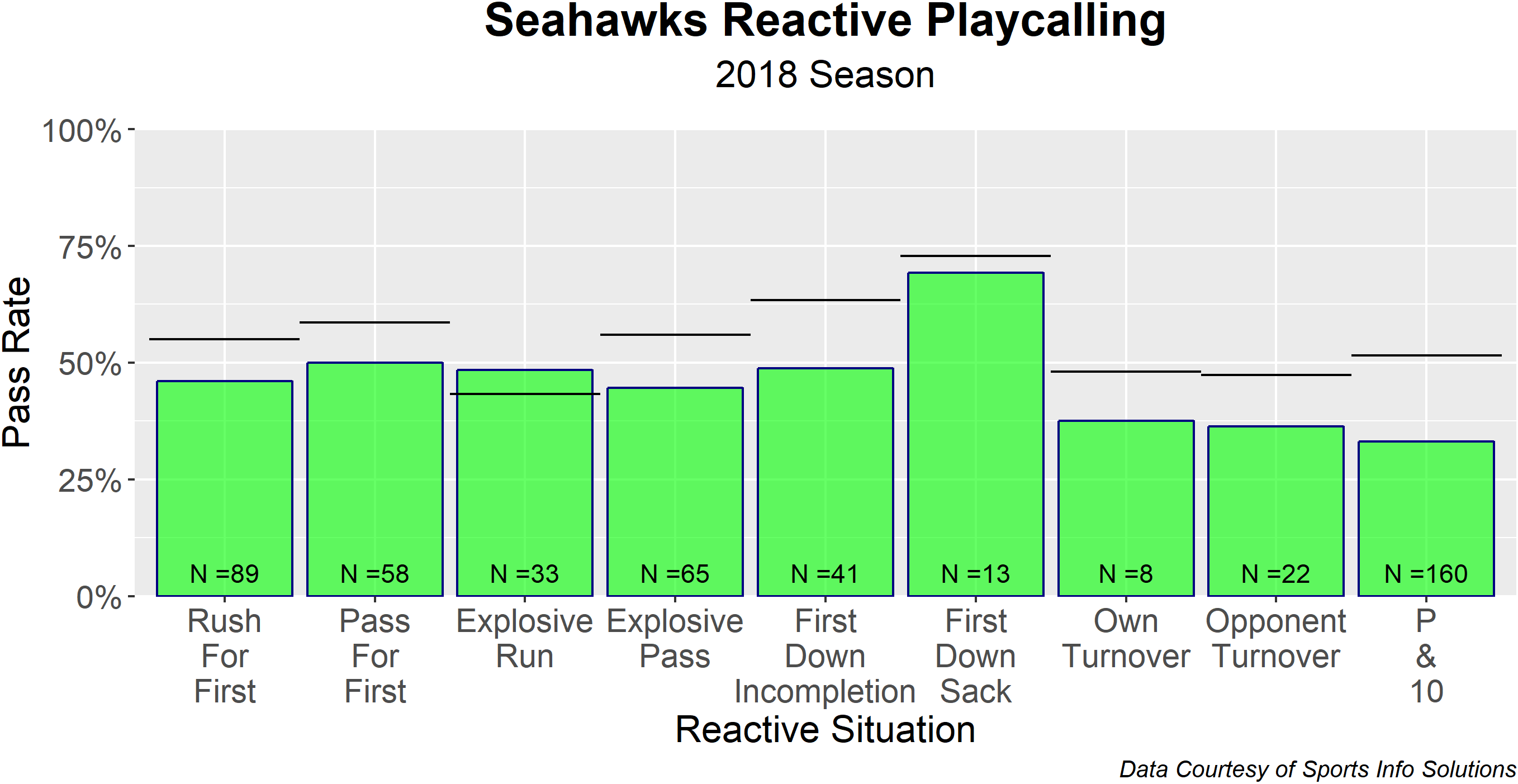
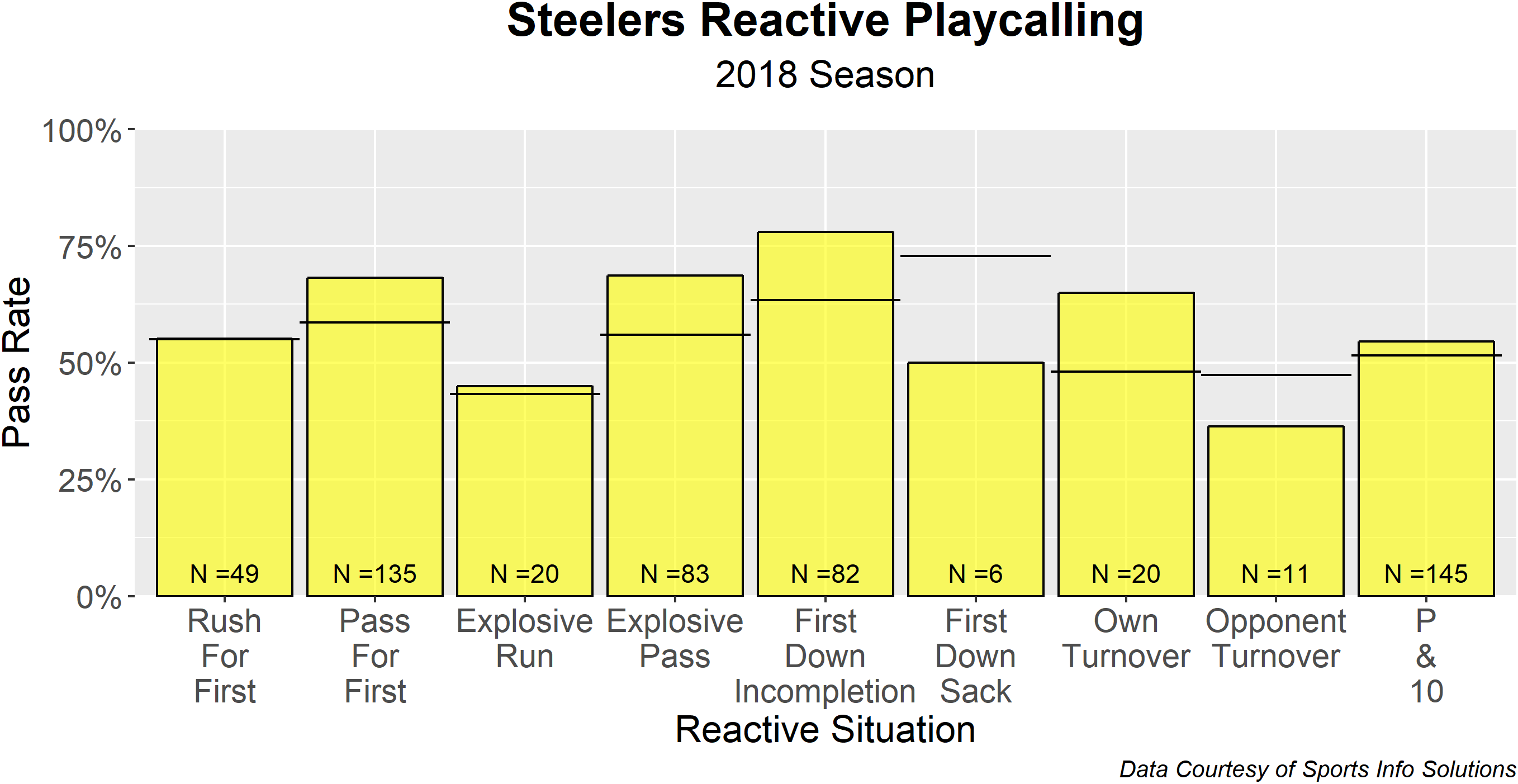
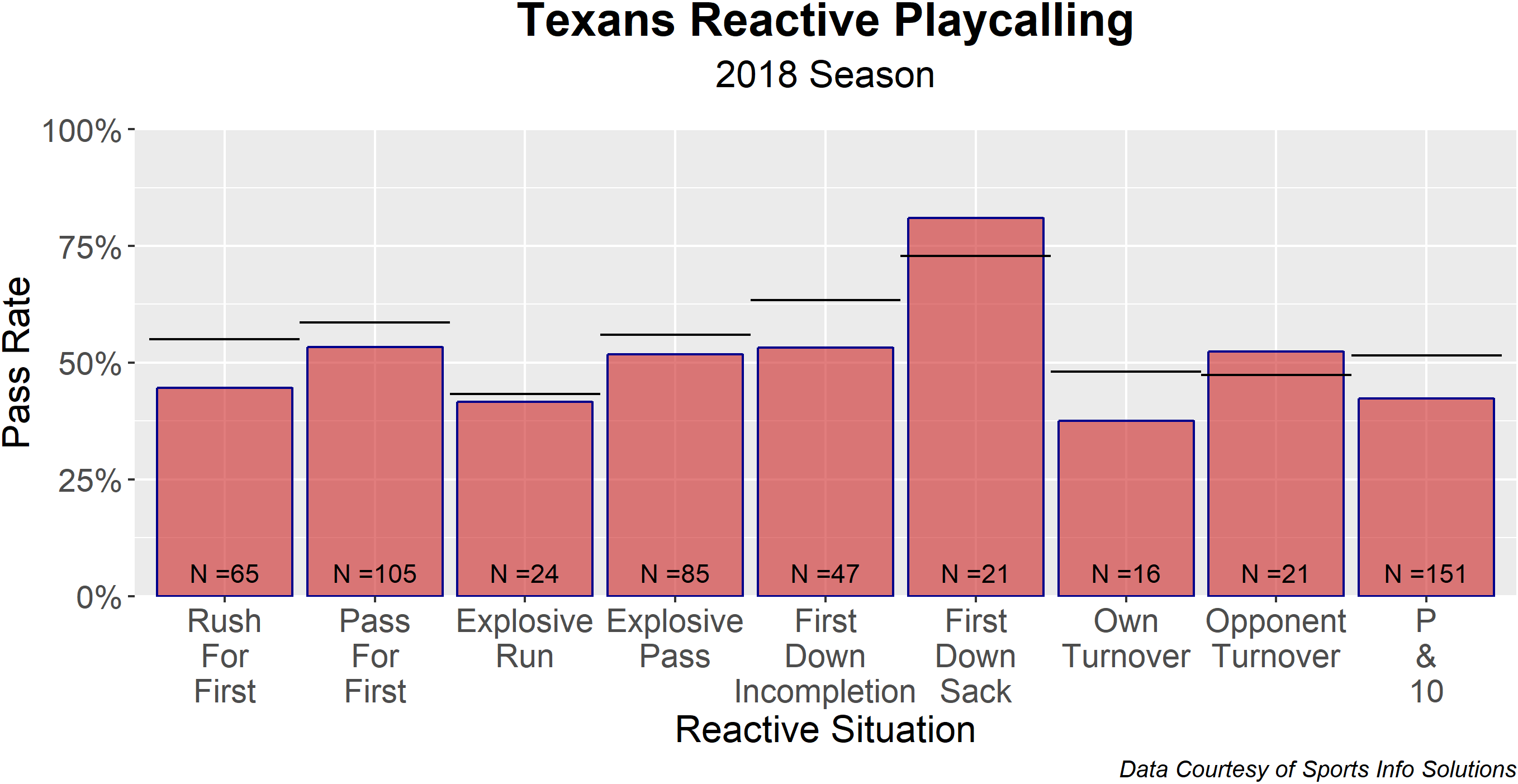
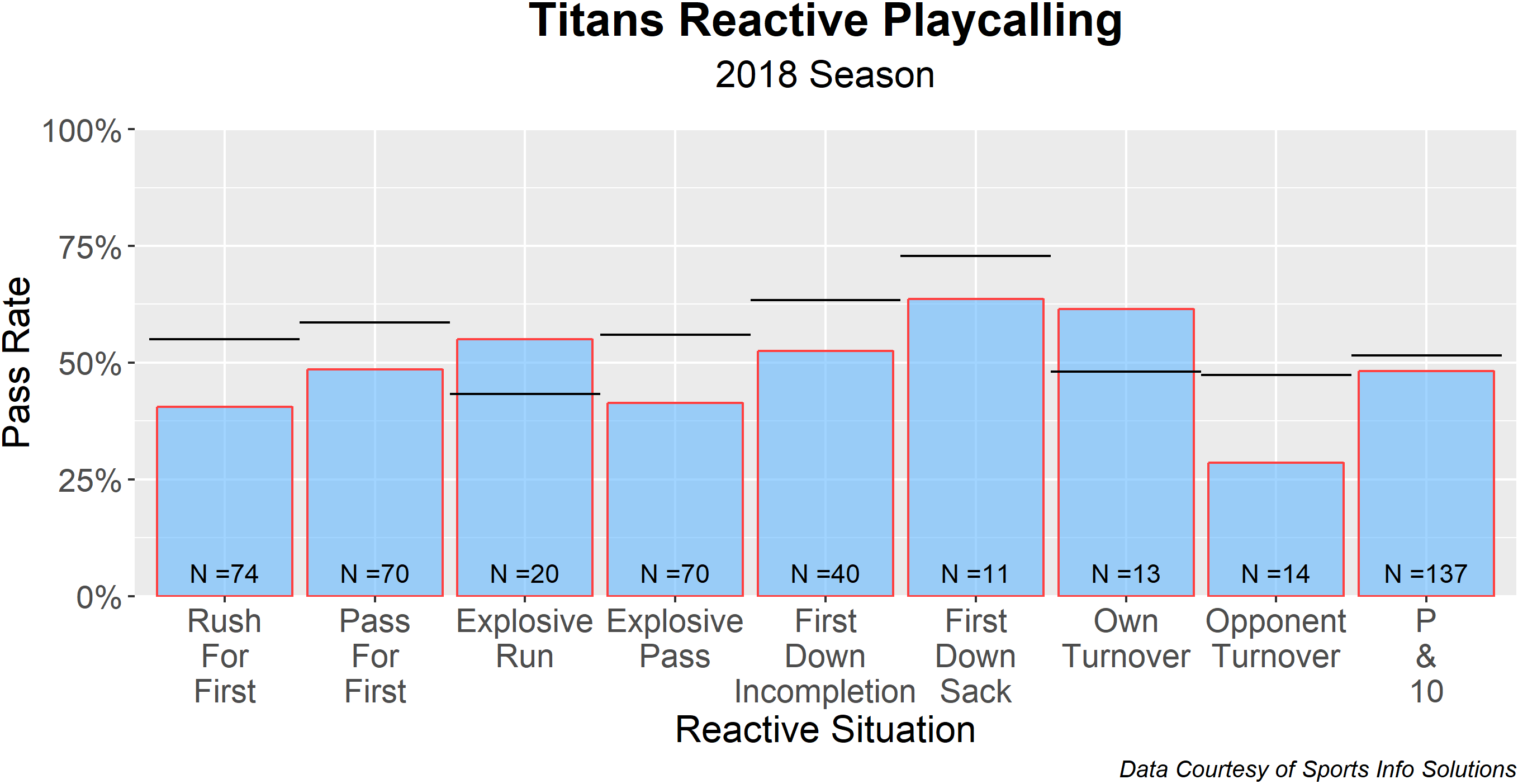
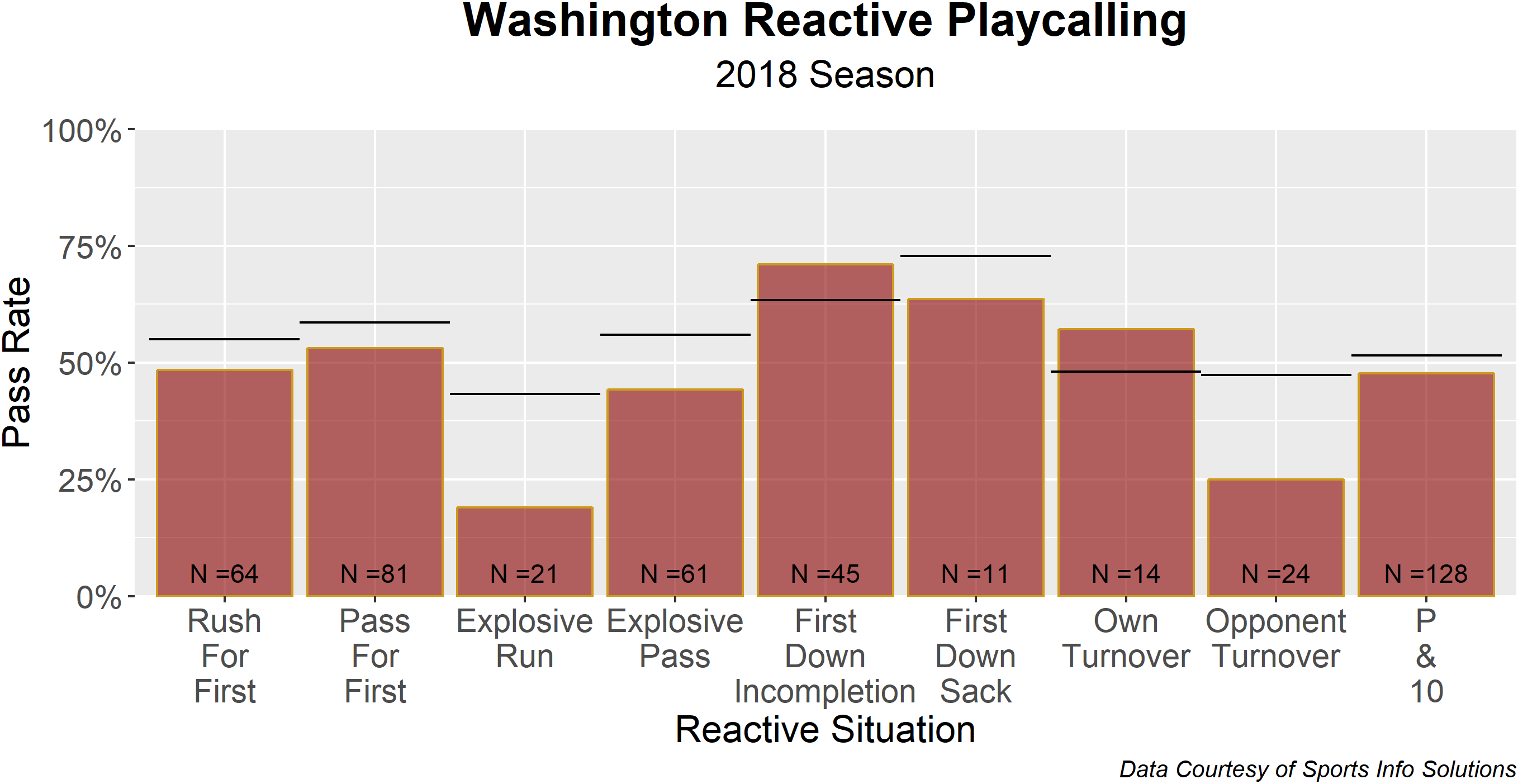
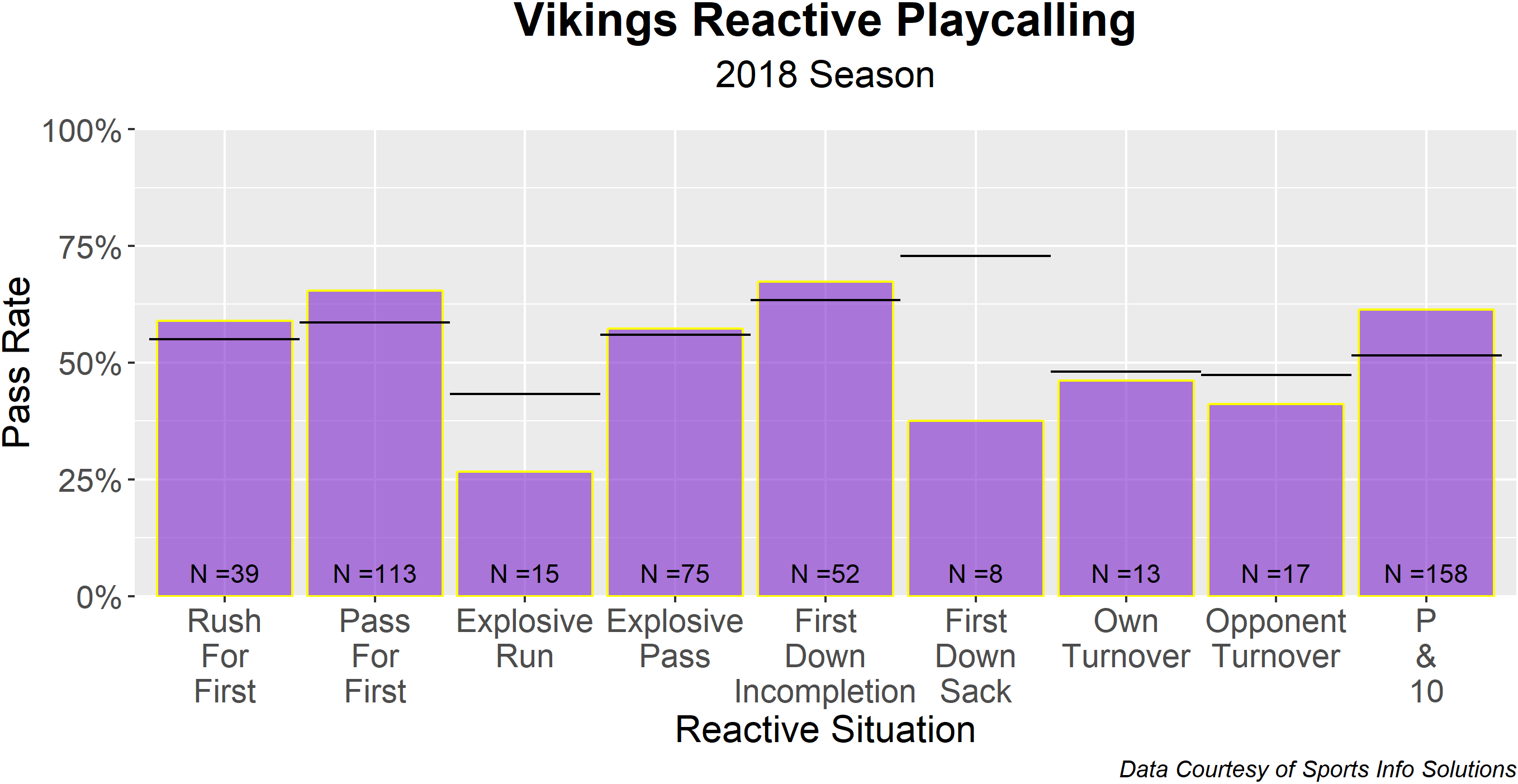
Rather than scribe out each team’s tendencies and waste your time with wordy prose and analysis you’re likely to skip over anyway, I’ve made something of a picture book. Below are 32 charts, one for each team’s reactive playcalling in 2018. But first, let’s go over some ground rules before we get started.
The black lines represent the league average rate for each reactive situation. “N =” indicates the number of times a team found itself in the specified reactive situation. Quarterback kneels were removed from the sample, so a team that kneeled the ball after hitting an explosive run to seal the game won’t have its pass rate watered down by such plays.
It should also be noted that explosive (15+ yards) passes and runs weren’t double-counted in passes and runs for firsts respectively, just as turnover-related opening plays are excluded from the P & 10 sample. Lastly, pass rate is based on the intent of the play, so scrambles and backwards passes are considered passes for the purpose of these calculations.
Without further ado, please enjoy and watch your step for small samples!
-
New football podcast episode: Fantasy Workloads and Expected Completions
Former NFL scout Matt Manocherian (@MattMano) of Sports Info Solutions and football analytics pioneer Aaron Schatz (@FO_ASchatz) of Football Outsiders welcome Nate Weller (@NateWellerr) of the SIS R&D team to the Off The Charts podcast to look at some of the toughest fantasy workload projections for the upcoming season. The group looks specifically at the RB groups for the Rams (0:47), Eagles (5:08), Bears (10:32) and the WR groups for the 49ers (14:07), Packers (16:03) and Ravens (21:38). Nate also updates everyone on a new stat he’s working on called “Predictive Completions” (27:30).
Click here to tune in.
-
When a sack is not scored a sack
By Mike Churchward
I deal with a lot of technicalities and minutiae when it comes to my role in checking our football data here. There’s one that has been on my mind for awhile that I’d like to share.
Most fans of NCAA and NFL football would assume that the rules for keeping official statistics would be similar, if not identical, between the two levels. While one would be mostly correct in this assumption, there are some major differences between the two levels that can affect statistical categories.
Sacks and how they are recorded are quite different between college and the NFL. Specifically, when there is a sack and fumble behind the line of scrimmage and the ball is picked up by another offensive player, the distinction in statistical record keeping between the two levels is notable.
If a defensive player recovers the ball, the sack rules take a different path. If the player that picks up the ball does not get beyond the original line of scrimmage while trying to advance the ball, the statistical reporting is quite different between college and the pros.
This is where one must really pay attention to what is supposed to be recorded.
The 2018 statistician guide for the NCAA states:
“Adams is back to pass, but has the ball stripped from his grasp before his arm starts going forward by Benson, causing a fumble. The ball is then recovered behind the line of scrimmage by Allen, who attempts to gain positive yardage before being tackled by Baker, still behind the line of scrimmage. Credit Benson with a forced fumble only. Credit Baker with a solo tackle and a solo tackle for loss for the yards lost to the final spot. Charge Adams with a rush attempt and minus yards rushing to the final spot. Charge Team A with a fumble not lost. Allen is not credited with any statistics on this play.”
The basic way to interpret this rule is that the defender who tackled the QB, and forced the fumble, will not get credit for anything but a forced fumble.
Think about that for a second.
There are thousands of sacks per year in a typical college football season. A large number of those sacks will have fumbles attached to them. Now if the teammate of the quarterback recovers the ball and tries to advance, but is tackled behind the line of scrimmage, then there is no sack on the play.
How odd is this rule?
While this type of sack fumble play is on the rare side, it still occurs enough that there could be a consequence for those that keep the statistics incorrectly. This would be especially true for the players that are competing for season sack leader. In 2018 the FBS sack leader was Jaylon Ferguson of Louisiana Tech with 17.5 sacks. Josh Allen of Kentucky was second in sacks with 17. The separation between the top two is a half-sack. In 2017 the sack leader was Sutton Smith from Northern Illinois with 14, with two players tied for second with 13. The separation between that year was only one sack.
The reason why these numbers were brought up is to show this rule could affect a major statistical category for football. Imagine if Ferguson’s chance of breaking Terrelle Suggs’ career sacks record was hurt by this scoring rule. One reason that fans have heard of Ferguson is because he now owns the mark. He wouldn’t be as well remembered if he came up one sack short.
Fortunately for Ferguson, none of the three instances of this last season impacted him. They did impact Tulsa’s Trevis Gipson (lost a sack vs SMU), Boise State’s Curtis Weaver (lost a sack vs Fresno State), and North Carolina’s Malik Carney (lost a sack vs North Carolina State).
The NFL statistician’s guideline for this type of play states:
“If a teammate or opponent recovers the fumble behind, or on, the line of scrimmage, charge the passer with sack yardage to the point of recovery. Yardage gained by teammate(s) after the recovery up to the line of scrimmage is used to reduce any yardage lost by the passer.”
This means that the player who sacked the quarterback and caused the fumble still gets credit for the sack; just the total sack yardage is reduced. This rule makes more sense on how to keep this type of statistic. This means that the defender gets credit for a sack when the offensive player who recovers the ball is still tackled behind the line of scrimmage.
That the NCAA only gives a forced fumble credit to the player that originally hit the quarterback is not telling the whole story. It is odd that this record keeping doesn’t line up with the NFL’s method. I hope someday that it will.
-
Sports Info Solutions NFL Round One Mock Draft
Members of the SIS operations department put together an annual seven-round mock draft and this year we decided to share the first round. This was done independent of previous rankings and analysis that appeared in other publications. Below are the picks along with a brief explanation from the person who selected them.
Pick Team Player School Position Selected by: 1 Cardinals Kyler Murray Oklahoma QB Nathan Cooper Murray is an explosive playmaker who will fit what Kliff Kingsbury is wanting at the Quarterback position.
Pick Team Player School Position Selected by: 2 49ers Nick Bosa Ohio State Edge John Todd After bolstering the defensive interior with past high picks, SF finishes the edges with Dee Ford and Bosa
Pick Team Player School Position Selected by: 3 Jets Quinnen Williams Alabama DT Noah Gatsik Arguably the best player in the Draft will bring more explosiveness to the Jets defensive line.
Pick Team Player School Position Selected by: 4 Raiders Josh Allen Kentucky Edge Justin Stine Allen is in the top tier of edge defenders in this class, and the Raiders desperately need to recoup some pass rush after the Mack trade
Pick Team Player School Position Selected by: 5 Buccaneers Ed Oliver Houston DT Nathan Cooper Oliver is an explosive pass rusher that Tampa can place next to 2018 1st Rounder Vita Vea once Gerald McCoy moves on.
Pick Team Player School Position Selected by: 6 Giants Montez Sweat Mississippi St Edge John Todd Assuming NY is fine with reported health concerns, Sweat replaces Vernon as a prototypical edge rusher.
Pick Team Player School Position Selected by: 7 Jaguars Jonah Williams Alabama OT Noah Gatsik Williams is a versatile OL that can come in and help protect newly acquired Nick Foles.
Pick Team Player School Position Selected by: 8 Lions Deandre Baker Georgia CB John Verros The Lions could possibly trade down from this spot and get Baker, where his closing speed and ball skills will help bring stability opposite Darius Slay.
Pick Team Player School Position Selected by: 9 Bills Devin White LSU LB Evan Butler Pairing White with 2018 1st Rounder Tremaine Edmunds will allow for an incredibly quick and rangy LB core.
Pick Team Player School Position Selected by: 10 Broncos Drew Lock Missouri QB Nathan Cooper Lock possesses the arm strength and raw talent that John Elway loves and is looking for in Denver.
Pick Team Player School Position Selected by: 11 Bengals Jawaan Taylor Florida OT Josh Hofer The Bengals desperately need to upgrade their offensive line and Taylor’s run and pass blocking ability should help the offense be more effective.
Pick Team Player School Position Selected by: 12 Packers Devin Bush Michigan LB John Shirley Bush brings speed and instincts to a defense that’s looking to get younger and faster.
Pick Team Player School Position Selected by: 13 Dolphins Garrett Bradbury NC State OC John Todd Miami seems keen on building the rest of the roster and passing on a QB until 2020. Bradbury is a top-rated OL.
Pick Team Player School Position Selected by: 14 Falcons Christian Wilkins Clemson DT Noah Gatsik Wilkins is a versatile DL that will be disruptive in the run and pass game for Atlanta’s defensive line.
Pick Team Player School Position Selected by: 15 Redskins TJ Hockenson Iowa TE John Todd Tough to pass on Haskins here, but Hockenson can be an elite two-way TE who doesn’t alert defenses to run or pass.
Pick Team Player School Position Selected by: 16 Panthers Brian Burns Florida St Edge Nathan Cooper Carolina can use more speed on defense and Burns brings that speed and raw pass rush ability off the edge.
Pick Team Player School Position Selected by: 17 Giants Andre Dillard Washington St OT John Todd NY has claimed it is still happy with Eli at QB. Protecting him better will help try to defend that opinion.
Pick Team Player School Position Selected by: 18 Vikings Cody Ford Oklahoma OG Jeff Dean The Vikings need significant offensive line help and would happily fit the massive Ford in anywhere on the right side.
Pick Team Player School Position Selected by: 19 Titans Dexter Lawrence Clemson NT Dan Foehrenbach Lawrence’s ability to get to the QB paired with Jurrell Casey would result in a very disruptive and improved defensive line.
Pick Team Player School Position Selected by: 20 Steelers Greedy Williams LSU CB Dan Wallie With both of the Devins gone, the Steelers can continue to bolster the secondary with Greedy’s patience and ball skills.
Pick Team Player School Position Selected by: 21 Seahawks Clelin Ferrell Clemson Edge Nathan Cooper Ferrell fits what the Seahawks are looking for off the edge with his explosion and pass rush ability.
Pick Team Player School Position Selected by: 22 Ravens AJ Brown Ole Miss WR John Todd With no WR off the board yet, Ravens can take their pick. They’ve been burned before by size/speed types like Metcalf, so they go for the more polished Brown here.
Pick Team Player School Position Selected by: 23 Texans Greg Little Ole Miss OT SIS Scouting Staff Little possesses the length and strength to be an effective pass blocker for a Texans OL group that needs to get better in front of Deshaun Watson.
Pick Team Player School Position Selected by: 24 Raiders DK Metcalf Ole Miss WR Justin Stine Metcalf has a high ceiling if he can stay healthy and prove he can separate in a full route tree
Pick Team Player School Position Selected by: 25 Eagles Chris Lindstrom Boston College OG Noah Gatsik Eagles need to address the interior O-line and Lindstrom is best available that adds depth since he can play both guard spots and also allows Seumalo to move to Center if Kelce has to miss any time.
Pick Team Player School Position Selected by: 26 Colts Jeffery Simmons Mississippi St DT Nathan Cooper Even with the knee injury and off-field issues, the Colts get a guy in Simmons that can bring the explosiveness and three-down ability that they are looking for on the D-Line.
Pick Team Player School Position Selected by: 27 Raiders Byron Murphy Washington CB Justin Stine Murphy might be the top cover corner in this year’s draft and would bring a balanced, dynamic skillset to the Raiders’ secondary
Pick Team Player School Position Selected by: 28 Chargers Dwayne Haskins Ohio St QB John Todd This is much later than Haskins should go but without projecting trades, a slide is possible if a top QB sneaks through the teens. Chargers could groom an heir to Rivers.
Pick Team Player School Position Selected by: 29 Seahawks Johnathan Abram Mississippi St S Nathan Cooper Abram’s all-around, 3-level ability on the back end should make for an easier transition from the departed Earl Thomas
Pick Team Player School Position Selected by: 30 Packers Marquise Brown Oklahoma WR John Shirley Brown has the speed and playmaking ability to be a threat with the ball in his hands around the line of scrimmage and can take the top off of the defense.
Pick Team Player School Position Selected by: 31 Rams Deionte Thompson Alabama S Justin Stine Thompson is a true “centerfield”-type safety, who can roam the middle of the field and use his range to make plays behind a talented defense.
Pick Team Player School Position Selected by: 32 Patriots Noah Fant Iowa TE Noah Gatsik With Gronk now gone, Fant will be viewed to step in and help give Brady another weapon at the Tight End position.
-
SIS Draft Special
Sports Info Solutions is opening its wealth of data to you for free during the NFL draft!
To celebrate the draft, all trials to the SIS DataHub will have the trial status removed and be given full access to the most in-depth and accurate football database.
The SIS DataHub is a premier research tool that has all the traditional metrics as well as proprietary statistics that are not available anywhere else- including blown block percentage, broken tackles, route data, and more.
Layers of filters and splits allow users to easily manipulate the data to view performance in certain situations in order to gain a deeper understanding about a player or team’s overall body of work. Two-minute drill, red zone production, man/zone splits, and one- possession games are just the surface of the type of situations you can access with the DataHub.
This week, Business Development Analyst and resident DataHub expert, Corey March, will be releasing a video demonstrating some of the DataHub’s unique capabilities and showing some of the best ways to navigate the site. Corey will talk about some of the players and stats he finds interesting about this year’s rookie class.
Inside the video, Corey will also mention a promo code that can be used with the DataHub to get a discount on new subscriptions.
To cap off the NFL draft celebration, trials to the DataHub will have a chance to win free subscriptions, with one subscription being given away each day of the draft.
Day 1: Annual account awarded
Day 2: Three- month account awarded
Day 3: One- month account awarded
Take advantage of this opportunity to research the newest class of future NFL starts and make decisions on each pick for yourself!
Sign up for your trial at SISDataHub.com
Questions? Reach out to Patrick at prowley@ww2.sportsinfosolutions.com
-
Two Highly Rated Prospects Have Seen Their Draft Stock Take a Hit: Here’s Why
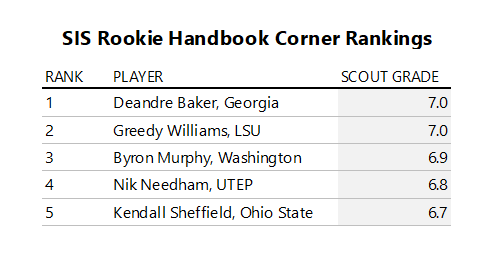
With the draft a little more than a week away, teams and draft analysts alike are finalizing their draft boards. For the most part, they look a lot different than they did only a few months ago. A couple of the highest rated prospects from the SIS Rookie Handbook are among those whose stock has taken a hit during the pre-draft process.
Greedy Williams
In the SIS Rookie Handbook, Greedy Williams was one of nine players to receive a grade of 7.0 or better, and was tied with DeAndre Baker as the highest rated corner grade. Initial mock drafts had Williams as a potential top 5 pick, and a virtual lock for top 10. Since then though, Williams has seen his stock taking a bit of a tumble. Mel Kiper has Williams 22nd on his big board, and his 3rd corner overall, trailing both Deandre Baker and Byron Murphy. Most mock drafts now have Williams as a mid to late first round pick, with some putting him as low as the top of the second round.
What he does well:
What’s interesting about Williams is that his ability to cover has never really been in question. In 2018 he allowed a deserved catch percentage of only 60%, and a QB Rating against of only 43.3. Both of those figures ranked as the second best among draft eligible cornerbacks, and were ahead of Baker and Murphy.
Part of what makes Williams so good in coverage is his ability to make quick transitions and stay patient on deep routes and double moves. While there was some worry after he struggled in his combine drills, particularly the pedal and turn, his numbers and film show little reason for concern overall.
On throws at least 20 yards downfield in 2018 Williams allowed only 6 completions for 172 yards and a touchdown on 22 targets, a yards per attempt of only 7.8. More impressive, while lined up on the outside in man coverage, receivers attempted a double move on Williams 9 times. The lone target fell incomplete. It is a relatively small sample, but illustrates his ability to suppress targets and is strong evidence of his ability to stay patient on long developing routes.
Where he comes up short:
The biggest reason for Greedy’s fall from the top of big boards is his tackling ability. Take this quote from Mel Kiper that echoes the concerns of a number of NFL teams:
“Opinions are already complete now, and I think the tackling and the ability to be an 11th man on that defense, and not play with 10 and have a big running back coming around the corner and make a business decision on whether you tackle or you don’t. Again, you’ve got to tackle these bigger receivers, these tight ends in space, because it’s an extension of the running game. Or these short passes. You can’t be missing tackles in the open field or around the line of scrimmage. Again, tackling not just running backs, but receivers and tight ends, that’s going to be the issue.”
There is room to debate just how important it is for corners to be strong tacklers, especially when they are as strong in coverage as Williams, but there is no denying that tackling is an issue. Williams had only 34 combined tackles in 2018, which did not even rank him in the top 200 among all college corners. He also had a broken tackle percentage of 15.4%, which was among the worst of all draft eligible corners. Put into perspective, fellow top prospects Deandre Baker and Byron Murphy came in at 2.4% and 8.2% respectively, both ranking in the top 10 among draft eligible corners.
Some of this is scheme related as Williams spent 63% of his snaps in man coverage in 2018, but his poor tackling technique is certainly a concern for teams that like to use corners in run support, and is the main culprit for his slide as we approach the draft.
N’Keal Harry
There has never really been a consensus among draft analysts about the top WRs in this years draft, and the picture hasn’t become much clearer as we approach the draft. One player that seems to be sliding though is N’Keal Harry, who comes in as the top receiver in the SIS Rookie Handbook.
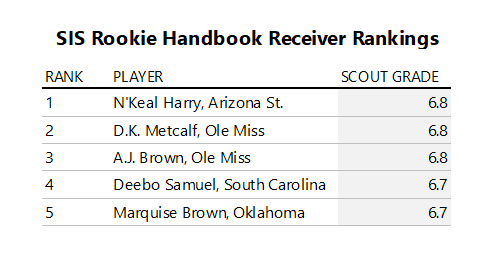
Once in contention with Metcalf for the top spot among receivers, Harry has been usurped in a most rankings by the likes of A.J Brown, Deebo Samuel, Marqise Brown and even J.J. Arcega-Whiteside. What’s different about his slide though is that there is nothing new you can point to that explains it. Sure, D.K. Metcalf showing up to the combine looking like a super human didn’t help, but Harry had a strong combine performance in his own right, posting a 4.53 40-yard dash, 38.5″ vertical, and 27 reps on the bench.
What he does well:
In 2018 Harry turned 90 catchable targets into 73 catches, 1,088 yards and 9 touchdowns, a QB Rating when targeted of 114.9. His ability to use his size to make plays downfield is part of what makes him such an intriguing prospect. Harry ran 47.2% of his routes down the field 2018, and on those targets racked up 17 catches for 421 yards and 5 TDs. Good for a rating of 129.75.
Harry is also dynamic with the ball in his hands after the catch, using his unique combination of size and speed to generate additional yardage. In 2018 he averaged 7.1 yards after the catch, and his 308 yards after contact ranked 5th in the NCAA.
Where he comes up short:
While Harry has shown a knack for finding soft spots in zone coverage, he fails to consistently create separation against man – particularly on shorter routes – and rather relies on his size, length, and catch radius to make plays. While this served him well in the college ranks, relying solely on size and athleticism gets exponentially more difficult against NFL corners.
To get an estimate of separation we looked at the amount of yards between when a receiver first caught the ball, and when he was first contacted by a defender. (Pass breakups and interceptions are counted as zeroes.) When looking at targets less than 15 yards downfield, Harry averaged about 2.4 yards against zone, but only .13 yards against man coverage. His numbers against man ranked him 2nd worst among draft eligible receivers, and 303rd of 313 receivers with at least 25 targets overall.
Separation is not always everything though, especially for a player who has the size and athleticism of Harry. While he struggled to consistently separate, it is also worth pointing out that some of the players in the NFL who find themselves amongst the trailers in this metric include A.J. Green, DeAndre Hopkins, and Julio Jones.