Tag: NFL

  • Optimistic and Pessimistic Takeaways for the Seahawks and Rams After Week 16

    Optimistic and Pessimistic Takeaways for the Seahawks and Rams After Week 16

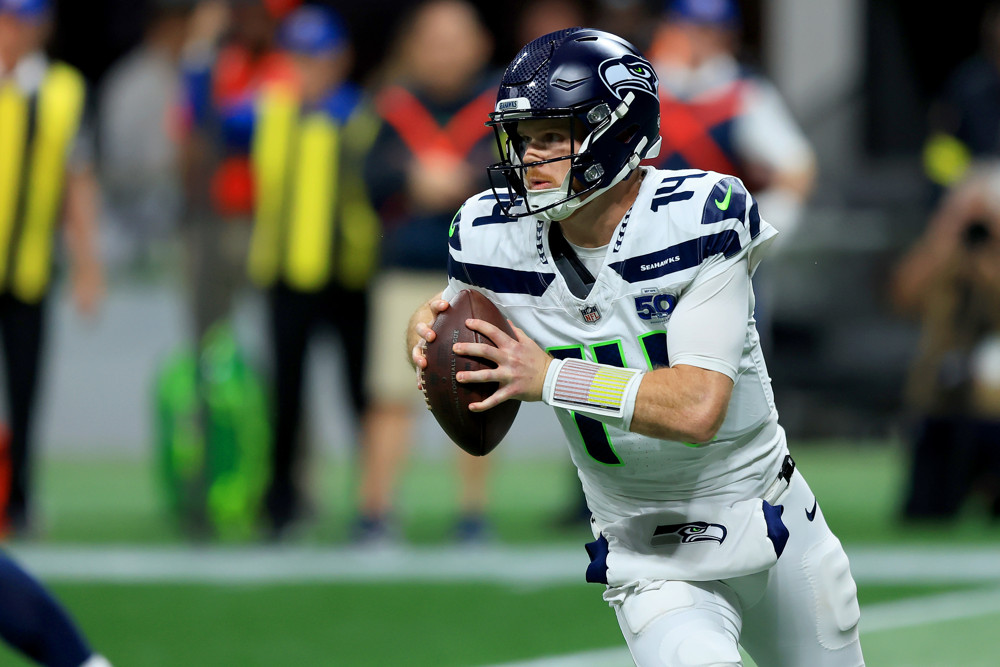
    Photo: David J. Griffin/Icon Sportswire

    Arguably the biggest game of the year so far took place last Thursday night and it did not disappoint. History was made, with us witnessing the first NFL game to end with a walk-off 2-point conversion. The Seattle Seahawks got their revenge and defeated the Los Angeles Rams 38-37, gaining the inside track to representing the NFC as the first seed in the process. 

    The Rams will be kicking themselves for letting go of the game that was all but theirs, but all is not lost. They should still feel confident in their chances come January, backed by the fact that they rank 1st overall in our team Total Points metric.* 

    *For a refresher, here is our primer on Total Points.

    The Seahawks came into the match ranking 2nd themselves, and the two bouts between them so far have further emphasized how neck and neck the two clubs are, well summarized by this stat

    Let’s take a deeper look into why each team should and shouldn’t feel confident about its chances to win it all.


    Why the Seahawks can win the Super Bowl: Improving rushing attack, special teams advantage

    In my previous article, I covered why the Seahawks should still feel like they’re in the mix due to their defense but in order to truly contend, they will need to answer questions about both their running and passing games, especially against elite defenses in high-stakes moments. 

    While they still have more to prove to completely quell those concerns, especially in their passing attack, their showing last Thursday was a step in the right direction. 

    The Seahawks entered the game with the 2nd worst rushing EPA per attempt in the league. Given that placement, it may seem odd that they ranked 14th in rushing Total Points per attempt, but that can be explained by them ranking as the worst run blocking unit in the same metric. 

    They arguably had their best rushing performance of the season so far, gaining 171 yards on 25 carries, with two of those resulting in touchdowns. The numbers matched what our eyes were telling us, improving across the board:

    Rushing EPA/A Rushing TP/A Run Blocking TP/A
    Weeks 1-15 -0.10 0.05 0.15
    Week 16 0.24 0.27 0.25

    Seattle must continue to demonstrate that it can punish opposing defenses on the ground and take pressure off Sam Darnold and the receiving corps. Teams that end up lifting the Lombardi trophy are often the best at problem solving and have other pitches to go to when their fastball is compromised, so to speak.  

    An area they have already proven to be among the league’s elite throughout the season is special teams. The Seahawks rank 6th in special teams Total Points per play, backing up that ranking with top 5 rankings in both punt and kickoff average return yards. 

    The momentum-shifting punt return touchdown by Rashid Shaheed upped Seattle’s combined punt and kick return touchdown total to three, tied for most in the league. They also have three combined punt and field goal blocks, again tied for most in the league, showcasing their penchant for making plays in all phases of special teams.


    Why not the Seahawks: Passing questions remain, turnovers

    To Sam Darnold’s credit, he demonstrated that he could deliver when the team needed him to and win a game with massive stakes, particularly against a team who has given him the most trouble the past couple of seasons. 

    For the last half of the fourth and overtime, Darnold went 8 for 11 (excluding a spike) for 91 yards and two touchdowns, in addition to completing two 2-point conversions. At least for one game, he was able to get the proverbial monkey off of his back. 

    For the first three-and-a-half quarters however, things didn’t seem that way, with Chris Shula and his defense seemingly flummoxing Darnold at every turn and forcing two back-breaking picks, both with disguised coverages. 

    I noted previously that up through Week 11, the Seahawks had a negative passing EPA for the season when facing dime personnel (6+ defensive backs). Things were more of the same last Thursday, with them posting a 10% success rate and -13 EPA against dime (-5 EPA against nickel as well).

    There is still time for Darnold and the Seahawks to establish whether they can perform consistently when in obvious passing down situations, but for now things don’t look fixed.

    In addition to the two aforementioned interceptions, Cooper Kupp also lost a fumble to his former team, bringing Seattle’s turnover total up to 26, second-most in the league. Denver, San Francisco, and Seattle are the only teams over .500 with a negative turnover differential. 

    Teams who have lost the turnover battle are a combined 41-143-1 so far in the 2025 season.  Needless to say, the Seahawks need to turn things around in that department to give themselves the best chance come January.


    Why the Rams can win the Super Bowl: Complete team on offense

    In a lot of ways, the Rams are who the Seahawks want to become on offense. They are 1st in offensive team Total Points per play, in large part due to having top 5 players at both quarterback and wide receiver in Matthew Stafford and Puka Nacua. 

    Even having to face an elite defense, Stafford lit up the Seahawks, throwing for 457 yards and three touchdowns with no picks. Nacua accounted for 12 of those completions, racking up a ludicrous 225 yards and two touchdowns. 

    If that wasn’t enough, they also employ the receiving touchdowns leader, Davante Adams, though it may take a while for him to return to form, as detailed in this piece by Alex Vigderman.

    The passing attack is counterbalanced by a solid run game led by Kyren Williams and Blake Corum, ranking 3rd in rushing success rate and 4th lowest in percentage of runs hit at the line. 

    Since Week 9, the midway point of the season, among tailbacks, Williams ranks 1st in rushing EPA per attempt and 11th in Total Points per play, while Corum ranks 12th and 6th in those same categories respectively. 

    Their offensive line is nothing to sneeze at either, ranking 3rd in blocking Total Points per play. They have the 4th lowest blown block percentage in the league and rank 2nd and 4th in sack and pressure percentage allowed, respectively. The Seahawks couldn’t bring Stafford down even once. 

    Over the full season, both the Rams and Seahawks are among the best teams in keeping the quarterback clean (and doing so without spamming quick game).
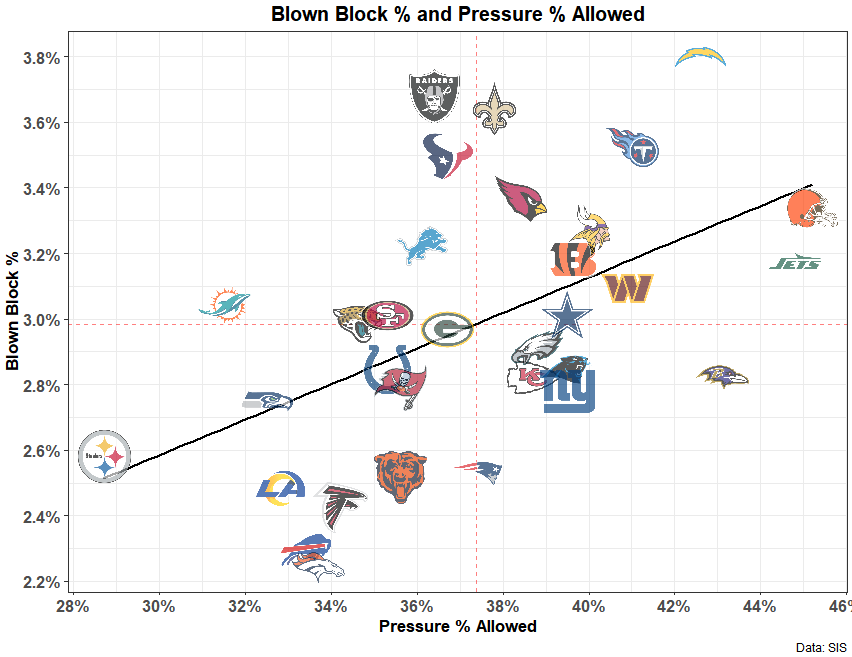
    Scatterplot of blown block rate and pressure rate allowed, with a slight trend between them. The Seahawks and Rams are in the bottom-left (good) end.

    * Bottom left is best


    Why not the Rams: Defensive slippage, special teams mistakes

    Honestly a bit of a nitpick here, as I would consider the Rams to employ a good defense. But no team is perfect and they are no exception. 

    The Rams are quietly 19th in run defense Total Points per play. They have allowed over 120 rushing yards in four of their past six games, and two of those four have resulted in losses, including Thursday night. 

    Against play action, they came into the game ranked T-7th-worst in EPA allowed per dropback, 8th-worst in boom percentage allowed, and 2nd-worst in bust percentage forced (where boom plays gain the offense 1 EPA or more and bust plays lose the offense 1 EPA or more). The Seahawks exploited this, with Darnold completing 10 of 13 passes for 167 yards and two touchdowns when in play action. 

    If opposing teams can establish their attacks on the ground and make hay with play action, the Rams have shown themselves to be susceptible. 

    A not-so-quiet underperforming phase of their team that reared its head in this game is special teams, and this proved to be the straw that broke the camel’s back with the firing of their special teams coordinator, Chase Blackburn. 

    The Rams rank 23rd in special teams Total Points per play. Special team blunders played a crucial role in three of their four losses this season, which include allowing two blocked field goals—one of which was returned for the game-deciding touchdown—against the Eagles, allowing a blocked extra point against the 49ers, and then giving up the punt return touchdown to the Seahawks.

    Final Words

    The Seahawks should be feeling great after wrestling away control of the NFC, but they know the job is not finished. They have questions they will need to continue to address through the end of the regular season and into the playoffs. 

    On the other side, even though they lost, the Rams have a solid argument for being the NFC’s best and most complete team. Their questions may prove to be more easily addressable as well. 

    Both the Seahawks and the Rams are top five teams by almost any overall measure of team quality. They are evenly matched through two, and there is a decent chance the two will meet again for a third and final match. 

    The winner may well represent the NFC in Santa Clara. Which of the two will come out victorious? I, for one, can’t wait to find out.  
  • Nathan Cooper’s 2025 First & Final 7-Round Mock NFL Draft

    Nathan Cooper’s 2025 First & Final 7-Round Mock NFL Draft

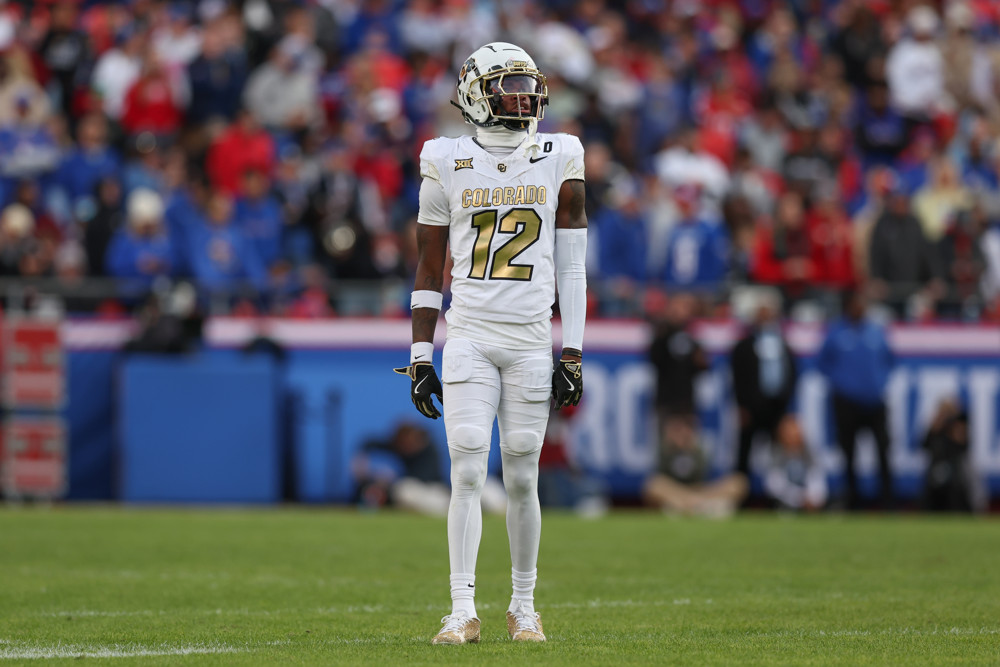
    Photo: Scott Winters/Icon Sportswire

    Every year since before I can remember, I do my own Mock Draft. I only do one, and it’s done within a day or two prior to Draft Day.

    Not only do I try to tackle the first round, but I predict the entire draft, all 257 picks.

    When do the QBs get taken? How many offensive tackles and edge rushers land in Round 1? Who will be Mr. Irrelevant?

    Without projecting trades and, instead, trying to match some players to teams, I attempt to answer those questions and more now.

    Round 1
    Pick Team Player College
    1 Titans QB Cam Ward Miami FL
    2 Browns CB/WR Travis Hunter Colorado
    3 Giants ED Abdul Carter Penn State
    4 Patriots OL Will Campbell LSU
    5 Jaguars RB Ashton Jeanty Boise State
    6 Raiders OL Armand Membou Missouri
    7 Jets TE Tyler Warren Penn State
    8 Panthers ED Jalon Walker Georgia
    9 Saints CB Jahdae Barron Texas
    10 Bears OL Kelvin Banks Jr. Texas
    11 49ers DT Walter Nolen Ole Miss
    12 Cowboys WR Tetairoa McMillan Arizona
    13 Dolphins DT Mason Graham Michigan
    14 Colts TE Colston Loveland Michigan
    15 Falcons ED Mykel Williams Georgia
    16 Cardinals CB Will Johnson Michigan
    17 Bengals ED Mike Green Marshall
    18 Seahawks OL Grey Zabel North Dakota State
    19 Buccaneers LB Jihaad Campbell Alabama
    20 Broncos RB Omarion Hampton North Carolina
    21 Steelers QB Shedeur Sanders Colorado
    22 Chargers DT Kenneth Grant Michigan
    23 Packers WR Matthew Golden Texas
    24 Vikings S Malaki Starks Georgia
    25 Texans OL Josh Simmons Ohio State
    26 Rams CB Trey Amos Ole Miss
    27 Ravens ED Shemar Stewart Texas A&M
    28 Lions ED Donovan Ezeiruaku Boston College
    29 Commanders ED James Pearce Jr. Tennessee
    30 Bills WR Emeka Egbuka Ohio State
    31 Chiefs OL Donovan Jackson Ohio State
    32 Eagles TE Mason Taylor LSU
    Round 2
    Pick Team Player College
    33 Browns QB Jalen Milroe Alabama
    34 Giants QB Jaxson Dart Ole Miss
    35 Titans WR Luther Burden III Missouri
    36 Jaguars DT Derrick Harmon Oregon
    37 Raiders RB TreVeyon Henderson Ohio State
    38 Patriots ED Nic Scourton Texas A&M
    39 Bears RB Quinshon Judkins Ohio State
    40 Saints OL Tyler Booker Alabama
    41 Bears ED JT Tuimoloau Ohio State
    42 Jets S Nick Emmanwori South Carolina
    43 49ers LB Carson Schwesinger UCLA
    44 Cowboys CB Maxwell Hairston Kentucky
    45 Colts ED Barryn Sorrell Texas
    46 Falcons OL Josh Conerly Jr. Oregon
    47 Cardinals OL Wyatt Milum West Virginia
    48 Dolphins CB Azareye’h Thomas Florida State
    49 Bengals DT Alfred Collins Texas
    50 Seahawks ED Princely Umanmielen Ole Miss
    51 Broncos WR Jaylin Noel Iowa State
    52 Seahawks OL Aireontae Ersery Minnesota
    53 Buccaneers CB Shavon Revel Jr. East Carolina
    54 Packers OL Jonah Savaiinaea Arizona
    55 Chargers DT Joshua Farmer Florida State
    56 Bills DT Tyleik Williams Ohio State
    57 Panthers CB Benjamin Morrison Notre Dame
    58 Texans DT Darius Alexander Toledo
    59 Ravens OL Tate Ratledge Georgia
    60 Lions WR Jayden Higgins Iowa State
    61 Commanders S Xavier Watts Notre Dame
    62 Bills CB Jacob Parrish Kansas State
    63 Chiefs RB Kaleb Johnson Iowa
    64 Eagles OL Marcus Mbow Purdue
    Round 3
    Pick Team Player College
    65 Giants OL Emery Jones Jr. LSU
    66 Chiefs OL Anthony Belton NC State
    67 Browns ED Oluwafemi Oladejo UCLA
    68 Raiders WR Tre Harris Ole Miss
    69 Patriots DT Omarr Norman-Lott Tennessee
    70 Jaguars CB Darien Porter Iowa State
    71 Saints QB Tyler Shough Louisville
    72 Bears OL Miles Frazier LSU
    73 Jets OL Ozzy Trapilo Boston College
    74 Panthers WR Jack Bech TCU
    75 49ers OL Charles Grant William & Mary
    76 Cowboys RB Cam Skattebo Arizona State
    77 Patriots OL Dylan Fairchild Georgia
    78 Cardinals WR Elic Ayomanor Stanford
    79 Texans CB Quincy Riley Louisville
    80 Colts LB Danny Stutsman Oklahoma
    81 Bengals WR Kyle Williams Washington State
    82 Seahawks DT T.J. Sanders South Carolina
    83 Steelers OL Jared Wilson Georgia
    84 Buccaneers DT Shemar Turner Texas A&M
    85 Broncos OL Jackson Slater Sacramento State
    86 Chargers CB Nohl Williams California
    87 Packers CB Zah Frazier UTSA
    88 Jaguars ED Josaiah Stewart Michigan
    89 Texans WR Savion Williams TCU
    90 Rams TE Elijah Arroyo Miami FL
    91 Ravens DL Deone Walker Kentucky
    92 Seahawks WR Jalen Royals Utah State
    93 Saints ED Bradyn Swinson LSU
    94 Browns RB Jordan James Oregon
    95 Chiefs ED Landon Jackson Arkansas
    96 Eagles S Kevin Winston Jr. Penn State
    97 Vikings CB Cobee Bryant Kansas
    98 Dolphins TE Terrance Ferguson Oregon
    99 Giants LB Demetrius Knight Jr. South Carolina
    100 49ers ED Kyle Kennard South Carolina
    101 Rams DT Jordan Phillips Maryland
    102 Lions S Jonas Sanker Virginia
    Round 4
    Pick Team Player College
    103 Titans ED Jordan Burch Oregon
    104 Browns OL Chase Lundt UConn
    105 Giants RB Dylan Sampson Tennessee
    106 Patriots RB Bhayshul Tuten Virginia Tech
    107 Jaguars LB Barrett Carter Clemson
    108 Raiders CB Zy Alexander LSU
    109 Bills LB Jeffrey Bassa Oregon
    110 Jets WR Tai Felton Maryland
    111 Panthers S Andrew Mukuba Texas
    112 Saints OL Logan Brown Kansas
    113 49ers CB Upton Stout Western Kentucky
    114 Panthers DT Jamaree Caldwell Oregon
    115 Cardinals OL Seth McLaughlin Ohio State
    116 Dolphins WR Isaiah Bond Texas
    117 Colts CB Bilhal Kone Western Michigan
    118 Falcons WR Pat Bryant Illinois
    119 Bengals LB Teddye Buchanan California
    120 Titans DT Vernon Broughton Texas
    121 Buccaneers WR Jaylin Lane Virginia Tech
    122 Broncos OL Hollin Pierce Rutgers
    123 Steelers RB DJ Giddens Kansas State
    124 Packers LB Cody Simon Ohio State
    125 Chargers RB Devin Neal Kansas
    126 Jaguars TE Harold Fannin Jr. Bowling Green
    127 Rams ED Jack Sawyer Ohio State
    128 Commanders CB Caleb Ransaw Tulane
    129 Ravens DT Jay Toia UCLA
    130 Lions OL Joshua Gray Oregon State
    131 Saints WR Xavier Restrepo Miami FL
    132 Bills ED Ashton Gillotte Louisville
    133 Chiefs WR Isaac TeSlaa Arkansas
    134 Eagles DT Ty Robinson Nebraska
    135 Dolphins OL Cameron Williams Texas
    136 Ravens OL Ajani Cornelius Oregon
    137 Seahawks CB Tommi Hill Nebraska
    138 49ers RB RJ Harvey UCF
    Round 5
    Pick Team Player College
    139 Vikings DT JJ Pegues Ole Miss
    140 Panthers OL Caleb Rogers Texas Tech
    141 Titans TE Gunnar Helm Texas
    142 Jaguars WR Dont’e Thornton Tennessee
    143 Raiders S Malachi Moore Alabama
    144 Patriots DT CJ West Indiana
    145 Jets LB Nick Martin Oklahoma State
    146 Panthers ED Tyrion Ingram-Dawkins Georgia
    147 49ers WR Tory Horton Colorado State
    148 Bears LB Cody Lindenberg Minnesota
    149 Cowboys OL Joe Huber Wisconsin
    150 Dolphins QB Quinn Ewers Texas
    151 Colts OL Luke Kandra Cincinnati
    152 Cardinals OL Jalen Rivers Miami FL
    153 Bengals S Maxen Hook Toledo
    154 Giants CB Robert Longerbeam Rutgers
    155 Dolphins OL Drew Kendall Boston College
    156 Steelers WR Tez Johnson Oregon
    157 Buccaneers OL Thomas Perry Middlebury
    158 Chargers TE Oronde Gadsden II Syracuse
    159 Packers RB Jaydon Blue Texas
    160 49ers WR Kobe Hudson UCF
    161 Eagles OL Xavier Truss Georgia
    162 Jets CB Jaylin Smith USC
    163 Panthers RB Jarquez Hunter Auburn
    164 Eagles WR Arian Smith Georgia
    165 Eagles RB Donovan Edwards Michigan
    166 Texans OL Clay Webb Jacksonville State
    167 Titans OL Jalen Travis Iowa State
    168 Eagles CB Mac McWilliams UCF
    169 Bills OL Bryce Cabeldue Kansas
    170 Bills RB Ollie Gordon II Oklahoma State
    171 Patriots LB Smael Mondon Jr. Georgia
    172 Seahawks LB Chris Paul Jr. Ole Miss
    173 Bills WR Ricky White III UNLV
    174 Cowboys OL Carson Vinson Alabama A&M
    175 Seahawks DL Cam Jackson Florida
    176 Ravens WR Nick Nash San Jose State
    Round 6
    Pick Team Player College
    177 Bills ED Sai’vion Jones LSU
    178 Titans CB Marcus Harris California
    179 Browns TE Jackson Hawes Georgia Tech
    180 Raiders DL Rylie Mills Notre Dame
    181 Chargers WR KeAndre Lambert-Smith Auburn
    182 Jaguars OL Myles Hinton Michigan
    183 Ravens S Lathan Ransom Ohio State
    184 Saints S Marques Sigle Kansas State
    185 Steelers RB Damian Martinez Miami FL
    186 Jets TE Moliki Matavao UCLA
    187 Vikings QB Will Howard Ohio State
    188 Titans OL Garrett Dellinger LSU
    189 Colts RB LeQuint Allen Syracuse
    190 Rams WR Konata Mumpfield Pittsburgh
    191 Broncos TE Thomas Fidone II Nebraska
    192 Browns LB Francisco Mauigoa Miami FL
    193 Bengals CB Justin Walley Minnesota
    194 Jaguars OL Hayden Conner Texas
    195 Rams QB Kyle McCord Syracuse
    196 Lions CB Alijah Huzzie North Carolina
    197 Broncos S Sebastian Castro Iowa
    198 Packers DL Nash Hutmacher Nebraska
    199 Chargers OL Branson Taylor Pittsburgh
    200 Browns S Jaylen Reed Penn State
    201 Rams OL Caleb Etienne BYU
    202 Rams DL Howard Cross III Notre Dame
    203 Ravens LB Jack Kiser Notre Dame
    204 Cowboys S Billy Bowman Jr. Oklahoma
    205 Commanders OL Jack Nelson Wisconsin
    206 Bills OL Aiden Williams Minnesota-Duluth
    207 Jets ED Tyler Baron Miami FL
    208 Broncos LB Collin Oliver Oklahoma State
    209 Chargers OL Connor Colby Iowa
    210 Ravens CB Fentrell Cypress II Florida State
    211 Cowboys OL Willie Lampkin North Carolina
    212 Ravens ED Que Robinson Alabama
    213 Raiders ED Jalen McLeod Auburn
    214 Chargers ED Antwaun Powell-Ryland Virginia Tech
    215 Raiders OL Marcus Tate Clemson
    216 Browns DL Tonka Hemingway South Carolina
    Round 7
    Pick Team Player College
    217 Cowboys LB Shemar James Florida
    218 Falcons OL Jonah Monheim USC
    219 Giants ED Fadil Diggs Syracuse
    220 Patriots QB Kurtis Rourke Indiana
    221 Jaguars S Malik Verdon Iowa State
    222 Raiders WR Isaiah Neyor Nebraska
    223 Seahawks ED Ahmed Hassanein Boise State
    224 Dolphins ED David Walker Central Arkansas
    225 Cardinals LB Kobe King Penn State
    226 Chiefs DL Aeneas Peebles Virginia Tech
    227 49ers OL Jake Majors Texas
    228 Lions DL Ty Hamilton Ohio State
    229 Steelers CB Dorian Strong Virginia Tech
    230 Panthers QB Dillon Gabriel Oregon
    231 Dolphins WR Ja’Corey Brooks Louisville
    232 Colts WR Andrew Armstrong Arkansas
    233 Bears CB Johnathan Edwards Tulane
    234 Seahawks RB Woody Marks USC
    235 Buccaneers OL Jordan Williams Georgia Tech
    236 Texans S Craig Woodson California
    237 Packers OL Gerad Christian-Lichtenhan Oregon State
    238 Patriots ED Jared Ivey Ole Miss
    239 Cowboys CB Melvin Smith Jr. Southern Arkansas
    240 Bears WR Jackson Meeks Syracuse
    241 Texans LB Chandler Martin Memphis
    242 Falcons DL Nazir Stackhouse Georgia
    243 Ravens K Andres Borregales Miami FL
    244 Lions ED Elijah Ponder Cal Poly
    245 Commanders RB Trevor Etienne Georgia
    246 Giants OL Torricelli Simpkins III South Carolina
    247 Cowboys WR Bru McCoy Tennessee
    248 Saints DL Cam Horsley Boston College
    249 49ers K Ryan Fitzgerald Florida State
    250 Packers CB BJ Adams UCF
    251 Chiefs LB Kain Medrano UCLA
    252 49ers TE Jake Briningstool Clemson
    253 Dolphins ED Elijah Roberts SMU
    254 Saints DL Jared Harrison-Hunte SMU
    255 Browns WR Theo Wease Jr. Missouri
    256 Chargers CB Denzel Burke Ohio State
    257 Chiefs OL Brandon Crenshaw-Dickson Florida

    Be sure to check my pre-Draft content on Twitter @ncoopdraft, the SIS Football account @football_sis, and check out all of our content on this year’s class on the NFL Draft site.

  • What a difference one change in alignment makes for the Dolphins

    What a difference one change in alignment makes for the Dolphins

    PHOTO: Mark Goldman/Icon Sportswire

    (All charting numbers in this piece are through Week 16)

    On Sunday night, the Dolphins will host the Bills for a chance to claim their first AFC East title since Tom Brady’s knee popped back in 2008. This game will feature some of the most exciting offensive players in all of football, as well as one of the most exciting coaches. Miami Dolphins head coach Mike McDaniel is the league’s newest offensive genius, and he’s also a media darling who has charmed journalists and fans alike with his earnest and energetic pressers.

    We could spend all day saying nice things about Mike McDaniel. In fact, we’ve spent most of the past year saying nice things about him. So, having established that we love and appreciate Mike for what he’s contributing to this great sport, let’s take a moment to talk about a strange phenomenon happening within his offense right now.

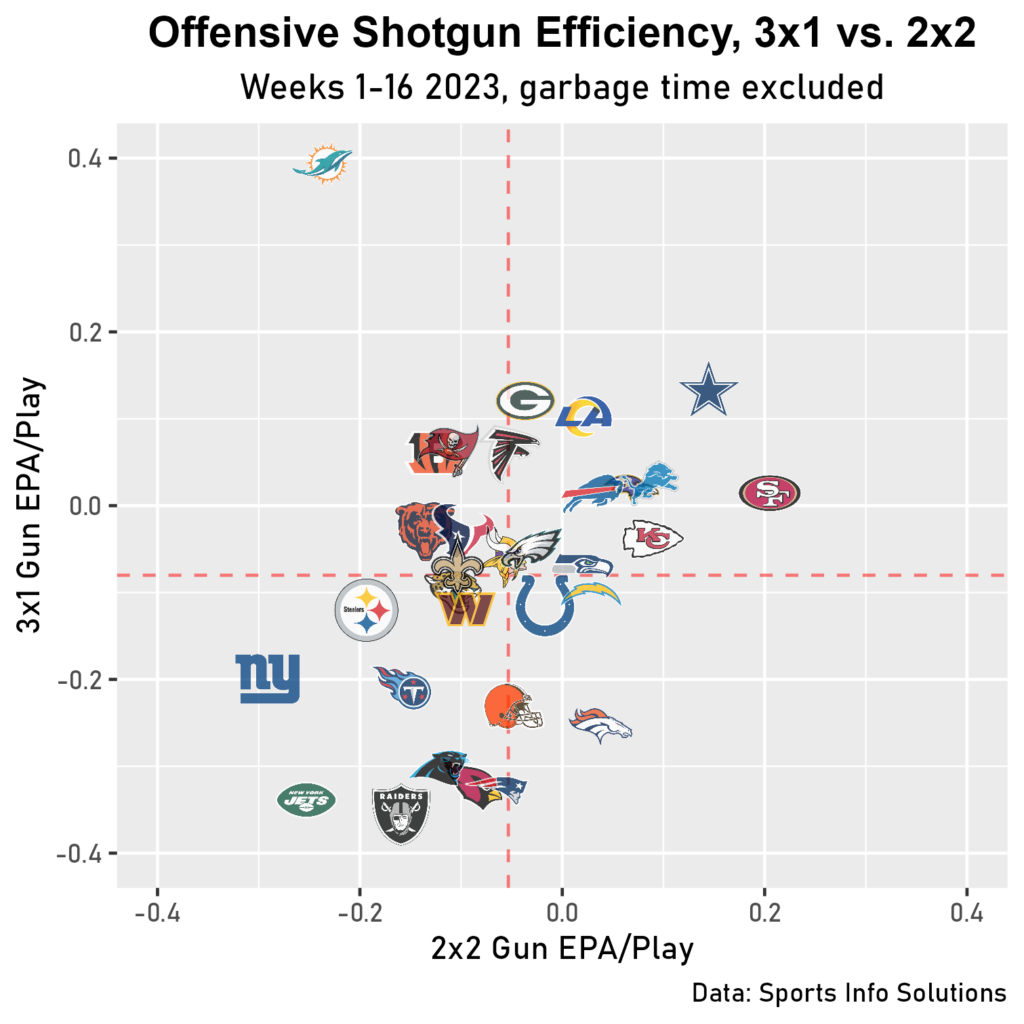
    Miami has been far and away the best 3×1 gun (three receivers to the strong side, one to the weak side in shotgun) team in the NFL this season. On 172 neutral script plays, they’ve averaged a whopping 0.39 EPA/play in this family of formations, which is three times better than the second-best team. It would behoove every coach, offensive or defensive, at every level to take some time this offseason to study what Miami does in 3×1 (and we’ll get into what exactly they do in a bit).

    On the other hand, they have been bad in their 2×2 gun formations (137 plays). They average -0.24 EPA/play – which is 30th in the league, just barely ahead of the New York teams – and the absolute difference between these two formation shells is easily the biggest for any team at a massive 0.63 EPA/play.

    Scatterplot of offensive shotgun efficiency by team in the NFL in 2023, with 2x2 and 3x1 formations on each axis. The Dolphins are the only team off-trend.

    This is seemingly not confounded by any basic scheme split. The pass rates are virtually identical, the motion usage is similar, and they actually use a bit more play action in 2×2. They have had worse fumble luck in 2×2, but even if you strip out the fumbles they’ve lost, there’s still a gap of 0.5 EPA/play. This is also not a single-season aberration, as they ranked 3rd and 27th in these formation shells last year.

    So, let’s first set the table with what they do in 3×1 gun.

    3×1 gun pass game overview

    They attack the intermediate area extremely well (their bread-and-butter is a double overs concept they rake on); they are ruthless about isolating Waddle/Hill on the backside, particularly on digs and skinny posts; they have a variety of outside vertical stretch concepts they use (e.g. Smash, Flood); and they do a good job of abusing their speed via motions in order to stress the back end of the defense horizontally (for example, picture a Cover 1 safety having two seams running at him). 

    Their best motion comes out of 3×1 where they trade a receiver across the formation towards a condensed split X. Most defenses respond with stack checks, which tends to create cushion for the motion player and often exploitable outside leverage for the new #2. Of course, they are also capable of abusing man-to-man in these looks. They try to accomplish a similar thing in 2×2 by motioning #2 outward behind #1 in condensed flanks, but the results have been mixed.

    3×1 run game overview

    Their use of motion in the run game is also effective. Their creativity with TE motion in 3Yx1 (3-receiver side with a tight end/Y attached) formations to create favorable blocking angles on both zone and gap concepts might be first thing you notice, but the way they marry their pass and run game is what stands out the most.

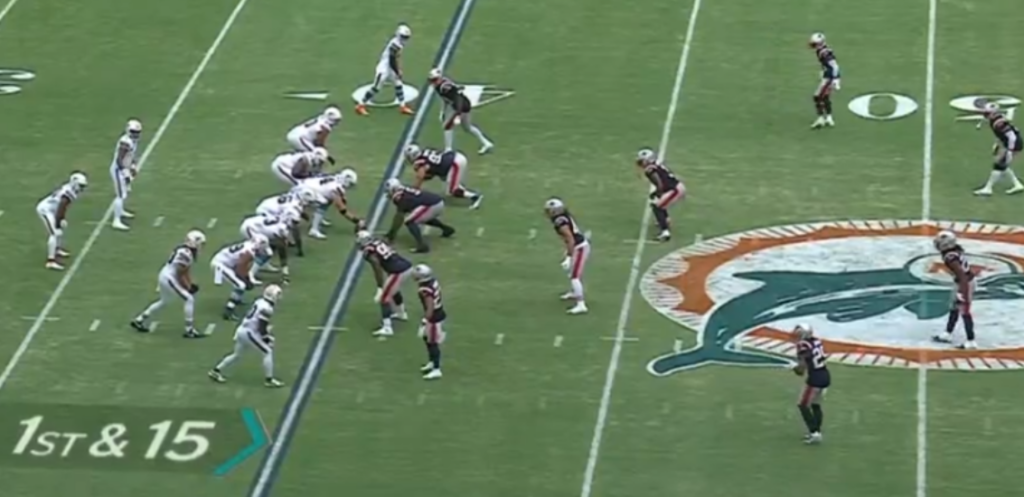
    Screen cap of Dolphins lined up in a 3x1 formation

    3×1 Tight Bunch Gun Strong vs. Patriots 4-2 under front (an even front with a defensive lineman in the A gap to the strength)

    Defensive coverages and fronts go hand in hand, and Miami does an excellent job of abusing the fronts that they get. Take, for example, their same-side power concept in 3×1 gun strong. Teams are willing to play Cover 4 against the Dolphins in 3×1 because they aren’t spamming low horizontal stretches that typically abuse this 4-deep, 3-under coverage, which has a couple of implications:

    1) Defenses generally don’t want the MIKE linebacker to be significantly out-leveraged by #3 (in the above case, the TE) in Cover 4, so it’s difficult for him to fit the strong A gap against the run, which means that, and

    2) Defenses will often be playing an under front to alleviate the MIKE’s run-pass conflict.

    ‘[The problem, then, is that same-side power is typically free real estate against under fronts. Over the last five seasons, power runs against under fronts have averaged 4.6 YPC and 0.02 EPA/play.

    2×2 alignment tendencies

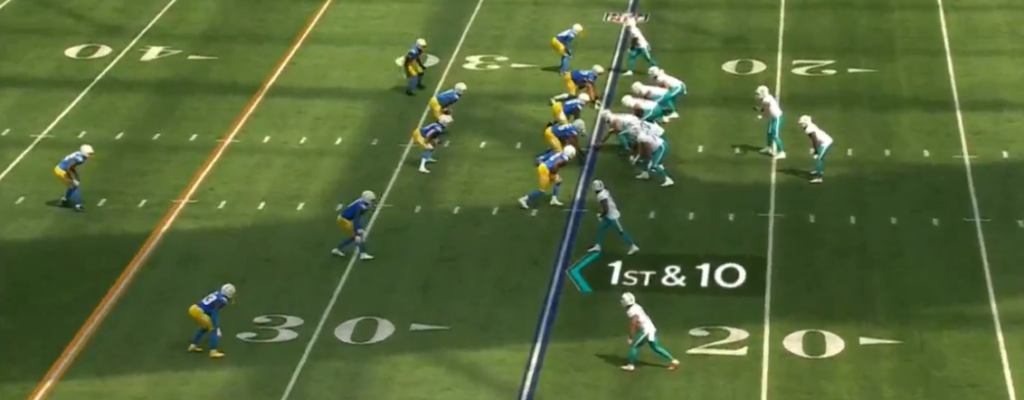
    Their 2×2 gun has deeper issues, but it’s worth briefly mentioning they have a few specific tells that opposing teams may be keying on. For example, any time they’re in 2x2Y gun strong with one of Waddle/Hill aligned on the ball at #2 on the strong side and the other at #1 on the weak side in a condensed split, they run a gap play action shot with a post from one side and a dig from the other. This resulted in the field safety intercepting the post in the Raiders game, although Tua sailing it admittedly didn’t help.

     Screen cap of the Dolphins lined up in a 2x2 formation2x2Y gun strong formation with a 2-open side and a 2-closed side with a cut split from the Z
    Now, to be clear, such trends are not endemic to the Dolphins. Every team has quirks like this that can and will be found if you look hard enough, and sometimes these plays only get called every few games. Furthermore, coaching staffs regularly self-scout to correct for things like this and break tendencies in future games. In fact, Miami seemingly self-identified a tendency in 3×1 earlier this year, in which an outward motion by Tyreek towards a stack would be a tunnel screen if and only if the on-ball player was a tight end. They broke this tendency against the Cowboys by motioning him towards a standard split with Braxton Berrios on the ball, and it went for 10 yards to convert a critical 3rd & 3 in the final drive of the game.

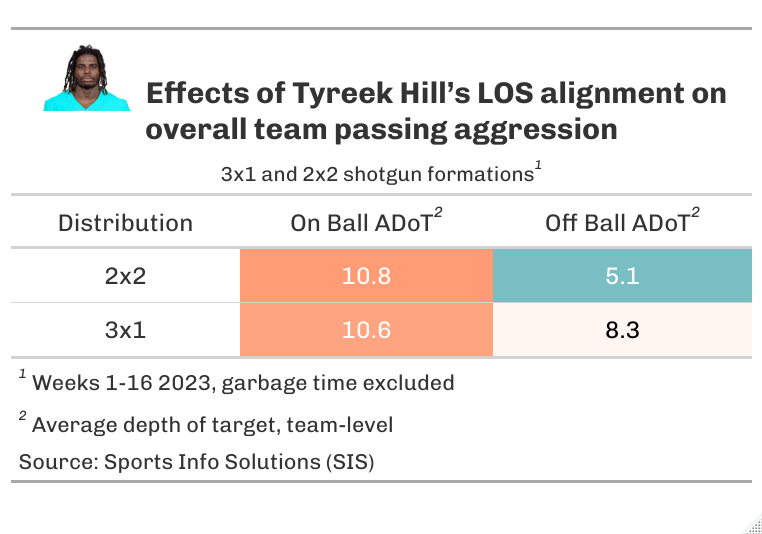
    What is probably more useful is to identify generalizable alignment tendencies, such as the one they have in 2×2 where Tyreek aligning on or off the line of scrimmage sends a pretty strong signal about the verticality of the offense.

    Table showing the effect of Tyreek Hill's alignment (on or off the ball) on the Dolphins' average throw depth. The team's average throw depth is higher when he's on the ball, but the drop-off is much more when Hill is off the ball in 2x2 formations.

    The value proposition of 2×2 pass game and Tua’s compatibility

    Moving onto the nuts and bolts of it all, the Dolphins are generally integrating the back into their dropback passing game more often. They fast-release the back (i.e. he is not staying in to protect, or to chip or check for a blitz before releasing) 10% more often in 2×2 than they do in 3×1, and that’s largely a function of the concepts they’re running. You see more of the classical, West Coast, Shanahan influence in this family of formations; more low horizontal stretch concepts and triangle reads. Slant-flat. Snag. Texas. Stuff like that. And these concepts are fine – Miami runs them a bit in 3×1, as well – but they’re just inherently a lower value proposition compared to what they do in trips.

    Setting aside the relative value of these things, there’s also an argument to be made that Tua just isn’t as good at some of them. He’s checking it down more often, with 17% of his non-screen attempts coming at or behind the line of scrimmage in 2×2, compared to just 5% of the time in 3×1. His turnover-worthy throw rate on passes past the line of scrimmage also jumps from 5% to 8%. More risky throws and more checkdowns is not a good combination!

    Four-open 2×2 (i.e., two receivers to each side with nobody lined up tight) has been particularly tough sledding for the Dolphins. 53% of their passing attempts in 2×2 gun have come from these looks, and they are averaging an NFL-worst -0.53 EPA/pass out of them. They see the sixth-highest rate of middle field open (MOFO) coverage in such formations at 53%, and that is not a function of them being pass-heavy. The league-wide, neutral-script passing rate within these formations is a staggering 90%, so the problem here is that the Dolphins simply have not been good at forcing the issue.

    Defenses playing split field coverages and getting 4 defenders over 3 offensive players (4-over-3) to the strongside and 3-over-2 to the weakside is a tough hill for any offense to climb, and opposing teams can afford to do this to the Dolphins with relative impunity for a couple of reasons. Arguably the most critical factor is that Tua struggles to make some of the throws that typically punish such structures. There are a lot of routes that he excels at throwing, but the slot out/flat is not one of them.

    Among non-screen throws he’s attempted at least 25 times in the last two years, flat routes and out routes from the slot are bottom five in EPA/attempt, On-Target Rate Over Expectation (xOnTgt+/-), and passing Total Points/play. This is where critiques of his arm strength come into play; it’s not that he can’t throw rainbows 50 yards downfield, it’s that he doesn’t consistently have the velocity to beat defenders on throws like these.

    This is not conducive to beating Cover 4. This is not true of all quarters variants, but, as a general rule, these coverage structures are susceptible in the flats. Furthermore, if a defense wants to play split field coverage and is less concerned about throws to that area, they can have their corners play looser techniques in Cover 2 that allow for sinking a bit longer if the outside receiver releases vertically. Anecdotally, the Dolphins are partial to Ohio (#1 on a go, #2 on an out) in 2×2, especially when Tyreek is in the slot, and they typically do well on it. However, some teams have had success playing Cover 2 to the Dolphins’ 2-open flanks despite that route concept being 1) a common pattern for Miami in those looks, and 2) a traditional Cover 2 beater.

    2×2 run game cat-and-mouse

    The run game has been another issue. They average 2 fewer yards per carry in gun 2×2, and have been more zone-heavy whereas in 3×1 they are gap-heavy. This is possibly a function of the fronts they’re getting. A lot of teams have liked to place a 3-tech away from the back against these looks and the Dolphins have a 39% success rate on RB handoffs against such fronts, compared to a 67% success rate when the 3-tech is to the back. There could be a lot of reasons teams are setting their front this way, but it can be difficult to run zone at that 3-tech. 

    Now, what’s interesting is that, in the past few weeks, McDaniel has made a concerted effort to counteract this. When Miami has been getting a 3-tech away from the offset back, they’ve started to do two things: 1) get the offensive linemen on a zone track one way, and path the back the opposite way, which essentially washes down the 3-tech, and 2) run toss away from the 3-tech, which is an unusual mechanism in shotgun but something they’ve also done on pin-pull concepts. Both of these have generally been paired with a TE splitting across the formation to either kick out or serve as a lead blocker, and it’s led to a spike in their overall efficiency in 2×2 gun runs.

    Whether or not this will be some Achilles heel remains to be seen. This umbrella of formations makes up approximately 20% of their offense – so we’re talking about roughly a dozen plays a game – and they’re still 4th in the league in EPA/play regardless. Furthermore, it is difficult for defenses to dictate to the offense what formations they have to use, and players ultimately have to execute on the field, anyways. If nothing else, it’s interesting that the same team can look so different just because someone moved an X on a board. It may not end up being significant, but not everything needs to be. Football is just cool like that.

  • Which teams have given us the most exciting stretches of football?

    Which teams have given us the most exciting stretches of football?

    By NATE WELLER

    Excitement Index (EI) was originally conceptualized by Brian Burke on his website Advanced Football Analytics, and more recently adopted by FiveThirtyEight for use in college basketball as well as plenty of other people and groups in the sports analytics community.

    The basic idea is to calculate the total change in win probability throughout the course of the game, and use that as a proxy for excitement, meaning games that are tightly contested or feature large comebacks and swings in win probability will be the most “exciting.”

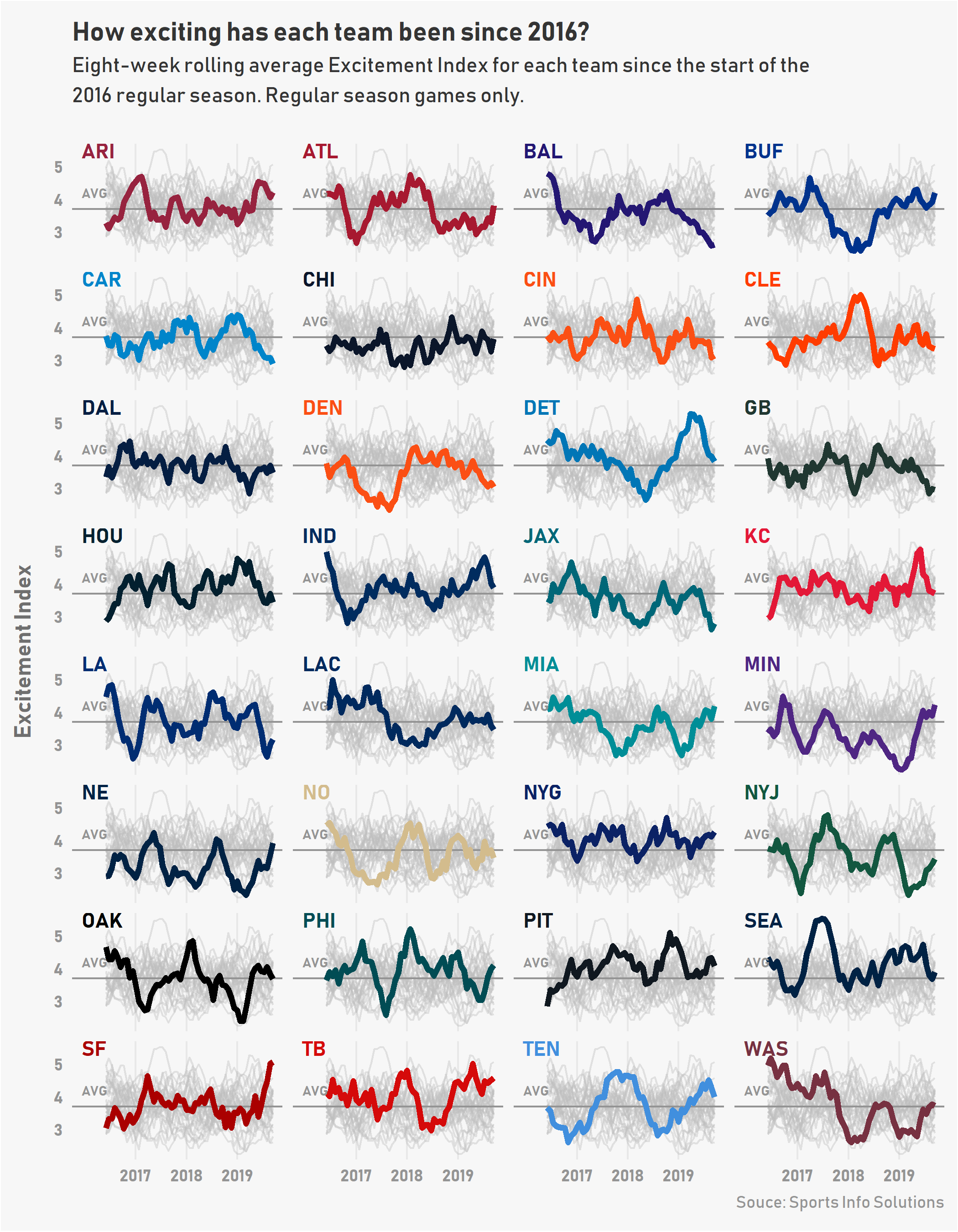
    For a slightly different look at things, EI can also be aggregated at the team level or turned into rolling averages. In this case, we will use the SIS win probability model to calculate eight-week rolling average EI. This way, we will see which teams have put together the most exciting stretches of football in recent memory, and not just the most exciting game.

    The 2017 Seattle Seahawks

    This could just as easily read “Seattle in General.” Since the beginning of the 2016 season Seattle’s games have had an average EI of 4.2, putting them comfortably in the top spot. Seattle has also participated in the two most exciting games within the SIS database by our index. All of this has earned them a reputation for “literally never playing in a normal game.”

    But even by their own lofty standards, 2017 was wild. 

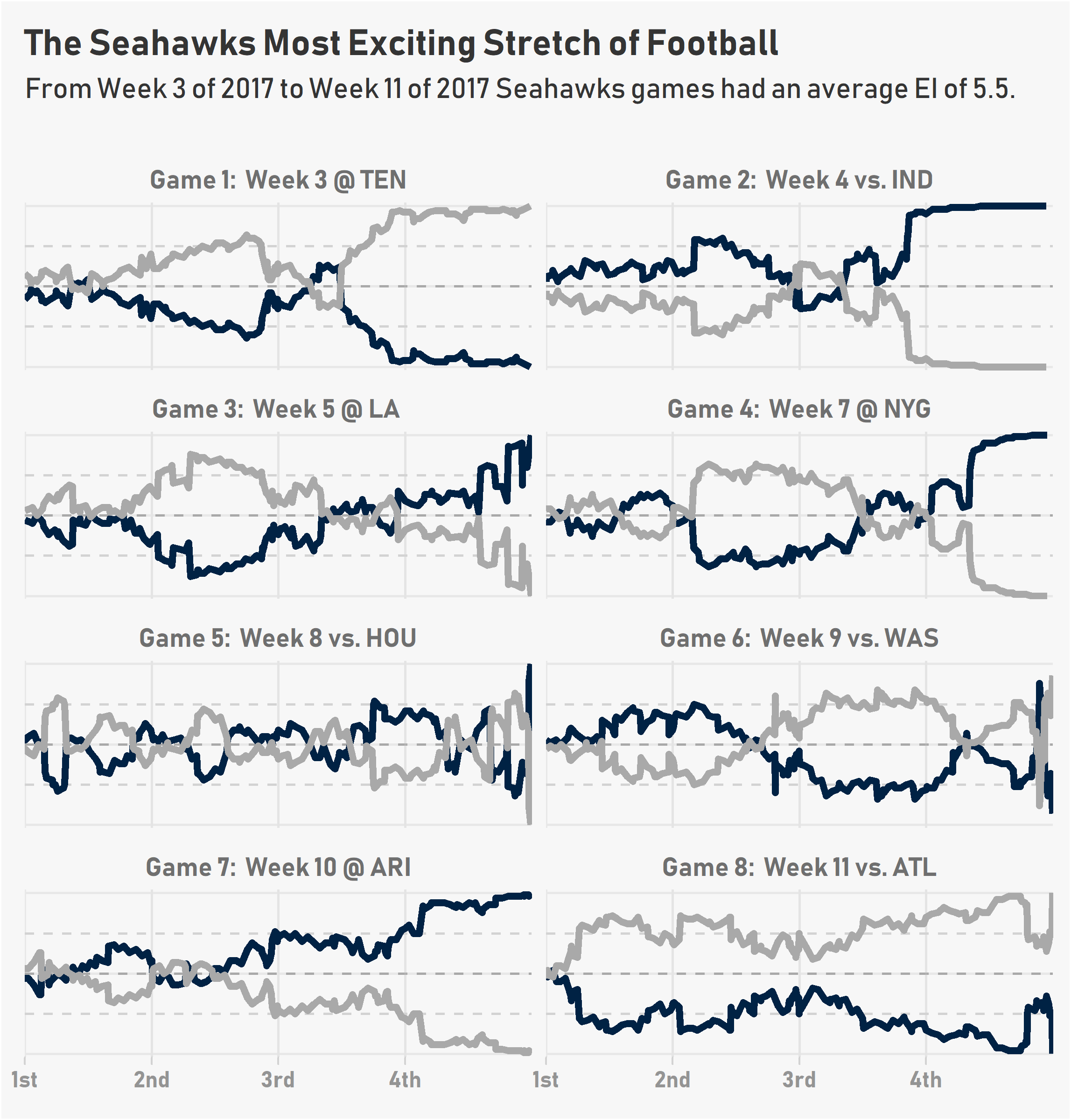
    Their run from Week 3 to Week 11 was the most exciting eight-game stretch within SIS’s database with an average EI of 5.5. Beyond that, four other eight-game iterations from that same season rounded out the top five.

    The Seahawks Week 8 win over the Texans was the most exciting game of the stretch, and also is the most exciting game since 2016 with an EI of 8.3. The Seahawks were down to about a 20% chance to win in the fourth quarter before taking the lead with 21 seconds left on an 18-yard Russell Wilson touchdown pass to Jimmy Graham. The game featured more than 400 passing yards from both Deshaun Watson and Russell Wilson and more than 200 yards receiving from DeAndre Hopkins.

    The 2019 Detroit Lions (Yes, Really)

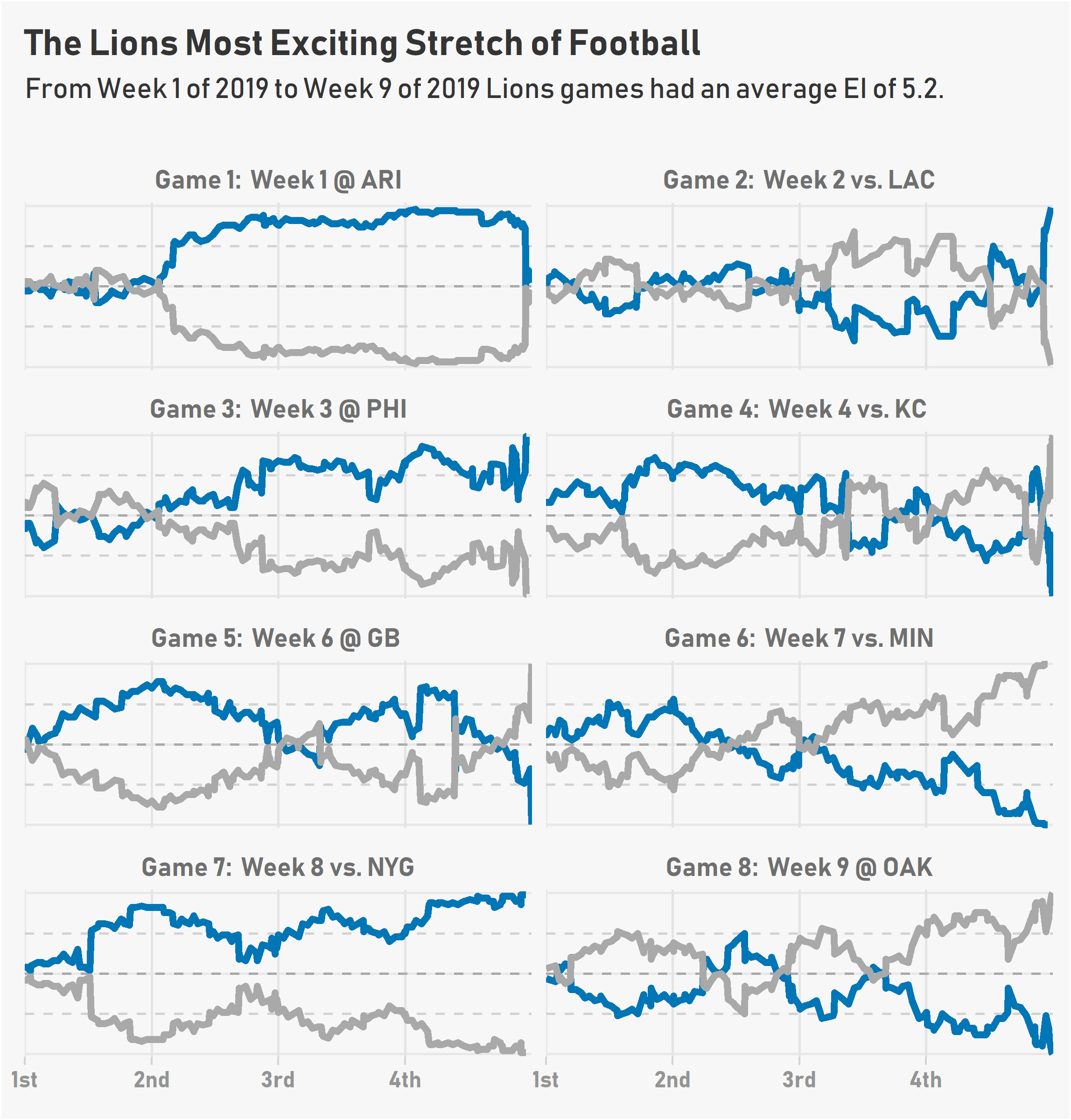
    A record of 3-4-1 isn’t exactly what comes to mind when you think of exciting football, but the 2019 Lions were truly one of the most exciting average football teams we have seen. Their average EI of 5.2 from Weeks 1-9 trails only the aforementioned 2017 Seahawks for the most exciting stretch of football we’ve seen over the last four seasons. 

    The “excitement” in this case though is mostly driven by two gut-wrenching losses in back-to-back games against the Chiefs and Packers. In each game the Lions eclipsed a 90% chance to win, and in both cases were north of 75% in the fourth quarter before losing late. 

    Honorable Mention: The 2017/2018 Philadelphia Eagles

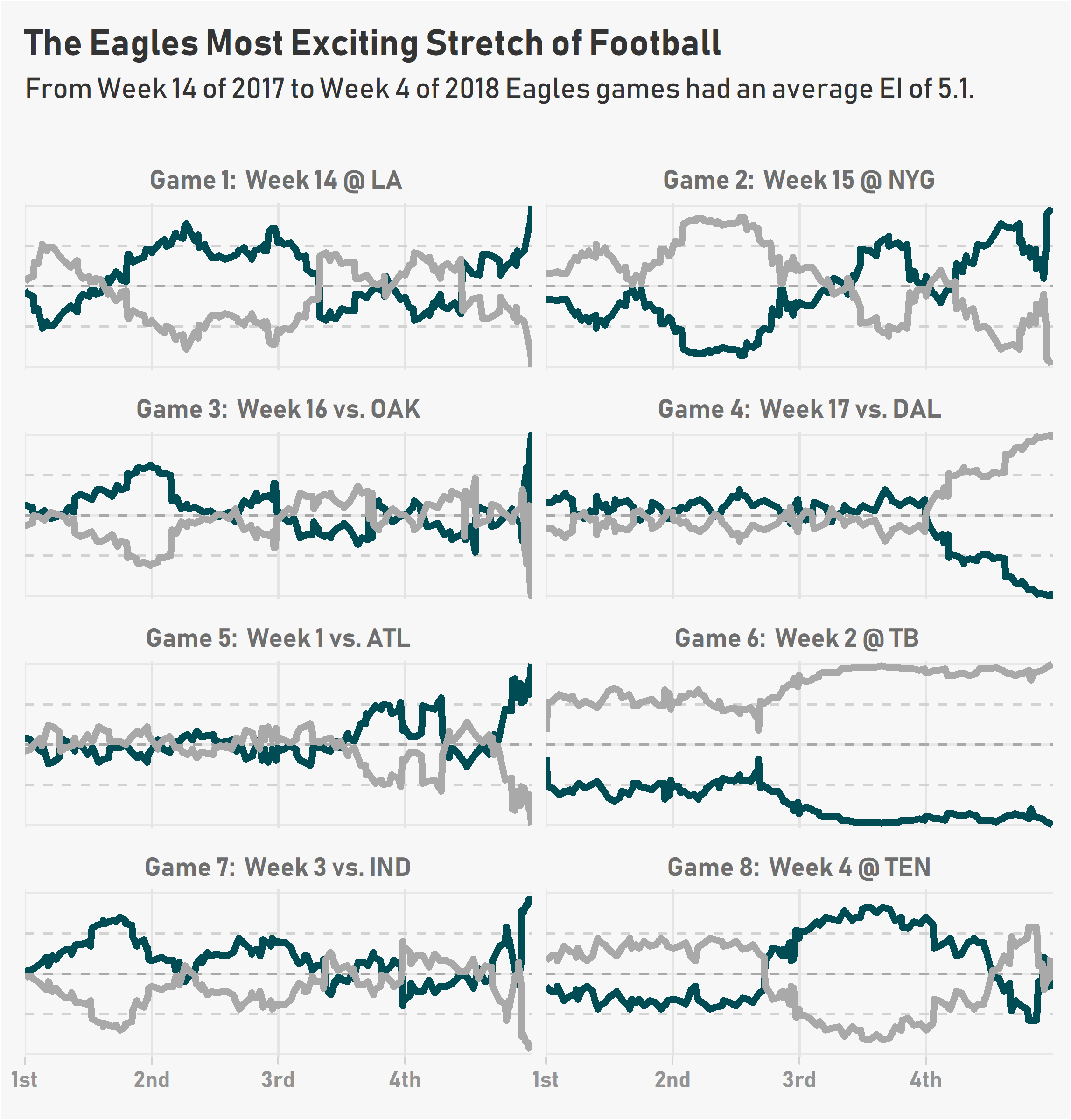
    After a thoroughly unexciting stretch of football at the end of 2016 that spilled into 2017, the Eagles put together one of the most exciting stretches of football  in the back half of their 2017 season. Even excluding the Nick Foles’ playoff run and Super Bowl victory, the Eagles had an average EI of 5.1 from Week 14 of 2017 to Week 4 of 2018.

  • Jadeveon Clowney is better than he showed in 2019

    Jadeveon Clowney is better than he showed in 2019

    By NATE WELLER

    After a hectic start to the NFL offseason, things have slowed considerably as GMs do their final draft prep and learn how to use Zoom. At some point, though, the market will pick back up, and the biggest non-QB domino left to fall is Jadeveon Clowney.

    It’s a weird time to be an NFL free agent, and Clowney is undoubtedly feeling the effects, probably more than any other player. Given his checkered injury history and team’s inability to perform a physical with their own doctors, Clowney has been unable to generate as much of a market as one might expect for a talented 27-year old pass rusher. Beyond that, teams are no doubt hesitant to throw top edge rusher money at a guy coming off of a three-sack campaign, even if that’s not really a fair reflection of Clowney’s performance.

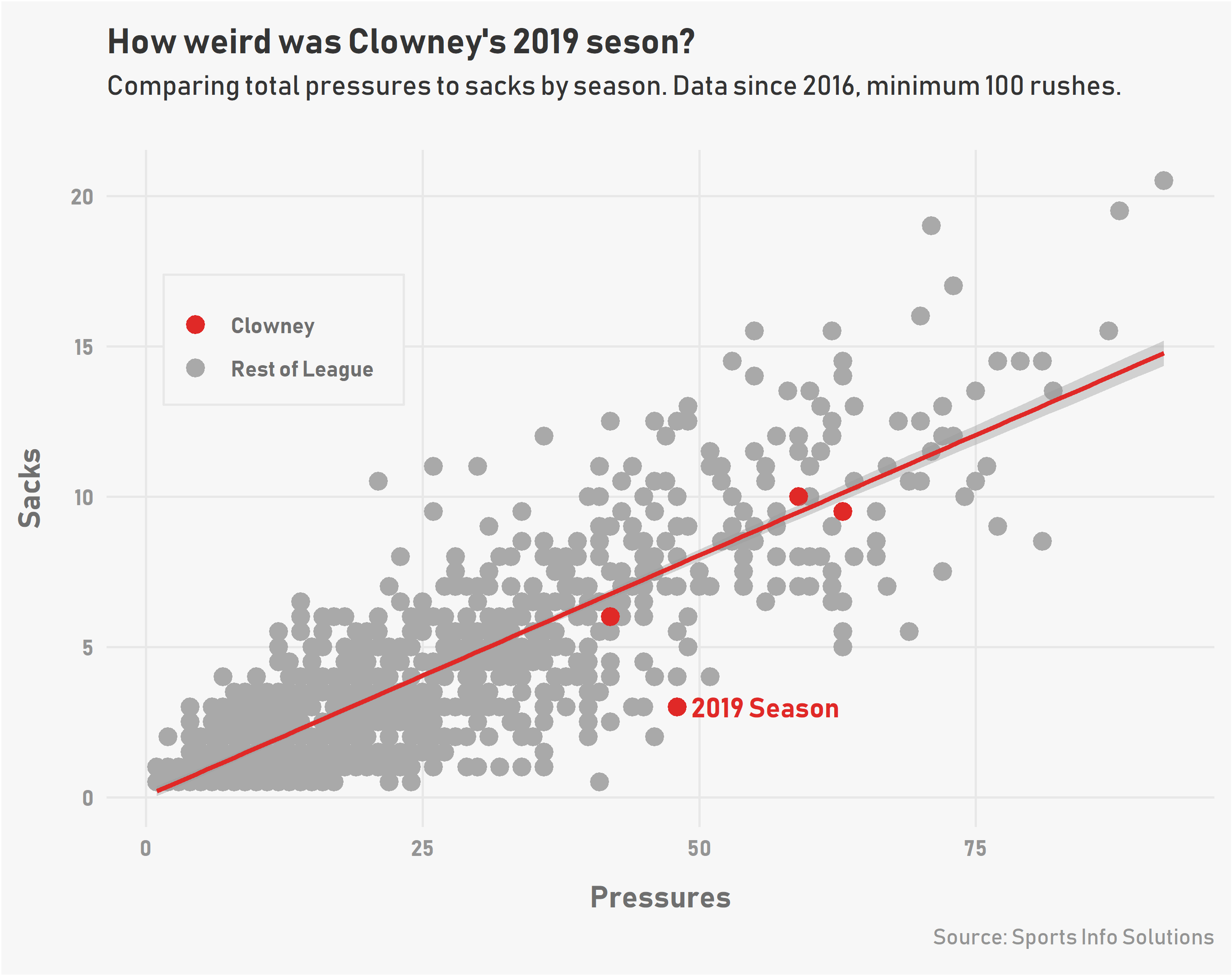
    Clowney generated 48 pressures in 2019, which still ranked him tied for 29th in the league despite missing time. The problem was that Clowney only turned those pressures into sacks a little less than six percent of the time, which ranked him 50th of 51 players with at least 40 pressures. Turning pressures into sacks is an inherently noisy metric, and there’s plenty of reason to believe Clowney will bounce back. Between 2016 and 2018 Clowney ranked 13th in the NFL in pressures with 163, and he turned 16 percent of those into sacks.

    Arguably the best part of Clowney’s game, though, is his ability against the run. Clowney was solid as a run defender 2019. His 13 Run Defense Points Saved in 2019 (a stat explained here) ranked him 12th among defensive ends. But even after a (relatively) down year against the run, Clowney still leads all defensive ends by this metric since 2016, edging out Calais Campbell.

    It’s impossible to say precisely how much of Clowney’s limited market can be attributed to his medical history and how much is a reaction to his stats in 2019. Regardless, Clowney is likely to have a strong market once things return to relative normalcy. And whatever team does pay Clowney will likely be getting production that is much closer to his performance between 2016 and 2018 than what we saw last season

  • Evaluating Draft Prospects Using Predicted Completion Percentage

    Evaluating Draft Prospects Using Predicted Completion Percentage

    By Nate Weller

    NextGen’s Completion Percentage Above Expected (CPOE) became one of the staple metrics for evaluating quarterback (and receiver and defensive back) performance this past NFL season. Due to its reliance on tracking data though, it was not able to evaluate NCAA players the same way. SIS’s two newest metrics—Predicted Completion Percentage (pComp) and Predicted Completion Percentage Plus/Minus (pComp+/-)—can add the same context to a player’s performance as CPOE, and can also be expanded into the NCAA ranks.

    Evaluating Quarterbacks

    A player’s pComp is calculated with SIS’s charting data. It uses route type, the defensive coverage, distance of throw, and whether or not the defensive line was able to generate pressure to determine how likely each pass was to be completed. pComp+/- is how much better or worse a player’s actual completion percentage was than what was predicted. Breaking down completion percentage in this way adds a lot of context to a player’s performance.

    2019 pComp+/- Leaders – Quarterbacks (Minimum 250 attempts)

    PlayerpCompActualpComp+/-
    Joe Burrow61.8%77.6%15.8
    Jalen Hurts60.2%71.7%11.5
    Tyler Huntley64.2%74.3%10.1
    Justin Fields59.9%70.0%10.1
    Kedon Slovis65.6%74.0%8.4

    Not surprisingly, presumptive number one overall pick Joe Burrow tops the leaderboard by a fairly wide margin. Burrow also led the NCAA in SIS’s Total Value Metric, Total Points (his 251 was 71 more than the next closest player), and trailed only Tua in EPA per Attempt (EPA/A).

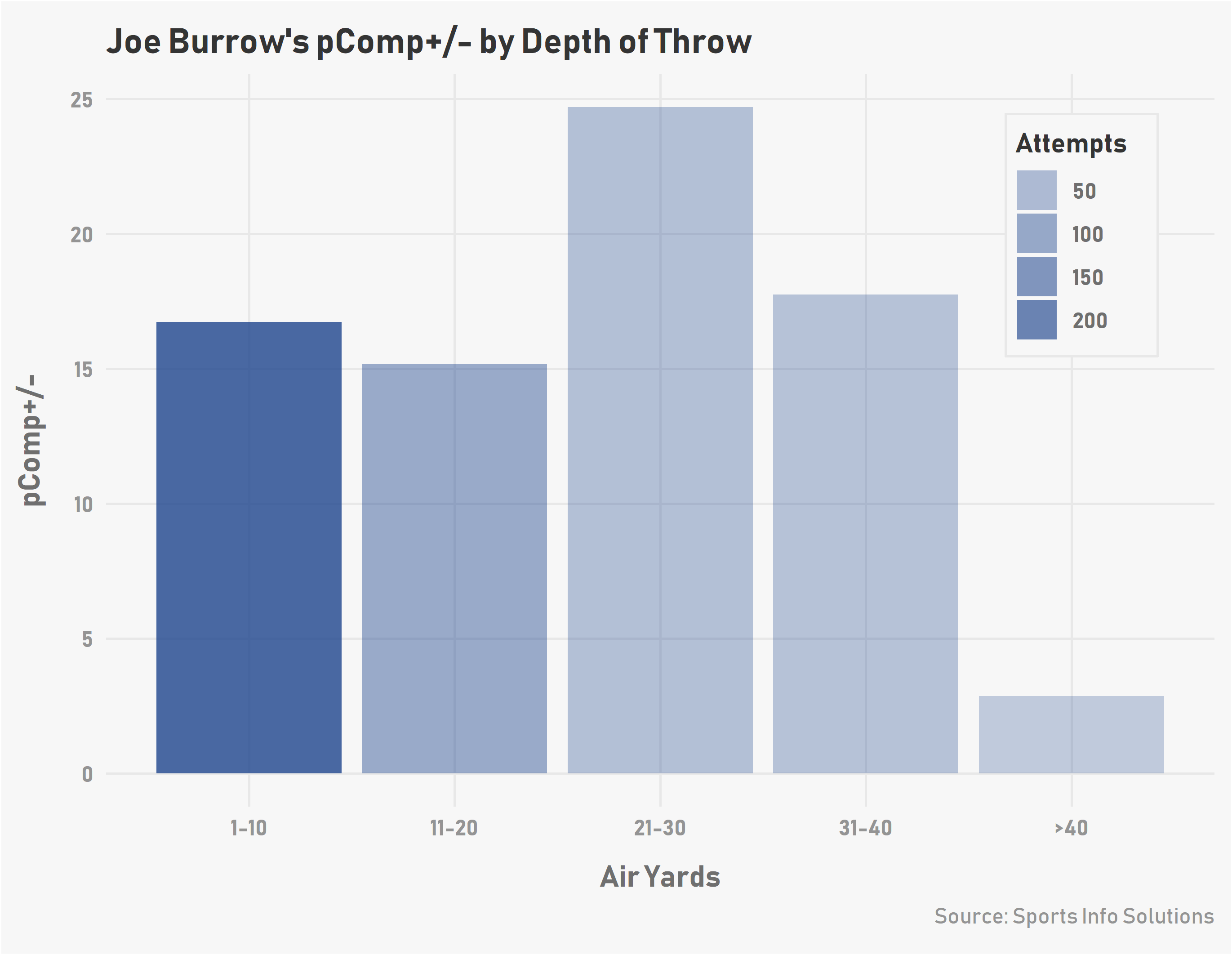
    Burrow’s pComp+/- becomes more impressive when breaking it down by throw depth. Using buckets of five air yards, Burrow is actually at his best in the intermediate and deeper portions of the field. He posted a pComp+/- of 24.7 on throws between 21 and 30 air yards and 17.8 on throws between 31 and 40 air yards (he completed 14-of-29 but was expected to complete only 9 of those passes).

    Another way to use pComp that has been popularized within the analytics “dark web” is to assess how many air yards a quarterback has completed above what would have been expected, or Air Yards Plus/Minus (AY+/-). As an example, a pass that travels 20 yards in the air with a pComp of 50% has an “expected air yards” of 10. A completion would net the quarterback +10, and an incompletion would be worth -10.

    2019 AY+/- Leaders – Quarterbacks (Minimum 250 attempts)

    PlayerADoTAY+/-
    Joe Burrow9.11.6
    Tanner Morgan11.41.3
    Jalen Hurts10.61.2
    Layne Hatcher11.01.1
    Tyler Huntley8.51.1

    Joe Burrow leads comfortably by this metric as well. On a per attempt basis, he completed 1.6 air yards above what would have been expected based on the difficulty of each throw. Jalen Hurts, who trailed only Burrow in pComp+/-, also cracks the top five here with an AY+/- of 1.2.


    Evaluating Receivers

    Predicted Completion Percentage can also be flipped on its head in a few different ways to evaluate receivers and defensive backs. For receivers, pComp+-/ is just the quarterbacks pComp+/- when targeting the receiver.

    2019 pComp+/- Leaders – Wide Receivers (Minimum 100 targets)

    PlayerpCompActualpComp +/-
    Justin Jefferson62.4%82.6%20.2
    Ja’Marr Chase53.8%68.0%14.2
    Easop Winston64.6%78.7%14.1
    Terrell Jana57.8%71.8%14.1
    Hasise Dubois57.6%71.4%13.8

    Pacing all receivers in pComp+/- are LSU’s Ja’Marr Chase and Justin Jefferson. It’s hard to parse their performances from Burrow’s entirely, but there is still no denying that Chase and Jefferson are among the best in the country. Chase led the nation in both receiving yards and touchdowns and won the Biletnikoff Award as the county’s best receiver. Jefferson projects to be a late day one or early day two pick in the coming NFL draft.


    Evaluating Corners

    Flipping the metric again, we can look at which corners were the best at preventing completions as the primary defender. The metric is calculated the exact same way as it is for quarterbacks and receivers, meaning that a plus/minus below zero is good.

    2019 pComp+/- Leaders – Corners (Minimum 40 targets)

    PlayerpCompActualpComp+/-
    Caleb Farley48.1%27.9%-20.2
    Trevon Diggs49.5%30.6%-18.9
    Charles Oliver53.8%36.4%-17.4
    Jeffrey Okudah56.3%39.6%-16.7
    Parnell Motley51.5%36.2%-15.3

    Virginia Tech’s Caleb Farley was the best in the country by this metric. His actual completion percentage when targeted of 27.9% was 20.2 percentage points lower than what would’ve been expected. Trevon Diggs and potential top ten pick Jeffrey Okudah rank as the best among prospects who have entered the draft.

  • The Winners and Losers of the NFL Offseason… So Far

    The Winners and Losers of the NFL Offseason… So Far


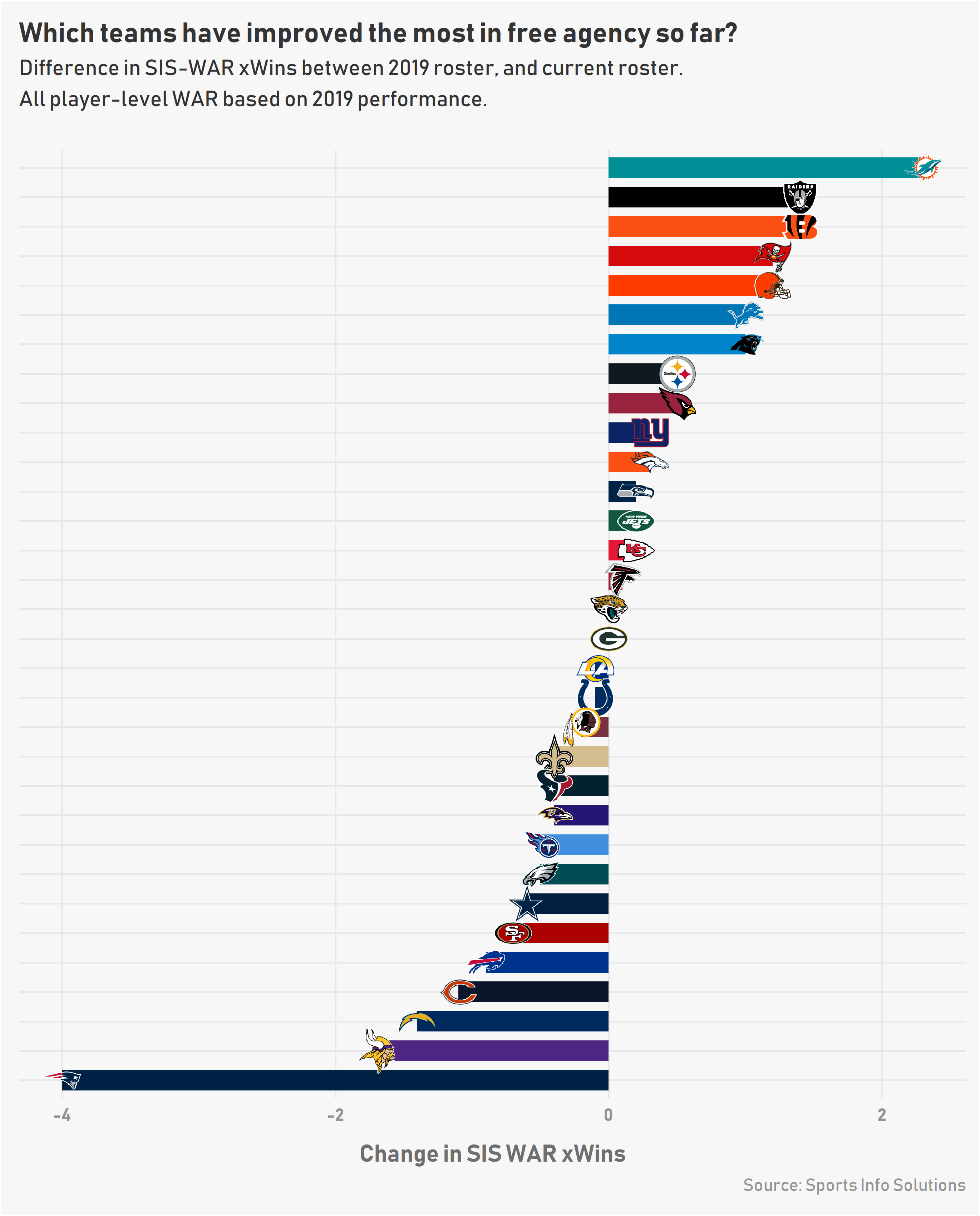
    While the rest of the sports world has come to a screeching halt, the NFL offseason has been as chaotic as ever. SIS-WAR xWins can be a helpful tool to make some sense of what exactly has gone down at a high-level.

    SIS’s Wins Above Replacement (WAR) uses a similar framework as Total Points (explained in more detail here). It compares a player’s Total Points per snap to that of a replacement-level player and scales it to win total. WAR xWins is the just sum of an entire team’s WAR plus two, the number of games a team of replacement level players would be expected to win. 

    A few small caveats before everyone gets mad about where their team ranks:

    • This is not a pure projection of the 2020 season. This does not make any assumptions about playing time or a player’s role on his new team. This is just a high-level overview of what’s gone down in free agency so far. 
    • This is only using a player’s 2019 WAR, which means it’s going to feel very strongly about players coming off career years, and not like guys who either were hurt or struggled in 2019.
    • This only includes players who have signed with or been traded to new teams. A player who is a free agent but has not yet signed will still be included with the team he played for in 2019. 

    With all of that said, here is where things stand a little more than one week into the new league year. 

    Biggest Winner: Miami Dolphins

    2019 xWins: 0.7  | Current xWins: 3.0

    A roster with the talent-level of the 2019 Dolphins would barely be expected to win one game on average, making them the only team to finish 2019 below replacement-level (though the Bengals did come very close). That was always the plan, though, and so far this offseason, they have added more than two wins’ worth of talent to their roster. 

    Leading the way are a couple strong signings within their front seven. Shaq Lawson is coming off a career year in Buffalo, where he posted a WAR of 0.6 with a career-high in both sacks (6.5) and pressures (40). It’s hard to say whether Lawson can match that performance moving forward—he only accumulated 0.6 WAR in his three previous seasons combined—but he has a chance to be a very valuable signing for the Dolphins. The Dolphins also added Kyle Van Noy, who is coming off of a season where he tallied 0.5 WAR thanks to 6.5 sacks and 54 pressures. 

    The biggest splash for the Dolphins was the addition of Byron Jones. Jones has been among the most consistent corners in the league since 2016, posting a WAR of 0.3 last season and 0.4 in each of the three seasons prior. Jones will play across from Xavien Howard and form one of the best cornerback tandems in the NFL. 

    Honorable Mention: Oakland Raiders

    2019 xWins: 7.5 | Current xWins: 8.9

    The Raiders haven’t made any headline-generating moves but have quietly had a solid offseason. The signings of Nick Kwiatowski, Carl Nassib, and Maliek Collins were worth 0.3 WAR each. The Raiders also parted ways with Tahir Whitehead, who managed a WAR of minus-0.7 in 2019, the worst among linebackers, and the fourth-worst among all players.


    Biggest Loser: New England Patriots

    2019 xWins: 11.4 | Current xWins: 7.4

    The obvious place to start is the departure of Tom Brady. Even in a down year where Brady clearly saw the effects of both his age and the Patriots’ lack of receiving talent, Brady was still worth a little more than two wins. Making the problem worse, the Patriots don’t have a clear heir apparent. Jarrett Stidham, a 4th-round pick last year, appears to be the next in line if the Patriots don’t make a run at one of the remaining free-agent quarterbacks.

    The departure of Brady still only accounts for about half of the value lost by the Patriots this offseason, though. The Patriots also lost Jamie Collins (0.9 WAR), Kyle Van Noy (0.5 WAR), and Duron Harmon (0.2 WAR). Collins and Van Noy led the Patriots in sacks last season and combined for 84 pressures on one of the league’s best defenses.

    The Patriots have made a handful of small signings to try and recoup some value, but none of the players they have signed have been worth more than 0.1 WAR. Most of the offseason is still ahead for the Patriots, and betting against Bill Belichick has been a terrible idea historically. Still, as of now, the end of the Patriots dynasty is appearing more and more likely. 

    Not-So-Honorable Mention: Minnesota Vikings

    2019 xWins: 11.0 | Current xWins: 9.3

    The most notable departure for the Vikings this offseason is top receiver Stefon Diggs. Diggs was worth half a win in 2019, and while the Vikings got a solid haul of draft picks in return, they didn’t receive any proven help. The Vikings also lost Trae Waynes (0.6 WAR), Andrew Sendejo (0.4 WAR), and Laquon Treadwell (0.3 WAR). Minnesota did make a solid depth signing in Tajae Sharpe (0.2 WAR), but they still have a lot of work left to do this offseason to break even.

  • Which QB is best at throwing the intermediate pass?

    We’ve been writing about quarterbacks and long passes and receivers and long passes recently, so this week, we’re taking a look at another type of QB throw.

    By Kyle Rodemann

    Watching your team complete a 15-yard pass on 2nd-and-10 feels pretty good. The drive continues, the QB is looking sharp, and the chance to score increases. While most quarterbacks can make these kinds of throws in their sleep, some excel in certain categories when it comes to “intermediate passes.” This article will look into which QBs have excelled at these throws so far during the 2019 NFL season.

    For our purposes, intermediate passes are balls that are thrown between 11 and 19 yards downfield, unless otherwise stated.

     Most Attempts

    Some quarterbacks prefer to throw the deep ball, while others like to game manage and throw the ball closer to the line of scrimmage. Other QBs have the weapons and tools to attack defenses in the middle of the field, in-between the linebackers and the safeties.

    Below is a table that displays which current starting quarterbacks have thrown the intermediate pass the most:

    Quarterback Number of Throws
    Jameis Winston 95
    Jared Goff 95
    Philip Rivers 94
    Matt Ryan 71
    Dak Prescott 68
    Kyle Allen 67
    Patrick Mahomes, Carson Wentz 66

    Andy Dalton also belongs on this list, with 83 intermediate passes, but has been removed since he no longer starts in the NFL.

    If there is one thing that all these quarterbacks have in common, besides their ability to attack the middle of the field, it’s the fact that they each have specific receivers that are chain-movers. The top three passers in this list enjoy throwing the ball to: Chris Godwin, Cooper Kupp, and Keenan Allen, respectively. With talent like that to throw to, it’s no wonder these QBs throw the intermediate ball so often.

    Most Accurate

    Just because a QB throws the intermediate pass the most, doesn’t necessarily mean they are the most accurate on those attempts. That’s a spoiler for this next table that looks at the highest Catchable Throw Percentage among QBs who throw the ball 11 to 19 yards down the field.

    Check out the table below:

    Quarterback Catchable Throw %
    Dak Prescott 85% (58 of 68)
    Aaron Rodgers 82% (37 of 45)
    Derek Carr 81% (39 of 48)
    Josh Allen 77% (46 of 60)
    Ryan Fitzpatrick 75% (35 of 47)
    Jimmy Garoppolo 74% (46 of 62)
    Matt Ryan 73% (52 of 71)

    Jameis Winston, leading the league in these pass attempts, doesn’t even make an appearance on this list. In fact, Winston is throwing an accurate ball on 72% of his intermediate throws, just missing the cut behind Matt Ryan’s 73%.

    One surprise on this list is Josh Allen, who was seen as an inaccurate QB during his rookie season last year. Cole Beasley sure makes a difference and helped raise Allen’s Catchable Throw Percentage from 63% last season to 77% this season.

    Highest IQR

    “Independent Quarterback Rating” is a metric that removes blame on the quarterback when he does not deserve it. This means that when a pass is dropped, he will not be blamed and his IQR will be boosted. On the other hand, if an interception is dropped, he will be blamed and his IQR will take a hit.

    The table below shows the highest IQR among QBs for intermediate passes:

    Quarterback IQR
    Derek Carr 135.8
    Lamar Jackson 133.4
    Patrick Mahomes 128.5
    Ryan Fitzpatrick 123.8
    Kirk Cousins 121.9
    Aaron Rodgers 118.6
    Drew Brees 114.3

    Derek Carr tops the list of QBs in IQR on intermediate passes. He has been very accurate (81% Catchable Pass Percentage as seen above) and has made few mistakes (1 interception). Ryan Fitzpatrick makes his second appearance in this article with an impressive IQR of 123.8.

     Most Impactful

    Points Earned is one way to determine which quarterbacks have made the largest positive impact while throwing the ball between 11 and 19 yards down the field. Here is a quick explanation of Points Earned, as explained by Alex Vigderman:

    The core assumption of passing Points Earned is that each throw has a certain expected outcome based on information like the route, the depth, and the coverage. From that point, the passer and receiver split responsibility for how well they perform above that expectation. Throwing off-target passes and deserved interceptions (caught or not) will bury a signal-caller, while he will be rewarded for leading receivers to more yards after catch and making something out of a broken pocket.

    A more in-depth explanation can be found here. This stat shows which quarterback has helped their team win the most while throwing the intermediate pass.

     Check out the league leaders below:

    Quarterback Points Earned
    Dak Prescott 35.9
    Philip Rivers 35.5
    Ryan Fitzpatrick 29.7
    Derek Carr 27.9
    Jameis Winston 26.7
    Carson Wentz 25.1
    Patrick Mahomes 25.0

     Prescott has added the most when throwing the intermediate pass. This is his third appearance in this article, making him one of the best passers in the league at throwing the ball 11 to 19 yards downfield. Fitzpatrick and Carr, two QBs who are seen as lower-end starters, also show their value when throwing this type of pass.

    Conclusion

    The intermediate pass is not always easy. It often comes with throwing over the linebacker and in front of the safety. Not all QBs are great at these passes. Prescott, Carr, and Fitzpatrick are three quarterbacks who excel at these throws. Look for these successful passers to continue attacking the middle of the field, targeting their talented receivers to help move the chains.

  • Two Highly Rated Prospects Have Seen Their Draft Stock Take a Hit: Here’s Why

    Two Highly Rated Prospects Have Seen Their Draft Stock Take a Hit: Here’s Why

    With the draft a little more than a week away, teams and draft analysts alike are finalizing their draft boards. For the most part, they look a lot different than they did only a few months ago. A couple of the highest rated prospects from the SIS Rookie Handbook are among those whose stock has taken a hit during the pre-draft process.

    Greedy Williams

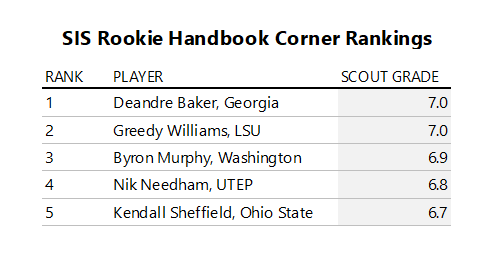
    In the SIS Rookie Handbook, Greedy Williams was one of nine players to receive a grade of 7.0 or better, and was tied with DeAndre Baker as the highest rated corner grade. Initial mock drafts had Williams as a potential top 5 pick, and a virtual lock for top 10. Since then though, Williams has seen his stock taking a bit of a tumble. Mel Kiper has Williams 22nd on his big board, and his 3rd corner overall, trailing both Deandre Baker and Byron Murphy. Most mock drafts now have Williams as a mid to late first round pick, with some putting him as low as the top of the second round.

    What he does well:

    What’s interesting about Williams is that his ability to cover has never really been in question. In 2018 he allowed a deserved catch percentage of only 60%, and a QB Rating against of only 43.3. Both of those figures ranked as the second best among draft eligible cornerbacks, and were ahead of Baker and Murphy.

    Part of what makes Williams so good in coverage is his ability to make quick transitions and stay patient on deep routes and double moves. While there was some worry after he struggled in his combine drills, particularly the pedal and turn, his numbers and film show little reason for concern overall.

    On throws at least 20 yards downfield in 2018 Williams allowed only 6 completions for 172 yards and a touchdown on 22 targets, a yards per attempt of only 7.8. More impressive, while lined up on the outside in man coverage, receivers attempted a double move on Williams 9 times. The lone target fell incomplete. It is a relatively small sample, but illustrates his ability to suppress targets and is strong evidence of his ability to stay patient on long developing routes.

    Where he comes up short:

    The biggest reason for Greedy’s fall from the top of big boards is his tackling ability. Take this quote from Mel Kiper that echoes the concerns of a number of NFL teams:

    “Opinions are already complete now, and I think the tackling and the ability to be an 11th man on that defense, and not play with 10 and have a big running back coming around the corner and make a business decision on whether you tackle or you don’t. Again, you’ve got to tackle these bigger receivers, these tight ends in space, because it’s an extension of the running game. Or these short passes. You can’t be missing tackles in the open field or around the line of scrimmage. Again, tackling not just running backs, but receivers and tight ends, that’s going to be the issue.”

    There is room to debate just how important it is for corners to be strong tacklers, especially when they are as strong in coverage as Williams, but there is no denying that tackling is an issue. Williams had only 34 combined tackles in 2018, which did not even rank him in the top 200 among all college corners. He also had a broken tackle percentage of 15.4%, which was among the worst of all draft eligible corners. Put into perspective, fellow top prospects Deandre Baker and Byron Murphy came in at 2.4% and 8.2% respectively, both ranking in the top 10 among draft eligible corners.

    Some of this is scheme related as Williams spent 63% of his snaps in man coverage in 2018, but his poor tackling technique is certainly a concern for teams that like to use corners in run support, and is the main culprit for his slide as we approach the draft.

    N’Keal Harry

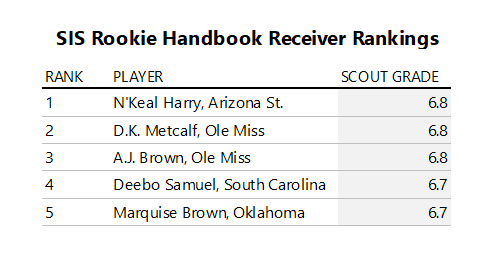
    There has never really been a consensus among draft analysts about the top WRs in this years draft, and the picture hasn’t become much clearer as we approach the draft. One player that seems to be sliding though is N’Keal Harry, who comes in as the top receiver in the SIS Rookie Handbook.

    Once in contention with Metcalf for the top spot among receivers, Harry has been usurped in a most rankings by the likes of A.J Brown, Deebo Samuel, Marqise Brown and even J.J. Arcega-Whiteside. What’s different about his slide though is that there is nothing new you can point to that explains it. Sure, D.K. Metcalf showing up to the combine looking like a super human didn’t help, but Harry had a strong combine performance in his own right, posting a 4.53 40-yard dash, 38.5″ vertical, and 27 reps on the bench.

    What he does well:

    In 2018 Harry turned 90 catchable targets into 73 catches, 1,088 yards and 9 touchdowns, a QB Rating when targeted of 114.9. His ability to use his size to make plays downfield is part of what makes him such an intriguing prospect. Harry ran 47.2% of his routes down the field 2018, and on those targets racked up 17 catches for 421 yards and 5 TDs. Good for a rating of 129.75.

    Harry is also dynamic with the ball in his hands after the catch, using his unique combination of size and speed to generate additional yardage. In 2018 he averaged 7.1 yards after the catch, and his 308 yards after contact ranked 5th in the NCAA.

    Where he comes up short:

    While Harry has shown a knack for finding soft spots in zone coverage, he fails to consistently create separation against man – particularly on shorter routes – and rather relies on his size, length, and catch radius to make plays. While this served him well in the college ranks, relying solely on size and athleticism gets exponentially more difficult against NFL corners.

    To get an estimate of separation we looked at the amount of yards between when a receiver first caught the ball, and when he was first contacted by a defender. (Pass breakups and interceptions are counted as zeroes.) When looking at targets less than 15 yards downfield, Harry averaged about 2.4 yards against zone, but only .13 yards against man coverage. His numbers against man ranked him 2nd worst among draft eligible receivers, and 303rd of 313 receivers with at least 25 targets overall.

    Separation is not always everything though, especially for a player who has the size and athleticism of Harry. While he struggled to consistently separate, it is also worth pointing out that some of the players in the NFL who find themselves amongst the trailers in this metric include A.J. Green, DeAndre Hopkins, and Julio Jones.

  • How Free Agency Might Impact the Top of This Year’s Draft

    How Free Agency Might Impact the Top of This Year’s Draft

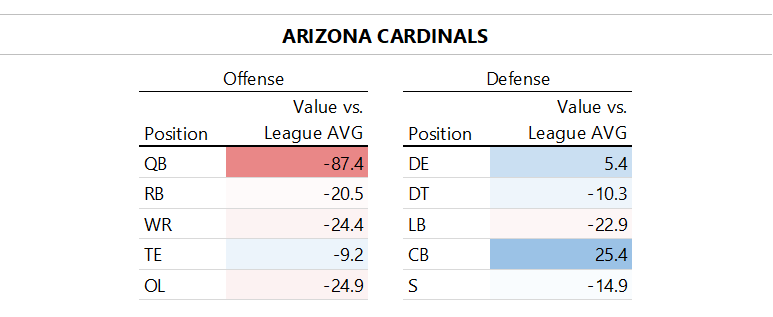
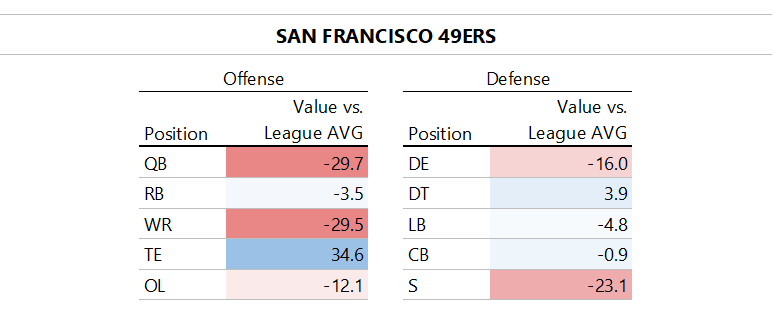
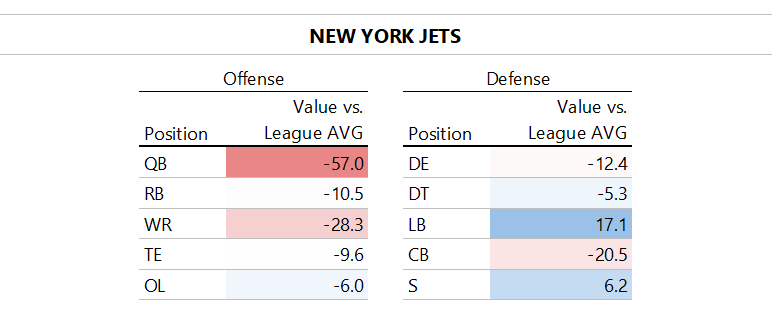
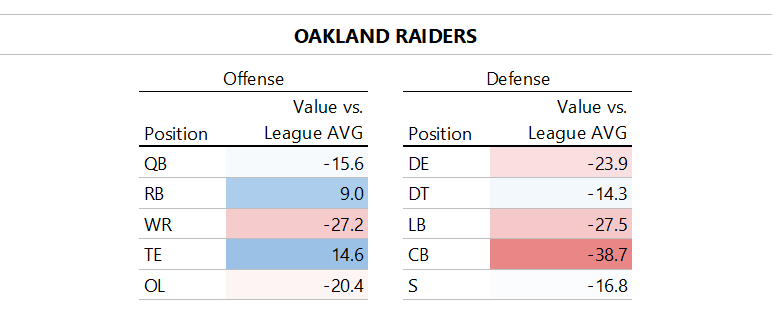
    With the free agency finally slowing down, all eyes are turning towards the draft. With that in mind we looked at how teams at the top of the draft have used free agency to bolster their records, and how it may affect their decision come draft day. Team need charts are based on SIS’s unique Total Points metric compared against the league average at each position.

    Biggest acquisitions:

    The Cardinals have been relatively busy already this offseason, but have yet to make a splash signing. Terrell Suggs and Jordan Hicks were arguably the two biggest signings for the team, both signed in an attempt to bolster a linebacker unit that struggled in 2018.

    Hicks was solid against the run in 2018, but struggled in the pass game. On 28 targets Hicks allowed 22 catches for 271 yards and a touchdown. A QBR against of a little bit over 100. Using Total Points, Hicks ranked as the 98th best linebacker in pass coverage among players with at least 10 targets.

    The soon-to-be-37 years old Suggs, while listed as a linebacker, will slot in on the edge, and despite his age he should still be able to add value to a pass rushing unit that actually fared pretty well in 2018.

    Additional signings:

    In terms of weapons for whoever the QB is in 2019, the Cardinals signed TE Charles Clay, TE Ricky Seals-Jones, and WR Kevin White, a rather uninspiring trio for a team lacking weapons and moving into a Kliff Kingsbury offense in 2019. The Cardinals also added a couple of offensive linemen in Max Garcia and Marcus Gilbert and defensive lineman Darius Philon.

    What to expect in the draft:

    The speculation of Murray to the Cardinals seemingly won’t go away, and while Rosen’s rookie season was nothing short of a disaster, it seems crazy to think they would move on from him only one year removed from moving into the top 10 to select him.

    Compounding the intrigue, Cardinals defensive ends were one of only two position groups that put up numbers above the league average in 2018. Outside of Murray, the only player’s who have been mocked at the top of the draft are pass rushers, namely Nick Bosa and Josh Allen. Either of those players would provide an immediate impact and be an upgrade over current Cardinals pass rushers, but it still makes the pick all the more interesting.

    Biggest acquisitions:

    It has been a relatively quiet offseason so far for the 49ers outside of sending second round pick to Kansas City for Dee Ford, adding a star player in a position of need.

    Ford was a force in 2018, generating 13 sacks and 72 pressures, good for 9th and 2nd best respectively. Additionally, his 6 forced fumbles also tied with J.J. Watt for the lead league. Overall, Ford was far and away the top rated pass rusher by Total Points 2018 with 37.7 Points Earned, outpacing the like of Frank Clark, Aaron Donald, and J.J. Watt.

    The 49ers also gave a massive 4 year deal to former Bucs linebacker Kwon Alexander, worth $54 million, including $25.5 million guaranteed. Alexander is a young high upside linebacker, but is coming off of a torn ACL. The 49ers are betting he can return to his 2017 form when he had 96 combined tackles, including 6.5 for a loss.

    Additional signings:

    The 49ers did also add another playmaker to their offense in Tevin Coleman. The 49ers were able to get solid production from a committee of running backs last season, namely Matt Breida, Alfred Morris and Raheem Mostert. Coleman will join a crowded but talented backfield, including a newly healthy Jerrick McKinnon.

    What to expect in the draft:

    The 49ers will have their fingers crossed hoping that the Cardinals take Murray with the 1st overall pick, allowing them to take whoever is on the top of their big board. 49ers GM John Lynch has made it clear he plans to take the “best player available”.

    That “best player” is very possibly another pass rusher to go alongside Dee Ford. Nick Bosa or Josh Allen lining up opposite of Ford would quickly turn an impotent pass rush from last year into one of the more dangerous tandems in the league.

    Defensive tackle was also a position of weakness for the 49ers last year, and the recent acquisition of Ford may allow the 49ers to select Quinnen Williams, a player many view as the best in the draft (including our rookie handbook). The Outland Trophy winner was dominant against the run, leading the nation in tackles for non-positive yards, and his hurry rate when pass rushing was also far and away the best among college defensive tackles.

    Biggest acquisitions:

    The Jets have been among the biggest spenders in free agency this season, most notably inking Le’Veon Bell to a four-year deal. Bell’s year off certainly adds some question marks, but it seems more likely than not that Bell will again find himself among the best at the position. Our Bryce Rossler took a deeper dive on what Bell does well earlier this offseason.

    The Jets also added LB C.J. Mosley. The former Raven was productive over the course of his rookie contract, particularly against the run. In 2018 Mosley had 101 combined tackles, including 4.5 for a loss. Mosley did struggle in pass coverage in 2018 though, allowing a QBR against of 100 on 39 targets. By SIS’s Points Saved metric Mosley ranked as the 40th best linebacker in pass coverage this past season.

    Additional signings:

    Some other notable transactions for the Jets include WR Jamison Crowder, who they are hoping can turn into a reliable target for Sam Darnold, and also WR Josh Bellamy.

    What to expect in the draft:

    After selecting their franchise QB in last years draft, the Jets will likely be taking the “best player available” approach with the No. 3 pick. This would likely be one of Nick Bosa, Josh Allen, or Quinnen Williams, all of whom would provide tremendous value at positions of need.

    It is also likely that the Jets will be fielding offers from QB-needy teams, especially if Murray slides past the Cardinals. This could allow the Jets to recoup some of the assets they parted ways with last year to get Darnold, and depending on the suitor could still leave them in position to get either Greedy Williams or Deandre Baker. Gaining assets while also grabbing the best player at arguably their biggest position of need may be the best case scenario for the Jets.


    Biggest acquisitions:

    After trading away Khalil Mack and Amari Cooper during the season, it appeared the Raiders were entering a lengthy rebuilding period. By trading for Antonio Brown they made it abundantly clear that was not the case. Brown immediately slots in as the best playmaker on the team, and the number one option for Derek Carr. I have already done a more detailed analysis on this trade here.

    The Raiders also gave a record setting contract to offensive tackle Trent Brown, fresh off a Super Bowl win and the best season of his career. By Total Points, Brown was the 4th highest rated offensive lineman, and was especially strong pass blocking, earning 4.4 of his 5.7 Points in the pass game.

    Additional signings:

    The Raiders also added more talent to their wide receiving core by adding the speedy Tyrell Williams, who should find himself as their No. 2 option. LaMarcus Joyner was also brought in to help bolster the secondary, and more recently the Raiders added LB Vontaze Burfict.

    What to expect in the draft:

    Even after a busy start to the offseason, the Raiders have needs just about everywhere. They also conveniently have three picks in the first round this year. While their have been fun rumors about Kyler Murray throwing to Antonio Brown, it would be surprising to see them do anything other than replace the Khalil Mack-sized hole in their pass rushing unit. Depending on what happens in the first three picks this may mean one of Montez Sweat or Clelin Ferrell, but a run on quarterbacks at the top of the draft could certainly shake things up.


    Biggest acquisitions:

    Because of cap concerns, the Bucs have been forced into an uneventful offseason. The honor of being their biggest signee likely belongs to LB Deone Bucannon.

    Bucannon played well in his time under Arians in Arizona, and now get’s a chance to be re-united with the coach who made him a first round pick in 2018. A converted safety, Bucannon will likely play a similar hybrid type role that he flourished in during his time in Arizona. In 2017 (his last season with Arians), he had 82 combined tackles, allowed a QBR against of only 76 on 44 targets, limited quarterbacks to 5.6 yards per attempt, and scored two defensive touchdowns.

    Additional signings:

    Outside of Bucannon, the Bucs have mostly looked to add depth. Other signings for the Bucs include S Kentrell Brice, G Earl Watford, and LB Shaqil Barrett.

    What to expect in the draft:

    By Total Points, the Bucs weaknesses aren’t quite as glaring as the rest of the top 5, but this is at least in some respects due to some Fitz-Magic early in the season. It is also worth noting that the future of their star defensive tackle, Gerald McCoy, is up in the air as the Bucs currently don’t have the cap to sign their upcoming draft picks.

    Whether or not the Bucs are able to retain the services of McCoy will likely play a huge role in who they take with the number 5 pick. It is not impossible that Quinnen Williams is still their for the taking, and he would provide a solid, and more importantly, cost controlled, consolation for the loss of McCoy.

    Two potential positions of need for the Bucs are at cornerback and on the offensive line. If the top of the draft goes as expected they will have the luxury of taking whoever is on the top of their board at either of the those positions, if they decide to go that route.

    On the offensive line this would likely mean a debate between Alabama product Jonah Williams, or the incredibly athletic Jawaan Taylor. At corner, DeAndre Baker and Greedy Williams sit atop our big board. All four could provide an immediate impact for the Bucs in 2019.

    The Bucs pick could also be a prime target for teams looking to make a move for a sliding QB. Projecting what Dave Gettelman will do at No. 6 is tricky, but the Giants taking a QB seems like the most likely outcome. A team like Washington or Cincinnati my need to jump to No. 5 if they want to grab their franchise QB in this draft.