Category: Baseball

  • Why Move Mike Trout Off CF? Let’s Look at the Numbers

    Why Move Mike Trout Off CF? Let’s Look at the Numbers

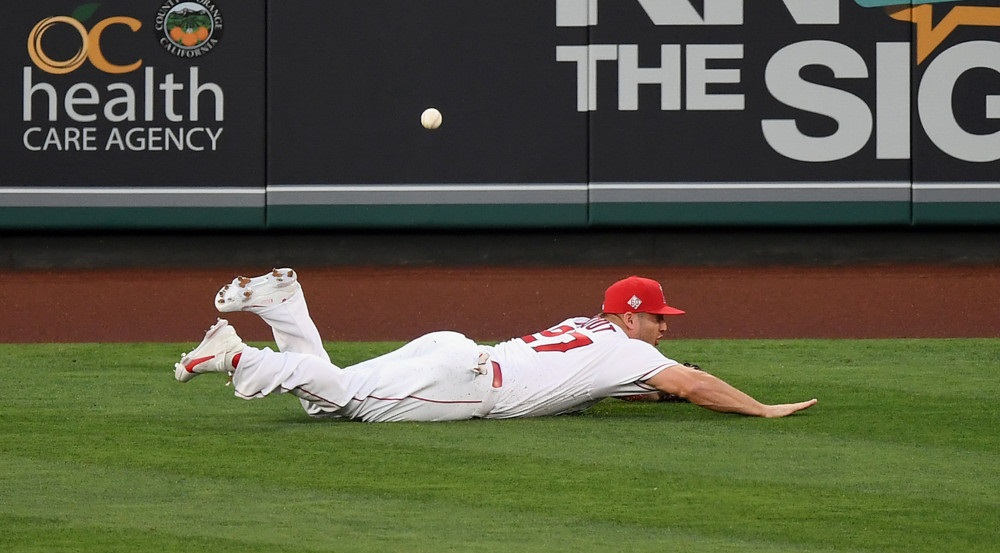
    Why would the Angels want to move Mike Trout off center field?

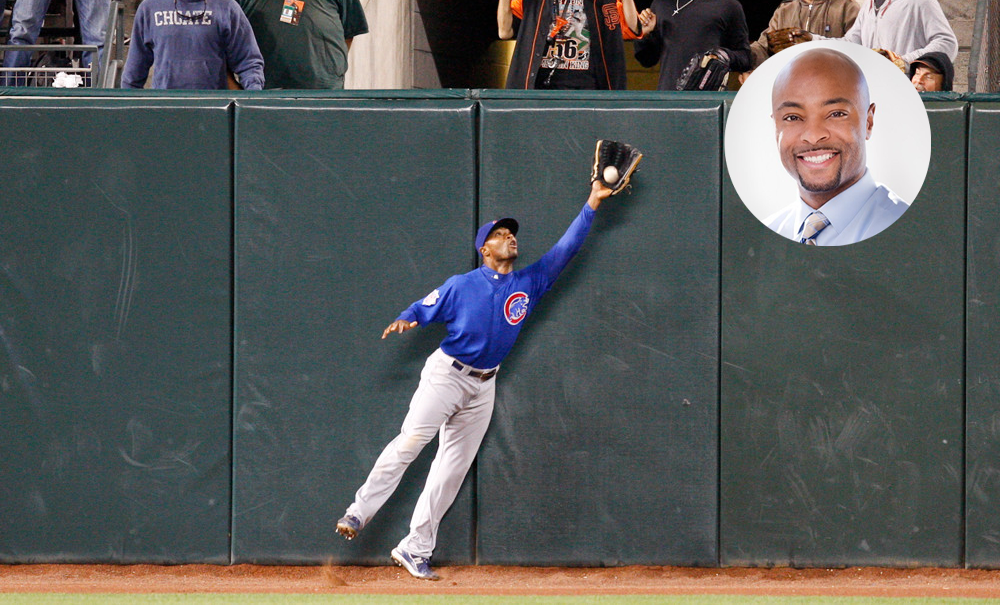
    It’s likely a simple matter of statistics. Catches like the one above have been the exception rather than the rule.

    Over the last two seasons, Trout ranks 32nd in Defensive Runs Saved per 1,000 innings in center field. That’s out of the 35 players with the most innings played there in that time.

    It goes back farther than that. Trout has posted a negative Defensive Runs Saved total in each of the last three seasons and four of the last five seasons.

    Yes, he does have a 21-Runs Saved season to his credit … in 2012. Since then, he’s cost the Angels 24 runs with his defense, per our measures.

    Trout doesn’t have any statistical strengths on defense anymore. He ranks a little below-average on shallow, medium, and deep fly balls over the last two seasons (though in Trout’s defense, he was slighly above-average on deep balls in his brief stint last season). That adds up.

    And he ranks below-average in throwing. Since 2020, he’s allowed 42 of 61 runners to advance an extra base on balls he’s fielded. That’s a 69% advance rate allowed compared to an average rate of 54% for center fielders last season.

    Getting back to Trout’s range, we have numbers that can show that Trout isn’t what he once was in center field. We can compare his 2020-21 out rates to those he had in 2018, his last season with a positive Defensive Runs Saved.

    Depth 2018 2020-21
    Shallow 58% 48% (88 plays)
    Medium 87% 78% (99 plays)
    Deep 82% 73% (67 plays)

    Trout isn’t making high-value plays and has missed some balls he should have caught.

    Over the last two seasons, he has 5 catches on balls that had an out probability of less than or equal to 30% and missed 14 plays on which the out probability was 70%.

    Here ‘s one example of the latter:

    Comparing ratios of other players with similar innings totals the last two seasons:

    Plays Made/Missed by Out Probability (2020-21)

    0-30% Plays Made >=70% Plays Missed
    Mike Trout 5 14
    Guillermo Heredia 6 6
    Kike Hernandez 5 3

    Worth pointing out: Trout has ranked last and next-to-last in the reaction component of Statcast’s Jump stat the last 2 seasons.

    On average, he’s about 2 feet short of where he should be within the first 1.5 seconds of a ball being hit.

    Trout’s potential replacement in center field, at least for the short term would be Brandon Marsh. He totaled -3 Runs Saved in 70 games there last season. Jo Adell’s experience in center field, both in the majors and minors, is minimal, though his elite speed could come in handy if they were to give him a try.

    That neither player is necessarily a standout would be one reason to keep things as-is.

    The other option the Angels would have if they don’t want to move Trout to left field is to tinker with his positioning. (Per Statcast) Trout played an average of 6 feet shallower at home in 2018 (318 feet) than he did in 2020 and 2021 (324 feet).

    That would seem like the most logical outcome here given Trout’s reluctance to switch positions. What we seem to have here is a case of the numbers indicating one thing, but player comfort pointing in another direction. Such is the push-and-pull an MLB manager has to deal with both in trying to win and keep his players happy.

    The Angels may move Trout around in the outfield – but only within the boundaries of his original position.

  • 2021’s Top Minor League Bat Missers

    2021’s Top Minor League Bat Missers

    Last week we looked at some prominent minor league hitters and the quality of their contact. This week, we shift to minor league pitchers and which ones were best at avoiding contact.

    A reminder that we track minor league data at the Single-A, Double-A, and Triple-A levels and that includes the specificity of whether pitchers net a swinging strike or a called strike.

    Among pitchers with at least 1,000 pitches tracked at those levels last season, the one with the highest miss rate (misses/swings taken) was Twins lefty reliever Jovani Moran, at 42%.

    Moran, who will turn 25 in April, struck out 109 batters in 67 1/3 innings pitched and posted a 2.41 ERA as a multi-inning reliever at Double-A and Triple-A last season. His primary miss-pitch is a nasty changeup. FanGraphs ranks him as the team’s 36th-best prospect, though he did get an MLB look last season, striking out 10 in 8 innings pitched.

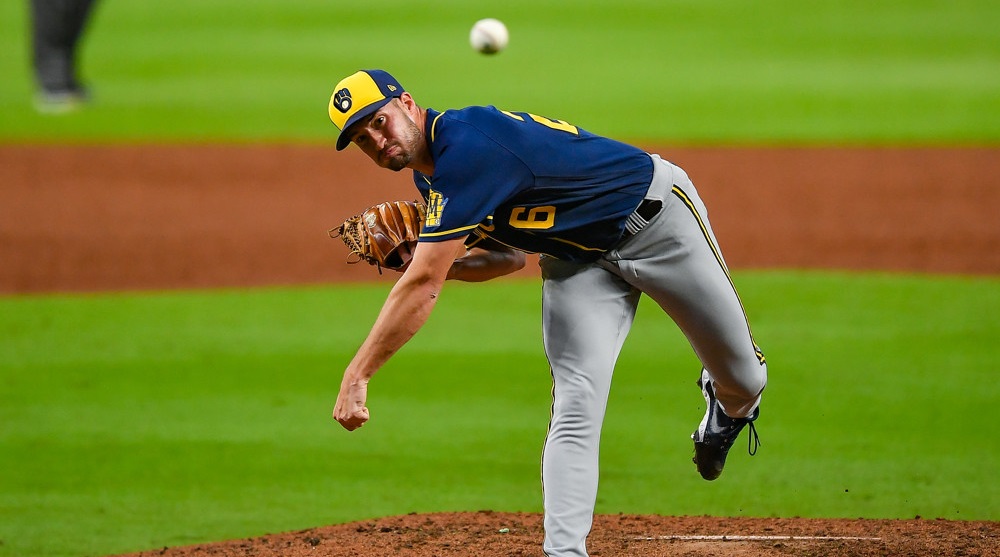
    Among pitchers who met the 1,000-pitch qualifier AND were ranked in the Top 100 across all organizations on FanGraphs’ Board, the top miss-getter in the minors was Brewers swingman Aaron Ashby.

    Ashby got misses on just over 38% of swings against him at Triple-A Nashville, where he struck out 100 batters in 63 1/3 innings. FanGraphs ranks Ashby as its No. 46 MLB prospect. He also pitched 31 2/3 MLB innings last season and induced a miss rate of 29%.

    A highly-touted prospect we’ll likely see in the minors at the start of the season is 22-year-old Orioles starter Grayson Rodriguez. Rodriguez is FanGraphs’ No. 3 prospect overall and its top-ranked pitching prospect.

    Rodriguez had the 10th-highest miss rate among minor league pitchers last season at 37%. He also ranked 27th (among more than 500 qualifiers) in called strike rate (the percentage of pitches taken that were called strikes). As such, his strikeout-to-walk ratio was just shy of 6-to-1 in 103 innings. He had 161 strikeouts, a rate of better than 14 per 9 innings.

    Like Moran, Rodriguez has a nasty changeup but he is able to pair it with a 99-MPH fastball and standout slider.

    One other Top-100 pitching prospect rated in the Top 25 in both miss rate and called strike rate last season. Reid Detmers of the Angels had rates of right around 36% in each stat. Detmers, who FanGraphs ranked No. 42 among prospects, also nearly had a strikeout-to-walk rate of 6-to-1 in 62 minor league innings. In 5 MLB starts, he totaled 19 strikeouts and 11 walks in 20 2/3 innings pitched.

  • Putting (Synthetic) Statcast Numbers on Top Minor League Sluggers

    Putting (Synthetic) Statcast Numbers on Top Minor League Sluggers

    For the moment, let’s focus on baseball that we know will be played this season – Minor League Baseball.

    SIS is an industry leader in Minor League Baseball coverage with advanced data collected from more than 5,000 games each season.

    In 2018, SIS built a machine-learning model, Synthetic Statcast, that was trained using actual MLB Statcast data and SIS internally-collected batted ball data to simulate exit velocity, launch angle and more for MLB players back to 2010, as well as for the minor leagues, NPB (Japan), and KBO (Korea).

    The result is a unique perspective on quality of contact for players across levels and how those players measure up to MLB standards.

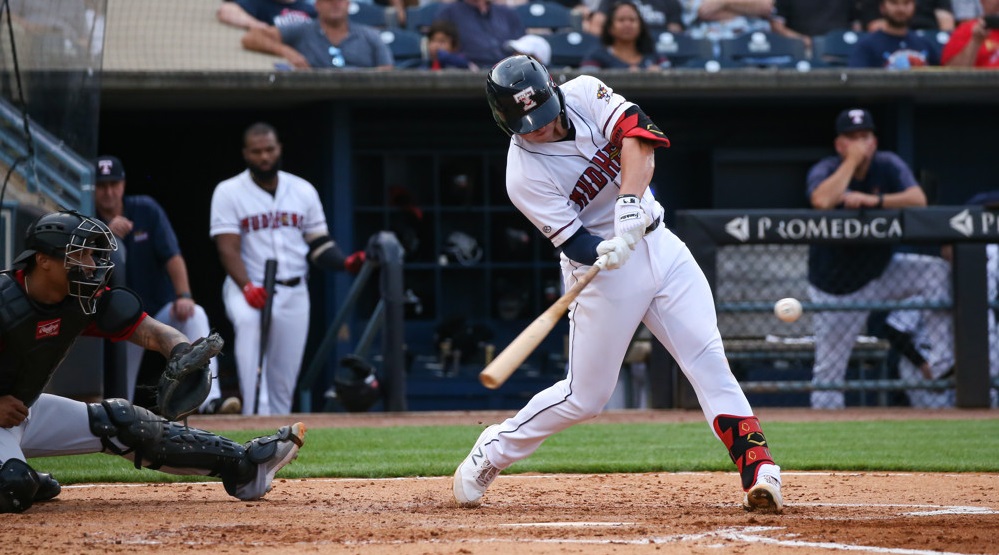
    Let’s look at a few of the top minor league prospects through the prism of that data. For now, we’ll focus on those not on 40-man rosters at the moment, meaning that they should be playing in the minor leagues come April.

    Let’s start with the No. 1 prospect on FanGraphs writer (and SIS alum) Eric Longenhagen’s Top 100 Prospects rankings, Orioles catcher Adley Rutschman. Rutschman hit .285 with 23 home runs, playing about two-thirds of his games in Double-A and the rest in Triple-A.

    Our data also allows us to construct expected batting averages and slugging percentages on balls in play based on where balls are hit and how hard they’re hit. We can then compare a player’s actual batting average and slugging percentage on balls in play (BABIP and SLGBIP) to their expected numbers (xBABIP and xSLGBIP)

    Rutschman’s BABIP and SLGBIP were .350 and .618 respectively, not far from his expected numbers of .347 and .608. His 86.5 MPH average exit velocity and 15.0 degree average launch angle resemble those of MLB catchers Kurt Suzuki (85.2, 14.6), Francisco Mejia (85.7, 14.9) and Tucker Barnhart (87.1, 15.5).

    Rutschman’s value may be significantly enhanced by his glove, as he ranked No. 2 among minor league catchers in Defensive Runs Saved, a number that is largely driven by his pitch framing stats.

    FanGraphs No. 2 prospect, Royals shortstop Bobby Witt Jr., had 33 home runs and a .936 OPS split almost evenly between Double-A Northwest Arkansas and Triple-A Omaha last season.

    Witt had a .392 BABIP and a .775 SLGBIP. In both cases, he overshot his expected numbers, his xBABIP by 46 points and his xSLGBIP by 88 points. He overachieved more than his fellow top prospects.

    Witt’s 88.5 MPH average exit velocity and 18.3 degree average launch angle are about the same as what Dodgers utility man Chris Taylor did in the major leagues last season (88.2 and 17.4, respectively).

    The Tigers have the next-highest ranked prospects among position players not currently on a 40-man roster in corner infielder Spencer Torkelson (No. 4) and outfielder Riley Greene (No. 5).

    Torkelson played at three minor league levels last season, finishing with 40 games in Triple-A. Overall, he hit .267 with a .935 OPS (brought down a little bit by hitting .238 with an .881 OPS at Toledo, his final stop).

    Torkelson’s .359 BABIP was a near-match for his .365 xBABIP and his .731 SLGBIP wasn’t far from his .714 xSLGBIP.

    Torkelson’s 90.1 MPH average exit velocity and 18.7 degree average launch angle are about the same numbers that Mookie Betts posted in MLB last season (90.3 and 18.9).

    Greene split time between Double-A and Triple-A last season and handled the latter better than Torkelson did. Between the two levels, he hit .301/.387/.534 with 24 home runs.

    However, Greene did overachieve a bit, particularly in slugging. His .775 SLGBIP was 104 points higher than his .671 xSLGBIP. His 89.6 MPH average exit velocity and 8.9 degree average launch angle were a close match to Marlins infielder Jazz Chisholm Jr.’s MLB numbers last season (90.2 and 9.0).

    Look for more minor league content in this space as the season approaches.

    Synthetic Statcast For Top Minor
    League Prospects

    Player Avg Exit
    Velo
    Avg
    Launch Angle
    MLB Comparable*
    Adley Rutschman 86.5 15.0 Tucker Barnhart
    Bobby Witt Jr. 88.5 18.3 Chris Taylor
    Spencer Torkelson 90.1 18.7 Mookie Betts
    Riley Greene 89.6 8.9 Jazz Chisholm Jr.

    Corey March also contributed to this article.

    Note: Updated Bill James Projections are typically released on March 1 every year. However, given the current situation with the MLB lockout, 2022 updated projections will be released at a date to be determined once the lockout has been resolved and MLB team rosters have been settled.

  • DH’ing Pete Alonso May Help Save Him From Himself

    DH’ing Pete Alonso May Help Save Him From Himself

    The NL’s implementation of the designated hitter is going to give teams an extra thing to think about when constructing their lineups.

    While the likeliest maneuver is to rotate hitters through the spot to give them days off, there are some situations in which a team might want to give one a player a few more days in the role than others.

    One of those teams is the Mets.

    Let me explain:

    If you had said a few years ago that the DH was coming to the National League, it would have been a no-brainer to say “Pete Alonso should be the Mets’ regular DH.”

    Alonso didn’t rate well as a defender coming up through the minor leagues. Dominic Smith did.

    But then, something happened that was kinda neat. Alonso addressed his defensive shortcomings. He’s a high-effort player in the field and it showed in his play.

    In three seasons at first base (including the abbreviated 2020), Alonso rates average. He’s totaled 1 Defensive Run Saved. He had 5 Runs Saved in 2021, which was only 4 Runs Saved off the lead.

    Former Mets first baseman turned SNY announcer Keith Hernandez, an all-time great defensive player, has said he thinks Alonso can win a Gold Glove someday.

    And Alonso has said that he wants to be a first baseman and not a DH.

    In fact, the argument for giving Alonso considerable time as a DH is no longer “Dominic Smith is a lot better than him.”

    It’s “Pete Alonso is going to wear himself out if he keeps playing as he does.”

    Here’s what I mean:

    I mentioned that Alonso is a high-effort player – that’s the key here.

    We chart a number of effort-related stats at Sports Info Solutions. They include things like how often a fielder sprinted to make a play, or how often he dove, slid, or jumped in the field.

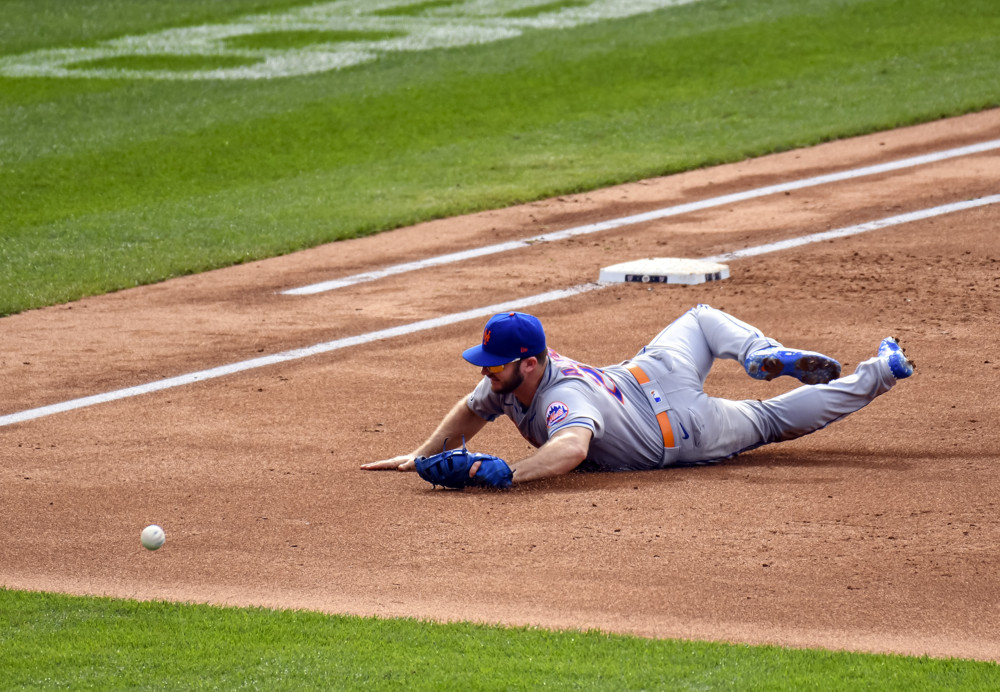
    To say that Alonso is the most prolific diver among first basemen would be an understatement. Alonso dove for a ball 47 times last season. The next-most diving attempts by a first baseman was 26 by Rhys Hoskins of the Phillies and 25 by Carlos Santana of the Royals.

    Only two players at any position dove more than Alonso did last season – Mariners shortstop J.P. Crawford (60 times) and Cardinals utility man Tommy Edman (55).

    Since the start of the 2019 season, Alonso dove for a ball 102 times. The next-closest first baseman is Paul Goldschmidt with 61 dives.

    Most Diving Attempts by First Baseman – 2019 to 2021

    Player Dives
    Pete Alonso 102
    Paul Goldschmidt 61
    Rhys Hoskins 59
    Joey Votto 55
    Carlos Santana 51
    Christian Walker 51

    Alonso’s 57 dives, slides, and jumps last season also easily led first basemen, as did his 138 slides, dives, and jumps since the start of 2019. Joey Votto is the closest first baseman in the latter with 101.

    There’s a tradeoff to consider here.

    The diving plays are probably helping Alonso be a better defensive first baseman. The average first baseman converts a diving attempt into an out 36% of the time. Alonso is 48-for-102 the last three seasons. He’s at 47%. There are 19 first basemen who have dove at least 20 times since the start of 2019. Alonso’s out rate is the highest of those 19*.

    * Most first basemen don’t dive anywhere near as much as Alonso. Eric Hosmer ranks 10th in dives in that time. He has 34, one-third as many as Alonso does. As another example, Anthony Rizzo and Freddie Freeman have each made 28 diving attempts since 2019.

    And one thing we don’t keep track of, but I feel comfortable noting anecdotally, is that Alonso is someone who does a split to try to catch a throw quite a bit. I don’t know that he’s doing it more than everyone else, but it’s fair to say he’s done it a considerable amount.

    Here’s a look at some of his better ones:

    Those same plays are also causing some wear-and-tear to his body.

    Here are a couple that didn’t work out well.

    And now for the tradeoff:

    At the 2021 SABR Analytics Conference, my colleague John Shirley presented an injury risk model that he built based on data tracked by our company. One of his most notable findings was that players who dove, slid, and jumped more often, had a greater chance of missing time due to injury.

    Makes sense, right? It’s kind of a ‘duh’ when you think about it.

    And as you’ve seen here, we have the resources to tell you which players are sliding, diving, jumping the most.

    One thing we haven’t mentioned: Alonso’s already an elevated injury risk because of how often he gets hit by pitches. He’s been plunked 39 times since the start of 2019, tied for 4th-most of anyone in that span. Tack onto that, Alonso’s sliding, diving, and jumping approach, and …

    By our injury model, Alonso has a 59% chance of missing enough time to warrant an IL stint at any point during the 2022 regular season. Alonso doesn’t top the list for first basemen. He’s actually not close to the top (Miguel Cabrera, 82%, Carlos Santana and Miguel Sano, 76%). But he’s 10 percentage points above the average for first basemen. The amount he’s diving is inevitably going to take its toll.

    Consider this: Goldschmidt, who is 34 and seven years older than Alonso, has a 49% injury probability next season. That’s 10 percentage points below Alonso.

    If you’re the Mets, the question becomes what to do about it.

    Giants shortstop Brandon Crawford acknowledged that he’s sliding and diving less now than he did when he was younger. The adjustment was among the things that he said helped him win a Gold Glove in 2021 because it improved his durability.

    But it’s easy for that kind of decision making to go the other way too. The Mets probably wouldn’t want Alonso to overthink how he plays in the field given that he’s shown a propensity for improvement.

    The most likely scenario is some sort of happy medium – that Alonso still plays first base a good amount and slides and dives as he usually does. But that he also gets a few more days than he might like at DH, essentially to protect him from himself.

    And if the Mets explain why they’re doing it, maybe it will be easier for Alonso to take, that in the long run it’s a win for everyone involved.


  • New baseball podcast: Working in MLB Ops w/ Josh Ruffin & Jasmine Dunston

    New baseball podcast: Working in MLB Ops w/ Josh Ruffin & Jasmine Dunston

    It’s Black History Month and for this episode, we talked to two people positively shaping the future in baseball front offices: Twins manager of player development research Josh Ruffin and White Sox director of minor league operations, Jasmine Dunston.

    Josh is an SIS alum now working in baseball analytics. He talks about his career path, what he did for the Twins as an advance scouting analyst, and his new role analyzing the skills of the Twins minor league players ().

    Jasmine talks about her new position with the White Sox, explains what a director of minor league operations does, and her career and educational background. She also talks about the influence of both her mom and her dad (former MLB shortstop and coach Shawon Dunston) on her career ().

    Both Josh and Jasmine also speak about the lack of Black men and women in their fields and offered guidance to anyone looking to pursue a baseball operations career.

    MLB is seeking qualified candidates from underrepresented backgrounds interested in careers in baseball operations to participate in the SABR Analytics conference March 17-20 with MLB covering the conference costs.

    Undergrads, grads, and recent grads are eligible.

    For more information and to apply, click this link and if you’re interested in working for SIS (like Josh), check out our careers page.

  • Why Does Paul Goldschmidt Rate Better on D Than Freddie Freeman?

    Why Does Paul Goldschmidt Rate Better on D Than Freddie Freeman?

    Over time, I’ve come across some Braves fans and media members who wonder why our Defensive Runs Saved numbers don’t rate Freddie Freeman more highly. And it’s fair to say what they’re asking is why Freeman doesn’t rate as a standard-setter at the position, like Paul Goldschmidt does.

    So I looked, using 2021 as my basis for comparison.

    The numbers

    Last season, Goldschmidt outperformed Freeman in Runs Saved, 9-2, with Goldschmidt’s total tying him for the MLB lead among first basemen.

    Taking the long view, the two of them rated just about even in 2019 and 2020. Freeman was MLB average. Goldschmidt was a run above.

    Goldschmidt’s 2021 harkened back to his younger years. From 2015 to 2018, he saved 39 runs, an average of about 10 per season.

    Freeman saved 18 in that span.

    The difference between the two is in their range. Freeman is a better scooper of throws – in fact, he was the best in baseball last year. But the gap between them isn’t that large. The difference between him and Goldschmidt by our “scoops” methodology was one run in 2021.

    The difference between the two of them on their respective ranges, specific to ground balls, is prominent (they rate the same on balls hit in the air).

    The differential is 8 runs of defensive value.

    In other words, there are more than enough ground balls hit their respective ways for Goldschmidt to make up for Freeman’s advantage in handling throws.

    Range Rovers

    What does an 8-run difference in ground ball range look like at the most basic level?

    Take a look at this:

    On Balls with a >0% Chance of Recording An Out

    2021 Defensive Performance

    Name Plays Made Opportunities Success Rate
    Paul Goldschmidt 181 318 57%
    Freddie Freeman 145 303 48%

    * Defining a “success” as a play made that resulted in at least one out.

    Let’s break that down even further. Here’s a look at the combined value of every play Goldschmidt and Freeman made.

    2021 Plays Made

    Name Plays Made Run Value
    Paul Goldschmidt 181 25.7
    Freddie Freeman 144 24.1


    On a per-play basis, Freeman matches up well with Goldschmidt. But

    a) He didn’t have as many plays made

    AND

    b) as you’ll see below, Freeman had a lot more plays that he didn’t make. Here are the instances of the two being debited for not making a play.

    2021 Plays Missed

    Name Plays Missed Run Value
    Paul Goldschmidt 137 18.1
    Freddie Freeman 159 24.3


    Right of Way

    Teasing this out a little further, we can see that the big advantage for Goldschmidt comes in his making plays on balls hit to his right.

    Goldschmidt converted 38% of plays made on balls hit to his right. Freeman converted 31%.

    Goldschmidt converted 5 more than he was expected to make based on our out probabilities. Freeman converted two fewer than he was expected to make.

    And when Goldschmidt made some of those plays, there was good value for doing so. Here are three examples:

    1) Goldschmidt’s toughest play of the year came on a ball on which the out probability was 9%, a ground ball hit by Lorenzo Cain well over in the first base/second base hole.


    2) Here’s one that Freeman experienced up-close. He was the batter – originally called safe on a play that replay overturned. The out probability on this ball was 19%. It’s a challenging play for a first baseman, who has to cover a lot of ground on a soft-hit ball.

    3) And for good measure, here’s one more – a play that Freeman watched Goldschmidt make against his teammate, Ozzie Albies. It had a 41% out probability.


    Goldschmidt made 27 of 35 plays on balls with out rates between 40 and 60%. Freeman was 24-of-36. A small difference, but notable when you’re asking why Freeman’s not the best at the position.

    * And I want to cut off one thing that Braves fans may be thinking here: “Our team dramatically changed how it played defense in the middle of the season.”

     This is true. But the question I’m trying to answer here encompasses the entire season’s worth of data:

    Why did Goldschmidt rate so much better than Freeman?”

    How they play the position

    Though Goldschmidt and Freeman are both playing the same position, they’re  playing two different versions of the position. Here are two key differences.

    1. Goldschmidt plays deeper. With no one on base, Goldschmidt played an average depth of 121 feet from home plate. Freeman played an average depth of 114 feet.

    The average MLB depth for a first baseman in that situation is 117 feet. Goldschmidt is 4 feet deeper. Freeman is 3 feet shallower.

    Goldschmidt can play deep and handle the rockets and medium-velocity balls – and he can adjust and make plays on the soft-hit balls too.

    The depth differential holds with runners on base too.

    One example: With a runner only on first base. Goldschmidt plays an average depth of 89 feet (one step in after holding the runner). Freeman plays 86 feet (he comes in as the pitch is thrown).

    2) The two differ in how they combine their depth with their width (how close to or how far away they play from first base)

    A couple of examples

    * Goldschmidt played much deeper than Freeman did when a left-handed batter was up and the team was not in a defensive shift.

    1B Defense Left-Handed Batter at-Bat, No Shift On

    Avg depth (feet) Avg width

    (angle to home)

    Goldschmidt 128 38 degrees
    Freeman 118 36 degrees


    Here’s what that looks like, using visuals from Baseball Savant

    And moving in the other direction, at the most extreme, there’s a 4-degree difference in where Goldschmidt plays vs where Freeman played when a right-handed batter batted with no one on base when their teams used a defensive shift.

    This is what that looks like.

    Point being: In most of the alignments that the teams play, Goldschmidt is a little more adventurous defensively than Freeman is both in depth and width.

    Sometimes a little. Sometimes a lot.

    And here’s what that does:

    In previewing the Super Bowl on our company football podcast, my boss, Matt Manocherian, talked about how moving a safety around “changes the shape” of a team’s defense. And that the Rams and Bengals would play a chess game, trying to get the other team to change their shape.

    Having Goldschmidt allows the Cardinals to change the shape of their defense for the better.

    Here are two plays, one hard-hit and one softly hit, that Freeman misses that Goldschmidt probably makes.


    And a play like this, on which Freeman has no shot, is one that Goldschmidt has a fighting chance at, because his skills allow him to play wider than Freeman does.

    This is not to be overly critical of Freeman. He’s good. But we’re comparing him to the best defensive first baseman in MLB.

    To get back to the idea of changing the shape of the defense:

    The Braves’ and Cardinals’ second basemen align in part based on where their infield mates are playing. And they’ll align differently based on whether the infielder is Freeman or Goldschmidt. Essentially, the first baseman and second baseman become a unit and the performance of one can be linked to the other.

    Let’s look at one thing related to the work of these units:

    How often was an out recorded by each’s team’s defense on a ground ball between the first base bag, and the spot approximately halfway between first base and second base?

    In this case, we’re asking how often did anyone make the play?

    On Ground Balls Between 1B and the 1B-2B Approximate Midpoint

    Out Rate MLB Rank
    Cardinals 88% (219/248) 4th
    Braves 82% (200/245) 24th

    On the whole, the Cardinals unit was pretty good in this area. The Braves unit was not (and yes, the Braves d was better – 84% after the All-Star Break when they shifted more … again, we’re looking at the whole season).

    Skill sets

    With regard to skills, let’s note the difference between Goldschmidt and Freeman in certain fielding skills in 2021.

    Forehand/Backhand Out Rates


    Forehand Out Rate Backhand Out Rate
    Goldschmidt 99%* 94%
    Freeman 94% 92%

    * Goldschmidt had 187 plays made on 189 opportunities he made when fielding the ball on his forehand

    Additionally, Goldschmidt was the more aggressive of the two in both diving and sliding for balls.

    When Sliding or Diving to Make a Play – 2021 Season

    Plays Made Opportunities
    Goldschmidt 15 28
    Freeman 6 18

    Goldschmidt’s willingness to dive or slide for balls extended his range in certain instances (such as on the play on Cain). It made a 9% out probability possible.

    In fairness to Freeman, if we add jumping to the mix, he looks a little better. Goldschmidt totals 18 plays in which he left his feet and extended his range (on 33 attempts). Freeman had 13 on 27 attempts.

    But he’s still not quite where Goldschmidt is.

    And that’s kind of the point of everything we’re doing here.

    It’s easy to say that Freeman was in Goldschmidt’s class.

    But when it comes to trying to prove it, we can’t make the case, at least not in 2021.

    Bottom line: They’re both great hitters and great players. One just happened to be a high-end fielder last season. The other wasn’t. But given that he’s got a World Series ring, he’s probably not complaining.

  • How Far Is Jarred Kelenic From Being an Average Defensive CF?

    How Far Is Jarred Kelenic From Being an Average Defensive CF?

    Mariners outfielder Jarred Kelenic was subject to a lot of scrutiny in his rookie season given how he had been ranked among the top prospects in baseball for multiple years running.

    That debut season was a challenging one in many ways. Kelenic hit .181 with a .615 OPS with 14 home runs in 93 games, though he showed positive signs at season’s end, posting an .829 slashline in his last 33 games.

    But Kelenic’s defensive performance was also not good. Forced to play center field because of Kyle Lewis’ season-ending knee injury, Kelenic struggled. He finished with -16 Defensive Runs Saved there and -18 Runs Saved overall.

    Mariners GM Jerry Dipoto told Ryan Divish of the Seattle Times that Kelenic would likely be the team’s regular center fielder next season, because even if Lewis comes back, his health may not lend itself to the wear of that position.

    That got me to wondering just how far Kelenic is from being an average center fielder. In other words, what would it take to make up his biggest defensive deficiencies in one season?

    Setting some parameters

    To make things simpler, I’m going to only focus on Kelenic’s range. Kelenic’s Defensive Runs Saved in center field in 2021 can be broken down thusly:

    -12 runs for Range (read as negative 12)

    -2 runs for Outfield Arm

    -2 runs for Good Fielding Plays/Defensive Misplays*

    * SIS charts 90 types of defensive plays and misplays, and assigns run values to some, such as overthrown throws, cutting a ball off in the gap to prevent base advancement, and robbing home runs.

    For our purposes, and since the push to get to average isn’t a large one, let’s stipulate Kelenic can get to 0 Arm Runs and 0 Good Plays/Misplays Runs without significant issue.

    What does average range looks like?

    Most baseball fans think that their team’s center fielder has great range. But if you’re grading on a curve (as we do for Defensive Runs Saved), that’s not possible.

    By our system, the everyday centerfielders with the best range in 2021 were Harrison Bader, Michael A. Taylor, and Kevin Kiermaier. Byron Buxton would almost surely have topped the list if he’d played a full season. Trent Grisham, Lorenzo Cain, and Jackie Bradley Jr. also rated near the top.

    In terms of average range, there are a number of players that fit the definition. Aging Yankees center fielder Brett Gardner had 0 Runs Saved in 2021. So did the much younger, though injury-hobbled, Cody Bellinger of the Dodgers.

    For the purposes of this article, I’m going to go with someone within Kelenic’s own division, Adolis García of the Rangers, as a basis for comparison.

    García had 1 Run Saved from range in center last season (he fared much better in right field after Joey Gallo was traded). He also played a nearly identical number of innings to Kelenic and had a similar number of opportunities to make plays.

    Kelenic vs Garcia

    Looking at this first without any consideration for play difficulty:

    Garcia caught 78% of the fly balls on which he had an opportunity to make the play (206 out of 254). We define “opportunity” as a play on which there was a >0% chance that the ball would be caught based on our charting data.

    For reference, Bellinger and Gardner were also 78%.

    Kelenic was at 72% last season (202 plays made on 282 opportunities).

    The easiest way to show the difference between Kelenic and García was to look at how they fared on balls hit to the deepest parts of the outfield, ones that tend to be higher-value plays because of their chance of being a double or triple.

    Kelenic is below MLB average here. He was expected to make 57 of 86 plays and he made 51. Garcia had a little bit easier selection of deep fly balls to deal with. He made 66 of 85 plays, one play more than expected.

    On Deep Fly Balls

    Player Plays Made/Opportunities Success Rate
    Adolis García 66/85 78%
    Jarred Kelenic 51/86 59%

    Kelenic also rates below-average on balls hit to medium depth. He has an 81% success rate on those opportunities. He made 92-of-113 plays when he was expected to make 97.

    Coincidentally, García doesn’t rate well on those either. He’s also at 81%. He made 87-of-108 plays when he was expected to make 91.

    Kelenic is a hair above average on shallow-hit balls, with a 71% success rate. They’re not as much an issue as the deeper balls, though you’ll see a few in a moment that he’d probably like another crack at.

    So how does Kelenic get to average?

    I watched a large selection of plays that Kelenic didn’t make last season. And from those, I plucked 14 from which the summed run value he lost for not making the play and that he would have gained had he made the play was 12.3 runs.

    I’m not going to show all 14 plays. They’re admittedly a bit of a cherry pick. But there are a few worth checking out.

    Before I do, a reminder on our methodology. We’re not making the numbers up here. Our out probabilities are based on historical data of how often balls are caught based on factors that include


    – Where the ball was hit

    – How hard it was hit

    – What kind of batted ball type was it (ground ball, line drive, fly ball…)

    – Where was the fielder aligned


    In other words, if we say a ball has a 72% out probability, that’s based on balls hit to the outfield in the past two years that were caught by an outfielder at that position 72% of the time.

    So let’s look at some film:

    1) This was the play that cost Kelenic the most run value last season and is a clearcut mishap.

    He slipped and fell on a ball that had a 97% out probability, which thus costs him a full run saved of value.


    2)Here’s one that Kelenic reached and dove for but can’t make the play. It has a 72% catch probability. My guess is that a play like that is a sprinting catch for most center fielders.


    3) Similarly, Arizona can be challenging for a rookie center fielder because of how much space there is to cover. This is another ‘just miss’ – one with a 49% out probability and again – educated guess – the Kiermaier’s and Buxton’s and Bradley’s find a way to get to this ball.


    4)What often separates the good from the bad defensively is that the player with good defensive metrics makes a play. The player with bad metrics just misses one.

    Here’s one for Kelenic’s ‘just missed’ file. This is a ball with a 63% catch probability.


    Click here to see another play, not quite a ‘just missed’ but a similar circumstance on a true 50-50 ball (50% out probability), in which an initial bad step cost Kelenic any chance of making the play.

    5)Kelenic had a few instances in which he converged with another fielder and both failed to make the catch. This one came on a play on which Kelenic had a 56% out probability.

    It’s a difficult play for an MLB center fielder, though not an impossible one given how long the ball was in the air.


    You can click here to see another example

    In Summary

    Revisiting the math, making these 14 catches would have given Kelenic 216 plays made instead of 202 and would have given him a 77% success rate instead of 72%, right at the 78% threshold that seems representative of MLB average.

    I’m not an outfield coach. I can’t necessarily tell Kelenic how to make more plays in center field next season. But the film seems suggestive of his issues being a little bit of everything, and perhaps a touch of the overeagerness you’d expect from a much-hyped rookie.

    Kelenic isn’t necessarily a bad outfielder. He had a bad season statistically. We still need more information to figure out what kind of outfielder he’ll be.

    We’ll try to keep tabs to see if there is any improvement in 2022.

  • KBO Scouting Report: Dan Straily Worthy of an MLB Return?

    KBO Scouting Report: Dan Straily Worthy of an MLB Return?

    While MLB’s lockout continues, this hasn’t stopped other leagues around the world from making moves and shoring up their rosters for the coming season. In the KBO, all roster spots for foreign players have now been filled, and two pitchers with MLB experience were not signed by any team in the league. Both Dan Straily and Aaron Brooks come with questions, but they could end up being useful depth options for MLB teams, or look to catch on in another league. 

    We’ll look at Straily in this article and Brooks in a separate piece in the near future.

    Straily came to the KBO with high expectations, as he easily had the most MLB experience of any pitcher looking to prove themselves in Korea.

    From 2012-2019 Straily was 44-40 with a 4.56 ERA in just over 800 career innings. The best stretch of his career was from 2016-2018, when he was a roughly league-average starter over almost 500 innings for the Reds and Marlins. However, his 2019 season was a disaster, as he had a 9.82 ERA that was fueled by allowing 4.2 HR/9.

    Season W-L ERA IP WHIP BB/9 K/9
    2020 KBO 15-4 2.50 194 2/3 1.02 2.4 9.5
    2021 KBO 10-12 4.07 165 2/3 1.38 3.6 8.9

    As the chart shows, Straily appeared to right the ship in 2020. He became the first KBO pitcher in 8 seasons to reach 200 strikeouts in a season (Hyun-jin Ryu had been the last pitcher to do so), and produced a great ERA in a league with defense well below the MLB standard. While his 2021 results were not as excellent as 2020, there were some positives to take from the season as well. Straily is now hoping to return to MLB for the 2022 season.

    Pitch Type Usage (2021) Average Velocity (MPH)
    Fastball 44% 91
    Slider 31% 84
    Changeup 15% 85
    Curveball 6% 76
    Cutter 4% 88

    Straily was aware that the league would adjust to him for a second season. He added a cutter to his repertoire, which he had not thrown before in either MLB or in Korea. He did scrap the pitch by July, but it shows his willingness to adapt and stay ahead of hitters. He also added a tick of velocity to his fastball, despite having thrown over 3,000 pitches in 2020.

    Straily’s changeup also became a better pitch in terms of limiting significant damage in 2021. His changeup features good downward break and armside run, which would typically make it more effective against left-handed hitters. But lefties hit the pitch surprisingly well with a .326 average against, while right-handed hitters only hit .121. 

    However, despite the high batting average by left-handed hitters, it’s worth notingthat no hitter managed an extra-base hit against his changeup all season.

    What led to the drop in his performance was some regression in control. Straily was pitching from behind more often, and had fewer opportunities for strikeouts. 

    Look at his best breaking pitch, the slider. It was his most used pitch with two strikes in both 2020 and 2021, and in both seasons his whiff rate on the pitch was around 30%.

    However, he dropped from 114 strikeouts with the slider in 2020 to only 62 in 2021. Part of the drop is likely attributed to hitters expecting the slider with two strikes in 2021, but the biggest factor was that he didn’t have as many opportunities to pitch with two strikes. His slider strike rate dropped from 70% in 2020 to 65% in 2021.

    The dip in control also contributed to a loss of effectiveness with his fastball. Despite adding 1 MPH to his average velocity, his OPS versus his fastball rose from .706 in 2020 to .890 in 2021.

    It wasn’t so much that his fastball was a worse pitch, just that his command wasn’t as sharp, and he was forced to throw it in the zone more as he fell behind in more counts.

    Overall, let’s keep the expectations reasonable.

    Straily looks like a potential back-end or depth starter candidate. Given his experience, and his having to make several adjustments throughout his career, he could be a good mentor who soaks up innings on a younger team, or he could be used as a swingman type on a competitive team that needs more pitching depth.

  • Stat of the Week: Upcoming Hall of Fame Classes

    Stat of the Week: Upcoming Hall of Fame Classes

    With this year’s Baseball Hall of Fame elections now complete, we can now look forward to the upcoming Baseball Writers Association of America ballot classes.

    Scott Rolen will have some strong momentum going into next year’s ballot, having received 63% of the vote in the most recent election. That’s up a little more than 10 percentage points from a year ago. We’ve written about Rolen’s Hall of Fame-caliber numbers and you’ll probably see another missive on that come the next ballot season.

    Among the ballot newcomers, there is one name that stands well above the rest: center fielder Carlos Beltrán. Though part of Beltrán’s candidacy will come down to how voters view his participation in the Astros cheating scandal, his overall numbers would almost certainly warrant selection.

    Beltrán is one of baseball’s all-time best switch-hitters. He was a nine-time All-Star and three-time Gold Glove Award winner. He ranks 47th all-time in home runs, 29th in doubles, 37th in RBIs and has the highest stolen base percentage (86.4%) among players with at least 200 attempts. He’s one of eight players with at least 300 home runs and 300 stolen bases.

    By the Bill James-devised Hall-of-Fame value scale— which combines Win Shares and Baseball-Reference’s Wins Above Replacement— Beltrán scores a 649.4, comparable to Hall-of-Fame second baseman Roberto Alomar (645.1). A score of 500 is considered Hall of Fame caliber.

    With no other strong candidates among first-timers on next year’s ballot, let’s skip ahead to the ballot that will elect the class of 2024.

    There will be several strong newcomers on that ballot: Adrián Beltré, Joe Mauer, and Chase Utley.

    Beltré ranks 16th all-time in hits, 11th in doubles, 31st in home runs, and 25th in RBIs. He’s also the leader in Defensive Runs Saved since SIS began tracking that stat in 2003 and won five Gold Gloves at third base. His 747.0 Hall of Fame Value score is higher than that of Ken Griffey Jr. (738.4).

    Mauer clears the Hall of Fame bar at 590.4, slightly ahead of Rolen’s 584.4. Mauer was a six-time All-Star in a 15-year career with the Twins. He won five Silver Slugger Awards and three Gold Gloves to go along with 2009 AL MVP honors. He also won three batting titles, each coming in a season in which his primary position was catcher.

    Utley is probably going to be the toughest call of these three for the BBWAA voters. His Hall of Fame value score is 549.2, a little higher than that of David Ortiz (537.2).

    Utley was a six-time All-Star and four-time Silver Slugger in his 16 years with the Phillies and Dodgers. He has the highest career stolen base percentage if we lower the minimum to 150 attempts (87.5%).

    From 2005 to 2009, Utley averaged close to 8 bWins Above Replacement per season, thanks in part to strong Defensive Runs Saved totals. He ranks second among second basemen in Runs Saved since SIS began tracking it in 2003. Utley also had strong postseasons in 2008 and 2009, helping the Phillies reach the World Series in both years (they won in 2008).

    Players With Hall of Fame Value Score of 500 or Higher

    On Next 2 Hall-of-Fame Ballots

    Name HOF-V
    Alex Rodriguez 961.1
    Adrián Beltré 747.0
    Manny Ramirez 685.2
    Gary Sheffield 672.2
    Carlos Beltrán 649.4
    Bobby Abreu 596.7
    Joe Mauer 590.4
    Scott Rolen 584.4
    Todd Helton 565.0
    Jeff Kent 560.8
    Chase Utley 549.2
    Andruw Jones 526.8
  • Kevin Newman Can’t Slide, Dive or Jump Well … And That’s Ok

    Kevin Newman Can’t Slide, Dive or Jump Well … And That’s Ok

    Behold this play from the seventh inning of the Pirates-Twins game on April 23, 2021.


    This very nice play by Pirates shortstop Kevin Newman on Alex Kiriloff happens to be the only play that Newman made all season in which he dove to field a ball.

    Last week, we looked at the top shortstop when it came to sliding, diving, and jumping the last three seasons, Carlos Correa.

    We explained that our company’s Video Scouts chart these things as they relate to how fielders approach balls, just one of many aspects of our ‘descriptive defense’ tracking.

    This week, we look at the opposite end of the leaderboard, which brings us to Newman.

    We come in praise … despite some of the numbers

    Before I share any notes, I want to make it clear that we’re not here to mock Newman.

    In fact, what we’re going to present will provide a good lesson in adapting to your personal circumstances.

    That said, Newman got an out on only 1-of-17 plays in which he dove last season and is 3-of-59 on his diving attempts dating to 2019.

    That explains why he ranks where he does when it comes to sliding, diving, and jumping, or what we call “Telegenic Plays.”

    Lowest Success Rate on Telegenic Plays – Shortstops 2019-2021

    (Among 33 SS with Most Telegenic Attempts)

    Player Telegenic Plays Made-Attempts Success Rate
    Kevin Newman 13-84 15%
    Didi Gregorius 30-131 23%
    J.P. Crawford 42-179 23.5%
    Tim Anderson 24-102 23.5%
    Jorge Polanco 20-83 24%
    Brandon Crawford 30-120 25%


    It should tip you off to the point that we’re going to make that a pair of Gold Glovers are on this list – Mariners shortstop J.P. Crawford (2020) and Giants shortstop Brandon Crawford (most recently 2021).

    And that point is that you don’t have to be a Correa-type fielder to be a good defensive shortstop.

    In the last few months, I’ve asked questions of multiple athletes (Brandon Crawford was one of them) that netted answers talking about the value of self-awareness.

    A basketball player who realized he didn’t have the foot speed to keep up with better athletes at the college level adjusted to focus on better knowing his opponent.

    Crawford realized he was getting older and needed to put less strain on his body, which he did by cutting back how often he slid and jumped in the field (30 times in 2019; 16 times in 2020-21 combined).

    And in Newman’s case, entering 2021, this was emblematic of what he was.


    In 2019 and 2020 combined, Newman cost the Pirates 10 runs with his defensive play at shortstop. So the Pirates gave him homework – develop a better first step and Newman realized that he needed to execute it to ensure big league survival.

    In Newman’s case, that took the form of pre-pitch movement, usually in the form of a plyo step that allowed him better forward explosiveness, and better reads of the ball of the bat.

    And with that, Newman transformed both how he played defense and the results he got from doing so.

    It made plays like these more routine for him than they previously were.


    He was now in better position to make a few tougher ones too, including this one, which had an out probability of 10% and was worth 0.7 Runs Saved, matching his most valuable play of the season.


    Here’s one going to his backhand, which had an out probability of 20% and a run value of 0.63 runs.


    This chart shows how Newman cut back his telegenic attempts. He slid, dove, and jumped a lot less often.

    Telegenic Attempts Innings DRS at Shortstop
    2019-20 58 1,008 2/3 -10
    2021 25 1,074 1/3 7

    He no longer needed to slide, dive, and jump because the movement either gave him better quickness to the ball or a couple-step head start to any ball in play on which he guessed right.

    It also allowed him to remain upright, thus making for an easier means to throw the ball to a base.

    The reward: A massive improvement in Defensive Runs Saved.

    Not everyone can be a Carlos Correa in the field. Newman has figured out what he is – and though he doesn’t slide, dive or jump effectively, he’s got other things going for him. It’s an approach that works for him and he made the most of it in 2021.