Category: Baseball

  • The Rise of Minor League Defensive Shifts

    The Rise of Minor League Defensive Shifts

    By ANDREW KYNE

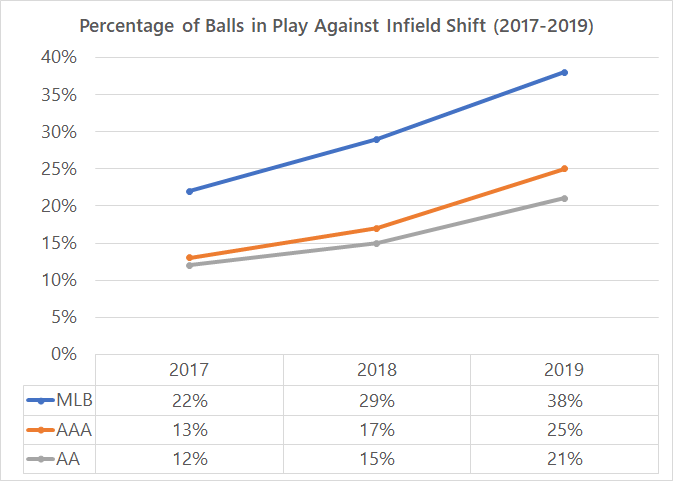
    Infield shifts are on the rise in Major League Baseball again this season. On balls in play, Baseball Info Solutions recorded 26,705 shifts in 2017 (22% of balls in play) and 34,671 in 2018 (29% of balls in play). This year, there have been 13,272 shifts (38% of balls in play), which prorates to more than 44,000 for a full season.

    And while our company and others in the industry have talked a lot about shifts at the MLB level, what about shifts in the minor leagues? Are they rising like they are in the majors? Are they are as common?

    BIS charts all AAA games and nearly all AA games (about 90-95%), so let’s take a look.

    Here’s a comparison of MLB, AAA, and AA in terms of percentage of balls in play against an infield shift over the last three seasons.

    Although the infield shift isn’t as common in the upper minors as it is in the majors, it is increasingly prevalent. This season, both AAA and AA teams have had a shift on for more than 20% of balls in play for the first time.

    Here are the leaders and trailers in shift usage at the AAA level this year, combining the International and Pacific Coast leagues:

    And here are the leaders and trailers at AA, combining the Eastern, Southern, and Texas leagues:

    The Twins have shifted the highest percentage of balls in play in the majors this year, so it’s not surprising to see their affiliates near the top in AA and AAA as well. Teams like the Rays and Pirates have also historically shifted a lot and have minor league clubs listed near the top here. And the Marlins have increased their shift usage this year, and their Jacksonville affiliate leads all AA teams.

    How well does a minor league team’s shift usage track with the shift usage of its parent club? For 2019, the correlation between MLB and AAA…

    … appears stronger than the correlation between MLB and AA.

    So while teams don’t shift as much in the minors as they do in the majors, they are becoming more popular. Infielders, pitchers, and hitters are getting accustomed to extreme infield alignments before they even get the call to MLB.

  • What’s been behind Justin Verlander’s great season?

    By MARK SIMON

    What’s the secret to Justin Verlander’s success this season? Verlander’s slider has been one of the best-performing pitches in baseball. And the defense behind Verlander has been pristine.

    Verlander has a 2.38 ERA and a 3.85 FIP. The latter is driven by 11 home runs in 64 1/3 innings, but FIP doesn’t expect what Verlander’s slider has done. So far this season, opponents are 4-for-72 against that pitch (.056 batting average, along with five walks). By Fangraphs’ run value stats, the pitch has gotten the second-best overall results of any pitch thrown by any pitcher in 2019 (Martin Perez’s cutter ranks first).

    Verlander had a lights-out slider in his last start against the Tigers. He threw 20 of 26 for strikes, got 12 misses on 19 swings, and got eight outs (five strikeouts) and allowed only one baserunner with it (a walk). The spin and release point don’t differ much from what they were last season.

    Verlander’s slider has usually rated good to very good. It rated elite by run value in 2016 but dropped in value the last two seasons. It’s typically his third-best pitch. But in 2019, it has been by far his best. Verlander’s slider gets the highest rate of chases in the majors (55 percent). The pitch is a little more often on the edge of the plate to a right-handed hitter than last season, netting some tough swing decisions for the hitter. Chases lead to misses (Verlander’s 36 percent miss rate is just above middle-of-the-pack) or unimpressive contact.

    Unimpressive contact leads to easy plays for the defense, and it’s worth noting that batters are 4-for-43 when they actually hit a Verlander slider, and 0-for-22 when hitting a ground ball against a Verlander slider.

    In fact, the Astros defense has done very well behind Verlander regardless of which pitch he throws. They’ve saved 6 runs with their range and positioning when he has pitched, which ranks fourth. They also don’t have any Defensive Misplays or Errors on batted balls behind him.

    The Astros have done this with most of their pitchers. They lead the AL with 41 Defensive Runs Saved, as well as an MLB-best 20 Shift Runs Saved. Opponents are hitting .179 when hitting a ground ball or short line drive against an Astros infield that has three defenders on the pull side. That’s 55 points below major league average. They’ve had plenty of chances, a major-league high 252.

    The negative differential between Verlander’s ERA and 3.85 FIP is the second-largest in baseball, which doesn’t bode well for Verlander’s ERA down the road. How long can a good slider and some great defense last? He’s going to find out.

  • Who can we combine into the best 5-tool player?

    By PATRICK ROWLEY

    In major league baseball there is always talk of finding a “five-tool prospect”. A player who can hit for both average and power, excels fielding the ball as well as throwing it, and has the foot speed and baserunning skills to round out their game devoid of any flaws. Having a five-tool player on the roster is quite an asset for a manager. You don’t have to take their bat out of your lineup late for defensive help or pull them for a pinch hitter or runner in a big spot. You can pencil them into the lineup and largely forget about them for the duration of the game.

    In short: Mike Trout.

    Plenty of prospects have been billed as the next great five-tool player and have failed to materialize. However, the point of this article is not to identify the next super prospect, but to build one comparable to Trout using different aspects of current MLB players.

    All stats entering May 20

    Fielding: Harrison Bader

    Much of our work is related to defensive performance, so we’ll start on the defensive side. The first component we are going to focus on is fielding, to show how well a fielder turns batted balls into outs. To evaluate this, I isolated the “Range and Positioning” component of Defensive Runs Saved (DRS), divided the total for each player by their innings played (minimum 750 innings since the start of 2018), and then multiplied that number by 1,000 to get Defensive Range and Positioning Runs Saved per 1,000 innings in the field.

    After doing this there were four players with over 15 runs saved per 1,000 innings, but the only one who was over 20 per 1,000 was Harrison Bader (the other three were Kolten Wong, Matt Chapman, and Adam Duvall). Last season Bader was moved all over the outfield, splitting time in center with Tommy Pham and filling in at the corners on the other days. With Tommy Pham now in Tampa, Bader now has a firm hold on the starting centerfield job in St. Louis and continues to perform well.

    Arm/Throwing: Ramón Laureano

    Laureano had a memorable debut last August when he hit a walk-off single for his first career hit in his MLB debut. Less than a fortnight later Laureano showcased the strength of his arm for the first time with an incredible double play against the Angels on August 11 and since then his arm has easily been the strongest part of his game.

    How strong is his arm? Since the start of 2018 Laureano is fifth in Outfield Arm Runs Saved with seven. The four players with more than Laureano since the start of 2018 have anywhere from 100-600 more innings in the field than he does.

    Hitting for Average: Michael Brantley

    Since the start of 2018 there are 141 batters who have had the requisite number of at-bats to qualify for a batting title. Among those, only Michael Brantley’s contact rate of 91% is greater than 90%. No one is better at putting the bat on the ball when they do take a swing. Brantley’s history as a great contact hitter isn’t exactly a secret as he has the 15th highest career batting average among active players, but he is off to an even better start this year.

    At Sports Info Solutions we a metric called Defensive Independent Batting Statistic, or DIBS. DIBS looks at a player’s batted ball profiles (where the ball was hit, what type of batted ball it was, and how hard it was hit.) and calculates what the expected batting line of a player should be. Since the start of 2018 Michael Brantley has an expected batting average of .334, edging out reigning NL MVP Christian Yelich for the best mark among players with at least 500 plate appearances between the last two seasons.

    Hitting for Power: Christian Yelich

    Yelich was just beaten out by Michael Brantley for the hitting for average portion of this exercise, but he decisively takes the power component. DIBS has Yelich with the highest projected home run total over the last two seasons with 53.5, just ahead of Khris Davis (53.0).  

    When you look at expected slugging instead, Yelich has an even clearer advantage. His .626 is considerably ahead of Anthony Rendon’s .568 in second.

    If you change the time filter to start from last year’s all-star break until now, then Yelich’s DIBS slugging percentage jumps up to .735. The guy has been mashing.

    Baserunning: José Ramírez

    José Ramírez is performing well below the excellent numbers he posted across 2017 and most of 2018, but luckily for Ramírez, speed doesn’t slump. Our Net Baserunning Runs Saved metrics creates an all-encompassing stat that measures all activity on the base paths that considers things such as avoidance of double plays and ability to take an extra base as well as just base stealing.

    This metric is broken down into two main components: SB Gain which reflects the player’s frequency and success stealing bases and BR Gain which focuses on all other aspects of their baserunning. Since the start of 2018 Ramírez has a net gain of 62 bases between the two stats, 19 ahead of Billy Hamilton in second.

    That huge lead is from being tied with Trea Turner and Jonathan Villar for first in SB Gained and first in BR Gained. Adalberto Mondesí is an interesting player to watch for with regard to this metric as he is within three of Billy Hamilton for second place since the start of 2018 and he wasn’t called up until June, but for now Ramírez is the gold standard on the bases.

    He completes our tool set that makes the complete baseball player.

  • 2019 Top College Baseball Draft Prospects: Left-Handed Pitching (Part 1)

    Over the next month leading up to the 2019 MLB Amateur Draft, Baseball Info Solutions will be publishing a series of position-by-position scouting reports from our Video Scouts for the top-50 collegiate draft prospects. Each player is graded by the 20-80 scouting scale, given a comprehensive evaluation, and assigned a floor and a ceiling comparison, which indicate–if a player makes the Major Leagues–the range of the type of player into which he can develop.

    Full coverage:
    Catchers
    Corner Infield (Part 1)
    Corner Infield (Part 2) 
    Middle Infield (Part 1)
    Middle Infield (Part 2)
    Outfield (Part 1)
    Outfield (Part 2)
    Left-Handed Pitching (Part 1)
    Left-Handed Pitching (Part 2)
    Right-Handed Pitching (Part 1)
    Right-Handed Pitching (Part 2)

    With 31 position players already covered in previous posts, this next installment focuses on the top tier of left-handed pitchers. There are only seven lefties in our top 50, but they have all done enough at the college level to warrant being drafted in the first four or five rounds.

    This group is headlined by two likely top-15 picks, with two other guys who should come off the board early on Day 2. Nick Lodolo has the most upside of any college pitcher in this class, but he still has a lot of development left ahead of him. Zack Thompson, John Doxakis and Ethan Small are more floor over ceiling, but are all coming off of a 2019 season in which they dominated SEC competition.


    Nick Lodolo, LHP
    Texas Christian University (JR, 2019)
    L/L 6-06, 185 lbs
    Date of Birth: 02/05/1998

    Fastball- 55 (65) Slider- 55 (65) Changeup- 45 (55) Control- 50 (55)

    Written by Harris Yudin

    Analysis
    Despite being drafted 41st overall by the Pittsburgh Pirates in 2016, Nick Lodolo decided to put off professional baseball in favor of a career at TCU. He flashed moments of brilliance over his first two years in college, but allowed his ERA to inflate over 4.00 both seasons. He has enjoyed a breakout junior campaign, however, and even with a couple of rough outings in Big 12 play, he still managed a 2.18 ERA across 91 innings over the regular season, compiling 113 strikeouts with just 19 walks in the process. His 5.95 strikeout-to-walk ratio led all Big 12 pitchers with at least 50 innings pitched.

    Operating out of a low three-quarters arm slot, Lodolo has a unique but smooth delivery that he repeats surprisingly well– he has made significant strides in this area over the last three years. He has an athletic build and a lean, wiry frame — a combination that oozes projectability — and he uses his length to get good extension and deception, the latter more so against lefties.

    Lodolo’s repertoire is headlined by a low-to-mid-90s fastball with late life. He has touched 96 on occasion, and given his frame, he is expected to pack on at least 20 pounds over the next few years, which should allow him to add a couple of ticks. His best secondary pitch is a wipeout breaking ball that he manipulates and can tailor to the current situation and batter, getting both called strikes and chases against both lefties and righties. He throws it with a cutter grip but calls it a slider, and the fact that he can change its shape and use it in different ways suggests a possibility of turning it into two separate pitches at the next level. He also works in a rare changeup, mostly to righties in an effort to keep them off-balance, and while it is largely a work in progress, he has flashed the potential to develop it into at least an average offering.

    Lodolo’s control is mostly good, but it can get away from him at times, particularly with the fastball. He commands each of his pitches pretty well, but the command will need to catch up to his stuff if he wants to maximize his overall arsenal. He has a habit of taking too long to settle in, often struggling in the first inning, but even when he doesn’t have his best stuff or is let down by a subpar TCU defense, he has demonstrated the ability to keep his composure and stay level-headed.

    Outlook
    Lodolo is widely considered the top arm in the 2019 draft class — albeit a relatively weak class, pitching-wise — and while he has the raw tools to back it up, he has a long way to go to reach his full potential. If he can turn that changeup into an above-average major league pitch and command all of his pitches more consistently, the talented lefty could one day find himself atop a big-league rotation. On the other hand, failure to make these improvements would likely lead to a future in the bullpen, where he has the fastball-slider combination to be an electric late-inning option.

    Projection: Potential front-line starter with two plus pitches and inconsistent command.

    Ceiling: Madison Bumgarner
    Floor: Andrew Miller
    Draft Expectation: Top-10 Pick

    Zack Thompson, LHP
    University of Kentucky (JR, 2019)
    L/L 6-03, 225 lbs
    Date of Birth: 10/28/1997

    Fastball- 55 (60) Slider- 55 (60) Curveball- 50 (55) Changeup- 50 (55) Control- 45 (55)

    Written by Kyle Price

    Analysis
    Thompson is a three-year starter for Kentucky, coming out of the bullpen his freshman year in addition to being a mid-week starter. Injuries have been a concern for the Wildcats’ lefthander since coming out of high school, when he failed a post-draft physical for a shoulder issue after being drafted in the 11th round by the Rays. He also missed two months of his sophomore season due to an elbow injury that didn’t require surgery. He overcame any injury concerns in 2019, tossing 90 innings across 14 regular season starts and displaying the ability to consistently go deep into games– he’s thrown at least six innings in 12 of those starts, including two complete games. In addition to the increased workload, Thompson has been pretty dominant as a junior, striking out 130 batters with a 2.40 ERA and a .184 batting average against.

    Thompson has a medium, athletic build with a strong lower half that generates good drive towards the plate. He has a high three quarters release point and finishes bent over his lead leg, typically following through facing third base. His delivery is very smooth and repeatable, which is why he is able to go deep into games while maintaining velocity and movement, and should translate well into a lengthier season at the pro level.

    Thompson features a solid, four-pitch mix with a fastball, slider, curveball and changeup. His fastball and slider work very well off each other, with his fastball topping out at 96 mph but sitting 91-93 with good run. His slider is another plus pitch that can be cutterish at times in the low-to-mid 80s, and could ultimately develop into two different pitches. His curveball, like his slider, has a very good spin rate, is very loopy but doesn’t play as well off his fastball. He mostly uses his changeup to keep hitters off-balance, and he has the potential to develop it into a fourth above-average pitch.

    Besides injuries, control is Thompson’s biggest concern, as walks have been an issue throughout his career at Kentucky. While he was able to get a lot of hitters to chase and create swings and misses in college, hitters at the next level should be able to lay off some of those pitches, draw more walks and increase his pitch count.

    Outlook
    Thompson might be the most polished left-handed pitcher in this draft, and could have the highest floor. However, his frame and build have little room for growth, which could limit his ability to add velocity and break to his pitches. He seems to have put the injuries behind him, and his biggest concern is his control, but that should improve as he makes his way to the majors. At worst, he should be a back-end starter, but he has the makings to be a very solid number two.

    Projection: Future mid-rotation starter with four potential above-average pitches.

    Ceiling: Jon Lester
    Floor: Tyler Anderson
    Draft Expectation: Top-15 Pick

    John Doxakis, LHP
    Texas A&M University (JR, 2019)
    L/L 6-04, 215 lbs
    Date of Birth: 08/20/1998

    Fastball- 50 (55) Slider- 50 (55) Changeup- 45 (55) Control- 55 (60)

    Written by Dominic Asta

    Analysis
    John Doxakis has excelled in his role as the Aggies’ Friday night starter this season. He has posted a 2.01 ERA and 96 strikeouts in 89.2 innings as a junior, besting his sophomore year numbers of a 2.70 ERA and 92 strikeouts. Doxakis has shot up draft boards this season by dominating in SEC play and increasing his strikeout numbers. With the potential for three above-average pitches and good control, he should hear his name called in the first couple of rounds in the upcoming draft.

    Doxakis has a large frame with a strong lower half and room to add weight. He has a repeatable delivery and a low three-quarters arm slot. He works quickly through his windup with a high leg kick and a drop-and-drive delivery towards the plate. He keeps good balance over the rubber and is consistent with his stride and plant foot. He starts in the middle of the rubber and strides directly towards home plate, creating good extension.

    Doxakis works his fastball in the upper 80s and low 90s with great arm-side sink. He may only have average fastball velocity, but the pitch plays up because of the movement and his unique arm slot and extension. He has the frame and strength to project an increase in velocity on his fastball, which flashed mid-90s as a reliever his freshman year. His slider is his strikeout pitch, and has great depth and late action. He throws the pitch mostly in the low 80s, but can manipulate the velocity and shape. He has the ability to throw the slider for strikes and also back-foot the pitch to righties for strikeouts. His changeup is a work in progress that flashes above-average potential with good fade, thrown with the same arm speed as his fastball. He does not throw it very often, but it has good velocity separation from his fastball, sitting mostly 81-84.

    Doxakis controls all three pitches well and pounds the strike zone consistently. He decreased his BB/9 from 2.8 last season to 2.2 this year, and limited opponents to only four home runs in almost 90 innings of work. He works quickly and has great tempo on the mound.  There are some concerns with his delivery and low arm slot, leading some to project him as a future bullpen arm. He has proven to be very durable in college, through, with a repeatable delivery and above-average control. He should be able to remain a starter at the professional level

    Outlook
    Doxakis is young for his draft class. He will be only 20 years old when the draft occurs in June. He does not have the raw stuff to be a front-line starter, but he has a high floor, and the frame and pitchability to be a reliable starter. He pitches with tenacity and toughness on the mound and is a great competitor. If he can add a few ticks to his fastball, he has the potential to be a solid mid-rotation guy at the next level. If he is moved to the bullpen in pro ball, he has shown increased velocity in shorter outings in the past.

    Projection: Back-end rotation arm with flashes of dominance and a floor of an effective reliever.

    Ceiling: Alex Wood
    Floor: Tony Watson
    Draft Expectation: Rounds 2-3

    Ethan Small, LHP
    Mississippi State University (RS JR, 2019)
    L/L 6-03, 214 lbs
    Date of Birth: 02/14/1997

    Fastball- 50 (55) Curveball- 45 (55) Changeup- 40 (45) Control- 55 (60)

    Written by John Todd

    Analysis
    Ethan Small is a two-year starter for Mississippi State, having made 15 relief appearances in his 2016 freshman campaign and missing all of the 2017 season after undergoing Tommy John surgery the previous summer. He bounced back in 2018 to make an SEC-high 18 starts as the Bulldogs’ number two, leading the team in strikeouts and ERA, and was taken by the Arizona Diamondbacks in the 26th round of the MLB Draft that summer. Small returned to school, however, and has since raised his level of play again, just two years removed from surgery. So far this season, the left-hander is second in the country in K/9 and WHIP, at 15.2 and 0.78, respectively, through 13 starts.

    Small has a medium, slightly wiry frame with decent athleticism, some muscle in his lower half, and upper body strength growth potential. He has a full-circle delivery, showing the ball well behind his body before getting to his overhand. He has a cross-body finish well toward third, ending with his back to the plate. He pitches hunched over and lacks some lower body extension to the plate. Despite a bit of lankiness and a long-limbed finish, he has repeatable arm actions and clears out his elbow and body well, limiting elbow stress. Small will vary his windup in advantageous counts occasionally, keeping hitters off-balance by mixing in a full-stop in his leg kick. He has shown, on numerous occasions, a high level of competitiveness, self-confidence and visible passion when challenged by opponents.

    He relies heavily on a high-80s-to-low-90s fastball, mixing in a curve and changeup with decent separation. Despite the low overall velocity, Small gets good carry on his fastball and induces a high number of swings and misses. He pounds the zone and shows impressive command to both sides of the plate. The curveball doesn’t always bite consistently, but he controls it well, and it has shown flashes of being a two-plane, hammer-breaking pitch. He doesn’t have a great feel for throwing his changeup for strikes, but he keeps it down and changes eye levels.

    Small is a rhythm pitcher who attacks batters and doesn’t waste pitches. He runs on adrenaline and pumps his velo up on out pitches. He’ll need to improve on his ability to getting hitters to chase out of the zone with his offspeed offerings moving forward.

    Outlook
    Small has made serious improvements in his two years as a starter, suggesting he’s just beginning to scratch the surface of his potential, but his ceiling may be capped by a lack of plus tools. He has two future average offerings with plus control and makeup. Small will win at the next level with his ability to consistently throw strikes from the left side and pitch with command and an attack-minded approach. He should continue to develop as a starter as he works on his offspeed pitches, and projects as a back-end guy with a ceiling of a No. 3. At the very least, though, he could be a high-end left-handed arm out of the bullpen, where he can maximize his velocity in shorter outings and prioritize his two pitches that consistently miss bats.

    Projection: Reliable, back-end starter with above-average command and some upside.

    Ceiling: Barry Zito
    Floor: Brett Cecil
    Draft Expectation: Rounds 3-4


    Other left-handed pitchers to keep an eye on:
    TJ Sikkema, University of Missouri
    Brandon Williamson, Texas Christian University
    Ben Brecht, UC Santa Barbara
    Jake Agnos, East Carolina University

  • Mets moving away from the inside fastball

    Mets moving away from the inside fastball

    By ANDREW KYNE

    In 2018, the New York Mets strongly emphasized an inside-pitching philosophy, with pitching coach Dave Eiland wanting his staff to be more aggressive. Eventual Cy Young winner Jacob deGrom was among several Mets who increased his usage of inside fastballs from 2017 to 2018, as we wrote about last summer.

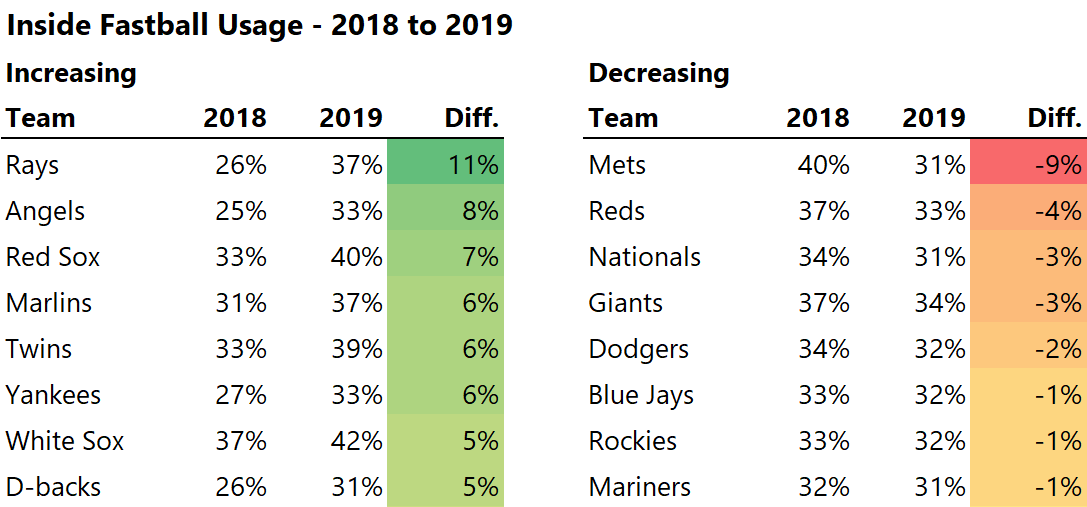
    By Baseball Info Solutions’ pitch charting, 40% percent of the Mets’ fastballs in 2018 were over the inner-third of the plate or further inside. That was the highest percentage in Major League Baseball.

    Interestingly, they have cut back on that approach in 2019. This season, 31% of the Mets’ fastballs have been thrown inside, a mark that ranks 28th in MLB.

    Pitching inside with the fastball has increased across the league this year. The Mets, however, are by far the most significant decliners in terms of percentage-point difference.

    Which pitchers are driving this change in New York? Let’s look at the 120 MLB pitchers who threw at least 750 fastballs last year and have thrown at least 200 so far this year.

    There are seven Mets in this sample of pitchers. Six of them have contributed the most significant percentage-point declines in inside fastball usage.

    (The seventh, Seth Lugo, has declined from 41% to 39%.)

    For deGrom, most of his decrease has come against left-handed batters. He’s still working up in the zone a lot with his fastball, but the emphasis has been more on up-and-away than up-and-in.

    On the other hand, Noah Syndergaard‘s decrease has come mostly against right-handed batters. He worked both corners with the fastball against them in 2018, but is focusing much more outside in 2019.

    How does this alter effectiveness? Here’s how the Mets’ fastballs have performed in 2018 and 2019 based on location.

    Inside fastballs haven’t generated as many misses per swing for them as non-inside fastballs, but they have resulted in less hard contact and slugging.

    We’ll see if this trend continues for the Mets throughout the season. For now, it’s a notable change in approach, given the organization’s clear emphasis on it in 2018.

  • 2019 Top College Baseball Draft Prospects: Outfield (Part 2)

    Over the next month leading up to the 2019 MLB Amateur Draft, Baseball Info Solutions will be publishing a series of position-by-position scouting reports from our Video Scouts for the top-50 collegiate draft prospects. Each player is graded by the 20-80 scouting scale, given a comprehensive evaluation, and assigned a floor and a ceiling comparison, which indicate–if a player makes the Major Leagues–the range of the type of player into which he can develop.

    Full coverage:
    Catchers
    Corner Infield (Part 1)
    Corner Infield (Part 2) 
    Middle Infield (Part 1)
    Middle Infield (Part 2)
    Outfield (Part 1)
    Outfield (Part 2)
    Left-Handed Pitching (Part 1)
    Left-Handed Pitching (Part 2)
    Right-Handed Pitching (Part 1)
    Right-Handed Pitching (Part 2)

    This post covers the second tier of our top-ranked outfielders for the upcoming MLB Draft in June. Though there are no first-rounders here. All four should be drafted within the first five rounds.

    Unlike some of the guys from the previous group, none of these outfielders possess much of a power-speed combination, but they should all provide one or the other to whichever team drafts them. Matt Wallner and Will Robertson are small-school right fielders with impressive power. Kyle Stowers has played all three outfield positions but fits best in left. Zach Watson has the best speed of the group, and is the only true center fielder.


    Matt Wallner, OF
    University of Southern Mississippi (JR, 2019)
    L/R 6-05, 220 lbs.
    Date of Birth: 12/12/1997

    Hit- 35 (45) Power- 50 (55) Run- 45 (40) Arm- 55 (55) Field- 50 (45)

    Written by Will Hoefer

    Analysis
    Wallner, an immense corner outfielder with easy plus raw power, has gotten off the mound and focused solely on hitting in his junior year at Southern Miss. The numbers are down a little bit in 2019, but a third straight season with a chance at an OPS greater than 1.000 is still a very impressive feat. Wallner is currently batting .293/.405/.585 with 15 home runs and a 16 percent walk rate.

    Swing and miss is likely to be an unavoidable consequence of Wallner’s lengthy stroke at the plate, and there’s a long leg kick load that could stand to be shortened up in a effort to polish timing issues. However, he does have solid hands, plus bat speed and a strong command of the strike zone, with plenty of loft generated on contact. Getting to that impressive raw power more consistently, whether it be through adjustments in hand position, closing his stance or smoothing out the rhythm of his lower body, will be the key to how far Wallner can go as a pro.

    On defense, Wallner moves decently in right and has strong instincts in the field. Though he’s likely to lose a step due to his size and turn into a below average runner as he gets older, Wallner has the requisite arm strength and accuracy to stick in right field. It’ll be important for him to maintain the leanness of his body, as any additional loss of lateral quickness could move Wallner to first base and put additional pressure on his bat.

    Outlook
    Wallner has some of the best raw power in this draft class, with 50 home runs in his college career, and there’s an advanced enough eye and approach to mitigate the whiffs. With a full-time role, expect at least 20 homers annually with fringe-average on-base skills that are depressed by a low BABIP and a high strikeout rate.

    Projection: Defensively-capable right fielder with above-average arm strength and power.

    Ceiling: Jay Bruce
    Floor: Garrett Jones
    Draft Expectation: Rounds 2-3

    Kyle Stowers, OF
    Stanford University (JR, 2019)
    L/L 6-3, 200 lbs
    Date of Birth: 01/02/1998

    Hit- 40 (50) Power- 45 (55) Run- 50 (50) Arm- 40 (40) Field- 55 (60)

    Written by Mitch Glessner

    Analysis
    After a stellar sophomore season — in which he was an All-Pac 12 honorable mention — and a great summer in the Cape Cod League, Kyle Stowers entered the 2019 season as one of the top outfielders in his class. He was named to the Golden Spikes Award Preseason Watch List and Baseball America preseason first-team All-America. He struggled out of the gate in his junior campaign, but has hit .326 with a .966 OPS and five home runs in Pac-12 conference play. Stowers’ unorthodox but effective hitting ability combined with solid outfield play makes him an intriguing draft prospect.

    Stowers stands very tall at the plate with a narrow base, and his hands start around chest height. A slight bat wiggle and long stride provide his load and timing, while his hands raise and separate. Mechanically, the swing itself looks much like Joc Pederson’s. While there are inconsistencies in his timing, his explosive hands can rip the barrel through the zone for solid contact even when his body is not in sync. He takes a very short path to the baseball and controls the barrel on both high and low pitches.

    Stowers will run into trouble when his timing isn’t exceptional. His narrow base and long open stride can sometimes trigger his lower half too early in his swing. He will bail out with his body when he is fooled by off-speed pitches. With some mechanical adjustments, his inconsistencies can be ironed out at the next level.

    Stowers has played a majority of his junior campaign in center field, with some action in left field, as well. He possesses very good outfield instincts, consistently makes good reads and has good first-step quickness, allowing him to cover a good amount of ground. He is not the fastest player in terms of pure running speed, but has shown that he can play every day in the outfield based on his instincts. The only concern for Stowers in the outfield is his arm. He has a very short circle, almost like an infielder’s, which does not produce much arm action, and his ball does not retain a lot of carry in its flight. His arm isn’t the strongest, but he can make it work by getting the ball out quickly and accurately to his target.

    Outlook
    Stowers does have the potential to be an every day contributor at the major league level, but he will have to make mechanical adjustments to be more consistent, and broaden his approach by going the other way, considering the prevalence of shifting in today’s game. His glove will play in the outfield, although he will likely move to left field.

    Projection: Starting left fielder with good power and inconsistent hit tool.

    Ceiling: Colby Rasmus
    Floor: Jeremy Hermida
    Draft Expectation: Rounds 2-3

    Will Robertson, OF
    Creighton University (JR, 2019)
    L/L 6-02, 210 lbs
    Date of Birth: 12/26/1997

    Hit- 40 (50) Power- 55 (60) Run- 50 (45) Arm- 50 (50) Field- 50 (55)

    Written by Dominic Asta

    Analysis
    Will Robertson was lightly recruited out of high school, but has become one of the best college outfielders while at Creighton. He has shown impressive power in college while playing in TD Ameritrade Park, a ballpark with huge dimensions. He is hitting .294/.388/.567 with 11 homers and 16 doubles in his junior season, and performed quite well in the Cape Cod League this past summer, batting .300/.380/.435 with four home runs and 11 doubles. Robertson has played exclusively right field for Creighton in his three years as a starter. He stands out for his immense raw power and his production in college and Cape Cod.

    Robertson has a strong, muscular build with average athleticism. He has a wide-crouched, open stance at the plate, and his leg kick helps to square his shoulders and get his front foot down. He holds his hands chest level and brings them back in his load while using his lower half well to drive the ball. He has a level swing and a quick bat that produces great pull-side power and line drives. His stance and swing mechanics are reminiscent of Kyle Schwarber. Robertson does not use the opposite field consistently and may need to adjust his stance and be more upright to use the entire field. He has kept his strikeout numbers down in college, with strikeout rates of 14 percent last season and 17 percent this season. Robertson does not walk at a great rate, either, posting walk rates of 8 and 9 percent the last two seasons.

    Robertson has been a right fielder his entire college career and has enough speed and range to stick there, but his arm is only average and would fit better in left field. He gets good reads and takes efficient routes in a big right field in his home ballpark. Robertson is an average runner with mostly 4.2-4.3 times from home to first. He has only stolen five bases in his college career and should not be a stolen base threat at the next level.

    Outlook
    Having flown under the radar coming out of a small Missouri high school, Robertson has had to consistently prove doubters wrong. He opened eyes in the Cape Cod League last summer and has backed his performance up with another impressive year at Creighton. His powerful lefty swing and ability to play in right field will be very attractive come draft day.

    Projection: Solid corner outfielder with future 25-home run power.

    Ceiling: Geoff Jenkins
    Floor: Brad Hawpe
    Draft Expectation: Rounds 3-4

    Zach Watson, OF
    Louisiana State University (JR, 2019)
    R/R 6-00, 164 lbs
    Date of Birth: 06/25/1997

    Hit- 35 (45) Power- 35 (45) Run- 70 (70) Arm- 45 (50) Field- 60 (65)

    Written By Max Schell

    Analysis
    Zach Watson is one of the fastest and most decorated players eligible for the for the 2019 MLB Amateur draft. In 2017, he was named Baseball America’s No. 1 pro prospect in the Northwoods League. In the summer of 2018, he was a member of Team USA’s collegiate team, leading the team in runs scored. He has been LSU’s starting center fielder for  each of the three seasons he has been in Baton Rouge. At LSU, he has been named 2017 Freshman All-SEC, 2017 Freshman All-American, 2018 SEC All-Defensive Team and 2018 ABCA Gold Glove Team.

    Watson has a slightly open batting stance at the plate with his feet just further than shoulder-width apart. He has a quick, but large leg kick in his swing and has very fast hands. At times he will get burned on the inside fastball because he gets his front foot down right as or after the pitcher releases the ball. He hits to all fields, and can do so with power, as well. Speed is the best part of his game. He has a chance to beat out almost any ground ball. He has good stolen base numbers in his collegiate career, with 36 steals in 45 attempts.

    With a similar build to Billy Hamilton, it would be beneficial to him to add some weight via the weight room. This would help his power numbers, and could have him hitting close to 20 home runs per season. The other aspects of his game he needs to work on are knowing when to steal and reading and understanding the opposing pitchers’ moves. With Watson’s speed, he should be a 35-stolen base threat each season as a professional. He needs to develop better pitch recognition in order to get on base and utilize his speed more. He has totaled 124 strikeouts to only 46 walks over his career at LSU.

    Outlook
    Watson currently has two major league-ready tools with his speed and fielding. If he can prove that he can hit professional pitching and put some serious effort into the weight room, he could become an above-average, everyday center fielder in the majors. Watson is more of a risky pick, though, with the adjustments he needs to make while he develops his baseball instincts.

    Projection: Everyday center fielder with massive stolen base potential.

    Ceiling: A.J. Pollock
    Floor: Peter Bourjos
    Draft expectation: Rounds 4-5


    Other outfielders to keep an eye on:
    Jake Mangum, Mississippi State University
    Tommy Jew, UC Santa Barbara
    John Rave, Illinois State University
    Pat DeMarco, Vanderbilt University

  • Do fielders dive more when a potential no-hitter is on the line?

    By PATRICK ROWLEY

    Not long ago my sister and I were watching a minor league baseball game and when Gregor Blanco came up to bat I told her about his diving catch to save Matt Cain’s perfect game in 2012.

    “I’m curious if players are more likely to dive if their pitcher has a perfect game or no-hitter going” she said

    This struck me as an interesting question. I think most of us would like to believe that players are giving it their all on every play, but most of us aren’t naïve enough to believe that. However, there is a certain mystique to no-hitters, particularly with complete games becoming a rare feat themselves. Each no-hitter seems to have that one defensive play that “saves” the no-hitter and becomes synonymous with the event.

    Then, only days after talking about Blanco, Jurickson Profar laid out in shallow right field to make a diving catch to keep Mike Fiers’ second career no hitter intact and we felt compelled to do some research.

    To look at this we used a combination of two defense metrics we track. The first being our “Scout’s Defensive Rating” which is a rating on a scale from 1-5 of how difficult it will be to convert a ball in play to an out. One is considered a “routine play” whereas a five is considered “uncatchable”. By isolating the focus to play difficulty grades 2-5 we remove the easiest plays the fielders shouldn’t need to dive for.

    The resulting balls in play were then separated into two groups- the balls in play in the seventh inning or later of a no-hitter and everything else.

    At SIS, we chart diving plays as part of our “Descriptive Defense Information” package, so we then looked at what percentage of balls in play that fielders were diving for in each of the two scenarios laid out. Our company has only tracked dives by fielders since the start of 2013, so our sample is slightly more than six seasons of data. What we found is that the likelihood of a player diving did go up when a pitcher had a late no-hit bid intact.

    Situation % of Plays with a Dive
    No-Hitter in 7th or Later 14.6%
    All Other Situations 8.9%

    What this data shows us is that in this time, a pitcher’s defender is about 64% more likely to dive when they have not allowed hit through six or more frames.

    The next question this brought up was whether these were “desperation dives” by players going for balls they can’t reach, or if the players are able to kick it into an extra gear and reach those extra balls. What we found is that not only do players dive more, but they have converted those dives into outs at a higher frequency.

    Situation Diving Success Rate
    No-Hitter in 7th or Later 39.5%
    All Other Situations 31.8%

    One thing that is important to consider is the relatively small sample size of the “No-Hitter in 7th or Later” category. The infrequency with which a no-hit bid extends beyond six innings lends itself to having a sample size that is less than 0.1% of the “All Other Situations” category.

    Even while considering this, the uptick in frequency with which a player dives in no-hitters as well as their success is noteworthy. It seems that if a pitcher wants to hang a zero in the “H” column for a game, they may need one of their players behind them to leave their feet for a ball at some point. 

  • 2019 Top College Baseball Draft Prospects: Outfield (Part 1)

    Over the next month leading up to the 2019 MLB Amateur Draft, Baseball Info Solutions will be publishing a series of position-by-position scouting reports from our Video Scouts for the top-50 collegiate draft prospects. Each player is graded by the 20-80 scouting scale, given a comprehensive evaluation, and assigned a floor and a ceiling comparison, which indicate–if a player makes the Major Leagues–the range of the type of player into which he can develop.

    Full coverage:
    Catchers
    Corner Infield (Part 1)
    Corner Infield (Part 2) 
    Middle Infield (Part 1)
    Middle Infield (Part 2)
    Outfield (Part 1)
    Outfield (Part 2)
    Left-Handed Pitching (Part 1)
    Left-Handed Pitching (Part 2)
    Right-Handed Pitching (Part 1)
    Right-Handed Pitching (Part 2)

    This post covers the first five of our top college outfielders for the 2019 MLB Draft. This group of outfielders has some high-end, first-round talent and a couple of underrated players in our eyes. All five of these players should have a future in the outfield, with three being center fielders.

    JJ Bleday and Hunter Bishop have battled all season for the Division I home run lead and will compete for a top-10 draft selection as well. Kameron Misner has the look and talent of a top-10 pick, but meager production in conference play has made him slide down draft boards. Dominic Fletcher and Bryant Packard own the most consistent college numbers of the group, but lack the size and upside of the other three.


    Hunter Bishop, OF
    Arizona State University (JR, 2019)
    L/R 6-05, 210 lbs
    Date of Birth: 06/25/1998

    Hit- 50 (60) Power- 60 (65) Run- 65 (60) Arm- 55 (55) Field- 55 (60)

    Written by Matt Noskow and Kerby Callison

    Analysis
    Hunter Bishop has exploded onto the draft scene this year, competing for the Division I lead in home runs and slugging over 1.000 for most of the year. He struggled last season at Arizona State, batting only .250/.352/.407 with five home runs and an alarming 30 percent strikeout rate before breaking out this season. Bishop is currently hitting .366/.492/.814 with 22 home runs and 11 stolen bases. His monstrous junior season seems legit, but his lack of a track record of college success and struggles in the Cape Cod League should still worry MLB teams.

    His breakout and climb up draft boards can be credited to his swing change in the fall. Previously, he had too many moving parts, which caused him to swing and miss at a high rate, but now he takes a more direct path to the ball, which has unleashed his bat speed and led to more power and a refined approach at the plate– he has cut down on his strikeouts and increased his walk total this season. Bishop has increased his walk rate from 11 percent last season to 17 percent this year. His strikeout numbers have fallen dramatically from a 30 percent strikeout rate to 22 percent in his junior season. Most of Bishop’s power is to his pull side, but he can hit to all fields. He has shown vulnerability to breaking balls outside the zone, but his refined eye has given pitchers fits this year as his plate selection has improved dramatically.

    Though he has never played center field exclusively, Bishop has shown the ability to be a well above average defender. He has plus range and covers ground very quickly. His arm is average, but should play well enough with the rest of his defense for him to project as a very good center fielder in the future.

    Outlook
    Bishop has great power potential as a pro and could be one of the better defensive center fielders as well. He has certainly cemented himself as a first round pick with an eye-popping junior season. His swing adjustment has allowed him to make enough contact to tap into his considerable power and he has handled center field well. Bishop has long had impressive tools and upside, but with little production to back the hype. His junior season has shown what Hunter Bishop is capable of and should make him a top ten selection in the upcoming draft.

    Projection: All-Star caliber center fielder with 30-home run potential.

    Ceiling: Cody Bellinger
    Floor: Michael Saunders
    Draft Expectation: Top-10 Pick


    JJ Bleday, OF
    Vanderbilt University (JR, 2019)
    L/L 6-03, 205 lbs
    Date of Birth: 11/10/1997

    Hit- 55 (60) Power- 55 (60) Run- 50 (50) Arm- 55 (60) Field- 50 (55)

    Written by Matt Noskow

    Analysis
    JJ Bleday has been a solid starter for two years for Vanderbilt. He has been a consistent force in the middle of the Commodores’ lineup, and has also produced well in the Cape Cod League. Over 249 plate appearances as a junior, he has crushed a Division 1-leading 23 home runs with an OPS north of 1.200.

    Bleday possesses great tools at the plate that should make him a quick riser through any system. He has a slightly open stance with a moderate leg kick, and exhibits very good pitch recognition and situational hitting awareness. His natural power is to his pull side, but he has shown the ability to drive the ball to the opposite field. His ability to generate power is evident, with a quick swing and the ability to transfer load to power.

    At six-foot-three and 205 pounds, Bleday has ideal size to play a corner outfield spot long-term. He has average to below-average speed, but his strong arm makes up for a lack of range.

    Outlook
    Bleday will likely be one of the top college bats drafted this year. He has an interesting profile with potential to further develop the power side of his offensive game. His plate approach is one of his biggest strengths, and should lend itself well to a quick rise through the minors. Despite being limited to a corner outfield spot, Bleday should be viewed as a high-floor prospect who could hear his name called within the first 10 picks of the 2019 draft.

    Projection: Everyday corner outfielder with plus power and all-star potential.

    Ceiling: Carlos Gonzalez
    Floor: David Peralta
    Draft Expectation: Top-10 Pick


    Kameron Misner, OF/1B
    University of Missouri (JR, 2019)
    L/L 6-04, 219 lbs
    Date of Birth: 01/08/98

    Hit- 45 (55) Power- 55 (65) Run- 60 (60) Arm- 60 (60) Field- 55 (60)

    Written by Dominic Asta

    Analysis
    Misner dominated for Missouri in 2018, batting .360/.497/.576 in 34 games before a broken foot caused by a foul ball ended his season. He played mostly left field and first base in his first two seasons, but has primarily been a center fielder in 2019. He has an imposing frame, standing six-foot-four with a strong, lean build. He was previously drafted in the 33rd round out of high school and his draft stock has exploded since arriving at Mizzou. He has exciting tools across the board, with a power-speed combo that stands out. Misner has dominated non-conference opponents in 2019, but has only posted a .222/.347/.323 line in SEC play. He is an enigma because he has the look and tools of an impact player, yet has not backed it up with his performance.

    Misner has a wide, slightly open stance at the plate with his hands at his head. He utilizes a toe tap and uses his above-average bat speed and leverage to drive the ball to all fields. He has struggled with his timing and getting his foot down in SEC play. He has great plate discipline and consistently works the count full. He has a great idea of the strike zone and will take his fair share of walks. Misner has drawn 52 walks on the year and should continue to produce high on-base numbers at the next level.

    Many college pitchers are unwilling to challenge him with fastballs, and he sees a steady diet of breaking balls and changeups away. He takes advantage of the opposite field, and can easily turn on pitches and drive them out of the ballpark. His long limbs and slight uppercut can cause his swing to become a bit long and creates a hole in his swing at times. He has struggled with fastballs up in the zone and changeups down and away. His patient approach can occasionally hurt him, as he passes up hittable pitches early in counts. He could help himself by being more aggressive earlier in his at-bats. Misner is just beginning to tap into his power potential, and has the frame and swing to hit 25-plus homers a year. Kameron has displayed some prodigious power this year with great pull-side power and even some homers to the opposite field. He has posted impressive isolated power numbers of .216 and .215 the last two season.

    Although Misner is new to center field, he has taken to the position quite well and flashes great potential at the position.. His speed, athleticism and long strides give him above-average range, and his arm is more than capable of handling center, but his reads and routes could use work. With an above-average arm and good speed, Misner can easily handle the corner outfield spots and would be above average in either spot. He also has experience at first base, where his athleticism is not appreciated as much. Misner has rare speed for a player his size. He has used this speed and baserunning ability to steal 49 bags in his college career. He will continue to be a threat on the basepaths at the professional level.

    Outlook
    Misner has an extremely exciting combination of power, patience, speed, and versatility. He has the potential to be a 20-20 player and is just beginning to tap into his considerable raw power. He should be a high on-base player with exceptional plate discipline and the ability to play all outfield positions as well as first base. Although Misner has not performed well in conference play this year, he has too much potential and talent to slip out of the first round.

    Projection: All-star center fielder with 20-plus homers per year and high on-base numbers.

    Ceiling: Josh Hamilton
    Floor: Max Kepler
    Draft Expectation: Round 1


    Dominic Fletcher, OF
    University of Arkansas (JR, 2019)
    L/L 5-10, 185 lbs
    Date of Birth: 09/02/1998

    Hit- 45 (55) Power- 50 (55) Run- 50 (50) Arm- 55 (55) Field- 55 (60)

    Written by Dominic Asta

    Analysis
    Dominic Fletcher is a small and muscular five-foot-ten, 185-pound outfielder from the University of Arkansas. He has surprising pop for his size, hitting 12 homers as a freshman and 10 homers last year. He is currently power over hit and does not project to be an above-average contact hitter. Fletcher is performing at a high level in his junior season, hitting .332/.394/.570. He has proven to be a more than capable defender in center field and has shown consistent power in his college career.  

    Fletcher has an upright stance with a whippy bat, loose hands, and an aggressive approach. He can mash fastballs with his good bat speed, but he has a tendency to pull his head off breaking balls and swing over them. Fletcher has produced 30 home runs and 44 doubles in his three seasons at Arkansas. His power and approach is mostly to the pull side, but is able to use the opposite field when he keeps his hands back and tempers his aggressive approach. He gets the most out of his small frame by using his strong forearms and quick hands to attack pitches. He has improved his plate discipline in his junior year, raising his BB% from 7 percent to 9 percent, but doesn’t project to be a high on-base percentage player at the next level.

    There are differing opinions on whether Fletcher can play center field because he does not have prototypical speed for the position, but his first-step quickness, instincts and route efficiency should allow him to comfortably stick in center. He has shown the ability to track fly ball from gap-to-gap and make highlight-reel plays. His plus arm would also play well in right field, as he led the Razorbacks in outfield assists his sophomore year. Fletcher has average speed home to first, but is faster at max effort. He has only three stolen bases at Arkansas and should not be a threat at the next level.

    Outlook
    Fletcher has the potential to be a 15-20-home run center fielder with an above-average arm and solid defense. He has made improvements in his plate discipline and increased his power in his junior season. While Fletcher has little to no projection left, he gets the most out of his frame, has good pop and should stick in CF. He could push himself into the second round if he impresses in SEC play and continues to prove himself in center field.

    Projection: Capable center fielder with good pop and arm strength.

    Ceiling: David DeJesus
    Floor: Gerardo Parra
    Draft Expectation: Rounds 3-4


    Bryant Packard, OF
    East Carolina University (JR, 2019)
    L/R 6-03, 200 lbs
    Date of Birth: 10/06/1998

    Hit- 55 (60) Power- 45 (50) Run- 50 (50) Field- 50 (50) Arm- 45 (50)

    Written by Harris Yudin

    Analysis
    Packard is one of the more polished hitters in college baseball. He as an excellent feel for the strike zone and a matured plate approach, and while he can be a bit aggressive, his bat-to-ball skills prevent him from racking up many strikeouts– 30 across his first 199 plate appearances in 2019. As of May 13, he has posted a .367/.447/.586 slash line with six home runs.

    Packard stands with his knees slightly bent and his feet squared to the pitcher, employing a small leg lift that helps him maintain his balance. He keeps his hands inside and delivers a short, compact stroke with a smooth swing path and good bat speed. The left-handed hitter sprays the ball across the whole field, utilizing the gaps, smashing line drives up the middle and taking pitches away down the third base line. He displayed more power as a sophomore, and there could be more to come given his frame.

    Although he has just average speed and isn’t likely to be too much of a base-stealing threat, Packard is an above-average baserunner due to his attentiveness and aggressiveness. He has proven capable in the outfield, with good instincts and an ability to track the ball well, but is likely limited to left field given his middling range and arm strength.

    Outlook
    Packard doesn’t possess the upside of many other college hitters, and that will likely affect his stock on draft day. However, his advanced feel for hitting could allow him to advance quickly through the minors. He should hit for a high average at the next level, with 20-homer power within reach.

    Projection: Bat-first corner outfielder with strong offensive profile but limited upside.

    Ceiling: Corey Dickerson
    Floor: David Murphy
    Draft Expectation: Rounds 4-5


    Other outfielders to keep an eye on:
    Ryan Olenek, University of Mississippi
    Matt Gorski, University of Indiana
    Matthew Barefoot, Campbell University
    Peyton Burdick, Wright State University

  • Home Run robberies are up … at least recently

    By MARK SIMON

    If it seems like there have been a lot of home run robberies lately, it’s true.

    There have been five in the last three days, most notably Jackie Bradley Jr.’s climb to steal a walk-off home run from Trey Mancini on Wednesday, and Josh Reddick’s snatch of Hunter Pence’s potential go-ahead home run in the ninth inning on Thursday. In all, there have been 19 this season.

    That sounds like a lot. Is it?

    Well, if home run robberies continue happening at this pace, it would be. This pace would produce 83 home run robberies for the season.

    Sports Info Solutions has been tracking home run robberies since 2004. Video Scouts watch every game and confer on any potential home run robbery call. Each one is scrutinized carefully via video review to ensure the ball would have been over the fence if not caught.

    The most home run robberies in a season is 65, which was done in 2018. So the current pace would shatter that mark.

    However, it’s worth noting that last season, there were 20 home run robberies through games played on May 9th, one more than this season.

    Also of note: Adam Jones recorded his 11th home run robbery on Thursday. That total ties for third in our data set. Jones is one of five players with at least 10 home run robberies.

    Carlos Gomez13
    Torii Hunter12
    Adam Jones11
    Mike Trout11
    Ichiro Suzuki10

    Reddick’s catch on Thursday marked the third time this season that a potential game-tying or go-ahead home run was robbed in the ninth inning or later. The other two were by Bradley on Wednesday and by Lorenzo Cain against Jose Martinez to end the Brewers’ Opening Day win over the Cardinals.

    Cain leads the majors with three this season. Ramon Laureano has two and is the only other player with more than one.

    There have been three robberies apiece at Camden Yards and Miller Park in 2019, the most in the majors.

    If you’re looking for a home run robbery at Wrigley Field, keep looking. It’s the one current ballpark that has never had one.

    For more home run robbery info, check out our article from The Athletic from last season or episode 3 of the SIS Baseball Podcast.

  • 2019 Top College Baseball Draft Prospects: Middle Infield (Part 2)

    Over the next month leading up to the 2019 MLB Amateur Draft, Baseball Info Solutions will be publishing a series of position-by-position scouting reports from our Video Scouts for the top-50 collegiate draft prospects. Each player is graded by the 20-80 scouting scale, given a comprehensive evaluation, and assigned a floor and a ceiling comparison, which indicate–if a player makes the Major Leagues–the range of the type of player into which he can develop.

    Full coverage:
    Catchers
    Corner Infield (Part 1)
    Corner Infield (Part 2) 
    Middle Infield (Part 1)
    Middle Infield (Part 2)
    Outfield (Part 1)
    Outfield (Part 2)
    Left-Handed Pitching (Part 1)
    Left-Handed Pitching (Part 2)
    Right-Handed Pitching (Part 1)
    Right-Handed Pitching (Part 2)

    This post covers the second half of our middle infielders. Though none of these players should be drafted in the first round, the group offers an exciting mix of toolsy shortstops and a high-floor second baseman. All of these middle infielders are projected to be drafted between the second and fourth rounds.

    Each one of these players has played the majority of his time this season at shortstop. Cameron Cannon is the only player to be projected as a second baseman. Greg Jones and Will Holland are future shortstops with the best speed of the group. Brady McConnell has the largest build and power of the bunch, while Josh Smith is the smallest but best pure hitter.


    Josh Smith, SS
    Louisiana State University (JR, 2019)
    L/R 5-10, 172 lbs.
    Date of Birth: 08/07/1997

    Hit- 45 (60) Power- 35 (50) Run- 50 (50) Arm- 50 (50) Field- 50 (50)

    Written by Mitch Glessner

    Analysis
    A former 38th-round pick out of high school, Smith began his collegiate career in 2017 with high expectations. He exceeded those expectations by earning Freshman All-American honors, playing in 71 games for the Tigers. After missing most of the 2018 season due to injury, Smith has made a strong case to be one of the first shortstops taken this upcoming draft, posting a .348/.444/.525 batting line this season.

    Smith holds the bat vertically and stands with a slightly open stance in his setup. Normally he has roughly a six-inch stride with a small leg kick involved. With two strikes, he will get lower to the ground and take away his stride for a more simplified approach. He will also do this when facing pitchers who rely on their off-speed stuff. Smith possesses rare talent in his ability to utilize his hands in his swing. He is able to use his hands so well because of how far back he keeps them. They start back, and remain behind the rest of his body as he initiates his swing. This allows him to keep the barrel in the hitting zone for a long time and spray the ball to all fields. Power is not Smith’s biggest strength, but he does drive the ball on pitches low in the zone. He has a flat bat plane, which results in a lot of line drives and a high contact rate. He takes an aggressive approach early in counts, and has the ability to become a pest by dragging out at-bats when behind in the count.

    In the field, Smith has an above-average arm that plays well at shortstop. His quick transition out of the glove and good internal clock make up for his average foot speed. He consistently makes accurate throws with good carry. He has the range to stick at shortstop and is better moving to his left on balls up the middle.

    Outlook
    What makes Smith so attractive is his natural swing with flashes of power despite being slightly undersized. He should be able to tap into more of his raw power as he gets stronger. The learning curve at the next level should not be a problem given the natural instincts he has on both sides of the ball. Smith has the skills and makeup to be an above-average major league shortstop.

    Projection: Everyday shortstop with well-rounded skill set and elite intangibles.

    Ceiling: Jason Kipnis
    Floor: Eric Sogard
    Draft Expectation: Rounds 2-3


    Greg Jones, SS
    UNC Wilmington (SO, 2019)
    B/R 6-02, 190 lbs.
    Date of Birth: 7/24/1997

    Hit- 35 (45) Power- 40 (50) Run- 70 (70) Arm- 55 (55) Field- 50 (55)

    Written by Will Hoefer

    Analysis
    Greg Jones is a draft-eligible sophomore out of a mid-major program, but has gotten opportunities to see ACC pitching in 2019 due to UNC Wilmington’s proximity to major programs like UNC and NC State. Early in the year, Jones was more inclined to utilize legitimate plus-plus speed to generate his offensive output. He had a controlled, compact stroke from both sides of the plate that he kept flat to generate as much line drive and ground ball contact as possible.

    Later in the season, Jones showed a more concerted effort to try and get to his above-average raw power. It was, and still is, very much a work in progress; he had trouble planting his back leg to drive the ball, and the increased length of his swing exacerbated his issues with hitting advanced breaking balls. Still, he has flashed plus bat speed and used his hands better of late, generating more loft on contact.

    Defensively, Jones looks every bit like a guy who can handle shortstop. He has smooth and quick lateral movements and enough arm strength to make the throws he needs to make. He sometimes looks like he lacks urgency when making plays, but there’s nothing attitude- or effort-wise to suggest this will be any sort of issue.

    Outlook
    On tools alone, Jones is easily a top-10 talent. However, he’s very raw offensively and will be a project for any team that takes him in this year’s draft. There’s star potential here if Jones can stick the landing with the adjustments he’s making in the batter’s box, with a floor of a bottom-of-the-order middle infielder who sprays the ball and causes havoc on the basepaths.

    Projection: High-upside speedster with raw offensive tools and an ability to stick at short.

    Ceiling: Adalberto Mondesi
    Floor: Jonathan Villar
    Draft Expectation: Rounds 2-3


    Cameron Cannon, 2B/SS
    University of Arizona (JR, 2019)
    R/R 5-10, 196 lbs.
    Date of Birth: 10/16/1997

    Hit- 45 (55) Power- 40 (45) Run- 50 (50) Arm- 50 (50) Field- 50 (55)

    Written by Dominic Asta

    Analysis
    Cameron Cannon is a compact 5-foot-10, 196-lb. middle infielder at the University of Arizona. He is in the midst of an outstanding junior season, hitting .370/.462/.587. Cannon has been moved around the infield this season, playing both second base and shortstop. He is a capable defender at either spot, but will most likely end up at second base long term. He has had a very impressive college career and has a ton of experience with wood bats, playing each collegiate summer in a different wood bat league. He is a contact hitter with sneaky power and the ability to play multiple positions. This tool set should get him selected in the first three rounds in June’s draft.

    Cannon sets up deep in the batter’s box and leans heavily on his back leg. He has a wide, low stance and a small toe tap as he loads for the pitch. He has a quick bat and an uppercut swing that produces a good deal of fly balls and line drives. He uses his lower body and great hip rotation to explode on the ball and spray line drives gap to gap. He currently leads the country in doubles and should grow into close to average power at the next level. Cannon excels at putting the ball in play, as he has struck out in less than 12 percent of his plate appearances this year (which is higher than his minuscule 8.4 percent last season). He is a selective hitter at the plate and is willing to take walks if he does not get his pitch. He currently has 74 walks compared to 58 strikeouts in his college career. He has the makings of a great contact hitter with doubles power and low strikeout numbers.

    Cameron has played all over the infield throughout his college career. He has played mostly second base and shortstop at Arizona, but played third base in the Cape Cod League this past summer. He has made a concerning number of errors this season and will most likely be moved off of shortstop at the next level. He possesses an accurate arm, but not the type of zip you want to see at shortstop. He has solid arm strength that plays better at second or third, and his great footwork and sure hands allow him to play those positions adequately. Cannon does not have great speed out of the box and is consistently 4.4-4.5 from home to first. He is a bit quicker when he is underway and at full effort.

    Outlook
    Cameron Cannon has solid tools across the board and a track record of success with wood bats. He has a high floor and the ability to play multiple positions in the infield. He is a good defender at second and third base, while also being capable of filling in at shortstop. He has the swing mechanics and plate coverage to hit for average and mostly doubles power. Based on his skill set, Cannon should be drafted in the first few rounds.

    Projection: Strong-hitting second baseman with solid tools and a high floor.

    Ceiling: Mark Ellis
    Floor: Gordon Beckham
    Draft Expectation: Rounds 3-4


    Brady McConnell, SS
    University of Florida (SO, 2019)
    R/R 6-03, 195 lbs.
    Date of Birth: 05/24/1998

    Hit- 45 (60) Power- 45 (60) Run- 55 (50) Arm- 60 (60) Field- 50 (60)

    Written by Harris Yudin

    Analysis
    Brady McConnell is one of the tougher collegiate players to project considering he has less than one full season of college experience under his belt. The draft-eligible sophomore totaled just 22 plate appearances as a freshman, but has enjoyed a terrific 2019 campaign in his first — and perhaps last — real taste of college ball. Across 204 plate appearances this season, the Gators’ shortstop has slashed .360/.415/.602 with 12 homers and five stolen bases, driving in 40 runs and scoring 42 more. His 1.017 OPS as of May 8th puts him fifth in the SEC.

    McConnell displays an open stance at the plate, utilizing a small leg lift towards the plate as the pitch approaches. He waves his bat around pre-pitch, but keeps his head and body quiet throughout his smooth, uppercut swing. He uses a quick bat and strong lower half to generate big raw power, and there is plenty of room for more power projection as he fills out over the next couple of years.

    A notorious fastball hitter, McConnell will often jump on the first pitch. He can get jammed on inside pitches, and occasionally makes the decision to swing too late. While he does have a tendency to chase breaking balls low and away, he has flashed the ability to get down and drive them. An overall aggressive hitter, he could benefit from being more selective and trying to draw more walks.

    The 21-year-old possesses above-average speed that he uses to his advantage on the basepaths and in the field. He has a quick reaction time and gets a good jump on stolen base attempts, but can be overly aggressive at times.

    Defensively, McConnell flaunts solid range both up the middle and in the hole, and can track down fly balls in the shallow outfield. He has good instincts charging in, and uses his soft hands to eat up hard-hit balls. He has a knack for making highlight reel-type plays, but can occasionally get complacent and make avoidable errors. He has an incredibly strong arm, with the ability to throw on the run and across his body, although he has a habit of double clutching before making a throw. While there are no concerns about McConnell’s ability to stick at shortstop for the immediate future, a move to third base — where he could be a plus defender — isn’t out of the question if he were to bulk up and lose some of his mobility.

    Outlook
    McConnell has off-the-charts tools and athleticism, but a limited college track record by age 21 — plus the possibility that he could choose to return to Gainesville — may hurt his draft stock a bit. Whichever team pulls the trigger on the sophomore, however, could be getting a cornerstone-type infielder at a great price. McConnell has some of the highest upside in this class, but has to go a very long way to reach it.

    Projection: Potential five-tool shortstop with All-Star upside but limited track record.

    Ceiling: Troy Tulowitzki
    Floor: Trevor Plouffe
    Draft Expectation: Rounds 3-4


    Will Holland, SS
    Auburn University (JR, 2019)
    R/R 5-10, 180 lbs.
    Date of Birth: 04/18/1998

    Hit- 30 (40) Power- 35 (40) Run- 60 (60) Arm- 60 (60) Field- 50 (50)

    Written by David Salway

    Analysis
    Will Holland is a 5-foot-10, 180-lb. shortstop from Auburn University who has had an up-and-down college career. During his freshman campaign in 2017, he was a below-average hitter, but the cornerstone of Auburn’s defense. Between 2017 and 2018, he made a huge leap on offense, hitting .313 with a .530 slugging percentage thanks to 12 home runs and 18 doubles, to go along with a .406 on-base percentage. However, he has regressed in the 2019 season, with his batting average and slugging both down over 100 points year over year.

    He has quick bat speed, but has a lot of swing and miss in his game. Holland is a patient hitter at the plate and will draw walks at an above average rate. He has a small load and can occasionally get lazy in his lower half, leading to a lack of contact or weak contact. When he does make contact, he is prone to popping the ball up due to his uppercut swing. While this could lead to the possibility of more home runs, he struggles with pitches low in the zone. So far in 2019, Holland has struck out 23 percent of the time, up seven percentage points from 2018.

    On defense, Holland is one of the best current-tool shortstop prospects in the draft. He is quick, shows great range and flashes a plus arm. The Auburn SS is prone to making errors, typically with the glove, which is average. However, his arm can make up for his lack of soft hands and tendency to not move his feet to get in proper position. Holland’s movements are smooth and he makes playing SS look easy compared to his peers. Occasionally, he will lack effort and it will seem as if he is not giving it his all, but more often than not he is able to perform as one of the premier defenders in the SEC.

    Outlook
    Holland will likely top out as a utility player, with the possibility of becoming a Quad-A type of middle infielder. If he reaches his full potential, though, he could become an MLB regular at SS, with the prospect of 10-15 HR per year to go along with above-average defense.

    Projection: Defense-first middle infielder who will need to maximize his hitting ability to become an impact player.

    Ceiling: Orlando Cabrera
    Floor:
    Taylor Featherston
    Draft Expectation: Rounds 3-4


    Other middle infielders to keep an eye on:
    Christian Koss, UC Irvine
    Grae Kessinger, University of Mississippi
    Michael Massey, University of Illinois
    Chris Cornelius, University of Missouri