Category: Baseball

  • Mike Trout, Albert Almora among outfielders off to strong defensive starts

    By LINDSAY ZECK
    On Monday, Mark Simon posted a blog entry about rookie Harrison Bader, who has had one of the most notable defensive performances thus far with diving catches like this one.

    He has already saved the Cardinals seven runs this season—tied for the third most in the league—despite only playing 152 innings.

    His defensive performance in the majors has been somewhat of a surprise, as his defense in the minors was below average. He cost the Springfield Cardinals and the Memphis Redbirds two runs in 2016 and the latter team two runs in 2017.

    Besides Bader, which other outfielders have been defensive standouts?

    Mike Trout, Los Angeles Angels
    Prior to the start of the season, Mike Trout was quoted as saying: “I think every outfielder that plays this game wants to win a Gold Glove.”

    So far in 2018, Trout has been working towards that goal like with this diving catch against Paulo Orlando of the Royals on April 13th. He is currently tied for second among center fielders in Defensive Runs Saved (DRS), saving the Angels six runs — behind only Michael A. Taylor who has saved the Nationals seven.

    Since 2012, when Trout saved 21 runs and finished second in DRS for center fielders behind only Michael Bourn, the greatest number of runs he saved in a given season was six in 2016. He is currently at that total, despite only playing 368 innings.

    Though it’s early to say if Trout improved defensively, he’s handled what has come his way without much issue through the first quarter of the season.

    Chris Owings, Arizona Diamondbacks
    Chris Owings is tied for the lead of all outfielders in DRS, saving the Diamondbacks eight runs in the outfield—seven in right field and one in left. If not for costing his team two runs at second base, he would be tied for the second-most DRS in the league. Impressively, his eight runs saved have come in only 182 innings in the outfield.

    Owings has led the Diamondbacks to the second most runs saved of any outfield in Major League Baseball. His eight runs saved in addition to Jarrod Dyson’s five, A.J Pollock’s four, and David Peralta’s two, with Steven Souza Jr. costing the team two in right field, give the D-backs outfield 17 runs saved. This is two fewer than the first-place outfield, the Milwaukee Brewers.

    Check out Owings’ most recent Good Fielding Play from two days ago against Manny Pina of the Brewers here.

    Albert Almora, Chicago Cubs
    Albert Almora vaulted up the Defensive Runs Saved rankings on Wednesday — literally. His home run robbery against the Braves upped his total to six runs saved defensively, tied for second among center fielders.

    Impressive catches have been Almora’s game this season. He leads all outfielders with nine Good Fielding Plays, all on fly ball or line drive catches.

    Carlos Gomez, Tampa Bay Rays
    The change of scenery and primary position had seemed to help Carlos Gomez find his defensive skills again until Wednesday, when he was placed on the disabled list with a strained groin.

    After two below average seasons, where he cost the Astros and Rangers six runs in 2016 and the Rangers four runs in 2017, he has saved the Rays eight runs this season—second most in the league. He has saved nine in right field and cost one in center (his primary position for the previous ten seasons).

    Gomez already has eight Good Fielding Plays—the most of all right fielders. Half of them are from holding a runner to a single on a ball that seemed more likely to be a double, the kind that doesn’t often make highlight reels, but is nonetheless important.

    In fact, runners have only taken an extra base on 32 percent of their opportunities against Gomez (7 of 22)—the fifth lowest percentage among right fielders. In 2017, at his primary position of center field, runners took an extra base against him on 59 percent of opportunities (49 of 83), which ranked 27th of the 35 center fielders with at least 30 opportunities.

  • How does Harrison Bader have so many Defensive Runs Saved?

    How does Harrison Bader have so many Defensive Runs Saved?

    BY MARK SIMON
    Most of the names atop the Defensive Runs Saved leaderboard are recognizable at this point of the season.

    One of the exceptions may be St. Louis Cardinals outfielder Harrison Bader.

    Bader has channeled his best Jim Edmonds in the form of multiple diving catches this season. He’s saved 7 runs defensively this season, 5 from center field and 2 from right. He ranks tied for fourth in Defensive Runs Saved among outfielders. In 15 games, he’s made a number of highlight-reel plays, including face-first dives to catch line drives hit by Eric Sogard, Tucker Barnhart, Ian Happ and Josh Bell.

    He’s also made a couple of full-speed sprinting catches, the most notable of which was on a line drive by Billy Hamilton. It was the final out and the play denied the tying run from scoring in a win over the Reds on April 15.

    From a statistical perspective, catching shallow fly balls was Bader’s specialty in the minor leagues, as he rated well in that in 2016 and 2017 (his numbers on deep balls were well below average). He also ranked third among outfielders in Double-A and Triple-A with 27 Good Fielding Plays in 2017.

    He made the most of his opportunity in the majors when Tommy Pham went on the disabled list, and the strong defense carried over from the minor leagues. In order to make the most of his defense, the Cardinals have been playing Bader an average of 7 feet deeper in center field in Busch Stadium than they’ve positioned Pham this season (and an average of 9 feet deeper overall).

    Bader isn’t necessarily a headline grabber, but he’s shown himself to be a useful player and a part of why the Cardinals currently stand tied for the lead in the NL Central.

  • Hardest-Hitting Minor Leaguers According to Synthetic Statcast

    Statcast is a really exciting product to have at our fingertips when analyzing players. It has given the public a whole new vocabulary with which we can talk about baseball. How many times did you hear the terms “spin rate,” “exit velocity,” or “launch angle” before a couple years ago? Now these terms are everywhere.

    The trouble with Statcast is that analysis is limited to recent major league seasons, so we don’t have the ability to build context around these numbers like we do for on-base percentage or swinging strike rate, for example.

    Enter Synthetic Statcast. This is a product Baseball Info Solutions (BIS) unveiled at the SABR Analytics Conference this past March (audio hereslides here) that estimates exit velocity, launch angle, and spray (i.e. horizontal) angle from the hit location and timing of batted balls. This data gets really interesting when we start applying it to time periods and leagues where Statcast doesn’t exist, because we can now talk about these new statistics in those contexts as well.

    Using Synthetic Statcast exit velocities, here are the Average Exit Velocity and Hard Hit Rate leaderboards for Double-A and Triple-A this season. In this case, Hard Hit Rate is the percentage of at-bats in which the player hit a ball at least 95 miles per hour.

    High Minors Average Exit Velocity Leaders, 2018 (min 100 AB)

    Player Level Org Avg Exit Velo
    Dylan Cozens AAA PHI 91
    Chris Carter AAA LAA 90
    Jacob Wilson AA/AAA WAS 89
    Ryan O’Hearn AAA KC 89
    Victor Roache AA STL 89
    Mike Ford AAA NYY 89

    High Minors Hard Hit Rate Leaders, 2018 (min 100 AB)

    Player Level Org Hard Hit Rate
    Mike Ford AAA NYY 31%
    Jacob Wilson AA/AAA WAS 28%
    Peter Alonso AA NYM 27%
    Dustin Fowler AAA OAK 26%
    Victor Roache AA STL 26%

    There are a few hotter prospect names on or just short of making these lists. MLB.com top ten prospect Fernando Tatis Jr. is seventh on the exit velocity leaderboard. He has a strong power profile but has struck out more than 30 percent of the time since graduating to Double-A. Recent A’s callup Dustin Fowler had his major league debut foiled by injury last season, but slugging over .500 in 100 games at Triple-A has earned him more than just a cup of coffee in the majors. Peter Alonso is one of the Mets’ top prospects, slugging over .500 and striking out less than 20 percent of the time at every level so far. And Blue Jays farmhand Vladimir Guerrero Jr., perhaps the best hitting prospect in the league after Ronald Acuna’s call-up, is 14th with a 24 percent Hard Hit Rate.

    It’s not very surprising to see Dylan Cozens and Chris Carter as exit velocity leaders. They are both high-strikeout sluggers who crush the ball when they do hit it. Notice that they aren’t at the top of the Hard Hit Rate leaderboard because they don’t make a lot of contact. Jacob Wilson, Mike Ford, and Victor Roache are notable because they appear on both lists, but Ford hasn’t harnessed that power yet and the other two have limited upside because of their age.

  • The numbers behind Sean Manaea’s hot start

    The numbers behind Sean Manaea’s hot start

    BY SPENCER HARRISON
    Sean Manaea is the owner of MLB’s only no-hitter this season. He is also the owner of the league’s second-lowest ERA (1.03), trailing only Johnny Cueto (0.84). Manaea is far from a slouch, but his current statline places him in company that most would consider aces.

    Sports Info Solutions charts every pitch and ball in play in a given game, and that data can be used to provide some insight into how Manaea has gotten off to such a hot start.

    The short answer: Manaea has benefited from spectacular defense behind him. This season, the Oakland Athletics have converted ground balls and bunts into outs at a 74% rate. That ranks them 11th in MLB. When Manaea is pitching, that number jumps to 81%—eight percentage points above the league average.

    They have also turned 12 of 17 line drives allowed by Manaea into outs. Among 191 pitchers with at least 10 line drives allowed, the A’s out rate with Manaea pitching ranks first (71%).

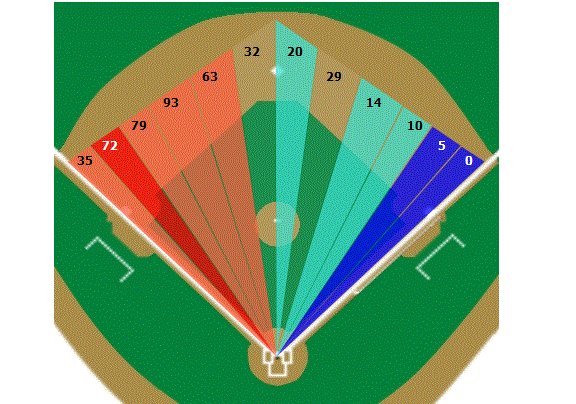
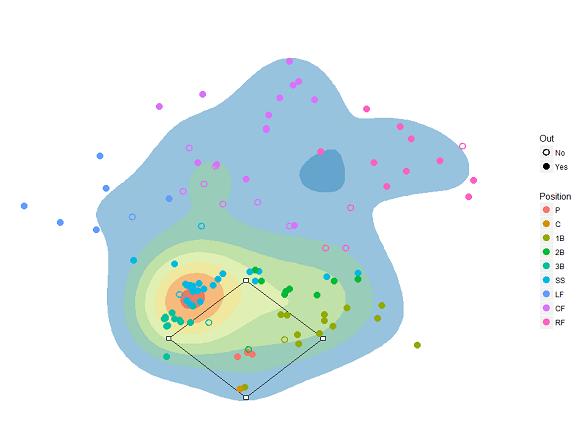
    Below is a chart of Manaea’s balls in play this season. Worth noting is that the densest congregation is on the left side of the infield. This is not abnormal when compared with other pitchers, but it has been something that Manaea has leveraged this season.
    Sean Manaea grounders
    With Manaea on the mound this season, Oakland has converted 25-of-30 (83.3%) of ground balls on the left side of the infield into outs, which is about four plays above average.

    Matt Chapman, Sports Info Solutions’ Defensive Player of the Month, happens to play on the left side of this infield. On ground balls and bunts hit off Manaea to the sixth of the infield for which the third baseman is responsible, the A’s have turned all eight ground balls into outs.

    Chapman’s diving snag of a Shin-Soo Choo ground ball on April 4 rates as one of the better plays made behind Manaea this season, along with a semi-sliding catch by Chad Pinder and Manaea’s own race to the bag to get Corey Seager out on a grounder to first. There was also the play by Jed Lowrie on Yasiel Puig, who was nailed trying to turn a single into a double on a ground ball that initially went off Lowrie’s glove.

    This defensive showing has contributed to Manaea’s league-low BABIP mark of .148. Manaea hasn’t just been getting by on the defense behind him, though.

    He also boasts a 98% strand rate, also an MLB-high. How has he accomplished that? With the bases empty, Manaea’s strikeout rate is 19%. With runners on base: 39%.

    Some of these numbers are sure to regress, but with the A’s playing high-caliber defense behind him, this has a chance to to be the best season of Manaea’s young career.
    2018 Oakland Athletics Photo Day

  • With Byron Buxton out again, let’s find his most statistically similar player

    BY ALEX VIGDERMAN
    While on a rehab assignment for another injury this past weekend, Byron Buxton fouled a ball off his toe and suffered a hairline fracture, sidelining him again in what is quickly shaping up to be a lost season.

    We all love keeping track of the trials and tribulations of Buxton as a tantalizing former uber-prospect, but with him on the shelf a little longer, I still want to feel that same thwarted lust for a five-tool superstar. Fortunately, I just realized that Michael A. Taylor and Buxton are basically the same player with a few years difference in age.

    Both have been up-and-down between Triple-A and the majors over the course of their relatively short careers thanks to their plate discipline limitations. Buxton was a top overall prospect without much competition in center field, so he saw playing time earlier in his career, while Taylor has needed injuries and the departure of Jayson Werth to find more opportunities.

    Here are Buxton’s and Taylor’s stat lines since the start of last season.

    Stat Buxton Taylor
    PA 554 537
    AVG .249 .261
    OBP .308 .315
    SLG .400 .466
    BB% 7.2 7.3
    K% 29.1 31.3

    Maybe Taylor strikes out a little more but has a little more consistent pop. But on the whole these are fairly similar low-contact moderate-power hitters.

    Of course, Buxton brings elite tools to the table outside of his bat. Since the start of 2017, Buxton has been the best in the major leagues as a defensive center fielder (24 runs saved) and as a baserunner (good for a +63 Net Gain, described in the Bill James Handbook).

    Taylor doesn’t have that elite level of performance over a larger sample, but he’s doing his darnedest this year to get to Buxton’s level. Through the first month of the season, he leads the major leagues in Net Gain on the bases (+15) and is second in DRS among center fielders (6, one run behind Delino DeShields). Buxton won a Gold Glove last season. Taylor’s teammates have talked him up as being a capable candidate.

    Like Buxton, Taylor got off to a slow start this season, but he’s been healthy and had the opportunity to make up for it. He’s hitting .289/.396/.600 in his last 14 games

    We’re still in Small Sample Size Mode in 2018, so caveats abound, but it will be exciting to see if Taylor keeps this up and, even at age 27, brings a little bit of new blood to the ultra-toolsy center fielder discussion.

  • Why does Bryce Harper have -5 Defensive Runs Saved?

    Why does Bryce Harper have -5 Defensive Runs Saved?

    By MARK SIMON

    Just like with offensive statistics, defensive statistics take time for samples to build up. But there was one number from the early-season metrics that I wanted to at least look at a little more closely – Bryce Harper’s -5 Defensive Runs Saved.

    Harper had saved 28 runs defensively in his first six seasons for the Nationals, half of those coming in his rookie season, primarily as a center fielder. He’s typically been an average to good defender the last five seasons.

    As a rightfielder, his range is alright. He catches balls hit to the shallow part of the ballpark at an above-average rate, but is slightly below average on deep balls. He makes up for any deficiencies with the deterrent value of his arm, which has saved eight runs, six the previous three seasons.

    So what’s going on with Harper’s defense in 2018?

    Let’s start with a point. We’re not here to disparage Harper. It’s too early to make judgments on this stat, just as it’s too early to judge Jed Lowrie’s amazing offensive start.

    This is a look at how the number is what it is.

    Harper’s range and positioning rate below average and this is a case where a few plays in a small sample are damaging in the short term. In the opening week of the season, Harper turned the wrong way on an Adam Duvall fly ball that he missed with a jumping attempt near the wall, resulting in a double.

    He also couldn’t get to base hits by Jay Bruce and Zack Wheeler that were hit in front of him, in which it looked like he played the ball conservatively, which dinged his rating. He didn’t lose anything for missing a foul ball hit along the right field foul line (in chilly weather), but it fit with the other two plays in that it looked like a ball that Harper could have caught.

    Our video review has Harper with 1 Good Fielding Play (GFP) in 25 games, a sliding catch on a Billy Hamilton line drive. Harper’s GFPs have dropped from 28 in 2015 to 24 and 12 the last two seasons (granted, last season, he only played 110 games compared to 140-plus the other two seasons).

    That tells us he’s probably not making plays that would add to his Defensive Runs Saved total. But he’s made mistakes at rates comparable to 2015 and 2016– he has 5 Defensive Misplays & Errors (he’s nearly halfway to last season’s 11)

    Harper’s arm also has not produced any value yet. There have been 22 instances in which a baserunner had an opportunity to take an extra base (first to third, second to home, first to home) on Harper. Fourteen succeeded (64 percent … his rate was 42 percent the last three seasons).

    Among the plays that hurt his ledger – a bobble in the right field corner on a DJ LeMahieu double that allowed a Rockies runner to go first to home (Harper got a “Mishandling Ball After Safe Hit” misplay). Harper also was slow to go after a hit by Ozzie Albies on which Albies’ hustle turned it from a single to a double (Harper received a Defensive Misplay for “Giving Up On The Play”).

    So what conclusions can we draw from all of this? Each of the plays we listed isn’t highly impactful on its own, but little things add up within a short period of time.

    Based on video observation, it seems that Harper’s results are in line with the eye test. But just like every major league hitter has a 25-game blip, it’s entirely possible that this is just some small-sample struggle that will even out over time, as Harper accumulates his share of good plays. We’re not making any judgments from this small a sample.

    But just in case it continues, you’ll have a better understanding as to what’s behind it.

  • Who are the best outfielders at avoiding mistakes?

    Who are the best outfielders at avoiding mistakes?

    By MARK SIMON
    On Monday, we looked at which infielders were the best at avoiding mistakes. Today, we’ll look at which outfielders rank the best at doing the same.

    To recap, Sports Info Solutions does video review of every pitch of every game and tracks both Good Fielding Plays in 30 classifications and Defensive Misplays & Errors in about 60 categories. Mistakes come in many forms, ranging from slipping and falling to dropping a ball, or misreading a ball bounce off the wall.

    Our look back covers since the start of the 2015 season through games played on April 23.

    Left Field: Two of your better left fielders head the list in Alex Gordon of the Royals and Christian Yelich of the Brewers, Gordon averages 1.1 misplays and errors per 100 innings, ahead of Yelich at about 1.4. Gordon also has the highest ratio of Good Fielding Plays to Defensive Misplays & Errors in that span (1.9).

    Center Field: A.J. Pollock of the Diamondbacks doesn’t often get brought up as an elite player at the position, but he does come out as the leader in this metric, a hair ahead of Mike Trout (both 1.3). This goes with Pollock’s defensive ratings in center field. He’s finished in the top 10 in Defensive Runs Saved at the position all five times that he’s played more than a handful of games in a season.

    Trout’s defense is a topic of much debate. There are those who question just how good his range or arm is. But he doesn’t get critiqued often for making mistakes, and rightfully so.

    Right Field: Curtis Granderson of the Blue Jays is known as one of baseball’s good guys. He’s also a good guy when it comes to this stat. His 1.1 Misplays & Errors per 100 innings are the fewest at the position. Granderson has fared well in terms of Defensive Runs Saved in the past, largely because of his ability to chase down fly balls hit to the deepest part of the ballpark.

    J.D. Martinez of the Red Sox ranks second. Often criticized for his defense, Martinez has made only 1.5 misplays per 100 innings in this stretch. However, he’s made so few Good Fielding Plays, that his ratio of good to bad is among the worst in the majors.

    For those wondering where Jayson Heyward is, he’s just behind Martinez and Seth Smith. Heyward has long been the standard-setter at the position and continues to be here.

  • Limiting damage, improved walk rate keying Phillies’ success

    By ALEX VIGDERMAN

    At least through the first third of the year, 2018 is shaping up to be the Year of Philadelphia. The Eagles finally won the Super Bowl, the Villanova Wildcats (admittedly merely a Philly suburb) won their second National Championship in three years, and the 76ers seem to finally be rewarding their fans’ Trust in the Process. The Flyers don’t fit with this narrative so we will not mention them.

    The Phillies made a few moves in the offseason and made an exciting managerial hire that signaled they were ready to take a leap after winning between 63 and 73 games each of the previous five seasons. And they proceeded to fall right on their spreadsheet-loving faces the first week of the year, starting 1-4 and making numerous pitcher-management and defensive-positioning blunders along the way.

    Well, since then the team has gone 13-3 and now sits just a half game out of the division lead. In fact, since April 5 they’ve scored the most runs in the National League and allowed the fewest.

    So they must be mashing, right? Well, sort of. They’re middle of the pack in both batting average and slugging percentage, but where the team is really making its bones is with plate discipline.

    They are walking an MLB-high 12 percent of the time so far this year, a four percentage-point jump from 2017 (when they ranked 22nd).

    You can thank a full complement of Rhys Hoskins and the addition of Carlos Santana for that. Phillies first basemen walked 56 times last season. Santana has topped that by at least 30 in each of the last seven seasons. The Phillies totaled 160 walks from their outfielders last season. They’re already at 40.

    If they were to maintain their walk percentage pace, it would be the largest year-to-year jump in walk rate since the 1940’s by nearly a full percentage point.

    Of course, the pitching is where the team has really performed excellently, even with much of the same cast of characters. Their starter ERA of 3.01 ranks fourth in the majors and tops in the NL, and after the whole kerfuffle about pulling Aaron Nola too early in the season opener, they rank in the top ten so far in the percentage of innings coming from starters.

    It seems possible they’ll be able to keep up this performance, as well, as the pitching staff as a whole has the lowest Hard Hit Rate in the major leagues at 17 percent.

    MLB Hard Hit Rate Allowed Leaders, 2018

    Rank Team Hard Hit %
    1 Phillies 17%
    2 Astros 18%
    3 Nationals 20%
    4 Mets 21%
    5 Cubs 21%

    That pitching success is coming in spite of a lackluster defensive showing, both from the fielders themselves and from the more aggressive defensive positioning adjustments the new coaching staff has implemented.

    The Phillies are last in the majors with -14 Defensive Runs Saved, including -4 Shift Runs Saved, which also ranks last in MLB. The team as a whole is new to shifting, of course, as they are projected to more than double their shift usage from any previous season.

    Some improvement is likely to come in that department as the fielders get more comfortable with the new approach to positioning, but this was a team whose defense cost itself 50 runs last season, so let’s not get carried away with those expectations.

    Heading into the last week of April this is one of the more surprisingly good starts of any team in baseball, and a vastly-improved approach at the plate and underperforming defense thus far suggest that they might be able to keep this up a bit longer.

    Follow us on Twitter at @Sportsinfo_SIS

  • Who are the best infielders at avoiding mistakes?

    By MARK SIMON
    A couple of weeks ago, we ran an article in The Athletic explaining our detailed scoring system for tracking Defensive Misplays and Errors. The piece focused mostly on those who were frequent mistake-makers, so we thought that we would share a look at the game’s best at avoiding defensive mistakes. We’ll do one post covering the infield and another looking at outfielders.

    For our purposes, we’ll look at extended runs of play – the referenced leaders will all be within the last four seasons entering play on April 23, and will have played at least 1,500 innings at that position.

    The leaderboard is based on video tracking that assesses Good Fielding Plays for 30 types of defensive excellence and Defensive Misplays & Errors for about 60 types of mistakes.

    First Base: The most mistake-free players here are Paul Goldschmidt of the Diamondbacks and Joe Mauer of the Twins, each of whom averages just over one Misplay & Error per 100 innings. With Goldschmidt, that’s not surprising given that he’s won three Gold Glove Awards and three Fielding Bible Awards. Mauer hasn’t won one at first base yet. But he has by far the best Good Fielding Play to Misplay & Error ratio of any first baseman.

    Second Base: Robinson Canó of the Mariners and Joe Panik of the Giants rank 1-2, each averaging just under 2 Misplays & Errors per 100 innings. Though neither ranks close to the leaders in Defensive Runs Saved at the position in that time, each plays a highly fundamentally sound brand of defense that limits miscues.

    Shortstop: The leader here is unsigned former Orioles shortstop J.J. Hardy, who was one of the game’s top infield defenders from 2012 to 2016. He averaged just under 2 Misplays & Errors per 100 innings, a hair ahead of Tigers shortstop José Iglesias. Though Andrelton Simmons dominates the shortstop position from a defensive perspective. Iglesias is better in this regard, averaging 2 Misplays & Errors per 100 Innings to Simmons’ 2.4 (which ranks fifth at the position).

    Third Base: Nationals third baseman Anthony Rendon is one of those players who is very good in many areas and avoiding mistakes is one of them. Rendon is the only player averaging fewer than 2 Misplays & Errors per 100 innings at third base. Injured Dodgers third baseman Justin Turner ranks second (2.2 Misplays & Errors per 100 innings).

    For those wondering, Nolan Arenado ranks 12th, as his style of play lends itself to an abundance of Good Fielding Plays (his 213 are 73 better than the player who ranks second) and Misplays & Errors (116 – only Todd Frazier has more with 119)

     We will look at outfielders in a future post

  • Breaking Down Mike Zunino’s Swing Changes

    Breaking Down Mike Zunino’s Swing Changes

    If you haven’t noticed, Mike Zunino has been smashing baseballs lately. Since his call-up from Triple-A (May 22) where he underwent mechanical changes, he’s hit .311/.364/.667 with nine home runs and five doubles. He’s driving the ball to center field and making an honest effort to use all parts of the field. And the mechanical changes he made are proof of this new found approach. So what’s changed?

    The Set-Up
    In April, Zunino’s set-up featured an open stance, with the bat comfortably rested on his shoulder, and his feet spread about shoulder width. Since being recalled, Zunino has brought his feet closer together and is starting his left foot in a slightly-more closed stance. He also has raised his hands a bit above his head, similar to Nelson Cruz.


    The Stride
    As you grow up playing baseball, you’re generally taught to stride towards the pitcher. In April, Zunino’s front foot would have a tendency to land in what’s commonly known as “the bucket”, meaning he was striding away from the plate. His initial stride looked to be headed towards the pitcher, but right as his front leg started to come down, his foot swung his hips open and his front foot landed towards third base. That type of stride typically makes it more difficult for batters to cover the outer half of the plate, and Zunino’s hot-and-cold zones from April demonstrate that he faced similar problems:

    Zunino SLG Before Demotion

    For that period, Zunino slugged just .130 in the three outside zones combined. Compare that to Zunino’s heat map over the last month since he was recalled:

    Zunino SLG After Demotion

    Zunino’s mechanical changes now have his front foot landing parallel to the pitcher, and the evidence supports that he’s now able to do damage on the outer half.

    You’ll also notice that he’s no longer striding to a pointed toe, instead choosing to land more on the balls of his feet. The result is that once he decides to swing, his trigger (front-foot) can fire faster, creating more time for him to process the pitch. Basically, there’s less wasted movement which results in a more explosive and compact swing.

    Zunino’s always been touted as being incredibly strong, and this newfound approach and mechanical adjustments give him more opportunities to take advantage of his natural power.

    April swing

    June swing