Category: MLB

  • Matthew Boyd turns back the clock

    BY COREY FISHMAN
    In 2015, Matthew Boyd was acquired by the Detroit Tigers in a trade that ultimately sent David Price to the Toronto Blue Jays. That same season Boyd won the MiLB.com Fans’ Choice Award for best starting pitcher in the minor leagues and he was also selected to be a Double-A All Star by Baseball America.

    Although Boyd excelled at the minor league level, he has not performed as well in the majors.

    Until now.

    From 2015 to 2017 Boyd had a 5.47 ERA while allowing a .284 batting average and .836 OPS. This year he has been able to improve these statistics drastically as he has a 3.23 ERA, .205 batting average allowed, and .613 OPS allowed.

    The most surprising thing here is that after digging into Boyd, it seems that he has decided to turn back the clock and pitch relatively similar to the way he did in 2015.

    When Boyd broke into the league in 2015 his best pitch by far was his slider, but as you’ll see in the graphic below, it became much more hittable after that.

    Batting Avg Against Boyd’s Slider
    Slug Pct
     2015  .158  .237
     2016  .208  .340
     2017  .375  .569

    The one major change Boyd made was increasing the velocity on his slider over time. From 2015 to 2017 it sped up from 80 to 86 MPH. The one constant we notice here is that the faster he threw this pitch, the worse his numbers got.

    By isolating just the 2018 season, we are able to see the drastic improvement in this pitch. He has decreased the MPH on his slider to 81 MPH, experienced a career high in miss rate at 32 percent, and he holds down a terrific .155 batting average and .194 slugging percentage. So why does slowing down this pitch improve his overall game so much? The answer can be defined in one word; placement. With help from heat maps available on Boyd’s player page at Fangraphs.com, we can show you the difference in where he locates the slider, specifically to right-handed hitters.

    What we are able to identify in the images above is that by taking off velocity from his slider, Boyd is able to paint the outside corners with tremendous success, reducing the number of hard-hit balls against it.

    So what we have here is a pitcher who has turned back the clock to redevelop the pitch that was giving him so much success in the minors. What has truly elevated Boyd to the next level is his willingness to deviate from being heavily reliant on his fastball to allowing his slider to take control of his game.

    As we established earlier, in 2015 Boyd’s slider was almost a mirror image of how it is today. The issue seems to be that he only threw it 17 percent of the time. This season he has upped the percentage to 34 percent.  This puts him right behind Diamondbacks pitcher Patrick Corbin (37 percent), who has been dominant at times when throwing sliders with high frequency.

    If Boyd is able to stick to this plan and rely heavily on his dominant slider, it is tough to see a future that doesn’t hold success for him at this level. Over the last four seasons, Boyd’s FIP- (a stat found on Fangraphs that accounts for ballpark factors) has dropped all the way down from 161 to 94.

    Overall, while many people may have lost hope in Boyd over the years, there is plenty of data to suggest that he has what it takes to be a quality starter at the highest level.

  • Why does Brett Gardner lead outfielders in Defensive Runs Saved?

    Why does Brett Gardner lead outfielders in Defensive Runs Saved?

    By MARK SIMON
    Age is no hindrance to 34-year-old New York Yankees outfielder Brett Gardner. He currently leads all outfielders with 14 Defensive Runs Saved this season, if you combine his work in center field and left field.

    This is nothing new for Gardner, who saved 20 runs defensively in 2017, his third season with at least 20, but his first since he had 23 in 2011.

    Here are the outfield leaders in Defensive Runs Saved this season.

     Brett Gardner  Yankees  14
     Adam Duvall  Reds  12
     Lorenzo Cain  Brewers  12
     Harrison Bader  Cardinals  11
     Lewis Brinson  Marlins  10

    He’s stayed healthy in a season in which some of the best in the game (Byron Buxton, Kevin Kiermaier, Mookie Betts) have not. And Gardner’s the best, even though most of the game’s top outfielders (Betts, Buxton, Jason Heyward) are five to 10 years younger than he is.

    So how does Gardner keep up?

    Gardner’s defensive numbers are driven by a few things.

    His Range
    Because of how they are positioned, it is hard for an outfielder to excel on both shallow fly balls and deep fly balls. But Gardner has no such trouble.

    Gardner rates 11 plays above average on balls hit to the shallowest parts of the outfield and 14 plays above average on balls hit to the deepest parts of the outfield over the last two seasons.

    In other words, take all the balls hit within catching distance of Gardner in that time. He caught that many more balls than an average player would have.

    Buxton is the only other outfielder to be at least plus-9 in both in that time.

    His Arm
    Over the last two seasons, Gardner has seven Defensive Runs Saved with his arm, including two this season. This year’s came from a combination of three outfield assists that didn’t require the help of a cutoff man, and that 32 percent of baserunners took an extra base on him when he was playing left field and 39 percent (5-of-13) did so when he was in center field (both are slightly better than the major league averages).

    Minimal fanciness
    If you’re having trouble thinking of a great play by Gardner this season, you’re not alone. He has four “Good Fielding Plays” this season, but they’re for his outfield assists and an instance of cutting a ball off to hold a batter to a single.

    Gardner has done what he’s done this season while staying on his feet. He’s rarely slid or dove, and has limited his leaping attempts as well. But in left field, he’s fared well relative to other left fielders when he sprints (we track the fielder’s approach to the ball), recording outs on 40 percent of his sprinting approaches (14-of-35).

    Only Jon Jay, at 41 percent, is better at the position among the 30 players with the most opportunities (82 plays). This was not a Gardner strength last season, but so far it has been one for him in 2018.

    Great defense is not always about diving, sliding or leaping. In this case, it’s just about getting in position to make plays and doing your job. Gardner isn’t the fanciest defender out there. But he’s among the best in the game.

  • Stat of the Week: Who’s moving up and down the Starting Pitcher rankings?

    By Mark Simon

    From May 2013 through the end of the 2016 season, Clayton Kershaw almost always reigned supreme in The Bill James World’s Best Starting Pitcher Rankings, a measure based on the Game Score metric and a pitcher’s sustained excellence over a lengthy body of work.

    But Kershaw’s recent injury history has caused him to drop in the rankings to No. 5 now, with the possibility that he slips even further if he remains on the sidelines.

    The race for the No. 1 spot has become a tight battle between former teammates Max Scherzer and Justin Verlander, who currently occupy the top two positions. Scherzer has been outstanding the last six seasons, but he may never have been better than in the first 13 starts of 2018, in which he’s averaged 13.7 strikeouts per 9 and allowed six home runs in 87 2/3 innings pitched.

    Verlander has a 1.24 ERA in 87 1/3 innings pitched this season, following up on a five-start run with the Astros in which he posted a 1.06 ERA en route to winning the World Series last season.

    Verlander and Scherzer have been so good that they’ve dropped Indians ace Corey Kluber, who ended the 2017 season ranked No. 1, to No. 3 in the rankings, even though Kluber has a 1.96 ERA and is averaging seven innings per start this season.

    On the Rise

    Among those who have moved up the rankings is Gerrit Cole of the Astros, who climbed into the top 10 after a strong start to the season. He started 2018 ranked No. 38. The Astros have two pitchers (Verlander and Cole) in the top 10, as do the Nationals (Scherzer and Strasburg).

    James Paxton of the Mariners was No. 45 at the start of May, then had a 16-strikeout game and no-hitter in back-to-back starts. That, along with his continued strong performance, has vaulted him to No. 23.

    Aaron Nola of the Phillies allowed a combined three hits in 13 2/3 innings pitched in two outings at the end of May, is now No. 25 after ranking No. 62 prior to Opening Day.

    On the decline

    As some climb the ladder, others slip. The No. 8, 9 and 10 pitchers entering the season fell out of the top 10, though Carlos Carrasco (preseason No. 8) hangs in at No. 11 and Jake Arrieta dropped from No. 9 to No. 14. Madison Bumgarner was No. 10 entering the season, but now ranks No. 58 after an injury sidelined him the first two months.

    Among those to drop the most based on performance was Giants pitcher Jeff Samardzija, who averaged a 40 Game Score in seven starts (a 50 Game Score is average) after a successful season debut. He’s fallen from No. 25 entering the season to No. 52.

    Red Sox pitcher Drew Pomeranz has plunged 25 spots from No. 35 to No. 60 (he has an 8.82 ERA in his last four starts). And formerly dominant Blue Jays starter Marcus Stroman is now on the disabled list with a shoulder injury after recording a 7.71 ERA in seven starts. He fell from No. 30 at season’s start to his current No. 65.

    World’s No. 1 Starting Pitcher Rankings

    1. Max Scherzer
    2. Justin Verlander
    3. Corey Kluber
    4. Chris Sale
    5. Clayton Kershaw
    6. Stephen Strasburg
    7. Jacob deGrom
    8. Zack Greinke
    9. Luis Severino
    10. Gerrit Cole

    The most updated rankings and an explanation of the methodology can be found at Bill James Online.

  • Bryce Harper’s batting average vexed by infield shifts.

    Bryce Harper’s batting average vexed by infield shifts.

    BY MARK SIMON
    Bryce Harper is having a very Bryce Harper-like season in a couple of regards. He has an NL-leading 18 home runs and 47 walks, to go with 40 RBI.

    So why is he hitting only .232?

    Some of that has to do with his performance against defensive shifts.

    Harper is seeing more shifts this season – both full shifts, meaning three defenders on the right side of the infield, and partial shifts, which entails two defenders significantly deviating from their normal positioning. And though he was able to beat shifts with regularity (and then some) last season, that isn’t happening in 2018.

    Bryce Harper BA on  Grounders/Liners vs Shifts
    2017 2018
    vs Full Shifts  .296
    (8/27)
    .118
    (4/34)
     vs Partial Shifts  .400
    (20/50)
     .308
    (8/26)

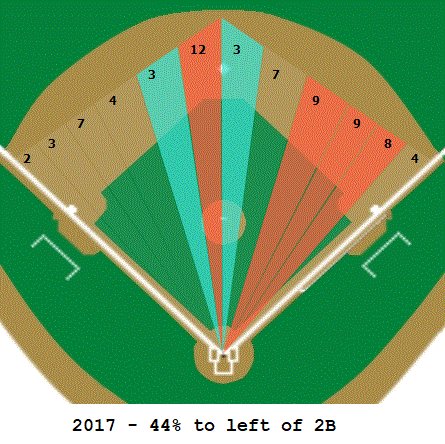
    What looks to be happening is that Harper is not hitting much to the opposite field against shifts. Here are his ground ball/short liner spray charts from last season and this season.


    In fairness to Harper, there have been some pretty good plays against his ground balls to take away hits (Jose Pirela took away two in one game in San Diego). That said, those plays were even slightly possible because an opponent was shifting. If Harper went opposite field a few more times (not necessarily an easy ask), he’d probably net a few more hits. It wouldn’t completely solve his batting average struggles, but it would make a notable difference.

    Harper’s not the only one to struggle against defensive shifts.

    Athletics outfielder, Matt Joyce is the most extreme example of a shift struggler. He is 2-for-35 when hitting a grounder or short liner against a full shift, 2-for-42 on those balls against shifts overall (and as an aside, 1-for-42 when hitting a ground ball all season). Other notables can be found in the chart below.

    Notable BA When Hitting Grounder/Liner vs Shift
    AB
     Christian Yelich  .095  21
     Matt Carpenter  .108  37
     Carlos Santana (as LHB)  .156  45
     Chris Davis  .161  56
  • Jeremy Hellickson’s start keyed by curveball

    Jeremy Hellickson’s start keyed by curveball

    BY SPENCER HARRISON
    Before Jeremy Hellickson made his 2010 debut with the Tampa Bay Rays, he was considered one of MLB’s most promising pitching prospects. Through his first two full seasons he looked every bit the part, stringing together consecutive seasons of 2.95 ERA and 3.10 ERA pitching in 2011 and 2012, albeit with some concerning peripheral stats.

    Then, in 2013, those peripherals caught up to him as his ERA ballooned to 5.17. Things have been mostly bumpy since then, with the exception of the 2016 season in which he pitched his way to a 3.71 ERA and a qualifying offer from the Phillies.

    Still, coming off a season in which he posted his worst K:BB ratio since 2011 and career worsts in ERA and home run rate, there was little reason to believe he would turn out to be more than a depth signing when the Nationals added him on a minor league deal in March.

    We’re now two months into the MLB season and Hellickson has flourished as the Nationals’ fifth starter. Through 43 innings, he has a 2.30 ERA, 5.7 K:BB ratio, and 0.93 WHIP. All of those marks would be career bests if sustained through the rest of the season. He has benefitted from some luck, but his 3.30 FIP indicates his early success is quite legitimate.

    So how has Hellickson bounced back from arguably the worst season of his career?

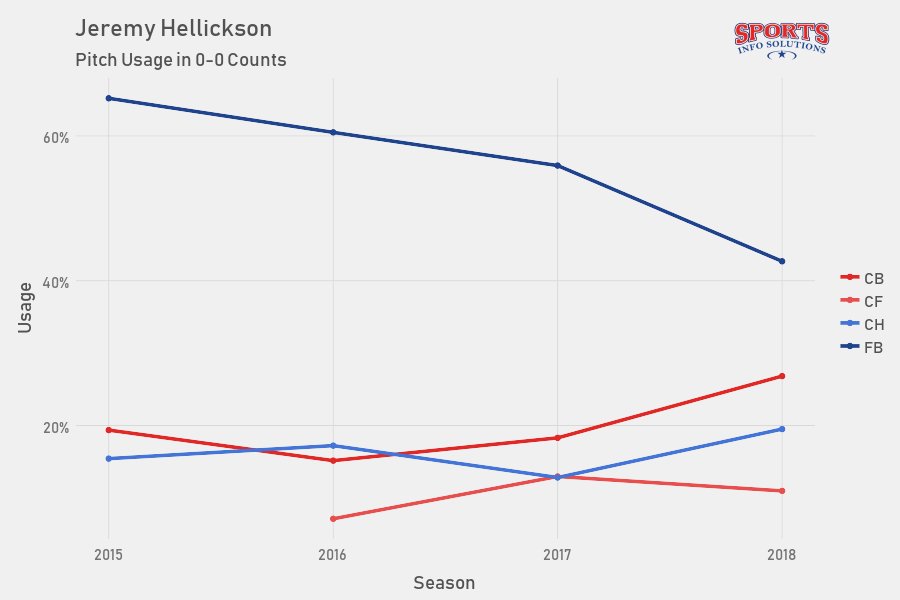
    His pitch usage this season offers some indication. His fastball usage has dipped from 46 percent in 2017 to 36 percent in 2018. Meanwhile his curveball usage has spiked to 27 percent, up from 13 percent in 2017. Compound that with a whiff rate on the pitch that is more in line with his career average (28 percent) then his 2017 season (15 percent) and things make a bit more sense.

    Yet Hellickson is pitching much better than his career average. What has really driven Hellickson’s success this season is first-pitch strikes.

    Among pitchers with at least 30 innings pitched, Hellickson’s 70 percent first-pitch strike rate ranks fourth in MLB. This is another area where increased curveball usage has been of importance for Hellickson.

    Hellickson has upped his first pitch curveball usage from 18 percent last season to 27 percent this season while his fastball usage is down to 43 percent from 56 percent in 2017. That change in strategy has paid dividends for Hellickson, who is converting 75 percent of his first-pitch curveballs into strikes (tied for second among MLB starters) and has a called strike rate of 67 percent (T-3rd in MLB) on the pitch.

    It makes sense that starting an at-bat with a strike is huge for a pitcher, but the numbers back this up. The MLB average wOBA allowed after a 1-0 count is .359. If the count starts 0-1 it drops to .268. That split holds true for Hellickson as well, who boasts a .249 wOBA against when starting an at-bat with a strike.

    One final point of emphasis for the Nationals with Hellickson pitching seems to be getting him out of the game before he faces the opposing lineup for a third time. He has gone over the 90 pitch mark just twice this season, and has had three starts end with fewer than 75 pitches.

    It makes sense given his splits this season. Opponents are 9-for-17 with five extra-base hits the third time through the order. While pitching the first two times through the order he holds opponents to a .228 wOBA (and only eight extra-base hits).

  • Kole Calhoun can’t beat the shift, but his glove is doing many good things

    Kole Calhoun can’t beat the shift, but his glove is doing many good things

    BY LINDSAY ZECK
    Angels right fielder Kole Calhoun has had one of the most unusual seasons of any player in 2018. His offensive performance has been well below his usual standards, but his defense is keeping him afloat.

    The hitting
    Of all the qualified batters in the game, Calhoun ranks last in batting average (.151) and last in OPS (.389).

    His main downfall has been his inability to beat the shift. He has been shifted at least partially on all but two of his groundball and short line drives this season.

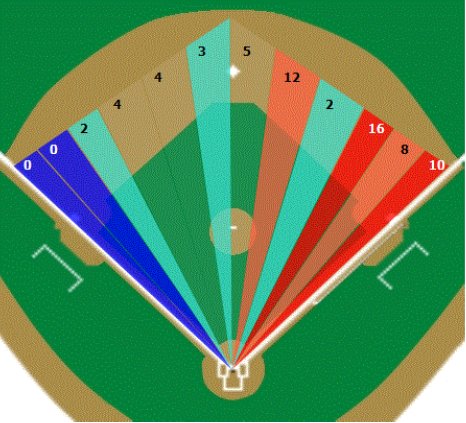
    As seen in the chart below, Calhoun has hit 80 percent of his grounders and short line drives to the right of second base — right into the gloves of his shifted opponents.

    Locations of Calhoun’s Groundballs and Line Drives, 2018

    See the first slice to the right of second base. Take that one and all of the ones to the right of it. Calhoun is a combined 4-for-53 on those balls this season. He’s not even close to the MLB average just on ground balls hit to the right of second base (.222).

    Calhoun is tied with Tigers DH Victor Martinez for the most net hits lost due to the shift this season with 11. Had these 11 hits got through the infield, his .151 batting average would increase to a more respectable .221.

    The defense
    Calhoun’s case to remain in the starting lineup, despite his slow start at the plate, lies with his great play so far in right field. He has already saved the Angels seven runs this season in 398 innings.

    This is more than he has ever saved his team and he still has just over two-thirds of the season left to play.

    His eight Good Fielding Plays in right field are tied for third-most in the league at the position, behind only Carlos Gomez and Stephen Piscotty. He also has yet to commit an error and has only three Defensive Misplays.

    Perhaps Calhoun’s biggest strength this season has been his arm:

    • He has four Outfield Arm Runs Saved—tied for second most in the league behind Aaron Judge (5).

    • Four of his eight Good Fielding Plays are due to his ability to throw out baserunners. One of which was this double play last week where Calhoun threw out Curtis Granderson at home plate.

    • He is tied with Lorenzo Cain, Aaron Judge, and Josh Reddick for the most Outfield Kills—an outfield assist without the use of a relay man — with five.

    • Baserunners are taking less chances with Calhoun this season. They have attempted to take an extra base on only 13 of 33 opportunities (39 percent) — in line with Calhoun’s career best in that department.

    Calhoun hasn’t been a stranger to the highlight reel either with plays like this catch against Marcus Semien in March or this one that robbed Gleyber Torres of an extra-base hit back in April.

    In order for Calhoun to be given the chance to keep succeeding in the field, however, he needs to perform better at the plate and figure out how to beat the shift—a .151 batting average may not cut it much longer.

  • A closer look at the Mets catching situation

    BY SEAN ZERILLO
    In 16 games with the New York Mets since being traded for Matt Harvey, Devin Mesoraco has provided a big power boost for his new club – hitting five homers with a .913 OPS over 50 at bats. He has channeled his 2014 All-Star form when he hit 25 doubles and 25 homers with a .893 OPS in 384 at bats with the Reds.

    The team will enter into a timeshare at catcher between Mesoraco and Kevin Plawecki, as the latter is back with the Mets after breaking his hand on April 11 and Travis D’arnaud is set to miss the rest of the season with a torn UCL.

    Comparing the defense
    Since his debut in 2015, Plawecki has 16 Defensive Runs Saved over 1,244 innings. He has saved his team 1.29 runs for every 100 innings played at catcher.

    Since his 2014 All-Star campaign, Mesoraco is -15 in Defensive Runs Saved over 1,604 innings. He has cost his team .935 runs for every 100 innings played at catcher.

    Much of the positive data for Plawecki is due to an outstanding rookie year behind the plate in 2015 and if he can return to that form, he’s probably the better option behind the plate. He had 10 Strike Zone Runs Saved and 5 Adjusted Earned Runs Saved (a stat that attempts to convey staff-handling — think of it as a better form of catcher ERA) over just 70 games and 602 innings, nabbing 87 more strike calls than expected, or about one in every 6.9 innings.

    Shared struggles
    That efficiency, however, has dropped off steadily since then to 2 Strike Zone Runs Saved in 2016 and -4 in 2017. Plawecki has cost the Mets 36 strikes in his last 37 games, instead of stealing more than one per game as he did in 2015. He does remain at 6 Adjusted Earned Runs Saved for his career.

    Mesoraco has never been particularly adept at maximizing called strikes. In that 2014 All-Star campaign, his only season with over 100 games played, Mesoraco finished with -7 Strike Zone Runs Saved. He has cost his team 8 Strike Zone Runs Saved in the 76 games he has played since 2016. He has cost his pitchers 23 strikes in the 24 games he has played in 2018. He’s also totaled -4 Adjusted Earned Runs Saved for his career.

    Pitch-blocking: Advantage Plawecki
    Mesoraco is also a liability at blocking potential wild pitches. Since the start of the 2016 season, he has blocked just 90 percent of potential wild pitches, a rate closer to Gary Sanchez (89 percent) than it is to Plawecki (93 percent) or 2017 Fielding Bible Award Winner Martin Maldonado (also 93 percent).

    Defensing bunts: Advantage Mesoraco
    The one area where Mesoraco has excelled defensively is in bunt defense. He has saved five runs defensively on bunt attempts for his career. Plawecki has not recorded a positive or negative value on bunt attempts, and remains at 0 Runs Saved for his career.

    SB an area of interest to Mets
    In recent seasons the Mets have consistently been one of the weakest teams at defending stolen base attempts, but Plawecki’s value on those steal attempts has been neutral (0 Stolen Base Runs saved for his career).

    Mesoraco has been below average at defending steals for his entire career, with a cumulative -11 Stolen Base Runs Saved. He is at -2 since 2016, and has thrown out only one runner in 19 attempts this season. Granted, pitchers are usually more responsible for stolen bases allowed than catchers, but Mesoraco’s long-term numbers indicate struggles in that area.

    Mesoraco hitting better than expected
    By our Defensive Independent Batting Stats (DIBS), Mesoraco’s Expected OPS this season is .704, far below his actual OPS of .787. This expected production is consistent with both his actual OPS (.711) and Expected OPS (.745) from 2017. They both are short of Plawecki’s actual (.764) and Expected OPS (.848) numbers from 2017 — the best offensive numbers of Plawecki’s career. So Mesoraco has been better in the short term, but the long term remains an unknown for both.

    But with Mesoraco’s strong offensive start, Plawecki may need to return to his 2015 defensive form to play his way back into a regular role.

  • Which infielders are best at making the toss-up plays?

    BY HARRIS YUDIN

    Since the start of the 2017 season, 325 infielders have been the primary fielder on a ball in play with a Sports Info Solutions Defensive Difficulty rating of 3 (1-5 scale). In this piece, we will identify the best and worst at each infield position at converting such plays.

    A play with a 3 difficulty is nearly a 50/50 play— one that can go either way (the actual conversion rate is around 55 percent). Seldom is a Defensive Misplay assigned to a toss-up play, and Good Fielding Plays are more commonly associated with a difficulty rating of 4.

    While it is challenging to near impossible to eliminate all human error, the video scouts at Sports Info Solutions aim to inject as much objectivity into the process as possible. For example, Nolan Arenado is going to make a difficult play look more makable than will Jake Lamb. The goal is to assign the proper difficulty rating by envisioning a league-average defender attempting to make each play.

    In order to qualify here, a player must have at least 200 plays as the primary fielder since the start of last season. All data runs from Opening Day 2017 through May 25.

    First Base
    Joe Mauer, Minnesota Twins
    Mauer’s success rate on these plays is a whopping 84 percent, helped by his being more successful on diving attempts than any other current first baseman, turning 23 of his 57 opportunities into outs (40 percent).

    Mauer excels moving to both the left and right, often taking away potential extra base hits down the line. While he may not be particularly flashy, the 35-year-old Mauer is making enough plays for the Twins to put off moving him to DH full-time.

    Josh Bell, Pittsburgh Pirates
    On the other end of the spectrum, Bell is currently bringing up the rear as one of two first baseman with a conversion rate below 40 percent (37 percent … just worse than Justin Bour’s 39 percent)—which is unfortunate considering, of the group, he has had the second-most such balls hit in his direction (38).

    Bell is extremely vulnerable to balls hit down the first base line, with just a 31 percent success rate on plays to the right. The Pirates’ cleanup hitter owns the worst Good Fielding Play–Defensive Misplay ratio at the position, so it makes sense that he fails to convert some of the tougher plays.

    Second Base
    Javier Báez, Chicago Cubs
    Baez, the 2017 multi-position Fielding Bible Award winner, has had his most success at second base, where he’s converted 19 of the 24 plays that were considered toss-ups (79 percent).

    He’s the best at the position going back on ground balls, with a 56 percent success rate on plays that require him to break away from the plate. Baez has also fared better when sprinting than any other qualified second baseman, and perhaps most impressively, he has turned a solid 82 percent of forehanded plays into outs (which ranks among the highest for any second baseman). Baez is much more than just a quick tagger; he has great range and picks up almost any ball hit in his vicinity.

    Daniel Murphy, Washington Nationals
    The eye test tells you that Murphy is well below average defensively. The metrics (-15 Defensive Runs Saved in 2017) agree. And our Defensive Difficulty data? More of the same. The 33-year-old owns a success rate of 41 percent on these plays , the lowest among second basemen.

    He has trouble with balls hit up the middle (26 percent moving to the left) and has recorded an out on just one of his 22 diving plays (5 percent). Murphy has yet to play this season, but his body of work from last year is large enough—and concerning enough—to earn him a spot on this list.

    Third Base
    Justin Turner, Los Angeles Dodgers
    While Nolan Arenado blows every other infielder out of the water when it comes to Good Fielding Plays, he has had many more opportunities than all other third basemen. Arenado leads the way in 4-difficulty success rate, but sits fifth in the 3-difficulty category, behind Turner, (71 percent) Eugenio Suárez (71 percent), Adrián Beltré (70 percent) and Kyle Seager (70 percent).

    Turner makes a living on weakly-hit balls—his 62 percent success charging in, 54 percent on sprinting plays, and 73 percent throwing on the move are all among the leaders at the position. Watching Turner man the hot corner is less of a spectacle than watching Arenado or Matt Chapman, but the Dodgers’ No. 3 hitter is as clean defensively as you will find.

    Todd Frazier, New York Mets
    By most advanced metrics, Frazier is one of the better defensive third basemen in baseball (fourth in Defensive Runs Saved, second in Defensive Runs Above Average last year).

    So why has he fared so poorly on these plays (43 percent)? Most of his struggles have to do with positioning—specifically his guarding the line—as he owns just a 28 percent success rate moving to the left and a 59 percent rate on backhanded plays.

    The eight-year veteran has the fourth-worst Good Fielding Play–Defensive Misplay differential among third basemen, with 10 of his 45 Defensive Misplays coming on ground balls hit down the line. Nicholas Castellanos is actually lower on the list at 40 percent success on toss-ups, but he has become a full-time outfielder this season.

    Shortstop
    Trevor Story, Colorado Rockies
    We’re going to change things up and go with the leader in ‘Grade 3’ play conversions rather than success rate, because though the differential is slim at the top, Trevor Story has a notable edge in successful conversions over Carlos Correa and Miguel Rojas.

    Story ranked fourth in Defensive Runs Saved last season. The 25-year-old can be mistake-prone, with the fourth-most Defensive Misplays at the position, but he has also accumulated the most Good Fielding Plays, more than half of which have come on ground balls hit in his direction

    Story has thrown on the move 183 times—by far the most in baseball—converting on such plays at a 75 percent clip. This skill has helped him record an out on 43 of the 63 such plays for which he was responsible.

    Marcus Semien, Oakland Athletics
    Semien isn’t just the worst shortstop at cashing in on toss-up plays—at 26 percent, he’s the worst infielder by a fair margin. He has made just 29 percent of his sprinting plays. Only Travis Shaw has converted a lower rate such plays in this stretch.

    Semien was actually 16th out of 59 shortstops in sprint speed last season, so it isn’t as if he can’t reach balls hit up the middle or in the hole. He doesn’t have the skills to cash in on these borderline opportunities. He doesn’t make a ton of mistakes, but his 11 Good Fielding Plays are the 38th most at the position.

  • How much has Kyle Schwarber improved on defense?

    BY MARK SIMON
    Kyle Schwarber had a rough re-acclimation to left field for the Chicago Cubs last year. He finished 2017 costing his team 9 runs defensively, which ranked fourth-worst among all left fielders. But in 2018, after a rough Opening Day, he’s flipped the script. His 5 Defensive Runs Saved rank fourth best at the position.

    The story behind Schwarber’s improved numbers is twofold.

    A more careful defender
    For one, he hasn’t done the things that hurt him the most. Last season, our video tracking charged Schwarber with 29 Defensive Misplays & Errors in left field (Misplays being things that had a negative consequence, such as allowing a baserunner to reach or missing the opportunity for an out). That was a rate of one every 28 innings.

    This season, Schwarber has made only 3 Misplays & Errors, a rate of one every 94 innings. If he was playing at last season’s rate, you’d expect that he’d have 10 Misplays & Errors by now.

    One of the biggest issues for Schwarber last season was in his handling of the ball – he had seven misplays for mishandling the ball after a safe hit or after a catch.

    Don’t run on this guy
    The other key change has been in his arm rating. Schwarber has four assists that didn’t require a cutoff man, tied for most among leftfielders, all of which have come this month. Among the highlights was his throwing out Nicky DelMonico at the plate, which netted a big smile as he ran back to the dugout, and the combination of a sliding stop and strong throw to nail Francisco Lindor, who was trying to stretch a single into a double.

    Throwing accuracy has thus far been good for Schwarber, who had 6 Misplays in arm-related categories (Missing the Cutoff Man and Wasted Throw After Hit or Error and Bad Throw to the Plate), but has none this season.

    Those four assists are already one more than Schwarber had all of last season. As such, only four baserunners have taken an extra base (first to third or second to home on a single, first to home on a double) against him on the 18 base hits he’s fielded.

    A 22 percent advance rate (lowest among all outfielders) with four unaided assists is worth four Defensive Runs Saved by itself. A 35 percent advance rate against Schwarber and three unaided assists were valued at -1 Defensive Runs Saved last season.

    Early returns: positive
    Though Schwarber doesn’t have a highlight reel of catches akin to some of his peers, he doesn’t need to have one to be successful. If he can take care of avoiding mistakes, his range and positioning ratings should stay steadily average.

    And so long as he doesn’t fall back into old habits, word will likely get out about his arm.

    In other words, if his defensive improvements match his offensive ones consistently, the Cubs should be in good shape in left field.

  • When Pedroia returns: Much better than Núñez, but keep an eye on the sliding

    BY NICK RABASCO
    This past offseason, the Red Sox re-signed infielder Eduardo Núñez with the knowledge that Dustin Pedroia would need a couple months to rehab his knee injury before getting back on the field.

    Nunez has been playing second base on a regular basis for Boston in 2018. Pedroia has been playing for the Pawtucket Red Sox the last few days and is nearing a return to Fenway Park.

    The differential
    The Red Sox are looking forward to having Pedroia’s defense back at second in a big way, because the difference between him and Nunez is huge.

    Sports Info Solutions has a video-tracking system for players, in which we award Good Fielding Plays in 30 categories (think: Web Gems) Defensive Misplays & Errors (mistakes such as slipping, colliding, failing to complete a double play) in 60 categories. According to that data, Pedroia has had a positive Good Fielding Play to Defensive Misplay plus Error ratio in every season since 2007. In fact, he had a 2-to-1 ratio in every season since 2007, except 2015 and 2017.

    Since 2007, Pedroia has been credited with 606 Good Fielding Plays and 228 Misplays & Errors. The ratio of his Good Plays to Misplays & Errors is the best in the majors in that time.

    In the last two seasons, Núñez has a Good Play to Misplay ratio of 2-to-23, the worst in the majors. Núñez is making mistakes more often than Pedroia and turning tough plays into outs or saving bases less often than Pedroia.

    Defensive misplays are divided into categories, and therefore we can get more granular with specific issues that Nunez has had.

    So far this season, Nunez has already been charged with two “Infielder Fails to Catch a Line Drive” misplays. These are plays in which a catchable line drive was hit his way, but he was unable to turn the play into an out despite getting a glove on the ball. For comparison, Pedroia has four such misplays in the past 10 years.

    Watch Pedroia slide
    It’s obvious that Pedroia will provide a significant upgrade over Nunez, but Pedroia is 34 years old and coming off knee surgery. So what can the Red Sox and their fans expect to see moving forward?

    After a terrific defensive 2016, Pedroia rated below average in 2017 with -2 defensive runs saved. Last year was also the first season Pedroia finished with a negative range and positioning total. That was driven by a lessened success on balls hit in the first base-second base hole.

    “You’re going to see the same guy you’ve seen play for however many years I’ve played”
    — Pedroia to reporters during hs rehab stint

    What should we be watching when Pedroia comes back? Pedroia is known as a player who goes all-out and is willing to dive or slide to increase his range whenever it’s necessary to make a play.

    From 2013 to 2016, Pedroia was successful on 76 percent of the plays in which he had to slide to field a ball. In 2017, he was successful on 4-of-11 sliding attempts, which comes out to half as often as he did in the previous four seasons.

    That could be random based on a small sample, but could also be indicative that the Red Sox have to make sure they put Pedroia in the best possible position to be effective as he gets older.