Category: MLB

  • Why not shift José Altuve?

    Why not shift José Altuve?

    By ANDREW ZENNER
    I was looking through our data to determine whether there were any hitters that may be strong “shift candidates” that are shifted against infrequently.

    One name stood out in my findings: Houston Astros second baseman Jose Altuve. Let’s look at whether other elements of our data support the lack of shifting for him.

    Looking at the proportion of grounders and short liners that Altuve has hit to the left of second base, he appears to be a strong shift candidate.

    88 percent of those balls in 2018 have been to the pull side. That number falls to 83 percent since the start of 2015, but that’s still fairly significant.

    For context, Mets outfielder Yoenis Céspedes is also at 83 percent since 2015. Yet Altuve has seen a team employ a shift against him only 9 percent of the time so far in 2018 and just 5 percent of the time since 2015. Cespedes has been shifted 36 percent of the time in that period.

    So why doesn’t Altuve see more shifts? Part of it may have to do with his success against the shift.

    Altuve has hit .325 on his grounders and short liners with no shift and .444 against the shift (24-for-54) since the start of 2015. That success is in such a small sample, though, that it’s unlikely to have scared many teams off in a meaningful way.

    The other thought has to do with where Altuve hits the ball when he hits it to the opposite field.

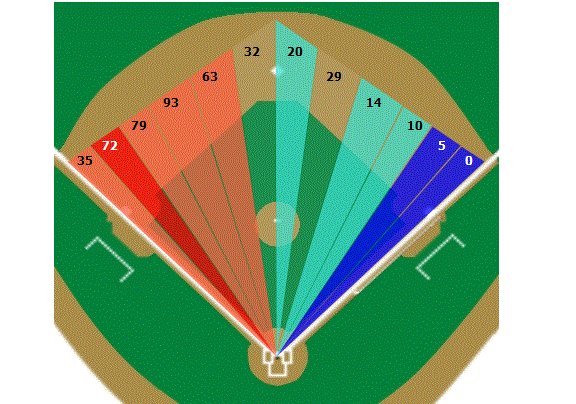
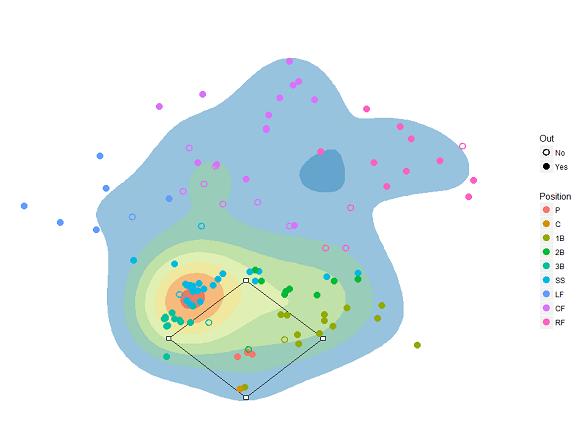
    Here is an image of Altuve’s grounders and liners by location since 2015.

    What I’d like you to notice is the second zone to the right of second base. It’s not a particularly hot zone, but it happens to be right about where a 2B would be positioned in a roughly “normal” alignment.

    Perhaps teams have taken notice of this and simply decided to keep their second baseman there rather than moving him. That seems like a perfectly viable strategy, but let’s look at the same graph for Cespedes to again provide context.

    These graphs look awfully similar. Cespedes has that same lukewarm zone to the right of second base that Altuve has. It represents 6 percent of the total for both of them.

    But teams have certainly had no problem shifting with Cespedes at the plate, especially relative to Altuve.

    Some would speculate that speed might also be a factor. Let’s look at another right-handed hitter with similar speed to Altuve. Altuve has averaged 28.4 feet per second per Statcast’s average sprint speed metric. Andrew McCutchen checks in slightly higher at 28.7 feet per second. McCutchen has hit 92 percent of his grounders and short liners to the left of second base in 2018, but he’s also been shifted much more often (40 percent of the time).

    So what are we left with? It’s pretty clear that Altuve and Cespedes have been very similar on grounders and short liners over the past three-plus seasons. I compared Altuve with McCutchen to address the speed component, but McCutchen doesn’t quite have any meaningful zone to the right of 2B like Altuve and Cespedes do.

    Perhaps it’s the combination of speed, success (in a small sample), and Altuve’s overall reputation as a well-rounded hitter that has kept teams from shifting against him. Based on the information presented here, it may be wise for teams to take a longer look at employing some shifts against Altuve.

    It seems that teams have at least taken notice a little bit so far in 2018: his shift percentage is up to 9 percent from 5 percent last year. If he continues to hit grounders and short liners to the left of second base as frequently as he has so far this year, expect that number to continue to rise.

  • Appreciating a .134-hitting catcher – for great defense

    Appreciating a .134-hitting catcher – for great defense

    By LINDSAY ZECK

    Rockies catcher Tony Wolters is hitting .134 so far this season—third worst of all catchers with at least 50 plate appearances, ahead of only Alex Avila and Roberto Pérez.

    So why haven’t the Rockies sent him down to the minors and brought up the hot-hitting Tom Murphy from Albuquerque? Murphy is currently hitting .301 with 11 home runs with the Triple-A Isotopes this season, in only 34 games.

    The answer is in the defensive value the Rockies see in a catcher who is not even hitting three quarters of his weight. Wolters’ defense has been outstanding so far this season. He is currently leading all catchers with eight runs saved—two more than anyone else at the position—and is only one behind the leader for the entire league, Brewers shortstop Orlando Arcia. This is new for the Rockies, as their catchers of the past haven’t exactly been skilled defensively.

    Here is a table showing the number of runs the Rockies’ primary catchers have cost the team going back to 2012:

    Season Primary Catcher Defensive Runs Saved Rank
    2018 Chris Iannetta -5 33
    2017 Tony Wolters/Jonathan Lucroy -1/-15 20/35
    2016 Nick Hundley -16 35
    2015 Nick Hundley -11 32
    2014 Wilin Rosario -14 31
    2013 Wilin Rosario -13 31
    2012 Wilin Rosario -18 33

    We can see that in 2016, Nick Hundley cost the Rockies 16 runs—more than any other catcher cost his team. In 2017, Jonathan Lucroy cost a combined league-worst 15 runs—seven for the Rockies after being traded at the end of July, and eight for the Rangers. Prior to the trade, the Rockies catchers (Tony Wolters—who cost the team a run, Ryan Hanigan, Dustin Garneau, and Tom Murphy) combined to cost the team six runs.

    So far this season, Chris Iannetta is tied as the second-worst defensive catcher, already costing the Rockies five runs.

    As a rookie, Wolters saved the Rockies five runs in 2016 while both filling in for an injured Nick Hundley and serving as his backup. He was the first Rockies’ catcher with positive runs saved since Yorvit Torrealba saved the Rockies one run back in 2013.

    This season, Wolters is the only catcher in the league to have saved runs in all five defensive components of Defensive Runs Saved for catchers—Stolen Bases, Bunts, Good Fielding Plays and Defensive Misplays Plus Errors, Adjusted Earned Runs Saved, and Strike Zone.

    Three of Wolters’ eight runs saved are due to his pitch framing—tied for the most in the league. He has currently obtained the second-most extra strikes called in the league with 21, behind only Yan Gomes with 23. Iannetta has zero extra strikes called this season and has been inconsistent in this stat throughout his career.

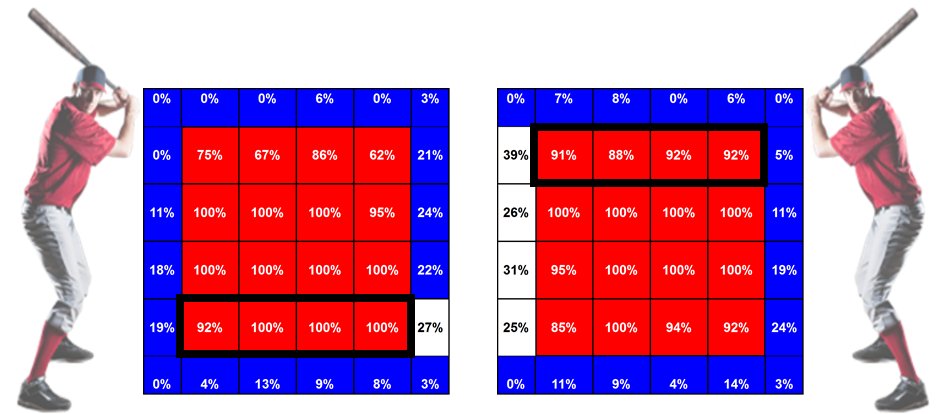
    The images below show the percentage of called strikes Wolters received by location along with the overall league percentage.

    Wolters Called Strike Rate, 2018

    Overall League Called Strike Rate, 2018

    We can see that against left-handed batters, when compared to the league, Wolters excels at receiving strike calls when the ball is low in the zone. Against right-handed batters, he is much better than the league at receiving called strikes high in the zone.

    Wolters, however, doesn’t only excel at pitch framing. Here are a few more facts about his defense:

    Pitchers Perform Better when he is Catching — The combined ERA of Rockies pitchers with Wolters behind the plate is 3.89. When Iannetta is catching, their ERA is 4.85.

    He limits stolen bases — Wolters has thrown out base-stealers in 6-of-17 opportunities (35 percent), right in line with his 37 percent last season. The overall league percentage for catchers is 21 percent.

    He can field a bunt — Wolters is one of only four catchers with a run saved due to bunt defense this season (our bunt runs saved rewards fielders who limit hits and cut down baserunners).

    He blocks – Wolters ranks 13th out of 48 catchers in pitch block rate (nearly 95 percent). He’s five percentage points better than Iannetta.

    The question the Rockies need to ask is, does the value of Wolters’ terrific defense significantly outweigh his shortcomings as a hitter? That they’re keeping him in the major leagues may tell you the answer to that.
    2018 Colorado Rockies Photo Day

  • Johan Camargo’s improvements net him everyday role

    Johan Camargo’s improvements net him everyday role

    By WILL HOEFER
    Braves’ Executive Vice President and General Manager Alex Anthopoulos called somewhat of a harried press conference on Sunday morning, in which he informed the media present at SunTrust Park that Jose Bautista had been released. The impetus for that decision, Anthopoulos noted, was to give Johan Camargo the everyday job at third base.

    There’s reason to be skeptical that this decision will last even through this season; it’s been the belief of this new Braves regime to not have anyone that could possibly block the arrival of slugging third base prospect Austin Riley.

    Nevertheless, a regular starting gig for any length of time has been a long time coming for Camargo. Widely viewed as a player with the ceiling of a utilityman, Camargo has exceeded expectations ever since his call-up in the summer of 2017. However, it’s not his slick fielding that’s inspired faith with the Braves’ front office, but the strides he has made at the plate.

    Camargo has improved his plate discipline dramatically by simply shrinking his zone. He’s swung at 22 percent of pitches outside the strike zone in 2018, down from a 34 percent clip in 2017. This has played a large part in Camargo cutting down on his whiffs; he’s gone from an 11 percent swinging strike rate last season to an 8 percent swinging strike rate this season.

    These improvements have already manifested in his walking more times in 81 plate appearances (15) than he did in 256 plate appearances last season (12). However, in addition to swinging at fewer pitches out of the zone, he’s cut his misses on those pitches (78 percent out of zone contact in 2018, 67 percent in 2017).

    Camargo probably won’t continue to maintain a Votto-eqsue 18 percent walk rate, but his improvements in discipline and contact show reason to expect some regression coming.

    That’s only part of the story with Johan so far. While perhaps not a swing-changer yet, Camargo has shown improvements in quality of contact so far.

    Last year, with pedestrian exit velocities and hard contact, it was probably in Johan’s best interest to focus on a more line drive heavy approach. This year has been different in a variety of positive ways. Camargo has gone from a 29 percent hard hit rate when making contact in 2017 to a 51 percent rate.

    He’s increased his flyball and line drive exit velocity from 91.4 MPH to 93.2 MPH, and has in turn started hitting the ball in the air more (6 point increase in fly ball percentage, 1.7 degree increase in avg. launch angle) with less bad contact (4 percent infield fly rate).

    There’s still room for improvement in terms of quality contact, however. Camargo still has issues barreling the ball (sub-5 percent barrel rate in both 2017 and 2018), which does provide somewhat of a bound on his expected productivity. But even those bounds aren’t prohibitive of great offensive performance.

    Camargo has an expected OPS of .881 so far in 2018. Camargo may only be hitting .215, but a quick search found three Web Gem-like plays against him in a four-game span by Evan Longoria, Denard Span and Carlos Gomez. Turn those outs into hits and Camargo’s batting average jumps 50 points.

    These figures of expected and actual offensive performance fit at pretty much any position on the field, with third base being no exception. Camargo has always been well-regarded as an infield defender, and there’s certainly an expectation in Atlanta that he continues to be a good defender at third base to ensure his status as an everyday starter.

    These offensive strides are coming in a small sample of only 81 plate appearances. But it is very clear that his bat has made a believer out of the Braves’ front office. It’s not every day that a general manager gathers the media to inform them of a new starter in the lineup.

  • Mike Trout, Albert Almora among outfielders off to strong defensive starts

    By LINDSAY ZECK
    On Monday, Mark Simon posted a blog entry about rookie Harrison Bader, who has had one of the most notable defensive performances thus far with diving catches like this one.

    He has already saved the Cardinals seven runs this season—tied for the third most in the league—despite only playing 152 innings.

    His defensive performance in the majors has been somewhat of a surprise, as his defense in the minors was below average. He cost the Springfield Cardinals and the Memphis Redbirds two runs in 2016 and the latter team two runs in 2017.

    Besides Bader, which other outfielders have been defensive standouts?

    Mike Trout, Los Angeles Angels
    Prior to the start of the season, Mike Trout was quoted as saying: “I think every outfielder that plays this game wants to win a Gold Glove.”

    So far in 2018, Trout has been working towards that goal like with this diving catch against Paulo Orlando of the Royals on April 13th. He is currently tied for second among center fielders in Defensive Runs Saved (DRS), saving the Angels six runs — behind only Michael A. Taylor who has saved the Nationals seven.

    Since 2012, when Trout saved 21 runs and finished second in DRS for center fielders behind only Michael Bourn, the greatest number of runs he saved in a given season was six in 2016. He is currently at that total, despite only playing 368 innings.

    Though it’s early to say if Trout improved defensively, he’s handled what has come his way without much issue through the first quarter of the season.

    Chris Owings, Arizona Diamondbacks
    Chris Owings is tied for the lead of all outfielders in DRS, saving the Diamondbacks eight runs in the outfield—seven in right field and one in left. If not for costing his team two runs at second base, he would be tied for the second-most DRS in the league. Impressively, his eight runs saved have come in only 182 innings in the outfield.

    Owings has led the Diamondbacks to the second most runs saved of any outfield in Major League Baseball. His eight runs saved in addition to Jarrod Dyson’s five, A.J Pollock’s four, and David Peralta’s two, with Steven Souza Jr. costing the team two in right field, give the D-backs outfield 17 runs saved. This is two fewer than the first-place outfield, the Milwaukee Brewers.

    Check out Owings’ most recent Good Fielding Play from two days ago against Manny Pina of the Brewers here.

    Albert Almora, Chicago Cubs
    Albert Almora vaulted up the Defensive Runs Saved rankings on Wednesday — literally. His home run robbery against the Braves upped his total to six runs saved defensively, tied for second among center fielders.

    Impressive catches have been Almora’s game this season. He leads all outfielders with nine Good Fielding Plays, all on fly ball or line drive catches.

    Carlos Gomez, Tampa Bay Rays
    The change of scenery and primary position had seemed to help Carlos Gomez find his defensive skills again until Wednesday, when he was placed on the disabled list with a strained groin.

    After two below average seasons, where he cost the Astros and Rangers six runs in 2016 and the Rangers four runs in 2017, he has saved the Rays eight runs this season—second most in the league. He has saved nine in right field and cost one in center (his primary position for the previous ten seasons).

    Gomez already has eight Good Fielding Plays—the most of all right fielders. Half of them are from holding a runner to a single on a ball that seemed more likely to be a double, the kind that doesn’t often make highlight reels, but is nonetheless important.

    In fact, runners have only taken an extra base on 32 percent of their opportunities against Gomez (7 of 22)—the fifth lowest percentage among right fielders. In 2017, at his primary position of center field, runners took an extra base against him on 59 percent of opportunities (49 of 83), which ranked 27th of the 35 center fielders with at least 30 opportunities.

  • How does Harrison Bader have so many Defensive Runs Saved?

    How does Harrison Bader have so many Defensive Runs Saved?

    BY MARK SIMON
    Most of the names atop the Defensive Runs Saved leaderboard are recognizable at this point of the season.

    One of the exceptions may be St. Louis Cardinals outfielder Harrison Bader.

    Bader has channeled his best Jim Edmonds in the form of multiple diving catches this season. He’s saved 7 runs defensively this season, 5 from center field and 2 from right. He ranks tied for fourth in Defensive Runs Saved among outfielders. In 15 games, he’s made a number of highlight-reel plays, including face-first dives to catch line drives hit by Eric Sogard, Tucker Barnhart, Ian Happ and Josh Bell.

    He’s also made a couple of full-speed sprinting catches, the most notable of which was on a line drive by Billy Hamilton. It was the final out and the play denied the tying run from scoring in a win over the Reds on April 15.

    From a statistical perspective, catching shallow fly balls was Bader’s specialty in the minor leagues, as he rated well in that in 2016 and 2017 (his numbers on deep balls were well below average). He also ranked third among outfielders in Double-A and Triple-A with 27 Good Fielding Plays in 2017.

    He made the most of his opportunity in the majors when Tommy Pham went on the disabled list, and the strong defense carried over from the minor leagues. In order to make the most of his defense, the Cardinals have been playing Bader an average of 7 feet deeper in center field in Busch Stadium than they’ve positioned Pham this season (and an average of 9 feet deeper overall).

    Bader isn’t necessarily a headline grabber, but he’s shown himself to be a useful player and a part of why the Cardinals currently stand tied for the lead in the NL Central.

  • Hardest-Hitting Minor Leaguers According to Synthetic Statcast

    Statcast is a really exciting product to have at our fingertips when analyzing players. It has given the public a whole new vocabulary with which we can talk about baseball. How many times did you hear the terms “spin rate,” “exit velocity,” or “launch angle” before a couple years ago? Now these terms are everywhere.

    The trouble with Statcast is that analysis is limited to recent major league seasons, so we don’t have the ability to build context around these numbers like we do for on-base percentage or swinging strike rate, for example.

    Enter Synthetic Statcast. This is a product Baseball Info Solutions (BIS) unveiled at the SABR Analytics Conference this past March (audio hereslides here) that estimates exit velocity, launch angle, and spray (i.e. horizontal) angle from the hit location and timing of batted balls. This data gets really interesting when we start applying it to time periods and leagues where Statcast doesn’t exist, because we can now talk about these new statistics in those contexts as well.

    Using Synthetic Statcast exit velocities, here are the Average Exit Velocity and Hard Hit Rate leaderboards for Double-A and Triple-A this season. In this case, Hard Hit Rate is the percentage of at-bats in which the player hit a ball at least 95 miles per hour.

    High Minors Average Exit Velocity Leaders, 2018 (min 100 AB)

    Player Level Org Avg Exit Velo
    Dylan Cozens AAA PHI 91
    Chris Carter AAA LAA 90
    Jacob Wilson AA/AAA WAS 89
    Ryan O’Hearn AAA KC 89
    Victor Roache AA STL 89
    Mike Ford AAA NYY 89

    High Minors Hard Hit Rate Leaders, 2018 (min 100 AB)

    Player Level Org Hard Hit Rate
    Mike Ford AAA NYY 31%
    Jacob Wilson AA/AAA WAS 28%
    Peter Alonso AA NYM 27%
    Dustin Fowler AAA OAK 26%
    Victor Roache AA STL 26%

    There are a few hotter prospect names on or just short of making these lists. MLB.com top ten prospect Fernando Tatis Jr. is seventh on the exit velocity leaderboard. He has a strong power profile but has struck out more than 30 percent of the time since graduating to Double-A. Recent A’s callup Dustin Fowler had his major league debut foiled by injury last season, but slugging over .500 in 100 games at Triple-A has earned him more than just a cup of coffee in the majors. Peter Alonso is one of the Mets’ top prospects, slugging over .500 and striking out less than 20 percent of the time at every level so far. And Blue Jays farmhand Vladimir Guerrero Jr., perhaps the best hitting prospect in the league after Ronald Acuna’s call-up, is 14th with a 24 percent Hard Hit Rate.

    It’s not very surprising to see Dylan Cozens and Chris Carter as exit velocity leaders. They are both high-strikeout sluggers who crush the ball when they do hit it. Notice that they aren’t at the top of the Hard Hit Rate leaderboard because they don’t make a lot of contact. Jacob Wilson, Mike Ford, and Victor Roache are notable because they appear on both lists, but Ford hasn’t harnessed that power yet and the other two have limited upside because of their age.

  • The numbers behind Sean Manaea’s hot start

    The numbers behind Sean Manaea’s hot start

    BY SPENCER HARRISON
    Sean Manaea is the owner of MLB’s only no-hitter this season. He is also the owner of the league’s second-lowest ERA (1.03), trailing only Johnny Cueto (0.84). Manaea is far from a slouch, but his current statline places him in company that most would consider aces.

    Sports Info Solutions charts every pitch and ball in play in a given game, and that data can be used to provide some insight into how Manaea has gotten off to such a hot start.

    The short answer: Manaea has benefited from spectacular defense behind him. This season, the Oakland Athletics have converted ground balls and bunts into outs at a 74% rate. That ranks them 11th in MLB. When Manaea is pitching, that number jumps to 81%—eight percentage points above the league average.

    They have also turned 12 of 17 line drives allowed by Manaea into outs. Among 191 pitchers with at least 10 line drives allowed, the A’s out rate with Manaea pitching ranks first (71%).

    Below is a chart of Manaea’s balls in play this season. Worth noting is that the densest congregation is on the left side of the infield. This is not abnormal when compared with other pitchers, but it has been something that Manaea has leveraged this season.
    Sean Manaea grounders
    With Manaea on the mound this season, Oakland has converted 25-of-30 (83.3%) of ground balls on the left side of the infield into outs, which is about four plays above average.

    Matt Chapman, Sports Info Solutions’ Defensive Player of the Month, happens to play on the left side of this infield. On ground balls and bunts hit off Manaea to the sixth of the infield for which the third baseman is responsible, the A’s have turned all eight ground balls into outs.

    Chapman’s diving snag of a Shin-Soo Choo ground ball on April 4 rates as one of the better plays made behind Manaea this season, along with a semi-sliding catch by Chad Pinder and Manaea’s own race to the bag to get Corey Seager out on a grounder to first. There was also the play by Jed Lowrie on Yasiel Puig, who was nailed trying to turn a single into a double on a ground ball that initially went off Lowrie’s glove.

    This defensive showing has contributed to Manaea’s league-low BABIP mark of .148. Manaea hasn’t just been getting by on the defense behind him, though.

    He also boasts a 98% strand rate, also an MLB-high. How has he accomplished that? With the bases empty, Manaea’s strikeout rate is 19%. With runners on base: 39%.

    Some of these numbers are sure to regress, but with the A’s playing high-caliber defense behind him, this has a chance to to be the best season of Manaea’s young career.
    2018 Oakland Athletics Photo Day

  • With Byron Buxton out again, let’s find his most statistically similar player

    BY ALEX VIGDERMAN
    While on a rehab assignment for another injury this past weekend, Byron Buxton fouled a ball off his toe and suffered a hairline fracture, sidelining him again in what is quickly shaping up to be a lost season.

    We all love keeping track of the trials and tribulations of Buxton as a tantalizing former uber-prospect, but with him on the shelf a little longer, I still want to feel that same thwarted lust for a five-tool superstar. Fortunately, I just realized that Michael A. Taylor and Buxton are basically the same player with a few years difference in age.

    Both have been up-and-down between Triple-A and the majors over the course of their relatively short careers thanks to their plate discipline limitations. Buxton was a top overall prospect without much competition in center field, so he saw playing time earlier in his career, while Taylor has needed injuries and the departure of Jayson Werth to find more opportunities.

    Here are Buxton’s and Taylor’s stat lines since the start of last season.

    Stat Buxton Taylor
    PA 554 537
    AVG .249 .261
    OBP .308 .315
    SLG .400 .466
    BB% 7.2 7.3
    K% 29.1 31.3

    Maybe Taylor strikes out a little more but has a little more consistent pop. But on the whole these are fairly similar low-contact moderate-power hitters.

    Of course, Buxton brings elite tools to the table outside of his bat. Since the start of 2017, Buxton has been the best in the major leagues as a defensive center fielder (24 runs saved) and as a baserunner (good for a +63 Net Gain, described in the Bill James Handbook).

    Taylor doesn’t have that elite level of performance over a larger sample, but he’s doing his darnedest this year to get to Buxton’s level. Through the first month of the season, he leads the major leagues in Net Gain on the bases (+15) and is second in DRS among center fielders (6, one run behind Delino DeShields). Buxton won a Gold Glove last season. Taylor’s teammates have talked him up as being a capable candidate.

    Like Buxton, Taylor got off to a slow start this season, but he’s been healthy and had the opportunity to make up for it. He’s hitting .289/.396/.600 in his last 14 games

    We’re still in Small Sample Size Mode in 2018, so caveats abound, but it will be exciting to see if Taylor keeps this up and, even at age 27, brings a little bit of new blood to the ultra-toolsy center fielder discussion.

  • Why does Bryce Harper have -5 Defensive Runs Saved?

    Why does Bryce Harper have -5 Defensive Runs Saved?

    By MARK SIMON

    Just like with offensive statistics, defensive statistics take time for samples to build up. But there was one number from the early-season metrics that I wanted to at least look at a little more closely – Bryce Harper’s -5 Defensive Runs Saved.

    Harper had saved 28 runs defensively in his first six seasons for the Nationals, half of those coming in his rookie season, primarily as a center fielder. He’s typically been an average to good defender the last five seasons.

    As a rightfielder, his range is alright. He catches balls hit to the shallow part of the ballpark at an above-average rate, but is slightly below average on deep balls. He makes up for any deficiencies with the deterrent value of his arm, which has saved eight runs, six the previous three seasons.

    So what’s going on with Harper’s defense in 2018?

    Let’s start with a point. We’re not here to disparage Harper. It’s too early to make judgments on this stat, just as it’s too early to judge Jed Lowrie’s amazing offensive start.

    This is a look at how the number is what it is.

    Harper’s range and positioning rate below average and this is a case where a few plays in a small sample are damaging in the short term. In the opening week of the season, Harper turned the wrong way on an Adam Duvall fly ball that he missed with a jumping attempt near the wall, resulting in a double.

    He also couldn’t get to base hits by Jay Bruce and Zack Wheeler that were hit in front of him, in which it looked like he played the ball conservatively, which dinged his rating. He didn’t lose anything for missing a foul ball hit along the right field foul line (in chilly weather), but it fit with the other two plays in that it looked like a ball that Harper could have caught.

    Our video review has Harper with 1 Good Fielding Play (GFP) in 25 games, a sliding catch on a Billy Hamilton line drive. Harper’s GFPs have dropped from 28 in 2015 to 24 and 12 the last two seasons (granted, last season, he only played 110 games compared to 140-plus the other two seasons).

    That tells us he’s probably not making plays that would add to his Defensive Runs Saved total. But he’s made mistakes at rates comparable to 2015 and 2016– he has 5 Defensive Misplays & Errors (he’s nearly halfway to last season’s 11)

    Harper’s arm also has not produced any value yet. There have been 22 instances in which a baserunner had an opportunity to take an extra base (first to third, second to home, first to home) on Harper. Fourteen succeeded (64 percent … his rate was 42 percent the last three seasons).

    Among the plays that hurt his ledger – a bobble in the right field corner on a DJ LeMahieu double that allowed a Rockies runner to go first to home (Harper got a “Mishandling Ball After Safe Hit” misplay). Harper also was slow to go after a hit by Ozzie Albies on which Albies’ hustle turned it from a single to a double (Harper received a Defensive Misplay for “Giving Up On The Play”).

    So what conclusions can we draw from all of this? Each of the plays we listed isn’t highly impactful on its own, but little things add up within a short period of time.

    Based on video observation, it seems that Harper’s results are in line with the eye test. But just like every major league hitter has a 25-game blip, it’s entirely possible that this is just some small-sample struggle that will even out over time, as Harper accumulates his share of good plays. We’re not making any judgments from this small a sample.

    But just in case it continues, you’ll have a better understanding as to what’s behind it.

  • Who are the best outfielders at avoiding mistakes?

    Who are the best outfielders at avoiding mistakes?

    By MARK SIMON
    On Monday, we looked at which infielders were the best at avoiding mistakes. Today, we’ll look at which outfielders rank the best at doing the same.

    To recap, Sports Info Solutions does video review of every pitch of every game and tracks both Good Fielding Plays in 30 classifications and Defensive Misplays & Errors in about 60 categories. Mistakes come in many forms, ranging from slipping and falling to dropping a ball, or misreading a ball bounce off the wall.

    Our look back covers since the start of the 2015 season through games played on April 23.

    Left Field: Two of your better left fielders head the list in Alex Gordon of the Royals and Christian Yelich of the Brewers, Gordon averages 1.1 misplays and errors per 100 innings, ahead of Yelich at about 1.4. Gordon also has the highest ratio of Good Fielding Plays to Defensive Misplays & Errors in that span (1.9).

    Center Field: A.J. Pollock of the Diamondbacks doesn’t often get brought up as an elite player at the position, but he does come out as the leader in this metric, a hair ahead of Mike Trout (both 1.3). This goes with Pollock’s defensive ratings in center field. He’s finished in the top 10 in Defensive Runs Saved at the position all five times that he’s played more than a handful of games in a season.

    Trout’s defense is a topic of much debate. There are those who question just how good his range or arm is. But he doesn’t get critiqued often for making mistakes, and rightfully so.

    Right Field: Curtis Granderson of the Blue Jays is known as one of baseball’s good guys. He’s also a good guy when it comes to this stat. His 1.1 Misplays & Errors per 100 innings are the fewest at the position. Granderson has fared well in terms of Defensive Runs Saved in the past, largely because of his ability to chase down fly balls hit to the deepest part of the ballpark.

    J.D. Martinez of the Red Sox ranks second. Often criticized for his defense, Martinez has made only 1.5 misplays per 100 innings in this stretch. However, he’s made so few Good Fielding Plays, that his ratio of good to bad is among the worst in the majors.

    For those wondering where Jayson Heyward is, he’s just behind Martinez and Seth Smith. Heyward has long been the standard-setter at the position and continues to be here.