Author: Andrew Kyne

  • Evaluating Infielder Throwing with the DRS PART System

    Baseball Info Solutions recently introduced a major update to Defensive Runs Saved that will be rolling out this offseason. We’re splitting DRS for infielders into Positioning, Air, Range, and Throwing components.

    In that introductory blog post, we mostly covered how this will affect the Positioning and Range components (which were previously reported together as one “Range & Positioning” metric). However, it’s also important to note how this system can estimate the value an infielder adds with his arm.

    So how do we calculate the Throwing component of the improved DRS?

    Using ball in play and positioning data charted by BIS Video Scouts, we estimate the chance that the play will be made at the point that the fielder obtains the ball, given the distance he must throw and how long he has to complete the play before the batter/runner reaches safely.

    This number is then subtracted from whether the play is made (0 or 1). That value gives us how many plays were saved by throwing, which is then multiplied by an expected run value to generate runs saved.

    Consider this play by Javier Baez. The chance that he would make the play from the point at which he obtained the ball – given his distance from first base and time to make the play – is estimated at approximately 39 percent. Baez made the play, so he’s credited with 0.61 plays saved (1 – 0.39).

    Baez is a standout with his strong throwing arm at shortstop. With our new methodology, he tied Matt Chapman at +11 Throwing Runs Saved to lead all infielders in 2019.

    Here’s a look at the top ten:

    Throwing Runs Saved Leaders, 2019

    Player Position Runs Saved
    Javier Baez SS 11
    Matt Chapman 3B 11
    Yolmer Sanchez 2B 8
    Amed Rosario SS 7
    Andrelton Simmons SS 7
    Jonathan Schoop 2B 7
    Nick Ahmed SS 7
    Tim Anderson SS 7
    Carlos Correa SS 6
    Kyle Seager 3B 6

    Over the past three seasons, the leaders are Nick Ahmed (+23), Kyle Seager (+23), Matt Chapman (+23), Jean Segura (+17), and Yolmer Sanchez (+17).

    This update to DRS allows us to not only split out the Positioning and Range components, but also to better understand an infielder’s value added with his arm. The data is now available on FieldingBible.com and will be featured in The Fielding Bible – Volume V (coming in the spring of 2020).

    Stay tuned for more information and updates regarding this improvement to DRS.

  • Infield Defense in PARTs: A Major Update to Defensive Runs Saved Coming Soon

    A major update is coming soon to Baseball Info Solutions’ Defensive Runs Saved (DRS) system to improve our evaluation of infield defense.

    Currently, DRS does not account for infielder positioning, thus relying on one “Range & Positioning” component to assess a fielder’s ability to convert batted balls into outs. It also considers shift plays entirely as a team defense, attributing runs saved/lost to the team overall.

    That, however, is about to change. We’ll be breaking the DRS system into PARTs.

    PART stands for Positioning, Air Balls, Range, and Throwing. This new system isolates each of these elements for individual fielders. It also allows us to evaluate how individual players perform defensively in shifts. BIS has been charting pre-pitch infielder positioning since 2013, which makes it possible for positioning to be evaluated.

    Given that positioning is largely controlled by the team rather than individual player, it is now its own separate component. Positioning Runs Saved will be added to the team’s DRS total, but not the individual player’s total. Thus, an infielder’s DRS is now the sum of:

    * His Air Ball Runs Saved
    * His Range Runs Saved
    * His Throwing Runs Saved

    How does this change the way we think about infield defense? We are transitioning from evaluating “how often did a player make that play?” to “how often did a player make that play given where he was positioned?” Additionally, we’re able to evaluate all infield plays, not just ones involving an unshifted defense. The result, we believe, is a more accurate overall depiction of defensive performance.

    How do we actually estimate the effects of positioning? The system evaluates the chance a play would be made without considering fielder positioning (using information about the batted ball’s trajectory, location, and velocity and the batter’s speed) and compares it to the chance it would be made considering those variables and the fielder’s positioning. If a batted ball is estimated to be a high percentage out, but a fielder isn’t close to it, then the team will get penalized in the form of Positioning Runs Saved—but the fielder will not.

    What does all this look like in action? Let’s consider Matt Chapman of the Oakland A’s, one of baseball’s top defensive players.

    The current DRS system awarded him 18 Defensive Runs Saved for 2019. The new system, however, will have him at 34 Defensive Runs Saved. Stripping out positioning and including shift plays gives Chapman a significant boost.

    Here’s the breakdown at how we arrive at the new number:

    * Range Runs Saved: +19
    (+11 in non-shifts, +8 in shifts)

    * Throwing Runs Saved: +11
    (+10 in non-shifts, +1 in shifts)

    * Air Ball Runs Saved: 0

    * Other Runs Saved: +4
    (Good Fielding Plays/Defensive Misplays, Double Plays, Bunts)

    * Total Defensive Runs Saved: +34

    What doesn’t get included here is positioning, and the system calculates that Chapman accumulated -13 Positioning Runs Saved (-10 in non-shifts, -3 in shifts). Again, this number will still be included in the team total, but the individual player will not be penalized for it.

    We can also see the gains for Chapman from including shift plays, as he was +8 for Range and +1 for Throwing in shifts. Even though the A’s shifted the least of any team per BIS charting, that’s a significant Runs Saved total that was previously uncredited to Chapman.

    This data for Chapman and all other Major League players will soon be rolling out on FieldingBible.com, and it will also be featured in The Fielding Bible – Volume V (coming in the spring of 2020) and in The Bill James Handbook 2020 (out November 1).

    Stay tuned for more information and updates regarding this improvement to DRS.

  • Which hitters reach favorable counts?

    Which hitters reach favorable counts?

    By Andrew Kyne

    On the most recent episode of the SIS Baseball Podcast, our guest Mike Ferrin talked about analyzing ball-strike count management among hitters.

    Specifically, which hitters get themselves in favorable counts, like 2-0, 3-0, and 3-1? And which hitters then do damage in those plate appearances? Let’s try to find out.

    For 2019, here are the ten players who have reached 2-0/3-0 or 3-1 in the highest percentage of their plate appearances (minimum 200 PA).

    BatterOverall PAPA w/ HCPct.wOBA
    Justin Smoak2617829.9%.432
    Cody Bellinger3379929.4%.508
    Carlos Santana3419828.7%.499
    Mike Trout34910028.7%.685
    Joey Gallo2276528.6%.544
    Mookie Betts37710728.4%.558
    Daniel Vogelbach3048628.3%.500
    Rhys Hoskins3509928.3%.581
    Tyler White2065627.2%.399
    Kendrys Morales2015426.9%.398

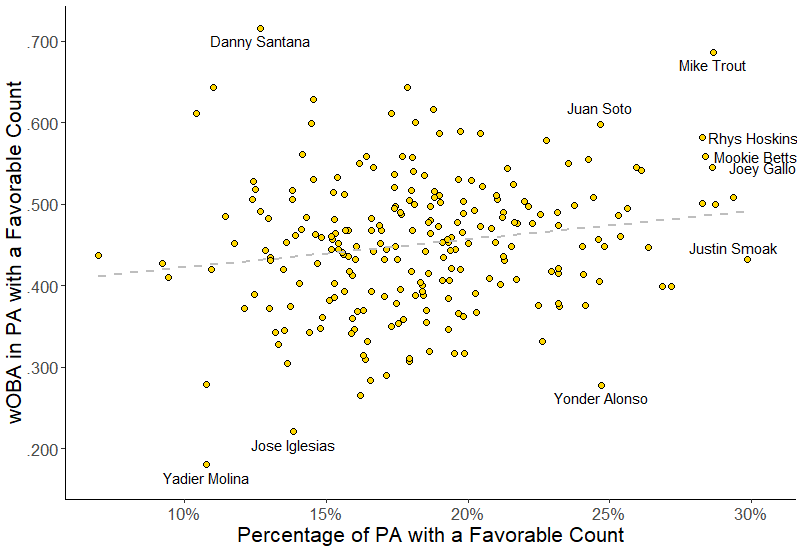
    The wOBA column represents their weighted on-base average in those plate appearances in which they got to a favorable count (but didn’t necessarily end the PA in one of them). So, in the 100 plate appearances in which Mike Trout got to a 2-0/3-0 or 3-1 count, he has an absurd .685 wOBA.

    Being a power hitter with exceptional plate discipline is a good way to make this list. But not everyone has ended up doing damage in those plate appearances, as you can see with Tyler White (who has a 91 wRC+ overall on the year) and Kendrys Morales (who has a 63 wRC+ overall and was just designated for assignment by the Yankees). Justin Smoak tops the list in terms of getting into favorable counts, but his wOBA is lagging a bit behind the others as well.

    The other seven players have been among the best at not only getting into hitter-favorable counts, but also finishing with success, all recording a wOBA of .499 or better in those PA. Trout, Rhys Hoskins, Mookie Betts, and Joey Gallo have been especially good.

    Here’s a look at the relationship in 2019 between getting into favorable counts and then having success:

    Getting into counts like 2-0 and 3-1 is certainly good for hitters, but is it a repeatable skill? Between 2017 and 2018, there was a strong year-to-year correlation (r = 0.76) for hitters with 400+ PA in each season.

    Between 2018 and 2019, Gallo has had one of the most significant increases in generating plate appearances with favorable counts, going from 20% to 29%. Pitchers are surely fearful of his power, and it helps that he’s cut his chase rate from 32% to 23%.

    On the other side, Cleveland’s Jose Ramirez has had one of the sharpest declines, going from 29% to 22%. After turning in consecutive seasons with a 146 wRC+, Ramirez is hitting just .216/.310/.329 in 2019.

    Finally, what about the ability to repeatedly do damage in plate appearances with a favorable count? The correlation isn’t as strong here (r = 0.33) but still positive.

    It’s good for hitters to be in favorable counts, and there’s evidence that being able to get into those situations may be consistent from year to year. That’s perhaps not a surprising conclusion, given batter quality and plate discipline, but it’s ultimately another important piece in hitter evaluation.

  • Visualizing Home Runs by Pitch Location

    Visualizing Home Runs by Pitch Location

    By Andrew Kyne

    Home runs are being launched at unprecedented rates in Major League Baseball. In 2019, there has been a home run hit once every 28 plate appearances — which if maintained would be the highest frequency for a season in history, followed by 2017 (1 every 30), 2016 (1 every 33), and 2018 (1 every 33).

    My colleague Mark Simon and I were curious about what home run heat maps look like in today’s MLB compared to several years ago. Let’s take a look, using methods similar to what Jim Albert has demonstrated.

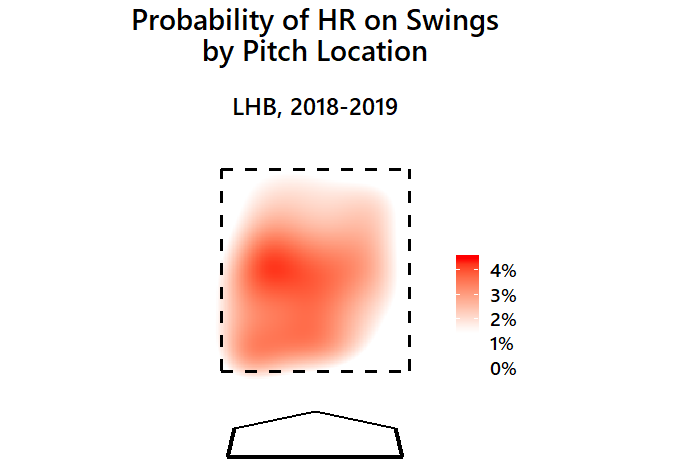
    The following heat maps show the probability of a swing resulting in a home run, given a pitch’s location. It excludes bunts, as well as pitchers hitting.

    The colored areas begin at a 1.5% probability, and darker red indicates a higher likelihood. Locations are from the pitcher’s perspective.

    First, for left-handed batters in 2018 and 2019:

    Pitches right down the middle/over the inner-third generate the most homers per swing. Pitches low in the zone tend to generate more HR compared to high or outside.

    But that’s intuitive — you could probably picture that one without even seeing it. What we’re more interested in is how that’s changed from when home runs weren’t so common.

    Here’s what it looked like for left-handed batters in 2013 and 2014:

    This heat map uses the same scale as the previous one, so not only is the area much smaller, but the red isn’t as dark (indicating lower probability).

    Here’s a GIF to compare them back-to-back:

    Now, here’s the heat map for right-handed batters recently:

    And right-handed batters five seasons ago:

    And in GIF form:

    Hitter hot zones are certainly expanding. And while differences may seem small — 4 home runs per 100 swings rather than 3 per 100 in the best spots to hit, or 2 per 100 rather than 1 per 100 on the edges — they add up considerably in the aggregate.

  • The Effect of Outfield Position Changes on DRS

    The Effect of Outfield Position Changes on DRS

    By Andrew Kyne

    In 2018, Charlie Blackmon cost the Rockies 28 runs in center field, the worst Defensive Runs Saved mark in MLB. Of those 28 runs, 21 were lost by way of the Range & Positioning component of DRS. The only outfielder to cost his team more runs via Range & Positioning alone was Adam Jones (-25), then with the Orioles.

    Both Jones (now with Arizona) and Blackmon have been moved from center field to right field in 2019. And thus far, their defensive results — while still slightly below average — have been better. Both are at -3 DRS (about -6 per 1,000 innings).

    The numerical improvement as they move out of center field makes sense. DRS rates players relative to others at their position. They may have rated poorly among center fielders — but there are a lot of defensively-talented center fielders, and not as many defensively-talented corner outfielders. This idea is what constitutes the framework of positional adjustments for Wins Above Replacement.

    Let’s take a look at these positional effects with DRS. How do center fielders rate when they move to a corner? How do corner outfielders rate when they move to center?

    Dating back to when DRS began in 2003, I took all outfielders who played at least 700 innings (about half a season) at a position in one year and 700 innings at a different position the next year. I calculated each player’s Range & Positioning Runs Saved per 1,000 innings.

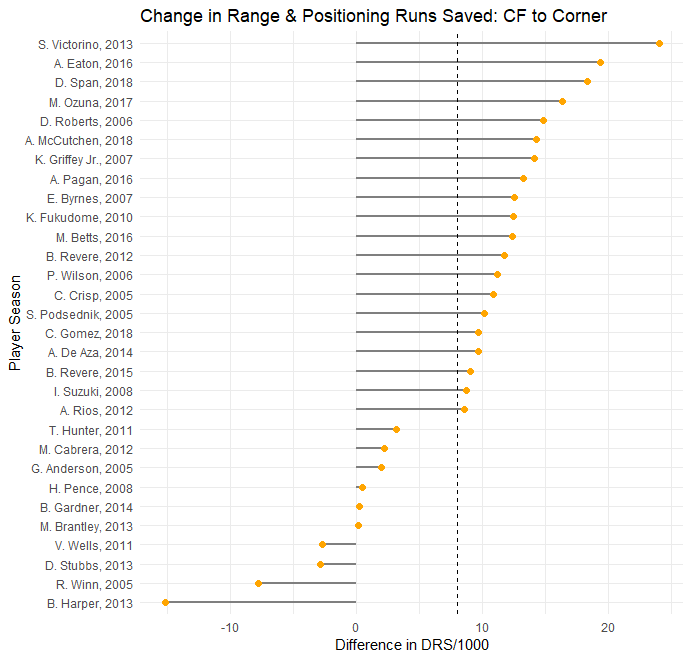
    Here are the differences in Year 1 and Year 2 Range & Positioning Runs Saved per 1,000 for outfielders who moved from center field to a corner spot:

    Of these 30 players, only four rated worse on a per-inning basis in Range & Positioning after moving to LF or RF. The average (represented by the dashed line) has been an improvement of 8 runs.

    That’s a lot.

    A player who can shift positions and perform better gives a team the flexibility to add a defender at his previous position that could be better than he was.

    Here are the differences for outfielders who moved from a corner to center, an understandably smaller sample:

    Of these 19 players, only five improved on a per-inning basis. The average has been a decline of 7 runs.

    And let’s also look at players who moved from one corner to the other:

    While there’s variation among these 23 players, the average difference is almost zero.

    There are various other factors that affect year-to-year performance, including aging and ballpark effects. And while the samples are fairly small, there’s an obvious numerical impact on moving an outfielder into or out of center field. We’re seeing that with Charlie Blackmon and Adam Jones, who should finish 2019 with much better DRS numbers than they did in 2018.

  • MLB’s Best Positioned Infields

    MLB’s Best Positioned Infields

    On the most recent episode of the SIS Baseball Podcast, our guest Joe Sheehan mentioned how teams like the Dodgers and Astros are aggressive in their positioning of defenders, whether they ultimately cross the lines that we draw to measure defensive shifts or not.

    With that in mind, let’s try to measure which teams have put their infielders in the best position to field groundballs.

    As mentioned a few weeks ago, Baseball Info Solutions charts the starting positions of infield defenders on grounders, in addition to batted ball information. Thus, we can calculate both the angle at which the ball was hit and the angle at which the fielders are standing.

    We divide the field into 90 degrees from foul line to foul line. Using the fielder and batted ball information, we can find the angle difference between where the ball was hit and where the closest fielder was standing.

    Since the first baseman will always be positioned near the bag and the other infielders are the ones being moved around, I only evaluated groundballs hit outside the first base area (the rightmost fifth of the infield). Additionally, I only looked at grounders hit at least 100 feet and not fielded by the pitcher or catcher.

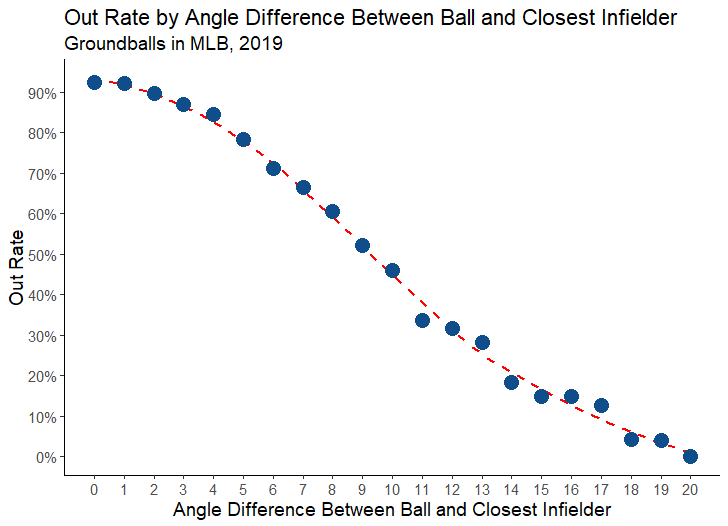
    On a league-wide level, this plot shows the rate of getting an out on a play by how far the closest infielder was from the ball (laterally), in terms of angle difference.

    The trend is obvious: the farther your closest infielder is from the ball, the less likely an out is to be recorded.

    Within three degrees of the ball’s path is where the expected out rate climbs north of 85%. So, based on all of the criteria above, which teams have played the highest percentage of groundballs with an infielder within three degrees of the path of the ball?

    The Astros and Dodgers rank in the top ten (as expected), and other shift-heavy teams like the Rays, Pirates, and Yankees rate well. There are exceptions, however; the Cubs don’t shift much at all but have been well positioned, and the Orioles have rapidly increased their shift usage and rank at the bottom.

    But what if teams played with traditional, straight-up positioning on each of these grounders? With that positioning, what percentage of plays would they have an infielder close to the ball, and how does that compare to their actual percentages? Is there a benefit?

    Overall, teams have had a 2B, 3B, or SS within three degrees of the ball on 39% of these plays. If they played with straight-up positioning (using the average angles of infielders on non-shift plays), teams would have been close on 33% of these plays.

    The Diamondbacks have had the most benefit of moving their infielders around. They would have only been close on 30% of plays with traditional positioning, so their actual 41% rate is a significant boost.

    Consider this play from last week, where the Diamondbacks had the Mets’ J.D. Davis played perfectly. The shortstop and third baseman were positioned similarly to league average, but the second baseman moved over to the left side and the ball was hit right to him.

    The Reds (39% actual vs. 28% with traditional), Yankees (43% vs. 33%), Tigers (40% vs. 30%), and Astros (40% vs. 31%) have also gained significant advantages.

    The important takeaway is that nearly every team has had a higher percentage of close plays with their positioning compared to if they just used traditional positioning. The only team slightly worse off has been Boston, and the difference is basically zero (36.6% vs. 37.2%).

    Of course, this doesn’t speak to fielder quality. Range, arm, and other factors are important to out conversion as well. But from a positioning perspective, teams are doing what they can to put infielders in the proper areas to be as close to potential grounders as possible.

  • On Catcher Injury Risk and Managerial Decision-Making

    On Catcher Injury Risk and Managerial Decision-Making

    In April, ESPN published an excellent feature on Farhan Zaidi and his path to becoming the Giants’ President of Baseball Operations. One story details how Zaidi, while in the doctorate program at UC Berkeley, studied irrational decision-making and the human tendency to “overweight low-probability events and underweight high-probability events.” The article explains:

    “…in baseball, Zaidi’s favorite small-probability event is the industry-wide reluctance to use the backup catcher. ‘Oh, what if he gets hurt? Then we don’t have a catcher and disaster will strike.’ … ‘The likelihood of the catcher getting hurt in the last two or three innings of a game is tiny. But when you’re making this decision, you’re not thinking, There’s a tiny chance. You’re thinking, There’s a chance.’”

    It’s an interesting dilemma. Being forced to play a non-catcher behind the plate is suboptimal, but should managers fear that scenario?

    Baseball Info Solutions has been tracking detailed injury information for a few seasons, so let’s take a look at some data on catcher injuries.

    First, how often does a catcher sustain an injury that forces him to leave the game immediately? Since the start of 2017, there have been 12,870 instances of a player appearing in a game behind the plate. Of those players, only 53 left any of those games immediately because of an injury. That’s 0.4% — or as Zaidi calls it, a tiny chance.

    All 53 of those players were the starting catcher in the game — so in this time frame, no player came off the bench, appeared behind the plate, and had to leave immediately due to injury.

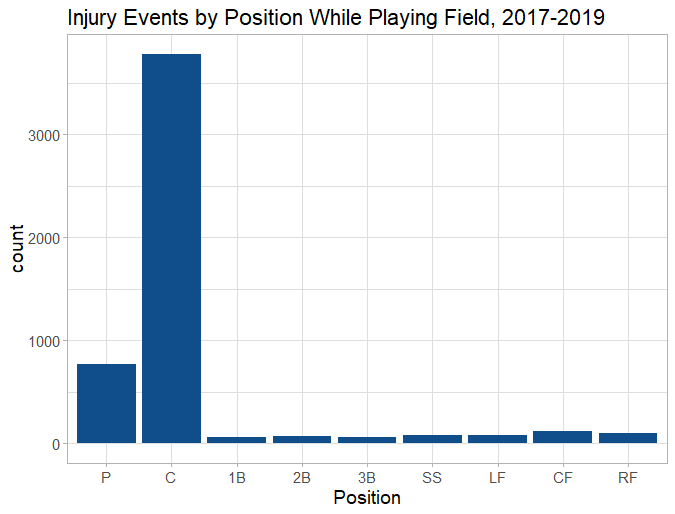
    Though those extreme injuries are rare, playing behind the dish does include more injury risk overall relative to other positions. Looking at injuries that occurred while playing the field, catchers come out way ahead of the pack in terms of total injury events.

    This is a little deceiving. We try to be as comprehensive as possible with our injury data collection and track even the slightest incidents on the field (like hit by pitches or foul balls off the body that may not incur much of a reaction). So a lot of those catcher injuries are low-risk.

    But our Video Scouts also provide a severity rating of each injury on a scale of 1 to 5. Ratings 1 and 2 are injuries with no or slight visible reactions, while 3 and up include clearly visible reactions and are more severe. To focus on higher-risk injury events, here’s the positional breakdown of injuries with a severity of 3 or higher:

    Pitchers surpass catchers in terms of severe injury events, but catchers are still at far more risk than other positions in the field. The more significant takeaway is that out of over 5,000 games played since the beginning of 2017, there have only been about 250 injury events to catchers (while on defense) that warranted a severity 3 rating or higher.

    The most common of our charted injury events to catchers fall under the category of being struck by a ball or bat. Recently, Roberto Perez of the Indians and Francisco Cervelli of the Pirates have suffered concussions on such events. Given the catcher’s exposure to foul tips and backswings, they’re certainly at more risk than someone in the infield or outfield.

    But overall, the chance of an extremely severe injury is rare. Perhaps more managers should be willing to use the backup catcher if the situation warrants it, even if it presents the low-probability risk of needing an emergency catcher to step in.

  • The Rise of Minor League Defensive Shifts

    The Rise of Minor League Defensive Shifts

    By ANDREW KYNE

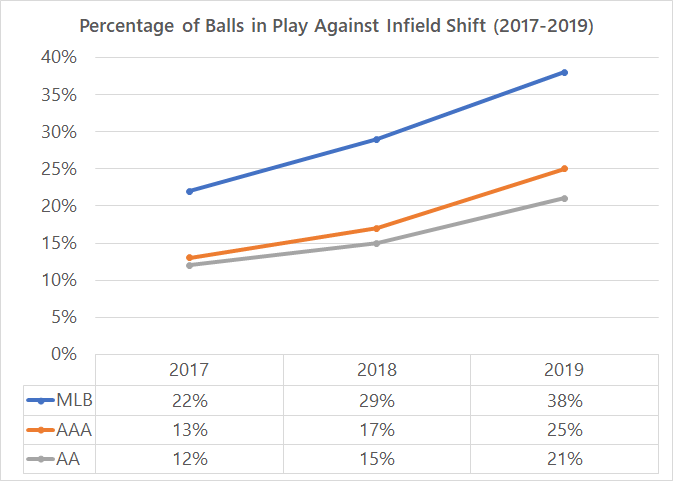
    Infield shifts are on the rise in Major League Baseball again this season. On balls in play, Baseball Info Solutions recorded 26,705 shifts in 2017 (22% of balls in play) and 34,671 in 2018 (29% of balls in play). This year, there have been 13,272 shifts (38% of balls in play), which prorates to more than 44,000 for a full season.

    And while our company and others in the industry have talked a lot about shifts at the MLB level, what about shifts in the minor leagues? Are they rising like they are in the majors? Are they are as common?

    BIS charts all AAA games and nearly all AA games (about 90-95%), so let’s take a look.

    Here’s a comparison of MLB, AAA, and AA in terms of percentage of balls in play against an infield shift over the last three seasons.

    Although the infield shift isn’t as common in the upper minors as it is in the majors, it is increasingly prevalent. This season, both AAA and AA teams have had a shift on for more than 20% of balls in play for the first time.

    Here are the leaders and trailers in shift usage at the AAA level this year, combining the International and Pacific Coast leagues:

    And here are the leaders and trailers at AA, combining the Eastern, Southern, and Texas leagues:

    The Twins have shifted the highest percentage of balls in play in the majors this year, so it’s not surprising to see their affiliates near the top in AA and AAA as well. Teams like the Rays and Pirates have also historically shifted a lot and have minor league clubs listed near the top here. And the Marlins have increased their shift usage this year, and their Jacksonville affiliate leads all AA teams.

    How well does a minor league team’s shift usage track with the shift usage of its parent club? For 2019, the correlation between MLB and AAA…

    … appears stronger than the correlation between MLB and AA.

    So while teams don’t shift as much in the minors as they do in the majors, they are becoming more popular. Infielders, pitchers, and hitters are getting accustomed to extreme infield alignments before they even get the call to MLB.

  • Mets moving away from the inside fastball

    Mets moving away from the inside fastball

    By ANDREW KYNE

    In 2018, the New York Mets strongly emphasized an inside-pitching philosophy, with pitching coach Dave Eiland wanting his staff to be more aggressive. Eventual Cy Young winner Jacob deGrom was among several Mets who increased his usage of inside fastballs from 2017 to 2018, as we wrote about last summer.

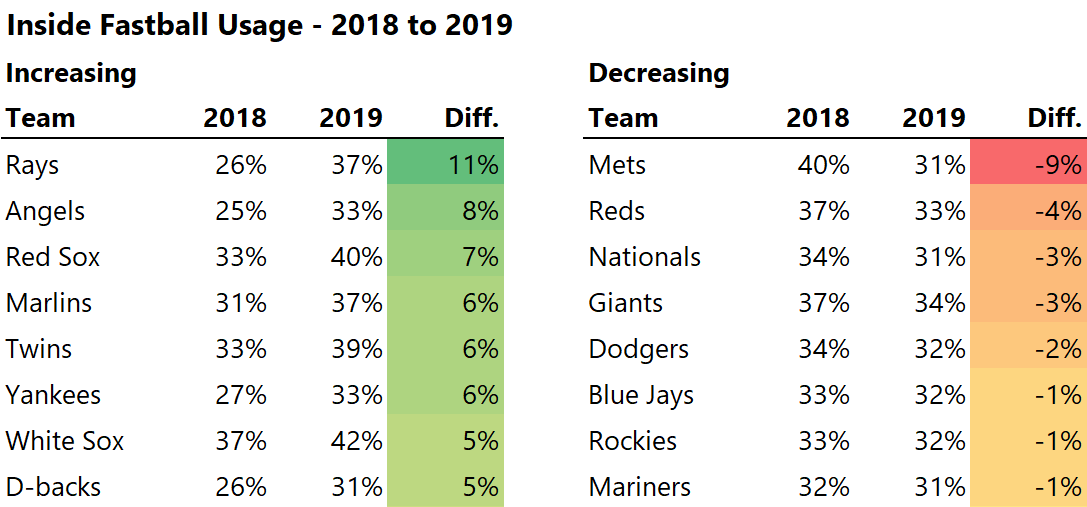
    By Baseball Info Solutions’ pitch charting, 40% percent of the Mets’ fastballs in 2018 were over the inner-third of the plate or further inside. That was the highest percentage in Major League Baseball.

    Interestingly, they have cut back on that approach in 2019. This season, 31% of the Mets’ fastballs have been thrown inside, a mark that ranks 28th in MLB.

    Pitching inside with the fastball has increased across the league this year. The Mets, however, are by far the most significant decliners in terms of percentage-point difference.

    Which pitchers are driving this change in New York? Let’s look at the 120 MLB pitchers who threw at least 750 fastballs last year and have thrown at least 200 so far this year.

    There are seven Mets in this sample of pitchers. Six of them have contributed the most significant percentage-point declines in inside fastball usage.

    (The seventh, Seth Lugo, has declined from 41% to 39%.)

    For deGrom, most of his decrease has come against left-handed batters. He’s still working up in the zone a lot with his fastball, but the emphasis has been more on up-and-away than up-and-in.

    On the other hand, Noah Syndergaard‘s decrease has come mostly against right-handed batters. He worked both corners with the fastball against them in 2018, but is focusing much more outside in 2019.

    How does this alter effectiveness? Here’s how the Mets’ fastballs have performed in 2018 and 2019 based on location.

    Inside fastballs haven’t generated as many misses per swing for them as non-inside fastballs, but they have resulted in less hard contact and slugging.

    We’ll see if this trend continues for the Mets throughout the season. For now, it’s a notable change in approach, given the organization’s clear emphasis on it in 2018.

  • Visualizing Shortstop Range

    Visualizing Shortstop Range

    By ANDREW KYNE

    As noted in last month’s look at Rougned Odor’s bunting against shifts, Baseball Info Solutions charts the starting positions of infielders on groundballs and short line drives.

    Combining those starting positions with batted ball information, let’s try to visualize the range of some of baseball’s best and worst defensive shortstops. We’ll focus on lateral range here (a good proxy for overall range). If a ball is hit 20 or 30 feet to a player’s left, how likely is he to field the ball? (What happens afterwards isn’t considered here; we’re just checking if it was fielded by the shortstop. How many balls can he get to?)

    This requires a few steps and filtering. Here was my approach:

    • Grounders measured between 1.25 and 2.00 seconds from the time it was hit to the time it was either fielded or reached the outfield grass. This gives us balls that aren’t hit too slowly (and would require an extreme charge), but also not super hard (and thus impossible to field unless perfectly positioned).
    • Excluding balls fielded by other infielders. The shortstop had to have had an opportunity to make the play.
    • To determine the lateral distances, I calculated the chord length between the fielder’s starting position and the path of the ball. Essentially, it’s the straight-line distance the shortstop would have to move between his starting position and the path of the ball at the same depth. Charging the ball can obviously impact this calculation/distance, but the 2.00-second cutoff is meant to limit those opportunities.
    • All applicable plays since 2016 to get a large enough sample.
    • For plotting, I bucketed balls in bins of 10 feet in either direction. And on the images below, negative distances are to the player’s right (into the SS/3B hole, if traditionally positioned) and positive distances are to the player’s left (up the middle).

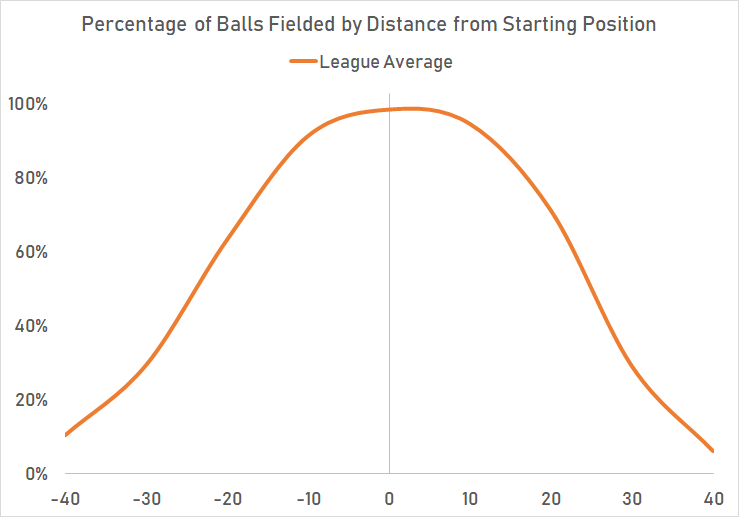
    With that said, here’s the league average distribution for these balls in play.

    These balls in play, when hit right at the shortstop, are fielded nearly 100% of the time. Balls hit about 10 feet in either direction are still above 90%. It dips to about 60-70% at 20 feet from the starting position, then down to about 30% at 30 feet away. And around 40 feet and beyond is where the rate of being fielded drops to 10% and below.

    Let’s compare that with Arizona’s Nick Ahmed, who has the most Range & Positioning Runs Saved at shortstop since the start of 2018.

    Ahmed (blue line) has been consistently above average to his left/up the middle (and can make highlight-reel plays like this one). He’s fielded a similar amount of balls as his peers going 10-20 feet to his right, but has reached more than the typical shortstop beyond that (like this one). And in addition to range, Ahmed’s arm helps separate him from other shortstops in converting outs.

    How about Andrelton Simmons?

    Interestingly, he tracks pretty closely with all shortstops, with the exception of a boost in the 30-foot bucket to his right. Like Ahmed, Simmons boasts a great arm to complement his range, elevating him further above other shortstops.

    But instead of comparing him to all shortstops, what about comparing him to one with poor range? Here’s Simmons (blue line) versus Jordy Mercer (orange line).

    Mercer has fielded a high percentage of balls hit within 10 feet in either direction, but Simmons has been better than him beyond that. Mercer has cost his teams 25 runs by our Range & Positioning system since the start of 2016.

    The only shortstop who has lost more Range & Positioning runs in that time is Boston’s Xander Bogaerts (-39). Our system has significantly penalized Bogaerts for balls hit to his right (SS/3B hole), and his limited range on those balls is confirmed here.

    Bogaerts has been close to his peers on balls hit to his left, but well below average at reaching balls hit to his right.

    The margins here are pretty small. After all, those who play shortstop — and stay there — tend to have the necessary range to reach enough batted balls in their zones. But since shortstops have a high volume of balls hit to them, those small differences can add up over the course of a season.