We know that MLB is back and we’ll talk about that plenty in the next few weeks. This week on the Sports Info Solutions Baseball Podcast, Mark Simon ( @MarkASimonSays) is joined by Japanese baseball writer, statistician and historian Jim Allen ( @JballAllen) of JballAllen.com to talk about Nippon Professional Baseball (the NPB). Jim explains his background and talks about how Japan was able to work to a 120-game season (1:47), and he also explains how the top storylines this season have been overshadowed by Coronavirus (5:49). He discusses how team pitching plans have changed and top starters are already going deep into games (7:34). Jim also explains the expectations for ex-MLB players Adam Jones and Justin Bour, the latter of whom has drawn comparisons to an all-time Japanese great (9:39). The two then talk about defense and the emphasis that Japanese players put into defense compared versus how much attention defense gets in highlights (14:36). Jim also gives insight into the game’s top defensive players, including standout shortstop Sosuke Genda (16:44). He also points out aspects of defense that Japanese players do better than MLB players (22:58). His choice for the coolest thing to watch about Japanese baseball might surprise you (25:33).
Stay healthy and stay safe. Thank you as always for listening. Please rate and review us if you can.
On this episode of the Sports Info Solutions Baseball Podcast, Mark Simon (@MarkASimonSays) is joined by Baseball America writer Carlos Collazo (@CarlosACollazo) to talk about last week’s MLB Draft and how different players rate from a defensive perspective. First, they discuss the preparation heading into the draft and the challenges of trying to evaluate a player’s defense at the amateur level (1:17). Then, Carlos gives a scouting report on Mets draftee Pete Crow-Armstrong, ranging from his defense to his makeup (5:20).
They also discuss No. 1 overall pick Spencer Torkelson and whether he was well equipped to make the move to third base (9:15). Next, Carlos shares his thoughts on Austin Martin to the Blue Jays and the idea of whether a player being versatile at the collegiate level was a good thing (11:16). Then, he talks about the top defensive prospect among infielders, Cubs draftee Ed Howard, and what makes him so promising as a fielder (14:11). One of Carlos’ favorite players in the draft was Garrett Mitchell, who went to the Brewers, and he explains why Mitchell rates so well (16:33). Then he talks about two catchers he likes a lot – Patrick Bailey of the Giants and Drew Romo of the Rockies (19:05).
Lastly, he provides a lengthy list of players who rate well in various analytic measurements, whether they be offense or pitching-based (23:51).
Check out Carlos and his work at baseballamerica.com. Thanks for tuning in. Stay safe, and don’t forget to rate and review the show!
At the time I watched then-Twins pitcher Francisco Liriano’s no-hitter against the White Sox, I was only the 824th person to click on the YouTube link. Compare that to the more than 16,000 combined that have clicked on two versions of Roy Halladay’s perfect game or the more than 157,000 that have checked out Tim Lincecum’s first no-hitter for the Giants.
It makes sense.
I’ve written about two extremely well-pitched games – Max Scherzer’s 17-strikeout no-hitter against the Mets and Halladay’s perfect game. This one is on the other end of the spectrum. Francisco Liriano entered the 42-degree evening in Chicago with a 9.13 ERA and 18 walks in 23 2/3 innings pitched.
A bad no-hitter can still be a good watch, or at least an interesting one.
It shows that you never know what you might see in a baseball game. The result of this one qualified as highly unlikely. Let’s look at what the data showed us about this game.
Effectively Wild
Liriano has struck out at least 10 batters in a game 27 times with a career-high of 15. He didn’t have that kind of stuff in this game. Not even close. Liriano finished with two strikeouts and six walks. But it was an effective wildness (podcast pun intended). The White Sox announcers, Steve Stone and Mike Huff, made repeated references to Liriano having a nasty slider (which got him 11 outs) and an occasionally-impressive changeup (which got two).
Most importantly, he kept the ball down. In 2011, opponents hit .308 against him when he threw a pitch in or above the upper half of the strike zone and .219 in at-bats ending with a pitch in or below the lower-half.
Liriano threw 87 of his 123 pitches in the lower-half of the zone, his fourth-highest rate of low pitches in his 24 starts that season. In sum, he netted three double plays and only two hard-hit balls. He made it work.
And the last pitcher to have that strikeout-walk combo or worse in a no-hitter was Ed Lafitte of the 1914 Brooklyn Tip-Tops against the Kansas City Packers in the Federal League. There’s no video available for that one.
The odds weren’t in his favor
The 2011 Twins ranked 27th in the majors and last in the American League in Defensive Runs Saved. They ranked last among all teams at shortstop (-26). But the players with the worst numbers at that position—Tsuyoshi Nishioka (-11) and Trevor Plouffe (-12)—were not playing. Their better-fielding infielder, Matt Tolbert (-1 in 31 games), was. Tolbert made four plays without issue in the last two innings, including the final one of the game, which we’ll address shortly.
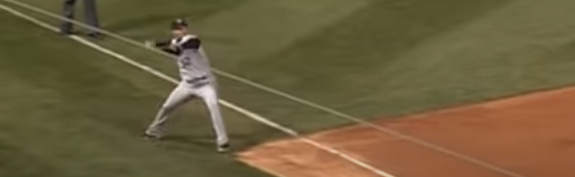
The best defensive play of the game was made by Twins third baseman Danny Valencia. Valencia went well into foul territory to field this ground ball hit by Carlos Quentin in the seventh inning.
Valencia did not rate well as a third baseman either that season (-13 Runs Saved, 3rd-worst in MLB) or for his career (-37). But he made a Matt Chapman-like play to get this out. Our calculations were that this ball had a 61% out probability (in an era before we could consider positioning), so it wasn’t a completely improbable play. Valencia got the desired result.
There were several examples in which the Twins’ defensive positioning was sharp. The best example of that was the first out of the game. Alexei Ramirez entered 10-for-20 against Liriano and hit a line drive right at Valencia.
The next-best looking defensive play came in the fourth inning when center fielder Denard Span chased down Quentin’s fly ball, one that had a 70% out probability. Span was the best defensive player the Twins had that season, leading the club with 9 Runs Saved.
Them’s the Breaks
Liriano didn’t seem to benefit much from home plate umpire Bruce Dreckman, but he got a little help from first base umpire Paul Emmel who called Gordon Beckham out at first base when Justin Morneau missed on his attempt to complete a double play with a swipe tag in the eighth inning.
Instant replay didn’t exist for calls on the bases until 2014, so there wasn’t anything Beckham or manager Ozzie Guillen could do other than protest. For what it’s worth, Emmel ranks middle-of-the-pack among umpires on calls at first base on what we deem “50-50 plays” in that time. He just happened to not get this one right.
Done (Dunn) Shifting
The use of defensive shifts in 2011 pales in comparison to how often they’re used in 2019. By our count, teams shift more than 20 times more often now than they did then. But there were a few hitters against whom defensive shifts were used at least semi-regularly. One of them was Adam Dunn.
Dunn hit balls to the right of second base 78% of the time in 2011, which meets the SIS threshold as a shift candidate. He stayed true to that in the first two times that he put the ball in play, hitting into a 4-6-3 double play and grounding to first base. With two outs in the ninth inning, Dunn was the White Sox last hope to get a hit. With Liriano’s pitch count at 116 entering the at-bat it figured that he was tiring, so it stood to reason that there was an even higher likelihood that Dunn would pull the ball.
But the Twins stayed true to what they did that season. Minnesota had the third-fewest balls in play against their shifts of any team in the majors. It amounted to about one ball in play against a shift every five games.
So though Tolbert was cheating towards second base, he wasn’t shifting. And that was a good thing because when Dunn oddly timed a slider and lined it to the left side, Tolbert was able to quickly shuffle two steps to his right to make the catch. That ball had a 67% out probability against an unshifted defense at that time.
However, line drives hit to that approximate area by left-handed batters against fully-shifted defenses in 2019 (meaning three defenders on the right side) were turned into outs 25-of-106 times (24%).
Not shifting Dunn there was an unorthodox decision that got a good result. An unorthodox but good result is also appropriate in describing this no-hitter.
Over the last nine years, I have created and adjusted a metric that is intended to be a useful tool to evaluate a hitter’s offensive season. It has undergone a few name changes, but I currently call it Offensive Expected Value (OEV). The people at SIS, where I work as a Video Scout, are allowing me to share it here. This is work that I’ve done independent of my work there and is a work-in-progress. I welcome any feedback on it.
The point of the stat is to give a player a value on their offensive output based on their at- bat results, similar to Weighted On-Base Average (wOBA). The most important difference being this: Instead of just hit types and reaching base getting different weights, out types are assigned different weights as well.
To make things a little simpler, the stat groups types of outs into bins of differing values. For example, sacrifice flies are grouped in with regular fly outs, as to not punish a player in a lineup with fewer guys who get on base to drive in from third. Hypothetically, a player on a weaker offensive team could be turning those regular fly outs into sacrifice flies. The groupings have been reconsidered every year, and I continue to look for an answer.
Another difference between it and wOBA is that the weights are looked at as “base values” instead of run values. Each valuation is supposed to match the bases their team would gain when the average base-situation was taking place. I have studied Run Expectancy tables to try to find what the proceeding, semi-arbitrary weight valuations should be. For 2019, here is how each category was laid out:
Home Runs
6.68
Triples
4
Doubles
3.52
Singles
1.48
Walks + HBP
1.12
Reached on error + Catcher Interference
0.52
“OOuts” (Including Sac Flies & Fly Outs)
0.17
“IOuts” (Including Fielder’s Choices and Sac Bunts)
0.09
“SOuts” (Infield Pop Ups & Lineouts + Strikeouts)
0
“MOuts” (Double Plays & Triple Plays)
-0.1925
One unique bit about OEV that this table shows is that reaching on an error or a catcher interference is counted as being on base, at least in part. The batter has some ownership of his advancement by putting the ball in play, so I’m giving him some credit for that.
You can also easily isolate just the extra-base hits component of the stat, similar to Isolated Power, which I call Power Expected Value, or PEV. To keep this piece lighter, I’m leaving PEV to the side for now.
If you’re following a game’s play-by-play on FanGraphs, the play results come from SIS’ software. So, for the 2019 season, I had access to SIS’ database, and with the gracious assistance of Alex Vigderman of our R&D staff, I was able to write a SQL code that produced each player’s OEV.
Below are the top 30 players in Offensive Expected Value versus the Top 30 in wOBA.
Player
OEV
Player
wOBA
1
Christian Yelich
1.128
1
Christian Yelich
.442
2
Mike Trout
1.103
2
Mike Trout
.436
3
Nelson Cruz
1.077
3
Alex Bregman
.418
4
Cody Bellinger
1.077
4
Nelson Cruz
.417
5
Alex Bregman
1.030
5
Cody Bellinger
.415
6
Anthony Rendon
1.026
6
Anthony Rendon
.413
7
Pete Alonso
1.014
7
Ketel Marte
.405
8
George Springer
1.013
8
George Springer
.400
9
Ketel Marte
1.008
9
Juan Soto
.394
10
Miguel Sano
1.001
10
Nolan Arenado
.392
11
Nolan Arenado
.999
11
Xander Bogaerts
.390
12
Josh Bell
.990
12
Anthony Rizzo
.390
13
Charlie Blackmon
.986
13
Freddie Freeman
.387
14
Jorge Soler
.984
14
Charlie Blackmon
.387
15
Eugenio Suarez
.981
15
Mark Canha
.386
16
Xander Bogaerts
.973
16
J.D. Martinez
.386
17
Austin Meadows
.966
17
Peter Alonso
.384
18
Rafael Devers
.964
18
Jeff McNeil
.384
19
Freddie Freeman
.962
19
Aaron Judge
.382
20
Juan Soto
.962
20
Eugenio Suarez
.381
21
J.D. Martinez
.960
21
Mookie Betts
.380
22
Trevor Story
.958
22
Trevor Story
.380
23
Matt Olson
.956
23
Carlos Santana
.380
24
Joc Pederson
.945
24
Austin Meadows
.380
25
Edwin Encarnacion
.944
25
Yoan Moncada
.379
26
Aaron Judge
.944
26
Kris Bryant
.379
27
Jose Altuve
.943
27
Jorge Soler
.378
28
Jeff McNeil
.939
28
Miguel Sano
.378
29
Yuli Gurriel
.939
29
Josh Bell
.378
30
Yoan Moncada
.936
30
Rafael Devers
.377
The top six hitters in both statistics feature the same names, in a slightly different order. While Mike Trout did reach base more than Christian Yelich in 2019, Yelich netting more extra-base hits was the biggest reason for him holding a lead over Trout in OEV.
One noticeable trend is how high home run rates really helped hitters like Pete Alonso (17th in wOBA, 7th in OEV), Miguel Sano (28th in wOBA, 10th in OEV), Matt Olson (43rd in wOBA, 23rd in OEV), Joc Pederson (t-49th in wOBA, 24th in OEV), and Edwin Encarnacion (t-49th in wOBA, 25th in OEV). A year like 2019, where the ball was leaving the ballpark at an all-time high rate, makes it more difficult to really know what the value of a home run hitter is, but we can see that extreme home run hitters can still stick out among the pack.
While strikeouts have risen with home runs, there are five hitters knocked down to the 22nd -26th range that all had strikeout rates above 30%. The stat is meant to counteract the belief that it’s okay for hitters who frequently hit the ball out of the ballpark to strike out, because not putting the ball in play wouldn’t advance a hypothetical runner on base.
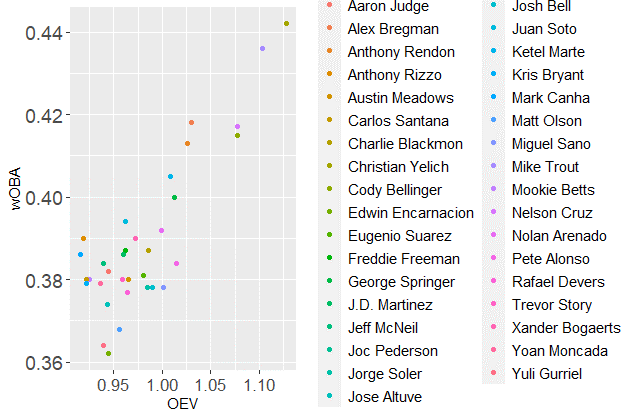
I plotted the wOBA and OEV of every player that was either in the Top 30 of wOBA or the Top 30 in OEV in 2019:
Top 30 Hitters by wOBA or OEV, 2019
Anthony Rizzo is one of the bigger outliers, ranking 46th in OEV (.919) but 12th in wOBA (.390). Pearson’s coefficient for the correlation between OEV and wOBA is .84, indicating a strong positive correlation, but there’s enough of a difference to explore the differences between the two metrics.
wOBA Versus OEV by Home Run Rate, 2019 Top Hitters
Here, you can continue to see that home run rate has a large impact on Offensive Expected Value, although maybe not in the way you’d expect. In both wOBA and OEV, there are three players with Home Run rates between 5.0% and 5.9% (Alex Bregman, Anthony Rendon, and Ketel Marte) with more value than anyone in the 6.0-6.9% range (e.g. Nolan Arenado, Josh Bell). That combined with the fact that the low-homer group tended to have lower OEV than wOBA (relative to their scales) shows that OEV doesn’t value home runs too highly.
wOBA Versus OEV by On-Base Percentage, 2019 Top Hitters
There’s a higher Pearson correlation between Home Run Rate and OEV than “on-base” percentage and OEV (.65 to .51), because of how much weight is put into home runs. However, in running a similar model for four bins of the non-traditional “on-base” percentage, there seems to be a little more of a constant where player’s OEV and wOBA go up with their OEV-based on-base average while the four groupings of home run rate are a little more clustered.
Next, I explored the relationships between a couple out types and a player’s OEV. Here I’m looking at SOuts (i.e. outs that won’t usually advance a runner, or “sole outs”) and OOuts (i.e. outs that are hit to the outfield).
OEV by SOut and OOut Rate, 2019
Ideally, a player would want to have a higher OOut than SOut, as a fly out could advance a potentially important baserunner, and anything that falls under SOut would not. You can see there are three players in the highest range of OEV falling nicely in the bottom right corner. That’s Anthony Rendon, Alex Bregman, and Cody Bellinger.
While not every at bat is crucial, there is value in a hitter who can hit into what’s considered a “productive out.” I also think that taking in every single plate appearance of a hitter’s season tells a better story of their season.
One limitation of the metric is that in a game situation, advancing a runner from third to home is more valuable than from first to second, but having a context-neutral element adds some fairness for fly ball hitters.
Even though baseball fans that carry an “old-school” mindset have a reputation for being averse to learning any new metric that comes out, I believe Offensive Expected Value can help bridge that gap, because it ties into the belief in productive outs, and brings value to those at bats. Thanks to SIS for allowing me to show this stat here.
On this episode of the Sports Info Solutions Baseball Podcast, Mark Simon (@MarkASimonSays) is joined by Coastal Carolina (@CoastalBaseball) outfielder Parker Chavers (@pchavers14). Parker was a preseason All-American and a two-time All-Sun Belt conference selection who missed the start of 2020 due to a shoulder injury. Prior to the injury he was ranked among college baseball’s top outfielders and was particularly praised for his arm strength. He’s viewed as anywhere from a Top 50 to Top 100 selection in this week’s MLB Draft.
Parker talks about how he’s feeling with the draft upcoming (2:16), what went into developing his arm and what has gone into rehabbing his torn labrum (2:31). He provides a self-scouting report on his defense, his hitting approach, and his power (6:58). He also explains why he models his game after Andrew Benintendi and Adam Eaton (10:55) and praises the coaches who helped him get to this point (13:17).
Mark is also joined by SIS Video Scout Associates Brandon Tew (@BrandonTeweets) and Corey Leaden (@cleaden24) (15:37). They dissect the top seven college baseball prospects in the draft, from first baseman Spencer Torkelson to outfielder Heston Kjerstad and pitcher Reid Detmers (18:56). They also provide tips to anyone looking to evaluate college baseball players (32:16).
The Sports Info Solutions Video Scouts recently conducted a two-round mock draft in conjunction with SIS’ college draft prospects series. Below is the two rounds of picks, along with a brief explanation on why each pick makes sense for that team (and links to scouting reports we’ve created on the top seven college prospects). While expected draft position is taken into account, picks are more so based on each team’s recent draft strategy, farm system composition and overall competitive outlook over the next few years.
While taking a first baseman at #1 is not typically the norm (Adrian Gonzalez, 2000), Torkelson’s plus hit and power tools that play to all fields are too tantalizing to pass up for Detroit.
Martin provides positional versatility. Having the opportunity to pair Adley Rutschman would gives the Orioles a huge boost of talent with two guys that can potentially be your No. 2 and No. 3 hitters for years to come.
The Marlins nab the the best fastball-slider combo (both plus-plus) in the draft in a dominant, sturdy SEC lefty. Lacy offers true ace potential to an already deep Marlins farm system, with his fastball that averages greater than 20″ of vertical movement, well above major league average.
Selected by Adam Sinkoe
Pick
Team
Player
Position
School
4
Royals
Zac Veen
OF
Spruce Creek HS (FL)
With a plethora of promising young pitching prospects acquired in recent drafts, the Royals will use their early first round pick to take a high-upside high school bat for the second year in a row.
The Blue Jays have spent 7 of their last 8 first round picks on college players. They continue that trend by selecting the high floor, high ceiling SEC right-hander. With a plus fastball, three above-average secondary pitches and ideal size size, Hancock has the makings of a future ace.
Selected by Evan Dennis
Pick
Team
Player
Position
School
6
Mariners
Max Meyer
RHP
Minnesota
With his combination of high-90s fastball and plus-plus slider, Meyer already has the stuff to be an MLB reliever this season if needed. Though lacking in size at just 6’0″ and 185 lbs, Meyer has shown he can be an effective starter, could project as a future front-line starter for the Mariners.
Pittsburgh couldn’t pass on the leader in home runs, runs, RBI, and total bases in all of college baseball through the 2020 shortened season. Gonzales will hope to join Kevin Newman in Pittsburgh to form a solid hitting duo in the middle of the infield for years to come.
The Padres should add to their minor league pitching depth with Detmers. He has a three-pitch mix with a devastating breaking ball. Detmers has the ability to become a front-to-mid rotation starter with his strong and durable frame.
Selected by Danny Jimenez
Pick
Team
Player
Position
School
9
Rockies
Robert Hassell
OF
Independence (TN)
The best pure hitter in the 2020 prep class Hassell has all the tools to be a solid MLB player and even a star. With a sweet lefty swing and an already advanced approach at the plate. Hassell, a gap-to-gap hitter couldn’t ask for a better home ballpark than Coors Field.
Selected by Brandon Tew
Pick
Team
Player
Position
School
10
Angels
Garrett Crochet
LHP
Tennessee
Any of the 4 top tier college arms would have been a tremendous value here. The Angels need front-line pitching. Crochet’s fastball has increased from 91-95 to 96-100 mph while maintaining its high spin rates. Taking him this high is a moderate risk with safer college arms available.
Selected by Matt Skiba
Pick
Team
Player
Position
School
11
White Sox
Nick Bitsko
RHP
Central Bucks East (PA)
The White Sox have built their foundation around power arms and bats as they have assumed the one of the better farm systems in baseball entering 2020. That recent trend will continue with Bitsko and his electric arsenal that reclassified from the 2021 class in January.
Selected by Tony Piraro
Pick
Team
Player
Position
School
12
Reds
Garrett Mitchell
OF
UCLA
Mitchell has been on prospect boards ever since high school and has worked on his weaknesses during his time at UCLA increasing his prospect rank. He is a five-tool talent with the strongest tool being his speed. If he is still on the board at pick No. 12, expect the Reds to draft him for a steal.
Selected by Alex Courtney
Pick
Team
Player
Position
School
13
Giants
Tyler Soderstrom
C
Turlock HS (CA)
One of the most polished prep bats in the draft, Soderstrom has impressed scouts with his athletic ability to move around the field. A 6’2 frame that will have the ability to fill out as he gets older, makeup off the charts, I believe San Francisco likes the high-ceiling prep bat here at 13.
Selected by Darren Trainor
Pick
Team
Player
Position
School
14
Rangers
Tanner Burns
RHP
Auburn
Hiding in plain sight for much of his college career at Auburn, Burns consistently navigated the toughest SEC competition with great poise and success. While durability concerns loom, his experience and ability to command pitches at an advanced level makes him a great fit.
Kjerstad has received notoriety from scouts for being the best left-handed power hitter in this year’s draft class. Given the Phillies lack of organizational depth in the outfield, they search for long-term options alongside Bryce Harper in the outfield.
Selected byJoseph Wittreich
Pick
Team
Player
Position
School
16
Cubs
Cade Cavalli
RHP
Oklahoma
The Cubs tend to draft college players early in drafts, and Cavalli fills the need for pitching depth in their rebuilding minor league system. He brings effortless velocity, a nasty curveball, and the potential to develop 2-3 more really solid pitches.
Selected by Vince DiSilvio
Pick
Team
Player
Position
School
17
Red Sox
Bryce Jarvis
RHP
Duke
An organization in desperate need of starting pitching, the Red Sox try to get some help from a class loaded with it. Jarvis fits the starting pitching mold with four average-to-above offerings, and plus control. Also his dad Kevin played 13 seasons in the majors; his last with the Boston Red Sox.
Selected byCorey Leaden
Pick
Team
Player
Position
School
18
D- Backs
Pete Crow-Armstrong
OF
Harvard- Westlake HS (CA)
Potential 5-tool outfielder, from a high school that has produced numerous major league players. A Vanderbilt commit; which are usually tougher to sign. The upside is worth the risk for the D-Backs holding another first round pick.
Selected by Justin Stine
Pick
Team
Player
Position
School
19
Mets
Mick Abel
RHP
Jesuit (OR)
After letting Wheeler walk and trading away their fourth-and-sixth best prospects for Stroman, both pitchers, they double down on the position after drafting Matthew Allan in the second round last year hoping to replenish it.
Selected by Alexander Arcidiacono
Pick
Team
Player
Position
School
20
Brewers
Patrick Bailey
C
NC State
An organization that is desperate for farm system talent gets their guy here at No. 20. Bailey a switch hitting catcher that has shown plus power in his time at NC State gives the Brewers another strong potential backstop in their minor league ranks.
Selected by Luke Iorio
Pick
Team
Player
Position
School
21
Cardinals
Ed Howard
SS
Mount Carmel (IL)
Howard has good middle-infield defensive ability and offensive upside. The consensus for Howard is that he is a top-15 pick, so the Cardinals are glad to get him here at 21.
Selected by Allen Ho
Pick
Team
Player
Position
School
22
Nationals
Cole Wilcox
RHP
Georgia
Wilcox honored his commitment to Georgia after the Nationals drafted him out of high achool in 2018. An organization that usually goes with college pitching in the first round, the Nationals should pounce on another chance to have Wilcox, and his mid-90s fastball.
Selected by Corey Eiferman
Pick
Team
Player
Position
School
23
Indians
Austin Hendrick
OF
West Allegheny HS (PA)
Since 2016, The Indians have used all of their first-round picks on high school talent. They continue to go in that direction by taking Hendrick. Hendrick’s combination of athleticism and power give the Indians a potential high impact bat in the outfield.
Selected by Ben Jaffy
Pick
Team
Player
Position
School
24
Rays
Casey Martin
SS
Arkansas
The Rays have one of the strongest farm systems in the MLB. They now have the ability to take a risk and draft someone with high upside. Casey Martin fits that mold with concerns about his hit ability, but an extremely high ceiling.
Selected by Chris Dominguez
Pick
Team
Player
Position
School
25
Braves
Jared Kelley
RHP
Refugio (TX)
In 2019 the Braves went safe in what was probably their last year with high picks for the foreseeable future. Kelley has a natural feel for the art of pitching and knows how to work the strike zone, both of which are traits that the Braves know how to develop and capitalize on.
Selected by Sales Pinckney
Pick
Team
Player
Position
School
26
Athletics
Bobby Miller
RHP
Louisville
The Athletics have used their late first-round picks to pick high ceiling college talent and Miller fits that mold with two high velocity fastballs that he is able to blow by hitters. Miller ranks among the hardest throwers in this year’s Draft.
Selected by Bryan Borruso
Pick
Team
Player
Position
School
27
Twins
Dillon Dingler
C
Ohio State
The draft can go a lot of ways for them and if given the opportunity to take Dingler, C, Ohio State, the Twins will to fill in the lack of depth they have behind the plate as an organization. Dingler is a catcher with pop who hit .291 in his sophomore effort with 14 extra base hits including 3 home runs.
Selected by Ethan Young
Pick
Team
Player
Position
School
28
Yankees
Clayton Beeter
RHP
Texas Tech
Beeter features a fastball in the mid-90s that can reach the upper-90s. The 6’2″ right-hander had Tommy John surgery before his freshman season, and while there are concerns about his durability, his upside could be too much for the Yankees to pass on.
Selected by Brendon Baker
Pick
Team
Player
Position
School
29
Dodgers
Austin Wells
C
Arizona
With defensive minded catcher Keibert Ruiz already in the system, an offensive first catcher is a great option for the Dodgers. Wells is a powerful left-handed hitter with above-average bat control that can be moved around in the field to ensure his bat is in the lineup.
Selected by Stephen Marciello
Competitive Balance Round A
Pick
Team
Player
Position
School
30
Orioles
Justin Lange
RHP
Llano HS (TX)
Lange might be the biggest question mark in this draft. His velocity increased from low 90s to touching 100 but wasn’t super consistent in the shortened spring season. With the Orioles in the middle of a rebuild and still many years from a playoff run they have time to develop him.
Selected by Payton Kuhnel
Pick
Team
Player
Position
School
31
Pirates
Slade Cecconi
Miami
Miami
The Pirates need some help in their starting pitching rotation, and Cecconi would be a perfect fit. Cecconi has a 4.09 ERA with 119 strikeouts in 101 1/3 innings in parts of 2 seasons with Miami, including a 3.80 ERA and 30 strikeouts in 21 1/3 innings in four starts.
Selected by Drew Onder
Pick
Team
Player
Position
School
32
Royals
Carmen Mlodzinski
RHP
South Carolina
The Royals could go a number of different ways here, but since they grabbed a position player with their first selection, they will elect to draft a pitcher here and add to their stockpile of talented young arms. The Royals love their pitching prospects, and Mlodzinski is a first round talent.
Selected by Trey Lake
Pick
Team
Player
Position
School
33
D-Backs
Justin Foscue
2B
Mississippi State
After going high risk high reward with first pick, the D-Backs go with a safer option here in a college bat with under slot potential. Foscue also offers infield defensive flexibility, and someone who should be a solid depth piece if not more.
Selected by Justin Stine
Pick
Team
Player
Position
School
34
Padres
Isaiah Greene
OF
Corona HS (CA)
This left handed hitting outfielder will bring skills that the Padres are lacking at the major league level. Greene has an athletic built and is very fast on the base paths. He has the speed to be a major league center fielder.
Selected by Danny Jimenez
Pick
Team
Player
Position
School
35
Rockies
Aaron Sabato
1B
North Carolina
With the universal DH possibly on the horizon the Rockies could just take the best power bat available. Sabato has exceptional strength from the right-handed batter’s box, with average defense. He has a bat and approach that could flourish at Coors Field.
Selected by Brandon Tew
Pick
Team
Player
Position
School
36
Indians
Seth Lonsway
LHP
Ohio State
The Indians have done a very good job of developing pitching. Lonsway possess one of the best curveballs in this year’s draft. Cleveland should feel confident that their development can help Lonsway make the most of his stuff and become a major league starter.
Selected by Ben Jaffy
Pick
Team
Player
Position
School
37
Rays
Daniel Cabrera
OF
LSU
The only “weakness” in the Rays farm system (if there is any) involves too many question marks in the outfield. Drafting a pure hitter like Daniel Cabrera gives the Rays more optimism in that area.
Selected by Chris Dominguez
Round 2
Pick
Team
Player
Position
School
38
Tigers
Nick Loftin
SS
Baylor
Loftin played five positions with Team USA last summer, showing off his plus instincts and a strong hit tool displayed with (Baylor, Cape Cod, Team USA).
Selected by Jeff Israel
Pick
Team
Player
Position
School
39
Orioles
Chris McMahon
RHP
Miami
McMahon improved every year and had a 1.05 ERA in 25 innings pitched before play was stopped this year. At 6’2 217, he has a solid build and provides plus stuff to miss the big bats of the AL East.
Selected by Christian Chavez
Pick
Team
Player
Position
School
40
Marlins
Jordan Walker
3B
Decatur HS (GA)
Miami has shown a clear preference for high-risk high-reward players under the 2 years of new ownership, and with no third basemen in their top 30 prospects, prep bat Jordan Walker fits the bill.
Selected by Adam Sinkoe
Pick
Team
Player
Position
School
41
Royals
Drew Romo
C
The Woodlands (TX)
The Royals have a recent track record of being able to sign away high school catchers (Melendez, 2017) and will take a chance they can do the same with Romo, a switch-hitting catcher.
Selected by Trey Lake
Pick
Team
Player
Position
School
42
Blue Jays
Blaze Jordan
1B
DeSoto Central HS (MS)
More than just a plus-power hitter, he was the No. 1 recruit in the class of 2021 before reclassifying. Jordan comes with elite makeup and a very high ceiling.
Selected by Evan Dennis
Pick
Team
Player
Position
School
43
Mariners
Yohandy Morales
3B
Braddock HS (FL)
With a lack of depth in their farm system at third base, the Mariners decide to draft a project player with high upside in Yohandy Morales. Standing at 6’4″, Morales already displays plus raw power.
Selected by Sam Waisanen
Pick
Team
Player
Position
School
44
Pirates
Chase Davis
OF
Franklin HS (CA)
Chase Davis has a cannon for an arm and has been clocked throwing 99 mph from the outfield. This pick could prove to be a solid depth piece for the Pirates, but also has the potential to be a star.
Selected by Andrew Onder
Pick
Team
Player
Position
School
45
Padres
Carson Montgomery
RHP
Windermere Prep HS (FL)
Carson has the ability to become a either a back of the bullpen pitcher or a front-end starter. The Padres could develop Carson to help out their pitching staff.
Selected by Danny Jimenez
Pick
Team
Player
Position
School
46
Rockies
Cade Horton
RHP/ SS
Norman (OK)
Signability is a major concern as he’s committed to play two sports at Oklahoma. The future Sooners QB might have a high asking price. Rockies get a compensation pick if they are unable to sign him.
Selected by Brandon Tew
Pick
Team
Player
Position
School
47
White Sox
J.T Ginn
RHP
Mississippi State
Chicago’s love for SEC talent leads the White Sox to their prized pitching prospect from Mississippi State. In 2019, the Sox selected seven pitchers with their first 10 picks and it continues here in 2020.
Selected by Tony Piraro
Pick
Team
Player
Position
School
48
Reds
C.J Van Eyk
RHP
Florida State
The Reds would more than likely use their second draft pick for a pitcher after picking up a much-needed outfielder in the first round. The Reds’ top prospects are mostly position players.
Selected by Alex Courtney
Pick
Team
Player
Position
School
49
Giants
Jared Jones
RHP
La Mirada HS (CA)
Jones’s has a fairly strong commitment to Texas. San Francisco would be betting on the ceiling of the pure stuff that Jones possess as an 18-year-old with signability concerns.
Selected by Darren Trainor
Pick
Team
Player
Position
School
50
Rangers
Alika Williams
SS
Arizona State
Sticking to the theme of adding seasoned college players with the ability to rise through the system quickly, Williams makes perfect sense here in Round 2 as a defensive minded shortstop
Selected by Andrew Delzotto
Pick
Team
Player
Position
School
51
Cubs
Logan Allen
LHP
Florida International
With both Jose Quintana and Jon Lester’s contracts ending by 2022, the Cubs are going to need major league ready pitching soon, and there isn’t much of that in their farm system right now.
Selected by Vince DiSilvio
Pick
Team
Player
Position
School
52
Mets
Hudson Haskin
OF
Tulane
He can help fill the Mets’ void in their farm system left by the Jared Kelenic trade. Specifically, none of their top 15 prospects are outfielders and only three are in the top 30 (according to MLB pipeline).
Selected by Alexander Arcidiacono
Pick
Team
Player
Position
School
53
Brewers
Alex Santos
RHP
Mount St. Michael Academy (NY)
The formula for winning baseball games today is clear: power. The Brewers add a young power arm here at pick 53 with Alex Santos. At just 18 years old Santos is already hitting 95 on the radar.
Selected by Luke Iorio
Pick
Team
Player
Position
School
54
Cardinals
Dax Fulton
LHP
Mustang (OK)
Although their farm system top arms are all left handed (Matthew Liberatore, Zack Thompson and Genesis Cabrera), it’s only because they get Kwang Hyun Kim as the lone option for big leagues.
Selected by Allen Ho
Pick
Team
Player
Position
School
55
Nationals
Cole Henry
RHP
LSU
Despite not having quite the experience, the Nationals shouldn’t shy away from using both of their first two picks on draft-eligible college sophomore pitchers.
Selected by Corey Eiferman
Pick
Team
Player
Position
School
56
Indians
Masyn Winn
RHP/ SS
Kingwood (TX)
Winn is one of the rare prospects that has a legitimate future either as a pitcher or a position player. On the mound, he pairs a 98-mph fastball with a plus curveball and a changeup.
Selected by Ben Jaffy
Pick
Team
Player
Position
School
57
Rays
Ben Hernandez
RHP
De La Salle Institute (IL)
Nothing wrong with having too much pitching! The Rays have been a model organization for developing pitchers for years. Hernandez adds to their already potentially strong future rotation.
Selected by Chris Dominguez
Pick
Team
Player
Position
School
58
Athletics
Jeff Criswell
RHP
Michigan
Criswell maintained his stuff and velocity when transitioning from reliever to starter. If he can do a better job of locating his pitches, he could develop into a mid-rotation starter.
Selected by Bryan Borruso
Pick
Team
Player
Position
School
59
Twins
Tanner Witt
RHP
Episcopal (TX)
At 6’6″ Witt is a long, young, high upside prospect. The trouble will be getting him to turn down his commitment to Texas which, if he does, could make him a steal late in the second round.
Selected byEthan Young
Pick
Team
Player
Position
School
60
Dodgers
Jordan Westburg
SS
Mississippi State
Westburg is a big shortstop with a lot of power in his bat and plus defensive prowess. With the ability to also play third base, Westburg’s power bat will quickly carry him through the minors.
Selected by Stephen Marciello
Competitive Balance Round B
Pick
Team
Player
Position
School
61
Marlins
Jared Shuster
LHP
Wake Forest
His steady improvement every year in college utilizing data and technology is telling about his aptitude. It gives him a good chance to reach his potential of solid middle of the rotation starter.
Selected by Adam Sinkoe
Pick
Team
Player
Position
School
62
Tigers
Nick Garcia
RHP
Chapman University
Taking a Division III pitcher with little track record as a starter at No. 62 may seem a little out there, but Garcia’s stuff is worth this selection especially after a solid summer in the Cape Cod League.
Selected by Jeff Israel
Pick
Team
Player
Position
School
63
Cardinals
Tommy Mace
RHP
Florida
After picking a left-handed pitcher with the second-round pick, the Cardinals could use a right-handed pitcher to bolster their minor league depth also featuring a plus cutter to build on.
Selected by Allen Ho
Pick
Team
Player
Position
School
64
Mariners
Carson Tucker
SS
Mountain Pointe HS (AZ)
Brother of Pirates SS Cole Tucker, Carson is a lanky 6’2″ shortstop with plenty of room to develop. While not excelling in any one area, Tucker provides a well-balanced skillset across the board.
Selected by Sam Waisanen
Pick
Team
Player
Position
School
65
Reds
Jake Eder
LHP
Vanderbilt
He has had troubles with consistency and placement during his time at Vandy, the team would surely look at honing in on the southpaw’s abilities. He would be a mistake to pass on at this point.
Selected by Alex Courtney
Pick
Team
Player
Position
School
66
Dodgers
Burl Carraway
LHP
Dallas Baptist
Regarded as the best reliever and most MLB-ready player in this draft, this left-hander can reach the high 90s with the fastball with a plus-plus curveball can be an excellent addition to the Dodgers.
Selected by Stephen Marciello
Free Agent Compensation Picks
Pick
Team
Player
Position
School
67
Giants
Daniel Susac
C
Jesuit HS (CA)
Although the Giants took Soderstrom in the first round and Joey Bart knocking on the door at the big league level, they are betting on Susac developing into a catcher with power and arm strength.
Selected by Darren Trainor
Pick
Team
Player
Position
School
68
Giants
Caden Grice
OF/ LHP
Riverside HS (SC)
Teams that put heavy emphasis on algorithms on age, height, weight, skill rave about Grice who could go in the second round does have a commitment to Clemson but carries great upside.
Selected by Darren Trainor
Pick
Team
Player
Position
School
69
Mets
Kyle Harrison
LHP
De La Salle (CA)
One of the best left-handers at this point in the draft, might as well gamble for a position that is relatively expensive to pay in free agency (LHP). He has a deceptive delivery, and good control.
Selected by Alexander Arcidiacono
Pick
Team
Player
Position
School
70
Cardinals
Drew Bowser
3B
Harvard-Westlake (CA)
Cardinals can opt for offensive upside here to raise the ceiling for their big league lineup in the future. Bowser is still young enough at 18 and needs time to develop.
Selected by Allen Ho
Pick
Team
Player
Position
School
71
Nationals
Gage Workman
3B
Arizona State
It’s impossible to replace the most vital position player on a World Series team, but with the departure of Anthony Rendon, the Nationals need to get some close-to-MLB ready talent at 3B.
Selected by Corey Eiferman
Pick
Team
Player
Position
School
72
Astros
Nick Swiney
LHP
NC State
The Astros could use a LHP in their starting rotation and bullpen as well. He spent two seasons as a middle reliever for the Wolfpack where he went 11-1 and moved to the starting rotation in 2020.
A few years ago, MLB’s Mike Petriello wrote about Odubel Herrera being the “Kelly Leak” of outfielders, meaning that he often tried to field balls that were more difficult for him than it would have been for his teammate.
The reference comes from “The Bad News Bears,” in which the character Kelly Leak would try to win at all costs, including going all-out to field any ball he had a shot at, even if another player was in better position. It’s great that you can get to a wide range of balls, sure, but sometimes it’s better to let someone else handle the play.
With the new Defensive Runs Saved calculation we implemented a few months ago, we calculate the out probabilities necessary to answer this question for infielders. We can use the batted ball characteristics as well as the starting positions of each fielder to find plays where the corner infielder snags a grounder that the middle infielder actually had a greater chance of turning into an out.
An example of how things can go very wrong would be this play, where Wil Myers ranges to field a ball that Freddy Galvis was very much in position to field, and he goes on to airmail the throw.
Let’s take a look at the leaders in this bittersweet statistic. To qualify, the middle infielder who was cut off must have had at least a 20 percent chance of making the play if he had fielded it.
Most Plays Fielding a Grounder When a Deeper Infielder Had a Better Chance 2017-19 Corner Infielders; other infielder had at least a 20 percent out rate
Player
Pos
Plays
Alex Bregman
3B
51
Nolan Arenado
3B
41
Joey Votto
1B
40
Eugenio Suarez
3B
38
Evan Longoria
3B
36
Josh Donaldson
3B
31
Rafael Devers
3B
30
Justin Turner
3B
29
Carlos Santana
1B
28
Todd Frazier
3B
28
What should be clear from the names on this list is that grabbing grounders that the numbers suggest you shouldn’t isn’t an indicator of poor defensive quality overall. Many of these names have made numerous appearances on Fielding Bible Award ballots in recent years. In fact, even on these potentially-troublesome plays, all of the players on this list saved runs in aggregate, with Alex Bregman’s eight runs leading the way.
In general, that’s the case. Even if you make things harder on your team by ranging to make a play that another fielder might have made more easily, you are still likely to make the play. Of course, the onus is on you to execute once you field the ball, else you end up being the goat.
Five players in the past three years have “Kelly Leaked” their teammates at least ten times and have cost their teams runs overall across these situations. Interestingly, two of them are Cubs infielders with strong defensive skill sets, so being on this list isn’t necessarily an indicator of faulty defensive instincts.
Corner Infielders Who Cost Their Team Runs on “Kelly Leak” Plays 2017-19 Corner Infielders, minimum 10 opportunities
Player
Pos
Plays
Eric Hosmer
1B
12
Anthony Rizzo
1B
14
Kris Bryant
3B
14
Josh Bell
1B
26
Jake Lamb
3B
13
NOTE: All of these players cost between zero and one run on these plays in total
Say it Ain’t So, Renato!
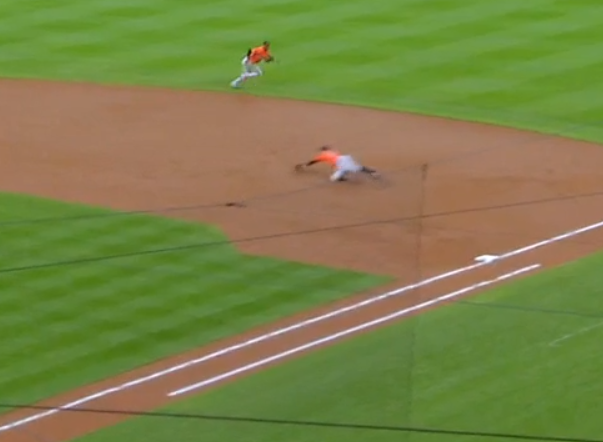
One player had a really rough go of things in this regard. In 2019 alone, on just three plays at first base, Orioles first baseman Renato Nuñez cost his team more runs than any of the above players by cutting off the second baseman on short grounders.
On this play, Nuñez dove and then airmailed a throw from his knees. Rockies outfielder Raimel Tapia was running, so there was some risk associated with letting the ball by, but the second baseman was in good position and as you can tell Tapia wasn’t far down the line.
This play was a much easier play for both possible fielders, as you can see by their positions. With a much slower Rockie running this time (Daniel Murphy), Nuñez again fails to complete the play by tossing the ball behind the pitcher coming over to cover the base.
This last play ends up being quite close, to the point that it might not have worked out even if the second baseman fielded it. Ketel Marte is running here, so again there’s some urgency, and again Nuñez throws behind the pitcher covering the base.
Nuñez’s ill-advised attempts granted three baserunners when letting the ball get to the second baseman likely would have eliminated them. Even if better throws would have changed the result, it’s important to emphasize that part of the reason Nuñez was in a worse position to make these plays is that the first baseman is moving away from the play when trying to make the throw to first, so the risk of an errant throw is part of the equation.
While it hasn’t been the case for Nuñez, it is interesting to find that making inefficient split-second decisions in the field isn’t a deal-breaker in terms of your value as a defender. Of course, it helps to be an excellent defender, because you can make up for those foibles on the back end.
2020 MLB Draft Top 5 College Baseball Prospect Rankings
Leading up to the 2020 MLB Amateur Draft,Baseball Info Solutions will be publishing a series of position-by-position scouting reports from two of our Video Scouts for the top 5collegiate draft prospects and two honorable mentions. Each player isgraded by the 20-80 scouting scale, given a comprehensive evaluation,and assigned a floor and a ceiling comparison, which indicate–if aplayer makes the Major Leagues–the range of the type of player intowhich he can develop.
Lacy is the best pitching prospect in the 2020 MLB Draft and it is because he turned himself into the unquestioned ace in College Station. Lacy rocketed up draft rankings and on the radar of scouts based on what he did his sophomore season. Lacy had a stellar campaign tossing a 2.13 ERA in 15 starts, led Division I in fewest hits allowed per 9 innings (5.0), and ranked eighth in strikeouts per 9 (13.2). Showing swing-and-miss ability, that also produces weak contact as batters rarely square his pitches.
Throwing with a fluid motion Lacy stays on balance and in rhythm. He creates a great downhill plane out of his high 3/4 arm slot. With Lacy shifting over more to the third base side of the pitching rubber he has been able to increase his downward movement while hiding the ball very well behind his back leg. He glides more to the arm side of his body towards first base and this causes him to throw across his body as he uncoils to the plate with max effort. Although, that might scare some injury-wise, his durable frame and build can hold up with this delivery and the added deception only elevates his pitches.
Throwing a plus fastball with increased velocity and vertical break, Lacy has also improved the spin rate of the pitch. This leads to an explosive fastball in the mid-’90s that stays at the top of the zone and misses bats. Lacy can easily reach back and hit 97 mph.
Lacy could have one of the best 4-seamers in baseball in a few years. His new and improved slider truly launched his draft stock. Arguably, the best projectable pitch in this draft. Lacy’s slider is more gyroscopic in spin, meaning it spins like a football spiraling towards the plate as gravity causes the ball to pull down to the ground. The result is a wipeout slider that ducks underneath the bat of a righty and down-and-away from lefties while being hard and tight.
Lacy is special because he can manipulate the spin on this pitch. He can get a tighter spin on the ball or more of a sweeping action to it. He can also turn the slider into more of a cutter depending on the situation and how he wants to attack a hitter but it is at its best when it’s hard and diving to the plate.
Lacy’s favorite pitch to throw is his changeup, a circle change with great depth and run, without losing arm action on the pitch allowing it to still look like a fastball at release. He still needs more consistency with the pitch but Lacy’s willingness to throw it to start at-bats as well as to end them is a promising sign.
Lacy’s command and control is the biggest issue. With a 4.4 BB/9, his Sophmore season he did improve that mark over the first three starts of this season lowering it slightly to 3.0. Unfortunately, the season was cut short after those three starts. The control and command issues are concerning as Lacy continues to work on honing his powerful offerings.
Although, he looked to turn the corner in this aspect during his last start of the season. Throwing seven innings of no-hit ball while striking out 13 against a New Mexico State lineup that featured Nick Gonzales and some other pro prospects.
He was pinpoint accurate during the start commanding his fastball and slider well. Lacy has a proven track record of striking out the best competition in college baseball carving up the SEC last season. His command has been suspect, but the performance against New Mexico State to end his college career only highlights Lacy can command the zone.
Summation:
A highly-competitive, elite, pitching prospect with two plus pitches that have a real chance to be 70 on the 20-80. Lacy lacks consistent command right now but has shown flashes of excellent control and command. With an advanced understanding of how to pitch and three potential above-average offerings depending on the development of his changeup. A potential dominant top of the rotation starter and future ace. Lacy is so dominant at points that if he reaches his true potential, he could start an All-Star game at some point in his MLB career.
Projection:
All-Star potential starter, with an elite fastball and slider combo, that possesses a solid four-pitch mix
2020 MLB Draft Top 5 College Baseball Prospect Rankings
Leading up to the 2020 MLB Amateur Draft,Baseball Info Solutions will be publishing a series of position-by-position scouting reports from two of our Video Scouts for the top 5collegiate draft prospects and two honorable mentions. Each player isgraded by the 20-80 scouting scale, given a comprehensive evaluation,and assigned a floor and a ceiling comparison, which indicate–if aplayer makes the Major Leagues–the range of the type of player into, which he can develop.
Not many baseball players can say they have broken a record that Barry Bonds held. That is what Torkelson did his freshman year at Arizona State launching 25 HR for the Sun Devils. Torkelson displayed great raw power in the batter’s box and followed up that performance with 23 HR in his sophomore season in Tempe. Torkelson has turned himself into the consensus number 1 pick on June 10.
Standing with a slightly open stance, Torkelson shifts his weight to his back leg as his front leg stays in rhythm as the pitcher starts to release the baseball. This allows Torkelson to explode towards the baseball with maximum energy and power. The power and bat speed is effortless as Torkelson never overswings and extends himself as a hitter.
With a tiny stride back towards the mound to square himself up. Torkelson then drops the bat head on the ball and whips the bat through the zone with a compact and smooth swing. With the elite bat speed Torkelson routinely lets outside pitches travel deeper into the zone and does not force anything as he drives the ball to the right side of the diamond.
Relaxed at the plate and extremely loose and comfortable, Torkelson can turn on inside pitches with ease while still display the rare ability to drive the ball out of the ballpark the other way. The loft he creates on his swing is impressive as he skies massive fly balls over the fence.
Torkelson has the unique talent and shows it off with his game power and raw power during batting practice. Even when Torkelson does not square a ball up, he still has enough strength to drive the ball out from foul pole to foul pole.
The power might stand out when you watch Torkelson, but he is a complete hitter taking pitches with good plate discipline and showing a great understanding of what he wants to accomplish at the plate.
Torkelson’s advanced approach at the dish rarely has him fooled with the same pitches in back-to- back at-bats. He punishes pitchers for making mistakes with hanging breaking pitches but also has the bat control to foul off nasty ones to get to the next fastball in the at-bat.
Torkelson hits the ball hard often, with a career batting average of .337 and an OPS of 1.166 has elite potential at the next level with his bat. Torkelson’s maturity and mental makeup and approach to the game remind me of Anthony Rizzo who has been a mainstay in the middle of the lineup and at first base for the Cubs the unquestioned leader of that team. Torkelson has those similar qualities to the lefty which make him a special prospect.
The defense at first base is solid. Torkelson has worked hard to refine his defensive skills and as a very good athlete he shows off baseball athleticism routinely by making movements and motions look easy that other guys find more challenging on a ball field.
Torkelson has a good glove at first base and an average arm that is accurate, and while he most likely will stick at first baseand be above average, teams could opt to move him to left field if needed. It could be rather quickly too as he displays the type of power that the last two Rookies of the Year in the NL possess in Roñald Acuna Jr. and Pete Alonso.
Summation:
An elite first base prospect with devastating power from the right side. Torkelson’s power coupled with his approach at the plate and plate discipline makes him a can’t-miss power bat in this year’s draft. He has potential to be first player to the majors from this class. Torkelson has the power to put up massive HR totals in the MLB and could put up 40 or more on a regular basis.
Projection:
All-Star caliber 1B with all the tools to be an elite bat
Ceiling: Pete Alonso, a right-handed Anthony Rizzo
Leading up to the 2020 MLB Amateur Draft, Baseball Info Solutions will be publishing a series of position-by-position scouting reports from two of our Video Scouts for the top-5 collegiate draft prospects and two honorable mentions. Each player is graded by the 20-80 scouting scale, given a comprehensive evaluation, and assigned a floor and a ceiling comparison, which indicate–if a player makes the Major Leagues–the range of the type of player into which he can develop.
It’s tough to find a player in this draft with a more complete game then Austin Martin. A late-round pick in the 2017 Draft, Martin went on to Vanderbilt and was a major piece of the 2019 National Championship. In his time at Vanderbilt he played many positions after coming in as a shortstop from HS, he also played first base, second base, third base, and center field.
Over his 140 games played as a member of the Commodores he hit .368/ .474/ .532 while hitting 14 homers and 43 stolen bases. He struck out in only 12% of at-bats showing a strong ability to put ball into play, walking slightly more at 13%. Martin is a savvy baserunner being able to take more bases then his above average speed would expect.
Martin has a slightly open stance with a slight knee bend. He has quiet hands and utilizes a leg kick to generate power as loads up. Martin shows great bat speed, easily turning on pitches middle-in with a quick compact swing. He is a patient hitter with a plus hit tool and an especially good eye on pitches on other side of plate. Martin is very relaxed in the box, with a balanced swing and has a knack of hitting the ball to wherever it is pitched. His high baseball IQ is displayed by being a strong situational hitter when needed and is also shown on the basepaths.
Martin has defensive question marks as he has played many positions in his time at Vanderbilt. He seems to be finding a home in center field where his athleticism can shine.
Defense is more of a question then an actual weakness as he looks natural in center but will take some time to adjust wherever he plays. He has the potential to make the move to second as well given his background playing the infield. He has many above-average tools but nothing jumps out as plus outside of his hit tool.
Summation
A guy who will hit in any spot of the order. Can set the table very well with the ability to drive the ball. Also carries above-average power and speed to impact the game in many ways. Defense is unclear but looks best suited in the outfield. Second base is an option. He comes from a strong program and is used to playing in big games
Projection
An impactful player who will hit in the top third of order and can be deployed defensively to suit a team’s needs.