Category: Baseball

  • Astros defense has been both excellent and reliable

    Astros defense has been both excellent and reliable

    By MARK SIMON

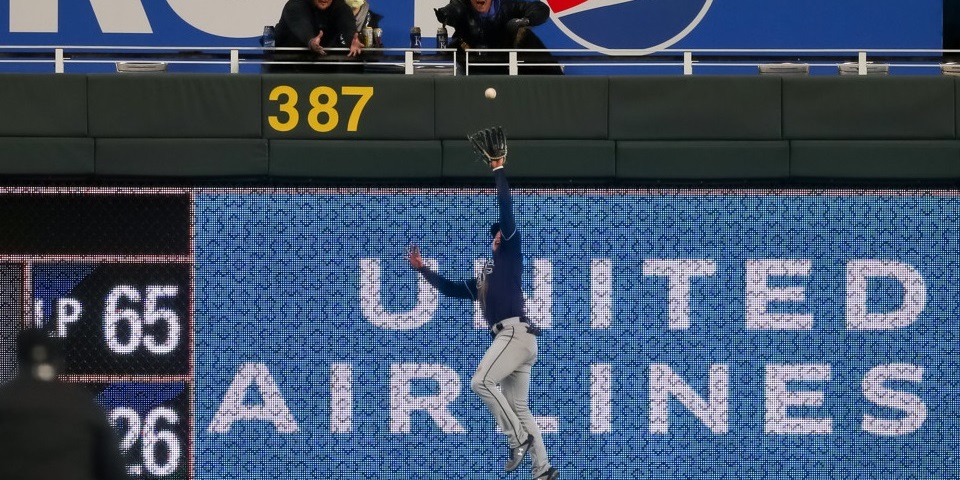
    The Astros have won 11 straight games, with last night’s win punctuated by a Michael Brantley home run robbery.

    So this seems like a good time to talk about Houston’s defense.

    The Astros rank second in the majors in Defensive Runs Saved, trailing only the Rays. And it’s a pretty simple explanation as to what’s driving their total.

    Most Defensive Runs Saved ÔÇô 2021 Season

    Team Defensive Runs Saved
    Rays 63
    Astros 48
    Nationals 44
    Rockies 39

    The Astros rank first in the majors in turning ground balls and bunts into outs (79%) and they rank first in the majors in turning balls hit in the air into outs (69%).

    There are a few different factors in play to explain the Astros out rates being so high.

    The shifts

    The Astros’ combination of positioning and skill when it comes to defensive positioning is unmatched by any team in 2021.

    The team’s out rate on grounders, bunts and liners when using a defensive shift is 80%.

    Highest Out Rate on Grounders, Bunts, Liners ÔÇô When Using a Shift (2021)

    RK Team Out Rate
    1 Astros 80%
    2 Rockies 78%
    3 Padres 78%
    4 White Sox 77%
    15 Marlins 74%
    30 Red Sox 70%

    The purpose of including the Marlins and the Red Sox was to make this point:

    If the Astros had the Marlins out rate, they would have gotten outs on 30 fewer balls. If they had the Red Sox out rate, they would have gotten outs on 53 fewer balls.

    Sixty two percent of opponents’ batted balls have come against an Astros shift, the 10th-highest rate in the majors. The Astros have the third-highest rate of using a full shift (three infielders on the pull side of second base), with 46% of batted balls coming against that alignment.

    The point of separation between the Astros and other teams is in shifting against right-handed batters. Their out rate on grounders, bunts, and liners against those hitters is 82%. The next-closest team is the Pirates at 78%.

    The Astros don’t overly shift against right-handed hitters. They pick their spots. They rank right in the middle in shift usage against them. But they get lots of outs.

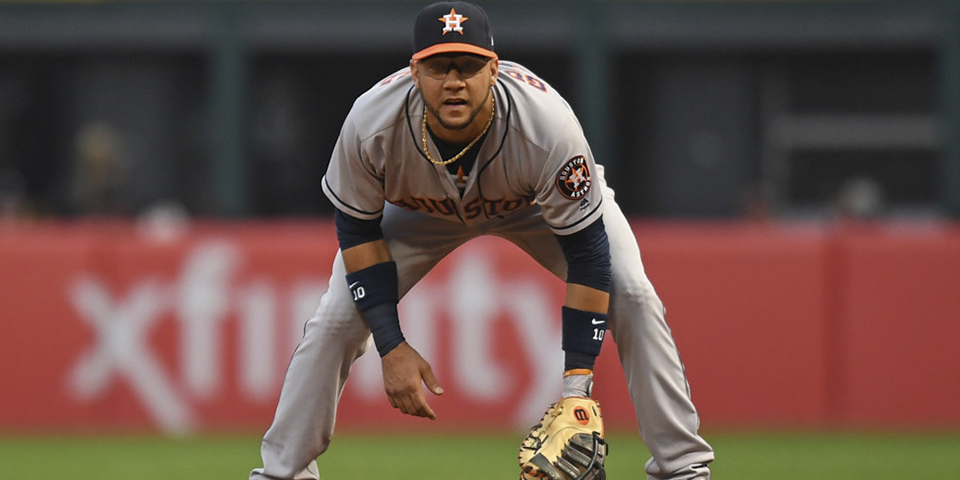
    The best payoff from that comes on a play like this one by José Altuve.

    or this one

    There are also grounders hit in the ‘56’ hole that Carlos Correa is able to turn into outs

    And the surehandedness of Alex Bregman comes in handy too. On this play, having Altuve positioned so close to second base made this a no-problem 5-4-3 double play

    Altuve, Correa, and Bregman have been at their best when used in defensive shifts this season. They’ve combined for 10 Runs Saved from their defense in Shifts. They’ve totaled 0 when playing a traditional alignment.

    The Rightfielders

    The Astros are tied for the MLB lead in Runs Saved from their right fielders with 9.

    The split on that is 6 Runs Saved from regular rightfielder Kyle Tucker and 3 Runs Saved from his fill-in Chas McCormick (who usually plays left field).

    Tucker, who just returned after missing eight games, has shown a penchant for handling the position. For his career, he’s saved 12 runs in about a half-season’s worth of innings (just under 700) in right field. His highlight reel includes these two plays.

    McCormick has made his mark quickly with catches like these. He rates fourth among outfielders in Statcast’s “burst” stat, which measures how much more ground an outfielder covers from 1.6 to 3 seconds after the ball hits the bat (essentially who closes in on potential catches best).

    Reliability

    There are 94 players currently at -3 Defensive Runs Saved or worse this season.

    The Astros employ none of them.

    The Astros are built to be a good defensive team because they have players with reliable track records.

    Correa’s 43 Runs Saved at shortstop since the start of 2017 ranks fifth at the position. Bregman has one season with a negative Runs Saved total at third base. Altuve grades out at exactly MLB average (0 Runs Saved) at second base since the start of 2016. First baseman Yuli Gurriel has finished each season with a positive Runs Saved total since 2017, so his current -2 is not anything to worry about.

    To go with Tucker and McCormick in the outfield, Brantley has one season with negative Runs Saved in left field in his 13-year career. Center fielder Myles Straw doesn’t have a long track record, but he’s played five positions in his career and he led center fielders in our minor league Defensive Runs Saved charting in 2018 (we track this info privately).

    Behind the plate, the Astros have 2017 Fielding Bible Award winner Martin Maldonado, who has never finished a season with worse than -1 Runs Saved. Backup Jason Castro cost his team 7 runs with his defense two seasons ago, but in 47 games since then, he’s at only -2.

    The Astros also have two starting pitchers who field very well in two-time Fielding Bible Award winner Zack Greinke and Lance McCullers Jr. (positive Runs Saved in every season). They don’t have any red flags among their other pitchers (José Urquidy’s -2 Runs Saved is largely the product of two balls, one that hit his glove and one he let go through that was then bobbled).

    The Astros have gotten average or positive defensive value at eight of the nine spots in the field.

    In short, if you were to look at the Astros on paper and ask: Why is this team good defensively?

    The easiest answer is simply – why wouldn’t they be?
  • College Baseball Prospect Rankings: No. 7 – Gunnar Hoglund

    College Baseball Prospect Rankings: No. 7 – Gunnar Hoglund

    Over the next couple weeks leading up to the 2021 MLB Amateur Draft, Sports Info Solutions will be publishing a series of scouting reports from three of our Video Scouts for the top-10 collegiate draft prospects and five honorable mentions. Each player is graded by the 20-80 scouting scale, given a comprehensive evaluation, and assigned a floor and a ceiling comparison, which indicate–if a player makes the Major Leagues–the range of the type of player into which he can develop.

    To read all the reports, click here.

    Gunnar Hoglund, RHP

    College University of Mississippi (JR.2021)
    Bio L/R 6-4, 220 lbs
    Date of Birth 12/17/1999
    Fastball 50(55)
    Curveball 40(50)
    Slider 45(55)
    Change Up 45(55)
    Control 65(70)
    Future Value 60

    Written by Brandon Tew

    Analysis:

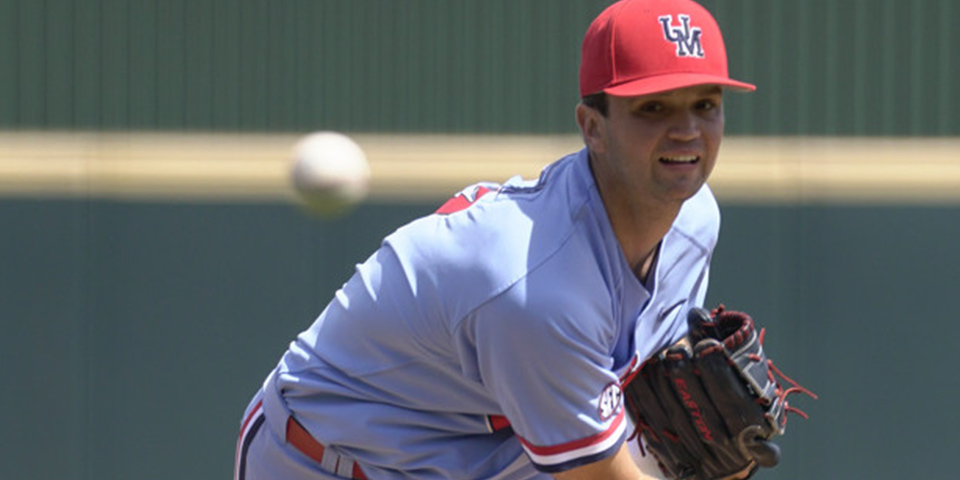
    Gunnar Hoglund is an intriguing pitching prospect. He possesses top-10 talent for this year’s draft, but an elbow injury suffered during his May 7 start against Texas A&M  and subsequent Tommy John Surgery means he might fall down draft boards come early July. The arm talent and ability to throw consistent strikes means some teams will consider Hoglund in the 1st round. This is why he remains a top college prospect on our list.

    2021:

    Hoglund dazzled at times during his junior season at Ole Miss. He demonstrated strikeout stuff with stellar command, while putting up 14 and 13 strikeouts in consecutive starts against Louisiana-Monroe and Auburn in mid-March. Hoglund tossed 14 scoreless innings in those two starts and quickly climbed draft boards. He shined throughout most of the season, posting a  2.87 ERA in 62 2/3 innings, striking out 39% of his opponents and walking only 7%. Hoglund displayed one of the most polished repertoires in the nation.

    Scouting Report:

    Hoglund attacks hitters and pounds the strike zone, consistently throwing strikes and commanding all his pitches. Hoglund’s above-average fastball sits around 92-94 mph and touched 96 mph at points this season. He throws the fastball to both sides of the plate, showing control of the pitch along with command and willingness to throw it in and out against both lefties and righties.

    He spots the fastball  away from hitters, allowing  him to attack with his slider (80-85mph) that has sharp action and tunnels well with his fastball. To righties, he will start the slider on the outer part of the plate and let it dive down and away. He forces hitters to swing at his slider late in counts because he spots the fastball early and often.

    Hoglund attacks hitters and pounds the strike zone, consistently throwing strikes and commanding his pitches.

    With a great feel for his fastball, Hoglund throws first-pitch strikes and stays ahead of hitters. He can challenge lefties with his slider and back foot it down and in, but his above-average changeup (80-83 mph) has become a solid weapon against LHBs. He pitches down and away, letting  his changeup fade away from hitters as a swing-and-miss pitch.  His curveball is a work in progress and he rarely throws it (14 times in the 2021 season). If he can get good separation on it from his slider, Hoglund can turn it into an average show-me offering, as a change-of-speed pitch in MLB.

    Hoglund stays on the edge of the plate with superb fastball location, getting weak contact and limiting the damage he allows. If Hoglund does lose control of his fastball, it can get hit pretty hard when left in the middle of the plate.  With average velocity on his fastball in today’s game, Hoglund needs to continue to pitch on the edges of the plate and locate his fastball to limit the advantages professional hitters can take on his mistakes. Hoglund counteracts this by pitching backwards at times and keeping hitters off-balance with a first-pitch changeup or slider in the zone for a strike. This will be a key part of his development in pro ball and will help him continue to have success.

    Hoglund’s delivery is simple and easy to repeat out of his high ¾ arm slot. He starts with his hands up at his face, bringing them down to his belt and back up in rhythm as he takes a step back, and settles on his back leg with a nice and easy leg lift to his belt. He then keeps great tempo with a slight double pump and tap of his glove, keeping his timing intact as he comes down the mound with his plant foot.

    Hoglund doesn’t overthrow and his delivery is smooth and very repeatable, which enhances his strike throwing. With great control of his pitches, he grades a potential 70 on the 20-80 scale. Hoglund can make slight adjustments during an at bat when he gets off track and can continue to throw strikes to all four quadrants of the zone.

    With this delivery, Hoglund projects well as a starting pitcher in his pro career. Despite the elbow injury ending his college career, he should stay relatively healthy as a mid-rotation starter.  His smooth arm action and longer arm circle makes his secondary pitches, especially his changeup projectable as a plus or even plus-plus pitch. The deception and movement of both his slider and changeup should only get better as he polishes those two pitches in the minors and pairs them with outstanding fastball command.

    Summation:

    Hoglund is a polished right-handed pitcher who has performed in the SEC against premier competition in 2020’s shortened season and most of 2021. This proven track record should have him staying in the 1st round despite his Tommy John Surgery in May. Hoglund is seen as a safer bet to be a starter in MLB than others on the draft board.

    With 3 above-average pitches and outstanding overall command, Hoglund should fit in as a mid-rotation guy at the next level as a No. 3 or No.4 starter, but with continuing improvements and good recovery from his surgery, Hoglund can still reach his full potential.

    Projection:

    Mid-Rotation starter with outstanding command and  a solid 4-pitch mix.

    Ceiling: Zack Greinke

    Floor: Mike Leake

    Draft Expectation: Middle-Late 1st round

  • College Baseball Prospect Rankings: No. 8 – Matt McLain

    College Baseball Prospect Rankings: No. 8 – Matt McLain

    Over the next couple weeks leading up to the 2021 MLB Amateur Draft, Sports Info Solutions will be publishing a series of scouting reports from three of our Video Scouts for the top-10 collegiate draft prospects and five honorable mentions. Each player is graded by the 20-80 scouting scale, given a comprehensive evaluation, and assigned a floor and a ceiling comparison, which indicate–if a player makes the Major Leagues–the range of the type of player into which he can develop.

    To read all the reports, click here.

    Matt Mclain, INF

    College UCLA (Jr. 2021)
    Bio R/R 5-11, 180 lbs.
    Date of Birth 8/6/1999
    Hit 65(70)
    Power 55(65)
    Run 70 (70)
    Field 55 (60)
    Arm 55 (60)
    Future Value 60

    Written By Dominick Ricotta

    Analysis

    Matt McLain is one of the safest, low risk picks in the 2021 MLB Draft. He has shown amazing bat-to-ball skills,  elite speed, quick hands, and is as reliable as it gets in the infield.

    Early college career

    McLain had a difficult start to his college career at UCLA in 2019, hitting .203 with a .276 OBP, .355 SLG and striking out 64 times in 217 AB. He was playing CF in 2019, so he was out of his usual element of the infield, which could have led to him struggling at the plate. During the shortened 2020 season McLain looked like himself again, he hit .397 with a .422 OBP and .621 SLG, but that season was too short to really be confident McLain was back. 

    2021

    This season he proved that his abilities and the hype around him was no fluke. Back at his normal position of shortstop for a full season, McLain looked comfortable at the plate and in the field. He hit .333 with a .434 OBP and .579 SLG, striking out 34 times and also walking 34 times in 183 AB. McLain hit 9 HR and hit them to every part of the ballpark.  He also stole 9 bases in 10 attempts. Defensively he committed 7 errors in 201 chances, with all of them coming in the first 2 months of the season (including 4 in the first 5 games). McLain has all the tools to become an All-Star player in MLB and he showcased them all season long.

    Scouting Report

    At the plate, McLain is extremely comfortable and relaxed. His stance is slightly open and he holds the bat almost straight up, in a great hitting position. He doesn’t have too much of a load up, he moves his hands back a little bit and doesn’t drop them at all. the bat stays in that great hitting position throughout. His leg kick is not big but he hovers his foot off the ground until he is ready to plant it and explode toward the baseball. He keeps his legs and his hands connected well, he doesn’t let his hips fly open too early. McLain’s balance is excellent. He doesn’t swing and fall over and he always finishes the swing in the same position. 

    One of the most impressive things about McLain at the plate is his approach. He is the classic No. 2 hitter. He stays patient, has an-above average eye, doesn’t try to lift the ball, and has superb bat-to-ball skills. McLain usually likes to take the first pitch to force the pitcher to throw a strike, but in big spots he can jump on the pitcher early and do damage. When he takes pitches he is never in-between. It’s impressive and shows how well he recognizes pitches and how well he knows the strike zone. He doesn’t start his swing and stop mid-swing. He knows very early whether or not he wants to swing.

    McLain has a simple “old school” approach to hitting, he doesn’t try to pull the ball or lift the ball. His barrel stays level through the zone and it stays in the zone for a long time. He focuses on putting the ball in play and hitting the inside part of the ball. He hits pitches in every quadrant of the zone, he trusts his hands to reach the outside corner and his hands are so quick he can turn on the inside pitch. He also has the ability to stay on top of the high pitch because of his level swing, which most MLB players struggle with because of their launch angle swings. 

    The biggest worry about McLain is whether or not his power will translate to the MLB. This season he hit 9 HR and he sprayed them to all parts of the field. He has some natural power and is still getting stronger as he develops. Being able to hit home runs to center and right center shows he has the ability and strength to be more of a power hitter. But his approach at the plate is just not one that power hitters have. Hopefully whoever drafts him does not try to groove his swing into having more launch angle because his approach now is outstanding and refreshing to see in 2021. 

    McLain stole 9 bases this season but only attempted 10 steals. He has elite speed and should have used it more. He is incredibly hard to double up even on routine double plays grounders. There probably isn’t too much room for him to improve his speed but learning to use it more will make him a real problem on the bases. 

    In the field McLain is an above average defender and could be a versatile player. At SS he has good range but his hands are the most impressive tool. His glove is reliable. If he can get to a ball there’s a great chance he will field it cleanly. He releases throws super quickly and it doesn’t matter which way he is moving or what kind of throw he needs to make. He makes quick throws on the run, with his feet planted, and when turning double plays. The throws are always accurate and strong, even when he is going to his right or coming in on slow choppers.  

    His footwork is smooth which helps him release throws quickly. His feet get into good position to throw when fielding the ball, he doesn’t cross his legs and does a great job of shuffling.  McLain does well going to his right, he gets around the ball using his speed and fields the ball on his forehand.  There were some occurrences where McLain would take one or two too many shuffles before throwing the ball. It really didn’t hurt him too often but it’s a bad habit to get into and could potentially cause problems with MLB runners.

    McLain’s range and ability to make strong throws from anywhere should keep him at SS in the MLB but there is a good chance he moves over to 2B because of his body type. It wouldn’t be surprising to see him play some 3B too, as his hands are so good that he should be able to play anywhere in the infield.

    Summation

    McLain’s hitting ability, speed, quick hands, and reliable glove make him a sure bet to make MLB eventually. He has shown he has the ability to do everything on a baseball field. There are no big holes in his game and nothing that might stop teams from drafting him early in the 1st round. There’s uncertainty about how much he could improve his abilities, since he already looks developed, but he won’t need to improve much to become a top-tier MLB player. 

    He will most likely move over to 2B but definitely has the defensive abilities to stay at SS and be above average defensively. His versatility should make him an even better draft piece.

    Projection

    Everyday 2B, won’t hit too many HRs, will be a high average and on-base hitter. All-Star potential.

    Ceiling: Whit Merrifield

    Floor: Kevin Newman

    Draft Prediction: 1st round 10th-15th pick

  • Mets Making Middle More Meaningful

    Mets Making Middle More Meaningful

    By MARK SIMON

    You might hear talk in some baseball circles on the value of defensive positioning. But what does that mean in practical terms?

    Let’s show this visually with a look at one team (the New York Mets) and one area of the field (up the middle).

    The Mets bolstered their analytics team this past offseason and changed their approach to playing defense. In particular, they’ve used many more infield shifts. They’ve had balls hit against their shifts at a per game rate 71% higher than their 2020 rate. That’s the highest increase in MLB. If the Mets keep going at their current pace, they’ll have nearly 2,400 balls hit against their shifts this season. Two seasons ago, they barely topped 1,100.

    By the eye test and the numbers, the Mets have one of their better-performing defensive infields in recent memory. You can see it in how they play with Francisco Lindor helping the coaching staff direct infielder movements. Though Lindor has voiced his distaste for shifts, he abides by the plan. If you’re at a game, you’ll see him consistently directing infielders where to play. And he tends to be in the right spot too.

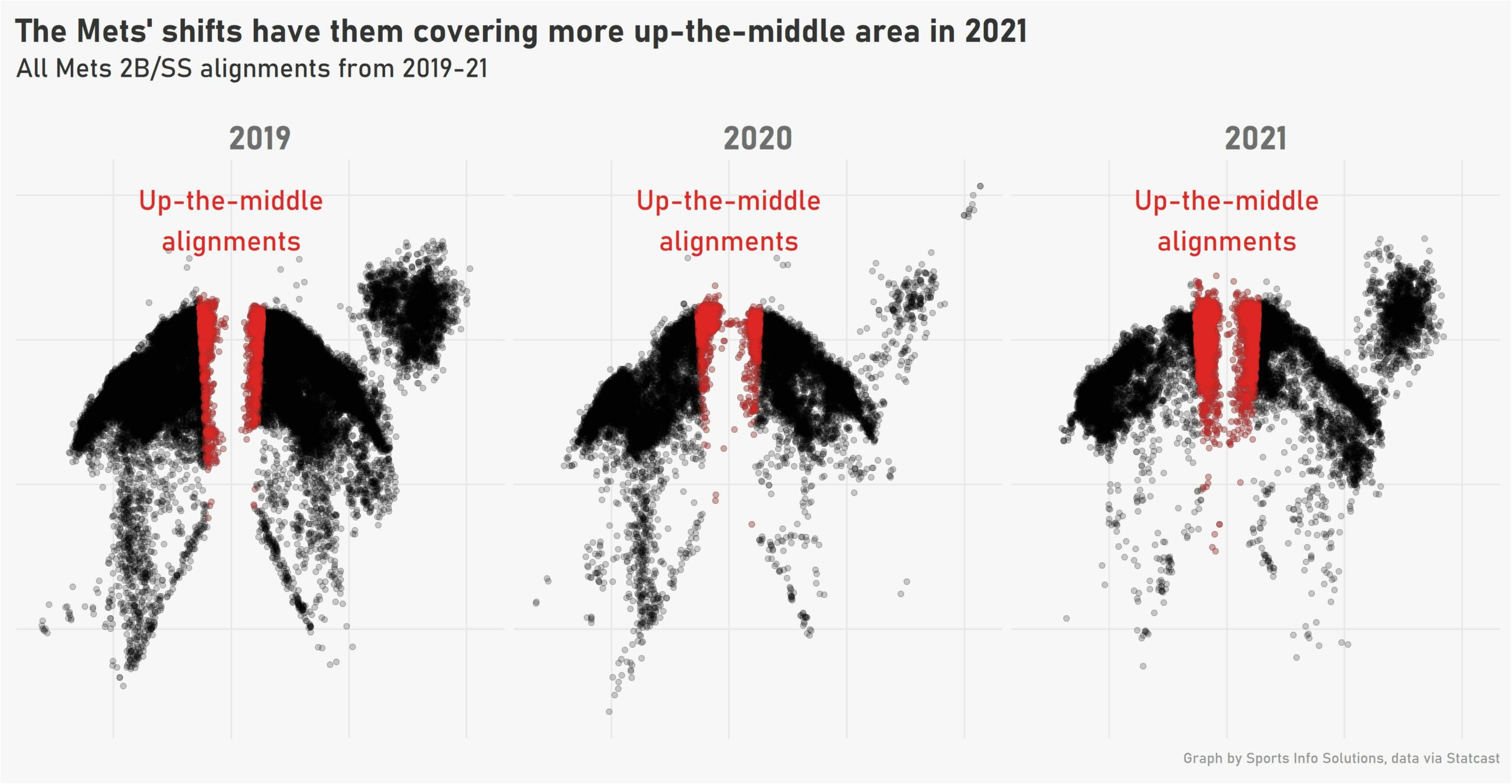
    You can see the Mets’ overall change in approach in the image below. The dots represent the positioning of the infield defense against all batted balls in 2019, 2020, and 2021.

    Credit: Alex Vigderman

    We’ve put emphasis on the area we consider up the middle by making those dots red. There’s a greater concentration up the middle as the Mets have made a concerted effort to cut off hits to that area.

    Here’s how they’ve done at that – using the criteria of balls hit within about 10 feet to either side of second base and at least 65 feet (beyond the pitcher’s mound).

    Ground Ball & Bunt Out Rate – Balls Up the Middle

    Season Out Rate Outs-Grounders Rank
    2019 35% 34-of-97 30th
    2020 57.5% 23-of-40 18th
    2021 75% 44-of-59 3rd

    Take note of two things here.

    1) In 2021, two-thirds of the ground balls that have been hit up the middle against the Mets defense have come against defensive shifts (41 of 59). Two seasons ago, only 21% did (20 of 97)

    2) The Mets already have converted more outs on balls hit up the middle than they did two seasons ago!

    Now, the key for this to work is that it doesn’t come at the expense of any other type of ball in play. Ground balls up the middle represent only a small percentage of all ground balls hit. It’s essentially hoping that the tradeoff of giving more room for hitters to go the other way is worth it.

    So here’s how the Mets have fared at turning ground balls and bunts into outs overall.

    Ground Ball & Bunt Out Rate

    Season Out Rate Rank
    2019 73% 20th
    2020 72% 24th
    2021 75% 10th

    What do the percentages mean? Had the Mets fielded grounders and bunts at a 75.3% out rate in 2020, they would have turned 20 more batted balls into outs in the shortened season. Had they done so in 2019, that would have been 41 more plays recording at least one out.

    Using 2019 (a full season) as an example, a percentage point increase represents about 18 more batted balls turned into outs.

    That may not sound like a lot but consider the value of not just taking away hits but also turning them into outs (some of which would have been double plays). The net result is that Mets have closed off an area of the field to hitters without a significant consequence in the aggregate.

    With fielders closer to where balls are hit, plays like this are easy. And if you cut off enough hits, you might find yourself, like the Mets, in a good position in the standings.

  • College Baseball Prospect Rankings: No. 9 – Ryan Cusick

    College Baseball Prospect Rankings: No. 9 – Ryan Cusick

    Over the next couple weeks leading up to the 2021 MLB Amateur Draft, Sports Info Solutions will be publishing a series of scouting reports from three of our Video Scouts for the top-10 collegiate draft prospects and five honorable mentions. Each player is graded by the 20-80 scouting scale, given a comprehensive evaluation, and assigned a floor and a ceiling comparison, which indicate–if a player makes the Major Leagues–the range of the type of player into which he can develop.

    To read all the reports, click here.

    Ryan Cusick, RHP

    College Wake Forest University(So.2021)
    Bio R/R 6-6, 235 Ibs
    Date of Birth 11/12/1999
    Fastball 65(70)
    Curveball 55(65)
    Change Up 30(35)
    Control 35(45)
    Future Value 55

    Written by Dominick Ricotta

    Analysis:

    Cusick is one of the most interesting arms in the 2021 draft class. He has electric stuff and has been dominant at times, but his control is a big problem. His ceiling is extremely high because of his exploding fastball (90-101MPH) and sharp breaking ball (72-85 MPH) but he also has the potential to struggle due to the control issues.

    Cusick has been moved up and down draft boards all season because he will need some work, but has the raw tools to be an elite pitcher at the next level. Right now he profiles better as a reliever than a starter, since he only has two legitimate pitches, but he has been trying to develop a third pitch in a changeup (87-93 MPH). Cusick has swing-and-miss ability with both his fastball and curveball, striking out 108 batters in 70 innings. On the flip side, he has also walked 32 batters and has thrown 7 wild pitches in those 70 innings, which highlights his control issues. His 2021 stats are not great, but when you watch Cusick you see the elite potential right away. His best stat is 13.9 K per 9, which ranked ninth in the nation.

    Cusick is an imposing figure on the mound at 6 feet 6 inches and a solid athletic body.  His release is from a high ¾ slot and everything he throws comes downhill. His motion is simple but tends to be inconsistent, which plays into the control issues.

    Once he gets into his motion he holds his hands around his stomach and has a small glove tap as his leg comes up. His right arm drops back fairly slowly, with good extension, and then explodes as he starts to throw the pitch. He comes at the batters with a slight crossfire but the plant foot can get lost at times. Cusick leans back slightly when he plants his foot and this can cause him to fly open too early. 

    Cusick’s fastball is by far his best pitch and his favorite pitch (we estimate about 70% usage). The ball explodes out of his hand with rise and tail to it, topping out at 101 MPH. Cusick already has the ability to get good spin on the ball. Per FanGraphs, his 2,400 RPM average spin on the fastball is higher than the MLB average of 2,350 rpm. When used in the top of the zone it can be nearly impossible to hit. At best, batters, foul it back because the great rise on Cusick’s fastball coupled with its location at the top of the zone makes it hard to get on top of the pitch.


    While Cusick’s fastball is his best pitch, his curveball can be his key to climbing up the ranks to the MLB.

    At Wake Forest this season Cusick was trying to throw the fastball low in the zone but would frequently miss up and the ball would end up belt high to the batter. This is when Cusick would get hurt and pitches would get hit hard off of him. When he committed to pitching up in the zone he was able to overpower more hitters and miss more bats. If he keeps doing that consistently, he should be able to have more success.

    While Cusick’s fastball is his best pitch, his curveball can be his key to climbing up the ranks to the MLB. It is a big breaking ball with sharp downward movement and it tunnels well with his fastball before it falls off the table. At its best it has 12-6 movement, but he can also make it slurvy. He isn’t afraid to throw the pitch in any count, and has the ability to throw it for a strike to start an at-bat or can bounce it and get missed swings to end an at-bat.

    The reason for the 55 current value on this pitch is because of Cusick’s inability to throw a consistent breaking ball every time. He can get wild and leave the breaking ball up in the zone or it can lack spin and not break as sharply. A lot of times when he misses, he misses up and to his arm side, which is most likely due to his motion and flying open too early. 

    There were times during 2021 where he did not have his breaking ball at all, which meant hitters could sit fastball and do damage on that pitch. It will be important for him to make this pitch consistent because when it’s on, it’s one of the better breaking balls in the draft and it plays off his fastball very well.

    The spin rate on his curveball is below the MLB average but has room to grow. Whichever team drafts him should be able to help him spin it and control it even better. 

    Cusick did not throw his changeup very often this season (only a couple per game) and when he did throw it, it wasn’t great. It doesn’t have much vertical drop to it but it has a lot of horizontal run. It definitely needs work to become a pitch he can use going forward, even if he can’t get it to have great vertical drop.

    Having a pitch that moves horizontally and at a different speed to play off of his two main pitches will be important to keep hitters off balance.

    The biggest thing for Cusick will be improving his control. His 4.1 BB/9 will obviously need to be lowered to succeed at the next level. When he misses he misses big, the pitches end up far out of the zone or on the other side of the plate from the catcher’s glove. He had one start this season with no walks but gave up 6 runs and 4 home runs in 6 1/3 innings pitched. Instead of missing out of the zone he was missing badly in the zone leaving a lot of pitches in the middle of the plate. 

    His pitches are so good that he does not need to spot everything perfectly. He just needs to be in the right quadrant of the zone. He had six games this season with at least 10 strikeouts, including 2 games with 12 strikeouts against two good offenses in Notre Dame and Florida State. Even when Cusick gives up walks or home runs he is never shaken and battles through these starts. He’s shown resiliency on the mound and always focuses on the next pitch and the next batter. He had only one start shorter than 5 innings all season. 

    Summation:

    Cusick has certainly shown he has the tools to be an elite level pitcher in the MLB. He will need some work but could end up being a top-of-the-rotation starter if he develops a third pitch. Tyler Glasnow is the pitcher Cusick should be looking to emulate his game after. Glasnow was good with his fastball-curveball combination but once he added his slider he became one of the best pitchers in baseball (pre-injury).

    If Cusick can’t figure out a 3rd pitch, his fastball and curveball combination is still good enough for him to become an important bullpen piece. As long as his command improves in the minors, Cusick will be in the majors in no time. The mental toughness shown throughout an up and down 2021 season is a great sign that while facing adversity Cusick can still be successful. 

    Projection:

    Frontline starter that will have high strikeout numbers, All-Star potential in a best-case scenario.

    Ceiling: Tyler Glasnow

    Floor: Nick Pivetta 

    Draft Expectation: Middle of 1st round

  • College Baseball Prospect Rankings: No. 10 – Jud Fabian

    College Baseball Prospect Rankings: No. 10 – Jud Fabian

    Over the next couple weeks leading up to the 2021 MLB Amateur Draft, Sports Info Solutions will be publishing a series of scouting reports from three of our Video Scouts for the top-10 collegiate draft prospects and five honorable mentions. Each player is graded by the 20-80 scouting scale, given a comprehensive evaluation, and assigned a floor and a ceiling comparison, which indicate–if a player makes the Major Leagues–the range of the type of player into which he can develop./

    JUD FABIAN, OF

    College University of Florida (Sophomore, 2021)
    Bio R/L 6-2, 190 lbs.
    Date of Birth Date of Birth: 9/27/2000
    Hit 35 (55)
    Power 45 (60)
    Run 55 (55)
    Field 50 (55)
    Arm 50 (55)
    Future Value 55

    Written by Adam Lan

    Analysis:

    Early college career

    Fabian is a 5-tool prospect who was thrust into the spotlight in Florida at a young age. Eligible to be drafted in 2019, Fabian, a lefthanded throwing, righthanded hitting outfielder instead chose to graduate high school early and enroll at the University of Florida in January 2019. Starting 54 games in center field as a true freshman, Fabian hit .232 with 7 home runs and 26 RBI, while tying for the team lead with 28 walks and 7 stolen bases.

    Though prone to striking out,  Fabian exhibited strong on-base skills early on with a .353 OBP and 28 walks (against 45 strikeouts).  Eager to build off his uneven freshman campaign, Fabian was off to a torrid start in 2020 showcasing the full range of tools that have scouts lining up to watch him play.  The power, patience, and burgeoning hit tool were all in sync, as Fabian was hitting .294 with 2 SB and a team leading 5 HR and 13 RBI in just 17 games before the season was cut short due to Covid-19. While the strikeouts (18 of them) remained high, the OBP jumped up to .407 thanks to 13 walks.  

    The accolades followed his incredible 2020 start, as Fabian was a unanimous Preseason First Team All-American, Preseason All-SEC First Team outfielder and ranked No. 5 in Baseball America’s Preseason top 150.

    2021

    However like many other athletes, Fabian was not immune to a rocky start once actual games resumed in 2021.  Fabian, who has had a tendency to hunt fastballs and struggle with breaking balls, actually struggled to catch up to fastballs up in the zone versus elite competition the first month of the 2021 season, going 1-for-13 with 7 strikeouts vs Miami in the opening days of the season and 0-for-13 with 11 strikeouts vs South Carolina a month later.

    Shortly after the South Carolina series however, everything began to click and Fabian began destroying fastballs and everything else in his path, flashing the tools that had many scouts believing he would be the first collegiate bat off the board in the 2021 Draft.

    From April 2 to May 14, Fabian reached base safely in 23 consecutive games, batting .304/.441/.759. Fabian would go on to be named a 2021 Third Team All-American and to the All-SEC First Team, as well as the All-SEC Defensive Team. Fabian’s most prominent tool, his power, came to the forefront as well, as he  became just the fifth player in the history of the University of Florida to hit 20 home runs in a season. Fabian finished the year with a .249/.364/.560 overall slash line to go along with 51 runs, 46 RBI, 6 SB. He had 79 strikeouts but also had 40 walks.

    While he certainly hasn’t had the most conventional trajectory, starting his collegiate career early and lacking a full, uninterrupted season coupled with the usual off season development, we can look to his success in the Cape Cod league the summer after his freshman season to see how his immense skill set might translate to professional baseball.  Fabian’s plus power and above average pitch recognition propelled him to a .290/.350/.500 line hitting 6 home runs in 35 games as an 18-year-old playing against players who on average were two years older than him. It was this eye opening performance that really put Fabian on the map and showcased his complete tool set . 

    Scouting Report

    While predominantly a pull hitter, Fabian’s swing, and power, plays to all fields.  His fluid swing helps him to generate easy power and his quick hands allow him to turn on pitches inside, but while he has the ability to cover most of the zone, he has struggled with pitches high and in. 

    Fabian’s willingness to steal a base and above-average speed give him the ability to approach double digit in steals as he makes the transition to full-season professional ball. In addition to his offense, Fabian’s athleticism shows up in the field as well. He’s an above-average defender in center field,  consistently taking good routes to the ball with the ability to make highlight-reel plays due to his exceptional reads off the bat. If he does get bumped off center by a more physically gifted defender, he would excel in either corner due to his accurate arm and quick release.

    Summation:

    Possessing every tool in the tool box, Fabian is a safe bet (or as safe as they come) to have some sort of major league career. His power and defense are the carrying tools, as he should be able to hit 25 home runs and play above-average defense. However, his ceiling will ultimately be determined by his hit tool and his propensity to strike out.

    Projection: 

    Potential 5-tool outfielder with plus power.

    Ceiling: Mitch Haniger

    Floor: Stephen Piscotty

    Draft Expectation: Mid-Late 1st Round Pick

  • Who’s Mastered Multi-Position Play

    Who’s Mastered Multi-Position Play

    By MARK SIMON

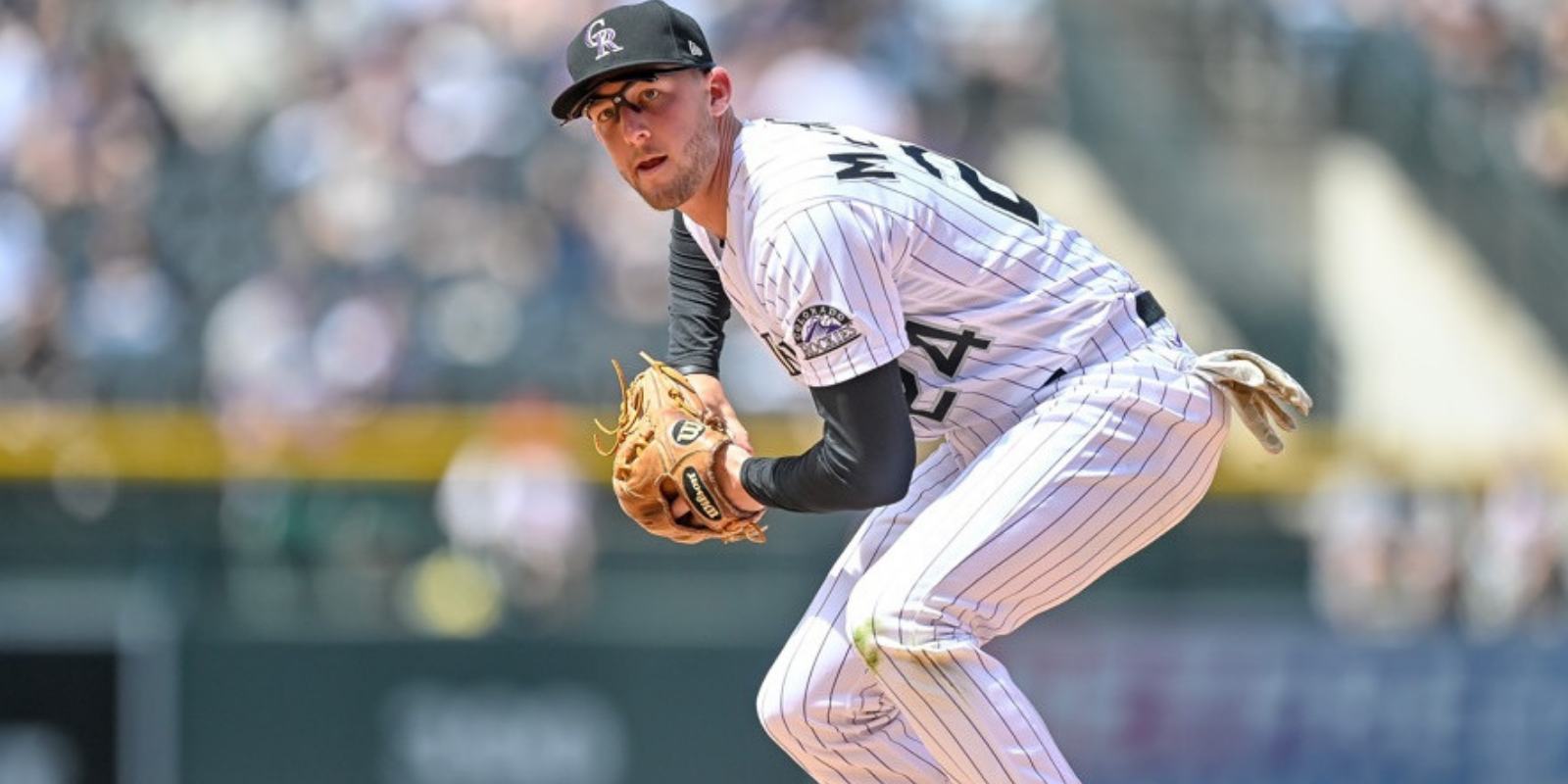
    Ryan McMahon, ROCKIES INFIELDER

    Rockies infielder Ryan McMahon was born to play baseball.

    “My grandfather got me a glove when I was just born. I used that all through Little League,” McMahon said on the most recent episode of the Sports Info Solutions Baseball Podcast (listen here).

    McMahon has been well versed in the fundamentals of the game his entire life.  That has propelled him to being among the top defensive players in baseball this season. He is currently tied with Adam Duvall for the MLB lead in Defensive Runs Saved.

    What’s impressive is that he does it well at two positions, second base (7 Runs Saved) and third base (3).

    “Third base, I’m just trying to react and be ready,” McMahon said. “Second base, I definitely lean with the pitch a little bit more, try to be leaning one way or the other.”

    McMahon’s defensive play has stood out on a team that traded its best defensive player this past offseason. His style of play has produced more reward than risk.

    “Loose, lean with pitches,” he said, explaining his approach. “I’m not afraid to guess wrong on somebody and lean the other way. I think that’s also what makes me good. I’m not the fastest guy. So getting good jumps and good reads is important to me.”

    Take a look at the Defensive Runs Saved leaderboard and you’ll see several players who, like McMahon, are versatile. Here are three of the best in 2021.

    Ha-seong Kim, Padres Utility

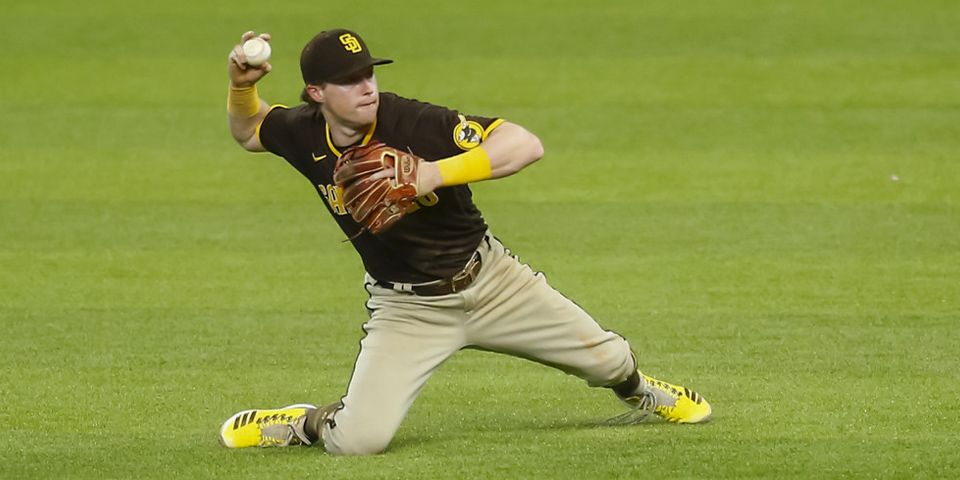
    Ha-seong Kim has been a valuable member of the Padres infield, particularly in defensive shifts. His 9 Runs Saved are one off the MLB lead. He has 4 Runs Saved filling in at shortstop for Fernando Tatis Jr., he has 3 (in five games) at second base, and he has 2 at third base.

    Of those 9 Runs Saved, 5 have come when the Padres have used a shift. The Padres rank 2nd in MLB in ground ball and bunt out conversion rate overall and No. 1 when using a full defensive shift. Kim plays multiple roles in that depending on what position he’s playing.

    Max Muncy, Dodgers 1B/2B

    Like Kim, Max Muncy has 9 Runs Saved, 1 shy of the MLB lead. He’s split them between first base (5) and second base (4 in 19 games).

    He’s nimble enough to make plays like this

    and surehanded enough to handle hard-hit rockets as well.

    Marwin Gonzalez, Red Sox utility

    When it comes to versatility, Marwin Gonzalez seems to have everyone else beat. He’s saved 3 runs at second base, two at shortstop, and one apiece at first base and right field.

    He’s someone who is both adaptable and can cover a lot of ground

    Tommy Edman, Cardinals Utility

    As the Cardinals broadcaster says in this clip “You can count on him!”

    The Cardinals have counted on Tommy Edman to make great plays wherever he’s been.

    He currently leads the majors with 19 Good Fielding Plays with this one being a good example of what he can do, whether he’s at second base, shortstop, or in the outfield.

    Check out our interview with Edman earlier this season (listen here).

    Manuel Margot, Rays OF

    While there is a difference between infielders who can play multiple positions and outfielders who can do so, what Manuel Margot is doing this season for the Rays is pretty good. If we’re going to pick one outfielder who has split time between three spots, we’ll go with Margot over the previously-mentioned Duvall (who’s pretty good too)

    Margot’s played the bulk of his innings in right field and saved 4 runs there. But he’s also saved 3 runs in left field and 1 in center field. Margot has finished on the plus side in Defensive Runs Saved in each of his previous five MLB seasons. The last two with Tampa Bay, he’s shown that he can handle any of the three spots.

    2021 Defensive Runs Saved Leaders

    Name Team DRS
    Ryan McMahon Rockies 10
    Adam Duvall Marlins 10
    Ha-seong Kim Padres 9
    Max Muncy Dodgers 9
    Josh Fuentes Rockies 8
    Manuel Margot Rays 8
    Jacob Stallings Pirates 8
    Adolis Garcia Rangers 8

  • New podcast episode: Ryan McMahon was born to play defense

    New podcast episode: Ryan McMahon was born to play defense

    On this episode of the Sports Info Solutions Baseball Podcast, Mark Simon (@MarkASimonSays) is joined by Rockies infielder Ryan McMahon (@Ry_McMahon), who won Sports Info Solutions Defensive Player of the Month honors for May.

    McMahon is quick and to the point in discussing how he learned to play defense (1:07), his approach to playing defense (2:09), what he learns from watching other players (6:39), and why he was given a glove at birth (9:50).

    Mark and show producer Justin Stine (@j_stine31) then review the early-season Defensive Runs Saved leaderboard and point out improvements, surprises, and key players (15:47).

  • A lot to like about the Rays outfield defense

    A lot to like about the Rays outfield defense

    By MARK SIMON

    The Rays entered Tuesday with the best record in baseball and the second-best Defensive Runs Saved total in baseball.

    The Rays have ranked in the Top 10 in Runs Saved in each of the last six seasons. So this is nothing new.

    The Rays have excelled in both the outfield and the infield. Their outfield has combined for 13 Runs Saved, most in MLB. Their infield has combined for 16 Runs Saved, which is tied for second-most.

    For the purposes of this piece, we’ll focus on their outfield.

    Quite simply, the Rays catch the ball well and they throw the ball well. They are the only outfield unit to rank in the top five in both percentage of fly balls and line drives hit into the outfield that became outs AND outfield assists.

    Highest Out Rate
    Outfielders on Fly Balls and Line Drives

    Team Out Rate
    Brewers 64%
    Dodgers 64%
    Astros 62.5%
    Rays 62%
    Nationals 61%
    * Among balls that stayed in the ballpark

    What’s most impressive about the Rays’ outfield total is that Kevin Kiermaier is responsible for only 1 Run Saved. Manuel Margot leads the way with 8. Brett Phillips has 6 and Randy Arozarena has 4.

    If you’re reading this, chances are you know that Kiermaier is typically awesome. So let’s educate you on the value of the other three.

    Manuel Margot

    Margot’s 8 Runs Saved are split between the three outfield spots, with 4 coming in right field, 3 in left field and 1 in center. The key to his success is in that he gets good breaks on the ball right off the bat and he has the speed to chase balls down. He ranked sixth in the quickness of his initial reaction per Statcast last season and does again this season. Both his sprint speed and split times are solidly better than MLB average.

    Brett Phillips

    Phillips’ Defensive Runs Saved stardom has been hidden from view because of how infrequently he used to play. He entered the season with 14 career Runs Saved in about a half-season’s worth of innings in center field. He also had 8 Runs Saved in just over 200 innings in right field.

    This season, Phillips has 4 Runs Saved in just over 100 innings in right field partly due to 3 assists he’s recorded without the aid of a cutoff man He also has a Run Saved in center field and one in left field as well.

    Catching up to balls has never been an issue.

    Per Statcast data, he ranks in the top 10 in the amount of ground he covers compared to the average player in both the first 1.5 seconds after the ball hits and bat and what’s known as “burst” – how much ground he covers compared to the average player from 1.6 to 3 seconds. This might also explain why Phillips ranks so highly in MLB’s 90-foot split times.

    Admittedly one of Phillips’ throw-outs was a gift – Salvador Perez was tagged out after thinking he hit a home run. But check out these two plays and we think you’ll be impressed with his defense.

    Randy Arozarena

    Arozarena hit 10 home runs in the 2020 postseason. But he’s made a name for himself in 2021 with his all-around play. He’s at his best when he’s in left field, where he has 6 Runs Saved. Arozarena doesn’t rate particularly well in either his initial jump or burst but he’s racked up a number of catches on low line drives and shown a penchant for making tough plays like these.

    (note: Arozarena was fine after making this catch … he homered in the next half-inning)

    One player we haven’t mentioned is Austin Meadows and that’s because he’s cost the Rays 6 runs with his defense this season. But the Tampa Bay staff is aware of Meadows’ shortcomings. He’s been the team’s DH in five of his last nine starts.

    Even with Meadows’ numbers being what they are, the Rays have gotten the most defensive value. And we’ll see if those pick up even more once Kiermaier really gets going.

  • Padres defense a product of fine right-side work

    Padres defense a product of fine right-side work

    By MARK SIMON

    They’re not just the Slam Diego Padres.

    The Padres are hot. They’ve won nine in a row and have scored opponents 66-18 in that stretch. They’re 30-17 and have the best record in baseball entering Monday night.

    It’s easy to cite the Padres hitting and pitching for the team’s success in 2021. But let’s not forget about their defense.

    The Padres rank first in MLB with 31 Defensive Runs Saved this season.

    Why have they been so good?

    Credit a stingy infield defense.

    Of their 31 Runs Saved, 24 have been credited to their first basemen, second basemen, shortstops, and third basemen, as well as their infield positioning.

    On a most basic level, they’ve converted an MLB-best 78% of ground balls, bunts, and short line drives (those basically within reach of an infielder) into outs. If you want to get more granular, we can.

    The best thing about the Padres defense is how well they cover ground to the right of second base.

    They’ve converted 89% of grounders, bunts and short liners to that area into outs. They are eight percentage points better than the next-closest team.

    The MLB average is 77%. The difference between the Padres is already about 30 balls turned into outs … just on balls hit to one side of the field.

    Looking even more closely, when the Padres have used a defensive shift and a ground ball or liner is hit to the right of second base, they’ve turned it into an out 93% of the time (138 plays made in 148 opportunities). MLB average is 79%.

    That level of success explains how the Padres as a team have 11 Runs Saved from their shift positioning (credit those to the coaching staff if you wish). Only the Rays (12) have more.

    The player most responsible for all that success (shifted or unshifted) is Jake Cronenworth, who has eight of the 10 Runs Saved that have been credited to Padres second basemen or first basemen this season. He’s saved six runs at second base and two more in eight games at first (he’s also cost them a run at shortstop). Here’s some of his best work:

    The Padres success on the right side field has provided cover for their primary defensive weakness. Fernando Tatis Jr. has cost them four runs at shortstop this season. That is another subject that we may cover at another time as more sample accumulates.

    For now, revel in the Padres success – at the plate, on the mound, and in the field in a way in which you may not have been aware.