
Category: Baseball

  • College Baseball Prospect Rankings: No. 1 Spencer Torkelson

    College Baseball Prospect Rankings: No. 1 Spencer Torkelson

    2020 MLB Draft Top 5 College Baseball Prospect Rankings

    Leading up to the 2020 MLB Amateur Draft, Baseball Info Solutions will be publishing a series of position-by-position scouting reports from two of our Video Scouts for the top 5 collegiate draft prospects and two honorable mentions. Each player is graded by the 20-80 scouting scale, given a comprehensive evaluation, and assigned a floor and a ceiling comparison, which indicate–if a player makes the Major Leagues–the range of the type of player into, which he can develop.

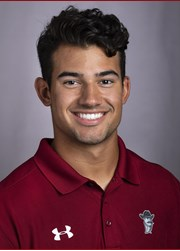
    #1 Spencer Torkelson, 1B

    Arizona State (JR, 2020)

    R/R 6-1, 220 lbs.

    Date of Birth: 8/26/1999

    Hit- 50 (60) Power- 55 (70) Run- 40 (40) Arm- 50 (50) Field- 45 (55)

    Future Value: 60 
    Written by Brandon Tew

    Analysis:

    Not many baseball players can say they have broken a record that Barry Bonds held. That is what Torkelson did his freshman year at Arizona State launching 25 HR for the Sun Devils. Torkelson displayed great raw power in the batter’s box and followed up that performance with 23 HR in his sophomore season in Tempe. Torkelson has turned himself into the consensus number 1 pick on June 10.

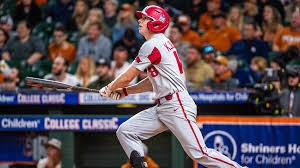
    Standing with a slightly open stance, Torkelson shifts his weight to his back leg as his front leg stays in rhythm as the pitcher starts to release the baseball. This allows Torkelson to explode towards the baseball with maximum energy and power. The power and bat speed is effortless as Torkelson never overswings and extends himself as a hitter.

    With a tiny stride back towards the mound to square himself up. Torkelson then drops the bat head on the ball and whips the bat through the zone with a compact and smooth swing. With the elite bat speed Torkelson routinely lets outside pitches travel deeper into the zone and does not force anything as he drives the ball to the right side of the diamond.

    Relaxed at the plate and extremely loose and comfortable, Torkelson can turn on inside pitches with ease while still display the rare ability to drive the ball out of the ballpark the other way. The loft he creates on his swing is impressive as he skies massive fly balls over the fence.

    Torkelson has the unique talent and shows it off with his game power and raw power during batting practice. Even when Torkelson does not square a ball up, he still has enough strength to drive the ball out from foul pole to foul pole.

    The power might stand out when you watch Torkelson, but he is a complete hitter taking pitches with good plate discipline and showing a great understanding of what he wants to accomplish at the plate.

    Torkelson’s advanced approach at the dish rarely has him fooled with the same pitches in back-to- back at-bats. He punishes pitchers for making mistakes with hanging breaking pitches but also has the bat control to foul off nasty ones to get to the next fastball in the at-bat. 

    Torkelson hits the ball hard often, with a career batting average of .337 and an OPS of 1.166 has elite potential at the next level with his bat. Torkelson’s maturity and mental makeup and approach to the game remind me of Anthony Rizzo who has been a mainstay in the middle of the lineup and at first base for the Cubs the unquestioned leader of that team. Torkelson has those similar qualities to the lefty which make him a special prospect.

    The defense at first base is solid. Torkelson has worked hard to refine his defensive skills and as a very good athlete he shows off baseball athleticism routinely by making movements and motions look easy that other guys find more challenging on a ball field.

    Torkelson has a good glove at first base and an average arm that is accurate, and while he most likely will stick at first baseand be above average, teams could opt to move him to left field if needed. It could be rather quickly too as he displays the type of power that the last two Rookies of the Year in the NL possess in Roñald Acuna Jr. and Pete Alonso.

    Summation:

    An elite first base prospect with devastating power from the right side. Torkelson’s power coupled with his approach at the plate and plate discipline makes him a can’t-miss power bat in this year’s draft. He has potential to be first player to the majors from this class. Torkelson has the power to put up massive HR totals in the MLB and could put up 40 or more on a regular basis.

    Projection:

    All-Star caliber 1B with all the tools to be an elite bat

    Ceiling: Pete Alonso, a right-handed Anthony Rizzo

    Floor:  Billy Butler

    Draft Expectation: #1 Pick
  • College Baseball Prospect Rankings: No. 3 Austin Martin

    Leading up to the 2020 MLB Amateur Draft, Baseball Info Solutions will be publishing a series of position-by-position scouting reports from two of our Video Scouts for the top-5 collegiate draft prospects and two honorable mentions. Each player is graded by the 20-80 scouting scale, given a comprehensive evaluation, and assigned a floor and a ceiling comparison, which indicate–if a player makes the Major Leagues–the range of the type of player into which he can develop.

    #3 Austin Martin, Utility

    Vanderbilt (JR, 2020)

    R/R 6-0, 185 lbs

    Date of Birth: 3/23/1999

    Hit- 35 (60) Power- 45 (55) Run- 55 (55) Arm- 45 (50) Field- 45 (55)

    Future Value: 60

    Written by Corey Leaden

    Analysis

    It’s tough to find a player in this draft with a more complete game then Austin Martin. A late-round pick in the 2017 Draft, Martin went on to Vanderbilt and was a major piece of the 2019 National Championship. In his time at Vanderbilt he played many positions after coming in as a shortstop from HS, he also played first base, second base, third base, and center field.

    Over his 140 games played as a member of the Commodores he hit .368/ .474/ .532 while hitting 14 homers and 43 stolen bases. He struck out in only 12% of at-bats showing a strong ability to put ball into play,  walking slightly more at 13%. Martin is a savvy baserunner being able to take more bases then his above average speed would expect.

    Martin has a slightly open stance with a slight knee bend. He has quiet hands and utilizes a leg kick to generate power as loads up. Martin shows great bat speed, easily turning on pitches middle-in with a quick compact swing. He is a patient hitter with a plus hit tool and an especially good eye on pitches on other side of plate. Martin is very relaxed in the box, with a balanced swing and has a knack of hitting the ball to wherever it is pitched. His high baseball IQ is displayed by being a strong situational hitter when needed and is also shown on the basepaths.

    Martin has defensive question marks as he has played many positions in his time at Vanderbilt. He seems to be finding a home in center field where his athleticism can shine.

    Defense is more of a question then an actual weakness as he looks natural in center but will take some time to adjust wherever he plays. He has the potential to make the move to second as well given his background playing the infield. He has many above-average tools but nothing jumps out as plus outside of his hit tool.

    Summation

    A guy who will hit in any spot of the order. Can set the table very well with the ability to drive the ball. Also carries above-average power and speed to impact the game in many ways. Defense is unclear but looks best suited in the outfield. Second base is an option. He comes from a strong program and is used to playing in big games

    Projection

    An impactful player who will hit in the top third of order and can be deployed defensively to suit a team’s needs.

    Ceiling: Mookie Betts
    Floor:  Garrett Hampson
    Draft Expectation: Top 3 Pick

  • College Baseball Prospect Rankings No. 5 Nick Gonzales

    College Baseball Prospect Rankings No. 5 Nick Gonzales


    Over the 10 days leading up to the 2020 MLB Amateur Draft, Baseball Info Solutions will be publishing a series of position-by-position scouting reports from two of our Video Scouts for the top-5 collegiate draft prospects and two honorable mentions. Each player is graded by the 20-80 scouting scale, given a comprehensive evaluation, and assigned a floor and a ceiling comparison, which indicate–if a player makes the Major Leagues–the range of the type of player into which he can develop.

    #5  Nick Gonzales, 2B

    New Mexico State (JR, 2020)

    R/R 5-10, 190 lbs

    Date of Birth: 5/27/1999

    Hit- 40 (60) Power- 40 (55) Run- 50 (50) Arm- 45 (45) Field- 45 (50)

    Future Value: 55

    NMStateSports.com

    Written by Corey Leaden & Brandon Tew

    Analysis

    Not many players had a better 2019 then Nick Gonzales, who took home numerous awards across regular and summer league play. He’s a 2019 All- American, NCAA batting champ (hitting .432), and the Cape Cod League MVP. After his top-notch summer against baseball’s top prospects, he started 2020 with a blistering effort over 58 at-bats; he had 12 HR, and was batting .448 before season was cut short. There were questions about the level of competition Gonzales was facing at New Mexico State, but he put almost all those questions to rest after his MVP performance in the premier wood bat Cape Cod League.

    Gonzales looks super-comfortable at the plate standing with an open stance shoulder-width apart and a slight bat waggle in his setup. The relaxed nature of his setup allows him to stay calm and fire his hands at the baseball later than other guys would. That means he lets the ball travel deeper in the zone and can stay back on breaking pitches longer. After the slight bat waggle, the lumber gets into an optimal position to square up the baseball. This allows Gonzales to end up with his energy heading toward the pitcher and in rhythm. Gonzales has great balance and is willing to work the count. An advanced hitter with a plan in every at-bat.

    Almost every swing he takes is short and compact as he rarely overswings to try and produce power.

    The raw power Gonzales has is greater than his in-game pop right now although he is progressing nicely and has the potential to reach average to slightly above-average power for his position. The New Mexico State product’s willingness to drive the ball gap-to-gap allows him to display some opposite-field power, which is a great sign that he can continue to add a power component to his bat. The way Gonzales takes pitches and always seems in rhythm again displays an advanced understanding at the plate that will help him early on his pro career.

    Gonzales is an average defender, smooth and fluid at second base. He will make all the routine plays and works well to get around the baseball and keeps himself in control. However, when he gets to the ball, he is sure handed. He turns a quick pivot at second on double-plays and while his arm is below average the quickness with which he gets the ball out allows him to still make plays.

    Summation

    The best potential hit tool in the 2020 Draft, while all other tools are projected to be average. A top of the lineup guy, who will get on base at an incredible clip. The question lies in what can be developed of his other tools.

    Projection

    Everyday second baseman, who can be an elite leadoff guy.

    Ceiling: Dustin Pedroia
    Floor:  Tony Graffanino
    Draft Expectation: Top 10 Pick

  • College Baseball Prospect Rankings: No. 4 Emerson Hancock

    College Baseball Prospect Rankings: No. 4 Emerson Hancock

    Over the 10 days leading up to the 2020 MLB Amateur Draft, Baseball Info Solutions will be publishing a series of position-by-position scouting reports from two of our Video Scouts for the top-5 collegiate draft prospects and two honorable mentions. Each player is graded by the 20-80 scouting scale, given a comprehensive evaluation, and assigned a floor and a ceiling comparison, which indicate–if a player makes the Major Leagues–the range of the type of player into which he can develop.

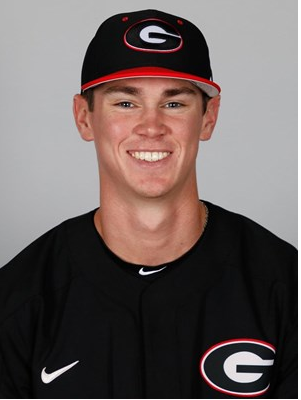
    #4 Emerson Hancock, RHP

    University of Georgia (JR, 2020)

    R/R 6-4, 213 lbs

    Date of Birth: 5/31/1999

    Fastball- 60 (65) Slider- 55 (60) Curveball- 45 (50) Changeup- 50 (60) Control- 45 (60)

    Future Value: 60

    Georgiadogs.com


    Written by Corey Leaden

    Analysis

    Emerson Hancock spent all three seasons in Athens as a part of the rotation, after not signing with the Diamondbacks when they selected him the 38th round of the 2017 Draft out of high school. In his career at Georgia he made 33 appearances (all starts) where he accumulated 192 innings with 3.47 ERA and a record of 16-7, with 206 strikeouts and 55 walks (9.7 K per 9, 2.6 BB per 9). Hancock was the frontline guy most of his time at Georgia but had a couple poor starts during 2020 season. Due to the shortened season he made no SEC starts in his junior year of college.

    He is a tall lanky starter, athletic body, and perfect frame for MLB. Hancock primarily delivers using a high leg kick and ¾ delivery; while featuring four above-average offerings (fastball, slider, curveball, changeup). His fastball sits in mid-90’s, topping out at 97, but does a real good job featuring all four options, and is willing to go to any pitch in strikeout situations. He’s greatly confident in his fastball, and his slider comes out hard sits mid-to- low 80s his best secondary pitch. He features his curveball a lot more in his third time through the order, while his changeup sits mid 80s with good arm-side run. He has great control which is displayed by 34-to-3 K-to-BB in his junior year. Hancock locates pitches to target, with great command.

    His curveball is just average, with no big drop. But it is a capable pitch and he uses it well as a fourth option. It is a pitch to monitor as he continues his development through minor league baseball. Hancock features plus attributes in almost every other category. Hancock has a great pedigree, body, and athleticism, though there are some concerns regarding a lat injury in 2019 and his overall consistency. But I think he has a chance to be a potential Opening Day starter of the future for whatever team selects him.

    Summation

    All-Star caliber pitching prospect with three plus pitches and plus control. He has a fourth-pitch curveball when he needs it to face an order multiple times. He’s an elite SEC pitcher with a great body mixed with good athleticism, and is arguably the top pitcher in the draft .

    Projection

    All- Star potential starter with three plus pitches including a mid-90s fastball. High strikeout potential mixed with plus command and control.

    Ceiling: Shane Bieber
    Floor: Dylan Bundy
    Draft Expectation: Top-5 Pick

  • 2020 MLB Draft Top College Baseball Prospect Rankings – Heston Kjerstad & Reid Detmers

    2020 MLB Draft Top College Baseball Prospect Rankings – Heston Kjerstad & Reid Detmers

    Over the next 10 days leading up to the 2020 MLB Amateur Draft, Sports Info Solutions will be publishing a series of position-by-position scouting reports from two of our Video Scouts for the top-5 collegiate draft prospects and two honorable mentions. Each player is graded by the 20-80 scouting scale, given a comprehensive evaluation, and assigned a floor and a ceiling comparison, which indicate–if a player makes the Major Leagues–the range of the type of player into which he can develop.

    Honorable Mentions:

    Heston Kjerstad, OF

    University of Arkansas (JR, 2020)

    L/R 6-3, 180 lbs.

    Date of Birth: 2/12/1999

    Hit- 35 (50) Power- 40 (60) Run- 50 (45) Arm- 50 (50) Field- 40 (50)

    Future Value: 55

    Kjerstad Honored as Collegiate Baseball All-American | Arkansas ...
    Photo: University of Arkansas Athletic Department

    Written by Corey Leaden

    Analysis

    Heston Kjerstad has been a premier college bat ever since he arrived in Fayetteville after being drafted out of high school in 2017 being taken in the 36th round by the Mariners. He has garnered numerous awards in his time at Arkansas from SEC Freshman of the year, and two years on the Golden Spikes watch list. He has been the heart of the lineup, and never missed a CWS during his time at the collegiate level. During the summer of 2019 he led team USA in BA, SLG, OBP, and tied for the team lead in home runs. Over his 67 AB during the shortened 2020 season he was batting .448/ .513/ .791 while hitting 6 home runs and lowering his strikeout percentage to 12% in this small sample.

    Kjerstad looks like a power hitter with good height, who could add more muscle as he matures. He has an upright stance with low hands and a complicated swing as he loads with a high leg kick as he brings the bat back and up. He finishes with a powerful swing as he brings his bat back through the zone to catch the ball out in front.

    There are a lot of moving parts in his swing but it has produced major results among top-flight college competition. He has an aggressive approach and strikes out at an above average clip (19%). But the tradeoff is major power potential given his elite bat speed and strength going deep on average once every 16 AB over his college career. His lack of patience is a little worrisome but he still carries elite MLB power potential.

    He is a below-average runner, with some acceleration that allows him to play average defense. He’s a fit for either corner spot at the next level, his arm is strong enough to stay in right. Kjerstad’s routes are not always the best but he makes most plays you would expect him to make. If he struggles in the outfield, he has an ideal body for 1B but will not be expected to be anything more than average in the field.

    Summation

    Kjerstad is an elite power bat who should stick in the heart of MLB order for many years. He played at ab elite program in Arkansas where he led them to CWS in both of his seasons. He’s an average pure hitter who should play league-average defense while hitting 30+ home runs consistently.

    Projection

    Everyday outfield starter in the middle of MLB lineup with potent power bat, while producing near league average performance in all other areas.

    Ceiling: Bryce Harper
    Floor: Brandon Moss
    Draft Expectation: Top 10 Pick

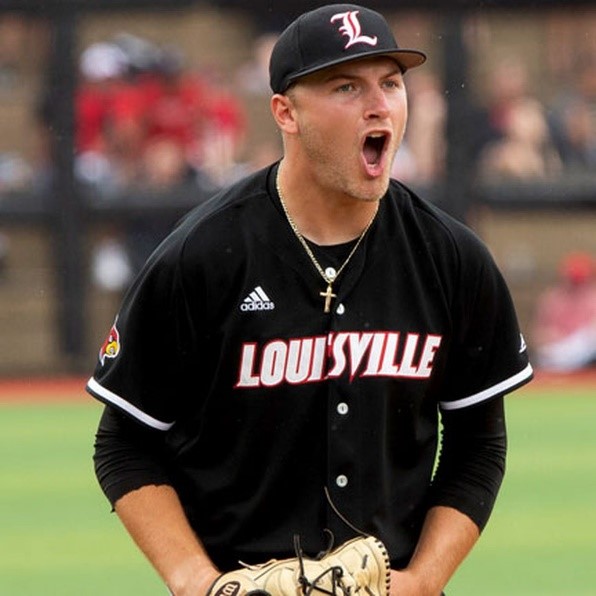
    Reid Detmers, LHP

    University of Louisville (JR, 2020)

    L/L 6-2, 210 lbs.

    Date of Birth: 7/8/1999

    Fastball- 50 (50) Curveball- 60 (65) Slider- 45(50) Changeup- 45(50) Control- 55(60)

    Future Value: 55

    Photo: University of Louisville Athletic Department

    Written by Brandon Tew

    Analysis

    Reid Detmers at Louisville has been one of the most impressive pitchers at the college level the last two seasons. Posting a 2.78 ERA in 2019 and a 1.23 ERA in the beginning of 2020 Detmers has been a dominant force in the ACC. Pitching against some of the best competition in the country, Detmers has proven he can strike out entire lineups, tossing a career-high 16 strikeouts against Georgia Tech last March and backing up that performance with a 15-strikeout showing against Wake Forest this March. Last postseason Detmers took the ball in game 1 of the Super Regionals against East Carolina and tossed a brilliant seven innings of one-run ball.

    Throwing out of a ¾ arm slot Detmers has a smooth, effortless and very repeatable delivery. With a lean medium-sized build, he isn’t going to wow anyone with his athleticism but the balance and ease at which he functions on the mound should lead to continued success as he works on honing his secondary offerings.

    Detmers’ fastball is not going to blow a batter away at the MLB level. It sits around 89-92 mph with his fastball. His curveball is elite with a true 12-6 break the pitch comes in towards the plate in the low to mid 70s. He can drop it out of the sky at the top of the zone for a strike or snap it off into the dirt as a swing-and-miss pitch. His curveball will continue to be his go-to offering, especially as his changeup and slider progress. The ability to spin the baseball at a high level allows for considerable hope that he will be able to potentially possess an average slider that will keep batters honest.

    Detmers’ control and command will be key with a pretty low walk rate of 2.3 per 9 innings in the 2019 season and 2.5 before the 2020 season  was cut short. Detmers has shown good control throughout his time at Louisville. Pair that with his strikeouts and you could have a great combination on the mound.

    The next step for Detmers is to tunnel his high four-seam fastball with his killer curveball. Then the development of a decent slider to go along with his fastball that he spots at the bottom of the zone. Detmers could also scrap the slider altogether and opt for a cutter, which he started throwing more in 2020. The command of his fastball and especially his curveball is what stands out for Detmers who is unafraid to throw his fastball to either side of the plate, while also breaking off a wicked curveball in any count.

    Summation

    Detmers is considered a top arm in the 2020 draft and with good command and the best breaking pitch in the draft, he should go high on June 10. A higher floor but lower ceiling guy, Detmers might be one of the safest picks in the 2020 draft. You know what you are going to get with him and, as a guy who might be able to throw with more effort while not sacrificing control, you might be getting even more than you imagined.

    Projection

    Mid-rotation guy with plus control, and an elite hook.

    Ceiling: Barry Zito

    Floor: Rich Hill

    Draft Expectation: Top 10 Pick

  • New podcast: No-hit wonders

    LISTEN HERE

    On this episode, Mark Simon (@markasimonsays) is joined by Dirk Lammers (@ddlammers), author of Baseball’s No-Hit Wonders and an expert on the history of no-hitters for a conversation on all the different factors that go into throwing one. Dirk explains the origins of his research, how much research he’s done, and his favorite (2:18). They then discuss the most prominent defensive plays in no-hitters, what made Gregor Blanco’s perfect game-saving catch so special, what percentage of no-hitters feature a good or great defensive play, and why Kevin Kouzmanoff should be remembered for his defensive work (7:21). They also get into the role of umpires and catchers (14:36) and look at patterns in pitchers that throw no-hitters (18:47). Lastly they discuss the most likely current pitchers to throw a no-hitter (20:01). Thanks for listening and stay safe!

  • Picture of Perfection: Rewatching Roy Halladay’s Perfect Game

    Picture of Perfection: Rewatching Roy Halladay’s Perfect Game

    By MARK SIMON

    Friday marks the 10th anniversary of Roy Halladay’s perfect game for the Phillies against the Marlins. It was the first of two no-hitters that he would pitch that season, the other coming in the NLDS against the Reds. These were the signature starts of Halladay’s Hall of Fame career.

    Some of the recent news on Halladay and his tragic death in a plane crash has been rather unpleasant. We’re not here to focus on that. We wanted to relive the perfect game, which you can watch at this link. We’ll enhance it with some of the data we collected that night.

    Prelude

    Halladay had gotten beaten up by the Red Sox in his last start, allowing seven runs in 5 2/3 innings pitched. But even with that, Halladay had been great through his first 10 starts of the season, pitching to a 2.22 ERA.

    Nonetheless, it was noted during the broadcast that he had been working on some issues (later revealed by pitching coach Rich Dubee to be related to the first step in his delivery).

    After all, the best pitchers tend to be perfectionists.

    The cutter

    Halladay threw 19 pitches, 11 for strikes in the first inning, the inning in which he looked least comfortable on an 85-degree Miami night (we might surmise he was still getting acclimated to his mechanical adjustments). He didn’t know it at the time, but he’d only get one run to work with, so he had to be on his game.

    The Marlins started a good lineup that day. No. 3 hitter Hanley Ramirez was hitting over .300, as was No. 6 hitter Cody Ross. Ramirez (4-for-8) and Dan Uggla (4-for-7) each had prior success against Halladay in small samples.

    Halladay’s changeup didn’t look great. He threw four in the first inning and got only one strike. His fastball was a little off too – only three strikes on seven pitches.

    One pitch was perfect: His cutter. Five pitches, five strikes.

    This pitch, whose grip was taught to him by its master, Mariano Rivera, was the biggest key to the perfect game.

    He threw 27-of-34 cutters for strikes (79%). He netted only one missed swing, but 11 of the 18 takes against it were called strikes (more on that in a moment). The pitch got him 11 outs (the most of any of his pitch types that night), including five punch-outs, and yielded no baserunners.

    The Man in Blue

    After the game, Halladay credited catcher Carlos Ruiz for being integral to the result, saying he put his trust in every sign Ruiz flashed. But the path to a perfect game doesn’t just require a pitcher and catcher to be in sync. The pitcher also needs to be in sync with the home plate umpire, knowing what the man in blue will call and what he won’t.

    This was Halladay’s lucky day.

    You know how sometimes we’ll say of someone “That person just gets me.”

    If you look at the numbers, it’s fair to say that Roy Halladay got Mike DiMuro. For his career, Halladay had a 2.17 ERA and four complete games in seven starts with DiMuro behind the plate.

    The last three were a three-hit shutout of the Red Sox in 2009, the perfect game against the Marlins, and a 14-strikeout 8 2/3 inning gem against the Padres in 2011.

    Halladay got 26 called strikes in this game and consistently worked the edges of the zone.

    They were perfect pitches because the hitter’s instincts made them think ‘ball’ when the pitch was repeatedly called a strike. Credit Halladay for making the most of this aspect of the game. His location was just about perfect. He did this with Carlos Ruiz catching. Though Phillies pitchers raved about Ruiz’s ability to call a game, pitch framing was never a strength of his. In fact, from 2010 to 2011, Ruiz ranked tied for third-worst in our framing metric, Strike Zone Runs Saved.

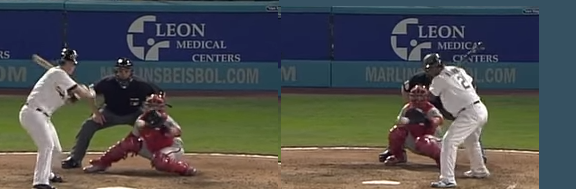
    The tone was set with the game’s first batter, Chris Coghlan. Halladay dotted the outside corner for a strike with his first pitch, then threw one to nearly the same spot on a 3-2 count. Ruiz made it look like it caught a little more plate than it did. DiMuro rung Coghlan up for the first of Halladay’s 11 strikeouts.

    “I’m not a guy who really argues calls,” Coghlan said (Miami Herald). “I thought it was close – a ball – but obviously it was a strike to the umpire and that’s all that matters.”

    The pitch had a 90% strike probability based on its horizontal and vertical location, the count, and how far the catcher had to move his target horizontally to catch the ball.

    Coghlan had a better case on the 2-2 pitch he took for strike three and the 3-2 pitch that Hanley Ramirez took for strike three in the seventh inning. They were thrown to nearly the same spot and had the same strike probability, 22%.

    Were they strikes? Well, they had a lot of tail on them. It’s a tough call for any umpire. Most umpires are reluctant to call strike three. DiMuro did it six times in this game. Makes sense given that by our tracking, he called extra strikes at the seventh-highest rate of any umpire in the major leagues in 2010 (2.4 per 150 pitches).

    And as Coghlan says, it only matters how the umpire saw it.

    Challenging Himself

    Halladay danced a fine line in this game, even with a pitcher-friendly umpire behind the plate. He ran a three-ball count to seven batters. They saw a combined 11 pitches in which they needed one ball for a walk.

    MLB pitchers retired 43% of hitters in plate appearances ending with a three-ball count.

    Halladay retired 100%, 7-of-7, three with the fastball, three with the cutter, and one with the curve.

    BatterCountResult
    1st- Chris Coghlan3-2Strikeout Looking
    1st- Hanley Ramirez3-2Ground out to second base
    2nd- Jorge Cantu3-2Strikeout Swinging
    5th- Dan Uggla3-2Flyout to center field
    6th- Cameron Maybin3-1Ground out to shortstop
    7th- Gaby Sanchez3-2Lineout to left field
    7th- Hanley Ramirez3-2Strikeout Looking

    Help in the Field

    The Phillies were without both shortstop Jimmy Rollins and third baseman Placido Polanco, who were both out with injuries. They started Wilson Valdez at shortstop and Juan Castro at third base.

    Valdez made one nice play, on a ground ball hit on a 3-1 pitch by speedy Cameron Maybin in the sixth inning. The out probability on the ball hit in the 5-6 hole was 73%. It was a tough play but one made well more often than not.

    Castro’s presence was more prominent because he turned in the game’s best defensive play. In the eighth inning, Jorge Cantu hit a rocket in the shortstop-third base hole that had a 41% out probability. Castro made the play on one hop. If he didn’t field it, the ball would have been a base hit. But Castro made the play and threw Cantu out.

    “He hit it pretty good,” Castro told reporters afterwards. “I was thinking to myself, ‘Every little ball that’s hit here, I have to dive for it. I was fortunate to get some glove and catch the ball.”

    Of the 16 balls hit by the Marlins, these were the only two with less than a 90% out probability.

    Castro also handled the final out of the game, going two steps to his left to field Ronny Paulino’s ground ball, and threw Paulino out easily.

    Defense at third base was not Castro’s forte. He only played eleven games at third base that season and finished with -11 Defensive Runs Saved there for his career. Valdez was a better fit for his position. He saved 10 runs in his time as a part-time shortstop.

    But what matters is that in this game, they were perfect.

    Remembered Forever

    Halladay would go on to win the NL Cy Young that season, leading the league in wins (21), innings pitched (250 2/3), complete games (9), and shutouts (4). It was one of a run of six straight seasons in which he made at least 30 starts every year and pitched to a 2.86 ERA.

    At his Hall of Fame induction in 2019, Halladay’s wife, Brandy, gave a touching speech. We’ll let her words close this piece out.

    “I think that Roy would want everyone to know that people are not perfect. We are all imperfect and flawed in one way or another. We all struggle, but with hard work, humility and dedication, imperfect people still can have perfect moments. Roy was blessed in his life and career to have some perfect moments. But I believe that they were only possible because of the man he strived to be, the teammate that he was, and the people he was so blessed to be on the field with.”

  • New podcast! All things Korean Baseball

    Listen here!

    On this episode of the Sports Info Solutions Baseball podcast, Mark Simon (@MarkASimonSays) is joined by Yonhap News reporter Jeeho Yoo (@Jeeho_1). Jeeho is based in Seoul, South Korea and covers the KBO on a daily basis.

    He explains fan reaction to the return of baseball (2:27) and what it’s like to cover baseball in the age of Coronavirus (4:46). He also gives his impressions of the season so far, why Preston Tucker is off to a good start, and which American and Korean pitchers have fared well (6:42). That leads to a discussion of how we should translate stats from KBO to MLB (9:02), how Korean teams use analytics (10:49), and how the hitting approach of a Korean batter differs from MLB counterparts (12:51).

    Jeeho also points out how much defensive tracking goes on in the KBO and who the top defensive players are (14:40), and how shifting hasn’t necessarily caught on quite as much (16:18). He also explains what he’s seen in terms of an early increase in injuries (20:20). Lastly, he shares a few fun facts and stats he has compiled (23:17), explains why he doesn’t want to jinx no-hitters by mentioning them on Twitter (25:22), and gives some things for viewers to keep an eye on for the rest of the season (26:16).

    Stay safe. Stay well. Don’t forget to rate, review, and subscribe. Thanks for listening!

  • The best-pitched game of the 21st century: Max Scherzer’s no-hitter vs Mets

    The best-pitched game of the 21st century: Max Scherzer’s no-hitter vs Mets

    BY MARK SIMON

    It would be super cool if we could use modern technology to look back at dominant pitching performances. We could further dissect Sandy Koufax’s perfect game in 1965 or something more recent, like Kerry Wood’s 20-strikeout game in 1998.

    But the kind of pitching and defensive data that we had available then pales to what we have now. Within our company in particular, we can tell you how often batted balls are turned into outs and how effective a pitcher’s pitches are dating to 2004 for just about any moment in any game.

    And we can use a stat like Game Score, which measures starting pitcher effectiveness on a scale that usually ranges from 0 to 100 to pick the game we want to look at. For those unfamiliar, Game Score increases with each out and strikeout recorded and each inning completed, and decreases with walks, hits, and runs allowed.

    The best-pitched game of the 21st century falls within our game-tracking window – Max Scherzer’s 17-strikeout, no-walk no-hitter for the Nationals against the Mets on October 3, 2015. That is one of the rare games that exceeded a 100 Game Score, coming in at 104.

    Extenuating Circumstances

    In reviewing the game, it’s important to note some of the extenuating circumstances, for one the weather, which Baseball-Reference lists at 54 degrees with 28 mile-per-hour winds blowing in from center field. A family member was at this game and texted during it that it was “sooooo cold.”

    Those sorts of conditions don’t present themselves often. This is the only one with that wind condition and direction in the last eight years. It’s one of three such games this century (one of which was on a night in Texas with temperatures in the 90s).

    Another thing to consider was that this was the second game of a doubleheader on the final Saturday of the season. The Mets had small stakes to play for–they were competing with the Dodgers for home-field advantage in their LDS matchup, but the lineup they put out didn’t show a sense of urgency in that regard.

    Yoenis Céspedes, Daniel Murphy, Lucas Duda, and David Wright were not in the starting lineup, though all but Wright would appear in the game.

    The No. 2 hitter, Ruben Tejada, and cleanup batter, Michael Cuddyer, had OPS’ around .700. The No. 6 through 8 hitters, Kirk Nieuwenhuis, Kevin Plawecki, and Dilson Herrera, all were below .700. The Mets were willing to put this lineup out against a pitcher who took a no-hitter into the eighth inning of his last start against the Reds.

    But ridiculous dominance is still ridiculous dominance, regardless of weather or opposing lineup.

    No Time At All

    I did something rudimentary just out of curiosity, timing how long each inning lasted. If you have a short-attention span, Scherzer’s pitching performance is perfect for you. The nine Mets’ half-innings lasted a combined 37 minutes and 7 seconds from first pitch to last out. That’s a little over four minutes per half-inning.

    Scherzer worked quickly throughout. He completed two half-innings in just under three minutes, with lengths not much longer than the two-minute commercial breaks between innings. Scherzer opened the game by striking out Curtis Granderson in 46 seconds. He ended it by getting Granderson to pop out in a five-pitch at-bat lasting one minute, 22 seconds.

    No inning went longer than the sixth (which took 6 minutes, 6 seconds), and that one would have been shorter had Nationals first baseman Clint Robinson been able to scoop third baseman Yunel Escobar’s throw. The error for Escobar on Kevin Plawecki’s ground ball resulted in the Mets’ only baserunner of the game.

    1st inning4 minutes, 16 seconds
    2nd inning2 minutes, 26 seconds
    3rd inning4 minutes, 17 seconds
    4th inning3 minutes, 10 seconds
    5th inning2 minutes, 38 seconds
    6th inning6 minutes, 6 seconds
    7th inning4 minutes, 6 seconds
    8th inning4 minutes, 24 seconds
    9th inning5 minutes, 44 seconds

    Dominance

    Scherzer began the game with a 92 mph fastball, but the pitch popped repeatedly after that. His fastball averaged about 94 mph in the opening inning, but nearly 96 in the ninth.

    For the game, the Mets swung at 40 Scherzer fastballs and missed 19. The 48% miss rate was the second-highest of his career (minimum 30 swings against it), trailing only a 2013 start against the Mets (19-of-39). With two strikes, Mets hitters swung 18 times at his fastball and missed on 12. From the looks of it on the game broadcast, most of those swings were very late.

    Scherzer also had the best version of his slider, which completely threw off the Mets’ hitters’ timing. He threw 18 of 23 for strikes, resulting in eight outs, including seven against right-handed hitters. It was his primary out pitch against righties (he got the other five outs against them with fastballs).

    A little help

    Scherzer went to three balls on only two batters. He got Michael Conforto to ground out on a 3-1 pitch in the first inning and he struck out Kevin Plawecki on a 3-2 pitch in the third. Conforto was ahead 3-0, but Scherzer got a generous strike call from home plate umpire Tony Randazzo on an inside pitch with a 33% strike probability.

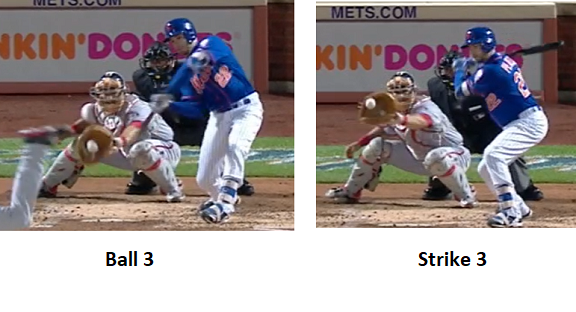
    Plawecki’s at-bat was an odd one. On 2-2, he took a pitch that appeared to nick the outside corner. Plawecki started to walk back to the dugout. Scherzer began his usual stomp around the mound.

    By our calculations, the pitch had an 83% strike probability, but Randazzo called it a ball. This was the only pitch with a greater than 50% strike probability that Randazzo called a ball the entire game.

    Then on 3-2, Plawecki took a pitch that was further off the plate, one with a 25% strike probability, but Randazzo rang up strike three. That was one of five instances in which Randazzo called a pitch a strike that had less than a 50% strike probability.

    It was bad enough for the Mets that Scherzer was at the top of his game on a cold, windy night with a depleted lineup against him. The home plate umpire wasn’t doing them many favors.

    Easy peasy

    The Mets put 11 balls into play against Scherzer, most of them meekly.

    Their hitters reached base once, as previously mentioned when Escobar’s throw to first was not scooped by Robinson, allowing Plawecki to reach.

    Escobar got the error, which resulted in a -.85 plays saved demerit on his register. In other words, a ground ball hit at that speed by a right-handed batter in Plawecki’s speed group (slow) where Escobar fielded it is turned into an out by the third baseman 85% of the time. This turned out to be one of the other 15%.

    We should also point out that scooping throws was not Robinson’s forte. He had 9 scooped throws and 5 mishandled scoops for the season, an effectiveness rate of 64%. That ranked third-lowest in the majors (minimum 10 scoop opportunities).

    Simply put: You can make a reasonable case that Scherzer should have pitched a perfect game.

    We say that because on the 10 balls in play on which the Nationals recorded outs, there weren’t any tough plays from a statistical perspective.

    ResultProbability Play Made
    1st– Conforto groundout to 2B93%
    2nd– Cuddyer flyout to LF77%
    2nd– Johnson groundout to 1B93%
    3rd– Harvey groundout to 1B100%
    4th– Granderson lineout to 2B83%
    4th– Conforto flyout to LF97%
    5th– Cuddyer groundout to 2B97%
    6th– Herrera popout to 2B100%
    6th– Murphy groundout to 2B70%
    9th– Granderson popout to 3B100%

    The closest the Mets came to a hit was when Murphy hit a ground ball to the left of Dan Uggla. Uggla corralled it and, with the option of retiring Murphy at first or getting a force play at second, got the force out at second place. That play had a 70% chance of being made given the aforementioned parameters. And it was.

    Scherzer struck out the next nine hitters after that. He wasn’t taking any more chances with his defense, save for Granderson’s game-ending weak popup, which had a 100% out probability.

    Respect

    Scherzer’s 17 strikeouts matched the most in a no-hitter (Nolan Ryan also had 17 in one of his 7 no-nos). The 104 Game Score is actually the second-best in a start of 9 innings or fewer, trailing only Wood’s 20-strikeout 105.

    The opposition paid its respects to Scherzer’s performance. Mets manager Terry Collins said it succinctly: “He was great. We were bad.”

    Mets broadcaster Gary Cohen called it “one of the greatest pitching performance in major league history.”

    Seems like a fair claim to us.

  • New podcast: A.J. Andrews on softball excellence

    On this episode of the Sports Info Solutions Baseball Podcast, Mark Simon (@MarkASimonSays) is joined by softball star A.J. Andrews (@aj_andrews_) to talk about what goes into being an outstanding defensive outfielder. A.J. was the first softball player to be awarded a Rawlings Gold Glove, and she breaks down three catches: the first being one along the right field line in which she explained proper diving technique and how to evaluate the angles you take (2:58), the second being the first time she could remember making a great play as a kid (10:24), and the third in which she crashed into the outfield wall (13:11).

    A.J. also discusses pre-pitch anticipation (15:38), how defensive positioning in softball is similar to defensive positioning in baseball (17:39), and the mentality needed to be a great defensive outfielder (22:24).

    Thank you for listening. Stay healthy and stay safe!

    Links

    AlwaysAJ.com

    TheAJAndrews.com

    A.J.’s YouTube page