Category: Baseball

  • Stat of the Week: Who were June’s top defensive players?

    The race for Defensive Player of the Month was a tight battle and, in the end, a pair of players tied for the top spot in our voting. So let’s salute Washington Nationals shortstop Trea Turner and Kansas City Royals left fielder Alex Gordon as June’s top defenders.

    Turner is one of the most improved defensive players in baseball. He ended June with 10 Defensive Runs Saved. Eight of those runs saved came in the month of June.

    Most Defensive Runs Saved
    SS in June
    Player Team DRS
    Trea Turner Nationals 8
    Freddy Galvis Padres 7
    Nick Ahmed Diamondbacks 5
    Addison Russell Cubs 4

    Turner had 10 Good Fielding Plays (think Web Gems and plays like keeping a ball in the infield to prevent advancement), the most of any shortstop for the month. He’s shown significant range improvements on balls hit everywhere, but he’s ascended to an outstanding rating on balls hit in the shortstop-third base hole.

    In June, the Nationals converted 25 of 32 ground balls hit into that hole into outs. The average team this season would have converted the play 21 times, the worst teams about 15 times.

    Our video scouts alerted us that Turner is doing his best to keep the jump throw alive. He turned 8-of-9 into an out in June after converting 6-of-14 into outs in the first two months of the season. Turner’s 23 jump-throw attempts through the end of June are easily the most among shortstops. Trevor Story of the Rockies ranked second with 10.

    Gordon doesn’t necessarily have a jump-throw equivalent, though he certainly impressed throughout the month for the Royals. He saved nine runs defensively, the most in the majors in June.

    He entered July with 14 Defensive Runs Saved as a left fielder this season, one shy of Adam Duvall for the major league lead. Gordon has saved one more run there than he did in the previous two seasons combined. He has done this with both his glove and his arm.

    Most Defensive Runs Saved
    LF in June
    Player Team DRS
    Alex Gordon Royals 9
    JaCoby Jones Tigers 7
    Adam Duvall Reds 5
    Cameron Maybin Marlins 5

    His five unaided assists already match his total from last season. His 22 Good Fielding Plays are one shy of his 2017 total, in more than 700 fewer innings. He had 13 Good Fielding Plays in June (including this one). No other outfielder had more than eight.

    At 34, Gordon is doing his best to hang with a new generation of outfielders that may be younger and faster but don’t have his experience.

    “I think it’s just the discipline from day in day out, the way he prepares, the way he takes care of his body and then goes through his daily routine of shagging,” said Royals first base coach Mitch Maier, who also works with the team’s outfielders.

    “It’s been the same since the first day he’s been in the outfield in 2010. The work has not changed, and it shows every day. He puts more work into it, the instincts, the reads off the bat, the jumps, the routes are as good as it gets, and it allows him to perform at a high level.”

    One other player we should note is Texas Rangers outfielder Delino DeShields, who ranked third in our voting. DeShields saved eight runs (helped by a home run robbery). He leads all center fielders with 15 Defensive Runs Saved this season.

  • What helps make Jacob deGrom great?

    What helps make Jacob deGrom great?

    BY MARK SIMON, SPENCER HARRISON AND ANDREW KYNE
    Mets ace Jacob deGrom started the season outside the top 10 in Bill James’ starting pitcher rankings, but he’s ascended to No. 5 with an incredible start to 2018. You might be aware that deGrom has received poor support from the Mets. He has a 1.69 ERA, but the Mets have won only six of his 16 starts.

    You might also know that deGrom has become the master of the high fastball, using it as one of his weapons to strike out more than 11 hitters per 9 innings.

    But what else should you know about deGrom’s success in 2018?

    Four great pitches
    Per Fangraphs’ pitch value stats, DeGrom is the only pitcher in baseball to have at least three runs saved for each of the four primary pitch types (fastball, curveball, slider or changeup) and the only starting pitcher to have at least one run saved per 100 pitches for all four of those pitch types.

    In other words, the hitter has to be ready for more than just deGrom’s fastball.

    Working Inside
    Pitching coach Dave Eiland said before the season started that Mets pitchers would take a much more aggressive approach at pitching hitters inside, going as far to say he hoped the Mets led the NL in hit batsmen.

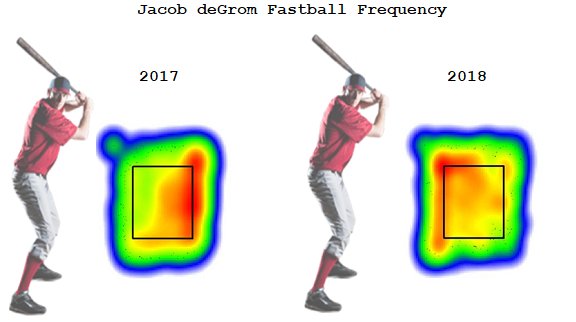
    DeGrom is among those who have taken Eiland’s message to heart. This pair of heat maps shows how deGrom has gone from pitching left-handed batters primarily away with his fastball to attacking inside with it (the red indicates where deGrom has pitched most frequently, the blue is where he has pitched least often).

    We can put numbers to it: This season, 46 percent of deGrom’s fastballs to left-handed hitters have either been on the inner edge of the plate (defined as the inner-fourth) or off the inside corner.

    That’s up from 19 percent in 2017. The 27 percentage point increase ranks first among MLB pitchers.

    Much of deGrom’s improvements from last season to this one have come against right-handed hitters, but left-handed hitters have been held to a .654 OPS against him this season, down 39 points from 2017.

    First-Pitch Curveballs
    A few times a game, deGrom likes to change things up and throw his curveball to start an at-bat.

    He’s done this with significant success this season, throwing 41 of 48 first-pitch curves for strikes, with a major-league best 76 percent called strike rate (22 strikes on 29 first-pitch takes).

    The Shift
    Though the Mets rate as a poor defensive team, they’ve managed to succeed in one area. They are one of the best teams in baseball at defensive shifting and when deGrom is on the mound, they often get the results they’re looking for.

    There have been 32 ground balls, or line drives hit less than 175 feet, against a shifted Mets defense with deGrom on the mound. They’ve gotten at least one out on 30 of those 32. The 94 percent out rate is the best in baseball for a starting pitcher.

    His teammates seem to have risen to the occasion around him in the field, if not at the plate.

  • Kyle Gibson’s slider has been vital to his success

    Kyle Gibson’s slider has been vital to his success

    By SEAN ZERILLO
    Minnesota Twins pitcher Kyle Gibson has had a breakout 2018 season, posting a 3.27 ERA with a 1.17 WHIP (career 4.55 ERA, 1.41 WHIP) over 14 starts and 82 2/3 innings pitched. Gibson has bumped his strikeout rate up to 8.8 strikeouts per 9 innings (K/9) from his career mark of 6.2 K/9 entering the season, while upping the miss rate on swings against him from 22 percent to 26 percent from last season to this season.

    Gibson’s biggest improvement this season has come against left handed hitters – against whom he owns a .336 weighted On Base Average (wOBA) with a 1.6 strikeout to walk (K/BB) ratio for his career (career .316 wOBA, 2.5 K/BB vs. righties). Against lefties in 2018, Gibson’s .279 wOBA essentially matches his .278 mark against righties, and his K/BB ratio has actually been better against lefties (2.4) than against righties (2.2).

    The success is due in part to an improvement in Gibson’s slider, which he throws 19 percent of the time. Per Fangraphs, the pitch cost him nearly two runs in 2017, but this year Gibson’s slider has already saved him over six runs. If Gibson continues to have success with the pitch, the turnaround will be worth over a full win in slider value alone.

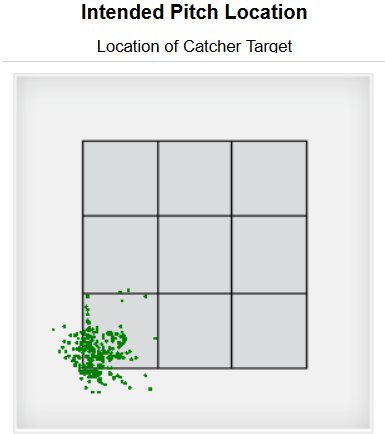
    The difference in slider quality is a result of both improved command of the pitch and a narrowed focus on where to locate it. In 2018, Gibson has exclusively attempted to throw his sliders down and away to righties or down and in to lefties (view is from pitcher’s perspective):


    Gibson has thrown 261 sliders in 2018, and the catcher’s intended target on those pitches has consistently hovered over the bottom left corner of the strike zone (from the pitcher’s perspective). In previous seasons Minnesota’s catchers would often set up for Gibson’s sliders a bit higher inside, or low and away to lefties as you can see in his 2017 slider targets below:


    Simply put, the backdoor, down the middle, and middle-in sliders were not missing lefty bats. The revised strategy, which is to bury all sliders low and in to lefties or low and away from righties, has paid dividends.

    Here’s how the swinging strike rate on Gibson’s slider has increased in the past three years against left-handed hitters (LHH).

    Year Sliders Thrown to LHB


    Swinging Strikes on Sliders vs. LHB Slider Swinging Strike % vs. LHB
    2016 153 28 18%
    2017 112 26 23%
    2018 77 23 30%

    Gibson has generated nearly as many swings and misses on sliders against lefties in 2018 as he did in each of the past two full seasons. Gibson’s command of the slider is also improving.

    We chart how often catchers catch pitches In 2017 Gibson threw 72 percent of his sliders close or closest to the intended target.

    In 2018, 85 percent of Gibson’s sliders have been close or closest to the target, with 57 percent in the area closest to the target – an increase of 23 percentage points from 2017.

    For context, since 2016 Clayton Kershaw has thrown 64 percent of his sliders close or closest to the target, with 34 percent in the area closest to the target.

    In attempting to throw the slider to a less hittable location, and hitting that spot with improved command, Gibson has directly increased his swinging strike rate on sliders on the outside corner at the knees to right-handed batters and the inside corner at the knees to lefties

    Gibson generated swings and misses on 7 percent of sliders in that area of the strike zone in 2017 (six missed swings all season). This season, the whiff rate in that part of the zone is up to 40 percent (11 missed swings).

    With improved control overall and a calculated approach towards locating what is likely his best pitch, Gibson looks likely to keep the gains he has made in 2018 – and he could continue to pitch to a sub-4.00 ERA moving forward as his 3.85 xFIP for 2018 would suggest.

  • Marco Gonzales seems to be figuring it out

    By ANDREW ZENNER
    Before 2018, Marco Gonzales had never been able to experience sustained success in the major leagues. The former first-round pick had compiled a 5.47 ERA and 5.03 FIP in 77 1/3 innings from 2014 to 2017. That lack of success made it easier for the Cardinals to part ways with him when they traded for Tyler O’Neill last July.

    But so far in 2017, Gonzales has been a huge reason why the Seattle Mariners currently find themselves neck and neck with the Astros atop the AL West. The lefty has pitched to a 3.42 ERA and 3.20 FIP, with 69 strikeouts and 19 walks in 79 innings through 14 starts. He has been a stabilizing force—along with Wade LeBlanc and Mike Leake—in the Mariners rotation behind James Paxton.

    What are the reasons for Gonzales’ success?

    Health is one factor. Gonzales struggled through shoulder trouble in 2015 and had Tommy John surgery in 2016, which kept him out until last year. But there may be more to the story than that.

    One glaring issue for Gonzales pre-2018 was turning the opposing lineup over. Between St. Louis and Seattle in 2017, he allowed a 438/.486/.762 slashline the second time through the order. In 2018, he’s trimmed that to a more modest .301/.358/.460 slashline, along with a .270/.308/.446 the third time through.

    The cause for this particular development may be the changes he has made to his repertoire in 2018. Gonzales has added a cutter, which changes the way he uses his pitches.

    Marco Gonzales’ Repertoire
    2017 2018
     Fastball  53%  36%
     Curveball  17%  22%
     Changeup  31%  24%
     Cutter  0%  17%

    The cutter has not only been a successful pitch, it has allowed him to utilize his other four offerings much more evenly, which has likely kept hitters guessing more when he’s faced them a second and third time.

    While his repertoire adjustments have been a major positive, there are some other factors in play that can help explain his early success.

    One thing Gonzales has always been is a pitch-to-contact pitcher. His 82 percent contact rate this year ranks just outside the top 10 in MLB, consistent with his 81 percent career rate. For a pitcher with that profile, limiting hard contact, keeping the ball in the ballpark and  keeping hitters off-balance are highly important.

    Gonzales has been good but not great in limiting hard contact. But his fly ball rate is only 25 percent, a figure bettered by only Clayton Richard, Ty Blach, and Dallas Keuchel. As a result, only nine ERA title qualifiers have allowed fewer home runs per 9 innings than Gonzales this season.

    As for making hitters uncomfortable, Gonzales has both a chase rate (33 percent) that rates among the 20 highest and a zone-swing rate (64 percent) that rates among the 20 lowest among qualified pitchers.

    In other words, he’s been able to make hitters chase at an elite rate and watch pitches go by at an elite rate. Only nine pitchers have a similar difference between those rates – among them are Kyle Hendricks, Patrick Corbin, Zack Greinke, Masahiro Tanaka, Carlos Carrasco, Chris Sale and Jose Berrios.

    With that, Gonzales has the highest fastball called strike rate in the majors (46 percent). For that, he can partly thank one of the better pitch-framers in baseball, Mike Zunino, who ranks seventh in Sports Info Solutions’ Strike Zone Runs Saved stat this season.

    While it may be premature to label Gonzales as a bona-fide mid-rotation starter, his results in 2018 have been encouraging. His new mix has allowed him to pitch deeper into games, and the combination of his getting called strikes and keeping the ball out of the air help him avoid damage without missing bats.

    Mariners fans have much to be excited about in 2018. Gonzales’ pitching is another thing to add to that list.

  • Numbers show improvement in Eric Hosmer’s range

    Numbers show improvement in Eric Hosmer’s range

    by ANDREW KYNE
    Evaluation of San Diego Padres first baseman Eric Hosmer’s defense has long differed between the eye test and metrics such as our Defensive Runs Saved (DRS). Scouts and coaches have considered the Padres’ new first baseman to be among the league’s best at the position, while the numbers have typically rated him as a negative from a run-saving perspective.

    MLB.com’s Jeffrey Flanagan discussed the varying perceptions last August, with Hosmer’s former manager, Ned Yost, praising the first baseman’s “footwork around the bag, the ability to make great picks, handling pickoff throws” and other defensive detail. Our numbers at Sports Info Solutions generally agree, especially for picks – Hosmer leads all first basemen in runs saved via scoops over the last three seasons.

    However, in a June 2016 profile for The Kansas City Star, Yost admitted that “(Hosmer) doesn’t have exceptional range.”

    His range is, in fact, what defensive metrics have been skeptical of. According to our data, he cost the Royals a total of 11 runs in 2016 and seven runs in 2017 due to his range and positioning.

    Given his history, it’s noteworthy to find Hosmer’s name currently atop the total DRS leaderboard at first base for 2018:

    Name

    Range & Positioning

    Total Runs Saved

    Eric Hosmer

    4

    6

    Brandon Belt

    4

    5

    Matt Olson

    3

    5

    Joey Votto

    5

    4

    Paul Goldschmidt

    5

    4

    Four of Hosmer’s runs saved have been credited to range and positioning, representing a significant improvement from his time as a Royal. He still rates slightly below average on plays to his glove side, but has been plus on balls hit straight at him and to his left.

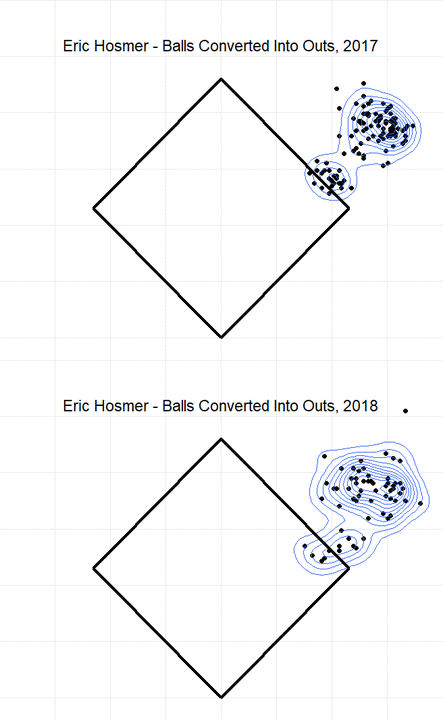
    The following animation illustrates the wider range of balls that Hosmer has converted into outs so far in 2018 compared to 2017:

    EricHosmerRange

    It is worth noting that Hosmer’s average starting position (in terms of depth and angle) has not been significantly different this season, as seen through Statcast and Baseball Savant’s Player Positioning application.

    Of course, the sample size has been small and defensive metrics like DRS need time to stabilize, but Hosmer has our attention.

  • Alex Gordon had a great defensive week

    By MARK SIMON
    The 22-49 Kansas City Royals don’t have much to be happy about these days, but the defensive play of Alex Gordon provided at least one positive this weekend.

    Gordon had four Good Fielding Plays in the three-game series against the Astros this weekend (Good Fielding Plays are Web Gem-type plays and other plays with a positive consequence, such as cutting off a throw to hold a runner).

    They consisted of three terrific catches and one unaided assist (without a cutoff man). All three required him to go back and towards left center to take away hits from Marwin Gonzalez, Carlos Correa and Evan Gattis.

    The good weekend propelled Gordon into the lead among outfielders with 17 Good Fielding Plays in total, two more than Reds center fielder Billy Hamilton. Coincidentally, last Wednesday, Gordon made a great diving catch to take a hit away from Hamilton.

    Gordon ranks second among left fielders with 10 Defensive Runs Saved this season, trailing only Adam Duvall of the Reds (12). That total has been bolstered by his saving three runs defensively on throws. His four unaided outfield assists are one shy of his total from 2017. If he can get to six, it would be his most since he had 13 in 2013.

    Most Defensive Runs Saved   Left Fielders
    Team DRS
     Adam Duvall  Reds  12
     Alex Gordon  Royals  10
     Brett Gardner  Yankees  9
     Corey Dickerson  Pirates  9

    Gordon’s 10 Defensive Runs Saved in left field are already one more than he had last season when he won his fifth AL Gold Glove. The battle for this one seems to be shaping up as one between Gordon and fellow 34-year-old Brett Gardner of the Yankees (whom we wrote about last week). A highlight-reel weekend like this one will only help Gordon’s cause.

  • ‘O’ my: Orioles’ defense struggling mightily

    BY MARK SIMON
    There was no reason to believe that the Baltimore Orioles were going to be as bad as they’ve been this season. Similarly, there was no reason to believe that the Orioles defense was going to be as bad as it has been in 2018.

    But here we are in mid-June, with the Orioles 19-48 and at -57 Defensive Runs Saved. Only the Phillies defense, which has cost the team 62 runs, rates worse.

    Fewest Defensive Runs Saved
     Phillies  -62
     Orioles  -57
     White Sox  -41
     Pirates  -29 
     Mets  -29

    But the Phillies foibles on defense were to be expected given their personnel. The Orioles were thought to be an average defensive team based on past performance. What’s happened?

    Machado’s defensive malaise
    Manny Machado, a Fielding Bible Award winner for defensive excellence in 2013, was moved from third base to shortstop with the thought that he’d be able to convert without issue, given that he fared fine there in a 45-game stint in 2016.

    That hasn’t happened. Machado has cost his team 13 runs defensively at shortstop, the most of anyone at the position. Though Machado has made some sparkling plays at the position (19 Good Fielding Plays), he’s let many balls go through.

    Machado rates seven plays below average in terms of getting outs on balls hit to the shortstop-third base hole and eight plays below average on balls hit up the middle. Most shortstops who are bad at fielding the ball in one area are average or above at fielding balls in the other direction. But Machado is far below average in both.

    A look through some of the plays that cost him the most defensive value includes a combination of slow reactions, mistimed jumps, poor throws and just general slowness — that one represented in a grounder to short that Adam Engel beat out a few weeks ago in a game the White Sox were winning 11-1.

    Additionally, the Orioles lost a great defender at third base and replaced him with the combination of Danny Valencia, Tim Beckham, Jace Peterson and Pedro Alvarez. Valencia has played the most in that group and has cost the Orioles six runs with his defense. Beckham, Peterson and Alvarez have combined for no runs saved.

    Adam Jones’ woes
    Adam Jones is a polarizing figure when it comes to evaluating his defense. Those who use the eye test say he’s Gold Glove worthy. The metrics have long shown otherwise.

    And the metrics don’t like Jones this year. He’s at -15 Defensive Runs Saved. Only Charlie Blackmon rates worse among center fielders (-18). This will likely be Jones’ third straight season costing his team at least 10 runs with his defense.

    Like Machado, Jones has multiple defensive issues. He’s not catching balls hit in front of him and he rates poorly on balls hit over his head.

    Jones no longer seems to be able to go get the ball like he used to. He averaged 19 Good Fielding Plays per season from 2015 to 2017 (Good Fielding Plays are plays like Web Gems and positives like cutting a ball off in the gap to prevent baserunner advancement) He’s totaled three in 61 games in 2018.

    In fairness to Jones, the difference between rating great and not can be a few balls — Jones has had the misfortune of playing to pull a few times on balls hit the opposite way and vice-versa. The one common thread on balls that cost him the most value is a couple of instances of pulling up on shallow flies.

    Mystifying Mancini
    One of Jones’ outfield mates has also suffered statistically from a defensive perspective. Left fielder and part-time first baseman, Trey Mancini has poor numbers, particularly in the outfield. He’s cost the team 14 runs in 52 games in left field.

    Mancini’s rate of Defensive Misplays and Errors (think plays with a negative consequence, such as slipping or misjudging a ball that bounces off the wall) appears to be contributing to the problems. He averaged one misplay and error every 56 innings in 2017, but is averaging one every 30 innings in 2018.

    Mancini’s size (6-4, 215 pounds) is a hindrance from the plays we watched, as he lacks speed to catch up to balls that a left fielder with good wheels would catch.

    Where do they go from here?
    The Orioles are headed towards both a historically bad season and a housecleaning. Machado and Adam Jones are both free agents this offseason and could both be moved before the July 31 trade deadline.

    The Orioles team you’ll see at season’s end will likely be vastly different from the one that’s taking the field daily now. We’ll see if the subtractions prove to be additions from a defensive perspective.

  • Stat of the Week: Evaluating the Phillies’ infield shifts

    By ANDREW KYNE

    Jake Arrieta’s recent comments called attention to the Philadelphia Phillies’ infield shifts. The veteran right-hander complained that his team is “the worst in the league with shifts,” and by our Shift Runs Saved metric at Sports Info Solutions, he is indeed correct. The Phillies rank last in Major League Baseball in Shift Runs Saved, costing themselves eight runs while no other team has cost themselves more than two runs. What has gone wrong for Gabe Kapler’s club?

    Most of the Phillies’ shift struggles have come against right-handed batters. Despite shifting righties much less frequently, shifts have cost them seven runs against righties and one run against lefties. On groundballs and short line drives, right-handers have hit .326 against the Phillies’ full Ted Williams shifts (three infielders on the left side of second base) and .381 against their partial Ted Williams shifts (two players significantly out of normal positioning).

    Batting Average Allowed

    Groundballs and Short Line Drives

    Bat Side Full Shifts Partial Shifts
    Phillies Right .326 .381
    MLB Right .232 .283
    Phillies Left .255 .271
    MLB Left .206 .267

    Against left-handed batters, the batting averages the Phillies allow on grounders and short liners are better when shifting (.255 with Full, .271 with Partial) than when not shifting (.299). However, compared to the rest of the league (.206 with Full, .267 with Partial), their shift performance is still problematic.

    Further review of the Phillies’ costliest Shift Runs Saved plays, particularly against right-handed batters, reveals another issue: throwing. Two of their worst plays happened to come behind Arrieta in his April 25th outing versus Arizona. Paul Goldschmidt twice rolled a groundball into the shift, but Maikel Franco committed a throwing error in the fourth inning and J.P. Crawford followed with a throwing error of his own in the sixth.

    Our “Good Throw Rate” statistic illustrates the Phillies’ struggles of throwing to first base from the left side of the infield. Franco, Crawford, and Scott Kingery can all be found near the bottom of the rankings at their respective positions.

    Good Throw Rate (Min. 30 Throws at Position)
    Player Pos Rate Pos Rank
    Scott Kingery SS 93% 27th of 36
    J.P. Crawford SS 88% 35th of 36
    Maikel Franco 3B 86% 37th of 37

    Part of their poor shift performance is certainly attributable to positioning, luck, and other factors, but the Phillies’ underlying defensive skills may be the root of the problem. By Defensive Runs Saved, which does not include shift plays, they have lost 13 runs at shortstop and six runs at third base this season, tying for the worst left side of the infield in baseball with the Baltimore Orioles.

    Fewest Defensive Runs Saved at SS and 3B
    Team DRS
    Philadelphia Phillies -19
    Baltimore Orioles -19
    New York Mets -15
    New York Yankees -14
    Boston Red Sox -13
    Pittsburgh Pirates -13

    Shifting does improve their poor defense, particularly on the left side, but it is still well below average relative to the rest of the league. Moving forward, there is reason to be optimistic from a strategy standpoint. The Phillies say that the information they were using in April
    “wasn’t always up to date” and they are confident that they have since implemented positive changes to their positioning strategy.

    As it turns out, all eight of their runs lost to the shift came in March and April, so they have performed considerably better (yet still not great) in recent weeks. That said, the shift cannot always mitigate the effects of poor defenders, especially when it comes to throwing across the diamond.

  • Matthew Boyd turns back the clock

    BY COREY FISHMAN
    In 2015, Matthew Boyd was acquired by the Detroit Tigers in a trade that ultimately sent David Price to the Toronto Blue Jays. That same season Boyd won the MiLB.com Fans’ Choice Award for best starting pitcher in the minor leagues and he was also selected to be a Double-A All Star by Baseball America.

    Although Boyd excelled at the minor league level, he has not performed as well in the majors.

    Until now.

    From 2015 to 2017 Boyd had a 5.47 ERA while allowing a .284 batting average and .836 OPS. This year he has been able to improve these statistics drastically as he has a 3.23 ERA, .205 batting average allowed, and .613 OPS allowed.

    The most surprising thing here is that after digging into Boyd, it seems that he has decided to turn back the clock and pitch relatively similar to the way he did in 2015.

    When Boyd broke into the league in 2015 his best pitch by far was his slider, but as you’ll see in the graphic below, it became much more hittable after that.

    Batting Avg Against Boyd’s Slider
    Slug Pct
     2015  .158  .237
     2016  .208  .340
     2017  .375  .569

    The one major change Boyd made was increasing the velocity on his slider over time. From 2015 to 2017 it sped up from 80 to 86 MPH. The one constant we notice here is that the faster he threw this pitch, the worse his numbers got.

    By isolating just the 2018 season, we are able to see the drastic improvement in this pitch. He has decreased the MPH on his slider to 81 MPH, experienced a career high in miss rate at 32 percent, and he holds down a terrific .155 batting average and .194 slugging percentage. So why does slowing down this pitch improve his overall game so much? The answer can be defined in one word; placement. With help from heat maps available on Boyd’s player page at Fangraphs.com, we can show you the difference in where he locates the slider, specifically to right-handed hitters.

    What we are able to identify in the images above is that by taking off velocity from his slider, Boyd is able to paint the outside corners with tremendous success, reducing the number of hard-hit balls against it.

    So what we have here is a pitcher who has turned back the clock to redevelop the pitch that was giving him so much success in the minors. What has truly elevated Boyd to the next level is his willingness to deviate from being heavily reliant on his fastball to allowing his slider to take control of his game.

    As we established earlier, in 2015 Boyd’s slider was almost a mirror image of how it is today. The issue seems to be that he only threw it 17 percent of the time. This season he has upped the percentage to 34 percent.  This puts him right behind Diamondbacks pitcher Patrick Corbin (37 percent), who has been dominant at times when throwing sliders with high frequency.

    If Boyd is able to stick to this plan and rely heavily on his dominant slider, it is tough to see a future that doesn’t hold success for him at this level. Over the last four seasons, Boyd’s FIP- (a stat found on Fangraphs that accounts for ballpark factors) has dropped all the way down from 161 to 94.

    Overall, while many people may have lost hope in Boyd over the years, there is plenty of data to suggest that he has what it takes to be a quality starter at the highest level.

  • Why does Brett Gardner lead outfielders in Defensive Runs Saved?

    Why does Brett Gardner lead outfielders in Defensive Runs Saved?

    By MARK SIMON
    Age is no hindrance to 34-year-old New York Yankees outfielder Brett Gardner. He currently leads all outfielders with 14 Defensive Runs Saved this season, if you combine his work in center field and left field.

    This is nothing new for Gardner, who saved 20 runs defensively in 2017, his third season with at least 20, but his first since he had 23 in 2011.

    Here are the outfield leaders in Defensive Runs Saved this season.

     Brett Gardner  Yankees  14
     Adam Duvall  Reds  12
     Lorenzo Cain  Brewers  12
     Harrison Bader  Cardinals  11
     Lewis Brinson  Marlins  10

    He’s stayed healthy in a season in which some of the best in the game (Byron Buxton, Kevin Kiermaier, Mookie Betts) have not. And Gardner’s the best, even though most of the game’s top outfielders (Betts, Buxton, Jason Heyward) are five to 10 years younger than he is.

    So how does Gardner keep up?

    Gardner’s defensive numbers are driven by a few things.

    His Range
    Because of how they are positioned, it is hard for an outfielder to excel on both shallow fly balls and deep fly balls. But Gardner has no such trouble.

    Gardner rates 11 plays above average on balls hit to the shallowest parts of the outfield and 14 plays above average on balls hit to the deepest parts of the outfield over the last two seasons.

    In other words, take all the balls hit within catching distance of Gardner in that time. He caught that many more balls than an average player would have.

    Buxton is the only other outfielder to be at least plus-9 in both in that time.

    His Arm
    Over the last two seasons, Gardner has seven Defensive Runs Saved with his arm, including two this season. This year’s came from a combination of three outfield assists that didn’t require the help of a cutoff man, and that 32 percent of baserunners took an extra base on him when he was playing left field and 39 percent (5-of-13) did so when he was in center field (both are slightly better than the major league averages).

    Minimal fanciness
    If you’re having trouble thinking of a great play by Gardner this season, you’re not alone. He has four “Good Fielding Plays” this season, but they’re for his outfield assists and an instance of cutting a ball off to hold a batter to a single.

    Gardner has done what he’s done this season while staying on his feet. He’s rarely slid or dove, and has limited his leaping attempts as well. But in left field, he’s fared well relative to other left fielders when he sprints (we track the fielder’s approach to the ball), recording outs on 40 percent of his sprinting approaches (14-of-35).

    Only Jon Jay, at 41 percent, is better at the position among the 30 players with the most opportunities (82 plays). This was not a Gardner strength last season, but so far it has been one for him in 2018.

    Great defense is not always about diving, sliding or leaping. In this case, it’s just about getting in position to make plays and doing your job. Gardner isn’t the fanciest defender out there. But he’s among the best in the game.