Category: NFL

  • Study: What Is So Dangerous About Special Teams Plays? 

    Study: What Is So Dangerous About Special Teams Plays? 

    An In-Depth Observational Analysis of Injuries that Occurred During Kickoff and Punt Plays Between the 2017-2021 Seasons: Part 1 

    Introduction 

    For years, we have been told how dangerous special team plays are, especially kickoffs and punts. Theoretically, it makes sense as we have elite athletes running at high speeds to engage in violent collisions with one another. That sentence alone makes me want to avert my eyes, but I can’t help my desire to watch the action unfold. Are these plays as dangerous as they are made out to be? 

    The NFL believes this is the case and continues to review and implement rule changes during the offseason for player safety. Their forward actions should be applauded, as injuries are an inevitable consequence due to the nature of the sport but should be minimized to whatever degree possible. Injury prevention is more of a pipe dream than a realistic goal, but risk reduction is what all parties are hoping to attain. 

    Luckily, SIS has the data to assess the situation and investigate the relationship between injuries and specific play types. This article will focus on the relationship between injuries during kickoff and punt plays compared to other plays at the pro and collegiate levels. We will then compare the two levels to one another to identify any discrepancies that presented themselves. 

     Breakdown of Injury Data 

    First, it’s important to understand the proportion of these two play types in the totality of all plays. Special teams accounts for between 17-18% of plays in each season, and kickoff and punts will make up around 11-12% on their own.  

    SIS scouts have identified 7,294 in-game injuries at the Pro level between the seasons of 2017-2021 and over that time our Injury Analysts have reviewed the film of each injury and cross-referenced injury reports to provide the most up-to-date and accurate information. 

    From our data, injuries on kickoff and punt plays account for 7% of all in-game injuries. Although that percentage does not appear concerning, it is the areas involved and the severity of these injuries that are alarming. Previous investigations identify the head and knee regions as areas of concern. Our data will provide a thorough analysis of these two regions as well as other concerning trends found during this investigation. 

    Examination of Head and Knee Injuries at the Professional Level 

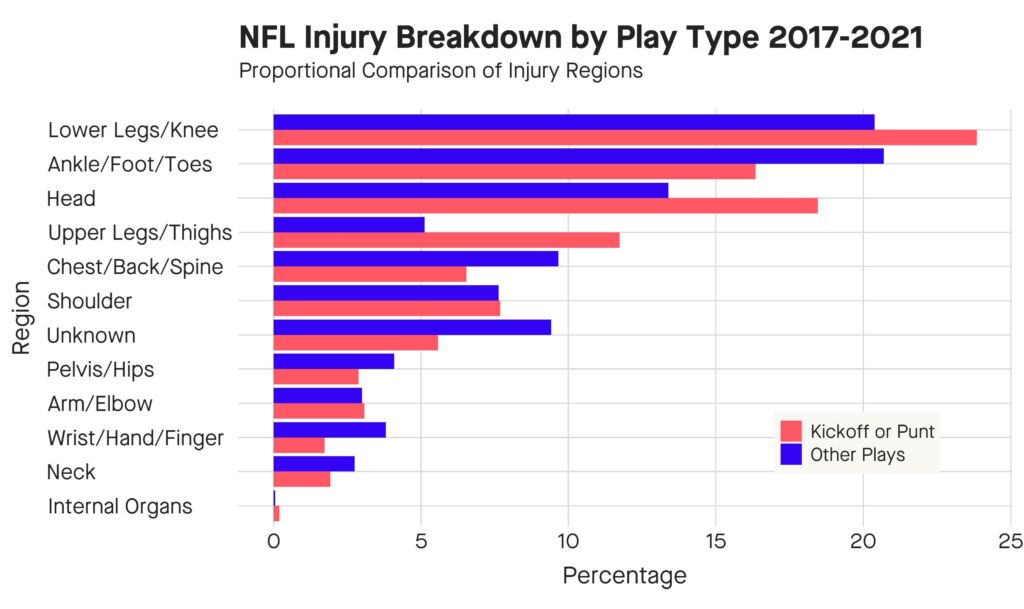
    The proportion of head injuries between kickoff and punt plays compared to other plays stands out. Injuries involving the head account for 18.5% of the injuries that occurred on kickoff and punt plays compared to 13.4% on the other play types (alpha= 0.05, p < .01). 

    NFL Injury Breakdown by Injury Region and Play Type for 2017-21. Lower extremity injuries are most common overall, with head and knee injuries being more common on kickoffs/punts.

    Assessing knee injuries on these specific play types sheds a different light. Knee injuries account for 23.8% of the injuries that occurred during kickoffs and punts compared to the 20.7% during the other play types (alpha= 0.05, p = 0.03). Though the gap between these proportions is smaller than what the head region revealed, things get interesting when you observe the specific knee diagnoses involved.  

    The alarming revelation appears when you evaluate the disparity of proportions between anterior cruciate ligament (ACL) injuries of these play type groupings. Confirmed ACL injuries account for 19.2% of the knee injuries that transpired on kickoffs and punts compared to 6.9% during other plays (alpha= 0.05, p < .01). 

    As most football fans know, ACL injuries will likely require a season-ending reconstruction surgery. Although the likelihood of a return to previous performance levels has improved, the duration of the rehab is lengthy and can vary greatly between athletes. 

    Examination of Head and Knee Injuries at the Collegiate Level 

    Next, we’ll examine the relationship between play types and injuries at the collegiate level. Since full disclosure of college injury diagnoses are difficult to verify, this analysis will focus on general regions. Like the NFL, the proportion of kickoff and punt plays follow the same ratio accounting for 11-12% of total plays. 

    SIS scouts identified 21,894 in-game injuries between the 2017-2021 seasons. As stated above, our Injury Analysts reviewed each play to identify the region affected during the play and updated that injury information accordingly.  

    From our data, 5.6% of the identified in-game injuries occurred during kickoff or punt plays. As we will see, the areas involved during those injuries stand out when comparing the regional distribution and their corresponding proportions between the play types of interest. 

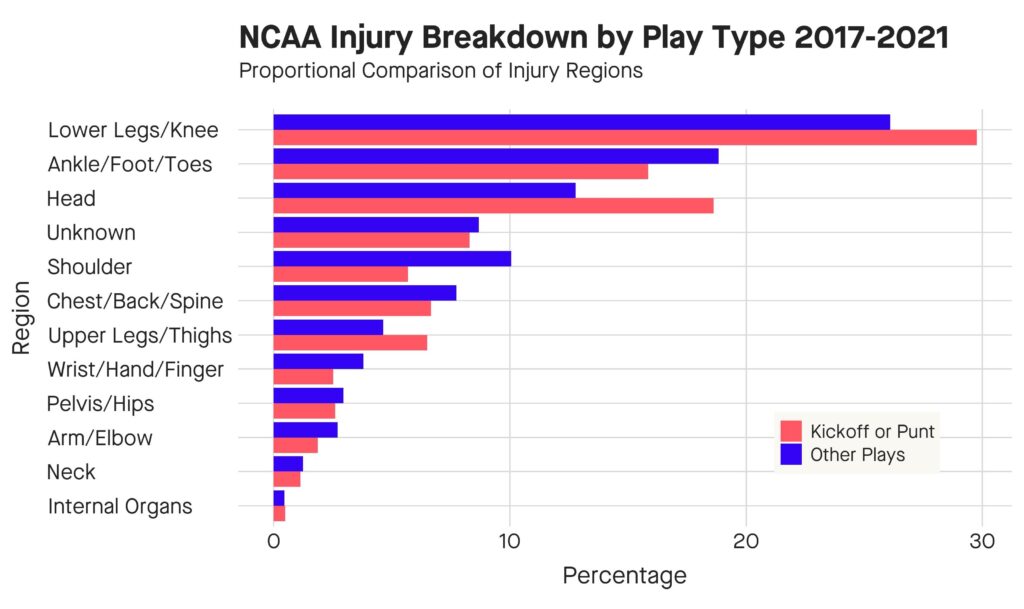
    NCAA Injury Breakdown by Injury Region and Play Type for 2017-21. Lower extremity injuries are most common overall, with head and knee injuries being more common on kickoffs/punts.

    Injuries involving the head during kickoff and punt plays account for 18.6% of our recorded injuries compared to 12.8% during the other play types (alpha= 0.05, p < .01). In addition, an injury sustained during a kickoff or punt play involved the knee 29.8% of the time compared to 26.1% for the other group of plays (alpha= 0.05, p < .01). 

    Once again, the data suggests that the head and knee regions are more likely to be involved when an injury occurs during a kickoff or punt play.  

    Comparison between College and the Pros 

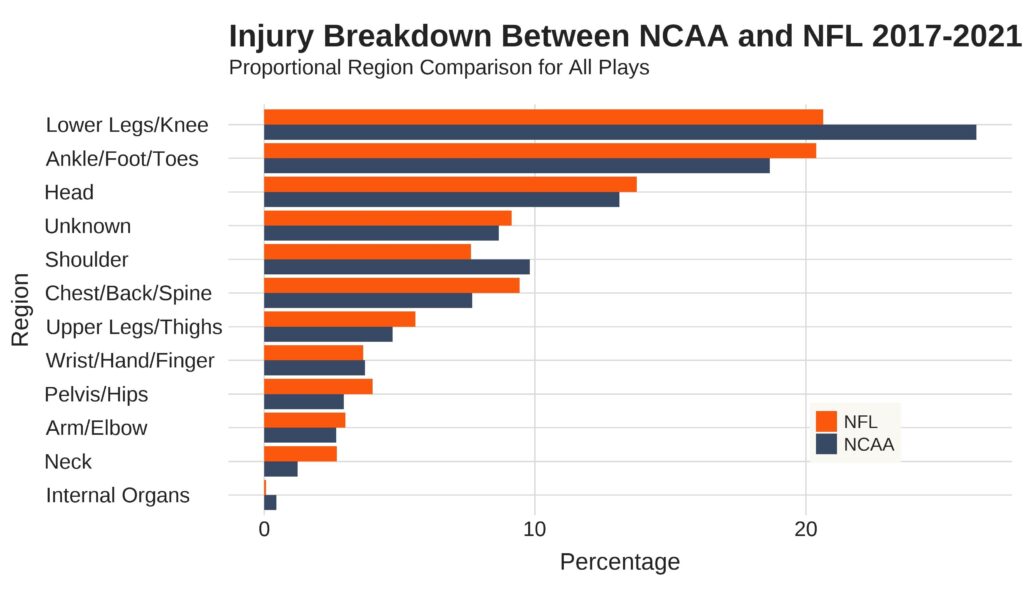
    A major discrepancy presented itself when the injury proportional data was compared between the two levels. Regardless of the type of play involved, college players’ knees were more likely to involved with the injury.

    NFL vs NCAA injury rates by body region. Lower leg / knee injuries are much more common in NCAA.  

    It is a peculiar phenomenon that proved to be significant. Retrospective research studies regarding football injuries identify the knee as an area of concern. We have gathered that the knee is the most at-risk region to be affected by an injury during a football game. The risk of involvement appears to increase at the collegiate level, in addition to during kickoff and punt plays.  

    Why do college players’ knees appear to be at higher risk compared to the pros? Is it the style of play between the levels or some other factor involved? Speculation could be drawn that the greater proportion of elite athletes at the professional level may decrease the knees’ involvement during injuries at that level. Another factor could be the increased variations of formations at the college level compared to the pros. More research is needed to understand this difference. 

    Further Research 

    Questions present themselves after observing this data. Questions like: Why do the head and knee regions appear to be more involved during kickoffs and punts? Other disproportions were apparent after examining the data that were not investigated further within this study. One example is the higher proportion of ankle and foot injuries at both levels during the other play types. 

    As one of the Injury Analysts at SIS, I hypothesize that the higher proportion of ankle and foot injuries appears because of the common mechanism of injury I witness while reviewing plays. Many ankle injuries occur at the line of scrimmage where linemen are engaged with one another and subsequently get rolled up on by another player. Eliminating this type of action from a kickoff and punt play would decrease the likelihood of the ankle being involved when an injury occurs. 

    The other disproportion that was not investigated further was the difference within the upper leg and thigh region between the play type groupings. Most injuries to that region involve a muscle strain. I elaborated on muscle strains, specifically hamstrings, during a threepart series at the beginning of this past season. A common mechanism of a muscle strain involves high velocity running, which is more likely to occur for a greater number of athletes on the field during a kickoff or punt play. I suspect that may be the culprit behind that region’s higher involvement during kickoffs and punts. 

    The goal of this observational analysis was to examine the data and evaluate the relationship between the varying play types and the injuries that occurred. It proved to be fruitful, and it will lead to further studies to help identify variables that may be contributing to the results. The next article will continue this investigation by focusing on the kickoff and punt plays individually. We will utilize our data to observe the injuries within different conditions and evaluate the players affected to enhance our understanding at what transpires during these plays. 

  • What Do Russell Wilson & Carson Wentz Bring Their New Teams

    What Do Russell Wilson & Carson Wentz Bring Their New Teams

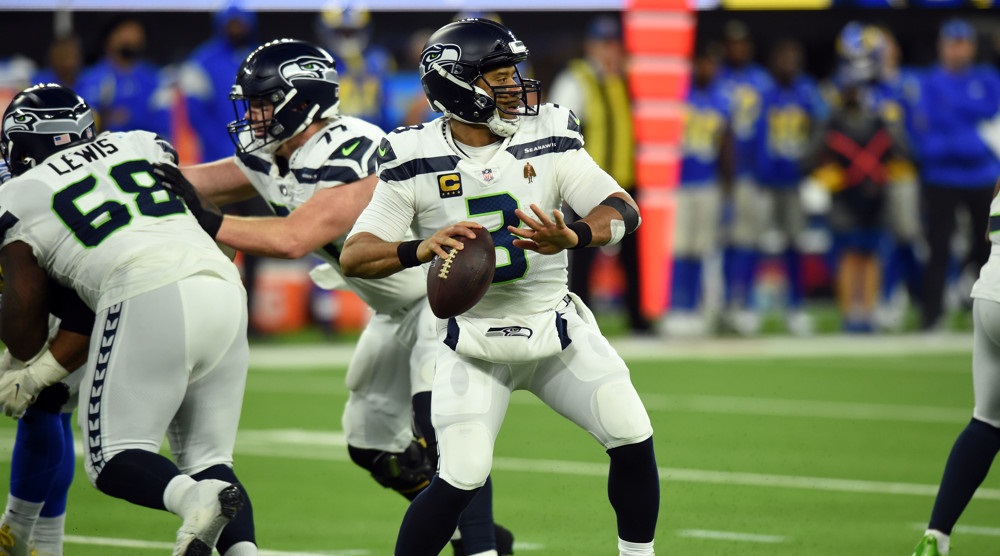
    Russell Wilson – Denver Broncos

    Denver has continued to seek a quarterback since Peyton Manning’s Super Bowl winning team in 2015-16, with a revolving door of “wow, remember him?” names, including Trevor Siemian, Brock Osweiler, Paxton Lynch, Case Keenum, Joe Flacco, Drew Lock, and more. It should come as no surprise they were very aggressive in acquiring a QB they can trust.

    Sending Drew Lock, Noah Fant, Shelby Harris, multiple first round picks, and more throw-ins to Seattle, the Broncos acquired the quarterback who defeated them 43-8 in Super Bowl XLVIII. Will the investment be worth it?

    Russell Wilson is coming off an up-and-down 2021 season, where he posted a statline of 3,113 yards, 65% completion percentage, 25:6 TD:INT, with 9.3 Passing Total Points Per 60 Plays, good for 18th-best among QBs with at least 100 attempts. Looking back at the first half of 2020 while he was an MVP candidate, his 15.6 Total Points Per 60 Plays, third best in the league. Aggregating over the last two seasons, WIlson ranks just inside the Top 10.

    Drew Lock recorded 5 Passing Total Points Per 60 Plays in 2020, ranking 28th in the league, and Bridgewater’s 10.0 in 2021 was 14th-best, which ranked a smidge higher than Wilson. It should be noted that Wilson was struggling with a finger injury for most of those games.

    The Broncos of the future are going to hold a different identity, and it isn’t just from the QB change. Vic Fangio was fired, and former Green Bay offensive coordinator Nathaniel Hackett is taking over as Head Coach. While Hackett was not the primary play caller, he was heavily involved in devising the game plans that gave Aaron Rodgers back-to-back MVP awards. 

    The 2021 Packers mostly operated out of 11 personnel, but their 12 personnel usage ranked 2nd-highest, and they ranked 4th-highest in 4 WR sets. Trading Fant to Seattle suggests that Denver might not be leaning too hard on the 2 TE packages, but the four-wide looks would be a new feel for Wilson.

    The 2021 Packers called more passes with four receivers on the field than the Seahawks did the last three years combined.

    The Packers used motion at the fifth-highest rate in the league, on 54% of plays, a stark contrast to the third-lowest 31% motion rate by the Seahawks. This is one of a number of ways in which the offense Wilson leaves was a bit stale.

    Rodgers was extremely effective in short dropbacks, with a league high 118.5 IQR (SIS Independent Quarterback Rating, which factors out things outside a QBs control like dropped passes and dropped interceptions). Comparably, Wilson ranked 9th at 103.0, and Bridgewater 14th at 97.1.

    Even on short drops, Wilson separates himself with his downfield aggression and willingness to let the play develop. He ranked one spot better than Rodgers in IQR on deep drops, with a throw depth of 18.9 yards on average, much higher than any other QB (Rodgers was at 11.5). This was all under a league-high pressure rate of 54.5%, which it should be noted is partly his doing by extending plays. Wilson continues to be one of the league’s best on deep drops with long throws.

    With a receiving room of Jerry Jeudy, Courtland Sutton, Tim Patrick, Albert Okwuegbunam, and KJ Hamler, Wilson will have weapons at all levels of the field, even if the top two aren’t in the same tier of Tyler Lockett and DK Metcalf.

    Denver paid a high price to find some consistency at the QB position. The Broncos were in the postseason mix last year at 7-10, and with Wilson’s improvements and an offensive scheme that will resemble 2021’s best, they could be considered contenders. Right now, they sit at the 5th-highest odds to win the Super Bowl at 12-1, which is impressive considering the other teams in their division.

    Carson Wentz – Washington Commanders

    After striking out on Matthew Stafford, Aaron Rodgers, and Russell WIlson, the Commanders found themselves looking at yet another year with a QB desire. With a new name, logo, and uniform set, Washington opted to trade for former division rival Carson Wentz, giving multiple mid-round picks to Indianapolis in the deal.

    Washington has continuity in head coach Ron Rivera. After a year as the second-most frequent users of play action, they found a QB that came from the 4th-highest play action team in Indianapolis, meaning Wentz will be asked to do a lot of the same. 

    On play-action passes, Wentz performed the same or slightly worse than the incumbent Washington QB, Taylor Heinicke, in all of IQR, Total Points Per Play, Positive %, Completion %, On-Target %, and Adjusted Net Yards Per Attempt, among many others. Simply put, Wentz is probably a lateral move..

    Both of these quarterbacks have reputations of making things happen when things go awry, but in 2021 they were both middling at best.

    Carson Wentz vs. Taylor Heinicke, 2021, Under Pressure

    Comp% On-Target% IQR Sack%
    Wentz 47.5% 59% 72.2 16%
    Heinicke 53.0% 66% 71.0 21%


    Where Wentz shows up as an improvement over Heinicke is when the pocket stays clean. This is particularly true on non-play-action dropbacks, but it shows across all unpressured dropbacks.

    Carson Wentz vs. Taylor Heinicke, 2021, Clean Pocket

    Comp% On-Target% IQR INT%
    Wentz 69.3% 77% 108.3 1%
    Heinicke 69.4% 73% 81.1 3%

    The bottom line for Washington fans is, not great. Wentz comes at a much higher salary than Heinicke, and if his 2021 performance is to continue, he offers an improvement on vanilla dropbacks with clean pockets but is at best as good as Heinicke otherwise. He is a good enough starter to keep Washington out of the league’s cellar where many teams acquire their QBs of the future, but I’m reserved on calling them a playoff team yet.

    For more on the QB carousel, check out the latest edition of the Off The Charts Football Podcast.

  • How do we evaluate Pittsburgh QB Kenny Pickett?

    How do we evaluate Pittsburgh QB Kenny Pickett?


    On the most recent episode of the Off The Charts podcast, we explained our football draft prospect scouting process. We went through the different factors our scouts consider, what they watch for as they watch film, and used a specific player to show how we do what we do.

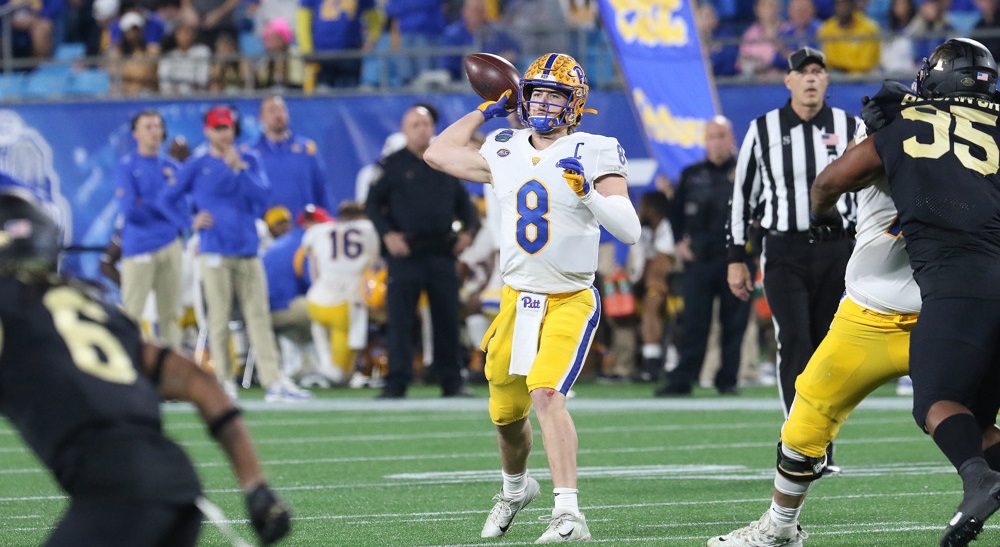
    For quarterbacks, we looked at Kenny Pickett from Pittsburgh.

    Here’s how one of our lead editors of our upcoming NFL Draft website, Nathan Cooper, came up with his grade.

    We require watching at least four games on a specific player per report.

    For quarterbacks, you’re going to watch more than four. I watched nine on Trey Lance last year.

    The hardest part about this process is that college offenses don’t always translate to the NFL. It’s hard to find guys in college who are doing exactly what he’s going to be asked to do. You have to find the traits, project the traits, and see as many NFL-worthy plays as you can, and rate those slightly higher than the rest.

    There are 15 factors on which we grade a quarterback. Three are what we call critical factors that we put a higher value on than the other 12 factors. We grade on a scale of 1 to 9, though most of our factor grades end up either 4, 5, 6, or 7. The three critical factors for quarterbacks are accuracy decision-making and mental processing, and clutch performance.

    Accuracy

    When you think of accuracy, a lot of people think of completion percentage and for us as data collectors and even as evaluators, it goes a lot deeper than that. We’re not only looking for the ball to be caught, but was it catchable? Was it on target? Did he give the receiver a chance to make a play?

    We look at the short passes, the intermediate passes and then deep down the field. Everyone obviously expects, passes to be completed a higher rate whenever you’re in the shorter areas of the field.

    With accuracy, he’s not always spot-on with his short passes, his swings and flats are a little behind. He lacks a bit of touch on his shorter throws as well, so I don’t love that aspect about him. But he has a very good touch on the deep ball. He’s money from 25 to 35 yards.

    I do worry about arm strength with him, about getting much deeper than 25 to 35 yards on his throws.

    So I would give him a 5 overall for accuracy. But if you broke it down, I’d say a 5 on short passes and a 6 on deep.

    Decision Making/Mental Processing

    For decision making, there are a lot of factors. We’re looking at the ability to make smart decisions, but also mental processing.

    • How well does he read the field?
    • How well does he process what the defense is doing?
    • Is he poised in the pocket or flustered under pressure?
    • Does he sense pressure and hang in?
    • Is he waiting for receivers to come open before he throws or is he throwing them open?

    I like his ability to make decisions. He works the field, rarely forces the passes into super-tight windows and doesn’t take too many chances.

    A majority of his turnovers come on off-target throws or late throws. He generally does a good job processing the field, going through his progressions, manipulating the safety with his eyes, holding him to one side before going back to the other side of the field. That’s one of those things that’s hard to see as a fan unless you know to look for it, as scouts do.

    He doesn’t throw with anticipation a lot. You’ll see it a bit on comeback routes. I want to see it more. But his overall decision making, he’s at a good level, or a 6, for the NFL.

    Clutch Performance

    Our third critical factor is clutch performance

    • How do they play on 3rd and 4th downs?
    • How are they in the red zone in the final minutes when their team is trailing?
    • How do they handle playing on the road? In adverse conditions?

    Pickett had a lot of 4th-quarter comebacks at Pitt and drove the ball down the field and made the throws to put the ball in the end zone when needed. He’s a 6 clutch at the next level for me.

    Positional Factors

    There are 12 positional factors and we’re not going to go through all of them.

    But one of them is leadership. Leadership kind of goes back to clutch a little bit.

    How does he play in adverse situations?

    What’s his body language? Is he sort of dejected over on the sideline by himself when he or his team is struggling? Or is he a guy that’s trying to rally the troops?

    But also, it’s things like – is he standing in there and making plays while taking hits. Is he putting his body on the line to get an extra yard for the first down. There’s an extra value for us beyond the statistical value of the first down yardage.

    With Pickett, he’ll stand in and take hits if needed. His mobility allows him to gain yards with his feet and he usually seems willing to get the extra yard if he can. He gets a 6 from me for leadership.

    Another positional factor is footwork, which ties in to working the pocket and resetting his base as he’s about to make a throw. You’ve got to be able to maneuver the pocket and stay away from the pass rush.

    One thing that Pickett does really well and quickly is reset his base when he has the chance to, rather than throwing off one foot. Maybe he’ll see a receiver come open quicker than expected or at the last second, and instead of hurrying to throw from whatever position he’s in, he’s quick to reset his feet and get into the correct position to make an accurate throw.

    With all of that in mind, I liked what I saw from Pickett on both of these. I graded him a 6 in footwork. . Remember that there are 10 other positional factors to consider. His other grades were a range of 5s and 6s, though I gave him a 7 in eye discipline, which refers back to what I said about him looking off safeties.

    Overall

    So when we try to come up with an overall grade, we generally have a scale ranging from 5.4 to 9 and the decimals matter. The higher the better.

    For quarterbacks, a 5.4 to 6.2 are generally backups. A 6.3 to 6.9 are starters of varying degrees, with a 6.5 and 6.6 being a lower-end starter working up to 6.7 to 6.9, which are solid starters.

    The 7s and above are high-end players with the potential to be among the league’s elite players.

    Last year:

    Trevor Lawrence was a 7.2.

    Justin Fields and Zach Wilson were 6.9.

    Mac Jones and Trey Lance were 6.6.

    I think Pickett is more of a ‘win-with’ type of quarterback, who definitely has traits to play at the next level. I just don’t think he’s going to be that top-tier talent that you see coming out early in the first round.

    I have him at the 6.6 grade level for my final grade.

    You’ll be able to see the full report on our new NFL Draft website in a few weeks!

    And check out our Off The Charts episode in which John Todd & I broke down 3 other college football standouts in a similar manner.

  • Podcast Episode: Black Players and Coaches in Pro Football – Currently/Historically

    Podcast Episode: Black Players and Coaches in Pro Football – Currently/Historically

    On this episode of the Off The Charts Football Podcast, Mark Simon (@MarkASimonSays) and Matt Manocherian (@mattmano) are joined by American University law professor and author Jeremi Duru to discuss the state of the NFL as it relates to hiring Black coaches and front office members, and Pro Football Hall of Fame senior advisor Joe Horrigan to detail the history and origin story of the Black athlete in pro football.

    Jeremi talks about the Brian Flores case and the possible directions it might go, as well as what the league and teams are doing to try to increase hiring in different areas (). Joe talks about the early segregated NFL and how the color barrier was broken, as well as prominent players in Black football history, including Emlen Tunnel and Doug Williams ().

    Thanks for listening. You can email the show with feedback at offthecharts@ww2.sportsinfosolutions.com and don’t forget to follow on Twitter @SportsInfo_SIS and Instagram @sportsinfosolutions. For more, check out: sportsinfosolutions.com SISDataHub.com

  • Providing Sharp Football Analysis on the Super Bowl

    Providing Sharp Football Analysis on the Super Bowl

    Check out our Super Bowl coverage at Sharp Football Analysis.

    Corey March takes a look at 3 Super Bowl prop bet options in which the numbers indicate a favorable option.

    “Kupp, who has proven the ability to beat any number. He’s gone over 100 yards in 13-of-20 games, including 8-of-11 since the injury to Robert Woods, and posted a combined 325 yards over his last two games.

    Kupp will put his technical mastery on display against a Bengals secondary that is slightly below average according to Pass Coverage Points Saved (ranked 19th). Even more problematic for the Bengals is that their biggest weakness has been guarding the slot, ranking dead-last with 137 yards per game allowed to slot receivers.”

    READ

    Stephen Polacheck looks at the Rams and Bengals offenses and asks the question: Are these teams predictable in what they do?

    “When thinking about key moments, many third and fourth downs with short yardages come back as pivotal talking points following a game. The Bengals’ personnel choice in this situation tips their play selection. 11 personnel features a 26% rushing rate, and 12 personnel returns an 88% rushing rate. Compare this to the Rams offense, which uses 11 personnel on 91% of these snaps but has a passing rate of only 57%.” 


    READ

  • Answering The Key Super Bowl Questions

    Answering The Key Super Bowl Questions

    Let’s get right to it – trying to answer the most pressing questions to help enhance the viewing experience for Super Bowl Sunday – with our VP of Football Matt Manocherian, our Lead Football Analyst, Alex Vigderman, and Off the Charts producer, Justin Stine (who tracked every play of every Rams game this season).

    You can listen to our podcast at the link above or read their thoughts below.

    What’s the most important thing to be watching going into this game?

    Alex: How do the Rams defend Cincinnati’s weapons in the passing game?
    We know that the Bengals want to get the ball out quickly, because the biggest mismatch is the Bengals’ O-line against the Rams’ front.

    The Rams will have to account for the fact that the Bengals are much more evenly distributed talent-wise at receiver than they are in the defensive backfield (read Stephen Polacheck’s look at the Bengals’ receivers here).

    If we look at Points Above Average, which is the part of the guts of Total Points that evaluates each player relative to average performance, Jalen Ramsey is +24 points and the rest of the secondary is –30.

    The question is whether or not the non-Jalen-Ramsey players on the back end for the Rams can hold up in those first few seconds.

    Matt: How both teams deploy their safeties. Both of these teams want to play light boxes. Each of these teams are going to try to get the other out of this alignment so that they can throw the ball over the top to their superstar receivers.

    When you play two safeties deep, that allows you to almost double-team Ja’Marr Chase. Because you have the help over the top, the underneath defenders don’t have to account for as much space whether they’re playing man or zone.

    What I’m trying to get at is that you can alter the shape of the defense with the run game and when you do that, that can create different opportunities for you.

    What advantages can the Bengals exploit?

    Matt: Both are heavy outside zone teams. If game script allows, Joe Mixon and the Bengals running game is a potential advantage over the Rams. If they really want to get Ja’Marr Chase going, I think Mixon is a potential avenue for success.

     Alex: To that point, the Bengals ran stretch zone (outside the tackles) as much as anyone this year, and while they weren’t super-successful with it, they will be running away from the teeth of the Rams’ defense. The Rams are in the top 5 in EPA per attempt and top 10 in Positive% defending inside runs, and more middle-of-the-pack on runs outside the tackles.

     How might the Rams defense all of this?

    Justin: Don’t expect the gameplan to look the same as it did against the San Francisco 49ers in the NFC Championship game.

    The Rams have primarily played a two-high safety shell scheme throughout the season, but Defensive Coordinator Raheem Morris made an adjustment against the 49ers and switched to a single-high look to try to contain the San Francisco running game.

    The team primarily used Nick Scott as the deep man in this scheme, while Eric Weddle was utilized more in the slot and in the box. The Rams don’t often load the box in their normal scheme, but Weddle and even nickel cornerback David Long spent more time near the line of scrimmage against the 49ers than any other game this season.

    Don’t expect the Rams to repeat that strategy against the Bengals, as they will likely move back to their two-high, softer-zone scheme and look to exploit of what appears to be an advantage with their defensive line vs. the Cincinnati offensive line.

    If they aren’t able to get the Rams out of that look, it could be a long day for Burrow and his offensive line, given that they’re dealing with a pass-rush that features the likes of Aaron Donald, Von Miller, and Leonard Floyd.

    How can the Rams overpower the Bengals?

    Matt: Overpower them with star power.

    Alex: The Rams have seven players who rank in the Top 5 at their respective positions in Total Points (Aaron Donald, Cooper Kupp, Jalen Ramsey, Andrew Whitworth, David Edwards, Leonard Floyd, and Matt Gay). The Bengals have one.

     Matt: And the Bengals interior offensive line is no match for Aaron Donald. They’ve even been rotating some players in there. He is better at his position than any player is at their position in the NFL, and he is a problem in both phases.

    Is there anything about the Rams that would concern you going into this game?

    Alex: We love questioning coaching decisions around fourth downs, and the Rams present an interesting opportunity for that. They’ve been more field-goal-heavy than we’d recommend when in close, and they’ve forgone punts for conversion attempts more than the typical team when they’re outside the 30. So they’re walking a fine line between making the nerds or jocks angry.

    Matt: I like living in a place where I make both the nerds and jocks angry frequently.

    For me, it’s the health question. Everybody from Whitworth to Ramsey seems dinged up for the Rams. Not to mention Robert Woods, who is really important to their pass and run games. Though on the other hand, Darrel Henderson could be an x-factor for them if he can play.

    Let’s talk up one unsung star on each team who could be vital on Sunday. With the Bengals, how about cornerback Chidobe Awuzie, who on a per-play basis ranks comparably in value to Jalen Ramsey?

    Alex: Awuzie didn’t make a lot of noise this year but he was solid. He wasn’t exclusively an outside corner but he did much better out there. He allowed just under a quarter of his targets to go for positive EPA when lined up outside.

    He was definitely getting beat a bit, but he was able to catch up and limit the damage. Put another way, he had the sixth-most intended air yards in his direction this season, but he yielded the 59th-most yards.

    One way he could impact the game in a negative way is getting beat over the top when they’re in zone. He was targeted more than any other player on throws 20+ yards downfield in zone coverage in the regular season, and he’s allowed 137 yards and a touchdown on five such targets in the playoffs.

    And from the Rams, that would be linebacker Leonard Floyd?

    Alex: Floyd is a perfect example of the interactive nature of pass rush. If you look at what we might call “cleanup sacks,” where one player hurries the quarterback and the other gets the sack, Floyd trails only TJ Watt the last two years with 10 of them.

    Having multiple threats up front makes a huge difference.

    Another example of this is that he had four sacks this year when he went unblocked. Having pass rush threats both inside and outside makes things hard for the offense, and sometimes that’s what comes of it. Adding Von Miller makes it even more difficult because you can hit from both sides, and Floyd’s really taken advantage. 

    Matt, let’s end on this – You’ve said Joe Burrow is a QB you can win a Super Bowl with, but not yet one you can win a Super Bowl ‘because of.’ What’s the missing piece there?

     His accuracy is awesome, and the numbers really illuminate that. And I don’t fault him for the sacks. I actually think he does a great job of avoiding them and playing with limited protection.

    But look at the off-platform throws.

    There were a couple of dropped interceptions in the AFC championship game that would really change the narrative on him right now, and I do think that every once in a while you see his inconsistent arm talent show up.

    So, for me, to be ‘win because of’ without an elite arm would require Drew Brees-like precision, which he is trending towards but I’m not quite ready to crown him with quite yet.

     Enjoy the game!

  • Stat of the Week: The Super Bowl is Super-Hard To Predict

    Stat of the Week: The Super Bowl is Super-Hard To Predict

    By MARK SIMON

    It was tradition in this space for John Dewan to devise a Super Bowl prediction system using a variety of statistical categories to pick the winner during Super Bowl week.

    So we’ve tried to find a way to modernize that.

    We’ve got Total Points, our player value stat, back to 2016, and can tell you which players and teams rank best in Points Earned or Points Saved per play for Passing, Rushing, Receiving, Blocking, Pass Rush, Pass Defense, and Run Defense combining the regular season and postseason.

    We have data on the last five Super Bowls:

    In those five games, the team with more advantages (by ranking) over its opponent in the core areas we just mentioned has only won twice.

    The 2020 Buccaneers, who had more Blocking Points Earned Per Play and more Points Saved Per Play in all three defensive facets (Pass Rush, Pass Coverage, Run Defense) last season were one of those teams. The 2017 Eagles, who beat the Patriots in the Super Bowl, were the other.

    The 2016 Patriots had three advantages among the seven stat categories but came from behind to beat the Falcons.

    The 2018 Patriots and 2019 Chiefs both had advantages in only two areas of Points Earned/Saved Per Play. The Patriots’ were in Passing and Blocking against the Rams. The Chiefs’ were in Passing and Receiving against the 49ers. But they were still able to win the Super Bowl.

    And there’s no clearly predictive element among these particular stats either.

    The team with better Blocking Points Earned Per Play has won three of the last five Super Bowls. The team with more Pass Coverage Points Saved Per Play has won three of the last five as well. And so has the team with more Run Defense Points Saved Per Play.

    One oddity to come from all of this. The team with fewer Rushing Points Earned has won four of the last five Super Bowls. And the team with fewer Receiving Points Earned has also won four of the last five.

    All that said, this game has something that the other five did not. The Rams have edges in six of the seven statistical categories. The only area in which the Bengals perform better than the Rams is in Rushing Points Earned Per Play.

    Bottom line: Total Points is a good stat. But this is one game and the Super Bowl is super-hard to predict, whichever system you use. Enjoy watching it!

    Last 5 Super Bowls

    Category
    (Points Earned/Saved Per Play)
    Trend* 2022 Team
    With Advantage
    Passing Won 2 of 5 Rams
    Rushing Won 1 of 5 Bengals
    Receiving Won 1 of 5 Rams
    Blocking Won 3 of 5 Rams
    Pass Rush Won 2 of 5 Rams
    Pass Defense Won 3 of 5 Rams
    Run Defense Won 3 of 5 Rams


    * Read as: “Team with more (category) has won X of the last 5 Super Bowls.”

    P.S: If you’re curious what John Dewan’s old system projects, it has the Rams ahead in 8 of 12 statistical categories (though the two teams barely differ in most of them). The Bengals are ahead in 3 and the teams are even in another.

    P.P.S.: If you’re into Super Bowl predictions related to player performance and team trends, check out Corey March and Stephen Polacheck’s articles on Sharp Football Analysis later this week.

    And check out The Off The Charts Football Podcast for plenty of Super Bowl talk.

  • From Heinicke to Brady: Joe Burrow’s Climb Up the QB Rankings

    From Heinicke to Brady: Joe Burrow’s Climb Up the QB Rankings

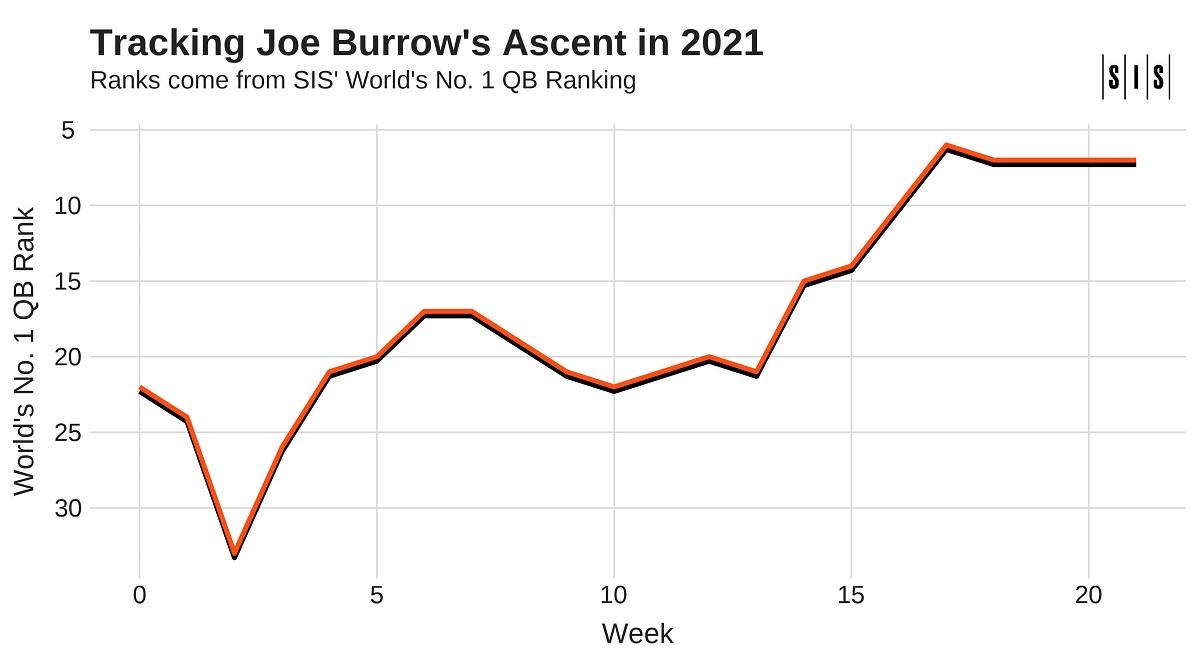
    In a Week 2 loss to the Bears, Joe Burrow threw three interceptions and was sacked five times.

    That dropped him nine spots in our World’s No. 1 QB Rankings. After that game, Burrow ranked 33rd. For perspective, at that moment he was eight spots behind Washington QB Taylor Heinicke. Heinicke and Burrow basically changed places in Week 2. Burrow went from 24 to 33. Heinicke went from 34 to 25 after beating the Giants.

    Flash forward five months and Burrow now ranks No. 7.

    And for what it’s worth, Heinicke ranks third-to-last, ahead of only Ben Roethlisberger and Mike Glennon.

    But we’re here to focus on the Super Bowl QB.

    A reminder that The World’s No. 1 Quarterback Ranking is based on a model devised by Bill James to evaluate The World’s No. 1 Starting Pitcher. Bill’s model was based on cumulative evaluation of individual starts over an extended time using the metric Game Score.

    The World’s No. 1 Quarterback Ranking uses our player value stat Total Points to make a cumulative evaluation of game performance over a three-year period. The key to our calculation is Points Above Average (PAA), which is the statistical underpinning of Total Points that is centered at zero so that positive numbers are above average and negative numbers are below average.

    Success over time is key to maintaining a good ranking. Prolonged inactivity results in a ranking drop. The most recent performances carry the most weight.

    That last sentence is Burrow’s season story. He ranked as low as No. 33 as we noted. After a six-sack, two-pick game against the Chargers in Week 13, he ranked No. 21, two spots behind Jimmy Garoppolo and 15 places behind Kirk Cousins, of whom he now sits one spot ahead.


    Here’s the current Top 10.

    1. Patrick Mahomes
    2. Justin Herbert
    3. Aaron Rodgers
    4. Josh Allen
    5. Tom Brady
    6. Matthew Stafford
    7. Joe Burrow
    8. Kirk Cousins
    9. Derek Carr
    10. Kyler Murray

    Since Week 14, which was actually a loss to the 49ers, Burrow has played at a different level, with 15 touchdown passes, 2 interceptions, and ranks top-two in completion percentage, catchable pass percentage, and on-target percentage (including the postseason).

    But maybe we could have seen this coming. Even in Weeks 1-13, when Burrow had 23 TD passes and 14 interceptions, Burrow led the NFL in catchable pass percentage (89%) and was 2nd in on-target percentage (83%).

    Burrow’s on-target percentage was actually one percentage point better in Weeks 1-13 than it has been from Week 14 to now.

    Where Burrow’s growth has come that has led to his jump up the rankings is in his play when pressured. Yes, he’s still taking his fair share of sacks (remember the nine times he went down against the Titans), but when he’s able to get the ball out, he’s done much more damage relative to what he was doing earlier in the season. He’s looked to shorter passes for greater success.

    Case in point against the Chiefs, where he was 9-of-14 for 120 yards and a touchdown, including two key first-down completions to Tee Higgins on the drive at the end of the first half that cut KC’s lead to 21-10

    Burrow When Pressured in 2021

    Weeks 1-13 Since Week 14
    Catchable Pass % 78% 90%
    TD-INT 4-6 4-0
    Sack % 27% 25%
    ADOT 12.1 yds 7.5 yds

    The Rams’ pressure will be a different kind of pressure than any Burrow has seen this season.

    Los Angeles ranks first in the NFL in Pass Coverage Points Saved Per Play.  Including the postseason, they have allowed only 3 touchdown passes and recorded 11 interceptions when pressuring opposing quarterbacks (the rest of the NFL has allowed 236 TD and recorded 168 interceptions when pressuring a QB).

    But hey, if you want to win a Super Bowl and keep climbing the World’s No. 1 QB Rankings, you’re going to have to get past the biggest obstacle in your way at some point.

    Here’s the full set of rankings.

    Rk Player PAA Per 60 Plays LastRk StartOfSeasonRank
    1 Patrick Mahomes 6.2 1 2
    2 Justin Herbert 6.2 2 10
    3 Aaron Rodgers 6.1 3 1
    4 Josh Allen 5.8 4 6
    5 Tom Brady 5.3 5 3
    6 Matthew Stafford 3.7 6 14
    7 Joe Burrow 3.1 7 22
    8 Kirk Cousins 2.4 8 9
    9 Derek Carr 2.0 9 7
    10 Kyler Murray 1.7 10 15
    11 Russell Wilson 1.5 11 5
    12 Lamar Jackson 0.9 12 12
    13 Teddy Bridgewater 0.8 13 18
    14 Ryan Tannehill 0.8 14 8
    15 Dak Prescott 0.7 15 17
    16 Mac Jones 0.6 16 N/A
    17 Matt Ryan -0.1 17 11
    18 Carson Wentz -0.5 19 81
    19 Taysom Hill -0.7 20 20
    20 Jimmy Garoppolo -0.7 18 25
    21 Jameis Winston -0.9 21 55
    22 Jacoby Brissett -1.1 22 21
    23 Josh Johnson -1.3 23 49
    24 Jalen Hurts -1.4 24 70
    25 Tua Tagovailoa -1.4 25 50
    26 Ryan Fitzpatrick -1.9 26 16
    27 Trevor Siemian -1.9 27 N/A
    28 Gardner Minshew -2.0 28 32
    29 Colt McCoy -2.2 29 51
    30 Jared Goff -2.2 30 31
    31 Tyrod Taylor -2.3 31 56
    32 Kyle Allen -2.3 33 34
    33 Chad Henne -2.3 32 29
    34 John Wolford -2.4 34 24
    35 Case Keenum -2.5 35 60
    36 Marcus Mariota -2.5 36 27
    37 Mason Rudolph -2.5 37 26
    38 Geno Smith -2.5 38 N/A
    39 C.J. Beathard -2.6 39 30
    40 Blaine Gabbert -2.6 40 36
    41 Brett Hundley -2.7 41 35
    42 Matt Barkley -2.7 42 48
    43 Chase Daniel -2.7 43 39
    44 Nick Mullens -2.7 44 72
    45 Nate Sudfeld -2.7 45 52
    46 Josh Rosen -2.7 46 58
    47 Brian Hoyer -2.7 47 59
    48 David Blough -2.8 48 61
    49 Joe Flacco -2.9 51 63
    50 Zach Wilson -2.9 50 N/A
    51 Drew Lock -2.9 49 23
    52 Will Grier -2.9 52 69
    53 Mike White -2.9 53 N/A
    54 Brett Rypien -2.9 54 65
    55 Jarrett Stidham -2.9 55 66
    56 Jordan Love -3.0 56 N/A
    57 Tyler Huntley -3.1 57 57
    58 Sean Mannion -3.1 58 45
    59 Garrett Gilbert -3.1 59 54
    60 Nick Foles -3.1 60 76
    61 Cooper Rush -3.2 61 N/A
    62 Ian Book -3.2 62 N/A
    63 Daniel Jones -3.2 63 71
    64 Baker Mayfield -3.3 64 13
    65 Dwayne Haskins -3.3 65 78
    66 Chris Streveler -3.3 66 62
    67 Trevor Lawrence -3.4 67 N/A
    68 Trey Lance -3.4 69 N/A
    69 Jake Luton -3.4 68 79
    70 Mitchell Trubisky -3.5 70 80
    71 Brandon Allen -3.7 72 75
    72 Phillip Walker -3.7 71 67
    73 Tim Boyle -3.7 73 N/A
    74 Justin Fields -3.8 74 N/A
    75 Cam Newton -3.8 75 19
    76 Jake Fromm -4.0 76 N/A
    77 Andy Dalton -4.1 77 46
    78 Davis Mills -4.8 78 N/A
    79 Sam Darnold -5.2 79 82
    80 Taylor Heinicke -5.5 80 28
    81 Ben Roethlisberger -6.5 81 53
    82 Mike Glennon -6.8 82 73
  • Matthew Stafford’s 7-Step Program

    Matthew Stafford’s 7-Step Program

    Clearly Sean McVay’s confidence in his offense with Matthew Stafford at the helm was well-founded.

    The Rams passing offense had a down couple years after the explosive 2018 campaign, but it rebounded substantially this season.

    A key element in that was the use of the 7-step drop. The Rams totaled 43 Expected Points Added on their 69 uses of 7-step dropbacks.

    That’s more than the Rams generated on all other 2021 dropbacks combined!

    For more on this subject and how this might play out against pass rushers Sam Hubbard and Trey Hendrickson, check out our detailed piece at Sharp Football Analysis

  • How do the Bengals match up with the Rams?

    How do the Bengals match up with the Rams?

    Our VP of Football and Research, Matt Manocherian, talked Bengals earlier this week with Mo Egger of ESPN Radio Cincinnati.

    You can listen to the full interview here. Here are a few of Matt’s thoughts.

    How are the Bengals going to block the Rams?

    I would actually push back on the notion that the Bengals are going to have to do that. The Bengals lead the league in short dropbacks.

    Maybe the Bengals are going to keep going with their whole strategy of ‘We don’t need to protect Joe Burrow.’ We just need to let our guys get into routes and let Burrow do his thing. They’ve ridden it this far without blocking anybody all that well.

    The Rams want to figure out ways to keep Joe Burrow holding onto the football. It was one of the things the Bengals did so well against the Chiefs, making Mahomes hang onto the football. Eventually he got impatient.

    You can bet the Rams are going to try some different window dressing with two weeks to prepare to confuse Burrow, to get him to hang onto the ball so that Aaron Donald and his friends on the defensive line can get to him and get home.

    How do the Bengals match up with Cooper Kupp and the other Rams receivers?

    Cooper Kupp is as precise a route runner as there is in the NFL. The Bengals are going to try to come out with what they do well, play a lot of man coverage and hope they can play better guy-on-guy than the Rams can.

    It could be a long day when it comes to Cooper Kupp. But I think what the Rams will lament is not having Robert Woods. Woods did a lot of what allowed them to tie their run game and their pass game so well together with play action.

    Without him in the lineup, I think you’ll see the Bengals dropping 8 guys back with a lot of man coverage and two-high safeties over the top, trying to do everything they can to make things look different. It’s a lot easier to guard Cooper Kupp if you don’t have to be worrying about guarding him deep. And they’ll be daring the Rams to run the ball.

    The Rams are going to be looking to get 5 or 6 yards on their outside zone plays and force the Bengals to drop somebody down so that they don’t have that extra player to defend Kupp over the top.

     Is there an area where the Bengals can expose the Rams?

    I think these are comparable teams at passing and catching the ball. And I think the Rams block better. But I think that in the running game, the Bengals have an edge. If Cincinnati can do just enough on the ground to complement things, so that it opens things up for their wide receivers, that would be the path to victory.

    If the Rams are going to play light boxes and dare you to run the ball, the thing the Bengals can do is punish you for playing that way.

    The Bengals ranked 15th in the regular season in Rushing Points Earned Per Play. The Rams ranked 28th.